anaheim-gazette 1891-11-26
Scanned page
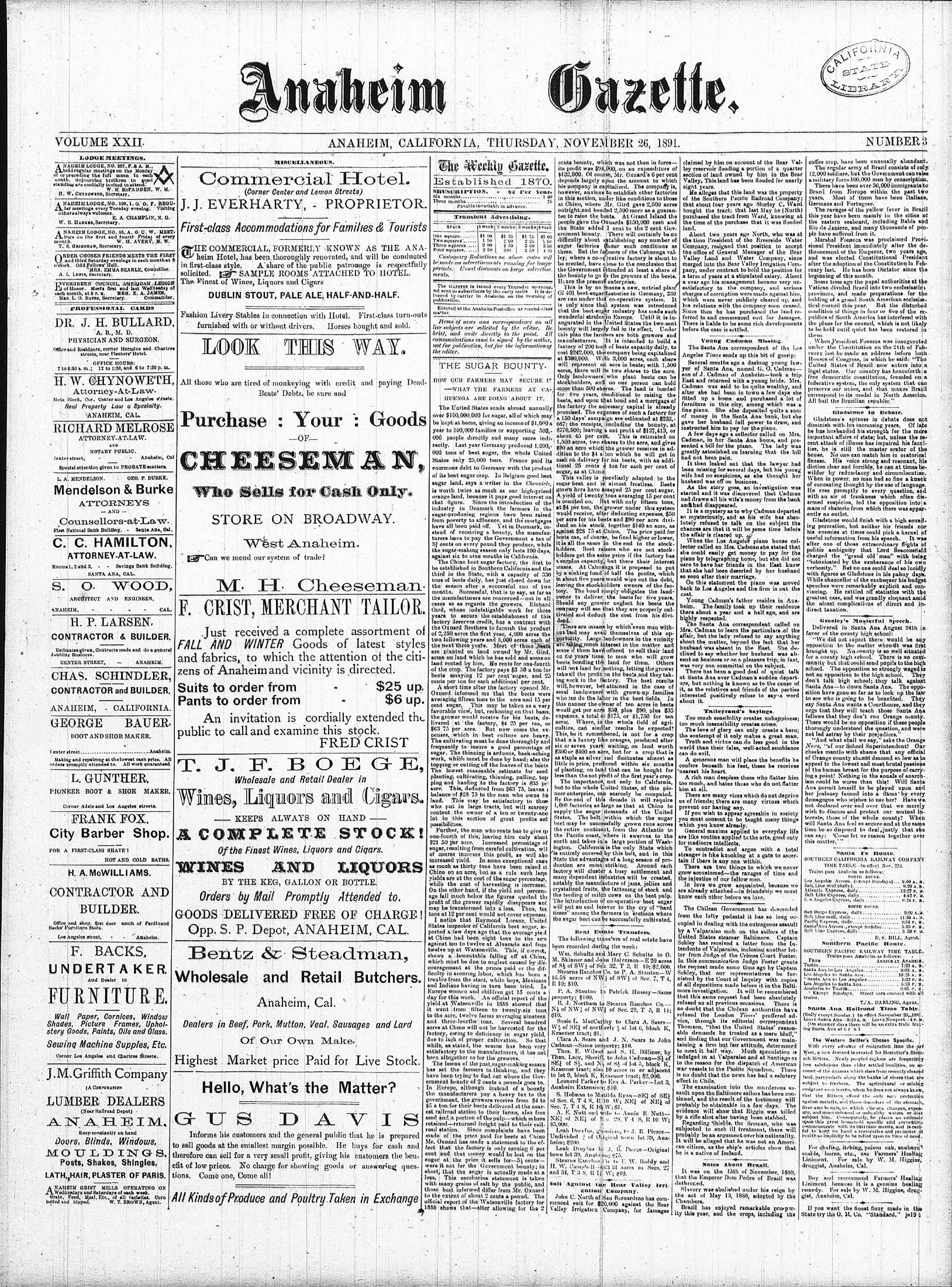
Searchable text
VOLUME XXII.
LODGE MEETINGS.
ANAHEIM LODGE, NO. 297, P. & A. M.
hold regular meetings on the Monday of or preceding the full moon in each month.
Sojourning brethren in good standing are cordially invited to attend.
W. M. McFAUDEN, W. M.
H. W. CHYNOWETH, Secretary.
ANAHEIM LODGE, NO. 109, I. O. U. F. REGULAR meetings every Tuesday evening.
Visiting others always welcome.
E. A. CHAMPLIN, N. G.
W. R. HARKER, Secretary.
ANAHEIM LODGE, NO. 85, A. O. U. W. MEETINGS on the first and fourth Friday of every month.
W. H. AVERY, M. W.
T. S. GRISNHAW, Secretary.
ORDER CHOSEN FRIENDS MEETS THE FIRST and third Saturday evenings in each month at 8 o'clock.
Odd Fellows' Hall.
MRS. EMMA SEARLE, Councilor.
A. L. LEWIS, Secretary.
EVERGREEN COUNCIL, AMERICAN LEGION of Honor.
Meets first and last Wednesday of each month, at 8 p.m.
MRS. E. A. JAMES,
Mrs. L. G. BATES, Secretary.
Commander.
PROFESSIONAL CARDS
DR. J. H. BULLARD,
A. B., M. D.
PHYSICIAN AND SURGEON.
Office and Residence, corner Hermline and Chartres streets, near Planters' Hotel.
OFFICE HOURS:
7 to 8:30 a.m.; 12 to 1:30, and 6 to 7:30 p.m.
H. W. CHYNOWETH,
Attorney-At-Law.
Metz Block, Cor. Center and Los Angeles streets.
Real Property Law a Specialty.
ANAHEIM, CAL.
RICHARD MELROSE
ATTORNEY-AT-LAW.
AND
NOTARY PUBLIC.
Center street,
Anaheim, Cal
Special attention given to PROBATE matters.
MISCELLANEOUS.
Commercial House
(Corner Center and Lemon Street)
J. J. EVERHARTY, - PRO
First-class Accommodations for Families
THE COMMERCIAL, FORMERLY KNOWN
Theim Hotel, has been thoroughly renovated, and in first-class style.
A share of the public patron solicited.
SAMPLE ROOMS ATTACHED
The Finest of Wines, Liquors and Cigars
DUBLIN STOUT, PALE ALE, HALF-A
Fashion Livery Stables in connection with Hotel furnished with or without drivers.
LOOK THIS VIEW
All those who are tired of monkeying with credit Beats' Debts, be sure and
Purchase : Your
OF
CHEESEM
H. W. CHYNOWETH,
Attorney-At-Law.
Metz Block, Cor. Center and Los Angeles streets.
Real Property Law a Specialty.
ANAHEIM, CAL.
RICHARD MELROSE
ATTORNEY-AT-LAW.
AND
NOTARY PUBLIC.
Center street,
Anaheim, Cal.
Special attention given to PROBATE matters.
L. A. MENDELSON.
GEO. P. BURKE.
Mendelson & Burke
ATTORNEYS
AND
Counsellors-at-Law.
First National Bank Building.
Santa Ana, Cal.
C. C. HAMILTON,
ATTORNEY-AT-LAW.
Rooms 1, 2 and 3,
Savings Bank Building.
SANTA ANA, CAL.
S. O. WOOD,
ARCHITECT AND ENGINEER,
ANAHEIM, CAL.
H. P. LARSEN,
CONTRACTOR & BUILDER.
Estimates given, Contracts made and do a general Jobbing Business.
CENTER STREET,
ANAHEIM.
CHAS. SCHINDLER,
CONTRACTOR and BUILDER.
ANAHEIM, CALIFORNIA.
GEORGE BAUER,
BOOT AND SHOE MAKER.
Center street...
Anaheim.
Making and repairing at the lowest cash price. All orders promptly attended to. All work guaranteed.
L. GUNTHER,
PIONEER BOOT & SHOE MAKER.
Corner Adelaide and Los Angeles streets.
FRANK FOX,
City Barber Shop.
FOR A FIRST-CLASS SHAVE!
HOT AND COLD BATHS.
H. A. McWILLIAMS.
CONTRACTOR AND BUILDER
All those who are tired of monkeying with credit
Beats' Debts, be sure and
Purchase : Your
OF
CHEESEM
Who Sells for Cash
STORE ON BROADWAY
West Anaheim
Can we mend our system of trade?
M. H. Chees
F. CRIST, MERCHANT
Just received a complete a
FALL AND WINTER Goods of
and fabrics, to which the attentio
zens of Anaheim and vicinity is d
Suits to order from
Pants to order from
An invitation is cordially
public to call and examine this st
FRED
T. J. F. BOE
Wholesale and Retail Dealer
Wines, Liquors and
KEEPS ALWAYS ON HAN
A COMPLETE ST
Of the Finest Wines, Liquors and
WINES AND LI
BY THE KEG, GALLON OR BOT
Orders by Mail Promptly Atten
FRANK FOX,
City Barber Shop.
FOR A FIRST-CLASS SHAVE!
HOT AND COLD BATHS.
H. A. McWILLIAMS.
CONTRACTOR AND BUILDER.
Office and shop, first door south of Ferdinand Backs' Furniture Store.
Los Angeles street, Anaheim.
F. BACKS,
UNDERTAKER.
And Dealer in
FURNITURE.
Wall Paper, Cornices, Window Shades, Picture Frames, Upholstery Goods, Paints, Oils and Glass.
Sewing Machine Supplies, Etc.
Corner Los Angeles and Chartres Streets.
J.M. Griffith Company
(A CORPORATION)
LUMBER DEALERS
(Near Hallroad Depot)
ANAHEIM.
Keep constantly on hand
Doors, Blinds, Windows,
MOULDINGS.
Posts, Shakes, Shingles,
LATH, HAIR, PLASTER OF PARIS.
ANAHEIM GRIST MILLS OPERATING ON Wednesdays and Saturdays of each week.
Grain, Feed, Meal, Etc., of all varieties. Corn heiled and hipped.
W. T. BROWN, Agent.
KEEPS ALWAYS ON HAND
A COMPLETE STORY
Of the Finest Wines, Liquors and WINES AND LIQUORS
BY THE KEG, GALLON OR BOT
Orders by Mail Promptly Atten
GOODS DELIVERED FREE OF
Opp. S. P. Depot, ANAHEIM
Bentz & Stead
Wholesale and Retail
Anaheim, Cal.
Dealers in Beef, Pork, Mutton, Veal, Sausa
Of Our Own Make.
Highest Market price Paid for
Hello, What's the Ma
Informs his customers and the general public that to sell goods at the smallest margin possible. He therefore can sell for a very small profit, giving his effit of low prices. No charge for showing goods or tions. Come one, Come all!
All Kindsof Produce and Poultry Taken
ANAHEIM, CALIFORNIA, THURSDAY, NOVEMBER 26, 1890
MISCELLANEOUS.
Special Hotel.
(Center and Lemon Streets)
PERTY - PROPRIETOR.
Dations for Families & Tourists
ORMERLY KNOWN AS THE ANAboroughly renovated, and will be conducted
of the public patronage is respectfully
ROOMS ATTACHED TO HOTEL.
Cars and Cigars
PALE ALE, HALF-AND-HALF.
Connection with Hotel. First-class turn-outs
at drivers. Horses bought and sold.
THIS WAY.
Monkeying with credit and paying DeadDebts, be sure and
Your: Goods
OF—
SEMAN,
The Weekly Gazette.
Established 1870.
SUBSCRIPTION, - $2 Per Year.
Six months.
Three months.
75 Pavable invariably in advance.
Transient Advertising.
SPACE.
1 week
2 weeks
3 weeks
4 week
One square.....$1 00
Two squares.....1 50
Three squares.....2 00
Four squares.....2 50
Customary Reductions on above rates will
be made on advertisements running for longer
periods. Usual discounts on large advertisements.
The Gazette is issued every Thursday morning,
and sent to subscribers by the early mails. It is delivered by carrier in Anaheim on the morning of
publication.
Entered at the Anaheim Postoffice as second-class
matter.
Items of news and correspondence on all
live subjects are solicited by the editor. Be
brief, and write directly to the point. All
communications must be signed by the author,
not for publication, but for the information of
the editor.
THE SUGAR BOUNTY.
HOW GUR FARMERS MAY SECURE IT
WHAT THE FARMERS AT CAHUENGA ARE DOING ABOUT IT.
The United States sends abroad annually
over $100,000,000 for sugar, all of which may
be kept at home, giving an income of $1,000 a
year to 100,000 families or supporting 500,
000 people directly and many more indirectly.
Last year Germany produced 1,200,
000 tons of beet sugar, the whole United
States only 25,000 tons. France paid its
enormous debt to Germany with the product
of its beet sugar crop. In Belgium good beet
counts bounty, which was not then in force,
its profit was $94,000, on an expenditure of
$132,000. Of course, Mr. Oxnard's 6 per cent
depends largely upon the amount to which his company is capitalized. The company is however, anxious to establish other factories in this section, under like conditions to those at Chino, where Mr. Gird gave 2,500 acres outright and bonded 2,500 more as a guarantee too to raise the beets. At Grand Island the people gave the Oxnards $150,000 cash and the State added 1 cent to the 2 cent Government bounty. There will certainly be difficulty about establishing any number of sugar factories under such conditions as these. But the farmers of the Cahuenga valley, where a co-operative factory is about to be erected, have come to the conclusion that the Government attaches at least a share to the bounty to go to the growers of the beets. Hence the present enterprise.
This is by no means a new, untried plan.
Of 401 beet-sugar factories in Germany, 333 are run under this co-operative system. It is only since that system was introduced that the beet-sugar industry has made such wonderful strides in Europe. Until it is inaugurated in the United States the two-cent bounty will largely fail in its effect. Under this plan the farmers are both growers and manufacturers. It is intended to build a factory of 200 tons of beets capacity daily; cost $242,000, the company being capitalized at $300,000. With 3,000 acres, each share will represent an acre in beets; with 1,500 acres, there will be two shares to the acre. Only landowners who plant beets can buy stockholders, and no one person can hold more than 500 shares. The land is bonified for five years, conditional to raising the beets, and upon that bond and a mortgage on the factory the necessary capital is already promised. The expenses of such a factory for a 150 days' campaign are estimated at $233,857; the receipts, including the bounty, are $370,500; leaving a net profit of $137,413, or about 45 per cent. This is estimated on 1,500 acres, two shares to the acre, and gives $90 an acre which the grower receives in addition to the $4 abon which he will get in cash on delivery for his beets, with an additional 25 cents or ten per cent of sugar, as at Chino.
This valley is peculiarly adapted to th
Your: Goods
Of
Cheeseman,
Merchant Tailor
A complete assortment of Goods of latest styles which the attention of the citi- and vicinity is directed.
From $25 up.
From $6 up.
Is cordially extended the examine this stock.
FRED CRIST
BOEGE,
and Retail Dealer in
Liquors and Cigars.
ALWAYS ON HAND —
ETE STOCK!
Wines, Liquors and Cigars.
AND LIQUORS,
GALLON OR BOTTLE.
Promptly Attended to.
HOW OUR FARMERS MAY SECURE IT
—WHAT THE FARMERS AT CAHUENGA ARE DOING ABOUT IT.
The United States sends abroad annually over $100,000,000 for sugar, all of which may be kept at home, giving an income of $1,000 a year to 100,000 families or supporting 500,000 people directly and many more indirectly. Last year Germany produced 1,200,000 tons of beet sugar, the whole United States only 25,000 tons. France paid its enormous debt to Germany with the product of its best sugar crop. In Belgium good beet sugar land, says a writer in the Chronicle, is worth twice as much as our high-priored orange land, because it pays good interest on that figure. Since the introduction of the industry in Denmark the farmers in the sugar-producing regions have been raised from poverty to affluence, and the mortgages have all been paid off. Yet in Denmark, instead of receiving a bounty, the manufacturers have to pay the Government a tax of 32 cents on every pound they produce, while the sugar-making season only lasts 100 days, against six to nine months in California.
The Chino best sugar factory, the first to be established in Southern California and the third in the State, with a capacity of 330 tons of beets daily, has just closed down for the season after a successful run of two months. Successful, that is to say, as far as the manufacturers are concerned—not in all cases so as regards the growers. Richard Gird, whose indefatible work for three years to secure the establishment of this factory deserves credit, has a contract with the Oxnard Brothers to furnish the product of 2,250 acres the first year, 4,000 acres the two following years and 5,000 acres each of the next three years. Most of these Beats are planted on land owned by Mr. Gird, some on land which he has sold and some on land rented by him. He rents for one-fourth of the crop. The factory pays $350 a ton for beets assaying 12 per cent sugar, and 25 cents per ton for each additional per cent.
A short time after the factory opened Mr. Oxnard informed me that the beets were averaging fifteen tons to the acre and 15 per cent sugar. This may be taken as a very favorable view, but, reckoning on that basis, the grower would receive for his beets, delivered at the factory, $425 per ton, or $6375 per acre. But now come the expenses, which in best culture are heavy. The cultivating must be done thoroughly and frequently to insure a good percentage of sugar. The thinning is arduous, back-acching work, which must be done by hand; also the topping or cutting off the leaves of the beets. The lowest reasonable estimate for seed planting, cultivating, thinning, pulling, toping and hauling to the factory is $85 per acre. This, deducted from $6375 leaves a balance of $2875 to the man who owns his land. This may be satisfactory to those who put in large tracts, but will scarcely content the owner of a ten or twenty-acre lot in this section of great profits and possibilities.
Further, the man who rents has to give up one-fourth of this leaving him only about $2150 per acre. Increased percentage of sugar resulting from careful cultivation will of course increase this profit, as will also increased yield. In some exceptional cases as much as thirty tons have been raised at Chino on an acre, but as a rule such large yields are at the cost of the sugar percentage, while the cost of harvesting is increase. On the other hand, if the yield and percentage fall much below the figures quoted the profit of the grower rapidly disappears and may be transformed into a loss. Thus ter-
This valley is peculiarly adapted to the sugar beet and is almost frostless. Beet grown here have assayed 25 per cent sugar. A yield of twenty tons averaging 15 per cent is counted on. But with only fifteen tons at $4 per ton, the grower under this system would receive, after deducting expenses, $5 per acre for his beets and $90 per acre divided on his stock, together $140 an acre, against $2875 at Cinno. The price paid for beets can, of course, be fixed higher or lower. It is all the same in the end to the stockholders. Beet raisers who are not stock holders get the same price if the factory has a surplus capacity; but there their interests seize.
At Cahnenga it is proposed to put by a sinking fund of half the profits, which in about five years would wipe out the debt, leaving the stockholders owners of the factory. The bond simply obligates the land owner to deliver the beets for five years. Should any grower neglect his beets company will see that they are properly cultivated and deduct the cost from his dividend.
There are means by which even men without land may avail themselves of this opportunity. Large landowners in the vicinity are taking much interest in the matter and some of them have offered to sell their land on five years' time to men who will grow beets bonding the land for them. Others will rent land for nothing, letting the grower take all the profit on the beets and they take stock in the factory. The best results will however be attained in the case of small landowners with grown-up families who can do the labor in the beet fields. In this manner the owner of ten acres in beets would get per acre $59, plus $90, plus $33 expenses, a total of $175, or $1,750 for ten acres. Where, in the whole field of agriculture, can similar results be expected? This, be it remembered, is not for a crop that is a luxury like oranges, produced after six或 seven years' waiting, on land worth $300 or $400 an acre, but for a crop that is as staple as silver and fluctuates almost as little in price, produced within six months of planting, on land that can be bought for less than the net profit of the first year's crop.
The importance not only to California but to the whole United States, of this pioneer enterprise, can scarceily be computed. By the end of this decade it will require 1,000 factories as large as that at Chino to supply the sugar demands of the United States. The belt within which the sugar beet may be successfully grown runs across the entire continent, from the Atlantic to the Pacific coast, where it swerves; to the north and takes in a large portion of Washington. California is the only State which is entirely covered by this holt; and in this State the advantages of a long season of production are most striking. Around each factory will cluster a busy settlement and many dependent industries will be created notably the manufacture of jams, jellies and crystallized fruits; the fattening of stock and the feeding of milch cows on the beet pulp.
The introduction of co-operative beet sugar will put an end forever to the cry of "hard"
ALWAYS ON HAND —
ETE STOCK!
Wines, Liquors and Cigars.
AND LIQUORS
GALLON OR BOTTLE.
Promptly Attended to.
LED FREE OF CHARGE!
ot, ANAHEIM, CAL.
Steadman,
and Retail Butchers.
heim, Cal.
Mutton, Veal, Sausages and Lard
Own Make.
Price Paid for Live Stock.
What's the Matter?
DAVIS
And the general public that he is prepared
margin possible. He buys for cash and
small profit, giving his customers the benfor showing goods or answering quesand Poultry Taken in Exchange
Further, the man who rents has to give up one-fourth of this, leaving him only about $21 50 per acre. Increased percentage of sugar, resulting from careful cultivation, will of course increase this profit, as will also increased yield. In some exceptional cases as much as thirty tons have been raised at Chino on an acre, but as a rule such large yields are at the cost of the sugar percentage, while the cost of harvesting is increased. On the other hand, if the yield and percentage fall much below the figures quoted the profit of the grower rapidly disappears and may be transformed into a loss. Thus, ten tons at 12 per cent would not cover expenses.
I notice that Raymond Loranz, United States inspector of California beet sugar, reported a few days ago that the average yield at Chino had been eight tons to the acre against ten to twelve at Alvarado and from twelve up at Watsonville. This, if correct, shows a jamentable falling off at China, which must be due to neglect caused by discouragement at the prices paid or the difficulty in securing labor, which has been a trouble from the start, white boys, Mexicans and Indians having in turn been tried. In Europe women and children get 15 cents a day for this work. An official report of the yield at Watsonville in 1888 showed that it went from fifteen to twenty-six tons to the acre, twelve farms averaging nineteen and three-fourths tons. Several hundred acres at Chino will not be harvested for the factory, owing to deficiency in sugar yield, due to lack of proper cultivation. So that while, as stated, the season has been very satisfactory to the manufacturers, it has not been altogether so for the growers.
The lesson of the past sugar-making season has set the farmers thinking, and they have been trying to find out where the Government bounty of 2 cents a pounds goes to. In Europe, although instead of a bounty the manufacturers pay a heavy tax to the government, the growers receive from $4 to $5 a ton for their beets delivered at the nearest railroad station to their farms, also free seed and a portion of the pulp—which is here retained—returned freight paid to their railroad station. Since complaints have been made of the price paid for beets at Chino Mr. Oxnard has made a statement to the effect that the factory is only earning 6 percent and that money would be lost on the sugar at the price it sells for—5½ cents—were it not for the Government bounty; in short, that the sugar is actually made at a loss. This saccharine statement is taken with many grains of salt by the public, and those best informed differ from Mr. Oxnard to the extent of about 2 cents a pound. The official report of the Watsonville factory for 1888 shows that—after allowing for the 2 contention of great profits and possibilities.
Further, the man who rents has to give up one-fourth of this, leaving him only about $21 50 per acre. Increased percentage of sugar, resulting from careful cultivation, will of course increase this profit, as will also increased yield. In some exceptional cases as much as thirty tons have been raised at Chino on an acre, but as a rule such large yields are at the cost of the sugar percentage, while the cost of harvesting is increased. On the other hand, if the yield and percentage fall much below the figures quoted the profit of the grower rapidly disappears and may be transformed into a loss. Thus, ten tons at 12 per cent would not cover expenses.
I notice that Raymond Loranz, United States inspector of California beet sugar, reported a few days ago that the average yield at Chino had been eight tons to the acre against ten to twelve at Alvarado and from twelve up at Watsonville. This, if correct, shows a jamentable falling off at China, which must be due to neglect caused by discouragement at the prices paid or the difficulty in securing labor, which has been a trouble from the start, white boys, Mexicans and Indians having in turn been tried. In Europe women and children get 15 cents a day for this work. An official report of the yield at Watsonville in 1888 showed that it went from fifteen to twenty-six tons to the acre, twelve farms averaging nineteen and three-fourths tons. Several hundred acres at Chino will not be harvested for the factory, owing to deficiency in sugar yield, due to lack of proper cultivation. So that while, as stated, the season has been very satisfactory to the manufacturers, it has not been altogether so for the growers.
The lesson of the past sugar-making season has set the farmers thinking, and they have been trying to find out where the Government bounty of 2 cents a pounds goes to. In Europe, although instead of a bounty the manufacturers pay a heavy tax to the government, the growers receive from $4 to $5 a ton for their beets delivered at the nearest railroad station to their farms, also free seed and a portion of the pulp—which is here retained—returned freight paid to their railroad station. Since complaints have been made of the price paid for beets at Chino Mr. Oxnard has made a statement to the effect that the factory is only earning 6 percent and that money would be lost on the sugar at the price it sells for—5½ cents—were it not for the Government bounty; in short, that the sugar is actually made at a loss. This saccharine statement is taken with many grains of salt by the public, and those best informed differ from Mr. Oxnard to the extent of about 2 cents a pound. The official report of the Watsonville factory for 1888 shows that—after allowing for the 2 contention of great profits and possibilities.
Further, the man who rents has to give up one-fourth of this, leaving him only about $21 50 per acre. Increased percentage of sugar, resulting from careful cultivation, will of course increase this profit, as will also increased yield. In some exceptional cases as much as thirty tons have been raised at Chino on an acre, but as a rule such large yields are at the cost of the sugar percentage, while the cost of harvesting is increased. On the other hand, if the yield and percentage fall much below the figures quoted the profit of the grower rapidly disappears and may be transformed into a loss. Thus, ten tons at 12 per cent would not cover expenses.
I notice that Raymond Loranz, United States inspector of California beet sugar, reported a few days ago that it went from fifteen to twenty-six tons to the acre, twelve farms averaging nineteen and three-fourths tons. Several hundred acres at Chino will not be harvested for the factory, owing to deficiency in sugar yield, due to lack of proper cultivation. So that while, as stated, the season has been very satisfactory to the manufacturers, it has not been altogether so for the growers.
The lesson of the past sugar-making season has set the farmers thinking, and they have been trying to find out where the Government bounty of 2 cents a pounds goes to. In Europe, although instead of a bounty the manufacturers pay a heavy tax to the government, the growers receive from $4 to $5 a ton for their beets delivered at the nearest railroad station to their farms, also free seed and a portion of the pulp—which is here retained—returned freight paid to their railroad station. Since complaints have been made of the price paid for beets at Chino Mr. Oxnard has made a statement to the effect that the factory is only earning 6 percent and that money would be lost on the sugar at the price it sells for—5½ cents—were it not for the Government bounty; in short, that the sugar is actually made at a loss. This saccharine statement is taken with many grains of salt by the public, and those best informed differ from Mr. Oxnard to the extent of about 2 cents a pound. The official report of the Watsonville factory for 1888 shows that—after allowing for the 2 contention of great profits and possibilities.
Further, the man who rents has to give up one-fourth of this, leaving him only about $21 50 per acre. Increased percentage of sugar, resulting from careful cultivation, will of course increase this profit, as will also increased yield. In some exceptional cases as much as thirty tons have been raised at Chino on an acre, but as a rule such large yields are at the cost of the sugar percentage, while the cost of harvesting is increased. On other hand, if the yield and percentage fall much below the figures quotedthe profit of the grower rapidly disappears and may be transformed into a loss. Thus, ten tons at 12 per cent would not cover expenses.
I notice that Raymond Loranz, United States inspector of California beet sugar,reported a few days ago that it went from fifteen to twenty-six tons totheacre,twelvefarmsaveragingnineteenandthree-fourthstons.Severalfarmswillnotbeharvestedforthefactoryowingdedeficiencyinsugaryieldduelackofpropercultivation.Sothatwhileasstated,theseasonhasbeentherviewedsnotbenaltogethersofthergrowers.
The lesson ofthe past sugar-making season has setthe farmers thinking,andtheyhavebeentryingtofindoutwheretheGovernmentbountyof2centalspoundsgoesto.InEuropealthoughinstudiedaboundythegrownerspayaheavytaxtothegovernment,thegrowersreceivefrom$4to$5a tonforthebeetsdeliveredatthenearestrailroadstationtothierfarmsalsofreeseedandapartofthepulp—whichishereretained—returnedfreightpaidtotheirrailroadstation.SincecomplaintshavebeenmadeofthepricepaidforbeetsatChinoMr.Oxnardhasmadeastatementtotheeffectthatthefactoryisonlyearning6percentandthatmoneywouldbeloosonthesugaratthepriceit sellsfor—5½cents—wereitnotfortheGovernmentbounty;inshort,thesugarisactuallymadeattacosscharinestatementistakenwithmanygrainsofsaltbythepublic,andthosebestinformeddifferfromMr.Oxnardtotheextentofabout2centsa pound.TheofficialreportoftheWatsonvillefactoryfor1888showsthat—afterallowingforthe2contentionofgreatprofitsandpossibilities.
John C.NorthofSanBernardinohascommencedsuittorealestatehavebeendocumentedduringtheweek:
Wim.SchulteandMaryC.SchultetoO.M.SkinnerandJohnHolverson-E20acresofS1ofSW1ofSec.32,T3,R10;$2000.
SusieL.MacCarthytoClaraA.Sears-W1ofSE1ofnortherly1oflot6blockK.Kraemertract;$1.
ClaraA.SearsandJ.N.SearstoJohnCadman-Sameproperty;$10.
Thos.E.WilsonandS.H.Dilliner,bylearn,Lacey,Sheriff.toJohnCadman-S1ofSE1ofS1andN1ofS1oflot5blockK.Kraemertract;also10acresinoradjacenttolot9.blockK.Kraemertract;$2000.
LeahDreyfus,guidian,toj.B.Pierce-UndividedofOriginaltownlot39.Anaheim;$2000.
LeahDreyfus,toj.B.Pierce-Originaltownlot39.Anaheim;$75.
StearnsRanchosIntoT.W.BuddydandH.W.Campbell-OE313acresinSecs.27and34.T3S.R1W;$10.
SuiltAgaintheBearValleyIrrigationCompany.
John C.NorthofSanBernardinohascommencedsuittorealestatehavebeendocumentedduringtheweek:
Wim.SchulteandMaryC.SchultetoO.M.SkinnerandJohnHolverson-E20acresofS1ofSW1ofSec.32,T3,R10;$2000.
SusieL.MacCarthytoClaraA.Sears-W1ofSE1ofNortherly1oflot6blockK.Kraemertract;also10acresinoradjacenttolot9.blockK.Kraemertract;$2000.
LeahDreyfus,guidian,toj.B.Pierce-UndividedofOriginaltownlot39.Anaheim;$2000.
LeahDreyfus,toj.B.Pierce-Originaltownlot39.Anaheim;$75.
StearnsRanchosIntoT.W.BuddydandH.W.Campbell-OE313acresinSecs.27and34.T3S.R1W;$10.
SuiltAgaintheBearValleyIrrigationCompany,
John C.NorthofSanBernardinohascommencedsuittorealestatehavebeendocumentedduringtheweek:
Wim.SchulteandMaryC.Schulte(toO.M.SkinnerandJohnHolverson-E20acresofS1ofSW1ofSec.32,T3,R10;$2000.
SusieL.MacCarthytoClaraA.Sears-W1ofSE1ofNortherntownlot39.Anaheim;$2000.
LeahDreyfus,guidian,toj.B.Pierce-UndividedofOriginaltownlot39.Anaheim;$75.
StearnsRanchosIntoT.W.BuddydandH.W.Campbell-OE313acresinSecs.27and34.T3S.R1W;$10.
Suilt AgaintheBearValleyIrrigationCompany,
John C.NorthofSanBernardinohascommencedsuittorealestatehavebeendocumentedduringtheweek:
Wim.SchulteandMaryC.Schulte(toO.M.SkinnerandJohnHolverson-E20acresofS1ofSW1ofSec.32,T3,R10;$2000.
SusieL.MacCarthytoClaraA.Sears-W1ofSE1ofNortherntownlot39.Anaheim;$2000.
LeahDreyfus,guidian,toj.B.Pierce-UndividedofOriginaltownlot39.Anaheim;$75.
StearnsRanchosIntoT.W.BuddydandH.W.Campbell-OE313acresinSecs.27and34.T3S.R1W;$10.
Suilt AgaintheBearValleyIrrigationCompany,
John C.NorthofSanBernardinohascommencedsuittorealestatehavebeendocumentedduringtheweek:
Wim.SchulteandMaryC.Schulte(toO.M.SkinnerandJohnHolverson-E20acresofS1ofSW1ofSec.32,T3,R10;$2000.
SusieL.MacCarthytoClaraA.Sears-W1ofSE1ofNortherntownlot39.Anaheim;$2000.
LeahDreyfus,guidian,toj.B.Pierce-UndividedofOriginaltownlot39.Anaheim;$75.
StearnsRanchosIntoT.W.BuddydandH.W.Campbell-OE313acresinSecs.27and34.T3S.R1W;$10.
Suilt AgaintheBearValleyIrrigationCompany,
John C.NorthofSanBernardinohascommencedsuittorealestatehavebeendocumentedduringtheweek:
Wim.SchulteandMaryC.Schulte(toO.M.SkinnerandJohnHolverson-E20acresofS1ofSW1ofSec.32,T3,R10;$2000.
SusieL.MacCarthytoClaraA.Sears-W1ofSE1ofNortherntownlot39.Anaheim;$2000.
LeahDreyfus,guidian,toj.B.Pierce-UndividedofOriginaltownlot39.Anaheim;$75.
StearnsRanchosIntoT.W.BuddydandH.W.Campbell-OE313acresinSecs.27和34.T3S.R1W;$10。
Suilt AgaintheBearValleyIrrigationCompany,
John C.NorthofSanBernardinohascommencedsuittorealestatehavebeendocumentedduringtheweek:
Wim.SchulteandMaryC.Schulte(toO.M.SkinnerandJohnHolverson-E20acresofS1ofSW1ofSec.32,T3,R10;$2000。
SusieL.MacCarthytoClaraA.Sears-W1ofSE1ofNortherntownlot39.Anaheim;$2000。
LeahDreyfus,guidian,toj.B.Pierce-UndividedofOriginaltownlot39.Anaheim;$75。
StearnsRanchosIntoT.W.BuddydandH.W.Campbell-OE313acresinSecs.27和34.T3S.R1W;$10。
Suilt AgaintheBearValleyIrrigationCompany,
John C.NorthofSanBernardinohascommencedsuittorealestatehavebeendocumentedduringtheweek:
Wim.SchulteandMaryC.Schulte(toO.M.SkinnerandJohnHolverson-E20acresofS1ofSW1OFSec.32,T3,R10;$2000。
SusieL.MacCarthytoClaraA.Sears-W1OfSE1OFNortherntownlot39.Anaheim;$2000。
LeahDreyfus,guidian,toj.B.Pierce-UndividedofOriginaltownlot39.Anaheim;$75。
StearnsRanchosIntoT.W.BuddydandH.W.Campbell-OE313acresinSecs.27和34.T3S.R1W;$10。
Suilt AgaintheBearValleyIrrigationCompany,
John C.NorthofSanBernardinohascommencedsuittorealestatehavebeendocumentedduringtheweek:
Wim.SchulteandMaryC.Schulte(toO.M.SkinnerandJohnHolverson-E20acresOfS1OfSW1OFSec.32,T3,R10;$2000。
SusieL.MacCarthytoClaraA.Sears-W1OfSE1OFNortherntownlot39.Anaheim;$2000。
LeahDreyfus,guidian,toj.B.Pierce-UndividedofOriginaltownlot39.Anaheim;$75。
StearnsRanchosIntoT.W.BuddydandH.W.Campbell-OE313acresinSecs.27和34.T3S.R1W;$10。
Suilt AgaintheBearValleyIrrigationCompany,
John C.NorthofSanBernardinohascommencedsuittorealestatehavebeendocumentedduringtheweek:
Wim.SchulteandMaryC.Schulte(toO.M.SkinnerandJohnHolverson-E20acresOfS1OfSW
MEMBER 26, 1891.
NUMBER3
which was not then in force—$94,000 on an expenditure of $94,000, on an expenditure of $94,000, on an expenditure of $94,000, on an expenditure of $94,000, on an expenditure of $94,000, on an expenditure of $94,000, on an expenditure of $94,000, on an expenditure of $94,000, on an expenditure of $94,000, on an expenditure of $94,000, on an expenditure of $94,000, on an expenditure of $94,000, on an expenditure of $94,000, on an expenditure of $94,000, on an expenditure of $94,000, on an expenditure of $94,000, on an expenditure of $94,000, on an expenditure of $94,000, on an expenditure of $94,000,
on an expenditure of $94,000, on an expenditure of $94,000, on an expenditure of $94,000, on an expenditure of $94,000, on an expenditure of $94,000, on an expenditure of $94,000, on an expenditure of $94,000, on an expenditure of $94,000, on an expenditure of $94,000, on an expenditure of $94,
The land is bonded to the bond and a mortgage of necessary capital is already expenses of such a factory for which are estimated at $233, including the bounty, at net profit of $137,413, or so peculiarly adapted to the almost frostless. Beets are assayed 25 per cent sugar, tons averaging 15 per cent but with only fifteen tons, the grower under this system deducting expenses, $50 beets and $90 per acre dividing together $140 an acre, as at Chino. The price paid for course, be fixed higher or lower, in the end to the stock-raisers who are not stock-same price if the factory has interest but their interest it is proposed to put on half the profits, which arms would wipe out the debt, holders owners of the fact simply obligates the land the boots for five years. Power neglect beets the case that they are properly outcast the cost from his division by which even men without themselves of this oppressive landowners in the vicinity have interest in the matter and have offered to sell their land to men who will grow the land for them. Others for nothing, letting the grower sit on the beets and they take factory. The best results attained in the case of hard with grown-up families labor in the beat fields. In owner of ten acres in beets $59, plus $90, plus $35 and $175, or $1,750 for ten in the whole field of agrimillar results be expected? Remembered, is not for a crop like oranges, produced after art waiting, on land worth acre, but for a crop that is rare and fluctuates almost as produced within six months and that can be bought for profit of the first year's crop. Not only to California, but not only to California, United States, of thispio can scarcely be computed. This decade it will require us large as that at Chino to demand of the United States within which the sugar successfully grown runs across continent, from the Atlantic to where it swerves; to the large portion of Washington is the only State which by this belt, and in this stages of a long season of prostrate striking. Around each buoy settlement and industries will be created, manufacture of jans, jellies and the fattening of stock and silken cows on the beet pulp. Forever to the cry of "hard peculiarly adapted to the almost frostless. Beets are assayed 25 per cent sugar, tons averaging 15 per cent but with only fifteen tons, the grower under this system deducting expenses, $50 beets and $90 per acre dividing together $140 an acre, as at Chino. The price paid for course, be fixed higher or lower, in the end to the stock-raisers who are not stock-same price if the factory has interest but their interest it is proposed to put on half the profits, which arms would wipe out the debt, holders owners of the fact simply obligates the land the boots for five years. Power neglect beets the case that they are properly outcast the cost from his divi-
Blaidstone in Debate.
Gladstone's aptness in debate does not diminish with his increasing years. Of late he has husbanded his strength for the more important affairs of state; but, unless the recent attack of illness has impaired his faculties, he is still the master orator of the house. No one can match him in oratory finesse. His voice strong and resonant, his diction clear and forcible, he can at times bewilder by redundancy and circumlocution. When in power, no man had so fine a knack of concealing thought by the use of language. He rose promptly to every question, and with an air of frankness which often disarmed suspicion, led the opposition into a maze of rhetoric from which there was apparently no outlet.
Gladstone would finish with a high sounding peroration, but neither his friends nor his enemies at times could pick a kernel of useful information from his speech. It was after one of those extraordinary flights of politic ambiguity that Lord Beaconfield charged the "grand old man" with being "intoxicated by the exuberance of his own verbosity." But no one could deal so lucidly with figures as Gladstone in his palmy days. While chancellor of the exchequer his budget speeches were remarkably explicit and convincing. He rattled off statistics with the greatest case, and was grandly eloquent amid the nicest complications of direct and indirect taxation.
Greeley's Masterful Speech.
Delivered in Santa Ana August 24th in favor of the county high school:
"We did not expect there would be any opposition to the matter when it was first brought up. No county is so well situated for a county high school. There is no community but that could send pupils to the high school. The opposition so strongly waged is not an opposition to the high school. They don't talk high school; they talk against Santa Ana—to down Santa Ana. The opposition have gone so far as to look up the law to see who is going to be benefited. They say Santa Ana wants a Courthouse, and they urge that they will teach those Santa Ana fellows that they don't run Orange county. There would be no opposition if these people thoroughly understood the question, and were not led astray by their prejudices."
"And what shall we say," asks the Orange News,"of our School Superintendent? Our cheeks mantle with shame that any official of Orange county should descend so low as to appeal to the lowest and most brutal passions of the human breast for the purpose of carrying a point! Nothing in the annals of anarchism could be worse than this! Will Santa Ana permit herself to be played upon and her jealousy fanned into a flame by every demagogue who wishes to use her? Have we not declared over and over that we merely wish to discuss and protect our mutual interests, those of the whole county? When will Santa Ana feel so secure and at the same time be so disposed to deal justly that she can say: 'Come let us reason together over this matter.'"
Santa Fe Route.
SOUTHERN CALIFORNIA RAILWAY COMPANY
TIME TABLE - In effect Nov. 221.
Trains pass Anathem as follows:
NORTH BOUND.
Los Angeles Accum (except Sundays)...8:00 A.M.
Belt Line mail (daily)...9:29 A.M.
Atlantic Express, daily...12:27 P.M.
Belt Line Express, daily...4:43 P.M.
Los Angeles Express, daily...6:24 P.M.
For chafing, itching, poison oak, sunburn's soals, burns, etc., use Farmers' Healing Liniment. For sale by W. M. Higgins, druggist, Anaheim, Cal.
Buy and recommend Farmers' Healing Liniment because it is a genuine healing remedy. For sale by W. M. Higgins, druggist, Anaheim, Cal.
If you want the finest flour made in the State try the O. M. Co. "Standard." je19 c