anaheim-gazette 1891-11-05
Scanned page
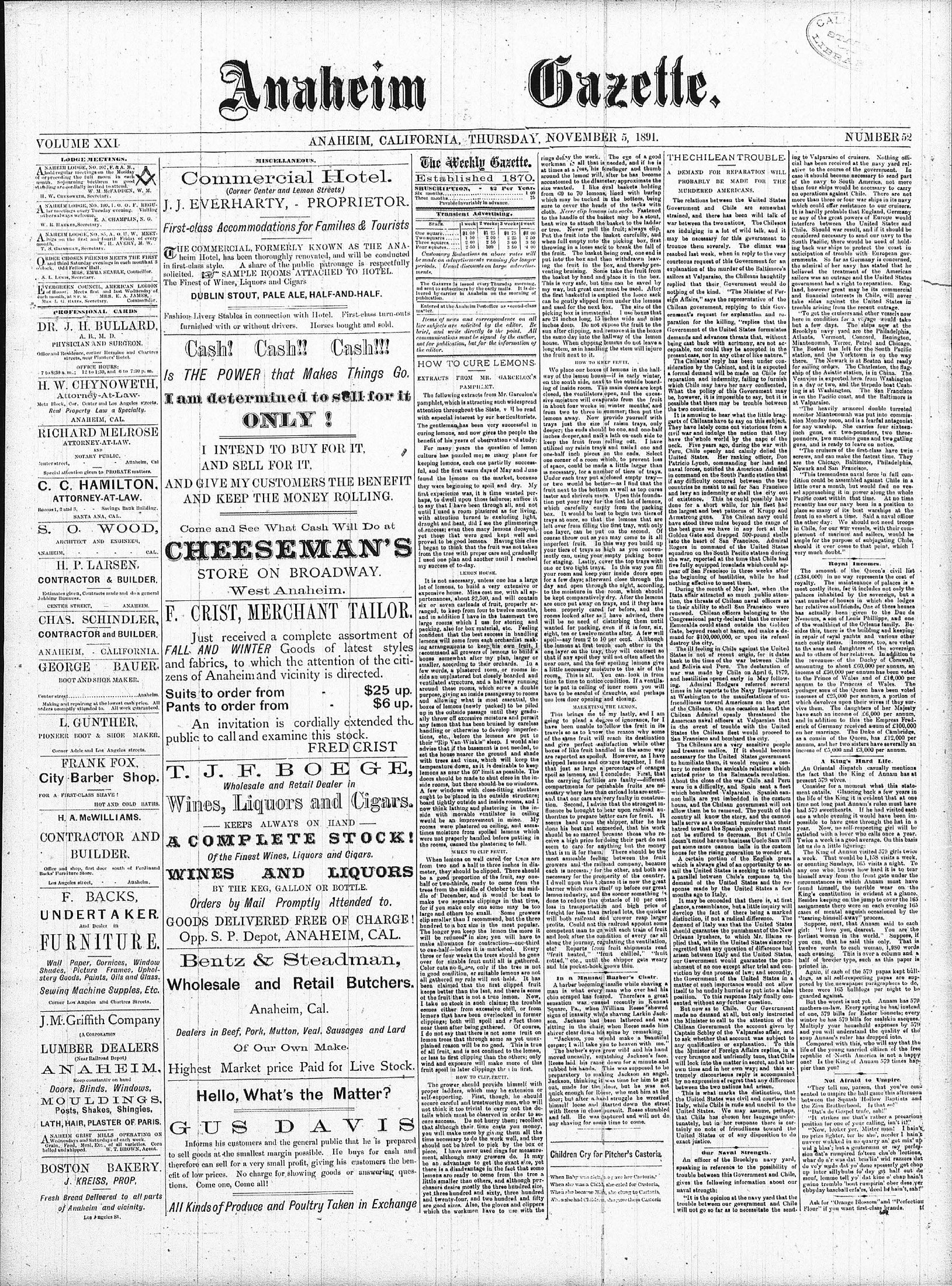
Searchable text
VOLUME XXI.
LODGE MEETINGS.
ANAHEIM LODGE, NO. 207, F. & A. M., hold regular meetings on the Monday of or preceding the full moon in each month. Sojourning brethren in good standing are cordially invited to attend. W. M. McFADDEN, W. M. H. W. Chynoweth, Secretary.
ANAHEIM LODGE, NO. 190, I. O. O. P. REGULAR MEETINGS every Tuesday evening. Visiting others always welcome. E. A. CHAMPLIN, N. G. W. R. HARKER, Secretary.
ANAHEIM LODGE, NO. 85, A. O. U. W. MEETINGS on the first and fourth Friday of every month. W. H. AVERY, M. W. T. S. GRISMHAW, Secretary.
ORDER CHOSEN FRIENDS MEETS THE FIRST AND third Saturday evenings in each month at 3 o'clock. Old Follows' Hall. MRS. EMMA SEARLE, Councilor. A. L. LEWIS, Secretary.
EVERGREEN COUNCIL, AMERICAN LEGION OF Honor. Meets first and last Wednesday of each month, at S.P.M. MRS. E. A JAMES, Mrs. L. G. HATES, Secretary.
PROFESSIONAL CARDS
DR. J. H. BULLARD,
A. B., M. D.
PHYSICIAN AND SURGEON.
Office and Residence, corter Hermine and Chartres streets, near Planters' Hotel.
OFFICE HOURS:
7 to 8:30 a.m.; 12 to 1:30, and 6 to 7:30 p.m.
H. W. CHYNOWETH,
Attorney-At-Law.
Metz Block, Cor., Center and Los Angeles streets.
Real Property Law a Specialty.
ANAHEIM, CAL.
RICHARD MELROSE
ATTORNEY-AT-LAW.
AND
NOTARY PUBLIC.
Center street,
Anaheim, Cal.
Special attention given to PROBATE matters.
MISCELLANEOUS.
Commercial Hotel
(Corner Center and Lemon Streets)
J. J. EVERHARTY, - PROPRIETORY
THE COMMERCIAL, FORMERLY KNOWN AS Theim Hotel, has been thoroughly renovated, and will be in first-class style. A share of the public patronage solicited. SAMPLE ROOMS ATTACHED TO The Finest of Wines, Liquors and Cigars.
DUBLIN STOUT, PALE ALE, HALF-AND-Fashion-Livery Stables in connection with Hotel. First furnished with or without drivers. Horses bought!
Cash! Cash!! Cash!
Is THE POWER that Makes Them determined to sell ONLY!
I INTEND TO BUY FOR I AND SELL FOR IT,
H. W. CHYNOWETH,
Attorney-At-Law.
Metz Block, Cor. Center and Los Angeles streets.
Real Property Law a Specialty.
ANAHEIM, CAL.
RICHARD MELROSE
ATTORNEY-AT-LAW.
AND
NOTARY PUBLIC.
Center street,
Anaheim, Cal.
Special attention given to PROBATE matters.
C. C. HAMILTON.
ATTORNEY-AT-LAW.
Rooms 1, 2 and 3.
Savings Bank Building.
SANTA ANA, CAL.
S. O. WOOD,
ARCHITECT AND ENGINEER.
ANAHEIM, CAL.
H. P. LARSEN,
CONTRACTOR & BUILDER.
Estimates given, Contracts made and do a general Jobbing Business.
CENTER STREET,
ANAHEIM.
CHAS. SCHINDLER,
CONTRACTOR and BUILDER.
ANAHEIM, CALIFORNIA.
GEORGE BAUER,
BOOT AND SHOE MAKER.
Center street...
Anaheim.
Making and repairing at the lowest cash price. All orders promptly attended to. All work guaranteed.
L. GUNTHER,
PIONEER BOOT & SHOE MAKER.
Corner Adele and Los Angeles streets.
FRANK FOX,
City Barber Shop.
FOR A FIRST-CLASS SHAVE!
HOT AND COLD BATHS.
H. A. McWILLIAMS.
CONTRACTOR AND BUILDER.
Office and shop, first door south of Perljinand Backs' Furniture Store.
Los Angeles street,
Anaheim.
F. BACKS,
I am determined to sell ONLY!
I INTEND TO BUY FOR I AND SELL FOR IT,
AND GIVE MY CUSTOMERS THE AND KEEP THE MONEY ROI
Come and See What Cash Will CHEESEMASTORE ON BROADWEST Anaheim.
F. CRIST, MERCHANT T
Just received a complete assortment of fall and winter Goods of late and fabrics, to which the attention zens of Anaheim and vicinity is direct.
Suits to order from
Pants to order from
An invitation is cordially ex public to call and examine this stock.
T. J. F. BOE
Wholesale and Retail Dealer in
Wines, Liquors and C
KEEPS ALWAYS ON HAND
A COMPLETE ST
Of the Finest Wines, Liquors and CIGARETTES AND LIQUIDS
BY THE KEG, GALLON OR BOTTLE
Orders by Mail Promptly Attend
H. A. McWILLIAMS.
CONTRACTOR AND BUILDER.
Office and shop, first door south of Ferjinand Backs' Furniture Store.
Los Angeles street, Anaheim.
F. BACKS,
UNDERTAKER.
And Dealer in
FURNITURE.
Wall Paper, Cornices, Window Shades, Picture Frames, Upholstery Goods, Paints, Oils and Glass.
Sewing Machine Supplies, Etc.
Corner Los Angeles and Chartres Streets.
J.M. Griffith Company
(A CORPORATION)
LUMBER DEALERS
(Near Railroad Depot)
ANAHEIM.
Keep constantly on hand
Doors, Blinds, Windows,
MOULDINGS.
Posts, Shakes, Shingles,
LATH, HAIR, PLASTER OF PARIS.
ANAHEIM GRIST MILLS OPERATING ON Wednesdays and Saturdays of each week.
Grain, Feed, Meal, Etc., of all varieties. Corn heled and shipped.
W.T. BROWN, Agent.
BOSTON BAKERY.
J. KREISS, PROP,
Fresh Bread Delivered to all parts of Anaheim and vicinity.
Los Angeles St.
KEEPS ALWAYS ON HAND
A COMPLETE STOCK
Of the Finest Wines, Liquors and Cigars
WINES AND LIQUIDS
BY THE KEG, GALLON OR BOTTLE
Orders by Mail Promptly Attend
GOODS DELIVERED FREE OF Opp. S. P. Depot, ANAHEIM
Bentz & Steadr
Wholesale and Retail B
Anaheim, Cal.
Dealers in Beef, Pork, Mutton, Veal, Sausage
Of Our Own Make.
Highest Market price Paid for L
Hello, What's the Ma
GUS DAVENPORT
Informs his customers and the general public that to sell goods at the smallest margin possible. He buys therefore can sell for a very small profit, giving his cfit of low prices. No charge for showing goods or tions. Come one, Come all!
All Kinds of Produce and Poultry Taken
ANAHEIM, CALIFORNIA, THURSDAY, NOVEMBER 5, 1891.
Special Hotel.
(and Lemon Streets)
RY, - PROPRIETOR.
Tions for Families & Tourists
ERLY KNOWN AS THE ANAghly renovated, and will be conducted
the public patronage is respectfully
MMS ATTACHED TO HOTEL.
Cigars
THE ALE, HALF-AND-HALF.
ention with Hotel. First-class turn-outs
ivers. Horses bought and sold.
Cash!!! Cash!!!
What Makes Things Go.
neded to sell for it
OLY!
NO BUY FOR IT,
OR IT.
COMMERS THE BENEFIT
The Weekly Gazette.
Established 1870.
SHUSCRIPTION, $2 Per Year.
Six months. 1 00
Three months. 75
Pavable invariably in advance.
Transient Advertising.
SPACE
One square... $1 00
Two squares... $1 50
Three squares... $2 00
Four squares... $2 50
Customary Reductions on above rates will
be made on advertisements running for longer
periods. Usual discounts on large advertisements.
The Gazette is issued every Thursday morning,
and sent to subscribers by the early mails. It is developed by carrier in Anaheim on the morning of
publication.
Entered at the Anaheim Postoffice as second-class
matter.
Items of news and correspondence on all
live subjects are solicited by the editor. Be
brief, and write directly to the point. All
communications must be signed by the author,
not for publication, but for the information of the editor.
HOW TO CURE LEMONS.
EXTRACTS FROM MR. GARCELON'S
PAMPHLET.
The following extracts from Mr. Garcelon's pamphlet, which is attracting such widespread attention throughout the State, will be read with especial interest by our horticulturist. The gentleman has been very successful in curing lemons, and now gives the people the benefit of his years of observation and study:
For many years the question of lemon culture has puzzled me; so many plaus for keeping lemons, each one particularly successful, and the first warm days of May and June found the lemons on the market, because rings dolley the work. The eye of a good workman is all that is needed, and if he is at times at a loss, his forefinger and thumb around the lemon will, after he has become accustomed to the diameter, approximate the size wanted. I like oval baskets holding from 60 to 70 lemons, lined with burlap which may be tucked in the bottom, being sure to cover the heads of the tacks with cloth. Never clip lemons into sacks. Fastened to the handle of the basket may be a stout, bent wire to attach the basket to the ladder or tree. Never pull the fruit; always clip. Put the fruit into the basket carefully, and when full empty into the picking box, first throwing in a loose sack to break the fall of the fruit. The basket being oval, one end is put into the box and then withdrawn leaving the fruit in the box, and thorby preventing bruising. Sonie take the fruit from the basket by hand and place it in the box. This is very safe, but time can be saved by my way, but great care must be used. After the first baskettail is emptied the loose sack can be gently slipped from under the lemons and used for the next box. The size of the picking box is immaterial. I use boxes that are 24 inches long, 15 inches wide and nine inches deep. Do not expose the fruit to the sun after clipping, and remove it in the boxes the same day into the hallway of the lemon house. When chipping lemons do not leave a long stem, as in handling the stem will injure the fruit next to it.
HOW TO KEEP FRUIT.
We place our boxes of lemons in the hallway of the lemon house—if in early winter, on the south side, next to the outdoor boarding of inside room. The main doors are kept closed, the ventilators open, and the excessive moisture will evaporate from the fruit in about four weeks in winter months, and from two to three in summer; then put the lemons away. Now provide yourself with trays just the size of raisin trays, only deeper; the ends should be one, and one-half inches deeper, and naill a lath on each side to keep the fruit from rolling out. I have utilized my raisin trays and nailed one and one-half inch pieces on the ends. Select one corner of a room which, to prevent loss of space, could be made a little larger than is necessary, for a number of trays. Under each tray put a closed empty tray—
NO BUY FOR IT,
FOR IT,
CUSTOMERS THE BENEFIT
MONEY ROLLING.
What Cash Will Do at
BEMAN'S
BROADWAY.
Anaheim.
ARCHANT TAILOR.
A complete assortment of
Goods of latest styles
in the attention of the citivicinity is directed.
m - $25 up.
m - $6 up.
is cordially extended the
amine this stock.
FRED CRIST
BOEGE,
Ad Retail Dealer in
DRES, LIQUORS and Cigars.
WAYS ON HAND
TE STOCK!
DRES, LIQUORS and Cigars.
GALLON OR BOTTLE.
Promptly Attended to.
EXTRACTS FROM MR. GARCELON'S
PAMPILLET.
The following extracts from Mr. Garcelon's pamphlet, which is attracting such widespread attention throughout the State, will be read with especial interest by our horticulturist. The gentleman has been very successful in curing lemons, and now gives the people the benefit of his years of observation and study:
For many years the question of lemon culture has puzzled me; so many plans for keeping lemons, each one partily successful, and the first warm days of May and June found the lemons on the market, because they were beginning to spoil and dry. My first experience was, it is time wasted perhaps, to dwell upon those failures; suffice it to say that I have been through all, and not until I used a room plastered as for living, with attention turned to excluding light, draught and heat, did I see the glimmerings of success; even then many lemons decayed, yet those that were good kept well and proved to be good lemona. Having this clue I began to think that the fruit was not taken from the tree with proper care and gradually I used one plan and another until I reached my success of to-day.
LEMON HOUSE.
It is not necessary, unless one has a large lot of lemons, to build a very extensive or expensive house. Mine cost me, with all appurtenances, about $2,500, and will contain six or seven carloads of fruit, properly arranged, to keep from four to twelve months, and in addition I have in the basement two large rooms which I use for storing and packing, also for box material, etc. Feeling confident that the best success in handling lemons will come from each orchard making arrangements to keep his own fruit, I recommend all growers of lemons to build a house somewhat after my plan, larger or smaller, according to their orchards. In a few words, a plastered room, or rooms inside an unplastered but closely boarded and ventilated structure, and a ballway running around these rooms, which serve a double purpose, giving an inside passageway to rooms and allowing what is most essential, the boxes of lemons (nowly packed) to be piled up in the outside passage until they gradually throw off excessive moisture and permit any lemon that has been bruised by careless handling or otherwise to develop imperfections, etc., before the lemons are put to their "Rip Van-Winkle" sleep. I would also advise that if the basement is not needed, to set the house nearer the ground and shade with trees and vines, which will keep the temperature down, as it is desirable to keep lemons as near the 60° limit as possible. The doors should be made to shut close in the inside rooms, but there should be no windows. A few windows with close-fitting shutters ought to be placed in the outside structure; board tightly outside and inside rooms, and I now think lathing and plastering in the inside with movable ventilator in ceiling would be an improvement in mine. My rooms were plastered on ceiling, and sometimes moisture from spoiled lemons which were not properly handled before putting in the rooms, caused the plastering to fall.
WHEN TO CLIP FRUIT.
When lemons on well cared for Lembs are from two and a half to three inches in diameter, they should be clipped. There should be a good proportion of the fruit, say one-half or two-thirds, ready to come from the trees from the middle of October to the middle of December, and it would be best to make two separate clippings in that time, for if you make only one some may be too
The main doors are kept closed, the ventilators open, and the excessive moisture will evaporate from the fruit in about four weeks in winter months, and from two to three in summer; then put the lemons away. Now provide yourself with trays just the size of raisin trays, only deeper; the ends should be one, and one-balf inches deeper, and nail a lath on each side to keep the fruit from rolling out. I have utilized my raisin trays and nailed one and one-half inch pieces on the ends. Select one corner of a room which, to prevent loss of space, could be made a little larger than as necessary, for a number of tiers of trays. Under each tray put a closed empty tray—or two would be better—as I find that the fruit next to the bottom as well as top cures taster and shrivels mors. Upon this foundation put your tray for the first lot of lemons, which carefully empty from the packing box. It would be best to begin two tiers of trays at once, so that the lemons that are left over from filling the first tray, with only one layer, can be put on the second. Of course throw out as you may come to it all imperfect fruit. In this way you build up your tiers of trays as high as you conveniently can, using your empty picking boxes for staging. Lastly, cover the top trays with one or two tight trays. In this way you fill your room and keep your inside doors open for a few days; afterward close through the day and open through the night, according to the moisture in the room, which should be kept comparatively dry. After the lemons are once put away on trays, and if they have been properly cared for before, and the rooms looked after as I have advised, there will be no need of disturbing them until wanted for packing, even if it is four, six, eight, ten or twelve months after. A few will spoil—say from 2 to 10 per cent. Although the lemons at first touch each other in the one layer on the tray, they will contract so that if any spoil they will not often affect the near ones, and the few spoiling lemons give a little necessary moisture to the air of the room. This is all. You can look in from time to time to notice condition. If a ventilator is put in coiling of inner room you will have to be careful of draughts, and perhaps use less door opening and closing.
MARKETING THE LEMON.
This brings me to my lastly, and I am going to plead a degree of ignorance, for I have been unable to follow the fruit in its travels so as to know the reason why some of the same fruit will reach its destination and give perfect satisfaction while other boxes of like fruit handled in the same way are reported as spoiled. However, as I have shipped lemons and oranges together, I find that just as large a percentage of oranges spoil as lemons, and I conclude: First, that the carrying facilities are faulty—different compartments for perishable fruits are necessary where less than earlobes lot are sent—and that our leaves are very faulty in construction. Second, I advise that the strongest influence be brought to bear upon railroad authorities to prepare better cars for fruit. It seems hard upon the shipper, after he has done his beat and succeeded, that his work should be so marred because those who receive a high price for doing their part do not seem to care for anything but the money that is in it for them. There should be the most amicable feeling between the fruit growers and the railroad company, because each is necessary for the other, and both are necessary for the prosperity of the country. I dwell upon this because it is now the great barrier which roars itself up before our great lemon industry, and she sooner something is done to reduce this obstacle of 10 per cent loss in transportation and high price of
now think lathing and plastering in the inside with movable ventilator in ceiling would be an improvement in mine. My rooms were plastered on ceiling, and sometimes moisture from spoiled lemons which were not properly handled before putting in the rooms, caused the plastering to fall.
WHEN TO CLIP FRUIT.
When lemons on well cared for leaves are from two and a half to three inches in diameter, they should be clipped. There should be a good proportion of the fruit, say one-half or two-thirds, ready to come from the trees from the middle of October to the middle of December, and it would be best to make two separate clippings in that time, for if you make only one some may be too large and others too small. Some growers clip smaller than I recommend, but the three hundred to a box size is the most popular. The longer you keep the lemon the more it will be reduced" in size; you will have to make allowance for contraction—one-third to one-half—before it is marketed. Every three or four weeks the trees should be gone over for sizable fruit until all is gathered. Color cuts no figure, only if the tree is not in good condition, or suitable lemons are not all gathered my rule will not hold. It has been claimed that the first clipped fruit keeps better than the last, and there is some of the fruit that is not a true lemon. Now, I take no stock in such claims; the trouble comes either from excessive chill, or from lemons that have been overlooked in former clippings; both will spoil and affect those near them after being gathered. Of course, I do not say that there is not some fruit on lemon trees that through some as yet unexplained reason will be no good. This is true of all fruit, and is not confined to the lemon, or less to first clipping than the others; only wind and exposure will make more of this fruit spoil in later clippings than in first.
HOW TO CLIP FRUIT.
The grower should provide himself with proper ladders, which may be extension or self-supporting. First, though, he should secure careful and trustworthy men, who will not think it too trivial to carry out the details which must be observed in order to secure success. Do not hurry them; recollect that although their time costs you money, you will make more by giving them all the time necessary to do the work well, and they should not be hired to pick by the box or piece. I have never used rings for measurement, although many growers do. It may be an advantage to get the exact size, yet there is a disadvantage in the fact that some lemons are ready to come from the tree a little smaller than others, and although purchasers desire mostly the three hundred size, yet three hundred and sixty, three hundred and twenty-four, and two hundred and fifty are good sizes. Also, the gloves and clippers which the workmen have to use with the fluence be brought to bear upon railroad authorities to prepare better cars for fruit. It seems hard upon the shipper, after he has done his beat and succeeded, that his work should be so marred because those who receive a high price for doing their part do not seem to care for anything but the money that is in it for them. There should be the most amicable feeling between the fruit growers and the railroad company, because each is necessary for the other, and both are necessary for the prosperity of the country. I dwell upon this because it is now the great barrier which roars itself up before our great lemon industry, and the sooner something is done to reduce this obstacle of 10 per cent loss in transportation and high price of freight for less than carload lots, the quicker will both railroad and grower reap larger profits. Could not the railroad appoint some competent man to go with each train of fruit and look after the condition of every car along the journey, regulating the ventilation, etc? Reports from fruit shipments read "fruit heated," "fruit chilled," "fruit rotted," etc., until the shipper gets weary and his pocket-book grows thin.
In a Maniac Harbor's Chair.
A barber becoming insane while shaving a man is what every man who ever had his chin scraped has feared. Therefore a great sensation was caused recently in Kennet Square, Pa., when William Reese showed signs of insanity while shaving Larkin Jackson. Jackson had been lathered and was sitting in the chair, when Reese made him shiver clear down a his spine by remarking: "Jackson, you would make a beautiful corpse; I will take you to heaven with me."
The harbor's eyes grew wild and his hand moved uncassily, scratching Jackson's face. Reese laid his razor down for a minute and rubbed his hands. This was supposed to be preparatory to making Jackson an angel. Jackson thinking it was time for him to get out, made for the door, but he was not quick enough for Reese, who met him at the door; but after a hard struggle he wrestled himself loose and started down the street with Reese in close pursuit. Reese stumbled and fell. He was captured and will not do any shaving for some time to come.
Children Cry for Pitcher's Castoria.
When Baby was sick she gave her Castoria.
When she was a Child she cried for Castoria.
When she became Mild she clung to Castoria.
When she had Children she gave them Castoria.
THE CHILEAN TROUBLE.
A DEMAND FOR REPARATION WILL PROBABLY BE MADE FOR THE MURDERED AMERICANS.
The relations between the United States Government and Chile are somewhat strained, and there has been wild talk of war between the two nations. The Chileans are indulging in a lot of wild talk, and it may be necessary for this government to trounce them severely. The climax was reached last week, when in reply to the very courteous request of this Government for an explanation of the murder of the Baltimore's sailors at Valparaiso, the Chileans haughtily replied that their Government would do nothing of the kind. "The Minister of Foreign Affairs," says the representative of the Chilean government, replying to this Government's request for explanation and reparation for the killing, "replies that the Government of the United States formulates demands and advances threats that, without being cast back with arrogance, are not acceptable, nor could they be accepted in the present case, nor in any other of like nature."
The Chileans' reply has been under consideration by the Cabinet, and it is expected a formal demand will be made on Chile for reparation and indemnity, failing to furnish which Chile may have her navy confiscated. What the policy of this Government may be, however, it is impossible to say, but it is possible that there may be trouble between the two countries.
It is amusing to hear what the little brags of Chileans have to say on this subject. They have lately come out victorious from a civil war and indulge the notion that they have the whole world by the nape of the neck. Five years ago, during the war with Peru, Chile openly and calmly defied the United States. Her ranking officer, Don Patricio Lynch, commanding her land and naval forces, notified the American Admiral in command on the South Pacific station that going to Valparaiso of cruisers. Nothing official has been received at the navy yard relative to the course of the government. In case it should become necessary to send part of the navy to South America, not more than four ships would be necessary to carry on operations against Chile. There are not more than three or four war ships in its navy which could offer resistance to our cruisers. It is hardly probable that England, Germany or any of the great powers of Europe would interfere between the United States and Chile. Should war result, and if it should be considered necessary to send our navy to the South Pacific, there would be used of holding back war ships to protect the coast in anticipation of trouble with European governments. So far as Germany is concerned, the admiral of her navy has stated that he believed the treatment of the American sailors was an outrage and the United States government had a right to reparation. England, however great may be its commercial and financial interests in Chile, will never take sides against the United States in trouble arising from the recent outrage.
"To get the cruisers and other vessels now here in condition for a voyage would take but a few days. The ships now at the Brooklyn navy yard are the Philadelphia, Atlanta, Vermont, Concord, Benington, Miantonomah, Torror, Petrel and Chicago. The Boston has left for the South Pacific station, and the Yorktown is on the way there. The Newark is at Boston and ready for sailing orders. The Charleston, the flagship of the Asiatic station, is in China. The Vesuvius is expected here from Washington in a day or two, and the torpedo boat Cushing is at Washington. The San Francisco is on the Pacific coast, and the Baltimore is at Valparaiso.
"The heavily armored double turreted monitor Miantoumomah was put into commission Monday noon, and is a fearful antagonist for any warship. She carries four sixteen-inch guns, six two-pounders, two three-pounders, two machine guns and two gatling guns, and is ready to leave on notice."
"The cruisers of the first-class have twin screws, and can make the fastest time. They are the Chicago, Baltimore, Philadelphia, Newark and San Francisco."
This tremendous naval force in full condition must be assembled before it arrives.
The main doors are kept open, and the excesorate from the fruit in winter months, and in summer; then put the new provide yourself with one of raisin trays, only should be one, and one-half a lath on each side to trim rolling out. I have ways and nailed one and two on the ends. Select which, to prevent loss made a little larger than number of tiers of trays. A closed empty tray—better—as I find that the custom as well as top cures amnesia. Upon this foundation, the first lot of lemons, empty from the packing, best to begin two tiers of at the lemon that are at the first tray, with only out on the second. Of you may come to it all in this way you build up as high as you convene your empty picking boxes cover the top trays with rays. In this way you fill your inside doors open toward close through the tough night, according to the room, which should rely dry. After the lemons can trays, and if they have been used for before, and the as I have advised, there disturbing them until even if it is four, six, months after. A few will need 10 per cent. Although touch each other in the day, they will contract so they will not often affect the new spoiling lemons give moisture to the air of the You can look in from ice condition. If a ventilation of inner room you will of draughts, and perhaps fog and closing.
ING THE LEMON.
to my lastly, and I am degree of ignorance, for I to follow the fruit in its will reach its destination satisfaction while other handled in the same way indeed. However, as I have oranges together, I find a percentage of oranges I conclude: First, that ties are faulty—different perishable fruits are neo-than carload lots are sent—very very faulty in construction that the strongest intended to bear upon railroad and better cars for fruit. It has shipped, after he has succeeded, that his work and because those who reorder doing their part do not anything but the money there. Should be the rolling between the fruit railroad company, because for the other, and both are property of the country, because it is now the great itself up before our great and the sooner something is costable of 10 per cent and high prices of
reparation and indemnity, failing to furnish which Chile may have her navy confiscated, What the policy of this Government may be, however, it is impossible to say, but it is possible that there may be trouble between the two countries.
It is amusing to hear what the little braggarts of Chileans have to say on this subject. They have lately come victorious from a civil war and indulge the notion that they have the whole world by the nape of the neck. Five years ago, during the war with Peru, Chile openly and calmly doled the United States. Her ranking officer, Don Patricio Lynch, commanding her land and naval forces, notified the American Admiral in command on the South Pacific station that if any difficulty occurred between the two countries he meant to sail for San Francisco and levy an indemnity or shell the city out of existence. This he could possibly have done for a short while, for his fleet had the largest and best patterns of Krupp and Armstrong guns. The Chilean navy could have stood three miles beyond the range of the best guns we have in any fort at the Golden Gate and dropped 500-pound shells into the heart of San Francisco. Admiral Rogers in command of the United States squadron on the South Pacific station during the war, reported at the time that Chile had five fully equipped troops which could appear off San Francisco in three weeks after the beginning of hostilities, while he had nothing effective to meet them.
During the month of May last, when the Itaña affair attracted so much public attention, the threats of Chilean naval officers as to their ability to shell San Francisco were renewed. Chilean officers belonging to the Congressional party declared that the cruiser Emeralda could stand outside the Golden Gate, beyond reach of harm, and make a demand for $100,000,000, or upon its refusal destroy the city.
The ill feeling in Chile against the United States is not of recent origin, for it dates back to the time of the war between Chile and Bolivia and Peru. The declaration of war was made by Chile on April 6, 1879, and hostilities opened early in May following. Admiral Rodgers referred several times in his reports to the Navy Department at Washington to the manifestations of unfriendless toward Americans on the part of the Chileans. On one occasion at least the Chilean Admiral openly threatened the American naval officers at Valparaiso that in the event of trouble with the United States the Chilean fleet would proceed to San Francisco and bombard the city.
The Chileans are a very sensitive people and treasure malice. If it should become necessary for the United States government to humiliate them, it would require a century to restore the amiable relations which existed prior to the Balmaceda revolution. About the close of the war Chile and Peru were in a difficulty, and Spain sent a fleet which bombed Valparaiso. Spanish cannon balls are yet imbedded in the custom house, and the Chilean government will not allow them be removed. The youth of the country all know the story, and the cannon balls serve as a constant reminder that their hatred toward Spanish government must not be suffered to decrease. But if Chile doesn't mind her own business Uncle Sam will put some more cannon balls in the custom house for the rising generation to wonder at.
A certain portion of the English press which is always glad of an opportunity to sail the United States is seeking to establish a parallel between Chile's response to the demand of the United States a few months ago to Italy.
It may be conceded that there is, at first glance, a resemblance, but a little inquiry will
"The heavily armored double turreted monitor Miantonomah was put into commission Monday noon, and is a fearful antagonist for any warship. She carries four sixteen-inch guns, six two-pounders, two three-pounders, two machine guns and two gatling guns, and is ready to leave on notice."
"The cruisers of the first-class have twin screws, and can make the fastest time. They are the Chicago, Baltimore, Philadelphia, Newark and San Francisco."
"This tremendous naval force in full condition could be assembled against Chile in a little over a month, but would find no vessel approaching it in power along the whole Pacific coast within that time. At no time recently has our navy been in a position to place so many of its best warships at the front in so short a time. Said a naval officer the other day: We should not need troops in Chile, for our war vessels, with their complement of marines and sailors, would be ample for the purpose of subjugating Chile. Should it ever come to that point, which I very much doubt."
Royal Incomes.
The amount of the Queen's civil list (£384,000) in no way represents the cost of royalty. The maintenance of palaces is a most costly item; for it includes not only the palaces inhabited by the sovereign, but a vast number of houses in which she lodges her relatives and friends. One of these houses has actually given to the Du de Nemours, a son of Louis Phillipe, and one of the wealthiest of the Orleans family. Besides this, there is the building and keeping in repair of royal yachts and various other such costly items. Incomes too, are vested to the sons and daughters of the sovereign and to others of her relatives. In addition to the revenues of the Duchy of Cornwall, amounting to about £60,000 per annum, an income of £50,000 per annum has been voted to the Prince of Wales and of £16,000 per annum to the Princess of Wales. The younger sons of the Queen have been voted incomes of £25,000 per annum, a portion of which devolves upon their wives if they survive them. The daughters of her Majesty have each an income of £6,000 per annum, and in addition to thisthe Empress Frederick of Germany received sums of £100,000 on her marriage. The Duke of Cambridge, as a cousin of the Queen, has £12,000 per annum, and her two sisters have severally an income of £5,000 and £3,000 per annum.
A King's Hard Life.
An Oriental dispatch casualty mentions the fact that the King of Annam has at present 579 wives.
Consider for a moment what this statement entails. Glancing back a few years in life of the King it is evident that at one time not long past Annam's rules must have had 579 sweethearts. If he had visited each one a whole evening it would have been impossible to have gone through the last in a year. Now no self respecting girl will be satisfied with a lover who calls once a year. Twice a week is a good average. On this basis let us do a little figuring:
The King of Annam visited 579 girls twice a week. That would be 1158 visits a week. Or counting Sundays, 165 visits a night. To any one who knows how hard it is to tear himself away from front gate under the circumstances in which Annam must have found himself,the terrible wear onthe King's constitution is evident at a glance.Besides keeping on the jump to coverthe 165 assignments there were on each evening 165
to bear upon railroad an
buyer for fruit in it.
the shipper, after he has
succeded, that his work
and because those who redoing their part do not
anything but the money
from. There should be the
between the fruit
railroad company, because
it is now the great
itself up before our great
and the sooner something is
costile of 10 per cent
condition and high price of
on carload lots, the quicker
and grower reap larger
the railroad appoint some
with each train of fruit
condition of every car all
regulating the ventilation,
of every fruit shipments read
"fruit chilled," "fruit"
and the shipper gets weary
look grows thin.
William Roese showed
while shaving Larkin Jackd been lathered and was
wair, when Reese made him
this spine by remarking:
would make a beautiful
you to heaven with me."
was grow wild and his hand
scatching Jackson's face.
zor down for a minute and
This was supposed to be
making Jackson an angel.
it was time for him to get
door, but he was not
Reese, who met him at the
hard struggle he wrestled
started down the street
pursuit. Reese stumbled
captured and will not do
time to come.
Our Naval Strength.
An officer of the Brooklyn navy yard,
speaking in reference to the possibility of trouble between this Government and Chile,
gives the following information about our naval strength:
"It is the opinion at the navy yard that the trouble between our government and Chile will not go so far as to necessitate the send-
allow them be to removed. The youth of the country all know the story, and the cannon balls serve as a constant reminder that their hatred toward the Spanish government must not be suffered to decrease. But if Chile doesn't mind her own business Uncle Sam will put some more cannon balls in the custom house for the rising generation to wonder at.
A certain portion of the English press which is always glad of an opportunity to assail the United States is seeking to establish a parallel between Chile's response to the demand of the United States and the response made by the United States a few months ago to Italy.
It may be conceded that there is, at first glance, a resemblance, but a little inquiry will develop the fact of there being a marked distinction, if not a radical difference. The demand of Italy was that the United States should guarantee the punishment of the New Orleans lynehers, to which Mr. Blaine replied that, while the United States sincerely regretted that any question of difference had arisen between Italy and the United States, our Government would guarantee the punishment of no one except after trial and conviction by due process of law; and secondly, the Government of the United States in a matter of such importance would not allow itself to be unduly hurried or put into a false position. To this response Italy finally consented without any further question.
But now as to Chile. Our Government made no demean at all, but only instructed the Minister to call to the attention of the Chilean Government the account given by Captain Schley of the Valparaiso affair, and to ask whether that account subject to any qualification or explanation. To this the Minister of Foreign Affairs replies, in a very brusque and unfriendly tone, that Chile will look into the matter in secret, and at her own time and in her own way; and this extremely discourteous reply is accompanied by no expression of regret that any difference between the two nations had arisen.
This is what marks the distinction, that the United States was civil and courteous to Italy, while Chils is rude and uncivil to the United States. We may assume, perhaps, that Chile has chosen her language unfortunately, but in her response there is certainly no note of friendliness toward the United States or of any disposition to do exact justice.
Our Naval Strength.
An officer of the Brooklyn navy yard,
speaking in reference to the possibility of trouble between this Government and Chile,
gives the following information about our naval strength:
"It is the opinion at the navy yard that the trouble between our government and Chile will not go so far as to necessitate the send-
allow them be to removed. The youth of the country all know the story, and the cannon balls serve as a constant reminder that their hatred toward the Spanish government must not be suffered to decrease. But if Chile doesn't mind her own business Uncle Sam will put some more cannon balls in the custom house for the rising generation to wonder at.
A certain portion of the English press which is always glad of an opportunity to assail the United States is seeking to establish a parallel between Chile's response to the demand of the United States and the response made by the United States a few months ago to Italy.
It may be conceded that there is, at first glance, a resemblance, but a little inquiry will develop the fact of there being a marked distinction, if not a radical difference. The demand of Italy was that the United States should guarantee the punishment of no one except after trial and conviction by due process of law; and secondly, the Government of the United States in a matter of such importance would not allow itself to be unduly hurried or put into a false position. To this response Italy finally consented without any further question.
But now as to Chile. Our Government made no demean at all, but only instructed the Minister to call to the attention of the Chilean Government the account given by Captain Schley of the Valparaiso affair, and to ask whether that account subject to any qualification or explanation. To this the Minister of Foreign Affairs replies, in a very brusque and unfriendly tone, that Chile will look into the matter in secret, and at her own time and in her own way; and this extremely discourteous reply is accompanied by no expression of regret that any difference between the two nations had arisen.
This is what marks the distinction, that the United States was civil and courteous to Italy, while Chils is rude and uncivil to the United States. We may assume, perhaps, that Chile has chosen her language unfortunately, but in her response there is certainly no note of friendliness toward the United States or of any disposition to do exact justice.
Our Naval Strength.
An officer of the Brooklyn navy yard,
speaking in reference to the possibility of trouble between this Government and Chile,
gives the following information about our naval strength:
"It is the opinion at the navy yard that the trouble between our government and Chile will not go so far as to necessitate the send-
allow them be to removed. The youth of the country all know the story, and the cannon balls serve as a constant reminder that their hatred toward the Spanish government must not be suffered to decrease. But if Chile doesn't mind her own business Uncle Sam will put some more cannon balls in the custom house for the rising generation to wonder at.
A certain portion of the English press which is always glad of an opportunity to assail the United States is seeking to establish a parallel between Chile's response to the demand of the United States and the response made by the United States a few months ago to Italy.
It may be conceded that there is, at first glance, a resemblance, but a little inquiry will develop the fact of there being a marked distinction, if not a radical difference. The demand of Italy was that the United States should guarantee the punishment of no one except after trial and conviction by due process of law; and secondly, the Government of the United States in a matter of such importance would not allow itself to be unduly hurried or put into a false position. To this response Italy finally consented without any further question.
But now as to Chile. Our Government made no demean at all, but only instructed the Minister to call to the attention of the Chilean Government the account given by Captain Schley of the Valparaiso affair, and to ask whether that account subject to any qualification or explanation. To this the Minister of Foreign Affairs replies, in a very brusque and unfriendly tone, that Chile will look into the matter in secret, and at her own time and in her own way; and this extremely discourteous reply is accompanied by no expression of regret that any difference between the two nations had arisen.
This is what marks the distinction, that the United States was civil and courteous to Italy, while Chils is rude and uncivil to the United States. We may assume, perhaps, that Chile has chosen her language unfortunately, but in her response there is certainly no note of friendliness toward the United States or of any disposition to do exact justice.
Our Naval Strength.
An officer of the Brooklyn navy yard,
speaking in reference to the possibility of trouble between this Government and Chile,
gives the following information about our naval strength:
"It is the opinion at the navy yard that the trouble between our government and Chile will not go so far as to necessitate the send-
allow them be to removed. The youth of the country all know the story, and the cannon balls serve as a constant reminder that their hatred toward the Spanish government must not be suffered to decrease. But if Chile doesn't mind her own business Uncle Sam will put some more cannon balls in the custom house for the rising generation to wonder at.
A certain portion of the English press which is always glad of an opportunity to assail the United States is seeking to establish a parallel between Chile's response to the demand of the United States and the response made by the United States a few months ago to Italy.
It may be conceded that there is, at first glance, a resemblance, but a little inquiry will develop the fact of there being a marked distinction, if not a radical difference. The demand of Italy was that the United States should guarantee the punishment of no one except after trial and conviction by due process of law; and secondly, the Government of the United States in a matter of such importance would not allow itself to be unduly hurried or put into a false position. To this response Italy finally consented without any further question.
But now as to Chile. Our Government made no demean at all, but only instructed the Minister to call to the attention of the Chilean Governmentthe account given by Captain Schley ofthe Valparaiso affair,and to ask whether that account subject to any qualification or explanation. To thisthe MinisterofForeignAffairs replies,averybrusqueandunfriendlytone,thatChileswilllookintothematterinsecret,andatherownzeitthereiscertainlynonoteoffriendlinesstowardtheUnitedStatesorofanydispositiontodoeactjustice.
Our Naval Strength.
An officer ofthe Brooklyn navy yard,
speaking in reference tothepossibilityoftroublebetweenthisGovernmentandChile,givesthefollowinginformationaboutournavalstrength:
"Itistheopinionatthenavyyardthattherollbackentheatronbearingsforfruitincomebutweareusedtobeatingupthefruitincomebutweareusedtobeatingupthefruitincomebutweareusedtobeatingupthefruitincomebutweareusedtobeatingupthefruitincomebutweareusedtobeatingupthefruitincomebutweareusedtobeatingupthefruitincomebutweareusedtobeatingupthefruitincomebutweareusedtobeatingupthefruitincomebutweareusedtobeatingupthefruitincomebutweareusedtobeatingupthefruitincomebutweareusedtobeatingupthefruitincomebutweareusedtobeatingupthefruitincomebutweareusedtobeatingupthefruitincomebutweareusedtobeatingupthefruitincomebutweareusedtobeatingupthefruitincomebutweareusedtobeatingupthefruitincomebutweareusedtobeatingupthefruitincomebutweareusedtobeatingupthefruitincomebutweareusedtobeatingupthefruitincomebutweareusedtobeatingupthefruitincomebutweareusedtobeatingupthefruitincomebutweareusedtobeatingupthefruitincomebutweareusedtobeatingupthefruitincomebutweareusedtobeatingupthefruitincomebutweareusedtobeatingupthefruitincomebutweareusedtobeatingupthefruitincomebutweareusedtobeatingupthefruitincomebutweareusedtobeatingupthefruitincomebutweareusedtobeatingupthefruitincomebutweareusedtobeatingupthefruitincomebutweareusedtobeatingupthefruitincomebutweareusedtobeatingupthefruitincomebutweareusedtobeatingupthefruitincomebutweareusedtobeatingupthefruitincomebutweareusedtobeatingupthefruitincomebutweareusedtobeatingupthefruitincomebutweareusedtobeatingupthefruitincomebutweareusedtobeatingupthefruitincomebutweareusedtobeatingupthefruitincomebutweareusedtobeatingupthefruitincomebutweareusedtobeatingupthefruitincome但我们需要知道的是什么。让我们知道的是什么。我们需要知道的是什么。我们需要知道的是什么。我们需要知道的是什么。我们需要知道的是什么。我们需要知道的是什么。我们需要知道的是什么。我们需要知道的是什么。我们需要知道的是什么。我们需要知道的是什么。我们需要知道的是什么。我们需要知道的是什么。我们需要知道的是什么。我们需要知道的是什么。我们需要知道的是什么。我们需要知道的是什么。我们需要知道的是什么。我们需要知道的是什么。我们需要知道的是什么。我们需要知道的是什么。我们需要知道的是什么。我们需要知道的是什么。我们需要知道的是什么。我们需要知道的是什么。我们需要知道的是什么。我们需要知道的是什么。我们需要知道的是什么。我们需要知道的是什么。我们需要知道的是什么。我们需要知道的是什么。我们需要知道的是什么。我们需要知道的是什么。我们需要知道的是什么。我们需要知道的是什么。我们需要知道的是什么。我们需要知道的是什么。我们需要知道的是什么。我们需要知道的是什么。我们需要知道的是什么。我们需要知道的是什么。我们需要知道的是什么。我们需要知道的是什么。我们需要知道的是什么。我们需要知道的是什么。我们需要知道的是什么。我们需要知道的是什么。我们需要知道的是什么。我们需要知道的是什么。我们需要知道的是什么。我们需要知道的是什么。我们需要知道的是什么。我们需要知道的是什么。我们需要知道的是什么。我们需要知道的是什么。我们需要知道的是什么。我们需要知道的是什么。我们需要知道的是什么。我们需要知道的是什么。我们需要知道的是什么。我们需要知道的是什么。我们需要知道的是什么。我们需要知道的是什么。我们需要知道的是什么。我们需要知道的是什么。我们需要知道的是什么。我们需要知道的是什么。我们需要知道的是什么。我们需要知道的是什么。我们需要知道的是什么.我们 need know about what they have done with their training of fruit condition of every woman in their world." Suppose, if you can hear, dearest. You are THE loveliest woman in THE free republic of North America is not a happy one? Is The King of Annam 579 times happier than you?
Not Afraid To Umpire.
"They tell me, parson, that you've consented to umpire-the ball game this afternoon between The Squash Hollow Baptists and The Zion Brotherhood. Is that so?"
"Dat's de Gospel truie,sah!"
"It strikes me that's rather a precarious position for one your calling isn't it?"
"Now, looker yer. Mister man! I hain' no prize fighter, ter bo she', needer I hain' nuvver wukked in no quarry an' got mix' up wid blas'; but a genterman er y'ap perfession dat's rumppied fo'teen chu'b loctions, whar do e'ar' was dat brislin' wil razzors dat de vo'y wuds dat yo' done spesperfy got chop up inter sillybubs fo'dey gut half out de moufl, lemme tell yo' dat kine o' chap hain' n guine tremble 'bout rumppir'in ob desse yer ebbyday baseball erfa're,'deed he hain't sah?"
Ask for "Orange Blossom" and "Perfection Flour" if you want first-class brands.