anaheim-gazette 1891-10-29
Scanned page
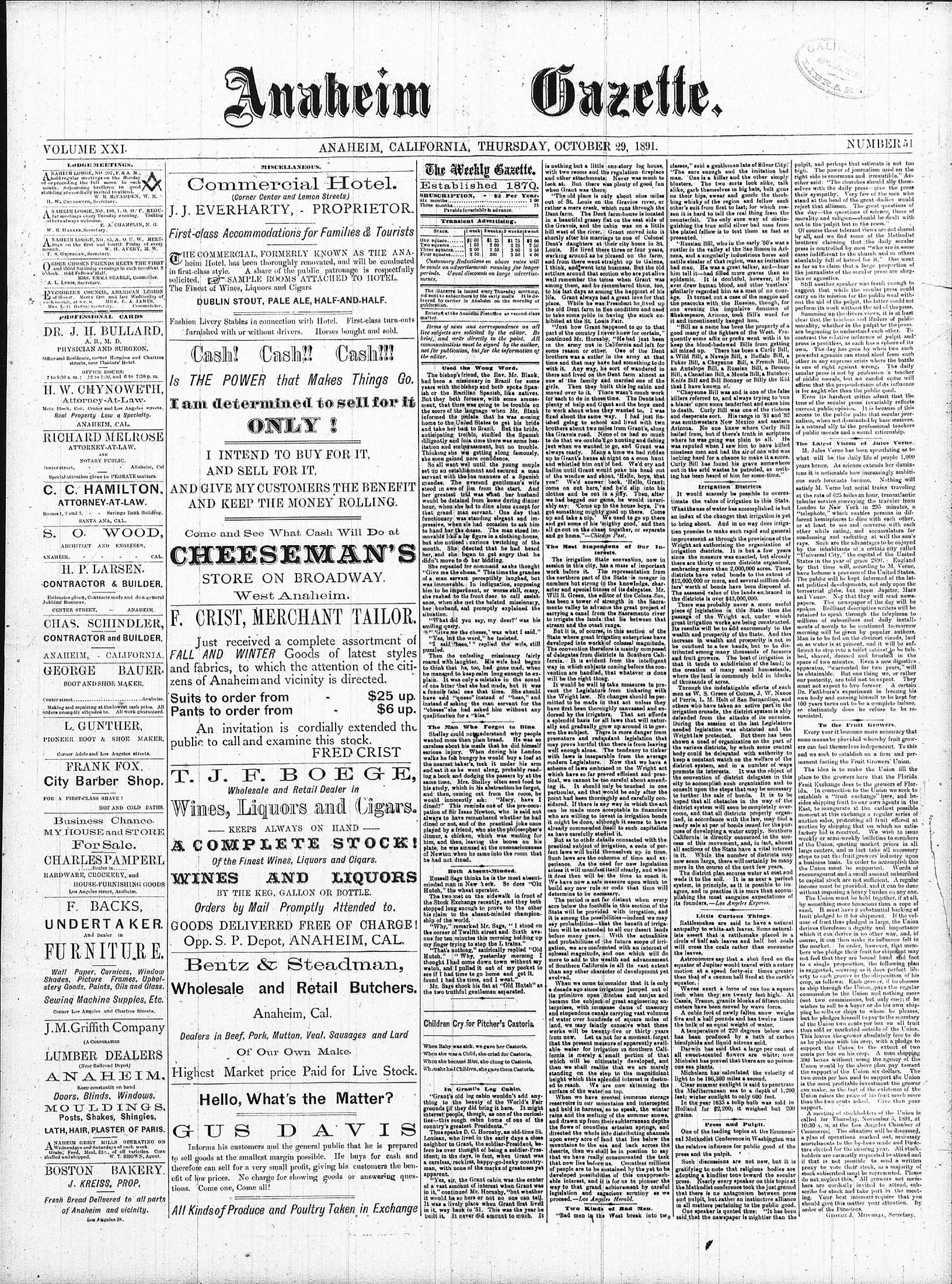
Searchable text
VOLUME XXI.
LODGE MEETINGS.
ANAHEIM LODGE, NO. 207, F. & A. M., hold regular meetings on the Monday of or preceding the full moon in each month. Sojourning brethren in good standing are cordially invited to attend. W. H. McPADDEN, W. M.
H. W. CHYNOWETH, Secretary.
ANAHEIM LODGE, NO. 199, I. O. O. P. REGULAR meetings every Tuesday evening. Visiting others always welcome. E. A' CHAMPLIN, N. G.
W. R. HARKER, Secretary.
ANAHEIM LODGE, NO. 85, A. O. U. W. MEETINGS on the first and fourth Friday of every month. W. H. AVERY, M. W.
T. S. GRIMSHAW, Secretary.
ORDER CHOSEN FRIENDS MEETS THE FIRST and third Saturday evenings in each month at 8 o'clock. Old Follows' Hall.
MRS. EMMA SEARLE, Councillor.
A. L. LEWIS, Secretary.
EVERGREEN COUNCIL, AMERICAN LEGION of Honor. Meets first and last Wednesday of each month, at 8 p.m.
MRRS. E. A JAMES,
Mrs. L. G. BAYRSE, Secretary.
PROFESSIONAL CARDS
DR. J. H. BULLARD,
A. B., M. D.
PHYSICIAN AND SURGEON.
Office and Residence, corner Hermine and Chartres streets, near Planters' Hotel.
OFFICE HOURS:
7 to 8:30 a.m.; 12 to 1:30, and 6 to 7:30 p.m.
H. W. CHYNOWETH,
Attorney-At-Law.
Metz Block, Cor., Center and Los Angeles streets.
Real Property Law a Specialty.
ANAHEIM, CAL.
RICHARD MELROSE
ATTORNEY-AT-LAW.
AND
NOTARY PUBLIC.
center street,
anaheim, Cal
Special attention given to PROBATE matters.
MISCELLANEOUS.
Commercial Hotel
(Corner Center and Lemon Streets)
J. J. EVERHARTY, - PROPRIETOR
First-class Accommodations for Families
THE COMMERCIAL, FORMERLY KNOWN Theim Hotel, has been thoroughly renovated, and w in first-class style. A share of the public patronage solicited. SAMPLE ROOMS ATTACHED To The Finest of Wines, Liquors and Cigars
DUBLIN STOUT, PALE ALE, HALF-AND-Fashion Livery Stables in connection with Hotel. Fi furnished with or without drivers. Horses boug
Cash! Cash!! Cash!
Is THE POWER that Makes T I am determined to se ONLY!
I INTEND TO BUY FOR AND SELL FOR IT,
H. W. CHYNOWETH,
Attorney-At-Law.
Metz Block, Cor. Center and Los Angeles streets.
Real Property Law a Specialty.
ANAHEIM, CAL.
RICHARD MELROSE
ATTORNEY-AT-LAW.
AND
NOTARY PUBLIC.
Jenter street, Anaheim, Cal.
Special attention given to PROBATE matters.
C. C. HAMILTON.
ATTORNEY-AT-LAW.
Rooms 1, 2 and 3. Savings Bank Building.
SANTA ANA, CAL.
S. O. WOOD,
ARCHITECT AND ENGINEER,
ANAHEIM, CAL.
H. P. LARSEN,
CONTRACTOR & BUILDER.
Estimates given, Contracts made and do a general Jobbing Business.
CENTER STREET, Anaheim.
CHAS. SCHINDLER,
CONTRACTOR and BUILDER.
ANAHEIM, CALIFORNIA.
GEORGE BAUER
BOOT AND SHOE MAKER.
Center street... Anaheim.
Making and repairing at the lowest cash price. All orders promptly attended to. All work guaranteed.
L. GUNTHER,
PIONEER BOOT & SHOE MAKER.
Corner Adele and Los Angeles streets.
FRANK FOX.
City Barber Shop.
FOR A FIRST-CLASS SHAVE!
HOT AND COLD BATHS.
Business Chance.
MY HOUSE and STORE
For Sale.
CHARLES PAMPERL
Dealer in...
HARDWARE, CROCKERY, and
HOUSE-FURNISHING GOODS
Los Angeles street, Anaheim.
F. BACKS
Is THE POWER that Makes
I am determined to se
ONLY!
I INTEND TO BUY FOR
AND SELL FOR IT,
AND GIVE MY CUSTOMERS THE
AND KEEP THE MONEY RO
Come and See What Cash Will
CHEESEMA
STORE ON BROADW
West Anaheim.
F. CRIST, MERCHANT T
Just received a complete ass
FALL AND WINTER Goods of la
and fabrics, to which the attentio
zens of Anaheim and vicinity is dir
Suits to order from
Pants to order from
An invitation is cordially ex
public to call and examine this sto
FRED
T. J. F. BOE
Wholesale and Retail Dealer in
Wines, Liquors and
KEEPS ALWAYS ON HANDE
A COMPLETE ST
Of the Finest Wines, Liquors and C
WINES AND LI
BY THE KEG, GALLON OR BOTT
Business Chance.
MY HOUSE and STORE
For Sale.
CHARLESPAMPERL
Dealer in...
HARDWARE, CROCKERY, and
HOUSE-FURNISHING GOODS
Los Angeles street, Anaheim.
F. BACKS,
UNDERTAKER.
And Dealer in
FURNITURE.
Wall Paper, Cornices, Window
Shades, Picture Frames, Upholstery Goods, Paints, Oils and Glass.
Sewing Machine Supplies, Etc.
Corner Los Angeles and Chartres Streets.
J.M.Griffith Company
(A CORPORATION
LUMBER DEALERS
(Near Railroad Depot)
ANAHEIM.
Keep constantly on hand
Doors, Blinds, Windows,
MOULDINGS.
Posts, Shakes, Shingies,
LATH, HAIR, PLASTER OF PARIS.
ANAHEIM GRIST MILLS OPERATING ON
Wednesdays and Saturdays of each week.
Grain, Feed, Meal, Etc., of all varieties, Corn
shelled and shipped.
BOSTON BAKERY.
J. KREISS, PROP,
Fresh Bread Delivered to all parts
of Anaheim and vicinity.
Los Angeles St.
Wines, Liquors and
COMPLETE STOCK
Of the Finest Wines, Liquors and C
WINES AND LIQUORS
BY THE KEG, GALLON OR BOTTLE
Orders by Mail Promptly Atten
GOODS DELIVERED FREE OF
Opp. S. P. Depot, ANAHEIM
Bentz & Steadu
Wholesale and Retail E
Anaheim, Cal.
Dealers in Beef, Pork, Mutton, Veal, Sausag
Of Our Own Make.
Highest Market price Paid for
Hello, What's the Ma
GUS DAVENPORT
Informs his customers and the general public that
to sell goods at the smallest margin possible. He bu
therefore can sell for a very small profit, giving his c
effit of low prices. No charge for showing goods or
tions. Come one, Come all!
All Kindsof Produce and Poultry Taken
ANAHEIM, CALIFORNIA, THURSDAY, OCTOBER 29, 1891.
Special Hotel.
(and Lemon Streets)
BY, - PROPRIETOR.
tions for Families & Tourists
MERLY KNOWN AS THE ANAoughly renovated, and will be conducted
at the public patronage is respectfully
OMS ATTACHED TO HOTEL.
and Cigars
LE ALE, HALF-AND-HALF.
ction with Hotel. First-class turn-outs
drivers. Horses bought and sold.
Cash!!! Cash!!!
That Makes Things Go.
ned to sell for it
ILY!
TO BUY FOR IT,
FOR IT,
The Weekly Gazette.
Established 1870.
SHUSCRIPTION, - 62 Per Year.
Six months... 1 00
Three months... 75
Pavable invariably in advance.
Transient Advertising.
Space.
1 week
2 weeks
3 weeks
4 week
One square.... $1 00
Two squares.... 1 50
Three squares.... 2 00
Four squares.... 2 50
Customary Reductions on above rates will be made on advertisements running for longer periods. Usual discount on large advertisements.
The Gazette is issued every Thursday morning, and sent to subscribers by the early mails. It is delivered by carrier in Anahim on the morning of publication.
Entered at the Anahim Postoffice as second-class matter.
Items of news and correspondence on all live subjects are solicited by the editor. Be brief, and write directly to the point. All communications must be signed by the author, not for publication, but for the information of the editor.
Used the Wong Word.
The bishop's friend, the Rev. Mr. Blank, had been a missionary in Brazil for some years with the bishop and both spoke Spanish or the Brazilian Spanish, like natives. But they both foresaw, with some amusement, that there was going to be trouble on the score of the language when Mr. Blank informed the prelate that he was coming home to the United States to get his bride and take her back to Brazil. But the bride, anticipating trouble, studied the Spanish diligently and fota time there was some hesitation and embarrassment, but no trouble. Thinking she was getting along famously, she soon gained more confidence.
So all went well until the young couple set up an establishment and secured a man servant with the fine manners of a Spanish
is nothing but a little one-story log house, with two rooms and the regulation fireplace and other attachments. Never was much to look at. But there was plenty of good fun when Grant was there.
"The old place is only about nine miles out of St. Louis on the Gravios river, or rather a mere creek, which runs through the Dent farm. The Dent farm-house is located in a beautiful grassy flat on the east side of the Gravois, and the cabin was on a little hill west of the river. Grant moved into it shortly after his marriage to one of Colonel Dent's daughters at their city home in St. Louis. He lived there three or four years, working around as he pleased on the farm, and from there went straight up to Galena, I think, and went into business. But the old settlers around that section who are yet alive well remember the times when Grant was among them, and he remembered them, too, to his last days as aming the happiest of his life. Grant always had a great love for that place. While he was President he fixed up the old Dent farm in fine condition and used to take some pride in having the stock exhibited at the St. Louis Fair.
"Just how Grant happened to go to that part of the country Inver know for certain," continued Mr. Hornsby. "He had just been in the army out in California and left for some reason or other. One of the Dent brothers was a satler in the army at that time and that may have had something to do with it. Any way, he sort of wandered in there and lived on the Dent farm almost as one of the family and married one of the girls. Then they built this log cabin and moved over to it. There wasn't much work for each to do in those time. The Dents had plenty of help and Grant and the boys used to work about when they wanted to. I was fixed about the same way. I had just finished going to school and lived with two brothers about two miles from Grant's, along Grants road. None of us had so much to do that we couldn't go hunting and fishing just when we wanted to go, and Grant was always ready. Many a time we had ridden up to Grant's house at night on aoon hunt and whistled him out of bed. We'd cry and halloo until Grant would poke his head out of the window and shout, 'Hello, boys,' that
TO BUY FOR IT,
FOR IT,
CUSTOMERS THE BENEFIT
THE MONEY ROLLING.
What Cash Will Do at
HEMAN'S
IN BROADWAY.
Anaheim.
MERCHANT TAILOR.
A complete assortment of
Goods of latest styles
with the attention of the citivicinity is directed.
$25 up.
$6 up.
is cordially extended theramine this stock.
FRED CRIST
BOEGE,
and Retail Dealer in
Ours and Cigars.
WAYS ON HAND —
ETE STOCK!
Ores, Liquors and Cigars.
ND LIQUORS
GALLON OR BOTTLE.
Promptly Attended to
had been a missionary in Brazil for some
years with the bishop and both spoke Spanish or the Brazilian Spanish, like natives.
But they both foresaw, with some amusement, that there was going to be trouble on
the score of the language when Mr. Blank
informed the prolate that he was coming
home to the United States to get his bride
and take her back to Brazil. But the bride,
anticipating trouble, studied the Spanish
diligently and for a time there was some heatitation and embarrassment, but no trouble.
Thinking she was getting along famously,
she soon gained more confidence.
So all went well until the young couple
set up an establishment and secured a man
servant with the fine manners of a Spanish
grandees. The neward gentleman's wife
stood in awe of him from the start. And
her greatest tril was when her husband
would be detainment from home during dinner
hour, when she had to dine alone except for
that grand man servant. One day that
functionary was standing elegant and impressive, when she had occasion to ask him
to hand her the cheese. The man stood immovable like a lay figure in a clothing-house,
but she noticed curious twitching of the
mouth. She dejected that he had heard
her, and she began to gry angry that he didn't move to do her bidding.
She repeated her command as she thought
"Give me the chiese." This time the grandee
of a man servant perceptibly laughed, but
was immovable. In indignation, supposing
him to be imprudent, or worse still, crazy,
she rushed to the front door to call assistance, when she met the belated missionary,
her husband, and promptly explained the
situation.
"What did you say, my dear?" was his smiling query.
"Give me the cheese," was what I said."
Yes, has the word," he insisted.
"I said 'bese.'" replied the wife, still puzzled.
Then the unfeeling missionary fairly roared with laughter. His wife had begun to think that he, too, had gone mad, when he managed to keep calm long enough to explain. It was only a mistake in the sound of one bitter that she had made, but it was a family fatal one that time. She should have said "queso" instead of "bese," and instead of asking the man servant for the "chosee" she had asked him without any qualification for a "kies."
The Man Who Forgot to Dine.
Shelley could not understand why people wanted more than plain bread. He was so careless about his meals that he did himself serious injury. When during his London walks he felt hungry he would buy a loaf at the nearest baker's, task it under his arm and eat it as he went along, probably reading a book and dodging the passers by at the same time. Mrs. Shilley often sent food to his study, which in his abstraction he forgot, and then, coming out from the room, he would innocently ask: "Mary, have I dined?"
This reminds one of the pre-cocupation of Sir Isaac Newton, who is said always to have remembered whether he had dined or not, and of the practical joke once played by a friend, who ate the philosopher's dinner, a chicken, which was waiting for him, and then, leaving the bones on his plate, he was amused at the unconsciousness of Newton when he came into the room that he had not dined.
Both Absent-Minded.
Russell Sage thinks he is the most absentminded man in New York. So does "Old Hutch," the wheat operator.
The two mat on the sidewalk in front of the Stock Erochange recently, and they both moved to move to the other one of the family and married one of the girls. Then they built this log cabin and moved over to it. There wasn't much work for each to do in those time. The Dents had plenty of help and Grant and the boys used to work about when they wanted to. I was fixed about the same way. I had finished going to school and lived with two brothers about two miles from Grant's, along the Gravois road. None of us had so much to do that we couldn't go hunting and fishing just when we wanted to go, and Grant was always ready. Many a time we had ridden up to Grant's house at night on aoon hunt and whistled him out of bed. We'd ory and halloo until Grant would poke his head out of the window and about "Hello, boys, that you!" We'd answer back "Hello, Grant; come on out here," and he'd slip into his clothes and be out in a jiffy. Then, after we had bagged our game, he would invariably say: "Come up to the house boys. I've got something mighty good up there. Come up and take a nap." We used to go up there and get some of his "mighty good," and then all go out on the chase together, or separate and go home."—Chicago Post.
The Most Stupendous of Our Interests.
The irrigation State convention, now in session in this city, has a mass of important work before it. The representation from the northern part of the State is meager in numbers but strong in the knowledge, character and special fitness of its delegates. Mr. Will S. Green, the editor of the Colusa Sun, has been a tower of strength in the Sacramento valley to advance the great project of carrying a canal from the Sacramento river to irrigate the lands that lie between that stream and the coast range.
But it is, of course, in this section of the State where great irrigation enterprises have developed into works of colossal magnitude. The convention therefore is mainly composed of delegates from districts in Southern California. It is evident from the intelligent way in which subjects coming before the convention are handled, that whatever is done will be the right thing.
It would be well to take measures to prevent the Legislature from tinkering with the Wright law. No changes should be permitted to be made in that act unless they have first been thoroughly canvassed and endorsed for the irrigators. That act affords a splendid basis for all laws that will naturally and gradually grow up around it to govern the subject. There is more danger from premature and redundant legislation that may prove hurtful than there is from leaving well enough alone. The tendency to tinker with laws is inseparable from the average modern Legislature. Now that we have a scheme of laws embraced in the Wright act which have so far proved efficient and practical, we cannot be too careful about amending it. It should only be touched in one particular, and that would be only after the point had been thoroughly and carefully considered. If there is any way in which the act can be made more acceptable to financiers who are willing to invest in irrigation bonds it might be done, although it seems to have already commended itself to such capitalists as have carefully studied it.
But as to other details connected with the practical subject of irrigation, a code of perfect laws will build themselves up in time. Such laws are the outcome of time and experience. As the need for new legislation arises it will manifest itself clearly, and when it does then will be the time to enact it. We have now a safe measure upon which to build any new rule or code that time will determine to be necessary.
The period is not far distant when every acre below the foothills in this section of the
WAYS ON HAND —
ETE STOCK!
Liquors and Cigars.
GALLON OR BOTTLE.
Promptly Attended to.
ED FREE OF CHARGE!
AT, ANAHEIM, CAL.
Steadman,
Retail Butchers.
neim, Cal.
button, Veal, Sausages and Lard
Own Make.
price Paid for Live Stock.
It's the Matter?
DAVIS
the general public that he is prepared
margin possible. He buys for cash and
small profit, giving his customers the benfor showing goods or answering questions.
Poultry Taken in Exchange
Both Absent-Minded.
Russell Sage thinks he is the most absentment in New York. So does "Old
Hutoh," the wheat operator.
The two men on the sidewalk in front of
the Stock Exchange recently, and they both
stopped long enough to prove to the other
his claim to the absent-minded championship
of the world.
"Why," remarked Mr. Sage, "I stood on
the corner of Twelfth street and Sixth avenue
for ten minutes this morning holding up my finger trying to stop the L trains."
"That's nothing," satirically replied "Old
Hutoh." "Why, yesterday morning I thought I had come down town without my watch, and I pulled it out of my pocket to see if I had time to go home and get it. found I had the time, and I want."
Mr. Sage shook his fist at "Old Hutah" as the two truthful gentlemen separated.
Children Cry for Pitcher's Castoria.
When Baby was sick, we gave her Castoria.
When she was a Child, she cried for Castoria.
When she became Miss, she clung to Castoria.
When she had Children, she gave them Castoria.
In Grant's Log Cabin.
"Grant's old log cabin wouldn't add anything to the beauty of the World's Fair grounds if they did bring it here. It might interest people, though, as one of the curiosities—this rough cabin home of one of the country's greatest Presidents."
Thus speaks D.C. Hornaby, an old-time St. Louisan, who lived in the early days a close neighbor to Grant, the soldier-President, before he over thought of being a soldier-President; in the days, in fact, when Grant was a careless, reckless, happy-go-lucky countryman, with none of the marks of greatness yet apparent.
Yes, sir, the Grant cabin was the center of a vast amount of interest when Grant was in it," continued Mr. Hornaby, "but whether it would be so here or not no one can tell. It was a lively place when Grant first lived in it, way back in '51. This was the year he built it. It never did amount to much. It can be made more acceptable to financiers who are willing to invest in irrigation bonds it might be done, although it seems to have already commended itself to such capitalists as have carefully studied it.
But as to other details connected with the practical subject of irrigation, a code of perfect laws will build themselves up in time. Such laws are the outcome of time and experience. As the need for new legislation arises it will manifest itself clearly, and when it does then will be the time to enact it. We have now a safe measure upon which to build any new rule or code that time will determine to be necessary.
The period is not far distant when every acre below the foothills in this section of the State will be provided with irrigation, and it is among the possibilities—indeed we may say probabilities—that the benefit of irrigation will be extended to all our desert lands before many years. With the actualities and probabilities of the future scope of irrigation, we are confronted with an interest of colossal magnitude, and one which will do more to add to the wealth and advancement of Southern California in all its vast extent than any other character of development yet evolved.
When we come to consider that it is only a decade ago since irrigation jumped out of its primitive open ditches and zanjas and became the subject of great engineering enterprises, with immense dams of masonry and stupendous canals carrying vast volumes of water over hundreds of square miles of land, we may fairly conceive what these works will be twenty-five or thirty years from now. Let us not for a moment forget that the present measure of apparently available water for irrigation in Southern California is merely a small portion of that which will be ultimately developed, and then we shall realize that we are merely standing on the step to the magnificient height which this splendid interest is destined to reach. We are now skimming the surface of the water on top.
When we have erected immense storage reservoirs in our mountains and intercepted and held in harcasses, so to speak, the winter rains and the melting of the summer snows, and drawn up from their subterranean depths the flows of countless artesian springs, and directed the whole into distributing channels upon every acre of land that lies below the mountains to the sea and back across the deserts, then we shall be in position to say that we have really consummated the task that now lies before us. Countless millions of people are to be sustained by the yet to be developed possibilities of this unapproachable interest, and it is for us to pioneer the way to that grand achievement by careful legislation and sagacious scrutiny as we proceed.—Los Angeles Herald.
Two Kinds of Bad Men.
"Bad men in the West break into two."
METER 29, 1891.
NUMBER 51
the one-story log house,
and the regulation fireplace
musts. Never was much to
be was plenty of good fun
there.
is only about nine miles
on the Gravius river, or
which runs through the
cent farm-house is located
by flat on the east side of
one cabin was on a little
earr. Grant moved into it
marriage to one of Colonial
at their city home in St.
there three or four years,
he pleased on the farm,
it straight up to Galena,
into business. But the old
selection who are yet alive
times when Grant was
a remembered them, too,
naming the happiest of his
had a great love for it.
was President he fixed up
in fine condition and used
in having the stock oxlonia Fair.
it happened to go to that
I never knew for certain."
namely, "He had just been
in California and left for
other. One of the Dent
er in the army at that
share had something to do
he sort of wandered in
the Dent farm almost as
and married one of the
built this log cabin and
There wasn't much work
soon time. The Dents had
Grant and the boys used
in they wanted to. I was
his way. I had just finhood and lived with two
miles from Grant's, along
None of us had so much
in go hunting and fishing
ed to go, and Grant was
any a time we had ridden
at night on a coon hunt
out of bed. We'd cry and
would poke his head out
about, 'Hello, boys, that
classes," said a gentleman late of Silver City?
"The sure enough and the imitation bad man. One is a killer and the other simply blusters. The two sorts look alike, talk alike, garb themselves in big hats, balt guns on their hips, swear and guzzle the throbbing whisky of the region and follow each other's suit from first to last; for which reason it is hard to tell the real thing from the counterfeit. The only sure way of distinguishing the true solid silver bad man from the plated fellow is to test them as fast as presented.
"Russian Bill, who in the early '80's was a rustler in the valley of the San Simon in Arizona, and a singularly industrious horse and cattle stealer of that region, was an imitation bad man. He was a great talker, and—hear him tell it—had filled more graves than an epidemic. It is doubtful, however, if he ever draw human blood, and other 'rufters' similarly regarded him as a man of no courage. It turned out a case of the magpie and the peacocks with the Russian, though, for one evening the impulsive denizens of Shakespeare, Arizona, took Bill's word for it and incontinently hanged him.
"Bill as a name has been the property of a good many of the fighters of the West. Frequently some affix or prefix went with it to keep the blood-bedewed Bills from getting all mixed up. There has been a Curly Bill, a Wild Bill, a Navajo Bill, a Buffalo Bill, a Poker Bill, a Cheyenne Bill, a French Bill, an Antelope Bill, a Russian Bill, a Bronco Bill, a Canadian Bill, a Monte Bill, a Butcher-Knife Bill and Bonney or Billy the Kid that I have known of.
"Cheyenne Bill was and is one of the false killers referred to, and always trying to run a blazer upon tenderfoot and scare him to death. Curly Bill was one of the riotous and desperate sort. His range in '81 and '82 was southwestern New Mexico and eastern Arizona. No one knew where Curly Bill hailed from, but if there's truth in scripture where he was going was plain to all. He was reputed when I saw him to have killed nineteen men and had the air of one who was looking hard for a chance to make it a score. Curly Bill has found his grave somewhere out in the arid wastes he patrolled, as nothing has been heard of him for some time."
pulpit, and perhaps that estimate is not too high. The power of journalism used on the right side is enormous and irresistible." Another said: "The churches should ally themselves with the daily press—give the press their sympathy. Very few of the men who stand at the head of the great dailies would reject that alliance. The great questions of the day—the questions of science, those of morality and religion—should be dealt with not in the pulpit but in the press."
Of course these tolerant views are not shared by all, and we find some of the Methodist brethren claiming that the daily secular press is controlled by men "who are in some cases indifferent to the church and in others absolutely full of hatred for it." One went so far as to claim that a large proportion of the journalists of the secular press are skeptics or agnostics.
Still another speaker was frank enough to suggest that while the secular press could carry on its mission for the public welfare without out the aid of the pulpit, the latter could not perform its work without the aid of the press.
Summing up the divers views, it is at least clear that the teachers and leaders of public morality, whether in the pulpit or the press, are beginning to understand each other. To contrast the relative influence of pulpit and press is protritess, as each has a sphere of its own. The day has gone by when two such powerful agencies can stand aloof from each other in any supreme crisis where the battle is one of right against wrong. The daily secular press is not by profession a teacher of public morals, but no candid critic will affirm that the preponderance of its influence is for aught else than the public good.
Even its harshest critics admit that the tone of the secular press invariably reflects current public opinion. It is because of this access to the public pulse that secular journalism, when not dominated by base motives, is a natural ally to the professional teachers of public morals and a sound citizenship.
The Latest Vision of Jules Verne.
M. Jules Verne has been speculating as to what will be the daily life of people 1,000 years hence. As science extends her dominions it is noticeable how increasingly ambiti-
and married one of the build this log cabin and there wasn't much work on time. The Dents had Grant and the boys used them wanted to. I was away. I had just finished and lived with two miles from Grant's along Name of us had so much knight hunting and fishing went to go, and Grant was any time we had ridden at night on aoon hunt out of bed. We'd cry and would poke his head out about 'Hello, boys, that ever back, 'Hello, Grant; and he'd slip into his it in a jiffy. Then, after games, he would invariably up to the house boys. I've good up there. Come We used to go up there 'mighty good,' and then came together, or separate Chicago Post.
Conditions of Our Interests.
State convention, now in has a mass of important The representation from of the State is meager in the knowledge, charisness of its delegates. Mr. editor of the Colusa Sun, of strength in the Sacramento river that lie between that range.
In this section of the irrigation enterprises have kings of colossal magnitude. Warfare is mainly composed districts in Southern California from the intelligent insects coming before the conclusion that whatever is done ning.
To take measures to prepare from tinkering with No changes should be peril that act unless they thoroughly canvassed and ennobsters. That act affords for all laws that will naturally grow up around it to govern There is more danger from undendant legislation that than there is from leaving. The tendency to tinker parable from the average Now that we have a abrased in the Wright act proved efficient and practiced too careful about amend- only be touched in one that would be only after the roughly and carefully conducted from the attacks of its enemies. During the session of the last Legislature needed legislation was obtained and the Wright law protected. But there has been shown a need of organization on the part of the various districts, by which some central body could be delegated with authority to keep a constant watch on the welfare of the district system, and in a number of ways promote its interests. It was the object of the convention of district delegates in this city to accomplish such organization and to consult upon the steps that may be necessary to further the sale of bonds. It is to be hoped that all obstacles in the way of the district system will soon be completely overcome, and that all districts properly organized, in accordance with the law, may find a ready sale at par of bonds issued for the purpose of developing a water supply. Southern California is directly concerned in the success of this movement, and in fact, almost all sections of the State have a vital interest in it. While the number of districts may now seem large, there will certainly be many more in the course of the next few years.
The district plan secures water at cost and weds it to the soil. It is near a perfect system, in principle, as it is possible to imagine, and in practice it is more than accomplishing the most sanguine expectations of its founders. —Los Angeles Express.
Knife Bill and Bill Bonney or Billy the Kid that I have known of.
"Cheyenne Bill was and is one of the false killers referred to, and always trying to run a blazer upon some tenderfoot and scarce him to death. Curly Bill was one of the riotians and desperate sort. His range in '81 and '82 was southwestern New Mexico and eastern Arizona. No one knew where Curly Bill hailed from, but if there's truth in scripture where he was going was plain to all. He was reputed when I saw him to have killed nineteen men and had the air of one who was locked hard for a chance to make it a score. Curly Bill has found his grave somewhere out in the arid wastes he patrolled, as nothing has been heard of him for some time."
Irrigation Districts.
It would scarcely be possible to overestimate the value of irrigation to this State. What use of water has accomplished is but an index of the changes that irrigation is yet to bring about. And in no way does irrigation promise to make such rapid and general improvement as through the provisions of the Wright act authorizing the organization of irrigation districts. It is but a few years since the measure was enacted, but already there are thirty or more districts organized, embracing more than 2,000,000 acres. These districts have voted bonds to the extent of $12,000,000 or more, and several million dollars' worth of bonds have been disposed of. The assessed value of the lands embraced in the districts is over $45,000,000.
There was probably never a more useful piece of legislation in this State than the passage of the Wright act, under which great irrigation works are being constructed. Its results will be to add enormously to the wealth and prosperity of the State. And this increase in wealth and prosperity is not to be confined to a few hands, but to be distributed among many thousands of farmers and fruit growers. The best of irrigation is that it tends to subdivision of the land; to the creation of many small homesteads, where the land is commonly held in blocks of thousands of acres.
Through the indefatigable efforts of such men as W. S. Green of Colusa, J. W. Nance of Perris, L. M. Holt of San Bernardino, and others who have taken an active part in the irrigation orseus, the district system is ably defended from the attacks of its enemies. During the session of the last Legislature needed legislation was obtained and the Wright law protected. But there has been shown a need of organization on the part of the various districts, by which some central body could be delegated with authority to keep a constant watch on the welfare of the district system, and in a number of ways promote its interests. It was the object of the convention of district delegates in this city to accomplish such organization and to consult upon the steps that may be necessary to further the sale of bonds. It is to be hoped that all obstacles in the way of the district system will soon be completely overcome, and that all districts properly organized, in accordance with the law, may find a ready sale at par of bonds issued for the purpose of developing a water supply. Southern California is directly concerned in the success of this movement, and in fact, almost all sections of the State have a vital interest in it. While the number of districts may now seem large, there will certainly be many more in the course of the next few years.
The district plan secures water at cost and weds it to the soil. It is near a perfect system, in principle, as it is possible to imagine, and in practice it is more than accomplishing the most sanguine expectations of its founders. —Los Angeles Express.
The Latest Vision of Julies Verne.
M. Jules Verne has been speculating as to what will be the daily life of people 1,000 years hence. As science extends her dominions it is noticeable how increasingly ambitious such forecasts become. Nothing will satisfy M. Verne but aerial trains traveling at the rate of 625 miles an hour, transatlantic tubular service conveying the traveler from London to New York in 295 minutes, a "telephote," which enables persons in different hemispheres to dine with each other or at least to see and converse with each other while eating, and accumulators for condensing and radiating at will sun's rays. Such are the advantages to be enjoyed by the inhabitants of a certain city called "Universal City," the capital of the United States in the year of grace 2891. England by that time will, according to M. Verne, have become a province of the United States. The public will be kept informed of the latest political developments, not only upon the terrestrial globe, but upon Jupiter, Mars and Venue. Not that they will read newspapers. The newspaper of the day will be spoken. Brilliant descriptive writers will be retained to speak through the telephone to millions of subscribers and daily installments of novels to be continued to-morrow morning will be given by popular authors. Man is to be fed on the choicest viands, laid on as water at present, and it will be sufficient to step into a toilet cabinet to be tubbed, shaved, dressed and brushed in the space of two minutes. Even a new digestive apparatus, "warranted for two years," will be obtainable. But one thing we, or rather our posterity, are told not to expect. They must not expect to live forever. A certain Dr. Faithburn's experiment in freezing his own body and causing himself to be kept for 100 years turns out to be a complete failure, so obstinately does he refuse to be resuscited.
To the Fruit Growers.
Every year it becomes more necessary that some means be provided whereby fruit growers can feel themselves independent. To this end we seek to establish on a firm and permanent footing the Fruit Growers' Union.
The idea is to make the Union fill the place to the growers here that the Florida Fruit Exchange does to the growers of Florida. In connection to the Union we seek to establish a "fruit exchange" here, and besides shipping fruit to our own agents in the East, to inaugurate at the earliest possible moment at this exchange a regular series of auction sales, protecting all fruit offered at auction by shipping that on which no satisfactory bid is received. We wish to issue weekly or semi-weekly bulletins to members of the Union, quoting market prices in all large centers, and in fact take all necessary steps to putthe fruit growers' industry upon a business basis. In order to accomplish this Union must be supported.Words of encouragement and a small amount subscribed to capital stock are not sufficient.A regular income must be provided,and it can be done without imposing a heavy burden on any one.The Union must be held together if at all,beyond something tenacious than a rope of
are acceptable to financiers invest in irrigation bonds although it seems to have itself to such capitalists studied it.
details connected with the irrigation, a code of per- and themselves up in time. outcome of time and ex- need for new legislation itself clearly, and when be the time to enact it. measure upon which to use or code that time will necessary.
at far distant when every hills in this section of the island with irrigation, and possibilities—indeed we may that the benefit of irrigated to all our desert lands.
With the actualities of the future scope of irrigation fronted with an interest of, and one which will do wealth and advancementerna in all its vast extent character of development yet to consider that it is only irrigation jumped out of min ditches and zanjas and of great engineering enmuneane dams of masonry伞 carrying vast volumes of square miles of twenty-five or thirty years was not for a moment. forget a small portion of that ultimately developed, and realize that we are merely stop to the magnificient expanded interest is destinie are now skimming the horizon top.
erected immense storage mountains and intercepted sea, so to speak, the winter ting of the summer snows, on their subterranean depths loses artesian springs, and into distributing channels of land that lies below the sea and back across the shall be in position to say really consummated the task there us. Countless millions are sustained by the yet to be abilities of this unapproach- it is for us to pioneer the aid achievement by careful magacious scrutiny as we Angeles Herald.
of Bad Men.
the West break into two
Little Curious Things.
Rattlesnakes are said to have a natural antipathy to white ash leaves. Some naturalists assert that a rattlesnake placed in a circle of half ash leaves and half hot coals will cross the coals rather than encounter the leaves.
Astronomers say that a shot fired on the equator of Jupiter would travel with a rotary motion at a speed forty-six times greater than that of a cannon ball fired at the earth's equator.
Waves exert a force of one ton a square inch when they are twenty feet high. At Cassis, France, granite blocks of fifteen cubic meters have been moved by wave force.
A cubic foot of newly fallen snow weighs five and a half pounds and has twelve times the bulk of an equal weight of water.
A temperature of 220 degrees below zero has been produced by a bath of carbon biusphide and liquid nitrous acid.
Darwin has said that a large per cent of all sweet-scented flowers are white; now Michelet has proved that there are no poisonous sea plants.
Michelson has calculated the velocity of light to be 186,360 miles a second.
Clear autumn sunlight is said to penetrate the Mediterranean sea to a depth of 1,200 feet; winter sunlight to only 600 feet.
In the year 1635 a tulip bulb was sold in Holland for $2,200; it weighed but 200 grains.
Press and Pulpit.
One of the leading topics at the Ecumenical Methodist Conference in Washington was the relative influence for public good of the press and the pulpit.
Such discussions are not new, but it is gratifying to note that religious bodies are adopting a kindlier tone toward the secular press. Nearly every speaker on this topic at the Methodist conference took the just ground that there is no antagonism between press and pulpit, but rather an instinctive alliance in all matters pertaining to the public good.
One speaker is quoted thus: "It has been said that the newspaper is mightier than the district system will soon be completely overcome, and that all districts properly organized, in accordance with the law, may find a ready sale at par of bonds issued for the purpose of developing a water supply. Southern California is directly concerned in the success of this movement, and in fact, almost all sections of the State have a vital interest in it. While the number of districts may now seem large, there will certainly be many more in the course of the next few years.
The district plan secures water at cost and weds it to the soil. It is as near a perfect system, in principle, as it is possible to imagine, and in practice it is more than accomplishing the most sanguine expectations of its founders." —Los Angeles Express.
East, to inaugurate at the earliest possible moment at this exchange a regular series of auction sales, protecting all fruit offered at auction by shipping that on which no satisfactory bid is received. We wish to issue weekly or semi-weekly bulletins to members of the Union, quoting market prices in all large centers, and in fact take all necessary steps to put the fruit growers' industry upon a business basis. In order to accomplish this Union must be supported. Words of encouragement and a small amount subscribed to capital stock are not sufficient. A regular income must be provided, and it can be done without imposing a heavy burden on any one.
The Union must be held together, if at all, by something more tenacious than a rope of sand. It must have a substantial backing of fruit pledged to it for shipment. If the volume of fruit thus pledged is large, the Union derives therefrom a dignity and importance which it can derive in no other way, and, of course, it can then make its influence felt in the market. In order, however, that members who pledge their feint for shipment may not feel that they are bound hand and foot to a single proposition, the following plan is suggested, securing as it does perfect liberty to each grower in the disposition of his crop, as follows: Each grower, if he chooses to ship through the Union, pays the regular commission to the Union and nothing more (not two commissions, but only one); if he wishes to sell to a buyer or do his own shipping he sells or ships to whom he pleases, but he pledges himself to pay to the secretary of the Union two cents per box on all fruit thus sold or marketed outside of the Union. This leaves the grower absolutely free to do as he pleases with his crop, with a pledge to support the Union to the extent of two cents per box on his crop. A man shipping 300 boxes without using the agency of the Union would by the above plan pay toward the support of the Union six dollars. The two cents per box paid to support the Union is the most profitable investment the grower can make, as the fact of the existence of the Union raises the price of his fruit much more than the two cents asked. Give then your support.
A meeting of stockholders of the Union is called for Thursday, November 5, 1891, at 10:30 A.M., at the Los Angeles Chamber of Commerce. The situation will be discussed, a plan of operations marked out, necessary amendments to the by-laws made and Directors elected for the ensuing year. All stockholders are earnest requested to attend and if that is not possible to send a written proxy to vote their stock, as a majority of stock subscribed must be represented. Please do not neglect this. All growers not members are cordially invited to attend, subscribe for stock and take part in the meeting. Your best interests require that you should give this matter your attention. By order of the Directors.
GEORGE J. MITCHELL, Secretary.