anaheim-gazette 1891-10-15
Scanned page
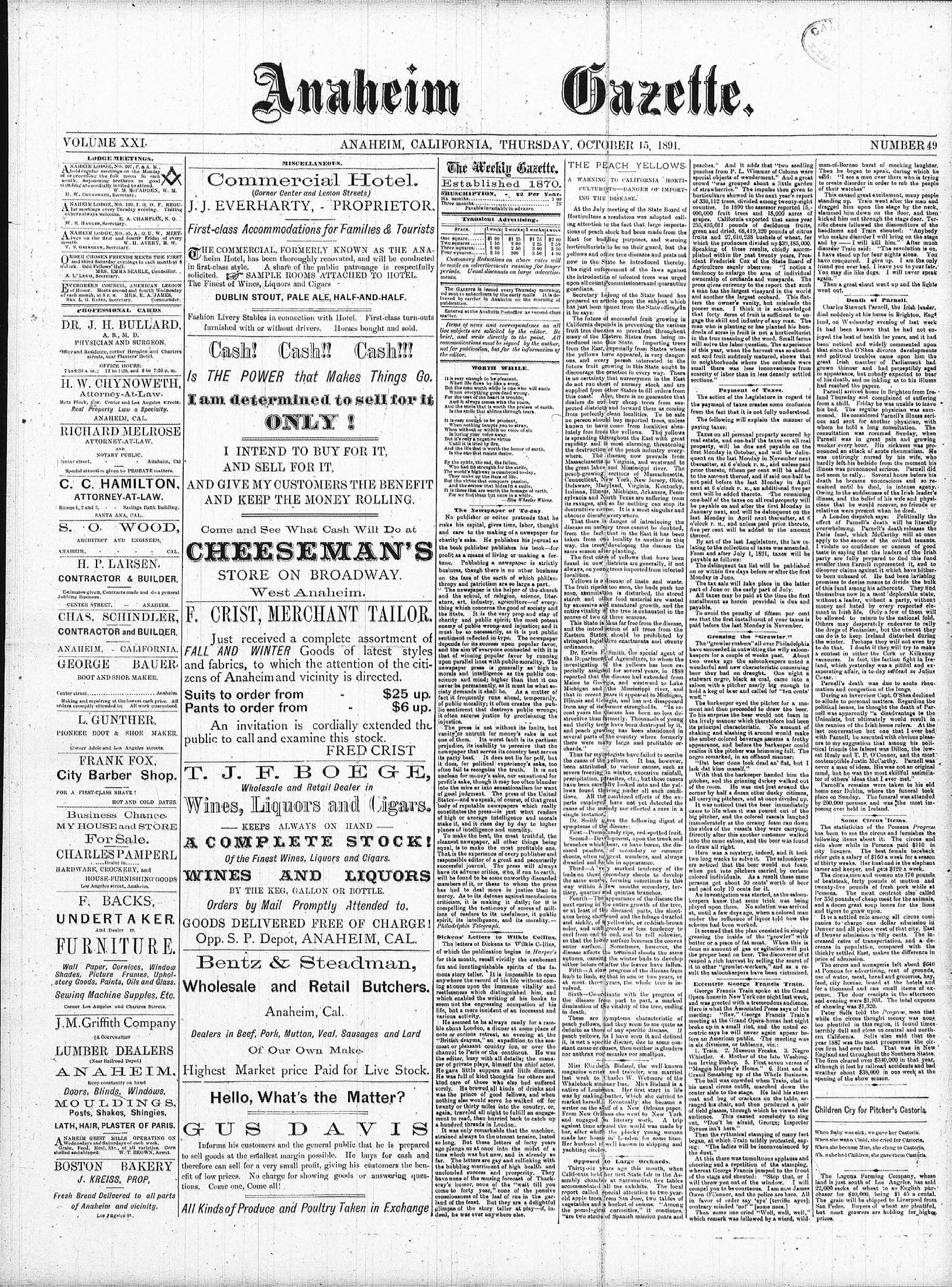
Searchable text
VOLUME XXI.
LODGE MEETINGS.
ANAHEIM LODGE, NO. 207, F. & A. M., hold regular meetings on the Monday of or preceding the full moon in each month. Sojourning brethren in good standing are cordially invited to attend. W. M. McFADDEN, W. M. H. W. CHYNOWETH, Secretary.
ANAHEIM LODGE, NO. 199, I. O. O. P. REGUARIAL meetings every Tuesday evening. Visiting others always welcome. E. A. CHAMPLIN, N. O. W. R. HARKER, Secretary.
ANAHEIM LODGE, NO. 85, A. O. U. W. MEETINGS on the first and fourth Friday of every month. W. H. AVERY, M. W. T. N. GRINSHAW, Secretary.
ORDER CHOSEN FRIENDS MEETS THE FIRST AND third Saturday evenings in each month at 8 o'clock. Odd Fellows Hall. MRS. EMMA SEARLE, Councillor. A. L.' LEWIS, Secretary.
EVERGREEN COUNCIL, AMERICAN LEGION OF Honor. Meets second and fourth Wednesday of each month, at S.P.M. MRS. E. A.JAMES, Mrs. L. G.HAYES, Secretary. Commander.
PROFESSIONAL CARDNS
DR. J. H. BULLARD.
A. B., M. D.
PHYSICIAN AND SURGEON.
Office and Residence, corner Hermine and Chartres streets, near Planters' Hotel.
OFFICE HOURS:
7 to 8:30 a.m.; 12 to 1:30, and 6 to 7:30 p.m.
H. W. CHYNOWETH,
Attorney-At-Law.
Metz Block, Cor. Center and Los Angeles streets.
Real Property Law a Specialty.
ANAHEIM, CAL.
RICHARD MELROSE
ATTORNEY-AT-LAW.
AND
NOTARY PUBLIC.
Center street, Anaheim, Cal.
Special attention given to PROBATE matters.
MISCELLANEOUS.
Commercial House
(Corner Center and Lemon Street)
First-class Accommodations for Family
THE COMMERCIAL, FORMERLY KNOWN Theim Hotel, has been thoroughly renovated, in first-class style. A share of the public patrol solicited. SAMPLE ROOMS ATTACHED The Finest of Wines, Liquors and Cigars
DUBLIN STOUT, PALE ALE, HALF
Fashion Livery Stables in connection with Hotel furnished with or without drivers.
Cash! Cash!!
Is THE POWER that Make I am determined to ONLY!
I INTEND TO BUY FOR AND SELL FOR IT,
H. W. CHYNOWETH,
Attorney-At-Law.
Metz Block, Cor. Center and Los Angeles streets.
Real Property Law a Specialty.
ANAHEIM, CAL.
RICHARD MELROSE
ATTORNEY-AT-LAW.
AND
NOTARY PUBLIC.
Center street,
Anaheim, Cal.
Special attention given to PROBATE matters.
C. C. HAMILTON,
ATTORNEY-AT-LAW.
Rooms 1, 2 and 3.
Savings Bank Building.
SANTA ANA, CAL.
S. O. WOOD,
ARCHITECT AND ENGINEER,
ANAHEIM, CAL.
H. P. LARSEN,
CONTRACTOR & BUILDER.
Estimates given, Contracts made and do a general
Jobbing Business.
CENTER STREET,
ANAHEIM.
CHAS. SCHINDLER,
CONTRACTOR and BUILDER.
ANAHEIM, CALIFORNIA.
GEORGE BAUER,
BOOT AND SHOE MAKER.
Center street...
Anaheim.
Making and repairing at the lowest cash price. All
orders promptly attended to. All work guaranteed.
L. GUNTHER,
PIONEER BOOT & SHOE MAKER.
Corner Adele and Los Angeles streets.
FRANK FOX,
City Barber Shop.
FOR A FIRST-CLASS SHAVE!
HOT AND COLD BATHS.
Business Chance.
MY HOUSE and STORE
For Sale.
CHARLESPAMPERL
Dealer in...
HARDWARE, CROCKERY, and
HOUSE-FURNISHING GOODS
Los Angeles street, Anaheim.
F. BACKS,
I am determined to
ONLY!
I INTEND TO BUY FOR
AND SELL FOR IT,
AND GIVE MY CUSTOMERS T
AND KEEP THE MONEY
Come and See What Cash
CHEESEM
STORE ON BROAD
West Anaheim
F. CRIST, MERCHANT
Just received a complete
FALL AND WINTER Goods of
and fabrics, to which the attent
zens of Anaheim and vicinity is
Suits to order from
Pants to order from
An invitation is cordially
public to call and examine this
T. J. F. BOI
Wholesale and Retail Dealer
Wines, Liquors and
KEEPS ALWAYS ON HA
A COMPLETE S
Of the Finest Wines, Liquors and
WINES AND L
BY THE KEG, GALLON OR B
Orders by Mail Promptly At
Business Chance.
MY HOUSE and STORE
For Sale.
CHARLES PAMPERL
Dealer in...
HARDWARE, CROCKERY, and
HOUSE-FURNISHING GOODS
Los Angeles street, Anaheim.
F. BACKS,
UNDERTAKER.
And Dealer in
FURNITURE.
Wall Paper, Cornices, Window
Shades, Picture Frames, Upholstery Goods, Paints, Oils and Glass.
Sewing Machine Supplies, Etc.
Corner Los Angeles and Chartres Streets.
J.M. Griffith Company
(A CORPORATION)
LUMBER DEALERS
(Near Railroad Depot)
ANAHEIM.
Keep constantly on hand
Doors, Blinds, Windows.
MOULDINGS.
Posts, Shakes, Shingies.
LATH, HAIR, PLASTER OF PARIS.
ANAHEIM GRIST MILLS OPERATING ON
Wednesdays and Saturdays of each week.
Grain, Feed, Meal, Etc., of all varieties. Corn
shelled and shipped.
W.T. BROWN, Agent.
BOSTON BAKERY
J. KREISS, PROP,
Fresh Bread Delivered to all parts
of Anaheim and vicinity.
Los Angeles St.
KEEPS ALWAYS ON HAIR
A COMPLETE SELECTION OF the Finest Wines, Liquors and
WINES AND LIVESTOCK
BY THE KEG, GALLON OR BOWTIE
Orders by Mail Promptly At
GOODS DELIVERED FREE OF CHARGE
Opp. S. P. Depot, ANAHEIM
Bentz & Stead
Wholesale and Retail
Anaheim, Cal.
Dealers in Beef, Pork, Mutton, Veal, Sauce
Of Our Own Make
Highest Market price Paid for
Hello, What's the MARKET?
GUS DALE
Informs his customers and the general public to sell goods at the smallest margin possible. He therefore can sell for a very small profit, giving him effit of low prices. No charge for showing goods tions. Come one, Come all!
All Kinds of Produce and Poultry Tak
ANAHEIM, CALIFORNIA, THURSDAY, OCTOBER 15, 1890
MISCELLANEOUS.
Commercial Hotel.
(Center and Lemon Streets)
PRTY, - PROPRIETOR.
Modations for Families & Tourists
FORMERLY KNOWN AS THE ANAthoroughly renovated, and will be conducted
share of the public patronage is respectfully
THE ROOMS ATTACHED TO HOTEL.
Horses and Cigars
, PALE ALE, HALF-AND-HALF.
connection with Hotel. First-class turn-outs
without drivers. Horses bought and sold.
Cash!! Cash!!!
R that Makes Things Go.
mined to sell for it
ONLY!
D TO BUY FOR IT,
L FOR IT,
The Weekly Gazette.
Established 1870.
SHUSCRIPTION, - 62 Per Year.
Six months... 1.00
Three months... 75
Parable in variably in advance.
Transient Advertising.
Space.
1 week
2 weeks
3 weeks
4 week
One square.... $1.00
Two squares.... 1.50
Three squares.... 2.00
Four squares.... 2.50
Customary Reductions on above rates will
be made on advertisements running for longer
periods. Usual discounts on large advertisements.
The Gazette is issued every Thursday morning,
and sent to subscribers by the early mails. It is deivered by carrier in Anaheim on the morning of
publication.
Entered at the Anaheim Postoffice as second-class
matter.
Items of news and correspondence on all
live subjects are solicited by the editor. Be
brief, and write directly to the point. All
communications must be signed by the author,
not for publication, but for the information of
the editor.
WORTH WHILE.
It is easy enough to be pleasant,
When life flows by like a song.
But the man worth while is one who will smile
When everything goes dead wrong.
For the test of the heart is trouble,
And it always comes with the years.
And the smile that is worth the praises of earth,
Is the smile that shines through tears.
It is easy enough to be prudent,
When nothing tempts you to stray,
When without or within no voice of sin
Is luring your voice away.
But it's only a negative virtue,
Until it tries by fire.
And the life that is worth the honor of earth,
Is the one that resists desire.
By the cynic, the sad, the fallen,
Who had no strength for the strife,
The world's highway is cumbersed to-day,
They make up the item of life.
THE PEACH YELLOW
A WARNING TO CALIFORNIA HORTICULTURES—DANGER OF IMPACTING THE DISEASE.
At the July meeting of the State Board,
Horticulture a resolution was adopted during attention to the fact that large impressions of peach stock had been made from East for budding purposes, and was horticulturists to be on their guard, less yellows and other tree diseases and pest now in the State be introduced there. The rigid enforcement of the laws against the introduction of infected trees was upon all county commissioners and quarrel guardians.
Secretary Leong of the State board prepared an article upon the subject which has just been issued from the State office; it he says:
The future of successful fruit growing in California depends in preventing the waxy fruit tree diseases so prevalent through many of the Eastern States from being produced into this State. Importing from the East, especially from States where the yellows have appeared, is very dangerous, and every person interested in future fruit growing in this State ought discourage the practice in every way. There is no certainty that nurserymen in the state do not run short of nursery stock and supplied from other States to fill orders this coast. Also, there is no guarantee that dealers do not buy cheap trees frompected districts and forward them as soon from perfectly clean localities. To be no person should buy imported trees, unless known to have come from localities a lately free from the yellows. The yield is spreading throughout the East with rapidity, and is most alarming, threatening the destruction of the peach industry everywhere. The disease now prevails in Massachusetts to Virginia, and westward to the great lakes and Mississippi river. Peach-growing sections of Massachusetts Connecticut New York New Jersey.
DUMMED to sell for it ONLY!
D TO BUY FOR IT,
E L FOR IT,
CUSTOMERS THE BENEFIT
THE MONEY ROLLING.
What Cash Will Do at SEMAN'S ON BROADWAY.
St Anaheim.
ERCHANT TAILOR.
And a complete assortment of ER Goods of latest styles which the attention of the citi- and vicinity is directed.
from $25 up.
from $6 up.
On is cordially extended the examine this stock.
FRED CRIST
BOEGE,
e and Retail Dealer in
lquors and Ciqars.
ALWAYS ON HAND —
LETE STOCK!
Wines, Liquors and Ciqars.
AND LIQUORS
G, GALLON OR BOTTLE.
Promptly Attended to.
The Newspaper of To-day.
No publisher or editor pretends that he raks his capital, gives time, labor, thought and care to the making of a newspaper for charity's sake. He publishes his journal as the book publisher publishes his book—for profit as a means of living or-making a fortune. Publishing a newspaper is strictly business, though there is no other business on the face of the earth of which philanthropy and patriotism are so large a part.
The newspaper is the helper of the church and the school, of relegion, science, literature, art, industry, agriculture—of everything which concerns the good of society and the State. It is the very prop and stay of charity and public spirit; the most potent enemy of public wrong and injustice; and it must be so necessarily, as it is put public sentiment reflected in type. The newspaper depends for its success upon popular favor, and the aim of everyone connected with it is that of winning popular favor by running upon parallel lines with public morality. The newspaper press is generally as high in morals and intelligence as the public conscience and mind; higher than that it can never be permanently, as it must be what society demands it shall be. As a matter of fact it frequently runs ahead, temporarily, of public morality; it often creates the public sentiment that destroys public wrongs; it often secures justice by proclaiming the injustice.
The press is not without its faults, but vanity or untruth for money's sake is not one of them. Its worst fault is its partisan prejudice, its inability to perceive that the newspaper that serves its country best serves its party best. It does not lie for self, but it does, for political experience's sake, too often fail to recognize the truth. It is not unclean for money's sake, nor secreal for profit's sake, though it may too often blunder into the mire or into sensationalism for want of good judgment. The press of the United States—and we speak, of course, of that great body of reputable newspapers which really constitutes the press—is just what readers of high or average intelligence and morals make it, and it rises day by day to higher planes of intelligence and morality.
To make the best, the most truthful, the cleanest newspaper, all other things being equal, is to make the most profitable one. That is the experience of every publisher and responsible editor of a great and pecuniarily successful journal. The press will always have its adverse critics, who, if run to earth, will be found to be some unworthy discarded members of it, or these to whom the press has had to deal more in justice than in mercy. As to its defense against mendacious criticism, it is making it daily; for it is compelling the testimony of scores of mill-
The disease now prevails in Massachusetts to Virginia, and westward the great lakes and Mississippi river. Peach-growing sections of Massachusetts, New York, New Jersey, Delaware, Maryland, Virginia, Kentucky Indiana, Illinois, Michigan, Arkansas, Pennsylvania and North Texas are suffering its ravages, and so far nothing can stop destructive course. It is a most singular obscure disease everywhere.
That there is danger of introducing disease on nursery trees cannot be doubt from the fact that in the East it has taken from one locality to another in way, the trees developing the disease same season after planting.
The first cases of yellows that have been found in new districts are generally, if always, on young trees imported from infested localities.
Yellows is a disease of haze and wind. The fruit ripens too soon, the buds push soon, assimilation is disturbed, the starch and other food material are wasted by excessive and unnatural growth, and entire vitality of the tree is exhausted in course of two or three seasons.
This Stato is thus far far from the dissection and the introduction of all trees from Eastern States should be prohibited stringent legislative enactments and ordinations.
Dr. Erwin F. Smith, the special agent in the Department of Agriculture, to whom investigation of the yellows has been specially assigned for several years, in reported that the disease had extended Maine to Georgia, and westward to Michigan and the Mississippi river., that in recent years it appeared in Michigan Illinois and Georgia, and has not disappeared from any of its former strengths. "In recent years the disease has been no less structive than formerly. Thousands of yelows and thrifty trees have been destroyed by and peach growing has been abandoned several parts of the country where forms there were many large and profitable chards."
Thus far mycologists have failed to ascertain the cause of the yellows. It has, however been attributed to various causes, such severe freezing in winter, excessive rain precipitation, parasites, etc., but these can have been carefully looked into and they low found thriving under all such conditions. All the combined efforts of the ports employed have not yet detected cause of the unsudy nor effected a cure in single instance.
Dr. Smith gives the following digests symptoms of the disease:
First—Prematurely ripe, red-spotted fry.
Second—Development upon the trunk branches which bear, or have borne,the caused peaches of secondary or sun shoots, often in great numbers, and almost dwarfed and foible in appearance.
Third—a very marked tendency of buds on these secondary shoots to die in same season forming sometimes in way within a few months secondary tiary, quartan and quintan branches.
Fourth—the appearance of the disease next spring in the entire growth of the t
ALWAYS ON HAND —
DELETE STOCK!
Wines, Liquors and Cigars.
AND LIQUORS
GALLON OR BOTTLE.
Promptly Attended to.
RED FREE OF CHARGE!
Boot, ANAHEIM, CAL.
Steadman,
and Retail Butchers.
naheim, Cal.
Mutton, Veal, Sausages and Lard
our Own Make.
price Paid for Live Stock.
what's the Matter?
DAVIS
and Poultry Taken in Exchange
To make the best, the most truthful, the cleanest newspaper, all other things being equal, is to make the most profitable one. That is the experience of every publisher and responsible editor of a great and pecunarily successful journal. The press will always have its adverse critics, who, if run to earth, will be found to be some unworthy discarded members of it, or those to whom the press has had to deal more in justice than in mercy. As to its defense against mendacious criticism, it is making it daily; for it is compelling the testimony of scores of millions of readers to its usefulness, it public spirit, its intelligence, and its morality.—Philadelphia Telegraph.
Dickens' Letters to Wilkie Collins.
The letters of Dickens to Wilkie Collins, of which the publication begins in Harper's for this month, recall vividly the exuberant fun and inexistingly spirits of the famous story teller. It is impossible to open anywhere the record of his life without coming at once upon the immense vitality and restlessness which distinguished him, and which enabled the writing of his books to seem not the engrossing occupation of his life, but a mere incident of an incessant and various activity.
He seemed to be always ready for a ramble about London, a dinner at some place of note or curious retreat, an evening at the "British drayma," an expedition to the seacoast or pleasant country inn, or over the channel to Paris or the continent. He was the editor, busy with all details; the manager of private plays, himself the chief actor. He gave little suppers and little dinners. He was full of kind thoughts for others and kind care of those who also had suffered sorely. He browed all kinds of drinks and was the prince of good fellows, and when nothing else would serve he walked off for twenty or thirty miles into the country, or, again, traveled all night to fulfill an engagement to read, then hurried back to catch up a hundred threads in London.
It was only remarkable that the machine, strained always to the utmost tension, lasted so long. But these letters of forty years ago plunge us at once into the midst of a time which was but now, and is already so far. The letters are gay and rollicking with the bubbling merriment of high health and unclouded success and prosperity. They have none of the musing forecast of Thackeray's humor, none of the "wait till you come to forty year," none of the pensive consciousness of the leaf of rue in the garland of the feast. But they are a delightful glimpse of the story teller at play—if indeed, he was ever anywhere else.
Dr. Smith gives the following digestion symptoms of the disease:
First—Prematurely ripe, red-spotted fry.
Second—Development upon the trunk branches which bear, or have borne, the caused peaches, of secondary or sun-shoots, often in great numbers, and allow dwarfed and foible in appearance.
Third—a very marked tendency of buds on these secondary shoots to develop the same season, forming sometimes in a way within a few months secondary, tiary, quartan and quintan branches.
Fourth—the appearance of the disease next spring in the entire growth of the tree or at least of the diseased parts, the shape being shortened and the foliage dwindling and sickly, of yellowish, or reddish-brown color, with greater or less tendency curl from end to end, and to roll sideways so that the lower surface becomes the computer surface. Sometimes however, disease affects the terminal shoots she autumn, causing the winter buds to develop either before or after the leaves have fallen.
Fifth—a slow progress of the disease limb to limb, so that in one or two years at most three years, the whole tree is involved.
Sixth—Co-ordinate with the progress of the disease from part to part, a maritime diminution of the vitality of the tree, end in death.
These are symptoms characteristic peach yellows, and they seem to me quite definite as those of any specific disease. Peach yellows, as I have seen it and defined it, is not a specific disease, due to some atlant cause or causes, then neither is gland nor anthrax nor measles smallpox.
Miss Elizabeth Bisland, the well-known magazine writer and traveler, was married last week to Charles W. Wetmore of Whaleback steamer line. Miss Bisland is native of Louisiana. Her first start in life was by making butter, which she carried market herself. Eventually she became writer on the staff of a New Orleans pay from New Orleans she went to New York and engaged in literary work. Against time around the world was made her after which she plucked young wood made her home in London for some time. Her husband is well known in shipping yachtings circles.
Opposed to Large Orchards.
Thirty-six years ago this month, we California held her first State fair in the semblably chambers at Sacramento, five times accommodated all the exhibits. The report called special attention to two-year-old apple trees from San Jose, two tables vegetables and a bucket of onions. "Amor the pomological cariosites," it continues "are two stems of Spanish mission pears."
PEACH YELLOWS.
BURGERS—DANGER OF IMPORTATION DISEASE.
A timely meeting of the State Board of Agriculture was adopted call to the fact that large importation stock had been made from the budding purposes, and warning lists to be on their guard, lest the other tree diseases and pests not in State be introduced thereby. Enforcement of the laws against infested trees was urged by county commissioners and quarantine officers of the State board has articled upon the subject which can be issued from the State office. In case of successful fruit growing in depends in preventing the various diseases so prevalent throughout Eastern States from being imported to this State. Importing trees must, especially from States where they have appeared, is very dangerous every person interested in the growth in this State ought to take the practice in every way. There is that nurserymen in the East short of nursery stock and are from other States to fill orders from them. Also, there is no guarantee that not buy cheap trees from suscians and forward them as coming strictly localities. To be safe should buy imported trees, unless have come from localities absent from the yellows. The follows throughout the East with great aid is most alarming, threatening the peach industry everywhere; disease now prevails from Texas to Virginia, and westward to Arkansas and Mississippi river. The sections of Massachusetts, New York, New Jersey, Ohio peaches." And it adds that "two seedling peaches from P. L. Wimmer of Coloma were special objects of wenderment." And a great crowd "was grouped about a little garden of strawberries." The impulse then given to horticulture showed in the next year's report of 330,112 trees, divided among twenty-eight counties. In 1890 the assessor reported 15,000,000 fruit trees and 18,000 acres of grape. California exported that same year 255,495,011 pounds of deciduous fruits, green and dried, 68,419,320 pounds of citrus fruits and 27,610,238 bushels of wheat, for which the producers divided up $29,185,000. Speaking of these results, chiefly accomplished within the past twenty years, President Frederick Cox of the State Board of Agriculture sagely observes: "I notice a tendency to enlarge the area of individual ownership of orchards and vineyards. The press gives currency to the report that such a man has the largest vineyard in the world and another the largest orchard. This flatters the owner's vanity, but misleads the poorer man. I think it is acknowledged that forty acres of fruit is sufficient to engage the skill and industry of any man. The man who is planting or has planted his hundreds of acres in fruit is not a horticulturist in the true meaning of the word. Small farms will solve the labor question. The experience of this year, when the harvest was so abundant and fruit suddenly matured, shows that in neighborhoods where the orchards were small there was less inconvenience from scarcity of labor than in less densely settled sections."
Payment of Taxes.
The action of the Legislature in regard to the payment of taxes creates some confusion from the fact that it is not fully understood.
The following will explain the manner of paying taxes:
Taxes on all personal property secured by real estate, and one-half the taxes on all real property, will be due and payable on the first Monday in October, and will be delinquent on the last Monday in November next thereafter, at 6 o'clock P.M., and unless paid prior thereto, fifteen per cent will be added to the amount thereof, and if said one-half be man-of-Borneo burst of mocking laughter. Then he began to speak during which he said: "I see a man over there who is trying to create disorder in order to rob the people of their watches."
This caused great excitement, many people standing up. Train went after the man and dragged him upon the stage by the neck, slammed him down on the floor, and then kicked him out through the stage door. Terrific cheers followed the discomfiture of the headlums and Train shouted: "Anybody who makes disorder I will bring on the stage and by——I will kill him." After much disorder Train said: "The revolution is on. I have stood up for four nights alone. You have conquered. I give up. I am the only friend you ever had. I leave you to your fate. You may die like dogs. I will never speak again."
Then a great shout went up and the lights went out.
Denth of Farnell.
Charles Stewart Parnell, the Irish leader, died suddenly at his home in Brighton, England, on Wednesday evening of last week. It had been known that he had not enjoyed the beat of health for years, and it had been noticed and widely commented upon that since the O'Shea divorce developments and political troubles came upon him the great Irish member of Parliament had grown thinner and had perceptibly aged in appearance, but nobody expected to hear of his death, and no inkling as to his illness had resolved the papers.
Parnell arrived home in Brighton from Ireland Thursday and complained of suffering from a chill. Friday he was unable to leave his bed. The regular physician was summoned. He considered Parnell's illness serious and sent for another physician, with whom he held a long consultation. The consultation was resumed Sunday, when Parnell was in great pain and growing weaker every hour. His sickness was pronounced an attack of acute rheumatism. He was uninterrupted nursed by his wife, who hardly left his bedside from the moment his illness was pronounced serious. Parnell did not seem to rally. Several hours before his death he went up.
New York New Jersey Ohio
In the danger of introducing the nursery trees cannot be doubted, and so far nothing can stop its course. It is a most singular and rare everywhere.
The disease of haste and waste, too soon, the buds push too fast is disturbed, the stored other food material are damaged and unnatural growth, and the way of the tree is exhausted in the two or three seasons.
Thus far free from the disease, production of all trees from the state should be prohibited by legislative enactments and county F. Smith, the special agent of the State of Agriculture, to whom the yellow has been assigned for several years, in 1858 the disease had extended from Georgia, and westward to Lake Huron, the Mississippi river, and out years it appeared in Michigan, Georgia, and has not disappeared since former strongholds.
In these diseases have been no less dangerous formerly. Thousands of young trees have been destroyed by it, rowing has been abandoned in the country where formerly many large and profitable orchardologists have failed to ascribe the yellows. It has, however, been tested to various causes, such as winter, excessive rainfall, parasites, etc., but these causes freely looked into and the yelldriving under all such conditions combined efforts of the ex-eyes have not yet detected the malady nor effected a cure in a race.
Gives the following digest of the disease:
1. Curiously ripe, red-spotted fruit development upon the trunk and bark bear, or have borne, the diseases of secondary or summer form great numbers, and always favorable in appearance.
2. Very marked tendency of the new shoots to develop forming sometimes in this few months secondary, turbid and quintan branches.
3. The appearance of the disease the entire growth of the tree,
**Payment of Taxes.**
The action of the Legislature in regard to the payment of taxes creates some confusion from the fact that it is not fully understood.
The following will explain the manner of paying taxes:
Taxes on all personal property secured by real estate, and one-half the taxes on all real property, will be due and payable on the first Monday in October, and will be delinquent on the last Monday in November next thereafter, at 6 o'clock P.M., and unless paid prior thereto, fifteen per cent will be added to the amount thereof, if said one-half be not paid before the last Monday in April next at 6 o'clock P.M., an additional five per cent will be added thereto. The remaining one-half of the taxes on all real property will be payable on and after the first Monday in January next, and will be delinquent on the last Monday in April next thereafter, at 6 o'clock P.M., and unless paid prior thereto, five per cent will be added to the amount thereof.
By act of the last Legislature, the law relating to the collection of taxes was amended. From and after July 1, 1891, taxes will be payable as follows:
The delinquent tax list will be published on or within five days before or after the first Monday in June.
The tax sale will take place in the latter part of June or the early part of July.
All taxes may be paid at the time the first installment as herein provided is due and payable.
To avoid the penalty of fifteen per cent see that the first installment of your taxes is paid before the last Monday in November.
**Grenasing the "Growler."**
The "growler rushes" all over Philadelphia have succeeded in outwitting the wily saloonkeepers for a couple of weeks past. About two weeks ago the saloonkeepers noted a wonderful and new characteristic concerning beer they had on draught. One night a stalwart negre, black as coal, came into a saloon with a pitcher nearly big enough to hold a keg of beer and called for "ten cents' wuff."
The barkeeper eyed the pitcher for a moment and then proceeded to draw the beer. To his surprise the beer would not foam in the lively manner which therefore had been its principal characteristic. No amount of shaking and slashing it around would make the amber-colored beverage assume a frothy appearance, and before the barkeeper could realize it the pitcher was brimming full. The negro remarked, in an offhand manner:
"Dat beer done look dead an' flat, but I lak dat kine masself."
With that the barkeeper handed him the pitcher, and the grinning darley walked out of the room. He was met just around the corner by half a dozen other dusky citizens, all carrying pitchers, and at once divided up.
It was noticed that the beer immediately came to life when it was poured out of the big pitcher, and the colored rascals laughed immidaneously as the creamy foam ran down the sides of the vessels they were carrying. Directly after this another customer walked into the same saloon, and the beer was found to draw all right.
Here was a mystery, indeed, and it took two long weeks to solve it. The saloonkeepers noticed that the beer would not foam when put into pitchers carried by certain colored individuals. As a result these same persons got about 50 cents' worth of beer and paid only 10 cents for it.
An investigation was started, as the saloonkeepers knew that some trick was being played upon them. No solution was arrived
Parnell arrived home in Brighton from Ireland Thursday and complained of suffering from a chill. Friday he was unable to leave his bed. The regular physician was summoned. He considered Parnell's illness serious and sent for another physician, with whom he held a long consultation. The consultation was resumed Sunday, when Parnell was in great pain and growing weaker every hour. His sickness was pronounced an attack of acute rheumatism. He was untiringly nursed by his wife, who hardly left his bedside from the moment his illness was pronounced serious. Parnell did not seem to rally. Several hours before his death he became unconscious and so remained until he died, in intense agony. Owing to the suddenness of the Irish leader's illness, and the belief of his wife and physicians that he would recover, no friends or relatives were present when he died.
A London dispatch says: Politically the effect of Parnell's death will be literally overwhelm. Parnell's death releases the Paris fund, which McCarthy will at once apply to the succor of the evicted tenants. I violate no confidence or cannon of good taste in saying that the leaders of the Irish party are fully prepared to find this fund smaller than Parnell represented it, and to discover claims against it which have hitherto been unheard of. He had been lavishing promises to devise means to divide the bulk of this fund among his adherents. They find themselves now in a most deplorable state without a leader, without a party, without money and hated by every respected element in Irish life. Only a few of them will be allowed to return to the national fold. Others may desperately endeavor to rally the dregs of Fenianism, but the utmost they can do is to keep Ireland disturbed during the winter. Perhaps they will not even try to do that. I doubt if they will try to make a contest in either the Cork or Killeeny vacancies. In fact, the faction fight in Ireland, which yesterday was a pitiful and exasperating affair, is to-day as dead as Julius Caesar.
Parnell's death was due to acute rheumatism and congestion of the lungs.
During an interview Capt. O'Shea declined to allude to personal matters. Regarding political issues, he thought the death of Parnell was apparently "a disadvantage to the Unionists, but ultimately would result in the reunion of the Irish home rulers. At the last conversation one that I ever had with Parnell; he asserted with obvious pleasure to my suggestion that among his political friends the falestar was Dillon, the lowest Healy and T. P. O'Connor, and the most contemptible Justin McCarthy. Parnell was never a man of ideas. His was not an original mind, but he was the most skillful assimilator of others' ideas that I ever met.
Parnell's remains were taken to his old home near Dublin, where the funeral took place on Sunday. The funeral was attended by 200,000 persons, and was the most imposing ever held in Ireland.
Some Circus Items.
The statistician of the Pomena Progress has been able to see the circus and furnishes the following items about it: The circus and side show while in Pomena paid $110 in city licenses. The best female bareback rider gets a salary of $160 a week for a season of thirty weeks. Her husband is the elephant tamer and keeper, and gets $120 a week.
The circus men and women ate 170 pounds of beefsteak, fifty pounds of mutton and twenty-five pounds of fresh pork while at Pomena. The meat contract also called for 350 pounds of cheap meat for the animals, and a dozen great soup bones for the lions
Some Circus Items.
The statistician of the Pomena Progress has been to see the circus and furnishes the following items about it: The circus and side show while in Pomona paid $110 in city licenses. The best female barback rider gets a salary of $160 a week for a season of thirty weeks. Her husband is the elephant tamer and keeper, and gets $120 a week.
The circus men and women ate 170 pounds of beefsteak, forty pounds of mutton and twenty-five pounds of fresh pork while at Pomona. The meat contract also called for 350 pounds of cheap meat for the animals, and a dozen great soup bones for the lions and tigers to gnaw upon.
It is a settled rule among all circus companies to charge one dollar admission in Denver and all places west of that city. East of Denver admission is fifty cents. The increased rates of transportation, and a decrease in population, compared with the thickly settled East, makes the difference in price of admission.
The circus and menagerie left about $640 at Pomona for advertising, rent of grounds, use of water, meat, bread and groceries, hay, feed, city license, board at the hotels and for a thousand and one small items of expense. The door receipts in the afternoon and evening were $1,931. The total expense of showing was $1,320.
Peter Sells told the Progress man that while the circus thought money was none too plentiful in this region, it found times terribly dull and close in central and northern California. Sells also said that the year 1887 was the most prosperous the circus firm had ever had. That was in New England and throughout the Southern States. The firm cleared over $340,000 in that year, although it lost by railroad accidents and bad weather about $38,000 in one week at the opening of the show season.
Children Cry for Pitcher's Castoria
When Baby was sick, we gave her Castoria.
When she was a Child, she cried for Castoria.
When she became Miss, she clung to Castoria.
When she had Children, she gave them Castoria.
The Laguna Farming Company, whose land is just south of Los Angeles, has sold 22,000 sacks of wheat to an English purchaser for $40,000, being $1.45 a cent. The grain will be shipped to Liverpool from San Pedro. Buyers of wheat are plentiful, but most growers are holding for higher prices.