anaheim-gazette 1891-05-21
Scanned page
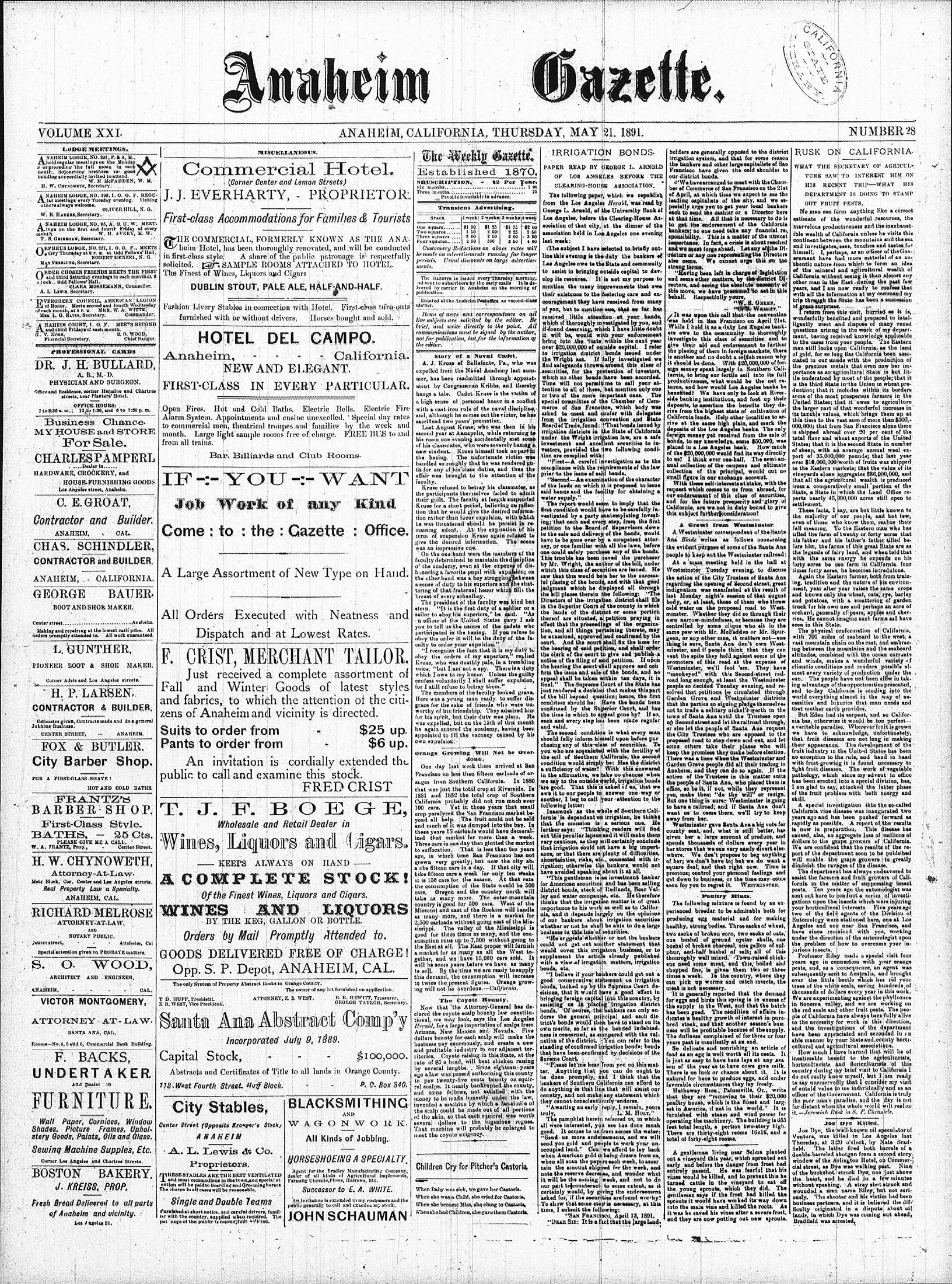
Searchable text
VOLUME XXI.
LODGE MEETINGS.
ANAHEIM LODGE, NO. 207, F. & A. M., hold regular meetings on the Monday or preceding the full moon in each month. Sojourning brethren in good standing are cordially invited to attend. W. M. McPADDEN, W. M. H. W. Chyneworth, Secretary.
ANAHEIM LODGE, NO. 199, I. O. O. F. REGULAR meetings every Tuesday evening. Visiting others always welcome. OLIVER HILL, N. O. W. R. HARKER, Secretary.
ANAHEIM LODGE, NO. 85, A. O. U. W. MEETings on the first and fourth Friday of every month. W. H. AVERY, M. W. T. S. GRIMSHAW, Secretary.
ORPHEUS LODGE, NO. 237, I. O. O. F., MEETs every Thursday at 8 p.m. at Odd Fellows Hall. ROBERT MENZEL, N. O. MAX NEBRUUNG, Secretary.
ORDER CHOSEN FRIENDS MEETS THE FIRST and third Saturday evenings in each month at 8 o'clock. Odd Fellows' Hall.
CLARA MOSSEMANN, Counsellor.
A. L. Lewis, Secretary.
EVERGREEN COUNCIL, AMERICAN LEGION of Honor. Meet second and fourth Wednesday of each month, at 8 p.m. Mrs. W. A. WITTE, Mrs. L. O. BATES, Secretary.
Commander.
ANAHEIM COURT, I. O. F., MEETS SECOND and third Fridays of each month.
G. V. Horn, S. O. WOOD, Financial Secretary.
Chief Ranger.
PROFESSIONAL CARDS
DR. J. H. BULLARD,
A. B., M. D.
PHYSICIAN AND SURGEON.
Office and Residence, corner Hermine and Chartres streets, near Planters' Hotel.
OFFICE HOURS:
7 to 8:30 a.m.; 12 to 1:30, and 6 to 7:30 p.m.
Business Chance MY HOUSE and STORE For Sale.
CHARLESPAMPERL ... Dealer in... HARDWARE, CROCKERY, and
MISCELLANEOUS.
Commercial Hotel
(Corner Center and Lemon Streets)
J.J.EVERHARTY, - PROPERTY
First-class Accommodations for Families
THE COMMERCIAL, FORMERLY KNOWN Athem Hotel, has been thoroughly renovated, and will in first-class style.
A share of the public patronage solicited.
SAMPLE ROOMS ATTACHED TO The Finest of Wines, Liquors and Cigars
DUBLIN STOUT, PALE ALE, HALF-AND-Fashion Livery Stables in connection with Hotel.
Furnished with or without drivers.
Horses bought
HOTEL DEL CAMP
Anaheim,
NEW AND ELEGANT.
FIRST-CLASS IN EVERY PART
Open Fires. Hot and Cold Baths. Electric Bells.
Alarm System. Appointments and ensuine unexcelled.
'S to commercial men, theatrical troupes and families by month.
Large light sample rooms free of charge.
From all trains.
Bar.Billiards and Club Room
PHYSICIAN AND SURGEON.
Office and Residence, corner Hermine and Chartres streets, near Planters' Hotel.
OFFICE HOURS:
7 to 8:30 a.m.; 12 to 1:30, and 6 to 7:30 p.m.
Business Chance.
MY HOUSE and STORE
For Sale.
CHARLESPAMPERL
Dealer in...
HARDWARE, CROCKERY, and
HOUSE-FURNISHING GOODS
Los Angeles street, Anaheim.
C. E. GROAT,
Contractor and Builder.
ANAHEIM, CAL.
CHAS. SCHINDLER,
CONTRACTOR and BUILDER.
ANAHEIM, CALIFORNIA.
GEORGE BAUER
BOOT AND SHOE MAKER.
Center street...Anaheim.
Making and repairing at the lowest cash price. All orders promptly attended to. All work guaranteed.
L. GUNTHER,
PIONEER BOOT & SHOE MAKER.
Corner Adele and Los Angeles streets.
H. P. LARSEN,
CONTRACTOR & BUILDER.
Estimates given. Contracts made and do a general Jobbing Business.
CENTER STREET, ANAHEIM.
FOX & BUTLER.
City Barber Shop.
FOR A FIRST-CLASS SHAVE!
HOT AND COLD BATHS.
FRANTZ'S
BARBER SHOP.
First-Class Style.
BATHS, - 25 Cts.
PLEASE GIVE ME A CALL.
W. A. FRANTZ, Prop., Center Street.
H. W. CHYNOWETH,
Attorney-At-Law.
Metz Block, Cor. Center and Los Angeles streets.
Real Property Law a Specialty.
ANAHEIM, CAL.
FIRST-CLASS IN EVERY PART
Open Fires. Hot and Cold Baths. Electric Bells.
Alarm System. Appointments and enqueue unexcelled. 'S to commercial men, theatrical troupes and families by month. Large light sample rooms free of charge. FR from all trains.
Bar. Billiards and Club Room
IF :: YOU :: WA
Job Work of any
Come : to : the : Gazette :
A Large Assortment of New Type
All Orders Executed with Neat Dispatch and at Lowest Rate
F. CRIST, MERCHANT T
Just received a complete assoc Fall and Winter Goods of late and fabrics, to which the attention zens of Anaheim and vicinity is direct
Suits to order from
Pants to order from
An invitation is cordially ext public to call and examine this stock
FRED C
T. J. F. BOE
Wholesale and Retail Dealer in Wines, Liquors and ()
KEEPS ALWAYS ON HAND
A COMPLETE ST
Of the Finest Wines, Liquors and Cigars
BARBER SHOP.
First-Class Style.
BATHS, — 25 Cts.
PLEASE GIVE ME A CALL.
W. A. FRANTZ, Prop., Center Street.
H. W. CHYNOWETH,
Attorney-At-Law.
Metz Block, Cor. Center and Los Angeles streets.
Real Property Law a Specialty.
ANAHEIM, CAL.
RICHARD MELROSE
ATTORNEY-AT-LAW.
AND
NOTARY PUBLIC.
Jauter street, Anaheim, Cal.
Special attention given to PROBATE matters.
S. O. WOOD,
ARCHITECT AND ENGINEER,
ANAHEIM, CAL.
VICTOR MONTGOMERY,
ATTORNEY-AT-LAW.
SANTA ANA, CAL.
Rooms—No.4, 5 and 6, Commercial Bank Building.
F. BACKS,
UNDERTAKER.
And Dealer in
FURNITURE.
Wall Paper, Cornices, Window Shades, Picture Frames, Upholstery Goods, Paints, Oils and Glass.
Sewing Machine Supplies, Etc.
Corner Los Angeles and Chartres Streets.
BOSTON BAKERY.
J. KREISS, PROP,
Fresh Bread Delivered to all parts of Anaheim and vicinity.
Los Angeles St.
T. J. F. BOE
Wholesale and Retail Dealer in
Wines, Liquors and (1)
KEEPS ALWAYS ON HAND
A COMPLETE ST
Of the Finest Wines, Liquors and Cigar
WINES AND LIQ
BY THE KEG, GALLON OR BOTTL
Orders by Mail Promptly Attend
GOODS DELIVERED FREE OF O
Opp. S. P. Depot, ANAHEIM
The only System of Property Abstract Books in Orange County.
The owner of any lot furnished.
T. D. HUFF, President.
ATTORNEY, Z. B. WEST.
R. E. HILL GEORGE
Santa Ana Abstract City Incorporated July 9, 1889.
Capital Stock,
Abstracts and Certificates of Title to all lands in Orla
113, West Fourth Street. Huff Block.
City Stables,
Center Street (Opposite Kranger's Block),
ANAHEIM
A. L. Lewis & Co.
Proprietors.
THESE STABLES ARE THE BEST VENTILATED
and most commodious in the town and special atention will be paid to Boarding and Grooming horses.
The charre in all cases will be reasonable.
Single and Double Teams
Furnished at short notice, and careful drivers familiar with the country, supplied when required. The pat nage of the public is respectful collected.
BLACKSMITH
AND
WAGON
All Kinds of
HORSESHOEING
Agent for the Bradley Madeer of all kinds of AgriFarming Utensils, Plows, HarSuccessor to E.
An invitation is extended to public generally to call and c
ANAHEIM, CALIFORNIA, THURSDAY, MAY 21, 1891.
Special Hotel.
(and Lemon Streets)
NY, - PROPRIETOR:
ions for Families & Tourists
ERLY KNOWN AS THE ANAghly renovated, and will be conducted
the public patronage is respectfully
ITS ATTACHED TO HOTEL.
Cigars
E ALE, HALF-AND-HALF.
ion with Hotel. First-class turn-outs
ivers. Horses bought and sold.
EL CAMPO.
California.
O ELEGANT.
EVERY PARTICULAR.
Paths. Electric Bells. Electric Fire
cusine unexcelled. Special day rates
tapes and families by the week and
free of charge. FREE BUS to and
and Club Rooms.
The Weekly Gazette.
Established 1870.
SNUSCRIPTION: $2 Per Year.
Three months. 75 Payclable invariably in advance.
Transient Advertising.
STACK.
1 week
2 weeks
3 weeks
4 week
One square.... $1 00
Two squares... $1 25
Three squares... $1 75
Four squares... $2 00
Customary Reductions on above rates will
be made on advertisements running for longer
periods. Usual discounts on large advertisements.
The Gazette is issued every Thursday morning,
and sent to subscribers by the early mails. It is
delivered by carrier in Anaheim on the morning of
publication.
Entered at the Anaheim Postoffice as second-class
matter.
Items of news and correspondence on all live subjects are solicited by the editor. Be brief, and write directly to the point. All communications must be signal by the author, not for publication, but for the information of the editor.
Story of a Naval Cadet.
A. J. Kruez of Bellefonte, Pa., who was expelled from the Naval Academy last summer, has been readmitted through appointment by Congressman Kribbs, and thereby hangs a tale. Cadet Kruez is the victim of a high sense of personal honor in a conflict with a cast-iron rule of the naval discipline, and, although he comes out the victor, he has sacrificed two years' promotion.
Last August Kruez, who was then in his second year at Annapolis, while returning to his room one evening accidentally met some of his classmates, who were severely hazing a new student. Kruez himself took no part in the hazing. The unfortunate victim was handled so roughly that he was rendered unfit for any of his class duties, and thus the affair was brought to the attention of the IRRIGATION BONDS.
PAPER READ BY GEORGE L. ARNOLD OF LOS ANGELES BEFORE THE CLEARING-HOUSE ASSOCIATION.
The following paper, which we republish from the Los Angeles Herald, was read by George L. Arnold, of the University Bank of Los Angeles, before the Clearing-House Association of that city, at the dinner of the association held in Los Angeles one evening last week:
The subject I have selected to briefly outline this evening is the duty of the bankers of Los Angeles owe to the State and community to assist in bringing outside capital to develop its resources. It is not my purpose to mention the many improvements that owe their existence to the fostering care and encouragement they have received from many of you, but to mention one, that far has received little attention at your hands, which if thoroughly investigated by you, and if found deserving, which I have little doubt it will be, would with your endorsement bring into the State within the next year over $20,000,000 of outside capital. I refer to irrigation district bonds issued under the Wright set. If fully investigated we find safeguards thrown around this class of securities, for the protection of investors, which no other bonds have been accorded. Time will not permit me to call your attention to all of these, but mention only one or two of the more important ones. The special committee of the Chamber of Commerce of San Francisco, which body was asked to meet and confer with delegates from the irrigation convention and State Board of Trade, found: That bonds issued by irrigation districts in the State of California under the Wright irrigation law, are a safe investment and excellent securities to investors, provided the two following condition are complied with:
"First—A careful investigation as to the compliance with the requirements of the law prior to the issue of said bonds."
EVERY PARTICULAR
methods. Electric Bells. Electric Fire
engine unexcelled. Special day rates
tapes and families by the week and
free of charge. FREE BUS to and
and Club Rooms.
WANT
of any Kind
Gazette : Office.
of New Type on Hand.
d with Neatness and
at Lowest Rates.
CHANT TAILOR.
complete assortment of
Goods of latest styles
the attention of the citivicinity is directed.
$25 up.
$6 up.
cordially extended the
mine this stock.
FRED CRIST
BOEGE,
Retail Dealer in
Cars and Liquors.
DAYS ON HAND —
TE STOCK!
Liquors and Cigars.
Ornage Growing Will Not be Overdone.
One day last week there arrived at San Francisco no less than fifteen carloads of oranges from Southern California. In 1880 that was just the total crop at Riverside. In 1881 and 1882 the total crop of Southern California probably did not run much ever 100 cars. Yet in those years that small crop paralyzed the San Francisco market beyond all help. The fruit could not be sold and much of it was dumped into the bay. In these years 15 carloads would have demoralized that market for more than a week. Three cars in one day then glutted the market to suffocation. That is less than ten years ago, in which time San Francisco has not grown very greatly; but now the city abuses fifteen cars in a day. If that city will take fifteen cars a week for only ten weeks it is 150 cars for the season. At that rate the consumption of the State would be 500 cars. Oregon and the country north will take as many more. The enter-mountain country is good for 500 cars. West of the mer, has been readmitted through appointment by Congressman Kribbe, and thereby hangs a tale. Cadet Krueis is the victim of a high sense of personal honor in a conflict with a cast-iron rule of the naval discipline, and, although he comes out the victor, he has ascribed two years' promotion.
Last August Krueis, who was then in his second year at Annapolis, while returning to his room one evening accidentally met some of his classmates, who were severely hazing a new student. Krueis himself took part in the hazing. The unfortunate victim was handled so roughly that he was rendered unfit for any of his class duties, and thus the affair was brought to the attention of the faculty.
Kruse refused to betray his classmaster, as the participants themselves failed to admit their guilt. The faculty at length suspended Kruse for a short period, believing on reflection that he would give the desired information rather than incur expulsion, with which he was threatened should be persisted in remaining silent. At the expiration of his term of suspension Krueis again refused to give the desired information. The scene was an impressive one.
On the one hand were the members of the faculty determined to maintain the discipline of the academy, even at the expense of dishonoring a favorite pupil with expulsion; on the other hand was a boy struggling between a sense of duty to his superiors and the shattering of that fraternal honor which fills the breast of every schoolboy.
The president of the faculty was kind but stern. "It is the first duty of a soldier or a sailor to obey his superiors," he said. "As an officer of the United States navy I ask you to tell us the names of the cadets who participated in the hazing. If you refuse to obey the order it will be the duty of the faculty to order your expulsion."
"I recognize the fact that it is my duty to obey the orders of my superiors," replied Krueis, who was deathly pale, in a trembling voice, "but I am not a spy. There is a duty which I owe to my honor. Unless the guilty confess voluntarily I shall suffer expulsion, for I still refuse to betray them."
The members of the faculty looked grave. Here was a young man ready to suffer disgrace for the sake of friends who were unworthy of his friendship. They admired him for his spirit, but their duty was plain. He was expelled, but on the 15th of this month he again entered the academy, having been appointed to fill the vacancy caused by his own expulsion.
Ornage Growing Will Not be Overdone.
One day last week there arrived at San Francisco no less than fifteen carloads of oranges from Southern California. In 1880 that was just the total crop at Riverside. In 1881 and 1882 the total crop of Southern California probably did not run much ever 100 cars. Yet in those years that small crop paralyzed the San Francisco market beyond all help. The fruit could not be sold and much of it was dumped into the bay. In these years 15 carloads would have demoralized that market for more than a week. Three cars in one day then glutted the market to suffocation. That is less than ten years ago, in which time San Francisco has not grown very greatly; but now the city abuses fifteen cars in a day. If that city will take fifteen cars a week for only ten weeks it is 150 cars for the season. At that rate the consumption of the State would be 500 cars. Oregon and the country north will take as many more. The enter-mountain country is good for 500 cars. West of the mer, has been readmitted through appointment by Congressman Kribbe, and thereby hangs a tale. Cadet Krueis is the victim of a high sense of personal honor in a conflict with a cast-iron role of the naval discipline, and, although he comes out the victor, he has ascribed two years' promotion.
Last August Krueis, who was then in his second year at Annapolis, while returning to his room one evening accidentally met some of his classmates, who were severely hazing a new student. Krueis himself took part in the hazing. The unfortunate victim was handled so roughly that he was rendered unfit for any of his class duties, and thus the affair was brought to the attention of the faculty.
Kruse refused to betray his classmaster, as the participants themselves failed to admit their guilt. The faculty at length suspended Kruse for a short period, believing on reflection that he would give the desired information rather than incur expulsion, with which he was threatened should be persistin remaining silent. At the expiration of his term of suspension Krueis again refused to give the desired information. The scene was an impressive one.
On the one hand were the members of the faculty determined to maintain the discipline of the academy, even at the expense of dishonoring a favorite pupil with expulsion; on the other hand was a boy struggling between a sense of duty to his superiors and the shattering of that fraternal honor which fills the breast of every schoolboy.
The president of the faculty was kind but stern. "It is the first duty of a soldier or a sailor to obey his superiors," he said. "As an officer of the United States navy I ask you to tell us the names of the cadets who participated in the hazing. If you refuse to obey the order it will be the duty of the faculty to order your expulsion."
"I recognize the fact that it is my duty to obey the orders of my superiors," replied Krueis, who was deathly pale, in a trembling voice, "but I am not a spy. There is a duty which I owe to my honor. Unless the guilty confess voluntarily I shall suffer expulsion, for I still refuse to betray them."
The members of the faculty looked grave. Here was a young man ready to suffer disgrace for the sake of friends who were unworthy of his friendship. They admired him for his spirit, but their duty was plain. He was expelled, but on the 15th of this month he again entered the academy, having been appointed to fill the vacancy caused by his own expulsion.
Ornage Growing Will Not be Overdone.
One day last week there arrived at San Francisco no less than fifteen carloads of oranges from Southern California. In 1880 that was just the total crop at Riverside. In 1881 and 1882 the total crop of Southern California probably did not run much ever 100 cars. Yet in those years that small crop paralyzed the San Francisco market beyond all help. The fruit could not be sold and much of it was dumped into the bay. In these years 15 carloads would have demoralized that market for more than a week. Three cars in one day then glutted the market to suffocation. That is less than ten years ago, in which time San Francisco has not grown very greatly; but now the city abuses fifteen cars in a day. If that city will take fifteen cars a week for only ten weeks it is 150 cars for the season. At that rate the consumption of the State would be 500 cars. Oregon and the country north will take as many more. The enter-mountain country is good for 500 cars. West of the mer, has been readmitted through appointment by Congressman Kribbe, and thereby hangs a tale. Cadet Krueis is the victim of a high sense of personal honor in a conflict with a cast-iron role of the naval discipline, and, although he comes out the victor, he has ascribed two years' promotion.
Last August Krueis, who was then in his second year at Annapolis, while returning to his room one evening accidentally met some of his classmates, who were severely hazing a new student. Krueis himself took part in the hazing. The unfortunate victim was handled so roughly that he was rendered unfit for any of his class duties, and thus the affair was brought to the attention of the faculty.
Kruse refused to betray his classmaster, as the participants themselves failed to admit their guilt. The faculty at length suspended Kruse for a short period, believing on reflection that he would give the desired information rather than incur expulsion, with which he was threatened should be persistin remaining silent. At the expiration of his term of suspension Krueis again refused to give the desired information. The scene was an impressive one.
On the one hand were the members of the faculty determined to maintain the discipline of the academy, even at the expense of dishonoring a favorite pupil with expulsion; on the other hand was a boy struggling between a sense of duty to his superiors and the shattering of that fraternal honor which fills the breast of every schoolboy.
The president of the faculty was kind but stern. "It is the first duty of a soldier or a sailor to obey his superiors," he said. "As an officer of the United States navy I ask you to tell us the names of the cadets who participated in the hazing. If you refuse to obey the order it will be the duty of the faculty to order your expulsion."
"I recognize the fact that it is my duty to obey the orders of my superiors," replied Krueis, who was deathly pale, in a trembling voice, "but I am not a spy. There is a duty which I owe to my honor. Unless the guilty confess voluntarily I shall suffer expulsion, for I still refuse to betray them."
The members of the faculty looked grave. Here was a young man ready to suffer disgrace for the sake of friends who were unworthy of his friendship. They admired him for his spirit, but their duty was plain. He was expelled, but on the 15th of this month he again entered the academy, having been appointed to fill the vacancy caused by his own expulsion.
Ornage Growing Will Not be Overdone.
One day last week there arrived at San Francisco no less than fifteen carloads of oranges from Southern California. In 1880 that was just the total crop at Riverside. In 1881 and 1882the total crop of Southern California probably did not run much ever 100 cars yet in those years that small crop paralyzedthe San Francisco market beyond all help.The fruit could not be sold and much of it was dumped intothe bay.In these years 15 carloads would have demoralized that market for more than a weekThree cars in one day then gluttedthe market to suffocationThat is less than ten years ago,在which time San Francisco has not grown very greatly;但nowthecityabusesfifteencarsinadayIfthatcitywilltakefifteencarsaweekforonlytenweeksitis150carsfortheseasonAtthatratetheconsumptionoftheStatewouldbe500carsOregonandthecountrynorthwilltakeasmanymore.Theenter-mountaincountryisgoodfor500carsWestofthemerhasbeenreadmittedthroughappointmentbyCongressmanKribbe,andthereynototherethanheavengethoughtimaintaininganywhatisacquiredwiththecomplianceofthelandsonwhichitisproposedtoissueaidbendsandthereportwadissimulatedofthelargesuccessionoftheorganization,andallthingspertainingthethereto maybeexamined,approvedandconfirmedbythecourt.Andthecourtshallfixthetimeforbearingofsaidpetition,andalltheconditionshouldbe:HavethebondsbeenconfirmedbytheSuperiorCourt,andhasthetimeinwhichtoappealgoneby?Ifsoeachandeverystephasbeenmaderegularandvalid.
The second condition is what every man should fully inform himself upon before purchasing anyofthisclassofsecurities.ToyouwhoareacquaintedwiththefertilityofthesoilofSouthernCalifornia,thesecondconditionwouldsimplybe:Hasthedistrictafluencyofwater!Withthisanswerintheaffirmative,tweaknochanceswhenwe saytooutheasideworld,i irrigationbondsaregood.Methatisinaskindofusicalrisks,eitherwill certainlyconcludethatirrigationcouldnothaveabigimportance,或那它 plentyof difficulties,uncertainties,risks,etc.,connectedwithirrigation;otherwisethebankerswouldnotaveidedsparingaboutitatall.
This gentleman is an investment banker for American securities,and has been selling district bonds,stockofRedlands,Bear Valleyandwater companies,etc.他 therefore thinks thattheirirrigationmatterisofgreat importance.tohisinharmaswellastoCalifornia
Retail Dealer in
Cars and Cigars.
Liquors and Cigars.
AND LIQUORS
ALLON OR BOTTLE.
Promptly Attended to.
O FREE OF CHARGE!
ANAHEIM, CAL.
In Orange County.
The owner of any lot furnished on application.
Y, Z. B. WEST.
R. E. Hewitt, Treasurer,
GEORGE TAYLOR, Secretary.
Abstract Comp'y
July 9, 1889.
$100,000.
tle to all lands in Orange County.
P. C. Box 340.
BLACKSMITHING
AND
WAGONWORK.
All Kinds of Jobbing.
HORSESHOEING A SPECIALTY.
Agent for the Bradley Manufacturing Company,
dealer of all kinds of Agricultural Implements,
Farming Utensils, Plows, Harrows, Etc.
Successor to E. A. WHITE.
An invitation is extended to my customers and the public generally to call and examine my stock.
JOHN SCHAUMAN
Yet in those years that small crop paralyzed the San Francisco market beyond all help. The fruit could not be sold and much of it was dumped into the bay. In these years 15 carloads would have demoralized that market for more than a week. Three cars in one day then glutted the market to suffocation. That is less than ten years ago, in which time San Francisco has not grown very greatly; but now the city abuts fifteen cars in a day. If that city will take fifteen cars a week for only ten weeks it is 150 cars for the season. At that rate the consumption of the State would be 500 cars. Oregon and the country north will take as many more. The enter-mountain country is good for 500 cars. West of the Missouri and east of the Rockies will handle as many more, and there is a market for 2,500 carloads without going east of the Mississippi. The valley of the Mississippi is good for three times as many, and the consumption runs up to 7,500 without going to the East at all. The East proper will furnish a market for as many as all the West together, and we have 15,000 cars sold. It will be some years before we have as many to sell. By the time we are ready to supply this demand, the consumption will increase to twice the present figures. Orange growing will not be overdone. — California.
The Coyote Hounty.
Now that the Attorney-General has declared the coyote scalp law constitutional, we may look, says the Los Angeles Herald, for a large importation of scalps from Arizona, New Mexico and Nevada. Five dollars bounty for each scalp will make the business pay enormously, and create a new and profitable industry in our adjacent territories. Coyote raising in this State, at the rate of $5 a head, will beat chicken raising by several lengths. Some eighteen-years ago a law was passed authorizing this county to pay twenty-five cents bounty on squirrel scalp. It nearly bankrupted the county, and some fellows, not satisfied with the money to be made honestly under the law, invented a machine by which a face-simile of the skin, so that each squirrel was worth several dollars to the ingenious rogue. That machine will probably be enlarged to meet the coyote exigency.
Children Cry for Pitcher's Castoria.
When Baby was sick, we gave her Castoria.
When she was a Child, she cryed for Castoria.
When she became Miss, she clung to Castoria.
When she had Children, she gave them Castoria.
Inamuch as the whole of Southern California is dependent on irrigation, he thinks that the condition is a serious one. He further says: "Thinking readers will find out this peculiar lapse and it will make them very cautious, as they will certainly conclude that irrigation could not have a big importance, or that there are plenty of difficulties, uncertainties, risks, etc., connected with irrigation; otherwise the bankers would not have avoided speaking about it at all.
"This gentleman is an investment banker for American securities; and has been selling district bonds, stock of Redlands, Bear Valley and water companies, etc. He therefore thinks that the irrigation matter is of great importance to his work as well as to California, and it depends largely on the opinions of our bankers about irrigation securities whether or not he shall be able to do a large business in this line of securities.
"He argues whether or not the bankers could not get out another statement that would cover this irrigation business, or to supplement the article already published with a view of irrigation matters, irrigation bonds, etc."
"I believe if your bankers could get out a good conservative statement on irrigation bonds, backed up by the Supreme Court decisions, that it would have a good effect in bringing foreign capital into this country, by assisting us in placing irrigation district bonds." Of course, the bankers can only endorse the general principal and each district's bonds would then have to stand on its own merits, so far as the bonded indebtedness is concerned, as compared with the valuation of the district. You can refer to the standing of confirmed irrigation bonds; bonds that have been confirmed by decisions of the Supreme Court.
"Please let me hear from you on this matter. Anything that you can do ought to be done promptly, and I think that the bankers of Southern California can afford to do anything in that line that will assist our country, and not make any statement which they cannot conscientiously endorse."
"Awaiting an early reply, I remain, yours truly."
L. M. Holl.
The pamphlet herein referred to, in which all were interested, you see has done much good. It comes to us from across the water: "Send us more endorsements, and we will send you gold and people to work your unoccupied land." Can we afford to lay back when American gold is being drawn from us, when all scan the papers each week, to ascertain the amount shipped for the week, and note the reserve decrease, and wonder what it will be the coming week, and not to do our part to counteract to some extent, as it certainly would, by giving the endorsement asked for, if the securities are found worthy? To show that some step is necessary, at this time, I submit the following:
"San Francisco, April 13, 1891."
"Dear Sir: It is a fact that the large land."
ON BONDS.
W GEORGE L. ARNOLD
GELLES BEFORE THE
HOUSE ASSOCIATION.
which we republish
as Herald, was read by
of the University Bank of
the Clearing-House Asy, at the dinner of the
Los Angeles one evening
selected to briefly outside capital to devit it is not my purpose to
improvements that owe
to fostering care and ensure received from many
one, that so far has
mention at your hands,
investigated by you, and
which I have little doubt
with your endorsement
date within the next year
outside capital. I refer
bonds issued under
fully investigated we
are around this class of
protection of investors,
have been accorded.
me to call your attentiobut mention only one
important ones. The
Chamber of Comcisco, which body was
confer with delegates
convention and state:
That bonds issued by
the State of California
irrigation law, are a safe
coefficient in the two following conditions: investigation as to the requirements of the law said bonds.
holders are generally opposed to the district irrigation system, and that for some reason the bankers and other large capitalists of San Francisco have given the cold shoulder to our district bonds.
"We have arranged to meet with the Chamber of Commerce of San Francisco on the 21st of April, at which time we expect to see the leading capitalists of the city, and we especially urge you to get your local bankers each to send the cashier or a Director here at that time. All that is necessary to do is to get the endorsement of the California banks; no one need take any financial responsibility. This is a matter of the utmost importance. In fact, a crisis is about reached and we must forge ahead. Let any of the Directors or any one representing the Directors also come. We cannot urge this on too strong terms.
"Having been left in charge of legislation and some other matters, by the district Directors, and seeing the absolute necessity of this move, we have presumed to act in this behalf. Respectfully yours,
"W. S. GREEN,
"O. D. WEIGHT."
It was upon this call that the convention was held in San Francisco on April 21st. While I hold it as a duty Los Angeles bankers owe to the community to thoroughly investigate this class of securities and to give their aid and endorsement to further the placing of them in foreign markets, there is another and no doubt a selfish reason why it should be done. With $20,000,000 of foreign money spent largely in Southern California, to bring our fertile soil into its full productiveness, what would be the net returns, and how would Los Angeles banks be benefited? We have only to look at River-side banking institutions, and foot up their deposits, to ascertain the benefits they derive from the highest state of cultivation of California lands. Help other localities to arrive at the same high plain, and mark the deposits of the Los Angeles banks. The only foreign money yet received from the sale of bonds, to my knowledge, some $50,000, was placed in a Los Angeles bank. How much of the $20,000,000 would find its way directly to us! I think over one-half. The semi-annual collection of the coupons and ultimate collection of the principal, would cut out small figures in our exchange account.
RUSK ON CALIFORNIA.
WHAT THE SECRETARY OF AGRICULTURE SAW TO INTEREST HIM ON HIS RECENT TRIP—WHAT HIS DEPARTMENT IS DOING TO STAMP OUT FRUIT PESTS.
No man can form anything like a correct estimate of the wonderful resources, the marvelous productivity and the inexhaustible wealth of California unless he visits this continent between the mountains and the sea and investigates seas, touches and tastes for himself. I, perhaps, as an officer of the Government have had more material of an authentic nature from which to form an idea of the mineral and agricultural wealth of California without seeing it than almost any other man in the East during the past few years, and I am now ready to confess that with all the information at my command my trip through the State has been a succession of great surprises.
I return from this visit, hurried as it is, wonderfully benefited and prepared to intelligently meet and dispose of many vexed questions arising in the work of my department, having received knowledge applicable to the cases from your people. The Eastern man still looks upon California, as the land of gold, for so long has California been associated in our minds with the production of the precious metals that even now bear importance as an agricultural State but little understood by most of the people; that it is the third State in the Union in wheat production; that it includes within its borders some of the most prosperous farmers in the United States; that it owes to agriculture the larger part of that wonderful increase in its taxable values, which brings them up at this time to the vast sum of more than $300,000; that from San Francisco alone there is shipped abroad over 20 per cent of the total flour and wheat exports of the United States; that it is the second State in number of sheep, with an average annual wool export of 35,000,000 pounds; that last year over $19,000,000 worth of fruits was shipped to the Eastern markets; that value of its vineyards alone aggregates $86,000,000, and
investigation as to the requirements of the law and bends.
the character it is proposed to issue facility for obtaining a productiveness, what would be the net return, and how would Los Angeles banks be benefited? We have only to look at Riverbank institutions, and foot up their deposits, to ascertain the benefits they derive from the highest state of cultivation of California lands. Help other localities to arrive at the same high plain, and mark the deposits of the Los Angeles banks. The only foreign money yet received from the sale of bonds, to my knowledge, some $50,000, was placed in a Los Angeles bank. How much of the $20,000,000 would find its way directly to us? I think over one-half. The semi-annual collection of the coupons and ultimate collection of the principal, would not out small figure in our exchange account.
With these self-interests at stake, with the request which comes to us abroad, for our endorsement of this class of securities, and for the future prosperity and glory of California, are we not in duty bound to give this subject further consideration?
A Growl from Westminster.
A Westminster correspondent of the Santa Ana Blade writes as follows concerning the evident purpose of some of the Santa Ana people to keep out the Westminster railroad:
At a mass meeting held in the hall at Westminster Tuesday evening, to discuss the action of the City Trustees of Santa Ana regarding the opening of Second street, great indignation was manifested at the result of last Monday night's session of that August body, or, at least, those of them who threw cold water on the proposed road to Westminster. Whether they did so through their own narrow-mindedness, or because they are controlled by some clique who sit in the same pew with Mr. McFadden or Mr. Spurgeon, or any other man, it matters not—one thing is sure, Santa Ana don't own Westminster, and if people think that they can vent the spite they hold against some of the promoters of this road at the expense of Westminster, we'll fool 'em. They have "monkeyed" with this Second-street railroad long enough, at least the Westminster people so decided Tuesday evening, and resolved that petitions be circulated through Garden Grove and Westminster districts that the parties so signing pledge themselves not to trade a salitary nickel's worth in the town of Santa Ana until the Trustees open up Second street and let the railroad through, or else let the people of Santa Ana request the City Trustees who are opposed to the proposed road to step down and out, and let some others take their place who will keep the promises they make before election. There was a time when the Westminster and Garden Grove people did all their trading in Anheims, and they can do so again. If the action of the Trustees in this matter suits the people of Santa Ana, who placed them in office, so be it, if not, while they represent you, make them "do thy will" or resign. But one thing is sure: Westminster is going to have a railroad; and if Santa Ana don't want us to come there, we'll try to keep away from her.
Westminster gave Santa Ana a big vote for county seat, and what is still better, has given her a large amount of produce, and spends thousands of dollars every year in her stores that we can very easily divert elsewhere. We don't propose to beg anything of her; we don't have to; but we do want a square deal, and that right now. Time is precious; control your personal feelings and get down to business, or the time may come soon for you to regret it. WESTMINSTER.
The following mixture is found by an extended by most of the people; that it is the third State in the Union in wheat production; that it includes within its borders some of the most prosperous farmers in the United States; that it owes to agriculture the larger part of that wonderful increase in its taxable values, which brings them up at this time to the vast sum of more than $300,000; that from San Francisco alone there is shipped abroad 20 per cent of the total flour and wheat exports of the United States; that it is the second State in number of sheep, with an average annual wool export of 35,000,000 pounds; that last year over $16,000,000 worth of fruits was shipped to the Eastern markets; that the value of its vineyards alone aggregates $86,000,000, and that all the agricultural wealth is produced from a comparatively small portion of the State, a State in which the Land Office reports nearly 45,000,000 acres still open to settlement.
These facts, I say, are but little known to the majority of our people, and but few, even of those who know them, realize their fall meaning. To the Eastern man who has tailed the farm of twenty or forty acres that his father and his father's father tailed before him, the farms of this great State are as the legends of fairy land, and when told that with the same energy he expands on his forty acres he can farm in California four times forty acres, he becomes incredulous.
Again the Eastern farmer, both from training, tradition and the nature of his environment, year after year raises the same crops and knows only the wheat, oats, rye, barley and potatoes, with a smattering of garden truck for his own use and perhaps an acre of orchard, generally of pears, apples and cherries. He cannot imagine such farms as I have seen in this State.
The physical conformation of California, with 700 miles of seaboard to the west, a vast mountain chain on the east, and embracing between the mountains and the seaboard altitudes, combined with the ocean currents and winds, makes a wonderful variety of climatic conditions and renders possible almost every variety of production under the sun. The people have not been slow in taking advantage of the opportunities presented, and to-day California is sending into the world everything almost in the way of necessities and luxuries that man needs and that mother earth provides.
But Eden had its servant, and so California has, otherwise it would be too perfect—a veritable paradise. Wherever fruit is grown we have to acknowledge, unfortunately that fruit diseases are not long in making their appearance. The development of the fruit industry in the United States has been no exception to the rule, and hand in hand with fruit-growing it is found necessary to fight fruit diseases. The work of vegetable pathology which since my advent in office has been erected into a special division, has I am glad to say, attacked the latter phase of the fruit problem with both energy and skill.
A special investigation into the so-called California vine disease was inaugurated two years ago and has been pushed forward as rapidly as possible. A report of the results is now in preparation. This disease has caused, alas, an aggregate loss of millions of dollars to the grape growers of California. We are confident that the results of the report of the department soon to be published will enable the grape growers to greatly diminish the ravages of the disease.
The department has always endeavored to assist the farmers and fruit growers of California in the matter of suppressing insect pests. Ten years ago the entomologist was sent out here to conduct a series of investigations upon the insects which were injuring both agricultural interests. Five years ago
an investment banker and has been selling Redlands, Bear Valleys, etc. He therefore motion matter is of great rank as well as to California largely on the opinions irrigation securities will be able to do a large amount of securities. Nor or not the bankers another statement that irrigation business, or to include already published opinion matters, irrigation bankers could get out a statement on irrigation in the Supreme Court de have a good effect in total into this country, by using irrigation district the bankers can only enjoy principal and each dishonest have to stand on its behalf bound indebted compared with the valley. You can refer to the irrigation bonds: bonds issued by decisions of the farmer on irrigation in the Supreme Court de have a good effect in total into this country, by using irrigation district the bankers can only enjoy principal and each dishonest have to stand on its behalf bound indebted compared with the valley.
So delicate and nourishing an article of food as an egg is well worth all its costs. It is just as easy to have hens lays at any season of the year as to have cows give milk. There is no luck or chance about it. It is natural for hens to produce eggs, and under favorable circumstances they lay freely.
Hathaway Bros., Painesville, Or., write that they are "removing to their $20,000 poultry house, which is the finest and largest in America, if not in the world." It is furnished with steam and wind power for operating the machinery. The building is 655 feet total length, a portion two-story high. There are thirty-sight rooms 16x16, and a total of forty-sight rooms.
A gentleman living near Selma planted out a vineyard this year, which sprouted out early and before the danger from frost had entirely passed. He was fearful that his vines would be killed, and to prevent this he turned cattle in the vineyard to eat off the young sprouts, which they did. The gentleman says if the frost had killed the sprouts it would have worked its way down into the main vine and killed the roots. As it was he saved his vines after a severe frost, and they are now putting out new sprouts.
A special investigation into the so-called California vine disease was inaugurated two years ago and has been pushed forward as rapidly as possible. A report of the results is now in preparation. This disease has caused, alas, an aggregate loss of millions of dollars to the grape growers of California. We are confident that the results of the report of the department soon to be published will enable the grape growers to greatly diminish the ravages of the disease.
The department has always endeavored to assist the farmers and fruit growers of California in the matter of suppressing insect pests. Ten years ago the entomologist was sent out here to conduct a series of investigations upon the insects which were injuring your horticultural interests. Five years ago two of the field agents of the Division of Entomology were stationed here, one at Los Angeles and one near San Francisco, and since remained with you, working under the direction of the entomologist upon the problem of how to overcome your injurious insects.
Professor Riley made a special visit four years ago in connection with your orange peats, and, as a consequence, an agent was subsequently sent to Australia, and brought over the little beetle which has rid your trees of the white scale, saving hundreds of thousands of dollars every year in this work. We are experimenting against the phylloxera in bonoma valley, and we are working on the red scale and other fruit peats. The people of California have always been fully alive to the necessity for work in this direction, and the investigations of the department have been appreciated and seconded in an able manner by your State and county horticultural and agricultural associations.
How much I have learned that will be of inestimable benefit to the agriculturists, horticulturists and floriculturists of this country during my brief visit to California I do not really know myself, but I am ready to say unreservedly that I consider my visit of untold value to me individually and as an officer of the Government. California is truly the poor man's paradise, and the day is not far distant when the whole world will realize it. Jeremiah Rusk in S. F. Chronicle.
Joe Dye Killed.
Joe Dye, the well-known oil speculator of Ventura, was killed in Los Angeles last Thursday at 3:20 o'clock by Nate Bradfield. The latter fired both barrels of a double-barreled shotgun from a second story window of the Arlington Hotel, on Commercial street, as Dye was walking past. Nine of the buckshot struck Dye, one just above the heart, and he died in a few minutes without speaking. A stray shot struck and wounded a man name Riley, but not seriously. The shooter and his victim had been business partners, and it is believed the difficulty originated in a dispute about oil lands, in which Dye was coming out ahead, Bradfield was arrested.