anaheim-gazette 1891-03-19
Scanned page
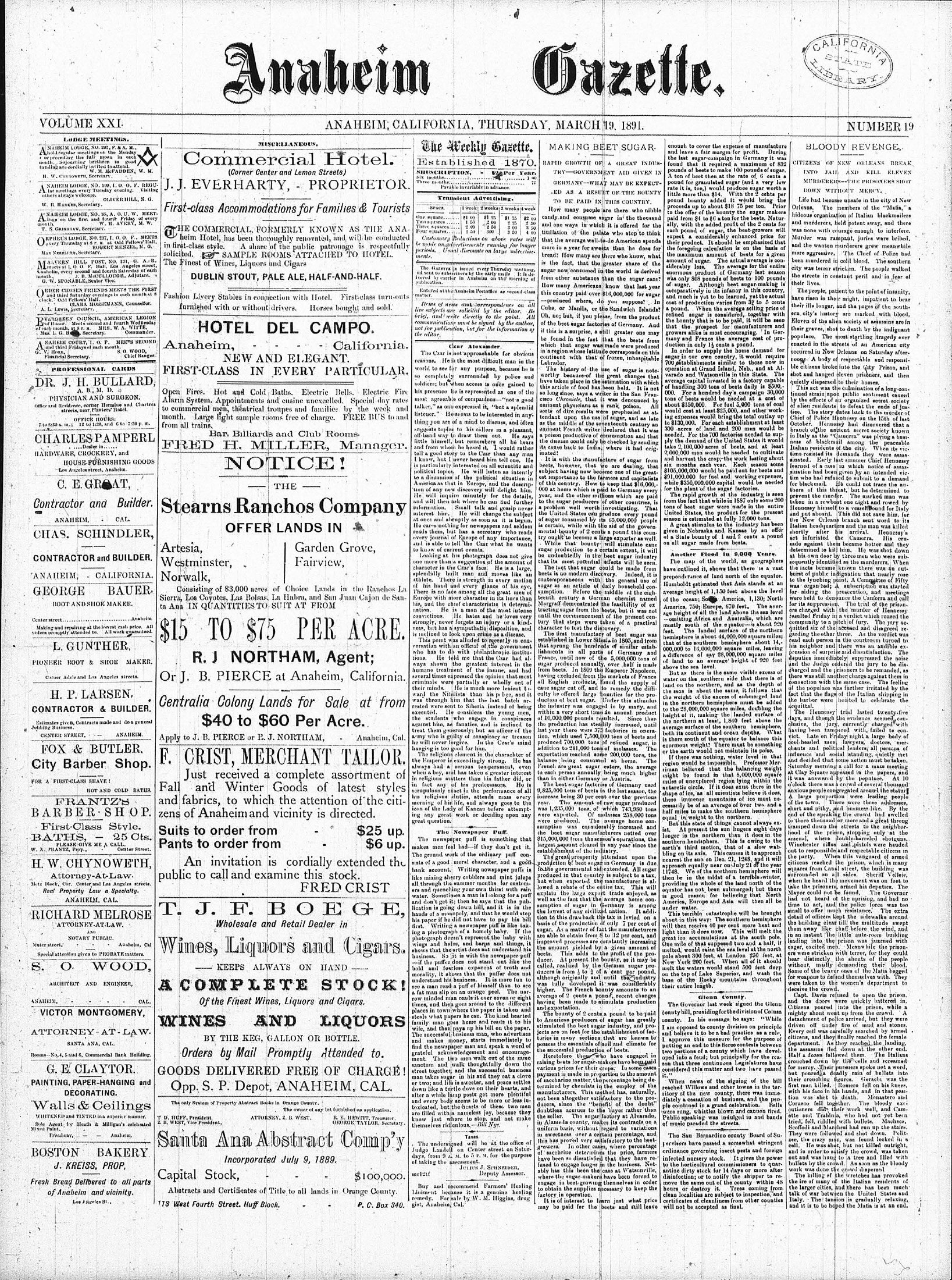
Searchable text
VOLUME XXI.
LODGE MEETINGS.
ANAHEIM LODGE, NO. 207, F. & A. M., hold regular meetings on the Monday or preceding the full moon in each month. Sojourning brethren in good standing are cordially invited to attend.
W. M. McFADDEN, W. M.
H. W. CHYSONERTH, Secretary.
ANAHEIM LODGE, NO. 199, I. O. O. F. REGULAR meetings every Tuesday evening. Visiting others always welcome.
OLIVER HILL, N. G.
W. R. HARKER, Secretary.
ANAHEIM LODGE, NO. 85, A. O. U. W. MEETINGS on the first and fourth Friday of every month.
W. H. AVERY, M. W.
T. S. GRISHAW, Secretary.
ORPHEUS LODGE, NO. 237, I. O. O. F. MEETS every Thursday at 5 p.m. at Old Fellows' Hall.
ROBERT MENZEL, N. G.
MAX NEELUNG, Secretary.
MALVERN HILL POST, NO. 131, G. A. B. meets at I. O. O. F. Hall, Los Angeles street, Anaheim, every second and fourth Saturday of each month.
J. H. McCULLLOUGH, Adjutant.
G. W. SPONABLE, Senior View.
ORDER CHOSEEN FRIENDS MEETS THE FIRST and third Saturday evenings in each month at 8 clock, Old Fellows' Hall.
CLARA MOSESEMANN, Counsellor.
A. L. LEWIS, Secretary.
EVERGREEN COUNCIL, AMERICAN LEQION Hotel Meets second and fourth Wednesday of each month at 5 p.m.
MRS. W. A. WITTE,
Mrs. L. G. B., Secretary.
Commander.
ANAHEIM COURT, I. O. F. MEETS SECOND and third Fridays of each month.
G. V. Horn,
S. O. WOOD,
Financial Secretary.
PROFESSIONAL CARDS
DR. J. H. BULLARD,
A. B., M. D.
PHYSICIAN AND SURGEON.
Office and Residence, corner Hermine and Chartrea streets, near Planters' Hotel.
OFFICE HOURS:
7 to 8:30 a.m.; 12 to 1:30; and 6 to 7:30 p.m.
CHARLES PAMPERL
...Dealer in...
HARDWARE, CROCKERY, and HOUSE-FURNISHING GOODS
Los Angeles street, Anaheim.
MISCELLANEOUS.
Commercial Hotel
(Corner Center and Lemon Streets)
J. J. EVERHARTY, - PROPRIETARY
First-class Accommodations for Families
THE COMMERCIAL, FORMERLY KNOWN AT Theim Hotel, has been thoroughly renovated, and will in first-class style. A share of the public patronage solicited.
SAMPLE ROOMS ATTACHED TO The Finest of Wines, Liquors and Cigars
DUBLIN STOUT, PALE ALE, HALF-AND-Fashion Livery Stables in connection with Hotel. First furnished with or without drivers. Horses bought.
HOTEL DEL CAMP
Anaheim,
NEW AND ELEGANT.
FIRST-CLASS IN EVERY PART
Open Fires. Hot and Cold Baths. Electric Bells.
Alarm System. Appointments and cuisine unexcelled.
To commercial men, theatrical troupes and families by month. Large light sample rooms free of charge.
From all trains.
Bar, Billiards and Club Rooms
FRED H. MILLER, MAIN NOTICE!
DR. J. H. BULLARD,
A. B., M. D.
PHYSICIAN AND SURGEON.
Office and Residence, corner Hermine and Chartres streets, near Planters' Hotel.
OFFICE HOURS:
7 to 8:30 a.m.; 12 to 1:30, and 6 to 7:30 p.m.
CHARLES PAMPERL
...Dealer In...
HARDWARE, CROOKERY, and HOUSE-FURNISHING GOODS
Los Angeles street, Anaheim.
C. E. GROAT,
Contractor and Builder.
ANAHEIM, CAL.
CHAS. SCHINDLER,
CONTRACTOR and BUILDER.
ANAHEIM, CALIFORNIA.
GEORGE BAUER,
BOOT AND SHOE MAKER.
Center street...Anaheim
Making and repairing at the lowest cash price. All orders promptly attended to. All work guaranteed.
L. GUNTHER,
PIONEER BOOT & SHOE MAKER.
Corner Adele and Los Angeles streets.
H. P. LARSEN,
CONTRACTOR & BUILDER.
Estimates given, Contracts made and do a general Jobbing Business.
CENTER STREET, ANAHEIM.
FOX & BUTLER.
City Barber Shop.
FOR A FIRST-CLASS SHAVE!
HOT AND COLD BATHS.
FRANTZ'S
BARBER SHOP.
First-Class Style.
BATHS, - 25 Cts.
PLEASE GIVE ME A CALL.
W. A. FRANTZ, Prop., Center Street.
H. W. CHYNOWETH,
Attorney-At-Law.
Metz Block, Cor. Center and Los Angeles streets.
Real Property Law a Specialty.
ANAHEIM, CAL.
Open Fires. Hot and Cold Baths. Electric Bells.
Alarm System. Appointments and ensuine unexcelled. S
to commercial men, theatrical troupes and families by
month. Large light sample rooms free of charge. FR
from all trains.
Bar, Billiards and Club Rooms
FRED H. MILLER, M
NOTICE!
THE
Stearns Ranchos Com
OFFER LANDS IN
Artesia,
Westminster,
Norwalk,
Consisting of 83,000 acres of Choice Lands in t
Sierra, Los Coyotes, Las Bolsas, La Habra, and San Juau
ta Ana IN QUANTITIES TO SUIT AT FROM
$15 TO $75 PER A
R. J NORTHAM, Age
Or J. B. PIERCE at Anaheim,
Centralia Colony Lands for Sale
$40 to $60 Per Acre
Apply to J. B. PIERCE or P. J. NORTHAM,
F. CRIST, MERCHANT TA
Just received a complete assort
Fall and Winter Goods of late
and fabrics, to which the attention o
zens of Anaheim and vicinity is direc
Suits to order from
Pants to order from
An invitation is cordially exte
public to call and examine this stock
BARBER SHOP.
First-Class Style.
BATHS, - 25 Cts.
PLEASE GIVE ME A CALL.
W. A. FRANTZ, Prop., Center Street.
H. W. CHYNOWETH,
Attorney-At-Law.
Metz Block, Cor. Center and Los Angeles streets.
Real Property Law a Specialty.
ANAHEIM, CAL.
RICHARD MELROSE
ATTORNEY-AT-LAW.
AND
NOTARY PUBLIC.
Center street,
Anaheim, Cal.
Special attention given to PROBATE matters.
S. O. WOOD,
ARCHITECT AND ENGINEER,
ANAHEIM, CAL.
VICTOR MONTGOMERY,
ATTORNEY-AT-LAW.
SANTA ANA, CAL.
Rooms No.4, 5 and 6, Commercial Bank Building.
G. E. CLAYTOR.
PAINTING, PAPER-HANGING and DECORATING.
Walls & Ceilings
WHITENED and TINTED in a superior manner.
Sole Agent for Heath & Milligan's celebrated Mixed Palette.
Broadway,
Anaheim.
BOSTON BAKERY.
J. KREISS, PROP,
Fresh Bread Delivered to all parts of Anaheim and vicinity.
Los Angeles St.,
Suits to order from
Pants to order from
An invitation is cordially extended public to call and examine this stock.
T. J. F. BOECH
Wholesale and Retail Dealer in
Wines, Liquors and Cocktails
KEEPS ALWAYS ON HAND
A COMPLETE STOCK
Of the Finest Wines, Liquors and Cigars
WINES AND LIQUORS
BY THE KEG, GALLON OR BOTTLE
Orders by Mail Promptly Attended
GOODS DELIVERED FREE OF COST
Opp. S. P. Depot, ANAHEIM,
The only System of Property Abstract Books in Orange County.
The owner of any lot furnished.
T. D. HUFF, President.
ATTORNEY, Z. B. WEST.
R. E. HE
GEORGE
Santa Ana Abstract Co.
Incorporated July 9, 1889.
Capital Stock,
Abstracts and Certificates of Title to all lands in Orlando.
113 West Fourth Street. Huff Block.
ANAHEIM, CALIFORNIA, THURSDAY, MARCH 19, 1891.
MILLANEOUS.
Special Hotel.
(and Lemon Streets)
RY, - PROPRIETOR.
ations for Families & Tourists
ERLY KNOWN AS THE ANAghly renovated, and will be conducted
the public patronage is respectfully
MS ATTACHED TO HOTEL.
Cigars
E ALE, HALF-AND-HALF.
ion with Hotel. First-class turn-outs
ivers. Horses bought and sold:
EL CAMPO.
California.
O ELEGANT.
EVERY PARTICULAR.
uths. Electric Bells. Electric Fire
cuisine unexcelled. Special day rates
tapes and families by the week and
is free of charge. FREE BUS to and
and Club Rooms.
LLER, Manager.
TICE!
The Weekly Gazette.
Established 1870.
SHUSCRIPTION, - $2 Per Year.
Six months. 1 00
Three months. 75
Pavable invariably in advance.
Transient Advertising.
SPACE
1 week 2 weeks 3 weeks 4 week
One square.....$1 00 $1 25 $1 75 $2 00
Two squares....1 50 2 00 2 25 2 50
Three squares...2 00 2 50 3 00 3 50
Four squares...2 50 300 3 50 4 00
Customary Reductions on above rates will be made on advertisements running for longer periods. Usual discounts on large advertisements.
The GAZETTE is issued every Thursday morning,
and sent to subscribers by the early mails. It is delivered by carrier in Anaheim on the morning of publication.
Entered at the Anaheim Postoffice as second-class matter.
Items of news and correspondence on all live subjects are solicited by the editor. Be brief, and write directly to the point. All communications must be signed by the author, not for publication, but for the information or the editor.
Czar Alexander.
The Czar is not approachable for obvious reasons. He is the most difficult man in the world to see for any purpose, because he is so completely surrounded by police and soldiers; but when access is once gained to his presence he is represented as one of the most agreeable of companions—"not a good talker," as one expressed it, "but a splendid listener." He seems to be interested in anything you are of a mind to discuss, and often suggests topics to his callers in a pleasant, off-hand way to draw them out. He says little himself, but remembers all he hears and from whom he heard it. I would rather tell a good story to the Czar than any man I know, but I never heard him tell one. He is particularly interested on all scientific and political topics. He will listen as intently to a discussion of the political situation in MAKING BEET SUGAR.
RAPID GROWTH OF A GREAT INDUSTRY—GOVERNMENT AID GIVEN IN GERMANY—WHAT MAY BE EXPECTED AS A RESULT OF THE BOUNTY TO BE PAID IN THIS COUNTRY.
How many people are there who nibble candy,and consume sugar in the thousand and one ways in which it is offered for the titillation of the palate who stop to think that the average well-to-do American spends more in a year for sweets than he does for bread? How many are there who know, what is the fact, that the greater share of the sugar now consumed in the world is derived from other substance than the sugar cane? How many Americans know that last year this country paid over $16,000,000 for sugar —produced where, do you suppose? In Cubs, or Manila, or the Sandwich Islands? Oh, no; but, if you please, from the product of the beet sugar factories of Germany. And if this is a surprise, a still greater one may be found in the fact that the beets from which that sugar was made were produced in a region whose latitude corresponds on this continent with that of frozen, inhospitable Labrador.
The history of the use of sugar is note-worthy because-of the great changes that have taken place in the estimation with which this article of food has been held. It is not so long since, says a writer in the San Francisco Chronicle, that it was denounced by eminent physicians as a rank poison. All sorts of dire results were prophesied as attendant upon the use of sugar, and as late as the middle of the seventeenth century an eminent French writer declared that it was a poison productive of consumption and that the disease could only be checked by sending its cause back to India, where it had originated!
It is with the manufacture of sugar from beets, however, that we are dealing, that subject having now become one of the greatest importance to the farmers and citizens.
The Newspaper Puff.
The newspaper puff is something that makes men feel bad—if they don't get it. The ground work of the ordinary puff consists of a good moral character, and a good bank account. Writing newspaper puff is like mixing sherry cobblers and mint juleps all through the summer months (for customers and quenching your own thirst with rain water). Sometimes a man is looking for a puff and doesn't get it; then he says that the pub completely surrounded by police and soldiers; but when access is once gained to his presence he is represented as one of the most agreeable of companions—"not a good talker," as one expressed it, "but a splendid listener." He seems to be interested in anything you are of a mind to discuss, and often suggests topics to his callers in a pleasant, off-hand way to draw them out. He says little himself, but remembers all he hears and from whom he heard it. I would rather tell a good story to the Czar than any man I know, but I never heard him tell one. He is particularly interested on all scientific and political topics. He will listen as intently to a discussion of the political situation in America as that in Europe, and the description of any new discovery will delight him. He will inquire minutely for the details, and will ask where he can find further information. Small talk and gossip never interest him. He will change the subject at once and abruptly as soon as it begins. He cares nothing for newspapers and seldom reads them, but has a secretary who reads every journal of Europe of any importance, and is able to tell the Czar what he wants to know of current events.
Looking at his photograph does not give one more than a suggestion of the amount of character in the Czar's face. He is a large, splendidly built man and moves like an athlete. There is strength in every motion of his hand and every glance of his eye. There is no face among all the great men of Europe with more character in its lines than his, and the chief characteristic is determination. He is a man of the most intense convictions. He hates and he loves very strongly, never forgets an injury or a kindness, but has a sympathetic disposition, and is inclined to look upon crime as a disease.
This point was alluded to recently in conversation with an official of the government who has to do with philanthropic institutions. He told me that the Czar had always shown the greatest interest in the humane treatment of the insane, and had several times expressed the opinion that most criminals were partially or wholly out of their minds. He is much more lenient toward the Nihilists than his police, and it was through him that the last batch arrested were sent to Siberia instead of being executed. He considers the young men, the students who engage in conspiracies against him, as fanatics, and is inclined to treat them generously; but an officer of the army who is guilty of conspiracy or treason will never forgive. In the Czar's mind hanging is too good for him.
The religious element in the charakter of the Emperor is exceedingly strong. He has always had a serious temperament, even when a boy, and has taken a greater interest in religious matters than his father did, or in fact any of his predecessors. He is scrupulously exact in the performance of all his religious duties, attends mass every morning of his life, and always goes to the icon of the Lady of Kanzan before attempting any great work or deciding upon any great question.
The first manufacturer of beet sugar was established in Lower Silva in 1805, and from that sprung the hundreds of similar establishments in all parts of Germany and France, until now of the 5,000,000 tons of sugar produced annually, over half is made from beets. In 1809 the Emperor Napoleon, having excluded from the markets of France all English products, found the supply of cane sugar cut off, and to remedy the difficulty he offered large quantities for the production of beet sugar. Under this stimulus the industry was engaged in by many, and within a very short time an annual product of 10,000,000 pounds resulted. Since then the production has steadily increased, until last year there were 373 factories in operation, which used 7,500,000 tons of beets and produced 700,000 tons of refined sugar, in addition to 241,000 tons of molasses. The exportation reached some 200,000 tons, the balance being consumed at home. The French are great sugar eaters, the average to each person annually being much higher than in either Germany or Austria.
The beet sugar factories of Germany used 9,825,000 tons of beets in the last season, the increase being 30 per cent over the previous year. The amount of raw sugar produced was 1,235,000 tons, of which 743,980 tons were exported. Of molasses 258,000 tons were produced. The average home consumption was considerably increased and the beet sugar manufacturers netted over $15,000,000 from the season's operations, the largest amount cleared in any year since the establishment of the industry.
The great prosperity attendant upon the production of beet sugar in Germany is due to the governmental aid extended. All sugar produced in that country is subject to a tax, but when exported the manufacturer is allowed a rebate of the entire tax. This will explain the large export trade enjoyed, as well as the fact that the average home consumption is considerably increased and the beet sugar manufacturers netted over $15,000,000 from the season's operations, the largest amount cleared in any year since the establishment of the industry.
The great prosperity attendant upon the production of beet sugar in Germany is due to the governmental aid extended. All sugar produced in that country is subject to a tax, but when exported the manufacturer is allowed a rebate of the entire tax. This will explain the large export trade enjoyed, as well as the fact that the average home consumption is considerably increased and the beet sugar manufacturers netted over $15,000,000 from the season's operations, the largest amount cleared in any year since the establishment of the industry.
The great prosperity attendant upon the production of beet sugar in Germany is due to the governmental aid extended. All sugar produced in that country is subject to a tax, but when exported the manufacturer is allowed a rebate of the entire tax. This will explain the large export trade enjoyed, as well as the fact that the average home consumption is considerably increased and the beet sugar manufacturers netted over $15,000,000 from the season's operations, the largest amount cleared in any year since the establishment of the industry.
The great prosperity attendant upon the production of beet sugar in Germany is due to the governmental aid extended. All sugar produced in that country is subject to a tax, but when exported the manufacturer is allowed a rebate of the entire tax. This will explain the large export trade enjoyed, as well as the fact that the average home consumption is considerably increased and the beet sugar manufacturers netted over $15,000,000 from the season's operations,
The Newspaper Puff
The newspaper puff is something that makes men feel bad—if they don't get it. The ground work of the ordinary puff consists of a good moral character, and a good bank account. Writing newpaper puffs is like mixing sherry cobblers and mint juleps all through the summer months for customers and quenching your own thirst with rain water. Sometimes a man is looking for a puff and don't get it; then he says that the publication is going down hill, and it is in the hands of a monopoly, and that he would stop his paper if he did not have to pay his bill first. Writing a newspaper puff is like taking a photograph of a homely baby. If the photograph doesn't represent the baby with wings and halos, and harps and things, it shows that the artist does not understand his business. So it is with the newspaper puff—if the puffer does not stand out like the bold and fearless exponent of truth and morality, it shows that the puffer does not understand his business. It is more fun to see a man read a puff of himself than to see a fat man slip on an orange peel. The narrow minded man reads it over seven or eight times, and then goes around to the different places in town where the paper is taken and steals what papers he can. The kind hearted family man goes home and reads it to his wife, and then pays up his bill on the paper. The successful business man, who advertises and makes money, starts immediately to find the newspaper man and speak a word of grateful acknowledgement and encouragement.
The two men walk out of the same sanctum and walk thoughtfully down the street together, and the successful business man takes sugar in his and they eat a clove or two; and life is sweeter, and peace settles down like a turtle dove on their hearts, and after a while lamp posts get more plentiful and every body seems to be more or less intoxicated, but the hearts of these two men are filled with a nameless joy, because they know just where to stop, and not make themselves ridiculous. Bill Nye.
Taxes.
The undersigned will be at the office of Judge Landell on Center street on Saturdays, from 9 A.M. to 5 P.M. for the purpose of taking the assessment.
Julius J. Schneider,
Deputy Assessor.
Buy and recommend Farmers' Healing Liniment because it is a genuine healing remedy. For sale by W. M. Higginis, drug gist, Anaheim, Cal.
The amount of raw sugar produced was 1,235,000 tons, of which 743,980 tons were exported. Of molasses 258,000 tons were produced. The average home consumption was considerably increased and the beet sugar manufacturers netted over $15,000,000 from the season's operations, the largest amount cleared in any year since the establishment of the industry.
The great prosperity attendant upon the production of beet sugar in Germany is due to the governmental aid extended. All sugar produced in that country is subject to a tax, but when exported the manufacturer is allowed a rebate of the entire tax. This will explain the large export trade enjoyed, as well as the fact that the average home consumption of sugar in Germany is among the lowest of any civilized nation. It addition to this drawback the tax is levied on a basis of the production of only 7 per cent of sugar. As a matter of fact the manufacturers are able to obtain from 8 to 12 per cent, and improved processes are constantly increasing the amount yielded by a given amount of beets. This adds to the profit of the producer. At present the bounty, as it may be called, realized by the German sugar producers is from 1/2 to 3/4 of a cent per pound, although originally and until the industry was fully developed it was considerably higher. The French bounty amounts to an average of 2 cents a pound, recent changes having been made to stimulate production and exportation.
The bounty of 2 cents a pound to be paid to American producers of sugar has greatly stimulated the beet sugar industry, and projects are on foot for the establishment of factories in many sections that are known to possess the essentials of soil and climate for the successful production of beets.
Herefore those who have engaged in raising beets for sugar-makers have been paid various prices for their crops. In some cases payment is made in proportion to the amount of saccharine matter, the percentage being determined by chemists in the employ of the manufacturers. This method has naturally, not been altogether satisfactory to the producers, since the "benefit of the doubt" doubtless accrues to the buyer rather than the seller. The sugar factory at Alvarado, in Alamuela county, makes its contracts on a uniform basis, without regard to variations in sweetness over a certain percentage, and this has proved very satisfactory to the beet-growers.
In other cases, where percentage of saccharine determines the price, farmers have been so dissatisfied that they have refused to engage longer in the business. Notably has this been the case at Watsonville, where the sugar-makers have been forced to engage in beet-growing themselves in order to obtain the supplies necessary to keep the factory in operation.
It is of interest to learn just what price may be paid for the beets and still leave
BEET SUGAR.
OF A GREAT INDUSMENT AID GIVEN IN
THAT MAY BE EXPECTBUST OF THE BOUNTY
IN THIS COUNTRY.
We are there who nibble
sugar in the thousand
which it is offered for the
state who stop to think
to-do American spends
vectes than he does for
there who know, what
the greater share of the
in the world is derived
near than the sugar cane?
know that last year
for $16,000,000 for sugar
do you suppose? In
the Sandwich Islands?
lease, from the product
series of Germany. And
still greater one may
that the beets from
made were produced
ude corresponds on this
of frozen, inhospitable
use of sugar is notethe great changes that
estimation with which
has been held. It is not
writer in the San Franit it was denounced by
a rank poison. All
proposed as a mode of sugar, and as late seventeenth century an or declared that it was be checked by seuring it where it had origifacture of sugar from we are dealing, that become one of the great farmers and cultivators.
enough to cover the expense of manufacture and leave a fair margin for profit. During the last sugar campaign in Germany it was found that it required a maximum of 832 pounds of beets to make 100 pounds of sugar. A ton of beet then at the rate of 6 cents a pound for granulated sugar (and a very low rate it is, too.) would produce sugar worth a little more than $14. With the 2 cents per pound bounty added it would bring the proceeds up to about $18 75 per ton. Prior to the offer of the bounty the sugar makers paid from $4 to $6 a ton for the beets. Naturally, with the added profit of the 2 cents for each pound of sugar, the beet-growers will expect a considerably enhanced price for their product. It should be emphasized that the foregoing calculation is on the basis of the maximum amount of beets for a given amount of sugar. The actual average is considerably less. The average for the entire enormous product of Germany last season was only 808 pounds of beets to 100 pounds of sugar. Although beet sugar-making is comparatively in its infancy in this country, and much is yet to be learned, yet the actual cost of production varies from 33 to 5 cents a pound. When the average selling price of refined sugar is considered, together with the bounty that is to be paid, it will be seen that the prospect for manufacturers and growers alike is most encouraging. In Germany and France the average cost of production in only 1½ cents a pound.
In order to supply the home demand for sugar in our own country, it would require 700 establishments similar to those now in operation at Grand Island, Neb., and at Alvarado and Watsonville in this State. The average capital invested in a factory capable of handling 300 tons of beets daily is $500,000. For a hundred day's campaign 30,000 tons of beets would be needed at a cost of about $150,000. For fuel 5,000 tons of coal would cost at least $25,000, and other working expenses would bring the total outlay up to $130,000. For each establishment at least 300 acres of land and 200 men would be needed. For the 700 factories needed to supply the demand of the United States it would take 2,100,000 acres of beets, and at least 2,000,000 men would be needed to cultivate and harvest the crop—the work lasting about six months each year. Each season some $105,000,000 would be paid out for beets and $91,000,000 for fuel and working expenses.
BLOODY REVENGE,
CITIZENS OF NEW ORLEANS BREAK INTO JAIL AND KILL ELEVEN MURDERERS--THE PRISONERS SHOT DOWN WITHOUT MERCY.
Life had become unsafe in the city of New Orleans. The members of the "Mafia," a hideous organization of Italian blackmailers and murderers, hold potent sway, and there was none with courage enough to interfere. Murder was rampant, juries were bribed, and the wanton murderers grew meanwhile more aggressive. The Chief of Police had been murdered in cold blood. The southern city was terror stricken. The people walked the streets in constant peril and in fear of their lives.
The people, patient to the point of insanity, have risen in their might, impatient to bear their ill longer, and the pages of the southern city's history are marked with blood. Eleven of the alien society of assassins are in their graves, shot to death by the indignant populace. The most startling tragedy ever enacted in the streets of an American city occurred in New Orleans on Saturday afternoon. A body of respectable and responsible citizens broke into the City Prison, and shot and hanged eleven prisoners, and then quietly dispersed to their homes.
This act was the culmination of a long continued strain upon public sentiment caused by the efforts of an organized secret society of alien residents to defeat the ends of justice. The story dates back to the murder of Chief of Police Hennessy on the 15th of last October. Hennessy had discovered that a branch of the ancient secret society known in Italy as the "Gamorra" was plying a business of blackmail among the peaceable Italian residents of the city. When its victims resisted its demands they were assassinated. Early last summer Chief Hennessy learned of an in which notice of assassination had been given by an intended victim who had refused to submit to a demand
average capital invested in a factory capable of handling 300 tons of beets daily is $500,000. For a hundred days' campaign 30,000 tons of beets would be needed at a cost of about $150,000. For fuel 5,000 tons of coal would cost at least $25,000, and other working expenses would bring the total outlay up to $130,000. For each establishment at least 300 acres of land and 200 men would be needed. For the 700 factories needed to supply the demand of the United States it would take 2,100,000 acres of beets, and at least 2,000,000 men would be needed to cultivate and harvest the crop—the work lasting about six months each year. Each season some $105,000,000 would be paid out for beets and $91,000,000 for fuel and working expenses, while $350,000,000 capital would be needed for the plant of the sugar factories.
The rapid growth of the industry, seen from the fact that while in 1887 only some 200 tons of beet sugar were made in the entire United States, the product for the present season is estimated at fully 12,000 tons.
A great stimulus to the industry has been given in Nebraska and Kansas by an offer of a State bounty of 1 and 2 cents a pound on all sugar made from beets.
Another Flood in 9,060 Years.
The map of the world, as geographers have outlined it, shows that there is a vast preponderance of land north of the equator. Humboldt estimated that Asia stands at an average height of 1,150 feet above the level of the ocean; South America, 1,130; North America, 750; Europe, 670 feet. The average height of all the land above the sea level—omitting Africa and Australia, which are mostly south of the equator—is about 920 feet. The landed surface of the northern hemisphere is about 44,000,000 square miles; that of the southern hemisphere about 14,-400,000 to 16,000,000 square miles, leaving a difference of say 28,800,000 square miles of land to an average height of 920 feet above the sea level.
But as there is the same visible excess of water on the southern side that there is of land on the northern, and as the depth of the seas is about the same, it follows that the weight of the excess of submerged land in the northern hemisphere must be added to the 28,000,000 square miles, doubling the height of it, making the landed surface of the northern at least 1,840 feet above the average surface of the southern hemisphere both its continent and ocean depths. What is there south of the equator to balance this enormous weight? There must be something or the earth would not maintain its noise.
If there was nothing, water level in that region would be impossible. Professor Merriam believed that the balancing weight might be found in that 8,000,000 square miles of unexplored region lying within the antarctic circle. If it does exist there in the shape of ice, as all scientists believe it does, these immense mountains of ice must necessarily be of an average of over two and a half miles to make the southern hemisphere equal in weight to the northern.
But this state of things cannot always exist. At present the sun lingers eight days longer in the northern than it does in the southern hemisphere. This is owing to the earth's third motion, that of a slow wobbling on its axis. This causes it to approach nearest the sun on Dec. 21, 1248, and it will approach equally near on July 21 of the year 11748. We of the northern hemisphere will then be in the midst of a terrible winter, providing the whole of the land north of the equator has not been submerged; but there is good reason for believing that North America, Europe and Asia will then all be quietly dispersed to their homes.
This act was the culmination of a long-continued strain upon public sentiment caused by the efforts of an organized secret society of alien residents to defeat the ends of justice. The story dates back to the murder of Chief of Police Hennessy on the 15th of last October. Hennessy had discovered that a branch of the ancient secret society known in Italy as the "Camorra" was plying a business of blackmail among the peaceable Italian residents of the city. When its victims resisted its demands they were assassinated. Early last summer Chief Hennessy learned of a case in which notice of assassination had been given by an intended victim who had refused to submit to a demand for blackmail. He could not trace the authors of this threat, but he determined to prevent the murder. The marked man was taken in a rowboat one night and rowed by Hennessy himself to a vessel bound for Italy and put aboard. This did not save him, for the New Orleans branch sent word to its Italian headquarters and the man was killed shortly after his arrival. Hennessy's act infuriated the Camorra. His cruade against them became hotter and they determined to kill him. He was shot down at his own door by three men who were subsequently identified as the murdersers. When the facts became known there was an outburst of public indignation that nearly rose to the lynching point. A Committee of Fifty was organized; A subscription was started for aiding the prosecution, and meetings were held to denounce the Camorra and call for its suppression. The trial of the prisoners charged with the murder of Hennessy resulted Friday in a verdict which roused the community to a pitch of fury. The jury acquitted six of the accused and disgusted regarding other three. As the verdict was read each person in the courtroom turned to his neighbor and there was an audible expression of surprise and dissatisfaction. The deputies immediately suppressed the noise and the Judge ordered the jury to be discharged and the prisoners to be remanded, as there was still another charge against them in connection with the same case. The feeling of the populace was further irritated by the fact that the flags of the Italian shipping in the harbor were hoisted to celebrate the acquittal.
The Hennessy trial lasted twenty-five days, and though the evidence seemed conclusive, the jury currently charged with having been tampered with failed to convict. Late on Friday night a large body of cool-headed men lawyers, doctors, merchants and political leaders, all persons of influence and social standing, quietly met and decided that some action must be taken. Saturday morning a call for a mass meeting at Clay Square appeared in the papers, and it was answered by the populace. At 10 o'clock there was a crowd of several thousand anxious people congregated around the statue. A large proportion were leading people of the town. There were three addresses, short and pitiful, and business-like. By the end of the speaking the crowd had swelled to three thousand or more and a great throng trumped down the streets to the neighborhood of the prison, stopping only at the arsenal, where double-barreled shotguns Winchester rifles and pistols were hauled out to responsible and respectful citizens in the party. When this vanguard of armed citizens reached the prison, which is many squares from Canal street, the building was surrounded on all sides. Sheriff Velleiche, when he heard the movement was on foot to take the prisoners, armed his deputies. The Mayor could not be found. The Governor had not heard of the uprising, and had no time to act andthe police force was too
raw sugar produced by the town of 743,980 tons in molasses, 258,000 tons in average home considerably increased and manufacturers netted over the season's operations, the bulk in any year since the industry.
Attendant upon the war in Germany is due aid extended. All sugar mills are subject to a tax, the manufacturer is obliged to retire tax. This will trade enjoyed, as an average home company Germany is among organized nation. It adds the tax is levied on a pound of sugar has greatly sugar industry, and pro-creation establishment of faculties that are known to soil and climate for beets. Who have engaged in makers have been paid crops. In some cases proportion to the amount percentage being de-ined the employ of the method has, naturally, satisfactory to the pro-mentation of the doubt" the buyer rather than factory at Alvarado, takes its contracts on a regard to variations certain percentage, and satisfactory to the beet-ses, where percentage ones the price, farmers that they have re-ceived the business. Not o case at Watsonville, have been forced to bring themselves in order necessary to keep the learn just what price beets and still leave ceasarily be of an average of over two and a half miles to make the southern hemisphere equal in weight to the northern.
But this state of things cannot always exist. At present the sun lingers eight days longer in the northern than it does in the southern hemisphere. This is owing to the earth's third motion, that of a slow wabbling on its axis. This causes it to approach nearest the sun on Dec. 21, 1248, and it will approach equally near on July 21 of the year 11748. We of the northern hemisphere will then be in the midst of a terrible winter, providing the whole of the land north of the equator has not been submerged; but there is good reason for believing that North America, Europe and Asia will then all be under water.
This terrible catastrophe will be brought about in this way: The southern hemisphere will then receive 40 per cent more heat and light than it does now. This will melt the great ice accumulations at the south pole. One mile of that supposed two and a half, if melted, would raise the sea level at the north pole about 300 feet, at London 250 feet, at New York 200 feet. When all of it should melt the waters would stand 500 feet deep on the top of Lake Superior, and wash the base of the Rocky mountains throughout their entire length.
Glenn County.
The Governor last week signed the Glenn county bill, providing for the division of Colusa county. In his message he says: "While I am opposed to county division on principle and believe it to be a bad practice as a rule, I approve this measure for the purpose of putting an end to this fierce contest between two portions of a county which have developed into a feud; but principally for the reason that three continuous Legislatures have considered this matter and two have passed it."
When news of the signing of the bill reached Williams and other towns in the territory of the new county, there was immediately a cessation of business, and the people combined in a grand celebration. Bells were rung, whistles blown and cannon fired. Public speaking was indulged in and bands of music paraded the streets.
The San Bernardino county Board of Supervisors have passed a somewhat stringent ordinance governing insect pests and foreign infected nursery stock. It gives the power to the horticultural commissioners to quarantine dirty stock for 14 days or more after disinfection; or to notify the shipper to remove out of the county within 48 hours or destroy it. Trees coming from clean localities are subject to inspection, and certificates of cleanliness from other counties will not be accepted as final.
Capt. Davis refused to open the prison, and the doors were quickly battered in. Citizens poured into the prison, while a mighty shout went up from the crowd. A detachment of police arrived, but they were driven off under fire of mud and stones. Every cell was carefully searched by armed citizens, and they finally reached the female department. As they reached the landing, the assassins fled down at the other end. Half a dozen followed them. The Italians crouched down by the cells and screamed for mercy. Their pursuers spoke not a word, but poured a deadly rain of bullets into their crouching figures. Geracha was the first man killed. Romero fell on his knees, with his face in his hands, and in that position was shet to death. Monastero and Corusco fell together. The bloody executioners did their work well, and Camette and Trahnia, who had not yet been tried, fell, riddled with bullets. Macheca, Scoffoli and Marchesi had run up the stairs. They were followed and shot down. Politize, the crazy man, was found locked in a cell. He was shot, but not killed outright, and in order to satisfy the crowd, was taken out and was hung to a tree and filled with bulls by the crowd. As soon as the bloody work was done the crowd dispersed.
The killing of the wretches has provoked the irie of many of the Italian residents of larger cities, and there has been much talk of war between the United States and Italy. The tension is gradually relaxing, and it is to be hoped that Maria is at an end.