anaheim-gazette 1891-02-26
Scanned page
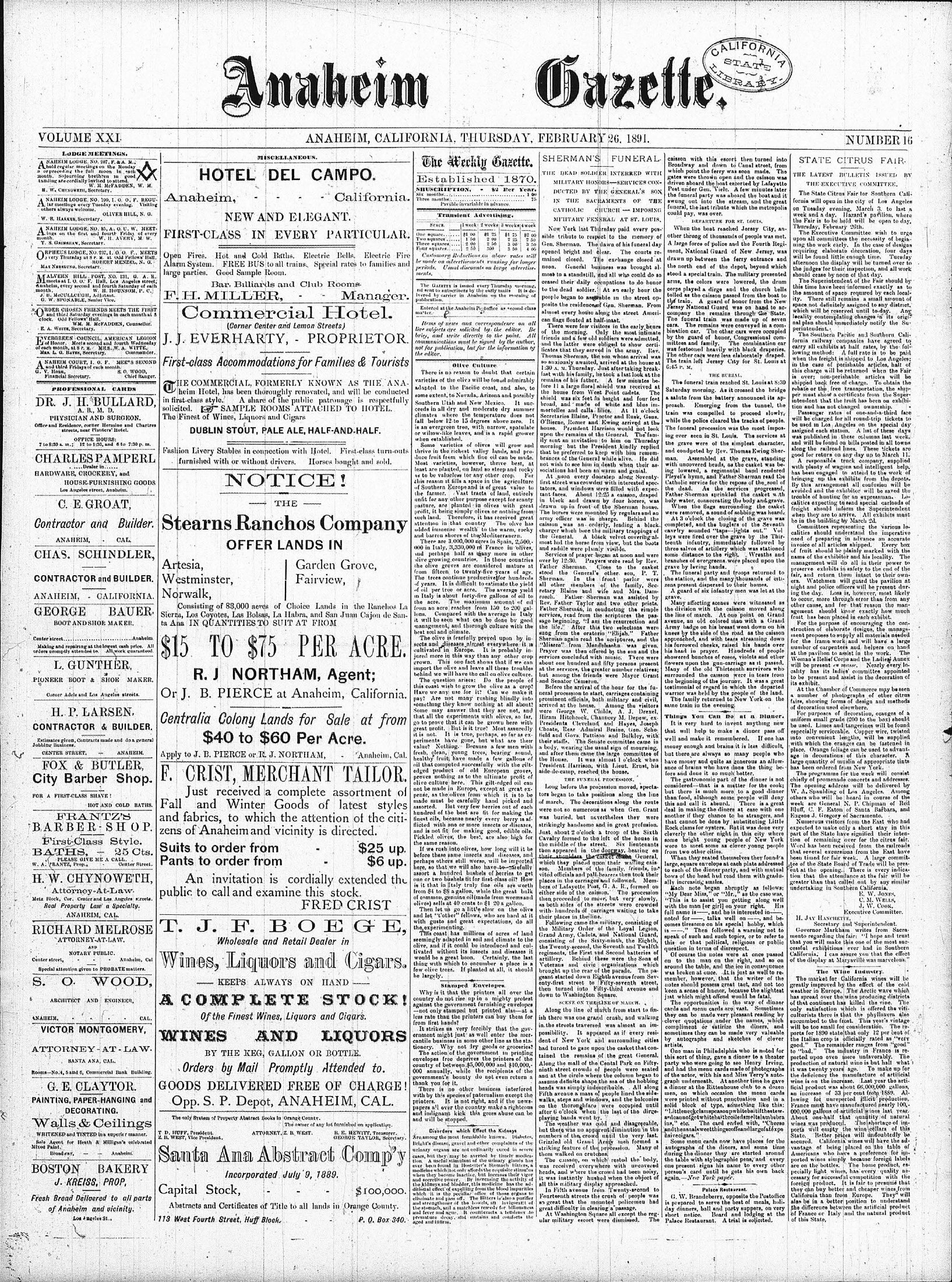
Searchable text
VOLUME XXI.
LODGE MEETINGS.
ANAHEIM LODGE, NO. 207, F. & A. M., hold regular meetings on the Monday at or preceding the full moon in each month. Soljournal brethren in good standing are cordially invited to attend.
W. M. McFADDEN, W. M.
H. W. Chryxowert, Secretary.
ANAHEIM LODGE, NO. 199, I. O. O. F. REGULAR meetings every Tuesday evening. Visiting others always welcome.
OLIVER HILL, N. O.
W. R. HARKER, Secretary.
ANAHEIM LODGE, NO. 85, A. O. U. W. MEETINGS on the first and fourth Friday of every month.
W. H. AVERY, M. W.
T. S. GRIMSHAW, Secretary.
ORPHEUS LODGE, NO. 237, I. O. O. F., MEETS every Thursday at 5 P.M. at Old Fellows Hall, ROBERT MENZEL, N. O.
MAX NEBLUNG, Secretary.
MALVERN HILL POST, NO. 131, G. A. R. meets at I. O. O. F. Hall, Los Angeles street; Anaheim, every second and fourth Saturday of each month.
W. H. HOUNSON, P. C.
J. B. McCULLIGH, Adjutant.
G. W. SPONABLE, Senior Vice.
ORDER CHOSEN FRIENDS MEETS THE FIRST and third Saturday evenings in each month at 5 clock. Old Fellows' Hall.
WM. M. McFADDEN, Counsellor.
E. A. WHITE, Secretary.
EVERGREEN COUNCIL, AMERICAN LEOION of Honor. Meet second and fourth Wednesday of each month at 5 P.M.
MRS. W.A. WITTE,
MRS. L. G. BAYES, Secretary.
ANAHEIM COURT, I. O. O.F., MEET'S SECOND and third Fridays of each month.
G. V. HORR,
S.O.WOOD,
Financial Secretary.
PROFESSIONAL CARDS
DR. J. H. BULLARD,
A.B., M.D.
PHYSICIAN AND SURGEON.
Office and Residence, corner Hermine and Chartres streets, near Planters' Hotel.
OFFICE HOURS:
7 to 8:30 a.m.; 12 to 1:30, and 6 to 7:30 p.m.
CHARLES PAMPERL
...Dealer in...
HARDWARE, CROCKERY, and
MISCELLANEOUS.
HOTEL DEL CAMP
Anaheim, ...Cal
NEW AND ELEGANT.
FIRST-CLASS IN EVERY PART
Open Fires. Hot and Cold Baths. Electric Bells.
Alarm System. FREE BUS to all trains Special rates large parties. Good Sample Room.
Bar, Billiards and Club Room
F.H.MILLER,...M
Commercial Hotel
(Corner Center and Lemon Streets)
J.J.EVERHARTY,- PROPR
First-class Accommodations for Families
THE COMMERCIAL, FORMERLY KNOWN AS Theim Hotel, has been thoroughly renovated, and will in first-class style.
A share of the public patronage solicited.
SAMPLE ROOMS ATTACHED TO The Finest of Wines, Liquors and Cigars
DUBLIN STOUT, PALE ALE, HALF-ANDFashion Livery Stables in connection with Hotel. First furnished with or without drivers. Horses bought
PROFESSIONAL CARDS
DR. J. H. BULLARD,
A. B., M. D.
PHYSICIAN AND SURGEON.
Officer and Residence, corner Hermine and Chartres streets, near Planters' Hotel.
OFFICE HOURS:
7 to 8:30 a.m.; 12 to 1:30, and 6 to 7:30 p.m.
CHARLES PAMPERL
...Dealer in...
HARDWARE, CROCKERY, and HOUSE-FURNISHING GOODS
Los Angeles street, Anaheim.
C. E. GROAT,
Contractor and Builder.
ANAHEIM, CAL.
CHAS. SCHINDLER,
CONTRACTOR and BUILDER.
ANAHEIM, CALIFORNIA.
GEORGE BAUER
BOOT AND SHOE MAKER.
Center street...Anaheim.
Making and repairing at the lowest cash price. All orders promptly attended to. All work guaranteed.
L. GUNTHER,
PIONEER BOOT & SHOE MAKER.
Corner Adele and Los Angeles streets.
H. P. LARSEN,
CONTRACTOR & BUILDER.
Estimates given, Contracts made and do a general Jobbing Business.
CENTER STREET, ANAHEIM.
FOX & BUTLER,
City Barber Shop.
FOR A FIRST-CLASS SHAVE!
HOT AND COLD BATHS.
FRANTZ'S
BARBER SHOP.
First-Class Style.
BATHS, - 25 Cts.
PLEASE GIVE ME A CALL.
W. A. PRANTZ, Prop., Center Street.
H. W. CHYNOWETH,
Attorney-At-Law.
Metz Block, Cor., Center and Los Angeles streets.
THE COMMERCIAL, FORMERLY KNOWN AS Cheim Hotel, has been thoroughly renovated, and will in first-class style. A share of the public patronage solicited. SAMPLE ROOMS ATTACHED TO The Finest of Wines, Liquors and Cigars
DUBLIN STOUT, PALE ALE, HALF-AND-Fashion Livery Stables in connection with Hotel. First furnished with or without drivers. Horses bought
NOTICE!
Stearns Ranchos ComOFFER LANDS IN
Artesia,
Westminster,
Norwalk,
Consisting of 83,000 acres of Choice Lands in Sierra, Los Coyotes, Las Bolsas, La Habra, and San Juanta Ana IN QUANTITIES TO SUIT AT FROM
$15 TO $75 PER Acre
R. J NORTHAM, Age
Or J. B. PIERCE at Anaheim,
Centralia Colony Lands for Sale
$40 to $60 Per Acre
Apply to J. B. PIERCE or R. J NORTHAM,
F. CRIST, MERCHANT T
Just received a complete assortment of Fall and Winter Goods of late and fabrics, to which the attention ofzens of Anaheim and vicinity is directed
Suits to order from
Pants to order from
An invitation is cordially extinct public to call and examine this stock
FRANTZ'S BARBER SHOP.
First-Class Style.
BATHS, - 25 Cts.
PLEASE GIVE ME A CALL.
W. A. FRANTZ, Prop., Center Street.
H. W. CHYNOWETH,
Attorney-At-Law.
Metz Block, Cor. Center and Los Angeles streets.
Real Property Late a Specialty.
ANAHEIM, CAL.
RICHARD MELROSE
ATTORNEY-AT-LAW.
AND
NOTARY PUBLIC.
Center street, Anaheim, Cal.
Special attention given to PROBATE matters.
S. O. WOOD,
ARCHITECT AND ENGINEER,
ANAHEIM, CAL.
VICTOR MONTGOMERY,
ATTORNEY-AT-LAW.
SANTA ANA, CAL.
Rooms—No.4, 5 and 6, Commercial Bank Building.
G. E. CLAYTOR.
PAINTING, PAPER-HANGING and DECORATING.
Walls & Ceilings
WHITENED and TINTED in superior manner.
Sole Agent for Heath & Milligan's celebrated Mixed Paint.
Broadway, Anaheim.
BOSTON BAKERY
J. KREISS, PROP,
Fresh Bread Delivered to all parts of Anaheim and vicinity.
Los Angeles St.,
Suits to order from
Pants to order from
An invitation is cordially extended public to call and examine this stock.
T. J. F. BOE
Wholesale and Retail Dealer in
Wines, Liquors and Cocktails
KEEPS ALWAYS ON HAND
A COMPLETE STOCK
Of the Finest Wines, Liquors and Cocktails
WINES AND LIQUORS
BY THE KEG, GALLON OR BOTTLE
Orders by Mail Promptly Attended
GOODS DELIVERED FREE OF OFFER
Opp. S. P. Depot, ANAHEIM,
The only System of Property Abstract Books in Orange County.
The owner of any lot furnished.
T. D. HUFF, President.
ATTORNEY, Z. B. WEST.
R. E. HE
GEORGE
Santa Ana Abstract Co.
Incorporated July 9, 1889.
Capital Stock,
Abstracts and Certificates of Title to all lands in Orlando.
113 West Fourth Street, Huff Block.
ANAHEIM, CALIFORNIA, THURSDAY, FEBRUARY 26, 1891.
EL CAMPO.
California.
O ELEGANT.
EVERY PARTICULAR.
Things. Electric Bells. Electric Fire
all trains. Special rates to families and
and Club Rooms.
Manager.
Special Hotel.
(and Lemon Streets)
Y, - PROPRIETOR.
ions for Families & Tourists
ERLY KNOWN AS THE ANAhighly renovated, and will be conducted
the public patronage is respectfully
MS ATTACHED TO HOTEL.
Cigars
E ALE, HALF-AND-HALF.
ion with Hotel. First-class turn-outs
rivers. Horses bought and sold.
The Weekly Gazette.
Established 1870.
SHUSCRIPTION, - $2 Per Year.
Six months... 1 00
Three months... 75
Payable in variable in advance.
Transient Advertising.
SPACK.
1 week
2 weeks
3 weeks
4 week
One square.... $1 00
$1 25
$1 75
$2 00
Two squares.... 1 50
2 00
2 25
2 50
Three squares.... 2 00
2 50
3 00
3 50
Four squares.... 2 50
300
3 50
4 00
Customary Reductions on above rates will be made on advertisements running for longer periods. Usual discounts on large advertisements.
The GAZETTE is issued every Thursday morning,
and sent to subscribers by the early mails. It is delivered by carrier in Anaheim on the morning of publication.
Entered at the Anaheim Postoffice as second-class maxt.
Items of news and correspondence on all live subjects are solicited by the editor. Be brief, and write directly to the point. All communications must be signed by the author, not for publication, but for the information of the editor.
Olive Culture.
There is no reason to doubt that certain varieties of the olives will be found admirably adapted to the Pacific coast, and also, to some extent, to Nevada, Arizona and possibly Southern Utah and New Mexico. It succeeds in all dry and moderate dry summer climates where the temperature does not fall below 12 to 15 degrees above zero. It is an evergreen tree, with narrow, spatulate or wilt-like leaves, and is a rapid grower when established.
Some varieties of olives will grow and thrive in the richest valley lands, and produce fruit from which fine oil can be made. Most varieties, however, thrive best, at least are planted, on land so steep and rocky as to be valueless for any other crop. For
SHERMAN'S FUNeral.
THE DEAD SOLDIER INTERRED WITH MILITARY HONORS—SERVICES CONDUCTED BY THE GENERAL'S SON IN THE SACRAMENTS OF THE CATHOLIC CHURCH — IMPOSING MILITARY FENEAL AT ST. LOUIS.
New York last Thursday paid every possible tribute to respect to the memory of Gen. Sherman. The dawn of his funeral day opened bright and clear. The courts remained closed. The exchange closed at noon. General business was brought almost to a standstill, and all who could do so ceased their daily occupations to do honor to the dead soldier. At an early hour the people began to assemble in the street opposite the residence of Gen. Sherman. From almost every house along the street American flags floated at half-mast.
There were few visitors in the early hours of the morning. Only the most intimate friends and a few old soldiers were admitted, and the latter were obliged to show certificates that they served in the army. Rev. Thomas Sherman, the son whose arrival was so anxiously awaited, arrived at the house at 1:30 A.M. Thursday. Just after taking breakfast with his family, he took a last look at the remains of his father. A few minutes before 11 a large floral shield was received at the house from West Point cadets. The shield was six feet in height and four feet broad, and made of white and blue immortelles and calla lilies. At 11 o'clock Secretaries Blaine, Proctor and Rusk, Genus O'Bierne, Romer and Ewing arrived at the house. President Harrison would not look upon the remains of the General. The family sent an invitation to him on Thursday morning but the President kindly replied that he preferred to keep with him remembrances of the General while alive. He did not wish to see him in death when their associations had been so warm and genial.
At noon every doorstep along Seventy-
PER ACRE.
HAM, Agent;
at Anaheim, California.
Goods for Sale at from 0 Per Acre.
NORTHAM, Anaheim, Cal.
CHANT TAILOR.
complete assortment of Goods of latest styles the attention of the citi- vicinity is directed.
$25 up.
$6 up.
cordially extended the nine this stock.
FRED CRIST
varieties of the olive will be found admirably adapted to the Pacific coast, and also, to some extent, to Nevada, Arizona and possibly Southern Utah and New Mexico. It succeeds in all dry and moderate dry summer climates where the temperature does not fall below 12 to 15 degrees above zero. It is an evergreen tree, with narrow, spatulate or wilt-like leaves, and is a rapid grower when established.
Some varieties of olives will grow and thrive in the richest valley lands, and produce fruit from which fine oil can be made. Most varieties, however, thrive best, at least are planted, on land so steep and rocky as to be valueless for any other crop. For this reason it fills a space in the agriculture of Southern Europe and is of great value to the farmer. Vaast tracts of land, entirely unfit for any other purpose except for scanty pasture, are planted in olives with great profit, it being simply olives or nothing from such land. Therefore, it has received great attention in that country. The olive has added immense wealth to the warm, rocky and barren shores of the Mediterranean.
There are 3,000,000 acres in Spain, 2,500,000 in Italy, 3,330,000 in France in olives, and perhaps half as many more in other olive growing countries. In those countries the olive groves are considered mature at from fifteen to twenty-five years of age. The trees continue productive for hundreds of years. It is difficult to estimate the yield of oil per tree or acre. The average yield in Italy is about forty-five gallons of oil to the acre. The maximum amount of oil from an acre reaches from 150 to 200 gallons. Compared with the average in Italy it will be seen what can be done by good management, and thorough culture with the best soil and climate.
The olive is fearfully preved upon by insects and diseases almost everywhere it is cultivated in Europe. It is probably injured more in this way than any other crop grown. This one fact shows that if we can import the olive and leave all these troubles behind we will have the call on olive culture.
The question arises: Do the people of this coast wish to grow the olive as a crop? Have we any use for it? Can we make it pay? Are not many rushing blindly into something they know nothing at all about? Some may answer that they are not, and that all the experiments with olives, so far, go to prove that it can be grown here with great profit. But is it true? Most assuredly it is not. It is true, perhaps, so far as experiments have gone, but what are their value? Nothing. Because a few men with fresh, clean, young trees, bearing sound, healthy fruit, have made a few gallons of oil that competed successfully with the gilt-edged product of old European groves, proves nothing as to the ultimate profit of olive culture here. This gilt-edged oil cannot be made in Europe, except at great expense, as the olives from which it is to be made must be carefully hand picked and assorted. But very few berries out of each hundred of the best are fit for making the finest oils, because nearly every berry is affected with one or more insects or diseases, and is not fit for making good, edible oils. Pickled olives; the best, are also high for the same reason.
If we rush into olives, how long will it be before these same insects and diseases, and perhaps others still worse, will be imported here, so that we will also have to carefully assort a hundred bushels of berries to get one or two bushels fit for first-class oil! How it is that in Italy truly fine oils are worth from $4 to $8 a gallon, while the great bulk of common, genuine oil (made from worms and olives) sells at 40 cents to $1 20 a gallon.
remains of his father. A few minutes before 11 a large floral shield was received at the house from West Point cadets. The shield was six feet in height and four feet broad, and made of white and blue immortelles and calla lilies. At 11 o'clock Secretaries Blaine, Proctor and Ruak, Genus O'Bierne, Romer and Ewing arrived at the house. President Harrison would not look upon the remains of the General. The family sent an invitation to him on Thursday morning but the President kindly replied that he preferred to keep with him remembrances of the General while alive. He did not wish to see him in death when their associations had been so warm and genial.
At noon every doorstep along Seventy-first street was crowded with interested spectators, and windows were filled with expectant faces. About 12:25 a caisson, draped in black and drawn by four horses, was drawn up in front of the Sherman house. The horses were mounted by regulars and an army officer was in charge. Behind the caisson was an orderly leading a black charger which bore the military trappings of the General. A black velvet covering almost hid the horse from view, but the boots and saddle were plainly visible.
Services of prayer began at noon and were over by 12:30. Prayers were read by Rev. Father Sherman. Close to the casket stood the General's other son, P. T. Sherman. In the front parlor were all other members of the family, Secretary Blaine and wife and Mrs. Damrosch. Father Sherman was assisted by Rev. Father Taylor and two other priests. Father Sherman, in conducting the simple services, read from the scriptures the passage beginning. "I am the resurrection and the life." After this two selections were sung from the oratorio "Elijah." Father Sherman again read the scriptures, and the "Misere" from Mendelssohn was given. Prayer was then offered by the son and the services concluded with music. There were about one hundred and fifty persons present at the services, the greater number relatives; but among the friends were Mayor Grant and Senator Cameron.
Before the arrival of the hour for the funeral procession to start, carriages containing prominent officials, both military and civil, arrived at the house. Among the visitors were George W. Childs, A.J.Drexel, Hiram Hitchocke, Chauency M. Depew, ex-presidents Cleveland and Hayes, Joseph Choate, Rear Admiral Braine, Gen.Scheffield and Gova.Pattition and Bulkley, with their staffs. The Senate committee came in a body, wearing the usual sign of mourning, and after them came the large committee of the House. It was almost 1 o'clock when President Harrison, with Lieut. Erust, his aide-de-camp, reached the house.
THE FUNERAL PROCESSION.
Long before the procession moved, spectators began to take positions along the line of march. The decorations along the route were not so numerous as when Gen.Grant was buried, but nevertheless they were strikingly handsome and in great profusion. Just about 2 o'clock a troop of the Sixth Cavalry formed to the left of the house in the middle of the street. Six lieutenants then appeared in the doorway, bearing on their shoulders the casket of General which they placed upon their walking caisson. Members of the family, friends, invited officials and pall-bearers then took their places in the carriages and followed. Members of Lafayette Post, G.A.R., formed on either side of the caisson. The procession then proceeded to move, but very slowly, as both sides of the streets were crowded
But very few berries out of each hundred of the best are fit for making the finest oils, because nearly every berry is afflicted with one or more insects or diseases, and is not fit for making good, edible oils. Pickled olives, the best, are also high for the same reason.
If we rush into olives, how long will it be before these same insects and diseases, and perhaps others still worse, will be imported here, so that we will also have to carefully assort a hundred bushels of berries to get one or two bushels fit for first-class oil? How is it that in Italy truly fine oils are worth from $4 to $8 a gallon, while the great bulk of common, genuine oil (made from worms and olives) sells at 40 cents to $1 20 a gallon.
Then let us go a little slow on the olive and lot "Other" fellows, who are hard at it with gusto and great expectations, do all the experimenting.
This coast has millions of acres of land seemingly adapted in soil and climate to the olive, and if it could be introduced and cultivated without its insects and diseases it would be a great boon. Certainly, the last thing with which to encumber a place is a few olive trees. If planted at all, it should be largely.
Stamped Envelopes.
Why is it that the printers all over the country do not rise up in a mighty protest against the government furnishing envelopes—not only stamped but printed also—a less rate than the printers can buy them for from first hands?
It strikes us very forcibly that the government might just as well enter the mercantile business in some other line as the stationery. Why not jry goods or groceries?
The action of the government in printing envelopes free deprives the printers of the country of between $5,000,000 and $10,000,000 annually, while the recipients of the government's bounty do not even return a thank you for it.
There is no other business interfered with by this species of paternalism except the printers. It is not right, and if the newspapers all over the country make a righteous and indignant kick this gross abuse can be and will be stopped.
Disorders which Effect the Kidneys
Are among the most formidable known. Diabetes, Bright's disease, gravel and other complaints of the urinary organs are not ordinarily cured in severe cases, but they may be averted by timely medication. A useful stimulant of the urinary glands has ever been found in Hostetter's Stomach Bitters, a medicine which not only affords the requisite stimulus when they become ineffective, but increases their vigor and secretive power. By increasing the activity of the kidneys and bladder, this medicine has the additional effect of expelling from the blood liquencies which it is the principal office of those organs to eliminate and pass off. The Bitters is also a purifier and strengthener of the bowels, an invigorant of the stomach, and a matchless remedy for billionsness and fever and acne. It counteracts a tendency to premature decay, and sustains and comforts the aged and infirm.
were not so numerous as when Gen. Grant was buried, but nevertheless they were strikingly handsome and in great profusion.
Just about 2 o'clock a troop of the Sixth Cavalry formed to the left of the house in the middle of the street. Six lieutenants then appeared in the doorway, bearing on their shoulders the casket of the General. Members of the family, friends, invited officials and ball-bearers then took their places in the carriages and followed. Members of Lafayette Post, G.A.R., formed on either side of the caisson. The procession then proceeded to move, but very slowly, as both sides of the streets were crowded with-hundreds of carriages waiting to take their places in the line.
Following came the military, consisting of the Military Order of the Loyal Legion, Grand Army, Cadets, and National Guard, consisting of the Sixty-ninth, the Eighth, the Twenty-second, the Seventh and Twelfth regiments, the First and Second batteries of artillery. Behind these were the Sons of Veterans and civic organizations which brought up the rear of the parade. The pageant started down Eighth avenue from Seventy-first street to Fifty-seventh street, then turned into Fifty-third avenue and down to Washington Square.
SCENE ON THE LINE OF MARCH.
Along the line of march from start to finish there was one grand crush, and walking in the streets traversed was almost an impossibility. It appeared as if every resident of New York and surrounding cities had turned to gaze upon the casket that contained the remains of the great General. Along the mall of the Central Park on Fifty-ninth street crowds of people were seated and at the circle where the column began to assume definite shape the sea of the hobbing heads was simply indescribable. All along Fifth avenue a mass of people lined the sidwalks, steps and windows, and the balconies on the thoroughfare were occupied until after 6 o'clock when the last of the dirge-playing bands went by.
The weather was cold and disagreeable, but there was no apparent diminution in the numbers of the crowd until the very last. Grissied old Grand Army men formed a striking feature of the procession. Many of them walked on crutches.
The caisson, on which rested the body, was received everywhere with uncovered heads, and where the crowd had been noisy, it was instantly hushed when the object of all this military display approached.
In Fifth avenue from Twenty-second to Fourteenth streets the crush of people was so great that the mounted policemen had great difficulty in clearing a passage.
At Washington Square all except the regular military escort were dismissed. The
FUNERAL.
INTER INTERRED WITH SERVICES CONTHE GENERAL'S SON
RAMMENTS OF THE
CHURCH — IMPOSING
GENERAL AT ST. LOUIS.
Thursday paid every posspect to the memory of
the dawn of his funeral day
clear. The courts relieve exchange closed at
business was brought aland all who could do so
occupations to do honor
At an early hour the
enable in the street opported Gen. Sherman. From
along the street Americal self-inast.
Militers in the early hours
Only the most intimate
soldiers were admitted,
obligated to show certined in the army. Rev.
he son whose arrival was
arrived at the house at
Just after taking breakhe took a last look at the
A few minutes beshield was received at
first Point cadets. The
height and four feet
of white and blue immilies. At 11 o'clock
Doctor and Ruk, Gens.
Ewing arrived at the
arrison would not look
The General. The famto him on Thursday
resident kindly replied
keep with him rememwhile alive. He did
no death when their aswarm and genial.
Opposed along Seventy-
caisson with this escort then turned into Broadway and down to Canal street, from which point the ferry was soon made. The gates were thrown open and the caisson was driven aboard the boat escorted by Lafayette Post under Gen. Viele. A few minutes later the funeral party was aboard the boat and it swung out into the stream, and the great funeral, the last tribute which the metropolis could pay, was over.
DEPARTURE FOR ST. LOUIS.
When the boat reached Jersey City, another throng of thousands of people was met. A large force of police and the Fourth Regiment, National Guard of New Jersey, was drawn up between the ferry entrance and the north end of the depot, beyond which stood a special train. The military presented arms, the colors were lowered, the drum corps played a dirge and the church bells toiled as the caisson passed from the boat to the train. A guard of honor from the New Jersey National Guard was on hand to accompany the remains through The State. The funeral train was made up of seven cars. The remains were conveyed in a combination car. The other cars were occupied by the guard of honor, Congressional committees and family. The combination car was festooned heavily with black draperies. The other cars were less elaborately draped. The train left Jersey City for St. Louis at 6:45 P.M.
THE BURIAL.
The funeral train reached St. Louis at 8:30 Saturday morning. As it crossed the bridge a salute from the battery announced its approach. Emerging from the tunnel, the train was compelled to proceed slowly, while the police cleared the tracks of people. The funeral procession was the most imposing ever seen in St. Louis. The services at the grave were of the simplest character, and conducted by Rev. Thomas Ewing Sherman. Assembled at the grave, standing with uncovered heads, as the caisson was lowered, a regimental band rendered Pleydel's hymn, and Father Sherman read the
STATE CITRUS FAIR.
THE LATEST BULLETIN ISSUED BY
THE EXECUTIVE COMMITTEE.
The State Citrus Fair for Southern California will open in the city of Los Angeles on Tuesday evening, March 3, to last a week and a day. Hazard's pavilion, where the Fair is to be held will be open to day, Thursday, February 26th.
The Executive Committee wish to urge upon all committees the necessity of beginning the work early. In the case of designs requiring elaborate decoration, four days will be found little enough time. Tuesday afternoon the display will be turned over to the judges for their inspection, and all work should cease by noon of that day.
The Superintendent of the Fair should by this time have been informed exactly as to the amount of space required by each locality. There still remains a small amount of space not definitely assigned to any district, which will be reserved until to-day. Any locality contemplating changes in its original plan should immediately notify the Superintendent.
The Southern Pacific and Southern California railway companies have agreed to carry all exhibits at half rates, by the following method: A full rate is to be paid when the freight is shipped to Los Angeles; in the case of perishable articles, halt of this charge will be returned when the Fair is over; non-perishable articles will be shipped back free of charge. To obtain the rebate or the free transportation, the shipper must show a certificate from the Superintendent that the fruit has been on exhibition and has not changed ownership.
Passenger rates of one-and-a-third fare will be charged for all round-trip tickets to be used in Los Angeles on the special day assigned each station. A list of these days was published in these columns last week, and will be found on bills posted in all towns along the railroad lines. These tickets are good for return on any day up to March 11.
A responsible truck company, supplied with plenty of wagons and intelligent help, has been engaged to attend to the work of
A few minutes beashed was received at
the Point cadets. The
height and four feet
of white and blue immilies. At 11 o'clock
doctor and Rusk, Gens.
Ewing arrived at the
harrison would not look
the General. The famto him on Thursday
resident kindly replied
keep with him renemed by four horses, was
of the Sherman house.
wanted by regulars and an
charge. Behind the
early, leading a black
military trappings of
black velvet covering alown view, but the boots
only visible.
Began at noon and were
were read by Rev.
Close to the casket
is other son, P. T.
front parlor were
of the family, Secwife and Mrs. Damerman was assisted by
and two other priests,
conducting the simple
scriptures the pasin the resurrection and
was two selections were
orio "Elijah." Father
the scriptures, and the
adulcahn was given,
based by the sun and the
th music. There were
fifty persons present
number relatives;
was Mayor Grant
Of the hour for the furt, carriages containing
with military and civil,
Among the visitors
Childs, A. J. Drexel,
nancey M. Depew, ext and Hayes, Joseph
Braine, Gen. Schoson and Bulkley, with
state committee came in
usual sign of mourning,
the large committee of
almost 1 o'clock when
with Lieut. Erust, his
had the house.
The procession moved, spectations along the line
rations along the route
was when Gen. Grant
overtheless they were
and in great profusion.
A troop of the Sixth
left of the house in
street. Six lieutenants
doorway, bearing on
caster train General,
once their walking caisthe family, friends, inbearers then took their
and followed. Memtory, G. A. R., formed on
soon. The procession
love, but very slowly,
attracts were crowded.
The funeral train reached St. Louis at 8:30 Saturday morning. As it crossed the bridge a salute from the battery announced its approach. Emerging from the tunnel, the train was compelled to proceed slowly, while the police cleared the tracks of people. The funeral procession was the most imposing ever seen in St. Louis. The services at the grave were of the simplest character, and conducted by Rev. Thomas Ewing Sherman.
Assembled at the grave, standing with uncovered heads, as the casket was being lowered, a regimental band rendered Pleyl's hymn, and Father Sherman read the Catholic service for the repose of the soul of the dead. As the services progressed, Father Sherman sprinkled the casket with holy water, consecrating the body and grave.
When the flags surrounding the casket were removed, a sound of sobbing was heard.
At 3 o'clock the closing of the grave was completed, and the buglers of the Seventh cavalry sounded "taps—lights out." Volleys were fired over the grave by the Thirteenth infantry, immediately followed by three salvos of artillery which was stationed some distance to the right. Wreaths and branches of overgreens were placed upon the grave by leaving hands.
The funeral party and troops returned to the station, and the many thousands of citizens present dispersed to their homes.
A guard of six infantry men was let at the grave.
Many affecting scenes were witnessed as the division with caisson moved along the line of march. At one point on Grand avenue, an old colored man with a Grand Army badge on his breast went down on his knees by the side of the road as the caisson approached, and with tears streaming down his furrowed cheeks, raised his hands over his head in prayer. Hundreds of people showered bunches of roses, violets and other flowers upon the gun-carriage as it passed. Many of the old Thirteenth survivors who surrounded the caisson were in tears from the beginning of the journey. It was a great testimonial of regard in which the departed warrior was held by the people of the land.
The family returned to New York on the same train in the evening.
Things You Can Do at a Dinner
It is very hard to invent anything new that will help to make a dinner pass off well and make it remembered. If one has money enough and brains it is less difficult, but there are always so many people who have money and quite as generous an allowance of brains who have done the thing before and done it so much better.
The gastronomic part of the dinner is not considered—that is a matter for the cook; but there is much more to a good dinner than food, although some people will deny this and call it absurd. There is a great deal in making the dinners at ease with one another if they chance to be strangers, and that cannot be done by substituting Little Rock clocks for oysters. But it was done very cleverly the other night in this city where some bright young people of New York were to meet as clever young people from two other cities.
When they reated themselves they found a large square envelope at each plate addressed to each of the dinner party, and with mutual bows of the head had read them with gradually increasing smiles.
Each note began abruptly as follows:
"My Dear Miss," or "Mr.," as the case was,
"This is to assist you getting along well with me for girl on your right."
Over; non-porishable articles will be shipped back free of charge. To obtain the rebate or show a certificate from the Superintendent that the trust has been on exhibition and has not changed ownership.
Passenger rates of one-and-a-third fare will be charged for all round-trip tickets to be used in Los Angeles on the special day assigned each station. A list of these days was published in these columns last week, and will be found on bills posted in all towns along the railroad lines. These tickets are good for return on any day up to March 11.
A responsible truck company, supplied with plenty of wagons and intelligent help, has been engaged to attend to the work of bringing up the exhibits from the depots. By this arrangement all confusion will be avoided and the exhibitor will be saved the trouble of hunting for an expressman. Localities expecting to send special carloads of freight should inform the Superintendent when they are to arrive. All exhibits must be in the building by March 2d.
Committees representing the various localities should understand the imperative need of preparing in advance an accurate invoice of all articles shipped. Every box of fruit should be plainly marked with the name of the exhibitor and his locality. The management will do all in their power to preserve exhibits in safety to the end of the fair, and return them intact to their owners. Watchmen will guard the pavilion at night and police officers will be present during the day. Loss is, however, most likely to occur, more through error than from any other cause, and for that reason the management should know exactly how much fruit has been placed in each exhibit.
For the purpose of encouraging the construction of elaborate designs, the management proposes to supply all materials needed for the frame work and will have a large number of carpenters and helpers on hand at the pavilion to assist in the work. The Woman's Relief Corps and the Ladder Annex will be present en masse. Nearly every locality has its ladies' committee appointed to be present and assist in the decoration of its exhibit.
At The Chamber of Commerce may be seen a number of photographs of other citrus fairs, showing forms of design and methods of decoration used elsewhere.
For purposes of decoration, oranges of a uniform small grade (200 to the box) should be used. Limits and tangerines will be found especially serviceable. Copper wire, twisted into convenient lengths, will be supplied with which oranges can be fastened in place. Orange foliage can be used to advantage in decorations of this character. A large quantity of muslin of appropriate tints has been ordered from New York.
The programme for the week will consist chiefly of promenade concerts and addresses. The opening address will be delivered by W.A. Spaulding of Los Angeles. Among others who will be heard in course of the week are General N.P. Chipman of Red Bluff, C.F. Eaton of Santa Barbara, and Engene J. Gregory of Sacramento.
Numerous visitors from East who had expected to make only a short stay in this part of the State have signified their intention of remaining over for the citrus fair. Word has been received from the railroads that several excursions from the East have been timed for fair week. A large committee of State Board of Trade will be present at the opening. There is every indication that the attendance at the fair will be greater than that called out by any similar undertaking in Southern California.
E.W.W.Jones,
C.M.Wells,
J.C.Work
as when Gen. Grant overthought they were and in great profusion.
a troop of the Sixth left of the house in street. Six lieutenants doorway, bearing on cassier of the General, upon their waiting caishe the family, friends, in bearers then took their and followed. Memtion, G. A. R., formed onason. The procession move, but very slowly, streets were crowded marriages waiting to take place.
military, consisting of of the Loyal Legion, and National Guard, seventh, ninth, the Eighth, Seventh and Twelfth and Second batteries of these were the Sons of organizations which of the parade. The pavement avenue from Seventy-fifty-seventh street, fifty-third avenue and Square.
LINE OF MARCH. March from start to finish, crush, and walking was almost an immeasured as if every reside and surrounding cities soon the casket that conof the great General. Central Park on Fifty-people were seated on the column began to the sea of the hobbing ascribable. All along people lined the sidewalks, and the balconies were occupied until the last of the dirge.
cold and disagreeable, urgent diminution in the day until the very last. Army men formed a procession. Many of them rested the body, where with uncovered crowd had been noisy, held when the object ofay approached.
Twenty-second to the crush of policemen had during a passage, square all except the regiment dismissed. The Palace Restaurant.
G. W. Brandeberry, opposite the Postoffice is prepared to serve the beat of meals, holiday dinners, ball and party suppers, on very short notice. Board and lodging at the Palace Restaurant. A trial is solicited.
There is a great deal in making the diners at ease with one another if they chance to be strangers, and that cannot be done by substituting Little Rock clams for oysters. But it was done very cleverly the other night in this city where some bright young people of New York were to meet some as clever young people from two other cities.
When they seated themselves they found a large, square envelope at each plate addressed to each of the dinner party, and with mutual bows of the head had read them with gradually increasing smiles.
Each note began abruptly as follows: "My Dear Miss," or "Mr.," as the case was, "This is to assist you getting along well with the man [or girl] on your right. His full name is——, and he is interested in—— noted for——, talks well on——, and becomes tiresome on his special hobby, which is——." Then followed a warning not to speak of such and such topics, or to refer to this or that political, religious or public question in terms of disrespect.
Of course the notes were at once passed on to the man on the right, and so on around the table, and the ice in consequence was broken at once. It is just as well to remember, however, that the writer of the notes should possess great tact, and not too keen a sense of humor, because the slightest jast which might offend would be fatal.
The opportunities in the way of dinner cards and menu cards are vast. Sometimes they can be made very pleasant reading by clever quotations under the names, which compliment or satirize the diners, and sometimes they can be made very valuable by autographs and sketches of clever artists.
One man in Philadelphia who is noted for this sort of thing, gave a dinner to a theater party who were going to see Henry Irving, and had the menu cards made of photographs of the actor, with his and Miss Terry's autograph underneath. At another time he gave a dinner at the Rittenhouse club to a dozen men, on which occasion the menu cards were printed without punctuation and in a solid block of type, something like this: "Littleneck clamspeasoupwhitebaitiftthesewavdacanofgetwhitebaitbroiledametalambrains," etc. The card ended with, "Cheese and thousandsweetthingsscoffandlargeafexpo haivecigara."
Some menu cards now have places for the autographs of the diners, and some time during the dinner they are started around the table with stylographic pens, and every one present signs his name to every other person's card until he gets his own back again.—New York paper.
Palace Restaurant.
G. W. Brandeberry, opposite the Postoffice is prepared to serve the beat of meals, holiday dinners, ball and party suppers, on very short notice. Board and lodging at the Palace Restaurant. A trial is solicited.
Numerous visitors from the East who had expected to make only a short stay in this part of the State have signified their intention of remaining over for the citrus fair. Word has been received from the railroads that several excursions from the East have been timed for fair week. A large committee of the State Board of Trade will be present at the opening. There is every indication that the attendance at the fair will be greater than that called out by any similar undertaking in Southern California.
E. W. Jones,
C. M. WELLS,
J. W. COOK,
Executive Committee.
H. JAY HANCHETTE,
Secretary and Superintendent.
Governor Markham writes from Sacramento regarding the fair: "I hope and trust that you will make this one of the most successful exhibitions ever had in Southern California. I can assure you that the effect of the display at Marysville was marvelous."
The Wine Industry.
The market for California wines will be greatly improved by the effect of the cold weather in Europe. The Arctic wave which has spread over the wine producing districts of that continent has killed the vine. The only satisfaction which is offered the viticulturists there is that the phylloxera also succumbed to the frost. This year's vintage will be too small for consideration. The reports for 1890 state that only 12 per cent of the Italian crop is officially rated as "very good." The remainder ranges from "good" to "bad." The industry in France is reported upon even more unfavorably. The production of natural wine is but half what it was twenty years ago. To make up for the deficiency the manufacture of artificial wine is on increase. Last year the artificial product was about 66,000,000 gallons an increase of 33 per cent from 1889. Allowing for unreported illicit production, France must have manufactured nearly 100,000,000 gallons of artificial wines last year. About one-half that quantity of natural wines was produced. The shortage of imports will empty the wine cellars of this State. Better prices will undoubtedly be secured. California wines will have the advantage of being placed on the table of Americans who have a preference for imported wines simply because foreign labels are on the bottles. The home product, especially light wines, has every quality necessary for successful competition with the foreign product. It is fair to presume that they can buy better and cheaper wines from California than from Europe. They will also be in a better position to understand the difference between the artificial product of Franco or Italy and the natural product of this State.