anaheim-gazette 1890-07-17
Scanned page
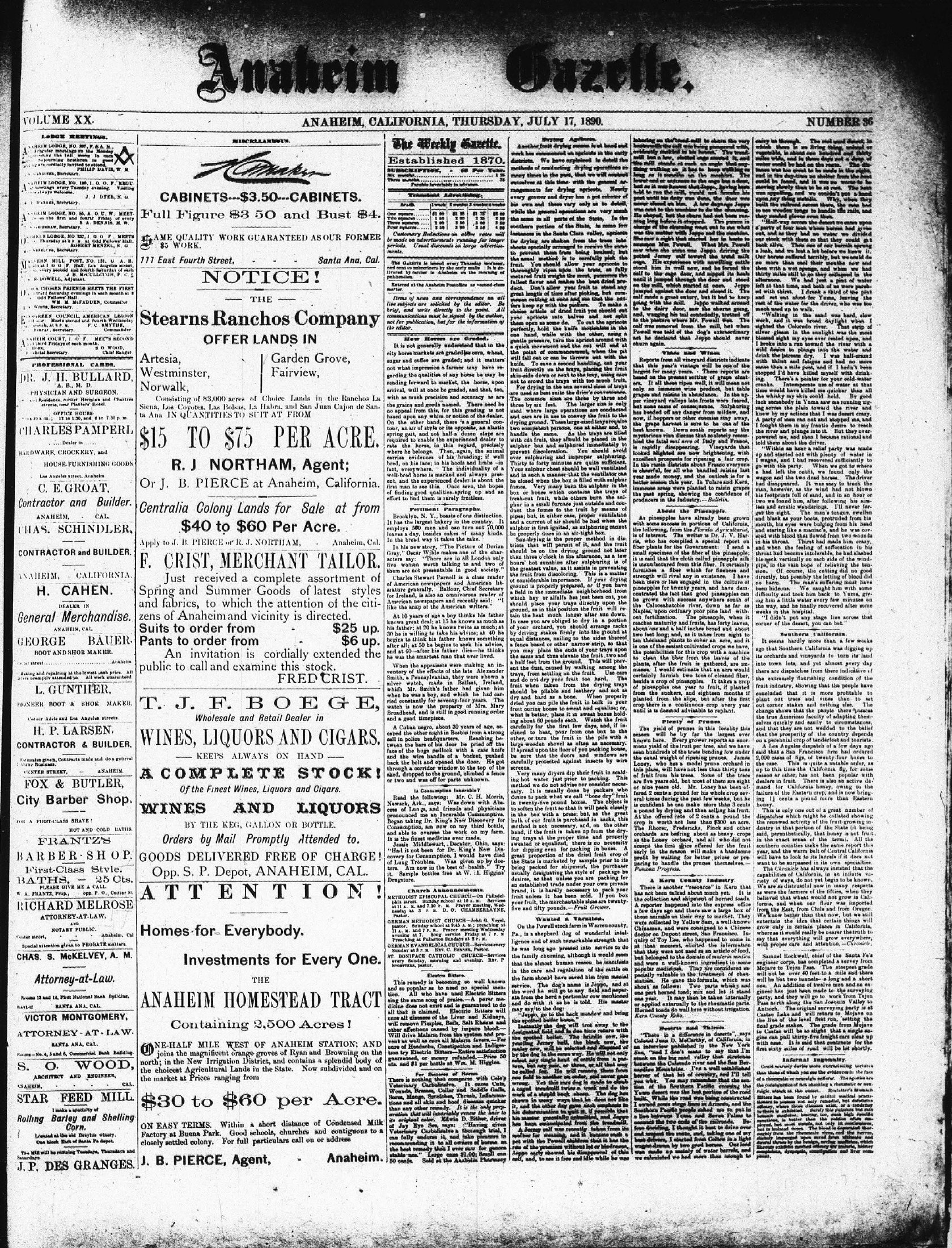
Searchable text
VOLUME XX.
ANAHEIM
LODGE MEETINGS.
ANAHEIM LODGE, NO. 187, F. & A. M.
Regular meetings on the Monday
including the full moon in good
sojourning bratham is good
and recordally invited to attend.
PHILIP DAVIS, W. M.
ANAHEIM LODGE, NO. 189, I. O. O. F. REGUments every Tuesday evening.
Visiting always welcome.
J. J. DYER, N. O.
J. HARRIS, Secretary.
ANAHEIM LODGE, NO. 265, A. O.U. W. MEETing on the first and fourth Friday of every
S.A. DENNIS, M.W.
ANAHEIM LODGE, NO. 237, I. O.O. F. MEETS
Thursday at 8 P.M. at Odd Fellow's Hall.
ROBERT MENZEL, N. O.
ANAHEIM MILL PORT, NO. 131, O. A. R.
at I. O.O. F. Hall, Los Angeles Street,
every second and fourth Saturday of each
J.B. McCULLCUCH, P.C.J.
M.DOWELL, Adjutant.
WORK CHOSEN FRIENDS MEETS THE FIRST
third Saturday evenings in each month at 8
Odd Fellow's Hall.
WM. M. McFADDEN, Counsellor
WHITE, Secretary.
GREEN COUNCIL, AMERICAN LEON
Hour. Meet a second and fourth Wednesday
month, at 8 P.M.
F.C. SMYTHE,
KEMPAT, Secretary.
Commander
ANAHEIM COURT, I. O.F. MEET'S SECOND
and third Fridays of each month.
Heek,
S.O. WOOD,
Financial Secretary
Chief Ranger
PROFESSIONAL CARD.
DR. J. H. BULLARD,
A.B., M.D.
PHYSICIAN AND SURGEON.
Residence, corner Hermins and Chartres
streets, near Plantera' Hotel.
OFFICE HOUSE:
12 to 1:30, and 6 to 7:30 p.m.
CHARLES PAMPERL
... Dealer in...
HARDWARE, CROCKERY, and
HOUSE-FURNISHING GOODS
MISCELLANEOUS.
CABINETS---$3.50---CABINETS
Full Figure $3 50 and Bust
AME QUALITY WORK GUARANTEED AS OUR FO-
$5 WORK.
111 East Fourth Street,
Santa Ana
NOTICE!
THE
Stearns Ranchos CompaOFFER LANDS IN
Artesia,
Westminster,
Norwalk,
Consisting of 83,000 acres of Choice Lands in the RanSiena, Los Coyotes, Las Bolsas, La Habra, and San Juan Cajon
ta Ana IN QUANTITIES TO SUIT AT FROM
$15 TO $75 PER ACRE
R.L.NORTHAM Agent:
DR. J. H. BULLARD,
A. B., M. D.
PHYSICIAN AND SURGEON.
Residence, corner Hermina and Chartres streets, near Planters' Hotel.
OFFICE HOUSE:
12 to 1:30, and 6 to 7:30 p.m.
CHARLES PAMPERL
Dealer in...
HARDWARE, CROCKERY, and
HOUSE-FURNISHING GOODS
Los Angeles street, Anaheim.
C. E. GROAT,
Contractor and Builder.
ANAHEIM, CAL.
CHAS. SCHINDLER,
CONTRACTOR and BUILDER.
ANAHEIM, CALIFORNIA.
H. CAHEN.
DEALER IN
General Merchandise.
ANAHEIM, CAL.
GEORGE BAUER.
BOOT AND SHOE MAKER.
Center street... Anaheim.
Making and repairing at the lowest cash price. All others promptly attended. All work guaranteed.
L. GUNTHER,
HONER BOOT & SHOE MAKER.
Corner Adele and Los Angeles streets.
H. P. LARSEN,
CONTRACTOR & BUILDER.
Estimates given, Contracts made and do a general jobing business.
CENTER STREET... ANAHEIM.
FOX & BUTLER,
City Barber Shop.
FOR A FIRST-CLASS SHAVE!
HOT AND COLD BATHS.
FRANTZ'S
BARBER SHOP.
First-Class Style.
BATHS... 25 Cts.
Westminster,
Norwalk,
Consisting of 83,000 acres of Choice Lands in the Rancho Siena, Los Coyotes, Las Bolsas, La Habra, and San Juan Cajon ta Ana IN QUANTITIES TO SUIT AT FROM
$15 TO $75 PER ACRE
R. J NORTHAM, Agent;
Or J. B. PIERCE at Anaheim, Califo
Centralia Colony Lands for Sale at $40 to $60 Per Acre.
Apply to J. B. PIERCE or R. J. NORTHAM, Anahei
F. CRIST, MERCHANT TAILER
Just received a complete assortment of Spring and Summer Goods of latest s and fabrics, to which the attention of the zens of Anaheim and vicinity is directed.
Suits to order from - $25
Pants to order from - $6
An invitation is cordially extended public to call and examine this stock.
FRED CRISI
T. J. F. BOEG
Wholesale and Retail Dealer in
WINES, LIQUORS AND CIGARETS
KEeps Always On Hand
A COMPLETE STOCK
Of the Finest Wines, Liquors and Cigars.
WINES AND LIQUORS
BY THE KEG, GALLON OR BOTTLE.
Orders by Mail Promptly Attended to
GOODS DELIVERED FREE OF CHARGE
Opp. S. P. Depot, ANAHEIM, CA
FOX & BUTLER,
City Barber Shop.
FOR A FIRST-CLASS SHAVE!
HOT AND COLD BATHS.
FRANTZ'S
BARBER SHOP.
First-Class Style.
BATHS, - 25 Cts.
PLEASE GIVE ME A CALL.
W. A. FRANTZ, Prop., opp. P. O., Center St.
RICHARD MELROSE
ATTORNEY-AT-LAW.
AND
NOTARY PUBLIC.
Center street, Anaheim, Cal.
Special attention given to PROBATE matters.
CHAS. S. McKELVEY, A. M.
Attorney-at-Law.
Rooms 13 and 14, First National Bank Building,
May 1st BANTA ANA, CAL.
VICTOR MONTGOMERY,
ATTORNEY-AT-LAW.
BANTA ANA, CAL.
Rooms—No. 4, 5 and 6, Commercial Bank Building.
S. O. WOOD,
ARCHITECT AND ENGINEER,
ANAHEIM, CAL.
STAR FEED MILL.
I make a specialty of
Rolling Barley and Shelling Corn.
Limited at the old Dreyfus winery.
One block Bank of Santa Fe depot.
The Mill will be running Tuesdays, Thursdays and Saturdays.
J. P. DES GRANGES.
Of the Finest Wines, Liquors and Cigars.
WINES AND LIQUORS
BY THE KEG, GALLON OR BOTTLE.
Orders by Mail Promptly Attended to
GOODS DELIVERED FREE OF CHARGE
Opp. S. P. Depot, ANAHEIM, CA.
ATTENTION
Homes for Everybody.
Investments for Every C
THE
ANAHEIM HOMESTEAD TRANSACTION
Containing 2,500 Acres!
ONE-HALF MILE WEST OF ANAHEIM STATION joins the magnificent orange groves of Ryan and Browning north; in the New Irrigation District, and contains a splendid view of the choicest Agricultural Lands in the State. Now subdivided the market at Prices ranging from
$30 to $60 per Acre ON EASY TERMS. Within a short distance of Condensed Factory at Buena Park. Good schools, churches and contiguous settled colony. For full particulars call on or address
J. B. PIERCE, Agent, Anaheim
ANAHEIM, CALIFORNIA, THURSDAY, JULY 17, 1890.
CABINETS.
and Bust $4.
ENTEED AS OUR FORMER
Santa Ana, Cal.
CE!
os Company
DS IN
garden Grove,
airview,
ce Lands in the Ranchos La,
and San Juan Cajon de SanT FROM
PER ACRE.
The Weekly Gazette.
Established 1870.
SUBSCRIPTION - 95 Per Year.
Six months - 1.25
Three months - 75
Purple invariably in advertisement.
Transactions Advertising:
Brand:
One square ... $1.00
Two squares ... 1.00
Three squares ... 2.00
Four squares ... 2.50
Customary Reductions on above rates will be made on advertisements running for longer periods. Usual discounts on large advertisements.
The Gazette is issued every Thursday morning, and sent to subscribers by the early mails. It is delivered by carrier in Anaheim on the morning of publication.
Entered at the Anaheim Postoffice as second-class matter.
Items of news and correspondence on all line subjects are solicited by the editor. Be brief, and write directly to the point. All communications must be signed by the author, not for publication, but for the information of the editor.
How Horses are Graded.
It is not generally understood that in the city horse markets are graded as corn, wheat, sugar and coffee are graded; and it matters not what impression a farmer may have regarding the qualities of any horse he may be sending forward to market, the horse upon arrival, will at once be graded, and that, too, with as much precision and accuracy as are the grains and goods named. There need be no appeal from this, for this grading is not based upon any whim or notion of the dealer. On the other hand, there’s a general contour, an air of style or its opposite, an elastic spring gait, and not half-a dozen steps are required to enable the experienced dealer to rate the horse, in this regard, precisely where he belongs. Then, again, the animal carries evidences of his breeding; if well bred, on his face; in his hoofs and limbs – in
Brewing Agrients.
Another fruit drying machine is at hand and work has commenced on apricots in the early distrients. We have explained in detail the methods of conducting drying operations so many times in the past, that we will continue ourselves at this time with the general arrangements for drying apricots. Nearly every grower and dryer has a pet volume of his own and these vary only as to detail, while the general operations are very much the same in all parts of the State. In the southern portion of the State, in some few instances in the Santa Clara valley, apricots for drying are shaken from the trenches specially arranged to receive the same to prevent them from being burned; but the main method is to carefully pick the fruit. You should allow your apricots to thoroughly ripen upon the tren, as fully matured fruit weighs the most, pummels the fallen flavor and makes the best dried product. Don’t allow your fruit to stand any great length of time after picking, but communicate cutting at once and see that the cutters keep up with the pickers. To make a choice article of dried fruit you should eat your apricots into halves and not split them open as some do. To cut the apricots perfectly, hold the knife motions in the one hand, while with the other, using a gentle pressure, turn the apricot around with a quick movement and the cut will end at the point of commencement, when the pit will fall out or can be thrown out with the knife. To save a second handling, cut your fruit directly on the trays, placing the fruit skin-side down or next to the tray, using care not to crowd the trays with too much fruit.
For drying in the sun several times of trays are used as best suits the driver’s convenience. The common sizes are three by three and three by six feet. The larger size is only used where large operations are conducted and cars are in use to convey the fruit to the drying ground. These large-sized trays require two competent persons, one at either end, to handle the same. As the trays are filled with cut fruit, they should be placed in the sulphar box and sulphured immediately to prevent discoloration. You should avoid over sulpharing and improper sulpharing. Thirty to forty minutes are quite sufficient.
Reports from that this year largest for man-based on the prairie. If all those only an immensely grape and raisin per vineyard vaut but none came has headed off now, if hoppings the grape harbors best known. mysterious rime bled the fatal risk rapidly dipped excellent prospect In the rainain
For Sale at from
Per Acre.
HAM,
Anaheim, Cal.
ANT TAILOR.
plete assortment of
ids of latest styles
attention of the citity is directed.
$25 up.
$6 up.
dially extended the
this stock.
FRED CRIST.
O E G E,
Dealer in
AND CIGARS.
ON HAND —
E STOCK!
oors and Ciqars.
LIQUORS
OR BOTTLE.
FREE OF CHARGE!
AHEIM, CAL.
Pertinent Paragraphs.
Brooklyn, N. Y., boasts of one distinction. It has the largest bakery in the country. It employs 560 men and can turn out 70,000 loaves a day, besides cakes of many kinds. In the bread way it takes the cake.
In his new story, "The Picture of Dorian Gray," Oscar Wilde makes one of the characters say: "There are in all London only five women worth talking to and two of them are not presentable in good society."
Charles Stewart Parnell is a close reader of American newspapers and American literature generally. Balfour, Chief Secretary for Ireland, is also an omnivorous reader of American newspapers and recently said: "I like the snap of the American writers."
At 10 years of age a boy thinks his father knows great deal; at 15 he knows an much as his father; at 20 he knows twice as much; at 30 he is willing to take his advice; at 40 he begins to think his father knows something after all; at 50 he begins to seek his advice, and at 60—after his father dies—he thinks he was the smartest man that ever lived.
When the appraisers were making an inventory of the effects of the late Alexander Smith, a Pennsylianian, they were shown a silver watch, made in Belfast, Ireland, which Mr. Smith's father had given him when he was a boy, and which he had carried constantly for seventy-four years. The watch is now the property of Mrs. Mary Broadhead, and is still in good running order and a good timepiece.
A Cuban negro, about 30 years of age, escaped the other night in Boston from a strong call in police headquarters. Reaching between the bars of his door he pried off the face of his pallid lock with a case knife and the wire handle of a bucket, pushed back the bolt and opened the door. He got through a corridor window to the top of the shed, dropped to the ground, climbed a fence or two and was off for parts unknown.
Is Consumption Incarrable?
Read the following: Mr. C. H. Morris, Newark, Ark., says: Was down with Abcess of Lung, and friends and physicians pronounced me an Incurable Consumptive. Began taking Dr. King's New Discovery for Consumption, am now on my third bottle, and able to oversee the work on my farm. It is the finest medicine ever made.
Jessie Middlewart, Decatur, Ohio, says: "Had it not been for Dr. King's New Discovery for Consumption, I would have died of Lung Troubles. Was given up by doctors. Am now in the best of health." Try it. Sample bottles free at W. M. Higgins Drugstore.
For drying in the sun several times of trays are used as best suits the driver's convenience. The common sizes are three by three and three by six feet. The larger size is only used where large operations are conducted and cars are in use to convey the fruit to the drying ground. These large-sized trays require two competent persons, one at either end, to handle the same. As the trays are filled with cut fruit, they should be placed in the sulphur box and sulphur immediately to prevent discoloration. You should avoid sulphuring and improper sulpharing. Thirty to forty minutes are quite sufficient. Your sulphur chest should be well ventilated and in such a manner that the ventilator can be closed when the box is filled with sulphur fumes. Very many burn the sulphur in the box or house which contains the trays of fresh-cut fruit, while others burn the sulphur in a small furnace just outside and conduct the fumes to the fruit by means of pipes; but, in either case, proper ventilation and a current of air should be had when the sulphur is first ignited, as sulphuring cannot be properly done in an air-tight box.
Sun-drying is the proper method in districts that will permit of it, and the fruit should be on the drying ground not later than three o'clock in the afternoon, as a few hours hot sunshine after sulphuring is of the greatest value, as it assists in preventing the fruit from discoloring. This is a matter of considerable importance. If your drying ground is properly prepared, or if you have a field in the immediate neighborhood from which hay or alfalfa has just been cut, you should place your trays directly upon the ground, as in this position the fruit will retain the heat much longer after sun down.
In case you are obliged to dry in a portion of your orchard, you should arrange racks by driving stakes firmly into the ground at equal distances, nailing to the sides thereof a fence board or other narrow strip, so that you may place the ends of your trays upon the same and thus elevate the fruit two and a half feet from the ground. This will prevent the dust caused by walking among the trays, from settling on the fruit. Use care and do not dry your fruit too hard. The fruit when taken from the drying trays should be pliable and leathery and not as dry and hard as a bone. When properly dried you can pile the fruit in bulk in your fruit curing house to sweat and equalize; or, what is better, place it in sweas boxes holding about 60 pounds each. Watch the fruit carefully for the first few days, and, if inclined to heat, pour from one box to the other, or turn the fruit in the pile with a large wooden shovel as often necessary. If spread upon the floor of you packing house, be sure that the doors and windows are carefully protected against insects by wire screens.
Very many dryers dip their fruit in scalding hot water just prior to packing. This method we do not advise nor consider necessary. It is usually done by packers who desire to pack what we call "bone dry" fruit in twenty-five pound boxes. The object is to soften the fruit so that it will pack closely in the box with a press; but, as the great bulk of our fruit is purchased in sacks, this method is not necessary; ard, on the other hand, if the fruit is taken up from the drying trays at the proper time and properly sweated or equalized, there is no necessity for dipping even for packing in boxes. A great proportion of the dried fruit crop of the State is marked by sample prior to its being packed for shipment, the purchaser usually designating the style of package he desires, so that unless you are packing for fruit directly on the tray, placing the fruit skin-side down or next to the tray, using care not to crowd the trays with too many fruits.
For drying in the sun several times of trays are used as best suits the driver's convenience. The common sizes are three by three and three by six feet. The larger size is only used where large operations are conducted and cars are in use to convey the fruit to the drying ground. These large-sized trays require two competent persons, one at either end, to handle the same. As the trays are filled with cut fruit, they afford be placed in the sulphur box and sulphur immediately to prevent discoloration. You should avoid sulphuring and improper sulpharing. Thirty to forty minutes are quite sufficient. Your sulphur chest should be well ventilated and in such a manner that the ventilator can be closed when the box is filled with sulphur fumes. Very many burn the sulphur in the box or house which contains the trays of fresh-cut fruit, while others burn the sulphur in a small furnace just outside and conduct the fumes to the fruit by means of pipes; but, in either case, proper ventilation and a current of air should be had when the sulphur is first ignited, as sulphuring cannot be properly done in an air-tight box.
Sun-drying is proper method in districts that will permit of it, and the fruit should be on the drying ground not later than three o'clock in the afternoon, as a few hours hot sunshine after sulphuring is of greatest value, as it assists in preventing the fruit from discoloring. This is a matter of considerable importance. If your drying ground is properly prepared, or if you have a field in the immediate neighborhood from which hay or alfalfa has just been cut, you should place your trays directly upon the ground, as in this position the fruit will retain the heat much longer after sun down.
In case you are obliged to dry in a portion of your orchard, you should arrange racks by driving stakes firmly into the ground at equal distances, nailing to the sides thereof a fence board or other narrow strip, so that you may place the ends of your trays upon the same and thus elevate the fruit two and a half feet from the ground. This will prevent the dust caused by walking among the trays from settling on the fruit. Use care and do not dry your fruit too hard. The fruit when taken from the drying trays should be pliable and leathery and not as dry and hard as a bone. When properly dried you can pile the fruit in bulk in your fruiting house to sweat and equalize; or what is better, place it in sweas boxes holding about 60 pounds each. Watch the fruit carefully for the first few days, and if inclined to heat, pour from one box tothe other, or turn the fruit in the pile with a large wooden shovel as often necessary. If spread upon the floor of you packing house, be sure that the doors and windows are carefully protected against insects by wire screens.
Very many dryers dip their fruit in scalding hot water just prior to packing. This method we do not advise nor consider necessary. It is usually done by packers who desire to pack what we call "bone dry" fruit in twenty-five pound boxes. The object is to soften the fruit so that it will pack closely inthe box with a press; but,asthe great bulkofourfruitispurchasedin sacks,themethodisnotnecessaryardontheresponsibilityfordippingevenforpackinginboxes.AgreatproportionofthedriedfruitcropoftheStateismarkedbysamplepriortoitsbeingpackedforshipment,thepurchaserusuallydesignatingthestyleofpackagehedesires,sothatunlessyouarepackingforfruitdirectlyonthetraysplacingthefruitskin-sidedownortnexttothetraysusingcarenottocrowdpracticingmaturebiodiversityandintensifiedproblem.Intherasdiskindiesonlyanimmunegrapeandraisedvineyardandbutnoneamereorlepineapplesforontheinstantmostbeenmoreorlepineapplesforontheinstantmostbeenmoreorlepineapplesforontheinstantmostbeenmoreorlepineapplesforontheinstantmostbeenmoreorlepineapplesforontheinstantmostbeenmoreorlepineapplesforontheinstantmostbeenmoreorlepineapplesforontheinstantmostbeenmoreorlepineapplesforontheinstantmostbeenmoreorlepineapplesforontheinstantmostbeenmoreorlepineapplesforontheinstantmostbeenmoreorlepineapplesforontheinstantmostbeenmoreorlepineapplesforontheinstantmostbeenmoreorlepineapplesforontheinstantmostbeenmoreorlepineapplesforontheinstantmostbeenmoreorlepineapplesforontheinstantmostbeenmoreorlepineapplesforontheinstantmostbeenmoreorlepineapplesforontheinstantmostbeenmoreorlepineapplesforontheinstantmostbeenmoreorlepineapplesforontheinstantmostbeenmoreorlepineapplesforontheinstantmostbeenmoreorlepineapplesforontheinstantmostbeenmoreorlepineapplesforontheinstantmostbeenmoreorlepineapplesforontheinstantmostbeenmoreorlepineapplesforontheinstantmostbeenmoreorlepineapplesforontheinstantmostbeenmoreorlepineapplesforontheinstantmostbeenmoreorlepineapplesforontheinstantmostbeenmoreorlepineapplesforontheinstantmostbeenmoreorlepineapplesforontheinstantmostbeenmoreorlepineapplesforontheinstantmostbeenmoreorlepineapplesforontheinstantmostbeenmoreorlepineapplesforontheinstantmostbeenmoreorlepineapplesforontheinstantmostbeenmoreorlepineapplesforontheinstantmostbeenmoreorlepineapplesforontheinstantmostbeenmoreorlepineapplesforontheinstantmostbeenmoreorlepineapplesforontheinstantmostbeenmoreorlepineapplesforontheinstantmostbeenmoreorlepineapplesforontheinstant mostbeenmoreorlepineapplesforontheinstant mostbeenmoreorlepineapplesforontheinstant mostbeenmoreorlepineapplesforonttheinstant mostbeenmoreorlepineappliesforonttheinstant mostbeenmoreorlepineappliesforonttheinstant mostbeenmoreorlepineappliesforonttheinstant mostbeenmoreorlepineappliesforonttheinstant mostbeenmoreorlepineappliesforonttheinstant mostbeenmoreorlepineappliesforonttheinstant mostbeenmoreorlepineappliesforontthe instantiest mostbeenmoreorlepineappliesforontthe instantiest mostbeenmoreorlepineappliesforontthe instantiest mostbeenmoreorlepineappliesforontthe instantiest mostbeenmoreorlepineappliesforONTHE instantiest mostbeenmoreorlepineappliesforONTHE instantiest mostbeenmoreorlepineappliesFORONTHE instantiest mostbeenmoreorlepineappliesFORONTHE instantiest mostbeenmoreORLEPNEAPPLIESFORONTHE instantiest mostbeenmoreORLEPNEAPPLIESFORONTHE instantiest mostbeENORENORENORENORENORENORENORENORENORENORENORENORENORENORENORENORENORENORENORENORENORENORENORENORENORENORENORENORENORENORENORENORENORENORENORENORENORENORENORENORENORENORENORENORENURENORENURENURENURENURENURENURENURENURENURENURENURENURENURENURENURENURENURENURENURENURENURENURENURENURENURENURENURENURENURENURENURENURENURENURENURENURENURENURENURENURENURENURENURENURENURENUREnurenurenurenurenurenurenurenurenurenurenurenurenurenurenurenurenurenurenurenurenurenurenurenurenurenurenurenurenurenurenurenurenurenurenurenurenurenurenurenurenurenurenurenurenurenurenurenurenurrenurenurrenurrenurrenurrenurrenurrenurrenurrenurrenurrenurrenurrenurrenurrenurrenurrenurrenurrenurrenurrenurrenurrenurrenurre nurernurernurernurernurernurernurernurernurernurernurernurernurernurernurernurernurernurernurernurernurernurernurernurernurernurernurernurernurernurernurernurernurenurenurenurenurenurenurenurenurenurenurenurenurenurenurenurenurenurenurenurenurenurenurenurenurenurenurenurenurenurenurenurenurenurenurenurenurenurenurenuronrenuronrenuronrenuronrenuronrenuronrenuronrenuronrenuronrenuronrenuronrenuronrenuronrenuronrenuronrenuronrenuronrenuronrenuronrenuronrenuronrenuronrenuronrenuronrenuronrenuronrenuronrenuronrenuronrenuronrenuronrenuronrenuronrenuronrenuronrenuronrenuronrenuronrenuronrenuronrenuron renuronrenuronrenuronronrename renuronrename renuronrename renuronrename renuronrename renuranrename renuranrename renuranrename renuranrename renuranrename renuranrename renuranrename renuranrename renuranrename renuranrename renuranrename renuranrename renuranrename renuranrename renuranrename renuranrename renuranrename renuranrename renuranrename renuranrename renuranrename renuranrename renuranrename renuranrename renuranrename renuranrename renuranrename renuranrename renuranrename renuranname renuranname renuranname renuranname renuranname renuranname renuranname renuranname renuranname renuranname renuranname renuranname renuranname renuranname renuranname renuranname renuranname renuranname renuranname renuranname renuranname renuranname renuranname renuranname renuranname renuranname renuranname renuranname renuranname renuranname renuranname renuranname renuranname renuerename renuerenameRenuerename Renuerename Renuerename Renuerename Renuerename Renuerename Renuerename Renuerename Renuerename Renuerename Renuerename Renuerename Renuerame Renuerame Renuerame Renuerame Renuerame Renuerame Renuerame Renuerame Renuerame Renuerame Renuerame Renuerame Renuerame Renuerame Renuerame Renuerame Renuerame Renuerame Renuerame Renuerame Renuerame Renuerame Renuerame Renuerame Renuerame Renuerame Renuerame Renuerame Renuerame Renuerame Renuerame Renuerame Renuerame RenuerameRenuerameRenuerAMERenuerAMERenauerAMERenauerAMERenauerAMERenauerAMERenauerAMERenauerAMERenauerAMERenauerAMERenauerAMERenauerAMERenauerAMERenauerAMERenauerAMERenauerAMERenauerAMERenauerAMERenauerAMERenauerAMERenauerAMERenauerAMERenauerAMERenauerAMERenauerAMERenauerAMERenauerAMERenauerAMERenauerAMERenauerAMERenauerAMERenauerNAMERenauerNAMERenauerNAMERenauerNAMERenauerNAMERenuderNAMERenuderNAMERenuderNAMERenuderNAMERenuderNAMERenuderNAMERenuderNAMERenuderNAMERenuderNAMERenuderNAMERenuderNAMERenuderNAMERenuderNAMERenuderNAMERenuderNAMERenuderNAMERenuderNAMERenuderNAMERenuderNAMERenuderNAMERenuderNAMERenuderNAMERenuderNAMERenuderNAMERenuderNAMERenuderNAMERenuderNAMERenuderNAMERenuderNAMERenuderNAMERenuderNAMERenuderNAMERenuderNAMERenuderNAMERenuderNAMERenuderNAMERenuderNAMERenuderNAMERenuderNAMERenuderNAMERenuderNAMERenuderNameRENDERNAMERENDERNAMERENDERNAMERENDERNAMERENDERNAMERENDERNAMERENDERNAMERENDERNAMERENDERNAMERENDER NAMERENDER NAMERENDER NAMERENDER NAMERENDER NAMERENDER NAMERENDER NAMERENDER NAMERENDER NAMERENDER NAMERENDER NAMERENDER NAMERENDER NAMERENDER NAMERENDER NAMERENDER NAMERENDER NAMERENDER NAMERENDER NAMERENDER NAMERENDER NAMERENDER NAMERENDER NAMERENDER NAMERENDER NAMERENDER NAMERENDER NAMERENDER NAMERENDER NAMERENDER NAMERENDER NAMERENDER NAMERENDER NAMERENDER NAMERENDER NAMERENDER NAMERENDER NAMERENDER NAMERENDER NAMERENDER NAMERENDER NAMERENDENAMERENDENAMERENDENAMERENDENAMERENDENAMERENDENAMERENDENAMERENDENAMERENDENAMERENDENAMERENDENAMERENDENAMERENDENAMERENDENAMERENDENAMERENDENAMERENDENAMERENDENAMERENDENAMERENDENAMERENDENAMERENDENAMERENDENAMERENDENAMERENDENAMERENDENAMERENDENAMERENDENAMERENDENAMERENDENAMERENDENAMERENDENAMERENDENAMERENDENAMERENDENAMERENDENAMERENDENAMERENDENAMERENDENAMERENDENAMERENDENAMEREND_NAMEREND_NAMEREND_NAMEREND_NAMEREND_NAMEREEND_NAMEREEND_NAMEREEND_NAMEREEND_NAMEREEND_NAMEREEND_NAMEREEND_NAMEREEND_NAMEREEND_NAMEREEND_NAMEREEND_NAMEREEND_NAMEREEND_NAMEREEND_NAMEREEND_NAMEREEND_NAMEREEND_NAMEREEND_NAMEREEND_NAMEREEND_NAMEREEND_NAMEreEND_NAMEreEND_NAMEreEND_NAMEreEND_NAMEreEND_NAMEreEND_NAMEreEND_NAMEreEND_NAMEreEND_NAMEreEND_NAMEreEND_NAMEreEND_NAMEreEND_NAMEreEND_NAMEreEND_NAMEreEND_NAMEreEND_NAMEreEND_NAMEreEND_NAMEreEND_NAMEreEND_NAMEreEND_NAMEreEND_NAMEreEND_NAMEreEND_NAMEreEND_NAMEreEND_NAMEreEND_NAMEreEND_NAMEreEND_NAMEreEND_NAMEreEND_NAMEreEND_NAMEreEndNamereEndNamereEndNamereEndNamereEndNamereEndNamereEndNamereEndNamereEndNamereEndNamereEndNamereEndNamereEndNamereEndNamereEndNamereEndNamereEndNamereEndNamereEndNamereEndNamereEndNamereEndNamereEndNamereEndNamereEndNamereEndNamereEndNamereEndNamereEndNamereEndNamereEndNamereEndNamereEndNamereEnd NameReend NameReend NameReend NameReend NameReend NameReend NameReend NameReend NameReend NameReend NameReend NameReend NameReend NameReend NameReend NameReend NameReend NameReend NameReend NameReend NameReend NameReend NameReend NameReend NameReend NameReend NameReend NameReend NameReend NameReend NameReend NameReend NameReend NameRerend NameRerend NameRerend NameRerend NameRerend NameRerend NameRerend NameRerend NameRerend NameRerend NameRerend NameRerend NameRerend NameRerend NameRerend NameRerend NameRerend NameRerend NameRerend NameRerend NameRerend NameRerend NameRerend NameRerend NameRerend NameRerend Rerend Rerend Rerend Rerend Rerend Rerend Rerend Rerend Rerend Rer end Rer end Rer end Rer end Rer end Rer end Rer end Rer end Rer end Rer end Rer end Rer end Rer end Rer end Rer end Rer end Rer end Rer end Rer end Rer end Rer end Rer end Rer end Rer end Rer end Rer end Rer end Rer end Rer end Rer end Rer end Rer end RER end RER end RER end RER end RER end RER end RER end RER end RER end RER end RER end RER end RER end RER end RER end RER end RER end RER end RER end RER end RER end RER end RER end RER end RER end RER end RER end RER end RER end RER end RER end RER end
LIQUORS OR BOTTLE. FREELY ATTENDED TO. FREE OF CHARGE! AHEIM, CAL.
ACTION!
BODY. For Every One.
TEAD TRACT DO Acres!
NAHEIM STATION; AND of Ryan and Browning on the land contains a splendid body of state. Now subdivided and on per Acre.
distance of Condensed Milk churches and contiguous to a pars call on or address
- Anaheim.
Is Consumption Incarable?
Read the following: Mr. C. H. Morris, Newark, Ark., says: Was down with Abscess of Lung, and friends and physicians pronounced me an Incurable Consumptive. Began taking Dr. King's New Discovery for Consumption, am now on my third bottle, and able to oversee the work on my farm. It is the finest medicine ever made.
Jessie Middlewart, Decatur, Ohio, says: "Had it not been for Dr. King's New Discovery for Consumption, I would have died of Lung Troubles. Was given up by doctors. Am now in the best of health." Try it. Sample bottles free at W. 11. Higgins' Drugstore.
Church Announcements.
METHODIST EPISCOPAL CHURCH—On Philadelphia street. Sunday school at 10 a.m. Services at 11 a.m. and 7:30 p.m. Prayer meeting, Wednesday at 3 p.m. D. O. CHAMBERLAYNE, Pastor.
OERMAN METHODIST CHURCH—John G. Vogel, pastor. Sunday school at 9:45 a.m.; preaching at 11 a.m. and 7 p.m. Praver meeting Wednesday evening at 7. Song service Friday at 7 p.m. Preaching at Fullerton Sundays at 2 p.m.
OERMAN EVANGELICAL CHURCH—Services every Sunday at 3 p.m. Rev. C. Bramble, Pastor.
ST. BONIFACE CATHOLIC CHURCH—Services every Sunday, morning and evening. Rev. P STORTTRANS, pastor.
Electric Bitters.
This remedy is becoming so well known and so popular as to need no special mention. All who have used Electric Bitters sing the same song of praise.—A purer medicine does not exist and is guaranteed to do all that is claimed. Electric Bitters will cure all diseases of the Liver and Kidneys, will remove Pimples, Beils, Salt Rheum and other affections caused by impure blood. Will drive Malaria from the system and prevent as well as cure all Malaria favors.—For cure of Headache, Constipation and Indigestion try Electric Bitters—Entire satisfaction guaranteed, or money refunded.—Price 50 cts. and $1 per bottle at Wm. M. Higgins.
For Business of Horse There is nothing that compares with Cale's Veterinary Carabalmera. It causes Cats, Worms, Bruises, Collar and Saddle Galls, Sores, Mange, Scratchers, Throat, Infirmations and all skin and hoof diseases quicker than any other remedy. It is the only preparation that will insurably reverse the hair to its original color. Edwin D. Bither, driver of Jay Eye Sun, says: "Having given Veterinary Carabalmera a thorough trial, I can fully endorse it, and take pleasure in recommending it to all owners of horses on the best remedy this I ever saw for general stable use." Large case $1.00; Small one 50 cents. Sold at the Anaheim Pharmacy
It is usually done by packers who desire to pack what we call "bone dry" fruit in twenty-five pound boxes. The object is to soften the fruit so that it will pack closely in the box with a press; but, as the great bulk of our fruit is purchased in sacks, this method is not necessary, ard, on the other hand, if the fruit is taken up from the drying trays at the proper time and properly sweated or equalized, there is no necessity for dipping even for packing in boxes. A great proportion of the dried fruit crop of the State is marketed by sample prior to its being packed for shipment, the purchaser usually designating the style of package he desires, so that unless you are packing for an established trade under your own private brand, it is hardly necessary to pack your fruit unless it has been sold. If you box your fruit, the merchantable sizes are twenty-five and fifty pounds.—Fruit Grower.
Wanted m Vacation.
On the Powell stock farm in Warren county, Pa., is a shepherd dog of wonderful intelligence and of such remarkable strength that he was long ago pressed into service to do the family churning, although it would mean that the almost human reason he manifests in the care and regulation of the cattle on the farm should have saved him from mental service. The dog's name is Jappo, and at the word he will go to any field and prepare from the herd a particular cow mentioned and do with it as he is told. His master may say/to the dog:
"Jappo, go to the back mound and bring the spotted heifer home."
Instantly the dog will trot away to the designated field and in due time return with the spotted heifer. The brindle coat, the yellow Jersey bell, the black new, the malay new, will be selected and dispensed of by the dog in the same way. He will not only select any single head of cattle from a pantern, but any pair, or three, all that may be called hit. He will remove them from one field to another an order, and never guess wrong. Yet this man dog is made to climb a steep hill twice a week and do the work of a steppar back sheep. The dog has shown in many ways that he does not like it, and the other day gives such emphasis to his determination to quit it if possible that his master grasped unchained, and Jappo has been encouraged from his trunkall.
A Jappo calf was recently taken from its mother for weaning, and it became much a pet with the Powell children that it has run of the premises without let or hindrance. Jappo early showed his dimpenval of this calf, and to see it free and idle while he was method we do not advise nor consider necessary.
It is usually done by packers who desire to pack what we call "bone dry" fruit in twenty-five pound boxes. The object is to soften the fruit so that it will pack closely in the box with a press; but, as the great bulk of our fruit is purchased in sacks, this method is not necessary, ard, on the other hand, if the fruit is taken up from the drying trays at the proper time and properly sweated or equalized, there is no necessity for dipping even for packing in boxes. A great proportion of the dried fruit crop of the State is marketed by sample prior to its being packed for shipment, the purchaser usually designating the style of package he desires, so that unless you are packing for an established trade under your own private brand, it is hardly necessary to pack your fruit unless it has been sold. If you box your fruit, the merchantable sizes are twenty-five and fifty pounds.—Fruit Grower.
There is an owl has not been taken to the collection area these animals were collected by Chinaman, and doctor on Duper quarry of Toy Dog at that moment that they warned but belonged to and were a popular medicine specially valuable matism. He about as follows one part borne one year. It or applied extra Horned toads on Kern County Bury.
There is no Colonial Juan Dane an interview Sun," and I stuck on the horse matime of Yew time of the Yew time of the Yew time of the Yew time of the Yew time of the Yew time of the Yew time of the Yew time of the Yew time of the Yew time of the Yew time of the Yew time of the Yew time of the Yew time of the Yew time of the Yew time of the Yew time of the Yew time of the Yew time of the Yew time of the Yew time of
IN 10. NUMBER 36
having on the hand-will to share the very best rumble the soil was being pumbed with, or hardly stabbed in his hands. The trunk-mill has a low, slanted edge around it, and the mill stands at such an angle that anything walking on it has to keep walking long before it stops. The person in charge of the alarming wort out to see what was the matter with Jeppo and the machine. He saw a sight that started her in hands to manage Mr. Powell. When Mrs. Powell now when she came was Jeppo driving the petal Jeremy self toward the trunk milk cage. His experiences with unwilling cattle stood him in wall now, and he forced the cage to the cage door, and slipped its hooks until it jumped through the door and stood on the mill, which started at once. Jeppo jumped against the door and shouted it. The mill made a great entry, but it had to keep going with the mill. Jeppo walked around to the dairy door, saw the charns going, and wagging his tail contendedly, trembled off to the pasture where Mr. Powell was. The dairy was removed from the mill, but when Powell was told of the dog's extraordinary not be declared that Jeppo should never churn again.
Wines and Wine.
Reports from all vineyard districts indicate that this year's vintage will be one of the largest for many years. These reports are based on the present setting of grape clusters. If all these ripen well, it will mean not only an immense wine product, but table grapes and rains in abundance. In the upper vineyard valleys late frosts were feared, but none came of consequence. Sulphuring has headed off any danger from mildew, and now, if hoppings or other enemies stay away, the grape harvest is sure to be one of the best known. Down south reports say the mysterious vine disease that so closely resembled the fatal mal arrofo of Italy and France, is rapidly disappearing.
Vineyards that looked bright are now brightening, with excellent prospects for ripening a fair crop. In the rainy districts about Fresno everyone
many in through. The real sand desert, in which there is no living thing, animal or vegetable, is about one hundred and thirty miles wide, and in those days not a drop of water could be had on the route. The distance was too great to be made in the night, and in the day-time no shelter from the heat would be found, and it was no worse to be moving slowly than to be at rest. The heat was appalling, and we couldn't put a hand upon any thing metallic. Why, when they built the railroad across there, the men had to use wooden tugs to handle the rail, and they needed gloves even them.
"Half-way across the desert we came upon a party of four men whom horses had given out, and as they had no water we divided our stock with them so that they could get back alive. Then one of our barrels sprang a leak, and we lost a lot before we knew it. Our horses suffered terribly, but we could do no more than owl their months now and then with a wet sponge, and when we had thirty miles still to go they collapsed in the afternoon. We had just a pint of water left at that time, and both of us were parched with thirst. I drank a third of the pint and set out afloat for Yuma, leaving the rest of the water far the driver, who was too much used up to walk.
"Walking in the sand was hard, slow work, and it was broad daylight when I sighted the Colorado river. That strip of silver gleam in the sunlight was the most blessed sight my eyes ever rested upon, and I broke into a run toward the river with a wild desire to plunge into the water and drink the latrams dry. I was half-craned with thirst and fatigue and had no more sense than a mile post, and if I hadn't been stopped I'd have killed myself with drinking. There's a pointer for your cold-water cranks.
Intemperate use of water at that time would have killed me quicker than all the whisky my skin could hold. By good luck somebody in Yuma saw me running zigzag across the plain toward the river and knew by my actions that I was desert orry. A party of men ran out and stopped me, and I fought them in my frantic desire to reach the river and plunge into it. But they overpowered me, and then I became rational and told them about the driver.
"Within an hour a relief party was made up and started out with plenty of water in I wagon, and I had recovered sufficiently to go with the party."
About the Pineapple.
As pineapples have already been grown with some success in portions of California, the following, from the Florida Agricultural is of interest. The writer is Dr. J. V. Harris, who has compiled a special report on fiber plants for the Government: I send a small specimen of the fiber of the pineapple; it is said that the cloth called pineapple silk is manufactured from this fiber. It certainly furnishes a fiber which for fineness and strength will rival any in existence. I have been more or less engaged in the culture of pineapples for twenty years, and have demonstrated the fact that good pineapples can be grown with success anywhere south of the Caloosahatchie river, down as far as Naples, upon ordinary poor pine land without fertilization. The pineapple, when it reaches maturity and fruits, has forty leaves, about one and a half inches broad and about two feet long; and, as it takes from sight to ten thousand plants to cover an acre, and it is one of the easiest cultivated crops we have, the possibilities for this crop with a machine to clean the fiber from the leaves of the plants, after the fruit is gathered, are immense. I would estimate that an acre would certainly furnish two tons of cleaned fiber, beside a crop of pineapples. It takes a crop of pineapples one year to fruit, if planted from the suckers, and eighteen months if planted from the slope, but after the first crop there is a continuous crop every year until it is deemed advisable to replant.
Plenty of Prunes.
The yield of prunes in this locality this season will be by far the largest ever known here. Every grower reports an enormous yield of the fruit per tree, and we have seen hundreds of the trees bending low under the usual weight of ripening prunes. James Loney, who has a model prune orchard in this place, will have not less than thirty tons of fruit from his trees. Some of the trees are five years old, but most of them are sight or nine years old. Mr. Loney has been offered 2 cents a pound for his whole crop several times during the past few weeks, but he is confident he can make more than 3 cents a pound by drying and then selling his fruit. At the offered rate of 2 cents a pound the crop is worth not less than $300 an acre. The Rhorer, Fredericks, Finck and other orchards are bearing about as heavy crops as the Loney orchard, and all who did not accept the first price offered for the fruit early in the season will make a handsome profit by waiting for better prices or preparing to handle the prunes themselves. Pomona Progress.
A Kern County Industry
Intemperate use of water at that time would have killed me quicker than all the whisky my skin could hold. By good luck somebody in Yuma saw me running vigorously across the plain toward the river and knew by my actions that I was desert crazy. A party of men ran out and stopped me, and I fought them in my frantic desire to reach the river and plunge into it. But they overpowered me, and then I became rational and told them about the driver.
Within an hour a relief party was made up and started out with plenty of water in I wagon, and I had recovered sufficiently to go with the party. When we got to where a had left the outfit, we found only the wagon and the two dead horses. The driver had disappeared. It was easy to track the man, however, as the wind had not blown his footprints full of sand, and in an hour or two we found him, after following his aimless and erratic wanderings. I'll never forget the sight. The man's tongue, swollen and black as your boots, protruded from his mouth, his eyes were bulging from his head and staring like a maniac; and he was covered with blood that flowed from two wounds in his throat. Thirst had made him crazy, and when the feeling of suffocation in his throat had become intolerable, he had slashed his neck vertically on each side of the windpipe, in the vain hope of relieving the tension. Of course, the cutting did no good directly, but possibly the letting of blood did no harm. The man's suffering must have been bideous. We caught him with some difficulty and took him back to Yuma, giving him a little water every few minutes on the way, and he finally recovered after some weeks in the hospital.
"I didn't put any stage line across that corner of the desert, you can bet."
Southern California.
It seems hardly more than a few weeks ago that Southern California was digging up its orchards and vineyards to turn its land into town lots, and yet almost every day there are dispatches from there indicative of the extremely flourishing condition of the fruit industry, showing that the people have concluded that it is more profitable to plant out trees and vines than to set out corner stakes and nothing else. The change shows that the people there possess the true American faculty of adapting themselves quickly and easily to circumstances, and that they are not wedded to the belief that the prosperity of the country depends on a perennial crop of tenderfeet and tourists.
A Los Angeles dispatch of a few days ago said that a San Francisco firm had ordered 2,000 cases of figs, of twenty-four boxes to the case. This is quite a metable order, as up to this time the California fig, for some reason or other, has not been popular with dealers in fruit. There is also an active demand for California honey, owing to the failure of the Eastern crop, and is now bringing 11 cents a pound more than Eastern honey.
This is only one out of a great number of dispatches which might be collated showing the renewed activity of the fruit-growing industry in that portion of the State (it being said, perenthetically, that honey is not fruit in the exact sense of the term). All the southern counties make the same report this year, and the warm belt of Central California will have to look to its laurels if it does not want to be surpassed in its own specialties.
The Chronicle has always insisted that the capabilities of California, in an infinite variety of waves, do not yet begin to be known.
A Kern County Industry.
There is another "resource" in Kern that has not been talked about much yet. It is the collection and shipment of horned toads. A reporter happened into the express office a few days ago and there saw a large box of these animals on their way to market. They were collected by Yellow Sam, a well-known Chinaman, and were consigned to a Chinese doctor on Dupont street, San Francisco. Inquiry of Toy Lee, who happened to come in at that moment, elicited the information that they were not used as an article of food, but belonged to the domain of materia medica and were a well-known ingredient in some popular medicines. They are considered especially valuable in the treatment of rheumatism. He gave the formula, which was about as follows: Two parts whisky and one part horned toad; mix and let it stand one year. It may then be taken internally or applied externally to the rheumatic parts. Horned toads do well here without irrigation. Kern County Echo.
Burrito and Thirstie.
"There is a difference in burritos", says Colesal Juan D. McCarthy, of California, in an interview published in the New York Sun, "and I don't mean to say that I'm attack on the big sand valley that stretches between the Colorado river and the San Bernardino Mountains. I've a well established horde of that bit of country, and I'll tell you. You may remember that the section of the Southern Pacific crossing the Yuma desert was the last portion of the road built. While the road was being constructed I owned some stage horses in Arizona, and the Southern Pacific people asked me to put in a line between Yuma and Seven Palms to connect the two ends of the railroad. Before deciding, I thought it host to drive over and support the snouts, and taking one of my hunk drivers, I started from Calhoun in a light wagon dream by two good horses. Our land was made up mainly of water barrels, and we calculated we had more than enough to
Informal Ingenuity.
Could scarcely devise more excruciating tortures than those of which you see the evidences in the face of a rheumatic or neuralgic sufferer. The agonies are the consequence of not checking a rheumatic or neuralgic attack at the onset. Hastaster's stomach malters has been found by skillful medical practitioners to possess not only remedial, but defensive efficacy, where these diseases exist, or a tendency to them is exhibited. Burly this palpation but male but female medicine, bearing too much high spastic muscularity in better than the position often seen but most unstable, not only in muscles, but in isolated drums. The blood is depersonated thereby from the rheumatic virus, and the nerves, almost impaired upon moved from壁垒 and distal thruses by the bones, moving musculature, which likewise exhibit marked affinity for muscles, history morphology, dyspnea, constipation and liver compaction.