anaheim-gazette 1890-04-17
Scanned page
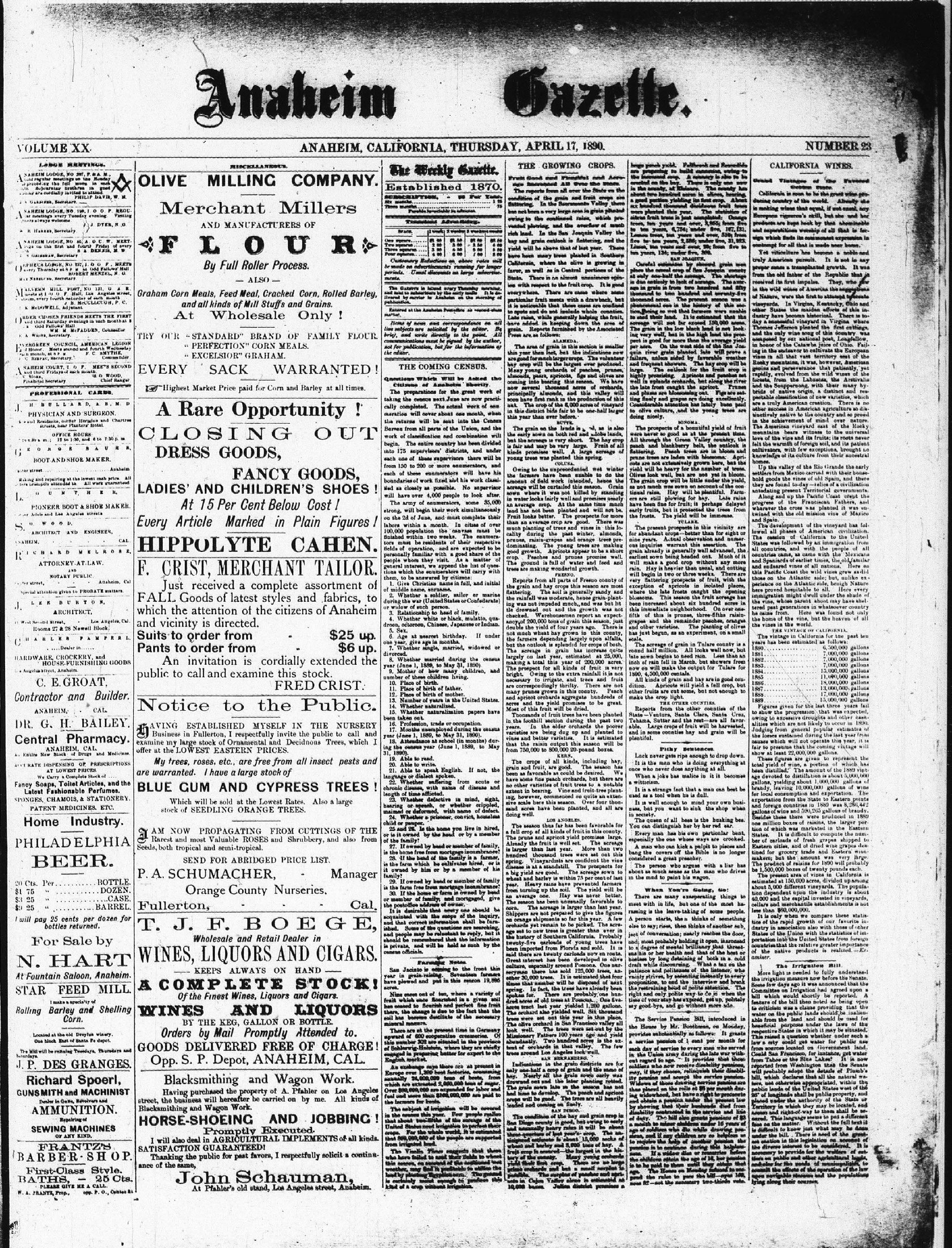
Searchable text
VOLUME XX.
ANAHEIM
LODGE MEETINGS.
ANAHEIM LODGE, NO 207, P.A.M.
hold regular meetings on the Monday
or preceding the full moon in each
month. Joinour brethren in good
colour are cordially invited to attend.
PHILIP DAVIS, W. M.
J. GARBERS, Secretary.
ANAHEIM LODGE, NO 198, I.O.O.F. REQUIlar meetings every Tuesday evening. Visiting
others always welcome.
J. DYER, M. O.
W. K HARRIS, Secretary.
ANAHEIM LODGE, NO 165, A.O.C.W. MEETS
on the first and fourth Friday of every
month.
B. A. DENNIS, M. W.
W. K GRINSAW, Secretary.
OPPELEA LODGE, NO 237, I.O.O.F. MEETS
every Thursday at 8 p.m. at Odd Fallow's Hall.
ROBERT MENZEL, N. O.
MAT NASSELL, Secretary.
ALVERN MILL PORT, NO 121, O.A.R.
Meets at I.O.O.F. Hall, Los Angeles street,
barn, every fourth Saturday of each month.
J. B. McCULLUCH, P.C.
K. McDOWELL, Adjutant.
ORDER CHOSEN FRIENDS MEET THE FIRST
and third Saturday evenings in each month at 8
Odd Fallow's Hall.
WM M. McFADDEN, Counsellor
K. A. WHITE, Secretary.
EVERGREEN COUNCIL, AMERICAN LEGION
Meets second and fourth Wednesday
each month, at 8 p.m.
P.C. SMYTHE,
P.C. RIMAC, Secretary.
ANAHEIM COURT, I.O.F. MEET'S SECOND
and third Fridays of each month.
V. MOOR,
Financial Secretary
Chief Ranger
PROFESSIONAL CANDES.
J. H BULLARD, A.B., M.D.
PHYSICIAN AND SURGEON.
Land Residence, corner Hermine and Chartree
streets, near Planters' Hotel.
OFFICE HOURS:
10:30 a.m.; 12 to 1:30, and 6 to 7:30 p.m.
GEORGE BAUER,
BOOT AND SHOE MAKER.
MISCELLANEOUS.
OLIVE MILLING COMPANY
Merchant Millers
AND MANUFACTURERS OF
FLOUR
By Full Roller Process.
— ALSO —
Graham Corn Meals, Feed Meal, Cracked Corn, Rolled B
and all kinds of Mill Stuffs and Grains.
At Wholesale Only!
TRY OUR "STANDARD" BRAND OF FAMILY FE
"PERFECTION" CORN MEALS.
"EXCELSIOR" GRAHAM.
EVERY SACK WARRANTED
Highest Market Price paid for Corn and Barley at all time
A Rare Opportunity
CLOSING OUT
DRESS GOODS,
PROFESSIONAL CARDS.
J. H BULLARD, A.B., M.D.
PHYSICIAN AND SURGEON.
Land and Residence, corner Hermaine and Chartree streets, near Planters' Hotel.
OFFICE HOURS:
12 to 1:30, and 6 to 7:30 p.m.
GEORGE BAUER,
BOOT-AND-SHOE MAKER.
Anaheim
Making and repairing at the lowest cash price. All orders promptly attended to. All work guaranteed.
L. OUNT, HEK.
PIONEER BOOT & SHOE MAKER.
Adele and Los Angeles streets.
S. O WOOD.
ARCHITECT AND ENGINEER.
ANAHEIM.
CAL.
RICHARD MELROSE,
ATTORNEY-AT-LAW.
AND
NOTARY PUBLIC.
Anaheim, Cal.
Special attention given to PROBATE matters.
J. LER BURTON,
ARCHITECT.
West Second Street, Los Angeles, Cal.
Rooms 27 & 28 Newell Block.
CHARLES PAMPERL.
Dealer in...
HARDWARE, CROCKERY, and HOUSE-FURNISHING GOODS
Los Angeles street, Anaheim.
C. E. GROAT,
Contractor ana Builder.
ANAHEIM, CAL.
DR. G. H. BAILEY,
Central Pharmacy.
ANAHEIM, CAL.
Entire New Stock of Drugs and Medicines.
ACCURATE DISPENSING OF PRESCRIPTIONS AT LOWEST PRICES.
We Carry a Complete Stock of Fanoy Soaps, Toilet Articles, and the Latest Fashionable Perfumes.
SPONGES, CHAMOIS, & STATIONERY.
PATENT MEDICINES, ETC.
Home Industry.
PHILADELPHIA BEER.
EVERY SACK WARRANTY
Highest Market Price paid for Corn and Barley at all time
A Rare Opportunity
CLOSING OUT
DRESS GOODS,
FANCY GOODS
LADIES' AND CHILDREN'S SHOP
At 15 Per Cent Below Cost!
Every Article Marked in Plain Figure
HIPPOLYTE CAHEW
F. CRIST, MERCHANT TAILOR
Just received a complete assortment of Fall Goods of latest styles and fabrics which the attention of the citizens of Anaheim and vicinity is directed.
Suits to order from - $25
Pants to order from - $6
An invitation is cordially extended public to call and examine this stock.
FRED CRIST
Notice to the Public
AVING ESTABLISHED MYSELF IN THE NURSE
Business in Fullerton, I respectfully invite the public to can examine my large stock of Ornamental and Deciduous Trees, whi offer at the LOWEST EASTERN PRICES.
My trees, roses, etc., are free from all insect pest are warranted. I have a large stock of BLUE GUM AND CYPRESS TREES.
Which will be sold at the Lowest Rates. Also a large stock of SEEDLING ORANGE TREES.
AM NOW PROPAGATING FROM CUTTINGS OF Rarest and most Valuable ROSES and Shrubbery, and also Seeds, both tropical and semi-tropical.
SEND FOR ABRIDGED PRICE LIST.
P. A. SCHUMACHER, Man
Home Industry.
PHILADELPHIA
BEER.
20 Cts. Per BOTTLE.
$1 75 DOZEN.
$3 25 CASE.
$9 25 BARREL.
I will pay 25 cents per dozen for bottles returned.
For Sale by
N. HART
At Fountain Saloon, Anaheim.
STAR FEED MILL.
I make a specialty of Rolling Barley and Shelling Corn.
Located at the old Dreyfus winery.
One block East of Santa Fe depot.
The Mill will be running Tuesdays, Thursdays and Saturdays.
J. P. DES GRANGES.
Richard Spoerl,
GUNSMITH and MACHINIST
Dealer in Guns, Revolvers and AMMUNITION.
Repairing of SEWING MACHINES OF ANY KIND.
FRANTZ'S
BARBER SHOP.
First-Class Style.
BATHS, - 25 Cts.
PLEASE GIVE ME A CALL.
BLUE GUM AND CYPRESS TREE
Which will be sold at the Lowest Rates. Also a large stock of SEEDLING ORANGE TREES.
AM NOW PROPAGATING FROM CUTTINGS OF Rarest and most Valuable ROSES and Shrubbery, and also Seeds, both tropical and semi-tropical.
SEND FOR ABRIDGED PRICE LIST.
P. A. SCHUMACHER,
Orange County Nurseries.
Fullerton,
T. J. F. BOEG
Wholesale and Retail Dealer in WINES, LIQUORS AND CIGARS
KEEPS ALWAYS ON HAND
A COMPLETE STOCK
Of the Finest Wines, Liquors and Cigars.
WINES AND LIQUOR
BY THE KEG, GALLON OR BOTTLE.
Orders by Mail Promptly Attended to.
GOODS DELIVERED FREE OF CHARGE.
Opp. S. P. Depot, ANAHEIM, CA
Blacksmithing and Wagon Work.
Having purchased the property of A. Pfahler on Los A street, the business will hereafter be carried on by me. All k Blacksmithing and Wagon Work.
HORSE-SHOEING AND JOBBINS
Promptly Executed.
I will also deal in AGRICULTURAL IMPLEMENTS of all SATISFACTION GUARANTEED!
Thanking the public for past favors, I respectfully solicit a chance of the same,
John Schauman,
At Pfahler's old stand, Los Angeles street, Anaheim
ANAHEIM, CALIFORNIA, THURSDAY, APRIL 17, 1890.
COMPANY.
Millers
RERS OF
U R
rocess.
ked Corn, Rolled Barley,
f s and Grains.
e Only !
OF FAMILY FLOUR
MEALS.
WARRANTED!
and Barley at all times.
rtunity!
G OUT
The Weekly Gazette.
Established 1870.
SUBSCRIPTION, - 60 Per Year.
My Month.
1 YEAR.
Three months.
Transcription Advertisement.
BRACE.
One square...
Two squares...
Three squares...
Four squares...
Customary Reductions on above rates will be made on advertisements running for longer periods. Unual discounts on large advertisements.
The Gazette is issued every Thursday morning, and sent to subscribers by the early mail. It is delivered by carrier in Anaheim on the morning of publication.
Entered at the Anaheim Postoffice in second-class matter.
Items of news and correspondence on all line subjects are solicited by the editor. Be brief, and write directly to the point. All communications must be signed by the author, not for publication, but for the information of the editor.
THE COMING CENSUS.
Questions Which Will Be Answered the Citizens of Anaheim Shortly.
The preparations for the great work of taking the common next June are now practically completed. The actual work of enumeration will cover about one month, when the returns will be sent into the Census Bureau from all parts of the Union, and the work of classification and combination will begin. The entire country has been divided into 175 supervisors' districts, and under each one of these supervisors there will be from 150 to 200 or more enumerators, and THE GROWING CROPS.
From Good and Beautiful and Accurate Information All Over the Nation.
The reports from all over the State on the condition of the grain and fruit crops are fathering. In the Sacramento Valley, there has not been a very large area in grain planted owing to the continued rains, which prevented plowing, and the overflow of much rich land. In the San Joaquin Valley the hay and grain outlook is fathering, and the yield will be above that of last year. There have been many trees planted in Southern California, where the olive is growing in favor, as well as in Central portions of the Santa. There is no almost unanimous opinion with respect to the fruit crop. It is good everywhere. There are some particular fruit meets with a drawback, but it is noticeable that those cases are confined in spots and do not include whole counties. Lake rains, while generally helping the fruit, have added in keeping down the area of grain. Reports furnished by the Associated Press are as follows:
ALAMEDA.
The area of grain in this section is smaller this year than last, but the indications now are good for much larger crops. The volunteer hay crop will be the largest ever produced. Many young orchards of panchas, prunus almonds, pears, apricots, figs and olives are coming into bearing this season. We have now several thousand acres of orchards, principally almonds, and this valley will soon have first rank in the production of this nut. The crop of the 6,000 acres of vineyard in this district bids fair to be one-half larger this year than ever before.
BUTTER.
The grain on the lands is good, as is also the early sown on both red and white lands, but the acresage is very short. The hay crop is fair and may be very large. Fruit of all kinds promises well. A large acreage of young trees was planted this spring.
COLUSA.
Large peach yields are preparing for the increased oil content on the bark in the canopy, and about two hundred a good portion, yrs x hundredth that were planted th e citrus fruit bran trees, hns years to hin years. Lemon tree, hns years to hin years. Lime; hns years to hin years. 134; curdling animal place the annual at only one-half age in grain in france thousand to twenty thousand phonemal emotion, flaring so as to send their laceage will not. The grain in th e ing very well, but perfect is good for per acre. On th e quin river grade failure, unlane a and frequent short large. The sea highly promising well in aplains to the lake front cans and plums are being finally and g Considerable attention to olive culturing doing nicely.
The prospects were never so good. All through the peach and black flattering. Prune trees are lote cots are not exta
The preparations for the great work of taking the census next June are now practically completed. The actual work of enumeration will cover about one month, when the returns will be sent into the Census Bureau from all parts of the Union, and the work of classification and combination will begin. The entire country has been divided into 175 supervisors' districts, and under each one of these supervisors there will be from 150 to 200 or more enumerators, and each of these enumerators will have his boundaries of work fixed and his work classified as closely as possible. No supervisor will have over 4,000 people to look after.
The army of enumerators, some 35,000 strong, will begin their work simultaneously on the 2d of June, and must complete their labors within a month. In cities of over 100,000 population the canvase must be finished within two weeks. The enumerators must be residents of their respective fields of operation, and are expected to be personally familiar with a good share of the people whom they visit. As a matter of general interest, we append the list of questions which the enumerators will carry with them, to be answered by citizens:
1. Give Christian name in full, and initial of middle name, surname.
2. Whether a soldier, sailor or marine during the war (United States or Confederate) or widow of such person.
3. Relationship to head of family.
4. Whether white or black, mulatto, quadroon, octoeroon, Chinese, Japanese or Indian.
5. Sex.
6. Age at nearest birthday. If under one year, give age in months.
7. Whether single, married, widowed or divorced.
8. Whether married during the census year (June 1, 1889, to May 31, 1890).
9. Mother of how many children, and number of those children living.
10. Place of birth.
11. Place of birth of father.
12. Place of birth of mother.
13. Number of years in the United States.
14. Whether naturalized.
15. Whether naturalization papers have been taken out.
16. Profession, trade or occupation.
17. Months unemployed during the census year (June 1, 1889, to May 31, 1890).
18. Attendance at school (in months) during the census year (June 1, 1889, to May 31, 1890).
19. Able to read.
20. Able to write.
21. Able to speak English. If not, the language or dialect spoken.
22. Whether suffering from acute or chronic disease, with name of disease and length of time afflicted.
23. Whether defective in mind, sight, hearing or speech, or whether crippled, maimed or deformed, with name of defect.
24. Whether a prisoner, convict, homeless child or pauper.
25 and 26. Is the home you live in hired, or is it owned by the head or by a member of the family?
27. If owned by hand or member of family, is the home free from mortgage incumbrances?
28. If the hand of the family is a farmer, is the farm which he cultivates hired, or is it owned by him or by a member of his family?
29. If owned by hand or member of family
THE COMING CENSUS.
Questions Which Will Be Answered the Citizens of Anaheim shortly.
The preparations for the great work of taking the census next June are now practically completed. The actual work of enumeration will cover about one month, when the returns will be sent into the Census Bureau from all parts of the Union, and the work of classification and combination will begin. The entire country has been divided into 175 supervisors' districts, and under each one of these supervisors there will be from 150 to 200 or more enumerators, and each of these enumerators will have his boundaries of work fixed and his work classified as closely as possible. No supervisor will have over 4,000 people to look after.
The army of enumerators, some 35,000 strong, will begin their work simultaneously on the 2d of June, and must complete their labors within a month. In cities of over 100,000 population the canvase must be finished within two weeks. The enumerators must be residents of their respective fields of operation, and are expected to be personally familiar with a good share of the people whom they visit. As a matter of general interest, we append the list of questions which the enumerators will carry with them, to be answered by citizens:
1. Give Christian name in full, and initial of middle name, surname.
2. Whether a soldier, sailor or marine during the war (United States or Confederate) or widow of such person.
3. Relationship to head of family.
4. Whether white or black, mulatto, quadroon, octoeroon, Chinese, Japanese or Indian.
5. Sex.
6. Age at nearest birthday. If under one year, give age in months.
7. Whether single, married, widowed or divorced.
8. Whether married during the census year (June 1, 1889, to May 31, 1890).
9. Mother of how many children, and number of those children living.
10. Place of birth.
11. Place of birth of father.
12. Place of birth of mother.
13. Number of years in the United States.
14. Whether naturalized.
15. Whether naturalization papers have been taken out.
16. Profession, trade or occupation.
17. Months unemployed during the census year (June 1, 1889, to May 31, 1890).
18. Attendance at school (in months) during the census year (June 1, 1889, to May 31, 1890).
19. Able to read.
20. Able to write.
21. Able to speak English. If not, the language or dialect spoken.
22. Whether suffering from acute or chronic disease, with name of disease and length of time afflicted.
23. Whether defective in mind, sight, hearing or speech, or whether crippled, maimed or deformed, with name of defect.
24. Whether a prisoner, convict, homeless child or pauper.
25 and 26. Is the home you live in hired,
or is it owned by the head or by a member of the family?
27. If owned by hand or member of family,
is the home free from mortgage incumbrances?
28-If the hand of the family is a farmer,
is the farm which he cultivates hired,
or is it owned by him or by a member of his family?
THE COMING CENSUS.
Question Which Will Be Answered the Citizens of Anaheim shortly.
The preparations for the great work of taking the census next June are now practically completed. The actual work of enumeration will cover about one month, when the returns will be sent into the Census Bureau from all parts of the Union, and the work of classification and combination will begin. The entire country has been divided into 175 supervisors' districts, and under each one of these supervisors there will be from 150 to 200 or more enumerators, and each of these enumerators will have his boundaries of work fixed and his work classified as closely as possible. No supervisor will have over 4,000 people to look after.
The army of enumerators, some 35,000 strong, will begin their work simultaneously on the 2d of June, and must complete their labors within a month. In cities of over 100,000 population the canvase must be finished within two weeks. The enumerators must be residents of their respective fields of operation, and are expected to be personally familiar with a good share of the people whom they visit. As a matter of general interest, we append the list of questions which the enumerators will carry with them, to be answered by citizens:
1. Give Christian name in full, and initial of middle name, surname.
2. Whether a soldier, sailor or marine during the war (United States or Confederate) or widow of such person.
3. Relationship to head of family.
4. Whether white or black, mulatto, quadroon, octoeroon, Chinese, Japanese or Indian.
5. Sex.
6. Age at nearest birthday. If under one year, give age in months.
7. Whether single,married,widowed或 divorced.
8. Whether married during the census year (June 1,1889,to May 31,1890).
9.Mother of how many children,and numberofthosechildrenliving.
10.Please provide your own information regarding your own personal details.
The grain on the lands is small as also is early sown on both red and globe lands butthe average is very short.The hay crop is fair and may be very large.Fruit off all kinds promises well.A large amountof young trees was planted this spring.
COLUSA.
Owing to the unprecedented wet winterthe farmers have been unable to dothe amountof fieldwork intended,hencethe averagewill be curtailedthis season.Grain down where it was not killedby standingin water looks fairly welland promises nearlyan average crop.At the same time muchlandhas not been planted andwill notbe.Fruit looks better.The prospectsfor more than an average crop aregoodThere wasmuch plantingoftreesandvinesinthislocalityduringthepastwinter.almondsprunessraisin-grapesandorangetreespredominating.Theyoungtreesaremakinggoodgrowth.Apricotsappeartobeashortcrop.Peachesandprunessprominewell.Thegroundisfullofwaterandfeedandtreesaremakingwonderfulgrowth.
PRENO.
ReportsfromallpartsofFresnocountyofthegrainandhaycropsthisseasonmostflattering.Thesoilisgenerallysandyandthe rainfallwasmoderate,hencegrain-plantingwasnotimpededmuch,andwas hittdrownedoutandthegrowthwasnotchecked.Warehousemenreportanexpectanyof200,000tonsofgrainthisseasonjustdoublethe yieldoffouryearsagoThereisnotmuchwheathaygrowninthiscounty,thefarmerdependinglargelyupalffallsbuttheontlookissplendidfordropsofbothTheacreageingrainhasincreasedquitelargelyatlastyear estimatedat25,000makingatotalthisyearof200,000acre.Theprospectforallkindsoffruitisverybright.Owingtotheextrarainfallitisnotnecessarytoirrigate,andtreesandfruitarecorrespondinglytrifty Therearenotmanyprunese growninthiscountyPeachandapricotorchardsaggregatehundredsacreandtheyieldpromisestobegreat.Mostofthisfruitwillbe dried.Thoubsandsofallkindsincludinghay,grainandfruitaregood.TheseasonhasbeenasfavorableascouldbedesiredWehavesome finepeachorchardsbuttherearenoothervarietiesoffruittreetobetailextentin bearing.Vineandfruit-treeplantinghowevercommencedonquiteanextivescaleherethisseasonOverfour thousandacrehavebeenplanted,andallaredoingwell.LOSANGELES.
Thecropsofalikindscouldinhay,grainandfruitaregood.TheseasonhasbeenasfavorableascouldbedesiredWehavesome finepeachorchardsbuttherearenoothervarietiesoffruittreetobetailextentin bearing.Vineandfruit-treeplantinghowevercommencedonquiteanextivescaleherethisseasonOverfour thousandacrehavebeenplanted,andallaredoingwell.LOSANGELES.
The prospectswerevernoogainAllthroughtheOliveandblackflatteningwillbehealOliviesnowintimewithinitialrains.Hereare stillplowshavebeenfinishedearlyfruits,butthe frosts.Thepresentpriorabundantcrossnineyears.Activeinquiriesweregrainalreadyisearmslatestbownowwillmake1890,4,500,000cound.Allkindsofgrainother fruits are owe makethecroplieTHEREPORTSFROMSTATE-VENTURA,Tehama,SutterableLargecropandincomecountplentiful.
LPMK
Luck nevergetsItistheman oncewho nevercooksWhenajokebawitticiethiamithemanespeciallytheoneAmanwhohangthecoverconsideredgreaterThepersonwouldaboutasmuchasinthe mudtopay
PRESS TREES!
AT Rates. Also a large
TREES.
FROM CUTTINGS OF THE
AND Shrubbery, and also from
PRICE LIST.
Manager
Nurseries.
CAL.
DEGE,
Dealer in
AND CIGARS.
N HAND —
STOCK!
Ours and Cigars.
LIQUORS
OR BOTTLE.
Attended to.
REE OF CHARGE!
AHEIM, CAL.
Wagon Work.
A. Pfahler on Los Angeles
ed on by me. All kinds of
ND JOBBING!
executed.
IMPLEMENTS of all kinds.
respectfully solicit a continu-
auman,
Los Angeles street, Anaheim.
22. Whether manning from cause of chronic disease, with name of disease and length of time afflicted.
23. Whether defective in mind, sight, hearing or speech, or whether crippled, maimed or deformed, with name of defect.
24. Whether a prisoner, convict, homeless child or pauper.
25 and 26. Is the home you live in hired, or is it owned by the head or by a member of the family?
27. If owned by hand or member of family, is the home free from mortgage incumbrance?
28. If the head of the family is a farmer, is the farm which he cultivates hired, or is it owned by him or by a member of his family?
29. If owned by head or member of family is the farm free from mortgage incumbrance?
30. If the home or farm is owned by hand or member of family, and mortgaged, give the postoffice address of owner.
It is desirable that every one should be acquainted with the scope of the inquiry, and that correct information shall be furnished. Some of the questions are searching, and people may be reluctant to reply, but it should be remembered that the information is private, and will be held as such by the consensual officials.
FARMER NEWS.
San Jacinto is entering to the front this year in grain raising. Seventeen farmers have plewed and put in this season 19,885 acres.
Nine cases out of ten, where a variety of fruit which once flourished in a given soil has ceased to flourish and perfect fine fruit there, the change is due to the fact that the soil has become destitute of the necessary mineral matter.
There are at the present time in Germany upward of 600 cooperative creameries. Of this number 202 are situated in the province of Schleswig-Holstein, where they are chiefly engaged in preparing better for export to the English market.
An exchange may there are as present in Europe over 1,200 heat fasteners, commencing annually 24,000,000 tons of boots, from which are extracted 2,000,000 tons of sugar. Over $80,000 are expended for labor and fuel and more than $100,000,000 are paid to the farmers for boots.
The subject of irrigation will be covered in the current year. Four people realize that about two-fifths of the average of the United States need irrigation to pursue their crops. For the whole world, it is estimated that $800,000,000 of the people are supported from irrigated land.
The Vinyl Pine mongrels that these who have failed to meet their fields to whend this season, on account of the continued wet weather, may find it profitable to add them to the hand by planting Haypaint corn. The ground is certainly meant to produce this kind of a crop without irrigation.
LOS ANGELES.
The season thus far has been favorable for a full crop of all kinds of fruit in this county. The prune and apricot yield promises large. Already the fruit is well set. The acreage is larger than last year. More than two hundred thousand trees were set out this spring. Vinyardists are confident the vine disease is at a standstill. The prospects for a big yield are good. The acreage sown to wheat and barley is within 75 per cent of last year. Heavy rains have prevented farmers from turning up the soil. The yield will be an average one. Hay was never better. The season has been unusually favorable to corn. The acreage is larger than last year. Shippers are not prepared to give the figures on orange shipments so far this year. A few orchards yet remain to be picked. The acreage set to new trees is greater than ever in the history of Southern California. Probably twenty-five carloads of young trees have been imported from Florida and sold. It is mid there are twenty carloads now on roads. Great interest has been developed in olive culture, especially around Pomona. One nurseryman there has sold 125,000 trees, another 30,000 trees. It is estimated that four times that number will be disposed of next spring. In fact, the trees have already been spoken for. There are probably one hundred acres of old trees at Pomona. One five-acre tract last year yielded 1,200 gallons. The orchard also yielded well. Six thousand trees were set out this place. The olive orchard in San Francisco valley all took well. The trees were set out by the Missionary Fathers 100 years ago and abundantly. Two hundred acres is the extent of orchards in that valley. The few trees around Los Angeles look well.
BAN BERNARDING.
Indications in the grain distripts are for only one-half a crop of grain and the name of hay. Nearly all the grain grown early was drenched out and the later planting retired. The grain grown late in the season has not had time to develop. The punch and apricot crops will be good. The trees are all heavily landed and coming on finely.
BAN DIEGO.
The condition of the hay and grain crop in San Diego county is good, but owing to early and unusually heavy rain it will be almost three-quarter of last year's crop. The anisogamous estimate is about 15,000 heads of wheat and barley and 8,000 heads of hay. A fresh crop is ensured—the largest in the history of the county. Many young orchards yield first crop. There are no huge prime orchards and but a small sprinkle in Caney Valley alone is estimated at 10,000 heads. Julian district premises a
CALIFORNIA WINES.
Grand Vintages of the Favored Grown State.
California is now to be the great wine producing country of the world. Already she is making wines that equal, if not equal, any European vigour's skill, but she and her products are hope back by that abominable and superstitious worship of all that in foreign which finds its commendation in contempt for all that is made near home.
Yet viticulture has become a noble and truly American permit. It is not in any proper sense a transplanted growth. It was from the old father of the Republic that it received its first impulse. They, who grew in the wild wines of America the suggestion of Nature, were the first to attempt to create vineyards. In Virginia, Kentucky, Ohio and other States the maiden efforts of this industry have become historical. There is today a successful vineyard in Virginia where Thomas Jefferson planted the first cottage, and the only wine song of this country was composed by our national poet, Longfellow, in honor of the Catawba juice of Ohio. Failing in the endeavor to cultivate the European vines in all that vast territory east of the Rocky mountains, it was, however, American genius and perseverance that patiently, yet rapidly, evolved from the wild wines of the forests, from the Labascas, the Arstivalia and the Soupperrnong, with their many hybrids of native origin, a distinct and respectable classification of new varieties, which are a truly American creation. There is no other success in American agriculture so distinctively native to the country and so proud in the achievement of mind over nature.
The American vineyard east of the Rocky mountains bears witness to the universal love of the vine and its fruits; its roots never fail the warmth of foreign soil, and its patient cultivators, with few exceptions, brought no knowledge of its culture from their ancestral homes.
The prospects of a beautiful yield of fruit were never so good as at the present time. All through the Green Valley country, the peach and blackberry belt, the outlook is flattering. Peach trees are in bloom and prune trees are laden with blossoms. Apricots are not extensively grown here, but the yield will be heavy for the number of trees. Olives look well, but are not yet in bloom. The grain crop will be little under the yield, as not much was sown on account of the continual rains. Hay will be plentiful. Farmers are still plowing for hay. Late rains have been fine for fruit; it perhaps delayed early fruits, but it protected the trees from the frosts. The yield will be immense.
TULARE
The present prospects in this vicinity are for abundant crops—better than for sight or nine years. Actual observation and numerous inquiries warrant this assertion. The grain already is generally well advanced, the earliest sown being headed out. Much of it will make a good crop without any more rain. Hay is heavier than usual, and cutting will begin in two or three weeks. There are very flattering prospects of fruit, with the exception of apricots in isolated places, where the late frosts caught the opening blossoms. This season the fruit accruage has been increased about six hundred acres in this immediate neighborhood. On over one-fifth of this is prunes, three-fifths raisin-grapes and the remainder peaches, oranges and other varieties. The planting of olives has just begun, as an experiment, on a small scale.
The acreage of grain in Tulare county is a round half million. All looks well now, but late sown begins to need rain. Less than an inch of rain fell in March, but showers from now on will make the output for Tulare for 1890, 4,500,000 centsals.
All kinds of grain and hay are in good condition. Apricots will yield a fall crop, but other fruits are cut some, but not enough to make the crop light.
THE OTHER COUNTIES.
Reports from the other counties of the State—Ventura, Santa Clara, Santa Cruz, Tehama, Sutter and the rest—are all favorable. Large crops of fruit will be harvested, and in some counties hay and grain will be plentiful.
Pithy sentences.
Luck never gets ripe enough to drop down.
It is the man who is doing everything at once who never does anything at all.
When a joke has malice in it it becomes a witticism.
It is a strange fact that a man can best be used as a tool when he is dull.
It is well enough to mind your own business, but you want to sink the shop when in society.
The queen of all bees is the husking bee. You can distinguish her by her red ear.
Every man has his own particular bent, especially the one whose ways are crooked.
A man who can kick a pulpit to pieces and bang the covers off the Bible is no longer considered a great preacher.
The person who argues with a liar has about as much sense as the man who drives in the mud to paint his wagon.
The genius and perseverance that patiently, yet rapidly, evolved from the wild wines of the forests, from the Labascas, the Arstivalia and the Scapparnong, with their many hybrids of native origin, a distinct and respectable classification of new varieties, which are a truly American creation. There is no other success in American agriculture so distinctively native to the country and so proud in the achievement of mind over nature.
The American vineyard east of the Rocky mountains bears witness to the universal love of the vines and its fruits; its roots never felt the warmth of foreign soil, and its patient cultivators, with few exceptions, brought no knowledge of its culture from their ancestral homes.
Up the valley of the Rio Grande the early settlers from Mexico carried with their household goods the vines of old Spain, and there they are found to-day—relics of a civilization antedating present Territorial governments.
Along and up the Pacific Coast crept the progress of the Franciscan Fathers, and wherever the cross was planted it was entwined with the old mission vine of Mexico and Spain.
The development of the vineyard has followed all phases of American civilization.
The cession of California to the United States was followed by an immigration from all countries, and with the people of all countries came, as came with the Mexicans and Spaniards of earlier times, the old familiar and endearded vines of all nations. Here on this Pacific Coast the wild vines grew as did those on the Atlantic side; but, unlike experience on the Atlantic side, benign Nature here proved hospitable to all. Here every immigration might dwell under the shade of the vine, whose parent shoot may have sheltered past generations in whatsoever country he came from. Here was found not only the home of the vine, but the heaven of all the vines in the world.
THE VINTAGE OF CALIFORNIA.
The vintage in California for the past ten years has been estimated as follows:
1880: 6,500,000 gallons
1881: 7,000,000 gallons
1882: 7,000,000 gallons
1883: 7,000,000 gallons
1884: 15,000,000 gallons
1885: 11,000,000 gallons
1886: 18,000,000 gallons
1887: 13,000,000 gallons
1888: 17,000,000 gallons
1889: 15,000,000 gallons
Figures given for the last three years fail to show the progression that was expected, owing to excessive droughts and other casualities which are not likely to occur in 1890. Judging from general popular estimates of the losses sustained during the last year from causes which will not operate this year, it is fair to presume that the coming vintage will show at least 22,000,000 gallons.
These figures are given to represent the total yield of wine, a portion of which has been distilled. The amount of the 1889 vintage devoted to distillation is about 5,000,000 gallons, yielding about 1,000,000 gallons of brandy, leaving 10,000,000 gallons of wine for local consumption and exportation. The exportation from the State to Eastern points and foreign countries in 1889 was 8,286,442 gallons of wine and 599,265 gallons of brandy. Besides these there were produced in 1889 one million boxes of raisins, the larger portion of which was marketed in the Eastern States. It is difficult to compute the number of carloads of fresh grapes shipped to Eastern cities, and of dried wine grapes destined for grocery trade and Eastern winemakers; but the amount was very large. The product of raisins for 1890 will probably be 1,500,000 boxes of twenty pounds each.
The present area of vines in California is estimated at 150,000 acres, divided among
It is a strange fact that a man can best be used as a tool when he is dull.
It is well enough to mind your own business, but you want to sink the shop when in society.
The queen of all bees is the husking bee. You can distinguish her by her red ear.
Every man has his own particular bent, especially the one whose ways are crooked.
A man who can kick a pulpit to pieces and bang the covers off the Bible is no longer considered a great preacher.
The person who argues with a liar has about as much sense as the man who drives in the mud to paint his wagon.
When You're Going, Be:
There are many exasperating things to meet with in life, but one of the most harassing is the leave-taking of some people.
A person starts, then thinks of something else to say; risen, then thinks of another subject of conversation; nearly reaches the door, and most probably holding it open, in an attempt to a degree of mental brilliance that threatens his or her health and that of the host or hostess by long detaining of both in a cold draft while discouraging. What a tax on the patience and politeness of the listener, who vainly strives, by assenting instantly to every proposition, to end the interview and break the restraining bond of polite attention. The right and only polite way to do it when the time of your stay has expired, get up, politely say good-bye, and go without more ado.
The Service Pension Bill, introduced in the House by Mr. Boothman, on Monday, provides substantially as follows: It grants a service pension of 1 cent per month for each day of service to every man who served in the Union army during the late war without regard to age. It provides that those soldiers who now receive disability pensions, may, if they choose, relinquish their disability pensions and accept the service pension. Windows of these drawing service pensions are thus placed on the rolls at 25 per month during widewheel, but have a right to prosecute and obtain a pension under this present law by showing that their handsome died from disability committed in the service and line of duty. The bill also grants pensions of 80 a month to minor children under 15 years of age of soldiers who die while drawing pensions, and if any children are on hiatus in order to require the help of another pensioner pursuant to this widow during this helplance. If a widow dies or remarries before the children attain the age of 16, her pension is to be paid until they attain that age. The House on Monday induced to suspend the rules to pass the bill—yes 168, none 82—not the necessary two-thirds vote.
The Irrigation Bill.
More light is needed to fully understand the irrigation measure now before the Senate. Some few days ago it was announced that the Committee on Irrigation had agreed upon a bill which would shortly be reported. A feature of the bill then noted as being open to criticism was a clause providing that the water on the public lands should be insanely able from the land and should be used for beneficial purposes under the laws of the respective States in which it may be situated. This raised a question whether such a law a city could get water for public use from sources located on Government land. Could San Francisco, for instance, get water from Tahoe or the Blue Lakes? It is now reported from Washington that the Senate will probably adopt the details of Plumb's bill, which declares that all the natural waters, not otherwise appropriated, within the public lands of the United States west of the 90° of longitude shall be public property, and placed under the authority of the State or Territory in which they may be located, and assume right-of-way to them shall be secured. This language seems to put a different face on the matter. Without the full text it is difficult to know just what may be done under the bill. There is need of greater caution in this legislation on account of the diverse interest to be considered. It is necessary to provide for the welfare of nations on public and other agricultural lands, and also for the needs of municipality, to consult the effects of the operation of the law on navigable streams and the populations lying along their courses.