anaheim-gazette 1890-03-20
Scanned page
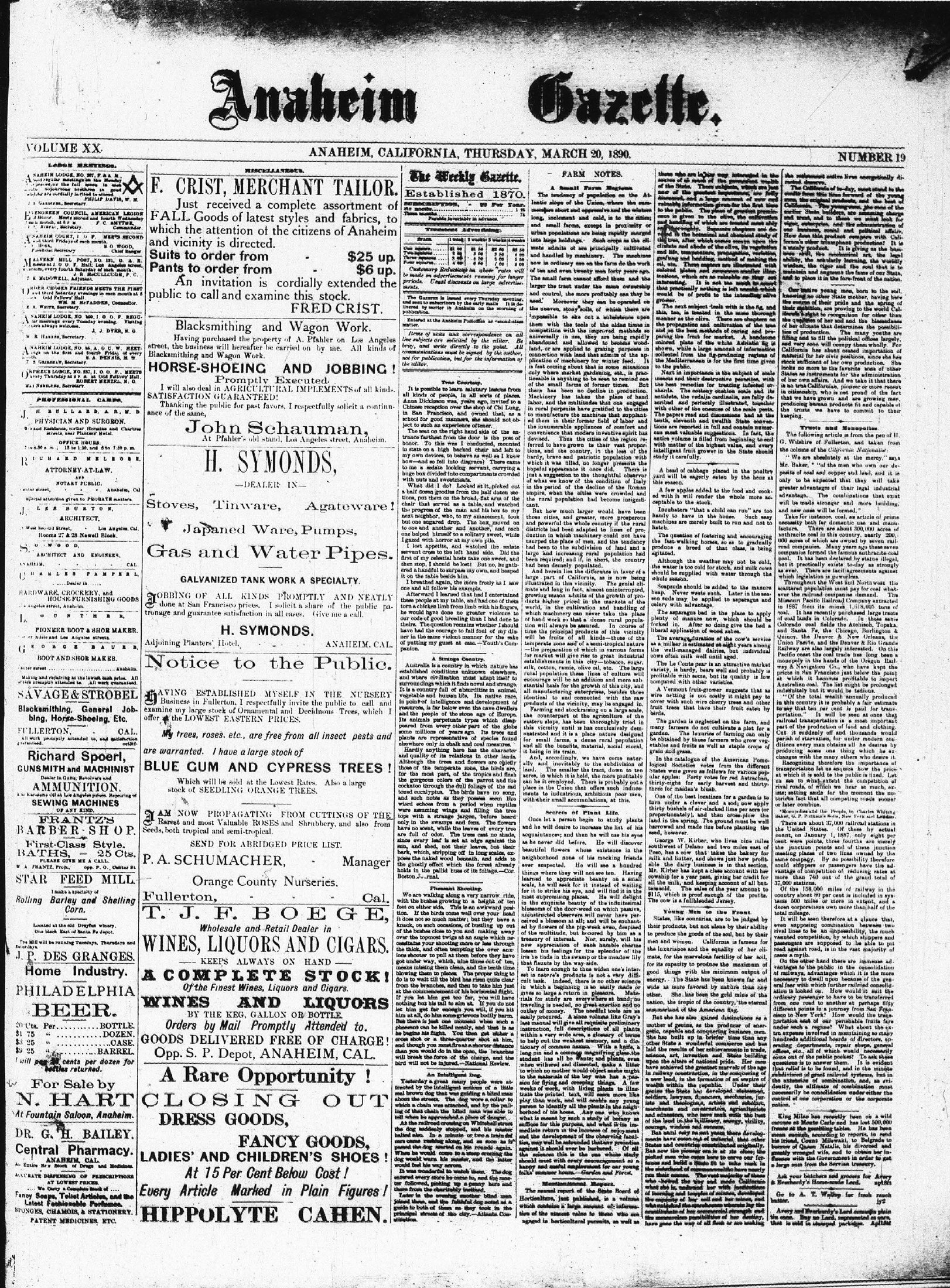
Searchable text
VOLUME XX.
ANAHEIM
LODGE MEETINGS.
ANAHEIM LODGE, NO. 287, F.B.A.M.
Regular meetings on the Monday preceding the full moon in each month.
Sojourning brethren in good health are cordially invited to attend.
PHILIP DAVIS, W. M.
VERGREEN COUNCIL, AMERICAN LEGION
A Honor. Meet a morning and fourth Wednesday each month at 8 P.M.
F.C. SHYTNE.
Commander.
ANAHEIM COURT, I.O.F. MEETS SECOND and third Fridays of each month.
A Honor. R.O.WOOD,
Financial Secretary
Chief Manager.
MALVERN HILL PORT, NO. 131, G.A.R.
Meets at I.O.F.P.Hall; Los Angeles street, Anaheim every fourth Saturday of each month.
J.B.MCULLLUCH, P.C.
T.K.MCOWELL, Adjunct.
ORDER CHOSEN FRIENDS MEETS THE FIRST and third Saturday evening in each month at 8 Odd Fellow's Hall.
WM.M.McFADDEN, Commander.
K.A.WHITE, Secretary.
ANAHEIM LODGE, NO. 289, I.O.O.F. REGULAR meetings every Tuesday evening. Visiting others always welcome.
J.J.DYKE, M.O.
W.R.HARRER, Secretary.
ANAHEIM LODGE, NO. 295, A.O.U.W. MEETINGS on the first and fourth Friday of every month.
B.A.DENNIE, M.W.
T.B.GRINNAW, Secretary.
ORPHEUS LODGE, NO. 287, I.O.O.F. MEETS every Thursday at 8 P.M.at Odd Fellow's Hall.
ROBERT MENZEL, M.O.
Max Nerlense, Secretary.
PROFESSIONAL CAMPS.
J.H.BULLARD, A.B.M.D.
PHYSICIAN AND SURGEON.
The residence, corner Hermina and Chartree streets, near Planters Hotel.
OFFICE HOUSE:
12 to 1:30, and 6 to 7:30 p.m.
RICHARD MELROSE,
ATTORNEY-AT-LAW.
MISCELLANEOUS.
F. CRIST, MERCHANT TALE
Just received a complete assortment of FALL Goods of latest styles and fabrics which the attention of the citizens of Anaheim and vicinity is directed.
Suits to order from
Pants to order from
An invitation is cordially extended public to call and examine this stock.
FRED CR
Blacksmithing and Wagon Work
Having purchased the property of A.Pfahler on L Street, the business will hereafter be carried on by me.
Blacksmithing and Wagon Work.
HORSE-SHOEING AND JOB
Promptly Executed.
I will also deal in AGRICULTURAL IMPLEMENTS SATISFACTION GUARANTEED!
Thanking the public for past favors. I respectfully solicite of the same,
John Schauman
At Pfahler's old stand, Los Angeles street,
H. SYMONDS,
PROFESSIONAL CARS.
J. H BULLARD, A.R., M.D.
PHYSICIAN AND SURGEON.
Residence, corner Hermina and Chartreuse streets, near Planters' Hotel.
OFFICE HOURS:
12 to 1:30, and 6 to 7:30 p.m.
RICHARD MELROSE,
ATTORNEY-AT-LAW.
AND
NOTARY PUBLIC.
Anahaim, Cal.
Special attention given to PROBATE matters.
J. LEE BURTON,
ARCHITECT,
West Second Street, Los Angeles, Cal.
Rooms 27 & 28 Newell Block.
S. WOOD,
ARCHITECT AND ENGINEER,
Anahaim, Cal.
CHARLES PAMPKEL,
Dealer in Hardware, Crockery, and House-Furnishing Goods
Angeles street, Anahaim.
L. GUNTHER,
PIONEER BOOT & SHOR MAKER.
Adale and Los Angeles streets.
GEORGE BAUER,
BOOT AND SHOR MAKER.
Anahaim.
Making and repairing at the lowest cash price. All or large promptly attended to. All work guaranteed.
SAVAGE & STROBEL
Blacksmithing. General Job-bing, Horse-Shoeing, Etc.
FULLERTON, OAL.
All work promptly attended to, and satisfaction guaranteed.
Richard Spoerl,
GUNSMITH and MACHINIST
Dealer in Guns, Ravolvers and AMMUNITION.
Ade Kawanee Oil at Los Angeles prices. Repairing of SEWING MACHINES OF ANY KIND.
FRANTZ'S BARBER SHOP.
First-Class Style.
BATHS, - 25 Cts.
PLEASE GIVE ME A CALL.
W A FRANTZ, Prop., opp. P. O., Chamber St
STAR FEED MILL.
I make a specialty of Rolling Barley and Shelling Corn.
Promptly Executed.
I will also deal in AGRICULTURAL IMPLEMENTS SATISFACTION GUARANTEED!
Thanking the public for past favors. I respectfully solicite of the same,
John Schaumann
At Pfahler's old stand, Los Angeles street.
H. SYMONDS,
—DEALER IN—
Stoves, Tinware, Agatev
Japaned Ware, Pumps,
Gas and Water Pip
GALVANIZED TANK WORK A SPECIALTY
JOBBING OF ALL KINDS PROMPTLY AND DONE at San Francisco prices. I solicit a share of the tronage and guarantee satisfaction in all cases. Give me a ca
H. SYMONDS.
Adjoining Planters' Hotel.
Notice to the Pub
AVING ESTABLISHED MYSELF IN THE N Business in Fullerton, I respectfully invite the public to examine my large stock of Ornamental and Deciduous Trees offer the LOWEST EASTERN PRICES.
My trees, roses, etc., are free from all insect p are warranted. I have a large stock of BLUE GUM AND CYPRESS TR Which will be sold at the Lowest Rates. Also a la stock of SEEDLING ORANGE TREES.
AM NOW PROPAGATING FROM CUTTINGS Rarest and most Valuable ROSES and Shrubbery, and Seeds, both tropical and semi-tropical.
SEND FOR ABRIDGED PRICE LIST.
P. A. SCHUMACHER,
Orange County Nurseries.
Fullerton,
FRANTZ'S BARBER SHOP.
First-Class Style.
BATHS, - 25 Cts.
PLEASE GIVE ME A CALL.
W. A FRANTZ, Prop., opp. P. O., Counter St.
STAR FEED MILL.
I make a specialty of Rolling Barley and Shelling Corn.
Located at the old Drayton winery.
One black East of Santa Fe depot.
The Mill will be running Tuesdays, Thursdays and Saturdays.
J. P. DES GRANGES.
Home Industry.
PHILADELPHIA BEER.
20 Cts. Per... BOTTLE.
$1 75 ... DOZEN.
$3 25 ... CASE.
$9 25 ... BARREL.
I will pay 20 cents per dozen for bottles returned.
For Sale by N. HART
At Fountain Saloon, Anaheim.
DR. G. H. BAILEY,
Central Pharmacy.
ANAHEIM, CAL.
An Entire New Book of Drugs and Medicines.
ACCURATE DISPENSING OF PRESCRIPTIONS AT LOWEST PRICE.
We Carry a Complete Book of:
Fancy Soaps, Toilet Articles, and the Latest Fashionable Perfumes.
SPONGES, CHAMOIS, & STATIONERY.
PATENT MEDICINES, ETC.
AM NOW PROPAGATING FROM CUTTINGS Rarest and most Valuable ROSES and Shrubbery, and Seeds, both tropical and semi-tropical.
SEND FOR ABRIDGED PRICE LIST.
P. A. SCHUMACHER,
Orange County Nurseries.
Fullerton,
T. J. F. BOEG
Wholesale and Retail Dealer in WINES, LIQUORS AND CIGARS
KEEPS ALWAYS ON HAND
A COMPLETE STOCK
Of the Finest Wines, Liquors and Cigars.
WINES AND LIQUORS
BY THE KEG, GALLON OR BOTTLE.
Orders by Mail Promptly Attended
GOODS DELIVERED FREE OF CHARGE
Opp. S. P. Depot, ANAHEIM,
A Rare Opportunity
CLOSING OUT
DRESS GOODS,
FANCY GOODS
LADIES' AND CHILDREN'S SHOP
At 15 Per Cent Below Cost!
Every Article Marked in Plain Figures
HIPPOLYTE CAHIER
ANAHEIM, CALIFORNIA, THURSDAY, MARCH 20, 1890.
HANT TAILOR.
complete assortment of styles and fabrics, to the citizens of Anaheim
$25 up.
$6 up.
cordially extended the stock.
FRED CRIST.
Wagon Work.
of A. Pfahler on Los Angeles carried on by me. All kinds of AND JOBBING!
Executed.
RAL IMPLEMENTS of all kinds.
I respectfully solicit a continu hauman,
Los Angeles street, Anaheim.
ONDS,
The Weekly Gazette.
Established 1870.
Transient Advertising.
Brand
1 week
2 weeks
3 weeks
4 weeks
One square... $2.00
Two square... $2.00
Three square... $2.00
Four square... $2.00
Customary Reductions on above rates will be made on advertisements running for longer periods. Usual discounts on large advertisements.
The Gazette is issued every Thursday morning, and sent to subscriptions by the early mails. It is delivered by carrier in Anaheim on the morning of publication.
Entitled at the Anaheim Postoffice as second-class matter.
Items of news and correspondence on all live subjects are solicited by the editor. Be brief, and write directly to the point. All communications must be signed by the author, not for publication, but for the information of the editor.
True Courtesy.
It is possible to learn military lessons from all kinds of people, in all sorts of places. Anna Dickinson was, years ago, invited to a Chinese reception over the shop of Chi Lung, in San Francisco, and owned that, as a school for good manners, she should not object to such an experience oftener.
The seat on the right hand side of the entrance farthest from the door is the post of honor. To this was I conducted, mounted in state on a high backed chair and left to my own devices, to behave as well as I knew how—and so fell into disgrace). There came to me a sedate looking servant, carrying a huge box divided into compartments crowded with nuts and sweets.
FARM NOTES.
A Small Farm Regiment.
The tendency of population on the Atlantic slope of the Union, where the semi-marsh short and oppressive and the winter long, inclement and cold, is to the cities; and small farms, except in proximity or urban populations are being rapidly merged into large holdings. Such crops as the climate admits of are principally cultivated and handled by machinery. The machines now in ordinary use on the farm do the work of ten and even twenty men forty years ago. The small farm cannot afford them and the larger the tract under the same ownership and control, the more profitably can they be used. Moreover they can be operated on the uneven, stony soils, of which there are impossible to skim out a substance upon them with the tools of the older times in competition with the improved methods so universally in use, they are being rapidly abandoned and allowed to become woodland, or are applied to grazing purposes in connection with land that admits of the application of machinery for winter feed. It is fast coming about that in some situations only where market gardening, etc., is practicable anything to be seen to remind one of the small farms of former times. But there has been no decline in production. Machinery has taken the place of hand labor, and the multitudes that one engaged in rural purposite have gratified to the cities to manufacture the machines that supplant them in their former field of labor and the innumerable appliances of comfort and convenience that modern inventive spirit has devised. Thus the cities of the region referred to have grown to their vast proportions, and the country, in the loss of the hardy, brave and patriotic population with which it was filled, no longer presents the hopeful appearance it once did. There is just a suggestion to the thoughtful observer of what we know of the condition of Italy.
It is possible to learn military lessons from all kinds of people, in all sorts of places. Anna Dickinson was, years ago, invited to a Chinese reception over the shop of Chi Lung, in San Francisco, and owned that, as a school for good manners, she should not object to such an experience oftener.
The seat on the right hand side of the entrance farthest from the door is the post of honor. To this was I conducted, mounted in state on a high backed chair and left to my own devices, to behave as well as I knew how—and so fell into disgrace. There came to me a sedate looking servant, carrying a huge box divided into compartments crowded with nuts and sweetmeats.
What did I do? Looked at it, picked out a half dozen goods from the half dozen sections, put them on the broad, flat arm of the chair that served as a table, and watched the progress of the man and his box to my next neighbor, who, to my amazement, took but one sugared drop. The box moved on to one another and another, and each one helped himself to a solitary sweet, while I gazed with horror at my own pila.
I lost appetite, and watched the sedate servant cross to the left hand side. Did the first of my celestial hosts take one sweet, and then stop, I should be lost! But no, he gathered a handful to surpass my own, and heaped it on the table beside him.
I breathed again, the more freely as I saw one and all follow his example.
Afterward I learned that had I entertained these people at my table, and had one of them torn a chicken limb from limb with his fingers, he would have done no greater violence to our code of good breeding than I had done to theirs. The question remains whether I should have had the courage to fall foul of my dinner in the same violent manner for the sake of putting my guest at ease—Youth's Companion.
A Strange Country.
Australia is a country in which nature has established conditions unknown elsewhere, and where civilization must adapt itself to surroundings which it finds novel and strange. It is a country full of absurdities in animal, vegetable and human life. Its native race, in point-of intelligence and development of resources, is far below even the cave dwellers and the people of the stone age of Europe. Its animals perpetuate types which disappeared from every other part of the globe some millions of years ago. Its trees and plants are representative of species found elsewhere only in chalk and coal measures.
Hardly anything here has the character and quality of its relations in other lands. Although the trees and flowers are chiefly those of the temperate zone, the birds are for the most part, of the tropics and flash the gorgeous colors of the parrot and the cockatoo through the dull foliage of the sad toned eucalyptus. The birds have no song, and such notes as they possess seem like wizard echoes from a period when reptiles were assuming wings and filling the tree tops with a strange jargon, before heard only in the swamps and fens. The flowers have no scent, while the leaves of every tree are full of odor. The trees cast no shade, since every leaf is set at edge against the sun, and shed, not their leaves, but their bark, which stripping off in long scales, exposes the naked wood beneath, and adds to the ghostly effect which the forest already holds in the pallid hue of its foliage.—Cor. Boston Journal.
Pharmast Shooting.
We are walking along a very narrow ride, with the bushes growing to a height of ten feet on either side. This is an awkward positionable anything to be seen to remind one of the small farms of former times. But there has been no decline in production. Machinery has taken the place of hand labor, and the multitudes that one engaged in rural purposite have gratified to the cities to manufacture the machines that supplanted them in their former field of labor and the innumerable appliances of comfort and convenience that modern inventive spirit has devised. Thus the cities of the region referred to have grown to their vast proportions, and the country, in the loss of the hardy, brave and patriotic population with which it was filled, no longer presents the hopeful appearance it once did. There is just a suggestion to the thoughtful observer of what we know of the condition of Italy in the period of the decline of the Roman empire, when the cities were crowded and the rural population had become insignificant.
But how much larger would have been those cities, and greater, more prosperous and powerful the whole country if the rural district had been adapted to lines of production in which machinery could not have usurped the place of men, and the tendency had been to the subdivision of land and a large and increasing rural population had been required; and if, in short, the country had been densely populated.
And herein lies the difference in favor of a large part of California, as is now being illustrated in this vicinity. The genial climate and long in fact, almost uninterrupted, growing season admits of the growth of products higher priced in the markets of the world, in the cultivation and handling of which machinery can never take the place of hand work so that a dense rural population will always be assured. In course of time the principal products of this vicinity will be fruits of all kinds—those of the temperate zone and of a semi-tropical nature—the preparation of which in various forms for market will give rise to great industrial establishments in this city—tobacco, sugar, milk, cotton, ramie, olive oil, etc. The large rural population these lines of culture will encourage will be an addition and more substantial basis for the growth of this city, and all manufacturing enterprises besides those identical to and connected with the raw products of the vicinity may be engaged in.
Farming and stockraising on a large scale, the counterpart of the agriculture of the eastern slope, has been thoroughly tried in this vicinity until it has conclusively demonstrated that it is a place nature designed for small farms, a dense rural population and all the benefitee material, social moral, it being in its train.
And, accordingly, we have come naturally and inevitably to the subdivision of land. The smaller tract, down to ten acres, in which it is held, the more profitably can be it employed. There is probably not a place in the Union that offers such inducements to industrious, ambitious poor men, with their small accumulations, at this.
Secrets of Plant Life.
Once let a person begin to study plants and he will desire to increase the list of his acquaintances; and then he will use his eyes as he never did before. He will discover beautiful flowers whose existence in the neighborhood none of his mocking friends ever suspected. He will see a hundred things where they will not see ten. Having learned to appreciate beauty on a small scale, he will seek for it instead of waiting for it to strike his eye, and will find it in the most unpromising places. He will delight in the exquisite beauty of the infinitesimal blossoms of the door-weed on which passive
FROM CUTTINGS OF THE
and Shrubbery, and also from
ED PRICE LIST.
R, Manager
Nurseries.
Cal.
OEGE,
rail Dealer in
AND CIGARS.
ON HAND —
THE STOCK!
LIQUORS
ON OR BOTTLE.
totly Attended to.
REE OF CHARGE!
NAHEIM, CAL.
fortunity!
G OUT
S,
CY GOODS,
DREN'S SHOES !
Below Cost !
in Plain Figures !
CAHEN.
were assuming wings and filling the tree
tops with a strange jargon, before heard
only in the swamps and fens. The flowers
have no scent, while the leaves of every tree
are full of odor. The trees cast no shade,
since every leaf is set at edge against the
sun, and shed, not their leaves, but their
bark, which stripping off in long scales, exposes the naked wood beneath, and adds to
the ghostly effect which the forest already
holds in the pallid hues of its foliage.—Cor.
Boston Journal.
Pheasant Shooting.
We are walking along a very narrow ride,
with the bushes growing to a height of ten
feet on either side. This is an awkward position. If the birds come well over your head
it does not so much matter; but they have a
knack, on such occasions, of bustling up out
of the bushes close to you and making away
over the topmost twigs at an angle which neconstates your shooting more or less through
the thick, and often tempting the over anxlous shooter to pull at them before they have
got under way, which, nine times out of ten,
means missing them clean, and the tenth time
blowing them to pieces. The proper thing to
do is to wait till the bird has risen quite clear
from the branches, and then to take him just
at the commencement of his horizontal flight.
If you let him get too far, you will have
nothing but his tail to aim at. If you do not
let him get far enough you will, if you hit
him at all, do him some grievous bodily harm.
But there is just one moment when such a phantom can be killed neatly, and that is as he begins his flight. You then get either a cross shot or a three-quarter shot at him,
and though you must fire at a shorter distance than you would do in the open, the branches will break the force of the charge, and the bird will not be injured.—National Review.
An Intelligent Dog.
Yesterday a great many people were attracted by the intelligent actions of a little brown dog that was guiding a blind man about the streets. The dog wore a collar to which a chain was attached, and by the pulling of that chain the blind man was able to tell when he approached a place of danger.
At the railroad crossing on Whitshall street the dog suddenly stopped, and his master halted also. In a minute or two a train came running along, and as soon as it passed the dog started on his round again. When he would come to a stop crossing the dog would warn his master, and the latter would feel his way arrows.
It was wonderful to watch them. The dog entered every store he came to, and the master followed, picking up a penny here and there from the charitably insulted.
Later in the evening another blind man joined them, and the faithful dog acted as a guide to both of them as they took in the principal streets of the city.—Atlanta Constitution.
Secrets of Plant Life.
Once let a person begin to study plants
and he will desire to increase the list of his acquaintances; and then he will use his eyes as he never did before. He will discover beautiful flowers whose existence in the neighborhood none of his mocking friends ever suspected. He will see a hundred things where they will not see ten. Having learned to appreciate beauty on a small scale, he will seek for it instead of waiting for it to strike his eye, and will find it in the most promising places. He will delight in the exquisite beauty of the infinitesimal blossoms of the door-weed on which passive, uninstructed observers will never have perceived a bloom at all; and will be enchanted by flowers of the pig-week even, despaired of the multitude, but honored by him as a treasury of interest. Nor, surely, will his new appreciation of such humble charms lose his feelings for the splendor of the iris he finds in the swamp or the meadow lily that flaunts by the way-side.
To learn enough to thus widen one's interest in nature's products is not a very difficult task. Indeed, there is no other science in which a beginning is so easily made or gives so large a return in pleasure. Materials for study are everywhere at hand; no travelling is needed, no great exertion and no outlay of money. The needful tools are easily procured. A since volume like Gray's last manual will give all requisite preliminary instruction, full descriptions of all plants within a very wide area, a glossary of terms to help out the weakest memory, and a dictionary of common names. With a knife, a long pin and a common magnifying glass, the student has all he wants; and plants, even when wilhed and dissected, make a litter to which no mother would object make might to the materials of the boy who has a passion for flying and creeping things. A few weeks of work, with living plants to illustrate the printed taxt, will seem more like play than work, and will enable any young person to identify all the plants in the neighborhood of his home. Any one who knows what is meant by such a study of botany as suffices for this purpose, and what in its immediate return in the increase of enjoyment and development of the observing fascination may well be extended that any prejudice against it should ever be harbored. Of all the mistakes this is the one whose study should meet with every encouragement as a happy and useful employment for our young folks' summer hours.—Garden and Forest.
Manual report of the State Board of Horticulture, just published, is a volume which contains a large amount of information of the utmost value to those who are engaged in horticultural permits, as well as
NOTES.
Meglena
examination on the Atlas,
where the summative and the winter hold, is to the cities;
except in proximity or being rapidly merged each crop as the cliprincipally cultivated arry. The machines the farm do the work men forty years ago, afford them and the same ownership profitably can they be operated on of which there are a subsistence upon the oldest times in improved methods so are being rapidly used to become wood-grazing purposes in admits of the ap- per winter feed. It is in some situations mening, etc., is prac- ceased to remind one former time. But online in production, the place of hand that one engaged gratified to the cities lines that supplement field of labor and needs of comfort and inventive spirit has use of the region re- their vast propor- tion in the loss of the cic population with longer presents the case did. There is thoughtful observor them who are laying over interested in the source of all much of the permanent wealth of the State. These subjugates, which are just one of the greatest improvements, are fully dismantled, and a large amount of new and valuable information given for the first time to the public. The plans of greatest prominence is given to the olive, the californian and handling of which are treated most ably and thoroughly. Separate chapters are devoted to the botanical and chemical study of the tree, after which comes upon the climate and shade of the olive. Its vegetation and life, temperature, propagation, variation, grafting and budding, method of making the oil, etc. These chapters are illustrated with colored plates and numerous smaller illustrations, which are no valuable as they are interesting. It is not too much to assert that practically nothing is left unnatural which would be of profit to the intending alive grower.
The next subject leads with in the fig, and this too, is treated in the same thorough manner as the olive. There are chapters on the propagation and cultivation of the tree and on the best methods of caring and preparing the fruit for market. A handsome colored plate of the white Adriatic fig is shown, while a large amount of information collected from the fig-producing regions of the Mediterranean is for the first time given to the public.
Next in importance is the subject of scale insects and their destructive parasites, with the best remedies for treating infected orchards. The cottony oushion scales and its antidote, the vedalia cardinalia, are fully described and perfectly illustrated, together with other of the enemies of the scale pests. The papers read and discussions had as the tenth, eleventh and twelfth State conventions are reported in full and contain numerous most valuable suggestions. In fact, the entire volume is filled from beginning to end with matter of the highest value, and every intelligent fruit grower in the State should study it carefully.
A head of cabbage placed in the poultry yard will be eagerly eaten by the hens as the retirement active lives energetically directed deserve.
The California of today must stand to the credit from this time forward of the young men, the original products, and the best of California. The young men, the ones of the earlier State buildings, are assuming charge and trust, and to them we must look for vigor, enterprise, and the administration of our business, social and political affairs.
How does this product compare with California's other triumphant production? It is a mainly product. It is giving us the business skill, the mechanical art, the legal ability, the scholarly learning, the worldly wisdom, the vigor and the soul that is to maintain and augment the fame of our State, and to place it in the fore-front of the nation.
Our native young men born to the soil, knowing no other State mother, having here the sources of their pride and the spring of their habituation, are proving to the world California ought to recognition for other than the qualities of her soil and the blamedness of her climate that determines the possibilities of production. The many youths are filling and to fill the political offices largely, and very soon will occupy them wholly. For California has about ceased importation of material for her civic positions, since she has stock sufficient of her own production. She looks no more to the favorite sons of other States as instruments for the administration of her own affairs. And we take it that there is no true Californian, pioneer or more recent in citizenship, who is not proud of the fact that we have grown and are growing men, producing human products fit and capable of the trusts we have to commit to their keeping.
Trusts and Monopolies.
The following article is from the pen of H. G. Wilshire of Fullerton, and taken from the column of the California Nationalist:
"We are absolutely at mercy," says Mr. Baker, "of the men who own our deposits of coal and copper and lead, and it is only to be expected that they will take
would have been more prosperous country if the rural land lines of property could not have and the tendency on land and a population had short, the country led.
Reference in favor of a case is now being considered.
The genial client uninterrupted, the growth of pro-urban markets of the and handling of the take the place whose rural population.
In course of this vicinity lands—those of the semi-tropical nature in various forms to great industrial industry—tobacco, sugar, oil, etc. The large areas of culture will be engaged in on a large scale, agriculture of the thoroughly tried in conclusively demonstrated rural population, social moral, have come naturally the subdivision of fact, down to ten more profitably is probably not a farmer such inducement poor men, actions, at this.
To study plants use the list of his will use his eyes He will discover existence in the mocking friends see a hundred see ten. Having beauty on a small stand of waiting will find it in the He will delight the infinitesimal which passive
A head of cabbage placed in the poultry yard will be eagerly eaten by the hen at this season.
A few apples added to the food and cooked with it will render the whole more acceptable to the stock.
Incubators "that a child can run" are too handy to have in the house. Such easy machines are merely built to run and not to hatch.
The question of fostering and encouraging the fast-walking horses, so as to gradually produce a breed of that class, is being agitated.
Although the weather may not be cold, the water is too cold for stock, and milk cows should be supplied with water through the whole season.
Soapuds should be added to the manure heap. Never waste such. Later in the season suds may be applied to asparagus and celery with advantage.
The asparagus bed is the place to apply plenty of manure now, which should be forked in. After so doing give the bed a liberal application of wood ash.
The average duration of the cow's service as a milker is estimated at eight years among the well-managed dairies, but individual cows often milk well until aged.
The Le Conte pear is an attractive market variety, is hardy, bears well and probably is profitable with some, but its quality is low compared with other varieties.
A Vermont fruit-grower suggests that as wire netting is not costly it might pay to cover with such wire cherry trees and other fruit trees that have their fruit eaten by birds.
The garden is neglected on the farm, and many farmers do not cultivate a plot for a garden. The luxuries of farming can only be obtained by those farmers who grow vegetables and fruits as well as staple crops of grain and grass.
In the catalogue of the American Pomological Societies votes from the different States were given as follows for various popular apples: Forty votes for red Astrachan, thirty-eight for early harvest and thirty-three for maiden's blush.
One of the best locations for a garden is to turn under a clever and a sod; now apply thirty bushels of air-stacked lime per acre (or proportionately), and then cross-plow the land in the spring. The ground must be well harrowed and made fine before planting the seed, however.
George W. Kirber, who lives nine miles southwest of Delano and two miles east of Pozo, has a cow that takes the bakery for milk and butter, and shows just how profitable the dairy business is in that section. Mr. Kirber has kept a close account with her cowship for a year past, giving her credit for all the milk, and keeping account of all buttermilk. The sales of the year amount to $115, which is proof enough of the profits. The cow is a fullbladed Jersey.
A head of cabbage placed in the poultry yard will be eagerly eaten by the hen at this season.
A few apples added to the food and cooked with it will render the whole more acceptable to the stock.
Incubators "that a child can run" are too handy to have in the house. Such easy machines are merely built to run and not to hatch.
The question of fostering and encouraging the fast-walking horses, so as to gradually produce a breed of that class, is being agitated.
Although the weather may not be cold, the water is too cold for stock, and milk cows should be supplied with water through the whole season.
Soapuds should be added to the manure heap. Never waste such. Later in the season suds may be applied to asparagus and celery with advantage.
The asparagus bed is the place to apply plenty of manure now, which should be forked in. After so doing give the bed a liberal application of wood ash.
The average duration of the cow's service as a milker is estimated at eight years among the well-managed dairies, but individual cows often milk well until aged.
The Le Conte pear is an attractive market variety, is hardy, bears well and probably is profitable with some, but its quality is low compared with other varieties.
A Vermont fruit-grower suggests that as wire netting is not costly it might pay to cover with such wire cherry trees and other fruit trees that have their fruit eaten by birds.
The garden is neglected on the farm, and many farmers do not cultivate a plot for a garden. The luxuries of farming can only be obtained by those farmers who grow vegetables and fruits as well as staple crops of grain and grass.
In the catalogue of the American Pomological Societies votes from the different States were given as follows for various popular apples: Forty votes for red Astrachan, thirty-eight for early harvest and thirty-three for maiden's blush.
One of the best locations for a garden is to turn under a clever and a sod; now apply thirty bushels of air-stacked lime per acre (or proportionately), and then cross-plow the land in the spring. The ground must be well harrowed and made fine before planting the seed, however.
George W. Kirber, who lives nine miles southwest of Delano and two miles east of Pozo, has a cow that takes the bakery for milk and butter, and shows just how profitable the dairy business is in that section. Mr. Kirber has kept a close account with her cowship for a year past, giving her credit for all the milk, and keeping account of all buttermilk. The sales of the year amount to $115, which is proof enough of the profits. The cow is a fullbladed Jersey.
A head of cabbage placed in the poultry yard will be eagerly eaten by the hen at this season.
A few apples added to the food and cooked with it will render the whole more acceptable to the stock.
Incubators "that a child can run" are too handy to have in the house. Such easy machines are merely built to run and not to hatch.
The question of fostering and encouraging the fast-walking horses, so as to gradually produce a breed of that class, is being agitated.
Although the weather may not be cold, the water is too cold for stock, and milk cows should be supplied with water through the whole season.
Soapuds should be added to the manure heap. Never waste such. Later in the season suds may be applied to asparagus and celery with advantage.
The asparagus bed is the place to apply plenty of manure now, which should be forked in. After so doing give the bed a liberal application of wood ash.
The average duration of the cow's service as a milker is estimated at eight years among the well-managed dairies, but individual cows often milk well until aged.
The Le Conte pear is an attractive market variety, is hardy, bears well and probably is profitable with some, but its quality is low compared with other varieties.
A Vermont fruit-grower suggests that as wire netting is not costly it might pay to cover with such wire cherry trees and other fruit trees that have their fruit eaten by birds.
The garden is neglected on the farm, and many farmers do not cultivate a plot for a garden. The luxuries of farming can only be obtained by those farmers who grow vegetables and fruits as well as staple crops of grain and grass.
In the catalogue of the American Pomological Societies votes from the different States were given as follows for various popular apples: Forty votes for red Astrachan, thirty-eight for early harvest and thirty-three for maiden's blush.
One of the best locations for a garden is to turn under a clever and a sod; now apply thirty bushels of air-stacked lime per acre (or proportionately), and then cross-plow the land in the spring. The ground must be well harrowed and made fine before planting the seed, however.
George W. Kirber, who lives nine miles southwest of Delano and two miles east of Pozo, has a cow that takes the bakery for milk and butter, and shows just how profitable the dairy business is in that section. Mr. Kirber has kept a close account with her cowship for a year past, giving her credit for all the milk, and keeping account of all buttermilk. The sales of the year amount to $115, which is proof enough of the profits. The cow is a fullbladed Jersey.
A head of cabbage placed in the poultry yard will be eagerly eaten by the hen at this season.
A few apples added to the food and cooked with it will render the whole more valuable suggestions. In fact, entire volume is filled from beginning to end with matter of highest value, and every intelligent fruit grower in the State should study it carefully.
Soapuds should be added to the manure heap. Never waste such. Later in the season suds may be applied to asparagus and celery with advantage.
The asparagus bed is the place to apply plenty of manure now, which should be forked in. After so doing give the bed a liberal application of wood ash.
The average duration of the cow's service as a milker is estimated at eight years among the well-managed dairies, but individual cows often milk well until aged.
The Le Conte pear is an attractive market variety, is hardy, bears well and probably is profitable with some, but its quality is low compared with other varieties.
A Vermont fruit-grower suggests that as wire netting is not costly it might pay to cover with such wire cherry trees and other fruit trees that have their fruit eaten by birds.
The garden is neglected on the farm, and many farmers do not cultivate a plot for a garden. The luxuries of farming can only be obtained by those farmers who grow vegetables and fruits as well as staple crops of grain and grass.
In the catalogue of the American Pomological Societies votes from the different States were given as follows for various popular apples: Forty votes for red Astrachan, thirty-eight for early harvest and thirty-three for maiden's blush.
One of the best locations for a garden is to turn under a clever and a sod; now apply thirty bushels of air-stacked lime per acre (or proportionately), and then cross-plow the land in the spring. The ground must be well harrowed and made fine before planting the seed, however.
George W. Kirber, who lives nine miles southwest of Delano and two miles east of Pozo, has a cow that takes the bakery for milk and butter, and shows just how profitable the dairy business is in that section. Mr. Kirber has kept a close account with her cowship for a year past, giving her credit for all the milk, and keeping account of all buttermilk. The sales of the year amount to $115, which is proof enough of the profits. The cow is a fullbladed Jersey.
A head of cabbage placed in the poultry yard will be eagerly eaten by the hen at this season.
A few apples added to the food and cooked with it will render the whole more valuable suggestions. In fact, entire volume is filled from beginning to end with matter of highest value, and every intelligent fruit grower in the State should study it carefully.
Soapuds should be added to the manure heap. Never waste such. Later in the season suds may be applied to asparagus and celery with advantage.
The asparagus bed is the place to apply plenty of manure now, which should be forked in. After so doing give the bed a liberal application of wood ash.
The average duration of the cow's service as a milker is estimated at eight years among the well-managed dairies, but individual cows often milk well until aged.
The Le Conte pear is an attractive market variety, is hardy, bears well and probably is profitable with some, but its quality is low compared with other varieties.
A Vermont fruit-grower suggests that as wire netting is not costly it might pay to cover with such wire cherry trees and other fruit trees that have their fruit eaten by birds.
The garden is neglected onthe farm,and many farmers do not cultivate a plot fora garden.Inthecolumnandthelibertycompanyextendsinthecountryabout80percentisincludedinsystems500milesormoreinextant,andadozencorporeiationsownmorethanhalfofthe
to study plants
use the list of his
will use his eyes
he will discover
existence in the
mocking friends
see a hundred
ten. Having
on a small
stead of waiting
will find it in the
He will delight
the infinitesimal
which passive,
never have perwill be enchantsk even, despiseed by him as a
surely, will his
hamble charma
applender of the
meadow lily.
widen one's internot a very diffno other science
family made or
lamara.
Matehere at hand; no
axertion and no
fewful tools are
as name like Gray's
minute preliminary
of all plants
dominy of terrismory, and a dicWith a knife, a
nifying glass, the
and plants, even
make a litter
object make might
who has a pansthings. A few
plants to illusseen more like
able any young
in the neighone who knows
duty of botany as
what is its immeasure of enjoyment
observing facultary preservation chore.
Of all whose study
management so far for our young men and Forest.
State Board of
is a volume
of informations who are
remits, as well as
Young Men to the Front.
States, like countries, are to be judged by their products, but not alone by their ability to produce the goods of the soil, but by their men and women. California is famous for the luxuriance and the equality of her climate, for the marvelous fertility of her soil, for its capacity to produce the maximum of good things with the minimum output of energy. The State has been known far and wide as more favored by nature than any other. She has been the gold mine of the nation, the tropic of the country, the eternal summerland of the American flag.
But she has also gained distinctions as a mother of genina, as the producer of energetic, capable and conquering business men. She has built up in briefer time than any other State a wonderful commerce and has laid the results of her achievements in trade, science, art, invention and State building upon the altars of national pride. Her men have achieved the greatest marvage of the age in railway construction, in the engineering of a new land, in the formation of an empire of wealth within the republic. Under their genius the State has developed statues, soldiers, lawyers, financiers, mechanics, jurists and theologians, artists and scholars, merchants and constructors, agriculturalists and adventurers, who have rank with the best of the land in the hillyness, energy, virility, courage, windows and masonry.
But until very recent years there developments have come one of material that other States and countries contributed originally. But now the pioneer era is at its close; the pinked man who came here to curve our fortune and build a State fit to take rank in the hinterland of numerous wealth have nearly run their course. The vast majority of those who claimed the way and made California what she is, understood her with institutions of learning and temple of science, developed the economy of her soil and her mines, and who established the abundance which lay the constituents of her commercial strength and the municipal possibilities of her identity, have gone the way of all flesh or are making
There are about 37,000 railroad stations in the United States. Of these by actual count, on January 1, 1887, only eight per cent were points, three fourths are merely the junction points and of these junction meeting places of two lines owned by the same company. By no possibility therefore could shippers or passengers have the advantage of competition of reducing rates at more than 740 out of the grand total of 37,000 stations.
Of the 158,000 miles of railway in the country about 90 per cent is included in systems 500 miles or more in extent, and a dozen corporations own more than half of the total mileage.
It will be seen therefore at a glance that, even supposing combination between two rival lines to be an impossibility, the much vaunted competition, by which shippers and passengers are supposed to be able to pit road against road, is in the vast majority of cases a myth.
On the other hand there are immense advantages to the public in the consolidation of railways, advantages which it is more necessary to dwell upon because of the general fear with which further railroad consolidation is looked on. How would it suit the ordinary passenger to have to be transferred from one road to another at perhaps fifty different points in a journey from San Francisco to New York? How would the transportation of our perishable fruits fare under such a regime? What about the extra expense involved in maintaining so many hundreds additional boards of directors, operating departments, repair shapes, general offices, etc., all of which would necessarily come out of the public pocket? To ask these questions is to answer them. It is evident that relief is to be found, and in the minute subdivisions of great railroad systems, but in the extension of combination, and, as evidently, the ultimate combination must necessarily be consolidation under either the control of one corporation or the corporate nation.
King Milan has recently been on a wild carcass at Monte Carlo and has lost 500,000 francs at the gambling tables. He has been mean enough according to reports, to send his friend Count Milewaki, to Belgrade to borrow of Queen Natalia, his divorced and generally wrenched wife, and to obtain her influence with the Government in order to get a large sum from the Servian treasury.
Ask your batchers and grocers for Avery & Everhardy's Home-made Lord.
Go to A. T. Wallop for fresh ranch baiter.
Avery and Everhardy's Lord commercial plain tin corn. Buy no Lard, represented as pure that is sold in stamped packages. Apilift