anaheim-gazette 1890-03-13
Scanned page
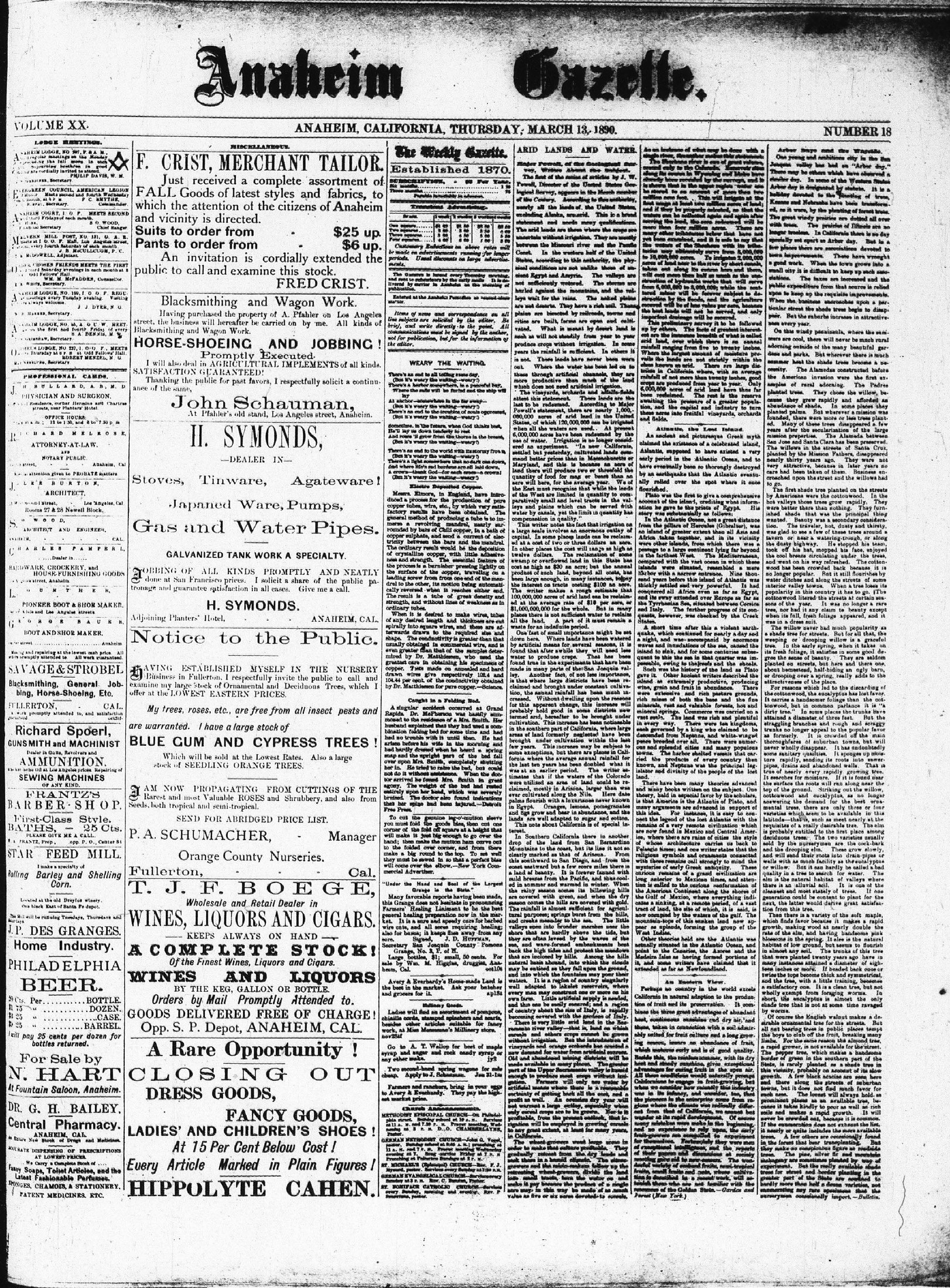
Searchable text
VOLUME XX.
ANAHEIM
Lodge Meetings.
ANAHEIM LODGE, NO. 197, P. A. M.
Regular meetings on the Monday
Saturdays in each
Saturday brethren in good
wear are cordially invited to attend.
PHILIP DAVIS, W. M.
GARDNER, Secretary.
EVERGREEN COUNCIL, AMERICAN LEOI
Hour. Meets second and fourth Wednesday
at 5 P.M.
P.C. SMYTHE,
Secretary.
ANAHEIM COURT, I.O.P. MEETS SECOND
Friday of each month.
B O. WOOD,
Financial Secretary.
Chief Ranger.
MALVERN MILL POST, NO. 131, O. A. R.
Meets at I.O.O.F. Hall, Los Angeles street,
every fourth Saturday of each month.
J.B. MCCULLCUOM, P.C.
A.M.DOWELL, Adjutant.
DADDER CHOSEN FRIENDS MEETS THE FIRST
Saturday evening in each month at 8
Old Fallows' Hall.
W.M. M. McFADDEN, Counsellor.
A.WHITE, Secretary.
ANAHEIM LODGE, NO. 190, I.O.O.F. RECUments every Tuesday evening.
Visiting always welcome.
J.J. DYER, N.O.
W.HARRIS, Secretary.
ANAHEIM LODGE, NO. 26, A.O.U.W. MEET
on the first and fourth Friday of every
B.A.DENNIS, M.W.
ORMISHAW, Secretary.
ANAHEIM LODGE, NO. 27, I.O.O.F. MEETS
Thursday at 8 P.M. at Old Fallows' Hall.
ROBERT MENZEL, N.O.
MORRISHAW, Secretary.
PROFESSIONAL CANDS.
J.H. BULLARD, A.B., M.D.
PHYSICIAN AND SURGEON.
Residence, corner Hermine and Chartrese
streets, near Planters' Hotel.
OFFICE HOURS:
12 to 1:30, and 6 to 7:30 p.m.
RICHARD MELROSE,
ATTORNEY-AT-LAW.
AND
NOTARY PUBLIC.
Street,
Annaheim, Cal.
Attention given to PROBATE matters.
MISCELLANEOUS.
F. CRIST, MERCHANT TAIL
Just received a complete assortment
FALL Goods of latest styles and fabric
which the attention of the citizens of Anaand vicinity is directed.
Suits to order from - $25
Pants to order from - $6
An invitation is cordially extended
public to call and examine this stock.
FRED CRIS
Blacksmithing and Wagon Work
Having purchased the property of A. Pfahler on Los
street, the business will hereafter be carried on by me. All
Blacksmithing and Wagon Work.
HORSE-SHOEING AND JOBBI
Promptly Executed.
I will also deal in AGRICULTURAL IMPLEMENTS of alSATISFACTION GUARANTEED!
Thanking the public for past favors, I respectfully solicit a cance of the same,
John Schauman,
At Pfahler's old stand, Los Angeles street, Anaheim
H. SYMONDS,
—DEALER IN—
J. BULLARD, A.B., M.D.
PHYSICIAN AND SURGEON.
Residence, corner Hermine and Chartree
street, near Planters' Hotel.
OFFICE HOURS:
12 to 1:30, and 6 to 7:30 p.m.
RICHARD MELROSE,
ATTORNEY-AT-LAW.
AND
NOTARY PUBLIC.
Street, Anaheim, Cal.
Attention given to PROBATE matters.
J. LEE BURTON,
ARCHITECT.
Second Street, Los Angeles, Cal.
Rooms 27 & 28 Newell Block.
S. WOOD,
ARCHITECT AND ENGINEER,
ANAHEIM.
CAL.
CHARLES PAMPERL,
... Dealer in...
Hardware, Crockery, and
House-Furnishing Goods
Street, Anaheim.
L. UNTHER,
PIONEER BOOT & SHOR MAKER.
Alele and Los Angeles streets.
GEORGE BAUK,
BOOT AND SHOR MAKER.
Street, Anaheim.
Making and repairing at the lowest cash price. All
when promptly attended to. All work guaranteed.
SAVAGE & STROBEL
Blacksmithing, General Jobbing, Horse-Shoeing, Etc.
FULLERTON,
CAL.
A work promptly attended to, and satisfaction
guaranteed.
Richard Spoerl,
GUNSMITH and MACHINIST
Dealer in Guns, Revolvers and
AMMUNITION.
Aker seine Oil at Los Angeles prices. Repairing of
SEWING MACHINES
OF ANY KIND.
FRANTZ'S
BARBER-SHOP.
First-Class Style.
BATHS, - 25 Cts.
PLEASE GIVE ME A CALL.
W. FRANTZ, Prop., opp. P. O., Canter St
STAR FEED MILL.
I make a specialty of
Rolling Barley and Shelling
Corn.
Located at the old Dreyfus winery.
One black East of Santa Fe depot.
Thanking the public for past favors, I respectfully solicit a c
ance of the same,
John Schauman,
At Pfahler's old stand, Los Angeles street, Anaheim
H. SYMONDS,
—DEALER IN—
Stoves, Tinware, Agatewa
Japaned Ware, Pumps,
Gas and Water Pipe
GALVANIZED TANK WORK A SPECIALTY.
OBBING OF ALL KINDS PROMPTLY AND NE
done at San Francisco prices. I solicit a share of the pub
tronage and guarantee satisfaction in all cases. Give me a call.
H. SYMONDS.
Adjoining Planters' Hotel,
ANAHEIM
Notice to the Public
AVING ESTABLISHED MYSELF IN THE NUR
Business in Fullerton, I respectfully invite the public to ca
examine my large stock of Ornamental and Deciduous Trees, w
offer at the LOWEST EASTERN PRICES.
My trees, roses, etc., are free from all insect pest
are warranted. I have a large stock of
BLUE GUM AND CYPRESS TREES
Which will be sold at the Lowest Rates. Also a large
stock of SEEDLING ORANGE TREES.
AM NOW PROPAGATING FROM CUTTINGS OF
Rarest and most Valuable ROSES and Shrubbery, and also
Seeds, both tropical and semi-tropical.
SEND FOR ABRIDGED PRICE LIST.
P. A. SCHUMACHER,
Orange County Nurseries.
Fullerton,
T. J. F. BOEG
Wholesale and Retail Dealer in
First-Class Style.
BATHS, — 25 Cts.
PLEASE GIVE ME A CALL.
W. A. FRANTZ, Prop., opp. P. O., Center St
STAR FEED MILL.
I make a specialty of
Rolling Barley and Shelling
Corn.
Located at the old Drayfus winery.
One block East of Santa Fe depot.
The Mill will be running Tuesdays, Thursdays and
Saturdays.
J.P. DES GRANGES.
Home Industry.
PHILADELPHIA
BEER.
$1 Cts. Per... BOTTLE.
$1 75 " ... DOZEN.
$3 25 " ... CASE.
$4 25 " ... BARREL.
I will pay 25 cents per dozen for
bottles returned.
For Sale by
N. HART
At Fountain Saloon, Anaheim.
DR. G. H. BAILEY,
Central Pharmacy.
ANAHEIM, CA.
An Entire New Block of Drugs and Medicines.
MORTAL DISPENSING OF PRESCRIPTIONS
AT LOWEST PRICES.
We Carry a Complete Book of
Fancy Soaps, Toilet Articles, and the
Latest Fashionable Perfumes.
SPONGES, CHAMOIR, & STATIONERY,
PATENT MEDICINES, ETC.
SEND FOR ABRIDGED PRICE LIST.
P. A. SCHUMACHER,
Orange County Nurseries.
Fullerton,
T. J. F. BOEG
Wholesale and Retail Dealer in
WINES, LIQUORS AND CIGARS
KEEPS ALWAYS ON HAND
A COMPLETE STOCK
Of the Finest Wines, Liquors and Cigars.
WINES AND LIQUOR
BY THE KEG, GALLON OR BOTTLE.
Orders by Mail Promptly Attended to.
GOODS DELIVERED FREE OF CHARGE
Opp. S. P. Depot, ANAHEIM, CA
A Rare Opportunity!
CLOSING OUT
DRESS GOODS,
FANCY GOODS,
LADIES' AND CHILDREN'S SHOES
At 15 Per Cent Below Cost!
Every Article Marked in Plain Figure
HIPPOLYTE CAHE
ANAHEIM, CALIFORNIA, THURSDAY; MARCH 13, 1890.
ANT TAILOR.
plete assortment of
les and fabrics, to
citizens of Anaheim
$25 up.
$6 up.
dially extended the
this stock.
FRED CRIST.
Wagon Work.
A. Pfahler on Los Angeles
ed on by me. All kinds of
ND JOBBING!
executed.
IMPLEMENTS of all kinds.
respectfully solicit a continuauman,
Los Angeles street, Anaheim.
NDS,
The Weekly Gazette.
Established 1870.
SUBSCRIPTION - NO PER YEAR.
SIX months.
Three months.
Twelve months.
Transnational Advertising.
Breast
One against...
Two against...
Three against...
Four against...
Customary Reductions on above rates will be made on advertisements running for longer periods. Usual discounts on large advertisements.
The Gammon is lurked every Thursday morning, and must be advertised by the early mail. It is delivered by carrier in Anaheim on the meaning of publication.
Entered at the Anaheim Postoffice no second-shift matter.
Items of news and correspondence on all line subjects are solicited by the editor. Be brief, and write directly to the point. All communications must be signed by the author, not for publication, but for the information of the editor.
WEARY THE WAITING.
There's an end to all telling rame day.
(But it's weary the waiting—weary!)
There's an end to the trouble of souls oppressed.
(But it's weary the waiting—weary!)
Sometimes in the future, when God thinks best, He'll lay us down tenderly to rest.
And rooms I'll grow from the thorns in the breast,
(But it's weary the waiting—weary!)
There's an end to the world with its stormy frost in
(But it's weary the waiting—weary!)
There's a light somewhere that no dark one down,
And where life's burdens are all laid down.
A crown—thank God for each crown—a crown!
(But it's weary the waiting—weary)
ARID LANDS AND WATER.
Major Powell, of the Geological Survey, writes Alaheim into his journal.
The first of the articles by J. W. Powell, Director of the United States Geological Survey, appears in the March number of the Century. According to the authority, nearly all the kinds of the United States, excluding Alaska, are used. This is a broad statement and needs many qualifications.
The arid lands are there where the crops are uncertain without irrigation. They are mostly between the Missouri river and the Prairie Coast. In the western half of the United States, according to this authority, the physical conditions are not unlike those of ancient Egypt and Ancient Asia. The valleys are not sufficiently watered. The streams are hurled against the mountains, and the valleys wait for the rains. The naked plains are not deserts. They have a rich soil. These plains are hambled by railroads, towns and cities are built, farms are open and cultivated. What is meant by desert land is such as will not standily from year to year produce crops without irrigation. In some years the rainfall is sufficient. In others it is not. These lands have never been worn out.
Where the water has been led on to these through artificial channels, they are more productive than much of the land which does not need artificial irrigation.
The vineyards, orchards and alfalfa-fields attest this statement. These lands are the last to be redeemed. According to Major Powell's statement, there are nearly 1,000,000 acres of arid land in the United States, of which 120,000 can be irrigated when all the waters are used.. At present 6,000,000 acres have been redeemed by the use of water. Irrigation is no longer considered an experiment. "In new California, settled but yesterday, cultivated lands command better prices than in Massachusetts or Maryland, and this is because an area of land there will produce two or threefold the quantity of food for man or bear than an
respectfully solicit a continupauman,
Los Angeles street, Anaheim.
NDS,
Agateware!
Pumps,
Water Pipes.
A SPECIALTY.
OMPTLY AND NEATLY
at a share of the public pases. Give me a call.
DS.
ANAHEIM, CAL.
e Public.
F IN THE NURSERY
invite the public to call and
Deciduous Trees, which I
CS.
from all insect pests and
of
PRESS TREES!
Rates. Also a large
PREES.
FROM CUTTINGS OF THE
Shrubbery, and also from
PRICE LIST.
Manager
Curseries.
Cal.
DEGE,
Dealer in
(But it's worry the waiting—worry!)
There's a harbor somewhere in a peaceful bay.
Where the mills will be furried and the ship will fly
At anchor—somewhere in the far away—
(But it's worry the waiting—worry!)
There's an end to the trouble of souls oppressed,
(But it's worry the waiting—worry!)
Sometimes in the future, when God thinks best,
He'll lay us down tenderly to rest.
And rooms I'll grow from the thorns in the branches,
(But it's worry the waiting—worry!)
There’s an end to the world with its stormy frost in,
(But it's worry the waiting—worry!)
There’s a light somewhere that no dark one down,
And where life's and burdens are all laid down,
A crown—Thank God for such crowns—a crown!
(But it's worry the waiting—worry!)
Electric Dependent Copper.
Mineral Minerals, in England, have introduced a process for the production of pure copper tubes, wire, etc., by which very satisfactory results have been obtained. The general method of producing a tube is to immerse a revolving mandrel, nearly surrounded by bars of Chili copper, in a bath of copper sulphate, and send a current of electricity between the bars and the mandrel. The ordinary result would be the deposition of crystalline copper, with little adhesiveness and strength. The essential feature of the process is a burnisher pressing lightly on the surface of the copper, travelling on a leading screw from one end of the mandrel to the other, its motion being automatically reversed when it reaches either end. The result is a tube of great density and strength, and without lines of weakness as in ordinary tubes.
When it is desired to make wires, tubes of any desired length and thickness are cut spirally into square wires, and these are afterwards drawn to the required size and shape. The conductivity is greater than that usually obtained in commercial wire, and is even greater than that of the samples determined by Dr. Matthiessen, who used the greatest care in obtaining his specimens of copper. Tests made on annealed and hard drawn wires give respectively 102.4 and 104.44 per cent. of the conductivity obtained by Dr. Matthiessen for pure copper.—Science.
Caught in a Folding Bed.
A singular accident occurred at Grand Rapids. Dr. McPherson was hastily summoned to the residence of a Mrs. Smith. Her husband explained that they had used a combination folding bed for some time and had no trouble with it until then. He had arisen before his wife in the morning and had hardly drunk when he heard a spring snap and the upright part of the bed fall over upon Mrs. Smith, completely shrugging her in. He tried to raise the bed, but could not do it without assistance. When the doctor arrived he found Mrs. Smith in great agony. The weights of the bed had resisted entirely upon her head, which was severely bruised. The doctor also found indications that her spine had been injured.—Detroit Free Press.
To cut the genuine lage-o-mutton sleeve you must fold the goods bias, then cut one corner of the fold off square as a height that will make it just big enough to go over the hand; then make the mutton ham curve out to the folded over corner, and from there make a big round to the top. To set wall they must be swned in so that a perfect bliss will come over the elbow.—New York Commercial Advertiser.
"Under the Head and Seal of the Largest Grange in the State."
Many favorable reports having been made, this Grange does not hesitate in pronouncing Farmers' Healing Limits to be the best more productive than much of the land which does not need artificial irrigation.
The vineyards, orchards and alfalfa fields attest this statement. These lands are the last to be redeemed. According to Major Powell's statement, there are nearly 1,000,060,000 acres of arid land in the United States, of which 120,000,000 can be irrigated when all the waters are need.. At present 6,000,000 acres have been redemanded by the use of water. Irrigation is no longer considered an experiment. "In new California, settled but yesterday, cultivated lands command better prizes than in Massachusetts or Maryland, and this is because an area of land there will produce two or threefold the quantity of food for mag or bese than an acre will here, for the average year. We do the East must recognize that while the lands of the West are limited in quantity to comparatively small and leval tracts in the valleys and plains which can be served with water by canals, yet the limit in quantity has compensation in quality."
This writer notes the fact that irrigation on a large scale involves an enormous outlay of capital. In some places lands can be reclaimed at a cost of two or three dollars an acre. In other places the cost will range as high as twelve dollars. The reclamation of some swamp or overflowed land in this State has cost as high as $20 an acre; but the annual product of such land, beyond all costs, has been large enough, in many instances, to pay the interest on tracts costing $100 an acre. The writer makes a rough estimate that 100,000,000 acres of arid land can be reclaimed at the average rate of $16 per acre, or $1,000,000,000 for the whole. But in many places there is not sufficient water to realise all the land. A part of it must remain a waste for an indefinite period.
One last of small importance might be set down here. Where lands have been watered by artificial means for several seasons, it is found that after awhile they will need less water to produce crops. That has been found true in the experiments that have been made in many parts of the San Joaquín valley. Another fast, of not less importance, is that where large districts have been reclaimed and brought under constant cultivation, the annual rainfall has been much increased. Without dwelling upon reasons for this apparent change, this increase will probably hold good in some districts new termed arid, hereafter to be brought under cultivation. This increase has been noticeable in the southern part of California, where large areas of land formerly neglected have been brought under cultivation within the last few years. This increase may be subject to some exceptions, but there are places in California where the average annual rainfall for the last ten years has been doubled what it was at an earlier period. The writer estimates that if the waters of Colorado were utilized an area of land could be reclaimed, mostly in Arizona, larger than was ever cultivated along the Nile. Here palm flourish with a luxuriance never known in Egypt. Oranges, lemons, pomegranates and tige grow and bear in abundance, and the lands are well adapted to sugar and cotton.
This note about California is of special interest.
In Southern California there is another drop of the land from San Bernardino Mountains to the coast, but its line it not so clearly marked as that of Arizona. From this southward to San Diego, and from the coast eastward but a few scores miles there is a land of beauty. It is forever fanned with mild breeze from the Pacific, and thus cooled in summer and warmed in winter. When the rainy season comes its billowing hills are covered with green, and when the dry season comes its hills are covered with gold. The rainfall is almost sufficient for agriculture.
An ancient claimed that Atlantia, an early period have even existed by an earthly rolled fleurance.
Photo was account of this nation he gave story was made.
In The Atlantic from the pillar an island of Africa takes other passage to Asia in the farther compared with islands worn farbear with sand years built thickly but conquered aland and its away The Tyrrhamme and Italy quetsa, however Staten.
A short quake which a night, and waves and inland岛赴 to this pennable eew Such was given it. Outland island as we were extensive rich mines o minerals; vast mineral spring vaults; in every way nash government descended from peace breeds o ones and splendenta towna. The riad了 prince known,and its isolator and dail land.
There have and may be theory; held is that America many argue this idea.
I meet the largest remains of a now foenice; where those of whom Palagic times religious symp with these rare mysteries o curious remaine long anterior time is called The American Gulf o causes a sinking tract of land.
To cut the genuine lago-mutton sleeve you must fold the goods bias; then cut one corner of the fold off square at a height that will make it just big enough to go over the hand; then make the mutton ham curve out to the folded over corner, and from there make a big round to the top. To set wall they must be saved in so that a perfect blaze will come over the elbow.—New York Commercial Advertiser.
"Under the Hand and Seal of the Largest Grange in the State."
Many favorable reports having been made, this Grange does not hesitate in pronouncing Farmers' Healing Liniment to be the best general healing preparation now in the market. It is a sure and speedy cure for barbed wire cuts, and all sorts requiring healing; also for burns; it keeps fires away from any more. Signed, J. D. Huffman, Secretary San Joaquin Pomona Grange, No. 2, P. of K.
Large bottles, $1; small, 50 cents. For sale by Wm. M. Higgins, druggist, Anaheim, Cal.
Avery & Everhardy's Home-made Lard is the best in the market. Ask your butcher and grocer for it.
Mallory Goods.
Ladies will find an assortment of pompons, chinille cordes, stamped splines and marbles, besides other articles available for fancy work, as Miss Manessman's Millinery store. nov28sf
Go to A. T. Wallop for best of maple syrup and sugar and rock candy syrup or any other make. jj2
Two second-hand spring wagons for sale cheap. Apply to J. Schumann. Jan 31-1st
Farmers and ranches bring in your eggs to Avery & Everhardy. They pay the highest market price.
CHAMBERLAKE CHURCH—On Philadelphia street. Sunday school at 10 a.m.
Burial at 11 a.m. and 7:30 p.m. Power meeting Wednesday at 3 p.m. D. O. CHAMBERLAKE PASTOR.
GERMAN METHODIST CHURCH—John O. Vogel, pastor. Sunday school at 10 a.m.; presbytery at 11 a.m. and 7 p.m. Power meeting Wednesday at 7 p.m. Presbytery at Palmetto Blvd. at 2 p.m.
ST. MICHAEL'S (Palmspray) CHURCH—Bun, F. J. Myrne, pastor. Burials every Thursday at 7:30 a.m.
GERMAN EVANGELICAL CHURCH—Servant every Monday at 3 p.m. Bun, C. Myrne, pastor.
ST. BOMIPACE CATHOLIC CHURCH—Every Sunday morning and evening. Rev. P. Brewerma, pastor.
In Southern California there is another drop of the land from San Bernardino Mountains to the coast, but its line it not so clearly marked as that of Arizona. From this southward to San Diego, and from the coast eastward but a few more miles there is a land of beauty. It is forever fanned with mild breeze from the Pacific, and thus cooled in summer and warmed in winter. When the rainy season comes its billowing hills are covered with green, and when the dry season comes the hills are covered with gold. The rainfall is almost sufficient for agricultural purposes; spring burst from the hills, and creaks蔓延到 the sun.
The little valleys open into broader marshes near the above that are hardly above the tide, but they are often laved by the waves of the sea, and wave-formed embankments beat back the high tides and protect the mendows that are inclined by hills. Among the hills natural basis abound, into which the clouds may be entwined as they fall upon the ground, and into which the counties may poor their waters.
It is a region of country singularly well adapted to lakeset reservoirs, where every man may construct one or more on his own farm.
Little artificial supply is needed, and thus can be easily measured; and a region of country about the size of Italy, is rapidly becoming covered with the gardens of Italy.
There is very little arid land in the Sarremente river valley—that is, land on which cereals and other crops cannot be grown without irrigation. But the introduction of vineyards and orange orchards has created a new demand for water from artificial sources. Old and abandoned mining districts will be made available in many places. The greater part of the Upper Sacramento valley is bound enough to produce most crops without irrigation.
Farmers will only use water by artificial means where there is a reasonable certainty of getting back all the cost, and a profit as well.
An extensive dry year will not warrant a large extinction, especially when only cereal crops are to be grown. Here is profitable, from the present outlook, that irrigation will be employed in growing cereals to any great extent, at least for many years, in California.
The wheat-growers want large areas in order to make that cultured profitable. They gradually retreat from the dry lands and seek them in a humid climate. The小麦-growers and the maize-growers follow up the retraining wheat-growers, dividing the land into small hands; hence the water on and make it pay because the product of a single value as five or six acres devoted to corn.
In Egypt, Orange, palm-pompon and fig grow and bear in abundance, and the lands are well adapted to sugar and cotton.
This note about California is of special interest.
In Southern California there is another drop of the land from San Bernardino Mountains to the coast, but its line it not so clearly marked as that of Arizona. From this southward to San Diego, and from the coast eastward but a few more miles there is a land of beauty. It is forever fanned with mild breeze from the Pacific, and thus cooled in summer and warmed in winter. When the rainy season comes its billowing hills are covered with green, and when the dry season comes the hills are covered with gold. The rainfall is almost sufficient for agricultural purposes; spring burst from the hills, and creaks蔓延到 the sun.
The little valleys open into broader marshes near the above that are hardly above the tide, but they are often laved by the waves of the sea, and wave-formed embankments beat back the high tides and protect the mendows that are inclined by hills. Among the hills natural basis abound, into which the clouds may be entwined as they fall upon the ground, and into which the counties may poor their waters.
It is a region of country singularly well adapted to lakeset reservoirs, where every man may construct one or more on his own farm.
Little artificial supply is needed, and thus can be easily measured; and a region of country about the size of Italy, is rapidly becoming covered with the gardens of Italy.
There is very little arid land in the Sarremente river valley—that is, land on which cereals and other crops cannot be grown without irrigation. But the introduction of vineyards and orange orchards has created a new demand for water from artificial sources. Old and abandoned mining districts will be made available in many places. The greater part of the Upper Sacramento valley is bound enough to produce most crops without irrigation.
Farmers will only use water by artificial means where there is a reasonable certainty of getting back all the cost, and a profit as well.
An extensive dry year will not warrant a large extinction, especially when only cereal crops are to be grown.
Here is profitable, from the present outlook, that irrigation will be employed in growing cereals to any great extent, at least for many years, in California.
The wheat-growers want large areas in order to make that cultured profitable. They gradually retreat from the dry lands and seek them in a humid climate. The小麦-growers and the maize-growers follow up the retraining wheat-growers, dividing the land into small hands; hence the water on and make it pay because the product of a single value as five or six acres devoted to corn.
In Egypt, Orange, palm-pompon and fig grow and bear in abundance, and the lands are well adapted to sugar and cotton.
This note about California is of special interest.
In Southern California there is another drop of the land from San Bernardino Mountains to the coast, but its line it not so clearly marked as that of Arizona. From this southward to San Diego, and from the coast eastward but a few more miles there is a land of beauty. It is forever fanned with mild breeze from the Pacific, and thus cooled in summer and warmed in winter. When the rainy season comes its billowing hills are covered with green, and when the dry season comes the hills are covered with gold. The rainfall is almost sufficient for agricultural purposes; spring burst from the hills, and creaks蔓延到 the sun.
The little valleys open into broader marshes near the above that are hardly above the tide, but they are often laved by the waves of the sea, and wave-formed embankments beat back the high tides and protect the mendows that are inclined by hills. Among the hills natural basis abound, into which the clouds may be entwined as they fall upon the ground, and into which the counties may poor their waters.
It is a region of country singularly well adapted to lakeset reservoirs, where every man may construct one or more on his own farm.
Little artificial supply is needed, and thus can be easily measured; and a region of country about the size of Italy, is rapidly becoming covered with the gardens of Italy.
There is very little arid land in the Sarremente river valley—that is, land on which cereals and other crops cannot be grown without irrigation. But the introduction of vineyards and orange orchards has created a new demand for water from artificial sources. Old and abandoned mining districts will be made available in many places. The greater part of the Upper Sacramento valley is bound enough to produce most crops without irrigation.
Farmers will only use water by artificial means where there is a reasonable certainty of getting back all the cost, and a profit as well.
An extensive dry year will not warrant a large extinction, especially when only cereal crops are to be grown.
Here is profitable, from the present outlook, that irrigation will be employed in growing cereals to any great extent, at least for many years, in California.
The wheat-growers want large areas in order to make that cultured profitable. They gradually retreat from the dry lands and seek them in a humid climate. The小麦-growers and the maize-growers follow up the retraining wheat-growers, dividing the land into small hands; hence the water on and make it pay because the product of a single value as five or six acres devoted to corn.
In Egypt, Orange, palm-pompon and fig grow and bear in abundance, and the lands are well adapted to sugar和棉花。
This note about California is of special interest.
In southern California there is another drop of the land from San Bernardino Mountains to the coast, but its line it not so clearly marked as that of Arizona. From this southward to San Diego, and from the coast eastward but a few more miles there is a land of beauty. It is forever fanned with mild breeze from the Pacific, and thus cooled in summer and warmed in winter. When the rainy season comes its billowing hills are covered with green, and when the dry season comes the hills are covered with gold. The rainfall is almost sufficient for agricultural purposes; spring burst from the hills, and creaks蔓延到the sun.
The little valleys open into broader marshes near the above that are hardly above the tide,but they are often laved by the waves ofthe sea,and wave-formed embankments beat backthe high tidesandprotectthemthatareinclinedbyhills.Amongthehillsnaturalbasisabound,intosupplementmountain-topasplainWestIndiana.OtherthenormallyattainntimeiscalledainkinternationaltheAmericastheGulfofLakecauseainkingtractoftlandnowoccupiedmountain-topasplainWestIndiana.OtherthenormallyattainntimeiscalledainkinternationaltheAmericastheGulfofLakecauseainkingtractoftlandnowoccupiedmountain-topasplainWestIndiana.OtherthenormallyattainntimeiscalledainkinternationaltheAmericastheGulfofLakecauseainkingtractoftlandnowoccupiedmountain-topasplainWestIndiana.OtherthenormallyattainntimeiscalledainkinternationaltheAmericastheGulfofLakecauseainkingtractoftlandnowoccupiedmountain-topasplainWestIndiana.OtherthenormallyattainntimeiscalledainkinternationaltheAmericastheGulfofLakecauseainkingtractoftlandnowoccupiedmountain-topasplainWestIndiana.OtherthenormallyattainntimeiscalledainkinternationaltheAmericastheGulfofLakecauseainkingtractoftlandnowoccupiedmountain-topasplainWestIndiana.OtherthenormallyattainntimeiscalledainkinternationaltheAmericastheGulfofLakecauseainkingtractoftlandnowoccupiedmountain-topasplainWestIndiana.OtherthenormallyattainntimeiscalledainkinternationaltheAmericastheGulfofLakecauseainkingtractoftlandnowoccupiedmountain-topasplainWestIndiana.OtherthenormallyattainntimeiscalledainkinternationaltheAmericastheGulfofLakecauseainkingtractoftlandnowoccupiedmountain-topasplainWestIndiana.OtherthenormallyattainntimeiscalledainkinternationaltheAmericastheGulfofLakecauseainkingtractoftlandnowoccupiedmountain-topasplainWestIndiana.OtherthenormallyattainntimeiscalledainkinternationaltheAmericastheGulfofLakecauseainkingtractoftlandnowoccupiedmountain-topasplainWestIndiana.OtherthenormallyattainntimeiscalledainkinternationaltheAmericastheGulfofLakecauseainkingtractoftlandnowoccupiedmountain-topasplainWestIndiana.OtherthenormallyattainntimeiscalledainkinternationaltheAmericastheGulfofLakecauseainkingtractoftlandnowoccupiedmountain-topasplainWestIndiana.OtherthenormallyattainntimeiscalledainkinternationaltheAmericastheGulfofLakecauseainkingtractoftlandnowoccupiedmountain-topasplainWestIndiana.OtherthenormallyattainntimeiscalledainkinternationaltheAmericastheGulfofLakecauseainkingtractoftlandnowoccupiedmountain-topasplainWestIndiana.OtherthenormallyattainntimeiscalledainkinternationaltheAmericastheGulfofLakecauseainkingtractoftlandnowoccupiedmountain-topasplainWestIndiana.OtherthenormallyattainntimeiscalledainkinternationaltheAmericastheGulfofLakecauseainkingtractoftlandnowoccupiedmountain-topasplainWestIndiana.OtherthenormallyattainntimeiscalledainkinternationaltheAmericastheGulfofLakecauseainkingtractoftlandnowoccupiedmountain-topasplainWestIndiana.OtherthenormallyattainntimeiscalledainkinternationaltheAmericastheGulfofLakecauseainkingtractoftlandnowoccupiedmountain-topasplainWestIndiana.OtherthenormallyattainntimeiscalledainkinternationaltheAmericastheGulfofLakecauseainkingtractoftlandnowoccupiedmountain-topasplainWestIndiana.OtherthenormallyattainntimeiscalledainkinternationaltheAmericstheGulfofLakecauseainkingtractoftlandnowoccupiedmountain-topasplainWestIndiana.OtherthenormallyattainntimeiscalledainkinternationaltheAmericstheGulfofLakecauseainkingtractoftlandnowoccupiedmountain-topasplainWestIndiana.OfterthenormallyattainntimeiscalledainkinternationaltheAmericstheGulfofLakecauseainkingtractoftlandnowoccupiedmountain-topasplainWestIndiana.OfterthenormallyattainntimeiscalledainkinternationaltheAmericstheGulfofLakecauseainkingtract oftlandnowoccupiedmountaintopasplainWestIndiana.OfterthenormallyattainntimeiscalledainkinternationaltheAmericstheGulfofLakecauseainkingtract oftlandnowoccupiedmountaintopasplainWestIndiana.OfterthenormallyattainntimeiscalledainkinternationaltheAmericstheGulfofLakecauseainkingtract oftlandnowoccupiedmountaintopasplainWestIndiana.OfterthenormallyattainntimeiscalledainkinternationaltheAmericstheGulfofLakecauseainkingtract oftlandnowoccupiedmountaintopasplainWestIndiana.OfterthenormallyattainntimeiscalledainkinternationaltheAmericstheGulfofLakecauseainkingtract oftlandnowoccupiedmountaintopasplAINWestIndiana.OfterthenormallyattainntimeiscalledainkinternationaltheAmericstheGulfofLakecauseainkingtract oftlandnowoccupiedmountaintopasplAIN WestIndiana.OfterthenormallyattainntimeiscalledainkinternationaltheAmericstheGulfofLakecauseainkingtract oftlandnow occupancyallocationallocationallocationallocationallocationallocationallocationallocationallocationallocationallocationallocationallocationallocationallocationallocationallocationallocationallocationallocationallocationallocationallocationallocationallocationallocationallocationallocationallocationallocationallocationallocationallocationallocationallocationallocationallocationallocationallocationallocationallocationallocationallocationalllocationallocationallocationallocationallocationallocationallocationallocationallocationallocationallocationallocationallocationallocationallocationallocationalllocationallocationalllocationallocationalllocationalllocationalllocationalllocationalllocationalllocationalllocationalllocationalllocationalllocation all location all location all location all location all location all location all location all location all location all location all location all location all location all location all location all location all location all location all location all location all location all location all location all location all location all location all location all location all location all location all location all location all location all location all location all location all location all location all location all location all location all location all location all location all location all location all location all location all location all location.allLocation.allLocation.allLocation.allLocation.allLocation.allLocation.allLocation.allLocation.allLocation.allLocation.allLocation.allLocation.allLocation.allLocation.allLocation.allLocation.allLocation.allLocation.allLocation.allLocation.allLocation.allLocation.allLocation.allLocation.allLocation.allLocation.allLocation.allLocation.allLocation.allLocation.allLocation.allLocation.allLocation.allLocation.allLocation.allLocation.allLocation.all Location.all Location.all Location.all Location.all Location.all Location.all Location.all Location.all Location.all Location.all Location.all Location.all LocationAll Location.All Location.All Location.All Location.All Location.All Location.All Location.All Location.All Location.All Location.All Location.All Location.All Location.All Location.All Location.All Location.All Location.All Location.All Location.All Location.All Location.All Location.All Location.All Location.All Location.All Location.All Location.All Location.All Location.All Location.All Location.All Location.All Location.All Location.All Location.All Location.All Location.All Location.All Location.All Location.All Location.All Location.All Location.All Location.All Location.All Location.All Location.AllocationAllLocationAllLocationAllLocationAllLocationAllLocationAllLocationAllLocationAllLocationAllLocationAllLocationAllLocationAllLocationAllLocationAllLocationAllLocationAllLocationAllLocationAllLocationAllLocationAllLocationAllLocationAllLocationAllLocationAllLocationAllLocationAllLocationAllLocationAllLocationAllLocationAllLocationAllLocationAllLocationAllLocationAllLocationAllLocationAllLocationAllLocationAllLocationAllLocationAllLocationAllLocationAllLocationAllLocationAllLocationAllLocationAllLocationAllLOCATIONALLLOCATIONALLLOCATIONALLLOCATIONALLLOCATIONALLLOCATIONALLLOCATIONALLLOCATIONALLLOCATIONALLLOCATIONALLLOCATIONALLLOCATIONALLLOCATIONALLLOCATIONALLLOCATIONALLLOCATIONALLLOCATIONALLLOCATIONALLLOCATIONALLLOCATIONALLLOCATIONALLLOCATIONALLLOCATIONALLLOCATIONALLLOCATIONALLLOCATIONALLLOCATIONALLLOCATIONALLLOCATIONALLLOCATIONALLLOCATIONALLLOCATIONALLLOCATIONALLLOCATIONALLLOCATIONALLLOCATIONALLLOCATIONALLLOCATIONALLLOCATIONALLLOCATIONALLLOCATIONALLLOCATIONALLLOCATIONALLLOCATIONALLLOCATIONALLLOCATIONALLLOCATIONALLLOCATIONALLLOCATIONSALLOCATIONALLLOCATIONALLLOCATIONALLLOCATIONALLLOCATIONALLLOCATIONALLLOCATIONALLLOCATIONALLLOCATIONALLLOCATIONALLLOCATIONALLLOCATIONALLLOCATIONALLLOCATIONALLLOCATIONALLLOCATIONALLLOCATION ALLLOCATION ALLLOCATION ALLLOCATION ALLLOCATION ALLLOCATION ALLLOCATION ALLLOCATION ALLLOCATION ALLLOCATION ALLLOCATION ALLLOCATION ALLLOCATION ALLLOCATION ALLLOCATION ALLLOCATURE ALLLOCATURE ALLLOCATURE ALLlocations All locations All locations All locations All locations All locations All locations All locations All locations All locations All locations All locations All locations All locations All locations All locations All locations All locations All locations All locations All locations All locations All locations All locations All locations All locations All locations All locations All locations All locations All locations All locations All locations All locations All locations All locations All locations All locations All locations All locations All locations All locations All locations All locations All locations All Locations All locations All locations All locations All locations All locations All locations All locations All locations All locations All locations All locations All locations All locations All locations All locations All locations All locations All locations All locations All locations All locations All locations All locations All locations All locations All locations All locations All locations All locations All locations All locations All locations All locations All locations All locations All locations Allocations Allocations Allocations Allocations Allocations Allocations Allocations Allocations Allocations Allocations Allocations Allocations Allocations Allocations Allocations Allocations Allocations Allocations Allocations Allocations Allocations Allocations Allocations Allocations Allocations Allocations Allocations Allocations Allocations Allocations Allocations Allocations Alocations Allocations Allocations Allocations Allocations Allocations Alocations Allocations Alocations Alocations Alocations Alocations Alocations Alocations Alocations AlocationsAlocationsAlocationsAlocationsAlocationsAlocationsAlocitionsAlocitionsAlocitionsAlocitionsAlocitionsAlocitionsAlocitionsAlocitionsAlocitionsAlocitionsAlocitionsAlocitionsAlocitionsAlocitionsAlocitionsAlocitionsAlocitionsAlocitiesAlocitionsAlocitionsAlocitiesAlocitionsAlocitiesAlocitiesAlocitiesAlocitiesAlocitiesAlocitiesAlocitiesAlocitiesAlocitiesAlocitiesAlocitiesAlocitiesAlocitiesAlocitiesAlocitiesAlocitiesAlocitiesAlocitiesAlocitiesAlocitiesAlocitiesAlocitiesAlocitiesAlocitiesAlocitiesAlocitiesAlocitiesAlocitiesAlocitiesAlocitiesAlocitiesAlocitiesAlocitiesAlocitiesAlocitiesAlocitiesAlocitiesAlocitiesAlocitiesAlocitiesAlocitiesAlocitiesAlocitiesAlocitoriesAlocitoriesAlocitoriesAlocitoriesAlocitoriesAlocitoriesAlocitoriesAlocitoriesAlocitoriesAlocitoriesAlocitoriesAlocitoriesAlocitoriesAlocitoriesAlocitoriesAlocitoriesAlocitoriesAlokitoriesAlokitoriesAlokitoriesAlokitoriesAdokitoriesAdokitoriesAdokitoriesAdokitoriesAdokitoriesAdokitoriesAdokitoriesAdokitoriesAdokitoriesAdokitoriesAdokitoriesAdokitoriesAdokitoriesAdokitoriesAdokitoriesAdokitoriesAdokitoriesAdokitoriesAdokitoriesAdokitoriesAdokitoriesAdokitoriesAdokitoriesAdokitoriesAdokitoriesAdokitoriesAdokitoriesAdokitoriesAdokitoriesAdokitoriesAdokitoriesAdokitoriesAdokitoriesAdokatoriesAdokitoriesAdokitoriesAdokitoriesAdokitoriesAdokitoriesAdokitoriesAdokitoriesAdokitoriesAdokitoriesAdokatoriesAdokatoriesAdokatoriesAdokatoriesAdokatoriesAdokatoriesAdokatoriesAdokatoriesAdokatoriesAdokatoriesAdokatoriesAdokatoriesAdokatoriesAdokatoriesAdokatorysAdokatorysAdokatorysAdokirectorysAdokirectorysAdokirectorysAdokirectorysAdokirectorysAdokirectorysAdokirectorysAdokirectorysAdokirectorysAdokirectorysAdokirectorysAdokirectorysAdokirectorysAdokirectorysAdokirectorysAdokirectorysAdokirectorysAdokirectorysAdokirectorysAdOkirectorysAdOKirectorysADOKirectorysADOKirectorysADOKirectorysADOKirectorysADOKirectorysADOKirectorysADOKirectorysADOKirectorysADOKirectorysADOKirectorysADOKirectorysADOKirectorysADOKirectorysADOKirectorysADOKDirectorysADOK_directorySADOK_directorySADOK_directorySADOK_directorySADOK_directorySADOK_directorySADOK_directorySADOK_directorySADOK_directorySADOK_directorySADOK_directorySADOK_directorySADOK_directorySADOK_directorySADOK_directorySADOK_directorySADOK_directorySADOK_directorySADOK_directorySADOK_directorySADOK_directorySADOK_directorySADOK_directorySADOK_directorySADOK_directorySADOkDirectorySADOkDirectorySADOkDirectorySADOkDirectorySADOkDirectorySADOkDirectorySADOkDirectorySADOkDirectorySADOkDirectorySADOkDirectorySADOkDirectorySADOkDirectorySADOkDirectorySADOkDirectorySADOkDirectorySADOkDirectorySADOkDirectorySADOkDirectorySADOkDirectorySADOkDirectorySADOkDirectorySADOkDirectorySADOkDirectorySADOkDirectorySADOk directoryS AD OK Directory S AD OK Directory S AD OK Directory S AD OK Directory S AD OK Directory S AD OK Directory S AD OK Directory S AD OK Directory S AD OK Directory S AD OK Directory S AD OK Directory S AD OK Directory S AD OK Directory S AD OK Directory S AD OK Directory S AD OK Directory S AD OK Directory S AD OK Directory S AD OK Directory S AD OK Directory S AD OK Directory S AD OK Directory S AD OK Directory S AD OK Directory S AD OK Directory S AD Ok Directory S AD OK Directory S AD OK Directory S AD OK Directory S AD OK Directory S AD OK Directory S AD OK Directory S AD OK Directory S AD OK Directory S AD OK Directory S AD OK Directory S AD OK Directory S AD OK Directory S AD OK Directory S AD
WATER.
As an instance of what may be done with a single river, throughout this continent.
The Mississippi River is one of great volume, running only to the Oklahoma. Minnesota along its course in Wyoming and Maine have already been rewilded by the merger, and it is shown that in the upper regions water can be shared to an amount of more than two million acres foot. This will insignify at the first stage at two million acres of land; and if they be properly selected, so that the waters can be collected again and again after moving the land, the same admirable will be more than four million acres. There are many other habitats below that have not yet been examined, and it is safe to say that the waters of the Mississippi with its reflections may ultimately move from 8,000,000 to 10,000,000 acres. To irrigate 2,000,000 acres of land near the river by short canals taken along its course here and there, will not more than half as much as the construction of hydraulic works that will serve from 6,000,000 to 8,000,000; while the scattered matter will be forever subject to destruction by the floods, and the agriculture secured will be of less value per area, because the host lands will not be served, and only important drainage will be assured.
This preliminary survey is to be followed up by others. The facts of greatest interest are the immense breadth of what is called arid land, over which there is an annual rainfall ranging from five to twenty inches. Where the largest amount of moisture prevails the lands are not strictly within the alum known as arid. There are large districts in California where, with an average rainfall of not more than twenty inches, good crops are produced from year to year. Only 6,000,000 acres of arid land have thus far been realized. The rest is the reserve awaiting the pressure of a greater population, and the capital and industry to turn these areas into fruitful vineyards, orchards and fields.
Atlantic, the Lost Island.
An ancient and picturesque Greek myth claimed the existence of a celebrated island, Atlantic, supposed to have existed a very early period in the Atlantic Ocean, and to have eventually been so thoroughly destroyed by an earthquake that the Atlantic eventuated.
Arbor Baye and the Wayette.
One young and ambitious city in the far western valley has had an "Arber day." There may be others which have observed a similar day. In some of the Western States Arber day is designated by states. It is a holiday devoted to the planting of tran- Kenne and Nebraska have been transformed, as it were, by the planting of forest trees. The great windy prairies are detined all over with trees. The prairies of Illinois are no longer treasured. In California there is no day specially set apart as Arber day. But in a few places there are associations devoted to town improvements. These have wrought a good work. When the town grows into a small city it is difficult to keep up such associations. The taxes are increased and the public expenditure from that source is relied upon to keep up the requisite improvements. When the business encroaches upon a particular street the shade tree begins to disperse. But the suburbs increase in attractiveness every year.
On this windy peninsula, where the summers are cool, there will never be much rural adorning outside of the many beautiful gardens and parks. But wherever there is much summer heat the shade trees become a necessity. The Alamedas constructed before the American invasion were the first examples of rural adorning. The Padres planted trees. They chose the willow, because they grow rapidly and afforded an abundance of shade. In some places they planted palms. But wherever a mission was founded, there were more or less trees planted. Many of these trees disappeared a few years after the secularization of the large mission properties. The Alameda between San Jose and Santa Clara has been preserved. The willows in the streets of Santa Cruz, planted by the Mission Pathers, disappeared nearly thirty years ago. They were not very attractive, because in later years no care had been taken of them. Business encroached upon the street and the willows had
At present, by the longer considered lands are the leading to Major
minimum 1,000 in the United
state be irrigated.
At Atlantic, the Least Island.
An ancient and pictureque Greek myth
claimed the existence of a celebrated island,
Atlanta, supposed to have existed a very
early period in the Atlantic Ocean, and to
have eventually been so thoroughly destroyed
by an earthquake that the Atlantic eventually rolled over the spot where it once
flourished.
Plato was the first to give a comprehensive
account of the island, crediting what information he gave to the priests of Egypt. His story was substantially as follows:
In the Atlantic Ocean, not a great distance
from the pillars of Hercules (Gibraltar), was an island of greater extent than all Asia and Africa taken together, and in its vicinity were other islands, from which there was a passage to a large continent lying far beyond in the farthest West. The Mediterranean, compared with the vast ocean in which these islands were situated, resembled a mere firbrar with a narrow entrance. Nine thousand years before this island of Atlantis was thickly entailed and very powerful. It had conquered all Africa even as far as Egypt, and its way extended over Europe as far as the Tyrannian Sea, situated between Corsica and Italy. The further progress of its conquests, however, was checked by the Creek States.
A short time after this violent earthquake, which continued for nearly a day and a night, and was accompanied by enormous waves and inundations of the sea, caused the island to sink, and for some centuries subsequent to this the sea in that quarter was impassable, ewing to the breeds and the shoals.
Such was the history of the land as Plato gave it. Other ancient writers described the island as extremely productive, producing wine, grain and fruit in abundance. There were extensive and rich pasture grounds, rich mines of both the basin and the fine minerals, vast and valuable forests, hot and mineral springs. Commerce was carried on a vast scale. The land was rich and plentiful in every way. There were ten kingdoms, each governed by a king who claimed to be descended from Neptune, and white-winged peace broadened over all. There were numerous and splendid cities and many populous towns. The harbor sheltered vessels that carried the products of every country then known, and Neptune was the principal legislator and divinity of the people of the lost land.
There have been many theories advanced and many books written on the subject. One theory, held in especial favor by the scholars, is that America is the Atlantic of Plato, and many arguments are advanced in support of this idea. For instance, it is easy to connect the legend of the lost Atlantic with the remains of a very remote civilization which are now found in Mexico and Central America, where there are ruins of cities the style of whose architecture carries us back to Palangic times; and one writer states that the religious symbols and ornaments connected with those remnants call strongly to mind the mysteries of early Greek antiquity. These curious remains of a grand civilization are long anterior to Mexican times, and attention is called to the curious conformation of the American Continent along the shores of the Gulf of Mexico, where everything indicates a sinking, at a remote period, of a vast tract of land, the site of which it is said is samples of rural adorning. The Padres planted trees. They chose the willow, because they grow rapidly and afforded an abundance of shade. In some places they planted palms. But wherever a mission was founded, there were more or less trees planted. Many of these trees disappeared a few years after the secularization of the large mission properties. The Alameda between San Jose and Santa Clara has been preserved. The willows in the streets of Santa Cruz, planted by the Mission Pathers, disappeared nearly thirty years ago. They were not very attractive, because in later years no care had been taken of them. Business encroached upon the street and the willows had to go.
The first shade tree planted on the streets by Americans were the cottonwood. In the hot valleys those trees grow rapidly. They were better there than nothing. They furnished shade that was the principal thing wanted. Beauty was a secondary consideration. The traveler, hot, dusty and thirsty, was glad to see a few of these trees around a tavern or near a watering trough, or along the dusty highway. He stopped his team, took off his hat, mopped his face, enjoyed the cool breeze circulating under the trees, and went on his way refreshed. The cottonwood has been crowded back because it is no longer popular. But it still flourishes by water ditches and along the streets of some interior valley towns. When a tree loses its popularity in this country it has to go. The cottonwood littered the streets at certain seasons of the year. It was no longer a rare tree, nor had it any claim to beauty except when its full, fresh foliage appeared, and it was in a dress suit.
The willow never had much popularity as a shade tree for streets. But for all that, the weeping or drooping willow is a graceful tree. In the early spring, when it takes on its fresh foliage, it satisfies in some good degree the sense of beauty. They are seldom planted on streets, but here and there one about hemestead, half-biding an ugly barn, or drooping over a spring, really adds to the attractiveness of the place.
For reasons which led to the discarding of the cottonwood, the eucalyptus has lost favor. It carries a handsome foliage than the cottonwood, but in common parlance it is "a dirty tree." In some places the trunks have attained a diameter of three feet. But the straggling branches and rough and scraggy trunks no longer appeal to the popular favor as formerly. It is crowded off the main thoroughfares of an urban town, but will never wholly disappear. It has undoubtedly some sanitary qualities. It sponges up moisture rapidly, sending its roots into sewer pipes, drains and abandoned wells. That is true of nearly every rapidly growing tree.
It searches for moisture. If it is found near the surface the roots will run along near the top of the ground. Striking out the willow, cottonwood and eucalyptus, as no longer answering the demand for the best ornamental trees, there are only three or four varieties which seem to be available in this latitude—that is, such as meet nearly at the requisites of a really desirable tree. The elm is probably entitled to the first place among deciduous trees. The two varieties usually sold by the nurserymen are the cock-bark and the drooping elm. These grow slowly, and will send their roots into drain-pipes or walls with as much facility as the eucalyptus or willow: But it can hardly be called a bad quality in a tree to search for water. The elm is the natural habitat of valleys where there is an alluvial soil. It is one of the cleanest and most stately of trees. If one generation could be content to plant for the next, the latter would derive great satisfaction from this tree.
An Eastern View.
Parkage no country in the world excels California in natural adaptation to the production of fruit and its preservation. It combines the three great advantages of abundant heat, continuous rain and dry air; and these, taken in connection with a soil admirably suited for fruit culture and a long growing season, immer an abundance of fruit, which matures early and is of good quality. Besides this, the rainforest, with its dry heat and already manmade, gives exceptional advantages for growing fruit in the open air. All these conditions would naturally prompt California to engage in fruit-growing, but when we consider how recently this industry was in its infancy, and wonder, too, that the pioneers in the enterprise come from regions where the climate was radically different from that of California, we cannot but wonder at its rapid development. Of many many mistakes were made in the beginning, and no experience to rely upon, the early fruit-growers are compelled to experiment for themselves. Fortunately they were men of exceptional intelligence, and the reports of their parents and dimensions at nearly meeting point aid to new discoveries. The wonderful variety of orchid fruits, small tropical fruits, small fruits and cactus, whose cultivation is demanded in a recent week, will absorb those who are not familiar with the remnants of the Golden State. — Garden and Forest (New York.)
Of course the English walnut makes a desirable ornamental tree for the streets. But all nut bearing trees in public places tempt the boys to club off the fruit, breaking many limbs. For the same reason the almond tree, a rapid grower, is not available for the street. The pepper tree, which makes a handsome border of green in the southern part of the State, is rarely planted as a shade tree in this vicinity, probably on account of its slow growth. A few black acacia are seen here and there along the streets of suburban towns, but it does not find much favor for such nausea. The locust will always hold as prominent plants as an available tree, because it takes kindly to poor as well as rich soils and makes a rapid growth. It will never be crowded out, because it is common. If the encumbrations do not exhaust the list, it merely or quite includes the more available trees. A few others are occasionally found in the forest that bear transplanting. But they make no conspicuous figures as roadside trees. The pine, silver fir and mountain ash may be sometimes planted by way of experiment. But the really available shade trees for street and border planting in the greater part of the State are combined to handle more than half a dozen varieties, not enumerating any rare specimens that the nurserymen commonly import. — Bulletin.