anaheim-gazette 1889-10-03
Scanned page
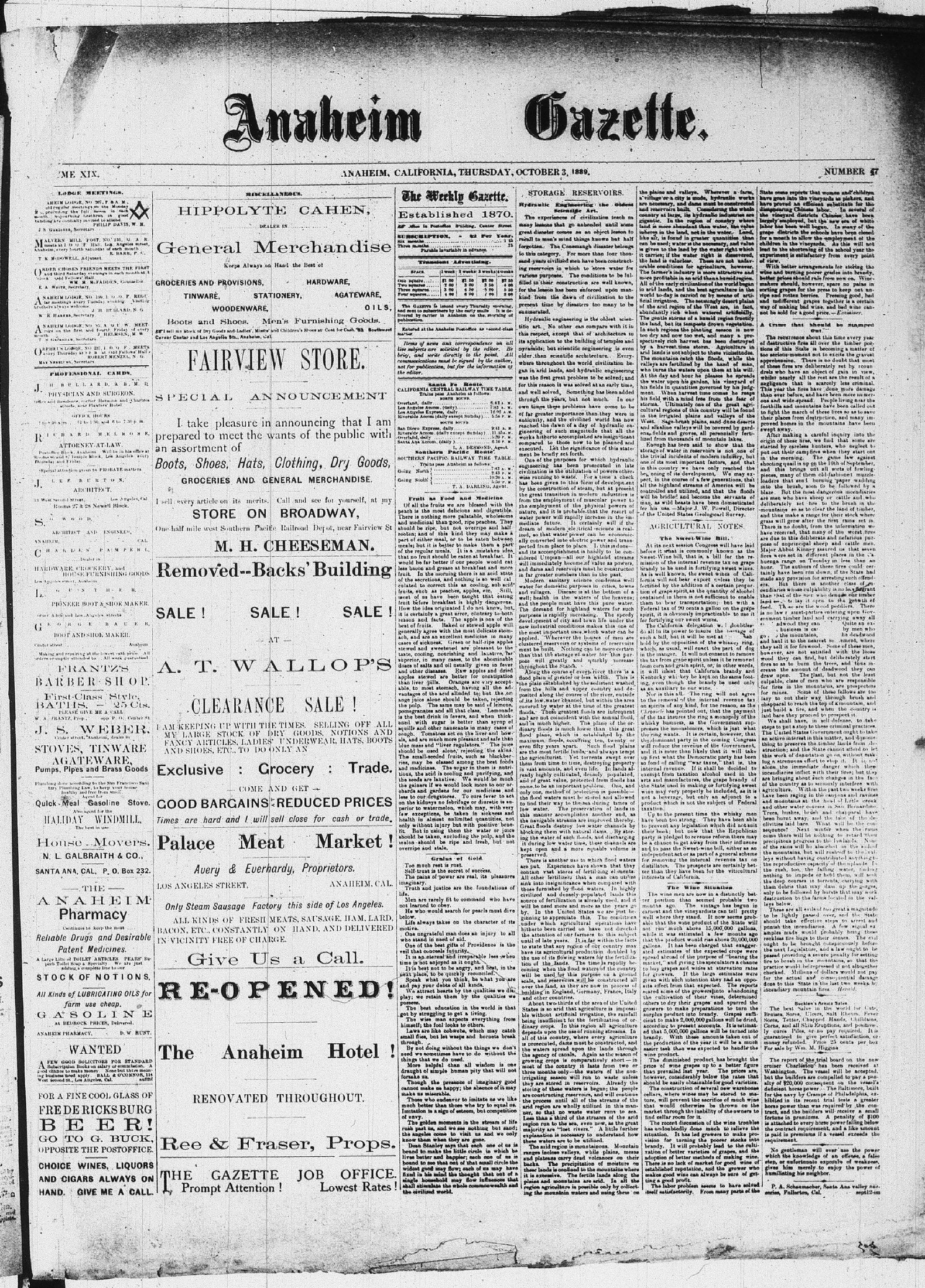
Searchable text
LODGE MEETINGS.
AHEIM LODGE, NO. 207, F & A M,
hold regular meetings on the Monday
M. preceding the full moon in each
month. Nojourning brethren in good
tanding are cordially invited to attend.
PHILIP DAVIS, W. M.
J. N. GARDINER, Secretary
ALVERN HILL POST, NO. 131, G. A R.
meets at LOO F. Hall, Los Angeles street,
Anahiem, every fourth Saturday of each month.
E. BARR, P.C.
T. K. McDOWELL, Adjutant
ORDER CHOSEN FRIENDS MEETS THE FIRST
and third Saturday evenings in each month at
clock. Old Fellow's Hall.
WM. M. McFADDEN, Counselor
E. A. WHITE, Secretary.
AHEIM LODGE, NO. 199, LOO F. REGUL
meetings every Tuesday evening. Visiting
brothers always welcome.
J. H. BYLLARD, N. G.
W. K. HARRER, Secretary.
AHEIM LODGE, NO. 85, LOO F. MEET
ings on the first and fourth Friday of every
month.
J. HELMSEN, M. W.
T. N. GRIMSHAW, Secretary.
ORPHEUS LODGE, NO. 237, LOO F. MEETS
every Thursday at 9 p.m. at Old Yellow Hall.
ROBERT MENZEL, N. G.
MAX NEBRUY, Secretary.
PROFESSIONAL CARDS.
J. H. BULLARD, A.B., M.R.
PHYSICIAN AND SURGEON.
Office and Residence corner Hermine and Chartres
streets, near Planters' Hotel.
OFFICE HOURS:
7 to 8 o'clock, 12 to 1:30 apd, 6 to 7:30 p.m.
RICHARD MELROSE,
ATTORNEY-AT-LAW.
Postoffice Block, Anahiem. Will be in his office at
Rooms 50 and 52 Temple Block, Los Angeles every
Thursday and Friday.
Special attention given to PROBATE matters.
MISCELLANEOUS.
HIPPOLYTE CAHIRE
DEALER IN
General Merchandise
Keeps Always on Hand the Best of
GROCERIES AND PROVISIONS,
HARDWARE,
TINWARE,
STATIONERY,
AGGAWOODENWARE,
Boots and Shoes. Men's Furnishing.
I sell my Stock of Dry Goods and Ladies', Minutes and Children's Shoes at Cost for C
Corner Center and Los Angeles Bts., Anahiem, Cal.
FAIRVIEW STORE
SPECIAL ANNOUNCEMENT
I take pleasure in announcing t
prepared to meet the wants of the pu
an assortment of
Boots, Shoes, Hats, Clothing, Dry
GROCERIES AND GENERAL MERCHAN
J. H BULLARD, A.B., M.R.
PHYSICIAN AND SURGEON.
Office and Residence, Carter Hermine and Chartres
streets, near Planters' Hotel.
OFFICE HOURS:
7 to 20 a.m., 12 to 1:30, and 6 to 7:30 p.m.
RICHARD MELROSE,
ATTORNEY-AT-LAW.
Postoffice Block, Anaheim. Will be in his office at
Rooms w. and 7 Temple Block, Los Angeles every
Thursday and Friday.
Special attention given to PROBATE matters.
J. LEE BUFTON,
ARCHITECT.
13 West Second Street, Los Angeles, Cal.
Rooms 27 & 28 Newell Block.
S. O WOOD,
ARCHITECT AND ENGINEER,
ANAHEIM.
C CHARLES PAMPERL,
Dealer in
HARDWARE, CROCKERY, and
HOUSE FURNISHING GOODS
Los Angeles street, Anaheim.
L. DUNTHERE,
PIONEER BOOT & SHOE MAKER.
Other Alden and Los Angeles streets.
GEORGE BAUER,
BOOT AND SHOE MAKER.
Center street ... Anaheim
Making and repairing at the lowest cash price. All
orders promptly attended to. All work guaranteed.
FRANTZ'S
BARBER SHOP.
First-Class Style.
BATHS. — 25 Cts.
PLEASE GIVE ME A CALL.
W.A.FRANTZ, Prop. opp P.O. Center St.
J. S. WEBER.
Center street, Anaheim, dealer in
STOVES, TINWARE
AGATEWARE,
Pumps, Pipes and Brass Goods
Plumbing done according to the San Francisco Sanitary Planning Law, to keep your house healthy and free from smelting.
Agent for Quick-Meal Gasoline Stove.
Also agent for the HALIDAY WINDMILL.
The best in use
House Movers.
N. L. GALBRAITH & CO.,
SANTA ANA, CAL., P. O. Box 232.
THE
ANAHEIM
SPECIAL ANNOUNCEMENT
I take pleasure in announcing that
prepared to meet the wants of the pub
an assortment of
Boots, Shoes, Hats, Clothing, Dry
GROCERIES AND GENERAL MERCHANDISE
I sell every article on its merits. Call and see for you
STORE ON BROADWAY
One half mile west Southern Pacific Railroad Depot, near
M. H. CHEESEM
Removed--Backs' Built
SALE! SALE!
AT —
A. T. WALLO
CLEARANCE SALE
I AM KEEPING UP WITH THE TIMES. SELLING
MY LARGE STOCK OF DRY GOODS, NOT
FANCY ARTICLES, LADIES' UNDERWEAR, ITH
AND SHOES, ETC., TO DO ONLY AN
Exclusive : Grocery :
COME AND GET →
GOOD BARGAINS REDUCED
Times are hard and I will sell close for cas
Palace Meat Market
Avery & Everhardy, Proprietor
LOS ANGELES STREET.
Only Steam Sausage Factory this side of Lo
Also agent for the HALIDAY WINDMILL,
The best in use
House Movers.
N. L. GALBRAITH & CO.,
SANTA ANA, CAL., P. O. Box 232.
THE
ANAHEIM
Pharmacy
Continues to keep the most...
Reliable Drugs and Desirable Patent Medicines.
A Large Line of TOILET ARTICLES PEARS' Superb Toilet Soap & Specialty. We are just adding a complete line to our STOCK OF NOTIONS.
All Kinds of LUBRICATING OILS for farm use cheap.
GASOLINE
AT BEDROCK PRICES, Delivered.
ANAHEIM PHARMACY, D. W. HUNT.
WANTED
A FEW GOOD SOLICITORS FOR STANDARD Subscription. Books on salary or commission. A good chance to make money. None but these meaning business need apply. BALL & O'CONNOR, 114 West Second St., Los Angeles, Cal.
FOR A FINE COOL GLASS OF FREDE RICKS BURG BEER!
GO TO G. BUCK, OPPOSITE THE POSTOFFICE.
CHOICE WINES, LIQUORS AND CIGARS ALWAYS ON HAND. GIVE ME A CALL.
Times are hard and I will sell close for cash.
Palace Meat Market
Avery & Everhardy, Proprietor
LOS ANGELES STREET,
Only Steam Sausage Factory this side of Los
ALL KINDS OF FRESH MEATS, SAUSAGE,
BACON, ETC., CONSTANTLY ON HAND, AND IN VICINITY FREE OF CHARGE.
Give Us a Call
RE-OPENED
The Anaheim H
RENOVATED THROUGHHOUSE
Ree & Fraser, P
THE GAZETTE JOB
Prompt Attention!
ANAHEIM, CALIFORNIA, THURSDAY, OCTOBER 3, 1889.
THE CAHEN,
Merchandise
Hand the Best of
HARDWARE,
TIONERY, AGATEWARE,
OILS,
Men's Furnishing Goods.
and Children's Shoes at Cost for Cash. Southwest
W STORE.
NOUNCEMENT
announcing that I am
wants of the public with
Clothing, Dry Goods,
The Weekly Gazette.
Established 1870.
SUBSCRIPTION, - $2 Per Year.
Six months.
Three months.
75 Parable in variability in advance.
Transient Advertising.
SPACE
One square... $1.00
Two squares... 2.00
Three squares... 3.00
Four squares... 4.00
6.00
7.00
8.00
The Gazetta is immed every Thursday morning,
and sent to subscribers by the early mails. It is delivered by carrier in Anaheim on the morning of publication.
Entered at the Anaheim Postoffice as second-class matter.
Items of news and correspondence on all line subjects are solicited by the editor. Be brief, and write directly to the point. All communications must be signed by the author, not for publication, but for the information of the editor.
Santa Fe Route.
CALIFORNIA CENTRAL RAILWAY TIME TABLE.
Trains pass Anaheim as follows:
NORTH BOUND.
Overland, daily... 6:42 A.M.
Los Angeles Accom. (daily)... 7:43 A.M.
Los Angeles Express, daily... 12:02 A.M.
Riverside Accom. (daily except Sunday)... 5:58 P.M.
BOOTH BOUND.
San Diego Express, daily... 9:41 A.M.
Riverside Accom. (daily except Sunday)... 11:25 A.M.
Overland, daily... 5:29 P.M.
Santa Ana Accom. (daily)... 6:10 P.M.
L.A. DESMOND, Agent.
SOUTHERN PACIFIC RAILWAY TIME TABLE.
Trains pass Anaheim as follows:
Going North... 7:43 A.M.
2:43 P.M.
Going South... 10:20 A.M.
STORAGE RESERVOIRS.
Hydraulic Engineering the Oldest Scientific Art.
The experiences of civilization teach us many lessons that go unheeded until some great disaster comes as an object lesson to recall to men's mind things known but half forgotten. The Conemaugh disaster belongs to this category. For more than four thousand years civilized men have been constructing reservoirs in which to store water for various purposes. The conditions to be fulfilled in their construction are well known, for the lesson has been enforced upon mankind from the dawn of civilization to the present time by disasters too many to be enumerated.
Hydraulic engineering is the oldest scientific art. No other can compare with it in this respect, except that of architecture in its application to the building of temples and pyramids; but scientific engineering is even older than scientific architecture. Everywhere throughout the world civilization began in arid lands, and hydraulic engineering was the first great problem to be solved; and for this reason it was solved at an early time, and well solved. Something has been added through the years, but not much. In our own times these problems have come to be of far greater importance than they were in antiquity, and the civilized world has now reached the dawn of a day of hydraulic engineering of such magnitude that all the works hitherto accomplished are insignificant compared to those now to be planned and executed. Let the significance of this statement be briefly set forth.
One of the purposes for which hydraulic engineering has been prosecuted in late civilization is the utilization of powers otherwise running to waste. For a time a check
NOUNCEMENT
announcing that I am
wants of the public with
Clothing, Dry Goods,
GENERAL MERCHANDISE.
Call and see for yourself, at my
BROADWAY,
Railroad Depot, near Fairview St
CHEESEMAN.
Backs' Building
SALE! SALE!
ALLOP'S
CE SALE!
TIMES. SELLING OFF ALL
DRY GOODS, NOTIONS AND
UNDERWEAR, HATS, BOOTS
ONLY AN
PROCERY: Trade.
AND GET
REDUCED PRICES
sell close for cash or trade.
AT Market!
hardy, Proprietors.
ANAHEIM, CAL.
ORY this side of Los Angeles.
Santa Fe Route.
CALIFORNIA CENTRAL RAILWAY TIME TABLE.
Trains pass Anaheim as follows:
NORTH BOUND.
Overland, daily 6:42 A.M.
Low Angeles Accum. (daily) 7:43 A.M.
Los Angeles Express, daily 12:02 A.M.
Riverside Accum. (daily except Sunday) 5:58 P.M.
SOUTH BOUND.
San Diego Express, daily 9:41 A.M.
Riverside Accum. (daily except Sunday) 11:25 A.M.
Overland, daily 5:29 P.M.
Santa Ana Accum. (daily) 6:10 P.M.
L.A. DESMOND, Agent.
Southern Pacific Route.
SOUTHERN PACIFIC-RAILWAY TIME TABLE.
Trains pass Anaheim as follows:
Going North 7:43 A.M.
Going South 2:43 P.M.
Going South 10:20 P.M.
T.A. DARLING, Agent.
Fruit as Food and Medicine.
Of all the fruits we are blessed with the peach is the most delicious and digestible. There is nothing more palatable, wholesome and medicinal than good, ripe peaches. They should be ripe, but not overripe and half rooken; and of this kind they may make a part of either meal, or to be eaten between meals; but it is better to make them a part of the regular meals. It is a mistaken idea that no fruit should be eaten at breakfast. It would be far better if our people would eat less bacon and grease at breakfast and more fruit. In the morning there is an acid state of the secretions, and nothing is so well cultured to correct this as cooling, sub acid' fruits, such as peaches, apples, etc. Still, most of us have been taught that eating fruit before breakfast is highly dangerous. How the idea originated I do not know, but it is certainly a great error, contrary to both reason and facts. The apple is one of the best of fruits. Baked or stewed apple will generally agree with the most delicate stomach, and are an excellent medicine in many cases of sickness. Green or half-ripe apples stewed and sweetened are pleasant to the taste, cooling, nourishing and laxative. Far superior, in many cases, to the abominable doses of salts and oil usually given in fever and other diseases. Raw apples and dried apples stewed are better for constipation than liver pills. Oranges are very acceptable, to most stomach, having all the advantages of the acid alluded to; but the orange juice alone should be taken, rejecting the pulp. The same may be said of lemons, pomegranates and all that class. Lemonade is the best drink in fevers, and when thickened with sugar is better than syrup of squille and other nauseants in many cases of cough. Tomatoes act on the liver and bowels, and are much more pleasant and safe than blue mass and "liver regulators." The juice should be used alone, rejecting the skins. The small-seeded fruits, such as blackberries, may be classed among the best foods and medicines. The sugar in them is nutritious, the acid is cooling and purifying, and the seeds are laxative. We would be much the gainers if we would look more to our chards and gardens for our medicines and less to our dragsters. To cure fever to act on the kidneys no febrifuge or diuretic is superior to watermelon, which may, with very few exceptions, be taken in sickness and health in almost unlimited quantities, not only without injury but with positive benefit. But in using them the water or juice should be taken, excluding the pulp, and the melon should be ripe and fresh, but not overripe and stale.
Grains of Gold.
Too much reat is rust.
Self-trust is the secret of success.
The pains of power are real, its pleasures imaginary.
Truth and justice are the foundations of life.
Men are rarely fit to command who have not learned to obey.
There is another use to which flood waters are put. Experience have shown that they contain vast stores of fertilizing elements. All other fertilizers that a man can utilize sink into insignificance when compared with those furnished by flood waters. In highly civilized and densely-populated lands this source of fertilization is already used, and it will be used more and more as the years go.
One of the purposes for which hydraulic engineering has been prosecuted in late civilization is the utilization of powers otherwise running to waste. For a time a check has been given to this form of development by the construction of steam, but at present the great transition in modern industries is from the employment of muscular power to the employment of the physical powers of nature, and it is probable that the resort of water power will rapidly increase in the immediate future. It certainly will if the dream of modern electrical science is realized, so that water power can be economically converted into electric power and transported from place to place. This done—and its accomplishment is hardly to be considered Utopian—all our highland streams will immediately become of value as powers, and dams and reservoirs must be constructed in far greater numbers than in the past.
Modern sanitary science condemns well water for domestic purposes in cities, towns and villages. Disease is at the bottom of a well; health in the waters of the heavens; and the people must have this pure water. The demand for highland waters for such purposes is rapidly increasing. The speedy development of city and town life under the new industrial conditions makes this one of the most important uses which water can be applied. Wherever the houses of men are clustered reservoirs or systems of reservoirs must be built. Nothing can be more certain than that the storage of water for this purpose will greatly and quickly increase throughout the States.
Along the course of every river there is a flood plain of greater or less width. This is the plain established by the sediment washed from the hills and upper country and deposited along the course of the river, outside its low-water channel, but within the area covered by water at the time of the greatest floods. These greatest floods are infrequent and are not coincident with the annual flood, and is much higher. The plane of the ordinary floods is much lower than this great flood plane, which is established by the maximum floods, occurring ten twenty or even fifty years apart. Such flood plains are the most fertile lands—and always tempt the agriculturist. Yet torrents swept over them from time to time, destroying property in vast amounts, and even life. In lands already highly cultivated, densely populated, and of great value, protected from floods has come to be an important problem. One, and only one method of protection is possible—the flood waters must be stored and allowed to find their way to the sea during times of low water. The preservation of lands in this manner accomplishes another, and as the navigable streams are improved thereby Great floods destroy low-water channels by blocking them with natural dams. By storing the water of such floods, and discharging it during low水 time these channels are kept open and a more equable volume is preserved.
At before Sweet mississippi brand As is former fortification contact theme Federal spirit for foil Tho do all such hold which in tha ta tam it wi Kenting an No to tha sn oppin Chrore Up Chrore Up have to pro their party be a ad indifferent for r dister tter inter
Grain of Gold.
Too much rest is rust.
Self-trust is the secret of success.
The pains of power are real, its pleasures imaginary.
Truth and justice are the foundations of life.
Men are rarely fit to command who have not learned to obey.
He who would search for pearls must dive below.
Life always takes on the character of its motive.
One ungrateful man does an injury to all who stand in need of aid.
One of the best gifts of Providence is the veil that conceals futurity.
It is an eternal and irreparable less when time is not enjoyed as it ought.
It is best not to be angry, and beat, in the next place, to be quickly reconciled.
Speak what you think, be what you are and pay your debts of all kinds.
We attract hearts by the qualities we possess.
The best education in the world is that got by struggling to get a living.
The wise man expects everything from himself; the fool looks to others.
Laws are like cobwebs, which may catch small flies, but let wasps and hornets break through.
By not doing without the things we don't need we sometimes have to do without the things that we do need.
More helpful than all wisdom is one draught of simple human pity that will not forsake us.
Though the presence of imaginary good cannot make us happy; the absence of it may make us miserable.
Those who endeavor to imitate us we like much better than those who try to equal us. Imitation is a sign of esteem, but competition of envy.
The golden moments in the stream of life rush past us, and we see nothing but sand; the angels come to visit us and we only know them when they are gone.
Dean Stanley says that each one of us is bound to make the little circle in which he lives better and happier; each one of us is bound to see that out of that small circle the widest good may flow; each of us may have fixed in his mind the thought that out of a single household may flow influences that shall stimulate the whole commonwealth and the civilized world.
There is another use to which flood waters are put. Experience have shown that they contain vast stores of fertilizing elements. All other fertilizers that a man can utilize sink into insignificance when compared with those furnished by flood waters. In highly civilized and densely-populated lands this source of fertilization is already used, and it will be used more and more as the years go by. In the United States we are just beginning to appreciate this. The conditions under which agricultural operations have hitherto been carried on have not directed the attention of our farmers to this subject until of late years. It is far within the facts to state that any region of one country may have its agricultural production doubled by the use of its flowing waters for the fertilization of the lands. The time is rapidly becoming when the flood waters of the country will be used for this purpose on a ground scale, and reservoirs will be constructed all over the land, as they are now in process of building in England, Germany, France, Italy and other countries.
About two-thirds of the area of the United States is so arid that agriculture is impossible without artificial irrigation, the rainfall being insufficient for the fertilization of ordinary crops. In this region all agriculture depends upon the use of running streams. In all of this country, where every agriculture is prosecuted, dams must be constructed, and the waters spread upon the lands through the agency of canals. Again as the season of growing crops is comparatively short—in most of the country it lasts from two or three months only—the waters of the non-irrigating season will run to waste unless they are stored in reservoirs. Already the storing of these waters is begun; the people are constructing reservoirs, and will continue the process until all of the streams of the arid region are wholly utilized in this manner, so that no waste water runs to sea. Less than a third of the streams of the arid region run to the sea, even now, as the great majority are "lost rivers." A little further explanation is necessary to understand how these waters are to be utilized.
The arid region is mountainous. Mountain ranges inclose valleys, while plains, meadows and plateaus carry dead volcanoes on their backs. The precipitation of moisture on these lands is confined to the mountains where it is excessive. The fertile lands along the plains and mountains are arid. In all the region agriculture is possible only by collecting the mountain waters and using them on low water. The preservation of lands in this manner accomplishes another and, as the navigable streams are improved thereby. Great floods destroy low water channels by blocking them with natural dams. By storing the water of such floods, and discharging it during low water time, these channels are kept open and a more equable volume is preserved.
There is another use to which flood waters are put. Experience have shown that they contain vast stores of fertilizing elements. All other fertilizers that a man can utilize sink into insignificance when compared with those furnished by flood waters. In highly civilized and densely-populated lands this source of fertilization is already used, and it will be used more and more as the years go by. In the United States we are just beginning to appreciate this. The conditions under which agricultural operations have hitherto been carried on have not directed the attention of our farmers to this subject until of late years. It is far within the facts to state that any region of one country may have its agricultural production doubled by the use of its flowing waters for the fertilization of the lands. The time is rapidly becoming when the flood waters of the country will be used for this purpose on a ground scale, and reservoirs will be constructed all over the land, as they are now in process of building in England, Germany, France, Italy and other countries.
About two-thirds of the area of the United States is so arid that agriculture is impossible without artificial irrigation, the rainfall being insufficient for the fertilization of ordinary crops. In this region all agriculture depends upon the use of running streams. In all of this country, where every agriculture is prosecuted, dams must be constructed, and the waters spread upon the lands through the agency of canals. Again as the season of growing crops is comparatively short—in most of the country it lasts from two or three months only—the waters of the non-irrigating season will run to waste unless they are stored in reservoirs. Already the storing of these waters is begun; the people are constructing reservoirs, and will continue the process until all of the streams of the arid region are wholly utilized in this manner, so that no waste water runs to sea. Less than a third of the streams of the arid region run to the sea, even now, as the great majority are "lost rivers." A little further explanation is necessary to understand how these waters are to be utilized.
The arid region is mountainous. Mountain ranges inclose valleys, while plains, meadows and plateaus carry dead volcanoes on their backs. The precipitation of moisture on these lands is confined to the mountains where it is excessive. The fertile lands along the plains and mountains are arid. In all the region agriculture is possible only by collecting the mountain waters and using them on low water. The preservation of lands in this manner accomplishes another and, as the navigable streams are improved thereby. Great floods destroy low water channels by blocking them with natural dams. By storing the water of such floods, and discharging it during low water time, these channels are kept open and a more equable volume is preserved.
There is another use to which flood waters are put. Experience have shown that they contain vast stores of fertilizing elements. All other fertilizers that a man can utilize sink into insignificance when compared with those furnished by flood waters. In highly civilized and densely-populated lands this source of fertilization is already used, and it will be used more and more as the years go by. In the United States we are just beginning to appreciate this. The conditions under which agricultural operations have hitherto been carried on have not directed the attention of our farmers to this subject until of late years. It is far within the facts to state that any region of one country may have its agricultural production doubled by the use of its flowing waters for the fertilization of the lands. The time is rapidly becoming when the flood waters of the country will be used for this purpose on a ground scale, and reservoirs will be constructed all over the land, as they are now in process of building in England, Germany, France, Italy and other countries.
About two-thirds of the area of the United States is so arid that agriculture is impossible without artificial irrigation, the rainfall being insufficient for the fertilization of ordinary crops. In this region all agriculture depends upon the use of running streams. In all of this country, where every agriculture is prosecuted, dams must be constructed, and the waters spread upon the lands through the agency of canals. Again as the season of growing crops is comparatively short—in most of the country it lasts from two or three months only—the waters of the non-irrigating season will run to waste unless they are stored in reservoirs. Already the storing of these waters is begun; the people are constructing reservoirs, and will continue the process until all of the streams of the arid region are wholly utilized in this manner, so that no waste water runs to sea. Less than a third of the streams of the arid region run to the sea, even now, as the great majority are "lost rivers." A little further explanation is necessary to understand how these waters are to be utilized.
The arid region is mountainous. Mountain ranges inclose valleys, while plains, meadows and plateaus carry dead volcanoes on their backs. The precipitation of moisture on these lands is confined to the mountains where it is excessive. The fertile lands along the plains and mountains are arid. In all the region agriculture is possible only by collecting the mountain waters and using them on low water. The preservation of lands in this manner accomplishes another and, as the navigable streams are improved thereby. Great floods destroy low water channels by blocking them with natural dams. By storing the water of such floods, and discharging it during low water time, these channels are kept open and a more equable volume is preserved.
There is another use to which flood waters are put. Experience have shown that they contain vast stores of fertilizing elements. All other fertilizers that a man can utilize sink into insignificance when compared with those furnished by flood waters. In highly civilized and densely-populated lands this source of fertilization is already used, and it will be used more and more as the years go by. In the United States we are just beginning to appreciate this. The conditions under which agricultural operations have hitherto been carried on have not directed the attention of our farmers to this subject until of late years. It is far within the facts to state that any region of one country may have its agricultural production doubled by the use of its flowing waters for the fertilization of the lands. The time is rapidly becoming whenthe flood watersofthecountrywillbeusedforthispurposeonabroundscale,andreservoirswillbeconstructedallovertheland,sowtherenarenowinprocessofbuildinginEngland,GermanyFranceItalyandothercountries.
About two-thirdsoftheareaoftheUnitedStatesissoaridthatagricultureisimpossiblewithoutartificialirrigation,therainfallbeinginsufficientforthefertilizationofordinarycrops.Inthisregionallagriculturedependsupontheuseofrunningstreams.Inallofthiscountrywhereeveryagricultureisprosecuted,damsmustbeconstructed,andthewatersspreaduponthelandsthroughtheagencyofcanals.Againastheseasonofgrowingcropsiscomparativelyshort—inmostofthecountryitlastsfromtwoorthreemonthsonly—thewatersofthenon-irrigatingseasonwillruntowasteunlesstheyarestoredinreservoirs.Alreadythestorageofthesewatersisbeginned;thepeopleareconstructingreservoirs,andwillcontinuetheprocessuntilallofthestrewsofthearidregionruntowethesea,evennow.asthegreatmajorityare"lostriversa."Alittlefurtherexplanationisnecessarytounderstandhowthesewatersaretobeutilized.Thearidregionismountainous.Mountainrangesinclosevalleyswhileplains,messasandplateauscarrydeadvolcanoesonthebacks.Theprecipitationofmoistureonthoselandsisconfinedtothemountainswhereitisexcessive.Thefertilelandslongtheplainsandmountainsarearid.Inalltheregionagricultureispossibleonlybycollectingthemountainwatersandusingthemonlowwater.Thepreservationoflandsinthesituationsacompairedwithasthenavigablestreamsareimprovedthereby.Greatfloodsdestroylowwaterchannelsbyblockingthemwithnaturaldams.Bystoringthewaterofsuchfloods,anddischargingitduringlowwatertime,thesechannelsarekeptopenandamoreequablevolumeispreserved.
Thereisanotherusetowhichfloodwatersareput.Experiencehaveshownthattheycontainvaststoresoffertilizingelements.Allotherfertilizersthatamainutilizeinkindefectibleintoinsignificancewhencomparedwiththose furnishedbyfloodwaters.Inhighlycivilizedanddensely-populatedlandsthissourceoffertilizingisalreadyused,anditwillbeusedmoreandmoreastheyearssgoby.IntheUnitedStateswearejustbeginningtoappreciatethis.theconditionsunderwhichagriculturaloperationshavehithertobecarriedonhavenotdirectedtheattentionofourfarmerstothissubjectuntiloflateyears.itisfarwithinthefactstostatethatanyregionofonecountrymayhaveitsagriculturalproductiondoubledbytheuseofitsflowingwatersforthefertilizationofthelands.Thetimeisrapidlybecomingwhenthefloodwatersofthecountrywillbeusedforthispurposeonabroundscale,andreservoirswillbeconstructedallovertheland,sowtherenarenowinprocessofbuildinginEngland,GermanyFranceItalyandothercountries.
Abouttwo-thirdsoftheareaoftheUnitedStatesissoaridthatagricultureisimpossiblewithoutartificialirrigation,therainfallbeinginsufficientforthefertilizationofordinarycrops.Inthisregionallagriculturedependsupontheuseofrunningstreams.Inallofthiscountrywhereeveryagricultureisprosecuted,damsmustbeconstructed,andthewatersspreaduponthelandsthroughtheagencyofcanals.Againastheseasonofgrowingcoursesiscomparativelyshort—inmostofthecountryitlastsfromtwoorthreemonthsonly—thewatersofthenon-irrigatingseasonwillruntowasteunlesstheyarestoredinreservoirs.Alreadythestorageofthesewatersisbeginned;thepeopleareconstructingreservoirs,andwillcontinuetheprocessuntilallofthestrewsofthearidregionruntowethesea,evennow.asthegreatmajorityare"lostriversa."Alittlefurtherexplanationisnecessarytounderstandhowthesewatersaretobeutilized.Thearidregionismountainous.Mountainrangesinclosevalleyswhileplains,messasandplateauscarrydeadvolcanoesonthebacks.Theprecipitationofmoistureonthoselandsisconfinedtothemountainswhereitisexcessive.Thefertilelandslongtheplains和mountainsarearid.Inalltheregionagricultureispossibleonlybycollectingthemountainwatersandusingthemonlowwater.Thepreservationoflandsinthesituationsacompairedwithasthenavigablestreamsareimprovedthereby.Greatfloodsdestroylowwaterchannelsbyblockingthemwithdischargingitduringlowwatertime,thesechannelsarekeptopenandamoreequablevolumeispreserved.
Thereisanotherusetowhichfloodwatersareput.Experiencehaveshownthattheycontainvaststoresoffertilizingelements.Allotherfertilizersthatamainutilizeinkindefectibleintoinsignificancewhencomparedwiththose furnishedbyfloodwaters.Inhighlycivilizedanddensely-populatedlandsthissourceoffertilizingisalreadyused,anditwillbeusedmoreandmoreastheyearssgoby.IntheUnitedStateswearejustbeginningtoappreciatethis.theconditionsunderwhichagriculturaloperationshavehithertobecarriedonhavenotdirectedtheattentionofourfarmerstothissubjectuntiloflateyears.itisfarwithinthefactstostatethatanyregionofonecountrymayhaveitsagriculturalproductiondoubledbytheuseofitsflowingwatersforthefertilizationofthelands.Thetimeisrapidlybecomingwhenthefloodwatersofthecountrywillbeusedforthispurposeonabroundscale,andreservoirswillbeconstructedallovertheland,sowtherenarenowinprocessofbuildinginEngland,GermanyFranceItalyandothercountries.
Abouttwo-thirdsoftheareaoftheUnitedStatesissoaridthatagricultureisimpossiblewithoutartificialirrigation,therainfallbeinginsufficientforthefertilizationofordinarycrops.Inthisregionallagriculturedependsupontheuseofrunningstreams.Inallofthiscountrywhereeveryagricultureisprosecuted,damsmustbeconstructed,andthewatersspreaduponthelandsthroughtheagencyofcanals.Againastheseasonofgrowingcoursesiscomparativelyshort—inmostofthecountryitlastsfromtwoorthreemonthsonly—thewatersofthenon-irrigatingseasonwillruntowasteunlesstheyarestoredinreservoirs.Alreadythestorageofthesewatersisbeginned;thepeopleareconstructingreservoirs,andwillcontinuetheprocessuntilallofthestrews-of-thearidregionruntowethesea,evennow.as-thegreatmajorityare"lostriversa."Alittlefurtherexplanationisnecessarytounderstandhowthesewatersaretobeutilized.Thearidregionismountainous.Mountainrangesinclosevalleyswhileplains,messasandplateauscarrydeadvolcanoeson-thebacks.Theprecipitationofmoistureonthoselandsisconfinedtothemountainswhereitisexcessive.Thefertilelandslongtheplains和mountainsarearid.Inalltheregionagricultureispossibleonlybycollectingthemountainwatersandusingthemonlowwater.Thepreservationoflandsinthesituationsacompairedwithasthenavigablestreamsareimprovedthereby.Greatfloodsdestroylowwaterchannelsbyblockingthemwithdischargingitduringlowwatertime,thesechannelsarekeptopenandamoreequablevolumeispreserved.
Thereisanotherusetowhichfloodwatersareput.Experiencehaveshownthattheycontainvaststoresoffertilizingelements.Allotherfertilizersthatamainutilizeinkindefectibleintoinsignificancewhencomparedwiththose furnishedbyfloodwaters.Inhighlycivilizedanddensely-populatedlandsthissourceOffertilizingIsAlreadyUsedInThisSection Of The World Market! Lowest Rates!
Saint Peter's Hotel!
THROUGHOUT.
Laser Props.
EJOB OFFICE.
Lowest Rates!
Parsell Office!
THE JOB OFFICE!
Lowest Rates!
RESERVOIRS.
Morting the Oldest Art.
Civilization teach us unheeded until some is an object lemon to things known but half through disaster belongs more than four thousand have been constructed to store water for conditions to be fulfilment are well known, enforced upon mankind civilization to the eastern too many to be is the oldest science compare with it in that of architecture in building of temples and engineering is even architecture. Every-world civilization being hydraulic engineering them to be solved; and solved at an early time, thing has been added not much. In our aims have come to be more than they were in illized world has now day of hydraulic ennitude that all the islands are insignificant new to be planned and significance of this state.
for which hydraulic prosecution in late nation of powers other-For a time a check the plains and valleys. Wherever a farm, a village or a city is mode, hydraulic works are necessary, and dams must be constructed and reservoirs built. Considering the whole country at large, its hydraulic industries are gigantic. In the region of country where land is more abundant than water, the value inheres in the land, not in the water. Land, like air, is found in greater quantities than can be used; water is the necessary, and value is given to the land by the water right which it carries; if the water right is discovered, the land is valuable. There are not unfavorable conditions for agriculture, however. The farmer's industry is more attractive and more profitable in an arid than a humid region. All of the early civilizations of the world began in arid lands, and the best agriculture in the world to-day is carried on by means of artificial irrigation. The seemingly desert plains of the arid region of the West are, in fact, abundantly rich when watered artificially. The gentle storms of a humid region frictily the land, but its tempests drown vegetation. In such regions the planting season is now too dry and now too wet, and many a prospectively rich harvest has been destroyed by a harvest time storm. Agriculture in arid lands is not subject to these vicissitudes. The mountains catch the floods, while the valleys are fertilized by the hand of man, who turns the waters upon them at his will. At the day and hour he pleases he spreads the water upon his garden, his vineyard of his fields in quantities governed by his judgment. When harvest time comes he resps his field with a mind free from the fear of storms. Ultimately one of the great agricultural regions of this country will be found in the irrigated plains and valleys of the West. Sage-brush plains, sand-dune deserts and alkaline valleys will be covered by gardens, fields and groves, all perennially fertilized from thousands of mountain lakes.
Enough has been said to show that the storage of water in reservoirs is not one of the trivial incidents of modern industry, but one of its most important factors, and that in this country we have only reached the beginning of its development. We may expect, in the course of a few generations, that State some reports that women and children have gone into the vineyards as planners, and have proved an efficient substitute for the disappearing Chinese labor. In several of the vineyard districts Chinese have been largely employed, but the new era of white labor has been well begun. In many of the grape districts the schools have been closed for a month to allow the employment of the children in the vineyards. As this will not lead to the shortening of the school year the experiment is satisfactory from every point of view.
With better arrangements for storing the wine and turning poorer grades into brandy, better prices should rule from now on. Wine-makers should, however, spare no palms in sorting grapes for the press to keep out unripe and rotten berries. Pressing good, bad and indifferent grapes together is a certain way of making bad wine, and bad wine cannot be sold for a good price. Examiners.
A crime that should be stamped out.
The recurrence about this time every year of destructive fires all over the timber portions of this State is becoming a matter of too serious moment not to excite the gravest apprehension. There is no doubt that most of these fires are deliberately set by countdrels who have an object of gain in view, whilst nearly all the rest are the result of a negligence that is scarcely less criminal. This year the fires have done more damage than ever before, and have been more numerous and wide-spread. People living near the foothills and mountains have been called out to fight the march of these fires so as to save their places from destruction, and many improved homes in the mountains have been swept away.
After making a careful inquiry into the origin of these fires, we find that some are started by careless hunters, who neglect to put out their campfires when they start out in the morning. The game law against shooting quail is up on the 10th of September, and this brings out all sorts of flowering pieces, many of them old fashioned muzzle-orders that send burning paper wildling
AGRICULTURAL NOTES.
The Sweet-Wine Bill.
At its next session Congress will have laid before it what is commonly known as the Sweet-Wine bill, that is, a bill for the remission of the internal revenue tax on grape brandy to be used in fortifying sweet wines. As is well known, the sweet wines of California will not bear export unless they be fortified by the addition of a certain proportion of grape spirit, as the quantity of alcohol contained in them is not sufficient to enable them to bear transportation; but with a Federal tax of 90 cents a gallon on the grape spirit, it is obviously impracticable to use it for fortifying our sweet wines.
The California delegation w. doubtless do all in its power to insure the passage of such a bill, but it will be met at each hold by the opposition of the whiskey ring, which, as usual, will enact the part of dog in the manger. It will not consent to remove the tax from grape spirit unless it be removed from corn and grain spirit, or, in other words, it will insist that California brandy and Kentucky whiskey be kept on the same footing, even though the brandy be used only as an auxiliary to our wine.
Nor is this all. The ring will not agree to the removal of the internal revenue tax on spirits of any kind, for the reason, as the Chronicle has pointed out, that the payment of the tax insures the ring a monopoly of the whisky business, as the Government suppresses the moonshiners, which is just what the ring wants. It is certain, however, that the dominant party in the coming Congress will reduce the revenue of the Government, and it is more than likely that it will take up first what the Democratic party has been so fond of calling "war taxes," that is, the internal revenue. If it shall be decided to exempt from taxation alcohol used in the arts and manufactures, the grape brandy of the State used in making or fortifying sweet wine may very properly be included, as it is not a beverage, but only an adjunct to a product which is not the subject of Federal taxation.
Up to the present time the whisky men have been too strong. They have been able to prevent any legislation which did not suit their book; but now that the Republican party is pledged to revenue reform there may be a chance to get away from their influence and to pass the Sweet-wine bill, either as an independent act or as part of a general scheme for removing the internal revenue tax on distillates. The prospects are certainly better than they have been for the viticultural interests of California.
The Wine Situation.
The wine men are now in a distinctly better position than seemed probable two months ago. The vintage has begun in negligence that is scarcely less criminal. This year the fires have done more damage than ever before, and have been more numerous and wide-spread. People living near the foothills and mountains have been called out to fight the march of these fires so as to save their places from destruction, and many improved homes in the mountains have been swept away.
After making a careful inquiry into the origin of these fires, we find that some are started by careless hunters, who neglect to put out their campfires when they start out in the morning. The game law against shooting quail is up on the 10th of September, and this brings out all sorts of flowing pieces, many of them old-fashioned muzzle loaders that send burning paper waddling into the brush, soon to be followed by a blaze. But the most dangerous incendias are men who have sheep or cattle and who deliberately set fire to the brush in the mountains so as to clear the land of timber, and thus make a range for their stock where grass will grow after the first rains set in. There is no doubt, from the information we have received, that many of the worst fires are due to this deliberate and nefarious purpose of unprincipal sheep and cattle men. Major Abbot Kinney assured us that seven fires were set in different places in the Cahuenga range on Tuesday in less than an hour. The authors of these fires could certainly have run down, if the State had made any provision for arresting such offenders. But there is another class of incendiaries whose culpability is no less great than that of the men who denude our timber land so as to lay it open to the growth of feed. These are the wood peddlers. There is no law ransit-parties entering upon Government timber land and carrying away all adwood they can.
Quite an ex-business is can-do by men who go to the mountains, he deadwood and haul it to the nearest seement, where they sell it for firewood. Some of these men, however, are not satisfied with the loose wood they can find, but deliberately start fires so as to burn the trees, and thus increase the amount of deadwood they can draw upon. The flast, but not the least culpable, class of men who are responsible for fires in the mountains, are prospectors for mines. Some of these fellows are too lazy to cut their way through brush and chaparral to reach the top of a mountain, and just build a fire, and when the country is laid bare they proceed to prospect it.
We shall have, in self-defense, to take steps to put a stop to these criminal practices. The United States Government ought to take an active interest in this matter, and decompose things to preserve the timber lands from destruction; and the State cannot afford to let this work of denudation go on without making a strenuous effort to stop it. It is not alone the immediate danger which these incendiaries inflict with their fires; but they are bringing about such changes in the face of the country as to seriously interfere with agriculture. Within past two weeks fires have been raging in the canyons and ravines and mountains at the head of Lytle Creek and other water courses in San Bernardino Trees, bushes, brush and chaparral have been burnt away, and the faces of the activities laid bare. What will be the consequence? Next winter when the rains come there will be nothing to retard their precipitous progress to the lowlands. None of the rains will be absorbed in the soil of the mountains, but will rush off to the valleys without having contributed anything to the reproductive capacity of the uplands. In the rush, too, the falling water, finding nothing to impede or hobble them, will seek deep courses in torrents, carrying with them debris that may dam up the gorges, only to be followed by bursts that may work destruction to the farms located in the valleys below.
These are all evils of too great magnitude
Up to the present time the whisky men have been too strong. They have been able to prevent any legislation which did not suit their book; but now that the Republican party is pledged to revenue reform there may be a chance to get away from their influence and to pass the Sweet-wine bill, either as an independent act or as part of a general scheme for removing the internal revenue tax on distillates. The prospects are certainly better than they have been for the viticultural interests of California.
The Wine Situation
The wine men are now in a distinctly better position than seemed probable two months ago. The vintage has begun in earnest and the vineyardists can tell pretty well where they stand. It now seems probable that the wine product of the State will not run much above 15,000,000 gallons, while it was estimated a few months ago that the product would rise above 20,000,000 gallons. It has been charged that exaggerated estimates of the expected crops were spread abroad of the purpose of "bearing the market," and giving the speculators a chance to buy grapes and wines at starvation rates for growers. If the large estimates were given with such intention they had an opposite effect from that expected. The reports scared some of the growers into abandoning the cultivation of their vines, determined others to dry their grapes and spurred the growers to make preparations to turn the surplus product into brandy. Grapes sufficient to make 2,000,000 gallons will be dried, according to present accounts. It is estimated that 5,000,000 gallons will be turned into brandy. With these amounts taken out of the production of the year it will be a much easier task than was expected to handle the wine product.
The diminished product has brought the price of wine grapes up to a better figure than prevailed last year. The prices are, however, considerably below the rates that should be easily obtainable for good varieties.
The construction of several new warehouse cellars, where wines may be stored to mature, will prevent the sacrifice of much wine that would otherwise be thrown on the market through the inability of the owners to find cellar room for it.
The recent discussion of the wine troubles has undoubtedly done much to relieve the situation. It has led growers to make provision for turning the poorer stocks into brandy. It will probably lead to the cultivation of better varieties of grapes, and the adoption of better methods of making wine. There is no lack of market for good wine of established reputation, and the grower who makes good wine can always be sure of getting a good profit.
The labor problem seems to have solved itself satisfactorily. From many parts of the Trees, bushes, brush and chaparral have been burnt away, and the face of the activities laid bare. What will be the consequence? Next winter when the rains come there will be nothing to retard their precipitous progress to the lowlands. None of the rains will be absorbed in the soil of the mountains, but will rush off to the valleys without having contributed anything to the reproductive capacity of the uplands. In the rush, too, the falling water, finding nothing to impede or hold them, will seek the deep courses in torrents, carrying with them debris that may damage only to be followed by bursts that may work destruction to the farms located in the valleys below.
These are all evils of too great a magnitude to be lightly passed over, and the State should take effective steps to arrest and punish the incendiaries. A few signal examples made would probably bring these reckless fire bugs to their senses. The evil ought to be brought conspicuously before the next Legislature, and a law might be passed providing a severe penalty for setting fire to brush in the mountains, so that the practice would be repressed if not altogether checked. Millions of dollars would not pay for the actual and consequential damage done to this State in the last two weeks by incendiary mountain fires.
Bucklen's Arnica Salve
The best Salve in the world for Cute Bruises, Sores, Ulcers, Salt Rheum, Fever Sores, Tetter, Chapped Hands, Chinblains, Corns, and all Shin Kruptions, and positively cures Piles, or no pay required. It is guaranteed to give perfect satisfaction, or money refunded. Price 25 cents per box For sale by Win. M. Higgins.
The report of the trial board on the new cruiser Charleston has been received at Washington. The vessel will be accepted, but the builders are compelled to pay a penalty of $20,000 consequent on the vessel's deficient horse power. The Baltimore, built for the navy by Cramps of Philadelphia, exhibited in its recent trial tests a greater horse power than was required by the contract, and the builders will receive a small fortune in premiums. A penalty of $100 is attached to every horse power falling below the contract requirement, and a like amount is paid in premiums if a vessel exceeds the requirement.
No gentleman will ever use the power which the knowledge of an offence, a false step, or unfortunate exposure of weakness gives him merely to enjoy the power of humiliating his neighbor.
P. A. Schanmacher, Santa Ana valley nurseries, Fullerton, Cal. sept12-im