anaheim-gazette 1889-08-22
Scanned page
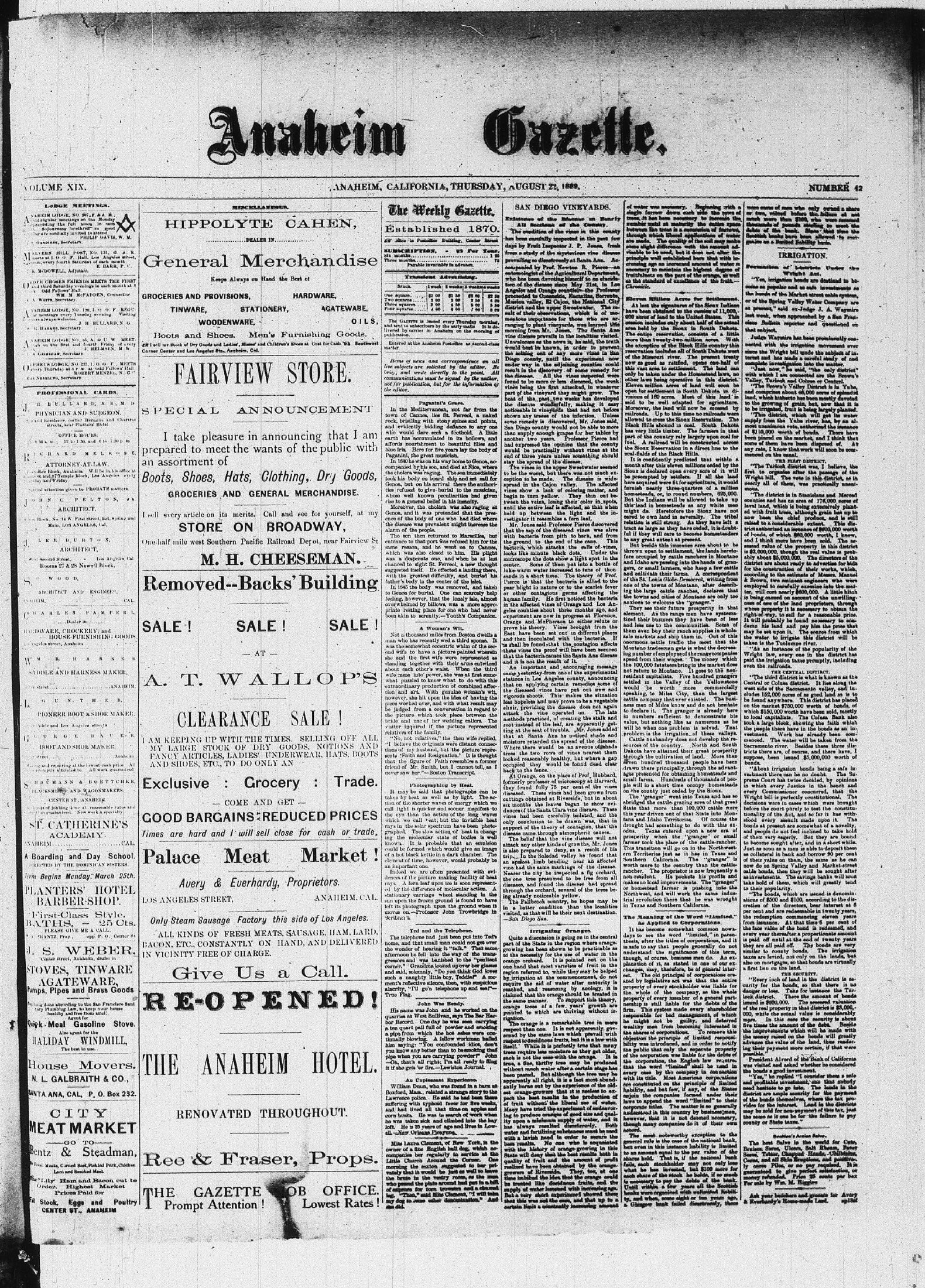
Searchable text
VOLUME XIX.
LODGE MEETINGS.
ANAHEIM LODGE, NO. 297, F.A.A.M.
regular meetings on the Monday preceding the full moon in each Bojourning brethren in good standing are cordially invited to attend PHILIP DAVIS, W. M.
GARDNER, Secretary.
MALVERN HILL POST, NO. 131, G. A.R.
meets at I.O.O.F. Hall, Los Angeles street,
every fourth Saturday of each month.
K. BARK, P.C.
K. McDOWELL, Adjutant.
OVER CHOSEN FRIENDS MEETS THE FIRST and third Saturday evenings in each month at 8 Odd Fellows' Hall
WM M. McFADDEN, Counselor
A. WUITR, Secretary.
ANAHEIM LODGE, NO. 192, I.O.O.F. REGULAR meetings every Tuesday evening. Visiting always welcome.
J. H. BULLARD, N. G.
H. HARRER, Secretary.
ANAHEIM LODGE, NO. 55, A.O.U.W. MEETINGS on the first and fourth Friday of every J. HELMSEN, M. W.
GRINESHAW, Secretary.
EPHEUS LODGE, NO. 237, I.O.O.F. MEETS every Thursday at 8 p.m. at Old Fellow's Hall.
ROBERT MENZEL, N. G.
WAY NEARLAND, Secretary.
PROFESSIONAL CARDS.
J. H. BULLARD, A.B., M.D.
PHYSICIAN AND SURGEON.
and Residence, corner Hermine and Chartres streets, near Planters' Hotel.
OFFICE HOURS:
9:30 a.m.; 12 to 1:30, and 6 to 7:30 p.m.
RICHARD MELROSE,
ATTORNEY-AT-LAW.
Office Block, Anaheim. Will be in his office at 42nd and 87 Temple Block, Los Angeles every Sunday and Friday.
MISCELLANEOUS.
HIPPOLYTE CAHEN
DEALER IN
General Merchandise
Keeps Always on Hand the Best of
GROCERIES AND PROVISIONS,
HARDWARE,
TINWARE,
STATIONERY,
AGATEE
WOODENWARE,
Boots and Shoes. Men's Furnishing Goods
I sell my Stock of Dry Goods and Ladies', Mines' and Children's Shoes at Cost for Cash.
Corner Center and Los Angeles St., Anaheim, Cal.
FAIRVIEW STORE
SPECIAL ANNOUNCEMENT
I take pleasure in announcing that prepared to meet the wants of the public an assortment of
Boots, Shoes, Hats; Clothing, Dry C
PROFESSIONAL CARDS.
J. H. BULLARD, A.B., M.D.
PHYSICIAN AND SURGEON.
and Residence, corner Hermaine and Chartres
streets, near Planters' Hotel.
OFFICE HOURS:
9:30 a.m.; 12 to 1:30, and 6 to 7:30 p.m.
RICHARD MELROSE,
ATTORNEY-AT-LAW.
Office Block, Anaheim. Will be in his office at
56 and 27 Temple Block, Los Angeles every
day and Friday.
Special attention given to Probate matters.
JOHN C. PELTON, J.R.
ARCHITECT.
No. 14 W First Street, bet. Spring and
Main, Los Angeles, Cal.
J. LEE BURTON,
ARCHITECT.
West Second Street, Los Angeles, Cal.
Rooms 27 & 28 Newell Block.
S. WOOD,
ARCHITECT AND ENGINEER.
ANAHEIM, CAL.
CHARLES PAMPERL,
...Dealer in.
HARDWARE, CROCKERY, and
HOUSE-FURNISHING GOODS.
Angeles street, Anaheim.
W. M. HARKER
SADDLE AND HARNESS MAKER.
street ...ANAHEIM.
L. OUNTHER,
PIONEER BOOT & SHOE MAKER.
Anaheim and Los Angeles streets.
GEORGE BAUER,
BOOT AND SHOE MAKER.
street ... Anaheim
SHACMANN & BOETTCHER,
BLACKSMITH AND WAGONMAKERS.
CENTER ST., ANAHEIM.
ST. CATHERINE'S
ACADEMY.
ANAHEIM, CAL.
A Boarding and Day School.
Directed by THE DOMINICAN SISTERS.
Term Begins Monday, March 25th.
PLANTERS' HOTEL
BARBER-SHOP.
SPECIAL ANNOUNCEMENTS
I take pleasure in announcing that
prepared to meet the wants of the public
an assortment of
Boots, Shoes, Hats, Clothing, Dry C
GROCERIES AND GENERAL MERCHANDI
I sell every article on its merits. Call and see for yourse
STORE ON BROADWAY,
One-half mile west Southern Pacific Railroad Depot, near F
M. H. CHEESEMA
Removed--Backs' Build
SALE! SALE! SA
— AT —
A. T. WALLO
CLEARANCE SALE!
I AM KEEPING UP WITH THE TIMES. SELLING OF
MY LARGE STOCK OF DRY GOODS, NOTION
FANCY ARTICLES, LADIES' UNDERWEAR, HATS
AND SHOES, ETC., TO DO ONLY AN
Exclusive : Grocery : T
— COME AND GET —
GOOD BARGAINS: REDUCED PR
Times are hard and I will sell close for cash o
Palace Meat Marke
Avery & Everhardy, Proprietors.
LOS ANGELES STREET, ANAHEIM
ST. CATHERINE'S ACADEMY
ANAHEIM...CAL.
A Boarding and Day School.
DIRECTED BY THE DOMINICAN SISTERS.
Term Begins Monday, March 25th.
PLANTERS' HOTEL BARBER-SHOP.
First-Class Style.
BATHS. — 25 Cts.
PLEASE GIVE ME A CALL.
PRANTZ, Prop., opp P. O., Center St.
J. S. WEBER,
Center street, Anaheim, dealer in
STOVES, TINWARE AGATEWARE,
Pumps, Pipes and Brass Goods
Pending done according to the San Francisco Sanitary Plumbing Law, to keep your house
healthy and free from smell!
Agent for Quick-Meal Gasoline Stove.
Also agent for the HALIDAY WINDMILL,
The best in use.
House Movers.
N. L. GALBRAITH & CO.,
SANTA ANA, CAL, P. O. Box 232.
CITY MEAT MARKET
GO TO
Bentz & Steadman,
Fresh Meats, Carneal Beef, Pickled Pork, Chicken
Lard and Smoked Meat.
The Lily Ham and Bacon out to
Order, Highest Market
Prices Paid for
Stock, Eggs and Poultry
CENTER ST., ANAHEIM
GOOD BARGAINS REDUCED PRICE
Times are hard and I will sell close for cash o
Palace Meat Mark
Avery & Everhardy, Proprietors.
LOS ANGELES STREET,
Only Steam Sausage Factory this side of Los AnALL KINDS OF FRESH MEATS, SAUSAGE, HAM
BACON, ETC., CONSTANTLY ON HAND, AND DELIIN VICINITY FREE OF CHARGE.
Give Us a Call
RE-OPENE
THE ANAHEIM HOT
RENOVATED THROUGHOUT
Ree & Fraser, Pro
THE GAZETTE OB OFF
Prompt Attention! Lowest
ANAHEIM, CALIFORNIA, THURSDAY, AUGUST 22, 1889.
CAHEN,
merchandise
and the Best of
HARDWARE,
ERY, AGATEWARE,
OILS,
Furnishing Goods.
Children's Bros at Cost for Cash, DA Southwest
STORE.
NOUNCEMENT
announcing that I am
ents of the public with
lothing, Dry Goods,
The Weekly Gazette.
Established 1870.
SUBSCRIPTION, - $2 Per Year.
Six months.
Three months.
Parable in variability in advance.
Transient Advertising.
BRACE
One square... $1.00
Two squares... 2.00
Three squares... 3.00
Four squares... 4.00
The Gazette is issued every Thursday morning,
and sent to subscribers by the early mail. It is delivered by carrier in Anaheim on the morning of publication.
Entered at the Anaheim Postoffice as second-class matter.
Items of news and correspondence on all line subjects are solicited by the editor. Be brief, and write directly to the point. All communications must be signed by the author, not for publication, but for the information of the editor.
Paganini's Grave.
In the Mediterranean, not far from the town of Cannes, lies St. Ferreol, a naked rock, bristling with stony spines and points, and evidently bidding defiance to any one who would dare seek a foothold. A little earth has accumulated in its hollows, and affords nourishment to beautiful lilies and blue iris. Here for five years lay the body of Paganini, the great musician.
In 1840 he was on his way home to Genoa, accompanied by his son, and died at Nice, where the cholera was raging. The son immediately took his body on board ship and set sail for San Diego Vineyards.
Existence of the Mammals in Nearly All Nations of the County.
The condition of the vines in this county has been carefully inspected in the past few days by Fruit Inspector J. P. Jones, fresh from a study of the myriad vine diseases prevailing so distantly at Santa Ana. Accompanied by Prof. Newton B. Pierce—an entomologist of the Agricultural Department, who has been devoting himself to an investigation of the disease since May 21st, in Los Angeles and Orange counties—the Professor promised to Commend Raccolta, Serranta Mission valley, El Calo, the National City district and the upper Sweetwater. The result of their observations, which is of momentous importance for those who are arranging to plant vineyards, was learned this morning from Mr. Jones. The Santa Ana vine disease prevails in the localities visited. Unwelcome as the news is, he said, the truth would best be known, in order to prevent the setting out of any more vines in San Diego county, until the experiment now underway in the adjoining counties could result in the discovery of some remedy for the disease. All the vines inspected were found to be more or less diseased, the weak vines being the first attacked, in whatever part of the vineyard they might grow. The boat of the past two weeks has developed the disease wonderfully, making it noticeable in vineyards that had not before shown any traces of the infection. Unless some remedy is discovered, Mr. Jones said, San Diego county would not be able to more than supply enough grapes for her tables by another two years. Professor Pierce had expressed the opinion that the county would be practically without vines at the end of three years unless something should stay the spread of the disease.
The vines in the upper Sweetwater seemed to be the worst, but there was not much exception to be made. The disease is wide-
Paganini's Grave.
In the Mediterranean, not far from the town of Cannes, lies St. Ferreol, a naked rock, bristling with stony spines and points, and evidently bidding defiance to any one who would dare seek a foothold. A little earth has accumulated in its hollows, and affords nourishment to beautiful lilies and blue iris. Here for five years lay the body of Paganini, the great musician.
In 1840 he was on his way home to Genoa, accompanied by his son, and died at Nice, where the cholera was raging. The son immediately took his body on board ship and set sail for Genoa, but on his arrival there the authorities refused to give burial to the musician, whose well known peculiarities had given rise to a general belief in his insanity.
Moreover, the cholera was also raging at Genoa, and it was pretended that the presence of the body of one who had died where the disease was prevalent might increase the alarm of the people.
The son returned to Marseilles, but entrance to that port was refused him for the same reason, and he went on to Cannes, which was also closed to him. His plight was a desperate one, and when he at last chanced to sight St. Ferreol, a new thought suggested itself. He effected a landing there, with the greatest difficulty, and buried his father's body in the center of the loaf.
In 1845 the body was removed, and taken to Genoa for burial. One can scarcely help feeling, however, that the lonely late, almost overwhelmed by billows, was a more appropriate resting place for one who had never been akin to sorenity.—Youth's Companion.
A Woman's Wit.
Not a thousand miles from Boston dwells a man who has recently wed a third spouse. It was the somewhat eccentric whim of the second wife to have a picture painted wherein she and the first wife were represented as standing together with their arms entwined about each other's waist. When the third wife came into power, she was at first somewhat puzzled to know what to do with this extraordinary production of combined affection and art. With genuine woman's wit, however, she hit upon the idea of having the piece worked over, and with what result may be judged from a conversation in regard to the picture which took place between the bride and one of her wedding callers. The visitor inquired if the picture represented relatives of the family.
"No, not relatives," the then wife replied. "I believe the originals were distant connections of my husband, but the picture represents 'Faith and Resignation.' It is thought that the figure of Faith resembles a former friend of Mr. Smith, but I cannot tell, as I never saw her."—Boston Transcript.
Photographing by Heat.
It may be said that photographs can be taken by heat as well as by light. The action of the shorter waves of energy which we call light is quicker and sooner manifests to the eye than the action of the long waves which we call heat; but the invisible heat rays in the solar spectrum have been photographed. The slow action of heat in changing the molecular state of bodies is well known. It is probable that an emulsion could be formed which would give an image of a hot black kettle in a dark chamber. The element of time, however, would probably be an important one.
Indeed we are often presented with evidences of the picture making facility of heat rays. A fern leaf upon ice is soon represented by the difference of molecular action. A stationary carriage wheel standing in the sun upon the frozen ground is found to have left its photograph upon the ground when it found to be more or less diseased, the weak vines being the first attacked, in whatever part of the vineyard they might grow. The boat of the past two weeks has developed the disease wonderfully, making it easy noticeable in vineyards that had not before shown any traces of the infection. Unless some remedy is discovered, Mr. Jones said, San Diego county would not be able to more than supply enough grapes for her tables by another two years. Professor Pierce had expressed the opinion that the county would be practically without vines at the end of three years unless something should stay the spread of the disease.
The vines in the upper Sweetwater seemed to be the worst, but there was not much exception to be made. The disease is widespread in the Cajon valley. The affected vines show a lack of coloring matter, and begin to turn yellow. They thin out between the veins, losing their color in spots, until the entire leaf is affected, so that when held up between the light and the investigator it resembles a fern leaf.
Mr. Jones said Professor Pierce discovered that the sap of the diseased vines was alive with bacteria from pith to bark, and from the ground to the end of the cane. This bacteria, which attacks the cells of vines, looks like minute black dots. Under the microscope the dots show a light spot in the center. Some of them put into a bottle of luke-warm water increased to tens of thousands in a short time. The theory of Prof. Pierce is that the bacteria is allied to the pear blight in nature or to the scarlet fever or other contagious germs affecting the human family. He first noticed the bacteria in the affected vines of Orange and Los Angeles counties about three months ago, and experiment are now in progress at Florence, Orange and McPherson to either refute or prove his theory. Vines brought from the East have been set out in different places and then inoculated with the bacteria. If shall be found that the contagion affects these vines the proof will have been secured that the bacteria can cause the Santa Ana disease and it is not the result of it.
An important and encouraging message came yesterday-from one of experimental stations in Los Angeles county, announcing that on applying certain remedies some of the diseased vines have put out new and vigorous shoots. This makes the situation less hopeless and may prove to be a vegetable elixir, providing the disease does not again attack the vine operated on. The late methods practiced, of creating the stalk and root instead of the leaf, are apparently getting at the seat of trouble. Mr. Jones added that at Santa Ana he noticed shade and moisture retarded the spread of the disease. Where there would be an avenue of shade trees the two rows of vines nearest them looked reasonably healthy, but where a gap occupied they would be found dead clear back to the fence.
At Orange, on the place of Prof. Hubbard, formerly professor of microscopy at Harvard, they found fully 75 per cent of the vines diseased. These vines had been grown from cuttings obtained at Riverside, but in about six months the leaves began to show evidences of the Santa Clara vine disease. These vines had been carefully isolated, and only conclusion to be drawn was, that in support of the theory of contagion, that the disease came through atmospheric causes.
The belief that the vine disease will not attack any other kind of growth, Mr. Jones is also prepared to deny, as a result of his trip... In the Soledal valley he found that an apoptotic limb bending near an affected vine had the same markings of the disease. Nearer the city be impected a fig orchard, one tree presumed to be free from all diseases, and found the disease had spread through the orchard, several of the trees being already noticeable yellow.
The Fallbrook country, he hopes may be in a better condition than the localities
REDUCED PRICES
close for cash or trade.
Market!
ly, Proprietors.
ANAHEIM, CAL.
TS, SAUSAGE, HAM, LARD,
HAND, AND DELIVERED
a Call.
ENED!
IM HOTEL.
HROUGHOUT.
er, Props.
OB OFFICE.
Lowest Rates!
Ted and the Telephone.
The telephone had just been put into Ted's home, and that small man could not get over the wonder of hearing it "talk." That same afternoon he fell into the way of the transgressors and was banished to the "penitent corner." Grandma looked up her glasses and said, solemnly, "Do you think God loves such a naughty little boy, Teddle?" A moment's reflective silence then, with suspicious alacrity, "I'll go'oh telephone up and see!"—True Flag.
John Was Ready.
His name was John and he worked on the quarries at West Sullivan, says The Bar Harbor Record. One day he was seen carrying a ten quart gall full of powder and smoking a pipe from which the hot ashes were continually blowing. A fellow workman hailed him saying: "You confounded killer, don't you know any better than to be smoking that pipe when you are carrying powder!" John —Oh, that's all right; I'm all ready to fling it if she gets 'or fire.' Lewiston Journal.
An Unpleasant Experience.
William Dunn, who was found in a barn at Boxford, Mass., related a strange story to the Lawrence police. He said he had been there suffering with typhoid fever for five weeks, and had lived all that time on apples and corn husks. He was in search of work when he was taken sick and climbed into the hay loft. He is 25 years of age and lives in Lowell—New Orleans. Pleasurna.
Miss Laura Clamens, of New York, is the owner of a fine English ball dog, which accompanies her regularly to service at the Little Church Around the Corner. One morning the sixon suggested to her privately that it would be just as well to have the trunk in the wrestry room, as the man who pawned the plate around had put in a bill of expenses for torn trunks and a chained bag. "Then," said Miss Clamens, "I will take my dog to some other demonstration."
And she did.
Irrigating Oranges.
Quite a discussion is going on in the central part of the State in the region where orange-growing has been shown to be practicable as to the necessity for the use of water in the orange orchard. It is pointed out on the one hand that most varieties of fruit in the region referred to, while they may be helped by irrigation at the commencement, do not require the aid of water after maturity is reached, and reasoning by anology, it is claimed that the orange should be treated in the same manner. To support this theory, orange trees of a few years' growth are pointed to which are thriving without irrigation.
The orange is a remarkable tree in more respect than one. It is not apparently governed by the same laws which prevail with respect to deciduous fruits, but it is a law with itself. While it is perfectly true that many trees require less moisture as they get older, such is not the case with the orange. It is true, a fine, thrifty tree may be produced without much water after a certain stage has been passed. But although the tree may be apparently all right, it is a fact most abundantly borne out by the experience of the oldest orange-growers that it is necessary to expect the best results in the production of fruit without the liberal use of water. Many have tried the experiment of endeavoring to produce oranges of good size and quality upon a minimum supply of water, and it has always resulted dimorphously. Both water and fertilizing substances must be used with a lavish hand in order to secure the best results. No one who is acquainted with the history of orange-growing in this State will deny that the best results both in quality of fruit and the amount of profit realized have been obtained by the orange-growers of Riverside. They too, at one time imbibed the idea that the orange could be treated like deciduous fruits, and the supply of water limited with increasing age. But a very short experiment showed them that this was not the aim, and that up to a certain limit a constantly increasing amount of the Santa Clara vine disease. These vines had been carefully isolated, and the only conclusion to be drawn was, that in support of the theory of contagion, that the disease came through atmospheric causes.
The belief that the vine disease will not attack any other kinds of growth, Mr. Jones is also prepared to deny, as a result of his trip... In the Solleday valley he found that an apoptot, limb bending near an affected vine had the same markings of the disease. Nearer the city he inspected a fig orchard, the one tree presumed to be free from all disease, and found the disease had spread through the orchard, several of the trees being already noticeable yellow.
The Fallbrook country, he hopes may be in a better condition than the localities visited, as that will be their next destination.
Sain Diego Sun.
Irrigating Oranges.
Quite a discussion is going on in the central part of the State in the region where orange-growing has been shown to be practicable as to the necessity for the use of water in the orange orchard. It is pointed out on the one hand that most varieties of fruit in the region referred to, while they may be helped by irrigation at the commencement, do not require the aid of water after maturity is reached, and reasoning by anology, it is claimed that the orange should be treated in the same manner. To support this theory, orange trees of a few years' growth are pointed to which are thriving without irrigation.
The orange is a remarkable tree in more respect than one. It is not apparently governed by the same laws which prevail with respect to deciduous fruits, but it is a law with itself. While it is perfectly true that many trees require less moisture as they get older, such is not the case with the orange. It is true, a fine, thrifty tree may be produced without much water after a certain stage has been passed. But although the tree may be apparently all right, it is a fact most abundantly borne out by the experience of the oldest orange-growers that it is necessary to expect the best results in the production of fruit without the liberal use of water. Many have tried the experiment of endeavoring to produce oranges of good size and quality upon a minimum supply of water, and it has always resulted dimorphously. Both water and fertilizing substances must be used with a lavish hand in order to secure the best results. No one who is acquainted with the history of orange-growing in this State will deny that the best results both in quality of fruit and the amount of profit realized have been obtained by the orange-growers of Riverside. They too, at one time imbibed the idea that the orange could be treated like deciduous fruits, and the supply of water limited with increasing age. But a very short experiment showed them that this was not the aim, and that up to a certain limit a constantly increasing amount of
KEYARDS.
in this county in the past few years, vines dwarf Santa Ana. An A. B. Pierce—an internal Department, half to an already 21st, in Los Angeles—the Professor James, Sorrento, National City water. The rebellion is of more who are learned this The Santa Ana counties visited. He said, the truth harder to prevent the vines in San experiment now counties could some remedy for inspected were named, the weak, in whatever growth. The has developed making it easy had not before detection. Unless Mr. Jones said, he able to more her tables by minor Pierces had that the county at vines at something should not much exasperate is wide of water was necessary. Beginning with a single furrow down each side the pore of trees, it has been necessary to immerse the number until at maturity the division between the tree is a dimension of furrows, through which liberal applications of water are made. The quality of the soil may make some slight difference with the amount adviable to be used, but it does not alter the principle well established here that with increasing age an increase amount of water is necessary to maintain the highest degree of fruitfulness on the part of the orange, as well as the standard of excellence of the fruit. Chronicle.
Eleven Million Acres for Settlement.
At last the signatures of the Sioux Indians have been obtained to the commission of 11,000,600 acres of land to the United States. This session includes only about half of the actual area held by the Sioux in South Dakota. The entire reservation consists of a little more than twenty-two million acres. With the exception of the Black Hills country this reservation includes all of South Dakota west of the Missouri river. The present treaty now as good as ratified, opens one-half of this vast area to settlement. The land can only be taken under the Homestead laws, no other laws being operative in this district. Eleven million acres of land will soon be open for settlement in South Dakota in divisions of 180 acres. Most of this land is said to be well adapted for agriculture. Moreover, the land will now be crossed by railroads. Up to this time no railroads were allowed to cross the Sioux Reservation. The Black Hills abound in coal. South Dakota has very little timber. The farmers in that part of the country rely largely upon coal for fuel. A railroad will be constructed across the Sioux Reservation in a direct line to the coal-fields of the Black Hills.
It is confidently predicted that within a month after this eleven millions owed by the Sioux is declared open every acre of it will be preempted by settlers. If all the land means men of man who only served a share or two, valued before the failure at not much more than $100, who were assumed thousands of premature standing to meet the debts of the bank. Since that time the Scottish banks have been allowed to renegotiate on a limited liability basis.
IRRIGATION.
Fermentation of Insects Under the Wright Act.
"Yes, irrigation hands are destined to become a popular and an aside investments on the hands of the Market street table system, or of the Spring Valley Water Company are at present," said ex-Judge J. A. Waymire last week, when approached by a San Francisco Bulletin reporter and questioned on that subject.
Judge Waymire has been prominently connected with the irrigation movement ever since the Wright bill made the subject of interest and has made a careful study of and complete investigation into the matter.
"Just now," he said, "the only district" with which I am connected are the Brown's Valley, Turhook and Colman or Central.
"The Brown's Valley District is in Yuba, and comprises about 46,000 acres of splendid land, which hitherto has been mostly devoted to the growing of grain, but, now that it is to be irrigated, fruit is being largely planted."
This district, which will get its water supply from the Yuba river, has by an almost unanimous vote, authorised the insurance of $110,000 worth of bonds. These have been placed on the market, and I think that some of them have been dispensed off. At any rate, I know that work will soon be commenced on the canal.
THE FIRST DISTRICT.
"The Turhook district was, I believe, the first to organize after the passage of the Wright bill. The vote in this district, as in
The Brown's Valley District is in Yuba, and comprises about 46,000 acres of splendid land, which hath to have been mostly devoted to the growing of grain, but now that it is to be irrigated, fruit is being largely planted.
This district, which will get its water supply from the Yahua river, has, by an almost unanimous vote, authorized the insurance of $110,000 worth of bonds. These have been placed on the market, and I think that some of them have been disposed of. At any rate, I know that work will soon be commenced on the canal.
THE FIRST DISTRICT.
"The Turlook district was, I believe, the first to organize after the passage of the Wright bill. The vote in this district, as in nearly all of them, was practically unanimous.
"The district is in Stanislaws and Merced counties and has an area of 176,000 acres of leal land, which is being extensively planted with fruit trees, although grain has up to now been the chief product, and is still raised to a considerable extent. This district authorized an insurance of $800,000 worth of bonds, of which $90,000 worth, I know, and I think more have been sold. The assumed value of the property in this district is $3,000,000, though the real value is probably about $5,000,000. The directors of the district are about ready to advertise for bids for the construction of their works, which, according to the estimate of Messi. Manuel & Brown, two aliment engineers who were employed to carefully examine into the matter, will cost nearly $800,000. A little hitch is being caused on account of the unwillingness of one of the land proprietors, through whose property it is necessary to obtain the right-of-way, to sell for a reasonable price. It will probably be found necessary to condemn his land and pay him the price that may be set upon it. The source from which the water to irrigate this district will be taken is the Toulomme river.
"As an instance of the popularity of the Wright law, every one in the district has paid the irrigation taxes promptly, including even the railroads."
THE CENTRAL DISTRICT.
"The third district is what is known as the Central or Colina district. It lies along the west side of the Sacramento valley, and includes 152,000 acres of good land as is to be found anywhere. This district has placed on the market $750,000 worth of bonds, of which $150,000 worth have been sold, mostly to local capitalist. The Colina Bank also took a large block, showing the faith which the people there have in the bonds as an investment. Work has already been commenced. The water will be taken from the Sacramento river. Besides these three districts there are, of course, and there have, I suppose, been issued $5,000,000 worth of bonds."
"About irrigation bonds being a safe investment there can be no doubt. The Supreme Court has twice decided, by opinions in which every Justice in the bench and every Commissioner concurred, that the Wright bill is perfectly constitutional. The decisions were in cases which were brought before the court purely to test the constitutionality of the Act, and so far it has withstood every assault made upon it. The bonds at present are somewhat of a novelty, and people do not feel inclined to take hold of them very eagerly. But they are bound to become sought after, and in a short while. Just as soon as a man is able to deposit them as collateral in bank and borrow 90 per cent of their value on them, the same as he can now do on Spring Valley and Market-street cable bonds, then they will be sought after as investments. The savings banks will soon take hold of them, which will greatly tend to their popularity."
"The bonds, which are issued is denominations of $500 and $100, according to the discretion of the directors, bear interest at 6%."
The Manning of the Word "Limited," as Applied to Corporations.
It has become somewhat common nowadays to see the word "limited," in parenthesis, after the titles of corporations, and it is safe to say that people generally do not understand the significance of this term, though, of course, businessmen do. An explanation of it, as stated in one of our exchanges, may, therefore, be of general interest.
The old principal of corporations created by legislative act was that the entire property of every stockholder was liable for the whole of the company, as the whole property of every member of a general partnership is still liable for the debts of the firm. This system made every shareholder responsible for bad management, of which he might not be guilty, and deterred wealthy men from becoming interested in the shares of corporations. To remove this objection the principle of limited responsibility was introduced, and in order to notify the public that only the separate property of the corporation was liable for the debts of the corporation, the English law requires that the word "limited" shall be used in every case by the company in connection with its title. Most American corporations are constituted on the principle of limited liability, and but few, if any, of the States join the companies formed under their laws to append the word "limited" to their corporate titles. The matter is no generally understood in this country by businessmen, however, that it is not deemed necessary, through many companies do it of their own accord.
The most noteworthy exception to the general rule is the case of the national bank, but even in this instance liability is limited to an amount equal to the par value of the shares held. That is, if the national bank fails, each stockholder may not only lose what he has invested, but $100 more for each share of the stock he holds; if no much is necessary to pay the debts of the bank. Until within a few years all the Scottish banks were organized with unlimited liability, and when, some eight or ten years ago, a Glasgow bank failed disastrously, there before the court purely to test the constitutionality of the Act, and so far it has withstood every assault made upon it. The bonds at present are somewhat of a novelty, and people do not feel inclined to take hold of them very eagerly. But they are bound to become sought after, and in a short while. Just as soon as a man is able to deposit them as collateral in bank and borrow $0 per cent of their value on them, the same as he can now do on Spring Valley and Market-street cable bonds, then they will be sought after as investments. The savings banks will soon take hold of them, which will greatly tend to their popularity.
"The bonds, which are issued is denominations of $500 and $100, according to the discretion of the directors, bear interest at 6 per cent and are redeemable in twenty years, the redemption commanding eleven years from insurance: At that time 6 per cent of the face value of the bond is redeemed, and every year therafter a proportionate amount is paid off until at the end of twenty years they are all paid off. The bonds are very similar to county bonds. The irrigation taxes are levied, not only on the lands, but also on mortgages, so that bonds are virtually a first lien on the land.
THE SECURITY.
"Every inch of land in the district is security for the bonds, so that there is no danger or loss. Take for instance the Turlock district. There are amounts of bonds loaned in $600,000. The assumed valuation of the real property in that district is $3,000,-000, while the actual value is considerably lower. In this case the security about five times the amount of the debt. Besides the improvements which will be made with the money raised on the bonds will greatly advance the value of the land, thus rendering their payment more certain, if that were possible."
President Alvard of the Bank of California was visited and asked whether he considered the bonds a good investment.
"Yes," he replied. "I consider them a safe and profitable investment; one that nobody need hesitate to go into. The lands in the district are ample security for the payment of the bonds themselves, where the tax provides for the interest. Land in the districts may be sold for non-payment of this tax, just the same as it can be for the failure to pay county or State taxes."
Sunshine's Arvine Salve.
The best Salve in the world for Cats, Bunnies, Squirrels, Ulcers, Salt Rabbits, Power Squirrels, Tether Chippepod Hands, Chillibirds, Currents, and All Skin Creepions, and possibly Currents or No Pay Required. It is guaranteed to give perfect satisfaction, or money refunded. Price 25 cents per box Per sale by Wm. M. Higginis.
Ask your husband and grantee for Avery & Everhardy's Home-made Land. splendid