anaheim-gazette 1889-08-08
Scanned page
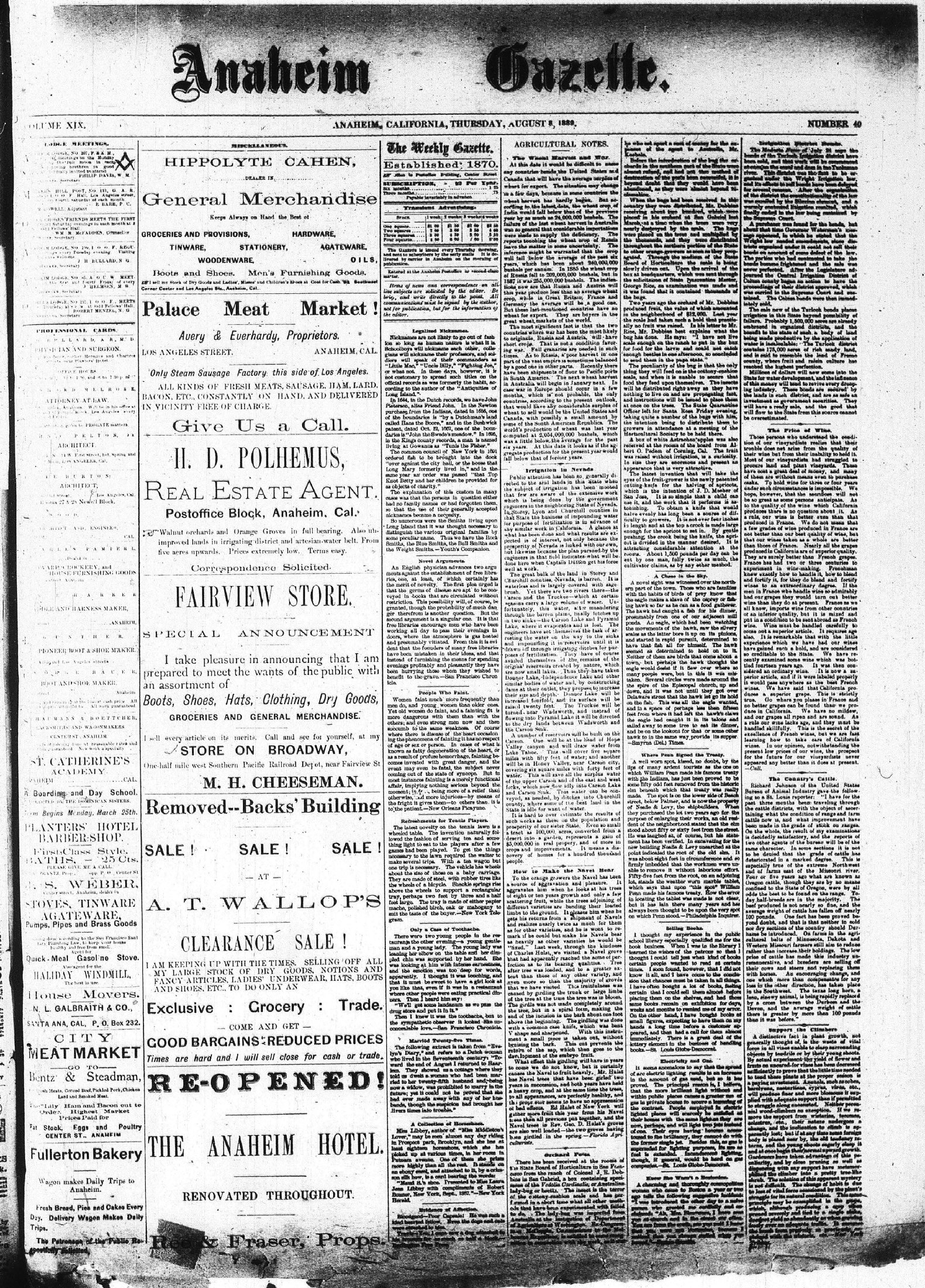
Searchable text
ANAHEIM
VOLUME XIX.
LODGE MEETINGS.
Lodge No. 267, P.A.M.
meetings on the Monday
the full moon in morning
warming brethren in good
morning invited to attend
PHILIP DAVIS, W. M.
Secretary
HILL POST, NO. 131, O. A.R.
F. Hall, Los Angeles street,
fourth Saturday of each month.
E BARK, P.C.
M.WELL, Adjutant
CHOSEN FRIENDS MEETS THE FIRST
Saturday evenings in each month at 8
Old Fellow's Hall.
WM. M. McFADDEN, Commissioner
Secretary
Lodge No. 190, L.O.O.F. REDUCTION
every Tuesday evening Visiting
welcome
J H. BULLARD, N. G.
Secretary
Lodge No. 25, A.O.U. W. MEET
the first and fourth Friday of every
J. HELMSEN, M.W.
Secretary
Lodge No. 27, L.O.O.F. MEETS
Thursday morning at Old Fellow's Hall.
ROBERT MENZEL, N. G.
Secretary
PROFESSIONAL CARDS.
PELLARD, A.R., M.D.
PHYSICIAN AND SURGEON.
Office hours:
1:30 and 2 to 7:30 p.m.
MELROSE,
ATTORNEY AT LAW.
Appeals. Will be in his office at
Tropical Rock, Los Angeles every day.
PROBATE matters.
PELTON, J.R.
ARCHITECT.
N.W. First Street, bet. Spring and
Moon, Los Angeles, Cal.
MISCELLANEOUS.
HIPPOLYTE CAHEN
DEALER IN
General Merchandise
Keeps Always on Hand the Best of
GROCERIES AND PROVISIONS,
HARDWARE,
TINWARE,
STATIONERY,
AGATEE
WOODENWARE,
Boots and Shoes. Men's Furnishing GeI sell my Stock of Dry Goods and Ladies', Mines' and Children's Shoes at Cost for Cash.
Corner Center and Los Angeles St., Anaheim, Cal.
Palace Meat Market
Avery & Everhardy, Proprietors.
LOS ANGELES STREET.
ANAHEIM
Only Steam Sauage Factory this side of Los AnALL KINDS OF FRESH MEATS, SAUSAGE, HAM
BACON, ETC., CONSTANTLY ON HAND, AND DELIIN VICINITY FREE OF CHARGE.
Give Us a Call.
H. D. POLHEMUS,
ALL KINDS OF FRESH MEATS, SAUSAGE, HAMBURG BACON, ETC., CONSTANTLY ON HAND, AND DELIVERY IN VICINITY FREE OF CHARGE.
Give Us a Call
II. D. POLHEMUS,
REAL ESTATE AGENT
Postoffice Block, Anaheim, CA
Walnut orchards and Orange Groves in full bearing improved lands in irrigating district and artesian-water five acres upwards. Prices extremely low. Terms easy.
Correspondence Solicited.
FAIRVIEW STORE
SPECIAL ANNOUNCEMENT
I take pleasure in announcing that prepared to meet the wants of the public an assortment of
Boots, Shoes, Hats, Clothing, Dry GROCERIES AND GENERAL MERCHANDISE
I sell every article on its merits. Call and see for your store ON BROADWAY One-half mile west Southern Pacific Railroad Depot, near M. H. CHEESEMA
Removed--Backs' Build
SALE! SALE! SALE!
AT
A. T. WALLO
PLANTERS’ HOTEL BARBER SHOP.
First-Class Style.
BATHS. — 25 Cts.
PLEASE GIVE ME A CALL.
GRANTZ, Prop.
opp. P. D., Center St.
J. S. WEBER,
Center street, Anaheim, dealer in
STOVES, TINWARE AGATEWARE,
Pumps, Pipes and Brass Goods
Quick-Meal Gasoline Stove.
Also agent for the
HALIDAY WINDMILL,
The best in use
House Movers.
N. L. GALBRAITH & CO.,
SANTA ANA, CAL, P. O. Box 232.
CITY MEAT MARKET
GO TO
Bentz & Steadman,
Fresh Meats, Corned Beef, Pickled Pork, Chicken
Lard and Smoked Meat.
The Lily Ham and Bacon cut to
Order. Highest Market
Prices Paid for
Pat Stock, Eggs and Poultry
CENTER ST., ANAHFIM
Fullerton Bakery
Wagon makes Daily Trips to
Anaheim.
Fresh Bread, Pies and Cakes Every
Day. Delivery Wagon Makes Daily
Trips.
The Patronage of the Public Besponsors.
SALE! SALE!
AT
A. T. WALLOY
CLEARANCE SALE!
I AM KEEPING UP WITH THE TIMES. SELLING MY LARGE STOCK OF DRY GOODS, NOTICE FANCY ARTICLES, LADIES' UNDERWEAR, HAT AND SHOES, ETC., TO DO ONLY AN
Exclusive: Grocery:
COME AND GET
GOOD BARGAINS: REDUCED PRICES
Times are hard and I will sell close for cash
RE-O-PENE
THE ANAHEIM HOUSE
RENOVATED THROUGHOUT
ANAHEIM, CALIFORNIA, THURSDAY, AUGUST 8, 1889.
CAHEN,
merchandise
and the Best of
HARDWARE,
ERY, AGATEWARE,
OILS,
Furnishing Goods.
Children's Books at Cost for Cash. Southwest
Market!
ly, Proprietors.
ANAHEIM, CAL.
this side of Los Angeles.
TS. SAUSAGE, HAM, LARD,
HAND, AND DELIVERED
a Call.
The Weekly Gazette.
Established; 1870.
AGRICULTURAL NOTES.
The Wheat Marvens and War.
At this date it would be difficult to name any countries beside the United States and Canada that will have the average crop of wheat for export. The situation may change in a few days, because in some countries the wheat harvest has hardly begun. But according to the latest data, the wheat crop of India would fall below that of the previous year by as much as 24,000,000 bushels. The failure of the last wheat harvest in Australia was no general that considerable importations were made to supply the deficiency. The reports touching the wheat crop of Russia leave the matter in some uncertainty. The inference might be warranted that the crop will fall below the average of the past six years, which has been about 240,000,000 bushels per annum. In 1885 the wheat crop of Russia fell to 209,000,000 bushels, but in 1887 it was 255,000,000 bushels. The indicions now are that Russia and Austria will this year produce less than an average wheat crop, while Great Britain, France and Germany the average will be a good one. But these last-mentioned countries have no wheat for export. They are buyers in the great wheat markets of the world.
The most significant fact is that the two countries where war has been the most likely to originate, Russia and Austria, will have short crops. That is not a condition favoring war. Full granaries are needed in such times. As to Russia, a poor harvest in one part of the vast empire is sometimes balanced by a good one in other parts. Recently there have been shipments of flour to Pacific ports in South America. The next wheat harvest in Australia will begin in January next. In case war in Europe should occur in a few months, which is not probable, the only countries according to the present outlook that would have any considerable surplus of wheat to sell would be the United States and Canada, with possibly a small amount by some of the South American Republics. The world's production of wheat was last year computed at 2,054,000,000 bushels, which was a little below the average for the past six years. At this date it looks as if the aggregate production for the present year would fall below that of former years.
irrigation in Nevada.
Public attention has been so generally directed by who adores Kansas.
Before the chards in the almost rural destruction beyond day abounded, clambed.
When the country thrashed its place in March, at a nearly dull were placed throughout to other areas signed.
The Board of Eight slowly drove box at headache the solicitor George Rice it was found the bags.
Two years produced fresh in the neighorally no fruit Rise, Mr. D bug has done no scale enough for food for enough beef to send them.
The peculiar thing they saw, scale and food they fear will be distracting nothing to and instruct at once on the Officer left taking quite the intention growers in Horticulture.
A box of received at Albert O. Ped was raised wi In size these appearances.
a Call.
HEMUS,
TE AGENT.
Anaheim, Cal.
moves in full bearing. Also unfit and artesian-water belt. From nearly low. Terms easy.
Solicited.
NOUNCEMENT
announcing that I am ments of the public with
lothing, Dry Goods,
ERAL MERCHANDISE.
full and see for yourself, at my BROADWAY,
Railroad Depot, near Fairview St
MESEMAN.
keks' Building
E! SALE!
LLOP'S
official records as was formerly the habit, according to the author of the "Antiquities of Long Island."
In 1644, in the Dutch records, we have John Pietersen, alias Friend John. In the Newton purchases from the Indians, dated in 1658, one of the boundaries is "by a Dutchman's land called Hans the Boore," and in the Bushwick patent, dated Oct. 23, 1607, one of the boundaries is "John Swede's meadow." In 1608, in the Kings county records, a man is named living at Gowanus as "Tunis the Fisher."
The common council of New York in 1601 ordered fish to be brought into the dock "over against the city hall, or the house that Long Mary formerly lived in," and in the same year an order was passed "that Top Knot Betty and her children be provided for as objects of charity."
The explanation of this custom in many cases was that the persons in question either had no family names or had forgotten them, so that the use of their generally accepted nicknames became a necessity.
So numerous were the Smiths living upon Long Island that it was thought necessary to distinguish the various original families by some peculiar name. Thus we have the Rock Smiths, the Blue Smiths, the Bull Smiths and the Weight Smiths.—Youth's Companion.
Novel Arguments.
An English physician advances two arguments against the establishment of free libraries, one, at least, of which certainly has the merit of novelty. The first plea urged is that the germs of disease are apt to be conveyed in books that are circulated without restriction. This possibility will, of course, be granted, though the probability of much dan ger therefrom is another question. But the second argument is a singular one. It is that free libraries encourage men who have been working all day to pass their evenings in doors, where the atmosphere is gas heated and presumably vitiated. From this it is evident that the founders of many free libraries have been mistaken in their ideas, and that instead of furnishing the means for spending evenings profitably and pleasantly they have been hurrying those whom they wished to benefit to the grave.—San Francisco Chronicle.
People Who Faint.
Women faint much more frequently than men do, and young women than older ones. Yet old women do faint, and a fainting fit is more dangerous with them than with the others; and even strong men now and then succumb to the same weakness. Of course where there is disease of the heart occasioning the phenomena of fainting it has no respect of age or sex or person. In cases of what is known as fatty degeneration of the heart, or as a result of profuse hemorrhage, fainting becomes invested with great danger, and the event may even be fatal, the subject never coming out of the state of syncope. But in most instances fainting is a merely functional affair, implying nothing serious beyond the moment; in fact being more of a relief than otherwise, and more injurious—by means of the fright it gives them—to others than it is to the patient.—New Orleans Picayune.
Refreshments for Tennis Players.
The latest novelty on the tennis lawn is a wheeled table. The invention naturally followed the fashion of serving tea and something light to eat to the players after a few games had been played. To get the things necessary to the lawn required the waiter to make several trips. With a tea wagon but one trip is necessary. The vehicle has wheels about the size of those on a baby carriage. They are made of steel, with rubber tires like the wheels of a bicycle. Shackle springs rise above the wheels to support a rectangular tray, perhaps two feet by three and a half foot large. The tray is made of either papier maché, polished birch, oak or mahogany to
in Australia will begin in January next. In case war in Europe should occur in a few months, which is not probable, the only countries, according to the present outlook, that would have any considerable surplus of wheat to sell would be the United States and Canada, with possibly a small amount by some of the South American Republics. The world's production of wheat was last year computed at 2,054,000,000 bushels, which was a little below the average for the past six years. At this date it looks as if the aggregate production for the present year would fall below that of former years.
Irrigation in Nevada.
Public attention has been so generally directed to the arid lands in this state when the subject of irrigation has been mooted that few are aware of the extensive work which is being done by the government engineers in the neighboring State of Nevada. In Storey, Lyon and Churchill counties in that State the business of impounding water for purpose of fertilization is in advance of any similar work in California. A glance at what has been done and what results are expected is of interest, not only because the prosperity of Nevada is linked with our own, but likewise because the plan pursued by the engineers in that field indicates what will be done here when Captain Dutton gets his force well at work.
The great bulk of the land in Storey and Churchill counties, Nevada, is barren. It is waterless and is largely covered with sagebrush. Yet there are two rivers there—the Carson and the Truckee—which at certain seasons carry a large volume of water. Unfortunately, this water, after meandering through the barren plains, finally fetches up in two sinks—the Carson Lake and Pyramid Lake, where it evaporates and is lost. The engineers have set themselves the task of creating water on the way to the sinks and impounding it in reservoirs until it is drawn off through irrigating ditches for purposes of fertilization. They have of course availed themselves of the remains of the original reservoirs created by nature, which are now small lakes. Thus they have taken Donor Lake, Independence Lake and other similar bodies of water and, by constructing dams at their outlet, they propose to increase their size and depth. Donner Lake will be increased fourfold, and its surface will be raised twenty feet. The Truckee will be turned near Wadsworth, and instead of flowing into Pyramid Lake it will be directed to the dry lands between Wadsworth and the Carson Sink.
A number of reservoirs will be built on the Carson. One will be at the head of Hope Valley canyon and will draw water from Lake Tahee. This will cover five square miles with fifty feet of water; and another will be in Honey Valley, near Carson city, covering six square miles with forty feet of water. This will save all the surplus water of the upper Carson and of the east and west fork, which now flow idly into Carson Lake and Carson Sink. This water can be conveyed, as needed, by ditches into Churchill county, where some of the best land in the State is idle for want of water.
It is hard to over estimate the results of such works as these on the population and prosperity of our sister State. Even so small a tract as 100,000 acres converted from a desert into a garden represents a gain of $5,000,000 in real property, and of more in crops and improvements. It means a discovery of homes for a hundred thousand people.
How to Make the Navel Bear.
To the orange growers the Navel has been a source of aggravation and pleasure. It aggravates him when he looks at his trees of eight or ten years growth and only a few scattering fruit, while the trees adjoining different varieties are bending their loaded food they fear will distract nothing to them and instruct at once on their Officer left taking quitethe intention growers in Herticulture.
A box received at bert O. Pedd was raised wi In size these appearances.
The latest eyes of the fart cutting knit which is t San Jose use it,and tonishing.halve eventually neatly to go in length enough for pushing;the out is divided attracting rooms.About by one cultivator c
Refreshments for Tennis Players.
The latest novelty on the tennis lawn is a wheeled table. The invention naturally followed the fashion of serving tea and something light to eat to the players after a few games had been played. To get the things necessary to the lawn required the waiter to make several trips. With a tea wagon but one trip is necessary. The vehicle has wheels about the size of those on a baby carriage. They are made of steel, with rubber tires like the wheels of a bicycle. Shackle springs rise above the wheels to support a rectangular tray, perhaps two feet by three and a half foot large. The tray is made of either papier maché, polished birch, oak or mahogany to suit the taste of the buyer.—New York Telegram.
Only a Case of Toothache.
There were two young people in the restaurant the other evening—a young gentleman and a young lady. The young lady was leaning her elbow on the table and her draped chin was supported by her hand. She was looking at him with intense earnestness, and the emotion was too deep for words, apparently. I thought it was touching, and that it must be sweet to have a girl look at you like that, even if it was in a restaurant where other people were eating practical dinners. Then I heard him say:
"We'll get some landamn as we pass the drug store and put it in it."
Then I knew it was the toothache, but to the sympathetic observer it looked like unconcealable love.—San Francisco Chronicle.
Married Twenty-five Times.
The following extract is taken from "Evelyn's Diary," and refers to a Dutch woman who lived in the Seventeenth century: "To ward the end of August I returned to Haarlem. They showed us a cottage where they told us dwelt a woman who had been married to her twenty-fifth husband and being now a widow, was prohibited to marry in the future; yet it could not be proved that she had ever made away with any of her husbands, though the suspicion had brought her livers times into trouble."
A Collection of Horsemen.
Miss Libbey, author of "Miss Middleton's Lover," may be seen almost any day riding in Prospect park, Brooklyn, and she has at least eighteen horsemen, which she has picked up at various times, in her room in Putnam avenue. One of them she primes more highly than all the rest. It stands on an abony sand, and attached to it, by a crimson silt how, is a card bearing the words:
"Mand it's also. Presented to Miss Laura Jean Libbey with compliments of Robert Bonner, New York, Sept., 1867."—New York Herald.
Bidence of Affection.
Bloodgood—Poor Capone! He was such a kind hearted fellow. Even the dogs and cats were attested to him.
Tender Man, I came near a dog admitted to his care, said a little more than State is idle for want of water.
It is hard to over estimate the results of such works as these on the population and prosperity of our sister State. Even so small a tract as 100,000 acres, converted from a desert into a garden, represents a gain of $5,000,000 in real property, and of more in crops and improvements. It means a discovery of homes for a hundred thousand people.
How to Make the Navel Bear.
To the orange growers the Navel has been a source of aggravation and pleasure. It aggravates him when he looks at his trees of eight or ten years growth and only a few scattering fruit, while the trees adjoining different varieties are bending their loaded limbs to the ground. It pleases him when he gets his returns from a shipment of Navels and realizes nearly twice as much for them as for other varieties, and he is wont to remark if he could but make his Navels bear as heavily as other varieties he would be "fixed." Last week, through the kindness of Charles Hulst, we visited a Navel grove that had apparently reached the same of perfection as to its bearing qualities. Tree after tree was loaded, and to a greater extent than those of any other variety, and even more so than the majority of groves that we have visited. The tranquilless was caused by girdling the trunk or large limbs of the tree at the time the tree was in bloom. The girdle was not made completely around the tree, but in a spiral form, making the end of the incision in the bark about one foot above the beginning. The girdling was done with a common case knife, which was bent V shape and sharpened. With this instrument a small piece is taken out, without bruising the bark. This cut prevents the return of the sap, which then goes to the development of the embryo fruit.
What effect this girdling will have in years to come we do not know, but it certainly causes the Navel to fruit heavily. Mr. Hulst has Navel trees that have been girled two years in succession, and both years have held a heavy crop, and as the same time the trees, to all appearances, are perfectly healthy, and thus proper stor seems to have no apprehension of bad effects. Ed Hulst of New York will gather more fruit this year from his Navel trees than all previous put together, and the Navel trees in Rev. Goe. D. Hulst's groves are also well loaded—the two groves having been girled in the spring—Florida Agricultural.
Archard Press.
There has been received at the rooms of the State Board of Horticulture in San Francisco from the ranch of Colonel J. R. Dolbine in San Gabriel, a box containing specimens of the Velolia Cardinale, or Australian lady-beg or beetle. The insect is the torror of the cottony-cushion scale and has performed in a short time what all other insects have been experimented with failed to do. The lady-beg was imported from Australia at the instigation of Department of Agriculture at Washington. No damage was observed in this building in connection with this incident.
NOTES.
Miss War.
Difficult to name and States and average orphan of whom may change the countries the begin. But no wheat crop of the previous 10 bushels. The most in Australia is importation deficiency. The crop of Russia territory: The that the crop of the past six year 240,000,000 wheat crop bushals, but in India. The indian Austria will average wheat France and is a good one. Countries have no buyers in the world. That the two most likelyoria will have condition favor-ened in such harvest in one's times balanced. Recently there to Pacific ports wheat harvest next. In occur in a fewable, the only present outlook, stable surplus of United States and all amount by republica. The was last year bushels, which for the past kaka as if the ag-ment year would waada. Generally di-
he who not apart a unit of money for the expense of the agent in Australia, Mr. Kephala.
Before the introduction of the bug that arrives in the northern part of the State were almost retired, and had both method of destruction of the parts been commenced, it is beyond doubt that they would have been abandoned, so they were almost beyond reclamation.
When the bugs had been received in this country they were distributed, Mr. Dobbins receiving about two hundred, which were placed in his orchard at fine Gabriel hot March; at a time when the trees were very nearly damaged by the thunder, and they were distributed throughout the northern portion of the State to other orange growers as soon as they propagated. Through the medium of the State Board of Horticulture the scale is being slowly driven out. Upon the arrival of the box at headquarters, which was sent through the solicitation of State Quarantine Master, George Rice, an examination was made and it was found that it contained thousands of the bugs.
Two years ago the orchard of Mr. Dobbins produced fruit, the value of which amounted in the neighborhood of $12,000. Last year the scale had taken much a hold that practically no fruit was raised. In his letter to Mr. Rice, Mr. Dobbins best explains what the bug has done. He says: "I have not live scale enough on the ranch to put in the box for food for the larvae and could not catch enough beetles in one afternoon, so concluded to send them in the paper state."
The peculiarity of the bug is that the only thing they will feed on is the octony-ochnion scale, and when it is unable to secure that food they feed upon themselves. The insects will be distributed right away as they have nothing to live on and are propagating fast, and instructions will be issued to place them at once on the tree. The State Quarantine Officer left for Santa Rosa Friday evening, taking quite a number of the bugs with him, the intention being to distribute them to growers in attendance at a meeting of the Horticultural Society to be held there.
A box of white Astrochan'apples was also received at the rooms of the board from Albert O. Pedem of Corning, Cal. The trait was raised without irrigation, is a curiosity. In size they are enormous and present an appearance that is very attractive.
The latest invention that will take the eyes of the fruit-grower is the newly patented irrigation District Bureau.
The Madonna Music of July Mays the hands of the Turkle Irrigation district have been cold, and that work will be continued at advantage the mud and dune in the Turkle river. This district was first to be organized under the Wright Irrigation law, and its effects to full houses have been delayed for several reasons. After the organization of the district the constitutionality of the law was amended by the Silverman almae, and a usually continued litigation resulted, which finally ended in the law being maintained by the Supreme Court.
A purchaser was found for the hands, but about that time Governor Waterson's damage appeared, in which he stated that the Wright law mandated ammonia, since districts organized under could not sell their buns an account of some defect of the law. The parties who had contracted to take the buns become frightened and the male was never perfected. After the Legislature adjourned the Central Irrigation District of Columna county began an action to have the proceedings of their district approved, which was carried to the Supreme Court and maintained. The Columna bonds were then immediately sold.
The sale new of the Turlock bonds places irrigation in this State beyond possibility of failure. Probably 1,500,000 nars are already enbued in organized district, and the buns to state of such a body of land being made productive by the application of water in insolubleable: "The Turlock district contains 175,000 nars of rich sandy hand, and is said to resemble the land of Pruma county, where fruit and raisin culture has reached the highest perfection.
Millions of dollars will now come into the State for water development, and the influence of this money will tend to revive every drooping industry. These bonds are secured by the lands in each district, and are safe an investment as government securities. They will have a ready sale, and the good that will flow to the State from this source cannot be overestimated.
The Price of Wine.
Those persons who understand the condition of our vineyardists realize that their trouble does not arise from the quality of their wine but from their inability to hold it. Most of our vineyardists had struggled to procure land and plant vinyards. These have cost a great deal of money, and many of them are without means even to purchase
In recent years, the food industry has seen a significant increase in demand for fresh produce. The latest report by the Food and Drug Administration (FDA) highlights the growing importance of this sector.
The FDA's report emphasizes that consumers are increasingly aware of the quality and safety of their food products. It also notes that the industry is becoming more competitive, with companies like Nestlé and Levy investing heavily in research and development to improve product performance.
The report suggests that the food industry is facing several challenges, including the need to adapt to changing consumer preferences and regulations. It also highlights the importance of innovation and collaboration among stakeholders to address these challenges.
The report concludes that the food industry is well-positioned to succeed in the future, provided it continues to focus on improving product quality and safety.
---
**A Chase in the Sky.**
A novel sight was witnessed over the northern part of the town. Those who are families with the habits of birds of prey know that the eagle makes a slave of the capreo or fishing hawk so far as he can as a food gatherer. The hawk had caught a fish for his dinner, presumably from one of our adjacent mill ponds. An eagle, which had been watching the movements of the hawk, saw the silvery scales as the latter bore it up on its pinions, and started in rapid pursuit, determined to have that fish all for himself. The hawk seemed as determined to hold on to it. Neither of them are birds that come about a town, but perhaps the hawk thought the eagle would desist if it flew over where so many people were, but in this it was mistaken. Several circles were made around the spire of the Episcopal church, up and down, and it was not until they got over Delaware street that the hawk let go its hold on the fish. This was all the eagle wanted, and in a space of perhaps less than fifteen feet from where it had left the hawk's claws the eagle had caught it in its talons and sailed away to some tree to eat its dinner, and be on the lookout for that or some other hawk to in the same way provide its supper—Smyrna (Del.) Times.
Where Penn Signed the Treaty.
A well worn spot, kissed, no doubt, by the lips of many ardent tourists as the one on which William Penn made his famous treaty with the Indiana, has just been proved to be some fifty odd feet removed from the historic elm beneath which that treaty was really made. The spot is on the lower side of Beach Street, below Palmer, and is now the property of Neale & Loye, the shipbuilders. When they purchased the lot two years ago for the purpose of enlarging their works, an old resident of the neighborhood stated that the elm stood about fifty or sixty feet from the street. He was langhed at, of course, but his statement has been verified. In excavating for the new building Neale & Loye unearthed as the point indicated the root of the old elm. It was about eight feet in circumference and so firmly imbbedded that the workmen were unable to remove it without laborious effort. Fifty-five feet from the root, on an adjoining lot, stands the weather worn marble tablet, which says that upon "this spot" William Penn made his famous treaty. How the error in locating the tablet was made is not clear, but it has lain there many years and has been thought to be near the very end of this article.
The Price of Wine.
Those persons who understand the condition of our vineyardists realize that their trouble does not arise from the quality of their wine but from their inability to hold it. Most of our vineyardists had struggled to procure land and plant vineyards. These have cost a great deal of money, and many of them are without means even to purchase casks. To hold wine for three or four years under such circumstances is impossible. We hope, however, that the sacrifices will not be so great as some persons anticipate. As to the quality of the wine which California produces there is no question about it. As a rule, our wine is better than that produced in France. We do not mean that a few grades of wine produced in France are not better than our best quality of wine, but that our wines taken as a whole are better than those of France. Nearly all the grapes produced in California are of superior quality. They are surely better than French grapes. France has had two or three centuries to experiment in wine-making. Frenchman knew exactly how to handle it, how to blend and fortify it, for they do blend and fortify wines to an extraordinary degree. If the man in France who handle wine so admirably had our grapes they would turn out better wines than they do at present. France as we all know, imports wine from other countries ot an inferior quality, but it is mixed and put in a condition to be sent abroad as French wine. Wine must be handled carefully to come out a superior article. It requires age also. It is remarkable that with the little experience which we have had our wines have gained such a hold, and are considered so creditable to the State. We have recently examined some wine which was bottled fourteen years ago. It was then considered an ordinary wine. It is now a superior article, and if it were labeled properly it would pass anywhere as the best French wines. We have said that California produces a superior grape. This is strictly true. Go where you please in France and no better grapes can be found than we produce in California. We have no mildew, and our grapes all ripen and are sound. As a rule our wine lacks age, and they must be handled skillfully. This is the secret of the excellence of French wines, but we are fast learning how to take care of California wines. In our opinion, notwithstanding the present low prices of our wine, the prospect for the future for our vineyardists never appeared any better than it does at present.
Call.
The Country's Castle.
Richard Johnson of the United States Bureau of Animal Industry gave the following to a St. Louis reporter: "I have for the past three months been traveling through the cattle districts, with the object of ascertaining what the condition of range and farm cattle now is, and what improvement have been made in the grade of stock on ranges. On the whole, the result of my examinations is decidedly satisfactory, and the reports of two other agents of the bureau will be of the same character. In some sections it is not to be denied that the grade of cattle has deteriorated in a marked degree. This is especially true of the extreme Northwest and of farms east of Missouri river. Four or five years ago what are known as Oregon cattle, though they are by no means confined to the State of Oregon, were by all odds the best to be found on the range. Today half-breeds are in the majority. The beef produced is not nearly so fine, and the
the results of population and
converted from a
a gain of
and of more in
It means a dishundred thousand
Navel Bear.
Navel has been
pleasure. It
hooks at his trees
and only a few
trees adjoining of
their loaded
cases him when he
ment of Navel
much for them
is wont to rehive Navel bear
he would be
high the kindness
of Navel grove
the acme of perqualities. Tree
to a greater exterior variety, and
majority of groves
truthfulness was
or large limbs
was in bloom,
completely around
him, making the
work about one foot
birdling was done
which was bent
With this instrucon out, without
but prevents the
then goes to the
fruit.
will have in years
but is certainly
wily. Mr. Hulat
been girled two
years have held
one time the trees,
most healthy, and
no apprehension.
New York will
from his Navel
together, and the
D. Hulat's groves
two groves having
—Florida Agri-
at the rooms of plants in San Francisco J. R. Debbcontaining specical or Australian
meters is the tarrier
and has护 all other manufactured with failed
imported from
Department.
At the rooms of plants in San Francisco J. R. Debb-containing speci-ical or Australian meters is the tarrier and has护 all other man- manufactured with failed imported from Department.
Know She Woman's Handicraft.
A charming and thoroughly cosmopolitan woman who came to Boston a year or two ago tells the following suggestive handi-
"I was introduced the other day to a new person who greeted me carefully and admired." Ah, Mrs. Hulat, I have many years at church and in the school our office. You are from the south, are you said I know that you always asked what you learned from me.
The purchase of enlarging their works, an old resident of the neighborhood stated that the elm stood about fifty or sixty feet from the street. He was laughed at, of course, but his statement has been verified. In excavating for the new building Nestle & Lery unearthed as the point indicated the root of the old elm. It was about eight feet in circumference and so firmly imbedded that the workmen were unable to remove it without laborious effort. Fifty-five feet from the root, on an adjoining lot, stands the weather worn marble tablet, which says that upon "this spot" William Penn made his famous treaty. How the error in locating the tablet was made is not clear, but it has lain there many years and has always been thought to be upon the very spot on which Penn stood —Philadelphia Inquirer.
Selling Books.
I thought my experience in the public school library especially qualified me for the book business. When I was in the library I learned the wishes of the patrons so that I thought I could tell just what kind of books certain people wanted to read at certain times. I soon found, however, that I did not know it all, and I have come to the conclusion that chances must be taken in all things. I have often bought a lot of books, feeling certain that I could sell them almost before placing them on the shelves, and had those same books remain on exhibition for days, weeks and months to remind me of my error. On the other hand, I have bought books at small figures, expecting to have them on my hands a long time before a customer appeared, and then had a call for them almost immediately. There is a great deal of the lottery element in the business of handling books. —St. Louis Globe-Democrat.
Electricity and Gas.
It seems anomalous to my than the spread of arc electric lighting results in an increase in the amount of gas used, but no it has proved. The principal reason is, I believe, that the more brilliant light without and within public places causes a greater use of gas in private houses to secure a housing of the contract. People employed in electric lighted places will naturally be satisfied at their homes with the same lights they are now, perhaps, and will light two juvenile ones. Their eyes have become accustomed to the brilliance, they cannot do with the former single jet. Besides this, as gas is supervised for lighting purposes, he is not fuel is extended. Incandescent lighting, though, if general, would be hard on gas companies —St. Louis Globe-Democrat.
Supports the Crimiere.
A distinctive fact in plant growth, not generally thought of, is the waste of vital force in all vines unable to sleep marrowning objects by tendrils or by their young shoots. By actual experiment-the yield of flower and fruits on unrored-for vines has been decreased sufficiently to prove that the little time needed to tend these plants at the proper season is a paying investment. Annuals, such as cabbage, harryanea, marmarians, oxypsis, vines, etc., will produce finer and more blooms if supplied with adequate support than if permitted to struggle along unassisted. Neither personal wood-climbers an exception. If we remove the support from winteria, taemonis, calantrus, etc., their mature undergrowth is apparently lost; but if at any time some foreign body is placed near by, the old tendency returns, and the young shoots severely sleep it and at once begin their normal upward growth. Gardens have taken advantage of this peculiarity, and by alone pruning as well as disguising with any support have木质ized the climber into a pretty two-like shrub. The solution of this apparent mystery is not difficult. The change of habit is due to loss of vital form continued by the plant's struggle for its natural condition.
This principle may be complied in the grape which, although producing a easy wine ground properly and tied by a single stalk, tender yield an abundantly as when growing hardy over an aggregate trunk. In summer the fruit properly as perennial with the stems etc.—Not I yet