anaheim-gazette 1889-07-18
Scanned page
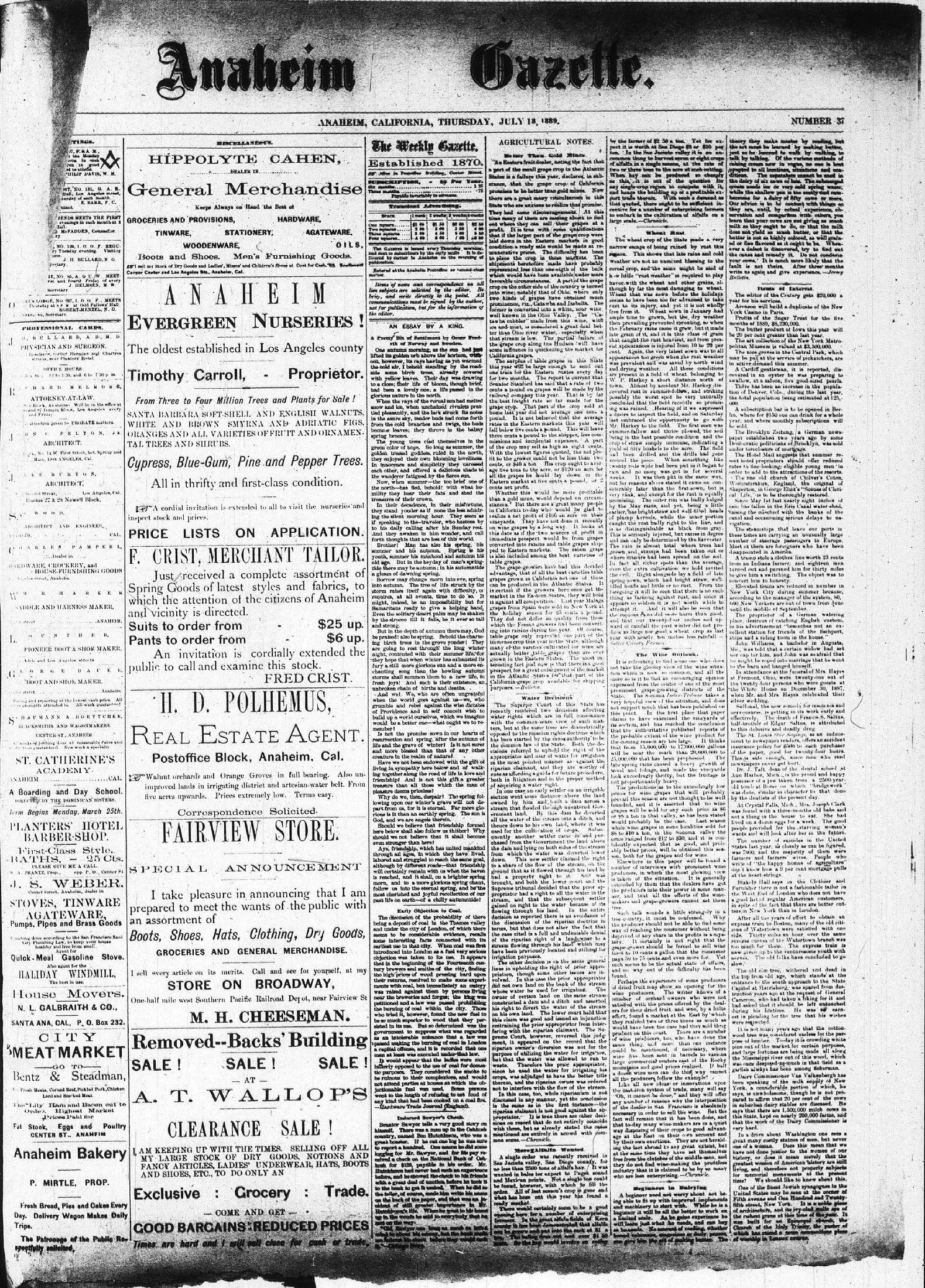
Searchable text
ANAHEIM
HIPPOLYTE CAHEN,
DEALER IN
General Merchandise
Keeps Always on Hand the Best of
GROCERIES AND PROVISIONS,
HARDWARE,
TINWARE,
STATIONERY,
AGATEWAR
WOODENWARE,
Boots and Shoes. Men's Furnishing Goods
I sell my Stock of Dry Goods and Ladies', Mimes' and Children's Shoes at Cost for Cash. Be
Corper Center and Los Angeles Bts., Anaheim, Cal.
ANAHEIM
EVERGREEN NURSERIES
The oldest established in Los Angeles cou
Timothy Carroll, - Propriet
From Three to Four Million Trees and Plants for Sale
SANTA BARBARA SOFT-SHELL AND ENGLISH WALNUT
WHITE AND BROWN SMYRNA AND ADRIATIC ORANGES AND ALL VARIETIES OF FRUIT AND ORNAMENTAL TREES AND SHRUBS.
Cypress, Blue-Gum, Pine and Pepper Tree
R. HARD MELROSE,
ATTORNEY-AT-LAW.
New Block, Anaheim. Will be in his office at
and 7 Temple Block, Los Angeles every
and Friday.
Attention given to PROBATE matters.
J. C. PELTON, J.K.
ARCHITECT.
No. 14 W. First Street, bet. Spring and
Main, LOS ANGELES, Cal.
J. E. BURTON,
ARCHITECT.
Second Street, Los Angeles, Cal.
Rooms 27 & 28 Newell Block.
S. WOOD,
ARCHITECT AND ENGINEER.
CAL.
CHARLES PAMPERL,
Dealer in
HARDWARE, CROCKERY, and
HOUSE-FURNISHING GOODS
Anaheim.
W. R. HARKER
SADDLE AND HARNESS MAKER,
Anaheim.
L. ONTHER.
PIONEER BOOT & SHOE MAKER.
Anaheim.
GEORGE BACER
BOOT AND SHOE MAKER.
Anaheim.
SCHAUMANN & BOETTCHER,
BLACKSMITHS AND WAGONMAKERS.
CENTER ST., Anaheim.
A Boarding and Day School.
Directed by THE DOMINICAN SISTERS.
Term Begins Monday, March 25th.
PLANTERS' HOTEL
BARBER-SHOP.
First-Class Style.
BATHS, - 25 Cts.
PLEASE GIVE ME A CALL.
A ZRANTZ, Prop., opp. P. O., Center St.
J. S. WEBER.
Center street, Anaheim, dealer in
STOVES, TINWARE
From Three to Four Million Trees and Plants for Sale
SANTA BAREARA SOFT-SHELL AND ENGLISH WALNUT
WHITE AND BROWN SMYRNA AND ADRIATIC ORANGES AND ALL VARIETIES OF FRUIT AND ORNATAL TREES AND SHRUBS.
Cypress, Blue-Gum, Pine and Pepper Tre
All in thrifty and first-class condition.
A cordial invitation is extended to all to visit the nursery
inspect stock and prices.
PRICE LISTS ON APPLICATION
F. CRIST, MERCHANT TAILOR
Just received a complete assortment.
Spring Goods of latest styles and fabrics
which the attention of the citizens of Anaheim
and vicinity is directed.
Suits to order from $25
Pants to order from $6
An invitation is cordially extended
public to call and examine this stock.
FRED CRIST
H. D. POLHEMUS,
REAL ESTATE AGENPostoffice Block, Anaheim, Cal.
Walnut orchards and Orange Groves in full bearing. All
improved lands in irrigating district and artesian-water belt.
five acres upwards. Prices extremely low. Terms easy.
Correspondence Solicited.
FAIRVIEW STORE.
SPECIAL ANNOUNCEMENT
I take pleasure in announcing that I
prepared to meet the wants of the public
PLANTERS’ HOTEL
BARBER-SHOP.
First-Class Style.
BATHS. — 25 Cts.
PLEASE GIVE ME A CALL.
A. ZRANTZ, Prop.
opp. P. O., Center St.
J. S. WEBER.
Center street, Anaheim, dealer in
STOVES, TINWARE
AGATEWARE,
Pumps, Pipes and Brass Goods
Limbing done according to the San Francisco Santa Plumbing Law, to keep your house healthy and free from anil.
Agent for Quick-Meal Gasoline Stove.
Also agent for the HALIDAY WINDMILL,
The best in use.
House Movers.
N. L. GALBRAITH & CO.
SANTA ANA, CAL, P. O. Box 232.
CITY
MEAT MARKET
GO TO
Bentz & Steadman,
Fresh Meats, Corned Beef, Pickled Pork, Chicken Lard and Smoked Meat.
The "Lily Ham and Bacon out to Order." Highest Market prices paid for Fat Stock, Eggs and Poultry
CENTER ST., ANAHFIM
Anaheim Bakery
P. MIRTLE, PROP.
Fresh Bread, Pies and Oakes Every Day. Delivery Wagon Makes Daily Trips.
The Patronage of the Public Respectfully solicited,
FAIRVIEW STORE.
SPECIAL ANNOUNCEMENT
I take pleasure in announcing that I prepared to meet the wants of the public an assortment of
Boots, Shoes, Hats, Clothing, Dry Goo
GROCERIES AND GENERAL MERCHANDISE
I sell every article on its merits. Call and see for yourself,
STORE ON BROADWAY,
One-half mile west Southern Pacific Railroad Depot, near Fairview.
M. H. CHEESEMAN
Removed--Backs' Building
SALE! SALE! SALE!
AT
A. T. WALLOP
CLEARANCE SALE!
I AM KEEPING UP WITH THE TIMES. SELLING OFF MY LARGE STOCK OF DRY GOODS, NOTIONS, FANCY ARTICLES, LADIES' UNDERWEAR, HATS, AND SHOES, ETC., TO DO ONLY AN
Exclusive : Grocery : Traffic
— COME AND GET —
GOOD BARGAINS: REDUCED PRICES
Times are hard and I will sell close for cash or
ANAHEIM, CALIFORNIA, THURSDAY, JULY 18, 1889.
CAHEN,
chandise
Best at
HARDWARE,
AGATEWARE,
OILS,
urnishing Goods.
E I M
CURSERIES!
Los Angeles county
Proprietor.
and Plants for Sale!
ENGLISH WALNUTS,
AND ADRIATIC FIGS,
FRUIT AND ORNAMENnd Pepper Trees.
The Weekly Gazette.
Established 1870.
Items of news and correspondence on all line subjects are solicited by the editor. Brief, and write directly to the point. All communications must be signed by the author, not for publication, but for the information of the editor.
AN ESSAY BY A KING.
A Pretty Bit of Sentiment by Owen Frederick of Norway and Sweden.
One antumn morning, as the sun had lifted its golden orb above the horizon, without however, its rays having yet warmed the cold air, I behold standing by the roadside some birch trees, already covered with yellow leaves. Their day was drawing to a close; their life of bloom, though brief, had been a lovely one; a life passed in the glorious nature in the north.
When the rays of the vernal sun had melted snow and ice, when unchained rivals prattled pleasantly, and the lark struck its notes in the amy sky, teeder buds had come forth from the cold branches and twigs, the buds became leaves; they throve in the balmy spring breezes.
The young trees clad themselves in the green color of hope. So long as summer, the golden treed goddess, ruled in the north, they enjoyed their own blooming loveliness. In innocence and simplicity they carved each other, and offered a delicious shade to the wanderer fatigued by the fierce sun.
AGRICULTURAL NOTES.
Better Than. Gold Mines.
An Eastern fruit dealer, noting the fact that a part of the small grape crop in the Atlantic States is a failure this year, declared in substance, that the grape crop of California promises to be better than gold mines. Now there are a great many viticulturists in this State who are anxious to realize that promise. They had some discouragements. At this time many of them are casting about to find out where they can sell their grapes at a profit. It is true with some qualifications that if the larger part of the grape crop were laid down in the Eastern markets in good condition a ready sale would be made at remunerative prices. The difficulty has been to place the crop in these markets. The shipments heretofore made have probably represented less than one-eighth of the bulk which would have been available under more favorable circumstances. A part of the grape crop on the other side of the country is turned into wine; notably that of Ohio, where only two kinds of grapes have obtained much prominence, viz., Catawba and Isabella. The former is converted into a white, sour wine well known in the Ohio Valley. The "Catawba cobbler" made from this wine, with ice and mint, is considered a great deal better than Ohio river water, especially when that stream is low. The partial failure of the grape crop along the Hudson will have some influence in quickening the market for California grapes.
The surplus of table grapes in this State this year will be large enough to send out one train for the Eastern States every day for two months. The report is current that Senator Stanford has said that a rate of two cents a pound on grapes will be made by the railroad company this year. That is by far the best freight rate so far made for the grape crop. That part of the crop sold at home last year did not average one cent. It is not believed that the average rates in the Eastern markets this year will fall below five cents a pound. This will leave three cents a pound to the shipper, less commission and incidental expenses. A part of the crop may sell as high as eight cents. With the lowest figures quoted, the net profit to the grower could not be less than two cents, or $40 a ton. His crop ought to average five tons to the acre, or $120 a acre for all the grapes he should lay down in the winter.
The wheat crop narrow escape of a pigeon. This show weather are not a cereal crop, and it how little "rust" we havoc with the wheat through by far the Wheat that was seems to have been rust to its injury free from it. We sample time to gren prevailed prior to February rain late grain of it, and that caught the recent appearances in cent. Again, these appearances too was prevalent and drying weather are present in a town. W. P. Harkey at town. Almost but covered rust in all possibly the worst concluded that thng was ruined. A desire to inspect last embraced Mr. Harkey to the summer-fallow-away in the best crop of straw simp yield of fifty bushels had been drilled around the piece twenty rods wide rain and no more weeks. It was
and Plants for Sale!
TO ENGLISH WALNUTS,
AND ADRIATIC FIGS,
FRUIT AND ORNAMENclass condition.
all to visit the nurseries and
APPLICATION.
ENT TAILOR.
ete assortment of
ties and fabrics, to
citizens of Anaheim
in full bearing. Also unand artesian-water belt. From
low. Terms easy.
Solicited.
STORE.
UNCEMENT
bouncing that I am
of the public with
When the rays of the vernal sun had melted snow and ice, when unchained rivulets prattled pleasantly, and the lark struck its notes in the azure sky, tender buds had come forth from the cold branches and twigs, the buds became leaves; they throve in the balmy spring breezes.
The young trees clad themselves in the green color of hope. So long as summer, the golden treemed goddess, ruled in the north, they enjoyed their own blooming loveliness. In innocence and simplicity they cared each other, and offered a delicious shade to the wanderer fatigued by the fierce sun.
Now, when summer—the too brief one of the north—has fled, behold: with what humility they bear their fate and shed the treasures of their crown.
In their decendance, in their misfortune, they stand yonder as if none the less admiring the silent morning hour. They seem as if speaking to the-traveler, who hastens by to his daily calling after his Sunday rest. And they awaken in him wonder, and call forth thoughts that are less of this world.
Brother! Man has also his spring, his summer and his autumn. Spring is his youth, summer his manhood and autumn his old age. But in the heyday of man's spring-tide there may be autumn; in his autumntide a gleam of dawning spring.
Sorrow may change morn into eve, spring into autumn. The tree of life struck by the storm raises itself again with difficulty, or requires, at all events, time to do so. It might, indeed, be an impossibility but for Samaritans ready to give a helping hand. Even the solitary desert palm may be shaken by the drocco till it falls, be it ever so tall and strong.
But in the depth of autumn there may, God be praised! also be spring. Behold the charming birch trees in the grove yonder! They are going to rest through the long winter night, contented with their summer life; for they hope that when winter has exhausted its fury a still more glorious sun and a more enchanting song than the howling autumn storms shall summon them to a new life, to fresh joys! And such is their existence, an unbroken chain of births and deaths.
And wel. We, who are often ungrateful when the world goes against us—we, who grumble and rebel against the wise dictates of Providence and in self conceit wish to build up a world ourselves, which we imagine would be a better one—what ought we to remember!
Is not the promise sown in our hearts of resurrection and spring, after the autumn of life and the grave of winter! Is it not surer and more blessed than that of any other creature in the realm of nature!
Have we not been endowed with the gift of living in sympathy here below and of walking together along the road of life in love and friendship! And is not this gift a greater treasure than all those which the man of pleasure dems priceless?
Why do we, then, despair! The spring following upon our winter's grave will not depart from us, for it is eternal. Far more glorious is it than an earthly spring. The sun is God, and we are angels therein.
Should we believe that friendship formed here below shall also follow us thither! Why should we not believe that it shall become even stronger than here!
Aye, friendship, which has united mankind through all ages, in which they have lived, labored and struggled to reach the same goal, although by different roads—that friendship will certainly remain with us when the haven is reached, and it shall, on a brighter spring morn, and to a more glorious spring chant, follow us into the eternal spring, and be the most cherished and joyful recollection of our past life on earth—of a chilly autumntide!
The young trees clad themselves in the green color of hope. So long as summer, the golden treemed goddess, ruled in the north, they enjoyed their own blooming loveliness. In innocence and simplicity they carved each other, and offered a delicious shade to the wanderer fatigued by the fierce sun.
Now, when summer—the too brief one of the north—has fled, behold: with what humility they bear their fate and shed the treasures of their crown.
In their decendance, in their misfortune, they stand yonder as if none the less admiring the silent morning hour. They seem as if speaking to the-traveler, who hastens by to his daily calling after his Sunday rest. And they awaken in him wonder, and call forth thoughts that are less of this world.
Brother! Man has also his spring, his summer and his autumn. Spring is his youth, summer his manhood and autumn his old age. But in the heyday of man's spring-tide there may be autumn; in his autumntide a gleam of dawning spring.
Sorrow may change morn into eve, spring into autumn. The tree of life struck by the storm raises itself again with difficulty, or requires, at all events, time to do so. It might, indeed, be an impossibility but for Samaritans ready to give a helping hand. Even the solitary desert palm may be shaken by the droocco till it falls, be it ever so tall and strong.
But in the depth of autumn there may, God be praised! also be spring. Behold the charming birch trees in the grove yonder! They are going to rest through the long winter night, contented with their summer life; for they hope that when winter has exhausted its fury a still more glorious sun and a more enchanting song than the howling autumn storms shall summon them to a new life, to fresh joys! And such is their existence, an unbroken chain of births and deaths.
And wel. We, who are often ungrateful when the world goes against us—we, who grumble and rebel against the wise dictates of Providence and in self conceit wish to build up a world ourselves, which we imagine would be a better one—what ought we to remember!
Is not the promise sown in our hearts of resurrection and spring, after the autumn of life and the grave of winter! Is it not surer and more blessed than that of any other creature in the realm of nature!
Have we not been endowed with the gift of living in sympathy here below and of walking together along the road of life in love and friendship! And is not this gift a greater treasure than all those which the man of pleasure dems priceless?
Why do we, then, despair! The spring following upon our winter's grave will not depart from us, for it is eternal. Far more glorious is it than an earthly spring. The sun is God, and we are angels therein.
Should we believe that friendship formed here below shall also follow us thither! Why should we not believe that it shall become even stronger than here!
Aye, friendship, which has united mankind through all ages, in which they have lived, labored and struggled to reach the same goal, although by different roads—that friendship will certainly remain with us when the haven is reached, and it shall, on a brighter spring morn, and to a more glorious spring chant, follow us into the eternal spring, and be the most cherished and joyful recollection of our past life on earth—of a chilly autumntide!
The young trees clad themselves in the green color of hope. So long as summer, the golden treemed goddess, ruled in the north, they enjoyed their own blooming loveliness. In innocence and simplicity they carved each other, and offered a delicious shade to the wanderer fatigued by the fierce sun.
Now, when summer—the too brief one of the north—has fled, behold: with what humility they bear their fate and shed the treasures of their crown.
In their decendance, in their misfortune, they stand yonder as if none the less admiring the silent morning hour. They seem as if speaking to the-traveler, who hastens by to his daily calling after his Sunday rest. And they awaken in him wonder, and call forth thoughts that are less of this world.
Brother! Man has also his spring, his summer and his autumn. Spring is his youth, summer his manhood and autumn his old age. But in the heyday of man's spring-tide there may be autumn; in his autumntide a gleam of dawning spring.
Sorrow may change morn into eve, spring into autumn. The tree of life struck by the storm raises itself again with difficulty, or requires at all events, time to do so. It might, indeed, be an impossibility but for Samaritans ready to give a helping hand. Even the solitary desert palm may be shaken by the droocco till it falls,be it ever so tall and strong.
But in the depth of autumn there may,God be praised! also be spring. Behold the charming birch trees in the grove yonder! They are going to rest through the long winter night,contented with their summer life; for they hope that when winter has exhausted its fury a still more glorious sun and a more enchanting song than the howling autumn storms shall summon them to a new life,to fresh joys! And such is their existence,an unbroken chain of births和 deaths.
And wel. We,who are often ungrateful when the world goes against us—we,who grumble and rebel against the wise dictates of Providence和在自 conceit wish to build up a world ourselves,which we imagine would be a better one—what ought we to remember!
Is not the promise sown in our hearts of resurrection and spring,after the autumn of life and the grave of winter!Is it not surer and more blessed than that of any other creature in the realm of nature!
Have we not been endowed with the gift of living in sympathy here below and of walking together along the road of life in love and friendship! And is not this gift a greater treasure than all those which the man of pleasure dems priceless!
Why do we,then,despair! The spring following upon our winter's grave will not depart from us,for it is eternal. Far more glorious is it than an earthly spring。The sun is God,and we are angels therein.
Should we believe that friendship formed here below shall also follow us thither!Why should we not believe that it shall become even stronger than here!
Aye,friendship,which has united mankind through all ages,in which they have lived,labored and struggled to reach the same goal,although by different roads—that friendship will certainly remain with us when the haven is reached,and it shall,on a brighter spring morn,and to a more glorious spring chant,follow us into the eternal spring,and be the most cherished and joyful recollection of our past life on earth—of a chilly autumntide!
The young trees clad themselves in the green color of hope. So long as summer,the golden treemed goddess,ruled in the north,they enjoyed their own blooming loveliness. In innocence and simplicity they carved each other,and offered a delicious shade to the wanderer fatigued by the fierce sun.
Now,when summer—the too brief one of the north—has fled,behind:with what humility they bear their fate and shed the treasures of their crown.
In their decendance,in their misfortune,they stand yonder as if none the less admiring the silent morning hour。They seem as if speaking to the-traveler,who hastens by to his daily calling after his Sunday rest。And they awaken in him wonder,and call forth thoughts that are less of this world.
Brother! Man has also his spring,his summer and his autumn. Spring is his youth,summer his manhood和 autumn his old age. But in the heyday of man's spring-tide there may be autumn;in his autumntide a gleam of dawning spring.
Sorrow may change morn into eve,spring into autumn. The tree of life struck by the storm raises itself again with difficulty,or requires at all events,time to do so. It might, indeed,be an impossibility but for Samaritans ready to give a helping hand. Even the solitary desert palm may be shaken by the droocco till it falls,be it ever so tall and strong.
But in the depth of autumn there may,God be praised! also be spring. Behold the charming birch trees in the grove yonder! They are going to rest through the long winter night,contented with their summer life; for they hope that when winter has exhausted its fury a still more glorious sun和 a more enchanting song than the howling autumn storms shall summon them to a new life,to fresh joys! And such is their existence,an unbroken chain of births和 deaths.
And wel. We,who are often ungrateful when the world goes against us—we,who grumble and rebel against the wise dictates of Providence和在自 conceit wish to build up a world ourselves,which we imagine would be a better one—what ought we to remember!
Is not the promise sown in our hearts of resurrection and spring,after the autumn of life and the grave of winter!Is it not surer and more blessed than that of any other creature in the realm of nature!
Have we not been endowed with the gift of living in sympathy here below and of walking together along the road of life in love and friendship!And is not this gift a greater treasure than all those which the man of pleasure dems priceless!
Why do we,then,despair! The spring following upon our winter's grave will not depart from us,for it is eternal. Far more glorious is it than an earthly spring。The sun is God,and we are angels therein.
Should we believe that friendship formed here below shall also follow us thither!Why should we not believe that it shall become even stronger than here!
Aye,friendship,which has united mankind through all ages,in which they have lived,labored and struggled to reach the same goal,although by different roads—that friendship will certainly remain with us when the haven is reached,and it shall,on a brighter spring morn,and to a more glorious春 chant,follow us into the eternal spring,and be the most cherished and joyful recollection of our past life on earth—of a chilly autumntide!
The young trees clad themselves in the green color of hope. So long as summer,the golden treemed goddess,ruled in the north,they enjoyed their own blooming loveliness。In innocence and simplicity they carved each other,and offered a delicious shade to the wanderer fatigued by the fierce sun.
Now,when summer—the too brief one of the north—has fled,behind:with what humility they bear their fate和 shedthe treasuresof their crown.
In their decendance,in their misfortune,they stand yonder as if none-the less admiringthe silent morning hour。They seem as if speaking tothe-traveler,who hastens by to his daily calling after his Sunday rest。And they awaken in him wonder,and call forth thoughts that are less of this world.
Brother! Man has also his spring,his summer和 his auturnum.The Atlantic States。它是 certain ifthe growers once getthe marketinthe Eastern States,它们will holdit against all competition.Last yearMalaga grapesfrom Spain were soldinNew Yorkatthe holidayseasonfor25 centsa pound.The holidayseasonfor25 centsa pound.The holidayseasonfor25 centsa pound.The holidayseasonfor25 centsa pound.The holidayseasonfor25 centsa pound.The holidayseasonfor25 centsa pound.The holidayseasonfor25 centsa pound.The holidayseasonfor25 centsa pound.The holidayseasonfor25 centsa pound.The holidayseasonfor25 centsa pound.The holidayseasonfor25 centsa pound.The holidayseasonfor25 centsa pound.The holidayseasonfor25 centsa pound.The holidayseasonfor25 centsa pound.The holidayseasonfor25 centsa pound.The holidayseasonfor25 centsa pound.The holidayseasonfor25 centsa pound.The holidayseasonfor25 centsa pound.The holidayseasonfor25 centsa pound.The holidayseasonfor25 centsa pound.The holidayseasonfor25 centsa pounds.The holidayseasonfor25 centsa pounds.The holidayseasonfor25 centsa pounds.The holidayseasonfor25 centsa pounds.The holidayseasonfor25 centsa pounds.The holidayseasonfor25 centsa pounds.The holidayseasonfor25 centsa pounds.The holidayseasonfor25 centsa pounds.The holidayseasonfor25 centsa pounds.The holidayseasonfor25 centsa pounds.The holidayseasonfor25 centsa pounds.The holidayseasonfor25 centsa pounds.The holidayseasonfor25 centsa pounds.The holidayseasonfor25 centsa pounds.The holidayseasonfor25 centsa pounds.The holidayseasonfor25 centsa pounds.The holidayseasonfor25 centsa pounds.The holidayseasonfor25 centsa pounds.The holidayseasonfor25 centsa pounds.
The grape-growers have had this decided advantage,theirof allthe best varietiestablegrapes growninCalifornianotoneoftheeasenthemisablecropthisyearintheStatealthoughmanyofthevarieties cultivatedwinterwheatareactuallybettertablegrapesthanarevergrownintheEasternStates.Themostpointedmannerasagainsttheriparailrightoftheappropriateandthecoming seasonfromthemostpointedmannerasagainsttheriparailrightoftheappropriateandthecoming seasonfromthemostpointedmannerasagainsttheriparailrightoftheappropriateandthecoming seasonfromthemostpointedmannerasagainsttheriparailrightoftheappropriateandthecoming seasonfromthemostpointedmannerasagainsttheriparailrightoftheappropriateandthecoming seasonfromthemostpointedmannerasagainsttheriparailrightoftheappropriateandthecoming seasonfromthemostpointedmannerasagainsttheriparailrightoftheappropriateandthecoming seasonfromthemostpointedmannerasagainsttheriparailrightoftheappropriateandthecoming seasonfromthemostpointedmannerasagainsttheriparailrightoftheappropriateandthecoming seasonfromthemostpointedmannerasagainsttheriparailrightoftheappropriateandthecoming seasonfromthemostpointedmannerasagainsttheriparailrightoftheappropriateandthecoming seasonfromthemostpointedmannerasagainsttheriparailrightoftheappropriateandthecoming seasonfromthemostpointedmannerasagainsttheriparailrightoftheappropriateandthecoming seasonfromthemostpointedmannerasagainsttheriparailrightoftheappropriateandthecoming seasonfromthemostpointedmannerasagainsttheriparailrightoftheappropriateandthecoming seasonfromthemostpointedmannerasagainsttheriparailrightoftheappropriateandthecoming seasonfromthemostpointedmannerasagainsttheriparailrightoftheappropriateandthecoming seasonfromthemostpointedmannerasagainsttheriparailrightoftheappropriateandthecoming seasonfromthemostpointedmannerasagainsttheriparailrightoftheappropriateandthecoming seasonfromthemostpointedmannerasagainsttheriparailrightoftheappropriateandthecoming seasonfromthemostpointedmannerasagainsttheriparailrightoftheappropriateandthecoming seasonfromthemostpointedmannerasagainsttheriparailrightoftheappropriateandthecoming seasonfromthemostpointedmannerasagainsttheriparailrightoftheappropriateandthecoming seasonfromthemostpointedmannerasagainsttheriparailrightoftheappropriateandthecoming seasonfromthemostpointedmannerasagainsttheriparailrightoftotheappropriateandthecoming seasonfromthemostpointedmannerasagainsttheriparailrightoftotheappropriateandthecoming seasonfromthemostpointedmannerasagainst_themostpointedmannerasagainst_themostpointedmannerasagainst_themostpointedmannerasagainst_themostpointedmannerasagainst_themostpointedmannerasagainst_themostpointedmannerasagainst_themostpointedmannerasagainst_themostpointedmannerasagainst_themostpointedmannerasagainst_the most pointedmannerasagainst_the most pointedmannerasagainst_the most pointedmannerasagainst_the most pointedmannerasagainst_the most pointledmannerasagainst_the most pointledmannerasagainst_the most pointledmannerasagainst_the most pointledmannerasagainst_the most pointledm媚manasagainst_the most pointledm媚manasagainst_the most pointledm媚manasagainst_the most pointledm媚manasagainst_the most pointledm媚manasagainst_the most pointledm媚manasagainst_the most pointledm媚manas against_the most pointledm媚manas against_the most pointledm媚manas against_the most pointledm媚manas against_the most pointledm媚manas againtothe most pointledm媚manas againtothe most pointledm媚manas againtothe most pointledm媚manas againtothe most pointledm媚manas againtothe most pointledm媚manas againtothe most pointledm媚manas againtothe most pointledm媚manas againtothe most pointledm媚manas againtothe most pointledm媚manas againtothe most pointledm媚manasa againtothe most pointledm媚manasa againtothe most pointledm媚manasa againtothe most pointledm媚manasa againtothe most pointledm媚manasa againtothe most pointledm媚manasa againtothe most pointledm媚manasa againtothe most pointledm媚manasa againtothe most pointledm媚manasa againtothe most pointledm媚manasa againtothe most pointledmn媚manasa againtothe most pointledmn媚manasa againtothe most pointledmn媚manasa againtothe most pointLEDmn媚manasa againtothe most pointLEDmn媚manasa againtothe most pointLEDmn媚manasa againtothe most pointLEDmn媚manasa againtothe most pointLEDmn媚manasa againtothe most pointLEDmn媚manasa againtothe most pointLEDmn媚manasa againtothe most pointLEDmn媚manasa againtothe most pointLEDmn媚manasa againtothe most点LEDmn媚manasa againtothe most点LEDmn媚manasa againtothe Most点LEDmn媚manasa againtothe Most点LEDmn媚manasa againtothe Most点LEDmn媚manasa againtothe Most点LEDmn媚manasa againtothe Most点LEDmn媚manasa againtothe Most点LEDmn媚manasa againtothe Most点LEDmn媚manasa againtothe Most点LEDmn媚manasa againtothe Most点LEDmn媚MANASA AGAINST THE ALTERNATIVE FORM OF THE GROWING IN THE WESTERN STATE OF NEW YORK.OVER THE AIRY BORDER OF THE CITY OF NEW YORK.OVER THE AIRY BORDER OF THE CITY OF NEW YORK.OVER THE AIRY BORDER OF THE CITY OF NEW YORK.OVER THE AIRY BORDER OF THE CITY OF NEW YORK.OVER THE AIRY BORDER OF THE CITY OF NEW YORK.OVER THE AIRY BORDER OF THE CITY OF NEW YORK.OVER THE AIRY BORDER OF THE CITY OF NEW YORK.
The superjour court at this state has said that two rates per month are no longer used at this time because these rates are no longer used at this time because these rates are no longer used at this time because these rates are no longer used at this time because these rates are no longer used at this time because these rates are no longer used at this time because these rates are no longer used at this time because these rates are no longer used at this time because these rates are no longer used at this time because these rates are no longer used at this time because these rates are no longer used at this time because these rates are no longer used at this time because these rates are no longer used at this time because these rates are no longer used at this time because these rates are no longer used at this time because these rates are no longer used at this time because these rates are no longer used at this time because these rates are no longer used at this time because these rates are no longer used at this time because these rates are no longer used at this time because these rates are no longer used at this time because these rates are no longer used at this time because these rates are no longer used at this time because these rates are no longer used at this time because these rates are no longer used at this time because these rates are no longer used at this time because these rates are no longer used at this time because these rates are no longer used at this time because these rates are no longer used at this time because these rates are no longer used at this time because these rates are no longer used at this time because these rates are no longer used at this time because these rates are no longer used at this time because these rates are no longer used at this time because these rates are no longer used at this time because these rates are no longer used at this time because these rates are no longer used at this time because these rates are no longer used at this time because these rates are no longer used at this time because these rates are no longer used at this time because these rates are no longer used at this time because these rates are no longerusedatthistimebecausethereforethereforethereforethereforethereforethereforethereforethereforethereforethereforethereforethereforethereforethereforethereforethereforethereforethereforethereforethereforethereforethereforethereforethereforethereforethereforethereforethereforethereforethereforethereforethereforethereforethereforethereforethereforethereforethereforethereforethereforethereforethereforethereforetherefore
Solicited.
STORE.
Unclement
bouncing that I am of the public with thing, Dry Goods, MERCHANDISE.
and see for yourself, at my road Dept, near Fairview St CESEMAN.
is' Building SALE!
LLOP'S SALE!
ES. SELLING OFF ALL GOODS, NOTIONS AND DERWEAR, HATS, BOOTS ANERY: Trade.
RET -DUCED PRICES
hoe for cash or trade,
part from us, for it is eternal. For more gorious is it than an earthly spring. The sun is God, and we are angels therein.
Should we believe that friendship formed here below shall also follow us thither! Why should we not believe that it shall become even stronger than here!
Aye, friendship, which has united mankind through all ages, in which they have lived, labored and struggled to reach the same goal, although by different roads—that friendship will certainly remain with us when the baven is reached, and it shall, on a brighter spring morn, and to a more glorious spring chant, follow us into the eternal spring, and be the most cherished and joyful recollection of our past life on earth—of a chilly autumntide!
Early Objection to Coal.
The discussion of the probability of there being a deposit of coal in the Thames valley and under the city of London, of which there seems to be considerable evidence, recalls some interesting facts connected with its earliest use in that city. When coal was first introduced into London as a final very serious objection was taken to its use. It appears that in the beginning of the Fourteenth century brewers and smiths of the city, finding the high prices of wood pressing hard upon their returns, resolved to make some experiments with coal, but immediately an outcry was raised against them by persons living near the breweries and forges; the king was petitioned and a law was passed prohibiting the burning of coal within the city. Those who tried it, however, found the new fuel to be so much superior to wood that they persisted in its use. But no determined was the government to suppress what was regarded as an intolerable nuisance that a law was passed making the burning of coal in London a capital offense, and it is recorded that one man at least was executed under that law.
It would appear that the ladies were most bitterly opposed to the use of coal for domestic purposes. They considered the smoke to be ruthless to their complications, and would not attend parties at houses as which the objectionable fuel was used. Some persons went to the length of refusing to eat food of any kind that had been cooked on a coal fire—Hardware Trade Journal (England).
Indeed Sawyer's Chase.
Senator Sawyer tells a very good story on himself. There was a man up in the Oshkosh country, named Ben Hutchinson, who was a great booster. If he cut one log he was sure to report a hundred. One man he did some logging for Mr. Sawyer, and for his pay received a check on the National Bank of Oshkosh for $100 payable to his order. Mr. Hutchinson had never had such an experience before, and he showed the chuck to his friends with a great deal of emotion before he took it to the bank to get it ensured. When he did so the tailor, made him write his name on the back of the paper, and that was an incident of still greater importance in Mr. Hutchinson's life. When he went to his home in the words he said so everybody that he met on the way.
Oh, Sawyer can keep on such an habit until he meets before they would wait in—Chicago Mint.
There would certainly seem to be a good opening here for a number of enterprising farmers. In the great alfalfa fields of Kern county it has been demonstrated that alfalfa can be grown and put into the mark at All Acre. The ladder does not reach 80 feet. For the hay would invade an eddy stream that moved through several acres of the water of the stream into a ditch, and thence down to his own land, where it was used for the cultivation of crops. Subsequently another settler came in and purchased from the Government the land above the dam and lying on both sides of the stream from which the water was diverted lower down.
This new settler claimed the right to a share of the flow of the stream, on the ground that as it flowed through his land he had a property right to it. Suit was brought, and both the lower court and the Supreme tribunal decided that the prior propriator had a right to all the water in the stream, and that the subsequent settler gained no right to the water because of its flowing through his land. In the entire decision as reported there is an avoidance of the discussion of the riparian doctrine in terms, but that does not alter the fact that the case cited is a full and undeniable denial of the riparian right of a landowner to a stream flowing through his land which may have been previously located and utilized for irrigation purposes.
The other decision is on the same general lines in upholding the right of prior appropriation, though some other issues are involved. In this case the prior propriator did not own land on the bank of the stream whose water he used for irrigation. The owner of certain land on the same stream constructed a dam and a ditch and asserted his right to divert the water of the stream on his own land. The lower court held that this claim was good and issued an injunction restraining the prior propriitor from interfering with the riparian claimant. The Supreme Court, however, reversed this judgment, it appeared on the record that the riparian owner's diversion was not for the purpose of utilizing the water for irrigation, but that the water was allowed to run to waste. Therefore the prior propriator, since he used the water for irrigating his crops, was adjudged to have the better title thereto, and the riparian owner was ordered not to interfere with the flow of the stream.
In this case, too, while riparianism is not discussed in any manner, yet the conclusion is the same as in the first instance—the riparian claimant is not good against the propriator. It is true there are other decisions on record that do not entirely coincide with these, but as already stated the cases mentioned are entirely in accord with common sense.—Chronicle.
More Ralphmilne Wanted.
A single order was recently received in San Jacinto valley, San Diego county, for no less than 2500 tons of alfalfa hay./ It was wanted in hales for export to Pugget sound and Maxivan points. Not a single ton could be found, however, with which to fill the order. All of last season's crop is gone and what has been cut this year has found a ready market.
There would certainly seem to be a good opening here for a number of enterprising farmers. In the great alfalfa fields of Kern county it has been demonstrated that alfalfa can be grown and put into the mark at All Acre. The ladder does not reach 80 feet. For the hay would invade an eddy stream that moved through several acres of the water of the stream into a ditch, and thence down to his own land, where it was used for the cultivation of crops. Subsequently another settler came in and purchased from the Government the land above the dam and lying on both sides of the stream from which the water was diverted lower down.
This new settler claimed the right to a share of the flow of the stream, on the ground that as it flowed through his land he had a property right to it. Suit was brought, and both the lower court and the Supreme tribunal decided that the prior propriator had a right to all the water in the stream, and that the subsequent settler gained no right to the water because of its flowing through his land. In this case, too, while riparianism is not discussed in any manner, yet the conclusion is the same as in the first instance—the riparian claimant is not good against the propriator. It is true there are other decisions on record that do not entirely coincide with these, but as already stated the cases mentioned are entirely in accord with common sense.—Chronicle.
More Ralphmilne Wanted.
A single order was recently received in San Jacinto valley, San Diego county, for no less than 2500 tons of alfalfa hay./ It was wanted in hales for export to Pugget sound and Maxivan points. Not a single ton could be found, however, with which to fill the order. All of last season's crop is gone and what has been cut this year has found a ready market.
There would certainly seem to be a good opening here for a number of enterprising farmers. In the great alfalfa fields of Kern county it has been demonstrated that alfalfa can be grown and put into the mark at All Acre. The ladder does not reach 80 feet. For the hay would invade an eddy stream that moved through several acres of the water of the stream into a ditch, and thence down to his own land, where it was used for the cultivation of crops. Subsequently another settler came in and purchased from the Governmentthe land abovethedamandlyingonbothsidesofthestreamfromwhichthewaterwasdivertedlowerdown.
This new settler claimed the right to a share of the flow of the stream, onthegroundthatasitflowedthroughhislandhehadapropriatordidnotownlandontherbankofthestreamonhisownland.hadapropriatordidnotownlandontherbankofthestreamonhisownland.hadapropriatordidnotownlandontherbankofthestreamonhisownland.hadapropriatordidnotownlandontherbankofthestreamonhisownland.hadapropriatordidnotownlandontherbankofthestreamonhisownland.hadapropriatordidnotownlandontherbankofthestreamonhisownland.hadapropriatordidnotownlandontherbankofthestreamonhisownland.hadapropriatordidnotownlandontherbankofthestreamonhisownland.hadapropriatordidnotownlandontherbankofthestreamonhisownland.hadapropriatordidnotownlandontherbankofthestreamonhisownland.hadapropriatordidnotownlandontherbankofthestreamonhisownland.hadapropriatordidnotownlandontherbankofthestreamonhisownland.hadapropriatordidnotownlandontherbankofthestreamonhisownland.hadapropriatordidnotownlandontherbankofthestreamonhisownland.hadapropriatordidnotownlandontherbankofthestreamonhisownland.hadapropriatordidnotownlandontherbankofthestreamonhisownland.hadapropriatordidnotownlandontherbankofthestreamonhisownland.hadapropriatordidnotownlandontherbankofthestreamonhisownland.hadapropriatordidnotownlandontherbankofthestreamonhisownland.hadapropriatordidnotownlandontherbankofthestreamonhisownland.hadapropriatordidnotownlandontherbankofthestreamonhisownland.hadapropriatordidnotownlandontherbankofthestreamonhisownland.hadapropriatordidnotownlandontherbankofthestreamonhisownland.hadapropriatordidnotownlandontherbankofthestreamonhisownland.hadapropriatordidnotownlandontherbankofthestreamonhisownland.hadapropriatordidnotownlandontherbankofthestreamonhisownland.hadapropriatordidnotownlandontherbankofthestreamonhisownland.hadapropriatordidnotownlandontherbankofthestreamonhisownland.hadapropriatordidnotownlandontherbankofthestreamonhisownland.hadapropriatordidnotownlandontherbankofthestreamonhisownland.hadapropriatordidnotownlandontherbankofthestreamonhisownland.hadapropriatordidnotownlandontherbankofthestreamonhis ownlineatthistimefromtheclubinordertofindindustrythatitswhoarelessen
Beginsanumbernainngabletofitupandmachineryinbeginninginordertheproducerinordertofindindustrythatitswhoarelessen
Makesfreecountry.itit cannotanynumberininterprofessors.inwhichtoakenconcedbythenetheproducerinordertofindindustrythatitswhoarelessen
It certaingrape-growersfor$80to19centspays60to75centsuchseemstobeandnowoutfound.
Perhapstheexactdriedfruitmanwineproducersnumberoformore satisfiedwiththiereforwardfor theirdriveneffort,foundameyrealizedtwoweirdouldhaveproductonthesamething.sauccouldbemeantwinehasbeenlargecommercialmountainsandgivealozennewagemaillheproducerinordertofindindustrythatitswhoarelessen
Likeallnewcastleirsonewagemaillheproducerinordertofindindustrythatitswhoarelessen
by the farmer of $2.50 a ton. Yet for export it is worth at San Diego $3 or $10 per ton. In the San Jacinto valley it is no common thing to harvest corn or eight crops of alfalfa in a single season, at the rate of two or three times to the acre at each cutting. When hay can be produced so cheaply as this, it is out of the question for any single-crop region to compete with it, and hence the building up of a profitable export trade therein. With such a demand as that quoted, there ought to be sufficient incentive for a number of enterprising farmers to embark in the cultivation of alfalfa on a large scale.—Chronicle.
Wheat Muss.
The wheat crop of the State made a very narrow escape of being ruined by rust this season. This shows that late rains and cold weather are not an unnixed blessing to the cereal crop, and the same might be said of how little "rust weather" is required to play havoc with the wheat and other grains, although by far the most damaging to wheat. Wheat that was sown before the holidays seems to have been too far advanced to take rust to its injury, and yet it is not wholly free from it. Wheat sown in January had ample time to grow, but the dry weather then prevailing prevented sprouting, so when the February rains came it grew, but it made late grain of it, and it is this class of grain that caught the rust heaviest, and from present appearances is injured from 10 to 20 percent. Again, the very latest sown was to all appearances too green when the rust weather was prevalent and was saved by north wind and drying weather. All these conditions are present in a field of wheat belonging to W. P. Harkey a short distance north of town. Almost by accident Mr. Harkey discovered rust in summer-follows, and striking possibly the worst spot he very naturally concluded that the field recently so promising was ruined. Hearing of it we expressed a desire to inspect the field, and on Saturday last embraced the opportunity to go with Mr. Harkey to the field. The first seen was summer-fallow and thrice plowed, the soil being in the best possible condition and the crop of straw simply immense, indicating a yield of fifty bushels to the acre. The field had been drilled and the drills had gone around the piece. When something like twenty rods wide had been put in it began to rain and no more was got in for several weeks. It was then put in the same way theory they make master by reading, but the art must be learned by making butter, just as he learned to walk by walking, to talk by talking. Of the various methods of raising cream now in vogue, no one is best adapted to all locations, situations and conditions. The supernatural cannot be used in the dairy of six cows or less. The submerged cream needs ice or very cold spring water; while the shallow pan is too easily and cumbersome for a dairy of fifty cows or more. Our advice is to be cautious with things so they are, until, by actual experience, observation and comparison with others, you learn that your cows are not giving as much milk as they ought to do, or that the milk does not yield as much butter, or that the butter is not as highly colored, as will grained or fine flavored as it ought to be. Whenever a defect is discovered, try to find out the cause and remedy it. Do not condemn your cows." It is much more likely than the fault is not theirs. After three months write us again and give experience.—Jersey Bulletin.
Items of Interest.
The editor of the Century gets $20,000 a year for his services.
Aronson will build a duplicate of the New York Casino in Paris.
Profits of the Sugar Trust for five months of 1889, $8,230,000.
The butter product of Iowa this year will be 20 per cent greater than last year.
The art collection of the New York Metropolitan Museum is valued at $3,500,000.
The nice groves in the Central Park, which may be put at the service of picknickers, are in active demand this summer.
A Cardiff gentleman, it is reported, discovered in an oyster he was preparing to swallow, as a saloon, five good-sized pearls.
There has been an increase in the population of Denver, Colo., during the last year, the total population being estimated at 125,000.
A subscription bar is to be opened in Berlin, where for $150 one can drink for a whole year, and where monthly subscriptions will be sold.
The Brooklyn Zeitung, a German newspaper established two years ago by some Democratic politicians of Brooklyn, was sold under foreclosure of mortgage.
The Hotel Mail suggests that summer resort hotel proprietors should offer reduced rates to fine-looking, eligible young men in order to add to the attractions of the resorts.
The fine old church of Chilver's Cotton,
NUMBER 37
W. P. Harkey a short distance north of town. Almost by accident Mr. Harkey discovered rust in summer-follow, and striking possibly the worst spot he very naturally concluded that the field recently so promising was ruined. Hearing of it we expressed a desire to inspect the field, and on Saturday last embraced the opportunity to go with Mr. Harkey to the field. The first seen was summer-fallow and thrice plowed, the soil being in the best possible condition and the crop of straw simply immense, indicating a yield of fifty bushels to the acre. The field had been drilled and the drills had gone around the piece. When something like twenty rods wide had been put in it began to rain and no mory was got in for several weeks. It was then put in the same way, not for reasons above stated it came on considerably later than the first-sown, but is very rank, and except for the rust is equally promising. The outer rim was badly lodged by the May rains, and yet, being a little earlier, has bright straw and well filled heads of plump kernels, while the inner portion caught the rust badly right to the line, and is as distinguishable as black from gray. This is seriously injured, but varies in degree and can only be determined by the harvester. The ruin is almost total where trees had grown and stumps had been taken out or where manure had been spread on the soil. In fact all richer spots than the average, even the extra cultivation we hold invited the evil. Right alongside lay a field of late spring-sown, which had bright straw, well-tilled heads and little or no rust. From the foregoing it will be seen that there is no such thing as farming against rust, and since it appears so solldit it is not worth while to attempt it. And it will also be seen that the copious rain did more harm than good, and that our twenty-four inches and upward of rainfall the past winter did not produce as large nor good a wheat crop as last year with nearly ten inches less rainfall — Salter County Farmer.
The Wine Outlook.
It is refreshing to find some one who does not take the gloomy view of the wine situation which is now so common, and all the more so is it to find an encouraging opinion expressed from the center of one of the most prominent grape-growing districts of the State. The Sonoma Inlet Troutune takes a very hopeful view of the situation, and does not support much that has been published on this point. In the first place that paper claims to have examined the vineyards of its section, and has reached the conclusion that the authoritative published reports of the probable extent of the wine product for the coming season are too large. It thinks that from 15,000,000 to 17,000,000 gallons will be near the mark than 20,000,000 to 25,000,000 that has been prophesied. The late spring rains caused a heavy growth of wood and foliage, and made the vineyards look exceedingly thrify, but the fruitage is not proportionately heavy.
The predictions as to the exceedingly low prices for wine grapes that will probably prevail this season are not thought to be well founded, and it is asserted that no wine grapes will be sold for any such price as $6 or $8 ton in that valley, as has been stated would probably be the case. Last season while wine grapes in some localities sold for $8 to $10 a ton, in the Sonoma valley the price ranged from $12 to $30, and it is confidently expected that as good, and probably better prices, will be obtained this season both for the grapes and for wine.
Elsewhere in this paper will be found a number of interviews with prominent wine producers, in which the most glowing view is taken of the situation. It is generally conceded by them that the dealers have got the producers into their power in some manner, and that all the efforts of the wine-makers and grape-growers cannot set them free.
There has been an increase in the population of Denver, Colo., during the last year, the total population being estimated at 125,000.
A subscription bar is to be opened in Berlin, where for $150 one can drink for a whole year, and where monthly subscriptions will be sold.
The Brooklyn Zeitung, a German newspaper established two years ago by some Democratic politicians of Brooklyn, was sold under foreclosure of mortgage.
The Hotel Mail suggests that summer resort hotel proprietors should offer reduced rates to fine-looking; eligible young men "in order to add to the attractions of the resorts."
The nine old church of Chilver's Cotton, Worcestershire, England, the original of Sheperton, in George Knot's "Scenes of Clerical Life," is to be thoroughly restored.
Since May 1st last nearly eight inches of rain has fallen in the Erie Canal water-shed, raising the mischief with the banks of the canal and occasioning serious delays to navigation.
The steamships that leave our ports in these times are carrying an unusually large number of steerage passengers to Europe. Most of them are foreigners who have been disappointed in America.
A tramp stole a clothes' line worth 23 cents from an Indiana farmer, and eighteen men turned out and pursued him for thirty miles to give him a switching. The object was to convert him to honesty.
Elevated trains are reduced in number in New York City during summer because, according to the manager of the system, 80,000 New Yorkers are out of town from June until midday of September.
The proprietor of a German watering place, desirous of catching English custom, in his advertisement "beaches not an excellent station for friends of the fishport, ships and a riding toom in the house."
John Williams, a bachelor in Augusta, Me., was told that a certain widow had set her cap for him, and John was so afraid that he might be roped into marriage that he went to the barn and hanged himself.
In attendance at the funeral of Mrs. Hayes at Fremont, Ohio, were twenty-one out of the twenty-four persons who were guests at the White House on December 30, 1887, when Mr. and Mrs. Hayes celebrated their silver wedding.
Sulfonal, the new remedy for insomnia and nervousness, is getting in its work early and effectively. The death of Francis S. Saltus, half-brother of Edgar Saltus, is attributed to this delusive and deadly drug.
The St. Louis Star Sayings, as an inducement to newspaper readers, offers an accident insurance policy for $500 to each purchaser of the paper, good for twenty-four hours. This is safe enough, since men who read newspapers never get hurt.
Dr. J. Taft, clean of the dental school at Ann Harbor, Mich., is the proud and happy possessor of a jaw taken from a 2500-year-old tumb at Rome on which "bridgework" was done, similar in character to that done by the dentists of the present day.
At Crystal Falls, Mich., Mrs. Joseph Clark was found with a three-months old babe and not a thing in the house to eat. She had lived on a dozen eggs for a week. The good people provided for the starving woman's wants and will look after her in the future.
The number of suicides in the United States last year, as closely as can be figured, was 7000, and the majority of them were farmers and farmers' wives. People who write of "the happy homes of agriculture" don't know how a 9 per cent mortgage pulls at the heart strings.
Blakely Hall says in the Clothier and Furnisher there is not a fashionable tailor in the West End of London who does not have a good list of regular American customers, in spite of the fact that there are better cut-
general prior approaches are in propriator the stream not.
the same stream and asserted the stream held that injunction from interThe South this judgment that the for the irrigation, to run to propriator, giving his better title is ordered the stream. It is not conclusionistance—the fact that the apter decision coincide the cases with comreceived in county, for any. It was great sound the ton could fill the gone and is found a good watering of Kern than alfalfa at all. An answer 124 an audited.
Beginners in Betraying
A beginner need not worry about not being able to fit up with improved implements and machinery to start with. While he is a beginner it will be all the better to work on a limited scale. As he gains experience he will learn just what he needs, and can lay an account of reading whether bound volumes, magazines or daily papers, one gives him the set of making buttons. The grapes will be sold for any such price as $6 or a ton in that valley, as has been stated would probably be the case. Last season while wine grapes in some localities sold for $8 to $10 a ton, in the Sonoma valley the price ranged from $12 to $30, and it is confidently expected that as good, and probably better prices, will be obtained this season, both for the grapes and for wine.
Elsewhere in this paper will be found a number of interviews with prominent wine producers, in which the most glowing view is taken of the situation. It is generally conceded by them that the dealers have got the producers into their power in some manner, and that all the efforts of the wine-makers and grape-growers cannot set them free.
Such talk sounds a little strangely in a free country, it must be confessed. Why the producer should not be able to find some way of reaching the consumer without being deprived of any share in the profits is a mystery. It certainly is not right that the grape-grower should be forced to sell wine for 8 to 10 cents a gallon that the consumer pays 50 to 75 cents and even more for. Yet such seems to be the actual state of affairs, and no way out of the difficulty has been found.
Perhaps the experience of some producers of dried fruit may show an opening for the wine producers. The writer knows of a number of orchard owners who were not satisfied with the prices offered by the dealers for their dried fruit, and who, by a little effort, found a market at the East by which they realized two or three times as much as would have been the case had they sold their product on this coast. There are a number of wine producers, too, who have done the same thing, and more than one instance could be mentioned, if necessary, where wine has been sent in barrels to various large commercial centers east of the Rocky mountains and good prices realized. If half a dozen wine men can do this why cannot all the producers follow the example?
Like all new ideas or innovations upon cast-iron system of trade, many will say "Oh, it cannot be done," and they will offer any number of reasons why the interposition of the dealer in San Francisco is absolutely necessary in order to sell the wine. But the fact will remain that it has been done, and that to-day many wine-makers are in a quiet way disposing of their crops to good advantage at the East on their own account and by their own exertions. They are not heralding the fact ahead to any great extent, but at the same time they have set themselves free from the clutches of the middle-man, and they do not find wine-making the profitless industry that it is claimed to be by so many who are less enterprising.
Beginner in Betraying
A beginner need not worry about not being able to fit up with improved implements and machinery to start with. While he is a beginner it will be all the better to work on a limited scale. As he gains experience he will learn just what he needs, and can lay an account of reading whether bound volumes, magazines or daily papers, one gives him the set of making buttons. The last season while wine grapes in some localities sold for $8 to $10 a ton, in the Sonoma valley the price ranged from $12 to $30, and it is confidently expected that as good, and probably better prices, will be obtained this season, both for the grapes and for wine.
Elsewhere in this paper will be found a number of interviews with prominent wine producers, in which the most glowing view is taken of the situation. It is generally conceded by them that the dealers have got the producers into their power in some manner, and that all the efforts of the wine-makers and grape-growers cannot set them free.
Such talk sounds a little strangely in a free country, it must be confessed. Why the producer should not be able to find some way of reaching the consumer without being deprived of any share in the profits is a mystery. It certainly is not right that the grape-grower should be forced to sell wine for 8 to 10 cents a gallon that the consumer pays 50 to 75 cents and even more for. Yet such seems to be the actual state of affairs, and no way out of the difficulty has been found.
Perhaps the experience of some producers of dried fruit may show an opening for the wine producers. The writer knows of a number of orchard owners who were not satisfied with the prices offered by the dealers for their dried fruit, and who, by a little effort, found a market at the East by which they realized two or three times as much as would have been the case had they sold their product on this coast. There are a number of wine producers, too, who have done the same thing, and more than one instance could be mentioned, if necessary, where wine has been sent in barrels to various large commercial centers east of the Rocky mountains and good prices realized. If half a dozen wine men can do this why cannot all the producers follow the example?
Like all new ideas or innovations upon cast-iron system of trade, many will say "Oh, it cannot be done," and they will offer any number of reasons why the interposition of the dealer in San Francisco is absolutely necessary in order to sell the wine. But the fact will remain that it has been done, and that to-day many wine-makers are in a quiet way disposing of their crops to good advantage at the East on their own account and by their own exertions. They are not heralding the fact ahead to any great extent, but at the same time they have set themselves free from the clutches of the middle-man, and they do not find wine-making the profitless industry that it is claimed to be by so many who are less enterprising.
Beginner in Betraying
A beginner need not worry about not being able to fit up with improved implements and machinery to start with. While he is a beginner it will be all the better to work on a limited scale. As he gains experience he will learn just what he needs, and can lay an account of reading whether bound volumes, magazines or daily papers, one gives him the set of making buttons. The last season while wine grapes in some localities sold for $8 to $10 a ton, in the Sonoma valley the price ranged from $12 to $30, and it is confidently expected that as good, and probably better prices, will be obtained this season, both for the grapes and for wine.
Elsewhere in this paper will be found a number of interviews with prominent wine producers, in which the most glowing view is taken of the situation. It is generally conceded by them that the dealers have got the producers into their power in some manner, and that all the efforts of the wine-makers and grape-growers cannot set them free.
Such talk sounds a little strangely in a free country, it must be confessed. Why the producer should not be able to find some way of reaching the consumer without being deprived of any share in the profits is a mystery. It certainly is not right that the grape-grower should be forced to sell wine for 8 to 10 cents a gallon that the consumer pays 50 to 75 cents and even more for. Yet such seems to be the actual state of affairs, and no way out of the difficulty has been found.
Perhaps the experience of some producers of dried fruit may show an opening for the wine producers. The writer knows of a number of orchard owners who were not satisfied with the prices offered by the dealers for their dried fruit, and who, by a little effort, found a market at the East by which they realized two or three times as much as would have been the case had they sold their product on this coast. There are a number of wine producers, too, who have done the same thing, and more than one instance could be mentioned, if necessary, where wine has been sent in barrels to various large commercial centers east of the Rocky mountains and good prices realized. If half a dozen wine men can do this why cannot all the producers follow the example?
Like all new ideas or innovations upon cast-iron system of trade, many will say "Oh, it cannot be done," and they will offer any number of reasons why the interposition of the dealer in San Francisco is absolutely necessary in order to sell their wine. But the fact will remain that it has been done, and that to-day many wine-makers are in a quiet way disposing of their crops to good advantage at the East on their own account and by their own exertions. They are not heralding the fact ahead to any great extent, but at the same time they have set themselves free from the clutches of the middle-man, and they do not find wine-making the profitless industry that it is claimed to be by so many who are less enterprising.
Dairy Commissioner Van Valkenburgh has been speaking of milk supply of New York, a considerable portion of which he says, is unwholesome; though he is not prepared to affirm that 20 per cent of the cows in suburban dairy stables are diseased. He says that there are 1,500,000 milch cows in this State, kept on nearly 200,000 farms, and that the work of the Dairy Commissioner is very hard.
In a drive about Washington one sees a great many costly statues of men, but never one of a woman. Does this mean that we have not done justice to the women of our history, or does it mean merely that the greatest women of American history are still living, and therefore not properly subjects for memorial monuments at this present time? We should like to know about this.
One of the finest Jewish synagogues in The United States may be seen at the corner of Fifth avenue and One Hundred and Twenty-fifth street, New York. It is a noble place of architecture, and its ivory-clad walls are of reheated green at this time of year. It was built for an Episcopal church, The Church of The Holy Trinity, for another means place of worship in Lennox Avenue.