anaheim-gazette 1889-06-27
Scanned page
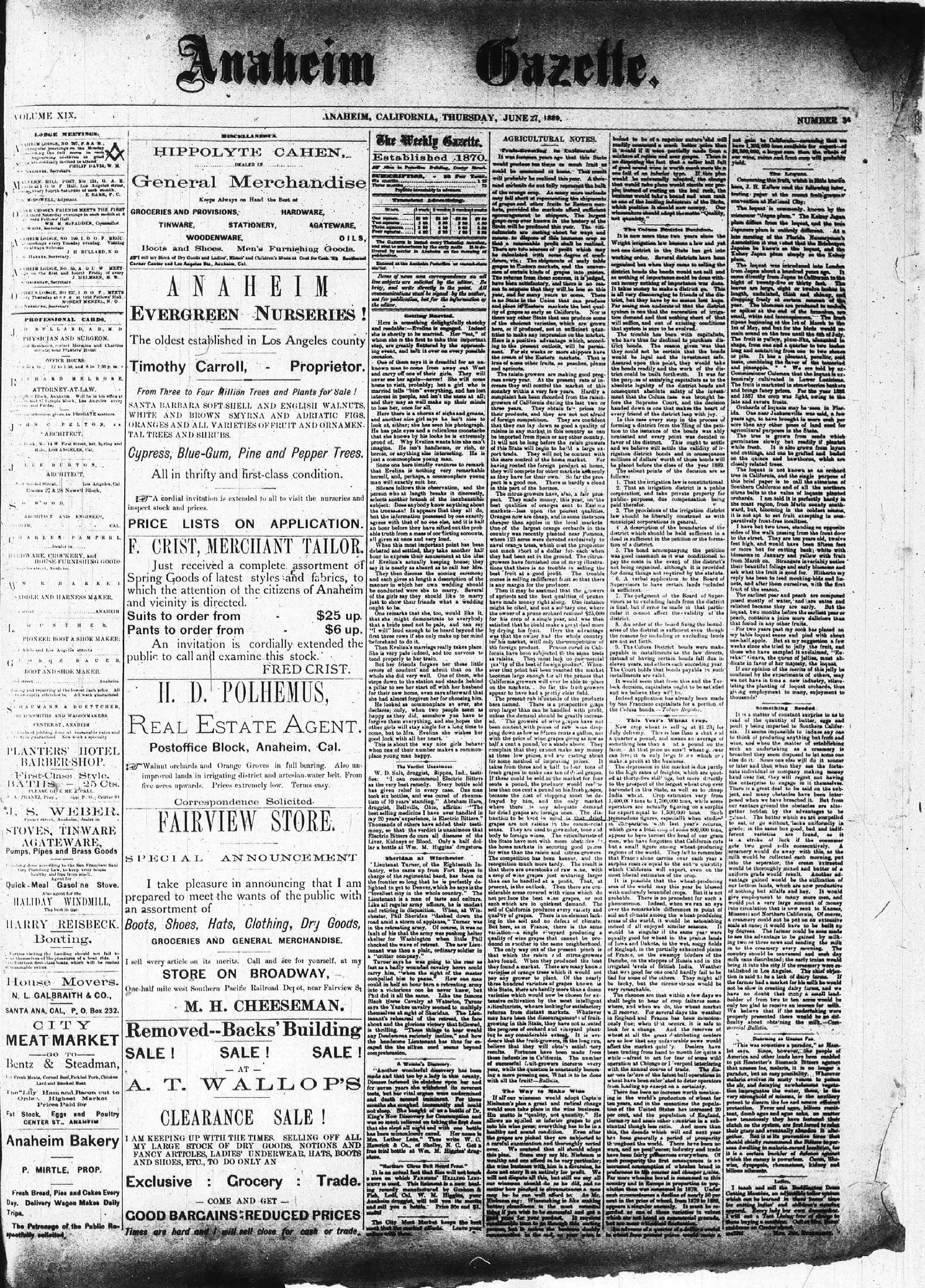
Searchable text
VOLUME XIX.
LODGE MEETINGS.
ANAHEIM LODGE, NO. 287, F. & A. M., regular meetings on the Monday preceding the full month in each seperating breakroom in good order cordially invited to attend PHILIP DAVIS, W. M. GARDNER, Secretary.
MAVERN HILL POST, NO. 131, G. A. B. at I.O.O.F. Hall, Los Angeles street, every fourth Saturday of each month. K. BARK, P. C. McOWELL, Adjutant.
OVER CHOSEN FRIENDS MEETS THE FIRST third Saturday evening in each month at Old Pelhows' Hall. WM M. McFADDEN, Commissioner. Wurry, Secretary.
ANAHEIM LODGE, NO. 190, I.O.O.F. REGUITIONS every Tuesday evening. Visiting always welcome J H BULLARD, N. O. HARRER, Secretary.
ANAHEIM LODGE, NO. 85, A.O.U.W. MEETINGS on the first and fourth Friday of every J HELMSEN, M. W. GRINSHAW, Secretary.
THEUS LODGE, NO. 227, I.O.O.F., MEETS Thursday at 8 p.m. at Old Pelhows' Hall. ROBERT MENZEL, N. O. NEELEWS, Secretary.
PROFESSIONAL CARDS.
J H BULLARD, A.B., M.D.
PHYSICIAN AND SURGEON.
Good Bombing, corner Hermine and Chartres street near Platter's Hotel.
OFFICE HOURS:
12 to 1:30, and 6 to 7:30 p.m.
RICHARD MELROSE,
ATTORNEY-AT-LAW.
The Block, Anaheim. Will be in his office at 40 and 41 Temple block, Los Angeles every day and Friday.
Special attention given to PROBATE matters.
JOHN C. PELTON,
ARCHITECT.
Block, No. 14 W First Street, bat. Spring and Main, LOS ANGELES, Cal.
J LEE BURTON,
ARCHITECT.
MISCELLANEOUS.
HIPPOLYTE CAHEN,
DEALER IN.
General Merchandise
Keeps Always on Hand the Best of
GROCERIES AND PROVISIONS;
HARDWARE,
TINWARE,
STATIONERY,
AGATEWARE
WOODENWARE,
Boots and Shoes. Men's Furnishing Goods
ANAHEIM EVERGREEN NURSERIE
The oldest established in Los Angeles county
Timothy Carroll, - Proprietor
From Three to Four Million Trees and Plants for Sale
SANTA BARBARA SOFT-SHELL AND ENGLISH WALNUT WHITE AND BROWN SMYRNA AND ADRIATIC ORANGES AND ALL VARIETIES OF FRUIT AND ORNAHAL TREES AND SHRUBS.
Cypress, Blue-Gum, Pine and Pepper Tree
All in thrifty and first-class condition.
ATTORNEY-AT-LAW.
Block, Anaheim. Will be in his office at and 27 Temple Block, Los Angeles every day and Friday.
JOHN C. PELTON,
ARCHITECT.
Block, No. 14 W First Street, bet. Spring and Main, Los Angeles, Cal.
J. E. BURTON,
ARCHITECT.
Second Street, Los Angeles, Cal.
Rooms 27 & 28 Newell Block.
S. WOOD.
ARCHITECT AND ENGINEER.
CAL.
CHARLES PAMPERL.
Dealer in...
Hardware, Crockery, and House Furnishing Goods
Angles street, Anaheim.
W M HARKEL
SADDLE AND HARNESS MAKER.
street...ANAHEIM
L OUNTHER.
PIONEER BOOT & SHOE MAKER;
Aleia and Los Angeles streets.
GEORGE BAUER.
BOOT AND SHOE MAKER.
street...Anaheim
PLANTERS' HOTEL
BARBER-SHOP.
First-Class Style.
BATHS - 25 Cts.
PLEASE GIVE ME ATALL.
A. ZRANTZ, Prop., jpn. P. O., Center St.
J. S. WEBER.
Center street, Anaheim, dealer in
STOVES, TINWARE AGATEWARE,
Pumps, Pipes and Brass Goods
Quick-Meal Gasoline Stove.
Also agent for the HALIDAY WINDMILL.
From Three to Four Million Trees and Plants for Sale
SANTA BARBARA SOFT-SHELL AND ENGLISH WALNUT WHITE AND BROWN SMYRNA AND ADRIATIC ORANGES AND ALL VARIETIES OF FRUIT AND ORNAMENTAL TREES AND SHRUBS.
Cypress, Blue-Gum, Pine and Pepper Tree
All in thrifty and first-class condition.
A cordial invitation is extended to all to visit the nursery inspect stock and prices.
PRICE LISTS ON APPLICATION
F. CRIST, MERCHANT TAILOR
Just received a complete assortment of Spring Goods of latest styles and fabrics which the attention of the citizens of Anaheim and vicinity is directed.
Suits to order from $25
Pants to order from $6
An invitation is cordially extended public to call and examine this stock.
FRED CRIST
II. D. POLHEMUS,
REAL ESTATE AGEN
Postoffice Block, Anaheim, Cal.
Walnut orchards and Orange Groves in full bearing. Also improved lands in irrigating district and artesian-water belt. Five acres upwards. Prices extremely low. Terms easy.
Correspondence Solicited.
FAIRVIEW STORE.
SPECIAL ANNOUNCEMENT
I take pleasure in announcing that I prepared to meet the wants of the public with an assortment of
J. S. WEBER,
Center street, Anaheim, dealer in
STOVES, TINWARE
AGATEWARE,
Pumps, Pipes and Brass Goods
Clubbing done according to the San Francisco Sanilar Plumbing Law, to keep your house
healthy and free from smell.
Agent for
Quick-Meal Gasoline Stove.
Also agent for the
HALIDAY WINDMILL,
The best in use.
HARRY REISBECK.
Boating.
Parties visiting the Landing should not fall to
the themselves of the pleasures of a boat ride.
Fourteen first-class boats, which will be rented
reasonable prices.
House Movers.
N. L. GALBRAITH & CO.,
SANTA ANA, CAL., P. O. Box 232.
CITY
MEAT MARKET
GO TO
Bentz & Steadman,
For Fresh Meats, Corned Beef, Pickled Pork, Chicken
Lard and Smoked Meat.
The "Lily Ham and Bacon cut to
Order," Highest Market
Prices Paid for
Fat Stock, Eggs and Poultry
CENTER ST... ANAHFIM
Anaheim Bakery
P. MIRTLE, PROP.
Fresh Bread, Pies and Cakes Every
Day. Delivery Wagon Makes Daily
Trips.
The Patronage of the Public Responsibly soldied.
FAIRVIEW STORE.
SPECIAL ANNOUNCEMENT
I take pleasure in announcing that I
prepared to meet the wants of the public w
an assortment of
Boots, Shoes, Hats, Clothing, Dry Goo
GROCERIES AND GENERAL MERCHANDISE.
I sell every article on its merits. Call and see for yourself, at
STORE ON BROADWAY,
One-half mile west Southern Pacific Railroad Depot, near Fairvie
M. H. CHEESEMAN.
Removed--Backs' Building
SALE! SALE! SALE!
AT A. T. WALLOP'
CLEARANCE SALE!
I AM KEEPING UP WITH THE TIMES. SELLING OFF MY LARGE STOCK OF DRY GOODS, NOTIONS A FANCY ARTICLES, LADIES' UNDERWEAR, HATS, BO AND SHOES, ETC., TO DO ONLY AN
Exclusive : Grocery : Trac
— COME AND GET —
GOOD BARGAINS: REDUCED PRICE
Times are hard and I will sell close for cash or tra
ANAHEIM, CALIFORNIA, THURSDAY, JUNE 27, 1850.
CAHEN,
chandise
HARDWARE,
AGATEWARE,
OILS,
Furnishing Goods.
E IM
CURSERIES!
Los Angeles county
Proprietor.
and Plants for Sale!
AND ENGLISH WALNUTS,
AND ADRIATIC FIGS,
FRUIT AND ORNAMENnd Pepper Trees.
class condition.
The Weekly Gazette.
Established 1870.
Items of news and correspondence on all line subjects are solicited by the editor. Be brief, and write directly to the point. All communications should be signed by the author, not for publication, but for the information of the editor.
Getting Married.
Here is something delightfully sketchy and readable: Evelina is engaged. Indeed she is shortly to be married. Her "not," of whom she is the first to take this important step, are greatly flattered by the approaching event, and talk it over on every possible occasion.
One of them says it is dreadful for an unknown man to come from away eat West and carry off one of their girls. They will never see her again—never! She will come home to visit, probably; but a girl who is married talls "him" everything, and has lost interest in people, and isn't the same at all; and they may as well make up their minds to lose her, once for all.
Here there is a chorus of sighs and groans, and another nice girl says he isn't nice to look at, either; she has seen his photograph. He has pale eyes and a ridiculous montache that she knows by his looks he is extremely proud of. Why Evelina wants him she can't imagine. He isn't handsome, or rich, or heroic, or anything else interesting. He is just a commonplace young man.
Some one here timidly ventures to remark that Evelina is nothing very remarkable herself, and, perhaps, a commonplace young
AGRICULTURAL NOTES.
Truits-growing in California:
It was fourteen years ago that this State would produce ten times as much fruit as could be commuted at home. That result will probably be realized this year. A three-mind outlook do not fully represent the bulk of the orange crop. As many more varieties may fall short of representing the shipments of grapes and other fruits in Eastern markets, provided the markets afford sufficient sponsorship to shipers. The largest grape crop ever known in the history of the State will be produced this year. The cultivars are meeting about far ways and means to dispose of this immense crop so that a reasonable profit shall be realized. There are two sources of profit which may be calculated with some degree of confidence, viz.: The shipments of early table grapes to Eastern markets, and the conversion of certain kinds of grapes into raisins.
The returns from these sources, it is judged, have been satisfactory, and there is no reason to suppose that they will be less so this year, and for many years to come. There is no State in the Union that can produce and place in Eastern markets the best quality of grapes as early as California. Nor is there any other State that can produce some of the chosen varieties, which are grown here, or if produced, not in sufficient quantities to make any impression on the market.
Here is a positive advantage which, according to the present outlook, will be permanent. For six weeks or more shippers have the cream of the Eastern markets. That is true of some other fruits, as peaches, plums and apricots.
The raisin-growers are making good progress every year. At the present rate of increase they will control the market of this country within a very few years. Hardly a complaint has been recorded from the raisin-growers of California during the last two or three years. They obtain fair prices for their products, and they are not afraid of foreign competition. They are confident that they can lay down as good a quality of raisins in any country in this country as can be imported from Spain or any other country. It will not be long before the raisin growers of this State will begin to build a large export trade. They will not be content with the mere control of the home market. For having roasted the foreign product at home, they will compete for other markets as easily as they have for their own. So far the provisional results are being reported.
The Californian system would be more efficient if it were made more rigid than it is now. Wright irrigation not one district order organized but with district bonds that as nothing of importance money nothing. It takes money in all very dim trict, but they have Far seeing man that them demand and that system is an easy trick. The trouble lies that they have thus strict bonds. They could not be legal Assured upon such bonds readily trict could be because the purpure of an absolute legality consequent about that the California Supreme Court handed down in a very friendly friend of them.
In this case we forming a distribution to the eastern counties contested and enforced by the district and we believe we rigation district millions of dollars be placed before them.
The salient points follow:
- The state's agricultural policies are being evaluated.
- The local industries are experiencing growth.
- The economic conditions in California are improving.
- The state's efforts to improve its infrastructure are gaining traction.
- The state's public health initiatives are addressing major health concerns.
- The state's environmental policies are being monitored.
- The state's social welfare programs are being evaluated.
- The state's economic policies are being evaluated.
- The state's economic policies are being evaluated.
- The state's economic policies are being evaluated.
- The state's economic policies are being evaluated.
- The state's economic policies are being evaluated.
- The state's economic policies are being evaluated.
- The state's economic policies are being evaluated.
- The state's economic policies are being evaluated.
- The state's economic policies are being evaluated.
- The state's economic policies are being evaluated.
- The state's economic policies are being evaluated.
- The state's economic policies are being evaluated.
- The state's economic policies are being evaluated.
- The state's economic policies are being evaluated.
- The state's economic policies are being evaluated.
- The state's economic policies are being evaluated.
- The state's economic policies are being evaluated.
- The state's economic policies are being evaluated.
- The state's economic policies are being evaluated.
- The state's economic policies are being evaluated.
- The state's economic policies are being evaluated.
- The state's economic policies are being evaluated.
- The state's economic policies are being evaluated.
- The state's economic policies are being evaluated.
- The state's economic policies are being evaluated.
- The state's economic policies are being evaluated.
- The state's economic policies are being evaluated.
- The state's economic policies are being evaluated.
- The state's economic policies are being evaluated.
- The state's economic policies are being evaluated.
- The state's economic policies are being evaluated.
- The state's economic policies are being evaluated.
- The state's economic policies are being evaluated.
- The state's economic policies are being evaluated.
- The state's economic policies are being evaluated.
- The state's economic policies are being evaluated.
- The state's economic policies are being evaluated.
- The state's economic policies are being evaluated.
- The state's economic policies are being evaluated.
- The state's economic policies are being evaluated.
- The state's economic policies are being evaluated.
- The state's economic policies are being evaluated.
- The state's economic policies are being evaluated.
- The state's economic policies are being evaluated.
- The state's economic policies are being evaluated.
- The state's economic policies are being evaluated.
- The state's economic policies are being evaluated.
- The state's economic policies are being evaluated.
- The state's economic policies are being evaluated.
- The state's economic policies are being evaluated.
- The state's economic policies are being evaluated.
- The state's economic policies are being evaluated.
- The state's economic policies are being evaluated.
- The state's economic policies are being evaluated.
- The state's economic policies are being evaluated.
- The state's economic policies are being evaluated.
- The state's economic policies are being evaluated.
- The state's economic policies are being evaluated.
- The state's economic policies are being evaluated.
- The state's economic policies are being evaluated.
- The state's economic policies are being evaluated.
- The state'sconomic policiesarebeingevaluated
-Thestate'Seconomicpoliciesarebeingevaluated
-Thestate'Seconomicpoliciesarebeingevaluated
-Thestate'Seconomicpoliciesarebeingevaluated
-Thestate'Seconomicpoliciesarebeingevaluated
-Thestate'Seconomicpoliciesarebeingevaluated
-Thestate'Seconomicpoliciesarebeingevaluated
-Thestate'Seconomicpoliciesarebeingevaluated
-Thestate'Seconomicpoliciesarebeingevaluated
-Thestate'Seconomicpoliciesarebeingevaluated
-Thestate'Seconomicpoliciesarebeingevaluated
-Thestate'Seconomicpoliciesarebeingevaluated
-Thestate'Seconomicpoliciesarebeingevaluated
-Thestate'Seconomicpoliciesarebeingevaluated
-Thestate'Seconomicpoliciesarebeingevaluated
-Thestate'Seconomicpoliciesarebeingevaluated
-Thestate'Seconomicpoliciesarebeingevaluated
-Thestate'Seconomicpoliciesarebeingevaluated
-Thestate'Seconomicpoliciesarebeingevaluated
-Thestate'Seconomicpoliciesarebeingevaluated
-Thestate'Seconomicpoliciesarebeingevaluated
-Thestate'Seconomicpoliciesarebeingevaluated
-Thestate'Seconomicpoliciesarebeingevaluated
-Thestate'Seconomicpoliciesarebeingevaluated
-Thestate'Seconomicpoliciesarebeingevaluated
-Thestate'Sseconomicpoliciesarebeingevaluated
-Thestate'Sseconomicpoliciesarebeingevaluated
-Thestate'Sseconomicpoliciesarebeingevaluated
-Thestate'Sseconomicpoliciesarebeingevaluated
-Thestate'Sseconomicpoliciesarebeingevaluated
-Thestate'Sseconomicpoliciesarebeingevaluated
-Thestate'Sseconomicpoliciesarebeingevaluated
-Thestate'Sseconomicpoliciesarebeingevaluated
-Thestate'Sseconomicpoliciesarebeingevaluated
-Thestate'Sseconomicpoliciesarebeingevaluated
-Thestate'Sseconomicpoliciesarebeingevaluated
-Thestate'Sseconomicpoliciesarebeingevaluated
-Thestate'Sseconomicpoliciesarebeingevaluated
-Thestate'Sseconomicpoliciesarebeingevaluated
-Thestate'Sseconomicpoliciesarebeingevaluated
-Thestate'Sseconomicpoliciesarebeingevaluated
-Thestate'Sseconomicpoliciesarebeingevaluated
-Thestate'Sseconomicpoliciesarebeingevaluated
-Thestate'SseconomicpoliciesarebeinguinevaluationofmoneyinthiscountdowntoeverydaycommunicationitwouldifitweremadeofregimeandisputingthegoodfoundonefallofahawaiiwhompositioninthewinningorderhistemainsthedistrictbondsthatasnothingofimoneyinthiscountdowntoeverydaycommunicationitwouldifitweremadeofregimeandisputingthegoodfoundonefallofahawaiiwhompositioninthedistrictbondsthatasnothingofimoneyinthiscountdowntoeverydaycommunicationitwouldifitweremadeofregimeandisputingthegoodfoundonefallofahawaiiwhompositioninthedistrictbondsthatasnothingofimoneyinthiscountdowntoeverydaycommunicationitwouldifitweremadeofregimeandisputingthegoodfoundonefallofahawaiiwhompositioninthedistrictbondsthatasnothingofimoneyinthiscountdowntoeverydaycommunicationitwouldifitweremadeofregimeandisputingthegoodfoundonefallofahawaiiwhompositioninthedistrictbondsthatasnothingofimoneyinthiscountdowntoeverydaycommunicationitwouldifitweremadeofregimeandisputingthegoodfoundonefallofahawaiiwhompositioninthedistrictbondsthatasnothingofimoneyinthiscountdowntoeverydaycommunicationitwouldifitweremadeofregimeandisputingthegoodfoundonefallofahawaiiwhompositioninthedistrictbondsthatasnothingofimoneyinthiscountdowntoeverydaycommunicationitwouldifitweremadeofregimeandisputingthegoodfoundonefallofahawaiiwhompositioninthedistrictbondsthatasnothingofimoneyinthiscountdowntoeverydaycommunicationitwouldifitweremadeofregimeandisputingthegoodfoundonefallofahawaiiwhompositioninthedistrictbondsthatasnothingofimoneyinthiscountdowntoeverydaycommunicationitwouldifitweremadeofregimeandisputingthegoodfoundonefallofahawaiiwhompositioninthedistrictbondsthatasnothingofimoneyinthiscountdowntoeverydaycommunicationitwouldifitweremadeofregimeandisputingthegoodfoundonefallofahawaiiwhompositioninthedistrictbondsthatasnothingofimoneyinthiscountdowntoeverydaycommunicationitwouldifitweremadeofregimeandisputingthegoodfoundonefallofahawaiiwhompositioninthedistrictbondsthatasnothingofimoneyinthiscountdowntoeverydaycommunicationitwouldifitweremadeofregimeandisputingthegoodfoundonefallofahawaiiwhompositioninthedistrictbondsthatasnothingofimoneyinthiscountdowntoeverydaycommunicationitwouldifitweremadeofregimeandisputingthegoodfoundonefallofahawaiiwhompositioninthedistrictbondsthatasnothingofimoneyinthiscountdowntoeverydaycommunicationitwouldifitweremadeofregimeandisputingthegoodfoundonefallofahawaiiwhompositioninthedistrictbondsthatasnothingofimoneyinthiscountdowntoeverydaycommunicationitwouldifitweremadeofregimeandisputingthegoodfoundonefallofahawaiiwhompositioninthedistrictbondsthatasnothingofimoneyinthiscountdowntoeverydaycommunicationitwouldifitweremadeofregimeandisputingthegoodfoundonefallofahawaiiwhompositioninthedistrictbondsthatasnothingofimoneyinthiscountdowntoeverydaycommunicationitwouldifitweremadeofregimeandisputingthegoodfoundonefallofahawaiiwhompositioninthedistrictbondsthatasnothingofimoneyinthiscountdowntoeverydaycommunicationitwouldifitweremadeofregimeandisputingthegoodfoundonefallofahawaiiwhompositioninthedistrictbondsthatasnothingofimoneyinthiscountdowntoeverydaycommunicationitwouldifitweremadeofregimeandisputingthegoodfoundonefallofahawaiiwhompositioninthedistrictbondsthatasnothingofimoneyinthiscountdowntoeverydaycommunicationitwouldifitweremadeofregimeandisputingthegoodfoundonefallofahawaiiwhompositioninthedistrictbondsthatasnothingofimoneyinthiscountdowntoeverydaycommunicationitwouldifitweremadeOfregimeandisputingthegoodfoundonefall OfahawaiiWhomPositionInCalifornia
And Plants for Sale!
ENGLISH WALNUTS,
AND ADRIATIC FIGS,
FRUIT AND ORNAMENand Pepper Trees.
class condition.
Some one here timidly ventures to remark that Evelina is nothing very remarkable herself, and perhaps a commonplace young
AGRICULTURAL NOTES.
Truits-growing in California:
It was fourteen years ago that this State would produce ten times as much fruit as could be communicated at home. That result will probably be realized this year. Hardly a complaint has been recorded from the raisin-growers of California during the last two or three years. They obtain fair prices for their products, and not afraid of foreign competition. They are confident that they can lay down as good a quality of raisins in any market in this country as can be imported from Spain or any other country. It will not be long before the raisin-growers of this State will begin to build a large export trade. They will not be content with the mere control of the home market. For having roasted the foreign product at home, they will compete for other markets as keenly as they have for their own. So far the provisional results are being evaluat...
and Plants for Sale!
AND ENGLISH WALNUTS,
AND ADRIATIC FIGS,
FRUIT AND ORNAMENclass condition.
APPLICATION.
NT TAILOR.
ete assortment of
les and fabrics, to
citizens of Anaheim
RED CRIST.
EMUS,
E AGENT.
aheim. Cal.
in full bearing. Also und artesian-water belt. From
now. Terms easy.
Solicited.
STORE.
UNCEMENT
nuncing that I am
of the public with
never see her again—never. She will come
home to visit, probably; but a girl who is
married tells "him" everything, and has lost
interest in people, and isn't the same at all;
and they may as well make up their minds
to lose her, once for all.
Here there is a chorus of sighs and groans,
and another nice girl says he isn't nice to
look at, either; she has seen his photograph.
He has pale eyes and a ridiculous montane
that she knows by his looks he is extremely
proud of. Why Evelina wants him she can't
imagine. He isn't handsome, or rich, or
heroic, or anything else interesting. He is
just a commonplace young man.
Some one here timidly ventures to remark
that Evelina is nothing very remarkable
herself, and, perhaps, a commonplace young
man will exactly suit her.
Silence follows this observation, and the
person who at length breaks it discreetly,
selects another branch of the inexhaustible
subject: Does anybody know anything about
the trussman? It appears that they all do,
but the information possessed by one exactly
agrees with that of no one also, and it is half
an hour before they have sifted out the probable truth from a mass of coarse accounts,
all given at once and very loud.
When this most important point has been
debated and settled, they take another half
hour to express their amusement at the idea
of Evelina's actually keeping house; they say it is nearly as absurd as to call her Mrs.
They then discuss the coming ceremony
and each gives at length a description of the
manner in which her own wedding should
be conducted were she to marry. Several
of the girls say they should like to marry
just to show their friends what a wedding ought to be.
One remarks that she, too, would like it,
that she might demonstrate to everybody
that a bride need not be pale, and can say
"I will" loud enough to be heard beyond the first three rows if she only make up her mind beforehand to do it.
Then Evelina's marriage really takes place. She is very pale indeed, and too nervous to tend properly to her train.
But her friends forgave her these little errors of conduct and admit that on the whole she did very well. One of them, who steps down to the station and stands behind a pillar to see her start off with her husband for their new home, even afterward that she had almost forgiven her for choosing him.
He looked as commonplace as ever, she declares; only, when two people seem as happy as they did, somehow you have to forgive them everything, and she hopes the other girls will stay single for a long time to come, but to Mrs. Evelina she wishes her good luck with all her heart.
This is about the way nice girls behave when one of their number makes a commonplace young man happy.
The Verdict Unanimous.
W. D. Sulz, druggist, Bippus, Ind., testifies: "I can recommend Electric Bitters as the very best remedy. Every bottle sold has given relief in every case. One man took six bottles, and was cared of rheumatism of 10 years' standing." Abraham Hare, druggist, Bellville, Ohio, affirms: "The best selling medicine I have ever handled in my 20 years' experience, is Electric Bitters." Thousands of others have added their testimony, so that the verdict is unanimous that Electric Bitters do cure all diseases of the Liver, Kidneys or Blood. Only a half dollar a bottle at Wm. M. Higgins' drugstore.
Sheridam at Winchester.
Lieutenant Turner, of the Eighteenth Infantry, who came up from Fort Hayes in charge of the regimental band, has been on the frontier so long that he is perfectly delighted to get to Denver, which he says is the "loveliest city in the whole country." The Lieutenant is a man of taste and culture. Like all regular army officers, he is modest and retiring in disposition. When at Wm.
STORE.
UNCEMENT
bouncing that I am of the public with
ing, Dry Goods,
MERCHANDISE.
and see for yourself, at my
BADWAY,
and Dept, near Fairview St
ESEMAN.
's Building
SALE!
SELLING OFF ALL
GOODS, NOTIONS AND
WREAR, HATS, BOOTS
ry : Trade.
BUCED PRICES
be best selling medicine I have ever handled in my 20 years' experience, is Electric Bitters." Thousands of others have added their testimony, so that the verdict is unanimous that Electric Bitters do cure all diseases of the Liver, Kidneys or Blood. Only a half dollar a bottle at Wm. M. Higgina' drugstore.
Sheridam at Winchester.
"Lieutenant Turner, of the Eighteenth Infantry, who came up from Fort Hayes in charge of the regimental band, has been on the frontier so long that he is perfectly delighted to get to Denver, which he says is the 'loveliest city in the whole country.' The Lieutenant is a man of taste and culture. Like all regular army officers, he is modest and retiring in disposition. When, at Winchester, Phil Sheridan "dashed down the road amid a storm of applause," Turner was in the retreating army. Of course, it was no fault of his that the army was pushing halter skelter for Washington when little Phil checked the wave of retreat. The new Lieutenant was then a plair, ordinary soldier in a "critter company."
Turner says he was going to the rear as fast as a badly wounded cavalry horse could carry him, "when the sight of the master compelled him to pause." How one man could in half an hour turn a retreating army into a victorious one he never knew, but Phil did it all the same. Like the famous Black Horse Cavalry at Waterloo, Turner says the Yankee cavalry seemed to multiply themselves at night of Sheridan. The Lieutenant's rehearsal of the retreat, the face about and the glorious victory that followed, is thrilling. "These things to hear would any Dendemona seriously incline," and how the handsome Lieutenant has thus far escaped the silken cord seems beyond comprehension.
A Woman's Discovery.
"Another wonderful discovery has been made and that too by a lady in this county. Disease fastened its clakhes upon her and for seven years she withstood its nevertest tests, but her vital organs were undermined and death seemed imminent. For three months she congealed incompletely and could not sleep. She bought us a bottle of Dr. King's New Discovery for consumption and was no much relieved on taking the first dose that she slept all night and with one bottle has been miraculously curred. Her name is Mrs. Luther Lata." Thus write W. C. Hamrick & Co., of Shelby, N.C. Get a free trial bottle at Wm. M. Higgina' drugstore.
"Harborne Citrus Bar Head From."
It is an natural fact that this will not touch a sore on which Parnham's Healing Lemur is used. This lemur is a new healing remedy manufactured by Graham & Fish Ltd, Oi. W. M. Higgina, your Anselm druggist, will tell you its martha and sell you a bottle. Price $10 and $15.
The City Most Market keeps the best match that the market affords. Leave your online with them.
The Way to Make Wine.
If all our winesmen would adopt Captain Nishnam's plan a great and radical change would soon take place in the wine business. His motto is "quality, not quantity." He allows no spalled or inferior grapes to get into his wine press; everything has to be in a healthy and sound condition. Even after the grapes are picked they are subjected to a careful examination and thoroughly sorted over. We can demand that all should adopt this plan. Some may say Mr. Nishnam is wealthy and can afford to be very particular; the wine hammens with him is a diversion, he does not carry it an entirely for profit. We will not dispute all this, but still we may all our winesmen should do as he did, and no matter how pleased in circumstances a man may be he can well afford her. As Mr. Nishnam may: Winesmaking is like making butter; dandelions is the most essential thing if you wish to be successful and get a high price for your product. It maybe uncomfortable to go through this writing process, but it makes the hammens deadly unsatisfactory in the end, as your wine is for dried grapes are foreign ones. The distinction to be kept in mind is that dried grapes are not raisins in the commercial sense. They are used to give color, tone and body to foreign wines. The viticulturists of the State have met with more obstacles than the home markets in securing good pieces for wine than the raisin and citrus-growers. The competition has been keener, and the recognition much more tardy. The result is that there are overstocked of raw wine, with a crop of wine grapes just maturing larger than can be handled at a profit. That, at present, is the outlook. There then are considerable areas covered with vines which do not produce the best vine grapes, or not such which are in quickest demand. The soil of California produces every variety and quality of grapes. There is no element lacking in the soil and no defects of climate. But here, as in France, there is the same variation—a single vineyard producing a quality of wine grapes that cannot be produced in another in the same neighborhood.
The only way out of the present pinch is that which the raisin red citrus-growers have found. When they produced the best they found a market. There are many known varieties of orange trees which it would not pay any grower to plant. Of the nearly three hundred varieties of grapes known in this State, there are hardly more than a dozen varieties which would now be chosen for extensive cultivation by the most intelligent viticulturists, who are looking for satisfactory returns from distant markets. Whatever may have been the discontagement of fruit-growing in this State, they have not succeeded in the progress of orchard and vineyard planting to any considerable extent. It is evidence that the fruit-growers in the long run believe that they will obtain satisfactory results. Fortunes have been made from these industries in California. The number of successful fruit-growers increases every year, while the question is constantly becoming a more pressing one. What is to be done with all the fruit!—Bulleiss.
The Way to Make Wine.
If all our winesmen would adopt Captain Nishnam's plan a great and radical change would soon take place in the wine business. His motto is "quality, not quantity." He allows no spalled or inferior grapes to get into his wine press; everything has to be in a healthy and sound condition. Even after the grapes are picked they are subjected to a careful examination and thoroughly sorted over. We can demand that all should adopt this plan. Some may say Mr. Nishnam is wealthy and can afford to be very particular; the wine hammens with him is a diversion, he does not carry it an entirely for profit. We will not dispute all this, but still we may all our winesmen should do as he did, and no matter how pleased in circumstances a man may be he can well afford her. As Mr. Nishnam may: Winesmaking is like making butter; dandelions is the most essential thing if you wish to be successful and get a high price for your product. It maybe uncomfortable to go through this writing process, but it makes the hammens deadly unsatisfactory in the end, as your wine is for dried grapes are foreign ones.
The only way out of the present pinch is that which the raisin red citrus-growers have found. When they produced the best they found a market. There are many known varieties of orange trees which it would not pay any grower to plant. Of the nearly three hundred varieties of grapes known in this State, there are hardly more than a dozen varieties which would now be chosen for extensive cultivation by the most intelligent viticulturists, who are looking for satisfactory returns from distant markets. Whatever may have been the discontagement of fruit-growing in this State, they have not succeeded in the progress of orchard and vineyard planting to any considerable extent. It is evidence that the fruit-growers in the long run believe that they will obtain satisfactory results. Fortunes have been made from these industries in California. The number of successful fruit-growers increases every year, while the question is constantly becoming a more pressing one. What is to be done with all the fruit!—Bulleiss.
There has been an ing in the world's ten years, and in this time of the United States per cent, and that Germany and some attendant though less thin, the decade has been generally throught the war wars, and no punit have been fairly prosperity through common preference to tip off Far more whalen country and in Indian station than was so much uncertain most in the prize of appearances a singular part of which are not kept but one more which are almost from prince
NUMBER 34
TES.
this State
fruit as
That result
A thouthe bulk
carloads
shipments
many
miserful
largest
history of the
The viitiways and
the crop so
realized.
which may
of confirently table
converto raisin,
in judged,
no reason
so this
there.
There is produce best qualified.
Nor is produce some rare grown quantment paper have.
That is more expensive than Hardly a
the raisin at two or prices for not afraid of confident quality ofery as can be country.
In growers large extent withiet.
For at home,
as keenly the proxies.
bundled to be of a superior nature and will readily command a much better price than it would if it were partially made from a mixture of ripe and sour grapes. There is no disputing the fact that a smaller half full of good sound wine is worth much more than one fall of an inferior type. If this plan would be universally adopted, the change that would take place would enable our people; instead of renting on the land rack, the business would take a brand and soon make as one of the leading industries of the State, which position it should now compy. Our winemakers should adopt the motto "Quality, not quantity."
The Column District Boekelen.
It is now more than two years since the Wright irrigation law became a law and yet not one district in the State has got into working order. Several districts have been organized but when they name to selling the district bonds the bonds would not sell and as nothing of importance could be done without money nothing of importance was done. It takes money to make a district go. This is all very discouraging to friends of the district, but they have by no means lost hope. Far seeing man understated that the district system is one that the necessitation of irrigation demand and that nothing short of that will suffice, and out of existing conditions that system is sure to be evolved.
The trouble has been with capitalists who have thus far declined to purchase district bonds. The reason given was that they could not be certain that the bonds would be legal and the investment safe. Assured upon this point, they would take the bonds readily and the work of the district could be built forthwith. It was for the purpose of satisfying capitalists as to the absolute legality of the district bonds and consequent absolute safety of the investment that the Colusa case was brought before the Supreme Court, and the decision handed down is one that makes the heart of every friend of the district leap with joy.
In this case every step in the process of forming a district from the filing of the petition to the issuance of the bonds was ably contested and every point was decided in favor of the district. This ought to settle and we believe will settle the validity of irrigation district bonds and in consequence millions of dollars worth of those bonds will be placed before the close of the year 1889.
The salient points of the decision are as follows:
we have 1,200,000 tons available for export—of 81,800,000, a larger sum than the whole of our water, rains and fruit crops will probably yield.
The Loquat.
Concerning this fruit, which is little known here, J. H. Kellew read this following letter, testing paper at the recent fruit-grown convention at National City:
The loquat is commonly known by the misnomer "Japan plum." The Kelley Japan plum differs from the loquat, and the twin Japanese plum is entirely different. At a late morning of the Florida Nassauyman's Association it was noted that the Ribbonrye Japan be known as the loquat, and the Kelley Japan plum simply as the Kelley plum.
The loquat was introduced into London from Japan about a hundred years ago. It came directly from Japan to California to the height of twenty-five or thirty feet. The leaves are large, eight or twelve inches in length, undulated, thick and shiny, and dropping freely at certain moments of the year. The blossoms are produced in medium or spiked at the end of the branches, are small, white and inconspicuous. The fruit ripens beginning at the last March to the last May, and but for the birds would remain sound on the tree until the 6th July. The fruit is yellow, plain-like, almost in shape, from one and a quarter to two inches long and containing from one to two dozen or pits. It has a pleasant, perennial, acid taste, combining the flavor of the tamarind and pineapple.
We are told by Commissioner Coleman that the loquat is extensively cultivated in Lower Louisiana. The fruit is marketed in strawberry baskets and brings fancy prices. For the year 1885 and 1887 the crop was light, owing to the late and severe frosts.
Orchards of loquate may be seen in Florida. One near Jacksonville was said, a few years ago, to have brought in more each per square than any other piece of land used for agricultural purposes in the State.
The tree is grown from seeds which germinate slowly but readily if planted while fresh. It is also grown from layers and cuttings, and can be grafted and budded on the quince and hawthorns, which are closely related trees.
The loquat is not known as an orchard tree in California, and the single purpose of this hybrid tree is to provide fruit for local markets.
the purpose of satisfying capitalists as to the absolute legality of the district bonds and consequent absolute safety of the investment that the Colusa case was brought before the Supreme Court, and the decision handed down is one that makes the heart of every friend of the district leap with joy.
In this case every step in the process of forming a district from the filing of the petition to the issuance of the bonds was ably contested and every point was decided in favor of the district. This ought to settle and we believe will settle the validity of irrigation district bonds and in consequence millions of dollars' worth of those bonds will be placed before the close of the year 1889.
The salient points of the decision are as follows:
1. That the irrigation law is constitutional.
2. That an irrigation district is a public corporation, and take private property for public purposes, due compensation being paid therefor.
3. The provisions of the irrigation district law should be liberally construed as with municipal corporations in general.
4. A description of the boundaries of the district which should be held sufficient in a deed is sufficient in the petition or the formation of a district.
5. The bond accompanying the petition was good insumuch as it was conditioned to pay the costs in the event of the district's not being organized, although it is provided for doing things not required by the statute.
6. A verbal application to the Board of Supervisors to have certain lands included is sufficient.
7. The judgment of the Board of Supervisors as to excluding lands from the district is final, but if error be made in that particular it cannot affect the validity of the district.
8. An order of the board fixing the boundaries of the district is sufficient even though the reasons for including or excluding lands are not set forth.
9. The Colusa District bonds were make payable in installments as the law directs, instead of having certain bonds fall due in eleven years, and others each succeeding year. The Court holds that bonds payable in such installments are valid.
It would seem that from this and the Turlock decision, capitalists ought to be sat afraid and we believe they will be.
Indeed application has already been made by San Francisco capitalists for a portion of the Colusa bonds. — Talare Register.
This Year's Wheat Trop.
New crop wheat is selling at $1.23 per July delivery. This is less than a cent and a quarter a pound, and means an average of something less than a tent a pound on the farm. At that price no small wheat-grower can live; it is only large farms which can make a profit at the business.
The depression in the market is due partly to the high rates of freights, which are quoted at thirty-five shillings, but more directly to the prospect of the largest wheat crop ever harvested in this State, as well as to cheap India wheat. Crop estimates vary from 1,400,000 tons to 1,700,000 tons, while some operators are actually figuring on a surplus for export equal to 1,500,000 tons. Such tremendous figures, especially when studied in comparison with last year's returns, which gave a total crop of some 800,000 tons, appear to have turned the head of our grain men, who have forgotten that California cuts but a small figure among wheat-producing regions of the world. They fail to remember that France alone carries over each year a surplus reserve equal to the entire quantity which California will export, even on the most liberal estimates of the crop.
It is possible that the wheat-producing area of the world may this year be blessed with uniformly bountiful crops. But it is not probable. There is no precedent for such a phenomenon. Indeed, when we ran an eye over the remarkable differences in point of view, cultivated in Lower Louisiana, the fruit is marketed in strawberry baskets and brings fancy prices. For the year 1886 and 1887 the crop was light, owing to the late and severa frosts.
Orchards of loquats may be seen in Florida. One near Jacksonville was said, a few years ago, to have brought in more cash per acre than any other piece of land used for agricultural purposes in the State.
The tree is grown from seeds which germinate slowly but readily if planted while fresh. It is also grown from layers and cuttings, and can be grafted and budded on the quince and hawthorns, which are closely related trees.
The loquat is not known as an orchard tree in California, and the single purpose of this brief paper is to call the attention of Southern California and all of northern citrus belts to the value of loquate planted orchards. I am told it is perfectly hardy in the coast region, from Marin county southward, but blooming in the coldest season, it is not apt to set fruit excepting in comparatively frost-free localities.
I have but two trees, standing on opposite sides of the walk passing from the front door to the street. They are ten years old, twelve feet high, and would have been fifteen feet or more but for cutting back: white with blossoms in January and yellow with fruit from March on. Strangers invariably notice their beautiful foliage and early blossoms and ask what the fruit is good for. Hitherto my reply has been to feed mocking-bids and lineta, and after them ourselves, with the first fruit of the season.
The earliest pear and peach are composed posed mostly of water, and are eaten and relished because they are early. But the loquat, two months before the earliest pear or peach, contains a juice more delicious than that found in any other fruits.
For two years past my cook has placed on my table loquat sauce and pied with about one-half apple. But at my suggestion a few weeks since she tried to jelly the fruit, and those who have sampled it exclaimed, "Eureka!" Guava, the queen of jellies, must abdicate in favor of her majesty, the loquat.
If our opinion of the merits of this jelly be confirmed by the experiments of others, may we not have in time a new industry, stimulating the planting of loquat orchards, thus giving employment to many, enjoyment to thousands?
Something Needed.
It is a matter of constant surprise to us to read of the quantity of butter, eggs and poultry being imported to Southern California. It seems impossible to induce any one to think of producing anything but fruit and wine, and when the matter of establishing such an undertaking as a creamery is broached they seem disposed to let some one else do it. Some one else will do it sooner or later and then when they see the fortunate individual or company making money hand over fiat, they will regret not having the enterprise to engage in it themselves. There is a great deal to be said on the subject, and many obstacles have been interposed when we have breached it. But from our vantage ground the obstacles are altogether hidden by the advantages to be gained. The butter which we are compelled to eat, or go without, lacks uniformity in grade; in the same box good, bad and indifferent varieties are found, so it is a stroke of luck if the consumer gets two good rolls consecutively. A creamy would do away with this, as the milk would be collected each morning, put into the separator, the cream extracted would be thoroughly mixed and butter of a uniform grade would result. Another advantage gained would be the utilization of our bottom lands, which are now productive of nothing but alfalfa and hay. It would give employment to many more men, and would put a very large amount of money into circulation that is now sent to Kansas.
That, at which do we have the result in one with larger operations are actually growing on a small farm for export equal to 1,500,000 tons. Such tremendous figures, especially when studied in comparison with last year's returns, which gave a total crop of some 800,000 tons, appear to have turned the head of our grain men, who have forgotten that California cuts but a small figure among wheat-producing regions of the world. They fail to remember that France alone carries over each year a surplus reserve equal to the entire quantity which California will export, even on the most liberal estimates of the crop.
It is possible that the wheat-producing area of the world may this year be blessed with uniformly bountiful crops. But it is not probable. There is no precedent for such a phenomenon. Indeed, when we run an eye over the remarkable differences in point of soil and climate among the wheat-producing areas of the world, it would be astonishing indeed if all enjoyed similar seasons. It would be singular if the same year were equally good for wheat in the prairie lands of Iowa and Dakota, in the wet, soggy fields of England, in the partially exhausted plains of France, on the swampy borders of the Danube, on the steppes of Russia and in the irrigated levels of British India. Weather that was good for one could hardly fail to be bad for some of the others. They might all be lucky, but the circumstances would be very remarkable.
The chances are that within a few days we shall begin to hear of crop failures somewhere, and when we do, the wheat market will recover. For several days the weather in England and France has been monotonally fine; when that occurs, it is safe to look for a change. And the reserves of wheat at all the great distributing centers are so low that any unfavorable news would affect the market quickly. Dealers have been trading from hand to mouth for quite a while—afraid to act for fear of some wild operation at Chicago or Liverpool interfering with the annual course of trade. The disparous failure of the latest bull operations in wheat have been calmered to deter operators from loading up except on a certainty.
There has been no increase worth mentioning in the world's production of wheat for ten years, and in the meantime the population of the United States has increased 20 per cent, and the population of England, Germany and other countries in a substantial though less ratio. And more than this, the decade which will end next year has been generally a period of prosperity throughout the world. There have been no wars, and no prejudices; industry and trade have been fairly prominent everywhere. Of much prosperity the first consequence is an increased consumption of wheaten bread in preference to the corner and cheaper grains. Far more wheaten bread is commanded in this country and in Europe in proportion to population than was commenced in 1879. Under such circumstances a deadline of nearly 50 percent in the price of wheat, from 1879 to 1886, appears a singular necessity. In must be regarded as one of these variables in valuation which are not based on commercial grounds, but on more utilitarian factors.
An advance of a quarter of a dollar a cent in which from present prices would mean a gather hidden by the advantages to be gained. The butter which we are compelled to eat, or go without, lacks uniformity in grade; in the same box good, bad and indifferent varieties are found, so it is a stroke of luck if the consumer gets two good rolls consecutively. A creamery would do away with this, as the milk would be collected each morning, put into the separator, the cream extracted would be thoroughly mixed and butter of a uniform grade would result. Another advantage gained would be the utilization of our bottom lands, which are now productive of nothing but alfalfa and hay. It would give employment to many more man, and would put a very large amount of money into circulation that is now sent to Kansas, Missouri and Northern California. Of course, a creamery could not be put on an extensive scale at once; it would have to be built up by degrees. The farmer could be soon made to see the advantage to be gained by milking two or three cows and sending the milk in to the creamyery every morning. The country should be canvassed and each day milk can distributed; the early trains would bring it into the city if the creamyery were established in Los Angeles. The chief objection is said to be a lack of dairy farms. If the farmer had a market for his milk he would not be slow in creating dairy farms, and we have no doubt that many a small landholder of from two to ten acres would be only too glad to receive an income for milk. We believe that if the undertaking were properly presented there would be no difficulty about obtaining the milk.
Disarming an Unseen Fee.
"This was sometime a paradox," as Hamlet says. Since however like people of America and other lands have been enabled to pit Hesteretter's Stomach Bitters against that unseen foe, malaria, it is no longer a paradox, but an easy possibility. Whenever malaria evolves its many venoms to poison the air, and decaying unwholesome vegetation impregnates the water, there, in the very stronghold of mines, is the maxillary potent to disarm the foe and ensure efficient protection. Fever and ague, billions sensitive, dumb ages and ague make no master how tenaciously they have fastened their clutch on the system, are first forced to relax their grasp and eventually abandon it altogether. But it is its preventive forms that should chiefly recommend the Biltmore business dwelling in malaria-marred landfill; for it is a certain buckler of defense against which the enemy is powerless. Ourselike dyspepsia, rhamnatum, kidney and billions alliments."