anaheim-gazette 1889-06-13
Scanned page
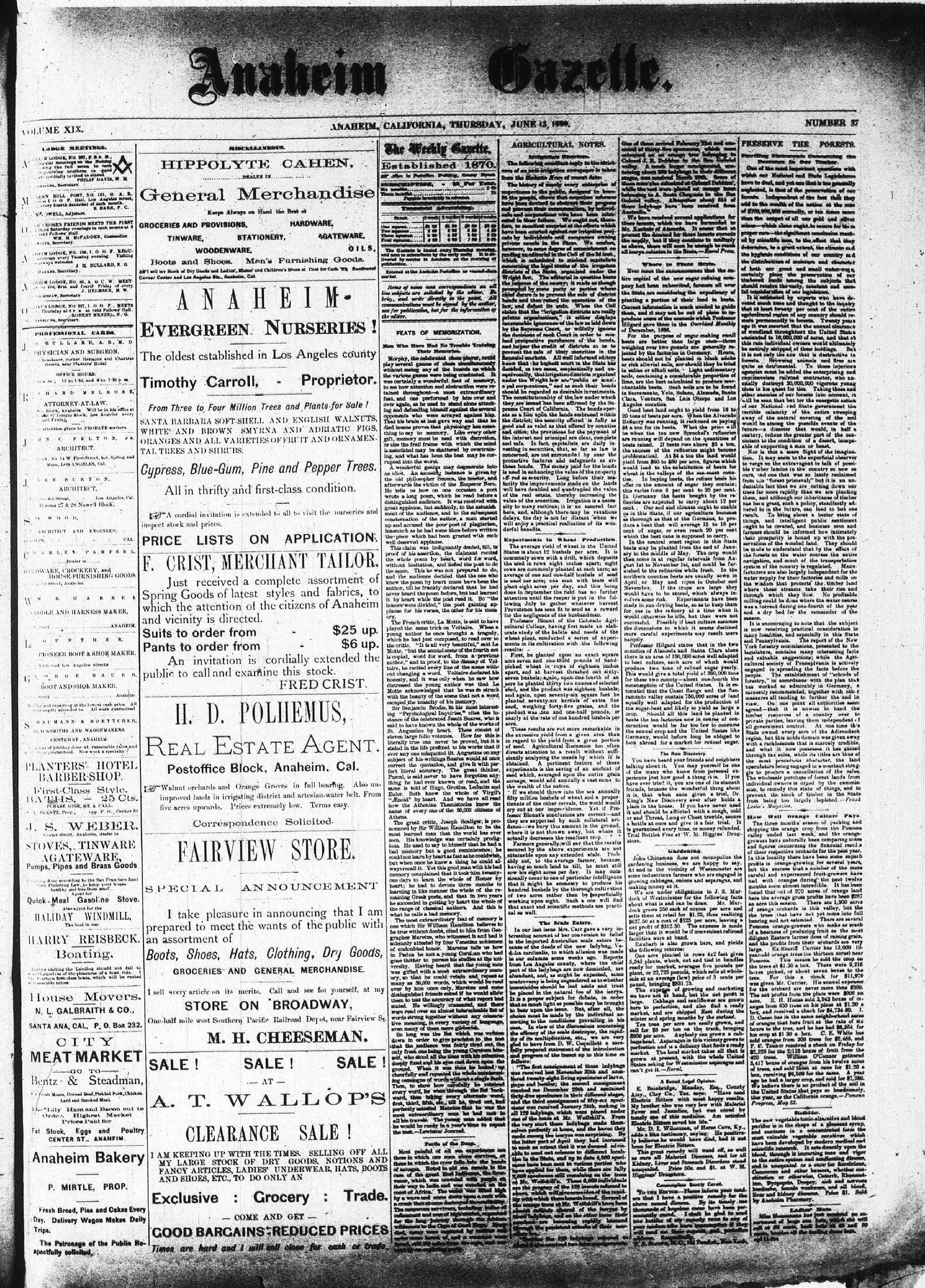
Searchable text
VOLUME XIX.
Lodge Meetings.
A MEMORIAL LODGE, NO. 287, F.A.A.M.
Meetings on the Monday
during the fall season in each
corridorially located building.
PHILIP DAYS, W. M.
MARRYER, Secretary.
MENN HILL POST, NO. 131, G. A. R.
MENN I.O.O.F. Hall, Los Angeles street,
every fourth Saturday of each month.
E BARK, P. C.
XF. DWELL, Adjutant.
CHOSEN FRIENDS MEETS THE FIRST
Monday evening in each month at 8
Odd Fellow's Hall.
WM. M. McFADDEN, Commissor.
AURY, Secretary.
MEMORIAL LODGE, NO. 190, I. O. O. F.
Meetings every Tuesday evening.
Visiting
always welcome.
J. H. BULLARD, N. O.
HARRIS, Secretary.
MEMORIAL LODGE, NO. 85, A. O. U. W.
Meet
the first and fourth Friday of every
J. HEIMSEN, M. W.
WASHAW, Secretary.
PROFESSIONAL CARDS.
J. BULLARD, A.B., M.D.
PHYSICIAN AND SURGEON.
Residence, corner Hermine and Chartres
streets, near Planters' Hotel.
OFFICE HOURS:
12 to 1:30, and 6 to 7:30 p.m.
RICHARD MELROSE,
ATTORNEY-AT-LAW.
Block, Anaheim Will be in his office at
the 9th Temple Block, Los Angeles every
and Friday.
Attention given to PROBATE matters.
JOHN C. PELTON, J.R.
ARCHITECT.
No 14 W First Street, bet Spring and
Main, Los Angeles, Cal.
MISCELLANEOUS.
HIPPOLYTE CAHEN
DEALER IN
General Merchandise
Keeps Always on Hand the Best of
GROCERIES AND PROVISIONS,
HARDWARE,
TINWARE,
STATIONERY,
AGATEV
WOODENWARE,
Boots and Shoes. Men's Furnishing Goo
EST will my Block of Dry Goods and Ladies', Mimes' and Children's Shoes at Cost for Cash.
Cermec Center and Los Angeles St., Anaheim, Cal.
ANAHEIM
EVERGREEN NURSERI
The oldest established in Los Angeles o
Timothy Carroll, - Proprietor
From Three to Four Million Trees and Plants for
SANTA BARBARA SOFT-SHELL AND ENGLISH WAWHITE AND BROWN SMYRNA AND ADRIATIC
ORANGES AND ALL VARIETIES OF FRUIT AND ORIGTAL TREES AND SHRUBS.
Cypress, Blue-Gum, Pine and Pepper
RICHARD MELROSE,
ATTORNEY AT LAW.
Block, Anaheim. Will be in his office at Temple Block, Los Angeles every Friday.
Attention given to PROBATE matters.
JONC PELTON, JE
ARCHITECT.
No 14 W First Street, bet. Spring and Main, LOS ANGELES, Cal.
JEE BURTON,
ARCHITECT.
Second Street, Los Angeles, Cal.
Rooms 27 & 28 Newell Block.
SWOOD,
ARCHITECT AND ENGINEER.
CAL.
CHARLES PAMPERL.
Dealer in Hardware, Crockery, and House Furnishing Goods street, Anaheim.
W R HARKE
HANDLE AND HARNESS MAKER,
ANAHEIM.
LUNTHER,
PIONEER BOOT & SHOE MAKER.
Anaheim.
GEORGE BAUER
BOOT AND SHOE MAKER.
Anaheim.
SHAUMANN & DOETTCHER,
BLACKSMITHS AND WAGONMAKERS.
CENTER ST, Anaheim.
PLANTERS' HOTEL
BARBER-SHOP.
First-Class Style.
BATHS. - 25 Cts.
PLEASE GIVE ME A CALL.
GRANTZ, Prop. opp. P. D., Center St
J. S. WEBER.
Center street, Anaheim, dealer in Stoves, Tinware Agateware,
Pumps, Pipes and Brass Goods
Quick-Meal Gasoline Stove.
Also agent for the
Timothy Carroll,
From Three to Four Million Trees and Plants for Santa Barbara Soft-Shell and English White and Brown Smyrna and Adriatic Oranges and All Varieties of Fruit and Orchard Trees and Shrubs.
Cypress, Blue-Gum, Pine and Pepper
All in thrifty and first-class condition.
A cordial invitation is extended to all to visit the nurseries inspect stock and prices.
PRICE LISTS ON APPLICATION
F. CRIST, MERCHANT TAIR
Just received a complete assortment of Spring Goods of latest styles and fabrics which the attention of the citizens of Anaheim and vicinity is directed.
Suits to order from $20
Pants to order from $9
An invitation is cordially extended public to call and examine this stock.
FRED CRISI
H. D. POLHEMUS,
REAL ESTATE AGENT
Postoffice Block, Anaheim, CA
Walnut orchards and Orange Groves in full bearing improved lands in irrigating district and artesian-water five acres upwards. Prices extremely low. Terms easy.
Correspondence Solicited.
FAIRVIEW STORE
SPECIAL ANNOUNCEMENT
J. S. WEBER.
Center street. Anaheim, dealer in
STOVES, TINWARE
AGATEWARE,
Pumps, Pipes and Brass Goods
Closing done according to the San Francisco Sani
City Plumbing Law, to keep your house
healthy and free from smell.
Agent for
Quick-Meal Gasoline Stove.
Also agent for the
HALIDAY WINDMILL,
The best in use.
HARRY REISBECK.
Boating.
Parties waiting the Landing should not fail to
themselves of the pleasures of a boat ride.
I have two first-class boats, which will be rented
for reasonable prices.
House Movers.
N. L. GALBRAITH & CO.,
SANTA ANA, CAL, P. O. Box 232.
CITY
MEAT MARKET
GO TO
Bentz & Steadman,
Fresh Meats, Corned Beef, Pickled Pork, Chicken
Lard and Smoked Meat.
The "Lily Ham and Bacon out to
Order." Highest Market
Prices Paid for
Fat Stock, Eggs and Poultry.
CENTER ST., ANAHFIM.
Anaheim Bakery
P. MIRTLE, PROP.
Fresh Broad, Pies and Cakes Every
Day. Delivery Wagon Makes Daily
Trips.
The Patronage of the Public Respontfully collected.
Correspondence Solicited.
FAIRVIEW STORE
SPECIAL ANNOUNCEMENT
I take pleasure in announcing that
prepared to meet the wants of the pub,
an assortment of
Boots, Shoes, Hats, Clothing, Dry
GROCERIES AND GENERAL MERCHANE
I sell every article on its merits. Call and see for your
STORE ON BROADWAY
One-half mile west Southern Pacific Railroad Depot, near
M. H. CHEESEMA
SALE! SALE! S
AT
A. T. WALLO
CLEARANCE SALE
I AM KEEPING UP WITH THE TIMES. SELLING
MY LARGE STOCK OF DRY GOODS, NOTHING
FANCY ARTICLES, LADIES' UNDERWEAR, HATS
AND SHOES, ETC., TO DO ONLY AN
Exclusive : Grocery :
— COME AND GET —
GOOD BARGAINS: REDUCED R
Times are hard and I will sell close for oush
ANAHEIM, CALIFORNIA, THURSDAY, JUNE 13, 1870.
CAHEN,
Merchandise
the Best of
HARDWARE,
ERY,
AGATEWARE,
OILS,
Furnishing Goods.
Children's Books at Cost for Cash.
E I M •
NURSERIES!
Los Angeles county
Proprietor.
Tees and Plants for Sale!
AND ENGLISH WALNUTS,
A AND ADRIATIC FIGS,
OFFRUIT AND ORNAMENe and Pepper Trees.
The Weekly Gazette.
Established 1870.
Items of news and correspondence on all line subjects are solicited by the editor. Brief, and write directly to the point. All communications must be signed by the author, not for publication, but for the information of the editor.
FEATS OF MEMORIZATION.
Men Who Have Had No Trouble Training
Their Memories.
Morphy, the celebrated chess player, could play several games of chess simultaneously without seeing any of the boards on which the various games were being conducted. It was certainly a wonderful feat of memory, to see how attention and abstraction were retained throughout—a most extraordinary feat, and one performed by him over and over again, as he used to stand alone attacking and defending himself against the several opponents who were arrayed against him.
That his brain at last gave way and that he died insane proves that physiology has something to say to memory. Like every other gift, memory must be used with discretion, or else the frail frame with which the mind is associated may be shattered by overtraining, and what has been the best may be corrupted into the worst.
A wonderful genius may degenerate into an idiot. An amazing instance is given by the old philosopher Seneca, the master, and
AGRICULTURAL NOTES.
Industrial Disturbance.
The following excellent reply to the strife of an paid irrigation newspaper in taken from the Mahante News of recent date.
The history of nearly every enterprise of importance to the public design to benefit the people, shows that irrigation advances have been derived to electent their programs and prevent their communication, by individuals and corporations who have been inhibited in their failures. We might not, therefore, to manifest surprise of the effects which have been started against our irrigation projects by individuals and companies owning private emblems in the State. We confine, however, to some degree of amusement on pending an editorial in the Call of the 24th month, which is calculated to maintain capitals concerning the legal status of the irrigation districts of the State, organized under the Wright law. The editorial in question bears the imprint of the enemy; it reads as though prompted by some party or partisan chief decree in to prevent the sale of district bonds and thus retard the operation of the law, and defeat its ends. When the Call states that the "irrigation districts are really private organizations," it either displays maximal ignorance of the law as laid down by the Supreme Court, or willfully ignores the dominion of such Court in order to mallead prospective paranormal of the bonds, and injure the credit of districts so as to prevent the sale of their securities in the financial markets. All well informed editors know that he highest court in the State has decided, in two cases, emphatically and unequivocally, that irrigation districts organized under the Wright law are "public or municipal corporations," and as such their bonds should be regarded as desirable investments.
The constitutionality of the law under which they are imposed has been affirmed by the Supreme Court of California. The bonds operate as a lien upon the lands embarked within the district; the security offered is fully as good and as valid as that offered by counties and cities; the provisions for the payment of the interest and principal are clear, complete and safe. In fact, capitalists are daily investing in securities, that, so far as law is concerned, are not surrounded by near the protective features and safeguards as are these bonds. The money paid for the bonds is used in enhancing the value of the property offred as security. Long before their ma-
One of three months ahead of Calendar J., Mr. Valley. A holding shares auger, now with them behind this bearing them Indyholly Oakland valids them Indyholly Australia.
We have no three inmates Mr. Kashkari present the captainship all its levy, and all its levy calls.
When ever sincere capital pay had been held in the State are planting a pro-Correct informers, and they produce some Hilgard gavels for December.
For the beets we weighing overjected by the financial markets. All well informed editors know that he highest court in the State has decided, in two cases, emphatically and unequivocally, that irrigation districts organized under the Wright law are "public or municipal corporations," and as such their bonds should be regarded as desirable investments.
The constitutionality of the law under which they are imposed has been affirmed by the Supreme Court of California. The bonds operate as a lien upon the lands embarked within the district; the security offered is fully as good and as valid as that offered by counties and cities; the provisions for the payment of the interest and principal are clear, complete and safe. In fact, capitalists are daily investing in securities, that, so far as law is concerned, are not surrounded by near the protective features and safeguards as are these bonds. The money paid for the bonds is used in enhancing the value of the property offred as security. Long before their ma-
Good beets: 20 tons of beef; Refinery was $4 a ton for when she are running beets raised; success problems yield from $5 would lead wheat in thieves. In b
was certainly a wonderful feat of memory,
to see how attention and abstraction were retained throughout—a most extraordinary feat, and one performed by him over and over again, as he need to stand alone attacking and defending himself against the several opponents who were arrayed against him. That his brain at last gave way and that he died inane proves that physiology has something to say to memory. Like every other gift, memory must be used with discretion, or else the frail frame with which the mind is associated may be shattered by overtraining, and what has been the best may be corrupted into the worst.
A wonderful genius may degenerate into an idiot. An amazing instance is given by the old philosopher Seneca, the master, and afterwards the victim of the Emperor Nero. He tells us how on one occasion a poet wrote a long poem, which he read before a distinguished audience. It was received with great applause, but suddenly, to the astonishment of the audience, and to the subsequent consternation of the author, a man started up and accused the poor poet of plagiarism, masmuch as he had some time before written the piece which had been greeted with such well deserved applause.
This claim was indignantly denied, till, in proof of his assertion, the claimant recited the whole poem by heart, word for word without hesitation, and defied the post to do the same. This he was not prepared to do, and the audience decided that the one who knew the poem by heart must have been the author; till he frankly declared that he had never heard the poem before, but had learned it by heart while the post read it. So "the honor-were divided," the poet gaining applause for his verse, the other for his memory.
The French critic, La Motte, is said to have played the same trick on Voltaire. When a young author he once brought a tragedy, which he had just composed, to read over to the critic. "It is all very beautiful," said La Motte, "but the second scene of the fourth act is copied, word for word, from a previous author," and in proof, to the dismay of Voltaire, he recited every line of the scene without changing a word. Voltaire declared his honesty, and it was only when he saw how distressed the young author was that La Motte acknowledged that he was struck with the beauty of the scene that not a word escaped the tenacity of his memory.
Sir Benjamin Brodie, in his most interesting "Psychological Inquiries," cities the instance of the celebrated Jesuit Suarez, who is said to have known the whole of the works of St. Augustine by heart. These consist of eleven large folio volumes. How far this literally true can never be proved, but it is stated in the life prefixed to his works that if ever any one misquoted St. Augustine on any subject of his writings Suarez would at once correct the quotation, and give it with perfect literal accuracy. The great thinker, Pascal, is said never to have forgotten anything he had ever known or read, and the same is told of Hugo Grotius, Leibnitz and Euler. Both knew the whole of Virgil's "Enneid" by heart. And we have all read how the Athenian Themistocles knew the name of every one of the 20,000 citizens of Athens.
The great critic, Joseph Scaliger, is pronounced by Sir William Hamilton to be the most learned man that the world has ever seen. His knowledge was certainly prodigious. He used to say to himself that he had a bad memory but a good reminiscence; he could not learn by heart as fast as he could wish, but when once he knew a thing he could always recall it. Yet this good man with his bad memory complained that it took him twenty-one days to learn the whole of Homer by heart; he had to devote three months to learning in like manner the whole of the remaining Greek poets, and that in two years he succeeded in getting by heart the whole of the range of classical authors. And this is certainly a wonderful feat of memory, to see how attention and abstraction were retained throughout—a most extraordinary feat, and one performed by him over and over again, as he need to stand alone attacking and defending himself against the several opponents who were arrayed against him. That his brain at last gave way and that he died innate proves that physiology has something to say to memory. Like every other gift, memory must be used with discretion, or else the frail frame with which the mind is associated may be shattered by overtraining, and what has been the best may be corrupted into the worst.
A wonderful genius may degenerate into an idiot. An amazing instance is given by the old philosopher Seneca, the master, and afterwards the victim of the Emperor Nero. He tells us how on one occasion a poet wrote a long poem, which he read before a distinguished audience. It was received with great applause, but suddenly, to the astonishment of the audience, and to the subsequent consternation of the author, a man started up and accused the poor poet of plagiarism, masmuch as he had some time before written the piece which had been greeted with such well deserved applause.
This claim was indignantly denied, till, in proof of his assertion, the claimant recited the whole poem by heart, word for word without hesitation, and defied the post to do the same. This he was not prepared to do, and the audience decided that the one who knew the poem by heart must have been the author; till he frankly declared that he had never heard the poem before, but had learned it by heart while the post read it. So "the honor-were divided," the poet gaining applause for his verse, the other for his memory.
The French critic, La Motte, is said to have played the same trick on Voltaire. When a young author he once brought a tragedy, which he had just composed, to read over to the critic. "It is all very beautiful," said La Motte, "but the second scene of the fourth act is copied, word for word, from a previous author," and in proof, to the dismay of Voltaire, he recited every line of the scene without changing a word. Voltaire declared his honesty, and it was only when he saw how distressed the young author was that La Motte acknowledged that he was so struck with the beauty of the scene that not a word escaped the tenacity of his memory.
Sir Benjamin Brodie, in his most interesting "Psychological Inquiries," cities the instance of the celebrated Jesuit Suarez, who is said to have known the whole of the works of St. Augustine by heart. These consist of eleven large folio volumes. How far this literally true can never be proved, but it is stated in the life prefixed to his works that if ever any one misquoted St. Augustine on any subject of his writings Suarez would at once correct the quotation, and give it with perfect literal accuracy. The great thinker, Pascal, is said never to have forgotten anything he had ever known or read, and the same is told of Hugo Grotius, Leibnitz and Euler. Both knew the whole of Virgil's "Enneid" by heart. And we have all read how the Athenian Themistocles knew the name of every one of the 20,000 citizens of Athens.
The great critic, Joseph Scaliger, is pronounced by Sir William Hamilton to be the most learned man that the world has ever seen. His knowledge was certainly prodigious. He used to say to himself that he had a bad memory but a good reminiscence; he could not learn by heart as fast as he could wish but when once he knew a thing he could always recall it. Yet this good man with his bad memory complained that it took him twenty-one days to learn the whole of Homer by heart; he had to devote three months to learning in like manner the whole of the remaining Greek poets, and that in two years he succeeded in getting by heart the whole of the range of classical authors. And this is certainly a wonderful feat of memory, to see how attention and abstraction were retained throughout—a most extraordinary feat, and one performed by him over and over again, as he need to stand alone attacking and defending himself against the several opponents who were arrayed against him. That his brain at last gave way and that he died innate proves that physiology has something to say to memory. Like every other gift, memory must be used with discretion, or else the frail frame with which the mind is associated may be shattered by overtraining, and what has been the best may be corrupted into the worst.
A wonderful genius may degenerate into an idiot. An amazing instance is given by the old philosopher Seneca, the master, and afterwards the victim of the Emperor Nero. He tells us how on one occasion a poet wrote a long poem, which he read before a distinguished audience. It was received with great applause, but suddenly, to the astonishment of the audience, and to subsequent consternation of the author, a man started up and accused the poor poet of plagiarism, masmuch as he had some time before written—the piece which had been greeted with such well deserved applause.
This claim was indignantly denied, till, in proof of his assertion, the claimant recited the whole poem by heart, word for word without hesitation, and defied the post to do the same. This he was not prepared to do, and the audience decided that the one who knew the poem by heart must have been the author; till he frankly declared that he had never heard the poem before, but had learned it by heart while the post read it. So "the honor-were divided,"the poet gaining applause for his verse,the other for his memory.
The French critic, La Motte,is said to have played 'the same trick on Voltaire.' When a young author he once brought a tragedy,which he had just composed,to read over to her critic. "It is all very beautiful," said La Motte,"butthe second sceneofthe fourthactiscopiedwordforwordfromapreviousauthor,"and in proof,to dieamayVoltaire,he recited every lineofthesomewithoutchangingaword.Voltairedeclaredhis honesty,anditwasonlywhenhe sawhowdistressedtheyoungauthorwasthatLaMotteackrustwiththebeautyofthescenethatnotawordescapedthetenacityofhismemory.
Sir Benjamin Brodie,in his most interesting "Psychological Inquiries," citiestheinstanceofthecelebratedJesuitSuarezwhoissaidedtohaveknownthewholeoftheworksofSt.Augustinebyheart.Theconsistofelevenlargefollovolumes.Howfarthisliterallytruecanneverbeproved,britishrowsinoneinsection;itisanassuredfacthere,andalthoughtheremaybeyexcessionsdelaysthedayisnotfardistantwhenwewillenjoyapracticalrealizationofitswonderfulbenefits.
Experiments in Wheat Production
The average yield of wheat in The United States is about 12 bushels per acre. It is commonly sown with a drill,whichdeposita seedin rowsin eight inches apart;eightrowsarecommonlyplantedateachturn;an averageofoneandone-halfbushelsofseedisusedperacream;oneacrewillplanteightacresperday,andthisbeingdoneinSeptemberthefieldhasnofurtherattentionuntilthereperisputinthefollowingJulytogatherwhateverharvestProvidencehasseenfitsendasrewardforthe negligenceofthehusbandman.
Professor BlountoftheColoradoAgriculturalCollege,havingfirstmadean elaboratestudyofthehabitsandneedsofthewheatplant,conductaseriesofexperimentsinitscultivationwith.thefollowingresults:
First,他 planted upon an exact squareacresevenandone-thirdpoundsoffhand-pickedwheatinrowsineighty-sevenbushels;again,pupillenowone-fourthofanacreheplantedthirtytwoouncesofselectedseed,andtheproductwouldsixteenbushels;andagainupone seventy-sixkernelsofextra fineseed,weighingforty-fivegrains,andtheproductwouldstenewone-halfpoundsofmorethanwecouldoutatourimprovidence.YetifProfessorBlount'sconclusionsarecorrect—andtheyaresupportedbysuchcollateralavidence—weburythisamountinthegroundwhereitisnot thrownaway,但whereitactuallydecreasestheresultancrop.
Farmersgenerallywill say thattheresultssecuredbytheaboveexperimentsarenotattainableupanyextendedscale.Probablynot,totheaveragefarmer,becausehavingso muchlandtotill,hemuststillnowhiseightacresperday.Iltmayoccasionallyoccurtooneparticularintelligencethatit mightbeeconomytoproducehimbundbashelsbylethoroughcultivationoftwoseacratherthanbyperpetiallyworkingupeight.Suchaonewillfindthatexactandscientificmethodsarepracti-
You have talking aboutofthemainperiencejighaveeverbefriends,beitisthatKing'sNephewinplaceitandshoworthorandTharobottleattainsguaranteeTrialBottlestore.
JohnChasegardeningAtandsomeinducingcrowingmakingme
We are dockofWaboutwhatlockgrow
NEW STORE.
NOUNCEMENT
announcing that I am
ents of the public with
Clothing, Dry Goods,
MERAL MERCHANDISE.
Call and see for yourself, at my
BROADWAY,
Railroad Depot, near Fairview St.
HEESEMAN.
SALE!
ALLLOP'S
E SALE!
TIMES. SELLING OFF ALL
ERY GOODS, NOTIONS AND
UNDERWEAR, HATS, BOOTS
ONLY AN
GOCERY: Trade.
ND GET —
REDUCED PRICES
all close for cash or trade.
The great critic, Joseph Scalliger, is pronounced by Sir William Hamilton to be the most learned man that the world has ever seen. His knowledge was certainly prodigious. He used to say to himself that he had a bad memory but a good reminiscence; he could not learn by heart as fast as he could wish, but when once he knew a thing he could always recall it. Yet this good man with his bad memory complained that it took him twenty-one days to learn the whole of Homer by heart; he had to devote three months to learning in like manner the whole of the remaining Greek poets, and that in two years he succeeded in getting by heart the whole of the range of classical authors. And this is what he calls a bad memory.
The most extraordinary feat of memory is one which Sir William Hamilton believes to be true without doubt, cited to him from Geographer Maretus, who witnessed it and had solemnly attested by four Venetian noblemen of undoubted honor. Maretus tells us how Padua he met a young Coralian who had gone thither to pursue his studies at the university. Having heard that the young man was gifted with a most extraordinary memory, so that he could retain and repaint as many as 30,000 words, which would be read over by him once only. Maretus and some distinguished friends asked if he would allow them to test the accuracy of what report had stated. He willingly consented, and there were read over an almost interminable list of words strung together without any consecutive meaning, in every variety of languages, even many of them mere gibberish.
So long was the list which was written down in order to give precision to the fact that the audience was fairly tired out, the only fresh one being the young Coralian himself, who stood all the time with his attention deeply fixed and his eyes cast down upon the ground. When it was time he looked up cheerfully and repeated the whole misremembering catalogue of words without a single fault. Then, to show how carefully he retained every word, he went through the list backward, then taking every alternate word first, third, fifth, etc., till he tried out, had perfectly satisfied Maretus that he was the most extraordinary man he had met in all his travels. The young man added that he would be ready in a year's time to repeat the task—Lewiston Journal.
Parts of the Deep.
Most painful of all men experiments are those in which one man alone survives, or those in which the crew falls into the hands of marigans. Noted in old accounts is the case of the great Indian Indian, the first renter, which was crowded with people on their way to India and was watched on the coast of Africa. The world was filled high by a wave and came down upon a rock with a crash that at least damaged its stability. The numerous survivors, including both of reinforcement and one of lightning strikes williams to the Coast of Great Britain. Many more were injured by storms and a constant rainfall williams to the Coast of Great Britain.
The great critic, Joseph Scalliger, is pronounced by Sir William Hamilton to be the most learned man that the world has ever seen. His knowledge was certainly prodigious. He used to say to himself that he had a bad memory but a good reminiscence; he could not learn by heart as fast as he could wish, but when once he knew a thing he could always recall it. Yet this good man with his bad memory complained that it took him twenty-one days to learn the whole of Homer by heart; he had to devote three months to learning in like manner the whole of the remaining Greek poets, and that in two years he succeeded in getting by heart the whole of the range of classical authors. And this is what he calls a bad memory.
The most extraordinary feat of memory is one which Sir William Hamilton believes to be true without doubt, cited to him from Geographer Maretus, who witnessed it and had solemnly attested by four Venetian noblemen of undoubted honor. Maretus tells us how Padua he met a young Coralian who had gone thither to pursue his studies at the university. Having heard that the young man was gifted with a most extraordinary memory, so that he could retain and repaint as many as 30,000 words, which would be read over by him once only. Maretus and some distinguished friends asked if he would allow them to test the accuracy of what report had stated. He willingly consented, and there were read over an almost interminable list of words strung together without any consecutive meaning, in every variety of languages, even many of them mere gibberish.
So long was the list which was written down in order to give precision to the fact that the audience was fairly tired out, the only fresh one being the young Coralian himself, who stood all the time with his attention deeply fixed and his eyes cast down upon the ground. When it was time he looked up cheerfully and repeated the whole misremembering catalogue of words without a single fault. Then, to show how carefully he retained every word, he went through the list backward, then taking every alternate word first, third, fifth, etc., till he tried out, had perfectly satisfied Maretus that he was the most extraordinary man he had met in all his travels. The young man added that he would be ready in a year's time to repeat the task—Lewiston Journal.
In our last issue Mrs. Cair gave a very interesting account of her conversion to belief in the imported Australian scale eaters because of the deeds of the new ladybug, Vadula cardinalis, to which allusion was made in our columns some weeks ago. Reporter from Los Angeles county, where the chief part of the ladybugs are now domiciled, are abundant, and, as might be expected, some controversy is being engendered as to whether innocides should be land aside and trust be placed in the natural foe of the icerya. It is a proper subject for debate, in order that as much light as possible may be brought to bear upon the issue. But after all, the choice must be made by the individual according to the conditions prevailing in his case. In view of the dimensions concerning the efficacy of the scale destroyer, the rapidity of its multiplication, etc., we are very glad to have from D. W. Coquillett a carefully prepared statement of the introduction and progress of the insect up to this time as follows:
"The first consignment of these ladybugs was received last November 20th and numbered twenty-eight living specimens of larvae pupae and beetles; the second consignment reached me December 29th and contained fifty-five specimens in their different stages, and the third consignment of fifty-six specimens was received January 24th, making in all 129 ladybugs, which were placed under one of the tents at Mr. Wolfskill's. From the very start these ladybugs made themselves perfectly at home, and they have made among the insects was surprising. By the latter part of April they had increased to such an extent that it was deemed advisable to send out columnes to different localities in the State, and up to date 4,000 specimens have been sent to various parts who have applied for them, while there are fully 2,000 specimens still remaining on the tents at Mr. Wolfskill's. These 6,000 individuals are the progeny of the 129 insects referred to above, which will remain broad. Several of these insects from Mr. Wolfskill's house already allowed of the insects by about half-bugs and on other lines than bulbids through the predated adults of their larvae."
To verify on these that above all thousand mammals have been yearly sold within a certain period
NOTES.
by to the strict paper is taken
not date:
enterprise of
agent to, homeasian ethantheir program
by individual
been inhaleright not, thereeffects which
arrival prejucent owing
We confirm,
amendment on
of the 2d lint,
and capitalize
the irrigation
and under the
question bounsals as though
partition whence
walls of district
mention of the
When the Call
acts are really
other displays
we laid down
fully ignores
order to manof the bonds,
gets to as to
varities in the
formed editors
the State has
really and unruptively organized
public or munbish their bonds
in investments.
under which
used by the Suthe bonds opercased within
and is fully as
used by counties
payment of clear, complete
are daily infar as law is
by near the guards as are
for the bonds of the property more their manuals.
One of these arrived Primary that and consisted of things like aquaculture, which were obtained on no charge but belonging to Colonial J. R. Dabbing in the San Gabriel valley.
A much larger investigation, containing about 500 hectares in their different stages, was conducted March 19th. Some of those over the extended at Colonial Dabbling, while they were plained at orange barn balancing to A. Scott Chapman in the San Gabriel valley. All together about 844 of these hectares have been received from Australia.
We have received several applications for these inmates, which we have forwarded to Mr. Kendall of Annapolis. It seems that at present the demand for these inmates exceeds the supply, but if they continue to multiply as above, there will seem be enough to result all leisure colonies in the State.—Rural Press.
Where to Pine Beets.
Ever since the announcement that the entire capital of the new sugar refining company had been subscribed, formans all over the State are considering the expedition of planting a portion of their land in beets. Correct information is much needed to guide them, and it may not be out of place to reproduce some of the commns which Professor Hilgard gave them in the Overland Monthly of December, 1896.
For the purpose of sugar-making small beets are better than large ones—those weighing over two pounds are generally rejected by the factories in Germany. Hence, beets should not be planted in black adobe or rich alluvial soils, nor should they be tried in saline or alkali soils. Light sedimentary soil, containing a considerable proportion of lime, are the best calculated to produce merchantable beets. Such soils are to be found in Sacramento, Yolo, Solano, Alameda, Santa Clara, Ventura, San Luis Obispo and Los Angeles counties.
Good beet land ought to yield from 16 to 20 tons of beets per acre. When the Alvarado Refinery was running, it reckoned on paying $4 a ton for its beets. What the price will be when the ten new Spreckel's refineries are running will depend on the quantities of beets raised. If beets rose above $5 a ton, the success of the refineries might become problematical. At $4 a ton the land would yield from $60 to $80 per acre, figures which would lead to the substitution of beets for wheat in the valleys of the sea-coast counties.
In buying beets, the retainer basis his
PRESERVE THE FORESTS.
Nurselling Statements Commencing the Monroe In Our Thunder.
One of the most important questions with which our National and State Legislatures have to deal, and yet one that is so generally neglected, is that of the preservation of our forests. Independent of the fact that they add to the wealth of the nation at the rate of $700,000,000 annually, or ten times more than the output of all our gold and silver mines—which alone ought to ensure for this proper care—the significant contribution reached by scientific men, to the effect that they determine, to a great extent, the climate and the hygromic conditions of our country and the distributions of moisture and character of both our great and small waterways, certainly play the preservation of our timberland lands among the subjects that should receive the early, constant and careful consideration of our legislators.
It is estimated by experts who have devoted much time and thought to the inquiry that at least twenty per cent of the entire agricultural region of any country should remain permanently in forests. Twenty years ago it was asserted that the annual elevenage of woodland throughout the United States amounted to 10,000,000 acres, and that at this rate individual owners would ultimately be entirely stripped of their holdings. But it is not only the axe that is destructive to formula. Browning animals and fires are quite as detrimental. To these injurious agencies must be added the enterprising and cooperative railroad contractor, who annually destroyed 30,000,000 vigorous young trees in his quest for ties. Taking these and other enemies of our forests into account, it will be seen that but for the energetic action of our National rad state government the terrible calamity of the entire sweeping away of the natural covering of the soil would be among the possible events of the future—a disaster that would, in half a century, reduce the greater part of the continent to the condition of a desert, incapable of supporting a man or bear.
Nor is this a mere flight of imagination. It may seem to the superficial observer to verge on the extravagant to talk of possible timber famine in the country so new as ours, and one that was so lately reclaimed from "forest primal" but it is an an-
Production in the United States is fully supported by counties in Sacramento, Yolo, Solano, Alameda, Santa Clara, Ventura, San Luis Obispo and Los Angeles counties.
Good beet land ought to yield from 16 to 20 tons of beets per acre. When the Alvarado Refinery is running, it reckoned on paying $4 a ton for its beets. What the price will be when the ten new Spreckel’s refineries are running will depend on the quantities of beets raised. If beets rose above $5 a ton, the success of the refineries might become problematical. At $4 a ton the land would yield from $60 to $80 per acre, figures which would lead to the substitution of beets for wheat in the valleys of the sea-coast counties.
In buying beets, the refiner basis his offer on the amount of sugar they contain; this varies from 6 per cent to 20 per cent. In Germany the beets bought by the refineries are expected to carry about 12 per cent. Our soil and climate ought to enable us in this State, if our agriculture becomes as thorough as that of the Germans, to produce a beet that will average 15 to 18 per cent of sugar, or even reach 20 per cent which the best cane is supposed to carry.
In the central coast region in this State beets may be planted from the end of January to the middle of May. The crop would then come in at regular intervals from August 1st to November 1st, and could be furnished to the refineries while fresh. In the northern counties beets are usually sown in April or May and ripen in October and November. If the crops are large they would have to be stored, which always involves some risk. Experiments have been made in sun-drying beets, so as to keep them for use in the refinery at a time when it would otherwise be idle, but they were not successful. Possibly if best culture assumes the dimensions to which it seems destined more careful experiments may result mere happily.
Professor Hilgard states that in the two counties of Alameda and Santa Clara alone there is an area of 190,000 acres well adapted to beet culture, each acre of which would produce two tons of refined sugar yearly. This would give a total yield of 380,000 tons for these two county—about one-fourth the consumption of the United States. It is estimated that the Coast Range and the Sacramento valley contain 750,000 acres of land equally well adapted for the production of the sugar-beet and likely to yield as large a crop. Should all this land be planted in beet the ten factories now in course of construction would be far too few to consume the annual crop and the United States like Germany, would before long be obliged to look abroad for a market for refined sugar.
The New Discovery.
You have heard your friends and neighbors talking about it. You may yourself be one of the many who know from personal experience just how good a thing it is. If you have ever tried it, you are one of its staunch friends, because the wonderful thing about it, that when once given a trial, Dr. King’s New Discovery ever after holds a place in the house. If you have never used it and should be afflicted with a cough, cold or Throat, Lung or Chest trouble, secure a bottle at once and give it a fair trial. It is guaranteed every time, or money refunded. Trial Bottles Free at W. M. Higgins’ Drugstore.
Gardening.
John Chinaman does not monopolize the gardening business, we are happy to say. At and in the vicinity of Westminster are some industrious farmers who are engaged in growing cabbage, onions and asparagus, and making money at it.
We are under obligations to J. S. Murdock of Westminster for the following facts about what is and can be done: Mr. Murdock grows 350 sack of onions per acre and lime, are the best calculated to produce merchantable beets. Such soils are to be found in Sacramento, Yolo, Solano, Alameda, Santa Clara, Ventura, San Luis Obispo and Los Angeles counties.
Good beet land ought to yield from 16 to 20 tons of beets per acre. When the Alvarado Refinery is running, it reckoned on paying $4 a ton for its beets. What the price will be when the ten new Spreckel’s refineries are running will depend on the quantities of beats raised. If beats rose above $5 a ton, the success of the refineries might become problematical. At $4 a ton the land would yield from $60 to $80 per acre, figures which would lead to the substitution of beets for wheat in the valleys of the sea-coast counties.
In buying beets, the refiner basis his offer on the amount of sugar they contain; this varies from 6 per cent to 20 per cent. In Germany the beets bought by the refineries are expected to carry about 12 per cent. Our soil and climate ought to enable us in this State, if our agriculture becomes as thorough as that of the Germans, to produce a beet that will average 15 to 18 per cent of sugar, or even reach 20 per cent which the best cane is supposed to carry.
In the central coast region in this State beets may be planted from the end of January to the middle of May. The crop would then come in at regular intervals from August 1st to November 1st, and could be furnished to the refineries while fresh. In the northern counties beets are usually sown in April or May and ripen in October and November. If the crops are large they would have to be stored, which always involves some risk. Experiments have been made in sun-drying beets, so as to keep them for use in the refinery at a time when it would otherwise be idle, but they were not successful. Possibly if best culture assumes the dimensions to which it seems destined more careful experiments may result mere happily.
Professor Hilgard states that in the two counties of Alameda and Santa Clara alone there is an area of 190,000 acres well adapted to beet culture, each acre of which would produce two tons of refined sugar yearly. This would give a total yield of 380,000 tons for these two county—about one-fourth the consumption of the United States. It is estimated that the Coast Range and the Sacramento valley contain 750,000 acres of land equally well adapted for the production of the sugar-beet and likely to yield as large a crop. Should all this land be planted in beet the ten factories now in course of construction would be far too few to consume the annual crop and the United States like Germany, would before long be obliged to look abroad for a market for refined sugar.
The New Discovery.
You have heard your friends and neighbors talking about it. You may yourself be one of the many who know from personal experience just how good a thing it is. If you have ever tried it, you are one of its staunch friends, because the wonderful thing about it, that when once given a trial, Dr. King’s New Discovery ever after holds a place in the house. If you have never used it and should be afflicted with a cough, cold or Throat, Lung or Chest trouble, secure a bottle at once and give it a fair trial. It is guaranteed every time, or money refunded. Trial Bottles Free at W. M. Higgins’ Drugstore.
Gardening.
John Chinaman does not monopolize the gardening business, we are happy to say. At and in the vicinity of Westminster are some industrious farmers who are engaged in growing cabbage, onions and asparagus, and making money at it.
We are under obligations to J. S. Murdock of Westminster for the following facts about what is and can be done: Mr. Murdock grows 350 sack of onions per acre and lime, are the best calculated to produce merchantable beets. Such soils are to be found in Sacramento, Yolo, Solano, Alameda, Santa Clara, Ventura, San Luis Obispo and Los Angeles counties.
Good beet land ought to yield from 16 to 20 tons of beets per acre. When the Alvarado Refinery is running, it reckoned on paying $4 a ton for its beets. What the price will be when the ten new Spreckel’s refineries are running will depend on the quantities of beats raised. If beats rose above $5 a ton, the success of the refineries might become problematical. At $4 a ton the land would yield from $60 to $80 per acre, figures which would lead to the substitution of beets for wheat in the valleys of the sea-coast counties.
In buying beets, the refiner basis his offer on the amount of sugar they contain; this varies from 6 per cent to 20 per cent. In Germany the beets bought by the refineries are expected to carry about 12 per cent. Our soil and climate ought to enable us in this State, if our agriculture becomes as thorough as that of the Germans, to produce a beet that will average 15 to 18 per cent of sugar, or even reach 20 per cent which the best cane is supposed to carry.
In the central coast region in this State beets may be planted from the end of January to the middle of May. The crop would then come in at regular intervals from August 1st to November 1st, and could be furnished to the refineries while fresh. In the northern counties beets are usually sown in April or May and ripen in October and November. If the crops are large they would have to be stored, which always involves some risk. Experiments have been made in sun-drying beets, so as to keep them for use in the refinery at a time when it would otherwise be idle, but they were not successful. Possibly if best culture assumes the dimensions to which it seems destined more careful experiments may result mere happily.
Professor Hilgard states that in the two counties of Alameda and Santa Clara alone there is an area of 190,000 acres well adapted to beet culture, each acre of which would produce two tons of refined sugar yearly. This would give a total yield of 380,000 tons for these two county—about one-fourth the consumption of the United States. It is estimated that the Coast Range and the Sacramento valley contain 750,000 acres of land equally well adapted for the production of the sugar-beet and likely to yield as large a crop. Should all this land be planted in beet the ten factories now in course of construction would be far too few to consume the annual crop and the United States like Germany, would before long be obliged to look abroad for a market for refined sugar.
The New Discovery.
You have heard your friends and neighbors talking about it. You may yourself be one of the many who know from personal experience just how good a thing it is. If you have ever tried it, you are one of its staunch friends, because the wonderful thing about it, that when once given a trial, Dr. King’s New Discovery ever after holds a place in the house. If you have never used it and should be afflicted with a cough, cold or Throat, Lung or Chest trouble, secure a bottle at once and give it a fair trial. It is guaranteed every time, or money refunded. Trial Bottles Free at W. M. Higgins’ Drugstore.
Gardening.
John Chinaman does not monopolize the gardening business, we are happy to say. At and in the vicinity of Westminster are some industrious farmers who are engaged in growing cabbage, onions and asparagus, and making money at it.
We are under obligations to J. S. Murdock of Westminster for the following facts about what is and can be done: Mr. Murdock grows 350 sack of onions per acre and lime, are the best calculated to produce merchantable beets. Such soils are to be found in Sacramento, Yolo, Solano, Alameda, Santa Clara, Ventura, San Luis Obispo and Los Angeles counties.
Good beet land ought to yield from 16 to 20 tons of beets per acre. Whenthe Alvarado Refinery is running,the entire sweeping awayofthe natural coveringofthe soulwouldbe amongthe possibleeventsofthefuture—a disasterthatwould,intabasedtotheconditionofa desert,intcapableofsupportingmanororbeast.
Noristhisamereflightoftheimagination.Iitmayseemtothesuperficialobservertoveronetheextravaganttalkofpossibletimestomafinefarmfamineinthecountrysonewours,andonethatwassolatelyreclaimedfromtheforestprimeval;"butitisanunderdisciplainfactorthetheeffectofforestfarmfamineoutwearthecuttingdownourtreesfarmorerapidlythanweareplantingthemandalthoughourinheritanceoftheimnaturehasbeentgreat,suchapolicysteadfastadheredtointhen futurecanbewatercoursewastorrentduringone-fourthoftheyearanda drybedfortheremainderoftheseason.
Itisencouragingtotnotethatthesubjectisnow-receivingpracticalconsiderinmanylocalities,andespeciallyinthisStateandPennsylvania.ThereportofNewYorkforestrycommissions,presentedtothelegislaturecontainsmanyinterestingfactsandvaluable suggestions;whiletheAgriculturalsocietyofPennsylvaniaisactivelyengagedinspreadingthefactsbeforethepeople.Theestablishmentof"schoolsofforestry,"inaccordancewiththeplanthathasworkedsoadmirablyinGermany,aearnestrecommended,togetherwithothermeasuresalltendingtofurtherendinview.Ononepointallauthorities seemagreed—thatititunewwisetohandthetimerepositoryofacountryovertoprivatelpartss leavingthemenindependentofallgovernmentcontrol.AtonetimethisStateownedeveryacreofAdirondackregion,butthis nobledomainwasgivenawaywitharecklessnessthatisscarcelycredible,andwhatitnowposessesithathasworkedsoadmirablyinGermany,aearnestrecommended,togetherwithothermeasuresalltendingtofurtherendinview.Ononepointallauthorities seemagreed—thatititunewwisetohandthetimerepositoryofacountryovertoprivatelpartss leavingthemenindependentofallgovernmentcontrol.AtonetimethisStateownedeveryacreofAdirondackregion,butthis nobledomainwasgivenawaywitharecklessnessthatisscarcelycredible,andwhatitnowposessesithathasworkedsoadmirablyinGermany,aearnestrecommended,togetherwithothermeasuresalltendingtofurtherendinview.Ononepointallauthorities seemagreed—thatititunewwisetohandthetimerepositoryofacountryovertoprivatelpartss leavingthemenindependentofallgovernmentcontrol.AtonetimethisStateownedeveryacreofAdirondackregion,butthis nobledomainwasgivenawaywitharecklessnessthatisscarcelycredible,andwhatitnowposessesithathasworkedsoadmirablyinGermany,aearnestrecommended,togetherwithothermeasuresalltendingtofurtherendinview.Ononepointallauthorities seemagreed—thatititunewwisetohandthetimerepositoryofacountryovertoprivatelpartss leavingthemenindependentofallgovernmentcontrol.AtonetimethisStateownedeveryacreofAdirondackregion,butthis nobledomainwasgivenawaywitharecklessnessthatisscarcelycredible,andwhatitnowposessesithathasworkedsoadmirablyinGermany,aearnestrecommended,togetherwithothermeasuresalltendingtofurtherendinview.Ononepointallauthorities seemagreed—thatititunewwisetohandthetimerepositoryofacountryovertoprivatelpartss leavingthemenindependentofallgovernmentcontrol.AtonetimethisStateownedeveryacreofAdirondackregion,butthis nobledomainwasgivenawaywitharecklessnessthatisscarcelycredible,andwhatitnowposessesithathasworkedsoadmirablyinGermany,aearnestrecommended,togetherwithothermeasuresalltendingtofurtherendinview.Ononepointallauthorities seemagreed—thatititunewwisetohandthetimerepositoryofacountryovertoprivatelpartss leavingthemenindependentofallgovernmentcontrol.AtonetimethisStateownedeveryacreofAdirondackregion,butthis nobledomain wasgivenawaywitharecklessnessthatisscarcelycredible,andwhatitnowposessesithathasworkedssoadmirablyinGermany,aearnestrecommended,togetherwithothermeasuresalltendingtofurtherendinview.Ononepointallauthorities seemagreed—that它itunewwisetohandthetimerepositoryofacountryovertoprivatelpartss leavingthemenindependentofallgovernmentcontrol.AtonetimethisStateownedeveryacreofAdirondackregion,butthis nobledomain wasgivenawaywitharecklessnessthatisscarcelycredible,andwhat它nowposSESitshowingthemenindependentofallgovernmentcontrol.AtonetimethisStateownedeveryacreofAdirondackregion,butthis nobledomain wasgivenawaywitharecklessnessthatisscarcelycredible,andwhat它nowposSESitshowingthemenindependentofallgovernmentcontrol.AtonetimethisStateownedeveryacreofAdirondackregion,butthis nobledomain wasgivenawaywitharecklessnessthatisscarcelycredible,andwhat它nowposSESitshowingthemenindependentofallgovernmentcontrol.AtonetimethisStateownedveryacreofAdirondackregion,butthis nobledomain wasgivenawaywitharecklessnessthatisscarcelycredible,andwhat它nowposSESitshowingthemenindependentofallgovernmentcontrol.AtonetimethisStateownedveryacreOfAdirondackregion,butthis nobledomain wasgivenawaywitharecklessnessthatisscarcelycredible,andwhat它nowposSESitshowingthemenindependentofallgovernmentcontrol.AtonetimethisStateownedveryacreOfAdirondackregion,butthis nobledomain wasgivenawaywitharecklessnessthatisscarcelycredible,andwhat它nowposSESitshowingthemenindependentofallgovernmentcontrol.AtonetimethisStateownedveryacreOfAdirondackregion,butthis nobledomain wasgivenawaywitharecklessnessthatisscarcelycredible,andwhat它nowposSESitshowingthemenindependentofallgovernmentcontrol.AtonetimethisStateownedveryacreOfAdirondackregion,butthis nobledomain wasgivenawaywitharecklessnessthatisscarcelycredible,andwhat它nowposSESitshowingthemenindependentofallgovernmentcontrol.AtonetimethisStateownedveryacreOfAdirondackregion,butthis nobledomain wasgivenawaywitharecklessnessthatisscarcelycredible,andwhat它nowposSESitshowingthemenindependentofallgovernmentcontrol.AtonetimethisStateownedveryacreOfAdirondackregion,butthis nobledomain wasgivenawaywitharecklessnessthatisscarcelycredible,andwhat它nowposSESitshowingthemenindependentofallgovernmentcontrol.AtonetimethisStateownedveryacreOfAdirondackregion,butthis nobledomain wasgivenawaywitharecklessnessthatisscarcelycredible,andwhat它nowposSESitshowingthemenindependentofallgovernmentcontrol.AtonetimethisStateownedveryacreOfAdirondackregion,butthis nobledomain wasgivenawaywitharecklessnessthatisscarcelycredible,andwhat它nowposSESitshowingthemenindependentofallgovernmentcontrol.AtonetimethisStateownedveryacreOfAdirondackregion,butthis nobledomain wasgivenawaywitharecklessnessthatisscarcelycredible,andwhat它nowposSESitshowingthemenindependentofallgovernmentcontrol.AtonetimethisStateownedveryacreOfAdirondackregion,butthis nobledomain wasgivenawaywitharecklessnessthatisscarcelycredible,andwhat它nowposSESitshowingthemenindependentofallgovernmentcontrol.Atone时间thisStateownedveryacreOfAdirondackRegion,butthis nobledomain wasgivenawaywitharecklessnessthatisscarcelycredible,andwhat它nowposSESitshowingthemenindependentofallgovernment控制.Atone时间thisStateownedveryacreOfAdirondackRegion,butthis noble domain wasgivenawaywitharecklessnessthatisscarcelycredible,andwhat它nowposSESitshowingthemenindependentofallgovernment控制.Atone时间thisStateownedveryacreOfAdirondackRegion,butthis noble domain wasgivenawaywitharecklessness thatisscarcelycredible,andwhat它nowposSESitshowingthemenindependentofallgovernment控制.Atone时间 thisStateownedveryacreOfAdirondackRegion,butthis noble domain wasgivenawaywitharecklessness thatisscarcelycredible,andwhat它nowposSESitshowingthemenindependentofallgovernment控制.Atone时间 thisStateownedveryacreOfAdirondackRegion,butthis noble domain wasgivenawaywitharecklessness thatisscarcelycredible,andwhat它nowposSESitshowingthemenindependentofallgovernment控制.Atone时间 thisStateownedveryacreOfAdirondackRegion,butthis noble domain wasgivenawaywitharecklessness thatisscarcelycredible,andwhat它nowposSESitshowingthemenindependentofallgovernment控制.Atone时间 thisStateownedveryacreOfAdirondackRegion,butthis noble domain wasgivenawaywitharecklessness thatisscarcelycredible,andwhat它nowposSESitshowingthemenindependentofallgovernment控制.Atone时间 thisStateownedveryacreOfAdirondackRegion,butthis noble domain wasgivenawaywitharecklessness thatisscarcelycredible,andwhat它nowposSESitshowingthemenindependentofallgovernment控制.Atone时间 thisStateownedveryacreOfAdirondackRegion,butthis noble domain wasgivenawaywitharecklessness thatisscarcelycredible,andwhat它nowposSESitshowingthemenindependentofallgovernment控制.AtONE时间 thisStateownedveryacreOfAdirondackRegion,butthis noble domain wasgivenawaywitharecklessness thatisscarcelycredible,andwhat它nowposSESitshowingthemenindependentofallgovernment控制.АтONE时间 thisStateownedveryacreOFAdirondackRegion,butthis noble domain wasgivenawaywitharecklessness thatisscarcelycredible,andwhat它nowposSESitshowingthemenindependent OFADIRONDACKREGION,BUTTHE FOREST IS THE NEW FORM OF ENGLAND'S FORESTSYSTEM AND IT HAS A REAL EFFECT ON THE ENVIRONMENT AND THE ENVIRONMENTAL PRODUCTS OF THE FOREST ARE IN A GREAT DISTANCE FROM THE SOUTHWESTERN COAST TO THE NORTHWESTERN COAST AND IT HAS A REAL EFFECT ON THE ENVIRONMENT AND THE ENVIRONMENTAL PRODUCTS OF THE FOREST ARE IN A GREAT DISTANCE FROM THE SOUTHWESTERN COAST TO THE NORTHWESTERN COAST AND IT HAS A REAL EFFECT ON THE ENVIRONMENT AND THE ENVIRONMENTAL PRODUCTS OF THE FOREST ARE IN A GREAT DISTANCE FROM THE SOUTHWESTERN COAST TO THE NORTHWESTERN COAST AND IT HAS A REAL EFFECT ON THE ENVIRONMENT AND THE ENVIRONMENTAL PRODUCTS OF THE FOREST ARE IN A GREAT DISTANCE FROM THE SOUTHWESTERN COAST TO THE NORTHWESTERN COAST AND IT HAS A REAL EFFECT ON THE ENVIRONMENT AND THE ENVIRONMENTAL PRODUCTS OF THE FOREST ARE IN A GREAT DISTANCE FROM THE SOUTHWESTERN COAST TO THE NORTHWESTERN COAST AND IT HAS A REAL EFFECT ON THE ENVIRONMENT AND THE ENVIRONMENTAL PRODUCTS OF THE FOREST ARE IN A GREAT DISTANCE FROM THE SOUTHWESTERN COAST TO THE NORTHWESTERN COAST AND IT HAS A REAL EFFECT ON THE ENVIRONMENT AND THE ENVIRONMENTAL PRODUCTS OF THE FOREST ARE IN A GREAT DISTANCE FROM THE SOUTHWESTERN COAST TO THE NORTHWESTERN COAST AND IT HAS A REAL EFFECT ON THE ENVIRONMENT AND THE ENVIRONMENTAL PRODUCTS OF THE FOREST ARE IN A GREAT DISTANCE FROM THE SOUTHWESTERN COAST TO THE NORTHWESTERN COAST AND IT HAS A REAL EFFECT ON THE ENVIRONMENT AND THE ENVIRONMENTAL PRODUCTS OF THE FOREST ARE IN A GREAT DISTANCE FROM THE SOUTHWESTERN COAST TO THE NORTHWESTERN COAST AND IT HAS A REAL EFFECT ON THE ENVIRONMENT AND THE ENVIRONMENTAL PRODUCTS OF THE FOREST ARE IN A GREAT DISTANCE FROM THE SOUTHWESTERN COAST TO THE NORTHWESTERN COAST AND IT HAS A REAL EFFECT ON THE ENVIRONMENT AND The ENVIRONMENTAL PRODUCTS OF THE FOREST ARE IN A GREAT DISTANCE FROM THE SOUTHWESTERN COAST TO THE NORTHWESTERN COAST AND IT HAS A REAL EFFECT ON THE ENVIRONMENT AND The ENVIRONMENTAL PRODUCTS OF THE FOREST ARE IN A GREAT DISTANCE FROM THE SOUTHWESTERN COAST TO The NORTHWESTERN COAST AND IT HAS A REAL EFFECT ON THE ENVIRONMENT AND The ENVIRONMENTAL PRODUCTS OF The FOREST ARE IN A GREAT DISTANCE FROM The SOUTHWESTERN COAST TO The NORTHWESTERN COAST AND IT HAS A REAL EFFECT ON The ENV
GARDENING.
John Chinaman does not monopolize the gardening business, we are happy to say. At and in the vicinity of Westminster are some industrious farmers who are engaged in growing cabbages, onions and asparagus, and making money at it.
We are under obligations to J. S. Murdock of Westminster for the following facts about what is and can be done. Mr. Murdock grows 350 sack of onions per acre and sells them at retail for $1.25, thus realizing $637.50 at a cost of $125 per acre, leaving a net profit of $312.50. The expense is made larger than it would be if convenient railroad facilities were at hand.
Ranbarb is also grown here, and yields the following returns:
One acre planted in rows 4x2 feet gives 5,545 plants, which cut and tied in bundles ready for market, averages five pounds per plant, or 22,725 pounds, which sells at wholesale at an average (low) price of 3 cents per pound, bringing $831.75.
The expunge of growing and marketing we have not at hand, but the net profit in large. Cabbage and cauliflower are grown here to perfection, and also find a ready market, and are shipped East during the winter and spring months by carload.
Ten tons per acre are easily grown, and sell for $8 per ton on the track, bringing $800 per acre. Anybody can grow a cabbage head. Asparagus in this vicinity grows to perfection and is a delicacy that finds a ready market. The local market takes all that is grown at present, with the whole United States asking for Westminster asparagus and can't get it.—Rural.
A Sound Legal Opinion.
E. Bainbridge, Manay, Esq., County Atty., Clay Co., Tex. says: "Have used Electric Bitters with most happy results. My brother also was very low with Material Fever and Jandinea, but was cared by trunely one of this medicine. Am assisted Electric Bitters saved his life."
Mr. D. I. Wilcoxon, of Horns Cave, Ky., adds a like testimony, saying: He positively believes he would have died, had it not been for Electric Bitters.
This great remedy will ward off, as well as cure all Malarial Diseases, and for all Kidney, Liver and Stomach Disorders stand unequaled. Price 50c. and $1. at W. M. Higgins' Drugstore.
Consumptive Safety Count.
To the Editor—Plans inform your readers that I have a positive remedy for the above named disease. By its timely use thousands of hopkins cases have been permanently cured. I shall be glad to send battle of my enemy to any of your patients who have presumption if they will send me their apologies, and pardon them.
W. R. Beasley M.C., Hill Pondet, New York.
Mow Well Orange Culture Pays.
The three month's season of packing and shipping the orange crop from the Pomona valley ended last week, and the orange-growers have naturally been comparing notes and figures concerning the financial result of their respective orchards for the past year.
In this locality there have been some superb profits in orange-growing for several years, but the success that a number of the more careful and experienced fruit-growers have had with oranges during the past twelve months seem almost incredible. It has been found that out of 970 acres of orange land here the average gross profits have been $287 an acre this season. There are 1,900 acres of orange orchards in this valley, but the trees that have not yet come into full bearing and not estimated. There are several Pomona orange-growers who make as much of a business of producing fruit as the most diligent Eastern farmer does of raising grain, and the profits from their orchards are very large.
Ex-Sheriff Currier has 12,000 10-year-old orange trees (on thirteen acres) near Pomona.
This season he sold the crop on the trees at $1.30 a box. There were 9,216 boxes picked, or about seven boxes to the tree.
For this a check for $11,979 was given Mr. Currier. His annual expenses for the orchard are never more than $200.
The net profits from the place were $006 an acre. R. H. House sold 3,943 boxes of oranges from 650 trees on his place at $1.20 a box, and received a check for $4,734 60.
J. D. Caen has in the same neighborhood acres of oranges that bore fruit at the rate of six boxes to the tree, and he has had $8,554 for his crop at $1.30 a box.
C. E. White has sold oranges from 300 trees for $2,465, and F. G. Tenner received a check on Friday for $2,528 for the 2,118 boxes of fruit from the 420 trees.
William O'Connor gathered 5,417 boxes of oranges from his twelve acres of trees, and sold them at once for $1.20 a box, receiving $6,509 for the name.
A year he had a larger crop, and sold for $7,280.
We believe there is no product of the soil in the United States that pays no handsomely this year, as the California orange—Pomona Progress, May 23.
Studbilder.
The new vegetable tonic-alterative and blood purifier is in the shape of a plump syrup, and contains in a concentrated form the most valuable vegetable curatives which have been developed by modern medical and scientific research. It acts directly upon the blood through its importing tone and vigor in the entire system and coordinating disease, and is unniquated as a cure for ferrodulence, Carcorone and other hammers whether constitution or otherwise, Catarrh, Rheumatism, Byspartia, Droopy, sick and nervous headaches, female weakness, and all blood fever and kidney diseases. Price $1.
Saldent Morte.
Miss Monmouth has just married an armenian of large sums here, which she will sell at 80 cents back held at 60 cents besides all the leading dozen lists,
and 14 cents.