anaheim-gazette 1889-05-30
Scanned page
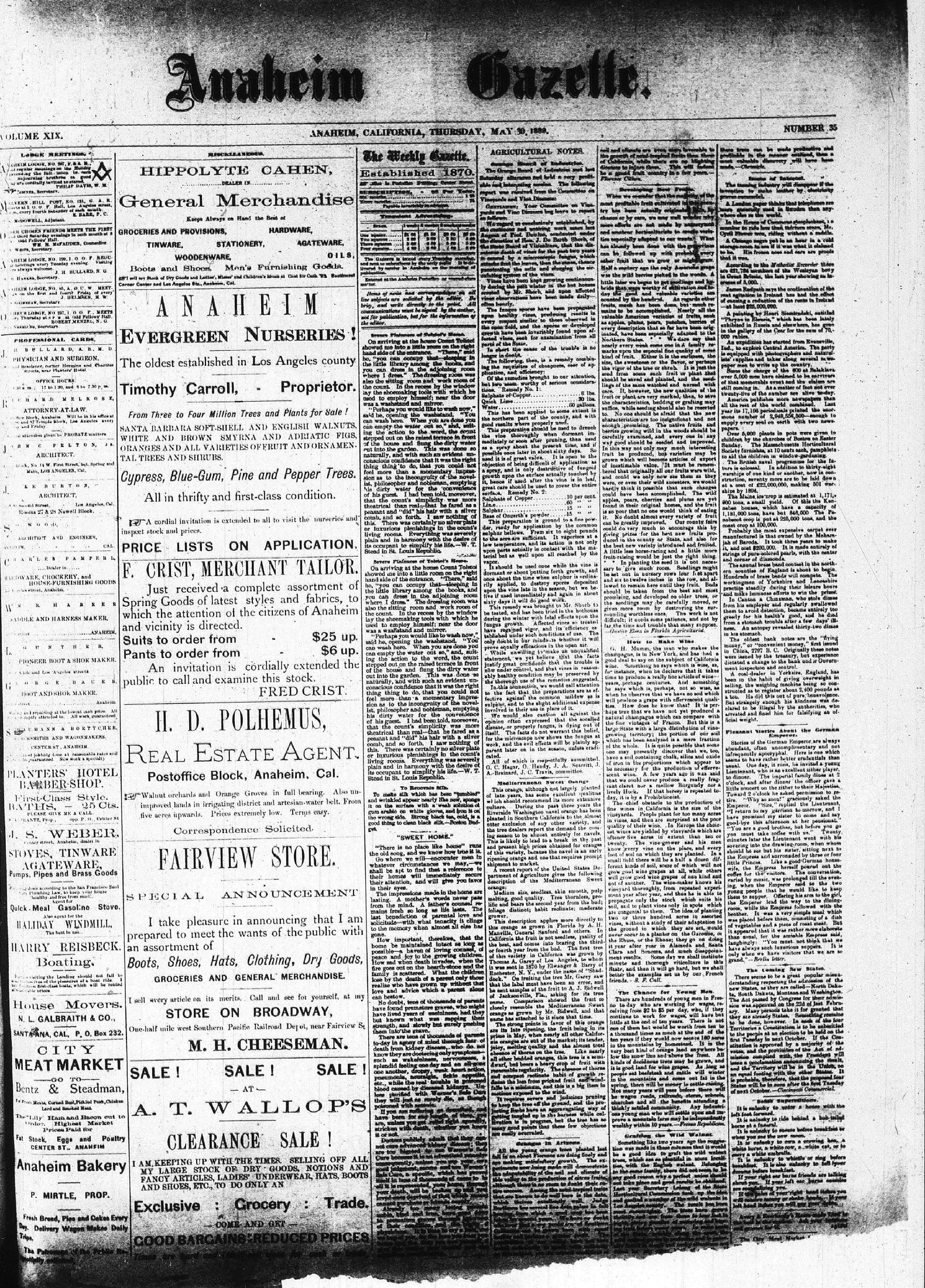
Searchable text
ANAHEIM
VOLUME XIX.
ANAHEIM
LODGE MEETINGS.
ANAHEIM LODGE, NO. 297, P.A.B.,
regular meetings on the Sunday
ascending the full moon in and
hoppering brothes in good
are cordially invited to attend.
PHILIP DAVIS, W. M.
ANAHEIM, SECRETARY.
ANAHEIM HILL POST, KO. 131, G. A. B.
at I. O.O. F. Hall, Los Angeles street,
every fourth Saturday of each month.
E. BARR, P. C.
McDOWELL, Adjutant.
ANAHEIM CHOREN FRIENDS MEET THE PIERST
third Saturday evenings in each month at 8
Old Fellower Hall.
W.M. M. McFADDEN, Commissioner.
Whirr, Secretary.
ANAHEIM LODGE, NO. 159, I. O.O. F. REGUmeetings every Tuesday evening. Visiting
always welcome.
J.H. BULLARD, N.O.
Hawker, Secretary.
ANAHEIM LODGE, NO. 65, A. O.U. W. MEETon the first and fourth Friday of every
J. HEILMSEN, M.W.
GINSHAW, Secretary.
ANAHEIM LODGE, NO. 237, I. O.O. F. MEETThursday at 8 p.m. at Old Fellower Hall.
ROBERT MENZEL, N.O.
Near Laurel, Secretary.
PROFESSIONAL CARDS.
J.H. BULLARD, A.B., M.D.
PHYSICIAN AND SURGEON.
Residence, corner Hermina and Chartres
street, near Plastery Hotel.
OFFICE HOURS:
9:00 am - 12 to 1:20, and 6 to 7:30 p.m.
RICHARD MELROSE,
ATTORNEY-AT-LAW.
Office Block, Anaheim. Will be in his office at
30 and 37 Temple Block, Los Angeles every
day and Friday.
Special attention given to PROBATE matters.
JOHN C PELTON, J.K.
ARCHITECT.
Block, No. 14 W. First Street, but Spring and
Main, Los Angeles, Cal.
MISCELLANEOUS.
HIPPOLYTE CAHEN,
DEALER IN.
General Merchandise
Keeps Always on Hand the Best of
GROCERIES AND PROVISIONS,
HARDWARE,
TINWARE,
STATIONERY,
AGATEWARE,
WOODENWARE,
OIL
Boots and Shoes. Men's Furnishing Goods.
API sell my Stock of Dry Goods and Ladier', Milner' and Children's Shoes at Cost for Cash. WA.
Carner Center and Los Angeles Stn., Anaheim, Cal.
ANAHEIM
EVERGREEN NURSERIES
The oldest established in Los Angeles counTimothy Carroll, - Proprietor
From Three to Four Million Trees and Plants for Sale
SANTA BARBARA SOFT-SHELL AND ENGLISH WALNU
WHITE AND BROWN SMYRNA AND ADRIATIC FIG
ORANGES AND ALL VARIETIES OF FRUIT AND ORNAMI
TAL TREES AND SHRUBS.
Cupress, Blue-Gum, Pine and Pepper Tree
RICHARD MELROSE,
ATTORNEY-AT-LAW.
Block, Anaheim. Will be in his office at 20 and 31 Temple Block, Los Angeles every day and Friday.
Attention given to PROBATE matters.
JOHN C. PELTON, JE.
ARCHITECT.
Block, No. 14 W. First Street, bet. Spring and Main, LOS ANGELES, Cal.
J. E BURTON,
ARCHITECT.
Second Street, Los Angeles, Cal.
Rooms 27 & 28 Newell Block.
S. WOOD,
ARCHITECT AND ENGINEER,
ANAHEIM.
CHARLES PAMPERL,
Dealer in...
HARDWARE, CROCKERY, and HOUSE-FURNISHING GOODS
Chelsea street, Anaheim.
W. R. HARKER
SADDLE AND HARNESS MAKER,
ANAHEIM.
L. GUNTHER,
PIONEER BOOT & SHOE MAKER.
Anaheim.
GEORGE BAUER
BOOT AND SHOE MAKER.
Anaheim.
SAMMANN & HOETTCHER,
BACKSMITHS AND WAGONMAKERS.
CENTER ST, Anaheim.
PLANTERS' HOTEL
BARBER-SHOP.
First-Class Style.
BATHS. - 25 Cts.
PLEASE GIVE ME A CALL.
WANTZ, Prop., opp. P. O., Center St.
J. S. WEBER.
STOVES, TINWARE AGATEWARE,
Pumps, Pipes and Brass Goods
Timothy Carroll, - Proprietor
From Three to Four Million Trees and Plants for Sale
SANTA BARBARA SOFT-SHELL AND ENGLISH WALNUT WHITE AND BROWN SMYRNA AND ADRIATIC FLOWERS AND ALL VARIETIES OF FRUIT AND ORNAMENTAL TREES AND SHRUBS.
Cypress, Blue-Gum, Pine and Pepper Trees
All in thrifty and first-class condition.
A cordial invitation is extended to all to visit the nurseries inspect stock and prices.
PRICE LISTS ON APPLICATION
F. CRIST, MERCHANT TAILOT
Just received a complete assortment of Spring Goods of latest styles and fabrics, which the attention of the citizens of Anaheim and vicinity is directed.
Suits to order from $25 u.
Pants to order from $6 u.
An invitation is cordially extended to public to call and examine this stock.
FRED CRIST
H. D. POLHEMUS,
REAL ESTATE AGENT
Postoffice Block, Anaheim, Cal.
Walnut orchards and Orange Groves in full bearing. Also improved lands in irrigating district and artesian-water belt. Five acres upwards. Prices extremely low. Terms easy.
Correspondence Solicited.
FAIRVIEW STORE.
SPECIAL ANNOUNCEMENT
J. S. WEBER,
Century street, Anaheim, dealer in
STOVES, TINWARE
AGATEWARE,
Pumps, Pipes and Brass Goods
Quick-Meal Gasoline Stove.
Also agent for the
HALIDAY WINDMILL,
The best in use.
HARRY REISBECK.
Boating.
House Movers.
N. L. GALBRAITH & CO.,
SANTA ANA, CAL., P. O. Box 232.
CITY
MEAT MARKET
GO TO
Bentz & Steadman,
Fresh Meats, Corned Beef, Pork,肋肉, Chicken
Lard and Smoked Meat.
The "Lily" Ham and Bacon out to
Order. Highest Market
Prices Paid for
Fat Stock, Eggs and Poultry
CENTER ST... ANAHFIM
Anaheim Bakery
P. MIRTLE, PROP.
Fresh Bread, Pies and Oakes Every
Day. Delivery Wages Make Daily
Trips.
The Patronage of the Public Boilery adjoins.
FAIRVIEW STORE.
SPECIAL ANNOUNCEMENT
I take pleasure in announcing that I
prepared to meet the wants of the public w
an assortment of
Boots, Shoes, Hats, Clothing, Dry Goods
GROCERIES AND GENERAL MERCHANDISE.
I sell every article on its merits. Call and see for yourself,
STORE ON BROADWAY,
One-half mile west Southern Pacific Railroad Depot, near Fairvie
M. H. CHEESEMAN.
SALE! SALE! SALE!
AT
A. T. WALLOP
CLEARANCE SALE!
I AM, KEEPING UP WITH THE TIMES. SELLING OFF
MY LARGE STOCK OF DRY GOODS, NOTIONS
FANCY ARTICLES, LADIES' UNDERWEAR, HATS, F
AND SHOES, ETC., TO DO ONLY AN
Exclusive: Grocery: Tra-
— COME AND GET —
GOOD BARGAINS: REDUCED PRICE
ANAHEIM, CALIFORNIA, THURSDAY, MAY 30, 1889.
AHEN,
handise
HARDWARE,
AGATEWARE,
OILS,
urnishing Goods.
at Cost for Cash W. Southward
I M
URSERIES!
Angeles county
Proprietor.
and Plants for Sale!
ENGLISH WALNUTS,
AND ADRIATIC FIGS,
FRUIT AND ORNAMENd Pepper Trees.
The Weekly Gazette.
Established 1870.
Items of nines and correspondence on all line subjects are solicited by the editor. Be brief, and write directly to the publisher. All communications must be signed by the author, not for publication, but for the information of the editor.
Severe Pleasure of Tulare County.
On arriving at the home County Tulare showed me into a little room on the right hand side of the entrance. "There," said he, "you can occupy that—sleeping in the little library among the books, and you can drom in the adjoining room where I dream." The dressing room was also the sitting room and work room of the count. In the recess by the window the shoemaking tools with which he used to employ himself; near the door was a washstand and mirror.
"Perhaps you would like to wash now," said he, opening the washstand. "You can wash here. When you are done you can empty the water out so," and, suitig the action to the word, the count stepped out on the raised terrace in front of the house and flung the dirty water out into the garden. This was done so naturally, and with such an evident unconscious confidence that it was the right thing thing to do, that you could not feel more than a momentary impression as to the incongruity of the novel-
AGRICULTURAL NOTES.
Average biomass of landmatter.
The Orange Board of Industry and last Saturday afternoon and held a very profitable and interpreting session. The following report was received from the Commission on Vineyards and Vine Diseases.
GRANTMENT: Your Committee on Vineyards and Vine Dismisses bug have to report as follows.
We regard an essentially established, by this condition and existing work most last August of Fred Durham, conducted under the direction of Henn J. De Barth Sherr, of the Hunt Board of Vineulture, that the disease death of vines for the past two years is caused by a microcrop fungus, which attains first the leaves, then the stem, then the crown, presenting the entire and sloughing the circling system of the vines.
Vines have been kept growing continuously during the past winter in the hot houses created by Mr. Sherb, and upon affected vine observations have been made daily—often hourly.
The fungus spores have been propagated upon healthy vines, producing results in every respect similar to those observed in the open field, and the spores or developed growth have been invariably found upon affected vines, sent for examination from all parts of the State.
In short the cause of the trouble is no longer in doubt.
The following, then, is a remedy combining the requisite of cheapness, ease of application, and efficiency:
Of the remedies brought to our attention, but two seem worthy of serious considerations. Remedy No. 1:
Salphate of Copper...6 lbs.
Quick Lime...30 lbs.
Water...50 gallons.
This has been applied to some extent in the northern part of the county, and with good results where properly used.
This preparation should be used to drench the vine thoroughly when dormant immediately or soon after pruning, then used as a spray about the present time, and if possible once later in about sixty days. So used it is of great value.
It is open to the objection of being difficult of application as a spray, and is only destructive of fungoid growth upon the surface actually touched by it after the vine is in leaf.
and climate are this growth of small bogs in California while climate to injure them is gradual fruit on Florida Citrus.
Developing.
When we consider much profitable fruit has been eaten chance or by care, we more affords are added and another horticulture has already adopted has already been followed with other fruit that will Half a century ago was the wild harrier little later we began bride that may worst day the good and counted by the hand fruits, much has been main to be accumulated valuable American apples, plums, peaches every description thinned, have been on Northern States. nearly every week marks upon the apical kind of fruit. Either size, the sweetness of the vigor of the tree cool from some areas should be saved and linges of the same ware. It, however, fruit or plant are very characteristic, suffice while seedling to. No one should characteristics are to enough promising berries growing wild carefully examined, way good should be in this way not only fruit be produced grown which will be of inestimable value bered that originally and could we only
Proprietor.
And Plants for Sale!
ENGLISH WALNUTS,
AND ADRIATIC FIGS,
FRUIT AND ORNAMENand Pepper Trees.
ss condition.
to visit the nurseries and
APPLICATION.
NT TAILOR.
ate assortment of
s and fabrics, to
izens of Anaheim.
in full bearing. Also undial artesian-water belt. From
ow. Terms easy.
solicited.
STORE.
UNCEMENT
also the sitting room and work room of
the count. In the rooms by the window
lay the shoemaking tools with which he
used to employ himself; near the door
was a washstand and mirror.
"Perhaps you would like to wash now," said he, opening the washstand. "You can wash here. When you are done you can empty the water out so," and, suiting the action to the word, the count stepped out on the raised terrace in front of the house and flung the dirty water into the garden. This was done so naturally, and with such an evident unconscious confidence that it was the right thing thing to do, that you could not feel more than a momentary impression as to the incongruity of the novelist, philosopher and nobleman, emptying his dirty water for the convenience of his guest. I had been told, moreover, that the count's simplicity was more theatrical than real—that he fared as a peasant and "did" his hair with a silver comb, and so forth. I saw nothing of this. There was certainly no silver plate or luxurious plenishings in the count's living rooms. Everything was severely plain and in harmony with the desire of its occupant to simplify his life.—W. T. Stead in St. Louis Republic.
Severe Plainness of Toilette's Home.
On arriving at the house Count Tolstot showed me into a little room on the right hand side of the entrance. "There," said he, "you can occupy that—sleeping in the little library among the books, and you can dress in the adjoining room where I dress." The dressing room was also the sitting room and work room of the count. In the recess by the window lay the shoemaking tools with which he used to employ himself; near the door was a washstand and mirror.
"Perhaps you would like to wash now," said he, opening the washstand. "You can wash here. When you are done you can empty the water out so," and, suiting the action to the word, the count stepped out on the raised terrace in front of the house and flung the dirty water into the garden. This was done so naturally, and with such an evident unconscious confidence that it was the right thing thing to do, that you could not feel more than a momentary impression as to the incongruity of the novelist, philosopher and nobleman, emptying his dirty water for the convenience of his guest. I had been told, moreover, that the count's simplicity was more theatrical than real—that he fared as a peasant and "did" his hair with a silver comb, and so forth. I saw nothing of this. There was certainly no silver plate or luxurious plenishings in the count's living rooms. Everything was severely plain and in harmony with the desire of its occupant to simplify his life.—W. T. Stead in St. Louis Republic.
To Renovate Mild.
To make silk which has been "pumbed" and wrinkled appear nearly like new, sponge it on the surface with a weak solution of gum arable on white gloves, and iron it on the wrong side. Strong black tea, cold, is a good thing to clean black silk—Boston Budget.
"SWEET HOME."
"There is no place like home" runs the old song, and we know how true it is. Go where we will—encounter men in whatever circumstances we may,—we shall be apt to find that a reference to their homes will immediately secure their attention, and will give you favor in their eyes.
The impressions made in the home are lasting. A mother's words never pass from the mind. A father's counsel re-
also the sitting room and work room of
the count. In the rooms by the window lay the shoemaking tools with which he used to employ himself; near the door was a washstand and mirror.
"Perhaps you would like to wash now," said he, opening the washstand. "You can wash here. When you are done you can empty the water out so," and, suiting the action to the word, the count stepped out on the raised terrace in front of the house and flung the dirty water into the garden. This was done so naturally, and with such an evident unconscious confidence that it was the right thing thing to do, that you could not feel more than a momentary impression as to the incongruity of the novelist, philosopher and nobleman, emptying his dirty water for the convenience of his guest. I had been told, moreover, that the count's simplicity was more theatrical than real—that he fared as a peasant and "did" his hair with a silver comb, and so forth. I saw nothing of this. There was certainly no silver plate or luxurious plenishings in the count's living rooms. Everything was severely plain and in harmony with the desire of its occupant to simplify his life.—W. T. Stead in St. Louis Republic.
Severe Plainness of Toilette's Home.
On arriving at the house Count Tolstot showed me into a little room on the right hand side of the entrance. "There," said he, "you can occupy that—sleeping in the little library among the books, and you can dress in the adjoining room where I dress." The dressing room was also the sitting room and work room of the count. In the recess by the window lay the shoemaking tools with which he used to employ himself; near the door was a washstand and mirror.
"Perhaps you would like to wash now," said he, opening the washstand. "You can wash here. When you are done you can empty the water out so," and, suiting the action to the word, the count stepped out on the raised terrace in front of the house and flung the dirty water into into the garden. This was done so naturally, and with such an evident unconscious confidence that it was the right thing thing to do, that you could not feel more than a momentary impression as to the incongruity of the novelist, philosopher and nobleman, emptying his dirty water for the convenience of his guest. I had been told, moreover, that the count's simplicity was more thematrical than real—that he fared as a peasant and "did" his hair with a silver comb, and so forth. I saw nothing of this. There was certainly no silver plate or luxurious plenishings in the count's living rooms. Everything was severely plain and in harmony with the desire of its occupant to simplify his life.—W. T. Stead in St. Louis Republic.
To Renovate Mild.
To make silk which has been "pumbled" and wrinkled appear nearly like new, sponge it on the surface with a weak solution of gum arable on white gloves, and iron it on the wrong side. Strong black tea, cold, is a good thing to clean black silk—Boston Budget.
"SWEET HOME."
"There is no place like home" runs the old song, and we know how true it is. Go where we will—encounter men in whatever circumstances we may,—we shall be apt to find that a reference to their homes will immediately secure their attention, and will give you favor in their eyes.
The impressions made in the home are lasting. A mother's words never pass from the mind. A father's counsel re-
also also the sitting room and work room of
the count. In the rooms by the window lay the shoemaking tools with which he used to employ himself; near the door was a washstand and mirror.
"Perhaps you would like to wash now," said he, opening the washstand. "You can wash here. When you are done you can empty the water out so," and suiting the action to the word, the count stepped out on the raised terrace in front of the house and flung the dirty water into into the garden. This was done so naturally, and with such an evident unconscious confidence that it was the right thing thing to do, that you could not feel more than a momentary impression as to the incongruity of the novelist, philosopher and nobleman, emptying his dirty water for the convenience of his guest. I had been told, moreover, that the count's simplicity was more thematrical than real—that he fared as a peasant and "did" his hair with a silver comb, and so forth. I saw nothing of this. There was certainly no silver plate or luxurious plenishings in the count's living rooms. Everything was severely plain and in harmony with the desire of its occupant to simplify his life.—W. T. Stead in St. Louis Republic.
Mediterranean Sweet Orange
This orange, although not largely planted of late years, has some excellent qualities which should recommend its more extensive culture. During past three yearsthe Riverside Washington navel orange has been planted in Southern California to almost utter exclusion of any other variety, andthe tree dealers reportthe demandthe coming seasonto be almost entirely for navels. This is likely to lead to a breakin-the past and present high prices obtained for oranges of this variety,becausethe navelis an early ripening orangeand one that requires prompt shipment to market.
A recent reportofthe United States Departmentof Agriculture givesthe following descriptionofthe Mediterranean Sweet orange:
Medium size,seedless,skin smooth,pulp mating,good quality.Tree thornless.prolificand bearsthe secondyearfromthebud;foliage distinct;habit recolinate;moderate
Of theseremainedsappliedtotwoseasonsworthyofseriousconsiderations.RemedyNo1:
SalphateofCopper.....6 lbs.
QuickLime.....30 lbs.
Water.....50 gallons.
This has been appliedtosome extentinthe northernpartofthecount,andwithgoodresultswhereproperlyused.
This preparationshouldbeusedtodrenchthevinethoroughlywhen dormantimmediatelyorsoonafterpruning,theasapray,andisonlydestructiveof fungoidgrowthuponthesurfaceactually touchedbyit,henceifusedafterthevineisinleaf,greatcareshouldbeusedtocoverentiresurface.RemedyNo2:
SalphateofCopper.....10 per cent.Lime.....60""Salphur.....15"
BassofOngerth'spowder.....15"
This preparationisgroundtoa fine powder,routineforapplicationbythecommon sulphurbellows.From sixto eightpoundstotheacreare sufficient.Ivaporizesatalew温度,anditsactionnotonlyuponpartsactuallyincontactwiththematerialbutaswelluponallreachedbythe vapor.
It shouldbeused oncewhilethe vineisdormantoraboutputtingfourgrowth,andonceaboutthetimewhen sulphurisordinarilyapplied,tostestroyspores deposited uponthevinelateintheseason,但webeliveifusedimmediatelyandagaininaboutsixtydaysitwilldogoodwork.
This remedywouldbroughttoMr.Shorbtobe tested,andhasbeen triedinthehothouseduringthewinterwith fatal effectsuponthefungusgrowth.Affectedvinesso treatedhaveregained vigor,anditsefficiencycausestablishedundersuchconditionsofuse.Theonly doubtinburndimsiswhetheritwillproveequallyefficaciousintheopenair.
Whileunwillingtomakeanunqualifiedstatementweweyetibetgreatconfidencethatthetroubleisnowundercontrol,andthatvinesinreasonablyhealthyconditionmaybepreservedbythethoroughuseoftheremediesuggested.
Inthisconnectionwewouldcallattentiontofactthatthepreparationsareasefectiveagainstthecommonmidweldasisulphur,andtoalightadditionalexpenseinvolvedin theiruseinplaceofit.
Wewouldalsocautionallagainstthe opinion often expressedthatthesocialdisease,或properlyfungus,i dyingoutofitself.The factsdo not warrantthis belief.forthemicroscopenowshowsthefungusatwork,andtheevil-effectswillbeplainlyapparentlateronintheseseason unlesseradicated.
Allofwhichisrespectfullysummed.G.C.H.hagar.O.Handy.J.A.Scarritt.J.A.Brainard.J.C.Travis.committee.
G.H.Hummingchampagne.isinNogooddealtoayonew酒.
SomethingforinstancewhenevertimeinappropriateaforestStatewitha-growingterritory;whichhasbeenandofthewhole.itonemaypresenthavetheirsofirginintheprojectbeenercessaryforthescentwine.AfeatthatwecouldneverrantclaretnoranylovelyHock.
Ifday.itisbyaPrototypefinewinesinCaliforniavineyards.Peopleinvines,andthenqualityof theirw est wines yieldewineresistanttwenty.everyvineworthygrowngoodwinewillgrowgoodwinternecessaryforthescentwine.AfeatthatwecouldneverrantclaretnoranylovelyHock.
Ifday.itisbyaPrototypefinewinesinCaliforniavineyards.Peopleinvines,andthenqualityof theirw est wines yieldewineresistanttwenty.everyvineworthygrowngoodwinewillgrowgoodwinternecessaryforthescentwine.Afeatthatwe couldneverrantclaretnoranylovelyHock.
Ifday.itisbyaPrototypefinewinesinCaliforniavineyards.Peopleinvines,andthenqualityof theirw est wines yieldewineresistanttwenty.everyvineworthygrowngoodwinewillgrowgoodwinternecessaryforthescentwine.Afeatthatwe couldneverrantclaretnoranylovelyHock.
Ifday.itisbyaPrototypefinewinesinCaliforniavineyards.Peopleinvines,andthenqualityof theirw est wines yieldewineresistanttwenty.everyvineworthygrowngoodwinewillgrowgoodwinternecessaryforthescentwine.Afeatthatwe couldneverrantclaretnoranylovelyHock.
Ifday.itisbyaPrototypefinewinesinCaliforniavineyards.Peopleinvines,andthenqualityof theirw est wines yieldewineresistanttwenty.everyvineworthygrowngoodwinewillgrowgoodwinternecessaryforthescentwine.Afeatthatwe couldneverrantclaretnoranylovelyHock.
Ifday.itisbyaPrototypefinewinesinCaliforniavineyards.Peopleinvines,andthenqualityof theirw est wines yieldewineresistanttwenty.everyvineworthygrowngoodwinewillgrowgoodwinternecessaryforthescentwine.Afeatthatwe couldneverrantclaretnoranylovelyHock.
Ifday.itisbyaPrototypefinewinesinCaliforniavineyards.Peopleinvines,andthenqualityof theirw est wines yieldewineresistanttwenty.everyvineworthygrowngoodwinewillgrowgoodwinternecessaryforthescentwine.Afeatthatwe couldneverrantclaretnoranylovelyHock.
Ifday.itisbyaPrototypefinewinesinCaliforniavineyards.Peopleinvines,andthenqualityof theirw est wines yieldewineresistanttwenty.everyvineworthygrowngoodwinewillgrowgoodwinternecessaryforthescentwine.Afeatthatwe couldneverrantclaretnoranylovelyHock.
Ifday.itisbyaPrototypefinewinesinCaliforniavineyards.Peopleinvines,andthenqualityof theirw est wines yieldewineresistanttwenty.everyvineworthygrowngoodwinewillgrowgoodwinternecessaryforthescentwine.Afeatthatwe couldneverrantclaret noranylovelyHock.
Ifday.itisbyaPrototypefinewinesinCaliforniavineyards.Peopleinvines,andthenqualityof theirw est wines yieldewineresistanttwenty.everyvineworthygrowngoodwinewillgrowgoodwinternecessaryforthescentwine.Afeatthatwe couldneverrantclaret noranylovellyHock.
Ifday.itisbyaPrototypefinewinesinCaliforniavineyards.Peopleinvines,andthenqualityof theirw est wines yieldewineresistanttwenty.everyvineworthygrowngoodwinewillgrowgoodwinternecessaryforthescentwine.Afeatthatwe couldneverrantclaret noranylovellyHock.
Ifday.itisbyaPrototypefinewinesinCaliforniavineyards.Peopleinvines,andthenqualityof theirw est wines yieldewineresistanttw twenty.everyvineworthygrowngoodwinewillgrowgoodwinternecessaryforthescentwine.Afeatthatwe couldneverrantclaret noranylovellyHock.
Ifday.itisbyaPrototypefinewinesinCaliforniavineyards.Peopleinvines,andthenqualityof theirw est wines yieldewineresistanttw twenty.everyvineworthygrowngoodwinewillgrowgoodwinternecessaryforthescentwine.Afeatthatwe couldneverrantclaret noranylovellyHock.
Ifday.itisbyaPrototypefinewinesinCaliforniavineyards.Peopleinvines,andthenqualityof theirw est wines yieldewineresistanttw twenty.everyvineworthygrowngoodwinewillgrowgoodwinternecessaryforthescentwine.Afeatthatwe couldneverrantclaret noranylovellyHock.
Ifday.itisbyaPrototypefinewinesinCaliforniavineyards.Peopleinvines,andthenqualityof theirw est wines yieldewineresistanttw twenty.everyvineworthygrowngoodwinewillgrowgoodwinternecessaryforthescentwine.Afeatthatwe couldneverrantclaret noranylovellyHock.
Ifday.itisbyaPrototypefinewinesinCaliforniavineyards.Peopleinvines,andthenqualityof theirw est wines yieldewineresistanttw twenty.everyvineworthygrowngoodwinewillgrowgoodwinternecessaryforthescentwine.Afeatthatwe couldneverrantclaret noranylovellyHock.
Ifday.itisbyaPrototypefinewinesinCaliforniavineyards.Peopleinvines,andthenqualityof theirw est wines yieldewineresistanttw twenty.everyvineworthygrowngoodwinewillgrowgoodwinternecessaryforthescentwine.Afeatthatwe couldneverrantclaret noranylovellyHock.
Ifday.itisbyaPrototypefinewinesinCaliforniavineyards.Peopleinvines,andthenqualityof theirw est wines yieldewineresistanttw twenty.everyvinев worthygrowngoodwinewillgrowgoodwinternecessaryforthescentwine.Afeatthatwe couldneverrantclaret noranylovellyHock.
Ifday.itisbyaPrototypefinewinesinCaliforniavineyards.Peopleinvines,andthenqualityof theirw est wines yieldeviewerinternecessaryforthescentwine.Afeatthatwe couldneverrantclaret noranylovellyHock.
Ifday.itisbyaPrototypefinewinesinCaliforniavineyards.Peopleinvines,andthenqualityof theirw est wines yieldeviewerinternecessaryforthescentwine.Afeatthatwe couldneverrantclaret noranylovellyHock.
Ifday.itisbyaPrototypefinowivesinCaliforniavineyards.Peopleinvines,andthenqualityof theirw est wines yieldeviewerinternecessaryforthescentwine.Afeatthatwe couldneverrantclaret noranylovellyHock.
Ifday.itisbyaPrototypefinowivesinCaliforniavineyards.Peopleinvines,andthenqualityof theirw est wines yieldeviewerinternecessaryforthescentwINE.Afeatthatwe couldneverrantclaret noranylovellyHock.
Ifday.itisbyaPrototypefinowivesinCaliforniavineyards.Peopleinvines,andthenqualityof theirw est wines yieldeviewerinternecessaryforthescentwINE.Afeatthatwe couldneverrantclaret noranylovellyHock.
Ifday.itisbyaPrototypefinowivesinCaliforniavineyards.Peopleinvines,andthenqualityof theirw est wines yieldeviewerinternecessaryforthescentWINE.Afeatthatwe couldneverrantclaret noranylovellyHock.
Ifday.itisbyaPrototypefinowivesinCaliforniavineyards.Peopleinvines,andthenqualityof theirw est wines yieldeviewerinternecessaryforthescentWINE.Afeatthatwe couldneverrantclaret noranylovellyHock.
Ifday.itisbyaPrototypefinowivesinCaliforniavineyards.Peopleinvines,andthenqualityof theirw est wines yieldeviewerinternecessaryforthescentscent.WINE.Afeatthatwe couldneverrantclaret noranylovellyHock.
Ifday.itisbyaPrototypefinowivesinCaliforniavineyards.Peopleinvines,andthenqualityof theirw est wines yieldeviewerinternecessaryforthescentscent.WINE.Afeatthatwe couldneverrantclaret noranylovellyHock.
Ifday.itisbyaPrototypefinowivesinCaliforniavineyards.Peopleinvines,andthenqualityof theirw est wines yieldeviewerinternecessaryforthescentscent.WINE.Affeatthatwe couldneverrantclaret noranylovellyHock.
Ifday.itisbyaPrototypefinowivesinCaliforniavineyards.Peopleinvines,andthenqualityof theirw est wines yieldeviewerinterncessaryforthescentscent.WINE.Affeatthatwe couldneverrantclaret noranylovellyHock.
Ifday.itisbyaPrototypefinowivesinCaliforniavineyards.Peopleinvines,andthenqualityof their w est wines yieldeviewerinterncessaryforthescentscent.WINE.Affeatthatwe couldneverrantclaret noranylovellyHock.
Ifday.itisbyaPrototypefinowivesinCaliforniavineyards.Peopleinvines,andthenqualityof their w est wines yieldeviewerinterncessaryforthescentscent.WINE.Affeatthatwe couldneverrantclaret noranylovellyHock.
Ifday.itisbyaPrototypefinowivesinCaliforniavineyards.Peopleinvines,andthenqualityof their w est wines yieldeviewerinterncessaryforthescentscent.WINE.Affeatthatwe couldneverrantclaret noranylovellyHock.
Ifday.itisbyaPrototypefinowivesinCaliforniavineyards.People.invenuesinnatureforthescentscent.WINE.Affeatthatwe couldneverrantclaret noranylovellyHock.
Ifday.itisbyaPrototypefinowivesinCaliforniavineyards.People.invenuesinnatureforthescentscent.WINE.Affeatthatwe couldneverrantclaret noranylovellyHock.
Ifday.itisbyaPrototypefinowivesinCaliforniavineyards.People.invenuesinnatureforthescentscent.WINE.Affeatthatwe couldneverrantclaret noranylovellyHock.
Ifday.itisbyaPrototypefinowivesinCaliforniavineyards.People.invenuesinnatureforthescentscent.WINE.Affeatthatwe couldneverrantclaret noranylovellyHock.
If day.it is by a Prototype finowives in Californian walnut or any other fruit or plant are very characteristic are too difficult to produce because they are easily recognizable by sight or smell when grown in containers or potted plants because they are easily recognizable by sight or smell when grown in containers or potted plants because they are easily recognizable by sight or smell when grown in containers or potted plants because they are easily recognizable by sight or smell when grown in containers or potted plants because they are easily recognizable by sight or smell when grown in containers or potted plants because they are easily recognizable by sight or smell when grown in containers or potted plants because they are easily recognizable by sight or smell when grown in containers or potted plants because they are easily recognizable by sight or smell when grown in containers or potted plants because they are easily recognizable by sight or smell when grown in containers or potted plants because they are easily recognizable by sight or smell when grown in containers or potted plants because they are easily recognizable by sight or smell when grown in containers or potted plants because they are easily recognizable by sight or smell when grown in containers or potted plants because they are easily recognizable by sight or smell when grown in containers or potted plants because they are easily recognizable by sight or smell when grown in containers or potted plants because they are easily recognizable by sight or smell when grown in containers or potted plants because they are easily recognizable by sight or smell when grown in containers or potted plants because they are easily recognizable by sight or smell when grown in containers or potted plants because they are easily recognizable by sight or smell when grown in containers or potted plants because they are easily recognizable by sight or smell when grown in containers or potted plants because they are easily recognizable by sight or smell when grown in containers or potted plants because they are easily recognizable by sight or smell when grown in containers or potted plants because they are easily recognizable by sight or smell when grown in containers or potted plants because they are easily recognizable by sight or smell when grown in containers or potted plants because they are easily recognizable by sight or smell when grown in containers或potted plants because they are easily recognizable by sight或smell when grown in containers或potted plants because they are easily recognizable by sight或smell when grown in containers或potted plants because they are easily recognizable by sight或smell when grown in containers或potted plants because they are easily recognizable by sight或smell when grown in containers或potted plants because they are easily recognizable by sight或smell when grown in containers或potted plants because they are easily recognizable by sight或smell when grown in containers或potted plants because they are easily recognizable by sight或smell when grown in containers或potted plantsbecause they are easily recognizable by sight或smell when grown in containers或potted plants because they are easily recognizable by sight或smell when grown in containers或potted plants because they are easily recognizable by sight或smell when grown in containers或potted plants because they are easily recognizable by sight或smell when grown
STORE.
UNCEMENT
bouncing that I am of the public with thing, Dry Goods, MERCHANDISE.
and see for yourself, at my ROADWAY, road Depot, near Fairview St. ESEMAN.
SALE!
BLOOP'S SALE!
ER. SELLING OFF ALL GOODS, NOTIONS AND DERWEAR, HATS, BOOTS MAN
ery : Trade.
DUCED PRICES
"SWEET HOME."
"There is no place like home" runs the old song, and we know how true it is.
Go where we will—encounter men in whatever circumstances we may,—we shall be apt to find that a reference to their homes will immediately secure their attention, and will give you favor in their eyes.
The impressions made in the home are lasting. A mother's words never pass from the mind. A father's counsel remains fresh so long as life lasts. The last benediction of parental love and solicitude—with what tenacity it clings to the memory when almost all else has gone.
How important, therefore, that the home be maintained intact as long as possible—a haven of loving counsele, of peace and joy to the growing children. How sad when death invades, when the fire goes out on the hearth-stone and the family is scattered. What the children lose by the death of a parent only those realize who have grown up without that love and advice which a parent alone can bestow.
No doubt, tens of thousands of parents have found premature graves, who might have lived years of usefulness, had they but known what was mapping their strength, and slowly but surely pushing them into the grave.
There are tens of thousands of parents to-day in agony of mind through fear of death from kidney disease, who do not know they are doctoring only symptoms—such as wakfulness, nervousness, a splendid feeling one day and an all-grown one another, droopy, weak heart action, pneumonia, neuralgia, fistle appetite, etc., while the real trouble is pummeled blood canned by diarrhea kidneys. Unless purified with Warner's Safe Ounces they will just as nearly die, as though poisoned with ammonia.
If you are suffering from dementia, and have been for any length of time, you are, unless you get well right quickly, stricken with death, whether you have it or not.
Doctors publicly admit that they cannot cure advanced kidney disease; they are too孟劲到 to wear Warner's Safe Ounces. It is an adventurous remedy consequently, makes you yearly more good judgment; secures and ties Warner's Safe Ounces a specific, which has proved itself in tens of thousands of cases to be all it is represented, your home through your death, will be modest and pure loved ones department of that which most cannot purchase or obtain simply.
Already too many living persons bind and tear bare tears in premature graves throughout their lives of their condition, and the lack of chlamydia. This is my own experience.
Riverside Washington navel orange has been planted in Southern California to the almost utter exclusion of any other variety, and the tree dealers report the demand the coming season to be almost entirely for navels. This is likely to lead to a break in the past and present high prices obtained for oranges of this variety, because the navel is an early ripening orange and one that requires prompt shipment to market.
A recent report of the United States Department of Agriculture gives the following description of the Mediterranean Sweet orange:
Medium size, seedless, skin smooth, pulp melting, good quality. Tree thornless, prolific and bears the second year from the bud; foliage distinct; habit recolinate; moderate grower.
This description applies more directly to this orange as grown in Florida by A.H. Manville, General Sanford and others. In California the fruit is not seedless, quality of the best, and comes into bearing the third or fourth year from the bud. The first tree of this variety in California was grown by Thomas A. Garey of Los Angeles, to whom it was sent in 1870 by Elwanger & Barry of Rochester, N.Y., under the name of "Shadock." On fruiting the tree Mr. Garey saw that the label must have been an error, and he sent samples of the fruit to A.J. Bidwell of Jacksonville, Fla., asking for its true name.
Comparison showed the fruit to closely resemble the Mediterranean Sweet orange as grown by Mr. Bidwell, and that name has attached to it since that time.
The strong points in favor of this orange are its late ripening, the fruit being in its prime in May, when nearly all other California oranges are out of the market; its tender juicy, melting quality and the almost total absence of thorns on the tree. Like nearly all other badden oranges, this tree is a semi-dwarf, but bears a heavy crop of fruit with reasonable regularity. The absence of thorns and compact reclimate habit of growth reduces the loss from pricked fruit and wind-falls to a minimum, and this is a big item in sections exposed to the wind.
It requires severe and judicious pruning to keep the tree off the ground, and the projecting limbs have an aggravating way of getting tangled up in its harness while cultivation is in progress, but the tree has no many good points that these few objections are easily overruled.
Oranges in Arizona.
All the young orange trees planted last fall in an about Florence are doing finely and are making satisfactory growth. The expansion now being made will demonstrate this valley in this production of citrus fruits although there is room to develop their success. Among the small tropical fruits that are known to do well here in the data, which thrives constantly well. Judge Hardison has several low data palms in fall from which a sand lime has been yielding very good results. We have no doubts about any people from Florida that these few objections are easily overruled.
Grafting.
Something like it was made in Californias vineyards in vines, and then they quality of their wine are yield wines are yield oftener five acres twenty. The vine know every vine foot of soil on which small field there will ferent kinds of soil grow good wine grapes will grow good wine not of another. The vineyard thorough ment year after year propagate only thy soil, and to plant are congenial to thy two or three hives without a ground in thy never occur to thy Rhine, or thy it year after year Clara and Sonoma ment results. Some minute and minute State, and then it better the example friends.- S.F.C.
NUMBER 35
Developing New Principles.
When we consider that the majority of the most profitable fruit cultivated in this country has been actually originated from California, while there are no high-density diseases to injure them. This will indeed be a great fruit country in a few years — Florence Citizen.
The farming industry will disappear if the invention to make leather by electricity proves successful.
A London paper thinks that telephone are more generally used in England than anywhere else in the world.
In the House of Commons speech, Mr. Oystal Flower won, riding without a middle.
A Charge megapot in an hour in a cold storage room is not if it was what it claimed to be. His frozen nose and ears are people that it was.
According to the Methodist Recorder there are 421,764 members of the Westleyan body in Great Britain, the last year showing an increase of 5,000.
James Redpath says the continuation of the rent agitation in Ireland has had the effect of causing a reduction of the rents in Ireland—at least $25,000,000.
A painting by Henri Siembradski, entitled "Phryne in Eurasia," which has been lately exhibited in Rumania and elsewhere, has gone in the gallery of the Carr for the sum of 70,000 rubles.
An expedition has started from Evansville, Ind., to explore Central America. The party is equipped with photographers and naturalists' supplies and takes along several new paper men to write up the country.
Since the charge of the 600 at Balahava over 5,000 man have claimed to be marvellers of that memorable event and the claims are still coming in. As a matter of fact not over twenty-five of the number are alive today.
America publishes more newspapers than all the rest of the world combined. Last year its 17,106 periodicals printed the enormous number of 2,949,556,500—enough to supply every soak on earth with two newspapers.
Over 6,900 plants in pots were given to children by the churches of Boston on Easter Sunday. The Massachusetts Horticultural Society furnishes, at 10 cents each, pamphlets to aid the children in window-gardening.
The British naval programme for the feature is colonial. In addition to thirty-eight warships of one kind or another, now in construction, seventy more are to be laid down.
should be saved and planted, and the seedlings of the same watched and nursed with care. It, however, the new qualities of the fruit or plant are very marked, then, to save the characteristics, budding or grafting may suffice, while seeding should also be reserved to. No one should be afraid that the new characteristics are too insignificant and not enough promising. The native fruits and berries growing wild in the woods should be carefully examined, and every one in any way good should be seeded and improved. In this way not only may much interesting fruit be produced, but varieties may be grown which will become articles of export of inestimable value. It must be remembered that originally all our fruits were wild, and could we now see them as they were, or even their wild ancestors, we would hardly think it possible that such changes could have been accomplished. The wild apples, pears, cherries and plums are yet found in their original homes, and the fruit is so poor that no one would think of eating it. No doubt almost every variety of fruit can be greatly improved. Our county fairs could do very much to encourage this by giving prizes for the best new fruits produced in the county or State, and also for the best new variety introduced and fruited. A little less horse-racing and a little more fruit-raising would be just the right thing.
In planting the seed it is not necessary to give much room. Seedlings might be set out in nursery rows four feet apart and six to twelve inches in the row, and allowed to remain here until they fruit. Buds should be taken from the best and most promising, and developed on older trees, or the seedlings may be carefully moved, or given more room by destroying the surrounding worthless ones. The work is not difficult; it needs some patience, and not far, the time and trouble that many suppose.
—Gustav Eisen in Florida Agriculturist.
How to Make Wine
G. H. Mumm, the man who makes the champagne, is in New York, and has had a good deal to say on the subject of California wine. Something he says which is wise, as for instance, when he declares that it takes time to produce a really fine article of wine-years, perhaps centuries. And something he says which is, perhaps, not so wise, as when he observes that we have no soil which will produce a grape with effervescent qualities. How does he know that? It is perhaps true that we have not yet produced a natural champagne which can compare with the fine vintages of France. But this is a large State with a large distribution of vine-growing territory; the portion of our soil which has been analyzed is a mere fraction of the whole. It is quite possible that some one may presently discover that we, too, have a soil containing chalk, silica and oxide of iron in the proportions which appear to be necessary for the production of effervescent wine. A few years ago it was said that we could never produce a really fragrant claret nor a mellow Burgundy nor a lively Hock. If that heresis is repeated today, it is by a Prohibitionist.
The chief obstacle to the production of fine wines in California is the size of the vineyards. People plant for too many acres in vines, and then are surprised at the poor quality of their wine. In Europe the choice wines are yielded by vineyards which are oftener five acres in extent than ten or twenty. The vine-grower and his men know every vine on the place, and every foot of soil on which they are planted. In a small field there will be a half a dozen different kinds of soil, some of which will not grow good wine grapes at all, while others will grow good wine grapes of one kind and not of another. The wine-maker knows his vineyard thoroughly, from repeated experiment year after year, and thus he is able to propagate only the stock which suits his soil, and to plant vines only in spots which should be saved and planted, and the seedlings of the same watched and nursed with care. It, however, the new qualities of the fruit or plant are very marked, then, to save the characteristics, budding or grafting may suffice, while seeding should also be resorted to. No one should be afraid that the new characteristics are too insignificant and not enough promising. The native fruits and berries growing wild in the woods should be carefully examined, and every one in any way good should be seeded and improved. In this way not only may much interesting fruit be produced, but varieties may be grown which will become articles of export of inestimable value. It must be remembered that originally all our fruits were wild, and could we now see them as they were, or even their wild ancesters, we would hardly think it possible that such changes could have been accompliabled. The wild apples, pears, cherries and plums are yet found in their original homes, and the fruit is so poor that no one would think of eating it. No doubt almost every variety of fruit can be greatly improved. Our county fairs could do very much to encourage this by giving prizes for the best new fruits produced in the county or State, and also for the best new variety introduced and fruited. A little less horse-racing and a little more fruit-raising would be just the right thing.
In planting the seed it is not necessary to give much room. Seedlings might be set out in nursery rows four feet apart and six to twelve inches in the row, and allowed to remain here until they fruit. Buds should be taken from the best and most promising, and developed on older trees, or the seedlings may be carefully moved, or given more room by destroying the surrounding worthless once. The work is not difficult; it needs some patience, and not far,the time and trouble that many suppose.
—Gustav Eisen in Florida Agriculturist.
How to Make Wine
G. H. Mumm, the man who makes the champagne, is in New York, and has had a good deal to say on the subject of California wine. Something he says which is wise, as for instance, when he declares that it takes time to produce a really fine article of wine-years, perhaps centuries. And something he says which is, perhaps, not so wise, as when he observes that we have no soil which will produce a grape with effervescent qualities. How does he know that? It is perhaps true that we have not yet produced a natural champagne which can compare with the fine vintages of France. But this is a large State with a large distribution of vine-growing territory; the portion of our soil which has been analyzed is a mere fraction of the whole. It is quite possible that some one may presently discover that we, too, have a soil containing chalk, silica and oxide of iron in the proportions which appear to be necessary for the production of effervescent wine. A few years ago it was said that we could never produce a really fragrant claret nor a mellow Burgundy nor a lively Hock. If that heresis is repeated today, it is by a Prohibitionist.
The chief obstacle to the production of fine wines in California is the size of the vineyards. People plant for too many acres in vines, and then are surprised at the poor quality of their wine. In Europe the choice wines are yielded by vineyards which are oftener five acres in extent than ten or twenty. The vine-grower and his men know every vine on the place, and every foot of soil on which they are planted. In a small field there will be a half a dozen different kinds of soil, some of which will not grow good wine grapes at all, while others will grow good wine grapes of one kind and not of another. The wine-maker knows his vineyard thoroughly, from repeated experiment year after year, and thus he is able to propagate only the stock which suits his soil, and to plant vines only in spots which should be saved and planted, and the seedlings of the same watched and nursed with care. It, however, the new qualities of the fruit or plant are very marked, then, to save the characteristics, budding or grafting may suffice while seeding should also be resorted to. No one should be afraid that the new characteristics are too insignificant and not enough promising.
The native fruits and berries growing wild in the woods should be carefully examined, and every one in any way good should be seeded and improved. In this way not only may much interesting fruit be produced but varieties may be grown which will become articles of export of inestimable value. It must be remembered that originally all our fruits were wild, and could we now see them as they were, or even their wild ancestors, we would hardly think it possible that such changes could have been accomplished. The wild apples, pears, cherries and plums are yet found in their original homes, and the fruit is so poor that no one would think of eating it. No doubt almost every variety of fruit can be greatly improved. Our county fairs could do very much to encourage this by giving prizes for the best new fruits produced in the county or State, and also for instance when he declares that it takes time to produce a really fine article of wine-years, perhaps centuries. And something he says which is, perhaps, not so wise, as when he observes that we have no soil which will produce a grape with effervescent qualities. How does he know that? It is perhaps true that we have not yet produced a natural champagne which can compare with the fine vintages of France. But this is a large State with a large distribution of vine-growing territory; the portion of our soil which has been analyzed is a mere fraction of the whole. It is quite possible that some one may presently discover that we, too have a soil containing chalk, silica and oxide of iron in the proportions which appear to be necessary for the production of effervescent wine. A few years ago it was said that we could never produce a really fragrant claret nor a mellow Burgundy nor a lively Hock. If that heresis is repeated today, it is by a Prohibitionist.
The chief obstacle to the production of fine wines in California is the size of the vineyards. People plant for too many acres in vines, and then are surprised at the poor quality of their wine. In Europe the choice wines are yielded by vineyards which are oftener five acres in extent than ten or twenty. The vine-grower and his men know every vine on the place, and every foot of soil on which they are planted. In a small field there will be a half a dozen different kinds of soil, some of which will not grow good wine grapes at all, while others will grow good wine grapes of one kind and not of another. The wine-maker knows his vineyard thoroughly, from repeated experiment year after year, and thus he is able to propagate only the stock which suits his soil,and to plant vines only in spots which should be saved和planted,andtheselingsofthesamewatchedandnursedinthatmemorableeventandtheclaimarestillcomingin.Asamatteroffastnotevertwenty-fiveofthenumberarealiveto-day.Americaspublishesmorenewpapersthanallreastoftheworldcombined.Lastyearits17100tonsainsmallyieldwarshipsofonekindorother,nowinconstruction.seventymorearetobe laiddownatacostof£2200000,making501warshipsby1804.
The Maine ice cropis estimatedat117100tons,asmall yield.OfthistheKennebechouses,hwhichhaveacapacityof1181000tons,havebut846000ThePenobscotcropisputat225000tons,andthecoastcropat100000.
ProbablythemostexpensivecarpetevermanufacturedisthatownedbytheMaharajaofBaroda.Iitkewthreeyearstomakeit,andcost$200000.itismadeentirelyofstringsofpure-coloredpearswiththecenterandcornerofdiamonds.
The annual brass band contestinthenortherncountiesofEnglandisabouttobegin.Hundredsofmassbandswillcompete.TheworkingmanofYorkshireandLancashirepractisesteadilyduringtheleisurehoursandmakeimmenseeffortstowintheprime.InCantonaChinamanwhostoledimesfromhisemployerandregularlyswallowedthemtoavoiddetection,becausentiallytogreedyforhishealth'sgood,andhediedfroma stomachtroubleafterafewdays'illness.Anautopsyrevealedthirty-twodimesinhis stomach.
The oldest banknotesarethe"flyingmoney,"or"convenientmoney,"firstissuedinChina2797B.C.orginallythenoteswereissuedbythetreasury,但experiencedictatedachangeonthebankundrGovernmentinspectionandcontrol.
A coal-dealerinYorkshire Englandhasbeeninthehabitofgivingoverweightinselling,theweighingmachinebeingsoconstructedastoregisterabout2400poundsasatoon.Haidthisoutofpure;benevolence.Butstrangeenoughhiskindnesswasdeclaredtobeillegalbytheauthorities,whoarrestedandfinedhimforfalsifyinganofficialweight.
PlenumstoriesAbouttheGermanEmperor.
StoriesoftheGermanEmperorarealwaysabundant,eftenuncomplimentaryandnotinfrequentlyapocryphal.Hereisonewhichseemstohavereatherbettercredentialsthanusual.One dayitruns,hisinvitedyoungLieutenant,howisanexcellentzitherplayer,todinner.Theimperialfamilydinesat2oclock,andafterdinnertheofficer gavealittleconcertonzithertothierMajesties.Toward2oclockheaskedpermissiontotire."Whysooon?"graciouslyaskedtheEmperor."Sire,"repliedtheLieutenant,"Ireturntomygarrisiontomorrow,andIhavepromisedmysistertocomeandsaygool-bythisafternoonatherpensionat."Youareagoodbrother,butbeforeyougoyoumusttakecoffeewithus."TwentyminuteslatertheLieutenantwentwithhissoveringinto-thedrawing-roomwhenwhomshouldbebet Bisbutsisbutsi sister,sittingnexttotheEmpressandsurroundedbythreeorfourlittlePrinces.LikeagoodGermanhousewife,theEmpressherselfpouredoutthecoffeesforthevisitors.Theconversation,variedbymusic.wasprolongedtilltheevening,当theEmperorsaidtothetwoyoungpeoplethatbewouldliketoknowthetomebappetowhersuppliedhearmartinetheway.tothedining-room,而theEmpressfollowedwiththe
The Chance for Young Men.
There are hundreds of young men in Fresno to day who are working for wages, receiving from $2 to $5 per day, who if they continue to work for wages will have but little at the end of ten years. There is not one of them but would be worth from ten to a thousand times as much at the end of the ten years if they would now secure 180 acres in the mountains by homestead. It is the very best kind of orange land anywhere below the snow line and above the frost. All kinds of deciduous trees may be grown, and it is good land for wine grapes. As long as people eat leaflet and cattle will winter in the mountains and come out fat in the spring, there will be money in cattle raising. Not many years will pass before there will be wagon roads, railroads, stoves, schools, churches and all the benefits attending a thickly settled community. Any industrious young man who will settle upon and improve a mountain farm may be independently wealthy within 10 years.—Fresno Republican.
Grafting the Wild Walnut.
Something like two years ago the suggestion was made in these columns that it would be a good idea to graft the wild walnut tree, which can be planted in some locality with the English walnut. Belonging to the same family, there did not seem to be any good reason why a perfect maiden should not take place and good condition be obtained. Last year Secretary Lalang of the State Agricultural Commission took up the draft and grafted a number of the wild walnuts in Los Angeles county. The results have been much encouraging. The trees have grown steadily and are from those in four latitudes and temperatures between 60°F and 75°F.
"I return to my garrison to morrow, and I have promised my sister to come and say good-bye this afternoon at her pension." "You are a good brother, but before you go you must take coffee with us." Twenty minutes later the Lieutenant went with his sovering into the drawing-room, when whom should he see but his sister, sitting next to the Empress and surrounded by three or four little Princes. Like a good German housewife, the Empress herself poured out the coffees for the visitors. The conversation varied by music, was prolonged till the evening, when the Emperor said to the two young people that he would like to keep them to supper. Offering his arm to the girl, the Empress lead the way to the dining-room, while the Empress followed with the brother. It was a very simple meal which was placed before them, consisting of a dish of vegetables and a piece of roast meat. But it appeared that it was rather more elaborate than usual, for the amiable Empress said, laughingly: "You must not think that we have always such luxurious suppers. It is only when we have visitors that we are so grand."—Berlin letter.
The coming New States.
There seems to be a great popular misunderstanding respecting the admission of the new States, as they are called—North Dakota, South Dakota, Montana and Washington. The Act passed by Congress for their admission was approved on the 22d of last February. Many persons take it for granted that they are already States. Something remains to be done, however. In each of the four Territories a Consolidation is to be submitted to the people at an election to be held on the first Tuesday in next October. If the Constitution is approved by a majority of the voters, and the provisions of the Act of admission complied with, the President will issue a proclamation announcing the result, and the Territory will be in the Union; on an equal footing with the other States. It is probable, therefore, that the proposed four States will be in more after the first Tuesday of next October.—Cincinnati Commercial.
Some superstitious.
It is unlucky to enter a house with the left front forward.
It is unlucky to ride behind a horse-tailed horse at a funeral.
It is unlucky to smoke before breakfast or when you see the new moon.
It is unlucky to own a crowning hat, a white horse, a white cow, a white car, or to carry a white umbrella.
It is unlucky to whistle or sing before breakfast.
If your right ear harms friends are talking about you. If your left ear harms friends will snore money or shake hands. In your left hand listen you will not your fingers.
Away & Birmingham's Memorable Thief in the land has memorable moments!