anaheim-gazette 1889-05-02
Scanned page
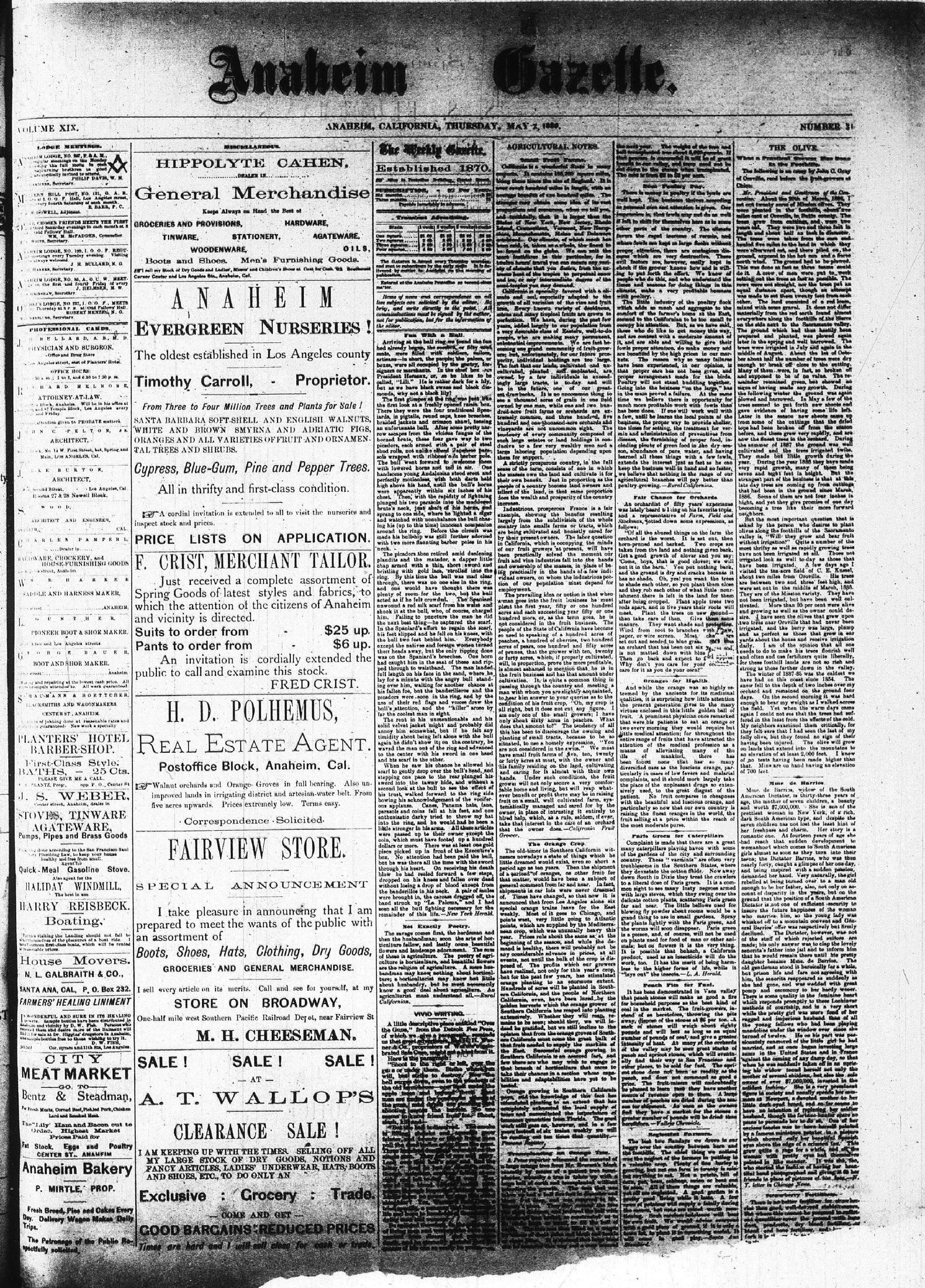
Searchable text
VOLUME XIX.
LODGE MEETINGS.
NORTH LODGE, NO. 37, F.A.A.M.
regular meetings on the Monday
ending the full month in good
weatherally invited to attend.
PHILIP DAVIS, W. M.
MIDWEST HILL POST, NO. 121, O. A. R.
L.O. P. Hall, Los Angeles district,
every fourth Saturday of each month.
E. BARK, P. C.
WOODELL, Adjutant.
CHOSEN FRIENDS MEETS THE FIRST
third Saturday evenings in each month at 8
Old Yellow Hall.
WM. M. McFADDEN, Commissor
Works, Secretary.
CHOSEN LODGE, NO. 190, I. O. O. F.
meetings every Tuesday evening.
Visiting always welcomed.
J. H. BULLARD, M. O.
HARRER, Secretary.
CHOSEN LODGE, NO. 85, A. O. U. W.
meet on the first and fourth Friday of every
J. HELMSEN, M. W.
GREENAW, Secretary.
CHOSEN LODGE, NO. 237, I. O. O. F.
meets Thursday at 8 p.m. at Old Yellow Hall.
ROBERT MENZNER, M. O.
NAHEIM, Secretary.
PROFESSIONAL CAMPS.
JOHN BELLARD, A.B., M.D.
PHYSICIAN AND SURGEON.
Office and Drug Store
Angeles street, east of Planters' Hotel.
OFFICE HOURS:
30 am; 1 to 2, and 6:30 to 7:30 p.m.
RICHARD MELROBE,
ATTORNEY-AT-LAW.
Block, Anaheim. Will be in his office at
and 7 Temple Block, Los Angeles every
and Friday.
Attention given to PROBATE matters.
JOHN C. PELTON, J.R.
ARCHITECT.
No. 14 W. First Street, bat, Spring,and
Main, LOS ANGELES, Cal.
MISCELLANEOUS.
HIPPOLYTE CAHEN,
DEALER IN
General Merchandise
Keeps Always on Hand the Best of
GROCERIES AND PROVISIONS,
HARDWARE,
TINWARE,
STATIONERY,
AGATEWA
WOODENWARE,
Boots and Shoes. Men's Furnishing Goods
28" tall my Stock of Dry Goods and Ladies', Mimes' and Children's Shoes at Cost for Cash.
Corner Center and Los Angeles Sts., Anaheim, Cal.
ANAHEIM
EVERGREEN NURSERIINE
The oldest established in Los Angeles co
Timothy Carroll, - Proprietor
From Three to Four Million Trees and Plants for SoSANTA BARBARA SOFT-SHELL AND ENGLISH WAKEWHITE AND BROWN SMYRNA AND ADRIATIC
ORANGES AND ALL VARIETIES OF FRUIT AND ORNATAL TREES AND SHRUBS.
Cypress, Blue-Gum, Pine and Pepper Tree
R. HARD MELROE,
ATTORNEY-AT-LAW.
Block, Anaheim. Will be in his office at 57 Temple Block, Los Angeles every and Friday.
J. N.C. PELTOM, J.R.
ARCHITECT.
No. 14 W. First Street, bet. Spring, and Main, LOS ANGELES, Cal.
J. LE BURTON,
ARCHITECT.
Second Street, Los Angeles, Cal.
Rooms 27 & 28 Newell Block.
S. WOOD,
ARCHITECT AND ENGINEER.
CAL.
C. CHARLES PAMPERL.
... Dealer in...
HARDWARE, CROCKERY, and HOUSE-FURNISHING GOODS
street, Anaheim.
W. R. HARKER
SADDLE AND HARNESS MAKER.
ANAHEIM.
L. UNTHER.
PIONEER BOOT & SHOE MAKER.
Alice and Los Angeles streets.
G. ORGE BAUER,
BOOT AND SHOE MAKER.
Anaheim
S. HAU-MANN & BOETTCHER,
BLACKSMITHS AND WAGONMAKERS.
CENTER ST., Anaheim.
PLANTERS' HOTEL
BARBER-SHOP.
First-Class Style:
BATHS, - 25 Cts.
PLEASE GIVE ME A CALL.
PLANTZ Prop., opp. P. O., Center St.
J. S. WEBER,
Center street, Anaheim, dealer in
STOVES, TINWARE
AGATEWARE,
Pumps, Pipes and Brass Goods
Quick-Meal Gasoline Stove.
Also agent for the HALIDAY WINDMILL,
The best in use.
HARRY REISBECK.
Timothy Carroll, - Property
From Three to Four Million Trees and Plants for 80 SANTA BARBARA SOFT-SHELL AND ENGLISH WAKE WHITE AND BROWN SMYRNA AND ADRIATIC ORANGES AND ALL VARIETIES OF FRUIT AND ORNAMENTAL TREES AND SHRUBS.
Cypress, Blue-Gum, Pine and Pepper Tree
All in thrifty and first-class condition
A cordial invitation is extended to all to visit the nurse inspect stock and prices.
PRICE LISTS ON APPLICATION
F. CRIST, MERCHANT TAILER
Just received a complete assortment of Spring Goods of latest styles and fabric which the attention of the citizens of Anaheim and vicinity is directed.
Suits to order from $25
Pants to order from $6
An invitation is cordially extended public to call and examine this stock.
FRED CRISI
H. D. POLHEMUS,
REAL ESTATE AGENDA
Postoffice Block, Anaheim, Cal
Walnut orchards and Orange Groves in full bearing. Improved lands in irrigating district and artesian-water be five acres upwards. Prices extremely low. Terms easy.
Correspondence Solicited.
FAIRVIEW STORE.
SPECIAL ANNOUNCEMENT
STOVES, TINWARE AGATEWARE,
Pumps, Pipes and Brass Goods
Cooking done according to the San Francisco Sanitary Plumbing Law, to keep your house healthy and free from smell.
Agent for Quick - Meal Gasoline Stove.
Also agent for the HALIDAY WINDMILL.
The best in use.
HARRY REISBECK.
Boating.
Parties visiting the Landing should not fail to thank themselves of the pleasures of a boat ride. I have fourteen first-class boats, which will be rented reasonable prices.
House Movers.
N. L. GALBRAITH & CO.,
SANTA ANA, CAL, P. O. Box 232.
FARMERS' HEALING LINIMENT
WONDERFUL AND SURE IN ITS HEALING Powers. Sample bottles have been distributed in haulem and vicinity by D. W. Plain. Parsons who treated them and desire more of the liniment will sell for sale at Dr. Higgins drugstore in Anaheim, sample bottles free to those wishing to try it.
J. D. W. FIBH.
Cor. nyram and 11th St., Los Angeles.
CITY MEAT MARKET
GO TO Bentz & Steadman,
For Fresh Meats, Corned Beef, Pichlied Pork, Chicken Lard and Smoked Meat.
The "Lily" Ham and Bacon out to Order. Highest Market Prices Paid for Fat Stock, Eggs and Poultry CENTER ST.. ANAHFIM
Anaheim Bakery
P. MIRTLE, PROP.
Fresh Bread, Flax and Oakes Every Day. Delivery Wagon makes Daily Trips.
The Patronage of the Public Respectfully solicited.
Correspondence Solicited.
FAIRVIEW STORE.
SPECIAL ANNOUNCEMENT
I take pleasure in announcing that prepared to meet the wants of the public an assortment of Boots, Shoes, Hats, Clothing, Dry GROCERIES AND GENERAL MERCHANDISSE
I sell every article on its merits. Call and see for yourself.
STORE ON BROADWAY,
One-half mile west Southern Pacific Railroad Depot, near Fair M. H. CHEESEMAN
SALE! SALE! SA!
AT A. T. WALLOR
CLEARANCE SALE!
I AM KEEPING UP WITH THE TIMES. SELLING OF MY LARGE STOCK OF DRY GOODS, NOTION FANCY ARTICLES, LADIES' UNDERWEAR, HATS, AND SHOES, ETC., TO DO ONLY AN
Exclusive: Grocery: Tr
COME AND GET
GOOD BARGAINS: REDUCED PRICES
Times are hard and I will call close for cash w
ANAHEIM, CALIFORNIA, THURSDAY, MAY 2, 1880.
CAHEN,
archandise
the Best of
HARDWARE,
RY,
AGATEWARE,
OILS,
Furnishing Goods.
E I M
NURSERIES!
Los Angeles county
Proprietor.
s and Plants for Sale !
ND ENGLISH WALNUTS,
AND ADRIATIC FIGS,
FRUIT AND ORNAMENand Pepper Trees.
The Weekly Gazette.
Established 1870.
Items of news and correspondence on all live subjects are collected by the editor. Be brief, and write directly to the point. All communications must be signed by the author, not for publication, but for the information of the editor.
Fun With a Hull.
Arriving at the ball ring we found the fan had already begun, the marmot, or fifty small snails, were filled with sanders, sailors, artisans—in short, the people; the palms, or boxes, were all occupied by the gentry, foreigners or merchants. In the closed box was President Heremax, or, as he likes to be called, "Lill." He is rather dark for a hily, but as we have black swans and black diamonds, why not a black lily?
The first glimpse of the ring was just like the first look at a freshly opened raisin box. There they were the four traditional Spaniards, in pigtails, round caps, knee braces, braided jackets and crimson shawl, tasting an unfortunate bull. After some pretty narrow escapes from the vicarious fungus of the borned brute, these four gave way to two picadorns, each armed with a pair of steel shod rolls, not unlike oak Japhanese paper, soils wrapped with ribbon's lace barber pole. The bull went forward to welcome them with lowered horns and tail in air. One handsome young Andalusian steed erect, and perfectly motionless, with both darts held
AGRICULTURAL NOTES.
California is a wonderful State in many respects. It contains 145,000 square miles, being three times the size of Kingland. It is never much landed within its length, with an average height of one hundred squares. The strongest may obtain some idea of the vast proportions and resources when we talk you, and suddenly, that it is larger than the States of New York, New Jersey, Rhode Island, Connecticut, Vermont, New Hampshire, Massachusetts, Maine and Delaware established. Our climate, of which has been mild in this region, is very warm that you desire, from the extreme heat of the tropics to perpetual snow and ice; it may intermediate degrees of the mean-tropics you may demand.
California is especially favored with aliments and salts, especially adapted to the growth of all varieties of the vine and fruit trees. Every known variety of deciduous trees and many tropical fruits are grown to perfection. We have, during the past few years, added largely to our population from a very desirable class of Eastern well-to-do people who are making many permanent, substantial improvements. We are fast becoming one grand community of fruit-growers; but, unfortunately, for our future prosperity, individual holdings are too large. The feet that our lands cultivated and uncultivated, planted and implanted, are owned by a few individuals in exceedingly large tracts, is to-day and will be in the future, one of our greatest drawbacks. It is no uncommon thing to see a thousand acres of grain in one field owned by one man, while one and two hundred-acre fruit farms or orchards are extremely common, and three hundred-five hundred and one-thousand-acre orchards and vineyards are not uncommon sight. The tendency of every community composed of such large estates or land holdings is conducive to a few very wealthy men and a large laboring population depending upon them for support.
A strictly prosperous country, in the full sense of the term, consists of one in which the masses own the land and cultivate it for their own benefit. Just in proportion as the next year shall keep us believing that persons can afford to buy down in time there is no personal misrepresentation by left to shift other parts from where down is proper; attendant which evil factors if shocked to put forth people who do not climate make with poultry.
The little which adds a comfort to the emptied his home those who do not and are content it, and are able to proper arrange Poetry will go into into the main part time we believe now more properly has been done a few until the times for a min and admin disease, the fecunding plants son, abound learned all these extends the leisure we believe that agricultural
Proprietor.
and Plants for Sale!
AND ENGLISH WALNUTS,
AND ADRIATIC FIGS,
OF FRUIT AND ORNAMENclass condition.
all to visit the nurseries and
APPLICATION.
ANT TAILOR.
plete assortment of
wiles and fabrics, to
citizens of Anaheim
$25 up.
$6 up.
dially extended the
this stock.
FRED CRIST.
HEMUS,
TE AGENT.
Anaheim, Cal.
res in full bearing. Also unand artesian-water belt. From
only low. Terms easy.
Solicited.
STORE.
NO UNCEMENT
called, "Lill." He is rather dark for a hly,
but as we have black swans and black diamonds, why not a black lily?
The first glimpse at the ring was just like the first look at a freely open ring box. There they were the four traditional Spaniards, in pigtails, round caps, knee braches, braided jackets and crimson shawl, tanning an unfortunate bull. After some pretty narrow escapes from the vicarious fungus of the borned brute, these four gave way to two picadors, each armed with a pair of steel ahod rolls, not unlike other Japanese page-olls wrapped with ribbons on barber pole. The bull went forward to welcome them with lowered horns and tail in air. One handsome young Andalusian steed erect, and perfectly motionless, with both darts held high above his head, until the bull's horns were apparently within six inches of his chest. Then, with the rapidity of lightning plunged his two parabola into the maddened brute's neck, just shaft of his horns, and sprang to one side, where he lighted a cigar and watched with nonchalance the ball chasing his (up to this time) innocent companion around the ring. Before the circuit was made his bullship was still further adorned with two more flaunting barber poles in his neck.
The picadors then retired amid deafening plaudits and the matador, a dapper little chap armed with a thin, short sword and bristling with gold lace, strolled into the ring. By this time the bull was mad clear through, there was no one else in the ring, and one would have thought there was plenty of room for the two, but the bull acted as if he felt crowded. The Spaniad unwound a red silk scarf from his wrist and shook it at the bull, who, of course, charged him. Failing to puncture the man he did the next best thing—he captured the scarf. In the Spaniad's effort to regain the scarf, his feet slipped and he fell on his knees, with the bull two feet behind him. Everybody except the natives and foreign women turned their heads away, but the only ripping done was on the Spaniad's breeches. One horn had caught him in the seat of those and riped through to waistband. The man landed full length on his face in the sand, where he lay for a minute with the angry bull standing over him, waiting for another chance at his fallen foe, but the banderilieros and the picadors were soon in the ring, and by the use of their red flags and voices drew the bull's attention, and the "killer" arrose by far the coolest man in sight.
The rent in his unmentionable and his solid velvet jacket might and probably did annoy him somewhat, but if he felt any timidity about being left alone with the bull again he didn't show it; on the contrary, he waved the man out of the ring and advanced to the center with his sword in one hand and his scarf in the other.
When he saw his chance he allowed his scarf to gently drop over the bull's head, and stepping one pace to the rear plunged his sword into the tawny hide, without a second look at the bull to see the effect of his trust, walked forward to the ring side bowing his acknowledgement of the vociferous applause. Canem, Panama hats, fans, parasols and coins fell at his feet, and one enthusiastic darky tried to throw my hat into the ring, and he would had been a little stronger in his arms. All these articles were passed up to their owner except the coin, which must have footed up a hundred dollars or more. There was at least one gold piece picked up in front of the Executive's box. No attention had been paid to the hall, but he was there all the time with the sword through his heart. On receiving his death blow he had reeled forward a few steps, dropped on his knees and fallen over dead without loosing a drop of blood except from the banderillos in his neck. A pair of mules were brought in, the carcass dragged off, the hand struck up "La Paloma," and I had seen all the bull fighting necessary for the called, "Lill."
He is rather dark for a hly, but as we have black swans and black diamonds, why not a black lily?
The first glimpse at the ring was just like the first look at a freely open ring box. There they were the four traditional Spaniards, in pigtails, round caps, knee braches, braided jackets and crimson shawl, tanning an unfortunate bull. After some pretty narrow escapes from the vicarious fungus of the borned brute, these four gave way to two picadors, each armed with a pair of steel ahod rolls, not unlike other Japanese pages wrapped with ribbons on barber pole. The bull went forward to welcome them with lowered horns and tail in air. One handsome young Andalusian steed erect, and perfectly motionless, with both darts held high above his head, until the bull's horns were apparently within six inches of his chest. Then, with the rapidity of lightning plunged his two parabola into the maddened brute's neck, just shaft of his horns, and sprang to one side, where he lighted a cigar and watched with nonchance the ball chasing his (up to this time) innocent companion around the ring. Before the circuit was made his bullship was still further adorned with two more flaunting barber poles in his neck.
The picadors then retired amid deafening plaudits and the matador, a dapper little chap armed with a thin, short sword and bristling with gold lace, strolled into the ring. By this time the bull was mad clear through, there was no one else in the ring, and one would have thought there was plenty of room for the two, but the bull acted as if he felt crowded. The Spaniad unwound a red silk scarf from his wrist and shook it at the bull, who, of course, charged him. Failing to puncture the man he did the next best thing—he captured the scarf. In the Spaniad's effort to regain the scarf, his feet slipped and he fell on his knees, with the bull two feet behind him. Everybody except the natives and foreign women turned their heads away, but the only ripping done was on the Spaniad's breeches. One horn had caught him in the seat of those and riped through to waistband. The man landed full length on his face in the sand, where he lay for a minute with the angry bull standing over him, waiting for another chance at his fallen foe, but the banderilieros and the picadors were soon in the ring, and by the use of their red flags and voices drew the bull's attention, and the "killer" arrose by far the coolest man in sight.
The rent in his unmentionable and his solid velvet jacket might and probably did annoy him somewhat, but if he felt any timidity about being left alone with the bull again he didn't show it; on the contrary, he waved the man out of the ring and advanced to the center with his sword in one hand and his scarf in the other.
When he saw his chance he allowed his scarf to gently drop over the bull's head, and stepping one pace to the rear plunged his sword into the tawny hide, without a second look at the Bull to see the effect of his trust, walked forward to the ring side bowing his acknowledgement of the vociferous applause. Canem, Panama hats, fans, parasols and coins fell at his feet, and one enthusiastic darky tried to throw my hat into the ring, and he would had been a little stronger in his arms. All these articles were passed up to their owner except the coin, which must have footed up a hundred dollars or more. There was at least one gold piece picked up in front of the Executive's box. No attention had been paid to the hall, but he was there all time with the sword through his heart. On receiving his death blow he had reeled forward a few steps, dropped on his knees and fallen over dead without loosing a drop of blood except from the banderillos in his neck. A pair of mules were brought in, the carcass dragged off, the hand struck up "La Paloma," and I had seen all the bull fighting necessary for that called, "Lill."
He is rather dark for a hly, but as we have black swans and black diamonds, why not a black lily?
The first glimpse at the ring was just like the first look at a freely open ring box. There they werethe four traditional Spaniards in pigtails,round caps,knee braches,braided jackets和crimson shawl,tunning an unfortunate bull.were apparently within six inches of his chest.The first glimpse atthe ringwasjustlikethefirstlookatfreelyopenringboxTheretheywerethefourtraditionalSpaniardsinpigtailssroundcapscountryinsmallmomentoftimewebelovedmoneyhasbeendonateda fewuntilhimtimeforaminingtheagriculturalbountylearnedalltheextendstheintenseofthetermconstituteoneofthemanyownestbeendonateda fewuntilhimtimeforaminingtheagriculturalbountylearnedalltheextendstheintenseofthetermconstituteoneofthemanyownestbeendonateda fewuntilhimtimeforaminingtheagriculturalbountylearnedalltheextendstheintenseofthetermconstituteoneofthemanyownestbeendonateda fewuntilhimtimeforaminingtheagriculturalbountylearnedalltheextendstheintenseofthetermconstituteoneofthemanyownestbeendonateda fewuntilhimtimeforaminingtheagriculturalbountylearnedalltheextendstheintenseofthetermconstituteoneofthemanyownestbeendonateda fewuntilhimtimeforaminingtheagriculturalbountylearnedalltheextendstheintenseofthetermconstituteoneofthemanyownestbeendonateda fewuntilhimtimeforaminingtheagriculturalbountylearnedalltheextendstheintenseofthetermconstituteoneofthemanyownestbeendonateda fewuntilhimtimeforaminingtheagriculturalbountylearnedalltheextendstheintenseofthetermconstituteoneofthemanyownestbeendonateda fewuntilhimtimeforaminingtheagriculturalbountylearnedalltheextendstheintenseofthetermconstituteoneofthemanyownestbeendonateda fewuntilhimtimeforaminingtheagriculturalbountylearnedalltheextendstheintenseofthetermconstituteoneofthemanyownestbeendonateda fewuntilhimtimeforaminingtheagriculturalbountylearnedalltheextendstheintenseofthetermconstituteoneofthemanyownestbeendonateda fewuntilhimtimeforaminingtheagriculturalbountylearnedalltheextendstheintenseofthetermconstituteoneofthemanyownestbeendonateda fewuntilhimtimeforaminingtheagriculturalbountylearnedalltheextendstheintenseofthetermconstituteoneofthemanyownestbeendonateda fewuntilhimtimeforaminingtheagriculturalbountylearnedalltheextendstheintenseofthetermconstituteoneofthemanyownestbeendonateda fewuntilhimtimeforaminingtheagriculturalbountylearnedalltheextendstheintenseofthetermconstituteoneofthemanyownestbeendonateda fewuntilhimtimeforaminingtheagriculturalbountylearnedalltheextendstheintenseofthetermconstituteoneofthemanyownestbeendonateda fewuntilhimtimeforaminingtheagriculturalbountylearnedalltheextendsTheextendsTheextendsTheextendsTheextendsTheextendsTheextendsTheextendsTheextendsTheextendsTheextendsTheextendsTheextendsTheextendsTheextendsTheextendsTheextendsTheextendsTheextendsTheextendsTheextendsTheextendsTheextendsTheextendsTheextendsTheextendsTheextendsTheextendsTheextendsTheextendsTheextendsTheextendsTheextendsTheextendsTheextendstheextendsTheextendsTheextendsTheextendsTheextendsTheextendsTheextendsTheextendsTheextendsTheextendsTheextendes>The extendes>The extendes>The extendes>The extendes>The extendes>The extendes>The extendes>The extendes>The extendes>The extendes>The extendes>The extendes>The extendes>The extendes>The extendes>The extendes>The extendes>The extendes>The extendes>The extendes>The extendes>The extendes>The extendes>The extendes>The extendes>The extendes>The extendes>The extendes>The extendes>The extendes>The extendes>The extendes>The extendesTHEEXTENDSTHEEXTENDSTHEEXTENDSTHEEXTENDSTHEEXTENDSTHEEXTENDSTHEEXTENDSTHEEXTENDSTHEEXTENDSTHEEXTENDSTHEEXTENDSTHEEXTENDSTHEEXTENDSTHEEXTENDSTHEEXTENDSTHEEXTENDSTHEEXTENDSTHEEXTENDSTHEEXTENDSTHEEXTENDSTHEEXTENDSTHEEXTENDSTHEEXTENDSTHEEXTENDSTHEEXTENDSTHETEXTENDSTHETEXTENDSTHETEXTENDSTHETEXTENDSTHETEXTENDSTHETEXTENDSTHETEXTENDSTHETEXTENDSTHETEXTENDSTHETEXTENDSTHETEXTENDSTHETEXTENDSTHETEXTENDSTHETEXTENDSTHETEXTENDSTHETEXTENDSTHETEXTENDSTHETEXTENDSTHETEXTENDSTHETEXTENDStHETEXTENDStHETEXTENDStHETXTEXTENDStHETXTEXTENDStHETXTEXTENDStHETXTEXTENDStHETXTEXTENDStHETXTEXTENDStHETXTEXTENDStHETXTEXTENDStHETXTEXTENDStHETXTEXTENDStHETXTEXTENDStHETXTEXTENDStHETXTEXTENDStHETXTEXTENDStHETXTEXTENDStHETXTEXTENDStHETXTEXTENDStHETXTEXTENDStHETXTEXTENDStHETXTEXTENDStHETXTEXTENDStHETXTEXTENDStHETXTEXTENDStHETXTEXTENDStHETXTEXTEDStHETXTEXTEDStHETXTEXTEDStHETXTEXTEDStHETXT_EXTEDStHETXT_EXTEDStHETXT_EXTEDStHETXT_EXTEDStHETXT_EXTEDStHETXT_EXTEDStHETXT_EXTEDStHETXT_EXTEDStHETXT_EXTEDStHETXT_EXTEDStHETXT_EXTEDStHETXT_EXTEDStHETXT_EXTEDStHETXT_EXTEDStHETXT_EXTEDStHETXT_EXTEDStHETXT_EXTEDStHETXT_EXTEDStHETXT_EXTEDStHETXT_EXTEDStHETXT_EXTEDStHETERXT_EXTDEDStHETERXT_EXTDEDStHETERXT_EXTDEDStHETERXT_EXTDEDStHETERXT_EXTDEDStHETERXT_EXTDEDStHETERXT_EXTDEDStHETERXT_EXTDEDStHETERXT_EXTDEDStHETERXT_EXTDEDStHETERXT_EXTDEDStHETERXT_EXTDEDStHETERXT_EXTDEDStHETERXT_EXTDEDStHETERXT_EXTDEDStHERETERX_EXTDED StHERETERX_EXTDED StHERETERX_EXTDED StHERETERX_EXTDED StHERETERX_EXTDED StHERETERX_EXTDED StHERETERX_EXTDED StHERETERX_EXTDED StHERETERX_EXTDED StHERETERX_EXTDED StHERETERX_EXTDED StHERETERX_EXTDED StHERETERX_EXTDED StHERETERX_EXTDED StHERETERX_EXTDED StHERETERX_EXTDED StHERETERX_EXTDED StHERETERX_EXTDED StHERETERX_EXTDED StHERETERX_EXTDED StHERETERX_EXTDED StHERETERX_EXTDED StHERETERX_EXTDED StHERETERX_EXTDED StHERETERX_EXTDED StHERETERX_EXTDED StHERETERX_EXTDED StHERTERX_EXTDED StHERTERX_EXTDED StHERTERX_EXTDED StHERTERX_EXTDED StHERTERX_EXTDED StHERTERX_EXTDED STHERTERX_EXTDED STHERTERX_EXTDED STHERTERX_extended STHERTERX_extended STHERTERX_extended STHERTERX_extended STHERTERX_extended STHERTERX_extended STHERTERX_extended STHERTERX_extended STHERTERX_extended STHERTERX_extended STHERTERX_extended STHERTERX_extended STHERTERX_extended STHERTERX_extended STHERTERX_extended STHERTERX_extended STHERTERX_extended STHERTERX_extended STHERTERX_extended STHERTERX_extended STHERTERX_extended STHERTERX_extended STHERTERX_extended STHERTERX_extended STHERTERX_extended STHERTERX_extended STHERTERX_extended STHERTERX_extended STHERTERX_extended STHERTERX_extended STHERTERX_extended STHERTERX_extended STHERTERX_extended STHERTERX_extended STHRER XExtended StHRER XExtended StHRER XExtended StHRER XExtended StHRER XExtended StHRER XExtended StHRER XExtended StHRER XExtended StHRER XExtended StHRER XExtended StHRER XExtended StHRER XExtended StHRER XExtended StHRER XExtended StHRER XExtended StHRER XExtended StHRER XExtended StHRER XExtended StHRER XExtended StHRER XExtended StHRER XExtended StHRER XExtended StHRER XExtended StHRER XExtended StHRER XExtended StHRER XExtended StHRER XExtended StHRER XExtended StHRER XExtended StHRER XExtended StHRER XExtended StHRER XExtended STHRER XExtended STHRER XExtended STHRER XExtended STHRER XExtended STHRER XExtended STHRER XExtended STHRER XExtended STHRER XExtended STHRER XExtended STHRER XExtended STHRER XExtended STHRER XExtended STHRER XExtended STHRER XExtended STHRER XExtended STHRER XExtended STHRER XExtended STHRER XExtended STHRER XExtending STHRER XExtending STHRER XExtending STHRER X Extending STHRer X Extending STHRer X Extending STHRer X Extending STHRer X Extending STHRer X Extending STHRer X Extending STHRer X Extending STHRer X Extending STHRer X Extending STHRer X Extending STHRer X Extending STHRer X Extending STHRer X Extending STHRer X Extending STHRer X Extending STHRer X Extending STHRer X Extending STHRer X Extending STHRer X Extending STHRer X Extending STHRer X Extending STHRer X Extending STHRer X Extending STHRer X Extending STHRer X Extending STHRer x Extending STHRer x Extending STHRer x Extending STHRer x Extending STHRer x Extending STHRer x Extending STHRer x Extending STHRer x Extending STHRer x Extending STHRer x Extending STHRer x Extending STHRer x Extending STHRer x Extending STHRer x Extending STHRer x ExtendingS THRERRER x ExtendingS THRERRERRERRERRERRERRERRERRERRERRERRERRERRERRERRERRERRERRERRERRERRERRERRERRERRERRERRERRERRERRERRERRERRERRERRERRERRERRRRERRERRRRERRRRERRRRRRRRRRRRRRRRRRRRRRRRRRRRRRRRRRRRRRRRRRRRRRRRRRRRRRRRRRRRRRRRRRRRRRRRRRRRRRRRRRRRRRRRRRRRRRRRRRRRRRRRRRRRRRRRRRRRRRRRRRRRRRRRRRRRRRRRRRRRRRRRRRRRRRRRRRRRRRRRRRRRRRRRRRRRRRRRRR
STORE.
NOUNCEMENT
announcing that I am
of the public with
nothing, Dry Goods,
REAL MERCHANDISE.
and see for yourself, at my
ROADWAY,
railroad Depot, near Fairview St
EESEMAN.
! SALE!
MER. SELLING OFF ALL
GOODS, NOTIONS AND
WENDERWEAR, HATS, BOOTS
AN
cery : Trade.
GET —
REDUCED PRICES
parasols and coins fell at his feet, and one enthusiastic darky tried to throw my hat into the ring, and he would had been a little stronger in his arms. All these articles were passed up to their owner except the coin, which must have footed up a hundred dollars or more. There was at least one gold piece picked up in front of the Executive's box. No attention had been paid the hall, but he was there all the time with the sword through his heart. On receiving his death blow he had reeled forward a few steps, dropped on his knees and fallen over dead without losing a drop of blood except from the banderillos in his neck. A pair of mules were brought in, the carosera dragged off, the band struck up "La Paloma," and I had seen all the bull fighting necessary for the remainder of this life.—New York Herald.
Net Exactly Poetry.
The savage comes first, the herdman and then the husbandman; soon the arts of horticulture fellow, and lastly come beautiful flowers and landscape adornment. The sum of these is agriculture. The poetry of agriculture is horticulture, and beautiful flowers are the religion of agriculture. A more husbandman may know nothing about horticulture; a horticulturist may know but little about husbandry, but he must necessarily know a good deal about agriculture. An agriculturist must understand all.—Eureal Californian.
VIVID WRITING.
A little descriptive poem entitled "Over the Guns," from the Detroit Free Press, of which we give a perennial memoir that great grief has made him. Werner A. O. proprietors of Westchester brated Sale Cases, might get a blight from it. Here is the paragraph:
"Shoot to the right or left, over the guts or under them. Strike where you will, best strike to destroy. Now bell surges down, even to the windows of the old barnhouse—the apple house and beyond thereof. Man are taken by the prowess of the great mind depths deep and shattering beneath the barn. No man except to know friend from fear. Shock, slash, Hillard."
The last line is indented.
Orange growing in Southern California pays, and the knowledge of this fact has stimulated planning to an extent that has completely exhausted the local supply of fruits and necessitated the importation of timber quantities from Florida. The good work will go on, however, and in a few years instead of six trains weekly we will be counting two times that quantity.—Penney Registry.
Press reporter witnessed the removal of a large tree from Mr. Blank's yard by some of pulp trees himself—a tree in India with branches with leaves that will not shed until the fall.
The last line is indented.
Parts
Complaint: many caterpillars of the garden country. The troublesome they devastate down South to a liberal dawn sight to with large at delicate cottage far and near blowing fly pests grand thing to the plants lily the worms we is a poison, and on plants newmals; but it is possible product, use work too, less to the "lays out" that
It has been that peach炒 for household coal in the stand of an away; dispense mack of short pounds and number of intensity of of the valley peach and spaly find other places, not stone decompose, and price. The be planned to sources of raw material for ship find they have greater numbers harvests.
NOTES.
In many regions miles inland, it is hard with an oxen. The size of the tree and half transplanted now about 8,000 pounds. If this pressure is successful it will be of great benefit to our valley, and hence need not be detrived by the strange wheat transplanted. The soil is from 60 to 90 per cent.
Some Poultry Farm.
There is money in poultry if the fowl are well kept. The business thrives according to personal skill and attention is given. Our impression is that fowls may and do as well if left to shift for themselves here as in some other parts of the country. The climate favors the angel insects of vermin, and where fowls are kept in large flocks without proper attention, there are contagious diseases which are very destructive. Thesevil fastions are, however, easily kept in shock if the grower knows how and is willing to put forth the effort. We know of people who do this, and who understand the times and seasons for doing things in this climate, make a very profitable business with poultry.
The little industry of the poultry flock which adds so much and aggregate to the comfort of the farmer's home at the East, seemed to the Outifornian to be too small to occupy his attention. But, as we have said, those who do like to get money this way, and are content with a moderate amount of it, and are able and willing to give their fowls proper attention, do make money and are benefited by the high prices in our markets. The reason why so many failures have been experienced, in our opinion, in that proper care has not been given, and proper arrangement made for the birds. Poultry will not stand huddling together. Going into the business "on the large," has in the main proved a failure. At the same time we believe there is opportunity for much more profitable work with fowls than has been done. If one will work well with a few, until he learns the local points of the business, the proper way to provide shelter, the times for setting, the treatment for vermin and administration of preventives from disease, the furnishing of proper food, including plenty of green food in the dry season, abundance of pure water, and having learned all these things with a few fowls, extends the interest just as fast as he can keep the business well-in hand and no faster, we believe that nothing in the range of our agricultural branches will pay better than
THE OLIVE.
Where a President Sawyer Mine House In the Powellville.
The following is an essay by John Q. Gray of Powellville, read before the fruit-growers at Chippewa.
Mr. President and Gentleman of the Convention: About the 50th of March, 1884, I set out twenty acres of Minnissippi. They were planted in the foothills, about five miles east of Overalls, in Battles county. The trees grew from embelling, and were two years old. They were two and three feet in length and almost half as high in diameter. The trees were taken from the area and handed five miles to the land in which they were forward set, and there piled on, the ground, exposed to the hot sun and a fierce north wind. The ground had to be plowed. This was done as fast as three trains could do it. A crew of men were put to work getting out the trees as fast as possible. The rows were not straight, nor the trees put an equal distance apart, though an attempt was made to set them twenty feet from each other. The land consisted of a red loam, mixed with some gravel. It does not differ materially from the red earth found almost everywhere along the foothills of the Birra on the side next to the Sacramento valley. The ground which had then hastily been prepared and planted, was plowed again later in the spring and well harrowed. The trees were irrigated in July and again in the middle of August. About the last of October about half the number of trees were dry enough to break off close to the cutting. Many of them were, in fact, so broken off and supposed to be of no value. The remainder remained green, but showed no signs of having made any growth. During the following winter the ground was again plowed and harrowed. In May a few of the trees seemed to put forth new shoots and gave evidence of having some life left. Later in the season new shoots came up from some of the cuttings that the dried tops had been broken off from the season before, and these grew very rapidly, and are now the finest trees in the orchard. During the summer of 1887 the ground was well cultivated and the trees irrigated twice. They made but little growth during the year. During the year 1888 they have made very rapid growth, many of them being seven and eight feet in height. But the strangest part of the business is that at this
Poultry will not stand huddling together. Going into the business "on the large," has in the main proved a failure. At the same time we believe there is opportunity for much more profitable work with fowls than has been done. If one will work well with a few, until he learns the local points of the business, the proper way to provide shelter, the times for setting, the treatment for vermin and administration of preventives from disease, the furnishing of proper food, including plenty of green food in the dry season, abundance of pure water, and having learned all these things with a few fowls, extends the interest just as fast as he can keep the business well-in-hand and no faster, we believe that nothing in the range of our agricultural branches will pay better than poultry-growing.—Rural California.
Fair Chance for Orchards
An orchardist of fifty years' experience was lately heard living on his favorite topic, and a representative of Farm, Field and Stockman, jotted down some expressions, as follows:
"Of all the abused things on the farm the orchard is the worst. It is sat out, then born-pruned and barked. Two crops are taken from the land and nothing given back. Get a good growth of clover and you say: 'Come, boys, that is good clover; we will put it in the barn.' You put nothing back, and the ground is dry and cracks because it has no shade. Oh, yes! you want the trees to shade each other, so you plant them close and they rob each other of what little nourishment there is left in the land for them after being cropped. Plant apple trees two rods apart, and in five years their roots will meet. Plant the trees on new ground—then take care of then. Give them some manure. They want shade and protection. Wind from root to branches with drawer, paper, or wire screen. Most chars are set out and seeded to blue grass. That has an orchard that has been out six years old, is not matted down with blue soil. Then go back and expect to find apples. Why don't you care for your orchard-care for it as you do your corn?"
Oranges for Health
And while the orange was so highly esteemed by the ancients for its medicinal qualities, it is surprising how little attention the present generation gives to the many virtues enclosed in this little golden ball of fruit. A prominent physician once remarked that were his patients to eat an orange or two every morning they would require but little medical attention; for throughout the entire range of fruits that have attracted the attention of the medical profession as a means of alleviating many of the ills of mankind, there has been found none that has so many diversified uses as the luscious orange, particularly in cases of low fevers and malarial complaints, and it should more largely take the place of the unpleasant drugs so extensively used, to the great disgust of the patient. No fruit compares in cheapness with the beautiful and luscious orange, and particularly so now that our own country is raising the finest oranges in the world, the fruit selling at a price within the reach of the most moderate purse.
Paris Green for Caterpillars
Complaint is made that there are a great many caterpillars playing havoc with some of the gardens of the city and surrounding country. These "varmints" are often very troublesome in the Southern States, where they devastate the cotton field. Now away down South in Dixie they treat the crawlers to a liberal dose of Paris green. It is a common sight to see many lusty negroes armed with large steves, which they swing over the delicate cotton plants, scattering Paris green far and near. The little bellows need for maninder remained green, but showed no signs of having made any growth. During the following winter the ground was again slowed and harrowed. In May a few of the trees seemed to put forth new shoots and gave evidence of having some life left. Later in the season new shoots came up from some of the cuttings that the dried tops had been broken off from the season before, and these grew very rapidly, and are now the finest trees in the orchard. During the summer of 1887 the ground was well cultivated and the trees irrigated twice. They made but little growth during the year. During the year 1888 they have made very rapid growth, many of them being seven and eight feet in height. But the strangest part of the business is that at this late day trees are coming up from cuttings that had been in the ground since March, 1886. Some of them are not four inches in high, and yet they give promise of one day becoming a tree like their more forward neighbors.
But the most important question that is asked by the person who desires to plant olives along the foothills of the Sacramento valley is, "Will they grow and bear fruit without irrigation?" Quite a number of the most thrifty as well as rapidly growing trees have not been irrigated at all. Those not irrigated look as well to-day as those that have been irrigated. A few days ago I visited the tenacre field of C.E.Kussel, about two miles from Oroville. His trees are between two and three feet high, and were set out in the middle of Maroh, 1888. They are of the Mission variety. They have not been irrigated, but have been well cultivated. More than 95 per cent were alive and growing as well as the owner could desire. I have seen the olives that grew upon two trees near Oroville that had never been irrigated, and the berry was large, plump and as perfect as those that grow in our yards about the house and reactive irrigation daily. I am of the opinion that all one needs to do to make his trees flourish well and often use fertilizers quite liberally, for these foothill lands are not so rich and strong as those farther down in the valley.
The winter of 1887-85 was the coldest we have had on this coast since 1854. The snow fell to the depth of two inches over my orchard and remained on the ground four days. On the second morning it was hard enough to bear my weight as I walked across the field. Yet when the warm days came again I could not see that the trees had suffered in the least from the effects of the cold. My neighbors examined them critically, for they felt sure that I had seen last of my folly olive, but they found no sign of their having been injured. The olive will grow on lands that extend into the mountains to an elevation of at least 2,000 feet. I know of no tests having been made higher than that. Mine are on hand having an elevation of 700 feet.
Mine de Marrios
Mine de Barrios, widow of the South American Dictator, is thirty-three years of age, the mother of seven children, a beauty and worth $7,000,000. She is one of the prettiest woman in New York, of a rich, dark South American type, and despite the seven children has not lost the least hint of her freshness and charm. Her story is a romantic one. At fourteen years of age she had reach that sudden development to womanhood which comes to South American girls almost as soon as they turn into their teens; the Dictator Barrios, who was then nearly forty, caught a glimpse of her one day, and being inspired with a sudden passion, demanded her hand. Very naturally, the girl rebelled at being turned over to a man old enough to be her father; also, not only on account of disparity in the years, but on the ground that position of a South American Dictator is not one of sufficient security to handle future harminess of the woman...
Paris Green for Caterpillars
Complaint is made that there are a great many caterpillars playing havoc with some of the gardens of the city and surrounding country. These "varmintes" are often very troublesome in the Southern States, where they devastate the cotton fields. Now away down South in Dixie they treat the crawlers to a liberal dose of Paris green. It is a common sight to see many lynxes armed with large steves, which they swing over the delicate cotton plants, scattering Paris green far and near. The little bellows used for blowing fly powder about rooms would be a grand thing to use in small gardens. Spray the plants lightly with the Paris green, and the worms will soon disappear. Paris green is a poison, and, of course, will not be used on plants used for food of man or other animals; but on flowers it is the very thing. It is possible that bachach, a California product, used as an insecticide will do the work, too. It has the merit of being harmless to the higher forms of life, while it "lays out" the insects. — L. A. Herald.
Punch Pine for Fuel.
It has been demonstrated in Vaca valley that peach stones will make as good a fire for household purposes as the best kind of coal in the market. The fruit-growers, instead of as heretofore throwing the pits away, dispose of the stones at $6 per ton. A pack of stones will weigh about eighty pounds and will last as long as an equal number of pounds of coal, and give a greater intensity of heat. At many of the orchards of the valley may be seen great stacks of peach and apricot stones, which will eventually find their way to San Francisco and other places, to be sold for fuel. The apricot stone does not burn as readily as the peach, and does not command as good a price. The fruit-rainers will undoubtedly be planned to learn that they have another source of revenue open to them. A large number of panches are dried during the season for shipment. As soon as the owners find they have a market for the stones a greater number of pounds will be drilled than hereford. — Valley Chronicle.
Magnetized Farms.
The last two Sundays we drove in our happy over the country between here and the foothills. The child thing we noticed was the neglect of the farmers in putting in a valuable crop. Plenty of fine hurley in growing, but not one farm in twenty minutes anything to eat. Not a paddle, bill of corn, pen, hone, cabbage, onion or heath nut at all. All of these things are valuable, yet all are unappreciated. A good garden is a pretty good living while it looks. A few rows of potatoes will supply a fairly lasting summer, but none are round worth nurturing. Such garden fieldsoon will bear its own fruit. We would advise someone with a good place of ground, if it is only a three lot, in plant it in something useful. It will come in good play, dafta And disdain.
Prettiest woman in New York, of a rich, dark South American type, and despite the seven children has not lost the least hint of her freshness and charm. Her story is a romantic one. At fourteen years of age she had reach that sudden development to womanhood which comes to South Americans girls almost as soon as they turn into their teens; the Dictator Barrios, who was then nearly forty, caught a glimpse of her one day, and being inspired with a sudden passion, demanded her hand. Very naturally, the girl rebelled at being turned over to a man old enough to be her father, also, not only on account of disparity in the years, but on the ground that the position of a South American Dictator is not one of sufficient security to insure the future happiness of the woman who marries him, so the young lady was whisked off to a mountain convent and General Barrios' offer was respectively but firmly declined. The Dictator, however, was not of the stuff of which rejected suitors are made; his only answer was to clap the lovely senorita's father into jail and to inform him that he would remain there until his pretty daughter became Mme. de Barrios. The old gentleman stood it heroically for a while, but prison life and fare not agreeing with him, the senorita respeared as suddenly as she had gone, and was wedded with great pomp and ceremony to her hard woner. There is some quality in the feminine heart which responds promptly to those Lochinvar methods of courtship, and in a very short while the pretty girl was more fond of her ragged and impersonal husband than all the young fellows who had been playing mandolines under the window since she turned of twister. He on his part was passionately enamored of the little girl he had married, and at once began investing large sums in the United States and in France against the coming of any damp day, so that when he was suddenly taken off in an uprising his widow found herself not only the mother of several children, but also the sole owner of over 87,000,000 invested in the incident fashion./ She is a very prominent figure in society and usually spends her summers at Newport, a devoted mother to her little dark-spotted brunet, and so far seems to have no intention of replacing her older husband, though the fortune-limited spare no puns to permade her to do so. One of her errant friends was to have himself painted by a famous miniature painter in a picture which showed only her beautiful Spanish eyes above the edge of a crimson fast. This grew quite a rage for a while, and all the women with pretty eyes had themselves painted in like manner. It was this she who started the fashion of having her hands photographed and giving it to her friends in place of pictures or his face—N.Y. letter in Chicago News.
Marjoram Fruitfulness.
There is no better fortifier for show-bearers than good well-dressed stalks; but when this cannot be presented in sufficient quantity ever the ground with home dust, poudreite, dry blond furilier, or flesh it is hard —