anaheim-gazette 1889-04-04
Scanned page
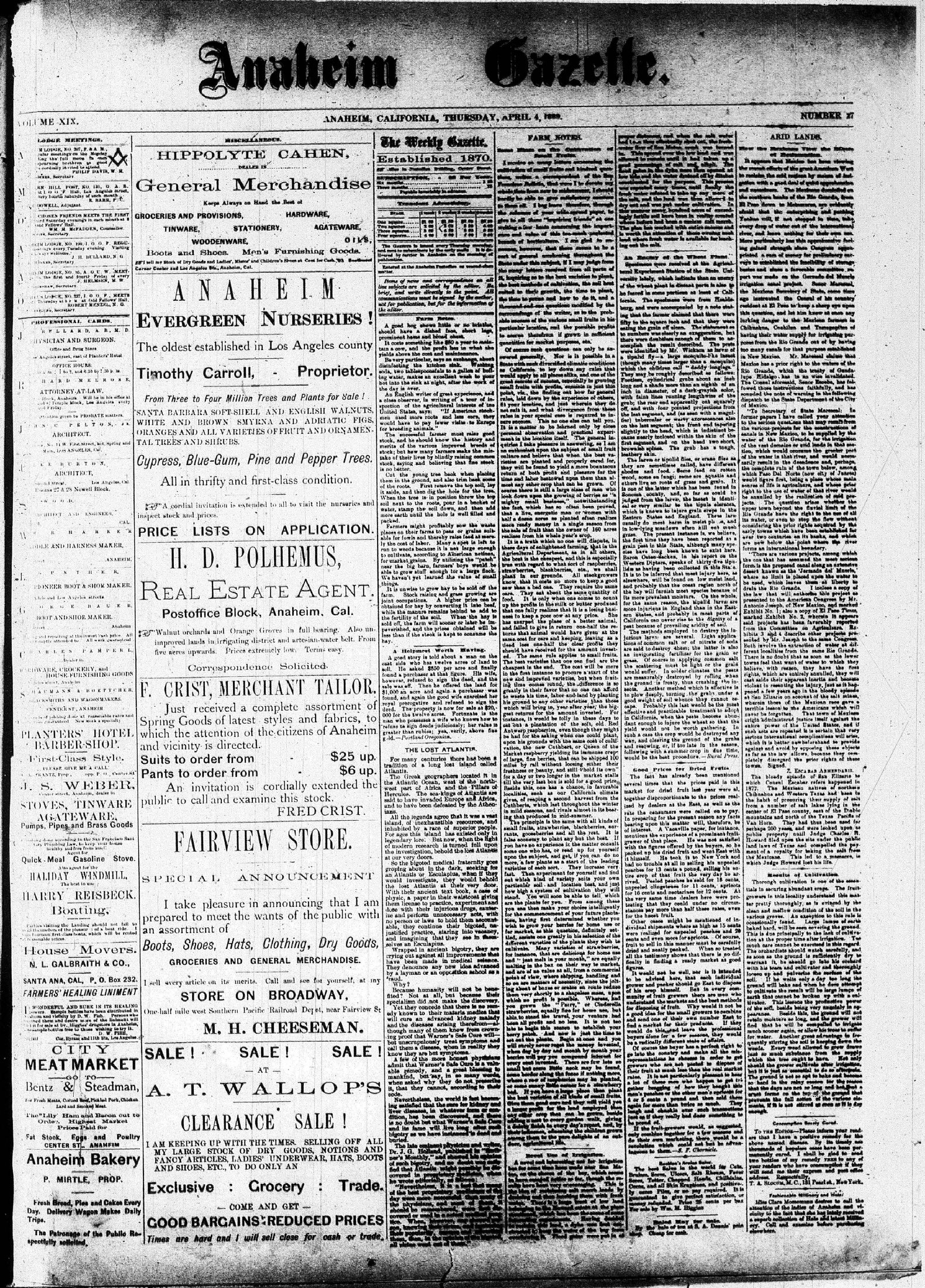
Searchable text
AOLOME XIX.
LODGE MEETINGS.
M LODGE, NO. 277, F. A. M., regular meetings on the Monday lying the full moon in each journing brethren in good cordially invited to attend. PHILIP DAVIS, W. M. MORRIS, Secretary.
M HILL PONT, NO. 121, O. A. B., AL O. O. F. Hall, Los Angeles street, every fourth Saturday of each month. K BARR, P. C. WOOWELL, Adjutant.
CHOSEN FRIENDS MEETS THE FIRST SATURDAY evenings in each month at Old Fallows' Hall. WM. M McFADDEN, Commissioner. SMITH, Secretary.
M LODGE, NO. 190, I. O. O. F. REGUERIES every Tuesday evening Visiting always welcome. J H. BULLARD, N. O. WILKINS, Secretary.
M LODGE, NO. 52, A. O. U. W. MEETS the first and fourth Friday of every J. HELMSEN, M. W. WOODENWARE, Secretary.
M LODGE, NO. 227, I. O. O. F., MEETS the first and fourth Friday at Old Fallows' Hall. ROBERT MENZEL, N. G. WOODENWARE, Secretary.
PROFESSIONAL CARDS.
BELLARD, A.B., M.D. PHYSICIAN AND SURGEON.
Office and Drug Stars
Los Angeles street, east of Planters' Hotel.
OFFICE HOURS:
1 to 2, and 6:30 to 7:30 p.m.
BARD MELROSE,
ATTORNEY-AT-LAW.
Block, Anaheim. Will be in his office at and 2 Temple Block, Los Angeles every and Friday.
Attention given to PROBATE matters.
CPELTON, J.K.
ARCHITECT.
No. 11 W First Street, but Spring and Main, Los Angeles, Cal.
LE BURTON,
ARCHITECT,
MISCELLANEOUS.
HIPPOLYTE CAHEN
DEALER IN
General Merchandise
Keeps Always on Hand the Best of
GROCERIES AND PROVISIONS,
HARDWARE,
TINWARE,
STATIONERY,
AGATEW
WOODENWARE,
Boots and Shoes. Men's Furnishing Goods
If I sell my Stock of Dry Gums and Ladies', Minerals and Children's Booms at Cost for Cash,
Carner Center and Los Angeles Blu., Anaheim, Cal.
ANAHEIM
EVERGREEN NURSERI
The oldest established in Los Angeles co.
Timothy Carroll, - Proprietor
From Three to Four Million Trees and Plants for SANTA BARBARA SOFT-SHELL AND ENGLISH WAKE
WHITE AND BROWN SMYRNA AND ADRIATIC ORANGES AND ALL VARIETIES OF FRUIT AND ORNAMAL TREES AND SHRUBS.
Cypress, Blue-Gum, Pine and Pepper
ATTORNEY AT LAW.
Block Anaheim Will be in his office at 27 Temple Block Los Angeles every Friday.
ARCHITECT.
No 11 W First Street, West Spring and Main, Los Angeles, Cal.
BURTON ARCHITECT,
Second Street Los Angeles, Cal.
Room 27 & 28 Newell Block.
WHOLE AND HARNESS MAKER,
ANAHEIM.
PONTHEK,
PIONEER BOOT & SHOE MAKER.
Anaheim and Los Angeles streets.
GORGE BAUER
BOOT AND SHOE MAKER.
Anaheim
WARE, CROCKERY, and HOUSE-FURNISHING GOODS
Street Anaheim.
HAUMANN & HOETTCHER,
BLACKSMITHS AND WAGONMAKERS.
Center St. Anaheim.
PLANTERS' HOTEL BARBER-SHOP.
First-Class Style.
Please give me a call.
J. S. WEBER,
STOVES, TINWARE AGATEWARE,
Pumps, Pipes and Brass Goods
Quick-Meal Gasoline Stove.
Also agent for the HALIDAY WINDMILL.
The host in use
HARRY REISBECK.
From Three to Four Million Trees and Plants for Sale
SANTA BARBARA SOFT-SHELL AND ENGLISH WAKE
WHITE AND BROWN SMYRNA AND ADRIATIO
ORANGES AND ALL VARIETIES OF FRUIT AND ORN
TAL TREES AND SHRUBS.
Cypress, Blue-Gum, Pine and Pepper Tree
All in thrifty and first-class condition
A cordial invitation is extended to all to visit the nurra inspect stock and prices.
PRICE LISTS ON APPLICATION
H. D. POLHEMUS,
REAL ESTATE AGENT
Postoffice Block, Anaheim, Ca.
Walnut orchards and Orange Groves in full bearing.
improved lands in irrigating district and artesian-water be five acres upwards. Prices extremely low. Terms easy.
Correspondence Solicited.
F. CRIST, MERCHANT TAIRI
Just received a complete assortment of spring Goods of latest styles and fabric which the attention of the citizens of Anais and vicinity is directed.
Suits to order from $20
Pants to order from $15
An invitation is cordially extend public to call and examine this stock.
FRED CRIST
FAIRVIEW STORE
SPECIAL ANNOUNCEMENT
I take pleasure in announcing tha
AGATEWARE,
Pumps, Pipes and Brass Goods
Following along according to the San Francisco Sanitary Plumbing Law, to keep your house
healthy and free from snail.
Agent for
Quick-Meal Gasoline Stove.
Also agent for the
HALIDAY WINDMILL,
The host in use
HARRY REISBECK.
Boating,
Parties visiting the Landing should not fail to
and themselves of the pleasure of a boat ride.
I have fourteen first-class boats, which will be rented
reasonable prices.
House Movers.
N. L. GALBRAITH & CO.,
SANTA ANA, CAL., P. O. Box 232.
FARMERS' HEALING LINIMENT
WONDERFUL AND SURE IN ITS HEALING
Dowers. Sample bottles have been distributed in
them and visibility by D. W. Fish.
Persons who
served them and desire more of the liniment will
it for sale at Dr. Hilgins' drugstores in Anaheim,
sample bottles free to those wishing to try it.
D. W. FIRH,
Cor. Byram and 11th St., Los Angeles.
CITY MEAT MARKET
GO TO
Bentz & Steadman,
For Fresh Meats, Corned Beef, Pickled Pork, Chicken,
Lard and Smoked Meat.
The "Lily Ham and Bacon out to
Order. Highest Market
Prices Paid for
Fat Stock, Eggs and Poultry
CENTER ST., ANAHFIM
Anaheim Bakery
P. MIRTLE, PROP.
Fresh Bread, Pies and Cakes Every
Day. Delivery Wagon Makes Daily
Trips.
The Patronage of the Public Respontfully solicited.
FAIRVIEW STORE
SPECIAL ANNOUNCEMENT
I take pleasure in announcing that
prepared to meet the wants of the public
an assortment of
Boots, Shoes, Hats, Clothing, Dry
GROCERIES AND GENERAL MERCHANDISE
I sell every article on its merits. Call and see for yourse
STORE ON BROADWAY
One-half mile west Southern Pacific Railroad Depot, near K
M. H. CHEESEMA
SALE! SALE! SALE!
AT
A. T. WALLO
CLEARANCE SALE!
I AM KEEPING UP WITH THE TIMES. SELLING O
MY LARGE STOCK OF DRY GOODS, NOTICI
FANCY ARTICLES, LADIES' UNDERWEAR, HAT
AND SHOES, ETC., TO DO ONLY AN
Exclusive : Grocery : T
— COME AND GET —
GOOD BARGAINS: REDUCED PRICE
Times are hard and I will sell close for cash
CAHEN,
orchandise
the Best of
HARDWARE,
RY,
AGATEWARE,
OILS;
Furnishing Goods.
Years' Elders at Cost for Cash.
E I M
NURSERIES!
Los Angeles county
Proprietor.
es and Plants for Sale !
ND ENGLISH WALNUTS,
A AND ADRIATIC FIGS,
OFFRUIT AND ORNAMENand Pepper Trees.
class condition
The Weekly Gazette.
Established 1870.
Items of news and correspondence on all line subjects are solicited by the editor. Brief, and write directly to the point. All communications must be signed by the author, not for publication, but for the information of the editor.
Farm Notes.
A good hog shows little or no brittle, should have a dished face, short legs, prominent hams and brindles.
It costs something like $50 a year to maintain a cow, and the profit has in what the yields above the cost and maintenance.
Be very particular, says an exchange about disinfecting the kitchen sink. Washing soda, two tablespoonfuls to a gallon of boiling water, makes an excellent wash to pour hot into the sink at night, after the work of the day is over.
An English writer of great experience, and a close observer, in writing of a tour of inspection of the agricultural interests of the United States, says: "If American stockmen used more roots and less corn, they would have to pay fewer visits to Europe for breeding animals."
The successful farmer must raise good stock, and he should know the history and merits of the various improved breeds of stock; but how many farmers make the mistake of their lives by blindly raising common stock, saying and believing that fine stock is no better.
Cut the young tree back when placing them in the ground, and also trim back some
FARM NOTES.
Some notes on the conservation of small Prairie.
I notice so many little occurrences the cultivation of small fruits and bivalve quinces within a correspondent of the Flies Foundation Publication, that some I devise ing which plants from new to adulthood. I should hardly be able to give multifaceted attention to them all. I beg here therefore, through the volume of your own spread paper, to give all those "requiring friends" at once writing a few lines commencing the importance and value of this too much popular branch of agriculture. I am glad to see someone, however, that these names to be a sort of personal acknowledging throughout the state make this subject. If I may judge from the many letters received from all parts of it, beginning as to the best variation in plant, the best methods of cultivation, the soil best suited to their growth, the time to plant, the time to prune and how to do it, and a thousand-and-one questions modified by the circumstances of the writer, as to the probable means of the various small fruits in his pertinent location, and the possible profits to acquire therefrom if grown in sufficient quantity for market purposes, etc.
Of some such questions can only be answered generally. Nor is it possible in a State with much diversified climatic conditions as California, to lay down any rules that would apply to all places alike, and one of the greatest sources of money, especially in growing small fruits with profits, dominates in just this point, viz., the finding out how far general rules, laid down by the experience of others, 63 your location, and just wherein they do not suit it, and what divergence from these rules in your special case is required to ensure success. This no one else can tell you.
Is a matter to be learned only by close personal observation and practical experiment in the location itself. The general inquiry I take pleasure in answering, as I am an enthusiast upon the subject of small fruit culture and believe that when the best varieties are planted and properly cared for, they will be found to yield a more bountiful return of both profits and pleasure for the time and labor bestowed upon them than all others.
An American Spainman rural Experiment lately of the wheat he feared in a ferala. The burg, and wasting that the fifty to the eighth grazing the grass to numbers we there were d complish that were identified a tipled fly (though many which the cog They may be Foetellan, oy long and a long inch in diaphy grub; the run off, and with the last segment flier) tabernant on the last a slightly cause nearly first segment brownish apple leather skin.
The larvae they are no abodes and wood, some
and Pepper Trees.
class condition.
APPLICATION.
HEMUS,
TE AGENT.
Anaheim. Cal.
aves in full bearing. Also undied and artesian-water belt. From
only low: Terms easy.
Solicited.
ANT TAILOR.
complete assortment of
styles and fabrics, to
the citizens of Anaheim
$25 up.
$6 up.
cordially extended the
me this stock.
FRED CRIST.
STORE.
NOUNCEMENT
announcing that I am
An English writer of great experience, and a close observer, in writing of a tour of inspection of the agricultural interests of the United States, says: "If American stockmen used more roots and less corn, they would have to pay fewer visits to Europe for breeding animals."
The successful farmer must raise good stock, and he should know the history and merits of the various improved breeds of stock; but how many farmers make the mistake of their lives by blindly raising common stock, saying and believing that fine stock is no better.
Cut the young tree back when placing them in the ground, and also trim back some of the roots. First remove the top soil, lay it aside, and then dig the hole for the树. When the tree is in position throw the top soil next to the roots, pour in a basket of water, stamp the soil down, and then add more earth until the hole is well filled and packed.
Farmers might profitably sow the waste places on their farms to peas or grains suitable for fowls and thereby raise feed at merely the cost of labor. Many a spot is left to run to weeds because it is not large enough to cultivate, according to American settlers, for market, grains. By utilizing the "patch" near the big barn, farmers' boys would be able to grow stuff enough for a large flock. We haven't yet learned the value of small things.
It is unwise to grow hay to be sold off the farm. Stock raising and grass growing are joint occupations. A higher price can be obtained for hay by converting it into beef, while the manure remains behind to add to the fertility of the soil. When the hay is sold off, the farm will sooner or later be impoverished, and the prices obtained will be less than if the steak is kept to consume the hay.
A Helpmeet Worth Having.
A good story is told about a man on the east side who has twelve acres of land to sell. He asked $850 per acre and finally found a purchaser at that figure. His wife, however, refused to sign the deed, and the sale was off. Then he offered the land for $1,000 an acre and again a purchaser was found, and again the good wife exorcised her royal prerogative and refused to sign the deed. The property is now for sale at $20,000 for the twelve acres. Fortunately in the man who possesses a wife who knows how to refuse to sign deeds judiciously; her value is greater than rubies; yes, verily, above fine gold.—Portland Oregonian.
THE LOST ATLANTIS.
For many centuries there has been a tradition of a long lost island called Atlantis.
The Greek geographers located it in the Atlantic Ocean, west of the northwest part of Africa and the Pillars of Hercules. The sea-kings of Atlantis are said to have invaded Europe and Africa, and to have been defeated by the Athonians.
All the legends agree that it was a vast island, of inexhaustible resources, and inhabited by a race of superior people. For ages this island has existed only in legendary lore. But now, when the light of modern research is turned full upon the investigation, behold the lost Atlantis at our very doors.
So the bigoted medical fraternity goes groping about in the dark, seeking for an Atlantis or Esculapula, when if they would investigate, they would behold the lost Atlantis at their very door. With their ancient text book, a case of physic, a paper in their waistcoat giving them license to practice, experiment and do with their injurious drums, canter hot into the sink at night, after the work of the day is over.
An English writer of great experience, and a close observer, in writing of a tour of inspection of the agricultural interests of the United States, says: "If American stockmen used more roots and less corn, they would have to pay fewer visits to Europe for breeding animals."
The successful farmer must raise good stock, and he should know the history and merits of the various improved breeds of stock; but how many farmers make the mistake of their lives by blindly raising common stock, saying and believing that fine stock is no better.
Cut the young tree back when placing them in the ground, and also trim back some of the roots. First remove the top soil, lay it aside, and then dig the hole for the tree. When the tree is in position throw the top soil next to the roots, pour in a basket of water, stamp the soil down, and then add more earth until the hole is well filled and packed.
Farmers might profitably sow the waste places on their farms to peas or grains suitable for fowls and thereby raise feed at merely the cost of labor. Many a spot is left to run to weeds because it is not large enough to cultivate, according to American settlers, for market, grains. By utilizing the "patch" near the big barn, farmers' boys would be able to grow stuff enough for a large flock. We haven't yet learned the value of small things.
It is unwise to grow hay to be sold off the farm. Stock raising and grass growing are joint occupations. A higher price can be obtained for hay by converting it into beef, while the manure remains behind to add to the fertility of the soil. When the hay is sold off, the farm will sooner or later be impoverished, and the prices obtained will be less than if the steok is kept to consume the hay.
A Helpmeet Worth Having.
A good story is told about a man on the east side who has twelve acres of land to sell. He asked $850 per acre and finally found a purchaser at that figure. His wife, however, refused to sign the deed, and the sale was off. Then he offered the land for $1,000 an acre and again a purchaser was found, and again the good wife exorcised her royal prerogative and refused to sign the deed. The property is now for sale at $20,000 for the twelve acres. Fortunately in the man who possesses a wife who knows how to refuse to sign deeds judiciously; her value is greater than rubies; yes, verily, above fine gold.—Portland Oregonian.
THE LOST ATLANTIS.
For many centuries there has been a tradition of a long lost island called Atlantis.
The Greek geographers located it in the Atlantic Ocean, west of the northwest part of Africa and the Pillars of Hercules. The sea-kings of Atlantis are said to have invaded Europe and Africa, and to have been defeated by the Athonians.
All the legends agree that it was a vast island, of inexhaustible resources, and inhabited by a race of superior people. For ages this island has existed only in legendary lore. But now, when the light of modern research is turned full upon the investigation, behold the lost Atlantis at our very doors.
So the bigoted medical fraternity goes groping about in the dark, seeking for an Atlantis or Esculapula, when if they would investigate, they would behold the lost Atlantis at their very door. With their ancient text book, a case of physic, a paper in their waistcoat giving them license to practice, experiment and do with their injurious drums, canter hot into the sink at night, after the work of the day is over.
An English writer of great experience, and a close observer, in writing of a tour of inspection of the agricultural interests of the United States, says: "If American stockmen used more roots and less corn, they would have to pay fewer visits to Europe for breeding animals."
The successful farmer must raise good stock, and he should know the history and merits of the various improved breeds of stock; but how many farmers make the mistake of their lives by blindly raising common stock, saying and believing that fine stock is no better.
Cut the young tree back when placing them in the ground, and also trim back some of the roots. First remove the top soil, lay it aside, and then dig the hole for the tree. When the tree is in position throw the top soil next to the roots, pour in a basket of water, stamp the soil down, and then add more earth until the hole is well filled and packed.
Farmers might profitably sow the waste places on their farms to peas or grains suitable for fowls and thereby raise feed at merely the cost of labor. Many a spot is left to run to weeds because it is not large enough to cultivate, according to American settlers, for market, grains. By utilizing the "patch" near the big barn, farmers' boys would be able to grow stuff enough for a large flock. We haven't yet learned the value of small things.
It is unwise to grow hay to be sold off the farm. Stock raising and grass growing are joint occupations. A higher price can be obtained for hay by converting it into beef, while the manure remains behind to add to the fertility of the soil. When the hay is sold off, the farm will sooner or later be impoverished, and the prices obtained will be less than if the steok is kept to consume the hay.
A Helpmeet Worth Having.
A good story is told about a man on the east side who has twelve acres of land to sell. He asked $850 per acre and finally found a purchaser at that figure. His wife, however, refused to sign the deed, and the sale was off. Then he offered the land for $1,000 an acre and again a purchaser was found, and againthe good wife exorcised her royal prerogative and refused to signthe deed.The property is now for sale at $20,000 forthe twelve acres.Fortunately inthe manwhose possessesa wifewho knowshowtorefusetosigndeedsjudicially;hervalueisgreaterthanrubies;yesverilyabovefinegold.-PortlandOregonian.
THE LOST ATLANTIS.
For many centuries there has been a tradition of a long lost island called Atlantis.
The Greek geographers located it intheAtlanticOcean.westofthenorthwestpartofAfricaandthePillarsofHercules.Thesea-kingsofAtlantisaresaidtohaveminvadedEuropeandAfrica,andtohavebeendefeatedbytheAthonians.
Allthelegendagreelyagreethatitwasawast岛.ofinexhaustibleresources,andinhabitedbyaraceofsuperiorpeople.Forgrowthofthemanufacturingindustry.inthislandmustbewritteninthemidstoftherelationshipwiththemarketstores.thelastmomentofthecompanynearlyextendedthetimethisstock.FREDCRIST.
STORE.
NOUNCEMENT
announcing that I am
All the legends agree that it was a vast island, of inexhaustible resources, and inhabited by a race of superior people. For ages this island has existed only in legendary lore: But now, when the light of modern research is turned full upon the investigation, behold the lost Atlantis at our very doors.
So the bigoted medical fraternity goes groping about in the dark, seeking for an Atlantis or Esculapius, when if they would investigate, they would behold the lost Atlantis at their very door. With their ancient text book, a case of physic, a paper in their waistcoat giving them license to practice, experiment and dose with their injurious drugs, canterize and perform unnecessary acts, with no person or laws to hold them accountable, they continue their bigoted, unjustified practice, staring into vanancy, and imagining that they see in themselves an Esculapius.
Wrapped in ancient bigotry, they are crying out against all improvements that have been made in medical science. They denounce any new idea advanced by a layman or an opposition school as fraud.
Why?
Because humanity will not be benefited? Not at all, but because their specialism did not make the discovery.
Yet they concede that there is no remedy known to their materia medica that will cure an advanced kidney malady and the diseases arising therefrom—although many of them know from crowning proof that Warner’s Safe Cure will but unacupulously treat symptoms and call them a disease, when in reality they know they are but symptoms.
A few of the more honest physicians admit that Warner’s Safe Cure is a valuable remedy, and a great blessing to mankind, but say, in no many words, when asked why they do not prescribe it, that they cannot, according to their code.
Nevertheless, the world is fast becoming satisfied that the cure for kidney and liver diseases, in whatever form or condition, has been discovered, and there is no doubt but what Warner’s Safe Cure and its fame will live long after and bigotry as we have instilled in death and buried.
The late eminent physician and writer Dr. J. G. Holland, published in Washington’s Monthly, said that Atlantis might possibly be discovered in pregnancy and childbirth when he wrote editorially as follows:
"Nevertheless, it is a fact that most of the best preparatory medicines of the day were more successful than any of the physicians, and most of them should be remembered, even if covered or used in animal trials. When, however, any medicine are hawking their prices and bringing their profits to them, is the question of whether all things want out of them."
The principle is the same with all kinds of small fruits, strawberries, blackberries, currants, gooseberries and all the rest. It is false economy to plant any but the best. If you have no experience in the matter consult some one who has, or read up for yourself upon the subject, and get, if you can do no more, a few plants as a start of the leading varieties of each sort. They increase very fast. Then experiment for yourself and find eat which kind of variety suits your own particular soil and location best, and just how high a system of cultivation they will stand. You will soon be able to tell which are the plants for you. From among those you can then make your choice intelligently for the commencement of your future plantation, having first determined whether you wish to grow your berries for home use or for market, as this question, definitely settled, admits one greatly in his selection of the different varieties of the plants they wish to cultivate. Many variation of strawberries for instance, are delicious for home use and “just malt in your mouth,” are equally melting in the box on their way to market, and are of no value at all, from a commercial point of view, where shipping handling and so on are matters of necessity, since the jolting abest of boxes or crates an route reduce them very shortly to a shapeless mass, upon which no profit is possible. Whereas, had you grown the “Parry,” or Cinderella strawberries equally fine for home use, but stood to travel your venture had been all profits and no loss. It is not too late to begin this season to establish your berry pouch. And now is just the time to set out the plants. Begin at once and you will surely never regret the money invested, when day by day and month by month your berries will pay you compound interest for every investment. There are few late so small but some little stock may be found; some border along the line if nothing more, where a row of snapshots may be planted; or some many little snapper for a strawberry bed.
If you have a large place on plants the best variation of all kinds of small fruits gives them good price for the land employed than any other crop that can be grown; besides adding it to every garden walk, giving a daily finish to every day’s report, and by these failures, admitting the children grown among them to the pure delights of an outdoor agricultural life.
New item of invention.
A novel and interesting use for irrigation has for most times been made near Marina on the shore of the bay, which seems here enough hot water to handle by directing and distributing such hands by directing and distributing such hands by directing and distributing such hands by directing and distributing such hands by directing and distributing such hands by directing and distributing such hands by directing and distributing such hands by directing and distributing such hands by directing and distributing such hands by directing and distributing such hands by directing and distributing such hands by directing and distributing such hands by directing and distributing such hands by directing and distributing such hands by directing and distributing such hands by directing and distributing such hands by directing and distributing such hands by directing and distributing such hands by directing and distributing such hands by directing and distributing such hands by directing and distributing such hands by directing and distributing such hands by directing and distributing such hands by directing and distributing such hands by directing and distributing such hands by directing and distributing such hands by directing and distributing such hands by directing and distributing such hands by directing and distributing such hands by directing and distributing such hands by directing and distributing such hands by directing and distributing such hands by directing and distributing such hands by directing and distributing such hands by directing and distributing such hands by directing and distributing such hands by directing and distributing such hands by directing and distributing such hands by directing and distributing such hands by directing and distributing such hands by directing and distributing such hands by directing and distributing such hands by directing and distributing such hands by directing and distributing such hands by directing and distributing such hands by directing and distributing such hands by directING AND DISTRIBUTION TAGGES BEFORE THE BAY
In preparing bearing up of interest mentions the grower of the with the fitted pack up himself had no trouble peaches for tire crop or rived. Pea unpeeled cider for 16 cents very testing thirsty stands pay for the honeys Other co dividinal she were real coins and fruit dried and ripe all the tastely figures.
It would be to be advancing grower and of his new manility of understanding for dispensing a good idea and finding a mark would do all buyers also be a radiance Of course into the repressional growers we their fruiting rates. It is a lot of the other burr man’s pain or 4 or 5 cents again for a length just as if he had pruned it only combs do their revolutions tagges before THE BAY
The best Braulius Sterns Ted Curna, Tyler Durna, etc., many generous many years for any burr
NUMBER 77
ARID LANDS.
Now the Merrimans view the Mines of Montmorency.
In appraisal that Merrimans has been viewing the recent effects of the great Amurhan West in molluscs with a good deal by means of incubation and incubation. The Merrimans dwell on the southern banks of the Rio Grande, from El Paso down to Montmorency, are evidently afraid that the encysting and pushing Tachin will not be stopped in time, take every drop of water out of the international river, and have nothing for their eyes. More particularly this approximate finding gained strength after Congress appropriated a sum of money for preliminary surveys to establish the feasibility of storage basins and thus a favorable committee report was made on the Gorrado del Mirillo irrigation canal project. Senior Marshal, the Mexican Secretary of State, some time ago instructed the General of his country resident at El Paso to keep a sharp eye open this question, and let him know at once any lurking danger to the Mexicans farmers in Chihuahua, Coahuila and Thnagapilte of having their water supply for irrigating purposes from the Rio Grande out of by having too many canals for that purpose established in New Mexico. Mr. Marshal shines that Mexico has a prior right to the waters of the Rio Grande, which the treaty of Guadalupe Hidalgo has in no way invalidated. The Consul aforementioned, Senior Marshal, has followed those instructions faithfully, and has sounded the note of warning in the following dispatch to the State Department of the City of Mexico.
"To Secretary of State Marshal: In former papers I have called your attention to the serious questions that may result from the various projects for the construction of canals in New Mexico, to be supplied by the water of the Rio Grande, for the irrigation of the vast domains or grid lands in that section, which would consume the greater part of the water in that river, and would necessarily result in the deprivation and perhaps the complete ruin of the town below, among which Paso Del Norte (now city of Jeanne) would form first, being a place whose males only be able to be an inhabitant in these conditions while one is just this far general sense of others, drain they do come from these tall you. Only by close technical experimentGeneral inering, as I am aware of small fruit the best variety cared for, more boonous measures for the them than all others."
The market stalls for a good price, in favorable California climate, harvest from the most in its bearer. With all kinds of blackberries, surrey rest. It is at the best. If the matter consults up for yourself you can do no more than the leading increase very yourself and find suits your own best, and justation they will be to tell which among these sales intelligently.
Good Prices for Dried Fruits
The fact has already been mentioned several times that the prices paid in this market for dried fruit last year were altogether disproportionate to the prices realized by dealers at the East, as well as the rate the consumers were called on to pay. In preparing for the present season any facts bearing upon this matter will, therefore, be of interest. A Vacaville paper, for instance, mentions the experience of a prominent fruit-grower of that place. He was not satisfied with the figures offered by the buyers, so he packed up his dried fruit and went east with it himself. He took it to New York and had no trouble at all in selling his unpeeled peaches for 13 cents a pound, selling his entire crop of that fruit the very day he arrived. Peeled peaches he sold for 18 cents, unpeeled clingettes for 11 cents, apricots for 16 cents and nectarines for 12 cents. At the very same time dealers here were protesting that they could under no circumstances buy more than half these rains, even
Foxtail, cylindrical grubs about me long and a shade more than an eighth of an inch in diameter, of a dark-grayish color, with faint lines running lengthwise of the grub; the rear end apparently cut squarely off, and with four pointed projections from the last segment, and (as seen with a magnifier) tubercular or warty excrecences also on the last segment; the frond and tapering slightly to the head, which is indistinct because nearly inclosed within the skin of the first segment, and on the head two short, brownish spines. The grub has a tough, leathery skin.
The larvae or tipulid flies, or errone flies as they are sometimes called, have different abodes and food. Some feed on rotten wood, some on fungi; some are aquatic and others live on roots of grass and grain. It is one of the latter which has been found in Sonoma county, and, so far as could be judged from the larvae, the insect is identical or very similar to the tipula elaterae, which is known to injure grain crops in the Eastern States and England. These larvae usually do most harm in moist plains, and in low-lying meadows often kill much grass. The present instance is, we believe, the first time they have been reported as a grain pest in this State, although many species have long been known to exist here. Baron Ostebacken, in his report on the Western Diptera, speaks of thirty-five tipulids as having been collected in this State. It is to be inferred that meet injury here, as elsewhere, will be found on low moist land, and probably that the coast reglen north of the bay will farnish most species because of its more prevalent moisture. On the whole, for the same reason, the tipulid larvae are more injuries in England than in the Eastern states, and probably in most parts of California can never rise to the dignity of a pest because of prevailing aridity of soil.
The methods employed to destroy the injurious larvae are several. Eight applications of common salt or of nitrate of soda are said to destroy them; the latter is also invigorating fertilizer for the grain or grass. Of course in applying common salt the scattering must be light or the grain would suffer. In colder climates the pests are measurably destroyed by rolling when the ground is frosty, thus crushing the insects. Another method which is effective is to plow deeply, turning. The grabs under a good weight of soil whence they cannot escape. Probably this last would be the most effective and practicable treatment to adopt in California, when the pests become abundant enough to injure the wheat so that the yield would not be worth gathering. In such a case the crop would be destroyed any way, and clearing the ground of the grubs and resowing, or, if too late in the season, following with a summer crop in due time, would be the best procedure.
Rural Press.
Z. ESCABAR ARMENDARIZ.
The bloody episode of San Elmaris to which Consel Escabar refers happened in 1577. The Mexican natives of northern Chihuahua and Western Texas had been in the habit of procuring their supply of salt from a number of salt lakes lying in the center of El Paso county, east of the Dislo mountainals and north of the Texas Pacific of Van Horn. They had thus been used for perhaps 200 years, and were looked upon as public property until Judge Charles R. Howard filed upon the site under the public land laws of Texas and compelled the payment of a royalty for taking the salt from the Mexicans. This led to a massacre, in which Judge Howard lost his life.
Measures of cultivation.
Thorough cultivation is one of the essentials in securing abundant crops. The fruit-growers in this locality understand this matter pretty thoroughly, as is evinced by the sound condition of the soil in
rate the consumers were called on to pay.
In preparing for the present season any facts bearing upon this matter will, therefore, be of interest.
A Vavaville paper, for instance, mentions the experience of a prominent fruit-grower of that place.
He was not satisfied with the figures offered by the buyers, so he packed up his dried fruit and went East with it himself.
He took it to New York and had no trouble at all in selling his unpeeled peaches for 13 cents a pound, selling his entire crop of that fruit the very day he arrived.
Pealed peaches he sold for 18 cents, unpeeled clingettes for 11 cents, apricots for 16 cents and nectarines for 12 cents.
At the very same time dealers here were protesting that they could under no circumstances pay more than half these rates, even for the highest fruit.
Other cases might be mentioned of individual shipments where as high as 15 cents were realized for unpeeled peaches and 29 cents and even more for apricots. Of course, fruit to sell in this manner must be carefully dried and neatly packed.
When no treated all the testimony shows that there is no difficulty in finding a readily market at good figures.
It would not be well, nor is it intended to be advised here, that each individual grower and packer should go East to dispose of their crop himself.
But in every community of fruit growers there are men who understand the markets and the best methods for disposing of fruit.
Why would it not be a good idea for the small growers to combine and send one of their own number East to find a market for their produce?
If they would do this, and leave the professional buyers alone for a few seasons, they would be a radically different state of affairs.
Of course the buyer has a perfect right to go into the country and make all the misrepresentations he chances in order to get growers who are not peeled to dispose of their fruit at much less than the real market rates.
It is not particularly pleasant to hear a lot of those men who happen to get together bargaining of how they bought this man's pears or the other man's apricots for 4 or 5 cents a pound and then said them again for more than twice as much.
They length and chinkle over such transactions just as if they really had done something to be paid off.
If the fruit-growers would, as suggested, only combine together for a few months and do their own marketing, there would be a revolution which could not but be advantageous to them.—S. F. Chornielt.
Bentham's Arvine Seller.
The best sales in the world for Cats,
Brains, Sorens, Ulmars, Salts Rheum, Fever Serus, Tetrer, Chapped Hands, Chillblains,
Currans, and all Skin Kraptions, and positively some Films, or no pay required.
It is guaranteed to give perfect satisfaction, or money refunded.
Price 25 cents per box for sale by Wm. M. Higgins.
Bentham May See Sale.
By the hale of ten at S. A. Dennis' pain shop.
Champ for each.
Miss Clara Monemann destroys to call the attention of the Indians of Amherst and vicinity to the fact that she has largely survived a super collection of Hake and Indian Military. Call and examine before purchasing elsewhere.
Measures of Cultivation.
Thorough cultivation is one of the essentials in securing abundant crops. The fruit-growers in this locality understand this matter pretty thoroughly, as is evident by the clean and mellow condition of the soil in various groves.
An exception to this rule is occasionally found. Large lumps of earth baked hard, will be seen covering the ground.
This is due principally to the lack of cultivation at the proper time after irrigation.
Two much care cannot be exercised in this regard.
The orchardists should watch carefully, and as soon as the ground is sufficiently dry to warrant it, he should go into his orchard with his team and cultivator and thoroughly loosen up and palverize the surface of the soil.
If he waits only a day too long the ground will bake and when he does attempt to cultivate the results will be large lumps of earth that cannot be broken up with a cultivator.
This lanceuse the productive power of the soft, besides being very magnificent in appearance.
Beside this, the ground will not retain moisture so long, and the grower will find that he will be compelled to irrigate much sooner again, or allow his trees to suffer for water.
Another great advantage in frequently stirring the soil in keeping down the weeds.
Every wood allowed to grow draws just so much substance from the supply which the tree ought to have.
Not only should the grower cultivate after irrigation but it is just as essential to do so afterwards.
The ground is not so apt to bake and become so hard in the rainy season for the reason that the days are not so long and heat just a certain form on the top of the group that prevents full action of the various elements. If it is not stirred as soon as it is dry enough.
Consumption Safety Cared.
To THE EDITOR—Please inform your readers that I have a positive remedy for the above named disease. By its timely use thousands of hapless cows have been permanently cured. I shall be glad to send two bottles of my remedy ruxa to any of your readers who have consumption if they will send me their express and post office address. Responsibly.
T. A. Slocum, M.C., 181 Pearl st., New York.
Fashionable Military and Nautical:
Miss Clara Monemann destroys to call the attention of the Indians of Amherst and vicinity to the fact that she has likely survived a super collection of Hake and Indian Military. Call and examine before purchasing elsewhere.