anaheim-gazette 1888-11-22
Scanned page
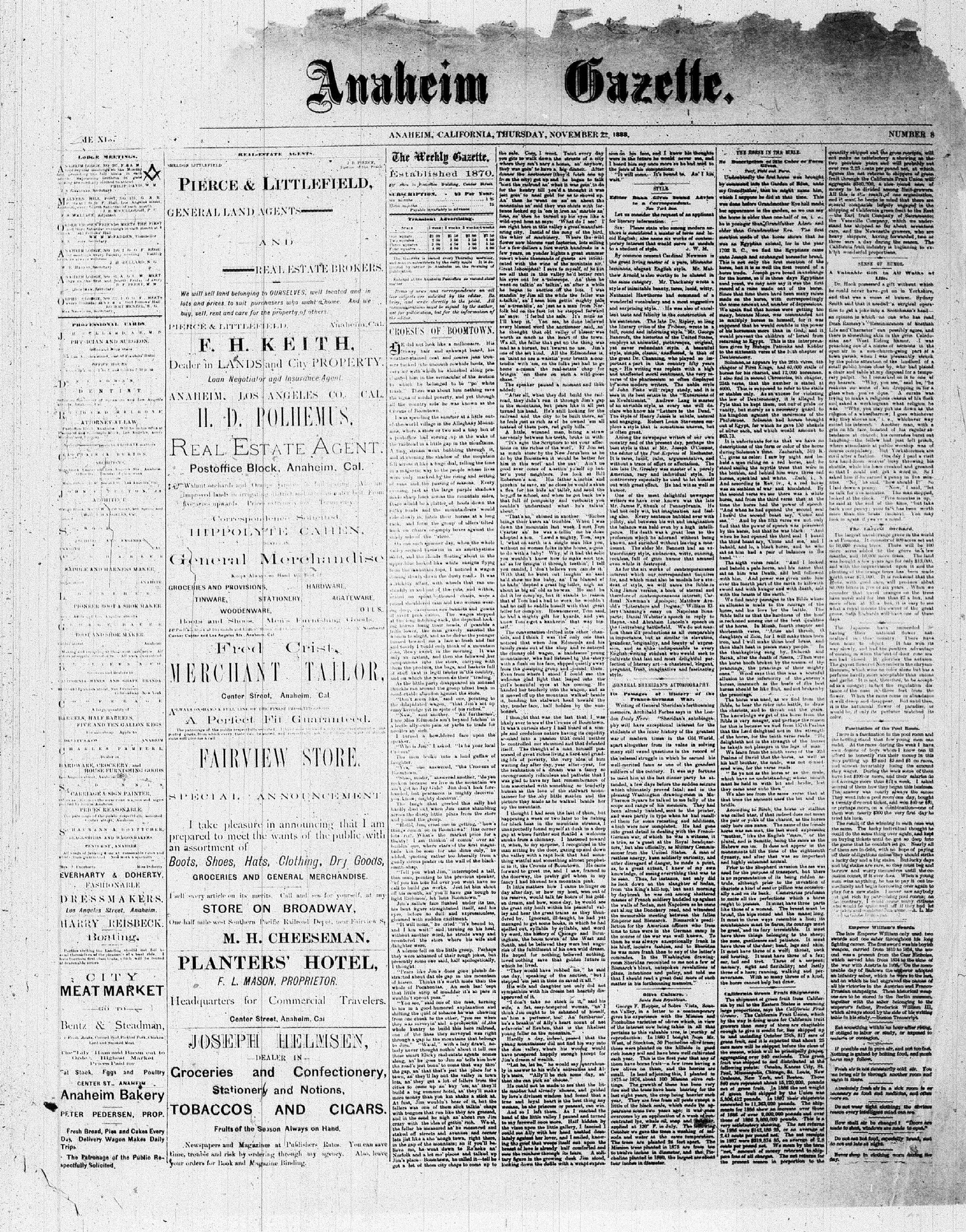
Searchable text
LODGE MEETINGS.
ANAHEIM LODGE, NO. 20, F.A.M.
and regular meetings on the Monday first, preceding this Friday morning in good weather are cordially invited to attend PHILIP DAVIS, W. M.
L. GARVEY, Secretary.
MALVPEN HILL, POST, NO. 131, O. A. R.
and K. D. P. HALL, Los Angeles street,
Anaheim, every Tuesday afternoon of each month at 8
POLLEY'S Hall.
WW. M. M. FADDEN, Commissioner
R. A. SECRETARY
OVERCOME PEIRENS MEETS THE FIRST
and Only Saturday evenings in each month at 8
POLLEY'S Hall.
WW. M. M. FADDEN, Commissioner
R. A. SECRETARY
ANAHEIM LODGE, NO. 191, O. O. F. REGU
for months every Tuesday evening.
J. H. BULLARD, N. G.
W. K. HARRY, Secretary
ANAHEIM LODGE, NO. 254, A. O. I. W. MEET
on the first and fourth Friday of every
F. P. PERRY, M. W.
GRAFFMAN, Secretary
OPHYLL LODGE, NO. 271, O. O. F. MEETS
every Sunday night at 8 P.O.Fallows Hall.
ROBERT MENZEL, N. G.
May Newton, Secretary.
PROFESSIONAL CARD
J. H. BULLARD, A.R., M.D.
PHYSICIAN AND SURGEON.
Official and Private Stars
Los Angeles street, east of Plants' Hotel
OFFICE HOURS
D. E. DOWAN,
DETINITT.
Official and Private Stars of Anaheim and Los Angeles
ATTORNEY AT LAW.
Planters' Hall, Anaheim. Will be his official
Patent attorney and complete booker in Los Angeles every
Monday and Tuesday.
REAL ESTATE AGENTS.
SHELDON LITTLEFIELD
PIERCE & LITTLEFIELD
GENERAL LAND AGENTS —
AND
REAL ESTATE BROKER
We will sell land belonging to OURSELVES, well located and lots and prices to suit purchasers who want a home. And buy, sell, rent and care for the property of others.
PIERCE & LITTLEFIELD.
Nanaheim
F. H. KEITH,
Dealer in LANDS and City PROPER
Loan Negotiator and Insurance Agent.
ANAHEIM, LOS ANGELES CO.
H. D. POLHEMUS.
REAL ESTATE AGENT
Dealer in LANDS and City PROPERTY
Loan Negotiator and Insurance Agent.
ANAHEIM, LOS ANGELES CO.
H. D. POLHEMUS.
REAL ESTATE AGENT
Postoffice Block, Anaheim, Cal.
General Merchandise
GROCERIES AND PROVISIONS,
HARDWARE,
TINWARE,
STATIONERY,
AGATEW
WOODENWARE.
Fred Crist,
MERCHANT TAILOR
Center Street, Anaheim, Cal.
A Perfect Fit Guarantee
FAIRVIEW STORE.
SPECIAL ANNOUNCEMENT
I take pleasure in announcing that prepared to meet the wants of the public an assortment of
Boots, Shoes, Hats, Clothing, Dry G
SPECIAL ANNOUNCEMENT
I take pleasure in announcing that prepared to meet the wants of the public an assortment of
Boots, Shoes, Hats, Clothing, Dry G
GROCERIES AND GENERAL MERCHANDIS
I sell every article on its merits. Call and see for yourself.
STORE ON BROADWAY,
One half mile west Southern Pacific Railroad Depot, near Fail
M. H. CHEESEMAN
PLANTERS' HOTEL
F. L. MASON, PROPRIETOR.
Headquarters for Commercial Trav
Center Street, Anaheim, Cal
JOSEPH HELMSEN
—DEALER IN—
Groceries and Confectionery Stationery and Notions,
TOBACCOS AND CIGA
Fruits of the Season Always on Hand.
Newspapers and Magazines at Publishers Rates. Your time, trouble and risk by ordering through my agency. A your orders for Book and Magazine Binding.
ANAHEIM, CALIFORNIA, THURSDAY, NOVEMBER 22, 1888.
BETTLEFIELD,
NTS
ESTATE BROKERS.
SELVES, well located and in
who want a home. And we
porty of others.
EITH,
City PROPERTY.
Insurance Agent.
GELES CO. CAL.
MEMUS.
TE AGENT.
CROESUS OF BOOMTOWN.
Ed did not look like a millionaire. His frosty hair and unkempt beard, his weather-stained coat and coarse jean trousers, tucked into uncoath cowhide boots, the very air with which he alouched along pre-claimed him in the vernacular of the section to which he belonged to be "po white trash." There was about him nothing save the signs of sorrow poverty, and yet through all the country side he was known as the Creusus of Boomtown.
I was spending the summer at a little out-of-the-world village in the Alleghany Mountains, where a store or two and a tiny box of a postoffice had sprung up in the wake of the railroad in a little gap in the mountains. A tiny, stream went bubbling through it, and at evening the shadow of the mountain made its mails. Camp I went. Taint every day you gits to walk down the streets of a city where they can't mary a homem, an' anyhow, they was gain' to have a big dinner. After dinner the innmaster (they'd fetch one up from the city) got up and he began to talk 'bout the railroad an' what it was gain' to do for the knenry till you'd a thought it was just gain' to heal gold for as to showed up. An' then he went on an' on about the mountains an' said they was china with fortunes looked up in 'em in iron an' marble an' lima, an' then he turned up his eyes like a wild-eyed hone an' mys: 'What do I see? I see right here in this valley a great manufacturing city. Instid of the song of the bird, the whir of machinery. Where the wild flower now blooms vast factories, lots selling for a few dollars a foot worth hundreds in a few years, on younger hights a great summer resort where thousands of guests are interested with the wine of the mountain air.' Great Jehovahsphat? I says to myself, of be kin see all that in this valley he'd better rent his eyes out for a telescope. An' then he went on talkin' an'talkin', an'after a while he began to auction off the lots. I was standin' by Jim all the while the feller was a-talkin', an'I seen him gettin' mighty pale an'a-tremblin', an' just as a man from Norfolk hid on the fast lot he stepped forward an'says: 'I farbid the sale. It's mine as I'll keep it.' You see, he done believed every blamed word the auctioneer said, an' he thought that old valley of himself was worth as much as the heart of the town. Wa all, the feller that get up the thing was mad as a hornet, but 'twaret no use. Jim's one of the set kind. All the Edmondses is, en'taint waistin' your breath a-countin' with us' em, on the folks just had to go home a-c窦in' the real-estate chap for bringin' em there on such a wild-goose chase."
The speaker paused a moment and then added:
"After all, when they did build the railroad, they didn't run it through Jim's gap in the mountains, but peers like it all just turned his head. He's still looking for the railroad and the city to be built there, an he feels just as rich as if he owned 'am all instead of them pore, red gully hills."
A little, winned man, biting a straw nervously between his teeth, broke in with:
"It's agin the Scripture to set your affections on the riches of the world." If Jim set as much store by the Boomtown it would be better for them on his face, and I know were in the future he would need I heard him my ones more as he the jurors of his companions:
"It will come. It's bound to wait."
STYLE
Editor Bann Given Ben to a Correspondent New York Sun.
Let us consider the request of for literary information:
Six: Please state who amnese there is considered a master of a cid English; also name six work pertaining interest that would serve to a student of style.
By common consent Cardinale the great living master of a prairie luminous, elegant English style shew Arnold is also worthy to be the same category. Mr. Thack style of imminible beauty, terms Nathaniel Hawthorne had so wonderful vocabulary and so man and surprising style... He was lent taste and felicity in the con his sentences. The late Dr. R. the literary critic of The Truman full, round and informing styles Baneroft, the historian of L employs an animated picture yet never redundant style style, simple, classic., unaffected the great Dr. Channing, who pliants part a in this country age.- His writing was replets and unaffected moral sentiment verse of the phariseism so often by some modern writers. The of John Pike will repay stene seen in its best estate in the "An Evolutionist." Andrew L. of an enviable style, as every clare who know his "Letters to Henry James is an and engaging. Robert Louis Slavey plays a style that is sometimes often great.
Among the newspaper writer country and of the present day, best style is that of Mr. Jensen; the editor of the Post Express It is tarse; calm; argum
were tucked into smooth cowhide boots, the very air with which he alouched along pre-claimed him in the vernacular of the section to which he belonged to be "po white trash." There was about him nothing save the signs of sorrid poverty, and yet through all the country side he was known as the Cresus of Boomtown.
I was spending the summer at a little out-of-the-world village in the Alleghany Mountains, where a store or two and a tiny box of a postoffice had sprung up in the wake of the railroad in a little gap in the mountains. A tiny stream went bubbling through it, and at evening the shadow of the mountain fell across it like a huge dial, telling the time in a magnetic way to the people whose lives were only marked by the rising and setting of suns and the passing of seasons. Every evening, just as the large purple shadows make sharp lines across the mountain sides, there would be a glitter of hoops down the rocky roads and the mountainers would ride slowly in little their horses at a long rack, and form the group of idlers tilted back on chairs or simply boxes against the smarty side of the "story."
On such summer day, when the whole valley seemed to saturate in an amethysttime midday, and the clouds floating about in the upper blue booked like white ensign flying from the mountain tops, I noticed a wagon coming slowly shown the dusty road. It was a rickety affair, with wheels that ran unsteady in and part of the ruts, and within, seated on spindle-bounded chairs, wore a round shoulder man and two women wearing deep, cavernous sand bannets and gowns of trout pink saffron. The wagons stopped at the long hitching rack, the dejected-looking horse hung their heads, if possible a trite lower, the man gravelly assisted the woman to sitight, and as she thrashed the younger turned toward me a face so fresh and fair and lovely I could only think of a mountain rose, lewy sweet in the morning. It was only an instant, and then she followed her companions into the store, carrying with them the produce, the bags, and basket full of stuff that is legal tender in the country, and on which the women do their "trading."
As the little party disappeared an amused chinkle ran around the group tilted back in comfortable attaunce against the store.
"Don't seem like," said one pointing to the dilapidated wagon, "that Jim's set up emmyery kit in spite of his riches."
"Now," said another, "An furthermo', I Miss Eleanor ain't beyand fetish' in a little ally-cum pain or yarbs to trade for needles an' sniff."
I turned a bewildered face upon the speaker.
"Who is Jim?" I asked. "Is he your local Croesus?"
The men booke into a loud guillow of laughter.
"Yes," one answered, "the Croesus of Boomtown."
"Shoe, mistir," answered another, "do you rockon because we live in the mountain we can't get no Jay Gude? Jim don't look forehanded, but pearances is mighty decovin' you know; mighty decovin'."
The laugh that greeted this sally had hardly died out when Jim came shambling across the dusty little plaza from the store and joined the group.
"Hello, Jim, crest one in getting,' how's things comin' on in Boomtown?' Has corner lots razt.' What's the market price for a thirsty' I am thinkin' of comin' over an buildin' one, where stars of the first magnitude kin be seen for one dime only,' he added, quoting rather too liberally from a gaudy circus poster on the wall of the black-smith ship.
I thought that was the last that I was likely ever to see of the Croesus of Boomtown. It was a curious story I had board of a simple and credulous nature having its capacity into a passion that could neither be controlled nor stemmed and that defeated itself. The thought of a man himself possessed of great riches living a hard and grading life of poverty, the very idea of him waiting day after day, year after-year, for the realization of a dream was a fancy so incongruously ridiculous and pathetic that I was glad to have my last remembrance of him associated with something so tenderly human as the love of the stalwart mountaineer for the abyss little maiden and the picture they made as he walked beside her up the mountain.
I thought I had seen the last of them, but happening a week or two later to be fishing for black bass in the mountain streams, I unexpectedly found myself at dusk in a deep gap at whose further and floated a welcome smoke from a chimney. He hastened toward it, when, to my surprise, I recognized in the man sitting by the door, gazing up and down the valley with a rapt look that had something waitful and something almost prophetic in it, the Croesus of Boomtown. He came tucked into smooth cowhide boots, the very air with which he alouched along pre-claimed him in the vermicular of the section to which he belonged to be "po white trash." There was about him nothing save the signs of sorrid poverty, and yet through all the country side he was known as the Croesus of Boomtown.
I was spending the summer at a little out-of-the world village in the Alleghany Mountains, where a store or two and a tiny box of a postoffice had sprung up in the wake of the railroad in a little gap in the mountains. A tiny stream went bubbling through it, and at evening the shadow of the mountain fell across it like a huge dial, telling the time in a magnetic way to the people whose lives were only marked by the rising and setting of suns and the passing of seasons. Every evening, just as the large purple shadows make sharp lines across the mountain side, there would be a glatter, of hoops down the rocky roads and the mountainers would rule slowly in littles their horaces at a long rack, and form the group of idlers tilted back on chairs or simply boxes against the smarty side of the "story."
On such summer day, when the whole valley seemed to saturate in an amethysttime midday, and the clouds floating about in the upper blue booked like white ensign flying from the mountain tops, I noticed a wagon coming slowly shown the dusty road. It was a rickety affair, with wheels that ran unsteady in and part of the ruts, and within, seated on spindle-bounded chairs, wore a round shoulder man and two women wearing deep, cavernous sand bannets and gowns of trout pink saffron. The wagons stopped at the long hitting rack, the dejected-looking horse hung their heads, if possible a trite lower, the man gravelly assisted the women to sitight, and as she thrashed the younger turned toward me a face so fresh and fair and lovely I could only think of a mountain rose, levy sweet in the morning. It was only an instant, and then she followed her companions into the store, carrying with them the produce, the bags, and basket full of stuff that is legal tender in the country, and on which the women do their "trading."
As the little party disappeared an amused chinkle ran around the group tilted back in comfortable attaunce against the store.
"Don't seem like," said one pointing to the dilapidated wagon," that Jim's set up emmyery kit in spite of his riches."
"Now," said another, "An furthermo', I Miss Eleanor ain't beyand fetish' in a little ally-cum pain or yarbs to trade for needles an' sniff."
I turned a bewildered face upon the speaker.
"Who is Jim?" I asked. "Is he your local Croesus?"
The men booke into a loud guillow of laughter.
"Yes," one answered, "the Croesus of Boomtown."
"Shoe, mistir," answered another, "do you rockon because we live in the mountain we isn't got no Jay Gude? Jim don't look forehanded, but pearances is mighty decovin' you know; mighty decovin'."
The laugh that greeted this sally had hardly died out when Jim came shambling across the dusty little plaza from the store and joined the group.
"Hello, Jim, crest one in getting,' how's things comin' on in Boomtown?' Has corner lots razt.' What's the market price for a thirsty' I am thinkin' of comin' over an buildin' one, where stars of the first magnitude kin be seen for one dime only,' he added, quoting rather too liberally from a gaudy circus poster on the wall of the black-smith ship.
I thought that was the last that I was likely ever to see of the Croesus of Boomtown. It was a curious story I had board of a simple and credulous nature having its capacity into a passion that could neither be controlled nor stemmed and that defeated itself. The thought of a man himself possessed of great riches living a hard and grading life of poverty, the very idea of him waiting day after day, year after-year, for the realization of a dream was a fancy so incongruously ridiculous and pathetic that I was glad to have my last remembrance of him associated with something so tenderly human as the love of the stalwart mountaineer for the abyss little maiden and the picture they made as he walked beside her up the mountain.
I thought I had seen the last of them, but happening a week or two later to be fishing for black bass in the mountain streams, I unexpectedly found myself at dusk in a deep gap at whose further and floated a welcome smoke from a chimney. He hastened toward it, when, to my surprise, I recognized in the man sitting by the door, gazing up and down the valley with a rapt look that had something waitful and something almost prophetic in it, the Croesus of Boomtown. He came tucked into unmooth cowhide boots, very air with which he alouached along pre-claimed him in all vermicular of the section to which he belonged to be "po white trash." There was about him nothing save the signs of sorrid poverty, and yet through all the country side he belonged to be "po white trash." There was about him nothing save the signs of sorrid poverty, and yet through all the country side he belonged to be "po white trash." There was about him nothing save the signs of sorrid poverty, and yet through all
Announcing that I am agents of the public with clothing, Dry Goods, general merchandise.
BROADWAY, Railroad Depot near Fairview S. HeeSEMAN. Commercial Travelers. Anaheim, Cal.
HELMSEN, Confectionery, and Notions, CIGARS. Always on Hand.
Publishers Rates: You can save through my agency. Also, leave binding.
"Shine, mistir," answered another, "do you rocken because we live in the mountain we can't get no Jay tide! Jim don't look forehanded, but pearances is mighty deceivin' you know; mighty deceivin'.
The laugh that greeted this sally had hardly died out when Jim came shambling across the dusty little plaza from the store and jumed the group.
"Hello, Jim, cruel one in getting, 'how's things come on in bloomtown?' Has corner lotta rat. What's the market price for a threaty? I am thinkin' of comin' over an buildin' one, where stars of the first magni-tude kin be seen for one dime only," he added, quoting rather too liberally from a gaudy circus poster on the wall of the blacksmith-shop.
"Tell you what Jim," interrupted a tall, thin man, pointing to the previous speaker, "of you kin tom talo over you wont have no call to build gas works." Jeat let him shoot off his mouth, an you'll have gas 'nough to right Richmond, let lons Boomtown."
Jim's saloon face flushed under its tan, his bent figure straightened itself, and his eyes, before so dull and expressionless, gleamed with sudden exultation.
"It will come," he cried, "'it's bound to, and I kn wait!" and turning on his heel, without another word, he strode away and re-entered the store where his wife and daughter were.
A silence fell on the little group. Perhaps they were ashamed of their rough jokes, but presently some one said, half apologetically, I thought.
"Pears like Jim's done plumb destracted about dat ole gap in the mountain of hissen. Thinks it's worth more than the whole of Pocahontas. An sech lan! 'cept that little strip of meadder it's so pere it wouldn't sprout peas."
"You see," said one of the men, turning to me in a good humored explanation and shifting the quil of tobacco he was chewing from one cheek to the other, "you see when they was surveyin' and a prospectin of she whole kentry to build this here railroad, one of the lines they surveyed was right through a gap in the mountains that belongs to Jim."
"Wa-al," with a lazy drawl, nobly never thought nothin' about it tell one these smart Klicky real-estate agents comes along, an he goes to Jim an tells him how the road's jest bonst to come that way thro' the gap, an that's just the place for a town, an they'll lay out the valley in town lots, an they get a lot of fellers from the cities to come up an' buy em, an they'll build a big summer hotel, an they'll make more money than you kin shake a stick at. At fust, Jim wouldn't hear of it, but the fellers was one of them slick talkin' chaps with tongues that run like they are greased, and in the send he nigh an' about run Jim crazy with the idea of gettin' rich. We al,' the feller he measured an' he measured and staked off streets and avannes and corner jist like a sho'nough town, right there, in the gap of the mountains; an if you'll believe ma, he went down to Roheke an' Norfolk and a lot mo' places and talked up Jim's place—Boomtown, he called it—tell he got a lot of them city chapa to come up to
It little matters how I came to finger on day after day, or how my host, won out of his reserve, would talk for hours of his golden dream, and how some day, he would see the great city built within his peaceful valley and hear the great trains as they thundered by. Ignorant, ill-taught, he had yet managed to get some books, in which he had spelled out, syllable by syllable, and word by word, the history of Chicago and Birmingham, the boom towns of the West and South, and be believed they were but anguages of the fulfilment of his own wild dream. He hoped for nothing, believed nothing loved nothing save that golden future in which he lived.
"They would have robbed me," he said one day, speaking of the auction, "but I stepped 'em just in time en saved it all."
His wife and daughter not only did not sympathize with his dream but heartily disapproved of it.
"I don't take no stock in it," said his wife, a fat, easy-tempered woman, "an I think Jim ought to be ashamed of himself, an him a partemor', too.' An furthermo', he's a breakin' of Ally's heart count of nast-a-favorin' at Reuben, that is the likeliest young fellow on the mountain."
Hardly a day indeed, passed that the young mountainmaster did not find his way into the dim valley, where his woong would have prospered happily enough except for Jim's wealth.
"Let be, let be," he would say querulously in answer to his wife's entreaties and Ally's hearts. "Ally'll be rich some day, an then she can pick an' chose."
He could not be made to see that the litte maiden had already chosen, and guided by love's divinent wisdom had found that a true and loyal heart in best thing any woman, he she princess or peasant, can win.
And so I left them. As I reached the head of the little valley I paused and turned to say farewell once more. Half hidden by the vines upon the little gallery, I famised I could see Ally with her head smalled denially against her lower, and I smiled, knowing the grief that weeps itself eat upon the breast of love is already half comforted and sees the rainbow through its tears. A solitary figure in the growing dusk Jim stood, looking down the defile with a wrapt expres-
to meet him at the last dinner tended,a few days before that which ultimately proved fatal pleasand Washington drawing Pherson Square he talked to me scope and range of his memoir been already finished,sent to el them for some recasting at which were now completed into great detail in dealing with Warrior of which he was trie, as a guest at the Royters,' but also officially as Milonator from the United States restless energy, keen soldierly utter disregard of danger he as to a great extent. I knew knowledge of seeing everything be seen. Thus, for instance,
he look down on the slaughter from 'the King's hill-top,' but by daybreak he was out mamed of French soldiers huddles the walls of Sedan,met Napoleon out along the Doncho read,the memorable meeting between Emperor and Bismarck. Bluntiction for the American office time to time were in the Gerr course of the war was well them he was always exception his bluff,incusive fashion,and he was more frank than to any comrade. In The Washing room Sheridan recounted to me Bismarck's blunt,ostepaine plans,intention and policy that I should read a great deal matter in his forthcoming memoir.
Olive Culture,
George F. Hopper, Subaru Ma Valley, in a letter to a gives his experience with the Piccolhine variety of olives w of the interest now being taken pertains to this valuable tree reproduction: In 1880 I bore West,of Stockton,m 50 Piccolhine those were planted on the hill rich loamy soil and have been each year. This is the first year them have borne fruit—a few low olive on them,and then small.In land adjointing this 1875 or 1876,b about 100 Mintings.The growth of these fine and the trees have borne last eight years,the crop being year They are free from all little of the black scalewhich pearance some two years ago overcome by an application of centrated lye,whale oil,mosp applied at 130°F.在 July.October we gave the truss a waoda and water at the same The trees are planted 24 feet Minium trees planted in 1875 to twelve inches in diameter,chelline planted in 1880,the haf fear inches in diameter.
azette.
2. 1888.
NUMBER 8
sion on his face, and I knew his thoughts were in the future he would never see, and I heard him my own more as he had said to the fears of his companions:
"It will come. It's bound to. An' I kin wait."
STYLE
Editor Bann. Given summer advice to a correspondent.
New York City.
Let us consider the request of an applicant for literary information:
Six: Please state who among modern authors is considered a master of verse and laid English; also name six works of contemporary interest that would serve as models to a student of style.
J.W.M.
By common consent Cardinal Newman is the great living master of a pure, idiomatic lutenious, elegant English style. Mr. Mathew Arnold is also worthy to be classed in the same category. Mr. Thackeray wrote a style of imitative beauty, term, lucid, witty. Nathaniel Hawthorne had command of a wonderful vocabulary and a most suggestive and surprising style. He was also of excellent taste and felicity in the construction of his sentences. The late Dr. Ripley, so long the literary critic of the Tribune, wrote in a full, round and informing style. Mr. George Baneroy, the historian of the United States, employs an animated, picturesque, original yet never redundant style. A beautiful style, simple,典雅, unaffected, in that of the great Dr. Channing, who played no important part in this country fifty years ago. His writing was replies with a high and unaffected moral sentiment, the very reverse of the phariseism so often displayed by some modern writers. The naughty style of John Pike will repay study, and it is seen in its best estate in the "Excavations of an Evelutianist." Andrew Lang is master of an enviable style, as every one will declare who know his "Letters to the Dead." The style of Henry James is subtle, natural and engaging. Robert Louis Stevenson employs a style that is sometimes uneven, but is often great.
Among the newspaper writers of our own country and of the present day, perhaps the best style is that of Mr. Joseph O'Connor, the editor of the Post Express of Rechauer.
It is tarse, lacini, calm, argumentative, and quantity shipped and the given receipts will not make an satisfactory showing as two previous years and will probably not over run 2,25 cents per pound net, at which figures the net returns to shipper of green fruit through the California Fruit Union will aggregate $340,200, a nine-round sum of money to be divided among fruit-growers. All this is the result of one organization, and it must be borne in mind that there are several companies largely engaged in the shipping of California green fruit to the East—the Earl fruit Company of Sacramento; the Vacaville Company, which we understand has shipped so far about seventeen cars, and the Newcastle growers who are heavy shipppers, having forwarded two or three cars a day during the season. The California fruit industry is beginning to exhibit wonderful proportions.
SENSE OF HUMOR.
A Valuable Gift in All Walks at Life.
Dr. Hook possessed a gift without which he could never have got on in Yorkshire, and that was a sense of humor. Sydney Smith said that it needed—a surgical operation to get a joke into a Scotchman's head—an opinion in which no one who has read Dean Ramsey's "Reminiscences of Scottish Life and Character" can possibly agree, and there is something skinny in the grim Caledonian and West Edinburgh. I was preaching one of a course of sermons in the open air in a non-church going part of a town parish, when I was piously struck by the polite attention of the landlord of a small public house close by, who had placed a chair and table at his disposal for a temporary pulpit. So I remarked on it to one of my hearers: "Why, you see," said he, "he reckons on some of am dropping in for a glass when you've done." A curate was trying to make a religious causus of his flock and asked a workingman what religion he was. "Why, you may put me down as the religion of a wheelbarrow; I guess whichever way they show me," I. e., whichever way suited his interest. Another man, with a grip on his face, boasted of his regular attendance at church; his comrade burst out laughing—the fellow had just left prison, where attendance at public worship was of course compulsory. But Yorkshiremen are civil after a fashion. One day I paid a visit
portant a part in this country fifty years ago. His writing was replied with a high
reverse and unaffected moral sentiment, the very reverse of the pharisonism often displayed by some modern writers. The noble style
of John Fisk will repay study, and it is seen in its best estate in the "Excursion of
an Evelitianist." Andrew Lang is master of an enviable style, as every one will declare who know his "Letters to the Dead."
The style of Henry James is subtle, natural
and engaging. Robert Louis Stevenson employs a style that is sometimes uneven, but is often great.
Among the newspaper writers of our own
country and of the present day, perhaps the best style is that of Mr. Joseph O'Connor,
the editor of the Post-Express of Rochester. It is terse, lustful, calm, argumentative, and
without a trace of effort or affectation. The late late Dr. Greenshaw was master of a purely
American, racy and individual style. In controversy especially he used to let himself out with great effect. He had wit as well as humor.
One of the most delightful newspaper
writers we have ever known was the lake
Mr. James F. Shunk of Pennsylvania. He
had not only wit, but imagination and feation also. Every sentence bubbled over with
jolity, and between his wit and imagination
the balance was held even by a high intelligence. His death was a great loss to the
profession which he adorned without being known, and sinned without leaving a monument. The older Mr. Bennatt had an extratrordinary style, andademy, witty,unning reckless, full of grim humor that amused even while it destroyed.
As for the six works of contemporaneous
interest which our correspondent inquires for, and which must also be models for a student of style, we will name the Bible in King James version, a book of eternal and therefore of contemporaneous interest; Cardinal Newman's Apologia; Matthew Arnold's "Literature and Dogma"; William Kiery Channing's essay on Napoleon Bonaparte; Daniel Webster's speech in reply to Haynes, and Abraham Lincoln's speech on the Gatsbyabattle battlefield. We do not mention these six productions as all comparable in importance, but as similar in elevation, grandeur, originality, beauty of expression, and as alike indispensable to every English writing student who would seek to cultivate that last and most delightful perfection of literary art—chaetatical, elegant, pregnant, fresh, imaginative and fascinating style.
GENERAL SHERIDAN'S AUTOMOGRAPHY
Its Passages of History of the
France-Terrier War.
Writing of General Sheridan's forthcoming memoirs, Archibald Forbes says in the London Daily News: "Sheridan's autobiography will have exceptional interest for the students of the inner history of the greatest war of modern times in the Old World, apart altogether from its value in solving many still vexed questions in the record of the celestial struggle in which he earned his well-merited fame as one of the grandest soldiers of the century. It was my fortune to meet him at the last dinner party he attended, a few days before the sudden seizure which ultimately proved fatal; and in the pleasant Washington drawing-room in Mo-pharaon Square he talked to me fully of the scope and range of his memories. They had been already dishabbed, sent to the printer, and were partly in type when he had resullated them for some recasting and addition, which were now completed. He had gone into great detail in dealing with the Franco-German war, of which he was a witness, it is true, as a guest at the Royal headquarterers, but also officially, as Military Commis-sioner from the United States. A man of restless energy, keen soldierly curiosity, and utter disregard of danger, he made a point, as to a great extent, I knew of my own
Notemann appears by the 20th verse, written chapter of First Kings, had 40,000 stalks of horse for his chariot, and 12,000 horsemen. I also find in Second Chronicle, 9th chapter, 25th verse, that the number is stated at 4000. This is supposed to refer to the stalks or stables only. As an excuse for violating the law of Deuteronomy, it is alleged by Pytele that he kept them not out of pride or vanity, but merely as a necessary guard to his kingdom among the incursions of the Philistines. Solomon had horses brought out of Egypt, for which he gave 130 shekels of silver each, and which would amount to $63.75.
It is unfortunate for us that we have no descriptions of the form or color of the horse during Solomon's time. Zeachiah, 319 B.C., gives us color: I saw by night and behold a man riding on a red horse, and he stood among the myrtle trees that were in the bottom, and behind him were three red horses, speared and white. Zachia, 18, S.And according to Raw iv., 4, a red horse was an emblem of war and bloodletting. By the second verse we see there was a white horse, and from the third verse that at the time the horse had the power of speech "And when he had opened the second seal I heard the second beat say" Come and see."
And by the fifth verse we not only find that the power of speech was possessed by the horse, but that he was black.
And when he had opened the third seal I heard the third beat say "Come and see," and I behold it on him Death, and hell followed with him. And power was given unto him over the fourth part of the earth to kill with wizard and with hanger and with death, and with the beats of the earth.
We find many passages in the Bible where an allusion is made to the courage of the horse, and his love for the battle. The Bible tells us that the hardiness of the hoof is reckoned among one of the best qualities of the horse. In Minah, fourth chapter and thirteenth verse: "Aries and thresh. O daughters of Zion, for I will make three horn iron, and I will make three hoof brass, and they shall beat in pieces many people." In the thanksgiving song by Deborah and Harak, after the death of Sisera. Then were the horse hoofs broken by the means of the prancing; the prancing of their mighty ones. Wood says that this was a scourge allusion to the inferiority of the enemy's horses; insamuch as the hoofs of their horses should be like flint, and not broken by the prancing.
The horse was used as we find from the Bible, to bear the rider into battle; to draw the charmets, and to throw out the grain. The knowledge we get of the horse from the Bible is very meager, and perhaps the reason for this is because we find from 157th Palms that the Lord delighted not in the strength of the horse; for the tenth verse reads: "He dalighteth not in the strength of the horse he taketh not pleasure in the legs of male."
We learn from the ninth verse of the 221 Palms of David that the horse, as well as his half brother, the mule, was not standard wine; for the verse reads:
"Be ye not as the horse or as the mule which have no understandance; whose mouth must be held in with bit and bridle; but they came near unto them."
We also see from the same verse that at that time ancient users used hit and beadles.
According to Birchbaird, the horse or stallion was called hit; if that indeed does not mean the pair or yoke of the chariot, as the horses only bore one name. The name of female horses was mat; last word expressing "mother," like the English "mare," or the plural, and is Semitic; being as shes The Hebrew sea im. It does not appear in the memorials till the time of eighteenth dynasty, and after that was an important and highly esteemed animal.
Prior to shepherd invasion she was
Notemann appears by the 20th verse, written chapter of First Kings, had 40,000 stalks of horse for his chariot, and 12,000 horsemen. I also find in Second Chronicle, 9th chapter, 25th verse, that the number is stated at 4000. This is supposed to refer to stalks or stables only. As an excuse for violating the law of Deuteronomy, it is alleged by Pytele that he kept them not out of pride or vanity, but merely as a necessary guard to his kingdom among the incursions of the Philistines. Solomon had horses brought out of Egypt, for which he gave 130 shekels of silver each, and which would amount to $63.75.
It is unfortunate for us that we have no descriptions of the form or color of the horse during Solomon's time. Zeachiah, 319 B.C., gives us color: I saw by night and behold a man riding on a red horse, and he stood among myrtle trees that were in the bottom, and behind him were three red horses, speared and white. Zachia, 18, S.And according to Raw iv., 4, a red horse was an emblem of war and bloodletting. By the second verse we see there was a white horse, and from the third verse that at time the horse had the power of speech "And when he had opened the second seal I heard the second beat say" Come and see."
And by the fifth verse we not only find that the power of speech was possessed by the horse, but that he was black.
And when he had opened the third seal I heard the third beat say "Come and see," and I behold it on him Death, and he who has him Death followed with him. And power was given unto him over the fourth part of the earth to kill with wizard and with death, and with beats of the earth.
We find many passages in the Bible where an allusion is made to the inferiority of the enemy's horses; insamuch as the hoofs of their horses should be like flint, and not broken by the prancing.
The horse was used as we find from the Bible, to bear the rider into battle; to drawthe charmets,andtothrowoutthegrainsonlyborneonename.Thenameofthefemalehorsewasmat,thelastwordexpressing"mother",liketheEnglish"mare",ortheplural,andisSemitic,besameastheHebrewseaim.Idoesnotappearnothememorialstillthetimeofeighteenthdynasty,andafterthatwasanimportantandhighlyesteemedanimal.
Prior to shepherd invasion she was
Notemann appears by the 20th verse,written chapter of First Kings,had 40,000 stalks of horse for his chariot,and 12,000 horsemen.IalsofindinSecondChronicle,9thchapter,25thverse,thatthenumberisstainedat4000.Assupposedtoreferextainpastailhorsehouseclosebyasmallpublichouseclosethyoyouhavewitness.Acuratewasytryingtomakeal religiouscausumofhisbookandaskaworkingmanwhatreligionhawwas.Whyyoumayputmedownasthe religionwhaysheshowsme.i.e.,whichweavemyinterestedhimselfatchurch;hiscorrandebatunt laughing—thefollewhadjustleftpricewhereattendanceatpub worshipwasofcoursecompulsory.ButYorkshiremenarecivilafterafashion.Ontyorkshiremenarecivilafterafashion.Ontyorkshiremenarecivilafterafashion.Ontyorkshiremenarecivilafterafashion.Ontyorkshiremenarecivilafterafashion.Ontyorkshiremenarecivilafterafashion.Ontyorkshiremenarecivilafterafashion.Ontyorkshiremenarecivilafterafashion.Ontyorkshiremenarecivilafterafashion.Ontyorkshiremenarecivilafterafashion.Ontyorkshiremenarecivilafterafashion.Ontyorkshiremenarecivilafterafashion.Ontyorkshiremenarecivilafterafashion.Ontyorkshiremenarecivilafterafashion.Ontyorkshiremenarecivilafterafashion.Ontyorkshiremenarecivilafterafashion.Ontyorkshiremenarecivilafterafashion.Ontyorkshiremenarecivilafterafashion.Ontyorkshiremenarecivilafterafashion.Ontyorkshiremenarecivilafterafashion.Ontyorkshiremenarecivilafterafashion.Ontyorkshiremenarecivilafterafashion.Ontyorkshiremenarecivilafterafashion.Ontyorkshiremenarecivilafterafashion.Ontyorkshiremenarecivilafterafashion.Ontyorkshiremenarecivilafterafashion.Ontyorkshiremenarecivilafterafashion.Ontyorkshiremenarecivilafterafashion.Ontyorkshiremenarecivilafterafashion.Ontyorkshiremenarecivilafterafashion.Ontyorkshiremenarecivilafterafashion.Ontyorkshiremenarecivilafterafashion.Ontyorkshiremenarecivilafterafashion.Ontyorkshiremenarecivilafterafashion.Ontyorkshiremenarecivilafterafashion.Ontyorkshiremenarecivilafterafashion.Ontyorkshiremenarecivilafterafashion.Ontyorkshiremenarecivilafterafashion.Ontyorkshiremenarecivilafterafashion.Ontyorkshiremenarecivilafterafashion.Ontyorkshiremenarecivilafterafashion.Ontyorkshiremenarecivilafterafashion.Ontyorkshiremenarecivilafterafashion.Ontyorkshiremenarecivilafterafashion.OntyORKSHIREMANS AUTOMOGRAPHY
Its Passages Of History Of The France-Terrier War.
Writing of General Sheridan's forthcoming memoirs Archibald Forbes says in The London Daily News: "Sheridan's autobiography will have exceptional interest forthe studentsoftheinnerhistoryofthegreatwarofmoderntimesinTheOldWorld,apartaltogetherfromitsvalueinsolvingmanystillvexedquestionsintherecordofthecelessualstruggleinwhichhecarriedhiswellmeritedfameasoneofthegrandestaddictsofthecentury。它是myfortunetomeithimatlastdinnerpartheattended,a fewdaysbeforethe suddenseizurewhichultimatelyprovedfatal;andinthepleasantwritingstudentwhowouldseektocultivatethatlastandmostdelightfulperfectionofliteraryart-chaetatical,elegant,pregnant,fresh,intaginaryandfascinatingstyle."
GENERAL SHERIDAN'S AUTOMOGRAPHY
Its Passages Of History Of The France-Terrier War.
Writing of General Sheridan's forthcoming memoirs Archibald Forbes says in The London Daily News: "Sheridan's autobiography will have exceptional interest forthe studentsoftheinnerhistoryofthegreatwarofmoderntimesinTheOldWorld,apartaltogetherfromitsvalueinsolvingmanystillvexedquestionsintherecordofthecelessualstruggleinwhichhecarriedhiswellmeritedfameasoneofthegrandestaddictsofthecentury.它是myfortunetomeithimatlastdinnerpartheattended,a fewdaysbeforethe suddenseizurewhichultimatelyprovedfatal;andinthepleasantwritingstudentwhowouldseektocultivatethatlastandmostdelightfulperformanceofliteraryart-chaetatical,elegant,pregnant,fresh,intaginaryandfascinatingstyle."
GENERAL SHERIDAN'S AUTOMOGRAPHY
Its Passages Of History Of The France-Terrier War.
Writing of General Sheridan's forthcoming memoirs Archibald Forbes says in The London Daily News: "Sheridan's autobiography will have exceptional interest forthe studentsoftheinnerhistoryofthegreatwarofmoderntimesinTheOldWorld,apartaltogetherfromitsvalueinsolvingmanystillvexedquestionsintherecordofthecelessualstruggleinwhichhecarriedhiswellmeritedfameasoneofthegrandestaddictsofthecentury.它是myfortunetomeithimatlastdinnerpartheattended,a fewdaysbeforethe suddenseizurewhichultimatelyprovedfatal;andinthepleasantwritingstudentwhowouldseektocultivatethatlastandmostdelightfulperformanceofliteraryart-chaetatical,elegant,pregnant,fresh,intaginaryandfascinatingstyle."
GENERAL SHERIDAN'S AUTOMOGRAPHY
Its Passages Of History Of The France-Terrier War.
Writing of General Sheridan's forthcoming memoirs Archibald Forbes says in The London Daily News: "Sheridan's autobiography will have exceptional interest forthe studentsoftheinnerhistoryofthegreatwarofmoderntimesinTheOldWorld,apartaltogetherfromitsvalueinsolvingmanystillvexedquestionsintherecordofthecelessualstruggleinwhichhecarriedhiswellmeritedfameasoneofthegrandestaddictsofthecentury.它是myfortunetomeithimatlastdinnerpartheattended,a fewdaysbeforethe suddenseizurewhichultimatelyprovedfatal;andinthepleasantwritingstudentwhowouldseektocultivatethatlastandmostdelightfulperformanceofliteraryart-chaetatical,elegant,pregnant,fresh,intaginaryandfascinatingstyle."
GENERAL SHERIDAN'S AUTOMOGRAPHY
Its Passages Of History Of The France-Terrier War.
Writing of General Sheridan's forthcoming memoirs Archibald Forbes says in The London Daily News: "Sheridan's autobiography will have exceptional interest forthe studentsoftheinnerhistoryofthegreatwarofmoderntimesinTheOldWorld,apartaltogetherfromitsvalueinsolvingmanystillvexedquestionsintherecordofthecelessualstruggleinwhichhecarriedhiswellmeritedfameasoneofthegrandestaddictsofthecentury.它是myfortunetomeithimatlastdinnerpartheattended,a fewdaysbeforethe suddenseizurewhichultimatelyprovedfatal;andinthepleasantwritingstudentwhowouldseektocultivatethatlastandmostdelightfulperformanceofliteraryart-chaetatical,elegant,pregnant,fresh,intaginaryandfascinatingstyle."
GENERAL SHERIDAN'S AUTOMOGRAPHY
Its Passages Of History Of The France-Terrier War.
Writing of General Sheridan's forthcoming memoirs Archibald Forbes says in The London Daily News: "Sheridan's autobiography will have exceptional interest forthe studentsoftheinnerhistoryofthegreatwarOfmoderntimesinTheOldWorld,apartaltogetherfromitsvalueInsolvingmanystillvexedquestionsInTheRecordOfTheFrancishTerrierWar.WritingOfGeneralSheridan'SAutomaticFloweringInTheIndependentMuseumAtTheParkOfNew York.MissouriWhichWouldBeUsedForTheStudentOfTheFrenchTerrierWar.WritingOfGeneralSheridan'SAutomaticFloweringInTheIndependentMuseumAtTheParkOfNew York.MissouriWhichWouldBeUsedForTheStudentOfTheFrenchTerrierWar.WritingOfGeneralSheridan'SAutomaticFloweringInTheIndependentMuseumAtTheParkOfNew York.MissouriWhichWouldBeUsedForTheStudentOfTheFrenchTerrierWar.WritingOfGeneralSheridan'SAutomaticFloweringInTheIndependentMuseumAtTheParkOfNew York.MissouriWhichWouldBeUsedForTheStudentOfTheFrenchTerrierWar.WritingOfGeneralSheridan'SAutomaticFloweringInTheIndependentMuseumAtTheParkOfNew York.MissouriWhichWouldBeUsedForTheStudentOfTheFrenchTerrierWar.WritingOfGeneralSheridan'SAutomaticFloweringInTheIndependentMuseumAtTheParkOfNew York.MissouriWhichWouldBeUsedForTheStudentOfTheFrenchTerrierWar.WritingOfGeneralSheridan'SAutomaticFloweringInTheIndependentMuseumAtTheParkOfNew York.MissouriWhichWouldBeUsedForTheStudentOfTheFrenchTerrierWar.WritingOfGeneralSheridan'SAutomaticFloweringInTheIndependentMuseumAtTheParkOfNew York.MissouriWhichWouldBeUsedForTheStudentOfTheFrenchTerrierWar.WritingOfGeneralSheridan'SAutomaticFloweringInTheIndependentMuseumAtTheParkOfNew York.MissouriWhichWouldBeUsedForTheStudentOfTheFrenchTerrierWar.WritingOfGeneralSheridan'SAutomaticFloweringInTheIndependentMuseumAtTheParkOfNew York.MissouriWhichWouldBeUsedForTheStudentOfTheFrenchTerrierWar.WritingOfGeneralSheridan'SAutomaticFloweringInTheIndependentMuseumAtTheParkOfNew York.MissouriWhichWouldBeUsedForTheStudentOfTheFrenchTerrierWar.WritingOfGeneralSheridan'SAutomaticFloweringInTheIndependentMuseumAtTheParkOfNew York.MissouriWhichWouldBeUsedForTheStudentOfTheFrenchTerrierWar.WritingOfGeneralSheridan'SAutomaticFloweringInTheIndependentMuseumAtTheParkOfNew York.MissouriWhichWouldBeUsedForTheStudentOFTheFrenchTerrierWar.WritingOfGeneralSheridan'SAutomaticFloweringInTheIndependentMuseumAtTheParkOFNew York.MissouriWhichWouldBeUsedForTheStudentOFTheFrenchTerrierWar.WritingOfGeneralSheridan'SAutomaticFloweringInTheIndependentMuseumAt>TheParkOFNew York.MissouriWhichWouldBeUsedForTheStudentOFTheFrenchTerrierWar.WritingOfGeneralSheridan'SAutomaticFloweringInTheIndependentMuseumAt>TheParkOFNew York.MissouriWhichWouldBeUsedForTheStudentOFTheFrenchTerrierWar.WritingOfGeneralSheridan'SAutomaticFloweringInTheIndependentMuseumAt>TheParkOFNew York.MissouriWhichWouldBeUsedForTHESTUDENTOFTHEFRANCISHTERRIER WAR.WritingOFGeneralSheridan'SAutomaticFloweringIN THEINDEPENDENTMUSEUMATTHEPARKOFNEW YORK.MISSUROUSWHICHWASUSEDFORTHESTUDENTOFTHEFRANCISHTERRIER WAR.WritingOFGeneralSheridan'SAutomaticFloweringIN THEINDEPENDENTMUSEUMATTHEPARK OFNEW YORK.MISSUROUSWHICHWASUSED FOR THE STUDENT OF THE FRANCISHTERRIER WAR.Writing OF General Sheridan'S Automatic Flowering IN THE Independent Museum At The Park Of New York.Missu罗卢 Which Was Used For The Student Of The French Terrier War.Writing Of General Sheridan'S Automatic Flowering IN The Independent Museum At The Park Of New York.Missu罗卢 Which Was Used For The Student Of The French Terrier War.Writing Of General Sheridan'S Automatic Flowering IN The Independent Museum At The Park Of New York.Missu罗卢 Which Was Used For The Student Of The French Terrier War.Writing Of General Sheridan'S Automatic Flowering IN The Independent Museum At The Park Of New York.Missu罗卢 Which Was Used For The Student Of The French Terrier War.Writing Of General Sheridan'S Automatic Flowering IN THE Independent Museum At The Park Of New York.Missu罗卢 Which Was Used For The Student Of The French Terrier War.Writing Of General Sheridan'S Automatic Flowering IN THE Independent Museum At The Park Of New York.Missu罗卢 Which Was Used For THE STUDENT OF THE FRANCISHTERRIER WAR.Writing OF General Sheridan'S Automatic Flowering IN THE Independent Museum At The Park Of New York.Missu罗卢 Which Was Used For THE STUDENT OF THE FRANCISHTERRIER WAR.Writing OF General Sheridan'S Automatic Flowering IN THE Independent Museum At The Park Of New York.Missu罗卢 Which Was Used FOR THE STUDENT OF THE FRANCISHTERRIER WAR.Writing OF General Sheridan'S Automatic Flowering IN THE Independent Museum At The Park Of New York.Missu罗卢 Which Was Used FOR THE STUDENT OF THE FRANCISHTERRIER WAR.Writing OF General Sheridan'S Automatic Flowering IN THE Independent Museum At The Park Of New York.Missu罗卢 Which Was Used FOR THE STUDENT OF THE FRANCISHTERRIER WAR.Writing OF General Sheridan'S Automatic Flowering IN THE Independent Museum At The Park Of New York.Missu罗卢 Which Was USED FOR THE STUDENT OF THE FRANCISHTERRIER WAR.Writing OF General Sheridan'S Automatic Flowering IN THE Independent Museum At The Park Of New York.Missu罗卢 Which Was USED FOR THE STUDENT OF THE FRANCISHTERRIER WAR.Writing OF General Sheridan'S Automatic Flowering IN THE Independent Museum At The Park Of New York.M missu罗卢 Which Was USED FOR THE STUDENT OF THE FRANCISHTERRIER WAR.Writing OF General Sheridan'S Automatic Flowering IN THE Independent Museum At The Park Of New York.M missu罗卢 Which Was USED FOR THE STUDENT OF THE FRANCISHTERRIER WAR.Writing OF General Sheridan'S Automatic Flowering IN THE Independent Museum At The Park Of New York.M missu罗卢 Which Was USED FOR THE STUDENT OF THE FRANCISHTERRIER WAR.Writing OF General Sheridan'S Automatic Flowering IN THE Independent Museum At The Park Of New York.M missu罗卢 Which Was USED FOR THE STUDENT OF THE FRANCISHTERRIER WAR.Writing OF General Sheridan'S Automatic Flowering IN THE Independent Museum At The Park Of New York.M missu罗卢 Which Was USED FOR THE STUDENT OF THE FRANCISHTERRIER WAR.Writing OF General Sheridan'S Autmatic Flowering IN THE Independent Museum At
to meet him at the last dinner party he attended, a few days before the sudden seizure which ultimately proved fatal; and in the pleasant Washington drawing-room in McPherson street he talked to me fully of the scope and range of his memoirs. They had been already dished, sent to the printer, and were partly in type when he had resallied them for some recasting and additions, which were now completed. He had gone into great detail in dealing with the Franco-German war, of which he was a witness, it is true, as 'a guest at the Royal headquarter,' but also officially, as Military Commissioner from the United States. A man of restless energy, keen soldierly curiosity, and utter disregard of danger, he made a point, as to a great extent, I knew of my own knowledge, of seeing everything that was to be seen. Thus, for instance, not only did he look down on the alangher of Sedan, from 'the King's hill-top,' but next morning by daybreak he was out among shattered masses of French soldiers huddled up against the walls of Sedan, met Napoleon as he came out along the Donchery road, and witnessed the memorable meeting between the fallen Emperor and Bismarck. Bismarck's prediction for the American officers who from time to time were in the German camp in the course of the war was well known. To them he was always exceptionally frank in his bluff, incisive fashion, and to Sheridan he was more frank than to any of the latter's comrades. In the Washington drawing-room Sheridan recounted to me not a few of Bismarck's blunt, outspoken revelations of plane, intentions and policy, and told me that I should read a great deal more of such matter in his forthcoming memoirs."
**Olive Culture.**
Santa Rosa Republicans.
George F. Hopper, of Subie Vista, Sonoma Valley, in a letter to a contemporary gives his experience with the Mission and Piccoline variation of olives which, in view of the interest now being taken in all that pertains to this valuable tree, is worthy of reproduction. In 1880 I bought from Mr. West, of Stockton, 50 Piccoline olive trees; these were planted on the hillside in good rich loamy soil and have been well cultivated each year. This is the first year that any of them have borne fruit—a few trees having a few olives on them, and the berries are small. In land adjoining this, I planted in 1875 or 1876, about 100 Mission olive trees. The growth of these has been very fine and the trees have been bearing for the last eight years; the crop being heavier each year. They are free from all pests except a little of the black scale, which made its appearance some two years ago; it was soon overcome by an application of a wash of concentrated lye, whale oil, soap and dish soap, applied at 120° F. in July. The following October we gave the trees a washing of salads and water at the same temperature. The trees are planted 24 feet apart. The Mission trees planted in 1875 are from ten to twelve inches in diameter, and the Piccoline planted in 1880, the largest are about four inches in diameter.
**Californian Grown Fruit shipments.**
The shipment of green fruit from Californiaby rail to the Eastern States is amassing large proportions; says the California Fruit Grover. The California Fruit Union, which by the way is doing more for California fruit growers than many of them are charitable enough to give it audit for, has shipped up to and including October 25th, 817 mats of green fruit, and it is expected that about 25 mats more will be shipped before the close of the season, which will be principally grapes, aggregating over 940 carloads. This green fruit was shipped to and distributed at the following points: Omaha, Kansas City; St. Paul, Minnesota; Chicago, St. Louis; New Orleans; New York; and Boston. Those 840 mats represent about 15,120,000 pounds net of green fruit. In 1886 the net weight of green fruit shipped by the Union was 5,906,412 pounds. In 1887 their shipments amounted to 11,263,020 pounds. The shipments for 1888 show an increase over those of 1886 of over 2,000,000 pounds and over those of 1886 2,900,000 pounds. This is a very satisfactory shipping. The net returns in 1886 were $142,185 25$, or an average of 2.41 cents per pound net. The net returns in 1887 were $819,874 85$, an average of 2.5 cents per pound net. We mean by the term "amount of money returned to shippersons of all charges." The net returns in proportion to the have lost $100 or more, and their salaries do not average more than $1 a week. I asked several of them how they began this business. They went into a pool room one day, bought a twenty-five cent ticket, and won $40 or $80, or perhaps more on a combination—one of them won nearly $300 the very first day he tried his luck.
The result of the winning in each case was the same. The lucky individual thought he could do the same thing over again, and kept on buying tickets until he got so deep into the game that he couldn't get go. Nearly all of them are in debt, with no hope of paying off their obligations unless they should strike a lucky day and a big stake. But lucky days and big stakes are rare, so they must beg and borrow and worry themselves until the occasion comes. If it ever does. When a young man wins anything, he has to pay it out immediately and begin borrowing over again to play for a new stake. I never saw anybody get rich by patronizing pool rooms; on contrary, I would many citizens who would be quite well off if they had let them wear clothes.
**Emperor William's Sworda.**
The late Emperor William only used two swords and one saber throughout his long fighting career. The first sword was his boyish weapon carried from 1810 to 1854, the second was a present from the Carr Michelin which served him from 1854 to the time of the war with Austria in 1895. On the memorable day of Sadow the emperor adopted an infant saber which he wore to his last and on which he had engraved the name of all his victories in the Austrian and Prussian campaigns. These historical weapons are to be stored in the Berlin museum together with the saber belonging to the emperor's father, Frederick William III, which always stood by the side of his writing table in his study—Boston Transcript.
Eat something within an hour after riting if obliged to labor or study, or expand to malaria or contagion.
If possible one in pure air, and not too fast. Nothing is gained by bolting food, and much warm may follow.
Fresh air is not necessarily cold air. You can bring air in through another room and warn it there.
Absolutely fresh air in a sick room in an emergency as food and medicine, and other more.
Do not wear tight clothing; the shirt runs even every intelligent mind can see.
How shall air be changed? "Doors are made to shut," windows are made to open."
Do not eat hot food, especially bread, and do not eat late night.
More sleep in clothing worn during the day.