anaheim-gazette 1888-10-18
Scanned page
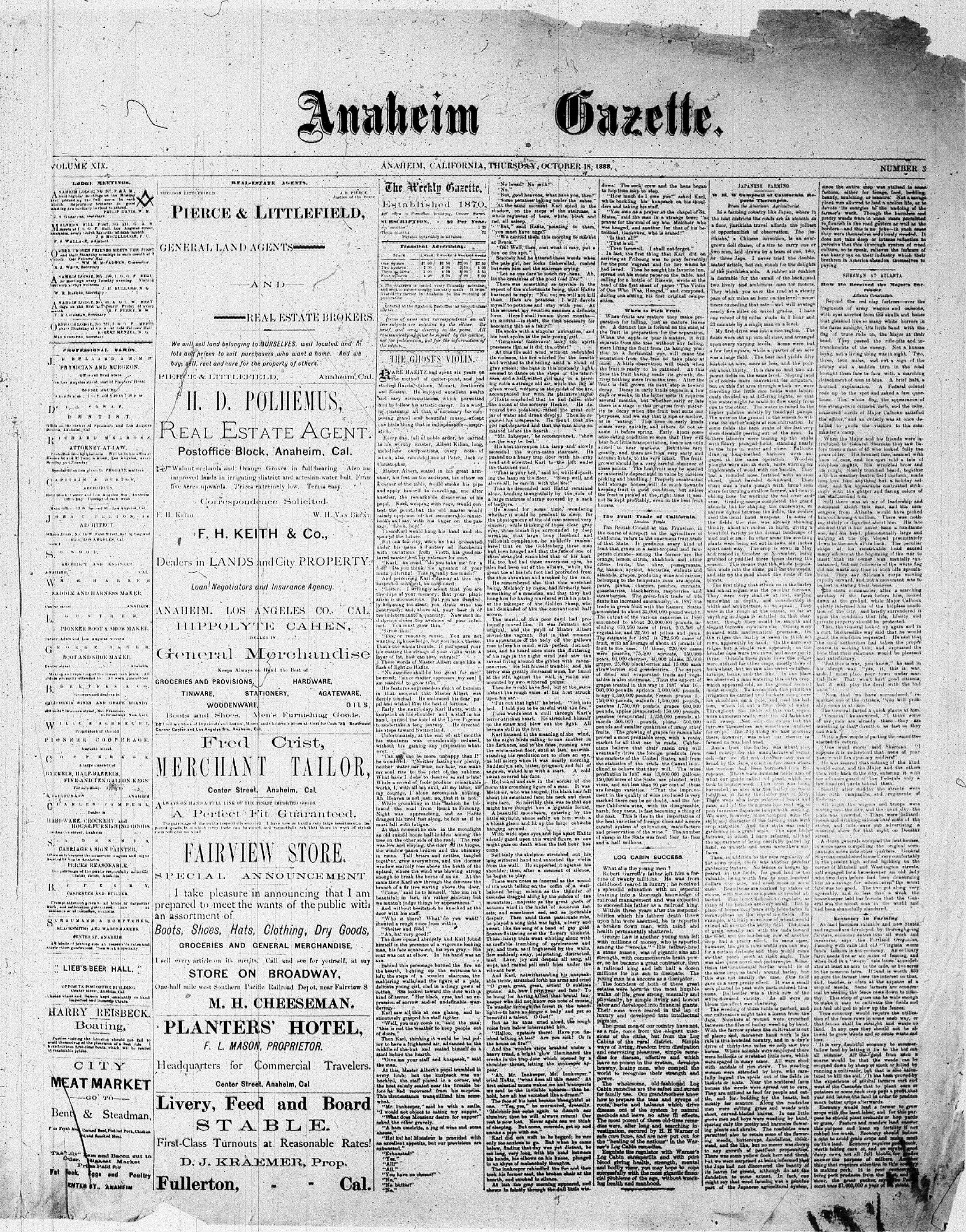
Searchable text
VOLUME XIX.
LODGE MEETINGS.
ANAHEIM LODGE, NO. 100, F.R.A.M.
hold regular meetings on the Monday first, presiding the fall month in each month. Majouring brethren in good standing are cordially invited to attend.
PHILIP DAVIS, W. M.
J. R. GARREAN, secretary
MALVERN BILL PORT, SO. QU., G.A.R.
mom at I.O.O.F. Hall, Los Angeles street, Manhattan, every fourth Saturday of each month.
J. R. McULLOUCH, P.C.
F.R.WALLACE, Adjutant
ORDER CHILDREN FRIENDS MEETS THE FIRST and third Saturday evenings in each month at 7 o'clock. Old Fellow Hall.
W.H. M. McFADDEN, Counselor
R.A. WHEN, Secretary
ANAHEIM LODGE, NO. 100, I.O.O.F. REGU
meetings every Tuesday evening. Visiting brothers always welcome.
J. H. BULLARD, N.G.
W.R.HARNE, Secretary
ANAHEIM LODGE, NO. 100, A.O.U.W. MEET
late on the first and fourth Friday of every month.
H.F. PERRY, M.W.
T.R. CAMBRAW, Secretary
ORPHOUS LODGE, NO. 201, I.O.O.F. MEETS
every Thursday at noon at Mold Fallow Hall, Robert Menzel, N.G.
MAY NEARBY, Secretary
PROFESSIONAL WARDS.
J. H. BELLARD, A.R.M.D.
PHYSICIAN AND SURGEON.
Office and Drudestars
On Los Angeles street, east of Planters Hotel.
OFFICE HOUSE
R.D.L.PGWAN,
DENTIST
Office on the corner of Nyamora and Los Angeles streets, Anaconda, Cal.
RICHARD MELROSE,
ATTORNEY AT LAW.
Postoffice Block, Anaheim. Will be in his office at Kaiser St and St Temple Blvd., Los Angeles, every
REAL ESTATE AGENTS.
PIERCE & LITTLEFIELD
GENERAL LAND AGENTS
AND
REAL ESTATE BROKER
We will sell land belonging to OURSELVES, well located, and fin lots and prices to suit purchasers who want a home. And we buy, sell, rent and care for the property of others.
PIERCE & LITTLEFIELD.
Anaheim.
II. D. POLHEMUS,
REAL ESTATE AGENT
Postoffice Block, Anaheim, Cal.
PHYSICIAN AND SURGEON.
Office and Draft stairs
On Los Angeles street, south of Players Hotel
OFFICE HOURS:
1:00 to 7:30 p.m.
DELLOW POWAY,
DENTIST.
Office on the corner of Syramsons and Los Angeles streets, Anaheim, Cal.
RICHARD MELROSE,
ATTORNEY AT LAW.
Postoffice Block, Anaheim. Will be in his office at Kauai 64 and 87 Temple Blvd., Los Angeles, every Monday and Tuesday.
Special attention given to PROBATE matters.
CAPITAIN & BURTON,
ARCHITECT.
Meta Block Center and Los Angeles Sts., Anaheim Office Day. Tuesday of each week.
JOHN C. FELLION, JR.
ARCHITECT.
Willson Bury, No. 14 W. First Street, Bet Spring and Main, LOS ANGELES, Cal.
S. NOOD,
ARCHITECT AND ENGINEER.
ANAHEIM, CA.
W. M. HARKER,
HANDLE AND HARNESS MAKER.
Center street, Anaheim.
L. GUNTHER,
PIONEER BOOT & SHOE MAKER.
Carter Adale and Los Angeles streets.
G. GEORGE BAUER,
BOOT AND SHOE MAKER.
Center street, Anaheim.
Making and repairing at the lowest cash price. All orders promptly attended to. All work guaranteed.
B. DREYFEN & CO.
Grocers and dealers in CALIFORNIA WINES AND ORANGE BRANDY.
204 Bramble street, San Francisco.
WILLE & ALBRECHT,
Propriators of the old PIONEER COOPERAGE.
Auguste street, Anaheim.
COOPERAGE
A large quantity of BARRELS, HALF-BARRELS, FIVE-AND-TEN GALLON KEGS FOR sale shop.
DREYFEN & CO.
Dealer in HARDWARE, CROCKERY, and HOUSE-FURNISHING GOODS Los Angeles street, Anaheim.
S. A. DENNIS,
CARRIAGE & SIGN FAINTER,
offices reference the numerous signs and signs painted by him in Anaheim.
PRICKS REASONABLE.
PIERCE & LITTLEFIELD, Anaheim.
II. D. POLIEMUS,
REAL ESTATE AGENT
Postoffice Block, Anaheim, Cal.
Walnut orchards and Orange Groves in full boaring. Also improved lands in irrigating district and artesian water built. Five acres upwards. Prices extremely low. Terms easy.
Correspondence Solicited.
F. H. Keim.
W. H. Van Birn
F. H. KEITH & Co.,
Dealers in LANDS and City PROPERTY
Loan Negotiators and Insurance Agency.
ANAHEIM, LOS ANGELES CO., CA.
HIPPOLYTE CAHEN,
DEALER IN
General Merchandise
Keeps Always on Hand the Best of:
GROCERIES AND PROVISIONS,
HARDWARE,
TINWARE,
STATIONERY,
AGATEWARE,
WOODENWARE,
Boots and Shoes. Men's Furnishing Goods.
Fred Crist,
MERCHANT TAILOR
Center Street, Anaheim, Cal.
ALWAYS ON HAND A FULL LINK OF THE FINEST IMPORTED GOODS.
A Perfect Fit Guaranteed.
The patronage of the public respectfully selected I have now on hand a very large assortment of ported goods, from which every taste can be suited, and respectfully ask that those in want of all souls will give me a call.
FAIRVIEW STORE.
MERCHANT FAIR
Center Street, Anaheim, Cal.
ALWAYS ON HAND A FULL LINK OF THE FINEST IMPORTED GOODS
A Perfect Fit Guaranteed.
FAIRVIEW STORE.
SPECIAL ANNOUNCEMENT
I take pleasure in announcing that I am prepared to meet the wants of the public with an assortment of
Boots, Shoes, Hats, Clothing, Dry Goods,
GROCERIES AND GENERAL MERCHANDISE.
I sell every article on its merits. Call and see for yourself, at STORE ON BROADWAY,
One-half mile west Southern Pacific Railroad Depot, near Fairview.
M. H. CHEESEMAN.
PLANTERS' HOTEL
F. L. MASON, PROPRIETOR.
Headquarters for Commercial Travele
Center Street, Anaheim, Cal
Livery, Feed and Board STABLE.
First-Class Turnouts at Reasonable Rate
D. J. KRAEMER, Prop.
Fullerton, - - Ca
ANAHEIM, CALIFORNIA, THURSDAY, OCTOBER 18, 1888.
AGENTS.
J. B. PIERCE,
Justice of the Peace
TLEFIELD,
ESTATE BROKERS.
VES. well located and in who want a home. And we why of others.
ANAheim, Cal.
IEMUS,
E AGENT.
anaheim, Cal.
The Weekly Gazette.
Established 1870.
Subscription - $2 Per Year.
Twelve months.
Payable invariably in advance.
Transient Advertising.
Spark 1 week 2 weeks 3 weeks 4 weeks
The Gazette is needed every Thursday morning, and sent to subscribers by the early mail. It is delivered by carrier in Anaheim on the morning of publication.
Entered at the Anaheim Postoffice as second-class matter.
Items of news and correspondence on all five subjects are solicited by the editor. Be brief, and cogent, directly to the point. All communication must be signed by the author, not for publication, but for the information of the editor.
THE GHOSTS VIOLIN.
RAKE HAKITZ had spent six years on the method of center-point, and had studied Haydn, Gluck, Mozart, Beethoven and Rossini. He enjoyed excellent health and easy circumstances, which permitted him to follow his artistic career. In a word he possessed all that is necessary for composing grand and beautiful music except one little thing that is indispensable—inspirational.
Every day, full of noble ardor, he carried to his worthy master, Albert Kulian, long, melodious compositions, every note of which, also, reminded one of Peter, Jack or
"No bread! No milk!"
"No."
"But, good heavens, what have you, then?"
"Some potatoe baking under the ashes."
At the same moment Karl spied in the shadow, on the steps of the staircase, a whole regiment of hens, white, black and red, all naked.
"But," said Hakitz, pointing to them,
"you must have eggs."
"We carried them this morning to market at Bruck."
"Oh! Well, then, cost what it may, put a hen on the spit."
Scarcely had he uttered these words when the pals girl, her locks dishevelled, rushed between him and the staircase crying.
"Let no one dare to touch my chess. Ah, let the creatures of the good (red live)"
There was something so terrible in the aspect of the unfortunate being, that Hakitz hastened to reply: "No; nor we will not kill them. Here are potatoes. I will devote myself to potatoes and stay with you. At this moment my vacation assumes a definite form. Here I shall remain three months—six months—in short, the time necessary for becoming thin as a fakir."
He spoke with a singular animation, and his host apoke to the pale young girl.
"Genesave! Genesave! look! the spirit possesses him as it did the other!"
At this cold wind without redoubled its violence, the fire whirled on the hearth and writhed to the ceiling amid a cloud of gray smoke; the hues in this unsteady light seemed to dance on the steps of the staircase, and a half-witted girl sang in a piercing voice a strange old air, while the log of green wood, weeping in its plaintive sight/ Hakitz concluded that he had fallen into the haunt of the sorcerer Hecker. He devoted two potatoes, raised the great reel jar of water and drank deeply. Then he regained his compass. He found that the girl had departed and that the man alone remained before the hearth.
Mr. Inkpeper, he recommenced, "show me the way to bed."
His heat thereupon lit a lamp and slowly ascended the worm-eaten staircase. He pushed up a heavy trap door with his gray daws. The sock crew and the horse to hop from step to step.
"How much do I owe you?" and while buckling his knapsack on her dane and taking his staff.
"You owe us a prayer at the chapel Blaine," said the man in a strange prayer for the soul of my son Malte was hanged, and another for that trockhed Genevere, who is crazed!
"It that all!"
"That is all."
"Then farewell. I shall not forget. In fact, the first thing that Karri arriving at Pribourg was to pray for the poor vagrant and for her had laved. Then he sought his favorite spread out his music paper on the table calling for a bottle of Rikewir, wrote head of the first sheet of paper "To One Who Was Hanged," and daring one sifting, his first original sition.
When to Pick Fruit.
When fruits are mature they must preparation for falling; just as mature do. A distinct line is formed on the fruit in preparation for the season. When the apple or pear is mature separate from the tree without any more lifting the fruit from its hangings to a horizontal one, will it separate from the tree to take once. A little observation will teach the fruit is ready to be gathered; time the fruit having made its grooves nothing more from the tree. Fruit is full grown its next step in decay. Decay in early kinds comes days or weeks; in the latter sorts its several months; but whether earlier there is a stage in this program from city to decay when the fruit best purposes, and we say that it ripes or in eating. Time in ear comes very quickly, and others demeasure it before spring. Early kind on eating condition soon so that bear but little transportation; hence suited to near markets. But greatly, and there are from very ancient autumns, to the very latest.
A KEL HAKITZ had spent six years on the method of center-point, and had studied Haydn, Gluck, Mozart, Beethoven and Rossini. He enjoyed excellent health and easy circumstances, which permitted him to follow his artistic career. In a word, he possessed all that is necessary for composing grand and beautiful music, except one little thing that is indispensable—inspiration.
Every day, full of noble ardor, he carried to his worthy master, Albert Kulian, long, melodious compositions, every note of which also reminded one of Peter, Jack or Christopher.
Master Albert, seated in his great armchair, his feet on the andirons, his elbow on a corner of the table, would smoke his pipe and apply himself to cancelling, one after another, the remarkable discoveries of his pupil. Karl, weeping with rage, would pontet the point, but the old master would calmly open one of his innumerable music books and say, with his finger on the passage: "Look how!" Then Karl would hang his head and despair of the future.
But one fine day, when he had presented under his name a Fantasy of Baccherini with variations from Viotti, his good-natured master best his patience for once.
Karl, he cried, "do you take me for a fool? Do you think he ignorant of your mean paterning? This is really too much!"
And perceiving Karl's apathy at this unsuspected outburst, he continued:
"Listen. I willingly admit that you are the shape of your memory; that your plagiarism is unconscious. But you are decidedly beaming too about; you drink wine too generously; and, above all, your beer is of two indolentinate quantities. Now such indolence closes the avenues of your intellect. You must grow thin."
"Grow thin."
"Yes, or renounce music. You are not wanting in knowledge, but you lack a therae. That's the whole trouble. If your spend your life coating the strings of your violin with a layer of fat, how can they vibrate?
These words of Master Albert came like a flash of light so Habitz.
"No sacrifice shall be too great for me!" hecried: "since matter oppresses my soul I am resolved to grow thin."
His features expressed so much of heroism in that moment that Master Albert was deeply touched. He embraced his dear pupil and wished him the beat of fortune.
Early the next day, Karl Habitz, with a knapsack on his shoulder and a staff in his hand, quitted the hotel of the Three Pigeons to undertake a long journey. He directed his steps toward Switzerland.
Unfortunately, at the end of six months his stoutness was considerably reduced without his gaining any inspiration what ever.
"Can any one be more unhappy than I?" he wondered. "Neither fasting nor plenty, neither water nor wine, nor beer, can make my soul rise to the patch of the sublime. What have I done to deserve so sad fate? While a crowd of fools produce remarkable works, I, with all my skill, all my labor, all my courage, I alone accomplish nothing. Ah, Heaven is not just; no, that it is not!
While grumbling in this fashion he followed the road from Bruck to Fribourg. Night was approaching, and as Habitz dragged his tired feet along, he felt as if he must fall with fatigue.
At that moment he saw in the moonlight an old ruined house half-hidden among the tree on the other side of the road. The roof was low and sloping, the door off its hinges, the window panes broken and the chimney in ruins. Tall briars and nettles, tangled together, grew everywhere, and the dormer window searched rose above the heath of the storehouse.
RALLE HAKITZ had spent six years on the method of center-point, and had studied Haydn, Gluck, Mozart, Beethoven and Rossini. He enjoyed excellent health and easy circumstances, which permitted him to follow his artistic career. In a word, he possessed all that is necessary for composing grand and beautiful music, except one little thing that is indispensable—inspiration.
Every day, full of noble arder, he carried to his worthy master, Albert Kulian, long, melodious compositions, every note of which also reminded one of Peter, Jack or Christopher.
Master Albert, seated in his great armchair, his feet on the andirons, his elbow on a corner of the table, would smoke his pipe and apply himself to cancelling, one after another, the remarkable discoveries of his pupil. Karl, weeping with rage, would pontet the point, but the old master would calmly open one of his innumerable music books and say, with his finger on the passage: "Look how!" Then Karl would hang his head and despair of the future.
But one fine day, when he had presented under his name a Fantasy of Baccherini with variations from Viotti, his good-natured master best his patience for once.
Karl, he cried, "do you take me for a fool? Do you think he ignorant of your mean paterning? This is really too much!"
And perceiving Karl's apathy at this unsuspected outburst, he continued:
"Listen. I willingly admit that you are the shape of your memory; that your plagiarism is unconscious. But you are decidedly beaming too about; you drink wine too generously; and above all, your beer is of two indolentinate quantity. Now such indolence closes the avenues of your intellect. You must grow thin."
"Grow thin."
"Yes, or renounce music. You are not wanting in knowledge, but you lack a therae. That's the whole trouble. If your spend your life coating the strings of your violin with a layer of fat, how can they vibrate?
These words of Master Albert came like a flash of light so Habitz.
"No sacrifice shall be too great for me!" hecried: "since matter oppresses my soul I am resolved to grow thin."
His features expressed so much of heroism in that moment that Master Albert was deeply touched. He embraced his dear pupil and wished him the beat of fortune.
Early the next day, Karl Habitz, with a knapsack on his shoulder and a staff in his hand, quitted the hotel of the Three Pigeons to undertake a long journey. He directed his steps toward Switzerland.
Unfortunately, at the end of six months his stoutness was considerably reduced without his gaining any inspiration what ever.
"Can any one be more unhappy than I?" he wondered. "Neither fasting nor plenty, neither water nor wine, nor beer, can make my soul rise to the patch of the sublime. What have I done to deserve so sad fate? While a crowd of fools produce remarkable works, I, with all my skill, all my labor, all my courage, I alone accomplish nothing. Ah, Heaven is not just; no, that it is not!
While grumbling in this fashion he followed the road from Bruck to Fribourg. Night was approaching, and as Habitz dragged his tired feet along, he felt as if he must fall with fatigue.
At that moment he saw in the moonlight an old ruined house half-hidden among the tree on the other side of the road. The roof was low and sloping, the door off its hinges, the window panes broken and the chimney in ruins. Tall briars and nettles, tangled together, grew everywhere, and the dormer window searched rose above the heath of the storehouse.
RAKE HAKITZ had spent six years on the method of center-point, and had studied Haydn, Gluck, Mozart, Beethoven and Rossini. He enjoyed excellent health and easy circumstances, which permitted him to follow his artistic career. In a word, he possessed all that is necessary for composing grand and beautiful music except one little thing that is indispensable—inspiration.
Every day, full of noble arder, he carried to his worthy master, Albert Kulian long, melodious compositions every note of which also reminded one of Peter,Jack or Christopher.
Master Albert,seated in his great armchair,his feet on the andirons,his elbow on a corner of the table,would smoke his pipe and apply himself to cancelling,一one after another,the remarkable discoveries of his pupil。 Karl,weeping with rage,would pontet the point,but the old master would calmly open one of his innumerable music books和 say,with his finger on the passage:"Look how!" Then Karl would hang his head and despair of the future.
But one fine day,when he had presented under his name a Fantasy of Baccherini with variations from Viotti,his good-natured master best his patience for once。
Karl,he cried,"do you take me for a fool?Do you think he ignorant of your mean paterning?This is really too much!"
And perceiving Karl's apology at this unsuspected outburst,he continued:
"Listen. I willingly admit that you are the shape of your memory;that your plagiarism is unconscious. But you are decidedly beaming too about;you drink wine too generously;and above all,your beer is of two indolentinate quantity.Now such indolence closes the avenues of your intellect. You must grow thin."
"Grow thin."
"Yes,or renounce music。You are not wanting in knowledge,but you lack a therae。That's the whole trouble。If your spend your life coating the strings of your violin with a layer of fat,如何能再现呢?
These words of Master Albert came like a flash of light so Habitz.
"No sacrifice shall be too great for me!" hecried:"since matter oppresses my soul I am resolved to grow thin."
His features expressed so much of heroism in that moment that Master Albert was deeply touched。He embraced his dear pupil and wished him the beat of fortune.
Early the next day,Karl Habitz,with a knapsack on his shoulder和a staff in his hand,quitted the hotel of the Three Pigeons to undertake a long journey。He directed his steps toward Switzerland.
Unfortunately,at the end of six months his stoutness was considerably reduced without his gaining any inspiration what ever.
"Can any one be more unhappy than I?" he wondered。"Neither fasting nor plenty,neither water nor wine,nor beer,can make my soul rise to the patch of the sublime。What have I done to deserve so sad fate?While a crowd of fools produce remarkable works,I,with all my skill,all my labor,all my courage,I alone accomplish nothing。Ah,Heaven is not just;no,that it is not!
While grumbling in this fashion he followed the road from Bruck to Fribourg。Night was approaching,and as Habitz dragged his tired feet along,他 felt as if he must fall with fatigue。
At that moment he saw in the moonlight an old ruined house half-hidden among the tree on the other side of the road。The roof was low and sloping,the door off its hinges,the window panes broken和the chimney in ruins。Tall briars and nettles,tangled together,grew everywhere,和the dormer window searched rose above the heath of the storehouse.
RAKE HAKITZ had spent six years on the method of center-point,and had studied Haydn,Gluck,Mozart,Beethoven和 Rossini。He enjoyed excellent health and easy circumstances,which permitted him to follow his artistic career。In a word,他 possessed all that is necessary for composing grand and beautiful music except one little thing that is indispensable—inspiration.
Every day,full of noble arder,he carried to his worthy master,Albert Kulian long,melodious compositions every note of which also reminded one of Peter,Jack or Christopher。
Master Albert,seated in his great armchair,his feet on the andirons,his elbow on a corner of the table,would smoke his pipe and apply himself to cancelling,一one after another,the remarkable discoveries of his pupil。 Karl,weeping with rage,would pontet the point,但the old master would calmly open one of his innumerable music books和 say,with his finger on the passage:"Look how!" Then Karl would hang his head and despair of the future.
But one fine day,当他 present under his name a Fantasy of Baccherini with variations from Viotti,his good-natured master best his patience for once。
Karl,he cried,"do you take me for a fool?" Do you think he ignorant of your mean paterning?This is really too much!"
And perceiving Karl's apology at this unsuspected outburst,他 continued:
"Listen. I willingly admit that you are the shape of your memory;that your plagiarism is unconscious。But you are decidedly beaming too about;you drink wine too generously;and above all,你 bear itself amid them的 face one of them strung resembled that on their host。He took had three those eyes,he also had been out at their alibows,而the great toe of his left foot had protruded fromthe shoe shrunken and snailed by the rain。他 remembered also that this wretched being.Melchor by name,有 formerly been something of a musician,和 that they had hung him for having murdered with their paterner.The inkeeper.of_the Golden Sheep,谁 had demanded_of himthe conventional halfrown。
The musicist.of this poor devil had profoundly moved him。它 was fantastic and original,and the pupil.of Master Albert cnvevedthe vagrant。但in that momentthe appearanceofthe bodyoffthe gallowrsrose beforehis mind.withperfectdistinctness,andhe heard once morethe flutteringofhis raysflyingaroundthe gobblewithravenouscries.His felt himself tremble,andhis terrorwas greatly increased whenhe foundatleft againstthewall,aviolinsurmountedbytwowiteredpalm。
Thenhe would have fled,但at_the sameinstantthe roughvoiceofhishost struckuponhisearn.Putoutthatlight!”hecried:“Getintobed.I toldyoutobe carefulwiththefire。”
Those words sent a chill through Karl'sterror-strikenheart.Hestrastedhimselfonthestraw-andbleauonthelight.Allbecameinthishut。
Karl listened tothe meaningofthewind.tothecrouchingfigureofa man。它wasMelchorwhowashanged.Hisblackhairfellabouthisemaciatedface;hismeekandchestwerebare.Sohorriblythinnedwasthatonemighthave thoughthimamagnificentanegustanthemicalattentiontobelievethattheywill.Willsweetweaponhissface.
He lookedandsawinthenewersintheroomcrouchingfigureofa man。它wasMelchorwhowashanged.Hisblackhairfellabouthisemaciatedface;hismeekandchestwerebare.Sohorriblythinnedwasthatonemighthave thoughthimamagnificentanegustanthemicalattentiontobelievethattheywill.Willsweetweaponhissface.
He lookedandsawinthenewersinthenewersinthenewersinthenewersinthenewersinthenewersinthenewersinthenewersinthenewersinthenewersinthenewersinthenewersinthenewersinthenewersinthenewersinthenewersinthenewersinthenewersinthenewersinthenewersinthenewersinthenewersinthenewersinthenewersinthennewersinthennewersinthennewersinthennewersinthennewersinthennewersinthennewersinthennewersinthennewersinthennewersinthennewersinthennewersinthennewersinthennewersinthennewersinthennewersinthennewersinthennewersin thennewersin thennewersin thennewersin thennewersin thennewersin thennewersin thennewersin thennewersin thennewersin thennewersin thennewersin thennewersin thennewersin thennewersin thennewersin thennewersin thennewersin thennewersin thennewERSIN thenNEWISIN thenNEWISIN thenNEWISIN thenNEWISIN thenNEWISIN thenNEWISIN thenNEWISIN thenNEWISIN thenNEWISIN thenNEWISIN thenNEWISIN thenNEWISIN thenNEWISIN thenNEWISIN thenNEWISIN thenNEWISIN thenNEWISIN thenNEWISIN thenNEWISIN thenNEWISIN thenNEWISIN thenNEWISIN thenNEWISIN thenNEWISIN thenNEWISIN thenNEWISIN thenNewERSIN thenNEWISIN thenNEWISIN thenNEWISIN thenNEWISIN thenNEWISIN thenNEWISIN thenNEWISIN thenNEWISIN thenNEWISIN thenNEWISIN thenNEWISIN thenNEWISIN thenNEWISIN thenNEWISIN thenNEWISIN则NEWISIN则NEWISIN则NEWISIN则NEWISIN则NEWISIN则NEWISIN则NEWISIN则NEWISIN则NEWISIN则NEWISIN则NEWISIN则NEWISIN则NEWISIN则NEWISIN则NEWISIN则NEWISH则NEWISH则 NEWISH则 NEWISH则 NEWISH则 NEWISH则 NEWISH则 NEWISH则 NEWISH则 NEWISH则 NEWISH则 NEWISH则 NEWISH则 NEWISH则 NEWISH则 NEWISH则 NEWISH则 NEWISH则 NEWISH则 NEWISH则 NEWISH则 NEWISH则 NEWISH则 NEWISH则 NEWISH则 NEWISH则 NEWISH则 NEWISH则 NEWISH则 NEWISH则 NEWISH则 NEWISH则 NEWISH则 NEWISS IN则NEWISS IN则NEWISS IN则NEWISS IN则NEWISS IN则NEWISS IN则NEWISS IN则NEWISS IN则NEWISS IN则NEWISS IN则NEWISS IN则NEWISS IN则NEWISS IN则NEWISS IN则NewISS IN则NewISS IN则NewISS IN则NewISS IN则NewISS IN则NewISS IN则NewISS IN则NewISS IN则NewISS IN则NewISS IN则NewISS IN则NewISS IN 则NewISS IN 则NewISS IN 则NewISS IN 则NewISS IN 则NewISS IN 则NewISS IN 则NewISS IN 则NewISS IN 则NewISS IN 则NewISS IN 则NewISS IN 则NewISS IN 则 NewISS IN 则NewISS IN 则NewISS IN 则NewISS IN 则NewISS IN 则NewISS IN 则NewISS IN 则NewISS IN 则NewISS IN 则NewISS IN 则NewISS IN 则NewISS IN 则NewISS IN 则NewISS IN 则NewISS IN 则NewISS IN 则NewISS IN 则NewISS IN 则NewISS IN 则NewISS IN 则NewSS IS则NewSS IS则NewSS IS则NewSS IS则NewSS IS则NewSS IS则NewSS IS则NewSS IS则NewSS IS则NewSS IS则NewSS IS则NewSS IS则NewSS IS则NewSS IS则NewSS IS则NewSS IS则NewSS IS则NewSS IS则是新SS IS则是新SS IS则是新SS IS则是新SS IS则是新SS IS则是新SS IS则是新SS IS则是新SS IS则是新SS IS则是新SS IS则是新SS IS则是新SS IS则是新SS IS则是新SS IS则是新SS IS则是新SS IS则是新SS IS则是新SS IS则是新SS IS则是新SS IS则是新SS IS则是新SS IS则是新SS IS则是新SS IS而是新 SS IS而是新 SS IS而是新 SS IS而是新 SS IS而是新 SS IS而是新 SS IS而是新 SS IS而是新 SS IS而是新 SS IS而是新 SS IS而是新 SS IS而是新 SS IS而是新 SS IS而是新 SS_IS而是新 SS_IS而是新 SS_IS而是新 SS_IS而是新 SS_IS而是新 SS_IS而是新 SS_IS而是新 SS_IS而是新 SS_IS而是新 SS_IS而是新 SS_IS而是新 SS_IS而不是新 SS_IS而不是新 SS_IS而不是新 SS_IS而不是新 SS_IS而不是新 SS_IS而不是新 SS_IS而不是新 SS_IS而不是新 SS_IS而不是新 SS_IS而不是新 SS_IS而不是新 SS_IS而不是新 SS_IS而不是新 SS_IS而不是新 SSI是再新的SS SI是再新的SS SI是再新的SS SI是再新的SS SI是再新的SS SI是再新的SS SI是再新的SS SI是再新的SS SI是再新的SS SI是再新的SS SI是再新的SS SI是再新的SS SI是再新的SS SI是再新的SS SI是再新的SS SI是再新的SS SI是再新的SS SI是再新的SS SI是再新的SS SI是再新的Ssi是再新的Ssi是再新的Ssi是再新的Ssi是再新的Ssi是再新的Ssi是再新的Ssi是再新的Ssi是再新的Ssi是再新的Ssi是再新的Ssi是再新的Ssi是再新的Ssi是再新的Ssi是再新的Ssi是再新的Ssi是再新的Ssi是再新的Ssi是再新的Ssi是再新的Ssi是再新的SsIs不是再新的SsIs不是再新的SsIs不是再新的SsIs不是再新的SsIs不是再新的SsIs不是再新的SsIs不是再新的SsIs不是再新的SsIs不是再新的SsIs不是再新的SsIs不是再新的SsIs不是再新的SsIs不是再新的SsIs不是再新的SsIs不是再新的SsIs不是再新的SsIs不是再新的SsIs不是再新的SsIs不是再新的SsIs不是再新的SsIs不是再新的SsIs不是再新的SsIs不是 再真的SsIs不是再真的SsIs不是再真的SsIs不是再真的SsIs不是再真的SsIs不是再真的SsIs不是再真的SsIs不是再真的SsIs不是再真的SsIs不是再真的SsIs不是再真的SsIs不是再真的SsIs不是再真的SsIs不是再真的SsIs不是再真的SsIs不是再真的SsIs不是再真的SsIs不是 再真的SsIs不是 再真的SsIs不是 再真的SsIs不是 再真的SsIs不是 再真的SsIs不是 再真的SsIs不是 再真的SsIs不能 再真的SsIs不能 再真的SsIs不能 再真的SsIs不能 再真的SsIs不能 再真的SsIs不能 再真的SsIs不能 再真的SsIs不能 再真的SsIs不能 再真的SsIs不能 再真的SsIs不能 再真的SsIs不能 再真的SsIs不能 再真的SsIs不能 再真的 SSI不能 再真的 SSI不能 再真的 SSI不能 再真的 SSI不能 再真的 SSI不能 再真的 SSI不能 再真正的 SSI不能 再真正的 SSI不能 再真正的 SSI不能 再真正的 SSI不能 再真正的 SSI不能 再真正的 SSI不能 再真正的 SSI不能 再真正的 SSI不能 再真正的 SSI不能 再真正的 SSI不能 再真正的 SSI不能 再真正的 SSI不能 再真正的 SSI不能 再真正的 SSI 不能 再真的 SSI不能 再真正的 SSI不能 再真正的 SSI不能 再真正的 SSI不能 再真正的 SSI不能 再真正的 SSI不能 再真正的 SSI不能 再真正的 SSI不能 再真正的 SSI不能 再真正的 SSI不能 再真正的 SSI不能 再真正的 SSI不能 再真正的 SSI不能 再真正的 SSI不能 再真正的 SSI不能 再真正的 SSi不能。再真的 SSi不能。再真的 SSi不能。再真的 SSi不能。再真的 SSi不能。再真的 SSi不能。再真的 SSi不能。再真的是 RSi能不能。再真的是 RSi能不能。再真的是 RSi能不能。再真的是 RSi能不能。再真的是 RSi能不能。再真的是 RSi能不能。再真的是 RSi能不能。再真的是 RSi能不能。再真的是 RSi能不能。再真的是 RSi能不能。再真的是 RSi能不能。再真的是 RSi能不能。再是真的 RSi能不能。再是真的 RSi能不能。再是真的 RSi能不能。再是真的 RSi能不能。再是真的 RSi能不能。再是真的 RSi能不能。再是真的 RSi能不能。再是真的 RSi能不能。再是真的 RSi能不能。再是真的 RSi能不能。再是真的 RSi能不能。再是真的 RSi能不能。再是真的 RSi能不能。再是真的 RSi能不能。再是真的 RSi能不能。再是真的 RSi能不能。再是真的 RSi能不能。再是真的 RSi能不能。再是真的 RSi能不能。再是真的 RSi就不能。再是真的 RSi能不能。再是真的RSi能不能。再是真的RSi能不能。再是真的RSi能不能。再是真的RSi就不能。再是真的RSi就不能。再是真的RSi就不能。再是真的RSi就不能。再是真的RSi就不能。再是真的RSi就不能。再是真的RSi就不能。再是真的RSi就不能。再是真的RSi就不能,再真是R Si cannot,再真是R Si cannot,再真是R Si cannot,再真是R Si cannot,再真是R Si cannot,再真是R Si cannot,再真是R Si cannot,再真是R Si cannot,再真是R Si cannot,再真是R Si cannot,再真是R Si cannot,再真是R Si cannot,再真是R Si cannot,再真是R Si cannot,再真是R Si cannot,再真是R Si cannot,再真是R Si cannot,再真是R Si cannot,再真是R Si cannot,再真是R Si cannot,再真是R Si cannot,再真是R Si cannot,再真是R Si cannot,再真是R Si cannot,再真是R Si cannot,再真是R Si cannot,再真是R Si cannot,再真是R Si cannot,再真是R Si cannot,再真是R Si cannot,再真是R Si cannot,再真是R Si cannot,再真是R Si cannot,再真是R Si cannot,再真是R Si cannot,再真是R Si cannot,再真是R Si cannot,再真是R Si cannot,再真是R Si cannot,再真是R Si cannot,再真是R Si cannot,再真是R Si cannot,再真是R Si cannot,再真是R Si cannot,再真是R Si cannot,再真是R Si cannot,再真是R Si cannot,再真是R Si cannot,再真是R Si cannot,再真是R Si cannot,再真是R SiCannot ,这真是个好词,好一个好词,好一个好词,好一个好词,好一个好词,好一个好词,好一个好词,好一个好词,好一个好词,好一个好词,好一个好词,好一个好词,好一个好词,好一个好词,好一个好词,好一个好词,好一个好词,好一个好词,好一个好词,好一个好词,好一个好词,好一个好词,好一个好词,好一个好词,好一个好词,好一个好词,好一个好词,好一个好词,好一个好词,好一个好词,好一个好词,好一个好词,好一个好词,好一个好词,好一个好词,好一个好词,好一个好词,好一个好词,好一个好词,好一个好词,好一个好词。好个好词,好个好词,好个好词,好个好词,好个好词,好个好词,好个好词,好个好词,好个好词,好个好词,好个好词,好个好词,好个好词,好个好词,好个好词,好个好词,好个好词,好个好词,好个好词,好个好词,好个好词,好个好词,好个好词,好个好词,好个好词,好个 好词,好个好词,好个好词,好个好词,好个好词,好个好词,好个好词,好个好词,好个好词,好个好词,好个好词,好个好词,好个好词,好个好词,好个好词,好个好词
What have I done to deserve so sad fate? While a crowd of fools produce remarkable works, I, with all my skill, all my labor, all my courage, I alone accomplish nothing. Ah, Heaven is not just; no, that it is not!
While grumbling in this fashion he followed the road from Brück to Fribourg. Night was approaching, and as Haltz dragged his tired feet along, he felt as if he must fall with fatigue.
At that moment he saw in the moonlight an old ruined house half-hidden among the tree on the other side of the road. The roof was low and sloping, the door all its hinges, the window panes broken and the chimney in ruins. Tall brains and nettles, tangled together, grew everywhere, and the dormer window scarcely rose above the heath of the upland, where the wind was blowing strong enough to break the horns of an ox. At the same time Karl saw through the dimness the branch of a fir tree waving above the door.
"Come," said he to himself, "the inn isn't beautiful; in fact, it's rather minister; but we mustn't judge things by appearances."
And without hesitation he knocked at the door with his staff.
"Who is there? What do you want?" shouted a rough voice from within.
"Shelter and food!"
"Ah, ha! very good!"
The door opened abruptly and Karl found himself in the presence of a vigorous-looking man, his face square-out, his eyes gray. His coat was out at elbow. In his hand was an axe.
Behind this personage burned the fire on the hearth, lighting up the entrance to a loft, the steps of a wooden staircase, the moldering walls, and the figure of a pale, delicate young girl, clad in a dingy gown of cotton. She looked toward the door with a kind of terror. Her black eyes had an expression of sorrow and of undefinable wandering.
Karl saw all this at one glance, and instinctively grasped his staff tighter.
"Well, you may come in," said the man;
"this is not the weather to keep people out of doors."
Then Karl, thinking it would be bad policy to have a frightened air, advanced to the middle of the hat and seated himself on a stool before the hearth.
"Give me your staff and knapsack," said the man.
At this Master Albert's pupil trembled in every limb; but the knapsack was unbacked, the staff placed in a corner, and the host calmly seated near the fireside before he had recovered from his surprise. This circumstance tranquillized him somewhat.
"Mr. Innkeeper," said he with a smile,
"I would not object to eating my supper."
"What does Monierar desire for supper?" asked the other gravelly.
"A ham omellette, a jug of wine and some alms."
"Hot hot! Hot monieur is provided with an excellent appetite, but our provisions are exhausted."
"Exhausted?"
"Yes!"
"All!"
"You have no cheese!"
"No."
"Ne butter!"
"No."
He looked and saw in the sorner of the room crouching figure of a man. It was Melchoir, who was hanged. His black hair fell about his emaciated face; his neck and chest were bare. So horribly thin was he that one might have thought him a gigantic locust.
A beautiful moonbeam, entering by the little skyline, shone softly on him with a bluish gleam and lit up the large cobwebs hanging around.
With wide open eyes and lips apart Habitz silently gazed upon this weird figure, as one might gaze on death when the last hour has come.
Swidelyly the skeleton stretched out his long withered hand and anathelied the viella from the wall. He supported it against his shoulder; then, after a moment of silence, he began to play.
There were notes as funeral as the sound of the earth falling on the coffin of a well-beloved being; solemn as the thunder of cascades dragged along by the schoos of the mountains; majestic as the great gusts of autumn wind in the midst of sonorous forests; and sometimes sad, and as incurable despair. Then amid these passionate sobs he played a song that was light, silvery and sweet, like the song of a band of gay gold-fineshatter over the flowery thickets. These daunty trills whirling along with an infallible trembling of garlesness and joy, and then, as if frightened by the waltz, suddenly away, palpitating, distracted. Mad. Love, joy and despair all sang, all wept, and rushed pell mell from under the vibrant bow.
And Karl, notwithstanding his unpeakable terror, strattached forth his arms and cried "O great, great, great artist!" O sublime genius! Ah, how I perish year and fate! To be bung for having killed that brutal lanker keeper who did not know one note of music. Te wander through the forest in the moonlight—to have no longer a body and yet so beautiful a talent. O God!
But as he thus cried aloud, the rough voices from below interrupted him.
Halloow, upaure there! Have you finished talking at last? Are you sick? Or is the house on fire?
And the wooden steps cracked under a heavy trunk, a bright glow illuminated the cracks in the trap-door which opened by a shoulder-thrust, letting the innkeeper appear.
"Ah Mr. Innkeeper," what does all this mean? At first calentual mute wakes me and transports my soul to the invisible sphere—the behold,hew all has vanished like a dream!"
The face of his heart became tense at once. "Yes yes," he murmured, dreamily. "Malchoir has come again to disturb war slumber; then he will always return! Our rest is now lost. Never again can we think of sleeping. But comes, comrade get up and smoke a pipe with me."
Karl did not wait to be hagged; he was only too anxious to go. But when he came below, finding that day was yet distant, he sat long, very long, with his head between his hands; his elbows on his knees, plunged in an akyn of melancholy thoughts.
The innkeeper raked wildly into his former seat; the broken chair at the hearth, and smashed in silence.
At last the gray morning appeared, and shown in family through the dull little win.
LOG CABIN SUCCESS
What ala the young men?
Robert Garrott's father left him time of twenty millions. He was childhood reared in luxury; he was a splendid education with an excellent training into a thorough knowledge railroad management and was exited to succeed his father as a railroadman.
Within three years after the realities which his fathers death upon him were assumed, he was a broken down man with main health permanently shattered.
George Law is another young man among millions of money who is reeling at both the "wrecks." His stone mason, was of gigantic size strength, with commensal bracer, so he became a great contractor—a railroad king and left half-a million for his son to displease young man is success as a disgrace.
The founder of both these estates born in the most high walks of life; grew strong; physically by simple living and labor and developed into financial Their sons were reared in this luxury and developed into intellectual pigment.
The great men of our country have as a rule come from the elegant slaves of the cities, but from the Cabins of the rural district.
Ways of living: Freedom from disease and observing pleasures; simple diets for disease; effective diet and leave no poison in the system; brawny, brainy men, who compete world to recognize their strengths power.
The wholesome, old-fashioned Cabin remedies are safe and for family use. Our grandmother how to prepare the teas and syrups herbs and balsam which dissolve out of the system by methods and leave no after fill. The most potent of these old-time diets were, after long and searchful investigation, secured by H. H Wash's cure fame, and are now put out of the "healing of the nations." In this year's Log Cabin remedies.
Regulate the regulator with Wash Log Cabin maraparilla and with blood giving health strength; and bodily vigor; you may hope to successfully with the most gigantic problems of the age without health health and manhood.
The cook crew and the hems began shop from step to step.
"How much do I owe you?" asked Karl, while buckling his knapsack on his shoulder and taking his staff.
"You owe us a prayer at the chapel of St. James," said the man in a strange tone; "a prayer for the soul of my son Melchair who was hanged, and another for that of his brother, Geneva, who is crazed!"
"Is that all?"
"That is all."
"Then farewell. I shall not forget." In fact, the first thing that Karl did on driving at Priboug was to pray fervently for the poor vagrant and for her whom he had loved. Then he sought his favorite inn, read out his music paper on the table, and filling up a bottle of Rikevir, wrote at the head of the first sheet of paper "The Violin One Who Was, Hanged," and composed, ringing one sitting, his first original composition.
When to Pick Fruit.
When fruits are mature they make preparation for falling, just as matures leaves. A distinct line is formed on the stem of the fruit in preparation for the separation, when the apple or pear is mature, it will separate from the tree without any falling. Are lifting the fruit from its hanging position to a horizontal one will cause the separation from the tree to take place at A little observation will teach when fruit is ready to be gathered. At this time the fruit having made its growth, deforms nothing more from the tree. After the fruit is full grown its next step is toward day. Decay in early kinds comes in a few days or weeks, in the latter sort it requires several months, but whether early or late there is a stage in this progress from maturity to decay when the fruit best suits our purposes, and we say that it ripes or mellow, in eating. This time in early kinds does very quickly, and others do not assume it before spring. Early kinds come so eating condition so soon that they will not but little transportation, hones are only used to hear markets. But these vary greatly, and there are from very early and many kinds, to the very latest. The fruit
JAPANESE FARMING
W. M. W Campbell of California Reports Therumpin.
From the American Agricultural Society.
In a farming country like Japan, where in the best districts the roads are as smooth as a floor, jinrikisha travel affords the jolliest of opportunities of observation. The jinrikisha, a Chinese invention, is an aver-grown doll chain, of a size to carry one or two men, and drawn by a team of one, two, or three Japa. I never tried the double-sated articles, but can vouch for the delights of the jinrikisha solo. A rubber air cushion is desirable for the small of the back, and two lively and ambitious men for motors. They whisk you over the road at a steady pace of six miles an hour on the level—sometimes exceeding that rate—and will average nearly five miles on mixed grades. I have one record of 94 miles made in 1 hour and 23 minutes by a single man on a level.
My first drive was into a rice region. The fields were cut up into all sizes, and arranged upon every varying levels. Some were but a few feet square, while a quarter of an acre was a large field. The best-land yields fifty bishola an acre, more or less, and the poorest about thirty. It is rare to find two adjacent fields on the same level. Sloping land is of course more convenient for irrigation, but on this flat area through which we were traveling the little rice fields were laboriously divided up at differing heights, so that the water might be made to flow easily from one to the other. The water is raised to the higher patches mostly by treadmill pumps. We were on the ground in the season to witness the earlier stages of rice cultivation. In some fields the hare stabs of the last crop were dismally peering out of the mud. In others laborers were tearing up the stubs with heavy pronged forkis, standing nearly to the hips in water and shine. Bullocks drawing long-tailed harrows were snapped in the same operation. Wooden since the entire crop was philized in some fashion, either for fences, food, bedding, beauty, mulching, or manure. Not a savage plant was allowed to lead a wildlife life, or to devote its energies to the undoing of the farmer's work. Though the harmless and pretty weeds were in some cases permitted to flourish in the road gutters as well as the borders—and this is no joke—in such cases they were themselves seduitionally weeded. It does not take deep or intense reflection to perceive that this thorough system of wood culture, so to speak, relieves the farmers of one heavy tax on their industry which their braithren in America abandon themselves to paying.
SHERMAN AT ATLANTA
How He Received the Major's Survender
Atlanta Constitution.
Beyond the red clay fortress—over the fragments of army wagons and caissons, with ayas averted from the skulls and bones that gleamed like so many white horrors in the fierce sunlight, the little band with the flag of trace role on, the Major at their head. They passed the rifle-pits and intrenchments of the enemy. Not a human being, not a living thing was in sight. Two, three, four miles, and not a sign of the enemy and a sudden turn in the road brought them face to face with a marching detachment of men in blues. A brief halt, a hurried explanation. A Federal colonel rode up to the spot and asked a few questions. The white flag, the appearance of two strangers in citizen's ear, and the calm measured words of Major Calhoun satisfied the officer, and an orderly was at once detailed to guide the visitors to the commander's camp.
When the Major and his friends were introduced to General Sherman they saw before them a man of 45 who looked fully ten years older. His bronzed face, seamed with fine hair and his eyes told a tale of
A little observation will teach when the fruit is ready to be gathered. At this time the fruit having made its growth, dews nothing more from the tree. After the fruit is full grown its next step is toward day. Decay in early kinds comes in a few weeks, in the latter sort it requires several months, but whether early or late there is a stage in this progress from maturity decay when the fruit best antes ourposes, and we say that is ripen or mellow in "eating." This time in early kinds ones very quickly, and others do not assume it before spring. Early kinds come so eating condition so soon that they will but little transportation, hones are only used to near markets. But these vary and, there are from very early andumn kinds, to the very latest. The fruit worker should be a very careful observer of points. The fruit may be spelled materially depreciated in value by careless handling and handling. Properly constructed storage houses will do much towards spiking fruit in good condition, but unless fruit is picked at the right time it can be kept profitably, even in the best fruit seasons.
The Fruit Trade of California.
London Times
The British Consul at San Francisco, in course of a report on the agriculture of forms, refers to the emerona fruit trade that State. It produces every kind of that grows in a semi-tropical and temperate climate—among the former are the lage, lemon, citron, shaddock and other fruits, the olive, pomegranate, banana, apricot, nectarine, walnut and oats, grapes, producing wine and raisins; among the temperate zone are apples, oranges, blackberries, raspberries and berries. The green-fruit trade of the state has increased enormously; in 1887 the size in green fruit with the Eastern States amounted to about 35,000,000-pound weight; output of the various canneries in 1886 amounted to about 30,000,000 pounds; ingestion of 659,950 cases of fruit, 203,500 of stables, and 22,500 of jellies and jams; estimate for 1887 is 782,500 cases of with an average of about 45 pounds of it to the case. Of these, 220,000 cases of peaches, 75,500 apricots, 150,000 peanuts, 60,000 cherries, 40,000 plums, 35,000 seses, 25,000 blackberries and 15,000 each berry and gooseberry. The export fried and dehydrated fruits and vegetables is also enormous. Thus the export of these treated in this way in 1887 was 16,000 pounds, apricots 3,000,000 pounds, yel-1,340,000 pounds, French prunes 1.,150,000 pounds, walnuts 1,560,000 pounds, apples (evaporated) 150,000 pounds, almonds (evaporated) 125,000 pounds, plums 560,000 pounds and smaller quantities of many other foods. The growing of grapes for raisins has a most profitable crop with a ready market for all that can be made. California believes that their raisin crop will usually drive the foreign products from markets of the United States, and from statistics of the trade the Consul is intended to believe that they will. The wine tasting in 1887 was 13,000,000 gallons; 1,000 acres of the State are planted with grapes and not less than 90 per cent of these foreign varieties. That the improvement in the quality of wine produced is very well there can be no doubt, and the for California wine, with its disagreeable horty taste, is fast becoming a thing of past. This is due to the importation of best varieties of foreign vines and a more ful system of cultivation, manufacture preservation of the wine. The number capped in the State was from four to four half millions.
LOG CABIN SUCCESS.
What at a young men?
What at the young men?
Robert Garrett's father left him a forfeiture of twenty millions. He was from childhood reared in luxury; he received splendid education with an especial training into a thorough knowledge of road management and was expected succeed-his father as a railroad king. Within three years after the responsibilities which his fathers death threw on him were assumed, he is reported broken down man, with mind and spirit permanently shattered.
George Law is another young man left with millions of money who is reported along the "wrecks." His father breed stone mason, was of gigantic size and length, with commensurate brain power; he became a great contractor, then railroad king and left half a dozen sons for his son to dissipate. The king man is a success as a dissipator. The founders of both of these great states were born in the most humble skins of life, grow strong, mentally and physically by simple living and honest work and developed into financial giants. Their sons were reared in the lap of luxury and developed into intellectual minds.
The great men of our country have not rule, come from the elegant manners of the cities, but from the Logs of the rural district. Simple arts of living, freedom from disdain, unnerving pleasures, simple remedies for disease, affective and which are no poison in the system, develop away, bainy men, who compell the old to recognize their strength and fierer.
The wholesome, old-fashioned Logs remedies are the safest and最耐寒 family use. Our grandmother knew how to prepare the teas and syrups of thyme and basilama which drive out of the system by natural rhythms and leaves no after fl effect. Most potent of these old-time remedies, after long and searching investigation, secured by H. H Warner of cure fame, and are now put out for "healing of the nations" In the War-Log Cabin remedies.
Regulate the regulator with Warner's or Cabin marsupialilla and with pure food giving health, strength, mental bodily vigor, you may hope to cope successfully with the most gigantic problems of the age, without wreak health and manhood.
There were immature herds also of what our gentle called oil plant; we took to be rape seed. This crop was being harvested, as soon as the barley in those localities, it being the latter part of May. These were also large patties of beans and peas, and of the thin grasses root where patties Japanese lamps with wickling. We were, however, more occupied with the style and character of the farming than with crop astragalus. And this style was really gardening on a grand scale. The new little furrows, to which I have referred, all had the appearance of being carefully patted by hand, so smooth and even were there surfaces.
Then, in addition to the nice regularity of the sown crops, there was another peculiar gardening feature. No fence or hedges appeared in the fields, for good land is too valuable, being worth five to nine hundred dollars; the area, and each more in some cases. Boundaries are marked by stakes of stones, with the owner a game or symbol attached. This is not difficult to regulate as many of the patches are very small. But in place of fence they were crop boundaries in many places on the ripe of the fields. For example, a thickly grown row of wheat would extend all around the barley field. The rows of grain usually ran with the ends bounded the road, and the bordering row of another crop had a pretty effect. In some cases, however, the grain rows would run one way for a certain distance and then would come another patch south at right angle. This was also quite novel and picturesque. Sometimes the ornamental border would be of the same crop, as barely around barley, but this was not usually the case. One field gave us a very pretty effect. It was a small area planted to pea with part-colored blossoms. Its border was a thick row of the white flowered variety. As all were in bloom the effect was charming.
The weeding of these fields is perfect, and our cultivators might take a lesson from the Japa. Numbers of women were croneched between the files of barley weeding by hand. With the farrow system the cultivator is out of place; and, moreover hand work is the rule in this crowded country, and in a day's drive of thirty-two miles we only saw two horses. Where animals were employed there were ballocks or wrenched little cows, which were spared in many cases. All were shot with sandals of rice straw. The weeding women were attended by boys, who carefully lagged the spoils out of the fields in baskets or mats. Near the scattered house the weeds spread out to care. They are utilized as food for people and cattle, and far bedding for the beasts, but mostly for manure. Along the roadsides men were cutting grass and weeds with short, curved-bladed knives. In one little grove man and boys were weeding by hand, sparing only the pretty and harmless flowering plants and shrubs. The roadsides were permitted also to retain some of the flowers, weeds, buttercups, dandelions, chickweed, and like it, but no money was shown to any growth of passiflent propenation. There was some yellow dock here and there, but we were surprised at being informed that Japa had not discovered the beauty of its leaves for greens, although do eat the dandelion to some extent. In fact, one might say that weed farming was a genuine part of the Japanese agricultural system,
Economy in Farming
As land becomes valuable and new States and regions are developed by thorough-growing farms, economy enters into all work and measures says, The Portland Oregonan Farming with rails laid old "Virginia worm fawn" fashion is not economical. An ordinary farm needs five or six miles of fencing, and when laid in a "worm" this fawn appropriates at least an acre to the mile, or acres to the common farm. If land is worth $50 an acre the farmer loses the interest on that, and besides it often at expense of a crop of weeds. Some farmers are economical by seeding the fence rows down to timothy. This strip of grass can be wide enough to make it easy to cultivate the fields and not feel obliged to plow up the fences.
True economy requires the utilization of the fence rows in some such way, or that fences shall be straight and waste no land. In any case they should not be allowed to grow weeds and so cause waste and loss.
It is very desirable economy to summer-fallow land by letting it lie to the hot sun all summer. All the good from such a course would be that the weeds can be cropped down by sheep or stock or killed by running a cultivator, but that is also calculated to kill the soil. It has been proved by the experience of several farmers east and west of Canada that to plant corn or potatoes or some such crop pays a profit that year and leaves the land in order to produce much better crops afterwards.
Economy would lead a farmer to grow crops with the least labor, and for this purpose he should plant orchards or hop yards or grass. Pastures and maidenland snowwer this purpose and keep up fertility if not robbed too much. Economy should induce a main to avoid grain crops and make most this land. Economy requires precision-worth taking care of, and no sugar good dairy cows, not all fall blended for grapes answer the purpose of milkers. Another thing that requires attention in this country is making park. It is poor municipality being perk prodents from the Federals only cost $1,000,000 a year of its means