anaheim-gazette 1888-07-12
Scanned page
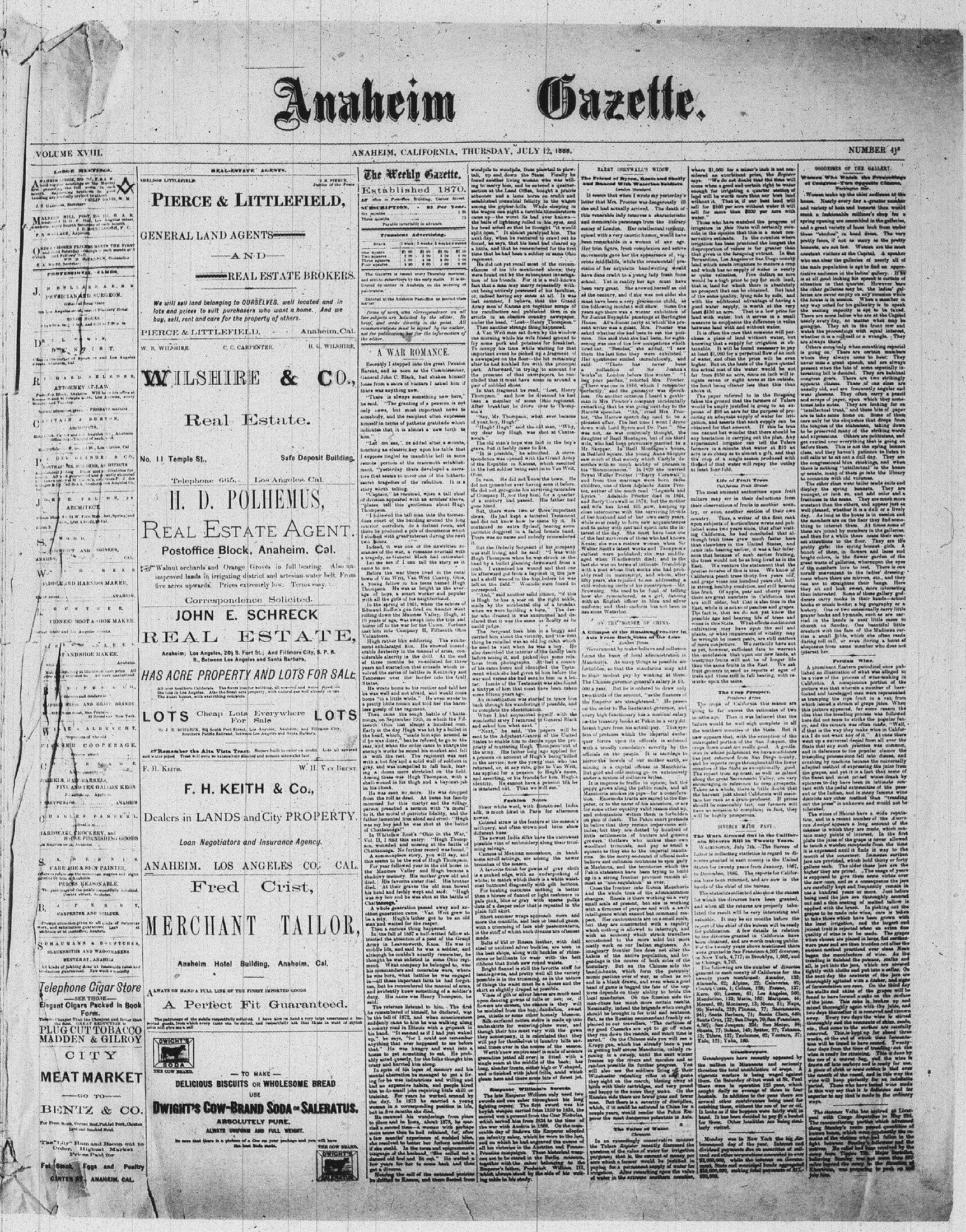
Searchable text
VOLUME XVIII
LODGE MEETINGS.
ANAHEIM LODGE, NO. 17, P.E.A.M.
Sold register mortgage of the Monday
first, presenting the full month in each
month. Subjecting births in good
landing are medically limited inland.
PHILIP DAVIS, W. M.
J. B. HARRIS, Secretary.
MALVERN HILL POST KOOL, O. A.R.
Mason, D.D., F. Hall, Los Angeles street,
Anaheim, city fourth Saturday of each month.
J. E. ROCULLOUGH, P.C.
P. WALLACE, Adjunct.
ORDER CHOSEN PRINCE MEETS THE FIRST
and third Saturday winters in each month at 9
o'clock in the Falling Hall.
WW.M. MESADON, Counsellor
R.A.WATTE, Secretary.
PROFESSIONAL CARDS.
J. M. BELLARD A.R., M. P.
PHYSICIAN AND SURGEON.
Office and Drug Store.
On Los Angeles at corner of Plantery Hotel
OFFICE HOURS.
8:00 to 12:00 and 6:00 to 7:30 p.m.
DR. E. L. COWAN,
DEPT. INST.
Special attention given PROBATE matters.
RICHARD MELROSE,
ATTORNEY AT LAW.
Part-Fin Block, Anaheim. Will be in his office at
Rhomas and St Temple Monk, Los Angeles, every
Monday and Tuesday.
Special attention given PROBATE matters.
CAPITAIN & BURTON,
ARCHITECTS.
Matteau, Center and Los Angeles, Anaheim
Offices on Tuesday of each week.
REAL ESTATE AGENTS.
SHELDON LITTLEFIELD
J. B. PIERCE,
Justice of the Peace
PIERCE & LITTLEFIELD,
GENERAL LAND AGENTS
AND
REAL ESTATE BROKERS.
We will sell land belonging to OURSELVES, well located and in
lots and prices to suit purchasers who want a home. And we
buy, sell, rent and care for the property of others.
PIERCE & LITTLEFIELD.
Anaheim, Cal.
W. B. WILSHIRE.
C. C. CARPENTER.
H. G. WILSHIRE.
WILSHIRE & CO.,
Real Estate.
No. 11 Temple St.
Safe Deposit Building.
WILSHIRE & CO., Real Estate.
No. 11 Temple St., Safe Deposit Building.
Telephone 665. Los Angeles, Cal.
H. D. POLHEMUS,
Real Estate Agent.
Postoffice Block, Anaheim, Cal.
Walnut orchards and Orange Groves in full bearing. Also unimproved lands in irrigating district and artesian-water belt. From five acres upwards. Prices extremely low. Terms easy.
Correspondence Solicited.
JOHN E. SCHRECK
REAL ESTATE,
Anaheim; Los Angeles, 201 S. Fort St.; And Fillmore City, S. P. R.
R., Between Los Angeles and Santa Barbara,
HAS AGRE PROPERTY AND LOTS FOR SALE
All over Southern California. The nearest lots for building, all powered and water piped on the lots in Los Angeles. Also the finest area property, with natural gas well already in use. The finest homes, with everything complete.
LOTS Cheap Lots Everywhere LOTS For Sale
By J. E. SCHRECK, 34 South Port Street, Los Angeles; Anaheim; and Fillmore City, Southern Pacific Railroad, between Los Angeles and Santa Barbara.
Remember the Alta Vista Tract. Houses built to order on credit. Lots all sewered and water piped. Trains will soon be extensively planted and cement sidewalks land.
F. H. Keith.
W. H. Van Brunt.
F. H. KEITH & Co., Dealers in LANDS and City PROPERTY.
Loan Negotiators and Insurance Agency.
ANAHEIM, LOS ANGELES CO., CAL.
MARKLES, HAM BARRELS,
FIVE AND TEN GALLON KEOS
Landmark Applicable
BKYPURACO... ANAHEIM
CHARLES PAMPERL
Hardware, Crockery, and House Furnishing Goods
Angeles street, Anaheim.
S. A. DENNIS,
CARRIAGE & SIGN PAINTER,
Offers referee the numerous wagons and signs painted by him Anaheim.
PRICES REASONABLE.
The patronage of the public respectfully solicited.
Center street, Anaheim.
B. J. PERRY,
Carpenter and Builder.
Prompt attention given to all kinds of carpenter work, and maintenance guaranteed.
Leave at evidence or at postoffice, Anaheim.
SCHAUMANN & BOETCHER,
BLACKSMITHS AND WAGONMAKERS.
ENTER ST., Anaheim.
All kinds of jabbing done at reasonable rates and satisfaction guaranteed. New work a specially
Telephone Cigar Store
SEE THONE—
Elegant Cigars Packed in Book Form.
Tubercle Cheaper Than the Chimpest and Better than the Book.
GREAT REDUCTION in PLUG CUT TOBACCO MADDEN & GILROY
CITY
MEAT MARKET
GO TO—
BENTZ & CO.
For Fresh Meats, Corned Beef, Pickled Pork, Chicken, Lard and Smoked Meat.
"The Lily" Ham and Bacon out to Order, Highest Market Price Paid for
Fat Steak, Eggs and Poultry
ENTER ST., ANAHEIM, CAL.
F. H. KEITH & Co.,
Dealers in LANDS and City PROPERTY.
Loan Negotiators and Insurance Agency.
ANAHEIM, LOS ANGELES CO., CAL.
Fred Crist,
MERCHANT TAILOR,
Anaheim Hotel Building, Anaheim, Cal.
AWAYS ON HAND A FULL LINE OF THE FINEST IMPORTED GOODS.
A Perfect Fit Guaranteed.
The patronage of the public respectfully solicited. I have now on hand a very large assortment of imported goods, from which every taste can be omitted, and respectfully ask that these be want of my usual suits will give me a call.
DWIGHT'S
SODA
THE COW BRAND.
TO MAKE—
DELICIOUS BISCUITS OR WHOLESOME BREAD
USE
DWIGHT'S COW-BRAND SODA OR SALTERATUS.
ABSOLUTELY PURE.
ALWAYS UNiform and Full Weight.
Be sure that there is a picture of a Chew on your package and you will have the best finds made.
ANAHEIM, CALIFORNIA, THURSDAY, JULY 12, 1855.
A WAR ROMANCE.
Recently I stepped into the great Pension Bureau, and as soon as the Commissioner, General John C. Black, had shaken himself loose from a score of visitors I asked him if there was anything new.
"There is always something new here," he said. "The granting of a pension is not only news, but most important news somebody, and the respient often expresses himself in terms of pathetic gratitude which indicates that it is almost a new birth to him."
"Let me see," he added after a minute, touching an electric key upon his table that I suppose tingled an inaudible bell in some woodpile, from plowtail to plowtail, up and down the Stam. Finally found another living woman who was willing to marry him, and he entered a quarter-section at the Land Office, bought a prairie schooner and a lame horse on credit and established cannabal falsity in the wagon among the gopher-hills. While sleeping in the wagon one night a terrible thunderstorm came up—the worst he had ever known—the bals of lightning rolled in his eyes, and his head ached so that he thought "it would split open." It almost paralyzed him. The next day, when he rented to crawl out he found, he says, that his head had cleared up a little, and that he remembered for the first time that he had been a soldier in same Ohio regiment.
He did not yet recall most of the circumstances of his life mentioned above; they were found out by the subsequent investigation of his friends. For it is a well-known fact that a man may marry repeatedly without being entirely possessed of his faculties, or indeed having any sense at all. It was last summer, I believe, that the Grand Army man of Kansas got together scrapes of his recollection and published them in an article in an obscure country newspaper under the head, "Lost—Henry Thompson."
Then another strange thing happened.
A Van Writ man sat down by the window one morning while his wife fouled around to fry some pork and potatoes for breakfast. To occupy his time while waiting for that important event he picked up a fragment of a newspaper on the floor—the bit remaining after he had kinkled fire with the principal part. Afterward, in trying to account for the presence of that newspapers, he concluded that it must have come in around a pair of cobbled shoes.
In that fragment he read, "Lost, Henry Thompson," and how he dreamed he had been a member of some Ohio regiment. After breakfast he drove over to Thompson's "Say, Mr. Thompson, what ever became of your boy, Hugh?"
"Hugh! Hugh?" said the old man, "Why, my dear boy Hugh was shot at Chattanooga."
The old man's hope was laid in the boy's grave, but it finally came to life.
"It is possible," he admitted. A correspondence was opened with the Grand Army woodpile, from plowtail to plowtail, up and down the Stam. Finally found another living woman who was willing to marry him, and he entered a quarter-section at the Land Office, bought a prairie schooner and a lame horse on credit and established cannabal falsity in the wagon among the gopher-hills. While sleeping in the wagon one night a terrible thunderstorm came up—the worst he had ever known—the bals of lightning rolled in his eyes, and his head ached so that he thought "it would split open." It almost paralyzed him. The next day, when he rented to crawl out he found, he says, that his head had cleared up a little, and that he remembered for the first time that he had been a soldier in same Ohio regiment.
He did not yet recall most of the circumstances of his life mentioned above; they were found out by the subsequent investigation of his friends. For it is a well-known fact that a man may marry repeatedly without being entirely possessed of his faculties, or indeed having any sense at all. It was last summer, I believe, that the Grand Army man of Kansas got together scrapes of his recollection and published them in an article in an obscure country newspaper under the head, "Lost—Henry Thompson."
Then another strange thing happened.
A Van Writ man sat down by the window one morning while his wife fouled around to fry some pork and potatoes for breakfast. To occupy his time while waiting for that important event he picked up a fragment of a newspaper on the floor—the bit remaining after he had kinkled fire with the principal part. Afterward, in trying to account for the presence of that newspapers, he concluded that it must have come in around a pair of cobbled shoes.
In that fragment he read, "Lost, Henry Thompson," and how he dreamed he had been a member of some Ohio regiment. After breakfast he drove over to Thompson's "Say, Mr. Thompson, what ever became of your boy, Hugh?"
"Hugh! Hugh?" said the old man, "Why, my dear boy Hugh was shot at Chattanooga."
The old man's hope was laid in the boy's grave, but it finally came to life.
"It is possible," he admitted. A correspondence was opened with the Grand Army woodpile, from plowtail to plowtail, up and down the Stam. Finally found another living woman who was willing to marry him, and he entered a quarter-section at the Land Office, bought a prairie schooner and a lame horse on credit and established cannabal falsity in the wagon among the gopher-hills. While sleeping in the wagon one night a terrible thunderstorm came up—the worst he had ever known—the bals of lightning rolled in his eyes, and his head ached so that he thought "it would split open." It almost paralyzed him. The next day, when he rented to crawl out he found, he says, that his head had cleared up a little, and that he remembered for the first time that he had been a soldier in same Ohio regiment.
He did not yet recall most of the circumstances of his life mentioned above; they were found out by the subsequent investigation of his friends. For it is a well-known fact that a man may marry repeatedly without being entirely possessed of his faculties, or indeed having any sense at all. It was last summer, I believe, that the Grand Army man of Kansas got together scrapes of his recollection and published them in an article in an obscure country newspaper under the head, "Lost—Henry Thompson."
Then another strange thing happened.
A Van Writ man sat down by the window one morning while his wife fouled around to fry some pork and potatoes for breakfast. To occupy his time while waiting for that important event he picked up a fragment of a newspaper on the floor—the bit remaining after he had kinkled fire with the principal part. Afterward, in trying to account for the presence of that newspapers, he concluded that it must have come in around a pair of cobbled shoes.
In that fragment he read, "Lost, Henry Thompson," and how he dreamed he had been a member of some Ohio regiment. After breakfast he drove over to Thompson's "Say, Mr. Thompson, what ever became of your boy, Hugh?"
"Hugh! Hugh?" said the old man, "Why, my dear boy Hugh was shot at Chattanooga."
The old man's hope was laid in the boy's grave, but it finally came to life.
"It is possible," he admitted. A correspondence was opened with the Grand Army woodpile, from plowtail to plowtail, up and down the Stam. Finally found another living woman who was willing to marry him, and he entered a quarter-section at the Land Office, bought a prairie schooner and a lame horse on credit and established cannabal falsity in the wagon among the gopher-hills. While sleeping in the wagon one night a terrible thunderstorm came up—the worst he had ever known—the bals of lightning rolled in his eyes, and his head ached so that he thought "it would split open." It almost paralyzed him. The next day, when he rented to crawl out he found, he says, that his head had cleared up a little, and that he remembered for the first time that he had been a soldier in same Ohio regiment.
He did not yet recall most of the circumstances of his life mentioned above; they were found out by the subsequent investigation of his friends. For it is a well-known fact that a man may marry repeatedly without being entirely possessed of his faculties, or indeed having any sense at all. It was last summer, I believe, that the Grand Army man of Kansas got together scrapes of his recollection and published them in an article in an obscure country newspaper under the head, "Lost—Henry Thompson."
Then another strange thing happened.
A Van Writ man sat down by the window one morning while his wife fouled around to fry some pork and potatoes for breakfast. To occupy his time while waiting for that important event he picked up a fragment of a newspaper on the floor—the bit remaining after他 had kinkled fire with the principal part. Afterward, in trying to account for the presence of that newspapers, he concluded that it must have come in around a pair of cobbled shoes.
In that fragment he read, "Lost, Henry Thompson," and how he dreamed he had been a member of some Ohio regiment. After breakfast he drove over to Thompson's "Say,Mr. Thompson,what ever became of your boy,Hugh?"
"Hugh! Hugh?" said the old man,"Why,my dear boy Hugh was shot at Chattanooga."
The old man's hope was laid in the boy's grave,but it finally came to life.
"It is possible," he admitted. A correspondence was opened with the Grand Army woodpile,from plowtail to plowtail,up and down the Stam. Finally found another living woman who was willing to marry him,and he entered a quarter-section at the Land Office,buyed a prairie schooner and a lame horse on credit and established cannabal falsity in the wagon among the gopher-hills. While sleeping in the wagon one night a terrible thunderstorm came up—the worst he had ever known—the bals of lightning rolled in his eyes,and his head ached so that he thought "it would split open." It almost paralyzed him. The next day,when he rented to crawl out he found,he says,that his head had cleared up a little,and that he remembered for the first time that he had been a soldier in same Ohio regiment.
He did not yet recall most of the circumstances of his life mentioned above; they were found out by the subsequent investigation of his friends. For it is a well-known fact that a man may marry repeatedly without being entirely possessed of his faculties,or indeed having any sense at all. It was last summer,I believe,that the Grand Army man of Kansas got together scrapes of his recollection and published them in an article in an obscure country newspaper under the head,"Lost—Henry Thompson."
Then another strange thing happened.
A Van Writ man sat down by the window one morning while his wife fouled around to fry some pork and potatoes for breakfast. To occupy his time while waiting for that important event he picked up a fragment of a newspaper on the floor—the bit remaining after他 had kinkled fire with the principal part. Afterward,in trying to account for the presence of that newspapers,he concluded that it must have come in around a pair of cobbled shoes.
In that fragment he read,"Lost,Henry Thompson," and how he dreamed he had been a member of some Ohio regiment. After breakfast he drove over to Thompson's "Say,Mr. Thompson,what ever became of your boy,Hugh?"
"Hugh! Hugh?" said the old man,"Why,my dear boy Hugh was shot at Chattanooga."
The old man's hope was laid in the boy's grave,but it finally came to life.
"It is possible," he admitted. A correspondence was opened with the Grand Army woodpile,from plowtail to plowtail,up and down the Stam. Finally found another living woman who was willing to marry him,and she entered a quarter-section at the Land Office,buyed a prairie schooner and a lame horse on credit and established cannabal falsity in the wagon among the gopher-hills. While sleeping in the wagon one night a terrible thunderstorm came up—the worst she had ever known—the bals of lightning rolled in his eyes,and her head ached so that she could appear at young lady fresh from school. Yet in reality her age must have very great. She avowed herself as old as the century,and if she was not older she must have been very precarious;and she has prevailed as winter exhibition at Sir Johann Reynolds' paintings at Burlington House.At'a dinner party at which she present writer was a guest.Mrs. Procter was asked whether she had been to see pictures.She said that she had been,for eight years ago there was a winter exhibition at Sir Johann Reynolds' paintings at Burlington House.At'a dinner party at which she present writer was a guest.Mrs. Procter was asked whether she had been to see pictures.She said that she had been,for eight years ago there was a winter exhibition at Sir Johann Reynolds' paintings at Burlington House.At'a dinner party at which she present writer was a guest.Mrs. Procter was asked whether she had been to see pictures.She said that she had been,for eight years ago there was a winter exhibition at Sir Johann Reynolds' paintings at Burlington House.At'a dinner party at which she present writer was a guest.Mrs. Procter was asked whether she had been to see pictures.She said that she had been,for eight years ago there was a winter exhibition at Sir Johann Reynolds' paintings at Burlington House.At'a dinner party at which she present writer was a guest.Mrs. Procter was asked whether she had been to see pictures.She said that she had been,for eight years ago there was a winter exhibition at Sir Johann Reynolds' paintings at Burlington House.At'a dinner party at which she present writer was a guest.Mrs. Procter was asked whether she had been to see pictures.She said that she had been,for eight years ago there was a winter exhibition at Sir Johann Reynolds' paintings at Burlington House.At'a dinner party at which she present writer was a guest.Mrs. Procter was asked whether she had been to see pictures.She said that she had been,for eight years ago there was a winter exhibition at Sir Johann Reynolds' paintings at Burlington House.At'a dinner party at which she present writer was a guest.Mrs. Procter was asked whether she had been to see pictures.She said that she had been,for eight years ago there was a winter exhibition at Sir Johann Reynolds' paintings at Burlington House.At'a dinner party at which she present writer was a guest.Mrs. Procter was asked whether she had been to see pictures.She said that she had been,for eight years ago there was a winter exhibition at Sir Johann Reynolds' paintings at Burlington House.At'a dinner party at which she present writer was a guest.Mrs. Procter was asked whether she had been to see pictures.She said that she had been,for eight years ago there was a winter exhibition at Sir Johann Reynolds' paintings at Burlington House.At'a dinner party at which she present writer was a guest.Mrs. Procter was asked whether she had been to see pictures.She said that she had been,for eight years ago there was a winter exhibition at Sir Johann Reynolds' paintings at Burlington House.At'a dinner party at which she present writer was a guest.Mrs. Procter was asked whether she had been to see pictures.She said that she had been,for eight years ago there was a winter exhibition at Sir Johann Reynolds' paintings at Burlington House.At'a dinner party at which she present writer was a guest.Mrs. Procter was asked whether she had been to see pictures.She said that she had been,for eight years ago there was a winter exhibition at Sir Johann Reynolds' paintings at Burlington House.At'a dinner party at which she present writer was a guest.Mrs. Procter was asked whether she had been to see pictures.She said that she had been,for eight years ago there was a winter exhibition at Sir Johann Reynolds' paintings at Burlington House.At'a dinner party at which she present writer was a guest.Mrs. Procter was asked whether she had been to see pictures.She said that she had been,for eight years ago there was a winter exhibition at Sir Johann Reynolds' paintings at Burlington House.At'a dinner party at which she present writer was a guest.Mrs. Procter was asked whether she had been to see pictures.She said that she had been,for eight years ago there was a winter exhibition at Sir Johann Reynolds' paintings at Burlington House.At'a dinner party at which she present writer was a guest.Mrs. Procter was asked whether she had been to see pictures.She said that she had been,for eight years ago there was a winter exhibition at Sir Johann Reynolds' paintings at Burlington House.At'a dinner party at which she present writer is
Recently I stepped into the great Pension Barean, and as soon as the Commissioner, General John C. Black, had shaken himself loose from a score of visitors I asked him if there was anything new.
"There is always something new here," he said. "The granting of a pension is not only news, but most important news to somebody, and the recipient often expresses himself in terms of pathic gratitude when indicates that it is almost a new birth to him."
"Let me see," he added after a minute, touching an electric key upon his table that I suppose tingled an innable bell in some remote portion of the mammoth establishment. "yesterday there developed a narrative that seems to cover one of the hitherto secret tragedies of the rebellion. It is a story worth telling.
"Captain," he resumed, when a tall chief of division appeared with an armless sleeve, "please tell this gentleman about Hugh Thompson.
"I followed the tall man into the tremendous court of the building around the long interior corridors, to a distant room, and there he produced a pile of documents which I studied with great interest during the next two hours.
Indeed, it was one of the unwritten romances of the war, a romance overlaid with a tragedy, as General Black had intimated.
Let me see if I can tell the story as it came to me.
Before the war there lived in the rural town of Van Writ, Van Writ County, Ohio, a young fellow in his teens haunted Hugh Thompson. He was as bright as the average of boys, a smart worker and popular with all the girls of his neighborhood.
In the spring of 1861, when the echoes of Elmand Ruffin's gun fired on Samter want rolling down the Maumee Valley, Hugh, at 19 years of age, was swept into the tide and borne off to the war for the Union. Fortune cast him into Company H, Fifteenth Ohio Volunteers.
Hugh rather like soldiering. The excitement exhilarated him. He showed conscientious dexterity in the manual of arms, considerable slurciness in the drill. At the end of three months he re-enlisted for three years and started on that crusade which involved the series of battles in Kentucky and Tennessee over the border into the Gulf States.
He wrote home to his mother and told her he was well and not afraid, and would come home "in a little while." He even wrote to a pretty little cousin and told her the harmless gossip of the regiment.
Then came the tough battle of Chattanooga, on September 19th, in which the Fifteenth Ohio lost almost a hundred men. Early in the day Hugh was hit by a bullet in the head, which, "unmade him spin around as if he was dizzy," but he refused to go to the rear, and when the order came to charge the enemy's works he seized his musket and fell in with the rest. The regiment was met with a hot fire and a solid wall of soldiers in grazing, and was compelled to fall back, leaving a dozen more stretched on the field. Among these were Hugh Thompson, with a shell-wound in his thigh and a bayonet-jab in his cheek.
He was seen no more. He was dropped from the roll as dead. At home his family mourned for this martyr and the village parson preached a sermon with "a moral" to it, the moral of patriotic fidelity, and the father lamented him aloud and cried: "Hugh was my boy and he was shot at the battle of Chattanooga."
In Whitelaw Reid's "Ohio in the War," Vol. II, I find this entry: "Hugh Thompson, wounded and missing at the battle of Chattanooga. No further record was found."
A commonplace story, you will say, and this seems to be the end of Hugh Thompson. For year followed year in the old house in Millmore City, S.P.R., Barbara, MUS FOR SALE
PROPERTY.
Nice Agency.
W.H.VAN BRUNT.
CO., PROPERTY.
ES CO.,CAL.
Recently I stepped into the great Pension Barean, and as soon as the Commissioner, General John C. Black, had shaken himself loose from a score of visitors I asked him if there was anything new.
"There is always something new here," he said. "The granting of a pension is not only news, but most important news to somebody, and the recipient often expresses himself in terms of pathic gratitude when indicates that it is almost a new birth to him."
"Let me see," he added after a minute, touching an electric key upon his table that I suppose tingled an innable bell in some remote portion of the mammoth establishment. "yesterday there developed a narrative that seems to cover one of the hitherto secret tragedies of the rebellion. It is a story worth telling.
"Captain," he resumed, when a tall chief of division appeared with an armless sleeve, "please tell this gentleman about Hugh Thompson.
"I followed the tall man into the tremendous court of the building around the long interior corridors, to a distant room, and there he produced a pile of documents which I studied with great interest during the next two hours.
Indeed, it was one of the unwritten romances of the war, a romance overlaid with a tragedy, as General Black had intimated.
Let me see if I can tell the story as it came to me.
Before the war there lived in the rural town of Van Writ, Van Writ County, Ohio, a young fellow in his teens haunted Hugh Thompson. He was as bright as the average of boys, a smart worker and popular with all the girls of his neighborhood.
In the spring of 1861, when the echoes of Elmand Ruffin's gun fired on Samter want rolling down the Maumee Valley, Hugh, at 19 years of age, was swept into the tide and borne off to the war for the Union. Fortune cast him into Company H, Fifteenth Ohio Volunteers.
Hugh rather like soldiering. The excitement exhilarated him. He showed conscientious dexterity in the manual of arms, considerable slurciness in the drill. At the end of three months he re-enlisted for three years and started on that crusade which involved the series of battles in Kentucky and Tennessee over the border into the Gulf States.
He wrote home to his mother and told her he was well and not afraid, and would come home "in a little while." He even wrote to a pretty little cousin and told her the harmless gossip of the regiment.
Then came the tough battle of Chattanooga, on September 19th, in which the Fifteenth Ohio lost almost a hundred men. Early in the day Hugh was hit by a bullet in the head, which "unmade him spin around as if he was dizzy," but he refused to go to the rear, and when the order came to charge the enemy's works he seized his musket and fell in with the rest. The regiment was met with a hot fire and a solid wall of soldiers in grazing, and was compelled to fall back, leaving a dozen more stretched on the field. Among these were Hugh Thompson, with a shell-wound in his thigh and a bayonet-jab in his cheek.
He was seen no more. He was dropped from the roll as dead. At home his family mourned for this martyr and the village parson preached a sermon with "a moral" to it, the moral of patriotic fidelity, and the father lamented him aloud and cried: "Hugh was my boy and he was shot at the battle of Chattanooga."
In Whitelaw Reid's "Ohio in the War," Vol. II, I find this entry: "Hugh Thompson, wounded and missing at the battle of Chattanooga. No further record was found."
A commonplace story, you will say, and this seems to be the end of Hugh Thompson. For year followed year in the old house in Millmore City, S.P.R., Barbara,
AGENT.
NICE AGENT.
MUS FOR SALE
PROPERTY.
NICE AGENT.
MUS FOR SALE
PROPERTY.
W.H.VAN BRUNT.
CO., PROPERTY.
ES CO.,CAL.
Recently I stepped into the great Pension Barean, and as soon as the Commissioner, General John C. Black, had shaken himself loose from a score of visitors I asked him if there was anything new.
"There is always something new here," he said. "The granting of a pension is not only news, but most important news to somebody, and the recipient often expresses himself in terms of pathic gratitude when indicates that it is almost a new birth to him."
Indeed, it was one of the unwritten romances of the war, a romance overlaid with a tragedy, as General Black had intimated.
Let me see if I can tell the story as it came to me.
Before the war there lived in the rural town of Van Writ, Van Writ County, Ohio, a young fellow in his teens haunted Hugh Thompson. He was as bright as the average of boys, a smart worker and popular with all the girls of his neighborhood.
In the spring of 1861, when the echoes of Elmand Ruffin's gun fired on Samter want rolling down the Maumee Valley, Hugh, at 19 years of age, was swept into the tide and borne off to the war for the Union. Fortune cast him into Company H, Fifteenth Ohio Volunteers.
Hugh rather like soldiering. The excitement exhilarated him. He showed conscientious dexterity in the manual of arms, considerable slurciness in the drill. At the end of three months he re-enlisted for three years and started on that crusade which involved the series of battles in Kentucky and Tennessee over the border into the Gulf States.
He wrote home to his mother and told her he was well and not afraid, and would come home "in a little while." He even wrote to a pretty little cousin and told her the harmless gossip of the regiment.
Then came the tough battle of Chattanooga, on September 19th, in which the Fifteenth Ohio lost almost a hundred men. Early in the day Hugh was hit by a bullet in the head, which "unmade him spin around as if he was dizzy," but he refused to go to the rear, and when the order came to charge the enemy's works he seized his musket and fell in with the rest. The regiment was met with a hot fire and a solid wall of soldiers in grazing, and was compelled to fall back, leaving a dozen more stretched on the field. Among these were Hugh Thompson, with a shell-wound in his thigh and a bayonet-jab in his cheek.
He was seen no more. He was dropped from the roll as dead. At home his family mourned for this martyr and the village parson preached a sermon with "a moral" to it, the moral of patriotic fidelity, and the father lamented him aloud and cried: "Hugh was my boy and he was shot at the battle of Chattanooga."
In Whitelaw Reid's "Ohio in the War," Vol. II, I find this entry: "Hugh Thompson, wounded and missing atthe battleofChattanooga.No furtherrecordwasfound."
A commonplace story,youwill say,andthisseemstobetheendofHughThompson.InyearfollowedyearintheoldhouseinMillmoreCity,S.P.R.Black,
GOVERNMENTbymake-believeandcollusionformsthebasisoflocaladministrationManchuria.As many thingsaspossibleandfortbiddensothatthemandarinmayaddtowhermostpaybywinkingatthenTheChinesegovernor-general'ssalaryis4000ayear.Buheisorderedtowratereachuntiltwentythirdsfotheamount;“asthefinancestheEmperorarestraightened.”Hepasseontheordertotheleutenant-governor,andeveryhighfunctionaryhasa nominalsalaryonthetreasurybooksatPakininveryferentfigurefromhisactualpayThistemofpretencewhichtheimperialexquerforceuponitsofficialsenforcewitha cruellycumulativeseveritybytheofficialsonthepeople。它isacrilegapiecethebowelsofourmotherearth,miningacapitaloffalsemino/goalinfinancebutextensivenatureofthecollusivebribes。
Itisimpioustotrafficinopium;butthepoppygrowsalongthepublic roads,andtheManchuriasmokesitpipe-foraconsideration.Knorrmoistractsare sacredtotheEmperor.ortothenameofhisancestors,或forsomeotherqualityvalidreasonshutandpenaltyonpainofdeath.ThePekin courtproteststobelievethattheyremainimpervioustudents;buttheyaredottedbyhundredlittlesettlementsofhuntersandgrainers.OwlcatchswarmsmakingownbeliefandcollusioncontinuestospaingainMachuria,andtheterritorieswhichtie
Among these was Hugh Thompson, with a shell-wound in his thigh and a bayonet-jab in his cheek.
He was seen no more. He was dropped from the roll as dead. At home his family mourned for this martyr and the village parson preached a sermon with "a moral" to it, the moral of patriotic fidelity, and the father lamented him aloud and cried: "Hugh was my boy and he was shot at the battle of Chattanooga!"
In Whitelaw Reid's "Ohio in the War," Vol. II, I find this entry: "Hugh Thompson, wounded and missing at the battle of Chattanooga. No further record was found."
A commonplace story, you will say, and this seems to be the end of Hugh Thompson.
For year followed year in the old house in the Maumee Valley and Hugh became a shadowy memory. His mother grew old and died. His favorite sister died. His brother died. At their graves the old man bowed his head and feebly wept and said: "Hugh was my boy and he was shot at the battle of Chattanooga."
A whole generation passed away and another generation came. Van Writ grew to be a city. Hugh's father got to be an old man and waited for the reaper.
Then a curious thing happened.
In the fall of 1887 a half-witted fellow attracted the attention of a pest of the Grand Army in Leavenworth, Kana. He was in middle life, and said he was a soldier, and although he couldn't exactly remember, he thought he was enlisted in some Ohio regiment. What company he belonged to, who his commanders and comrades were, where he was born, what battles he was engaged in—all these important facts he had forgotten, but he remembered the manual of arms, and evidently knew something of a soldier's duty. His name was Henry Thompson, he said.
The veterans listened to him. The first he remembered of himself, he declared, was in the fall of 1872, and when connoisseurs suddenly came to him he was walking along a county road in Illinois with a graspin' in his hand. "It seemed as if I had just waked up," he says, "for I could not remember anything that ever happened to me before that." He was hungry and went into a house to get something to eat. He probably acted querely, for the folks thought him crazy and harried him along.
In spite of his lapse of memory and his mental aberration he managed to get a living for he was indifferent and willing and had no expensive habits, and people hired him to do small jobs requiring little skill or training. For years he worked around by the day. In 1875 he married a young woman in a corresponding position in life, but in five months she died.
He resumed his wandering from place to place and in Iowa, about 1875, he married a second time—a woman with perhaps more sense than he had retained, for after a few months' experience of wielding blim, she smiled to better her form condition if she could. In the terms of epigrammatic language of the husband, "She called me a darned old fool and lit out." He waited a few years for her to come back and then got a divorce.
Hearing the call of the unnamed painter he drifted to Kansas, and there found from
Fashion Notes.
Sheer white wool, with Roman-red India silk, is much liked in Paris for afternoon gowns.
Colored straw is the feature of the season's millinery, and often crown and brim show different hues.
The newest India silk have the narrowest possible vine of embroidery along their trimming selvage.
Cameos of Mexican moonstone, in handsome scroll settings, are among the newer brooches of the season.
A favorite finish for gowns of gray cloth is a pink edge, with an underpunking of white; to match which there is a white waistcoat buttoned diagonally with gilt buttons.
For boating costumes nothing is better than a blouse of flannel or light cashmere in pale pink, blue or gray with sparse polka dot of a deeper color that is repeated in the plain full skirt.
Short summer wraps approach more and more the mantilla, and lace or beaded gauze, with a trimming of lace and passementerie, is the stuff of which such dreams are oftentimes made.
Belt of kid or Russia leather, with dull steel or oxidized silver buckles, are seen in the best shops, along with buckles of rhine-stone or brilliants for wear with the belt ribbons that finish new round waists.
Bright flannel is still the favorite stuff for tennis gowns, and pretty well all the variety possible is in the trimming, as in the nature of things the waist must be a blouse and the skirt as slightly draped as possible.
Vines of gilt or silver leaves are much used upon dancing gowns of tulle or net; or, if flowers are sheen, the chance is that they will be modalled from the hop, dandelion, sweet pea, thistle or some other homely blossom.
Silk-surfaced cotton moiré is made up into underskirts for watering-place wear, and though their bus must vary with the gown they accompany, it is calculated that they will pay for themselves in laundry bills several times over in the course of the season.
Worth's new empire scarf is made of armgrenadine jetted all over it fitted with a single seam at the middle of the back; has long, slender fronts, either high or V-shaped, and is finished with jabot frills, amid which gleam here and there some bits of finest jet.
Imaginary frontier line does not alter habits of the native population, and gandage is the course of both sides of boundary. But on the Chinese side stand-hints, which form the permanent pastime over war, as often as in a blank drawn, and even when a head of game is bagged the fate of its lives depends on their ability to bridge local mandarins.
On the Russian side man-chase has much more certain renminli, indeed the brigands when can should be brought in for trial and sent out. But, as the Russian commandant frankly pleased to our travellers, "The carbine my good Coorsacks are apt to go off when run down the ramps, and marshals renders possible its further program.
Willinchester repeating rifles at attack sites sight on the march, blazing bricks with their cartridges, and very pains and happy in the nose they make.
On Russians side there are fewer guns and firing men. But there is a severity of disruption which, if it could be enforced in China's couple years, would render the Pakin perror most dangerous potable in A.
The Values of Water.
Chronicle.
In an exasperating conservative man the Talkee Register recently discussed questions of the value of water for irrigation; that is, in the amount of reason needed which a farmer would be justified paying for a permanent supply of water irrigation. After remarking upon the value of water in the extreme southern countryside it is impious to traffic in opium; but this poppy grows on public roads, and a Manchuria smokes its pipe—for a consideration. Enormous tracts are sacred to the Eperor; or to the name of his ancestors, or for some other equality valid reason shut up and colonization within them is forbidden on pain of death. The Pakin court pretends to believe that they remain impervious so tides; but they are dotted by hundred little settlements of hunters and ginger growers. Outlaws makes their own woodland tribunals, and pays as small squares as they can to the imperial manna. So the merry-roo-round official manna believe and collusion continues to spin grain in Machuria, and the territories which take Pakin stalkamen have been trying to build up in a strong frontier province remain most as "non-regulation" as ever.
Crosses frontier into Russia Manchuria and the whole tone of the administrative changes. Russia is there working on a very small scale at present, but she is working with a firmness which cannot but command respect. Her cantonments are on a small scale but they are constructed with a rapidity which nothing is allowed to interrupt; with an economy which struck travel accustomed to the more solid but most costly work on our Indian engineers. Imaginary frontier line does not alter habits of the native population, and gandage is the course of both sides of boundary. But on the Chinese side stand-hints which form the permanent pastime over war, as often as in a blank drawn, and even when a head of game is bagged the fate of its lives depends on their ability to bridge local mandarins.
On the Russian side man-chase has much more certain renminli, indeed the brigands when can should be brought in for trial and sent out. But as the Russian commandant frankly pleased to our travellers, "The carbine my good Coorsacks are apt to go off when run down the ramps, and marshals renders possible its further program.
Willinchester repeating rifles at attack sites sight on the march, blazing bricks with their cartridges, and very pains and happy in the nose they make.
On Russians side there are fewer guns and firing men. But there is a severity of disruption which if it could be enforced in China's couple years, would render the Pakin perror most dangerous potable in A.
MERY CORNWALL'S WIDOW,
and of Hyren, Kent and Shelly,
laced With Waterloo Baldersm.
London Standard.
at that when I wrote my yesterday's
Mrs. Procter was dangerously ill
and actually arrived. The death of
able lady removes a characteristic
personage from the literary
London. Her intellectual vigor,
in a very caustic humor, would have
writable in a woman of any age,
figure, fresh complexion and active
a gave her the appearance of vignalife, while the ornamental preexquisite handwriting would
credit to a young lady fresh from
yet in reality her age must have
great. She avowed herself as old
story, and if she was not older she
been a very precocious child, as
ing incident will allow. Some five
there was a winter exhibition of
Keynolds paintings at Barlington
it'd dinner party at which the prewas a guest, Mrs. Procter was
ther she had been to see the piotsaid that she had been, for sightone of the few occupations which
"Bessles," she added, "I saw last time they were exhibited."
Dinner smiled incredulously, and
"There has never been
section of Sir Joshua's
London before this winter." "I pardon," retorted Mrs. Procter,
one in 1810, which I remember
and the gainayer I speechanother occasion I heard a gentlea. Procter's company incidentally
that he was going next day to the
meches. "Ah," cried Mrs. Procter,
farrow speech day used to be a
fair. The last time I went I drove
Lord Byron and Dr. Parr." She
was commonly thought, the
of Basil Montague, but of his third
had been previously married to a
ar. In Basil Montague's house,
square, the young Anne Skepier
of that society which Carlyle de
where $1,000 for a miner's inch is not conconsidered an axorbit prim, the Register says: "We do not doubt that the time will come when a good and certain right to water enough for irrigating a quarter section of land will be worth more than our best land without it. That is, if our best land will sell for $100 per acre without wafer it will sell for more than $200 per acre with water."
Those who have watched the progress of irrigation in this State will certainly coincide in the opinion that this is a most conservative estimate. In the counties where irrigation has been practiced the longest disproportion of values is far greater than that given in the foregoing extract. In San Bernardino, Los Angeles or San Diego county land which needs irrigation to mature a crop and which has no supply of water is nearly or quite valueless. Five dollars an acre would be a high price to pay for such land, that is, land for which there is absolutely no prospect that can be obtained. But land of the some quality, lying side by side, and with the additional advantage of having a good water supply, is worth at the very least $150 an acre. That is a low price for land with water, but it serves in a small measure to emphasize the difference in value between land with and without water.
It is often the case that someone will purchase a piece of land without water, but knowing that a supply for irrigation is obtainable. It will be found necessary to pay at least $1,000 for a perpetual flow of an inch of water, and often the price will be even higher. But on the basis of the figure quoted the actual cost of the water would be not far from $150 an acre, since an inch will irrigate seven or eight acres at the outside, the limit being oftener less than this than above it.
The paper referred to in the foregoing takes the ground that the farmers of Tulare would be amply justified in going to an expense of $10 an acre for the purpose of procuring an adequate supply of water for irrigation, and asserts that such supply can be obtained for that amount. If this be true one cannot but wonder that there should be any hesitation in carrying out the plan. Any experienced irrigator can tell the Tulare farmers in a minute that water at $10 an acre is so cheap as to almost a gift, and that the crop of a single season produced with water.
GODDESSES OF THE GALLERY.
Women Who Watch the Precinctings of Congreve—Two Opposite Chambers.
Washington Street.
Women make up the shiest audience at the house. Nearly every day a greater number and variety of hats and bonnets than would snook a fashionable milliner's shop for a spring opening are assembled in the galleries, and a great variety of faces look from under these "station" in head dress. The very pretty faces, if not many as the pretty bonnets, are not few. Women are the most constant visitors at the Capitol. A speaker who can clear the galleries of nearly all of the male population is apt to find an appreciative audience in the ladies' gallery. If he is at all good looking his speech is certain of attention in that quarter. However here the other galleries may be, the ladies' galleries are never empty on any occasion while the house is in season. When a member in any way noted for his gallantry is to speak the seating capacity is apt to be taxed. There are some ladies who are at the Capitol nearly every day; no matter what may be going on. They sit in the front row and watch the proceedings with equal interest, whether it is a roll call or a wrangle. They are always there.
Others some only when something especial is going on. There are certain members whom they always come to hear. They never miss a great speech, and are always present when the fate of some especially interesting bill is decided. They are habitual congress goers. There are two strikingly opposite classes. These of one slain are usually old, and are frequently angular and wear glasses. They often carry a pencil and scrapes of paper, upon which they sometimes take notes. They are looking for an intellectual treat, and these bits of paper are to take some home on. Some of them care only for the eloquence that drops from the tongues of the statesmen, taking down to be preserved many of the striking words and expressions. Others are politicians, and get excited over everything that is going on before them. This is not the spring bounnist class, and they haven't patience to listen to roll calls or to sit out a dull day. They are
There has never been a new session of Sir Joshua London before this winter." "I pardon," retorted Mrs. Procter, one in 1810, which I remember and the gainayer was speech another occasion heard a gentleman, Procter's company incidentally that he was going next day to the churches. "Ah," cried Mrs. Procter, arrow speech day used to be a fair. The last time I went I drove Lord Byron and Dr. Parr. She was commonly thought, the Basil Montague, but of his third had been previously married to a woman. In Basil Montague's house, square, the young Anne Skeppier of that society which Carlyle deeds so much acidity of phrases in miseries." In 1829 she marriedeller Proctor ("Harry Coruwall"); this marriage were born three of them Adelaide Anne Procot of the much read "Legends and Adelaide Proctor died in 1864, Cornwall in 1874; but the mother has lived till now, keeping up course with the surviving friends and of her own early years, ready to form new acquaintances with zeal and spirit into the inter-day. She must have been one survivors of those who had known was a mature woman when Sir Itt's latest works and Teunyson's are published; she was middle-aged Woodsworth died; and to the on terms of intimate friendship it whose first works she had problem in manuscript, and whom, after she rejoined to see addressing a ring circle of his countrymen—Mr. She used to be fond of telling remembered, as a girl, dancing English officer in blue and silver and that uniform has not been in Waterloo.
THE BORDER OF CHINA.
One of the Hussain Frontier in both Niles of the Lime-London Trims is ment by make-believe and collusion basis of local administration in Asia. As many things as possible are so that the mandarins may add modest pay by winking at them, vice governor-general's salary is £1. But he is ordered to draw only one of the amount, "as the finances of error are straightened." He passes over to the lieutenant-governor, and functionary has a nominal salary treasury books at Pakin in a very different from his actual pay. This system which the imperial exhouses upon its officials is enforced usually cumulative severity by the people. It is sacrilege to bowels of our mother earth, so as a capital offence in Manchuria, and cook mining go on extensively system of collusive bribes.
appious to traffic in opium; but all walks along the public roads, and all smokes at pipe—for a considera-mortona tracta are sacred to the Emperor to the name of his ancestors, or are other equality valid reason shut up, utilization within them is forbidden death. The Pakun court preaches that they remain impervious solitary they are dotted by hundred of settlements of hunters and ginseng Outlaws who makes their own tribunals, and pay as small as they can to the imperial mandate the merry-so-round of official make and collusion continues to spin gaily trums, and the territories which build higher. But on the basis of the figure quoted the actual cost of the water would be not far from $150 an acre, since an inch will irrigate seven or eight acres at the outside, the limit being oftener less than this than above it.
The paper referred to in the foregoing takes the ground that the farmers of Tulare would be amply justified in going to an expense of $10 an acre for the purpose of procuring an adequate supply of water for irrigation, and asserts that such supply can be obtained for that amount. If this be true one cannot but wonder that there should be any hesitation in carrying out the plan. Any experienced irrigator can tell the Tulare farmers in a minute that water at $10 an acre is so cheap as to almost a gift, and that the crop of a single season produced with the aid of that water will repay the outlay at least four-fold.
Life of Fruit Trees
California Fruit Grower
The most aminent authorities upon fruit culture may err in their deductions from their observations of fruits in another country, or even another section of their own country. Thus, a writer, of the first rank upon subjects of horticulture wrote and published some two years since, that after visiting California, he had concluded that although fruit trees grew much faster here than elsewhere in the United States, and came into bearing earlier, it was a fair infraction that because of such earlier fruiting, the trees would not be as long-lived as in the East. We venture the statement that the precise reverse of this is true. We know of California peach trees thirty-five years old, and grape vines one hundred years old, both in strong healthy condition, and still bearing fruit. Of apple, pear and cherry trees there are great numbers in California that are still older, but that is also true in the East, while it is not so of peaches and grapes. The fact is, that we do not yet know the possible age and bearing life of trees and vines in this State. What effect continuous cultivation may have upon the soil and plants, or what impairment of vitality may be wrought by insect pests, are still matters of mere conjecture. We certainly have not as yet, however, sufficient data to warrant the conclusion that upon our new lands, at least our fruits will not be of longer life than the same fruits in the East. We ask fruit growers to send us reports at ages of trees and vines still in fall bearing with remarks upon the same.
The Crop Prospect.
Petalauma Aryus
The crops of California this season are going to far excess the estimates of two months ago. Then it was believed that the failure would be well nigh complete in all the southern counties of the State. But it new appears that, with the exception of the unirrigated portion of the San Josequim, the crops down coast are really good. A gentleman in whose judgement we have confidence has just returned from San Diego county, and he reports crops throughout all lower counties of the State as exceptionally good. The report from up coast, as well as land along the great Sacramento Valley, are very encouraging in reference to crop prospects. Taken as a whole, there is little doubt that the harvest just ahead California will maintain her rank as a grain-producer. If prices should be reasonably fair, our farmers will have no occasion to complain; in fact, they will be highly prosperous.
DIVORCE MADE FASY.
The Work Ground Out in the California Divorce Mill in Twenty Years.
Washington, July 7th—The Bureau of Labor is collecting statistics in regard to divorces granted in each county in the United States for twenty years from January, 1867,
never misses a great speech, and are always present when the fate of some especially interesting bill is decided. They are habitual congress goers. There are two strikingly opposite classes. These, of one class are usually old, and are frequently angular and wear glasses. They often carry a pencil and scrape of paper, upon which they sometimes take notes. They are looking for an intellectual treat," and these bits of paper are to take some home on. Some of them care only for the eloquence that drops from the tongues of the statesmen, taking down to be preserved many of the striking words and expressions. Others are politicians, and get excited over everything that is going on before them. This is not the spring bonnet class, and they haven't patience to listen to roll calls or to sit out a dull day. They are the congressional blue stockings, and when there is nothing "intellectual" in the house or senate, many of them go into the library to commute with old volumes.
The other class wear tailor made suits and display the spring bonnets. They are younger, or look so, and add color and a freshness to the scene. They are much more constant than the others, and appear just as well plassed, whether it is a dull or a lively day. As long as the house is in session and the members are on the floor they find something to interest them. At times some of them are joined by members in the galleries, and then for a while these cause their earnest attention to the floor. They are the pretty girls; the spring bonnets girls. A bunch of them, in flowers and lace and bright colors, is the flower garden of the greatest waste of galleries, whereupon the eyes of the members love to rest. There is one corner convenient to the ladies' dressing room where there are mirrors, etc., and they can see to straighten their hangs. Here they sit and look sweet, more interesting than interested. Some of these gallery goddeses carry books in their hands—school books or music books; a big geography or a history. One or two occasionally carry little prayer books and hymnals, such as are carried in the hands is neat little cause to church on Sunday. One beautiful little creature with the face of Madonna carries a small Bible, which she often reads during roll call, or even during a burst of abolition from some member who does not interest her.
Persian Wine.
A prominent Eastern periodical once published an illustration of what was alleged to be a view of the process of wine-making in California. A conspicuous portion of the picture was that wherein a number of barfooted and barlegged man were represented as tramping the ripe fruit in a vat from which issued a stream of grape juice. When this picture appeared, for some reason the idea that the treading process was followed here did not seem to strike the popular fancy, and the remark was often made," Wall, if that is the way they make wine in California I do not want any of it." At once there went up a universal denial from all over the State that any such practice was common, and inference to the popular clamor the trampling process soon fell into disuse, and crushing by machines became the universally adapted method of expressing the juice from the grapes, and yet it is a fast that some of the finest and most prised wines drank by epicures to-day have been in intimate contact with the pedal extremities of the peasant or the Indian, and in many famous wine districts any other method than "treading out the press" is unknown and would not be tolerated.
The wines of Shoreaz have a wide reputation, and in a recent number of American Analyst appears a long account of the manner in which they are made, which contain many points of interest. In this place the juice of the grape is never allowed to touch a wooden receptacle from time it is expressed until it finds it way to the mouth of the consumer. Immense earthen jars are provided, which hold thirty or forty gallons each. The older these jars are the
The report from up coast, as well as in main along the great Sacramento Valley, are very encouraging in reference to crop prospect. Taken as a whole, there is little doubt that the harvest just ahead California will maintain her rank as a grain-producer. If prices should be reasonably fair, our farmers will have no occasion to complain; in fact, they will be highly prosperous.
Divorce Made Easy
The Work Ground Out in the California Divorce Mill in Twenty Years.
Washington, July 7th — The Bureau of Labor is collecting statistics in regard to divorces granted in each county in the United States for twenty years from January, 1867, to December, 1886. The reports for California have been returned, and are now in the hands of the chief of the bureau.
The statistics collected also show the causes for which the divorces have been granted, and when all the returns are properly tabulated the result will be very interesting and valuable. It may be six months before the report of the chief of the bureau will be ready for publication. A few details in relation to the divorces granted in California have been obtained, and are worth making public. For the twenty years above mentioned there were granted in San Francisco 4,507 divorces; in New York, 4,717; in Brooklyn, 1,602; and in Chicago, 8,765.
The following are the number of divorces granted in each county of California for the twenty years mentioned: Amador, 123; Alameda, 62; Alpine, 22; Calaverra, 82; Contra Costa, 1; Colina, 128; Fresno, 127; Kern, 60; Llamas, 61; Los Angeles, 580; Mendocino, 123; Marin, 182; Mariposa, 44; Merced, 89; Montaray, 13; Mono, 61; Napa, 95; Nevada, 219; Plumas, 77; Sacramenta, 941; Santa Barbara, 71; Santa Clara, 440; Santa Cruz, 127; San Diego, 70; San Francisco, 4,507; San Joaquin, 224; San Mateo, 86; Shasta, 77; Solano, 145; Sutter, 27; Tehama, 15; Tlahara, 127; Tenominee, 62; Ventura, 37; Yolo, 121; Yuba, 180.
Grasshopper
Grasshoppers have recently appeared by the million in Minnesota and seriously threaten the total annihilation of weeds. A vigorous warfare is being waged against them. On Saturday of last week at St. Paul there were in operation 125 pans, which caught daily an average of three to four bensha. In addition to the pans there are several other contrivance being used for catching them, without the use of tar or oil. Is looks as if the hopper were fairly well in hand. It has been decided to pay $1 a bushel for them. Other localities are being similarly visited.
Monday was in New York the big business day of the year. Interest and dividend payments due on summits of railroad and other corporations amounted to over $30,000,000 while the interest on Government State and municipal bonds aggregated $640,000,000 making total payments of $817,-000,000.
The wines of Shoraz have a wide reputation, and in a recent number of the American Analyst appears a long account of the manner in which they are made, which contain many points of interest. In the first place the juice of the grape is never allowed to touch a wooden receptacle from the time it is expressed until it finds it way to the mouth of the consumer. Immense earthen jars are provided, which hold thirty or forty gallons each. The older these jars are the higher they are prized. The usage of years is supposed to give them some virtue over the new ones, and as a consequence the jars are carefully kept and frequently remain in a hundred years or more. Just before being used the jars are thoroughly scoured out and a thin coating of malted tallow is applied with the brush. In picking out the grapes to be made into wine, care is taken to take those which have been grown with the least irrigation, and the largest and juicest fruit is rejected when an extra fine quality of wine is to be made. The grapes when chosen are placed in large flat earthworms pans and are then trodden out after the instant method practiced ever since Noah began the manufacture of wine. As the trending is finished the pomace, stalks and all, is put into the jars which are covered tightly with cloths and put into a sellier. On next day the contents of the jars are thoroughly agitated with a deshler, and signs of fermentation are seen. On the third day the stalks and skins of the grapes will be found to have formed a moke on the surface of the juices. This cake is broken up and mixed thoroughly again with the juices, and two days thereafter it is removed and thrown away. Every two days the wine is stirred thoroughly and the remnants of shime made easily that come to the surface are carefully removed. This is kept up for three weeks at the end of which time fermentation will be found to have ceased. Twenty-four days from the time of trending; cut the wine is ready for drinking. This is done by use of a canvast-bag, and the wine in drawn off into murbrous and is ready for me. A piece of cloth or none cotton is tied over the mouth of the vessel, and in this way the wine will keep perfectly for an indeterminate period. Those who have tested wine made in this way may say that it is delicious and far superior to any that is made in the ordinary ways.
The steamer Volta has arrived at Liverpool with Congo dispatchers to May 25d. The reconnaissance part which advanced along Stanley's route passed obstruction of human bones which were apparently the remains of the widow who had fallen in the fight between Stanley's fallmen and the natives. He said had been murdered by the camp from Tippet Thi. Major Rumbatlat believed Stanley was not more than 600 miles beyond the camp in the direction of Khartoum, was preparing to push on and join him.