anaheim-gazette 1888-05-10
Scanned page
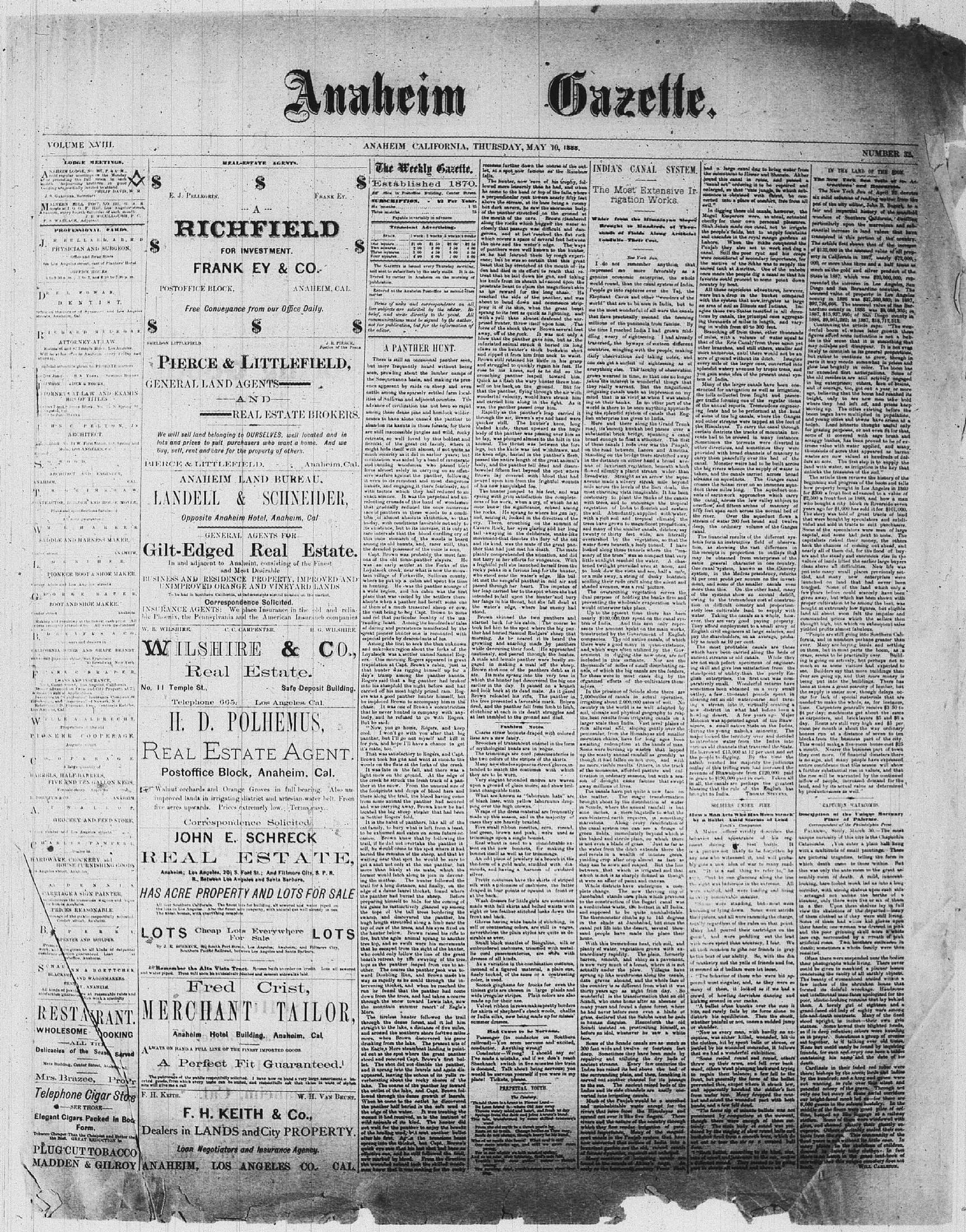
Searchable text
VOLUME XVIII.
LODGE MEETINGS.
ANAHEIM LODGE, NO. 207, F. & A. M.
hold regular meetings on the Monday
of preceding the full moon in each month,
no pursuing business in good
holding are personally invited to attend.
PHILIP DAVIS, M. M.
J. N. GARNEER, Secretary.
MALVERN HILL POST, NO. 131, O. A. R.
MOUNTAIN STREET, HALL, Los Angeles street,
ANAheim, every fourth Saturday of each month.
J. B. MOULLEUGH, P. C.
F. S. WATLACE, Adjutant.
PROFESSIONAL CARDS.
J. H. ELLARD, A.B., M.D.
PHYSICIAN AND SURGEON.
Office and Drug Store
On Los Angeles street, east of Planters' Hotel
OFFICE HOURS
8:30 a.m., 1 to 2, and 8:30 to 7:30 p.m.
DE L. ROWAN,
DENTIST.
Office on the corner of Bryan and Los Angeles
streets, Anaheim, Cal.
RICHARD MELROSE,
ATTORNEY AT LAW.
Rooms 56 and 57 Temple Ridge, Los Angeles.
Will be at his office in Anaheim every Friday and
saturday.
PIERCE & LITTLEFIELD,
GENERAL LAND AGENTS
AND
REAL ESTATE BROKERS.
We will sell land belonging to OURSELVES, well located and in
lots and prices to suit purchasers who want a home. And we
buy, sell, rent and care for the property of others.
GENERAL LAND AGENTS AND REAL ESTATE BROKERS.
We will sell land belonging to OURSELVES, well located and in lots and prices to suit purchasers who want a home. And we buy, sell, rent and care for the property of others.
PIERCE & LITTLEFIELD. Anaheim, Cal.
ANAHEIM LAND BUREAU.
LANDELL & SCHNEIDER,
Opposite Anaheim Hotel, Anaheim, Cal.
GENERAL AGENTS FOR Gilt-Edged Real Estate.
In and adjacent to Anaheim, consisting of the Finest and Most Desirable BUSINESS AND RESIDENCE PROPERTY, IMPROVED AND UNIMPROVED ORANGE AND VINEYARD LANDS
To be had in Southern California, at and accents served to move on the market.
Correspondence Solicited.
INSURANCE AGENTS: We place Insurance in the old and reliable Phoenix, the Pennsylvania and the American Insurance companies.
W. B. WILSHIRE. C. C. CARPENTER. H. G. WILSHIRE.
WILSHIRE & CO., Real Estate.
No. 11 Temple St., Safe Deposit Building.
Telephone 665; Los Angeles, Cal.
H. D. POLHEMUS,
REAL ESTATE AGENT.
Postoffice Block, Anaheim, Cal.
Walnut orchards and Orange Groves in full bearing. Also unimproved lands in irrigating district and artesian-water belt. From five acres upwards. Prices extremely low. Terms easy.
Correspondence Solicited.
JOHN E. SCHRECK
REAL ESTATE,
BARERLS, HALF-BARRELS,
FIVE AND TEN GALLON KEGS.
FOR SALE ONLY.
ANAHEIM.
A. WALLOW.
GROCERY AND FED STORE.
CHARLES PAMETEL.
DOWER IN
HARDWARE, CHOCKERY, AND
HOUSE FURNISHING GOODS.
LAngles street, Anaheim.
A. DENNIS
CARRIAGE & SIGN PAINTER.
Constructs the numerous wagons and signs
for him in Anaheim.
PRICES REASONABLE.
Storage of the public respectfully solicited.
Center street, Anaheim.
B. PERK
PENTER AND BUILDER.
Promises to all kinds of carpenter
work, and also given to all kinds of carpenter
residence addition guaranteed. Levy at
staff offices, Anaheim.
SCHAUIN & BOETTCHER
BLACKSMITH AND WAGONMAKERS.
MENTOR: ANAHEIM.
All kinds of javelins at reasonable rates and
attention guaranteed. New work a specialty.
RESTAURANT.
WHOLESOME COOKING
—ALL THE
Delicacies of the Season Served
Meta Building, Center Street, Anaheim.
Mrs. Brazee, Prowr
Telephone Cigar Store
SEE THOSE
Elegant Cigars Packed in Book
Form.
Tobacco Champer Than the Company and Better than the Bank. GREAT REDUCTION in
PLUG-CUT TOBACCO
MADDEN & GILROY
Postoffice Block, Anaheim, Cal.
Walnut orchards and Orange Groves in full bearing. Also unimproved lands in irrigating district and artesian-water belt. From five acres upwards. Prices extremely low. Terms easy.
Correspondence Solicited.
JOHN E. SCHRECK
REAL ESTATE,
Anaheim; Los Angeles, 201 S. Fort St.; And Fillmore City, S. P. R.
R., Between Los Angeles and Santa Barbara.
HAS ACRE PROPERTY AND LOTS FOR SALE
All over Southern California. The neat lots for building, all sewered and water piped on
the lots in Los Angeles. Also the finest are property, with natural gas well already in use.
The neat homes, with everything complete.
LOTS Cheap Lots Everywhere LOTS
For Sale
By J. K. SCHRECK, 701 South Port Street, Los Angeles; Anaheim; and Fillmore City,
Southern Pacific Railroad, between Los Angeles and Santa Barbara.
Remember the Alta Vista Tract. Rooms built to order on credit. Lots all sewered
and water piped. Trees will soon be extensively planted and cement sidewalks labl.
Fred Crist,
MERCHANT TAILOR,
Anaheim Hotel Building, Anaheim, Cal.
Always on hand a full link of the finest imported goods.
A Perfect Fit Guaranteed.
The paltryage of the public respectfully solicited. I have now on hand a very large apartment omitted grounds, from which every trade can be suited, and respectfully ask that these in want of stylish
sites will give me a call.
F. H. Keith.
W. H. Van Brunt.
F. H. KEITH & Co.,
Dealers in LANDS and City PROPERTY.
Loan Negotiators and Insurance Agency.
ANAHEIM, LOS ANGELES CO. CAL.
ANAHEIM CALIFORNIA, THURSDAY, MAY 10, 1888.
The Weekly Gazette.
Established 1870.
Transient Advertising.
SPACE
1 week 2 weeks 3 weeks 4 weeks
One square $1.00 $1.50 $2.00 $2.50
Two squares 2.00 2.50 2.50 4.00
Three squares 3.00 4.50 5.00 5.50
Four squares 4.00 6.00 7.00 8.00
The Gazette is issued every Thursday morning, and sent to subscribers by the early mails. It is delivered by carrier in Anaheim on the morning of publication.
Entered at the Anaheim Postoffice as second-class matter.
Items of news and correspondence on all line subjects are solicited by the editor. Brief, and write directly to the point. All communications must be signed by the author, not for publication, but for the information of the editor.
A PANTHER HUNT.
There is still an occasional panther seen, but more frequently heard without being seen, prowling about the lumber camp of the Susquehanna basin, and making its presence apparent by rails on sheep and even cattle among the sparsely settled farm localities of Sullivan and adjacent counties. The advance of civilization has not been so rapid among these dense pine and hemlock wildernesses to have alone caused the panther to alamont its haunts in those forests; for there are still inaccessible jungles and wild, rocky retreats, so well loved by this boldest and most beautiful of the great cat family, where it might hide itself with almost, if not quite as much security as it did in earlier years; but excavation was added by a burial of insects.
receives further down the course of the outlet, at a spot now famous as the Rainbow Falls.
The hunter, now sure of his trophy, followed more leisurely than his had, and when he came to the head or top of the falls, where a perpendicular rock tower nearly fifty feet above the stream, at its base being a roomy but dark cavern, he saw the enormous body of the panther stretched on the ground at the mouth of the cave. Brown clambered along the rocks which hugged the water so closely that passage was difficult and dangerous, and at last reached the flat rock which covers a space of several feet between the cave and the water's edge. The ways of panthers were well known to the hunter, as he had learned them by rough experience; but he was certain that this great beast that lay stretched at the mouth of its den had died in its effort to reach that retreat that he laid down has gun, and taking his knife from its sheath advanced upon the prostrate beast to claim the magnificent skin as his reward for the long chase. He reached the side of the panther, and was about to bend down and commence stripping it of its skin, when the great beast sprang to its feet as quick as lightning, and with a yell than almost daunted the surprised hunter, threw itself upon him. The force of the shock threw Brown several feet away, off of the rock. It was not only a blow that the panther gave him, but as the infuriated animal struck it buried its long claws in the hunter's thick buckskin shirt and ripped it from him from neck to waist. Brown still retained his knife in his grasp and struggled to quickly regain his feet. He rose to his knees, and as he did so the crouching panther leaped toward him. Quick as a flash the wary hunter threw himself on his back on the ground. But for that the panther, flying through the air with wonderful velocity, would have stroked him and carried him along in the fight. As it was, the panther passed over him.
Rapidly as the panther's leap carried it through the air, Brown's eye and hand were quicker still. The hunter's keen, long-bladed knife, thrust upward as the huge body of the panther was passing over him as he lay, was plunged almost to the hilt in the animal. The thrust was between the fore legs, but the knife was not withdrawn, and its keen edge, buried in the panther's flesh, passed the entire length of its tail.
INDIA'S CANAL SYSTEM
The Most Extensive Rigation Works.
Water from the Himalayan River brought to hundreds of Tamil Nadu towns for irrigation works. Their cost.
New York Sun.
I do not remember anything impressed me more favorably on genuine economic enterprise, while world round, than the canal system of India. People go into raptores over the Taj,
Elephant Caves and other "wonders of world" that are to be seen in India, but me the most wonderful of all were the ones that have practically rescued the two millions of the peninsula from famine.
The time I reached India I had grown dugging weared in time, so that one no longer takes interest in wonderful things they really warrant. But the magnificent irrigating canals made an impression on my mind that as vivid as when I was standing on their banks. In no other part of world is there to be seen anything approaching the splendid system of canals that Kishen enterprise has given to India.
Here and there along the Grand Trunk road, a smooth kinkah pass over substantial brick bridge, spanning a canal enough to float a schooner. The of these canals I rode over was the Penghai on the road between Laeide and Amritsar. Standing on the bridge there stretched a mile across it.
but more frequently heard without being seen, prowling about the lumber camps of the Susquehanna basin, and making its presence apparent by rails on sheep and even cattle among the sparsely settled farm localities of Sullivan and adjacent counties. The advance of civilization has not been so rapid among these dense pine and hemlock wildernesses to have alone caused the panther to abandon its haunts in those forests, for there are still inaccessible jungles and wild, rocky retreats, so well loved by this boldest and fiercest, of the great cat family, where it might hide itself with almost, if not quite, as much security as it did in earlier years; but civilization was aided by a band of inveterate and numbing woodsmiths who passed their lives almost solely in carrying on an offensive warfare against the panther, following it even to its remotest and most dangerous haunts, and engaging it there fearlessly, and with tactics which they had reduced to an exact science. It was the perpetual and unrelenting crusade of this band of woodsmiths that gradually reduced the once numerous race of panthers in these woods to a condition of almost absolute extinction, so that today, with conditions favorable not only to its existence, but to its increase, it is only at rare intervals that the blood carving cry of this once monarch of the woods is heard among its old haunts, and, rarer still, that the dreaded possessor of the voice is seen.
Capt. Brown was probably the most famous of the old time-panther slayers. He was an early settler at the Forks of the Loyal sock creek, near what is now the mountain village of Forksville, Sullivan county, where he put up a cabin and spent his time in hunting. He was the panther acouge of a wide region, and his cabin was the first place that was visited by the settlers there about when a panther had bereft some one of them of a much treasured sheep or cow, the visit being to beg Capt. Brown to come and rid that particular locality of the maurning beast. Among the hundreds of tales of daring and persistence manifested by the great pioneer hunter one is recounted with especial pride by descendants of his.
Among the first to seek the then unknown and unbroken region about the forks of the Loyal sock was a settler named Samuel Rogers. One morning Rogers appeared in great trepidation at Capt. Brown's cabin, just as that hunter was rigging himself up for a day's tramp among the panther haunts. Rogers said that a big panther had broken into his sheepfold the night before and had carried off his most highly prized ram. Rogers was a good panther hunter himself, but he implored Brown to accompany him in the chase. It was one of Brown's eccentricities that he never hunted in company with anybody, and he refused to go with Rogers. But he said:
"Now, you go home, Rogers, and keep cool. I won't go with you after that big panther, but I'll go out myself and kill it for you, and hope I'll have a chance to get it'a mate too."
That was satisfactory to Rogers, and Capt. Brown took his gun and went at once to the woods on the flats at the forks of the creek.
It was late in the fall, and there was a light snow on the ground. At the edge of the creek he struck the fresh track of a panther in the snow. From the unusual size of the footprints and drops of blood here and there along the trail, the blood having come from some animal the panther had secured and was carrying away. Brown knew he had located the big sheep stealer that had been in Settler Rogers' fold.
It is the habit of panthers, like all of the cat family, to bury what is left from a feast, to be extruded and eaten on some future occasion. Brown knew that by following the trail, if he did not overtake the panther it self, he would come to the spot where it had hurried the remains of the sheeps, and that by waiting near that spot he would be sure to get a shot not only at the one panther, but more than likely at its mate, which the advance of civilization has not been so rapid among these dense pine and hemlock wildernesses to have alone caused the panther to abandon its haunts in those forests, for there are still inaccessible jungles and wild, rocky retreats, so well loved by this boldest and fiercest, of the great cat family, where it might hide itself with almost, if not quite, as much security as it did in earlier years; but civilization was aided by a band of inveterate and numbing woodsmiths who passed their lives almost solely in carrying on an offensive warfare against the panther, following it even to its remotest and most dangerous haunts, and engaging it there fearlessly, and with tactics which they had reduced to an exact science. It was the perpetual and unrelenting crusade of this band of woodsmiths that gradually reduced the once numerous race of panthers in these woods to a condition of almost absolute extinction, so that today, with conditions favorable not only to its existence, but to its increase, it is only at rare intervals that the blood carving cry of this once monarch of the woods is heard among its old haunts, and, rarer still, that the dreaded possessor of the voice is seen.
Capt. Brown was probably the most famous of the old time-panther slayers. He was an early settler at the Forks of the Loyal sock creek, near what is now the mountain village of Forksville, Sullivan county, where he put up a cabin and spent his time in hunting. He was the panther acouge of a wide region, and his cabin was the first place that was visited by the settlers there about when a panther had bereft some one of them of a much treasured sheep or cow, the visit being to beg Capt. Brown to come and rid that particular locality of the maurning beast. Among the hundreds of tales of daring and persistence manifested by the great pioneer hunter one is recounted with especial pride by descendants of his.
Among the first to seek the then unknown and unbroken region about the forks of the Loyal sock was a settler named Samuel Rogers. One morning Rogers appeared in great trepidation at Capt. Brown's cabin, just as that hunter was rigging himself up for a day's tramp among the panther haunts. Rogers said that a big panther had broken into his sheepfold the night before and had carried off his most highly prized ram. Rogers was a good panther hunter himself, but he implored Brown to accompany him in the chase. It was one of Brown's eccentricities that he never hunted in company with anybody, and he refused to go with Rogers. But he said:
"Now, you go home, Rogers, and keep cool. I won't go with you after that big panther, but I'll go out myself and kill it for you, and hope I'll have a chance to get it'a mate too."
That was satisfactory to Rogers, and Capt. Brown took his gun and went at once to the woods on the flats at the forks of the creek.
It was late in the fall, and there was a light snow on the ground. At the edge of the creek he struck the fresh track of a panther in the snow. From the unusual size of the footprints and drops of blood here and there along the trail, the blood having come from some animal the panther had secured and was carrying away. Brown knew he had located the big sheep stealer that had been in Settler Rogers' fold.
It is the habit of panthers, like all of the cat family, to bury what is left from a feast, to be extruded and eaten on some future occasion. Brown knew that by following the trail, if he did not overtake the panther it self, he would come to the spot where it had hurried the remains of the sheeps, and that by waiting near that spot he would be sure to get a shot not only at the one panther, but more than likely at its mate, which
light snow on the ground. At the edge of the creek he struck the fresh track of a panther in the snow. From the unusual size of the footprints and drops of blood here and there along the trail, the blood having come from some animal the panther had secured and was carrying away. Brown knew he had located the big sheep stealer that had been in Settler Rogers' fold.
It is the habit of panthers, like all of the cat family, to bury what is left from a feast, to be extinguished and eaten on some future occasion. Brown knew that by following the trail, if he did not overtake the panther it self, he would come to the spot where it had hurried the remains of the sheep, and that by waiting near that spot he would be sure to get a shot not only at its mates, which the former would fetch along to join in favouring the mutton. The hunter followed the trail for a long distance, and finally, on the edge of a dense laurel thicket, found where the panther had buried the sheep. Before preparing himself to hide for the coming of his game he instinctively glanced up among the tops of the tall tree bordering the swamp, and discovered the panther, his high length stretched along a limb near the top of one of the trees, and his eyes fixed on the hunter below. Brown raised his rife to fire, but the agile animal sprang to another tree top, and so swift were his movements that he escaped from the sight of the hunter, who could only follow the line of the great bear's retreat, by the awaiving of the tree tops as the panther leaped from one to another. The course the panther took was toward Doubling Run, and Brown made his way as rapidly as he could through the intervening thicket, and when he reached the run he found that the panther had come down from the trees, and had taken a course through the snow toward Lewis lake, now the mountain summer resort of Eagle's Mesa.
The tireless hunter followed the trail through the dense forest, and it led him straight to the lake, a distance of five miles, and around the southern shore for two miles more, when Brown discovered his game drinking from the lake. The present site of the Eagle's Mesa steamboat landing is pointed out as the spot where the great panther stood and received Capt. Brown's first bullet. The shot did not disable the panther, and it strangely into the laurels and again disappeared, leaving the echoes of its yells reverberating about the rocky shores of the lake. The course of the panther lay toward the outlet of the lake, and Capt. Brown followed through the dense growth of herds. When he came to the outlet he discovered the panther half buried in the soft mud at the edge of the water. It was treating the wound it had received, as in the instinct of wild animals of its kind. The hunter did not wait for the panther to enjoy the benefit of the healing man; but must another bullet after his first. Again, the tremendous burst springing into the thicket, but Capt. Brown's quick eye saw that his hat had been an adaptive man, and he still followed the lake, now marred by blood. From this direction the wounded animal back skilled manners know that it was making for the study light snow on the ground. At the edge of the creek he struck the fresh track of a panther in the snow. From the unusual size of the footprints and drops of blood here and there along the trail, the blood having come from some animal the panther had secured and was carrying away. Brown knew he had located the big sheep stealer that had been in Settler Rogers' fold.
It is the habit of panthers, like all of the cat family, to bury what is left from a feast, to be extinguished and eaten on some future occasion. Brown knew that by following the trail, if he did not overtake the panther it self, he would come to the spot where it had hurried the remains of the sheep, and that by waiting near that spot he would be sure to get a shot not only at its mats, which the former would fetch along to join in favouring the mutton. The hunter followed the trail for a long distance, and finally, on the edge of a dense laurel thicket, found where the panther had buried the sheep. Before preparing himself to hide for the coming of his game he instinctively glanced up among the tops of the tall tree bordering the swamp, and discovered the panther, his high length stretched along a limb near the top of one of the trees, and his eyes fixed on the hunter below. Brown raised his rife to fire, but the agile animal sprang to another tree top, and so swift were his movements that he escaped from the sight of the hunter, who could only follow the line of the great bear's retreat, bythe awaiving ofthe tree tops asthepantherleapedfromonetoanother.ThecoursethepantherookwastowardDoublingRun,andBrownmadehiswayasrapidlyhecouldthroughtheinterveningthicket,andwhenh棕迪coveredhisgamedrinkingfromthelake.ThepresentsiteoftheEagle'sMeresteamboatlandispointedoutasthespotwherethegreatpantherstoodandreceivedCapt.Brown'sfirstbullet.Theshotdidnotdisablethepanther,anditstrangelyintothelaurelsandagaindisappeared.leavingtheechoesofitsyallsreverberatingabouttherockysshoresofthelake.Thecourseofthepantherlaytowardtheoutletofthelake,andCapt.BrownfollowedthroughthedensegrowthofherdsWhenhusenumethatisfoundthepanthertoenjoythebenefitofthehealingman;butmustanotherbulletafterhisfirst.Agree,theintensiousburstspringintothethicket,betcapt.Brown'squickeyenewthathushatthadneenaadaptiveman,andhesstillfollowedthelake.worsemarredbyblood.Fromthisdirectionthewoundedanimalbackskilledmannersknowthatitwasmakingforthestudylight snow ontheground.Attheedgeofthecreekhestruckthefreshtrackoftapantherinthesnow.Fromtheunusualsizeofthefootprintsanddropsofbloodhereandtherealongthetrail,thebloodhavingcomefromsomeanimalthepantherhadsecuredandwascarryingaway.Brownknewthatbyfollowingthetrailifhedidnotovertakethepantheritself,houldcometochestwhereithadhurriedtheremainsofthesheep,andthatbywaitingnearthatspothewouldbe suretogetashotnotonlyatitsmatawhichtheformerwouldfetchalongtojoinindavouringthemutton.Thehunterfollowedthetrailforalongdistance,and finally.ontheedgeofadenselaurelthicket,foundwherethepantherhadburiedthesheep.Beforepreparinghimselftohideforthecomingofhisgameheinstinctivelyglancedupamongthetopsofthetalltreebordertingtheswamp,anddiscoveredthepanther,hughlengthstrettedalongalimbnearedontoponeofthetrees,andhiseyesfixedonthen Hunterbelow.Brownraisedhisrifetofire,buttheagileanimalsprungtoanothertreetop,andso Swiftwerehismovementsthatheescapedfromthesightofthehunterwhocouldonlyfollowthelineofthegreatbeast'sretreat,bytheawaivingofthetreetopasthepantherleapedfromonetoanother.ThecoursethepantherookwastowardDoublingRun,andBrownmadehiswayasrapidlyhecouldthroughtheinterveningthicket,andwhenh棕迪coveredhisgamedrinkingfromthelake.ThepresentsiteoftheEagle'sMeresteamboatlandispointedoutasthespotwherethegreatpantherstoodandreceivedCapt.Brown'sfirstbullet.Theshotdidnotdisablethepanther,anditstrangelyintothelaurelsandagaindisappeared.leavingtheechoesofitsyallsreverberatingabouttherockysshoresofthelake.ThecourseofthepantherlaytowardDoublingRun,andBrownmadehiswayasrapidlyhecouldthroughtheinterveningthicket,andwhenh棕迪coveredhisgamedrinkingfromthelake.ThepresentsiteoftheEagle'sMeresteamboatlandispointedoutas-thespotwherethegreatpantherstoodandreceivedCapt.Brown'sfirstbullet.Theshotdidnotdisablethepanther,anditstrangelyinto.thelaurelsandagaindisappeared.leavingtheechoesofitsyallsreverberatingabouttherockysshoresofthelake.ThecourseofthepantherlaytowardDoublingRun,andBrownmadehiswayasrapidlyhecouldthrough.theinterveningthicket,andwhenh棕迪coveredhisgamedrinkingfromthelake.ThepresentsiteoftheEagle'sMeresteamboatlandispointedoutas-thespotwhere.thegreatpantherstoodandreceivedCapt.Brown'sfirstbullet.Theshotdidnotdisablethepanther,anditstrangelyinto.thelaurelsandagaindisappeared.leaving.theechoes.ofitsyallsreverberatingabout.therockysshoresofthelake.ThecourseofthepantherlaytowardDoublingRun,andBrownmadehiswayasrapidlyhecouldthrough.theinterveningthicket,andwhenh棕迪coveredhisgamedrinkingfromthelake.ThepresentsiteoftheEagle'sMeresteamboatlandispointedoutas-thespotwhere.thegreatpantherstoodandreceivedCapt.Brown'sfirstbullet.TheshotdidnotdisableThepanther,anditstrangelyinto.thelaurelsandagaindisappeared.leaving.theechoes.ofitsyallsreverberatingabout.therockysshoresofthelake.ThecourseofThepantherlaytowardDoublingRun,andBrownmadehiswayasrapidlyhecouldthrough.theinterveningthicket,andwhenh棕迪coveredHisgamedrinkingfromTheLake.ThepresentsiteOfTheEagle'SMereSteamBoatlandIsPointedOutAsTheSpotWhereTheGreatPantherStandedAndReceivedCapt.Brown'SFirst Bullet.The Shoot Did Not Disable The Panther And It Reached The Spot Where The Great Panther Standed And Received Capt.Brown'S First Bullet.The Shoot Did Not Disable The Panther And It Reached The Spot Where The Great Panther Standed And Received Capt.Brown'S First Bullet.The Shoot Did Not Disable The Panther And It Reached The Spot Where The Great Panther Standed And Received Capt.Brown'S First Bullet.The Shoot Did Not Disable The Panther And It Reached The Spot Where The Great Panther Standed And Received Capt.Brown'S First Bullet.The Shoot Did Not Disable The Panther And It Reached The Spot Where The Great Panther Standed And Received Capt.Brown'S First Bullet.The Shoot Did Not Disable The Panther And It Reached The Spot Where The Great Panther Standed And Received Capt.Brown'S First Bullet.The Shoot Did Not Disable The Panther And It Reached The Spot Where The Great Panther Standed And Received Capt.Brown'S First Bullet.The Shoot Did Not Disable The Panther And It Reached The Spot Where The Great Panther Standed And Received Capt.Brown'S First Bullet.The Shoot Did Not DisableThe Panther And It Reached The Spot Where The Great Panter Standed And Received Capt.Brown'S First Bullet.The Shoot Did Not DisableThe Panter And It Reached The Spot Where The Great Panter Standed And Received Capt.Brown'S First Bullet.The Shoot Did Not DisableThe Panter And It Reached The Spot Where The Great Panter Standed And Received Capt.Brown'S First Bullet.The Shoot Did Not DisableThe Panter And It Reached The Spot Where The Great Panter Standed And Received Capt.Brown'S First Bullet.The Shoot Did Not DisableThe Panter And It Reached The Spot Where The Great Panter Standed And Received Capt.Brown'S First Bullet.The Shoot Did Not DisableThe Panter And It Reached The Spot Where The Great Panter Standed And Received Capt.Brown'S First Bullet.The Shoot Did Not DisableThe Panter AND IT REACHED THE SPOT WHERE THE GREAT PANTHER STANDED AND RECEIVED CAPT.BROWN'S FIRST BULLET. THE SHOT DID NOT DISABLE THE PANTHER AND IT REACHED THE SPOT WHERE THE GREAT PANTHER STANDED AND RECEIVED CAPT.BROWN'S FIRST BULLET. THE SHOT DID NOT DISABLE THE PANTHER AND IT REACHED THE SPOT WHERE THE GREAT PANTHER STANDED AND RECEIVED CAPT.BROWN'S FIRST BULLET. THE SHOT DID NOT DISABLE THE PANTHER AND IT REACHED THE SPOT WHERE THE GREAT PANTHER STANDED AND RECEIVED CAPT.BROWN'S FIRST BULLET. THE SHOT DID NOT DISABLETHE PANTHER AND IT REACHED THE SPOT WHERE THE GREAT PANTHER STANDED AND RECEIVED CAPT.BROWN'S FIRST BULLET. THE SHOT DID NOT DISABLETHE PANTHER AND IT REACHED THE SPOT WHERE THE GREAT PANTHER STANDED AND RECEIVED CAPT.BROWN'S FIRST BULLET. THE SHOT DID NOT DISABLETHE PANTHER AND IT REACHED THE SPOT WHERE THE GREAT PANTHER STANDED AND RECEIVED CAPT.BROWN'S FIRST BULLET. THE SHOT DID NOT DISABLETHE PANTHER AND IT REACHED THE SPOT WHERE THE GREAT PANTHER STANDED AND RECEIVED CAPT.BROWN'S FIRST BULLET. THE SHOT DID NOT DISABLETHE PANTHER AND IT REACHED THE SPOT WHERE THE GREAT PANTHER STANDED AND RECEIVED CAPT.BROWN'S FIRST BULLET. THE SHOT DID NOT DISABLETHE PANTHER AND IT REACHED THE SPOT WHERE THE GREAT PANTHER STANDED AND RECEIVED CAPT.BROWN'S FIRST BULLET. THE SHOT DID NOT DISABLETHE PANTHER AND IT REACHED THE SPOT WHERE THE GREAT PANTHER STANDED AND RECEIVED CAPT.BROWN'S FIRST BULLET. THE SHOT DID NOT DISABLETHE PANTHER AND IT REACHED THE SPOT WHERE THE GREAT PANTHER STANDED AND RECEIVED CAPT.BROWN'S FIRST BULLET. THE SHOT DID NOT DISABLETHE PANTHER AND IT REACHED THE SPOT WHERE THE GREAT PANTHER STANDED AND RECEIVED CAPT.BROWN'S FIRST BULLET. THE SHOT DID NOT DISABLETHE PANTHER AND IT REACHED THE SPOT WHERE THE GREAT PANTHER STANDED AND RECEIVED CAPT.BROWN'S FIRST BULLET. THE SHOT DID NOT DISABLETHE PANTHER AND IT REACHED THE SPOT WHERE THE GREAT PANTHER STANDED AND RECEIVED CAPT.BROWN'S FIRST BULLET. THE SHOT DID NOT DISABLETHE PANTHER AND IT REACHED THE SPOT WHERE THE GREAT PANTHER STANDED AND RECEIVED CAPT.BROWN'S FIRST BULLET. THE SHOT DID NOT DISABLETHE PANTHER AND IT REACHED THE SPOT WHERE THE GREAT PANTHER STANDED AND RECEIVED CAPT.BROWN'S FIRST BULLET. THE SHOT DID NOT DISABLETHE PANTHER AND IT REACHED THE SPOT WHERE THE GREAT PANTHER STANDED AND RECEIVED CAPT.BROWN'S FIRST BULLET. THE SHOT DID NOT DISABLETHE PANTHER AND IT REACHED THE SPOT WHERE THE GREAT PANTHER STANDED AND RECEIVED CAPT.BROWN'S FIRST BULLET. THE SHOT DID NOT DISABLETHE PANTHER AND IT REACHED THE SPOT WHERE THE GREAT PANTHER STANDDED AND RECEIVED CAPT.BROWN'S FIRST BULLET. THE SHOT DID NOT DISABLETHE PANTER AND IT REACHED THE SPOT WHERE THE GREAT PANTER STANDDED AND RECEIVENCAPT.BROWN'S FIRST BULLET. THE SHOT DID NOT DISABLETHE PANTER AND IT REACHED THE SPOT WHERE THE GREAT PANTER STANDDED AND RECEIVENCAPT.BROWN'S FIRST BULLET. THE SHOT DID NOT DISABLETHE PANTER AND IT REACHED THE SPOT WHERE THE GREAT PANTER STANDDED AND RECIEVENCAPT.BROWN'S FIRST BULLET. THE SHOT DID NOT DISABLETHE PANTER AND IT REACHED THE SPOT WHERE THE GREAT PANTER STANDDED AND RECIEVENCAPT.BROWN'S FIRST BULLET. THE SHOT DID NOT DISABLETHE PANTER AND IT REACHED THE SPOT WHERE THE GREAT PANTER STANDDED AND RECIEVENCAPT.BROWN'S FIRST BULLET. THESHOT DID NOT DISABLETHE PANTER AND IT REACHED THE SPOT WHERE THE GREAT PANTER STANDDED AND RECIEVENCAPT.BROWN'S FIRST BULLET. THESHOT DID NOT DISABLETHE PANTER AND IT REACHED THE SPOT WHERE THE GREAT PANTER STANDDED AND RECIEVENCAPT.BROWN'S FIRST BULLET. THESHOT DID NOT DISABLETHE PANTER AND IT REACHEDTHE SPOT WHERE THE GREAT PANTER STANDDED AND RECIEVENCAPT.BROWN'S FIRST BULLET. THESHOT DID NOT DISABLETHE PANTER AND IT REACHEDTHE SPOT WHERE THE GREAT PANTER STANDDED AND RECIEVENCAPT.BROWN'S FIRST BULLET. THESHOT DID NOT DISABLETHE PANTER AND IT REACHEDTHE SPOT WHERE THE GREAT PANTER STANDDED AND RECIEVENCAPT.BROWN'S FIRST BULLET. THESHOT DID NOT DISABLETHE PANTER AND IT REACHEDTHE SPOT WHERE THE GREAT PANTER STANDDED AND RECIEVENCAPT.BROWN'S FIRST BULLET. THESHOT DID NOT DISABLETHE PANTER AND IT REACHEDTHE SPOT WHERE THE GREAT PANTER STANDDED AND RECIEVENCAPT.BROWN'S FIRST BULLET. THESHOT DID NOT DISABLETHE PANTER AND IT REACHEDTHE SPOT WHERE THE GREAT PANTER STANDDED AND RECIEVENCAPT.BROWN'S FIRST BULLET. THESHOT DID NOT DISABLETHE PANTER AND IT REACHEDTHE SPOT WHERE THE GREAT PANTER STANDDED AND RECIEVENCAPT.BROWN'S FIRST BULLET. THESHOT DID NOT DISABLETHE PANTER AND IT REACHEDTHE SPOT WHERE THE GREAT PANTER STANDDED AND RECIEVENCAPT.BROWN'S FIRST BULLET. THESHOT DID NOT DISABLETHE PANTER AND IT REACHEDTHE SPOT WHERE THE GREAT PANTER STANDDED AND RECIEVENCAPT.BROWN'S FIRST BULLET. THESHOT DID NOT DISABLETHE PANTER AND IT REACHEDTHE SPOT WHERE THE GREAT PANTER STANDDED AND RECIEVENCAPT.BROWN'S FIRST BULLET. THESHOT DID NOT DISABLETHE PANTER AND IT REACHEDTHE SPOT WHERE THE GREAT PANTER STANDDED AND RECIEVENCAPT.BROWN'S FIRST BULLET. THESHOT DID NOT DISABLETHE PANTER AND IT REACHEDTHE SPOT WHERE THE GREAT PANTER STANDDED AND RECIEVENCAPT.BROWN'S FIRST BULLET. THESHOT DID NOT DISABLETHE PANTER AND IT REACHEDTHE SPOT WHERE THE GREAT PANTER STANDDED AND RECIEVENCAPT.BROWN'S FIRST BULLET. THESHOT DID NOT DISABLETHEPANTERANDITREACHEDITHERANCETHEPUNCHINGINTHISWATERHOUSEWHICHISADESTROYINGINTHISWATERHOUSEWHICHISADESTROYINGINTHISWATERHOUSEWHICHISADESTROYINGINTHISWATERHOUSEWHICHISADESTROYINGINTHISWATERHOUSEWHICHISADESTROYINGINTHISWATERHOUSEWHICHISADESTROYINGINTHISWATERHOUSEWHICHISADESTROYINGINTHISWATERHOUSEWHICHISADESTROYINGINTHISWATERHOUSEWHICHISADESTROYINGINTHISWATERHOUSEWHICH ISADESTROYINGINTHISWATERHOUSEWHICH ISADESTROYINGINTHISWATERHOUSEWHICH ISADESTROYINGINTHISWATERHOUSEWHICH ISADESTROYINGINTHISWATERHOUSEWHICH ISADESTROYINGINTHISWATERHOUSEWHICH ISADESTROYINGINTHISWATERHOUSEWHICH ISADESTROYINGINTHISWATERHOUSEWHICH ISADESTROYINGINTHISWATERHOUSEWHICH ISADESTROYINGINTHISWATERHOUSEWHICH IS ADESTROYINGINTHISWATERHOUSEWHICH ISADESTROYINGINTHISWATERHOUSEWHICH ISADESTROYINGINTHISWATERHOUSEWHICH ISADESTROYINGINTHISWATERHOUSEWHICH ISADESTROYINGINTHISWATERHOUSEWHICH ISADESTROYINGINTHISWATERHOUSEWHICH ISADESTROYINGINTHISWATERHOUSEWHICH IS ADESTROYINGINTHISWATERHOUSEWHICH ISADESTROYINGINTHISWATERHOUSEWHICH ISADESTROYINGINTHISWATERHOUSEWHICH ISADESTROYINGINTHISWATERHOUSEWHICH ISADESTROYINGINTHISWATERHOUSEWHICH IS ADESTROYINGINTHISWATERHOUSEWHICH IS ADESTROYINGINTHISWATERHOUSEWHICH IS ADESTROYINGINTHISWATERHOUSEWHICH IS ADESTROYINGINTHISWATERHOUSEWHICH IS ADESTROYINGINTHISWATERHOUSEWHICH IS ADESTROYINGINTHISWATERHOUSEWHICH IS A DESTROYINGINTHISWATERHOUSEWHICH IS ADESTROYINGINTHISWATERHOUSEWHICH IS ADESTROYINGINTHISWATERHOUSEWHICH IS ADESTROYINGINTHISWATERHOUSEWHICH IS ADESTROYINGINTHISWATERHOUSEWHICH IS ADESTROYINGINTHISWATERHOUSEWHICH IS ADESTROYINGINTHISHASDESTROYINGINTHISHASDESTROYINGINTHISHASDESTROYINGINTHISHASDESTROYINGINTHISHASDESTROYINGINTHISHASDESTROYINGINTHISHASDESTROYINGINTHISHASDESTROYINGINTHISHASDESTROYING INTHISHASDESTROYING INTHISHASDESTROYING INTHISHASDESTROYING INTHISHASDESTROYING INTHISHASDESTROYING INTHISHASDESTROYING INTHISHASDESTROYING INTHISHASDESTROYING INTHISHASDESTROYING IN THIGHASHASDESTROYING IN THIGHASHASDESTROYING IN THIGHASHASDESTROYING IN THIGHASHASDESTROYING IN THIGHASHASDESTROYING IN THIGHASHASDESTROYING IN THIGHASHASDESTROYING IN THIGHASHASDESTROYING IN THIGHASHASDESTROYING IN THIGHASHAS DESTROYING IN THIGHASHAS DESTROYING IN THIGHASHAS DESTROYING IN THIGHASHAS DESTROYING IN THIGHASHAS DESTROYING IN THIGHASHAS DESTROYING IN THIGHASHAS DESTROYING IN THIGHASHAS DESTROYING IN THIGHASHAS DESTROYING IN THIGHASHAS DESTROYING IN THAIGHASHAS DESTROYING IN THAIGHASHAS DESTroying IN THAIGHASHAS DEStroying IN THAIGHASHAS DEStroying IN THAIGHASHAS DEStroying IN THAIGHASHAS DEStroying IN THAIGHASHAS DEStroying IN THAIGHASHAS DEStroying IN THAIGHASHAS DEStroying IN THAIGHASH AS DEStroying IN THAIGHASH AS DeStroying In THAIGHASH AS DeStroying In THAIGHASH AS DeStroying In THAIGHASH AS DeStroying In THAIGHASH AS DeStroying In THAIGHASH AS DeStroying In THAIGHASH AS DeStroying In THAIGHASH AS DeStroying In THAIGHASH AS DeStroying In ThighASH AS DeStroying In ThighASH AS DeStroying In ThighASH AS DeStroying In ThighASH AS DeStroying In ThighASH AS DeStroying In ThighAH AS DeStroying In ThighAH AS DeStroying In ThighAH AS DeStroying In ThighAH AS DeStroying In ThighAH AS DeStroying In ThighAH AS DeStroying In ThighAH AS DeStroying In ThighAH AS DeStroy
INDIA'S CANAL SYSTEM.
The Most Extensive Irrigation Works.
From the Mimnayan Mopoli brought to hundreds of thousands of fields along Artificial Grand Trunk and their Cost.
New York Sun.
Do not remember anything that was more favorably as economic enterprise, the whole ground, than the canal system of India. Go into raptores over the Taj, the Caves and other "wonders of the that are to be seen in India, but to most wonderful of all were the canals practically reached the teeming of the paninsula from famine. By I reached India I had grown midway of sightseeing. I had already felt, by ways of sixteen different views, mingling with the people, making observations and taking notes, and got a surfeit of sightseeing as of being else. The faculty of observation carried in time, so that one no longer is interested in wonderful things that really warrant. Sat the magnificent canals made an impression on my mind as is vivid as when I was stand-near banks. In no other part of the there to be seen anything approach-plendid system of canals that Eugerprise has given to India.
And there along the Grand Trunk smooth kunkah bed passes over a canal brick bridge, spanning a canal tough to float a schooner. The first canals I rode over was the Ponjab canal between Lacore and Amritta.
had a large canal day to bring water from the mountains to Himar and Shanatha. Ah her jound this canal in ruin, and passed a "canal set" ordering it to be repaired and enlarged, so that "this jungle, in which existence is obtained with finest, be converted into a place of comfort, free from all evil."
In digging these old canals, however, the Mogul Emperors were, as usual, actabilly chiefly for their own personal pleasure. Shah Jehan made one canal, not to irrigate the people's fields, but to supply fountains and cancades in the royal mango gardens at Lahora. When the Sikhs conquered the Punjab they also set to work and dug a canal. Still the poor ryot and his crew were considered of secondary importance, for the motive of the Sikhs was to supply the sacred tank at Amritta. One of the nobles once made the people dig a canal so that his favorite could proceed to some point down country by boat.
All those captivious adventures, however, were but a drop in the bucket compared with the system that now irrigates as large an area of soil as Illinois and Indiana. Imagine these two States ramified in all directions by canals, the principal ones aggregating thousands of miles in length, and varying in width from 40 to 300 feet.
Branching off from these, other thousands of miles, with a volume of water equal to that of the Erie Canal; from these again yet other branches, and still others, smaller and more numerous, until there would not be an acre of ground without its ditch. Imagine every mile of the larger ones, converted into splendid wawery avenues by tropic trees, and you gain some idea of the present canal system of India.
Many of the larger canals have been constructed for navigation as well as irrigation, the tolls collected from feight and passenger traffic forming one of the regular items of the annual reports. Tremendous engineering feats had to be performed at the head of some of the big canals, where the Ganges and other streams were tapped at the foot of the Himalayas. To carry the canal through certain districts the tracks of mountain torrents had to be crossed in many instances. Sometimes the torrents were diverted in other directions, and sometimes they were provided with broad channels of masonry to carry them peacefully over the bed of the NUMBER 32.
IN THE LAND OF THE BOOK
The New York Sun of April 21 devotes six solid columns of reading matter from the pen of the city editor, John B. Bagatil, to a fair and impartial history of the manifold wonders of Southern California; dwelling particularly upon the marvelous and substantial increase in land values that have transpired in this portion of the country.
The article first shows that of the increase of $132,000 in the assumed value of all property in California in 1887, nearly $72,000,000 or more than three and a half times as much as the gold and silver product of the State in 1887, which was $20,000,000, represented the increase in Los Angeles, San Diego and San Bernardino counties. The assumed value of property in Los Angeles county in 1886 was $37,500,800; in 1887,$92,796,666. The assumed value of San Bernardino county in 1886 was $8,086,305; in 1887,$15,937,995; of San Diego county in 1886,$9,961,282; in 1887,$18,712,515.
Continuing the article says: "The wonderful boom of white later growth these figures afford some indication is not a bubble in this sense that it is something that may collapse and disappear. It is not even likely to diminish in its general proportions, but rather to continue to grow, though in parts it may recode somewhat in prices and glow less brightly in color. The boom has far exceeded first anticipations. Some of the old residents are still actively engaged in big enterprises; others, keen brains, and of courage, too, got out a year or more ago, believing that the boom had reached its height, only to see new men take hold where they had left off, and prizes keep moving up. The cities existing before the boom began have multiplied in population, and young cities and towns have arisen at a touch. Land hitherto thought useful only for grazing purposes, or not even fit for that, some of it covered with sage brush and scrubgy bushes, has been proved to be of extreme value with water applied, and many thousands of acres that appeared as barren wastes are now valued at hundreds of dolls."
get a surent of sightseeing as of
long else. The faculty of observation
carried in time, so that one no longer
is interest is wonderful things that
mally warrant. But the magnificent
canals made an impression on my
pat. is vivid when I was standeir banks. In no other part of the
there to be seen anything approachblend system of canals that Enguprise has given to India.
and there along the Grand Trunk
smooth kunkah bed passes over a
alley brick bridge, spanning a canal
rough to float a schooner. The first
canal I rode over was the Penjab,
between Laore and Amritta.
On the bridge there stretched away
ance on either hand a broad availuvariant vegetation, beneath which
idently a placid stream wider than
straight as an arrow the aquesmade a silvery streak beyond the
levels of the Bari dool, the
forming vista imaginable. It has been
to plant the banks of the canals,
and to encourage the tropical
of India to flourish and sustain
Abundantly supplied with water,
soil and tropical climate the
grown to magnificent proportions,
of the smaller canals, ditches, say
thirty feet wide, are literally
by the vegetation, so that the
was beneath a leafy tunnel. I have
going these tunnels where the "mathe trees" was so compact that very
right reached the water. A chanight provailed even at noon, and
low the vista and见, half a mile,
away, a string of dusky boatmen
are rude craft along the silent and
enures, was a real picture.
Searching vegetation serves the use of holding the banks firm and the wholesale evaporation which otherwise take place.
The present time there has been 100,000,000 spent on the canal systems. And this sum only reprenant spent on the main works,
by the Government of English.
The old native canals, of which
a good many in quasi-existence,
were often utilized by the Government digging the new ones, are not in this estimate. Nor are the so miles of small distributing canals which the big canals are the feeders, were in most cases dug by the efforts of the cultivators them-
Province of Scinde alone there are of canals in actual operation, about 2,000,000 acres of soil. No world is as well adapted by land and physical geography to reap results from irrigating canals on a less than India. Vast level plains of soil, sloping gently over the from the Himalayas and smaller hills, have for long ages been depletion at the hands of man, burning up waters that lapped city annual rainfall as greedily as had fallen on hot iron, and with little results. Others, in the track seasons, afforded pasture and culinary seasons, but with a seamed came famine that swept one of lives.
Have put quite a new face on water. The magic transformation out by the distribution of water where the annual rainfall is but a mere bagatelle to what the earth requires, is something along every ramification of system one can see a fringe of it, immediately beyond which is and sterile plain, on which there a blade of grass." Just as far as from the ditch extends there in a wealth of intense green after crop almost as fast as sown and reaped. But the line that which is irritated and that there along the Grand Trunk smooth kunkah bed passes over a certain brick bridge, spanning a canalough to float a schooner. The first canal I rode over was the Penjab, between Laore and Amritta. On the bridge there stretched away distance on either hand a broad avail-uvariant vegetation, beneath which idently a placid stream wider than straight as an arrow the aques-made a silvery streak beyond the levels of the Bari dool, the forming vita imaginable. It has been to plant the banks of the canals, and to encourage the tropical of India to flourish and sustain Abundantly supplied with water, soil and tropical climate the grown to magnificent proportions, of the smaller canals, ditches, say thirty feet wide, are literally by the vegetation, so that the was beneath a leafy tunnel. I have going these tunnels where the "ma-the trees" was so compact that very right reached the water. A chanight provailed even at noon, and low the vista and见,半 a mile, away, a string of dusky boatmen their rude craft along the silent and enures, was a real picture.
Searching vegetation serves the use of holding the banks firm and the wholesale evaporation which otherwise take place.
The present time there has been 100,000,000 spent on the canal sys-ntems. And this sum only repre-nant spent on the main works,
by the Government of English.
The old native canals, of which a good many in quasi-existence,
were often utilized by the Government digging the new ones, are not in this estimate. Nor are the so miles of small distributing canals which the big canals are the feeders, were in most cases dug by the efforts of the cultivators them-
Province of Scinde alone there are of canals in actual operation, about 2,000,000 acres of soil. No world is as well adapted by land and physical geography to reap results from irrigating canals on a less than India. Vast level plains of soil, sloping gently over the from the Himalayas and smaller hills, have for long ages been depletion at the hands of man, burning up waters that lapped city annual rainfall as greedily as had fallen on hot iron, and with little results. Others, in the track seasons, afforded pasture and culinary seasons, but with a seamed came famine that swept one of lives.
Have put quite a new face on water. The magic transformation out by the distribution of water where the annual rainfall is but a mere bagatelle to what the earth requires, is something along every ramification of system one can see a fringe of it, immediately beyond which is and sterile plain, on which there a blade of grass." Just as far as from the ditch extends there in a wealth of intense green oil after crop almost as fast as sown and reaped. But the line that which is irritated and that there along the Grand Trunk smooth kunkah bed passes over a certain brick bridge, spanning a canalough to float a schooner. The first canal I rode over was the Penjab, between Laore and Amritta. On the bridge there stretched away distance on either hand a broad avail-uvariant vegetation, beneath which idently a placid stream wider than straight as an arrow the aques-made a silvery streak beyond the levels of the Bari dool, the forming vita imaginable. It has been to plant the banks of the canals, and to encourage the tropical of India to flourish and sustain Abundantly supplied with water, soil and tropical climate the grown to magnificent proportions, of the smaller canals, ditches, say thirty feet wide, are literally by the vegetation, so that the was beneath a leafy tunnel. I have going these tunnels where the "ma-the trees" was so compact that very right reached the water. A chanight provailed even at noon, and low the vista and见,半 a mile,away,a string of dusky boatmen their rude craft along the silent and enures,was a real picture.
Searching vegetation serves the use of holding the banks firm and the wholesale evaporation which otherwise take place.
The present time there has been 100,000,000 spent on the canal sys-ntems. And this sum only repre-nant spent on the main works,
by the Government of English.
The old native canals, of which a good many in quasi-existence,
were often utilized by the Government digging the new ones,are not in this estimate. Nor are the so miles of small distributing canals which the big canals are the feeders, were in most cases dug by the efforts of the cultivators them-
Province of Scinde alone there are of canals in actual operation,about 2,000,000 acres of soil.No world is as well adapted by land and physical geography to reap results from irrigating canals on a less than India.Vast level plains of soil,sloping gently over the from the Himalayas and smaller hills,have for long ages been depletion at the hands of man,burning up waters that lapped city annual rainfall as greedily as had fallen on hot iron,and with little results. Others,in the track seasons,afforded pasture和 culinary seasons,but with a seamed came famine that swept one of lives.
Have put quite a new face on water. The magic transformation out by the distribution of water where the annual rainfall is but a mere bagatelle to what the earth requires,is something along every ramification of system one can see a fringe of it,immediately beyond which is and sterile plain,on which there a blade of grass." Just as far as from the ditch extends there in a wealth of intense green oil after crop almost as fast as sown and reaped. But the line that which is irritated and that there along the Grand Trunk smooth kunkah bed passes over a certain brick bridge,spanning a canalough to float a schooner. The first canal I rode over was the Penjab,between Laore and Amritta. On the bridge there stretched away distance on either hand a crossed across broad streams on aqueducts.The Ganges canal crosses Solasi river on immense aqueduct three miles long.The aqueduct consists of earthwork approaches which carrythe canal across leew valley subject to overflow,and fifteen arches of masonryof fifty feet open each across normal bedofthe river.Overthe aqueduct flowsa streamofwater200 feet broad and twelve deep,the ordinary volumeofthe Ganges canal.
The financial results of different systems form an instructive field of observation,as showingthe vast difference inthe receiptsin proportionto outlaysthat maybe obtainedfrom enterprisesofthe same general characterin one country。一one canal system,knownasthe Canerysystem,在the Medras presidency,returns8per cent profit per annumonthe investment,and someofthesmallcanalaevenmorethanthis.Ontheotherhand,manyofthesystemsshowanannualdefectowritingtotheremendouscostofconstructionin difficultcountryandproportionatelycultivatablelandto supplywithwater.Takingthecanalsaswholehowever,theyareverygoodpayingproperty TheyaffordemploymenttoasmallarmyofEnglish civil engineersatlarge salaries,andpaytheshareholders.onamverageprobablyasmuch10percent.
Most profitable canals are thosewhich have been carried alongbedsof ancient streams or old canals.Whiletheyarenotsuch perfect specimensofengineeringskillandgivesless satisfactionfromthestandpointutilitythanthepurelyEnglishenterprises,thefirstcostwascomparativelysmall.Wonderful returnshave sometimesbeenabtainedonaverysmalloutlay,fewthousandpoundsspentinclearingoutanoldwatercourseandturningastreamintoit,virtuallycreatingannewdistrictinwhathadbeforebeenahowlingdesert.Afewyears agoMajorMinnionwasappointedagentoftheBha-wipire,asmall nativeStateonIndia,duringthe young nababeaminority.ThemajorlookedtheterritoryoveranddecidedintroducewaterfromtheIndiesinvariousoldchannelsthattraversedTheState.Heborrowed£15,000at12percentandsetthepeople£15,000at12percentandsetthepeople£15,000at12percentandsetthepeople£15,000at12percentandsetthepeople£15,000at12percentandsetthepeople£15,000at12percentandsetthepeople£15,000at12percentandsetthepeople£15,000at12percentandsetthepeople£15,000at12percentandsetthepeople£15,000at12percentandsetthepeople£15,000at12percentandsetthepeople£15,0
SOLDIERS UNDER FIRE
How a Man Arts Who Has Been Struck by a Bullet Amid Norms of Land
Fountain, Compass.
A Maine officer vividly describes the behavior and appearance of his regiment during first battle. It is a picture not likely to be forgotten by any one who witnessed it, and will probably give a new idea of war to many readers. "It is a sad thing to refer to," he says, "but to one glancing along the line night was luridness in the extreme. All were excited, and were loading and firing in every conceivable manner."
Some were standing, but most were kneeling or lying down. We were astute their pieces, and all were ramming the charge, totally regardless of the rules on that point. Many had poured their cartridges on the ground, and were peddling out the lead with more speed than accuracy. I fear. We all took occasion to gibe our friends in gray to the beat of our ability. So, with the din of monkery and the yell of friends and foe, it seemed as if bedlam were let loose.
"The behavior of those who hit appeared most singular, and, as they were so many of them, it looked as if we had a crowd of hawling dervishes dancing and kicking around in our ranks.
"A bullet often knocks over the man it hits, and rarely fails by its force alone to disturb his equilibrium. Then the shock, whether painful or not, causes a sudded jump or shudder.
"Now every man, with hardly an exception, was either killed, wounded, hit in the clothes, hit by bells or stones, or jailed by his wounded comrades. It follows that we had a wonderful exhibition.
"Some reared round and rummed, others threw up their arms, and fell over back ward, others went plunging backward trying to regain their balance; a few fall to the front, but generally the form of the bullet prevented this, except where it struck low, and apparently knocked the soldier's foot from under him. Many dropped the musket and sound the wounded part with both hands, and a few fell dead.
"The force slip of minute ballots was not prominent by comparison as the moment, though there were enough of them certainly. The main body of sound was produced by the singing of slow round balls and handshot fired from a smooth horn, which do not cut or tear the air so a sustained balloon.
"When bullet sounding in his mind, size of wound and momentum in the ear, within a different sound. They sound to be going past all animal and above us."
CAPTCHIN CATACOMBS
Description of the Unique Mortuary Piece of Palermo.
Correspondent of the Philadelphia Press.
Palermo, Sicily, March 20—The most unique curiosity of this city is the Chapachin Catacombs. You enter a plain hall hung with a multitude of small paintings. These are pictorial tragedies, telling the form in which death came to those within. But this was only the ante room to the great assembly room of death. A mild, innocent-looking, bare-faced mokk led us into a long corridor, with strong shelves upon each side arranged not unlike the berths of a steamer, only there were five or six of them in a tier. Upon these shelves lay in full view the skulls of the departed—many of them clad as if they were still living. Some of them had white kid glowers upon their hands; one woman was dressed in pink and the poor grinning skull wore a white lace cap, surrounded by a wrath of pink artificial roses. Two brothers enthroned in death; sometimes a whole family were thus reunited.
Often there were suspended near the bodies their photographs while living. There never could be given to mankind a plainer lesson concerning the vanity of all earthly objects. The beauty of womanhood amused within a few inches of the shrunken house that formed its doleful wrecks. Handmade and intellectual man-faces apologized for the poor, idiotic-looking remains that lay behind them. A lovely girl of eightteen and a grand-faced old lady of eighty were among life-and-death contrasts. Many of the dead stood upright, in inches—their own grin atttains. Some bowed their blighted hands, as if in deep reflection; others were kneeling as in prayer. Sometimes a group of ovens met together, as if talking over old times. Names but could easily be found by impiring friends, for each and every one has a tailor containing his name and the date of his death.
Cardinale in their folded red robes were there; bishops by the score; lords and ladies by the hundred; and a king and queen were not wanting to rule over this silent and painful colony of the grave. Through not only one but many of these surreal corridors our bright-faced mokk led us—for there are 5,000 guests in the salone hostelry. In the middle of the flowers were great pilions of soft-film, helped up like luggage at a railway station. Home of them were windflower with glass and almost pliant their quantities. Others similarly enclosed their contents from the eye. This community of the third years is not without little men. In many places in the shrubs mokk book of mortality that their unique omnibody does not breath.
WILL CARLSON.