anaheim-gazette 1888-03-22
Scanned page
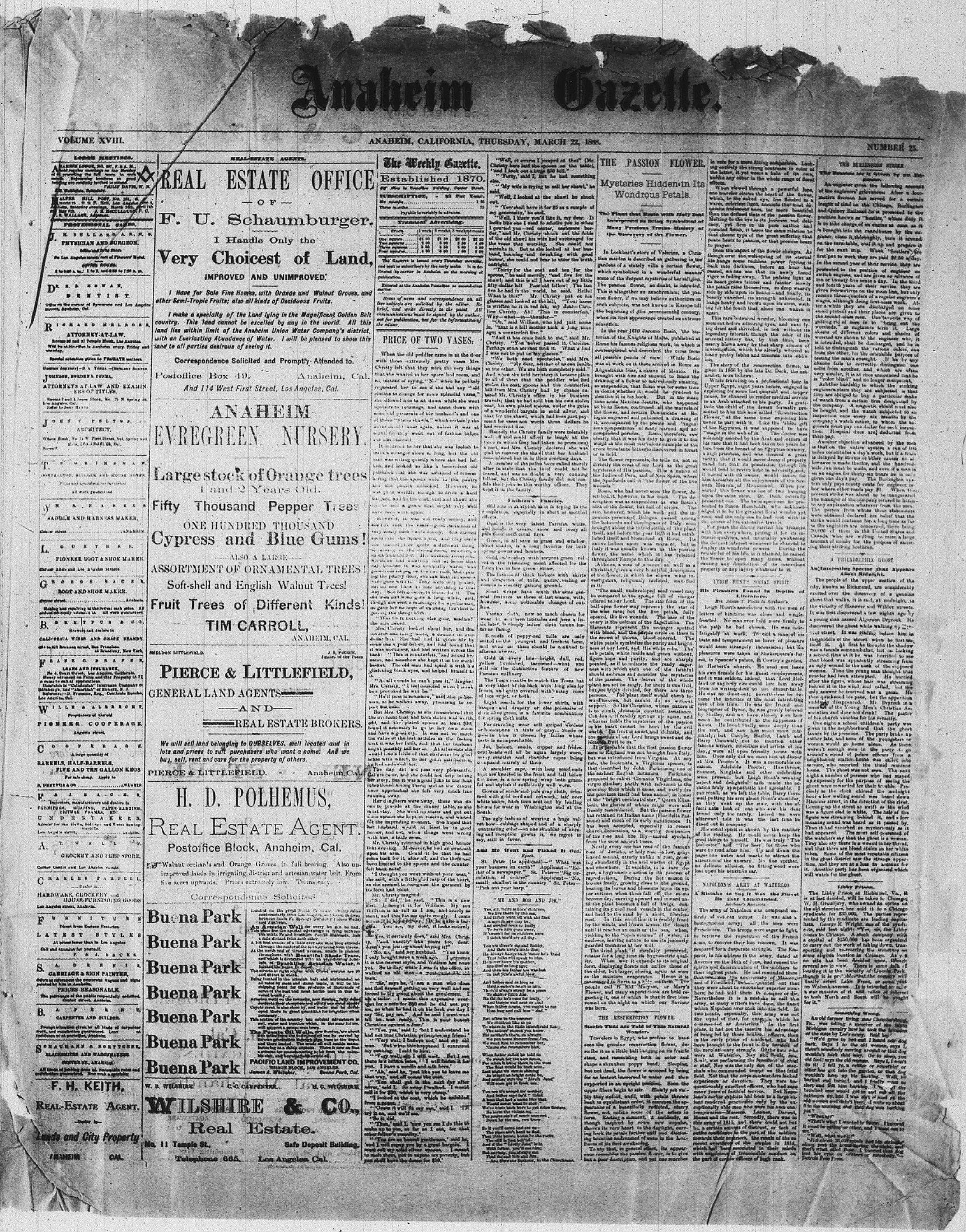
Searchable text
VOLUME XVIII.
REAL ESTATE AGENTS.
REAL ESTATE OFFICE
OF
F. U. Schaumburger
I Handle Only the
Very Choicest of Land
IMPROVED AND UNIMPROVED.
I Have for Sale Fine Homes, with Orange and Walnut Groves,
other Semi-Tropical Fruits; also all kinds of Deciduous Fruits.
I make a specialty of the Land lying in the Magnificent Golden
country. This land cannot be excelled by any in the world. All
land lies within limit of the Anaheim Union Water Company's district
with an Everlasting Attendance of Water. I will be pleased to show
the land to all parties desirous of seeing it.
Correspondence Solicited and Promptly Attended to.
Postoffice Box 49.
Anaheim, Cal.
And 114 West First Street, Los Angeles, Cal.
ANAHEIM
EVREGREEN NURSERY
ANAHEIM
EVREGREEN NURSERY
Large stock of Orange tree
1 and 2 Years Old.
Fifty Thousand Pepper Trees
ONE HUNDRED THOUSAND Cypress and Blue Gums
Also a large assortment of ornamental trees
Soft-shell and English Walnut Trees!
Fruit Trees of Different Kinds
TIM CARROLL,
ANAHEIM, CAL.
SMELDON LITTLEFIELD.
PIERCE & LITTLEFIELD,
GENERAL LAND AGENTS
AND
REAL ESTATE BROKERS
We will sell land belonging to OURSELVES, well located and in lots and prices to suit purchasers who want a home. And we buy, sell, rent and care for the property of others.
PIERCE & LITTLEFIELD.
H. D. POLHEMUS,
REAL ESTATE AGENT.
Postoffice Block, Anaheim, Cal.
Walnut orchards and Orange Groves in fall bearing. Also un-
H. D. POLHEMUS,
REAL ESTATE AGENT.
Postoffice Block, Anaheim, Cal.
Walnut orchards and Orange Groves in fall bearing. Also unimproved lands in irrigating district and artesian-water belt. From five acres upwards. Prices extremely low. Terms easy.
Correspondence Solicited
Buena Park
Buena Park
Buena Park
Buena Park
Buena Park
F. H. KEITH.
REAL-ESTATE AGENT.
Lands and City Property
Anaheim, Cal.
W. R. WILSHIRE
C. G. CARPENTER
H. G. WILSHIRE
WILSHIRE & CO., Real Estate.
No. 11 Temple St.
Telephone 665 Los Angeles, Cal.
ANAHEIM, CALIFORNIA, THURSDAY, MARCH 22, 1878.
E OFFICE
hamburger.
ly the
of Land,
IMPROVED:
ange and Walnut Groves, and
disciduous Fruits.
in the Magnificent Golden Belt
any in the world. All this
on Water Company's district,
will be pleased to show this
Promptly Attended to.
Anahiem, Cal.
Los Angeles, Cal.
IM
NURSERY.
The Weekly Gazette.
Established 1870.
Items of news and correspondence on all line subjects are solicited by the editor. Be brief, and write directly to the point. All communications must be signed by the author, not for publication, but for the information of the editor.
PRICE OF TWO VASES:
When the old peddler came in at the door with those extremely pretty vases Mrs. Christy felt that they were the very things that she wanted in her spare bed room, and so instead of saying, "No" when he politely requested her to see if she had any "old clothes to change for some splendid vases," she allowed him to sit down while she went upstairs to remimage, and came down with some old groats of her husband's and one of these vases she said, "which certainly she never should wear again, unless it was at night for they went out of fashion before she was married."
It occurred to her that she was foolish to leave a stranger alone so long, but the old office in Anaheim on the morning of publication.
Transmission Advertising:
Bracket 1 week 2 weeks 3 weeks 4 weeks
One square $2.00 $2.50 $3.00 $3.50
Two squares $2.00 $2.50 $3.00 $3.50
Three squares $2.00 $2.50 $3.00 $3.50
Four squares $2.00 $2.50 $3.00 $3.50
The Gazette is issued every Thursday morning, and sent to subscribers by the early mail. It is delivered by carrier in Anaheim on the morning of publication.
Entered at the Anaheim Postoffice as second-class matter.
Items of news and correspondence on all line subjects are solicited by the editor. Be brief, and write directly to the point. All communications must be signed by the author, not for publication, but for the information of the editor.
PRICE OF TWO VASES:
When the old peddler came in at the door with those extremely pretty vases Mrs. Christy felt that they were the very things that she wanted in her spare bed room, and so instead of saying, "No" when he politely requested her to see if she had any "old clothes to change for some splendid vases," she allowed him to sit down while she went upstairs to remimage, and came down with some old groats of her husband's and one of these vases she said, "which certainly she never should wear again, unless it was at night for they went out of fashion before she was married."
It occurred to her that she was foolish to leave a stranger alone so long, but the old office in Anaheim on the morning of publication.
"The Gazette is issued every Thursday morning, and sent to subscribers by the early mail. It is delivered by carrier in Anaheim on the morning of publication."
Entered at the Anaheim Postoffice as second-class matter.
Items of news and correspondence on all line subjects are solicited by the editor. Be brief, and write directly to the point. All communications must be signed by the author, not for publication, but for the information of the editor.
PRICE OF TWO VASES:
When the old peddler came in at the door with those extremely pretty vases Mrs. Christy felt that they were the very things that she wanted in her spare bed room, and so instead of saying, "No" when he politely requested her to see if she had any "old clothes to change for some splendid vases," she allowed him to sit down while she went upstairs to remimage, and came down with some old groats of her husband's and one of these vases she said, "which certainly she never should wear again, unless it was at night for they went out of fashion before she was married."
It occurred to her that she was foolish to leave a stranger alone so long, but the old office in Anaheim on the morning of publication.
"The Gazette is issued every Thursday morning, and sent to subscribers by the early mail. It is delivered by carrier in Anaheim on the morning of publication."
Entered at the Anaheim Postoffice as second-class matter.
Items of news and correspondence on all line subjects are solicited by the editor. Be brief, and write directly to the point. All communications must be signed by the author, not for publication, but for the information of the editor.
PRICE OF TWO VASES:
When the old peddler came in at the door with those extremely pretty vases Mrs. Christy felt that they were the very things that she wanted in her spare bed room, and so instead of saying, "No" when he politely requested her to see if she had any "old clothes to change for some splendid vases," she allowed him to sit down while she went upstairs to remimage, and came down with some old groats of her husband's and one of these vases she said, "which certainly she never should wear again, unless it was at night for they went out of fashion before she was married."
It occurred to her that she was foolish to leave a stranger alone so long, but the old office in Anaheim on the morning of publication.
"The Gazette is issued every Thursday morning, and sent to subscribers by the early mail. It is delivered by carrier in Anaheim on the morning of publication."
Entered at the Anaheim Postoffice as second-class matter.
Items of news and correspondence on all line subjects are solicited by the editor. Be brief, and write directly to the point. All communications must be signed by the author, not for publication, but for the information of the editor.
PRICE OF TWO VASES:
When the old peddler came in at the door with those extremely pretty vases Mrs. Christy felt that they were the very things that she wanted in her spare bed room, and so instead of saying, "No" when he politely requested her to see if she had any "old clothes to change for some splendid vases," she allowed him to sit down while she went upstairs to remimage, and came down with some old groats of her husband's and one of these vases she said, "which certainly she never should wear again, unless it was at night for they went out of fashion before she was married."
It occurred to her that she was foolish to leave a stranger alone so long, but the old office in Anaheim on the morning of publication.
"The Gazette is issued every Thursday morning, and sent to subscribers by the early mail. It is delivered by carrier in Anaheim on the morning of publication."
Entered at the Anaheim Postoffice as second-class matter.
Items of news and correspondence on all line subjects are solicited by the editor. Be brief, and write directly to the point. All communications must be signed by the author, not for publication, but for the information of the editor.
PRICE OF TWO VASES:
When the old peddler came in at the door with those extremely pretty vases Mrs. Christy felt that they were the very things that she wanted in her spare bed room, and so instead of saying, "No" when he politely requested her to see if she had any "old clothes to change for some splendid vases," she allowed him to sit down while she went upstairs to remimage, and came down with some old groats of her husband's and one of these vases she said, "which certainly she never should wear again, unless it was at night for they went out of fashion before she was married."
It occurred to her that she was foolish to leave a stranger alone so long, but the old office in Anaheim on the morning of publication.
"The Gazette is issued every Thursday morning, and sent to subscribers by the early mail. It is delivered by carrier in Anaheim on the morning of publication."
Entered at the Anaheim Postoffice as second-class matter.
Items of news and correspondence on all line subjects are solicited by the editor. Be brief, and write directly to the point. All communications must be signed by the author, not for publication, but for the information of the editor.
PRICE OF TWO VASES:
When the old peddler came in at the door with those extremely pretty vases Mrs. Christy felt that they were the very things that she wanted in her spare bed room, and so instead of saying, "No" when he politely requested her to see if she had any "old clothes to change for some splendid vases," she allowed him to sit down while she went upstairs to remimage, and came down with some old groats of her husband's and one of these vases she said, "which certainly she never should wear again, unless it was at night for they went out of fashion before she was married."
It occurred to her that she was foolish to leave a stranger alone so long, but the old office in Anaheim on the morning of publication.
"The Gazette is issued every Thursday morning, and sent to subscribers by the early mail. It is delivered by carrier in Anaheim on the morning of publication."
Entered at the Anaheim Postoffice as second-class matter.
Items of news and correspondence on all line subjects are solicited by the editor. Be brief, and write directly to the point. All communications must be signed by the author, not for publication, but for the information of the editor.
PRICE OF TWO VASES:
When the old peddler came in at the door with those extremely pretty vases Mrs. Christy felt that they were the very things that she wanted in her spare bed room, and so instead of saying, "No" when he politely requested her to see if she had any "old clothes to change for some splendid vases," she allowed him to sit down while she went upstairs to remimage, and came down with some old groats of her husband's and one of these vases she said, "which certainly she never should wear again, unless it was at night for they went out of fashion before她 was married."
It occurred to her that she was foolish to leave a stranger alone so long, but the old office in Anaheim on the morning of publication.
"The Gazette is issued every Thursday morning, and sent to subscribers by the early mail. It is delivered by carrier in Anaheim on the morning of publication."
Entered at the Anaheim Postoffice as second-class matter.
Items of news and correspondence on all line subjects are solicited by the editor. Be brief, and write directly to the point. All communications must be signed by the author, not for publication, but for the information of the editor.
PRICE OF TWO VASES:
When the old peddler came in at the door with those extremely pretty vases Mrs. Christy felt that they were the very things that she wanted in her spare bed room, and so instead of saying, "No" when he politically requested her to see if she had any "old clothes to change for some splendid vases," she allowed him to sit down while she went upstairs to remimage, and came down with some old groats of her husband's and one of these vases she said, "which certainly she never should wear again, unless it was at night for they went out of fashion before她 was married."
Christy felt that they were the very things that she wanted in her spare bed room, and so instead of saying, "No" when he politely requested her to see if she had any old clothes to change for some splendid vases, she allowed him to sit down while she went upstairs to remimage, and came down with some old growths of her husband's and one of them "systems shawl," which certainly she never should wear again, unless it was at night for they went out of fashion before she was married.
It occurred to her that she was foolish to leave a stranger alone so long, but the old man was sitting quietly where she had left him, and looked so like a benevolent old patrick that she was ashamed of reminding that the spouses were in the pantry and the pantry unblocked. However, he was just worldly enough to drive a hard car and be in the coal, tea and shawl and gown that might very well have been worn again.
It was not ready money, and now the vase was made of very slowly used linen. She carried the vase in the space, and they made it quite a different thing in the living room, more elegant. He himself entered the room not at home that way, because it was unusually warm. Was grooming in his lap, saw that the spouses gave him it. They were only peeled, but no one knew what to say. She felt guilty about it. The old man and he gave a long white, though she sent a messenger in a policewoman, gave her no impulse of examining the thief or getting the things back.
"Was there nothing else good, madam?" the main asked.
Mrs. Christy looked about her, and discovered one thing more, a counter in overdollar bin. She had had it given her by someone a year before, and had found that it was worthies, and had written across the black: "This is counterfeit," and added her name, and somehow she kept it in her work basket. The old man had said it with a glazing black eyes, and helped himself to it.
"A call events he can't pass it," laughed Mrs. Christy, "I feel confused when I think how provoked he will be."
"He'll pass it sometime," said the policeman, as he walked away, promising to report the whole.
But Mrs. Christy, as she remembered that the overstreet that had been stolen was worth $400, and the plated spouses at least $100 found is necessary to go to her own room and have a good cry. It was not so match the value of the last articles as the feeling that it was her fault, and that her husband might possibly sell her. At all events she would lose a little of that character for good sense with which, to her great satisfaction, he had endowed her.
The day did not pass very pleasantly. Callers came, and she could not help telling their story, but it was a good joke to the best intention among them; and as the dinner hour approached she felt very much like running away.
Her daughters were away, there was no one to provide at the dinner table, so she must stay. She went up stairs and got out some spouses she kept in reserve, and waited for the impending moment. She hoped that her husband would at least be in good humor, and not when things went wrong with him, a little creme.
Mr. Christy returned in high good humor that evening. Moreover, he had an overcast apus his arm. Could it be that he had come back for it, after all, and the theft had been limited to the spouses and the counter-felt bank note?
Christy: "My dear, neither of us can laugh at the other. We are both completely said." And when she told her story it became plain to all of them that the peddler who had stolen the coat, spoons and the counter-bill from Mr. Christy office in his business travel; that he had sold him his own stolen coat, his own placed spoons, under the grime of a wonderful bargain in solid silver, and that for the shawl, which had been part payment for vases not worth three dollars he had received five.
Harmfully the Christy family were tolerably well off and could afford to laugh at the once in which they had taken so prominent a part, and Mrs. Christy declared she was glad to recover the shawl that her husband remembered her in their counting days.
A member of the police force called shortly after to state that the thief could not be traced, and was no doubt a very cunning fellow, but the Christy family did not confide their joke in this worthy officer. They kept it in the family.
Fashion's Fanciest.
Old rose is as stylish as it is trying to be completed, especially in short or mottled effects.
Oak is the very latest Parisian white, and bends it cream, snow and ivory all pile fleet inefficient fires.
Green is all save in grass and window blinds; is a long favorite for both spring gowns and bonnets.
Gold embellished with serpent green velvet is the trimming much affected for the Tousa hat in fine green strap.
The fashion of thick bodices with skirts and draperies of tulle, gauze, veiling or muslin is steadily gaining ground.
Short wraps have much the same general features as those of last season, with however some noticeable changes of outlines.
Vienna cloth now so much chosen for wear in southern latitudes and here a little later, is simply ladier cloth minus luster or facing.
Linings of poppy-red tulle are only suited to the youngest and freshest faces, and even on them should be continued to afternoon wear.
Gold in every line—bright, dull, red, yellow burnished, tarnished—what you will is the distinctive feature of new Parisian millinery.
The Tousa mantle to match the Tousa hat is very short of the back with long slen fronte and quite covered with many rows of face or jet or both.
Light resins for the lower skirts with basque and drapery or also polonaise of dulce olive green is a favorite combination for spring cloth suits.
For traveling wear soft striped wovenens or homespunes in tints of gray., Suede or goldimin blue is chosen by ladias whose taste is nannpeachable.
Jat., benzene, amdeo, copper and fridescent beads will all be again largely worn many maniles and shoulder capes being composed entirely of them.
A shoulder cape with long scarf ends that are knotted in the front and fall below the knee, is a new spring wrap both graceful and stylish if suffieldly well worn.
Gowns of suede said pale gray cloth, trimmed with gold cord and network, laid over white moiré have been sent out by leading honeys for wear in Washington and at the South.
The ugly fashion of wearing a huge velvet bow—calibra shaped and of a sharply contrasting color—on one shoulder of evening and reception gowns is we regret to say, still in favor.
And He Went and Picked It Out.
St. Peter (to applicant)—"What was your business on earth?" Applicant—"El-
Augustinian friar; a native of Mexico brought with him and showed to him drawing of a flower so marvelously adorned with suspenders; that芭芭 would so astound whether it would be granted mention it in his book. But in the time some Mexican-Jesuits who have to be in Rome, confirmed all the marks the flower, and certain Dominican logia engraved and published a drawit accompanied by the pennsils and compositions of many learned persons.
Boni therefore clearly that it was his duty to give it would as most marvellous examples cross triontante bitterto discover luror or field.
The flower represents he tells us directly the cross of our Lord as that mysteries of His passion. It is a mystery of His passion; it is a mystery of His passion; it is a mystery of His passion; it is a mystery of His passion; it is a mystery of His passion; it is a mystery of His passion; it is a mystery of His passion; it is a mystery of His passion; it is a mystery of His passion; it is a mystery of His passion; it is a mystery of His passion; it is a mystery of His passion; it is a mystery of His passion; it is a mystery of His passion; it is a mystery of His passion; it is a mystery of His passion; it is a mystery of His passion; it is
Her daughters were away, there was no one to preach at the dinner table, so she must stay. She went up stairs and got out some spouses she kept in reserve, and waited. On the impending moment, she hoped that her husband would at least be in good humor, and not when things went wrong with him, a little crow.
Mr. Christy returned in high good humor that evening. Moreover, he had an overcast upon his arm. Could it be that he had come back for it, after all, and the theft had been limited to the spoons and the counter-felt bank note?
"I thought you went without your coat," she said, with a little glad heap of the heart, as she seemed to recognize the garment by its form and color.
Mr. Christy laughed.
"So I did," he said. "This is a new deal. I bought it for William. My son William is as tall as I am, and weary asaint, and this fish me quite surely. I came across it in my way. I quite a bargain. You see, my dear, it looks entirely fine."
Yes, if certainly does," said Mrs. Christy, "and exactly like yours too, dear. Aren't you just about buying it?
"No, it," said her husband. "You know I only bought mine a week ago. I prismate it in the newest style, and William had none yet. So to-day, while I was in the office, in walked an old man—a poor man—all man.
"Sir, may he, I am a man who does not find himself getting on very well and am forced to fly going about the gentlemen. I am a tailor. I made this expensive avail-able for a mute $10 and he did not pay me, as when he had it on his back one day I say 'Sir, pay me.' And he said I must wait will he, was ready. This is your honest Christian against a Jew."
"Yes, you," said I; but I understand he had not true Christian principles, my friend!
"Very well, I believe not," said my old man. "But when this happened I accused my running.
"I am to him:
"Very well, sir I will wait. But I am there in a baiton here. I will sit for you. I have a needle and silk here."
"Ah," and he, "just like you to have me that way, and off course the most."
"You shall get it the next day after never," said I. So away I washed. I would call it for $20, which is very cheap."
"I looked at the coat, which he unfolded from a glove."
"Gunna it will fit my age," said I. "Till they be on, and we'll be."
So it did.
Then, said I: "now you are I do this to make up to you, as far as I can, for that other follow suitality."
"You are an honest gentleman," and he, "and I will repay you by a great bargain. I much call my sold ally spouses. I meant to make them, and to expire my property, but you shall have the dome for $10."
THE PASSION FLOWER.
Mysteries Hidden in Its Wondrous Petals.
A plant that mimics with Holy Real Interpreted as Boting Symbolical of Many Precious Truths: History of the Discovery of the Flower.
Lockhart's story of Valerius, a Christa maiden is described as gathering in the idea of a stately villa a certain flower, which symbolized in a wonderful manner one of the deepest mysteries of her religion, passion flower, no doubt, is intended. It is altogether an anachronism; the passion flower, if we may believe authorities on subjects, was not known in Europe till beginning of this seventeenth century, as its first appearance created an extreme sensation.
The year 1610 Jacomo Bosio, the historian of the Knights of Malta, published at his famous religious work, in which he complained and described the cross from possible points of view. While Bosio at work on it there arrived in Rome an astonishing friar, a native of Mexico. He night with him and showed to Bosio the ring of a flower so marvelously amazing, supernatural, that Bosio was for some time quite whether it would be pleasant to mention it in his book. But in the mean some Mexican Jesuits, who happened in Rome, continued all the marvels of flower, and certain Dominicans at Bosio engraved and published a drawing of accompanied by poems and "ingenious compositions" of many learned and accomplished persons. Bosio therefore saw why that it was his duty to give it to the most marvelous example of the trifurcate bitters discovered in forest field.
In vain for a more fitting comparison. Locking gently against the strong continuum in color of the latter, if yet wore a halo of its own, unlike any other in the whole range of floral effects.
When viewed through a powerful lens, one traveler claims the heart of the flower, which, to the naked eye, line flooded in a warm, colorless light, assumes the most quintessential hue, far more beautiful than the defined tints of the passion flower. Melting to the eye in its juiciness and delicacy, yet firm in its pure outline and rounded finish, it bears the same relation to that chosen type of the great suffering that peace bears to passion, or that promise hearts to prayer.
Soon the impact of the flower changes. As though over the well-spring of its eternal life hangs some ruthless power forcing it back into darkness before an hour has passed, we can see that its newly found vigor is fading away. The palming light at its heart grows fainter and fainter—slowly the petals raise themselves, to drop wearily side by side upon its bosom—and finally, its beaty vanished, its strength exhausted. It bangs heavy and brown upon its stem, waiting for the touch that alone can waken it again.
This rare botanical wonder, blooming one moment before admiring eyes, and next dying dried and shriveled, is not without the legendary interest, though the color of its oriental history has, by this time, been nearly blown away by that sharp simoon of investigation, which has already whirled so many pretty fables and theories into oblivion.
The story of the resurrection flower, as given in 1850 by the late Dr. Deck, the naturalist, is as follows:
While traveling on a professional tour in Upper Egypt, eight years before, engaged in exploring for some lost general and copper mines, he chanced to render medical services to an Arab attached to his party. In gratitude the child of the desert formally presented to him this now called "Resurrection Flower," at the same time enjoining him never to part with it. Like the "abled gift of the Egyptian it was supposed to have" magic in the web of it.
The Doctor was solemnly assured by the Arab and others of his race that it had been taken ten years before from the breast of an Egyptian monkey, a high priestess, and was deemed a great raitie; that it would never do anything.
THE NURLINGTON STRIKE.
The Humane law is driven by man's grievance.
An engineer gives the following account of the engineers' grievance: After a humorous fireman has served for a certain length of time on the Chicago, Burlington and Quincy Railroad line is promoted to the position known as "hostler," whose duty it is to take charge of an engine as soon as it is brought into the roundhouse by the engineer, clean it thoroughly, turn it around on the turn-table, cool it up and prepare it for the next trip. When "hostlers" are first put to work they are paid $2.50 a day.
In the second year of their service they are promoted to the position of engineer on switch engines, and are given an advance of ten or twenty-five cents a day. In the third and fourth years of their service they are given locomotives on the main line, but only receive three-quarters of a regular engineer's wages, although doing first-class work. After a while they are discharged on some small pretend and their places are given to the second class men. One favorite way of getting rid of men is to "being out the worsteds," as engineers term it. Large skins of different colors and shades of worsed are shown to the engineer who it is intended, shall be discharged, and he is told to distinguish the various colors one from the other, for the ostentable purpose of testing the man's eyewitness. If he by any chance fails to correctly distinguish one color from another, and which are often very similar, it is at once announced that he is "color blind" and no longer competent.
Another hardship to which the striking engineers claim they are subjected is that they are obliged to buy a particular make of watch from a certain firm designated by the company. A magnetic shield must also be bought, and the watch subjected to an inspection once every six months by the company's watch maker, to whom the engineers must pay one dollar for each inspection. Hospital dues are deducted from their pay.
Another objection advanced by the men is that on the entire system a run of 180 miles constitutes a day's work, but if a train is delayed at storms or other causes no
The story of the resurrection flower, as given in 1638 by the late Dr. Deck, the naturalist, is as follows:
While traveling on a professional tour in Upper Egypt, right years was engaged in exploring for some last general and copper mine, he chanced to render medical service to an Arab attached to his party. In gratitude the child of the desert formally presented him this now called "Resurrection Flower," at the same time enjoining him never to part with it. Like the "abled gift of the Egyptian it was supposed to have" magic in the web of it, The Doctor was solemnly assured by the Arab and others of his race that it had been taken ten years before from the breast of an Egyptian mummy, a high priestess, and was deemed a great rarity; that it would never decay if properly cared for; that its possession through life would tend to revive hope in adversity, and if burned with its owner, would insure for him hereafter all the enjoyments of the Seventh Heaven, of Mosammad. When presented this flower was one of two hanging upon the same stem. Dr. Deck carefully preserved one. The twin specimens he presented to Baron Humboldt, who acknowledged it to be the greatest final wonder yet ever, and the only one he had not with in the course of his extensive travel.
For years the doctor carried his treasure with him everywhere, paving it for its intrinsic qualities, and invariably awakening the deepest interest whenever he changed to display its wondrous powers. During the remainder of his life, it is claimed, he caused the flower to open many times without causing any diminution of its marvelous property or any injury whatever to it.
A PRILDELPHIA GHOST
An interesting specter sham Appenre About Midnight.
The people of the upper section of the city, known as Richmond, are considerably excited over the discovery of a genius ghost that walks, it is said, at midnight, in the vicinity of Hanover and Willey streets. It was first discovered a few nights ago by a young man named Algernon Dryrock. He discovered the ghost while walking up Herbert street. It was gliding before him in the middle of the street when he first noticed it. At first he thought the shadow was a female somnambulist, but looking a second time at it he was horrified to see that blood was apparently streaming from an ugly wound in the neck of the supposed woman. Then the young man thought that murder had been attempted. He hurried after the figure whose hair was streaming behind it in the wind, and called, but the only answer he received was a gren. He then quickened his pace, but the apperition suddenly disappeared. Mr. Dryrock is a member of the Young Men's Christian Association and does not drink! The pastor of his church vouches for his versatility.
One night a school children's party was given in the neighborhood that the ghost favors by its presence. The party broke up rather late, and none of the youngsters or women would go home alone. As there weren't enough men in the party to go around a spread of police officers from a neighboring station-home was called into service, who escorted the timid maiden home. The ghost was not seen. The next night a number of persons who had stayed up expressly for the purpose of making the ghost were rewarded for their trouble. Precisely as the clock chimed the midnight hour a low wall sounded down Hanover street, in the direction of the river. Coming up the street as swift as the wind was a figure clad in white. The hale of the figure was streaming behind it, and a low meaning sound was heard as it passed by. Then it vanished as mysteriously as it had appeared. The most self-proclaimed of the watchers say that the ghost is a woman. They also say there is a wound in her throat, and that there are blood stains on her white robes. Some of the most reputable citizens in the ghost district saw the strange apparition, and they are at a loss to account for it. Another party has been organized which chance fails to correctly distinguish one color from another, and which are often very similar, it is at once announced that he is "color blind"; and no longer competent.
Another hardship to which the striking engineers claim they are subjected is that they are obliged to buy a particular make of watch from a certain firm designated by the company. A magnetic shield must also be bought, and the watch subjected to an inspection once every six months by the company's watch maker, to whom the engineers must pay one dollar for each inspection. Hospital dues are deducted from their pay.
Another objection advanced by the men is that on the entire system a run of 10 miles constitutes a day's work, but if a train is delayed by storms or other causes no allowance is made for them. The hundred-mile run must be made, and even if a man is on an engine for thirty-six hours he is only given one day's pay. The Burlington system only pays money for engineer-train where other results pay $1. When that present strike was about to be inaugurated the manager of the company refused to listen to any explanation whatever from the men. The person from whom those statements were obtained declared his belief that the strike would continue for a long time as far as the engineers are concerned, there being 20,000 of them in the United States and Canada who are willing to raise a large amount of money for the purpose of assisting their striving brethren.
A PRILDELPHIA GHOST
An Interesting Specter Sham Appears About Midnight.
The people of the upper section of the city, known as Richmond, are considerably excited over the discovery of a genius ghost that walks, it is said, at midnight, in the vicinity of Hanover and Willey streets. It was first discovered a few nights ago by a young man named Algernon Dryrock. He discovered the ghost while walking up Herbert street. It was gliding before him in the middle of the street when he first noticed it. At first he thought the shadow was a female somnambulist, but looking a second time at it he was horrified to see that blood was apparently streaming from an ugly wound in the neck of the supposed woman. Then the young man thought that murder had been attempted. He hurried after the figure whose hair was streaming behind it in the wind, and called, but the only answer he received was a gren. He then quickened his pace, but the apperition suddenly disappeared. Mr. Dryrock is a member of the Young Men's Christian Association and does not drink! The pastor of his church vouches for his versatility.
One night a school children's party was given in the neighborhood that the ghost favors by its presence. The party broke up rather late, and none of the youngsters or women would go home alone. As there weren't enough men in the party to go around a spread of police officers from a neighboring station-home was called into service, who escorted the timid maiden home. The ghost was not seen. The next night a number of persons who had stayed up expressly for the purpose of making the ghost were rewarded for their trouble. Precisely as the clock chimed the midnight hour a low wall sounded down Hanover street, in the direction of the river. Coming up the street as swift as the wind was a figure clad in white. The hale of the figure was streaming behind it, and a low meaning sound was heard as it passed by. Then it vanished as mysteriously as it had appeared. The most self-proclaimed of the watchers say that the ghost is a woman. They also say there is a wound in her throat, and that there are blood stains on her white robes. Some of the most reputable citizens in the district saw the strange appearance, and they are at a loss to account for it.
Another objection advanced by the men is that on the entire system a run of 10 miles constitutes a day's work, but if a train is delayed by storms or other causes no allowance is made for them. The company's watch maker, to whom the engineers must pay one dollar for each inspection. Hospital dues are deducted from their pay.
Another objection advanced by the men is that on the entire system a run of 10 miles constitutes a day's work, but if a train is delayed by storms or other causes no allowance is made for them. The company's watch maker, to whom the engineers must pay one dollar for each inspection. Hospital dues are deducted from their pay.
Another objection advanced by the men is that on...
A MISTAKE TO SAY IT WAS THE FINEST
He ever commanded.
The army of Napoleon was composed entirely of natan troops. It was also a homogeneous army; all the men were Frenchmen. The troops were eager to fight, to retrieve the reputation of the French army, to recover their lost renown. It was prepared for a desperate struggle. The Emperor, in his address to the army, dated at Avenna on the 14th of June, had raised the spirits and determination of the soldiers to their highest pitch. He had reminded them that the anniversary of Macdonald and of Friedland "he...pointed out that they were about to encounter superior numbers; he had told them to conquer or die. Nevertheless it is a mistake to call this army, as many writers have done, the finest when Napoleon ever took into the field. In two points, especially, this army was not the equal of that, for example, which he commanded at Austerlitz. In the first place, it had not the instinct his advantage of being led by those brilliant officers, then in the early prime of manhood, who had been brought to the front in the turmoil of the war's temporary struggle. Of these two who were at Waterloo, Ney and Neill, one, Sullivan, was performing the function of chief staff. Ney was the only one of the marshals who commanded troops on that fatal field. Not that the corps commanders lacked experience or devotion. They were questionably excellent officers, who had seen many years of faithful service. But Napoleon's earlier exploits had been to a large extent rendered practicable only by the exceptionally able man who knew his own contemporaries—Mannem, Lannes, Davenport, Morat and the rest. Secondly, there was in this army of 1815, and there could not but be a certain amount of distrust, or lack of mature confidence in the part of the soldiers towards their superiors, the result of the recent overthrow of the empire in 1814, which had been associated in their minds with suspicion of treasonable conduct on the part of certain officers of high rank.
NAPOLEON'S ARMY AT WATERLOO
A Mistake to Say It Was the Finest
He ever commanded.
The army of Napoleon was composed entirely of natan troops. It was also a homogeneous army; all the men were Frenchmen. The troops were eager to fight, to retrieve the reputation of the French army, to recover their lost renown. It was prepared for a desperate struggle. The Emperor, in his address to the army, dated at Avenna on the 14th of June, had raised the spirits and determination of the soldiers to their highest pitch. He had reminded them that the anniversary of Macdonald and of Friedland "he...pointed out that they were about to encounter superior numbers; he had told them to conquer or die. Nevertheless it is a mistake to call this army, as many writers have done, the finest when Napoleon ever took into the field. In two points, especially, this army was not the equal of that, for example, which he commanded at Austerlitz. In the first place, it had not the instinct his advantage of being led by those brilliant officers, then in the early prime of manhood, who had been brought to the front in the turmoil of the war's temporary struggle. Of these two who were at Waterloo, Ney and Neill, one, Sullivan, was performing the function of chief staff. Ney was the only one of the marshals who commanded troops on that fatal field. Not that the corps commanders lacked experience or devotion. They were questionably excellent officers, who had seen many years of faithful service. But Napoleon's earlier exploits had been to a large extent rendered practicable only by the exceptionally able man who knew his own contemporaries—Mannem, Lannes, Davenport, Morat and the rest. Secondly, there was in this army of 1815, and there could not but be a certain amount of distrust, or lack of mature confidence in the part of the soldiers towards their superiors, the result of the recent overthrow of the empire in 1814, which had been associated in their minds with suspicion of treasonable conduct on the part of certain officers of high rank.
Liberty Prison.
The Liberty prison at Richmond, Va., is at last decided, will be taken to Champlain W. H. Grand jury, who owned an opinion on the old structure has sold it to a Chicago syndicate for $35,000. The parties represented by the syndicates are leading capitalists. George K. Wright, one of the syndicates, said last night: "Yes, sir, the Liberty comes to Chicago. A shock company with a capital of $220,000 has been organized to carry out the work of taking down transports and re-erecting the structure on some eligible location in Colony. As yet no site has been avoided upon through several are in view. There is some talk I located it in vicinity of Lincoln Park. Though it is proclaimed that the company will finally select Lake Front, or some point on Walshah avensa. It is intended to make a war museum of it and relieve an interest to both North and South will be sought for it."
Resurrection Flower.
Whent are Yold This Natural Wonder,
arses in Egypt, who profess to have genuine resurrection flower,
desas a little ball hanging on its fragile and remembling both in color and shrunken poppy head. Sleeping,
the flower is arisen in water and then in an upright position. Soon the arm begin to stir. Slowly yet unfallen,
until with petals thrown equidistant order, it assumes the shape of a beautiful radiant star,
unlike some of the asters in dancing a moment, it suddenly,
is inspired by some new impulse,
a very heart to the daplight,
curvity petals further still and disdainous and remamed of more in love's first awakening,
that in general affect its appearance and flower is to give or description, and yet one searches
that in general affect its appearance and flower is to give or description, and yet one searches
that in general affect its appearance and flower is to give or description, and yet one searches
that in general affect its appearance and flower is to give or description, and yet one searches
that in general affect its appearance and flower is to give or description, and yet one searches
that in general affect its appearance and flower is to give or description, and yet one searches
that in general affect its appearance and flower is to give or description, and yet one searches
that in general affect its appearance and flower is to give or description, and yet one searches
that in general affect its appearance and flower is to give or description, and yet one searches
that in general affect its appearance and flower is to give or description, and yet one searches
that in general affect its appearance and flower is to give or description, and yet one searches
that in general affect its appearance and flower is to give or description, and yet one searches
that in general affect its appearance and flower is to give or description, and yet one searches
that in general affect its appearance and flower is to give or description, and yet one searches
that in general affect its appearance and flower is to give or description, and yet one searches
that in general affect its appearance and flower is to give or description, and yet one searches
that in general affect its appearance and flower is to give or description, and yet one searches
that in general affect its appearance and flower is to give or description, and yet one searches
that in general affect its appearance and flower is to give or description, and yet one searches
that in general affect its appearance and flower is to give or description, and yet one searches
that in general affect its appearance and flower is to give or description, and yet one searches
that in general affect its appearance and flower is to give or description, and yet one searches
that in general affect its appearance and flower is to give or description, and yet one searches
that in general affect its appearance and flower is to give or description, and yet one searches
that in general affect its appearance and flower is to give or description, and yet one searches
that in general affect its appearance and flower is to give or description, and yet one searches
that in general affect its appearance and flower is to give or description, and yet one searches
that in general affect its appearance and flower is to give or description, and yet one searches
that in general affect its appearance and flower is to give or description, and yet one searches
that in general affect its appearance and flower is to give or description, and yet one searches
that in general affect its appearance and flower is to give or description, and yet one searches
that in general affect its appearance and flower is to give or description, and yet one searches
that in general affect its appearance and flower is to give or description, and yet one searches
that in general affect its appearance and flower is to give or description, and yet one searches
that in general affect its appearance and flower is to give or description, and yet one searches
that in general affect its appearance和flower is to give或description,andyetonesearchs
thatingeneralaffectithisappearanceandfloweristogiveordescription,andyetonesearchs
What are I wanted to know?
I hurried it must be calling or other,and I want out too.
Well what was it?
"I did about 200 gallons half strung along past the brass during the night,and that's what all them.I known them dog hud his eyes on criticism or somebody."—Detroit Free Press