anaheim-gazette 1888-02-02
Scanned page
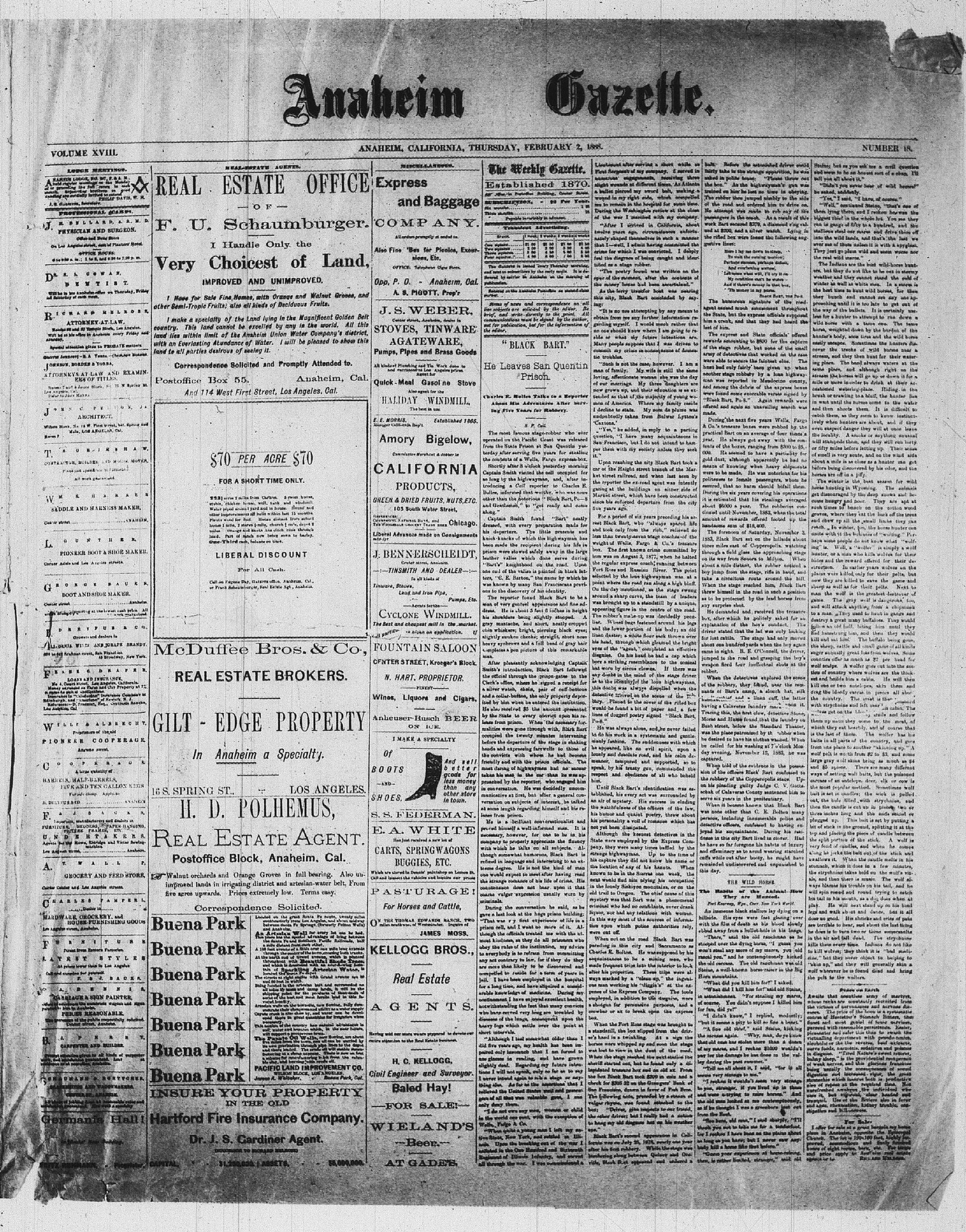
Searchable text
VOLUME XVIII.
LONG MEETINGS.
HARKIN LODGE, NO. 97, P.A. N.
hold regular meetings on the Monday of every month in each county in such manner as may be necessary by ordinance.
PHILIP DAVIS, W. M.
J. R. GARREY, BURGARY.
PROFESSIONAL CAMPS.
J. R. DELLAIRD, A.B. M. D.
PHYSICIAN AND SURGEON.
Office and Drink Store
On Los Angeles street, near of Plantery Hotel.
OFFICE HOURS:
6 to 8 p.m.; 1 to 5, and 6:30 to 7:20 p.m.
DR. E. L. COWAN,
DENTIST.
Will be in his Anaheim office on Thursday, Friday and Saturday of each week.
RICHARD MELROSE,
ATTORNEY-AT-LAW.
Room 90 and 91 Temple Blvd., Los Angeles.
Will be at his office in Anaheim every Friday and Saturday.
Special attention given to PROBATE matters.
QUERRE JENNESEN]—R.A. Yonka—(Pamela Bonanza)
JOHNSON, BORDER & TORRA,
ATTORNEYS AT LAW AND EXAMINERS OF TITLES.
Noams Trust & Justice Block, No. 12 N Spring St., Los Angeles, Cal.
Dale to Jack Hayra
JOHN C. PEITON, JA
ARCHITECT.
Wilson Block, No. 14 W First Street, Hat, Spring and Main, Los Angeles, Cal.
T. R. ORIMBHAW.
REAL ESTATE AGENT.
REAL ESTATE OFFICE
OF
F. U. Schaumburgen
I Handle Only the
Very Choicest of Land
IMPROVED AND UNIMPROVED.
I Make for Sale Fine Homes, with Orange and Walnut Groves, or other Semi-Tropic Fruits; also all kinds of Deciduous Fruits.
I make a specialty of the Land lying in the Magnificent Golden Bowl country. This land cannot be excelled by any in the world. All the land lies within limit of the Anaheim Union Water Company's district with an Everlasting Abundance of Water. I will be pleased to show the land to all parties desirous of seeing it.
Correspondence Sollicited and Promptly Attended to.
Postoffice Box 55.
Anaheim, Ca
And 114 West First Street, Los Angeles, Cal.
$70 PER ACRE $70
$70 PER ACRE $70
FOR A SHORT TIME ONLY.
23 acres 2 miles from Carlton. A room house,
stable, chicken house, well, tank and windmill.
Waker piled around yard and in house. House and
other improvements all built within last 15 months.
Pleasant wood for fuel. House distant from school
house 1 mile, 2 stories 4-mile, church 1 mile, depot 2
miles. Orange and Santa Ana ditch runs through
land. Part of munch now being sown to barley.
One-Third cash, balance on time.
LIBERAL DISCOUNT
For All Cash.
Call on Eugene Day, Gazette office, Anaheim, Cal.
or Frank Sebaumburger, Real Estate Agent, Anaheim.
McDuffee Bros. & Co.
REAL ESTATE BROKERS.
GILT - EDGE PROPERTY
In Anaheim a Specialty.
16 S. SPRING ST... LOS ANGELES
H. D. POLHEMUS,
REAL ESTATE AGENT
Postoffice Block, Anaheim, Cal.
H. D. POLHEMUS,
REAL ESTATE AGENT
Postoffice Block, Anaheim, Cal.
Walnut orchards and Orange Groves in full bearing. Also unimproved lands in irrigating district and artesian-water belt. From five acres upwards. Prices extremely low. Terms easy.
Correspondence Solicited.
Buena Park
Buena Park
Buena Park
Buena Park
Buena Park
Buena Park
INSURE YOUR PROPERTY IN THE OLD
Hartford Fire Insurance Company
Dr. J. S. Cardiner Agent.
ANAHEIM, CALIFORNIA, THURSDAY, FEBRUARY 2, 1868.
OFFICE
Hamburger.
of Land,
IMPROVED.
ange and Walnut Groves, and
eciduous Fruits.
in the Magnificent Golden Belt
any in the world. All this
in Water Company's district,
will be pleased to show this
promptly Attended to.
Anaheim, Cal.
Los Angeles, Cal.
MISCELLANEOUS.
Express
and Baggage
COMPANY.
All orders promptly at midday to.
Also Fine 'Bes for Picnics, Excursions, Etc.
OFFICE: Telephone Cigna Store.
Opp, P. O. - Anaheim, Cal.
A. S. PIGOTT, Prep'r
J.S.WEBER,
Center street, Anaheim, demies in
STOVES, TINWARE
AGATEWARE,
Pumps, Plpes and Brass Goods
All kinds of Plumbing and Tin Work done to
and warranted at Low Angeles prices.
Agent for
Quick-Meal Gasoline Stove
Also agent for the
HALIDAY WINDMILL.
The best in use.
E.E.MORRIS.
Manager California Day't
Amory Bigelow,
Commission Merchant & Jobber in
The Weekly Gazette.
Established 1870.
Transient Advertising.
Brick.
I week I weeks I weeks I weeks
One square:
$1.00 $1.50 $2.00 $2.50
Two square:
2.00 3.00 3.50 4.00
Three square:
4.00 4.50 5.00 5.50
Four square:
4.00 4.50 5.00 5.50
The Gazette is issued every Thurday morning,
and sent to subscribers by the early mail. It is delivered by environ in Anaheim on the morning of publication.
Entered at the Anaheim Postoffice as innermost district matter.
News of news and correspondence on all line subjects are solicited by the editor. Be brief, and write directly to the point. All communications must be signed by the author, not for publication, but for the information of the editor.
"BLACK BART."
He Leaves San Quentin Prison.
Charles E. Moller Talks to a Reporter
About His Adventures After serviing Five Years for Mobery.
S.P.Call.
The most famous stage-robber who ever operated on the Pacific Coast was released from the State Prison at San Quentin yesterday after serving five years for stealing the contents of a Wells Fargo express-box.
Limiment after serving a short whit First Surgement of my company. I am numerous engagements, receiving slight wounds at different times. At a bullet pierced my sword hull, my wound in my right side, which comes in remains in the hospital for some During the Washington review at the of the war I marched with my coor.
"After I arrived in California, twelve years ago, circumstances naturally shaped themselves in such a that I—well, I admit having committed crime for which I was convicted. I feel the diagrace of being caught and tiled as a stage rubber.
"The poetry found was written aper of the moment, after the contour the money boxes had been ascertaind As the ferry transfer host was at this city, Black Bart concluded by ing;
"It is no use attempting by any man obtain from me any further information garding myself. I would much rather an one should know where I am going aside or what my future intentions Many people suppose that I was driven commit my crime in consequence of a tie troubles.
"Such is not the case; however, I man of family. My wife is still the loving, affectionate woman she was the of our marriage. My three daughters now grown up, and their education is tended as that of the majority of your men of America. Where my family decline to state. My nom de plum undpubtedly taken from Balwer Ly Caxtona."
"Yes," he added, in reply to a question, "I have many acquaintances San Francisco, but I do not intend to per them with my society unless they it."
He Leaves San Quentin Prison
Charles E. Moller Talks to a Reporter About His Adventures After Serving Five Years for Mobbery.
S. P. Call
The most famous stage-robber who ever operated on the Pacific Coast was released from the State Prison at San Quentin yesterday after serving five years for stealing the contents of a Walla, Fargo express-box.
Shortly after 8 o'clock yesterday morning Captain Smith visited the cell occupied for so long by the highwayman, and, after introducing a Call reporter to Charles E. Bolles, informed that worthy, who was none other than the notorious "Black Bart, Po-8 and Gentlemen," to "get ready and come along."
Captain Smith found "Bart" neatly dressed, with every preparation made for his departure. The little presents and knick-knacks of which the highwayman has been made the recipient during his life in prison were stowed safely away in the large leather valise which done serve during "Bart's" knighthood on the road. Upon one end of the valise is painted in black letters, "C. E. Barton," the name by which he was known by many San Franciscans previous to the discovery of his identity.
The reporter found Black Bart to be a man of very gentle appearance and fine address. He is about 5 feet 6 inches in height his shoulders being slightly stooped. A gray mustache, and short, nearly cropped chin whiskers; bright, piercing black eyes; slightly sauken cheeks; straight, short nose heavy eyebrows and a full head of gray hair completes a pen picture of this remarkable man.
After pleasantly acknowledging Captain Smith's introduction, Black Bart followed the official through the prison-gates to the Clerk's office, where he signed a receipt for a silver watch, chain, pair of cuff buttons and a collar-belt, the only property deposited by him when he entered the institution. He also received $5 the amount presented by the State to every convict upon his release from prison. When the necessary formalities were gone through with Blark Bart occupied the twenty minutes intervening before the departure of the stage in shaking hands and expressing farewells to those of the convicts with whom he had become friendly and with the prison officials. The most daring of highwaymen had no sooner taken his seat in the car than he was approached by the reporter, who engaged him in conversation. He was decidedly uncommunicative at first, but after a general conversation on subjects of interest, he talked at some length regarding himself and his release from prison.
He is a brilliant conversationalist and proved himself a well-informed man. It is necessary, however, for one to be in his company to properly appreciate the fluency with which he talks on all subjects. Although somewhat humorous, Black Bart is refined in language and interesting to an extreme degree. He is not the kind of man "Smith is not the case; however, I man of family. My wife is still there loving, affectionate woman she was the father of our marriage. My three daughters now grown up, and their education is tended as that of the majority of young men of America. Where my family lives I decline to state. My son deplains undoubtedly taken from Balwer Ly 'Caxtons."
"Yes," he added, in reply to a question, "I have many acquaintances San Francisco, but I do not intend to per them with my society unless they it."
Upon reaching the city Black Bart car of the Haight street branch of the ket street railroad, and when last seen the reporter ex-road agent was in gazing at the buildings on either side Market street, which have been constricted since his enforced departure from the five years ago.
For a period of six years preceding rest Black Bart, who "always spared and took only from the rich," relieved less than twenty-seven stage coaches—weight of Wells, Fargo & Co.'s train box. The first known crime committed him was on August 3, 1877, when he was regular express coach running between Port Ross and Russian River. The selected by the lone highwayman was point where the road ran along a high road. On the day mentioned, as the stage of appearing figure in the centre of the robber's make-up was decidedly clear. Wheat bags fastened around his head and the lower portion of his body; a linen duster; a white flour sack thrown his head, through which gleamed the eyes of the "agent," completed an effusive dignified. On his head he had a cap bore a striking resemblance to the one worn by sirens clowns. If there any doubts in the mind of the stage owner to the identity of the lone highway this doubt was always dispelled when detective arrived on the scene of that bury. Planed to the cover of the riffle would be found a bit of paper and a lines of doggerel poetry signed "Black Bart."
He was always alone, and he never wanted to do his work in a systematic and generally fashion. The suddenness with which he appeared, like an evil spirit, upheld lonely and desolate road, and his call meantor, tempered and supported, speak, by his trusty gun, commanded respect and obedience of all who bury him.
Until Black Bart's identification was established, his every act was surrounded an air of mystery. His success in eliciting the watchfulness of the officers of the humour and quaint poetry, throw into his personality a veil of romanes which not yet been dissipated.
Although the keenest detectives in State were employed by the Express Company, they were many times baffled by strange highwayman. Up to the time his capture they did not know his name—the location of any of his haunts.
LOS ANGELES.
EMUS,
E AGENT.
aheim. Cal.
in full bearing. Also unand artesian-water belt. From
now. Terms easy.
Solicited.
gods for less money than any other store in town.
S. S. FEDERMAN.
E. A. WHITE
Has just received a new lot of
CARTS, SPRINGWAGONS
BUGGIES, ETC.
Which are stored in Denate' paintshop on Lemon St.
Call and inspect the vehicles and inquire our prices
PASTURAGE!
For Horses and Cattle,
ON THE THOMAS EDWARDS NANCH, TWO
miles southwest of Wentimakin. Inquire of
JAMES MOSS.
KELLOGG BROS.,
Real Estate
AGENTS.
Having sold our store we are prepared to devote our entire attention to the Real kite hummin.
H. C. KELLOGG,
Civil Engineer and Surveyor.
Baled Hay!
FOR SALE!
WIELAND'S
Been.
AT GADEB.
taken his mast in the ear than he was approached by the reporter, who engaged him in conversation. He was decidedly uncommunicative at first, but after a general conversation on subjects of interest, he talked at some length regarding himself and his release from prison.
He is a brilliant conversationalist and proved himself a well-informed man. It is necessary, however, for one to be in his company to properly appreciate the fluency with which he talks on all subjects. Although somewhat humorous, Black Bart is refined in language and interesting to an extreme degree. He is not the kind of man one would expect to meet after having read the strange romance of his life of crime. His countenance does not bear upon it that coarse vulger expression usually worn by criminals.
During the conversation he said, as he gave a last look at the huge prison building: "That was my first experience of life in a prison cell, and I want no more of it. Although the officials treated me with the utmost kindness, they do all prisoners who obey the rules of the institution, my advice to everybody is to refrain from committing any act contrary to law, for if they do they are more than likely to be discovered and compelled to reside for a term of years in jail. I have been employed in the hospital for a long time, and have acquired a considerable knowledge of medicine. During my confinement I have enjoyed excellent health, notwithstanding the fact that many convicts who have served very long are troubled by disease of the lungs, consequent upon the heavy fogs which settle over the point at short intervals."
Although I feel somewhat older than I did five years ago, my health has been impaired only insomniac that I am forced to use glamis in reading, and have grown slightly small. Regarding my future intentions I will not speak, only so far as to say I never intend again to rob a stage or anything else. As far as the questions that I relieved the United States mail and passengers of all that was valuable goes, I may only deny them.
"I do not own any man, woman or child in the world one suit, with the exception of Walle, Padge & Co."
When quite a young man I left my native State, New York, and settled in Illinois. Upon the breaking out of the war I enlisted in the One Hundredth and Sixteenth Regiment of Illinois Infantry, and served all through the war. I was commissioned a
Until Black Bart's identification was established, his every act was surrounded an air of mystery. His success in eliciting the watchfulness of the officers of the his humor and quaint poetry, threw his personality a veil of romances which not yet been dislipated.
Although the keenest detectives in State were employed by the Express Company, they were many times baffled by strange highwayman. Up to the time his capture they did not know his name; the location of any of his haunts. We known to be in the Stearns one week, next would find him plying his occupies in the lonely Siakiyon mountains, or on old road Oregon. The chief cause of mystery was that Bart was a phenomenal criminal who had no conflants, never dug liquor, nor had any relations with women. In this way most of the sources of information upon which police authorities were cut off.
When not on the road Black Bart parading in this city and Sacramento Charles E. Bolton. He was supposed to acquaintances to be a mining man, made frequent trips into the interior to after his properties. These trips were ways marked by a "clean-up," the ingress one man working his "diggin'" at the pense of the Express Company. The time employed, in addition to the disgivevie, was a shotgun for pervasive purposes, and crowbar or ax to break open the expo box.
When the Port Rose stage was brought a standstill, the box slipped from the door's hand in a twinkling. At a sign horn were whipped up and soon the door was lost to view in the dust of the room. When the stage reached the next station she shifted started out, but he found only a lapidated trumbrello box and an old ax. This box Black Bart took $200 in coin nai check for $252 on the Granger' Bank San Pascualion, drawn in favor of Paul R. The following note, presented by a stunned valuers rhyme, was found attached to box: "Driver, give respects to our friend; the other driver; but I really had no reason to hang my old diagnee hat on his wrist eyes."
Black Bart's annual appearance in O'Connor was on July 25, 1873, nearly one year after his first robbery. While the stage hung burning along between Quincy and ville, Black Bart appeared and unleashed
NUMBER 18.
A man after surviving a short while as Sergeant of my company, & arrived in various engagements, receiving three wounds at different times. At Atlanta he pierced my award belt, making a wound in my right side, which compelled him to remain in the hospital for some time. During the Washington review at the close of the war I marched with my company. After I arrived in California, about two years ago, circumstances unfavorably shaped themselves in such a manner that for which I was convicted, I disply the diagrace of being caught and identified as a stage rubber.
The poetry found was written on the of the moment, after the contents of money boxes had been ascortained." The ferry transfer host was nearing family, Black Bart concluded by saying it is no use attempting by any means to run from me any further information regarding myself. I would much rather that we should know where I am going to re-verify what my future intentions are. A people suppose that I was driven to commit my crime in consequence of domestic troubles.
Such is not the case; however, I am a member of family. My wife is still the same age, affectionate woman she was the day her marriage. My three daughters are grown up, and their education as ex-ample as that of the majority of young women of America. Where my family reside line to state. My nom de plume was abruptly taken from Bulwar Lytton's home."
He added, in reply to a parting question, "I have many acquaintances in Francisco, but I do not intend to hambam with my society unless they seek halts. Before the automated driver could fairly take in the strange apparition, he was nailed in polite tenons: "Please throw out the box." As the highwayman's gun was trained on him he lost no time in obeying. The robber then jumped slightly to the side of the road and ordered him to drive on. No attempt was made to rob any of the passengers in the coach. As a result of this work Bart secured $379, a diamond ring valued at $200, and a silver watch. Lying in the rifled box were found the following suggestive lines:
Here I lay me down to sleep,
To wait the coming mirror;
Perhaps museums, perhaps defenses,
And everlasting sorrow.
Let name what will, I'll try it on.
My condition can't be worse—
And if there's money in that box,
"The money in my purses."
Black Bart, The Po-8.
The humorous signature of the road agent caused much amusement throughout the State, but the express officials supposed him a crank, and that they had heard the last of him.
The express and State officials offered rewards amounting to $800 for the capture of the stage robber, but none of the small army of detectives that worked on the case were able to secure the faintest else. The hunt had only fairly been given up when another stage robber by a lone highwayman was reported in Mendocino county, and among the debris of the express boxes were found some execrable verses signed by "Black Bart, Po-8." Again rewards were offered and again an unavailing search was made.
During the next five years Wella, Fargo & Co.'s treasure boxes were robbed by the practical Bart on an average of four times a year. He always got away with the contents of the boxes, ranging from $300 to $500. He seemed to have a partiality for gold dust, although apparently he had no stains.
Stalney; but as you ask me a well question and seem to be an honest sort of a shap, I'll tell you all about it."
"Didn't you never bear of wild horsemal?" he asked suddenly.
"Yes," I said, "I have, of course."
"Well," continued Steine, "that's one of them lying there, and I reason he was the biggest thief in the whole lot. You see they run in gangs of fifty to a hundred, and the stallion steal our mares and drive them off into the wild lands, and that's...the last we ever see of them uncle it is with a spyglass. They just go plam wild and soon worse nor the real wild maras."
The Indians are the best wild-horse hunters, but they do not like to be out in stormy weather and they cannot stand the cold of winter as well as white men. In a storm is the best time to hunt wild horses, for then they bunch and cannot see any one approaching until it is too late to get out of the way of the bullets. It is certainly useless for a hunter to attempt to run down a wild horse with a tame one. The tame horse, weighted down by the burden of the hunter's body, soon tires and the wild horse easily escapes. Sometimes the hunters discover the tracks of wild horses near a stream, and they then hunt for their watering place. The band always watches at the same place, and although right on the stream the horses will go up or down it for a mile or more in order to drink at their customed watering-places. Hiding in the brush or crawling to a bluff, the hunter lies in wait until the horses come to the water and then shoots them. It is difficult to catch them, as they seem to know instinctively when hunters are about, and if they even suspect danger they will at once leave the locality. A smoke or anything unusual will stampede them, and they will run lorry or fifty miles before letting up. Their sense of smell is very acute, and on the wind side..."
on reaching the city Black Bart took a
the Haight street branch of the Marrrest railroad, and when last seen by
porter the ex-road agent was intently
at the buildings on either side of
street, which have been constructed
his enforced departure from the city
years ago.
a period of six years preceding his arBlack Bart, who "always spared life
look only from the rich," relieved no
noble twenty-seven stage coach—of the
bit of Wells, Fargo & Co.'s treasure
The first known crime committed by
was on August 3, 1877, when he halted
regular express coach, running between
Ross and Russian River. The point
by the loose highwayman was at a
where the road ran along a high bluff,
day mentioned, as the stage swung
a sharp curve, the team of leaders
brought up to a standstill by a uniqueing figure in the centre of the road.
Robber's make-up was decidedly pecuWheat bags fastened around his legs
the lower portion of his body; an old
daster; a white flour sack thrown over
head, through which gleamed the bright
of the "agent," completed an effective
case. On his head he had a cap which
is striking resemblance to the conical
corn by circus clowns. If there was
count in the mind of the stage driver
the identity of the loose highwayman,
robber was always dispelled when the
live arrived on the scene of the pub.
Pinned to the cover of the riled box
he found a bit of paper and a law
of doggerl poetry signed "Black Bart,
was always alone, and he never failed
his work in a systematic and gentle
fashion. The suddenness with which
spared, like an evil spirit, upon a
and desolate road, and his calm detempered and supported, so to
by his trusty gun, commanded the
st and obedience of all who behold
Black Bart's identification was essured, his every act was surrounded by
of mystery. His success in eluding
mischieffulness of the officers of the law,
amor and quaint poetry, threw about
personality a veil of romance which has
been dissipated.
though the keenest detectives in the
were employed by the Express Comthey were many times baffled by the
highwayman. Up to the time of
future they did not know his name or
notation of any of his haunts. When
During the next five years Wells, Fargo &
Co.'s treasure boxes were robbed by the practical Bart on an average of four times a year. He always got away with the contents of the boxes, ranging from $300 to $5,
000. He seemed to have a partiality for gold dust, although apparently he had no means of knowing when heavy shipments were to be made. He was notorious for his politeness to female passengers, whom he assured, that no harm should belfall them. During the six years covering his operations it is estimated that his stealings averaged about $6000 a year. The rubberies continued until November, 1883, when the total amount of rewards offered footed up the handsome sum of $18,400.
The foremoon of Saturday, November 3,
1883, Black Bart sat on the hillside about three miles east of Copperopolis, watching through a field glass approaching stage on its way from Sonora to Milton. When about a mile distant, the robber noticed a boy jump from the stage, rifle in hand, and take a circuitous route around the hill. When the stage reached him, Black Bart threw himself in the road in such a position as to be protected by the lead horses from any surprise shot.
He demanded and received the treasure box, after which he politely asked for an explanation of the boy's conduct. The driver stated that the lad was only looking for lost cattle. The stage had only moved about one hundred yards when the boy again came in sight. R.E.O'Connell, the driver, jumped to the road and grasping the boy's weapon fired four ineffectual shots at the robber.
When the detectives explored the scene of the robbery, they found near the remnants of Bart's camp, a slough hat, silk handkerchief and a linen cuff, the latter having a Calaveras laundry mark on it. Tracing this, the first claw, detective Stone, Morse and Hume found that the laundry on Bush street, below the Standard Theater, was the place patronized by the robber when he desired to have his clothes washed. When he called for his washing at 7 o'clock Monday evening, November 12, 1883, he was captured.
When told of the evidence in the possession of the officers Black Bart confessed to the robbery of the Copperopolis stage. Upon his pleading guilty Judge C.V.Gottschak of Calaveras County sentenced him to serve six years in the penitentiary.
When it became known that Black Bart was none other than C.K.Bolton many people, including innumerable police and detective officers, confessed to having enjoyed his acquaintance. During his residence in this city Bart lived in clover. Had he have so far foregone his habits of luxury and effeminacy as to avoid wearing starched cuffs while out after booty, he might have remained undiscovered and unpunished to this day.
The hand always watches at the same place, and although right on the stream the horses will go up or down it for a mile or more in order to drink at their accustomed watering-place. Hiding in the brush or crawling in a bluff, the hunter lies in wait until the horses come to the water and then shoots them. It is difficult to catch them, as they seem to know instinctively when hunters are about, and if they even suspect danger they will at once leave the locality. A smoke or anything unusual will stampede them, and they will run forty or fifty miles before letting up. Their sense of smell is very acute, and on the wind side about a mile is as close as a hunter can get before being discovered by his odor, and the horses are off in a jiffy.
The winter is the best season for wild horse hunting in Wyoming. The animals get discouraged by the deep snows and become hungry and poor. They are apt at such times to bunch on the cotton wood groves, where they eat the bark off the trees and chew up all the small limbs they can reach. In winter, ten of the horse hunter can unite with 97 business of "wolfing." Perhaps some people do not know what "wolfing" is. Well, a "wolver" is simply a wolf hunter, or a man who kills wolves for their hides and the reward offered for their destruction. In earlier years wolves on the plains were killed only for their pelts, but now they are killed to save the game and sleep as well as for their pelts. Next to man the wolf is the greatest destroyer of game. The gray wolf is dangerous too, and will attack anything from a chipmunk to a man. They used to hunt in gangs and destroy a great many buffaloes. They would follow an old bull, biting him until they had hamstring him, and then they would kill and eat him. The buffalo being gone, the sheep, cattle and small game of all kinds anger annually great loss from wolves. Some counties offer as much as $2 per head for wolf scalpe. A wolver goes out into the section of country where wolves are the thickest and builds him a cabin. He will then kill one or two antelope, skin them and drag the bloody carcass in pieces all about the country. The meat is then poisoned with atrychnine and left near its cabin. The wolves get on the blood trail and follow them up natch they come to the meat, of which they eat heartily, and of course that is last of them. The wolver has his hails in all parts of the country, and goes from one place to another "skimming up." A wolf pelt is worth from $2 to $3, and some large gray wolf skins bring as much as $4 and $5 apiece. There are many different ways of setting wolf haits, but the poisoned carcase of an antelope, deer, elk or cow is the most popular method. Sometimes wolf bait is set in candles; the wick is pulled out; the bule filled with atrychnine; and then the candle is cut up in pieces two or three inches long and ends sawn or plugged up. This bait is set by putting a bit of stick in the ground, splitting it at the top and placing the piece of candle between the split portion of the stick. A wolf is very fond of candles; and when he comes along he joinks it bait out of the stick and awaits it. When the candle melts in his stomach, which it does in a few minutes,
---
Black Bart's identification was ensured, his every act was surrounded by the mystery. His success in eluding the watchfulness of the officers of the law, morals and quaint poetry, threw about personality a veil of romance which has been dissipated.
Though the keenest detectives in the were employed by the Express Company they were many times baffled by the highwayman. Up to the time of nature they did not know his name oration of any of his haunts. When to be in the Siarra one week, he would find him plying his occupation lonely Siskiyou mountains, or on the trail to Oregon. The chief cause of this may was that Bart was a phenomenal man who had no consiliants, never drank nor had any relations with women. Way most of the sources of information which police authorities rely, sat off.
Not on the road Black Bart was lying in this city and Sacramento as K. Bolton. He was supposed by his instances to be a mining man, who frequent trips into the interior to look at property. These trips were all marked by a "clean-up" at the exit of the Express Company. The tools used, in addition to this disguise, were used for pervasive purposes, and a car or ax to break open the express.
In the Fort Ross stage was brought to still, the box slipped from the drizzle in a twinkling. At a sign the warehipped up and soon the stage is view in the dust of the road. The stage reached the next station the started out, but he found only a diagonal treasure box and no ax. From Black Bart took $300 in coin and a $200 22 on the Grangers' Bank of finance, drawn in favor of Pash Brom. Now long note, presumed by a stammer of Siskiyou, was found attached to the "Driver," give requests to our friend, ever driver; but I really had a notion my old diagrams had on his weather.
Black Bart's second appearance in California on July 25, 1876, nearly one year after robbery. While the stage was going along between Quincy and Orlando first appeared and ordered a robbery of the Copperopolis stage. Upon his pleading guilty Judge C. V. Gottaack of Calaveras County sentenced him to serve six years in the penitentiary.
When it became known that Black Bart was none other than C. E. Bolton many people, including innumerable police and detective officers, confessed to having enjoyed his acquaintance. During his residence in this city Bart lived in clover. Had he have so far foregone his habit of luxury and effeminacy as to avoid wearing starched cuffs while out after booty, he might have remained undiscovered and unpinned to this day.
THE WILD HORSE
The Habits of the Animal How They are Munted.
Fort Knanney, Wyoming, Corr. New York World.
An immense black stallion lay dying on a hillside. His eyes were fast glazing over with the film of death as his blood slowly ebased away from a bullet-hole in his lungs.
"There," said the old ranchman as he stooped over the dying horse, "I guess you won't aim any more of my mares, you old racal you," and he contemptuously kicked the old carman. The old ranchman was old Steine, a well-known horse-raiser in the Big Horn mountains.
"What did you kill him for?" I asked.
"What did I kill him for?" said old Steine, in astonishment. "For stealing my mares, of course. You didn't suppose I killed him for fun, did yet."
"I didn't know," I replied, modestly; "but it seems a pity to kill so fine a beast."
"A fine old thief," said Steine, kicking the carman again.
"Why, man, do ye know that old cam has stolen more than a down of my mares, and I reckon $1000 wouldn't pay for the damage he has done in the valley during the past summer."
"Tell me all about it, I said," for it all seems very strange to me."
"I reckon it would seem very strange to you, stranger, if you lived up in them and were a trying to raise her." And the old man looked at me contemplatively, as if he thought I was a greenhorn just out from the back.
"See here, old man," I said sharply, "Till thank you not to take me for a tenderfoot, for I sutheme I have been on the plains about as long as you have; but I never saw anybody hill a home like that before."
"Guess your experience at house-rushing, then, is rather limited...strange," said old way of setting wall hats, but the poisoned carcase of an antelope deer, elk or cow is the most popular method. Sometimes wolf bait is set in candles; the wick is pulled out; the hole filled with strychnine, and then the candle is cut up in pieces two or three inches long and the endsmailed or plugged up. This bait is set by putting a bit of stick in the ground, splitting it at the top and placing the piece of candle between the split portion of the stick. A wolf is very fond of candles, and when he comes along he jerks the bait out of the stick and awaits it. When the candle melts in his stomach, which it does in a few minutes, the strychnine takes hold on the wolf's viature, and then there is music. The wolf always blames his trouble on his tail, and he will spin round and round trying to catch his tail in his mouth, as a dog does when at play. He will next stand up on his hand legs and walk about and dance, but it all does no good. His shrieks and cries of pain are terrible to hear, and about the last thing he does is to turn two or three somersaults in the air and fall dead. The strychnine kills them every time. Indiana do not like to kill wolves; they think it is "bad medicine," but they never object to helping to "skin up," and they will generally skin a wolf wherever he is found dead and bring the pelt to the wolfers.
Penny on Earth
Awaits that mountaineer army of martyrs whose ranks are constantly recruited from the victims of nervousness and nervous diseases. The price of the boon is a systematic course of Hesutter's Stomach Bitters, the finest and most genial of tense marines, pursued with reasonable persistence. Easter pleasantater and safer this than to awaken the victualling department with pseudo-tomics alcoholic or the reverse, beef extracts nerve foods, narrows, advenient and prince in dingoing. Tired Nature's adventurer balmy sleep," in the providential reunion of weak nerves and this glorious franchise being usually the consequence of sound digestion and increased vigor, the great stomach which insures both is productive also of repose at the required time. Not unrarestained awakening, the individual who uses it, but vigorous clear handed and tranquil. Use of the Betters also in fever and ague, rhinotension, kidney trouble, conjugation and kill-unseen.
Fear Make
I offer for sale at a great bargain my house place in Anahadia, opposite the Episcopal Church. The lot is 120x100 feet, highly improved, accommodates and finally finished houses of eight rooms, turn one. For terms and price apply for Auction else and entitle against or to:
RECEIVE MR. REME