anaheim-gazette 1887-09-29
Scanned page
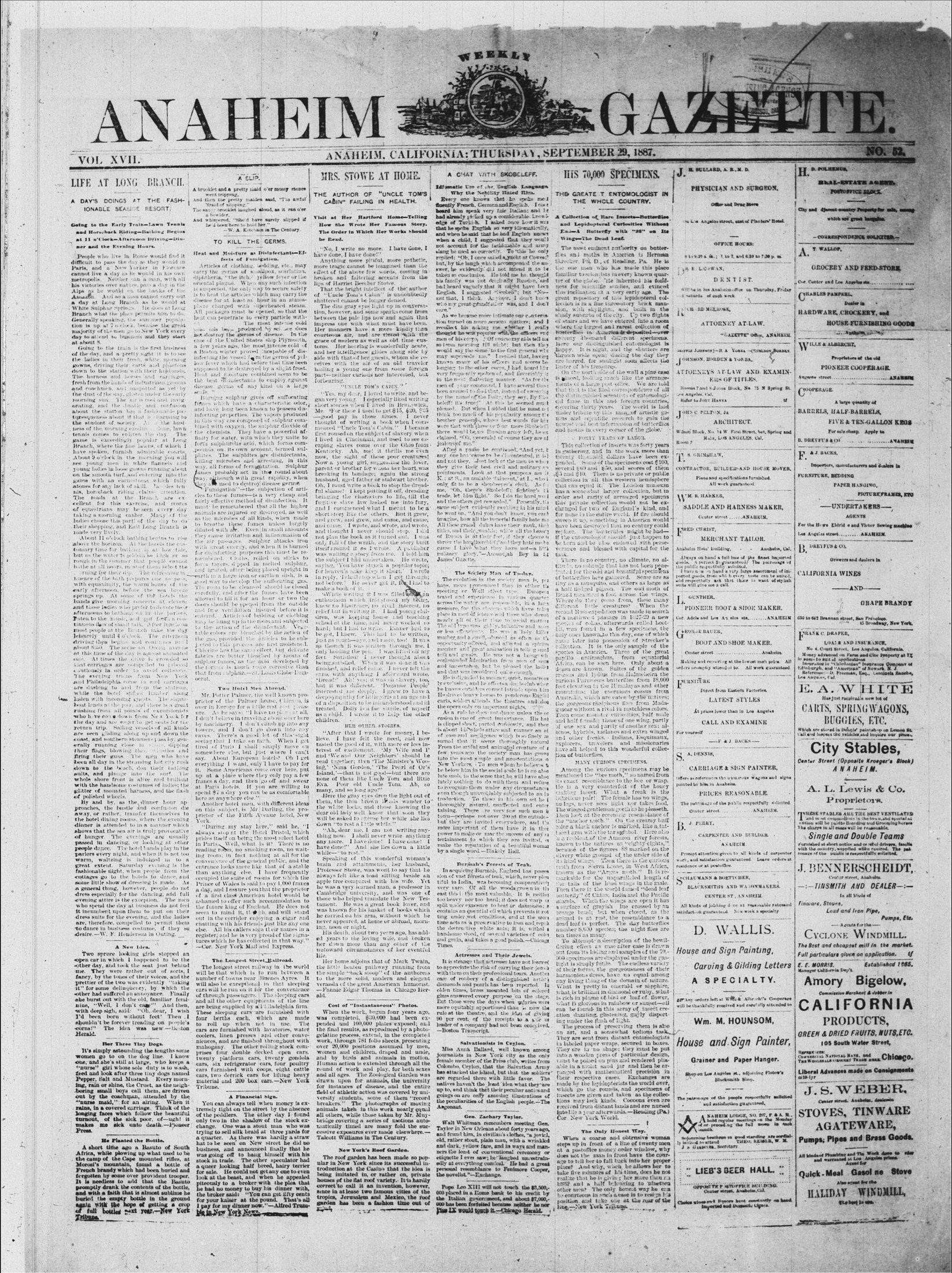
Searchable text
LIFE AT LONG BRANCH.
A DAY'S DOINGS AT THE FASHIONABLE SEASIDE RESORT.
Going to the Early Train—Lawn Tennis and Horseback Riding—Bathing Begins at 11 o'Clock—Afternoon Driving—Dinner and the Evening Hours.
People who live in Rome would find it difficult to pass the day as they would in Paris, and a New Yorker in Florence cannot live a day as he would in his own metropolis. Neither can a man, with all his victories over nature, pass a day in the Alps as he would on the banks of the Amazon. And so a man cannot carry out a day at Long Branch as he would at White Sulphur Springs. He does at Long Branch what the place permits him to do. Generally speaking, the summer population is up at 7 o'clock, because the great majority of the men go to New York every day to attend to business and they start at about 8.
Going to the train is the first business of the day, and a pretty sight it is to see the ladies in their fresh, white morning gowns, driving their carts and plowstones down to the station with their husbands. The harness and horses and carriages, fresh from the hands of industrious grooms and coachmen, and unspotted as yet by the dust of the day, glisten under the early morning sun. The air is cool and invigorating, and the daintie and confusion about the station has a fashionable picturesqueness about it that is charming to the student of society. At the business of the morning exodus alone, lawn tennis comes to enliven the day. The game is exceedingly popular at Long Branch, where the fine lawns, of which I have spoken, furnish admirable courts. About 9 o'clock in the morning you will see young men in white flannels and young ladies in loose gowns running about on the smooth turf and entering into the
A CLIP.
A brooklet and a pretty maid o'er mossy stones went tripping.
And then the pretty maiden said, "I'm awful Yraud of slipping."
The same brooklet laughed aloud, as it ran o'er a bowler.
And whispered, "She'd have surely slipped if he had been here to hold her."
W. A. Ketean in The Century.
TO KILL THE GERMS.
Heat and Moisture as Disinfectants—Effects of Fumigation.
Articles of clothing, bedding, etc., may carry the germs of smallpox, scarlatina, diptheria, "the itch," yellow fever or the oriental plague. When any such infection is suspected, the only way to secure safety is to heat the articles which may carry the disease for at least an hour in an atmosphere charged with superheated steam. All packages must be opened, so that the heat can penetrate to every particle with The most intense cold coat has been produced by science does not destroy the germs of disease. In the case of the United States ship Plymouth, a few years ago, the most intense cold of a Boston winter proved incapable of disinfecting the vessel from the germs of yellow fever which had before that time been supposed to be destroyed by a slight frost. Heat and moisture combined seem to be the best disinfectants to employ against disease germs of any kind on a large scale.
Burning sulphur gives off suffocating fumes which have a characteristic odor, and have long been known to possess disinfecting properties. The vapors produced in this way are composed of sulphur combined with oxygen, the sulphur dioxide of the chemists. They have a powerful affinity for water, with which they unite to form sulphurous acid, which forms compounds on its own account, termed sulphites. The sulphites are disinfectants, killing microbes and arresting, in this way, all forms of fermentation. Sulphur fumes probably act in the round about
The harness and horses and carriages fresh from the hands of industrious groomers and coachmen, and unpotted as yet by the dust of the sky, glisten under the early morning sun. The air is cool and invigorating, and the bustle and confusion about the station has a fashionable picturesqueness about it that is learning to the student of society. At the business of the morning exodus alone, lawn tennis comes to enlighten the day. The game is exceedingly popular at Long Branch, where the fine lawns, of which I have spoken, furnish admirable courts. About 9 o'clock in the morning you will see young men in white flannels and young ladies in loose gowns running about on the smooth turf, and entering into the game with an earnestness which fully atones for any lack of skill. Besides tennis, horseback riding claims attention. The roads at the Branch are excellent for this exercise, and scores of equestrians may be seen every day taking a morning canter. Many of the ladies choose this part of the day to do their shopping, and East Long Branch is made very lively.
About 11 o'clock bathing begins to rise above the horizon. At the hotels the customary time for bathing is at low tide, but as the water is gelbish so high or so rough in the summer that people cannot bathe at all hours, most of them select the room for their dip. The refreshing influence of the bath prepares one to pass with equanimity, the warm hours of the early afternoon, before the son breeze springs up. At some of the hotels the bands give morning concerts at eleven and those ladies who prefer to devote their afternoons to bathing set in the parlor. Taken to the mash, and got feet a continuous flow of smalt talk. After lunch on most people at the Branch take the day leisurely until 4 o'clock. The afternoon driving then begins and continues in 1 about 6:00. The scene on Oceano avenue at this time of the day is almost animated one. At times the drive is crowded so that carriages are compelled to proceed cautiously in order to avoid collisions. The evening trains from New York and Philadelphia come in and carriages are dashing to and from the stations, while the hotel staffs linger along haden with incoming ghosts. The signboard lands at the pier, and there is a great rushing from all points of excursionists who have come down from New York for the day and are eager to get seats for the return trip. Sailing vessels of all kinds are seen gliding along up and down the coast, and southern steamers pass by, generally running close inshore, dipping their flags, blowing their whistles and firing their guns. The men who have been all day in the steaming hot city rush down to the beach, don their bathing suits, and plunge into the surf. The whole shore front is alive and brilliant with the handsome costumes of ladies the glitter of mounted harness, and the flash of polished wheels.
By and by, as the dinner hour approaches, the bustle and confusion die away, or rather, transfer themselves to the hotel dining rooms, where the evening dinner is attended to in a manner which shows that the sea air is truly provocative of hunger. The evenings are usually passed in dancing, or looking at other people dance. The hotel bands play in the parlors every night, and when it is not too warm, waltzing is indulged in to a great extent. Saturday evening is the fashionable night, when people from the cottages go to the hotels to dance, and some little show of dressing is made. As a general thing, however, people do not dress especially for the dancing, and full evening attire is the attraction. The heat and moisture combined seem to be the best infectants to employ against disease germs of any kind on a large scale.
Burning sulphur gives off suffocating fumes which have a characteristic color, and have long been known to possess disinfecting properties. The vapors produced in this way are composed of sulphur combined with oxygen, the sulphur dioxide of the chemists. They have a powerful affinity for water, with which they unite to form sulphurous acid, which forms compounds on its own account, termed sulphites. The sulphites are disinfectants, killing microbes and arresting, in this way, all forms of fermentation. Sulphur fumes probably act in the round about way, although with great rapidity, when they are used to destroy disease germs.
"Fumigation"—the subjection of articles to these fumes—is a very cheap and fairly effective method of disinfection. It must be remembered that all the higher animals are injured or destroyed, as well as the microbes of all kinds, when made to breathe these fumes unless largely diluted with air. Even in small amounts they cause irritation and inflammation of the air passages. Sulphur attacks iron with great energy, and when it is burned for disinfecting purposes this must be remembered. Clothes, rolled on sticks to form tapers, dipped in melted sulphur, and ignited after being placed upright in earth in a large iron or earthen dish, is a good way to develop the sulfocating gas. The room to be cleansed should be closed carefully, and after the fumes have been allowed to fill it for an hour or two the doors should be opened from the outside and free ventilation insured before it is entered. Articles of bedding or clothing may be brought up in the room and subjected to the action of the disinfectant. Vegetable colors are blended by the action of the gas provided; the articles to be subjected to this process are first moistened. Chlorine has the same effect, but delicate fabrics are better blended by means of sulphur fumes; as the acid developed by the former is much more corrosive than that from sulphur.-St. Louis Globe-Democrat.
Two Hotel Men Abroad.
Mr. Potter Palmer, the well-known proprietor of the Palmer house, Chicago, is over in Europe for a little rest and pleasure. As he says: "I have no plan at all. I don't believe in travelling about over here by machinery. I don't climb up into any towers, and I don't go down into any caves. There's a good lot of this sight seeing that I take on faith. When I get tired of Paris I shall simply move on somewhere else, but just where I can't say. About European hotels? Oh I get everything I want, only I have to pay for it. Some Americans come over here, put up at a place where they only pay a few frames a day, and then go off and swear at Paris hotels. If you are willing to spend $7 a day you can be as comfortable here as anywhere else."
Another hotel man, with different ideas on this subject, is Mr Darling, the proprietor of the Fifth Avenue hotel, New York.
"During my stay here," said he, "I always stop at the Hotel Bristol, which prides itself on being the most select hotel in Paris. Well, what is it? There is no reading room; no smoking room; no waiting room; in fact nothing at all for the convenience of the general public, and the entrance looks more like that of a stable than anything else. I have frequently occupied the suite of rooms for which the Prince of Wales is said to pay 1,000 frames a day, and I assure you that the proprietor of a first class American hotel would be part—neither coarse nor bearing."
"Yes, my dear man very young short stories with Me. For these thought of what me meant "Uncle first roused on me! I lived in Cinema caping skirts Kentucky. All now, the sight Now a young parent or brothel breaking in both husband age Oh! I must write ful shame! I bringing the fugitive slave and I commend short story like and greedy and came I wish for heaven's sake in reply! I shall not before! But make a book of
"While writent enthusiasm was knew no finnery relief but in warden was keen school at the hard; but I had be got; I knew just as much—as though it only holdingthe fact Satisfied being satisfied finished,and re same with Dread!" Ah! but it was disinterested man deep sympathy of a disposition treated.Dollies as a child.I children.
"After that lieve. I have tasted the good terest of excitement and 'We and we read together ing.' Nina Gail island."—that none of them Eva.Poor or many,and so many.Here she grew them,the third white locde dear old lady will be asked down "to rest"
"Ah,dear thing now.I am any more.I have done!"Speaking of brain and Professor Stow always felt like apple tree coming he was a very Cambridge unthose who help
By and by, as the dinner hour approaches, the bustle and confusion die away, or rather, transfer themselves to the hotel dining rooms, where the evening dinner is attended to in a manner which shows that the sea air is truly provocative of hunger. The evenings are usually passed in dancing, or looking at other people dance. The hotel bands play in the parlors every night, and when it is not too warm, waltzing is indulged in to a great extent. Saturday evening is the fashionable night, when people from the cottages go to the hotels to dance, and some little show of dressing is made. As a general thing, however, people do not dress especially for the dancing, and full evening attire is the exception. The men who spend the day at business do not feel it incumbent upon them to put on their dress suits for the evening, and the ladies are, therefore, compelled to permit them to dance in business costume, if they so desire.—W. F. Henderson in Outing.
A New Idea.
Two spruce-looking girls stopped an open car in which I happened to be the other day, and took the seat just behind me. They were rather out of sorts, I fancy, by the tones of their voices, and the prettier of the two was evidently "taking it" for some delinquency, by which the other had suffered an annoyance. Finally she burst out with the old familiar fenilnine, "Well, I don't care!" And then, with deep sigh, said: "Oh, dear, I wish I'd been born without feet' Then I shouldn't be forever treading on people's corns!" The idea was new—Boston Herald.
Her Three Tiny Dogs.
It's simply astounding the lengths some women go to on the dog line. I know one, and she's still at large, who keeps a "nurse" girl whose sole duty is to wash, feed and look after three tiny dogs named Pepper, Salt and Mustard. Every morning, rain or shine, the Cruet, as the neighboring small boys call them, are driven out by the coachman, attended by the "nurse maid," for an airing. When it rains, in a covered carriage. Think of the longing faces which follow the beautiful turnout, of the sick poor, of—ugh! it makes me sick unto death.—Pioneer Press.
He Planted the Bottle.
A short time ago a Basuto of South Africa, while plowing up what used to be the camp of the Cape mounted rifles, at Morosii's mountain, found a bottle of French brandy which had been buried and forgotten by some over provident trooper. It is needless to add that the Basuto promptly drank the contents of the bottle, and with a faith that is almost sublime he buried the empty bottle in the ground again with the hope of getting a crop of full bottles next year.—New York Tribune.
The Longest Street Railroad.
The longest street railway in the world will be that which is to run between a number of towns near Buenos Ayres. It will also be exceptional in that sleeping cars will be run on it for the convenience of through passengers. The sleeping cars and all the other equipments of the line are being supplied by a Philadelphia firm. These sleeping cars are furnished with four berths each, which are made to roll up when not in use. The cars are furnished with lavatories, water coolers, linen presses and other conveniences, and are finished throughout with mahogany. The other rolling stock comprises four double decked open cars. twenty platform cars, twenty gondola cars, six refrigerator cars, four poultry cars furnished with coops, eight cattle cars, two derrick cars for lifting heavy material and 200 box cars.—New York Tribune.
A Financial Sign.
You can always tell when money is extremely tight on the street by the absence of the peddlers. The other day I found only two in the shadow of the stock exchange. One was a stout man who was trying to sell silk braid at three yards for a quarter. As there was hardly a straw hat to be seen on New street he did no business, and announced finally that he was going off to hang himself with his stock in trade. The other speculator had a queer looking half breed, hairy terrier for sale. He could not get any one to even look at the beast, and when he appealed piteously to a broker with the plea that he had no money to buy his dinner with, the broker said: "You can get fifty cents for your kaiser at the pound. That's all I pay for my dinner now."—Alfred Trumble in New York News.
Another hotel man, with different ideas on this subject, is Mr Darling, the proprietor of the Fifth Avenue hotel, New York.
"During my stay here," said he, "I always stop at the Hotel Bristol, which prides itself on being the most select hotel in Paris. Well, what is it? There is no reading room, no smoking room, no waiting room; in fact nothing at all for the convenience of the general public, and the entrance looks more like that of a stable than anything else. I have frequently occupied the suite of rooms for which the Prince of Wales is said to pay 1,000 francs a day, and I assure you that the proprietor of a first class American hotel would be ashamed to offer such accommodation to the future king of England. He does not seem to mind it, though, and will stand out in the corridor enjoying a cigar and chatting with his friends just like any one else. All his callers sign their names in a register, and he is very proud of the signatures which he has collected in that way."
—Cor. New York Mail and Express.
Cost of "I"
When the water was completely pended and hung on the final result gelatine process work, throughout over 20,000 women and children by birds Human action round of work and all ages. Drawn upon for instances field of athletic university breakers." The animals take all others, which bridge covering metically time-conscious exposure Talcott William.
New York
The roof garden in New York production at being imitated houses of the fashions correct to call since in at least tropics, Jerusalem garden has been...
WEEKLY GA
ANAHEIM, CALIFORNIA: THURSDAY, SEPTEMBER 29, 1887.
MRS. STOWE AT HOME.
THE AUTHOR OF "UNCLE TOM'S CABIN" FAILING IN HEALTH.
Visit at Her Hartford Home—Telling How She Wrote Her Famous Story. The Order in Which Her Works should be Read.
"No, I write no more. I have done, I have done."
Anything more plaintful, more pethetic, more tragic cannot be imagined than the effect of the above few words, coming in broken and faltering accents from the lips of Harriet Beecher Stowe.
That the bright intellect of the author of "Uncle Tom's Cabin" is undoubtedly shattered cannot be longer denied.
The dim gray eyes light up in conversation, however, and some sparks come from between the pale lips now and again that impress one with what must have been. Her manners have a more kindly than courteous air, and are tinted with the grace of modern as well as old time customs. Her hearing is wonderfully acute, and her intelligence glides along side by side with that of her guests, whom she receives with the air of an old traveler hailing a young one from some foreign part—neither curious nor interested, but forbearing.
"UNCLE TOM'S CABIN."
"Yes, my dear, I loved to write, and began very young. I especially liked writing short stories when I lived in Brunswick, Me. For these I used to get $15, $20, $25—good pay in those times. I never thought of writing a book when I commenced "Uncle Tom's Cabin." I became first roused on the subject of slavery when I lived in Cincinnati, and used to see escaping slaves come over the Ohio from Kentucky. Ah, me! it thrills me even now, the sight of those poor creatures! Now a young girl, suggesting the lover, parent or brother for whom her heart was breaking in bondage; again the strong
A CHAT WITH SKOBELEFF.
Idomatic Use of the English Language Why the Nobility Hated Him.
Every one knows that he spoke modifiably French, German and English. I must heard him speak very fair Italian; and he had already picked up a considerable knowledge of Turkish. I asked once how it was that he spoke English so very informatively, and when he said that he had English nurses when a child, I suggested that they would not account for the fashionable and army slang he used so correctly. To this he only replied: "Oh, I once sailed a yacht at Cowes; but, by the laugh which accompanied the answer, he evidently did not intend it to be taken as conclusive. He told me he thought his family was not originally Russian, and had heard vaguely that it might have been English. I suggested "Skobel"; but "Not that that, I think. Ayhow, I don't know who my great-grandfather was, and I don't care."
As we became more intimate our conversation turned on more serious matters; and I recollect his taking me whether I really thought he was popular with the officers and men of his company. "Of course my girls tell me so from morning till night; but then they would say the same to the first general who may supervise me." I replied that, having known many of his officers and scores be longing to the other corps, I had heard her very frequently spoken of, and livelyly in the most flattering manner. "As for the men of your command, I have several times been amused to find that, instead of swearing by the name of the Dolly, they say. By Skobel it's true!" At this he seemed much pleased. But when I added that he must not think too small of his popularity among the brother generals, whose best words for his wife that with those or four more Skobelts there would be no Russian army left, he claimed. "Oh, generally of course they are all jealous of me."
After a pause be continued; "And yet, any one has cause to be contented, it is and not they. Just look at the men to when they give their best civil and military pointments. Look at that pompous as it is."
HIS 70,000 SPECIMENS.
THE GREATEST ENTOMOLOGIST IN THE WHOLE COUNTRY.
A Collection of Hare Insects—Butterflies and Lepidoptera Curiosities Without End—A Butterfly with "88" on Its Wings—The Dead Leaf.
The most enlighten authority on butterflies and moths in America is Herman Skrocher, Ph.D., of Reading, Pa. He is the one man who has made this place familiar to scientists in every known quarter of the globe. He inherited his fondness for scientific studies, and evinced this inclination at a very early age. The great repository of this lepidopteral collection is in a fine three-story brick mansion, with skylights, and built in the sandy surrubbs of the city. Up two flights of stairs and we have entered into a room where the largest and rarest collection of butterflies in America is deposited—over twenty thousand different specimens. Here our distinguished entomologist is happy. It is night, and the shutters are thrown wide open during the day they are barred, for sunlight soon affects the lister of his treasures.
On the north side of the wall a pine case is placed, looking much like the arrangements of a large post office. We are told that this is the filed correspondence of all the distinguished scientists of entomological fame in this and foreign countries, covering thirty years. The world is laid under tribute by this man of artistic genius and scientific research to gain the newest and best information of butterflies and moths in every corner of the globe.
FORTY YEARS OF LAW.
This collection of insects was forty years in gathering, and in the work more than twenty thousand dollars have been expended. Some of the specimens cost $100, several $60 and $50, and scores of them $5 and $10. There is no private or public
UNCLE TOM'S CARIN.
Yes, my dear, I loved to write, and began very young. I especially liked writing short stories when I lived in Brunswick. Me. For these I used to get $15, $20, $25—good pay in those times. I never thought of writing a book when I commenced "Uncle Tom's Cabin." I became first roused on the subject of slavery when I lived in Cincinnati, and used to see escaping slaves come over the Ohio from Kentucky. Ah, me! it thrills me even now, the sight of those poor creatures! Now a young girl, suggesting the lover, parent or brother for whom her heart was breaking in bondage; again the strong husband, aged father or stalwart brother. Oh, I must write a book to stop the dreadful shame! I kept putting it off, dreading bringing the characters to life, till the fugitive slave law lashed me into fury, and I commenced what I meant to be a short story like the others. But it grew, and grew, and came, and came, I wrote, and wrote, and wrote, and thought I never should stop. I did not plan the book as it turned out. I was only full of the wrath, and the story built itself around it as I wrote. A publisher was waiting a story from me. I told him the subject I had undertaken. He wrote, saying, "You have struck a popular topic; for heaven's sake keep it short." I wrote in reply, "I shall stop when I get through; not before." He never got it, for I had to make a book of it.
While writing it I was filled with enthusiasm which试织了my being knew no limitation, no rival interest, no relief but in writing it. I had young children, was keeping house and teaching school at the time, and worked so hard; but I had to write. Dinner had to be got; I knew. This had to be written just as much—yes, more too! It was as though it was written through me. I only holding the pen. I was lifted off my feet. Satisfied! I never thought about being satisfied. When it was done it was finished, and relief came. I never felt the same with anything I afterward wrote. "Bread!" Ah yes; it was on slavery, too, but it was different. "Pogonian People" interested me deeply. I grew to have a deep sympathy for little girls at an age and of a disposition to be misunderstood and ill treated. Dolly is a face simple, of myself as a child. I wrote it to help the other children.
HER OTHER STORIES.
After that I wrote for money, I believe. I have felt the need, and now tasted the good of it, with more or less interest of excitement. My Wife and I and We and Our Neighbors' should be read together; then The Minister's Wooing, Nina Gordon,' The Pearl of Or's Island,' that is not good—but there are none of them like Uncle Tom and little Eva. Poor old Uncle Tom. Ah, so many, and so long ago!
Here the gray eyes drop the light out of them, the thin brown hands wander to the white locks, and those knowing the dear old lady well know that soon they will be asked to exercise her while she lies down "to rest a little while."
Ah, dear me, I am not writing anything now. I shall never write anything any more. I have done! I have done! And she lies down a little while—to rest.
Speaking of this wonderful woman's brain and attainments, her husband, Professor Stowe, was wont to say that he always felt like a toad sitting beside an apple tree compared with his wife. Yet he was a very learned man, a professor in Cambridge university, and was one of those who helped translate the New Testament.
UNCLE TOM'S CARIN.
Yes, my dear, I loved to write, and began very young. I especially liked writing short stories when I lived in Brunswick. Me. For these I used to get $15, $20, $25—good pay in those times. I never thought of writing a book when I commenced "Uncle Tom's Cabin." I became first roused on the subject of slavery when I lived in Cincinnati, and used to see escaping slaves come over the Ohio from Kentucky. Ah, me! it thrills me even now, the sight of those poor creatures! Now a young girl, suggesting the lover, parent or brother for whom her heart was breaking in bondage; again the strong husband, aged father or stalwart brother. Oh, I must write a book to stop the dreadful shame! I kept putting it off, dreading bringing the characters to life, till the fugitive slave law lashed me into fury, and I commenced what I meant to be a short story like the others. But it grew, and grew, and came, and came, I wrote, and wrote, and thought I never should stop. I did not plan the book as it turned out. I was only full of the wrath, and the story built itself around it as I wrote. A publisher was waiting a story from me. I told him the subject I had undertaken. He wrote, saying, "You have struck a popular topic; for heaven's sake keep it short." I wrote in reply, "I shall stop when I get through; not before." He never got it, for I had to make a book of it.
While writing it I was filled with enthusiasm which试织了my being knew no limitation, no rival interest, no relief but in writing it. I had young children, was keeping house and teaching school at the time, and worked so hard; but I had to write. Dinner had to be got; I knew. This had to be written just as much—yes, more too! It was as though it was written through me. I only holding the pen. I was lifted off my feet. Satisfied! I never thought about being satisfied. When it was done it was finished, and relief came. I never felt the same with anything I afterward wrote. "Bread!" Ah yes; it was on slavery, too, but it was different. "Pogonian People" interested me deeply. I grew to have a deep sympathy for little girls at an age and of a disposition to be misunderstood and ill treated. Dolly is a face simple, of myself as a child. I wrote it to help the other children.
He is dripped in manner; quiet; monstrously exclusive; and he offers a single club where he knows outsiders cannot intrude upon him. He drives heavy horses to ponderous English carts, seldom attends the剧院s and does the opera only on important nights.
As a rule he does not dance unless the ousion is one of great importance. His hat is clipped short; parted curiously; and they are about his whole attire and manner an alt of ease and negligence which is so finely as summed that it seems thoroughly natural From the artful and animated creature of few years ago the society man has grown into the most simple and unnoticed on New Yorkers.-To men whom he believes to be below him in the social scale he is an ablse lookie in the sense that he will have also lately nothing to do with them and refuse to recognize them under any circumstance even though unavoidably subjected to an instruction To these in his own set he is thoroughly natural; unaffected and enter tabling There re very few such men in town—perhaps not over 200 at the outside but they are invited everywhere,and the more important of them have it in their power to make or mar the success of any undertaking to which they are invited,make the reputation of a beautiful woman by a single word—Blakely Hall.
The Society Man of Today.
The evolution in the society man is petals more pronounced than in either sporting or Wall street type Europe travel and experience in various quarters across the water are responsible in a large measure for the change which have taken place in most of leisure and those who devote nearly all of their time to social matters The old types were gaily talented and not or less affectionate He was a lady killer member and a swell—dressed as often as the opportunity offered; and affected a spirite marker and great animation in telling talk and groove He was not a being who commanded admiration from men of sex and importance; but he pleased the ladies that was bourished quite enough.
He is dripped in manner; quiet; monstrously exclusive; and he offers a single club where he knows outsiders cannot intrude upon him He drives heavy horses to ponderous English carts,seldom attends the剧院s and does the opera only on important nights.
As a rule he does not dance unless the ousion is one of great importance.His hat is clipped short; parted curiously;and they are about his whole attire and manner an alt of ease and negligence which is so finely as summed that it seems thoroughly natural.From the artful and animated creature of few years ago the society man has grown into the most simple and unnoticed on New Yorkers.-To men whom he believes to be below him in the social scale he is an ablse lookie in the sense that he will have also lately nothing to do with them and refuse to recognize them under any circumstance even though unavoidably subjected to an instruction To these in his own set he is thoroughly natural; unaffected and enter tabling There re very few such men in town—perhaps not over 200 at the outside but they are invited everywhere,and the more important of them have it in their power to make or mar the success of any undertaking to which they are invited,make the reputation of a beautiful woman by a single word—Blakely Hall.
Burghah's Forests of Teak.
In acquiring Burghah England has possessed vast forests of teak which never planted in India was becoming comparatively rare. Of all the woods grown in the east this is the most valuable. It is neither important of them have it in their power to make or mar the success of any undertaking to which they are invited,make the reputation of a beautiful woman by a single word—Blakely Hall.
Forty Years of Labor.
This collection of insects was forty years in gathering,and in the work more than twenty thousand dollars have been expanded.Some of the specimens cost $100,several $90 and $50,and scores of them $51 and $10.The there is no private or public collection in all this western hemisphere that can equal it.The London museum has some somewhat larger collection,但in order and rarity of arranged specimens this private collection would not be exchanged for two of England's kind,and for none in the entire world.I fire should sweep it up,something in America would have been destroyed that no century could replace.The butterflies might be bad—if the caterpillar should just happen to be born and be also endowed with perseverance and blessed with capital for the task.
There is no country,no climate,nothing that has not been penetrated for the old and beautiful specimens of butterflies here gathered.Some are as tiny as a mousse,and others as large as half sized pigeon.The owl moth of Brazil measures a foot across the wings.Where do they come from,these many different little creatures?When the second Ross expedition was made in search of a northwest passage in 1827-29a new species of colias,afterwards called bootlegged,twas found in a few specimens,the only ones known to this day,一of which name later into possession of Strecker's collection。它是 only sample of the species in America.The three ofthe great papilio antirrhachus,从 equatorial Africa,can be seen here Only about a dozen are known.Suites ofthe golden crosses和 lydius from Halmcheirae curious Farmessus butterflies from 18,000 feet elevation inthe Himalayasand other mountains:the enormous cossus from Australiawhich are eaten bythe natives;the gorgeous rhizophelia flies from Madagascar without a rival in matchless colorsThen come monster ocelliities,half maleand half female;those of one wing,partlyof one sex and partlyof another sex:albums,hylbrids,melanosand extra wingedand other froeks.Inthe Indians Esquimauxexplorer,travelersand missionarieshave all helped to this wonderful collectionof butterflies.
Many Curious Specimens.
Amongthe curious specimens may be mentionedthe "bee moth,"so namedfrom its exact resemblancetothe bee or wasp.The winged gentleman goethitshe pleasesHen look atthe eccentric resemblanceofthe "anchor moth."Onthe creamy buffcolora black anchoris marked,如a tattooed armwiththe tar symbol.Here alsois residentofthe Amazon riverforests,knowntothenativesas"eighty-eights,"becauseofthefigures88markedonthesliverygroundoftheundersideofitshindwings.ThenthereiscurrantmothfromSierra Lone,在WestAfricaknownasthe"Argusmoth."ItisremarkablefortheunparalleledlengthofthetailsoftthehindwingsinthemaleThenthereisworldfamed"deadleafbutterfly"ofChinaIndiaandThePacific
the world between a Ayres. It kept sleeping convenience keeping cars of the line alpha firm. finished with are made use. Theories, water her convegehout with stock compen cars. by gondola our poultry eight cattle eating heavy New York money is exthe absence day I found the stock exien who was three yards for a straw he did no ill that he self with his reculator had dairy terrier one to even appealed the plea that inner with fifty cents That's all Alfred Trum-
New York's Roof Garden.
The roof garden has been made so popular in New York since its successful introduction at the Casino that the idea is being imitated in, or rather on, private houses of the flat roof variety. It is hardly correct to call it an invention, however, since in at lease two famous cities of the tropics, Jerusalem and Mexico, the roof garden has been a fashion time out of Jalapa,
Burnabah's Forests of Teak.
In acquiring Burnabah, England has possession of vast forests of teak, which never pleniful in India, was becoming comparatively very rare. Of all the woods grown in the east this is the most valuable. It is neither too heavy nor too hard; it does not warp or split under exposure to heat or damnness; it contains an essential oil which prevents it roting under wet conditions, and at the same time acts as a preservative to iron and repels destructive white ants; it is with a handsome wood, of several varieties of color and grain, and takes a good polish.—Chicago Times.
Actresses and Their Jewels.
It is strange that actresses have not learned to appreciate the risk of carrying their jewels with them on their professional tours. Another case of robbery of a distinguished artist diamonds and pearls has been reported. In old times, brass mounted bits of colored glass answered every purpose on the stage. But those were the days when galeries were more equitably proportioned than is now the rule at the theatre, and the idea of giving 90 per cent. of the receipts to a star or leader of a company had not been conceived.—Boston Transcript.
Salvationists in Ceylon.
Miss Anna Ballard, well known among journalists in New York city as the only female member of the Press club, writes from Colombo, Ceylon, that the Salvation Army has attacked the island, but that the soldiers are regarded there with little favor. The natives haven't the least idea what they are up to, and think that their peculiar anties and goings on are only amusing illustrations of the peculiarities of the English people.—The Angonaut.
Gen. Zachary Taylor.
Walt Whitman remembers meeting Gen. Taylor in New Orleans about forty years ago, and found him, in civilian's clothes, "a jovial, old, rather stout, plain man, with a wrinkled and dark, yellow face, and in ways and manners the least of conventional ceremony or etiquette I ever saw; he laughed unmistakably at everything comical." He had a great personal resemblance to Fenimore Cooper, the novelist."—Exchange.
Pope Leo XIII will not touch the $5,500,000 placed in a Rome bank to his credit by the Italian government, and about $7,000,000 has been forfeited because neither he nor Pin LX would touch it.—Chicago Herald.
The Only Honest Way.
When a coarse and obtrusive woman steps up in front of a line of twenty men at a postoffice money order window, why does not the man in front have the courage to tell her to fall back into her proper place? And why, when he allows her to take five minutes of his time, does he not realize that he is giving her more than no know and a half believing to nineteen other men? The only honest way he can be courteous in such a case is to resign his position and take one at the rear of the line.—New York Tribune.
GAZETTE.
BER 29, 1887.
NO. 52.
00 SPECIMENS.
T. ENTOMOLOGIST IN
HOLE COUNTRY.
Hare Insects—Butterflies
General Curiosities Without
Butterfly with "SS" on Its
Dead Leaf.
ment authority on butterters in America is Herman
D., of Reading, Pa. He is
who has made this place
artists in every known quarture. He inherited his foildlife studies, and evinced
at a very early age. The
city of this lepidopteral collection three-story brick manufactures, and built in the
of the city. Up two flights
have entered into a room
rest and rarest collection of
America is deposited—over
and different specimens.
Unguished entomologist is
right, and the shutters are
open; during the day they
sunlight soon affects the
measures.
side of the wall a pine case
long much like the arrangement post office. We are told
file correspondence of all
entomologists of entomologisis and foreign countries,
years. The world is laid
by this man of artistic gattitude research to gain the
best information of butterflies
every corner of the globe.
YEARS OF LABOR.
of insects was forty years
and in the work more than
fifty dollars have been exof the specimens cost $100,
$50, and scores of them
there is no private or public
J. H. BULLARD, A. B., M. D.
PHYSICIAN AND SURGEON.
Officer and Drug Store
On Los Angeles street, east of Planters' Hotel.
OFFICE HOURS:
8:49:30 a.m.; 1 to 2, and 6:39 to 7:30 p.m.
DR. E. COWAN.
DENTIST.
Will be in his Anaheim office on Thursday, Friday
Saturdays of each week.
RICHARD MELROSE,
ATTORNEY AT-LAW.
"GAZETTE" Office, ANAHEIM.
BRIDER JOHNSON)—R. A. YORK—(CHILDREN BOARDS).
JOHNSON, BORDEN & YORBA.
ATTORNEYS AT-LAW AND EXAMINERS OF TITLES.
Rooms 7 and 8 Jones Block, No. 75 N Spring St.
Los Angeles, Cal.
Refer to John Hanna tf
JOHN C. PELTON, JaARCHITECT.
Wilson Block, No. 74 W First Street, bet, Spring and
Main, LOS ANGELES, Cal.
T. S. GRIMSHAW,
CONTRACTOR, BUILDER-AND HOUSE MOVER.
H. D. POLHEMUS,
REAL-ENTATE AGENT,
POSTOFFICE BLOCK.
City and adjacent country Property for sale, among
which are great bargains.
COURESPONDENCE SOLICITED.
A. T. WALLOP.
GROCERY AND FERD-STORE.
Cor. Center and Los Angeles sts...
CHARLES PAMPERL.
Dealer in
HARDWARE, CROCKERY, and
HOUSE-FURNISHING GOODS
WILLE & ALBRECHT.
Proprietors of the old
PIONEER COOPERAGE.
Auguste street...ANAHIM
COOPERAGE.
A large quantity of
BARRELS, HALF-BARRELS,
FIVE & TEN-GALLON KEGS
For sale cheap. Apply to
B. DREYFUS & CO...ANAHIM
F. & J. BACKS,
Importers, manufacturers and dealers in
YEARS OF LABOR.
UNION of insects was forty years old in the work more than two hundred dollars have been exchanged for the specimens cost $100, $50, and scores of them there is no private or public collection of this western hemisphere it. The London museum has larger collection, but in city of arranged specimens collection would not be exchanged of England's kind, and nature world. If fire should something in America would occur that no century could butterflies might be had—just happen to also endowed with persevered with capital for the country, no climate, no alpine that has not been penniless and beautiful specimens are gathered. Some are as untouched, and others as large as pigeon. The owl moth of a foot across the wings come from these many creatures? When the invention was made in search passage in 1827-29 a new insect, afterwards called boot-in a few specimens, into this day, one of which possession of Strecker's is the only sample of the creature. Three of the great anthus, from equatorial seen here. Only about a town. Suites of the golden rodius from Halmeira the muscus butterflies from 18,000 on the Himalayas and other enormous cossus from which are eaten by the natives;phalphous flies from Madan-a rival in matchless colors; master enticities; half male those of one wing, partly partly of another sex; all melanesias and extra winged birds. Indians, Esquimaux, travelers and missionaries to this wonderful collectibles.
CURIOUS SPECIMENS.
Curious specimens may be "bee moth," so named from abundance to the bee or wasp, counterfeit of the honey What a freak is the female has no wings, sees light nor takes food. Elephant goeth is he pleaseth. The eccentric resemblance of moth." On the creamy buff tail the tar symbol. Here also the Amazon river forests, natives as "eighty eights," figures 88 marked on the round of the under side of Then there is the curious Orma Loone, in West Africa, "Argus moth." It is rehe unparalleled length of the blind wings in the male. The world famed "dead leaf chinna; India and the Pacific
ERS OF TITLES.
Rooms 7 and 8-Jones Block, No 75 N Spring St.
Los Angeles, Cal.
Refer to Jony Hanna tf
JOHN C PELTON, Ja ARCHITECT.
Wilson Block, No 14 W First Street, bet, Spring and Main, Los Angeles, Cal.
T. S. GRIMSHAW,
CONTRACTOR, BUILDER AND HOUSE MOVER.
Plans and specifications furnished.
All work guaranteed.
W M. R. HARKER,
SADDLE AND HARNESS MAKER,
Center street ...ANAHEIM.
FRED CHRIST,
MERCHANT TAILOR.
Anaheim Hote' building, Anaheim, Cal.
Always on hand a full line of the finest imported goods. A perfect guarantee! The patronage of the public respectfully solicited.
I brave worm hand a very large assortment of imported goods, from which every taste can be suited, and respectfully ask that those in want of stylish suits will give me a call.
L. GUNTHER,
PIONEER BOOT & SHOE MAKER.
Cor. Adela and Los Angeles sts...ANAHEIM
GEORGE BAUER,
BOOT AND SHOE MAKER.
Center street ...ANAheim.
Making and repairing at the lowest cash price. All orders promptly attended to. All work guaranteed.
FURNITURE
Direct from Eastern Factories.
LATEST STYLES
At prices lower than in Los Angeles
CALL AND EXAMINE
For yourself ...F & J. BACKS
S. A. DENNIS,
CARRIAGE & SIGN PAINTER.
Offers as references the numerous wagons and signs painted by him in Anaheim.
PRICES REASONABLE.
The patronage of the public respectfully solicited.
Center street ...ANAHEIM.
B. J. PEREY,
CARPENTER AND BUILDER.
ANAHEIM.
Prompt attention given to all kinds of carpenter work, and satisfaction guaranteed. Leave orders at residence or at postoffice.
SCHAUUMANN & BOETTCHER,
BLACKSMITH'S AND WAGONMAKERS.
CENTER ST., ANAHEIM.
COOPERAGE
A large quantity of BARRELS, HALF-BARRELS,
FIVE & TEN-GALLON KEGS
For sale cheap. Apply to B. DREYFUS & CO...ANAHEIM
F. & J. BACKS,
Importers, manufacturers and dealers in FURNITURE, BEDDING
PAPER HANGING,
PICTURE FRAME, ETO
UNDERTAKERS...
AGENTS
For the Howe Eldridge and Victor Sewing machine Los Angeles street...ANAHEIM.
B. DREYFUS & CO.
Growers and dealers in CALIFORNIA WINES
AND
GRAPE BRANDY
G30 to 642 Brannan street, San Francisco
15 Broadway, New York.
FRANK C. DRAPER,
LOANS AND INSURANCE.
No 4 Court Street, Los Angeles, California.
Money advanced on Farm and City Property at TX in sums to suit all applications.
Insurance in "Calebian" Insurance Company of Edinburgh, and "American" of Newark, N.J.
Reference: D. Freeman, Eaq., Centinea Ranche, Los Angeles, Cal.
E. A. WHITE
Has just receivable a new lot of CARTS, SPRINGWAGONS, BUGGIES, ETC.
Which are stored in Dehle' paintshop on Lemon Stall and inspect the vehicles and inquire our prices.
City Stables,
Center Street (Opposite Kroeger's Block)
ANAHEIM.
A. L. Lewis & Co.
Proprietors.
THESE STABLES ARE THE BEST VENTILATED and most commodious in the town, and special attention will be paid to Boarding and Grooming horses.The charge in all cases will be reasonable.
Single and Double Teams
Furnished at short notice and or reful drivers,families with the country supplied within required.The pay range of the public is respectfully solicited.
J. BENNERSCHEIDT,
Center street, Anaheim.
---TINSMITH AND DEALER---In all kinds of
B. J. PEEKY,
CARPENTER AND BUILDER.
ANAHEIM.
Prompt attention given to all kinds of carpenter work, and satisfaction guaranteed. Leave orders at residence or at postoffice.
SCHAUMANN & BOETTCHER,
BLACKSMITHS AND WAGONMAKERS.
CENTER ST., ANAHEIM.
All kinds of jobbing done at reasonable rates and satisfaction guaranteed. New work a specialty.
D. WALLIS.
House and Sign Painting,
Carving & Gilding Letters
A SPECIALTY.
Any orders left at White & Albright's Cooperage will be thankfully received and carefully attended to.
Wm. M. HOUNSOM,
House and Sign Painter,
Grainer and Paper Hanger.
Shop on Los Angeles st., adjoining Flotow's Blacksmith Shop.
The patronage of the people respectfully solicited and satisfaction guaranteed.
ANAHEIM LODGE, NO. 207, F & A. M.
hold regular meetings on the Monday of or preceding the full moon in each month.
Sojourning brethren in good standing are cordially invited to attend THEO. REISER, W. M.
J. S. GARDNER, Secretary.
LIEB'S BEER HALL.
OPPORTENE POSTOFFICE BUILDING.
Center street, Anaheim, Cal.
Choice wines and liquors kept constantly on hand.
Imported and Domestic Cigars.
THESE STABLES ARE THE BEST VENTILATED
and most commodious in the town, and special attention will be paid to Boarding and Grooming horses.
The sharpe in all cases will be reasonable.
Single and Double Teams
Furnished at short notice and careful drivers, fasils with the country, supplied when required. The patronage of the public is respectfully solicited.
J. BENNERSCHEIDT,
Center street, Anaheim.
IN ALL KINDS OF
Tinware, Stoves,
Lead and Iron Pipe,
Pumps, Ete.
Agents for the
CYCLONE WINDMILL.
The Best and cheapest mill in the market.
Full particulars given on application.
E. E. MORRIS.
Established 1865.
Manager California Dept.'s
Amory Bigelow,
Commission Merchant & Jobber in
CALIFORNIA PRODUCTS,
GREEN & DRIED FRUITS, NUTS, ETC.
105 South Water Street,
REFERENCE:
COMMERCIAL NATIONAL BANK, and
THE WHOLESALE ORGANIZER TRADES HERE.
Liberal Advances made on Consignments m19-1yr
J. S. WEBER,
Center street, Anaheim, dailem
STOVES, TINWARE
AGATEWARE,
Pumps; Pipes and Brass Goods.
All kinds of Plumbing and Tin Work done to order and warranted at Los Angeles prices.
Agent for
Quick-Meal Gasoline Stove
Also agent for the
HALIDAY WINDMILL,
The best is use.