anaheim-gazette 1887-09-22
Scanned page
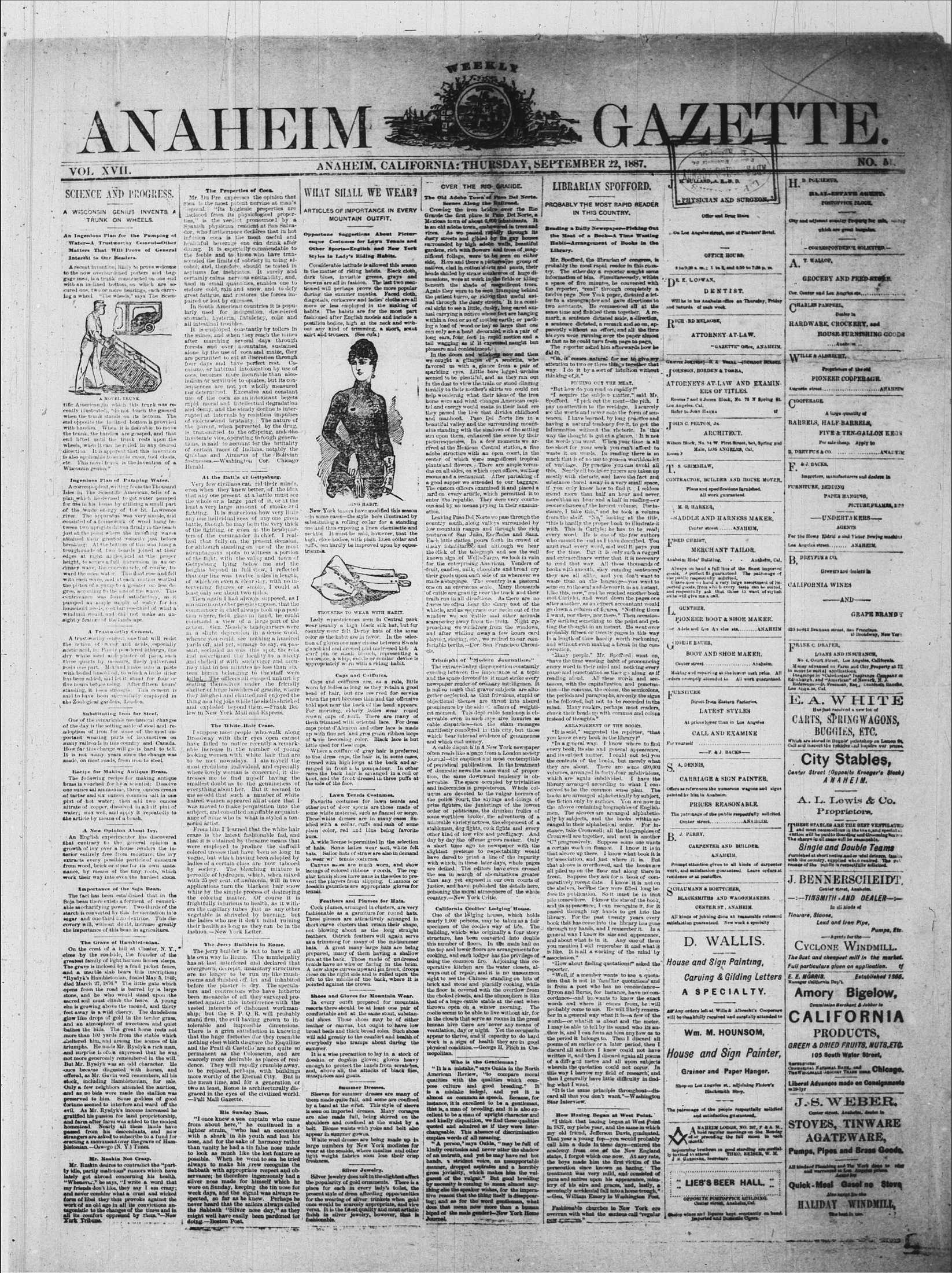
Searchable text
SCIENCE AND PROGRESS.
A WISCONSIN GENIUS INVENTS A TRUNK ON WHEELS.
An Ingenious Plan for the Pumping of Water—A Trustworthy Cement—Other Matters That Will Prove of General Interest to Our Readers.
A recent invention, likely to prove welcome to the now overburdened porters and baggage men, is a trunk constructed on one end with an inclined bottom, on which are secured one, two or more bearings, each carrying a wheel. "The wheels," says The Scientist.
A NOVEL TRUNK.
tific American (in which this trunk was recently illustrated), do not touch the ground when the trunk stands on its bottom. The end opposite the inclined bottom is provided with handles. When it is desirable, to move the trunk, the handles are grasped, and that end lifted until the trunk rests upon the wheels, when it can be rolled in any desired direction. It is apparent that this invention is also applicable to sample cases, tool chests, etc. This novel trunk is the invention of a Wisconsin genius."
A NOVEL TRUNK.
tific American fir which this trunk was recently illustrated, "do not touch the ground when the trunk stands on its bottom. The end opposite the inclined bottom is provided with handles. When it is desirable to move the trunk, the handles are grasped, and that end lifted until the trunk rests upon the wheels, when it can be rolled in any desired direction. It is apparent that this invention is also applicable to sample cases, tool chests, etc. This novel trunk is the invention of a Wisconsin genius."
Ingenious Plan of Pumping Water.
A correspondent, writing from the Thousand Isles in The Scientific American, tells of a plan which he devised to get water pumped for use in his house by utilizing a small part of the waste energy of the St. Lawrence river. The apparatus was very simple, and consisted of a framework of wood hung between two uprights driven firmly in the beach just at the point where the incoming waves attained their greatest velocity just before breaking. At the bottom of this was hung a trough made of two boards joined at their edges at right angles, and at the proper height, to secure a full immersion in an ordinary wave; the concave side, of course, toward the open water. This float rose and fell with each wave, and at each motion worked the piston of a pump to a greater or less degree, according to the size of the wave. This contrivance was found satisfactory, as it pumped an ample supply of water for his household needs, cost but one third of what a windmill would, and did not make an unsightly feature of the landscape.
A Trustworthy Cement.
A trustworthy cement, one that will resist the action of water and acids, especially acetic acid, is finely powdered in charge, fine dry white sand and plaster of paris, each three quarts by measure, finely palverized rosin one part. Mix and make into a paste with boiled lime oil, to which a little drier has been added, and let it stand for four or five hours before using. After fifteen hours' standing, it loses strength. This cement is said to have been successfully employed in the Zoological gardens, London.
Substituting Iron for Steel.
One of the remarkable mechanical changes of the day is the setting nail of steel and re-adoption of iron for some of the most important wearing parts of locomotives on many railroads in this country and Canada. How far this change will go is hard to tell. It is not many years since the change was made, on most roads, from iron to steel.
Recipe for Making Antique Brass.
The following recipe for making antique brass is vouched for by a scientist: Dissolve one ounce sal ammoniac, three ounces cream of tartar and six ounces common salt in one pint of hot water; then add two ounces nitrate of copper, dissolved in half pint of water; mix well, and apply it repeatedly to the article by means of a brush.
A New Opinion About Ivy.
An English experimenter has discovered that contrary to the general opinion a growth of ivy over a house renders the interior entirely free from moisture; the ivy extracts every possible particle of moisture from wood, brick or stone for its own sustenance, by means of the tiny roots, which work their way into even the hardest stone.
Importance of the Soja Bean.
The fact has been established that in the
A New Opinion About Ivy.
An English experimenter has discovered that contrary to the general opinion a growth of ivy over a house renders the interior entirely free from moisture; the ivy extracts every possible particle of moisture from wood, brick or stone for its own sustenance, by means of the tiny roots, which work their way into even the hardest stona.
Importance of the Soja Bean.
The fact has been established that in the Soja bean there exists a ferment of remarkable saccharifying power. Two-thirds of the starch is converted by this fermentation into sugar and one third into dextrine. This discovery will, without doubt, increase greatly the importance of this bean in agriculture.
The Grave of Hambletonian.
On the crest of a hill at Chester, N. Y., close by the roadside, the founder of the greatest family of light harness horses sleeps. The grave is inclosed by a frail picket fence, and a marble slab bears this inscription: "Rysdyk's Hambletonian, foaled May 5, 1840; died March 27, 1876." The little gate which opens from the road is barred by a large stone, and he who would stand upon the sacred soil must climb the fence. A young elm is growing above the mound, and thirty feet away is a wild cherry. The dandelions glow like drops of gold in the tender grass, and an atmosphere of sweetness and quiet bathes the hills. The great horse rests not more than 100 yards from the stable which sheltered him, and among the scenes of his triumphs. He made Mr. Rysdyk a rich man, and surprise is often expressed that he was not more generously remembered in the will. But Mr. Rysdyk was an odd character. He once became disgusted with horses, and offered, as Mr. Gavin well remembers, all his stock, including Hambletonian, for sale. Only a few neighbors attended the auction, and as no bids were made the stallion was preserved to him. Some goddess of good fortune seemed to interfere and ward off the evil. As Mr. Rysdyk's income increased he gratified his passion for land proprietorship, and farm after farm was added to the modest homestead. Nearly all these lands have passed from his descendants, and now strangers are asked to subscribe to a fund for erecting a monument over the grave of Hambletonian—Oswego (N. Y.) Times.
Mr. Ruskin Not Crazy.
Mr. Ruskin desires to contradict the "partly idle, partly malicious" rumors which have lately got abroad concerning his health. "Whenever," he says, "I write a word that my friends don't like, they say I am crazy; and never consider what a cruel and wicked form of libel they thus provoke against the work of an old age in all its convictions antagonistic to the changes of the times and in all its comfort oppressed by them."—New York Tribune.
The Jerry Builders in Rome.
The jerry builder is not to have it all his own way in Rome. The municipality has at last interfered and declared that overgrown, decrepit, insanitary structures are no longer to be run up like mushrooms and finished off, let and inhabited before the plaster is dry. The speculators and contractors who have hitherto been monarchs of all they surveyed protested against this interference with the vested interests of dishonest workmanship; but the S. P. Q. R will probably stand firm, the evil having grown to intolerable and impossible dimensions. There is a grim satisfaction in knowing that the huge factories (for they resemble nothing else) which disgrace the Esquilline and the Prati di Castello are not quite so permanent as the Colossenum, and are scarcely more desirable as places of residence. They will rapidly crumble away, to be replaced, perhaps, with buildings more worthy of the Eternal City. But in the mean time, and for a generation or two at least, Rome is architecturally disgraced in the eyes of the civilized world.—Pall Mall Gazette.
His Sunday Nose.
"I once knew a sea captain who came from about here," he continued in a lighter strain, "who had an encounter with a shark in his youth and lost his nose, and for the sake of harmony rather than vanity he had a tin false nose made to look as much like the lost feature as possible. When he went to sea he tried always to make his crew recognize the Sabbath with appropriate respect and observance; he therefore ingenuously had a silver nose made for himself which he wore on Sunday, keeping the tin nose for week days, and the signal was always respected, so far as he knew. Perhaps he never heard that the sailors always called the Sabbath "Silver nose day," as they might well have easily been pardoned for doing—Boston Post.
Favorite costume other out of door shoes some white material These white dresses is fitted with a collared plain color, red and black.
A wide license is pledged to hats. Some ladies hats. Sailor hats of to wear wi' tennis.
Canvas suites are lacings of colored rhinoceros tennis shoes have vent the players from doeskin gauntlets are tennis.
Feathers and Cock plumes, arrange fashionable as a glove These plumes are short curve clusters not blowing about feathers. Ostrich feathers as a trimming for mats.
Shoes and Gloves.
In every outfit resorts there should comfortable and attentive shoes. These leather or canvas, broad beaks and thick will add greatly to everybody who tries summer.
It is a wise precaution doeskin or dogskin enough to protect them and above all, the musquitoes and guards.
Summer
Sleeves for summer them made quite full by a band at the waist is seen on imported shoes also made full shoulders and comfort belt. Blouse waists appear in summer garments.
White wool dresses large numbers by women wear at the senside, light weight fabric freshness.
Silver
Silver jewelry does the popularity of gold place for each inch present style of dress for the wearing of silvers would be scarce versa. It is the face finish in silver jeans fashionable.
WEEKLY
EIM GA
ANAHEIM, CALIFORNIA: THURSDAY, SEPTEMBER 22, 1887.
WHAT SHALL WE WEAR?
ARTICLES OF IMPORTANCE IN EVERY MOUNTAIN OUTFIT.
Opportunities About Picturesque Costumes for Lawn Tennis and Other Sports—English and New York Styles in Lady's Riding Habits.
Considerable latitude is allowed this season in the matter of riding habits. Black cloth, dark blues, invisible greens, grays and browns are all in fashion. The last two menions will perhaps prove the more popular during the summer months. Faced cloth, diagonal, corkscrew and ladies' clothes are all more or less employed in the making of habits. The habits are for the most part fashioned after English models and include a postion bodice, high at the neck and without any kind of trimming, a short, scant skirt and trousers. (See cuts.)
OVER THE RIO GRANDE.
The Old Adobe Town of Paso Del Norte. Seenes Along the Railroad.
Crossing the iron bridge over the Rio Grande the first place is Paso Del Norte, a Mexican town of about 6,000 inhabitants. It is an old adobe town, embowered in trees and vines. As we passed rapidly through its dusty streets and glided by its gay houses surrounded by high adobe walls, beautiful gardens, rich with flowers and trees of magnificent foliage, were to be seen on either side. Here and there a picturesque group of natives, clad in cotton shirts and pants, their heads shaded by straw sombreros of huge dimensions, were at work in the fields or filling beneath the shade of magnificent trees. Again they were to be seen trampling behind the patient burro, or riding that useful animal through the dusty streets. It is a comical sight to see a little, dusky, long eared animal carrying a native whose feet are hanging within a foot or so of another earth; or parking a load of wood or hay so large that one can only see a head decorated with a pair of long ears, four feet in rapid motion and a tail wagging as if it expressed naught but pleasure and contentment.
In the door and window now and then we caught a glimpse of A renorita, who favored us with a glance from a pair of sparkling eyes. Little bare leggedurchins seemed to be plentiful, and as they ran out in the dust to view the train or stood clinging timidly to their mother's skirts we could not help wondering what their ideas of the iron horse were and what changes American capital and energy would make in their land ere they passed the line that divides childhood and manhood. Paso Del Norte lies in a beautiful valley and the surrounding mountains standing with the shadows of the setting sun upon them, enhanced the scene by their picturesqueness. In a few moments we arrived at the Mexican Central station, a fine adobe structure with an open court, in the center of which were magnificent tropical plants and flowers. There are ample verandas on all sides, on which open offices, waiting.
LIBRARIAN SPOFFORD.
PROBABLY THE MOST RAPID READER IN THIS COUNTRY.
Reading a Daily Newspaper—Picking Out the Meat of a Book—A Time Wasting Habit—Arrangement of Books in the Library.
Mr. Spofford, the librarian of congress, is probably the most rapid reader in this country. The other day a reporter sought some information of him. Immediately, within a space of five minutes, he conversed with the reporter, "read" through completely a twelve page New York paper, dictated a letter to a stenographer and gave directions to two assistants. He commenced all at the same time and finished them together. A remark, a sentence dictated aside, a direction, a sentence dictated, a remark and so on, apparently without an effort, and all the time his eyes were running over the paper almost as fast as he could turn from page to page.
The reporter asked him afterwards how he did it.
"Oh, it comes natural for me to give my attention to two or three things together that way. I do it by a sort of intuition without thinking of it."
PICKING OUT THE MEAT.
"But how do you read so rapidly?"
"I acquire the subject matter," said Mr. Spofford. "I pick out the meat—the pith. I pay no attention to the verdiage. I scarce see the words and never note the form of sentences. I have learned, by long practice and having a natural tendency for it, to get the information without the rhetoric. In this way the thought is got at a glance." It is not the words you want. When your time is all too short for your work you can't afford to waste it on words. In reading there is so much that is of no use to you—a worthless lot of verbiage. By practice you can avoid all this. Nearly all books or papers are taken up."
NEW HABIT.
New York tanners have modified this season—in some cases—the style here illustrated by substituting a rolling collar for a standing one and thus exposing a linen chemisette and necktie. It must be said, however, that the high, close bodice, with plain linen collar and cuffs, can hardly be improved upon by equestrienne.
TROUSERS TO WEAR WITH HABIT.
Lady equestriennes seen in Central park wear usually a high black silk hat, but for country wear felt Derby hats of the same color as the habit are in favor. In the selection of gloves one may choose between Swede glazed kid and dressed and madred kid. A scarf pin or small brooch, representing a horseshoe, a whip, saddle or similar device is appropriately worn with a riding habit.
Caps and Coiffures.
Caps and coiffures are, as a rule, little worn by ladies as long as they retain a good head of hair, but are reserved for service when the part becomes thin and the offensive bald spot near the back of the head appears. For morning, elderly ladies wear round crown caps of null. There are many of them trimmed with oriental lace. For dress caps point d'Alencon and other lace is made up with fine net and gros grain ribbon loops of one becoming color. Black lace is but little used for these caps.
Where a coifure of gray hair is preferred to the dress caps, the hair is, in some cases, dressed with high loops at the back and arranged in front a la pompadour. In other cases the back hair is arranged in a coil or knot, and the front dressed in three puffs at the side of the face.
LAWN TENnis Costumes.
Favorite costumes for lawn tennis and other out of door sports are those made of some white material, such as flannel or serge. These white dresses are in many cases finished with a collar, cuffs and sash of some plain color, red and blue being favorite hues.
A wide license is permitted in the selection of hats. Some ladies wear soft, white felt hats. Sailor hats of straw are also in demand to wear wi' tennis costumes.
Canvas shoes are much worn, and show laceings of colored ribbons rords. The regular tennis shoes have nails in the soles to prevent the players from slipping. Chamois or doxin gauntlets are appropriate gloves for tennis.
PICKING OUT THE MEAT.
"But how do you read so rapidly?"
"I acquire the subject matter," said Mr. Spofford. "I pick out the meat—the pith. I pay no attention to the veidage. I scarcely see the words and never note the form of sentences. I have learned, by long practice and having a natural tendency for it, to get the information without the rhetoric. In this way the thought is got at a glance. It is not the words you want. When your time is all too short for your work you can't afford to waste it on words. In reading there is so much that is of no use to you—a worthless lot of verbs. By practice you can avoid all this. Nearly all books or papers are taken up mostly with rhetoric, and have the fact and substance stored away in a very small space, if you only know how to find it. I seldom spend more than half an hour and never more than an hour and a half in reading—or recombineance of the latest volume. For instance, I take this," and be took a volume from the shelf. "No," looking at the title, "this is hardly the proper book to illustrate it with. This is Carlyle; he has to be read; every word. He is one of the few authors who cannot be called as I have described. You must read every word, and well it pays you for the time. But it is only such a rugged and extraordinary writer that it is necessary to read that way. All those thousands of books with smooth, easy running sentences, they are all alike, and you don't want to waste time on the language—you want to seize on to the soul and devour it in an instant. Like this, now," and he reached another book (not Carlyle), and went down the pages one after another, as an expert accountant would go on a column of figures. "Nothing there I want, nor there, nor there." Then occasionally striking something to the point and getting the thought in an instant. He went over probably fifteen or twenty pages in this way in a length of time hardly worth reckoning, and without even making a break in the conversation.
"Many people." Mr. Spofford went on, "have the time wasting habit of pronouncing every word in their mind and noticing every pause and punctuation as they go along as if reading aloud. All these words and sentences, with the capitalization and punctuation—the commas, the colons, the semicolons, the periods and paragraphs, are only the signs to be followed, but not to be recorded in the mind. Many readers, perhaps most readers, check their heads up with commas and colons instead of thoughts."
ARRANGEMENT OF THE BOOKS.
"It is said," suggested the reporter, "that you know every book in the library?"
In a general way, I know where to find every book, its size and general appearance, and its subject matter. I could not tell you the contents of the books, but merely what they are about. There are some 600,000 volumes, arranged in forty-four subdivisions, which are again subdivided. I have the library arranged according to what I conceived to be the common sense plan. The books are arranged alphabetically by subject, the fiction only by authors. You are now in the alcove containing biographies of Englishmen. The alcoves are arranged alphabetically by subjects, and the books within arranged in their alphabetical order. For instance, take Cromwell; all the biographies of Cromwell are together, and next is another "C" progressively. Suppose some one wants a certain work on finance. I know it is in that alcove up there. I know what book it is by association, and just where it is. But that alcove is overflowed, and the books are all piled up on the floor and along there in front. Suppose they ask for a book of comparatively recent date. I know it is not on the shelves; because they were filled long before its publication. So it must be in that alcove up there.
New York tanners have modified this season—in some cases—the style here illustrated by substituting a rolling collar for a standing one and thus exposing a linen chemisette and necktie. It must be said, however, that the high, close bodice, with plain linen collar and cuffs, can hardly be improved upon by equestrienne.
TROUSERS TO WEAR WITH HABIT.
Lady equestriennes seen in Central park wear usually a high black silk hat, but for country wear felt Derby hats of the same color as the habit are in favor. In the selection of gloves one may choose between Swele glazed kid and dressed and madred kid. A scarf pin or small brooch, representing a horseshoe, a whip, saddle or similar device is appropriately worn with a riding habit.
Caps and Coiffures.
Caps and coiffures are, as a rule, little worn by ladies as long as they retain a good head of hair, but are reserved for service when the part becomes thin and the offensive bald spot near the back of the head appears. For morning, elderly ladies wear round crown caps of null. There are many of them trimmed with oriental lace. For dress caps point d'Alencon and other lace is made up with fine net and gros grain ribbon loops of one becoming color. Black lace is but little used for these caps.
Where a coifure of gray hair is preferred to the dress caps, the hair is, in some cases, dressed with high loops at the back and arranged in front a la pompadour. In other cases the back hair is arranged in a coil or knot, and the front dressed in three puffs at the side of the face.
LAWN Tennis Costumes.
Favorite costumes for lawn tennis and other out of door sports are those made of some white material, such as flannel or serge. These white dresses are in many cases finished with a collar, cuffs and sash of some plain color, red and blue being favorite hues.
A wide license is permitted in the selection of hats. Some ladies wear soft, white felt hats. Sailor hats of straw are also in demand to wear wi' tennis costumes.
Canvas shoes are much worn, and show laceings of colored ribbons rords. The regular tennis shoes have nails in the soles to prevent the players from slipping. Chamois or doxin gauntlets are appropriate gloves for tennis.
PICKING OUT THE MEAT.
"But how do you read so rapidly?"
"I acquire the subject matter," said Mr. Spofford. "I pick out the meat—the pith. I pay no attention to the veidage. I scarcely see the words and never note the form of sentences. I have learned, by long practice and having a natural tendency for it, to get the information without the rhetoric. In this way the thought is got at a glance. It is not the words you want. When your time is all too short for your work you can't afford to waste it on words. In reading there is so much that is of no use to you—a worthless lot of verbs. By practice you can avoid all this. Nearly all books or papers are taken up mostly with rhetoric, and have the fact and substance stored away in a very small space, if you only know how to find it. I seldom spend more than half an hour and never more than an hour and a half in reading—or recombineance of the latest volume. For instance, I take this," and be took a volume from the shelf." No," looking at the title," this is hardly the proper book to illustrate it with. This is Carlyle; he has to be read; every word. He is one of the few authors who cannot be called as I have described. You must read every word,and well it pays you for the time. But it is only such a rugged and extraordinary writer that it is necessary to读 that way.All those thousands of books with smooth,easy running sentences," they are all alike,they don't want to waste time on the language—you want to seize on tothe soulanddevouritinaninstant.Like this,now,"andhe reached another book (not Carlyle),and went downthepagesoneafteranother.asanexpertaccountwouldgoonaccolumnoffigures."NothingthereIwantnorthere,northere."Thenoccasionallystriking somethingtothepointandgettingthethoughtinaninstant.Hewwentoverprobablyfifteenortwentypagesinthiswayinalengthoftimehardlyworthreckoning,andwithoutevenmakingabreakintheconversation.
"Many people."Mr.Spoffordwenton,havethetimewastinghabitofpronouncingeverywordinyourmind和noticingeverypauseandpunctuationastheygoalongasifreadingaloud.Allthesewordsandsentenceswiththecapitalizationandpunctuation—thecommas,thecolons,thesemicolons,theperiodsandparagraphsareonlythesignsbestfollowedbutnottoberecordedinthemind.Manyreadersperhapsmostreaders.chucktheheaddupwithcommasandcolonsinsteadofthoughts."
ARRANGEMENTOFTHEBOOKS.
"Itis said," suggested the reporter,"thatyouknoweverybookinthelibrary?"
In a general way.I know where to find every book,其size和general appearance,anditssubjectmatter.Icouldnot tellyouthecontentsofthebooks,但merelywhattheyareabout。Therearesome60000volumesarrangedinforty-foursubdivisionswhichareagainsubdivided.IhavethelibraryarrangedaccordingtowhatIconceivedtobethecommonsenseplan.Thebooksarearrangedalphabeticlybysubject,thefictiononlybyauthors.YouarenowinthealcovecontainingbiographiesofEnglishmen.Thealcovesarearrangedalphabeticlybysubject,andthebookswitharraignmentinthealphabeticalorder.Forinstance,takeCromwell;allthebiographiesofCromwellare together,andnextisanother"C"progressively.Supposeonewhatcainataleoveupthere.Iknowwhatbookitisbyassociation,andjustwhereitis.Butthatalcoveisoverflowed,andthebooksareallpileduponthefloorandalongthereinfront.Supposetheyaskforabookofcomparativelyrecentdate.Iknowitisnotonthesilvers但becausetheywerefilledlongbeforeitspublication.Soitmustbeinthatsilversshowthetimehowdoyoureadsorapidly!"
Favorite costumes for lawn tennis and other out of door sports are those made of some white material, such as flannel or serge. These white dresses are in many cases finished with a collar, cuffs and sash of some plain color, red and blue being favorite hues.
A wide license is permitted in the selection of hats. Some ladies wear soft, white felt hats. Sailor hats of straw are also in demand to wear wi' tennis costumes.
Canvas shoes are much worn, and show lacings of colored ribbon rords. The regular tennis shoes have nails in the soles to prevent the players from slipping. Chamois or dogfights, cock fights and every other kind of low vice and profligacy. And day by day the offense grows ranker. Only a short time ago no newspaper with the slightest pretense to respectability would have dared to print a line of the impurity with which, in these later days, whole pages are defiled. The editors have even crossed the sea in search of abominations greater than any yet exposed in our courts of justice, and have published the details here, poisoning the moral atmosphere of the whole country.—New York Critic.
Feathers and Plumes for Hats.
Cock plumes, arranged in clusters, are very fashionable as a garment for round hats. These plumes are attractively arranged in short curve clusters that retain their shape, not blowing about as the long straight feathers. Ostrich feathers will again serve as a trimming for many of the midsummer hats. A great many large hats are being prepared, many of them having a shallow rim at the back. Those made of undressed braids have no wire or facing in the brim. A new shape curves upward gin front, droops close on the right side and is rolled upon the left to the middle of the back, where it is pointed against the crown.
Shoes and Gloves for Mountain Wear.
In every outfit prepared for mountain resorts there should be at least one pair of comfortable and at the same stout, substantial shoes. These shoes may be of either leather or canvas, but ought to have low broad heels and thick broad soles. Such shoes will add greatly to the comfort and health of everybody who tramps about during the summer.
It is a wise precaution to lay in a stock of doeskin or dogskin gloves; gloves heavy enough to protect the hands from scratches, and, above all, the attacks of black flies, musquitoes and guats.
Summer Dresses.
Sleeves for summer dresses are many of them made quite full, and some are confined by a band at the wrist. This style of sleeve is seen on imported dresses. Many corsages are also made full, being shirred on the shoulders and confined at the waist by a belt. Blouse waists with yoke and belt also appear in summer gowns.
White wool dresses are being made up in large numbers by New York modistes for wear at the senside, where muslims and other light weight fabrics soon lose their crisp freshness.
Silver Jewelry.
Silver jewelry does not in the slightest affect the popularity of gold ornaments. There is a place for each in every lady's toilet, the present style of dress affording opportunities for the wearing of silver trinkets when gold ones would be scarcely appropriate, and vice versa. It is the fastest quality and most artistic finish in silver jewelry, however, that is fashionable.
California Coolies' Lodging House.
One of the lodging houses, which holds nearly 1,000 persons, may be taken as a fair specimen of the coolie's way of life. The building, which was originally a four story structure, has been converted into double this number of floors. In the main hall on the top and lower floors are arrangements for cooking, and each lodger has the privilege of using the common fire. Adjoining this cooperative kitchen are the water closets, always out of repair; and it is no uncommon sight to see the Chinese standing on bits of brick and stone and placidly cooking, while the floor is covered with the overflow from the choked closets, and the atmosphere is like that of a huge cattle stable at the cast when thrown open on a winter morning. The coolie seems to be able to live without air, for in the closets that serve as rooms in the great human hive there are never any means of ventilation, day or night. Yet the occupants appear to thrive, and if capacity to do hard work is a sign of health they are in good physical condition.—George H. Fitch in Cosmopolitan.
Who is the Gentleman?
"It is a mistake," says Ouida in the North American Review, "to compare moral qualities with the qualities which compose culture and good breeding." It is a mistake indeed, and yet it is almost as common as speech. Because, for instance, it is excellent to be a gentleman, that is, a man of breeding, and it is also excellent to be a man of upright character and kindly disposition, we find these qualities quoted and admired as if they were interchangeable. This absence of discrimination implies words of all meaning.
"A person," says Ouida, "may be full of kindly courtesies and never utter the shadow of an untruth, and yet he may have red hot hands, a strident voice, an unsupportable manner, dropped aspirates and a horribly gross joviality, which makes him the vulgare of the vulgar." But good breeding by necessity is coming to mean almost anything else the speaker wishes, for the imperative reason that the thing itself is disappearing; and as for the word gentleman, what does that mean now more than a human biped of the male gender!—New York Home Journal.
How Hazing Began at West Point.
"I think that hazing began at West Point in 1827, my plebe year, and the same in which my old friend, Jefferson Davis, graduated. That year a young fop—you would probably call him a dude in these days—entered the academy from one of the New England states, I forgot which one now. At any rate, the boys made him the first victim of the persecution since known as hazing. The treatment was very mild, and consisted of puns and satires upon his appearance, mimery of his airs and graces,'and lastly,a seemingly accidental fall into a horse trough."—Gen William Emory in Washington Post.
Fashionable churches in New York are overrun with what the sexons call "regular pew worshippers."
GAZETTE.
R 22, 1887.
NO. 41
OFFICE HOURS:
8 to 9:30 a.m.; 1 to 4, and 4:30 to 7:30 p.m.
DR. E. L. COWAN,
DENTIST.
Will be in his Anaheim office on Thursday, Friday
and Saturday of each week.
RICH RD MELROSE,
ATTORNEY AT LAW.
"GAZETTE" Office, ANAHEIM.
GRIPPIN JOHNSON—B. A. VONAL—(SHADOW WARE).
JOHNSON, BORDEN & YORK,
ATTORNEYS AT LAW AND EXAMINERS OF TITLES.
Rooms 7 and 8 Jones Block, No. 76 N Spring St.
Los Angeles, Cal.
Refer to John Hayne
JOHN C. PELTON, Jr.
ARCHITECT.
Wilson Block, No. 14 W. First Street, bet, Spring and
Main, Los Angeles, Cal.
T. S. GRIMSHAW,
H. D. POLIEMUS.
REAL-ESTATE AGENCY,
POSTOFFICE DLOCK.
City and adjacent country Property for sale, among
which are great bargains.
CORRESPONDENCE SOLICITED.
A. T. WALLOP,
GROCERY AND FEED STORE.
Cor. Center and Los Angeles sts.
CHARLES PAMPERL,
Dealer in
HARDWARE, CROCKERY, and
HOUSE-FURNISHING GOODS
...Anahie...
WILLE & ALBRECHT.
Proprietors of the old
PIONEER COOPERAGE.
Augusta street.....ANAHEIM
COOPERAGE.
A large quantity of
BARRELS, HALF-BARRELS,
FIVE & TEN-GALLON KEOS
For sale cheap. Apply to
B. DREYFUS & CO....ANAHEIM
F. & J. BACKS,
ATTORNEYS AT LAW AND EXAMINERS OF TITLES.
Rooms 7 and 8 Jones Block, No. 75 N Spring St.
Los Angeles, Cal.
Refer to John Hanna
JOHN C. PELTON, Ja.
ARCHITECT.
Wilson Block, No. 14 W. First Street, bet. Spring and Main, LOS ANGELES, Cal.
T. S. GRIMSHAW,
CONTRACTOR, BUILDER AND HOUSE MOVER.
Plans and specifications furnished.
All work guaranteed.
M. R. HARKER,
—SADDLE AND HARNESS MAKER,
Center street.....ANAHEIM.
FRED CHRIST,
MERCHANT TAILOR.
Anaheim Hotel Building..... Anaheim, Cal.
Always on hand a full line of the finest imported goods. A perfect fit guaranteed. The patronage of the public responsibly solicited.
I have now on hand a very large assortment of imported goods, from which every taste can be suited, and respectfully ask that those in want of stylish suits will give me a call.
L. GUNTHER,
PIONEER BOOT & SHOE MAKER.
For Adele and Los Angeles sta.....ANAHEIM
GEORGE BAUER,
BOOT AND SHOE MAKER.
Center street..... Anaheim.
Making and repairing at the lowest cash price. All orders promptly attended to. All work guaranteed.
FURNITURE
Direct from Eastern Factories.
LATEST STYLES
At prices lower than in Los Angeles
CALL AND EXAMINE
For yourself ..... F. & J. BACKS
S. A. DENNIS,
CARRIAGE & SIGN PAINTER.
Offers as references the numerous wagons and signs painted by him in Anaheim.
PRICES REASONABLE.
The patronage of the public responsfully solicited.
Center street.....ANAHEIM.
B. J. PERRY,
CARPENTER AND BUILDER.
ANAHEIM.
Prompt attention given to all kinds of carpenter work, and satisfaction guaranteed. Leave orders at residence or at postoffice.
SCHAUMANN & BOETCHER,
BLACKSMITHS AND WAGONMAKERS.
PIONEER COOPERAGE.
August street.....ANAHEIM
COOPERAGE.
A large quantity of BARRELS, HALF-BARRELS,
FIVE & TEN-GALLON KEOPS
For sale cheap. Apply to B. DREYFUS & CO.
F. & J. BACKS,
Importers, manufacturers and dealers in FURNITURE, BEDDING
PICTURE FRAMES, ETC
UNDERTAKERS
AGENTS
For the Howe Eldrid a and Victor Sewing machines
Los Angeles street.....ANAHEIM.
B. DREYFUS & CO.
Grewers and dealers in CALIFORNIA WINES
AND
GRAPE BRANDY
630 to 642 Brannan street, San Francisco
15 Broadway, New York
FRANK C. DRAPER,
LOANS AND INSURANCE.
No 4 Court Street, Los Angeles, California.
Money advanced on Farm and City Property at 7% in some suit applications.
Insurance in "Californian" Insurance Company on Edinburgh, and "American" of Newark, M. J.
References—D. Freeman, Esq., Centinsal, Rancho Los Angles, Cal.
E. A. WHITE
Has just received a new lot of CARTS, SPRINGWAGONS, BUGGIES, ETC.
Which are stored in Dennie's paintshop on Lemon St.
Call and inspect the vehicles and acquire our prices.
City Stables,
Center Street (Opposite Kroeger's Block)
ANAHEIM.
A. L. Lewis & Co.
Proprietors.
THESE STABLES ARE THE BEST VENTILATED and most commodious in the town, and specialization will be paid to boarding and grooming horses.The charge in all cases will be reasonable.
Single and Double Teams
Furnished at short notice and so useful drivers,families with the country, supplied when required.The patrons of the public is respectfully solicited.
J. BENNERSCHEIDT.
Center street, Anaheim:
TINSMITH-AND-DEALER:
PRICES REASONABLE.
The patronage of the public respectfully solicited.
Center street.....ANAHEIM.
B. J. PERRY,
CARPENTER AND BUILDER.
ANAHEIM.
Prompt attention given to all kinds of carpenter work, and satisfaction guaranteed. Leave ordars at residence or at postoffice.
SCHAUMANN & BOETTCHER,
BLACKSMITHS AND WAGONMAKERS.
CENTER ST., ANAHEIM.
All kinds of jobbing done at reasonable rates and satisfaction guaranteed. New work a specialty.
D. WALLIS.
House and Sign Painting,
Carving & Gilding Letters
A SPECIALTY.
Any orders left at Wille & Albrecht's Cooperage will be thankfully received and carefully attended to.
Wm. M. HOUNSOM,
House and Sign Painter,
Grainer and Paper Hanger.
Shop on Los Angeles st., adjoining Flotow's Blacksmith Shop.
The patronage of the people respectfully solicited and satisfaction guaranteed.
ANAHEIM LODGE, NO. 207, F & A.M.
hold regular meetings on the Monday of or preceding the full moon in each month.
Sojourning brethren in good standing are cordially invited to attend THEO, REISER, W. M.
J. & GARDINNA, Secretary.
LIEB'S BEER HALL,
OPPOSITE POSTOFFICE BUILDING.
Center street, Anaheim, Cal.
Choice wines and liquors kept constantly on hand.
Imported and Domestically Cigars.
A. L. Lewis & Co.
Proprietors.
THESE STABLES ARE THE BEST VENTILATED and most commodious in the town, and specialention will be paid to Boarding and Grooming horses. The charge in all cases will be reasonable.
Single and Double Teams
Furnished at short notice and so useful drivers, Canada with the country, supplied when required. The patronage of the public is respectfully solicited.
J. BENNERSCHEIDT,
Center street, Anaheim.
:—TINSMITH - AND DEALER—
In all kinds of Tinware, Stouse,
Lead and Iron Pipe,
Pumpa, Etc.
Agents for the Cyclone Windmill.
The Sast and cheapest mill in the market. Full particulars given on application. tf
E. E. MORRIS.
Established 1906.
Manager California Day't.
Amory Bigelow,
Commission Merchant & Jobber in CALIFORNIA PRODUCTS,
GREEN & DRIED FRUITS, NUTS, ETC.
105 South Water Street,
Chicago.
Liberal Advances made on Consignments mils-lyr
J. S. WEBER.
Center street, Anaheim, dealer in STOVES, TINWARE AGATEWARE,
Pumps, Pipes and Brass Goods.
All kinds of Plumbing and The Work done to clean and warranted at Lee, Angus prices. Agent for Quick-Meal Gasoline Stove Also agent for the HALIDAY WINDMILL. The best in use.