anaheim-gazette 1887-09-15
Scanned page
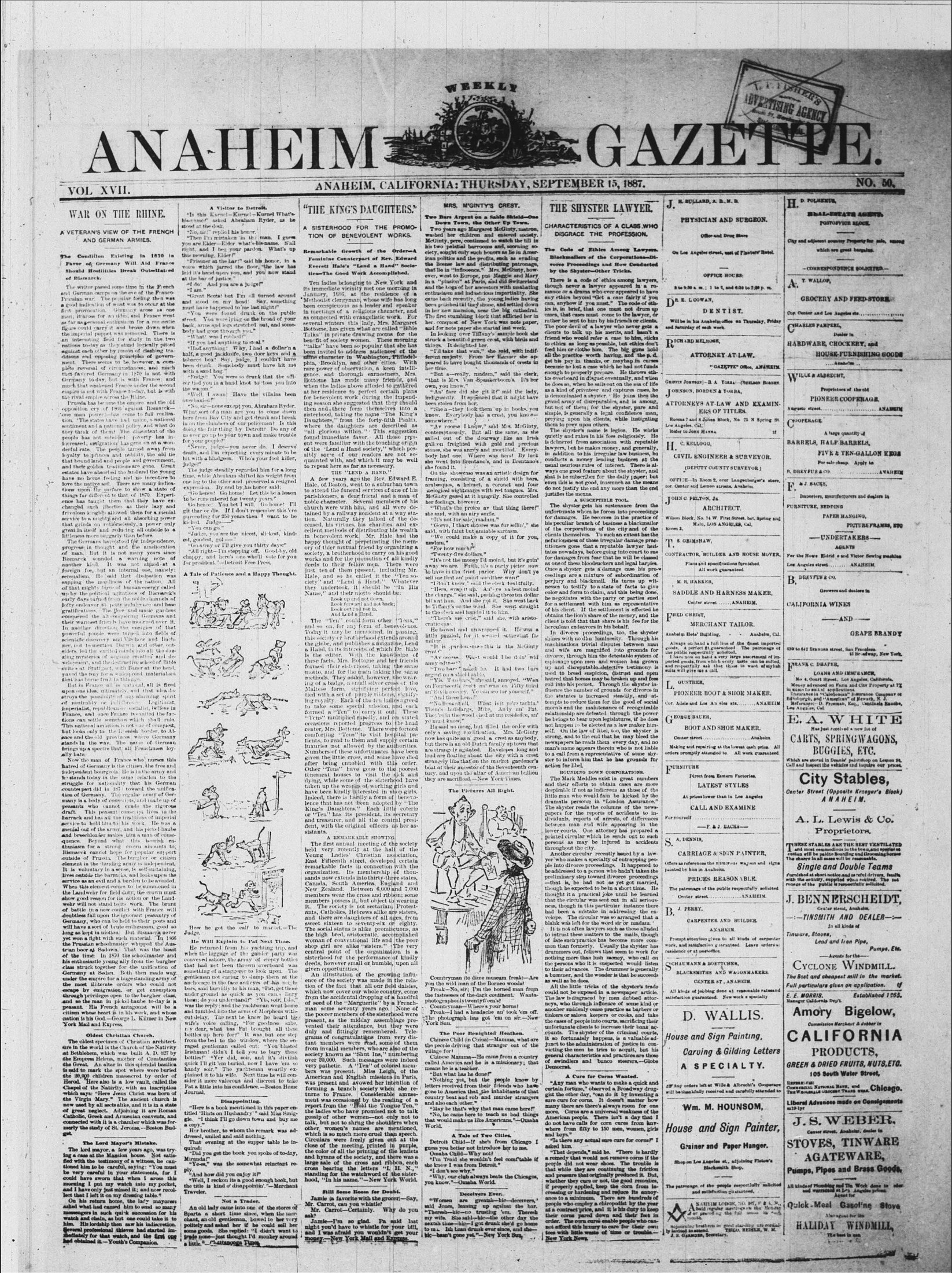
Searchable text
WAR ON THE RHINE.
A VETERAN'S VIEW OF THE FRENCH AND GERMAN ARMIES.
The Condition Existing in 1870 in Favor of Germany Will Aid France Should Hostilities Break Out—Hatred of Bismarck.
The writer passed some time in the French and German camps on the eve of the Franco-Prussian war. The popular feeling then was a good indication of what was to occur at the first provocation. Germany arose as one man; it arose for no video, and France went as far as personal enthusiasm for a romantic figure could carry it and broke down when the imperial puppet was removed. There is an interesting field for study in the two nations today as they stand logically pitted against each other by reason of clashing traditions and opposing principles of government. There seems to be, however, a complete reversal of circumstances; and much that favored Germany in 1870 is not with Germany to day, but is with France; and much that weakened France under the second empire is not with France today, but is with the rival empires across the Rhine.
Prussia has become the emperor and the old opposition cry of 1865 against Bismarck—one man power!—has come to full realization. 'The states have had union, a national sentiment and a national policy, and what do they think of them?' The discontent of the people has not subsided; poverty has increased; immigration has gone on at a wonderful rate. The people turned away from loyalty to princes and nobility, the old tie that bound land and people and government, and their golden traditions are gone. Great estates have absorbed the land and the young
A Visitor to Detroit.
"Is this Kurnel—Kurnel—Kurnel What's his name?" asked Abraham Ryder, as he stood at the desk.
"No, sir!" replied his honor.
"Then I'm mistaken in the man. I guess you are Elder—Elder what's his name. S'all right, and I beg your pardon. What's up this morning, Elder?"
"Prisoner at the bar!" said his honor, in a voice which jarred the floor, "the law has laid it's hand upon you, and you now stand at the bar of justice."
"I do! And you are a judge!"
"I am."
"Great Scota! but I'm all turned around and stood on my head! Say, something must have happened to me last night!"
"You were found drunk on the public street. You were lying on the broad of your back, arms and legs stretched out, and somebody had gone through you."
"What! was I robbed?"
"If you had anything to steal."
"Had anything? Why, I had a dollar'n a half, a good jackknife, two door keys and a tobacco box! Say, judge, I couldn't have been drunk. Somebody must have hit me with a sand bag."
"Fudge! You were so drunk that the officer tied you in a hand knot to toss you into the wagon."
"Well, I swan! Have the villains been overhauled?"
"No, sir—none except you, Abraham Ryder. What sort of a man are you to come down here from Bay City and get drunk and break in on the slumbers of our policemen? Is this doing the fair thing by Detroit? Do any of us ever go up to your town and make trouble for your people?"
"Never, judge—you never do. I deserve death, and I'm expecting every minute to be hit with a bludgeon. Who's your fool killer, judge?"
"The judge steadily regarded him for a long time."
"THE KING'S"
A SISTERHOOD TION OF BENE
Remarkable Growth
Feminine Counter
Everett Hale's writings—The Good Woman
Ten ladies belong to its immediate vicinity January, 1886, at Methodist clergyman been conspicuous among in meetings of a rite as connected with several winters this Bottome, has given Talks" in private d benefit of society we "talks" have been s been invited to add affine character in phia, Brooklyn, an rare power of observance, and thorou Bottome has made when the ladies abide at her residence to for benevolent work ing season she suggest then and there for sisterhood, taking Daughters," from where the daughter "all glorious with found immediate f ent were familiar w of the Lend a Hand sibly some of our quainted with, and to repeat here as fa
Prussia has become the empire and the old opposition cry of 1861 against Bismarck—one man power!—has come to full realization. The states have had union, a national sentiment and a national policy, and what do they think of them? The discontent of the people has not subsided; migration has gone on at a wonderful rate. The people turned away from loyalty to princes and nobility, the old tie that bound land and people and government, and their golden traditions are gone. Great estates have absorbed the land and the young have no home feeling and no incentive to love the native soil. There are many indications upon the surface to show a state of things far different to that of 1870. Experience has taught them that they have exchanged such liberties as their lazy and frivolous kingdoms allowed them for a menial service to a mighty and all absorbing power that grinds on reflexively, a power only great in itself and reducing all outside to a littleness more beggarly than before.
The Germans have stood for independence, progress in thought and the amelioration of man. But it is not many years since Bismarck sounded a warning note of another kind. It was not aligned at a foreign foe, but an internal one, namely: sensualism. He said that dissipation was sapping the machiness of the nation. All of that mighty force of human energy called up by the political agitations of Bismarck's early days turned from the noble channels of lofty endeavor to petty indulgence and base gratifications. The poor and music gardens conquered the all-competing Germans and their warmest friends have mourned over it. In another direction, the energies of that powerful people were turned into fields of scientific discovery and Virtue and Buchner, not to mention Darwin and other outsiders, led the excited minds into all the dazzling mysteries of organic creation and development, and the destructive school of Bible critics at Stuttgart, with Baner at the head, paved the way for a widespread materialism that has borne fruit in this age.
But in France all is national, all is fixed upon one idea, ultimately, and that idea destroys the possibility of any alarming spirit of neutrality or indifference. Legitimist, imperialist, republican or socialist, believe in France, and once France is exiled the factions can settle somehow which shall rule. This national ambition is not one of conquest, but looks only to the French border, to Alsace and the old provinces where Germany stands in the way. The name of German brings up a spectre that all Frenchmen lovingly hate.
Now the man of France who nurses this hatred of Germany is the citizen, the free and independent bourgeois. He is in the army and he stands today in the same relation to the struggle for nationality that his German counterpart did in 1871 toward the unification of Germany. The regular army of Germany is a body of conscripts, and made up of peasants who cannot evade the rigorous draft. This peasant conscript lives in the barracks and has all the traditions of imperial service to hold him to his work. He was a menial out of the army, and his picket haube and breechloader makes him a man of consequence. Beyond what this beoirish enthusiasm for a strong crown amounts to, Bismarck cannot hope for popular support outside of Prussia. The burgher or citizen element in the standing army is independent. It is voluntary in a sense, is self-sustaining, lives outside the barracks, and looks upon the service as an evil and a burden to be avoided. When this element comes to be summoned in the Landwehr for field duty, the crown must show good reason for its action or the Landwage!
"Fudge!" You were so drunk that the officer tied you in a hand knot to toss you into the wagon."
"Well, I swan! Have the villains been overlaunted."
"No, sir—none except you, Abraham Ryder. What sort of a man are you to come down here from Bay City and get drunk and break in on the clumps of our policemen? Is this doing the fair thing by Detroit? Do any of us ever go up to your town and make trouble for your people?
"Never, judge—you never do. I deserve death, and I'm expecting every minute to be hit with a blundson. Who's your fool killer, judge?
The judge steadily regarded him for a long time, while Abraham shifted his weight from one leg to the other and preserved a resigned expression. By and by his honor said:
"Go hence! Go home! Let this be a lesson to be remembered for twenty years."
Go hence! You bet I will. Go home! I'll git thar or die. If I don't remember this're purcoding for 250 years then I want to be kicked. Judge——
"You can go."
"Judge, you are the nicest, slickest, kindest, goodest, gol——"
"Go away or I'll give you thirty days."
"All right—I'm stepping off, Good-by, old chappy, and here's one who'll vote for you for president."—Detroit Free Press.
A Tale of Patience and a Happy Thought.
The "Ten" conceived so on, for any Today it may be that this society or bridegroom works and for the deeds to their felicities just ten of them Hale, and so he be society" and "Land they undertook, Name," and their
Look up on Look forward And Land
The "Ten" conceived so on, for any Today it may be that this society or bridegroom works and for the deeds to their felicities just ten of them Hale, and so he be society" and "Land they undertook, Name," and their
Look up on Look forward And Land
The "Ten" conceived so on, for any Today it may be that this society or bridegroom works and for the deeds to their felicities just ten of them Hale, and so he be society" and "Land they undertook, Name," and their
Look up on Look forward And Land
The "Ten" conceived so on, for any Today it may be that this society or bridegroom works and for the deeds to their felicities just ten of them Hale, and so he be society" and "Land they undertook, Name," and their
Look up on Look forward And Land
The "Ten" conceived so on, for any Today it may be that this society or bridegroom works and for the deeds to their felicities just ten of them Hale, and so he be society" and "Land they undertook, Name," and their
Look up on Look forward And Land
The "Ten" conceived so on, for any Today it may be that this society or bridegroom works and for the deeds to their felicities just ten of them Hale, and so he be society" and "Land they undertook, Name," and their
Look up on Look forward And Land
The "Ten" conceived so on, for any Today it may be that this society or bridegroom works and for the deeds to their felicities just ten of them Hale, and so he be society" and "Land they undertook, Name," and their
Look up on Look forward And Land
The "Ten" conceived so on, for any Today it may be that this society or bridegroom works and for the deeds to their felicities just ten of them Hale, and so he be society" and "Land they undertook, Name," and their
Look up on Look forward And Land
The "Ten" conceived so on, for any Today it may be that this society or bridegroom works and for the deeds to their felicities just ten of them Hale, and so he be society" and "Land they undertook, Name," and their
Look up on Look forward And Land
The "Ten" conceived so on, for any Today it may be that this society or bridegroom works and for the deeds to their felicities just ten of them Hale, and so he be society" and "Land they undertook, Name," and their
Look up on Look forward And Land
The "Ten" conceived so on, for any Today it may be that this society or bridegroom works and for the deeds to their felicities just ten of them Hale, and so he be society" and "Land they undertook, Name," and their
Look up on Look forward And Land
The "Ten" conceived so on, for any Today it may be that this society or bridegroom works and for the deeds to their felicities just ten of them Hale, and so he be society" and "Land they undertook, Name," and their
Look up on Look forward And Land
The "Ten" conceived so on, for any Today it may be that this society or bridegroom works and for the deeds to their felicities just ten of them Hale, and so he be society"和 "Land they undertook,Name,"和 "Land they undertook,Name,"和 "Land they undertook,Name,"和 "Land they undertook,Name,"和 "Land they undertook,Name,"和 "Land they undertook,Name,"和 "Land they undertook,Name,"和 "Land they undertook,Name,"和 "Land they undertook,Name,"和 "Land they undertook,Name,"和 "Land they undertook,Name,"和 "Land they undertook,Name,"和 "Land they undertook,Name,"和 "Land they undertook,Name,"和 "Land they undertook,Name,"和 "Land they undertook,Name,"和 "Land they undertook,Name,"和 "Land they undertook,Name,"和 "Land they undertook,Name,"和 "Land they undertook,Name,"和 "Land they undertook,Name,"和 "Land they undertook,Name,"和 "Land they undertook,Name,"和 "Land they undertook,Name,"和 "Land they undertook,Name,"和 "Land they undertook,Name,"和 "Land they undertook,Name,"和 "Land they undertook,Name,"和 "Land they undertook,Name,"和 "Land they undertook,Name,"和 "Land they undertook,Name,"和 "Land they undertook,Name,"和 "Land they undertook,Name,"和 "Land they undertook,Name,"和 "Land they undertook,Name,"和 "Land they undertook,Name,"和 "Land they undertook,Name,"和 "Land theyunderstoek,Name,"和 "Landtheyunderstoek,Name,"和 "Landtheyunderstoek,Name,"和 "Llandtheyunderstoek,Name,"和 "Llandtheyunderstoek,Name,"和 "Llandtheyunderstoek,Name,"和 "Llandtheyunderstoek,Name,"和 "Llandtheyunderstoek,Name,"和 "Llandtheyunderstoek,Name,"和 "Llandtheyunderstoek,Name,"和 "Llandtheyunderstoek,Name,"和 "Llandtheyunderstoek,Name,”和 “Llandtheyunderstoek,Name,”和 “Llandtheyunderstoek,Name,”和 “Llandtheyunderstoek,Name,”和 “Llandtheyunderstoek,Name,”和 “Llandtheyunderstoek,Name,”和 “Llandtheyunderstoek,Name,”和 “Llandtheyunderstoek,Name,”和 “Llandtheyunderstoek,Name,”和 “Llandtheyunderstoek,Name,”和 “Llandtheyunderstoek,Name,”和 “Llandtheyunderstoek,”和 “Llandtheyunderstoek,”和 “Llandtheyunderstoek,”和 “Llandtheyunderstoek,”和 “Llandtheyunderstoek,”和 “Llandtheyunderstoek,”和 “Llandtheyunderstoek,”和 “Llandtheyunderstoek,”和 “Llandtheyunderstoek,”和 “Llandtheyunderstoек,”和 “Llandtheyunderstoек,”和 “Llandtheyunderstoек,”和 “Llandtheyunderstoек,”和 “Llandtheyunderstoек,”和 “Llandtheyunderstoек,”和 “Llandtheyunderstoек,”和 “Llandtheyunderstoек,”和 “Llandtheyunderstoек,”和 “Llandtheyunderstoек,”和 “Llandtheyunderstoек,”和 “Llandtheyunderstoек,” 和 “ L陆地” 和 “陆地” 和 “陆地” 和 “陆地” 和 “陆地” 和 “陆地” 和 “陆地” 和 “陆地” 和 “陆地” 和 “陆地” 和 “陆地” 和 “陆地” 和 “陆地” 和 “陆地” 和 “陆地” 和 “陆地” 和 “陆地” 和 “陆地” 和 “陆地” 和 “陆地” 和 “陆地” 和 “陆地” 和 “陆地” 和 “陆地” 和 “陆地” 和 “陆地” 和 ”陆地” 和 ”陆地” 和 ”陆地” 和 ”陆地” 和 ”陆地” 和 ”陆地” 和 ”陆地” 和 ”陆地” 和 ”陆地” 和 ”陆地” 和 ”陆地” 和 ”陆地” 和 ”陆地” 和 ”陆地” 和 ”陆地” 和 ”陆地” 和 ”陆地” 和 ”陆地” 和 ”陆地” 和 ”陆地” 和 ”陆地”,如“陆地”,如“陆地”,如“陆地”,如“陆地”,如“陆地”,如“陆地”,如“陆地”,如“陆地”,如“陆地”,如“陆地”,如“陆地”,如“陆地”,如“陆地”,如“陆地”,如“陆地”,如“陆地”,如“陆地”,如“陆地”,如“陆地”,如“陆地”,如“陆地”,如“陆地区”,如“陆地区”,如“陆地区”,如“陆地区”,如“陆地区”,如“陆地区”,如“陆地区”,如“陆地区”,如“陆地区”,如“陆地区”,如“陆地区”,如“陆地区”,如“陆地区”,如“陆地区”,如“陆地区”,如“陆地区”,如“陆地区”,如“陆地区”,如“陆地区”,如“陆地区”,如“陆地区”,如“陸地区”,如“陸地区”,如“陸地区”,如“陸地区”,如“陸地区”,如“陸地区”,如“陸地区”,如“陸地区”,如“陸地区”,如“陸地区”,如“陸地区”,如“陸地区”,如“陸地区”,如“陸地区”,如“陸地区”,如“陸地区”,如“陸地区”,“陸地区”,“陸地区”,“陸地区”,“陸地区”,“陸地区”,“陸地区”,“陸地区”,“陸地区”,“陸地区”,“陸地区”,“陸地区”,“陸地区”,“陸地区”,“陸地区”,“陸地区”,“陸地区”,“陸地区”,“陸地区”,“陸地区”,“陸地区”,“陸地区”,“陸地区”,“陸地区”,“陸地区”,“陸地区”,“陲区”,“陲区”,“陲区”,“陲区”,“陲区”,“陲区”,“陲区”,“陲区”,“陲区”,“陲区”,“陲区”,“陲区”,“陲区”,“陲区”,“陲区”,“陲区”,“陲区”,“陲区”,“陲区”,“陲区”,“陲区”,“陲区”,“陲区”,“陲区”,“隅区”、“隅区”、“隅区”、“隅区”、“隅区”、“隅区”、“隅区”、“隅区”、“隅区”、“隅区”、“隅区”、“隅区”、“隅区”、“隅区”、“隅区”、“隅区”、“隅区”、“隅区”、“隅区”、“隅区”、“隅区”、“隅区”、“隅区”、“隅区”、“隅区”、“隅区”、“隅区”、“隅区”、“隅区”、“隅区”、“隅区”、“隅区”、“隅区”、“隄区”、“隄区”、“隄区”、“隄区”、“隄区”、“隄区”、“隄区”、“隄区”、“隄区”、“隄区”、
many is a body of conscripts, and made up of peasants who cannot evade the rigorous draft. This peasant consept lives in the barrack and has all the traditions of imperial service to hold him to his work. He was a menial out of the army, and his pickel haube and breechloader makes him a man of consequence. Beyond what this beorish enthusiasm for a strong crown amounts to, Bismarck cannot hope for popular support outside of Prussia. The burgher or citizen element in the standing army is independent. It is voluntary in a sense, is self-sustaining, lives outside the barracks, and looks upon the service as an evil and a burden to be avoided. When this element comes to be summoned in the Landwehr for field duty, the crown must show good reason for its action or the Landwehr will not stand to its work. The brunt of battle in a new conflict with France will doubtless fall upon the ignorant peasantry of Germany, who can be held to their posts and will have a sort of brute enthusiasm, good so long as kept in motion. But Bismarck never yet won a fight with such material. In 1866 the Prussian schoolmaster whipped the Austrian boor at Sadowa. That was the boast of the time: In 1870 the schoolmaster and his enthusiastic young ally from the burgher class struck together for the unification of Germany at Sedan. Both then made way under the empire for a hugestanding army of the most illiterate orders who could not escape by emigration, or get exemption through privileges open to the burgher class, and so the man in pickel haube to-day is a peasant. His French antagonist will be a citizen whose heart is in his work, and whose nation is his God.—George L. Kilmer in New York Mail and Express.
Oldest Christian Church.
The oldest specimen of Christian architecture in the world is the Church of the Nativity at Bethlehem, which was built A.D. 1227 by the Empress Helena, mother of Constantine the Great. An alter in this splendid basilica is said to mark the spot where were buried the 20,000 children massacred by order of Herod. Here also is a low vault, called the Chapel of the Nativity, with an inscription which says: "Here Jesus Christ was born of the Virgin Mary." The ancient church is now used by all sects alike, and it is in a state of great neglect. Adjoining it are Roman Catholic, Greek and Armenian convents, and connected with it is a chamber which was formerly the study of St. Jerome.—Boston Budget.
The Lord Mayor's Mistake.
The lord mayor, a few years ago, was trying a case at the Mansion house. Not satisfied with the testimony of a witness, he cautioned him to be careful, saying: "You must be very careful in your statements, for I could have sworn that when I arose this morning I put my watch into my pocket, and I have only just missed it; and now recollect that I left it on my dressing table."
On his return home, the lady mayors asked what had caused him to send so many messengers in such quick succession for his watch and chain, as but one could take it to him. His lordship then saw his indiscretion. Several professional thieves had started immediately for that watch, and the first one had obtained it.—Youth's Companion.
How he got the calf to market.—The Judge.
He Will Explain to Pat Next Time.
He returned from his yachting trip, and when the luggage of the gander party was conveyed ashore, the array of empty bottles that had not been thrown overboard was something of a staggerer to look upon. The gentleman not caring to dump them at the anchorage in the face and eyes of his neighbors, said hurriedly to his man, "Pat, get those under ground as quick as you can! Burry them; do you understand?" "Yes, soir, I do," was the reply; and the yachtman went home and tumbled into the arms of Morpheus without delay. The next he knew he heard his wife's voice calling, "For goodness sake, my dear, what has Pat brought all these bottles up here for!" It was but one step from the bed to the window, where the enraged gentleman called out: "You blasted Irishman! didn't I tell you to bury those bottles?" "Yer did, soir, and it's divilish quick I'll git 'em buried, now I have 'em so handy soir." The yachtman wearily explained it to his wife. Next time he will consider it more valorous and discreet to take Pat a little into his confidence.—Boston Home Journal.
Disappointing.
"Here is a book mentioned in this paper entitled 'Hints on Hushandry' said Miss Smiggle. 'I think I'll go down town and buy me a copy.' Her brother, to whom the remark was addressed, smiled and said nothing.
That evening at the supper table he inquired:
"Did you get the book you spoke of to-day, Miranda?"
"Ye-es," was the somewhat reluctant reply.
"And how did you enjoy it?"
"Well, I reckon its a good enough book, but the title is kind o' disappointin'."—Merchant Traveler.
Not a Trader.
An old lady came into one of the stores of Sparta a short time since, when the merchant, an old gentleman, bowed to her very politely and asked her if he could sell her some goods. She replied: "I didn't want to trade none—just thought I'd monkey around a little."—Chattanooga Times.
A Remark.
The first annual held very recently Young Ladies' East Fifteenth strem remarkable facts organization. Its sands now extends Canada, South Africa New Zealand. Be members wear their members possess it it. The society is an ants, Catholics. He and there are dang sweet sixteen to it. The social status is the high bred, aristocrat of the society of the fact that which now cover oo from the accidental seed of the "Man man some seventh poorer member present, as the man vented their attentive grains of congratulation members were from invalid member society known as "over 20,000." Such very pathetic. Abers was present American and England was present and after forming a branch turns to France ment was occasion report from the "If ladies who have gossip of other women talk, but not to shi other women's m which is so much more Circulars were free close of the meetthe color of all they and hymns of the large sale of the cross bearing the standing for the woo hood, "In his name
Still Some H
Jamie (a favorite Mr. Carrot, can you Mr. Carrot—Cen ask?
Jamie—I'm so night you'd have told and I was afraid you money—New York
"THE KING'S DAUGHTERS."
A SISTERHOOD FOR THE PROMOTION OF BENEVOLENT WORKS.
Remarkable Growth of the Order—A Feminine Counterpart of Rev. Edward Everett Hale's "Lend a Hand" Societies—The Good Work Accomplished.
Ten ladies belonging to New York and its immediate vicinity met one morning in January, 1886, at the residence of a Methodist clergyman, whose wife has long been conspicuous as a leader and speaker in meetings of a religious character, and as connected with evangelistic work. For several winters this lady, Mrs. Margaret Bottome, has given what are called "Bible Talks" in private drawing rooms for the benefit of society women. These morning "talks" have been so popular that she has been invited to address audiences of the same character in Washington, Philadelphia, Brooklyn, and other cities. With rare power of observation, a keen intelligence, and thorough earnestness, Mrs. Bottome has made many friends, and when the ladies above alluded to gathered at her residence to perfect certain plans for benevolent work during the impending season she suggested that they should then and there form themselves into a sisterhood, taking the name "The King's Daughters," from the forty-fifth Psalm, where the daughters are described as "all glorious within." This suggestion found immediate favor. All those present were familiar with the touching origin of the "Lend a Hand society," which possibly serve of our readers are not acquainted with, and which it may be well to repeat here as far as necessary.
THE "LEND A HAND."
MRS. M'GINTY'S CREST.
Two Bars Argent on a Sable Shield—One Down Town, the Other Up Town.
Two years ago Margaret McGinty, matron, washed her children and entered society. McGinty, pere, continued to watch the till in his two palatial barrooms and, sooming society, sought only such honors as lie in American politics and the profits, such as evading the license law and distributing patronage, that lie in "infloence." Mrs. McGinty, however, went to Europe, put Maggie and Mary in a "pinsion" at Paris, and did Switzerland and the logs of her ancestors with unalating enthusiasm and industrious impartiality. She came back recently, the young ladies having been polished till they shone, and settled down in her new mansion, near the big cathedral. The first stumbling block that afflicted her in her conquest of New York was note paper, and for note paper she started last week.
In looking over Tiffany's sample book she struck a beautiful green crest, with birds and things. It delighted her.
"I'll take that wan," she said, with indifferent majesty. From her flammer she appeared to have bought thousands of crests in her time.
But a—really, madam," said the clerk, "that is Mrs. Van Spankerboom's. It's her own, you know."
An' fare did she git it!" said the lady, indignantly. It appeared that it might have been stolen from her.
She a—they look them up in books, you know. Everybody has a crest, you know—somewhere."
Av coorso I know," said Mrs. McGinty, contemptuously. But all the same, as she sailed out of the doorway like an Irish gallon freighted with gold and precious stones, she was angry and mortified. Everybody had one. Where was he hurt? By luck she went into Brentano's, and in Brentano's she found it.
On the showcase was an artistic design for THE SHYSTER LAWYER.
CHARACTERISTICS OF A CLASS WHO DISGRACE THE PROFESSION.
The Code of Ethics Among Lawyers. Blackmailers of the Corporations—Divorce Proceedings and How Conducted by the Shyster—Other Tricks.
There is a code of ethics among lawyers, though never a lawyer appeared in a romance or a drama who ever appeared to have any ethics beyond "Get a case fairly if you can, anyhow if you must." The code of ethics is, in brief, that one must not drum up cases, that cases must come to the lawyer, or rather be sent to him by his friends or clients. The poor devil of a lawyer who never gets a client to talk up his merits, and hasn't a friend who would refer a case to him, sticks to ethics as long as possible, but ethics don't feed him or clothe him. The big gums hold all the practice worth having, and the paid get his pay in thanks, or mayhap in curses because he lost a case which he had not funds enough to properly prepare. He throws ethics overboard in disgust eventually, and when he does so, when he sails out on the sea of life as a kind of privateer and captures cases, he is denominated a shyster. He joins then the grand army of disreputables, and is among, but not of them; for the shyster, pure and simple, is generally a legal confidence man, preying upon his clients, while instigating them to prev upon others.
The shyster's name is legion. He works quietly and rakes in his fees religiously. He is debarred from association with reputable lawyers, but he makes money, and generally, in addition to his irregular law business, he conducts a money lending business at the usual usurious rates of interest. There is always one good feature about the shyster, and
The LEND A HAND.
A few years ago the Rev. Edward E. Hale, of Boston, went to a suburban town to attend the funeral services of one of his parishioners, a dear friend and a man of noble character. Several members of his church were with him, and all were detained by a railway accident at a way station. Naturally they talked of the deceased, his virtues, his charities and excellent methods of distributing his wealth in benevolent work. Mr. Hale had the happy thought of perpetuating the memory of their mutual friend by organizing a society, a brotherhood to carry on his good works and for the promotion of all kindly deeds to their fellow men. There were just ten of them present, including Mr. Hale, and so he called it the "Ten society" and "Lend a Hand." Whatever they undertook, it should be "In His Name," and their motto should be:
Look up and not down.
Look forward and not back;
Look out and not in.
And lend a hand.
The "Ten" could form other "Tens," and so on, for any form of benevolence. Today it may be mentioned, in passing, this society or brotherhood extends around the globe, and publishes a magazine, Lend a Hand, in its interests of which Dr. Hale is the editor. With the knowledge of these facts, Mrs. Bottome and her friends formed their sisterhood, taking the same motto, and for the main taking the same methods. They added, however, the wearing of a badge, a small silver cross of the Maltese form, signifying perfect love, tied with a set of purple ribbons, signifying royalty. Each of the ten ladies agreed to take some special mission, and each formed a "Ten" to carry it out. These "Tens" multiplied rapidly, and on stated occasions reported progress to the head center, Mrs. Bottome. There were formed comforting "Tens" to visit hospital patients, to read to them and supply certain luxuries not allowed by the authorities. Numbers of these unfortunate have been given the little cross, and some have died after being ennobled with this order.
Other "Tens" have gone to the poorest tenement houses to visit the sick and dying, while some of the sisterhood have taken up the wrings of working girls and have been kindly interested in shop girls. Indeed, there is hardly a form of benevolence that has not been adopted by The King's Daughters." Each little coterie or "Ten" has its president, its secretary and treasurer, and all the central president, with the original officers as her assistants.
A REMARKABLE SHOWING
The first annual meeting of the society held very recently at the hall of the Young Ladies' Christian association, East Fifteenth street, developed certain remarkable facts in connection with the organization. Its membership of thousands now extends into thirty-three states, Canada, South America, England and New Zealand. Between 6,000 and 7,000 members wear the cross and ribbon; some gents, and thorough earnestness, Mrs. Bottome has made many friends, and when the ladies above alluded to gathered at her residence to perfect certain plans for benevolent work during the impending season she suggested that they should then and there form themselves into a sisterhood, taking the name "The King's Daughters," from the forty-fifth Psalm, where the daughters are described as "all glorious within." This suggestion found immediate favor. All those present were familiar with the touching origin of the "Lend a Hand society," which possibly some of our readers are not acquainted with, and which it may be well to repeat here as far as necessary.
THE "LEND A HAND."
A few years ago the Rev. Edward E. Hale, of Boston, went to a suburban town to attend the funeral services of one of his parishioners, a dear friend and a man of noble character. Several members of his church were with him, and all were detained by a railway accident at a way station. Naturally they talked of the deceased, his virtues, his charities and excellent methods of distributing his wealth in benevolent work. Mr. Hale had the happy thought of perpetuating the memory of their mutual friend by organizing a society, a brotherhood to carry on his good works and for the promotion of all kindly deeds to their fellow men. There were just ten of them present, including Mr. Hale, and so he called it the "Ten society" and "Lend a Hand." Whatever they undertook, it should be "In His Name," and their motto should be:
Look up and not down.
Look forward and not back;
Look out and not in.
And lend a hand.
The "Ten" could form other "Tens," and so on, for any form of benevolence. Today it may be mentioned, in passing, this society or brotherhood extends around the globe, and publishes a magazine, Lend a Hand, in its interests of which Dr. Hale is the editor. With the knowledge of these facts, Mrs. Bottome and her friends formed their sisterhood, taking the same motto, and for the main taking the same methods. They added, however, the wearing of a badge, a small silver cross of the Maltese form, signifying perfect love, tied with a set of purple ribbons, signifying royalty. Each of the ten ladies agreed to take some special mission, and each formed a "Ten" to carry it out. These "Tens" multiplied rapidly, and on stated occasions reported progress to the head center, Mrs. Bottome. There were formed comforting "Tens" to visit hospital patients, to read to them and supply certain luxuries not allowed by the authorities. Numbers of these unfortunate have been given the little cross, and some have died after being ennobled with this order.
Other "Tens" have gone to the poorest tenement houses to visit the sick and dying, while some of the sisterhood have taken up the wrigs of working girls and have been kindly interested in shop girls. Indeed, there is hardly a form of benevolence that has not been adopted by The King's Daughters." Each little coterie or "Ten" has its president, its secretary and treasurer, and all the central president, with the original officers as her assistants.
A REMARKABLE SHOWING
The first annual meeting of the society held very recently at the hall of the Young Ladies' Christian association, East Fifteenth street, developed certain remarkable facts in connection with the organization. Its membership of thousands now extends into thirty-three states, Canada, South America, England and New Zealand. Between 6,000 and 7,000 members wear the cross and ribbon; some gents, and thorough earnestness, Mrs. Bottome has made many friends, and when the ladies above alluded to gathered at her residence to perfect certain plans for benevolent work during the impending season she suggested that they should then and there form themselves into a sisterhood, taking the name "The King's Daughters," from the forty-fifth Psalm, where the daughters are described as "all glorious within." This suggestion found immediate favor. All those present were familiar with the touching origin of the "Lend a Hand society," which possibly some of our readers are not acquainted with, and which it may be well to repeat here as far as necessary.
THE "LEND A HAND."
A few years ago the Rev. Edward E. Hale, of Boston, went to a suburban town to attend the funeral services of one of his parishioners, a dear friend and a man of noble character. Naturally they talked of the deceased, his virtues, his charities and excellent methods of distributing his wealth in benevolent work. Mr. Hale had the happy thought of perpetuating the memory of their mutual friend by organizing a society, a brotherhood to carry on his good works and for the promotion of all kindly deeds to their fellow men. There were just ten of them present, including Mr. Hale, and so he called it the "Ten society" and "Lend a Hand." Whatever they undertook, it should be "In His Name," and their motto should be:
Look up and not down.
Look forward and not back;
Look out和not in.
And lend a hand.
The "Ten" could form other "Tens," and so on, for any form of benevolence. Today it may be mentioned in passing, this society or brotherhood extends around the globe, and publishes a magazine, Lend a Hand, in its interests of which Dr. Hale is the editor. With the knowledge of these facts, Mrs. Bottome and her friends formed their sisterhood, taking the same motto, and for the main taking the same methods. They added, however,the wearing of a badge,a small silver cross of the Maltese form,signifying perfect love,tied with a set of purple ribbons,signifying royalty。Each of these ten ladies agreed to take some special mission,and each formed a "Ten" to carry it out。These "Tens" multiplied rapidly,and on stated occasions reported progress to the head center,Mrs.Bottome。There were formed comforting "Tens" to visit hospital patients,to read to them和supply certain luxuries not allowed by the authorities.Numbers of these unfortunate have been given the little cross,and some have died after being ennobled with this order.
Other "Tens" have gone to the poorest tenement houses to visit the sick and dying,while some of the sisterhood have taken up the wrigs of working girls和have been kindly interested in shop girls。Indeed,there is hardly a form of benevolence that has not been adopted by The King's Daughters." Each little coterie or "Ten" has its president,its secretary和treasurer,and allthe central president,withtheoriginalofficersasherassistors.-NewYorkTimes.
The Pictures All Right.
The Mark Meddles exist in great numbers and their efforts to obtain cases are more despicable if not as indictuous as those ofthe little man who would fainn be kicked bythe dramatis personis in“London Assurance.”The shyster readsthecolumnsofthe newspapersforthereportsofaccidentstoindividuals,reportsofarrests,of differencesbetweenmanandwifeappearinginthelowercourts。一oneattorneyhaspreparedaprintcircularwhichhe sendsoutsuchpersonsasmaybeinjuredinaccidentsthroughoutthecity.
Another circular recently issuedbya lawyerwho makesa specialtyofentrappingpeopleintodivorceproceedings。它 happenedtobeaddressedtoapersonwhohadn'ttakenthe preliminarystep towarddivorceproceedings—thatis,hehadnotasyetgotmarried,thoughheexpectedtobeinahalftime.Hewoughtitapracticaljokeuntilinhearned
GUSCEPTIBLE TOOL.
The shystergetshissustancefromtheunfortunatewhomhebecomesintheprocessofhispeculiarbranchofbusinessblackmailerofthecorporationsofthecityandofclientsemselfes.Tosuchanextanthasnefariousnessoftheirirregulardamagepractitionergeneratedthatatrepairlawyerhistowardsnowadays:beforegoingintocurefordamagesfromfearthathewillbeclassedasoneofthebloodsuckersandlegalharparesOnceashystergetsadamagecasehisproofceedingsareametabordescriptionofperjuryandblackmailHeturnupswitnessstotestifytoastateoffactsogivecolorandformtoclaim,andthisbeingdonehenegotiateswiththepartyorpartiessuedfora settlementwithhimasrepresentativeofhisclientIfthesettlementis effectedobeyainslion'sshareofthemoney,andtheclientis toldthatshareishisfeefortheherculenendeavoursinhisbehalf.
In divorce proceedings,too,the shystershineswithnodinluminosity.Athoughhismachinationstrivialdisputesbetweenmanandwifearemagnifiedintogroundsforgiverexplorationuponmenandwomenhusgnowedupanddisreputabledetective testimonyisusedbettresuspicion,distrustandopenhatredthathomesmaybebrokenupandfeesrollinthis pocket.Dthroughtheshysterinfluencethenumberofgroundsfordivorceinthestatutesincreasedsteadily,andattemptstoreducethemforthegoodofsocialmoralsonsthemaintenanceofrecognizabl relationshipare defeatedthroughthepowerbe bringsto bearuplegislaturesifhedoesnot happentobe electedaslawmakerhimself.Onthelawoflibo,too,theshysterisstrong,andtotheendthathemaybledethenewspapershereadstheneveryday,andno man'snameappernethereisnotliabilitytoacallfromarepresentativeofsomeshystertoinfirmiomthathehasgroundsforactionforlibel.
HOUNDINGDOWNCORPORATIONS.
TheMarkMeddlesexistingreatnumbersandtheireffortstoobtaincasesaremoredespicableifnotasindictuousasthoseofthelittlemanwhowouldfainnbekickedbythedramaistpersonisin“LondonAssurance.”Theshysterreadsthecolumnsofthe newspapersforthereportsofaccidentstoindividuals,reportsofarrests,of differencesbetweenmanandwifeappearinginthelowercourts。一oneattorneyhaspreparedaprintcircularwhichhe sendsoutsuchpersonsasmaybeinjuredinaccidentsthroughoutthecity.
Another circular recently issuedbya lawyerwho makesa specialtyofentrappingpeopleintodivorceproceedings.它 happenedtobeaddressedtoapersonwhohadn'ttakenthe preliminarystep towarddivorceproceedings—thatis,hehadnotas yet gotmarried,thoughheexpectedtobeinahalftime.Hewoughtitapracticaljokeuntilinhearned
A REMARKABLE SHOWING
The first annual meeting of the society held very recently at the hall of the Young Ladies' Christian association, East Fifteenth street, developed certain remarkable facts in connection with the organization. Its membership of thousands now extends into thirty-three states, Canada, South America, England and New Zealand. Between 6,000 and 7,000 members wear the cross and ribbon; some members possess it, but object to wearing it. The society is not sectarian; Protestants, Catholics, Hebrews alike are sisters, and there are daughters of all ages, from sweet sixteen to seventy-six or eighty. The social status is alike promiscuous, as the high bred, aristocratic, accomplished woman of conventional life and the poor shop girl are alike "sisters." The very central point of the organization is a sisterhood for the performance of kindly deeds, however small or humble, upon all given opportunities.
An illustration of the growing influence of the society was made in the relation of the fact that all our field daisies, which now cover our whole country, come from the accidental dropping of a handful of seed of the "Marguerite" by a Frenchman some seventy years ago. None of the poorer members of the sisterhood were present, as the midday assemblage prevented their attendance, but they were duly and fittingly remembered. Telegrams of congratulations from very distant members were read, some of them from invalid members, who are also of the society known as "Shut Ins," numbering over 20,000. Such messages were indeed very pathetic. A "Ten" of colored members was present. Miss Leigh, of the American and English missions in Paris, was present and avowed her intention of forming a branch society when she returns to France. Considerable amusement was occasioned by the reading of a report from the "Hold the Tongue Ten," the ladies who have promised not to talk gossip of other women—not only not to talk, but not to shrug the shoulders when other women's names are mentioned, which is so much more cruel than speech. Circulars were freely given out at the close of the meeting, printed in purple, the color of all the printing of the leaflets and hymns of the society, and there was a large sale of the cross and ribbon each cross bearing the letters "I. H. N.," standing for the watchword of the sisterhood, "In his name."—New York World.
Still Some Room for Doubt.
Jamie (a favorite with the grocer)—Say, Mr. Carrot, can you whistle?
Mr. Carrot—Certainly. Why do you ask?
Jamie—I'm so glad. Pa said last night you'd have to whistle for your bill, and I was afraid you wouldn't get your money—New York Mall and Express.
Countryman (to dime museum freak)—Are you the wild man of the Borneo woods?
Freak—No, sir; I'm the horned man from the fastnesses of the dark continent. Want-a photographonlytwentyfour's!
Countryman—Where's your horns?
Freak—I had a headache an' took 'em off. The photograph has got 'em on sir.—New York Sun.
The Poor Benighted Heathen.
Chinese Child (in China)—Mamma, what are the people driving that stranger out of the village for?
Chinese Mamma—He came from a country called America and he is a missionary; that means he is a teacher.
"But what has he done?"
"Nothing yet, but the people know by letters received from their friends who have gone to America that the inhabitants of that country beat and rob and murder strangers and also each other."
"May be that's why that man came here?"
"No, he came here to teach us bad things that would make us like Americans."—Omaha World.
A Tale of Two Cities.
Detroit Child—If she's from Chicago I guess you better not introduce her to me.
Omaha Child—Why not!
"I'm afraid she wouldn't feel comfortable if she knew I was from Detroit."
"I don't see why."
"Why, our club always beats the Chicagos, you know."—Omaha World.
Decelvers Ever:
"Women are greatsh-hic-deceivers," said Jones, leaning up against the bar. "Theresh-hic-no trusting 'em. Theresh my wife. She said-hic-the other day the nextah time-hic-I got drunk she'd go home to me. Ish tean drunk ever since, and she-bic-basn't gone yet."—New York Sun.
The shyster reads the columns of the newspapers for the reports of accidents to individuals, reports of arrests, differences between man and wife appearing in lower courts. One attorney has prepared a printed circular which he sends out to such persons as may be injured in accidents throughout the city.
Another circular recently issued by a lawyer who makes a specialty of entrapping people into divorce proceedings. It happened to be addressed to a person who hadn't taken the preliminary step toward divorce proceedings—that is, he had not as yet got married, though he expected to be in a short time. He thought it a practical joke until he learned that the circular was sent out in all seriousness, though in this particular instance there had been a mistake in addressing the envelope. The circular was so arranged that a blank was left for the word sir or madam.
It is not often lawyers such as those allowed to instrust these matters to the mails, though of late such practice has become more common than formerly. Usually the shyster has drummers out, fellows that seem to work for nothing more than lush money, who call on the persons who it is suspected would listen to their advances. The drummer is generally a bummer, and the wonder is that he succeeds as well as he does.
All the little tricks of the shyster's trade could not be exposed in a newspaper article. The law is disgraced by men dubbed attorneys, who through influence of some kind or another suddenly cease practice as barbers or tinkers or saloon keepers or cooks, and take the cases of people into courts, sacrificing their unfortunate clients to increase their bank accounts. The shyster of the criminal courts, it so fortunately happens, is a valuable adjunct to the administration of justice in convicting the men he tries to acquit, but his general characteristics and practices are those of swindlers and bunco steerers. Globe Democrat.
A Cure for Corns Wanted.
"Any man who wants to make a quick and certain fortune," observed a Broadway drug-gist the other day,"can do it by inventing a sure cure for corn. It doesn't matter how many there are there's always room for one more. Corns are a universal weakness of the American people. There isn't a day that I do not have calls for corn cures from anywhere from fifty to 150 men, women, girls and boys."
"Is there any actual sure cure for corns?" I asked him.
"That depends," said he. "There is hardly a remedy that would not remove corn if the people did not wear shoes. The trouble is that while they are continuing the friction and pressure that originally produced it. But, whether they cure or not, the good remedies, if properly applied, keep the corn from increasing or hardening and reduce its annoyance to a minimum. There are hundreds of people who employ a chiropodist by the year at a contract price, and it is his duty to keep their corn pared down and their feet in order. The corn cures enable people who cannot afford this luxury to care for their own toes with little waste of time or trouble." New York News.
GAZETTE.
APR 15, 1887.
NO. 50.
J. H. BULLARD, A. B., M. D.
PHYSICIAN AND SURGEON.
Office and Drug Store
On Los Angeles street, east of Planters' Hotel.
OFFICE HOURS:
8 to 9:30 a.m.; 1 to 2, and 6:30 to 7:30 p.m.
D. R. E. COWAN,
DENTIST.
Will be in his Anabelm office on Thursday, Friday and Saturday of each week.
RICHARD MELROSE,
ATTORNEY AT-LAW.
"GAZETTE" Office, Anaheim.
GRIPPIN JOHNSON)—B. A. YORBA—(SHELTON BORDEN)
JOHNSON, BORDEN & YORBA,
ATTORNEYS AT-LAW AND EXAMINERS OF TITLES.
Rooms 7 and 8 Jones Block, No. 75 N Spring St.
Los Angeles, Cal.
Refer to John Hanna.
H. C. KELLOGG,
CIVIL ENGINEER & SURVEYOR.
(DEPUTY COUNTY SURVEYOR)
H. D. POLHENUR,
REAL ESTATE AGENTS,
POSTOFFICE BLOCK.
City and adjacent country Property for sale, among which are great bargains.
-CORRESPONDENCE SOLICITED.
A. T. WALLOP,
GROCERY AND FEED-STORE.
Corp. Center and Los Angeles etc.
CHARLES PAMPERL,
Dealer in
HARDWARE, CROCKERY, and HOUSE-FURNISHING GOODS
... Anaheim ...
WILLE & ALBRECHT,
Proprietors of the old PIONEER COOPERAGE.
August street ... Anaheim
COOPERAGE.
A large quantity of
BARRELS, HALF-BARRELS,
FIVE & TEN-GALLON KEGS
For sale cheap. Apply to
R. DREYFUS & CO ... Anaheim
GRIPPIN JOHNSON)—B. A. YORSA (SHELTON BORDER)
JOHNSON, BORDEN & YORK,
ATTORNEYS AT-LAW AND EXAMINERS OF TITLES.
Rooms 7 and 8 Jones Block, No. 75 N Spring St.
Los Angeles, Cal.
Refer to John Hanna.
H. C. KELLOGG,
CIVIL ENGINEER & SURVEYOR.
(DEPUTY COUNTY SURVEYOR)
OFFICE—In Room 2, over Langenberger's store,
cor. Center and Lemon streets, Anaheim.
JOHN C. PELTON, Jr.
ARCHITECT.
Wilson Block, No. 14 W First Street, bet, Spring and
Main, Los Angeles, Cal.
Room 2.
T. S. GRIMSHAW,
CONTRACTOR, BUILDER AND HOUSE MOVER.
Plans and specifications furnished.
All work guaranteed.
M. R. HARKER,
SADDLE AND HARNESS MAKER,
Center street...ANAHEIM.
FRED CHRIST,
MERCHANT TAILOR.
Anaheim Hote' Building... Anaheim, Cal.
Always on hand a full line of the finest imported
goods. A perfect fit guaranteed. The patronage of
the public respectfully solicited.
I have now on hand a very large assortment of imported goods, from which every taste can be suited,
and respectfully ask that those in want of stylish
suits will give me a call.
L. GUNTHER,
PIONEER BOOT & SHOE MAKER.
Cor. Allele and Los Angeles sta...ANAHEIM
GEORGE BAUER,
BOOT AND SHOE MAKER.
Center street... Anaheim
Making and repairing at the lowest cash price. All
orders promptly attended to. All work guaranteed.
FURNITURE
Direct from Eastern Factories.
LATEST STYLES
At prices lower than in Los Angeles
CALL AND EXAMINE
For yourself...F. & J. BACKS--
S. A. DENNIS,
CARRIAGE & SIGN PAINTER,
Offers as references the numerous wagons and signs
painted by him in Anaheim.
PRICES REASONABLE.
The patronage of the public respectfully solicited
Center street...ANAHEIM.
WILLE & ALBRECHT,
Proprietors of the old
PIONEER COOPERAGE.
August street...ANAHEIM
COOPERAGE
A large quantity of
BARRELS, HALF BARRELS,
FIVE & TEN-GALLON KEGS
For sale cheap. Apply to
R. DREYFUS & CO..ANAHEIM
F. & J. BACKS,
Importers, manufacturers and dealers in
FURNITURE, BEDDING
PAPER HANGING,
PICTURE FRAMES, NTQ
UNDERTAKERS—AGENTS
For the Howe Eldrid e and Victor Sewing machine
Los Angeles street...ANAHEIM.
B. DREYFUS & CO.
Growers and dealers in
CALIFORNIA WINES
AND
GRAPE BRANDY
639 to 642 Brannan street, San Francisco.
15 Broadway, New York.
FRANK C. DRAPER,
LOANS AND INSURANCE.
No 4 Court Street, Los Angeles, California.
Money advanced on Farm and City Property at 7%
in sums to suit all applications.
Insurance in "Caledonian" Insurance Company of Edinburgh, and "American" of Newark, N.J.
References: D. Proeman, Esq., Centinela Bauche,
Los Angeles, Cal.
E. A. WHITE
Has just received a new lot of
CARTS, SPRINGWAGONS,
BUGGIES, ETC.
Which are stored in Dennie' paintshop on Lemon St.
Call and inspect the vehicles and inquire our prices.
City Stables,
Center Street (Opposite Krogerer's Block)
ANAHEIM.
A. L. Lewis & Co.
Proprietors.
THESE STABLES ARE THE BEST VENTILATED
and most commodious in the town, and special as
enthusia will be paid to Boarding and Grooming horses.
The charges in all cases will be reasonable.
Single and Double Teams
Furnished at short notice; and so careful drivers, family
with the country, supplied when required. The pet
ronage of the public is respectfully solicited.
LBNNERSCHEIDT
CALL AND EXAMINE
For yourself
S. A. DENNIS,
CARRIAGE & SIGN PAINTER,
Offers as references the numerous wagons and signs painted by him in Anaheim.
PRICES REASONABLE.
The patronage of the public respectfully solicited
Center street...ANAHEIM.
B. J. PERBY,
CARPENTER AND BUILDER.
ANAHEIM.
Prompt attention given to all kinds of carpenter work, and satisfaction guaranteed. Leave orders at residence or at postoffice.
SCHAUMANN & BOETTCHER,
BLACKSMITHS AND WAGONMAKERS.
CENTER ST., ANAHEIM.
All kinds of jobbing done at reasonable rates and satisfaction guaranteed. New work a specialty.
D. WALLIS.
House and Sign Painting,
Carving & Gilding Letters
A SPECIALTY.
Any orders left at Wille & Albrecht's Cooperage will be thankfully received and carefully attended to.
Wm. M. HOUNSOM,
House and Sign Painter,
Grainer and Paper Hanger.
Shop on Los Angeles st., adjoining Flotow's Blacksmith Shop.
The patronage of the people respectfully solicited and satisfaction guaranteed.
ANAHEIM LODGE, NO. 97, F. & A. M.
Build regular meetings on the Monday or preceding the full moon in each month.
Sojourning brachmen in good standing are cordially invited to attend THEO. REISKE, W.M.
J. S. GRANTZ, Secretary.
A. L. Lewis & Co.
Proprietors.
THESE STABLES ARE THE BEST VENTILATED and most commodious in the town, and special asention will be paid to Boarding and Grooming horses.The charge in all cases will be reasonable.
Single and Double Teams
Furnished at short notice and so careful drivers, families with the country, supplied when required. The not rename of the public is respectfully solicited.
J. BENNERSCHEIDT,
Center street, Anaheim.
:—TINSMITH AND DEALER:
In all kinds of Tinware, Stoves,
Lead and Iron Pipe,
Pumps, Etc.
Agents for the
CYCLONE WINDMILL.
The Best and cheapest mill in the market.Full particulars given on application.of E. E. MORRIS.
Established 1965.Manager California Dep't.
Amory Bigelow,
Commission Merchant & dober in
CALIFORNIA PRODUCTS,
GREEN & DRIED FRUITS, NUTS, ETC.
105 South Water Street,
REFERENCE:
Commercial National Bank, and
The Wholesale Grocery Trade Bureau
Chicago.
Liberal Advances made on Consignments m19-1yr
J. S. WEBER,
Center street, Anaheim, deals in
STOVES, TINWARE AGATEWARE,
Pumps, Pipes and Brass Goods,
All kinds of Plumbing and The Work done to clean and warranted at Los Angeles prison.Agent for the
HALIDAY WINDMILL,
The best in use.