anaheim-gazette 1887-09-01
Scanned page
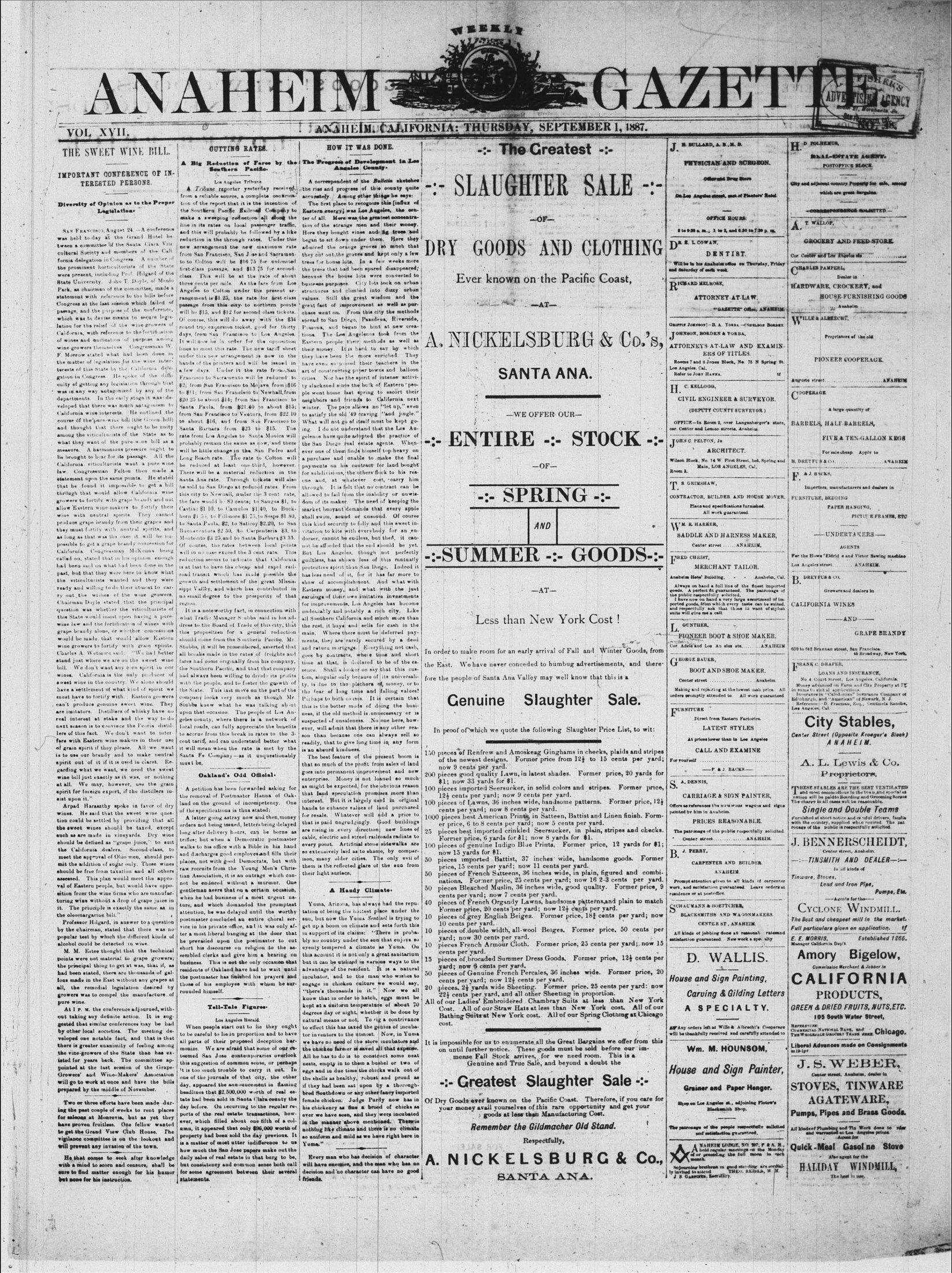
Searchable text
THE SWEET WINE BILL.
IMPORTANT CONFERENCE OF INTERESTED PERSONS.
Diversity of Opinion as to the Proper Legislation
SAN FRANCISCO, August 24. A conference was held today at the Grand Hotel between a committee of the Santa Clara Vita cultural Society and members of the California delegation in Congress. A number of the prominent horticulturists of the State were present, including Prof. Hilgard of the State University. John T. Doyle, of Menlo Park, as chairman of the committee, made a statement with reference to the bills before Congress at the last session which failed of passage, and the purpose of the conference, which was to devise means to secure legislation for the relief of the wine growers of California, with reference to the fortification of wines and unification of purpose among wine-growers themselves. Congressman W. F. Morrow stated what had been done in the matter of legislation for the wine interests of this State by the California delegation in Congress. He spoke of the difficulty of getting any legislation through that was in any way antagonized by any of the departments. In the early stage it was developed that there was much antagonism to California wine interests. He outlined the course of the pure-wine bill (the Green bill) and thought that there ought to be unity among the viticulturists of the State as to what they want of the pure-wine bill as a measure. A harmonious pressure ought to be brought to bear for its passage. All the California viticulturists want a pure wine law. Congressman Felton then made a
OUTTING RATES.
A Big Reduction of Fares by the Southern Pacific.
Los Angeles Tribune
A Tribune reporter yesterday received from a reliable source, a complete confirmation of the report that it is the intention of the Southern Pacific Railroad Company to make a sweeping reduction all along the line in its rates on local passenger traffic, and this will probably be followed by a like reduction in the through rates. Under this new arrangement the new maximum rate from San Francisco, San Jose and Sacramento to Colton will be $16.75 for unlimited first-class passage, and $13.75 for second-class. This will be at the rate of about three cents per mile. As the fare from Los Angeles to Colton under the present arrangement is $1.25, the rate for first-class passage from this city to northern points will be $15, and $12 for second-class tickets. Of course, this will do away with the $34 round trip excursion ticket, good for thirty days, from San Francisco to Los Angeles. It will now be in order for the opposition lines to meet this rate. The new tariff sheet under this new arrangement is now in the hands of the printers and will be issued in a few days. Under it the rate from San Francisco to Sacramento will be reduced to $2; from San Francisco to Mojave from $16 to $11; from San Francisco to Newhall, from $20.25 to about $14; from San Francisco to Santa Paula, from $21.40 to about $15; from San Francisco to Ventura, from $22.10 to about $16, and from San Francisco to Santa Barbara from $23 to $15. The rate from Los Angeles to Santa Monica will probably remain the same as now, and there will be little change in the San Pedro and Long Beach rate. The rate to Colton will be reduced at least one-third, however. There will be a material reduction in the
HOW IT
The Progress of Angola
A correspondent on the rise and progress accurately. Among The first place to Eastern energy waster of all. Here warned here they bought vines began to sit down unadmired the orange they cut out; the grove trees for house lots. The trees that had been because the house business purposes structures and climatic values. Still the great fact of improvement went on. From spread to San Diego Pomona, and bagatrices. The Los Angeles Eastern people their money. It is they have been they have even surpassed art of constructing cities. Nor has they been slackened since they went home last neighbors and friend winter. The pace at to satisfy the old '49 What will not go off ing. I do not understand gelenos have quite as the San Diego real ever one of them fingering a purchase and una payments on his co for subdivisions, these
gation in Congress. He spoke of the difficulty of getting any legislation through that was in any way antagonized by any of the departments. In the early stage it was developed that there was much antagonism to California wine interests. He outlined the course of the pure-wine bill (the Green bill) and thought that there ought to be unity among the viticulturists of the State as to what they want of the pure-wine bill as a measure. A harmonious pressure ought to be brought to bear for its passage. All the California viticulturists want a pure wine law. Congressman Felton then made a statement upon the same points. He stated that he found it impossible to get a bill through that would allow California wine growers to fortify with grape brandy and not allow Eastern wine-makers to fortify their wine with neutral spirits. They cannot produce grape brandy from their grapes and they must fortify with neutral spirits, and as long as that was the case it will be impossible to get a grape brandy concession for California. Congressman McKenna being called on, stated that in his opinion enough had been said on what had been done in the past, but that they were here to know what the viticulturists wanted and they were ready and willing to do their utmost to carry out the wishes of the wine growers. Chairman Doyle stated that the principal question was whether the viticulturists of this State would insist upon having a pure wine law and the fortification of wines with grape brandy alone, or whether concessions would be made that would allow Eastern wine growers to fortify with grain spirits. Charles A. Wetmore said: "We had better stand just where we are on the sweet wine bill. We don't want any corn spirit in our wines. California is the only producer of sweet wine in the country. We alone should have a settlement of what kind of spirit we must have to fortify with. Eastern growers can't produce genuine sweet wine. They are imitators. Distillers of whisky have no real interest at stake and the way to do next season is to convince the Peoria distillers of this fact. We don't want to interfere with Eastern wine makers in their use of grain spirit if they please. All we want is to use our brandy and to make neutral spirit out of it if it is used in claret. Regarding what we want, we need the sweet wine bill just exactly as it was, or nothing at all. We may, however, use the grain spirit for foreign export, if the distillers insist upon it."
Arpad Haraszthy spoke in favor of dry wines. He said that the sweet wine question could be settled by providing that all the sweet wines should be taxed, except such as are made in vineyards. Dry wine should be defined as "grape juice," to suit the California dealers. Second-class, to meet the approval of Ohio men, should permit the addition of sugar only. Those wines should be free from taxation and all others assessed. This plan would meet the approval of Eastern people, but would have opposition from the wine firms who are manufac-tion in Congress. He spoke of the difficulty of getting any legislation through that was in any way antagonized by any of the departments. In the early stage it was devel-oped that there was much antagonism to California wine interests. He outlined the course of the pure-wine bill (the Green bill) and thought that there ought to be unity among the viticulturists of the State as to what they want of the pure-wine bill as a measure. A harmonious pressure ought to be brought to bear for its passage. All the California viticulturists want a pure wine law. Congressman Felton then made a statement upon the same points. He stated that he found it impossible to get a bill through that would allow California wine growers to fortify with grape brandy and not allow Eastern wine-makers to fortify their wine with neutral spirits. They cannot produce grape brandy from their grapes and they must fortify with neutral spirits, and as long as that was the case it will be impossible to get a grape brandy concession for California. Congressman McKenna being called on, stated that in his opinion enough had been said on what had been done in the past, but that they were here to know what the viticulturists wanted and they were ready and willing to do their utmost to carry out the wishes of the wine growers.
Chairman Doyle stated that the principal question was whether the viticulturists of this State would insist upon having a pure wine law and the fortification of wines with grape brandy alone, or whether concessions would be made that would allow Eastern wine growers to fortify with grain spirits. Charles A. Wetmore said: "We had better stand just where we are on the sweet wine bill. We don't want any corn spirit in our wines. California is the only producer of sweet wine in the country. We alone should have a settlement of what kind of spirit we must have to fortify with. Eastern growers can't produce genuine sweet wine. They are imitators. Distillers of whisky have no real interest at stake and the way to do next season is to convince the Peoria distillers of this fact. We don't want to interfere with Eastern wine makers in their use of grain spirit if they please. All we want is to use our brandy and to make neutral spirit out of it if it is used in claret. Regarding what we want, we need the sweet wine bill just exactly as it was, or nothing at all. We may, however, use the grain spirit for foreign export, if the distillers insist upon it."
Arpad Haraszthy spoke in favor of dry wines. He said that the sweet wine question could be settled by providing that all the sweet wines should be taxed, except such as are made in vineyards. Dry wine should be defined as "grape juice," to suit the California dealers. Second-class, to meet the approval of Ohio men, should permit the addition of sugar only. Those wines should be free from taxation and all others assessed. This plan would meet the approval of Eastern people, but would have opposition from the wine firms who are manufact-ration in Congress. He spoke of the difficulty of getting any legislation through that was in any way antagonized by any of the departments. In the early stage it was devel-oped that there was much antagonism to California wine interests. He outlined the course of the pure-wine bill (the Green bill) and thought that there ought to be unity among the viticulturists of the State as to what they want of the pure-wine bill as a measure. A harmonious pressure ought to be brought to bear for its passage. All the California viticulturists want a pure wine law. Congressman Felton then made a statement upon the same points. He stated that he found it impossible to get a bill through that would allow California wine growers to fortify with grape brandy and not allow Eastern wine-makers to fortify their wine with neutral spirits. They cannot produce grape brandy from their grapes and they must fortify with neutral spirits, and as long as that was the case it will be impossible to get a grape brandy concession for California. Congressman McKenna being called on, stated that in his opinion enough had been said on what had been done in the past, but that they were here to know what the viticulturists wanted and they were ready and willing to do their utmost to carry out the wishes of the wine growers.
Chairman Doyle stated that the principal question was whether the viticulturists of this State would insist upon having a pure wine law and the fortification of wines with grape brandy alone, or whether concessions would be made that would allow Eastern wine growers to fortify with grain spirits. Charles A. Wetmore said: "We had better stand just where we are on the sweet wine bill. We don't want any corn spirit in our wines. California is the only producer of sweet wine in the country. We alone should have a settlement of what kind of spirit we must have to fortify with. Eastern growers can't produce genuine sweet wine. They are imitators. Distillers of whisky have no real interest at stake and the way to do next season is to convince the Peoria distillers of this fact. We don't want to interfere with Eastern wine makers in their use of grain spirit if they please. All we want is to use our brandy and to make neutral spirit out of it if it is used in claret. Regarding what we want, we need the sweet wine bill just exactly as it was, or nothing at all. We may, however, use the grain spirit for foreign export, if the distillers insist upon it."
Arpad Haraszthy spoke in favor of dry wines. He said that the sweet wine question could be settled by providing that all the sweet wines should be taxed, except such as are made in vineyards. Dry wine should be defined as "grape juice," to suit the California dealers. Second-class, to meet the approval of Ohio men, should permit the addition of sugar only. Those wines should be free from taxation and all others assessed. This plan would meet the approval of Eastern people, but would have opposition from the wine firms who are manufact-ration in Congress. He spoke of the difficulty of getting any legislation through that was in any way antagonized by any of the departments. In the early stage it was devel-oped that there was much antagonism to California wine interests. He outlined the course of the pure-wine bill (the Green bill) and thought that there ought to be unity among the viticulturists of the State as to what they want of the pure-wine bill as a measure. A harmonious pressure ought to be reduced at $2; from San Francisco to Mojave from $16 to $11; from San Francisco to Newhall, from $20 25 to about $14; from San Francisco to Santa Paula, from $21 40 to about $15; from San Francisco to Ventura, from $22 10 to about $16; and from San Francisco to Santa Barbara from $23 to $15.The rate from Los Angeles to Santa Monica will probably remain the same as now, and there will be little change in the San Pedro and Long Beach rate.The rate to Colton will be reduced at least one-third, however There will be a material reduction in Santa Ana rate.Trough tickets will also be sold to San Diego at reduced rates.From this city to Newhall, under the 3 cent rate,the fare would be 80 cents; to Sangus $1,to Castiaco $1 10,tom Camulos $1 14,tom Buckhorn $1 50,tillmore $1 75,tospe $1 80,tom Santa Paula,$2,tos Saticoy $2 20,tom Buenaventura $2 50,tocarpenteria $3,tomontecito $3 25,and tocanta Barbara $3 35.Of course,the rates between local points will in no case exceed the 3 cent rateThis reduction seems to indicate that California is at last to have the cheap and rapid railroad transit which has made possible growth and settlement of the great Mississippi Valley,and which has contributed in no small degree to the prosperity of that region.
It is a noteworthy fact,in connection with what Traffic Manager Stubbs said in his addressto the Board of Trade of this city,that this proposition for a general reductionshould come fromthe Southern Pacific,Mr Stubbs,它will be remembered,assertedthat all breaks made inthe ratesof freightsand fareshad come originallyfrom his company,the Southern Pacific,and that that companyhad always been willingto divide its profitswiththe people,andto fosterthe growthoftheStateThis last move onthe partofthecompany looksverymuchas thoughMr Stubbs knewwhat hewas talkingaboutthat occasion.ThepeopleofLosAngelescountywherethereisanetworkoflocalroadscanfullyappreciatethebenefitstocarcerfromthisbreakinratestothe3centtariff,andcanunderstandbetwearthatwillmeanwhentherateismetbytheSantaFeCompany-asitunquestionablymustbe.
Oakland's Odd Official
A petition has been forwarded askingforthe removalofPostmaster Hanuaof Oaklandonthegroundofincompetency.Onofthespecificationsis thusstated:
A letter going astraynowandthen,moneyordersnotbeingissued,Lettersbeingdelayedlongafterdeliveryhours,canbeborneastrifles;butwhenaDemocraticpostmasterwalkstohisofficewithaBibleinhishandanddischargesgoodemployeesandfillstheirplaces,notwithgoodDemocrats,butwithrawrecruitsfromtheYoungMen'sChristianAssociation,它isanoutragewhichcannotbeenduredwithouta murmurOnegentlemanaversthatona certainoccasion,whenhehadbusinessofamosturgentna-city.Norhasthecityslackenedsincetheplewenthomelastneighborsandfriendwinter.Thepaceadto satisfytheold'49Whatwillnotgooffing.Ido notundergelenoshavequitealamostomachibuyantdemishswould swim,soundofthiskindsecuritytotvitationtokitewithdorser,cannotbeenusedthatbutlosseriverseverwill admitthatsonthanbecauseoreadily,thattogiveanaburdkindnessThebestfeatureoncertainsofmuchofthee-governingsintopermanententerprise.Moneyasmightbeexpectedthatlandspeculationinterest.Bitlethisispaidungrudeare risingineverycable,electricandsteverypoint.Antificiationsoextensivelylaidason,manyoldercitizensisthereflectedtheirlightsurface。
Arpad Haraszthy spoke in favor of dry wines. He said that the sweet wine question could be settled by providing that all the sweet wines should be taxed, except such as are made in vineyards. Dry wine should be defined as "grape juice," to suit the California dealers. Second-class, to meet the approval of Ohio men, should permit the addition of sugar only. Those wines should be free from taxation and all others assessed. This plan would meet the approval of Eastern people, but would have opposition from the wine firms who are manufacturing wine without a drop of grape juice in it. The principle is exactly the same as in the oleomargarine bill.
Professor Hilgard, in answer to a question by the chairman, stated that there was no popular test by which the different kinds of alcohol could be detected in wine.
M. M. Estee thought that the technical points were not material to grape growers; the principal thing to get at was, that if, as had been stated, there are thousands of gallons made in the East without any grapes at all, the remedial legislation desired by growers was to compel the manufacture of pure wine.
At 1 P.M. the conference adjourned, without taking any definite action. It is suggested that similar conferences may be had by other local societies. The meeting developed one notable fact, and that is that there is greater unanimity of feeling among the vine-growers of the State than has existed for years back. The committee appointed at the last session of the Grape-Growers' and Wine-Makers' Association will go to work at once and have the bills prepared by the middle of November.
Two or three efforts have been made during the past couple of weeks to rent places for saloons at Monrovia, but as yet they have proven fruitless. One fellow wanted to get the Grand View Club House. The vigilance committee is on the lookout and will prevent any invasion of the town.
He that comes to seek after knowledge with a mind to scorn and censure, shall be sure to find matter enough for his humor but none for his instruction.
A letter going astray now and then, money orders not being issued, letters being delayed long after delivery hours, can be borne as trifles; but when a Democratic postmaster walks to his office with a Bible in his hand and discharges good employs and fills their places, not with good Democrats, but with raw recruits from the Young Men's Christian Association, it is an outrage which cannot be endured without a murmur. One gentleman avers that on a certain occasion, when he had business of a most urgent nature, and which demanded the promptest attention, he was delayed until the worthy postmaster concluded an entire choral service in his private office, and it was only after a most liberal banging at the door that he prevailed upon the postmaster to cut short his discourse on religion to the assembled clerks and give him a hearing on business. This is not the only occasion that residents of Oakland have had to wait until the postmaster has finished his prayers and those of his employees with whom he surrounded himself.
Tell-Tale FiguresLos Angeles Herald
When people start out to lie they ought to be careful to lie in proportion and to have all parts of their proposed deception harmonize. We are afraid that some of our esteemed San Jose contemporaries overlook this suggestion of common sense, or perhaps it is too much trouble to carry it out. In one of the journals of that city, the other day, appeared the announcement in flaming headlines that $2,500,000 worth of real estate had been sold in Santa Clara county the day before. On recurring to the regular reports of the real estate transactions, however, which filled about one fifth of a column, it appeared that only $96,000 worth of property had been sold the day previous. It is a matter of most utter indifference to us how much the San Jose papers make out the daily sales of real estate in that burg to be, but consistency and common sense both call for some agreement between their several statements.
Yuma, Arizona, station of being the sun, but now the Yuget up a boom on cliff in support of its claim by no country under evenly tempered a this account it is not but it can be utilized advantage of the rest incubator, and to engage in chicken "there's thousands know that in order to kept at a uniform degree day or night natural means or not to effect this has taxor inventors to the we have no need of the chicken farmer in All he has to do is these, empty in to the eggs and in due time the shells as healthy if they had been sathed Southdown or female chicken. Just his chickenry as fin ever we have seen, in the manner above nothing like climate so uniform and mild Yuma."
WEEKLY
ANAHEIM, CALIFORNIA: THURSDAY, SEPTEMBER 1, 1887.
HOW IT WAS DONE.
The Progress of Development in Los Angeles County.
A correspondent of the Bulletin sketches the rise and progress of this county quite accurately. Among other things he says:
The first place to recognize this [influx of Eastern energy] was Los Angeles, the center of all. Here was the greatest concentration of the strange men and their money. Here they bought vines and fig trees and began to sit down under them. Here they admired the orange groves so much that they cut out, the groves and kept only a few trees for house lots. In a few weeks more the trees that had been spared disappeared; because the house lots were converted to business purposes. City lots took on urban structures and climbed into dizzy urban values. Still the great wisdom and the great fact of improvement as well as purchase went on. From this city the methods spread to San Diego, Pasadena, Riverside, Pomona, and began to hint at new creations. The Los Angelesans took from the Eastern people their methods as well as their money. It is hard to say by which they have been the more enriched. They have even surpassed their teachers in the art of constructing paper towns and balloon cities. Nor has the spirit of intense activity slackened since the bulk of Eastern people went home last spring to escort their neighbors and friends to California next winter. The pace allows no "let up," even to satisfy the old '49 craving "and jingle." What will not go of itself must be kept going. I do not understand that the Los Angelesans have quite adopted the practice of the San Diego real estate agents. Whenever one of them finds himself top-heavy on a purchase and unable to make the final payments on his contract for land bought for subdivisions, the others flock to his res-
-- The Greatest --
-- SLAUGHTER SALE --
OF--
DRY GOODS AND CLOTHING
Ever known on the Pacific Coast,
AT--
A. NICKELSBURG & Co.'s,
SANTA ANA.
—WE OFFER OUR—
ENTIRE -- STOCK --
OF—
SANTA ANA.
—WE OFFER OUR—
÷ ENTIRE ÷ STOCK ÷
—OF—
÷ SPRING ÷
AND
÷ SUMMER ÷ GOODS ÷
—AT—
Less than New York Cost!
In order to make room for an early arrival of Fall and Winter Goods, from the East. We have never conceded to humbug advertisements, and therefore the people of Santa Ana Valley may well know that this is a Genuine Slaughter Sale.
In proof of which we quote the following Slaughter Price List, to wit:
150 pieces of Renfrew and Amoskeag Ginghams in checks, plaids and stripes of the newest designs. Former price from 12½ to 15 cents per yard; now 9 cents per yard.
200 pieces good quality Lawn, in latest shades. Former price, 20 yards for $1; now 33 yards for $1.
100 pieces imported Seersucker, in solid colors and stripes. Former price, 12½ cents per yard; now 9 cents per yard.
100 pieces of Lawns, 36 inches wide, handsome patterns. Former price, 12½ cents per yard; now 8 cents per yard.
1000 pieces best American Prints, in Satteen, Battist and Linen finish. Former price, 6 to 8 cents per yard; now 5 cents per yard.
25 pieces best imported crinkled Seersucker, in plain, stripes and checks. Former price, 6 yards for $1; now 8 yards for $1.
100 pieces of genuine Indigo Blue Prints. Former price, 12 yards for $1; now 15 yards for $1.
50 pieces imported Battist, 37 inches wide, handsome goods. Former price, 15 cents per yard; now 11 cents per yard.
50 pieces of French Satteens, 36 inches wide, in plain, figured and combinations. Former price, 25 cents per yard; now 16 2-3 cents per yard.
50 pieces Bleached Muslin, 36 inches wide, good quality. Former price, 9 cents per yard; now 7 cents per yard.
A Handy Climate.
Yuma, Arizona, has always had the reputation of being the hottest place under the sun, but now the Yuma Sentinel is trying to get up a boom on climate and sets forth this in support of its claims: "There is probably no country under the sun that enjoys so evenly tempered a climate as Yuma. On this account it is not only a great sanitarium but it can be utilized in various ways to the advantage of the resident. It is a natural incubator, and to the man who wishes to engage in chicken culture we would say, 'there's thousands in it.' Now we all know that in order to hatch, eggs must be kept at a uniform temperature of about 70 degrees day or night, whether it be done by natural means or not. To rig a contrivance to effect this has taxed the genius of incubator inventors to the utmost. Now, in Yuma we have no need of the store incubators and the chicken farmer is saved all that expense. All he has to do is to construct some neat nests, empty in to them a bushel or two of eggs and in due time the chicks walk out of the shells as healthy, robust and proud as if they had been sat upon by a thorough-bred Southdown or any other fancy imported female chicken. Judge Purly now has in his chickenry as fine a brood of chicks as ever we have seen, and they were incubated in the manner above mentioned. There is nothing like climate and there is no climate so uniform and mild as we have right here in Yuma."
Every man who has decision of character will have enemies, and the man who has no decision and no character can have no good friends.
100 pieces of Lawns, 36 inches wide, handsome patterns. Former price, 12½ cents per yard; now 8 cents per yard.
1000 pieces best American Prints in Satteen, Battist and Linen finish. Former price, 6 to 8 cents per yard; now 5 cents per yard.
25 pieces best imported crinkled Seersucker, in plain, stripes and checks. Former price, 6 yards for $1; now 8 yards for $1.
100 pieces of genuine Indigo Blue Prints. Former price, 12 yards for $1; now 15 yards for $1.
50 pieces imported Battist, 37 inches wide, handsome goods. Former price, 15 cents per yard; now 11 cents per yard.
50 pieces of French Satteens, 36 inches wide, in plain, figured and combinations. Former price, 25 cents per yard; now 16 2-3 cents per yard.
50 pieces Bleached Muslin, 36 inches wide, good quality. Former price, 9 cents per yard; now 7 cents per yard.
40 pieces of French Organdy Lawns, handsome patterns,and plain to match Former price, 20 cents per yard; now 12½ cents per yard.
10 pieces of grey English Beiges. Former price, 18¼ cents per yard; now 10 cents per yard.
10 pieces of double width, all-wool Beiges. Former price, 50 cents per yard; now 30 cents per yard.
10 pieces French Armour Cloth. Former price, 25 cents per yard; now 15 cents per yard.
15 pieces of brocaded Summer Dress Goods. Former price, 12½ cents per yard; now 6 cents per yard.
50 pieces of Genuine French Percales, 36 inches wide. Former price, 20 cents per yard; now 12½ cents per yard.
20 pieces, 2½ yards wide Sheeting. Former price, 25 cents per yard: now 22½ cents per yard, and all other Sheeting in proportion.
All of our Ladies' Embroidered Chambray Suits at less than New York Cost. All of our Straw Hats at less than New York cost. All of our Bathing Suits at New York cost. All of our Spring Clothing at Chicago cost.
It is impossible for us to enumerate all the Great Bargains we offer from this on until further notice. These goods must be sold before our immense Fall Stock arrives, for we need room. This is a Genuine and True Sale, and beyond a doubt the
-- Greatest Slaughter Sale --
Of Dry Goods ever known on the Pacific Coast. Therefore, if you care for your money avail yourselves of this rare opportunity and get your goods at less than Manufacturing Cost.
Remember the Gildmacher Old Stand.
Respectfully,
A. NICKELSBURG & Co.,
SANTA ANA.
GAZETTE
ER 1, 1887.
ALE
LOTHING
Coast,
& Co.'s,
OCK
J. R. BULLARD, A. B., M. R.
PHYSICIAN AND SURGEON.
Offer and Drug Store
On Los Angeles street, east of Pineater' Hotel.
OFFICE HOURS:
8 to 9:20 a.m.; 1 to 2, and 6:35 to 7:30 p.m.
DR. R. L. COWAN,
DENTIST.
Will be in his Anaheim office on Thursday, Friday
and Saturday of each week.
RICHARD MELROSE,
ATTORNEY-AT-LAW.
"GAZETTE" Office, Anaheim.
GRIFFIN JOHNSON]—B. A. YORBA—(SHELTON BORDEN)
JOHNSON, BORDEN & YORBA,
ATTORNEYS AT-LAW AND EXAMINERS OF TITLES.
Rooms 7 and 8 Jones Block, No. 75 N Spring St.
Los Angeles, Cal.
Refer to John Hanna.
H. C. KELLOGG,
CIVIL ENGINEER & SURVEYOR.
(DEPUTY COUNTY SURVEYOR.)
OFFICE—In Room 2, over Langenberger's store,
cor. Center and Lemon streets, Anaheim.
JOHN C. PELTON, Jr.
ARCHITECT.
Wilson Block, No. 14 W. First Street, bet. Spring and
Main, LOS ANGELES, Cal.
Room 2.
H. D. POLHEMUS,
REAL-ESTATE AGENT.
POSTOFFICE BLOCK.
City and adjacent country Property for sale, among
which are great bargains.
A. T. WALLOP,
GROCERY AND FEED STORE.
Cor. Center and Los Angeles stn.
CHARLES PAMPERL,
Dealer in
HARDWARE, CROCKERY, and
HOUSE-FURNISHING GOODS
Anaheim.
WILLE & ALBRECHT,
Propriators of the old
PIONEER COOPERAGE.
COOPERAGE.
A large quantity of
BARRELS, HALF-BARRELS,
FIVE & TEN-GALLON KEGS
For sale cheap Apply to
B. DREYFUS & CO.
D. J. BACKS.
H. C. KELLOGG,
CIVIL ENGINEER & SURVEYOR.
(DEPUTY COUNTY SURVEYOR)
OFFICE—In Room 2, over Langenberger's store,
cor. Center and Lemon streets, Anaheim.
JOHN C. PELTON, Jr.
ARCHITECT.
Wilson Block, No. 14 W. First Street, bet. Spring and
Main, LOS ANGELES, Cal.
Room 2.
T. S. GRIMSHAW,
CONTRACTOR, BUILDER AND HOUSE MOVER.
Plans and specifications furnished.
All work guaranteed.
WM. R. HARKER,
SADDLE AND HARNESS MAKER,
Center street ...ANAHEIM.
FRED CHRIST,
MERCHANT TAILOR.
Anaheim Hote' Building, Anaheim, Cal.
Always on hand a full line of the finest imported
goods. A perfect fit guaranteed. The patronage of
the public respectfully solicited.
I have now on hand a very large assortment of imported goods, from which every taste can be suited,
and respectfully ask that those in want of stylish
suits will give me a call.
L. GUNTHER,
PIONEER BOOT & SHOE MAKER.
Cor. Adele and Los Angeles sts...ANAHEIM
GEORGE BAUER,
BOOT AND SHOE MAKER.
Center street ... Anaheim
Making and repairing at the lowest cash price. All
orders promptly attended to. All work guaranteed.
FURNITURE
Direct from Eastern Factories.
LATEST STYLES
At prices lower than in Los Angeles
CALL AND EXAMINE
For yourself ...P & J. BACKS—
S. A. DENNIS,
CARRIAGE & SIGN PAINTER.
Offers as references the numerous wagons and signs
painted by him in Anaheim.
PRICES REASONABLE.
The patronage of the public respectfully solicited.
Center street ...ANAHEIM.
B. J. PERRY,
CARPENTER AND BUILDER
ANAHEIM.
Prompt attention given to all kinds of carpenter
work, and satisfaction guaranteed. Leave orders at
residence or at postoffice.
COOPERAGE
A large quantity of
BARRELS, HALF-BARRELS,
FIVE & TEN-GALLON KEGS
For sale cheap Apply to
R. DREYFUS & CO...ANAHEIM
F. & J. BACKS,
Importers, manufacturers and dealers in
FURNITURE, BEDDING
PAPER HANGING,
PICTURE FRAMES, ETC
UNDERTAKERS
AGENTS
For the Howe 'Eldrid e and Victor Sewing machine
Los Angeles street...ANAHEIM.
B. DREYFUS & CO.
Growers and dealers in
CALIFORNIA WINES
AND
GRAPE BRANDY
639 to 642 Brannan street, San Francisco.
45 Broadway, New York.
FRANK C. DRAPER,
LOANS AND INSURANCE,
No 4 Court Street, Los Angeles, California.
Money advanced on Farm and City Property at 7%
in sums to suit all applications.
Insurance in "Caledonian" Insurance Company of
Edinburgh, and "American" of Newark, N.J.
Reference - D. Freeman, Esq., Centinela Ranche,
Los Angeles, Cal.
City Stables,
Center Street (Opposite Kroeger's Block)
ANAHEIM.
A. L. Lewis & Co.
Proprietors.
THESE STABLES ARE THE BEST VENTILATED
and most commodious in the town, and special at
mention will be paid to Boarding and Grooming Horses.
The charve in all cases will be reasonable.
Single and Double Teams
furnished at short notice and careful drivers, family
with the country, supplied when required. The patronage of the public is respectfully solicited.
J. BENNERSCHEIDT,
Center street, Anaheim.
TINSMITH AND DEALER:
In all kinds of
Tinware, Stoves,
Lead and Iron Pipe,
Pumps, Eta.
Offers as references the numerous wagons and signs painted by him in Anaheim.
PRICES REASONABLE.
The patronage of the public respectfully solicited.
Center street...ANAHEIM.
B. J. PERRY,
CARPENTER AND BUILDER
ANAHEIM.
Prompt attention given to all kinds of carpenter work, and satisfaction guaranteed. Leave orders at residence or at postoffice.
SCHAUWANN & BOEITCHER,
BLACKSMITHS AND WAGONMAKERS.
CENTER ST., ANAHEIM.
All kinds of jobbing done at reasonable rates and satisfaction guaranteed. New work a specialty.
D. WALLIS.
House and Sign Painting,
Carving & Gilding Letters
A SPECIALTY.
Any orders left at Wille & Albrecht's Cooperage will be thankfully received and carefully attended to.
Wm. M. HOUNSOM,
House and Sign Painter,
Grainer and Paper Hanger.
Shop on Los Angeles st., adjoining Plotow's Blacksmith Shop.
The patronage of the people respectfully solicited and satisfaction guaranteed.
ANAHEIM LODGE, NO. 207, P. & A. M.
hold regular meetings on the Monday of preceding the full moon in each month.
Sojourning brethren in good standing are cordially invited to attend THEO. REISLR, W. M.
J. S. GARFINES, Secretary.
The charm in all cases will be reasonable.
Single and Double Teams
Furnished at short notice and careful drivers, familiar with the country, supplied when required. The patronage of the public is respectfully solicited.
J. BENNERSCHEIDT,
Center street, Anaheim.
TINSMITH AND DEALER:
In all kinds of
Tinware, Stoves,
Lead and Iron Pipe,
Pumps, Etc.
Agents for the
CYCLONE WINDMILL.
The Best and cheapest mill in the market.
Full particulars given on application.
E. E. MORRIS,
Established 1866.
Manager California Day's
Amory Bigelow,
Commission Merchant & Jobber in CALIFORNIA PRODUCTS,
GREEN & DRIED FRUITS, NUTS,ETC.
105 South Water Street,
REFERENCES:
COMMERCIAL NATIONAL BANK, and THE WHOLESALE GROcery TRADING HERE Chicago.
Liberal Advances made on Consignments milt-lyr
J. S. WEBER,
Center street, Anaheim, dealer in STOVES, TINWARE AGATEWARE,
Pumps, Pipes and Brass Goods.
All kinds of Plumbing and Tin Work done to rdwar and warranted at Los Angeles prices.
Agent for Quick-Meal Gasoline Stove
Also agent for the HALIDAY WINDMILL,
The best in use.