anaheim-gazette 1887-07-21
Scanned page
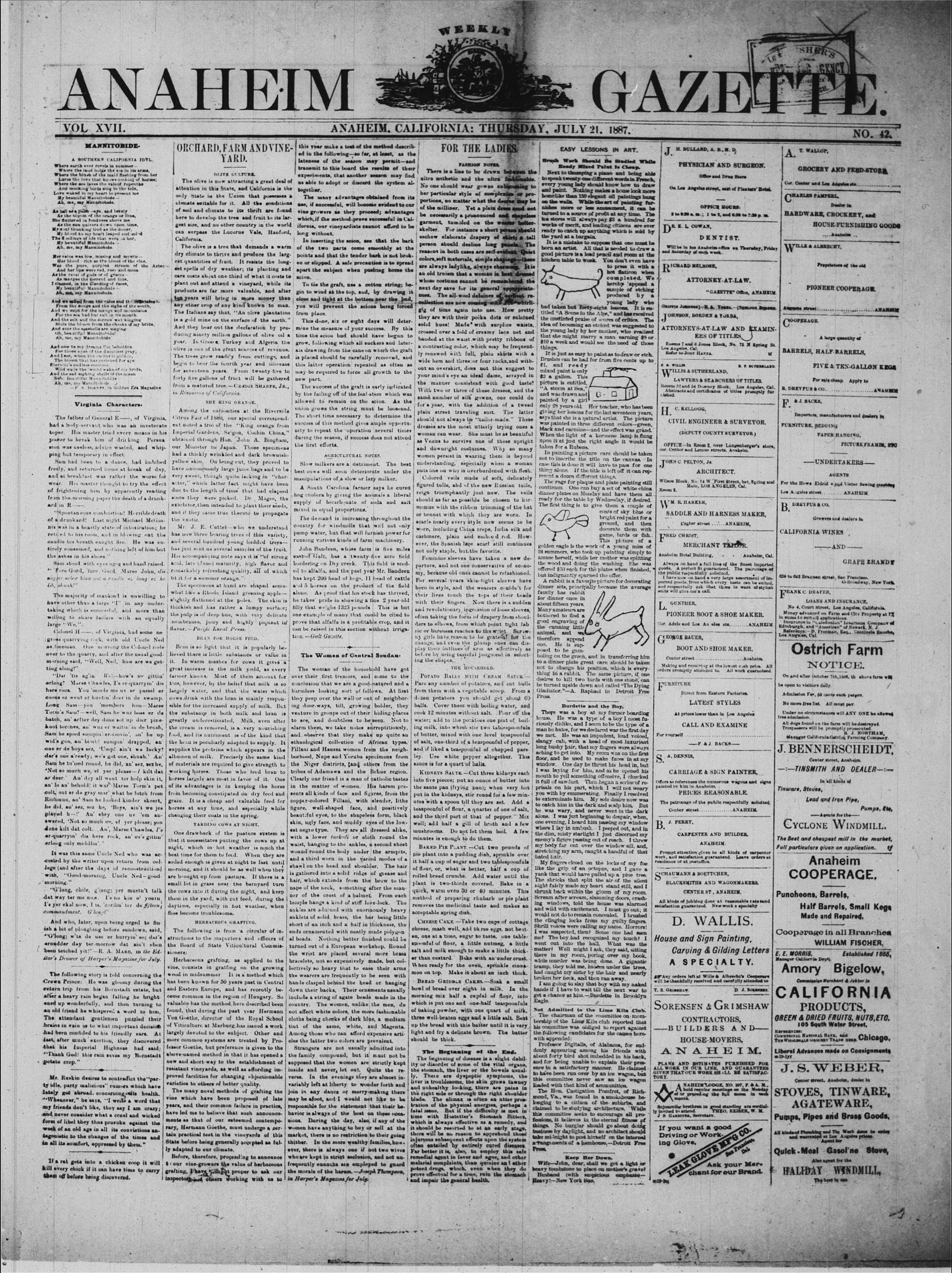
Searchable text
ANAHEIM
VOL XVII.
MANNITOBIDE.
A SOUTHERN CALIFORNIA IDYL.
Where earth ever revels in summer—
Where the land holds the sea in its arms,
Where the blush of the malf flashing from her
Lures the love that knows nothing of harms;
Where the sea laves the vale of repenthe
And mocking birds sing to the tide,
Love waked in my heart to present me
My beautiful Mannitobide—
Ah, me, my Mannitobide.
As tall as a palm—ays, and lovely
As the bloom of the orange or lime,
She fluttered in fondness above me
As the sun quivers down upon time,
My soul thanking God as the donor,
My blood to my heart leaped and spilled
The sodings of life that were on her,
My beautiful Mannitobide—
Ah, me, my Mannitobide.
Her voice was low, musing and mystic—
Her blood—rich as the blood of the vine,
Was the pure, purple stream of the Aztec—
And her lips were red, roses and mine.
As the revel of gods or of graces
As merges the torrent and tide,
I clasped, in the blending of races,
My beautiful Mannitobide—
Ah, me, my Mannitobide.
And we called from the vales and the mountains—
From the songs and the sights of the south,
And we wept for the mango and mountains
For the sea had burst in its mouth
And the salt and the sorrow wet winging
Stoke the bloom from the checks of my bride,
And ever the seashells are singing—
Oh, beautiful Mannitobide!
Ah, me, my Mannitobide.
And now to my dreams I'm beholden
For those eyes of the daintest gray;
And I see, when the cactus is golden,
The bloom that has perished for age.
Eternity's endless emotion
Wild waits the weird wake of my bride,
And the sad sighting shells of the ocean
Sab, Beautiful Mannitobide—
Ah, me, my Mannitobide.
P. S. DORNEY, in Golden Era Magazine
Virginia Characters.
The father of General E——of Virginia,
had a body servant who was an inveterate topper.
His master tried every means in his power to break him of drinking. Persuasion was useless, advice wasted, and whipping but temporary in effect.
Sam had been to a dance, had imbibed freely, and returned home at break of day,
ORCHARD, FARM AND VINE-YARD.
OLIVE CULTURE.
The olive is now attracting a great deal of attention in this State, and California is the only State in the Union that possesses a climate suitable for it. All the conditions of soil and climate to its thrift are found here to develop the tree and fruit to its largest size, and no other country in the world can surpass the Lucerne Vale, Hanford, California.
The olive is a tree that demands a warm dry climate to thrive and produce the largest quantities of fruit. It resists the longest spells of dry weather; its planting and care costs about one-third of what it costs to plant out and attend a vineyard, while its products are far more valuable, and after ten years will bring in more money than any other crop of any kind known to man.
The Italians say that, "An olive plantation is a gold mine on the surface of the earth." And they bear out the declaration by producing ninety million gallons of olive oil a year. In Greece, Turkey and Algeria the olive is one of the great sources of revenue. The trees grow readily from cuttings, and begin to bear the fourth year and increase for seventeen years. From twenty-five to forty five gallons of fruit will be gathered from a matured tree.—CRAIGE SHARPE, JR., in Resources of California.
THE KING ORANGE.
Among the curiosities at the Riverside Citrus Fair of 1880, our special correspondent noted a trio of the "King orange from Imperial Gardens, Saigon, Cochin China," obtained through Hon. John A. Bingham, our Minister to Japan. Those specimens had a thickly wrinkled and dark brownish-yellow skin. On being cut, they proved to have uncommonly large juice bags and to be this year make a test ed in the following—lateness of the season transmit to this board experiments, that ano us able to adopt or do together.
The many advantages use, if successful, will vine growers as they which, if the method pifornia, our vineyardis long without.
In inserting the science of the two parts points and that the te en or slipped. A safe part apart the subject whe scien.
To tie the graft, use gin to wind at the top close and tight at the end you will prevent them from place.
This done, six or eight mine the measure of your time the acion bud sh grow, following which als drawing from the c is placed should be carried this latter operation may be required to form new part.
The success of the graft by the failing off of the allowed to remain on union grows the string.
The short time necessa success of this method during the season, if sui the first efforts.
AGECULTURE.
Slow milkers are a d best cows will soon de
Virginia Characters.
The father of General E———, of Virginia, had a body servant who was an inveterate toper. His master tried every means in his power to break him of drinking. Persua sion was useless, advice wasted, and whipping but temporary in effect.
Sam had been to a dance, had imbibed freely, and returned home at break of day, and at breakfast was rather the worse for wear. His master thought to try the effect of frightening him by apparently reading from the morning paper the death of a drunkard in R———
"Spontaneous combustion! Horrible death of a drunkard! Last night Michael McGinnis was in a beastly state of intoxication; he retired to his room, and in blowing out the candle his breath caught fire. He was entirely consumed, and nothing left of him but the ashes in his shoes."
Sam stood with eyes ageg and hand raised. "Fore Gord, fore Good, Marse John, disigner sewer blown out a rumble ez long ez he lib, shawh!"
The majority of mankind is unwilling to have other than a large "I" in any undertaking which is successful, and more than willing to share failure with an equally large "We." Colonel H———, of Virginia, had some necrous quarrying rock, with old Uncle Ned as foreman. One morning the Colonel rode over to the quarry, and after the usual good-morning said, "Well, Ned, how are we getting along?"
"Dar 'tis ag'in. We!—how's we gittin' erlong? Marse Chawles, I's er-quarryin' dis here roca. You 'minds me uv er passel er coons ez went er huntin' deer in de swamp. Long Sam —you 'members him —Marse Torm's Sam?—well, Sam he wuz boss er de batch, an' arfter dey done sat up dier pine-knot torches, an' wuz er waitin' in de brush, Sam he spied sumpin' er-novin', an' he up wid's gun, an' bimb! sumpin' drapped, an one er de boys sez, 'Ump! ain't we lucky? dar's one already; we're got one, shuah.' An' Sam he tu'ned round, he did, an' sez, sez he, Not so much we, ef yer please—i kilt dat ar deer.' An' dey all went ter holp skin it, an' lo an' behold! it war Marse Torm's pet colt, out er de gray mar' what he fotch from Richmun, an' Sam he looked kinder skeert, he did, an' sez, sez he, 'Boys, ain't we js played h—! An' ebry one uv 'em answered, 'Not so much ice, ef yer please; you done kilt dat colt. An', Marse Chawles, I's er-quarryin' dis here rock, an' we've gittin' erlong only middlin'."
It was this same Uncle Ned who was accosted by the writer upon return from college (and after the days of reconstruction) with, "Good-morning, Uncle Ned—good-morning."
"G'long, chile, g'long; yer mustn't talk dat way ter me now. Is'n kin o' yours forty five gallons of fruit will be gathered from a mature tree.—CREAGE SHARPE, JR., in Resources of California.
THE KING ORANGE.
Among the curiosities at the Riverside Citrus Fair of 1880, our special correspondent noted a trio of the "King orange from Imperial Gardens, Saigon, Cochin China," obtained through Hon. John A. Bingham, our Minister to Japan. Those specimens had a thickly wrinkled and dark brownish-yellow skin. On being cut, they proved to have ancommonly large juice bags and to be very sweet, though quite lacking in "character," which latter fact might have been due to the length of time that had elapsed since they were picked. Dr. Magee, the exhibitor, then intended to plant their seeds, and if they came true thereto to propagate the exotic.
Mr. J. E. Cutter—who we understand has now three bearing trees of this variety, and several hundred young budded trees—has just sent us several samples of the fruit. His accompanying note says it is "of strong acid, late (June) maturity, high flavor and remarkably refreshing quality, all of which hit it for a summer orange."
The specimens at hand are shaped somewhat like a Rhode Island greening apple—slightly flattened at the poles. The skin is thickish and has rather a lumpy surface; the pulp is of deep hue, with very delicate membranes, juicy and highly piquant in flavor.—Pacific kural Press.
BRAN FOR HOUSE FEED.
Bran is so light that it is popularly believed there is little substance or value in it. In warm mashes for cows it gives a great increase in the milk yield, as every farmer knows. Most of them account for this, however, by the belief that milk is so largely water, and that the water which cows drink with the bran is mainly responsible for the increased supply of milk. But the substance in both milk and bran is greatly underestimated. Milk, even after the cream is removed, is a very nourishing food, and its nutriment is of the kind that the bran is peculiarly adapted to supply. It supplies the protome which appears in the albumen of milk. Precisely the same kind of materials are required to give strength to working horses. Those who feed bran to horses largely are most in favor of it. One of its advantages is in keeping the horse from becoming constipated on dry feed and grain. It is a cheap and valuable feed for horses at any time, and especially while changing their coats in the spring.
YARDING COWS AT NIGHT.
One drawback of the pasture system is that it necessitates putting the cows up at night, which in hot weather is much the best time for them to feed. When they are soiled enough is given at night to last until morning, and it should be as well when they are brought up from pasture. If there is a small lot in grass near the barnyard turn the cows into it during the night, and keep them in the yard with cut feed during the
Richmun, an' Sam he looked kinder skeert,
he did, an' sez, sez he, 'Boys, ain't we jeas played h—! An' ebry one uv 'em answered,
'Not so much ice, ef yer please; you done kilt dat colt. An', Marse Chawles, I's er-quarryin' dis here rock, an' we're gittin' erlong only middlin'.
It was this same Uncle Ned who was accosted by the writer upon return from college (and after the days of reconstruction) with, "Good-morning, Uncle Ned—good-morning."
"G'long, chile, g'long; yer mustn't talk dat way ter me now. I'm no kin o' yours. I'm yer ekal now, I is, cordin' ter de fifteen commandment. G'long!
And who, later, upon being urged to finish a bit of ploughing before sundown, said, "G'long; w'ts de use er hurryin' so; dar's arnudder day ter-morrow dat ain't eben been tetched yit!" — R. A. MARK, in the Editor's Drover of Harper's Magazine for July.
The following story is told concerning the Crown Prince: He was gloomy during the return trip from his Bornstadt estate, but after a heavy rain began falling he brightened up wonderfully, and then turning to an old friend he whispered a word to him. The attendant gentlemen puzzled their brains in vain as to what important decision had been considered to his friendly ears. At last, after much exertion, they discovered that his Imperial Highness had said: "Thank God! this rain saves my Bornstadt potato crop."
Mr. Ruskin desires to contradict the "party idle, party malicious" rumors which have lately got abroad, concerning his health. "Whenever," he says, "I write a word that my friends don't like, they say I am crazy; and never consider what a cruel and wicked form of libel they thus provoke against the work of an old age in all its convictions antagonistic to the changes of the times and in all its comfort, oppressed by them."
If a rat gets into a chicken coop it will kill every chick if it can have time to carry them off before being discovered.
One drawback of the pasture system is that it necessitates putting the cows up at night, which in hot weather is much the best time for them to feed. When they are soiled enough is given at night to last until morning, and it should be as well when they are brought up from pasture. If there is a small lot in grass near the barnyard turn the cows into it during the night, and keep them in the yard, with cut feed, during the daytime, especially in hot weather, when flies become troublesome.
HERBACEOUS GRAFTING.
The following is from a circular of instructions to the inspectors and officers of the Board of State Viticultural Commissioners:
Herbaceous grafting, as applied to the vine, consists in grafting on the growing wood in midsummer. It is a method which has been known for 50 years past in Central and Eastern Europe, and has recently become common in the region of Hungary. So valuable has the method here described been found, that during the past year Hermann Von Goethe, director of the Royal School of Viticulture at Marburg, has issued a work largely devoted to the subject. Other and more common systems are treated by Professor Goethe, but preference is given to the above-named method in that it has opened a new and short way to the establishment of resistant vineyards, as well as affording improved facilities for changing objectionable varieties to others of better quality.
The many novel methods of grafting the vine which have been proposed of late years, and their common failure in practice, have led me to believe that such announcements as that of our esteemed contemporary, Hermann Goethe, must undergo a certain practical test in the vineyards of this State before being generally accepted as fully adapted to our climate.
Before, therefore, proceeding to announce to our vine-growers the value of herbaceous grafting, I have thought proper to ask our inspectors and others working with us to grain. It is a cheap and valuable feed for horses at any time, and especially while changing their coats in the spring.
YARDING COWS AT NIGHT.
One drawback of the pasture system is that it necessitates putting the cows up at night, which in hot weather is much the best time for them to feed. When they are soiled enough is given at night to last until morning, and it should be as well when they are brought up from pasture. If there is a small lot in grass near the barnyard turn the cows into it during the night, and keep them in the yard, with cut feed, during the daytime, especially in hot weather, when flies become troublesome.
HERBACEOUS GRAFTING.
The following is from a circular of instructions to the inspectors and officers of the Board of State Viticultural Commissioners:
Herbaceous grafting, as applied to the vine, consists in grafting on the growing wood in midsummer. It is a method which has been known for 50 years past in Central and Eastern Europe, and has recently become common in the region of Hungary. So valuable has the method here described been found, that during the past year Hermann Von Goethe, director of the Royal School of Viticulture at Marburg, has issued a work largely devoted to the subject. Other and more common systems are treated by Professor Goethe, but preference is given to the above-named method in that it has opened a new and short way to the establishment of resistant vineyards, as well as affording improved facilities for changing objectionable varieties to others of better quality.
STRANGERS ARE NOT USED THE FAMILY COMPound, BUT SUPPLIED THAT THE WOMEN INSIDE AND NEVER LET OUT VERSE. In the evenings they variably left at liberty to join in any dance or may be afoot, and I would responsible for the statemen havior is always of the biosia. During the day women have anything to do market, there is no restraint thither. In the more worn ever there is always one who are kept in strict sec frequently ennuchs are edthe morals of the harem...in Harper's Magazine for
WEEKLY
IM GA
ANAHEIM, CALIFORNIA: THURSDAY, JULY 21. 1887.
this year make a test of the method described in the following—so far, at least, as the lateness of the season may permit—and transmit to this board the results of their experiments, that another season may find us able to adopt or discard the system altogether.
The many advantages obtained from its use, if successful, will become evident to our vine growers as they proceed; advantages which, if the method prove successful in California, our vineyardists cannot afford to be long without.
In inserting the scion, see that the bark of the two parts come smoothly at the points and that the tender bark is not broken or slipped. A safe precaution is to spread apart the subject when pushing home the scion.
To tie the graft, use a cotton string; begin to wind at the top, and, by drawing it close and tight at the bottom near the bud, you will prevent the scions being forced from place.
This done, six or eight days will determine the measure of your success. By this time the scion bud should have begun to grow, following which all suckers and laterais drawing from the cane on which the graft is placed should be carefully removed, and this latter operation repeated as often as may be required to force all growth to the new part.
The success of the graft is early indicated by the failing off of the leaf-stem which was allowed to remain on the scion. As the union grows the string must be loosened. The short time necessary to determine the success of this method gives ample opportunity to repeat the operation several times during the season, if success does not attend the first efforts.
AGRICULTURAL NOTES.
Slow milkers are a detriment. The best cows will soon deteriorate under the
FOR THE LADIES.
FASHION NOTES.
There is a line to be drawn between the ultra aesthetic and the ultra fashionable. No one should wear gowns unbecoming to her particular style of complexion or proportions, no matter what the decree may be of the milliner. Yet a plain dress need not be necessarily a pronounced and shapeless garment, tumbled on the weasel hetterskelter. For instance a short person should eschew elaborate drapery of skirt; a tall person should decline long panels. The reasons in both cases are self-evident. Quint colors, soft materials, simple shapes—these are always ladylike, always charming. It is an old truism that a woman in best dressed whose costume cannot be remembered the next day save for its general appropriateness. The all-wool delaines of earliest recollection are now coming with such whirligig of time again into use. How pretty they are with their polka dots or subdued solid hues! Made with surplice waists, crossed over a fold of creamy lace net and banded at the waist with pretty ribbons of a contrasting color, which may be frequently renewed with full, plain skirts with a wide hem and three or four tucks, and without an overskirt, does not this suggest to your mind's eye an ideal dame, arrayed in the manner consistent with good taste?
With two or three of these dresses, and the same number of silk gowns, one could do for a year, with the addition of a tweed plain street traveling suit. The latter should not always be "tailor-made." These dresses are the most utterly trying ones a woman can wear. She must be as beautiful as Venus to survive one of these upright and downright costumes. Why so many women persist in wearing them is beyond understanding, especially when a woman puts one on who is overburdened with flesh.
EASY LESSONS IN ART.
Brush Work Should Be Studied While Ready Mixed Paint Is Cheap.
Next to thumping a piano and being able to speak twenty-one different words in French, every young lady should know how to draw and paint. Nothing makes a house look more homelike than 150 elegant oil paintings hung on the walls. While the art of painting furnishes more or less amusement, it can be turned to a source of profit at any time. The tea stores will always pay $3 a hundred for works of merit, and leading citizens are ever ready to catch up anything which is sold by the yard at a bargain.
It is a mistake to suppose that one must be born an artist. All that is needed to draw a good picture is a lead pencil and room at the kitchen table to work. You don't even have to press it with a hot flatiron when completed. We hereby 'append a sample of etching produced by a young lady who had taken but forty-eight lessons. It is entitled "A Scene in the Alps," and has received the unstinted praise of scores of critics. The idea of becoming an etchist was suggested to the young lady by her mother, who realized that she might marry a man earning $8 or $10 a week and would see the need of those things.
It is just as easy to paint as to draw or etch. Brushes can be bad for from five cents up to $1, and ready mixed paint is only $2 a gallon. This picture is entitled, "A storm at Sea," and was drawn and painted by a girl only 28 years old. Her teacher, who has been giving her lessons for the last seventeen years, says that she is a natural artist. The picture was painted in three different colors—green, black and carmine—and the effect was grand. When the light of a kerosene lamp is flung upon it at just the right angle it would be taken for a Rubens.
In painting a picture care should be taken not to inscribe the title on the canvas. In case this is done it will have to pass for one thing alone. If the title is left off it can repurpose it as a detritus under the
The success of the graft is early indicated by the failing off of the leaf-stem which was allowed to remain on the acorn. As the union grows the string must be loosened. The short time necessary to determine the success of this method gives ample opportunity to repeat the operation several times during the season, if success does not attend the first efforts.
AGRICULTURAL NOTES.
Slow milkers are a detriment. The best best cows will soon deteriorate under the manipulations of a slow or lazy milker.
A South Carolina farmer says he cured hog cholera by giving the animals a liberal supply of bicarbonate of soda and salt mixed in equal proportions.
The demand is increasing throughout the country for windmills that will not only pump water, but that will furnish power for running various kinds of farm machinery.
John Bandeen, whose farm is five miles east of Galt, has a twenty-five acre field bordering on Dry creek. This field is seeded to alfalfa, and the past year Mr. Bandeen has kept 200 head of hogs, 11 head of cattle and 5 horses on the product of the field alone. As proof that his stock has thrived, he takes pride in showing a fine 2 year old filly that weighs 1325 pounds. This is but one example of many that could be cited to prove that alfalfa is a profitable crop, and it can be raised in this section without irrigation.—Galt Gazette.
The Women of Central Soudan.
The woman of the household have got over their first tremors, and come to the conclusion that we are a good-natured and a harmless looking sort of fellows. At first they peep over the wall or out of neighboring doorways, till, growing bolder, they venture in groups out of their hiding places to see, and doubtless to be seen. Not to alarm them, we take notes surreptitiously, and observe that they make up quite an ethnological collection of African types. Fillani and Haussa women from the neighborhood, Nupe and Yoruba specimens from the Niger districts, and others from the tribes of Adamawa and the Behue region. Clearly our friend is a man of Catholic tastes in the matter of women. His harem presents all kinds of face and figures, from the copper-colored Fillani, with slender, lithe figure, well-shaped face, and positively beautiful eyes, to the shapeless form, black skin, ugly face, and muddy eyes of the lowest negro type. They are all dressed alike, with a lower turkoli or cloth round the waist, hanging to the ankles, a second sheet wound round the body under the armpits, and a third worn in the varied modes of a shawl on the head and shoulder. The hair is gathered into a solid ridge of grease and hair, which extends from the brow to the nape of the neck, something after the manner of the crest of a helmet. From each your mind's eye an ideal dame, arrayed in the manner consistent with good taste? With two or three of these dresses, and the same number of silk gowns, one could do for a year, with the addition of a tweed plain street traveling suit. The latter should not always be "tailor-made." These dresses are the most utterly trying ones a woman can wear. She must be as beautiful as Venus to survive one of these upright and downright costumes. Why so many women persist in wearing them is beyond understanding, especially when a woman puts one on who is overburdened with flesh.
Colored veils made of soft, delicately figured tulle, and of the new Russian tuile, reign triumphantly just now. The veils should as far as possible be chosen to harmonize with the ribbon trimming of the hat or bonnet with which they are worn. In scarfs nearly every style now seems to be worn, including China crepe, India silk and cashmere, plain and embroidred. However, the Spanish lace scarf still continues not only staple, but the favorite.
Feminine sleeves have taken a new departure, and not one conservative economy, because old ones cannot be refashioned. For several years skin-tight sleeves have been in style, and the wearers couldn't for their lives touch the tops of their heads with their fingers. Now there is a sudden and revolutionary ingression of loose sleeves, often taking the form of drapery from shoulders to elbows, from which point tight fabric or bareness reaches to the wrist. Scratchy girls have reason to be grateful for the change, and even the plump ones can display their outlines of arm as effectively as before by using tasteful judgment in selecting the shapes.
THE HOUSEHOLD.
POTATO BALLS WITH CREAM SAUCE — Pare any number of potatoes, and cut balls from them with a vegetable scoop. From a dozen potatoes you should get about 60 balls. Cover them with boiling water, and cook 12 minutes without salt. Pour off the water; add to the potatoes one pint of boiling milk, into which stir two tablespoonfuls of butter, mixed with one level teaspoonful of salt, one-third of a teaspoonful of pepper, and if liked a teaspoonful of chopped parsley. Use white pepper altogether. This sauce is for a quart of balls.
KIDNEYS SAUTÉ — Cut three kidneys each into five pieces; put an ounce of butter into the saute pan (frying pan); when very hot put in the kidneys, stir round for a few minutes with a spoon till they are set. Add a teaspoonful of flour, a quarter of one salt, and the third part of that of pepper. Mix well; add half a gill of broth and a few mushrooms. Do not let them boil. A few minutes is enough to do them.
BAKED PIE PLANT — Cut two pounds of pie plant into a pudding dish, sprinkle over it half a cup of sugar and two tablespoonfuls of flour, or, what is better, half a cup of rolled bread crumbs. Add water until the plant is two-thirds covered. Bake in a quick, warm oven 30 or 40 minutes. This method of preparing rihabarb or pie plant your mind's eye an ideal dame, arrayed in the manner consistent with good taste?
With two or three of these dresses, and the same number of silk gowns, one could do for a year, with the addition of a tweed plain street traveling suit. The latter should not always be "tailor-made." These dresses are the most utterly trying ones a woman can wear. She must be as beautiful as Venus to survive one of these upright and downright costumes. Why so many women persist in wearing them is beyond understanding, especially when a woman puts one on who is overburdened with flesh.
Colored veils made of soft, delicately figured tulle, and of the new Russian tuile, reign triumphantly just now. The veils should as far as possible be chosen to harmonize with the ribbon trimming of the hat or bonnet with which they are worn. In scarfs nearly every style now seems to be worn, including China crepe, India silk and cashmere, plain and embroidred. However, the Spanish lace scarf still continues not only staple, but the favorite.
Feminine sleeves have taken a new departure, and not one conservative economy, because old ones cannot be refashioned. For several years skin-tight sleeves have been in style, and the wearers couldn't for their lives touch the tops of their heads with their fingers. Now there is a sudden and revolutionary ingression of loose sleeves, often taking the form of drapery from shoulders to elbows, from which point tight fabric or bareness reaches to the wrist. Scratchy girls have reason to be grateful for the change, and even the plump ones can display their outlines of arm as effectively as before by using tasteful judgment in selecting the shapes.
THE HOUSEHOLD.
POTATO BALLS WITH CREAM SAUCE — Pare any number of potatoes, and cut balls from them with a vegetable scoop. From a dozen potatoes you should get about 60 balls. Cover them with boiling water, and cook 12 minutes without salt. Pour off the water; add to the potatoes one pint of boiling milk, into which stir two tablespoonfuls of butter, mixed with one level teaspoonful of salt, one-third of a teaspoonful of pepper, and if liked a teaspoonful of chopped parsley. Use white pepper altogether. This sauce is for a quart of balls.
KIDNEYS SAUTÉ — Cut three kidneys each into five pieces; put an ounce of butter into the saute pan (frying pan); when very hot put in the kidneys, stir round for a few minutes with a spoon till they are set. Add a teaspoonful of flour, a quarter of one salt, and the third part of that of pepper. Mix well; add half a gill of broth and a few mushrooms. Do not let them boil. A few minutes is enough to do them.
BAKED PIE PLANT — Cut two pounds of pie plant into a pudding dish, sprinkle over it half a cup of sugar and two tablespoonfuls of flour, or what is better, half a cup of rolled bread crumbs. Add water until the plant is two-thirds covered. Bake in a quick, warm oven 30 or 40 minutes. This method of preparing rihabarb or pie plant your mind's eye an ideal dame, arrayed in the manner consistent with good taste!
With two or three of these dresses, and the same number of silk gowns, one could do for a year, with the addition of a tweed plain street traveling suit. The latter should not always be "tailor-made." These dresses are the most utterly trying ones a woman can wear. She must be as beautiful as Venus to survive one of these upright and downright costumes. Why so many women persist in wearing them is beyond understanding, especially when a woman puts one on who is overburdened with flesh.
Colored veils made of soft, delicately figured tulle, and of the new Russian tuile, reign triumphantly just now. The veils should as far as possible be chosen to harmonize with the ribbon trimming of the hat or bonnet with which they are worn. In scarfs nearly every style now seems to be worn, including China crepe, India silk and cashmere, plain and embroidred. However, the Spanish lace scarf still continues not only staple, but the average family has rabbit for dinner once in about fifteen years. Many amateurs are bothered to find a good engraving of the cunning little animal, and we therefore append one. He is supposed to be gamboling on the green, and in transferring him to a dinner plate great care should be taken not to change his position, which is everything in a rabbit. The same picture; if one desires to kill two birds with one stone can be turned upside down and called "The Dying Gladiator."—A. Raphael in Detroit Free Press.
Burdette and the Boy.
There was a boy at my former boarding house. He was a type of a boy I most furiously dislike, and I seem to be the type of a man he hates; for we declared warthe first day we met. He was an impudent; loud voiced; slangy cub; with a head of most luxuriant long bushy hair; that my fingers were always aching to get into My room was on the first floor,and he used to make faces in at my window. One day he thrust his head in,但I was laying for him,and as he opened his mouth to yell something offensive; I chucked it full of sawdust. Then began a series of reprisals on his part,the which I will not weary you with by enumerating.Finally I resolved to exterminate him.My sole desire now was to catch him in dark and scalp him.But he was wary,and never went in the dark alone.I was just beginning to despair,当one evening,我 heard him passing my window where I lay in ambush.I peeled out,and in the dim,misty starlight I just discerned my enemy's figure passing outof reach.I threw my body far out over the window sill,and stretching my arm,caught a handfulof that hated hair.
My fingers closed on the locks of my foe like the grip of an octopus,and I gave a yank that would have pulled up a pine tree.The shrieks that splitthe airofthe silent night fairly made my heart stand still,and I shrunk back withinthe gloomof my room.Scream after scream,slamming doors,crashed work,a residence
copper-colored Fillani, with alender, lithe figure, well-shaped face, and positively beautiful eyes, to the shapeless form, black skin, ugly face, and muddy eyes of the lowest negro type. They are all dressed alike, with a lower turkeli or cloth round the waist, hanging to the ankle, a second sheet wound round the body under the armpits, and a third worn in the varied modes of a shawl on the head and shoulder. The hair is gathered into a solid ridge of grease and hair, which extends from the brow to the nape of the neck, something after the manner of the crest of a helmet. From each temple hangs a kind of stiff love-lock. The ankles are adorned with enormously heavy anklets of solid brass, the bar being little short of an inch and a half in thickness, the ends ornamented with neatly made polygonal beads. Nothing better finished could be turned out of a European workshop. Round the wrist are placed several more brass bracelets, not so expensively made, but collectively so heavy that to ease their arms the wearers are frequently to be seen with hands clasped behind the head or hanging down their backs. Their ornaments usually include a string of agate beads made in the country. The women, unlike the men, do not affect white colors, the more fashionable clothes being checks of dark blue, a medium tint of the same, white, and Magenta. Among those who can afford expensive articles the latter two colors are prevalent.
Strangers are not usually admitted into the family compound, but it must not be supposed that the women are strictly kept inside and never let out. Quite the reverse. In the evenings they are almost invariably left at liberty to wonder forth and join in any dance or merry-making there may be afoot, and I would not like to be responsible for the statement that their behavior is always of the best on these occasions. During the day, also, if any of the women have anything to buy or sell at the market, there is no restriction to their going thither. In the more wealthy families, however, there is always one if not two wives who are kept in strict seclusion, and not unfrequently ennuchs are employed to guard the morals of the harem.—Joseph Thompson, in Harper's Magazine for July.
BAKED PIE PLANT. — Cut two pounds of pie plant into a pudding dish, sprinkle over it half a cup of sugar and two tablespoonfuls of flour, or, what is better, half a cup of rolled bread crumbs. Add water until the plant is two-thirds covered. Bake in a quick, warm oven 30 or 40 minutes. This method of preparing rhubarb or pie plant removes the medicinal taste and makes an acceptable spring dish.
CHEESE CAKE. — Take two cups of cottage cheese, mash well, add three eggs, not beaten, one at a time, sugar to taste, one tablespoonful of flour, a little nutmeg, a little salt and milk enough to make a little thicker than custard. Bake with an under crust. When ready for the oven, sprinkle cinnamon on top. Make it about an inch thick.
BREAD GRIDDLE CAKES. — Soak a small bowl of bread over night in milk. In the morning mix half a cupful of flour, into which is put one and one-half teaspoonfuls of baking powder, with one quart of milk, three well-beaten eggs and a little salt. Beat up the bread with this batter until it is very light and fry a delicate brown. The batter should be thick.
The Beginning of the End.
The beginning of disease is a slight debility or disorder of some of the vital organs, the stomach, the liver or the bowels usually. There are dyspeptic symptoms, the liver is troublesome, the skin grows tawney and unhealthy looking, there are pains in the right side or through the right shoulder blade. The elimax is often an utter prostration of the physical energies, perhaps a fatal issue. But if the difficulty is met in time with Hostetter's Stomach Bitterns, which is always effective as a remedy, and it should be resorted to at an early stage, there will be no reason to apprehend those injurious subsequent effects upon the system often entailed by entirely cured diseases. Far better it is, also, to employ this safe remedial agent in fever and ague, and other malarial complaints, than quinine and other potent drugs, which, even when they do prove effectual for a time, ruin the stomach and impair the general health.
My fingers closed on the locks of my foe like the grip of an octopus, and I gave a yank that would have pulled up a pine tree. The shrieks that split the air of the silent night fairly made my heart stand still, and I shrunk back within the gloom of my room. Scream after scream, slamming doors, crashing windows, told the house was alarmed and wild with excitement. I must go out; it would not do to remain concealed. I brushed the clinging locks from my guilty fingers. Shrill voices were calling my name. Horrors! I was suspected, then? Some one had seen me! The toy had recognized my touch! I went out into the hall. What was the matter? Well might I ask, they said, sitting there in my room, poring over my book, while murder was being done. A gigantic tramp, they told me, hidden under the trees, had caught my sister by the hair and nearly broken her neck, and then ran away.
I am going to slay that boy with my naked hands if I have to wait till the next war to get a chance at him.—Burdette in Brooklyn Eagle.
Not Admitted to the Lime Kiln Club.
The chairman of the committee on membership of the Lime Kiln club reported that his committee was obliged to report against the following candidates for the causes herewith appended:
Professor Digitalis, of Alabama, for suddenly appearing among his friends with about forty bird shot imbedded in his back, and for being unable to explain their presence in a satisfactory manner. He claimed to have been run over by an ice wagon, but this committee never saw an ice wagon loaded with that kind of ammunition.
The Hon. Castigation Pomfret, of Richmond, Va., was found in a smokhouse belonging to a citizen of the suburbs, and claimed to be studying architecture. While this committee seeks to encourage all professions it believes in the eternal fitness of things. No burglar should go about doing business by daylight, and no architect should take midnight to post himself on the internal arrangements of a hambouse.—Detroit Free Press.
Keep Her Down.
Wife—John dear shall we get a light or heavy tombstone to place on mother's grave!
Husband (with suspicious emphasis)—Heavy!—New York Sun.
GAZETTE.
1887.
NO. 42.
J. H. BULLARD, A. B., M.D.
PHYSICIAN AND SURGEON.
Office and Drug Store
On Los Angeles street, east of Planters' Hotel.
OFFICE HOURS:
8 to 9:30 a.m.; 1 to 2, and 6:30 to 7:30 p.m.
D. E. L. COWAN,
DENTIST.
Will be in his Anabeim office on Thursday, Friday and Saturday of each week.
RICHARD MELROSE,
ATTORNEY-AT-LAW.
"GAZETTE" Office, ANAHEIM.
GRIPPIN JOHNSON—B. A. YOUNG—(SUMLOX BROWN).
JOHNSON, BORDEN & TORBA,
ATTORNEYS-AT-LAW AND EXAMINERS OF TITLES.
Rooms 7 and 8 Jones Block, No. 75 N Spring St.
Los Angeles, Cal.
Refer to Jonx Hanna.
P. R. WILLIAM
R. P. SUTHERLAND.
WILLIS & SUTHERLAND,
LAWYERS & SEARCHERS OF TITLES.
Rooms 52 and 54 Downey Block, Los Angeles, Cal.
Abstracts and certificates of titles promptly furnished.
H. C. KELLOGG,
CIVIL ENGINEER & SURVEYOR.
(DEPUTY COUNTY SURVEYOR.)
OFFICE—In Room 2, over Langenberger's store, cor. Center and Lemon streets, Anabeim.
A. T. WALLOP,
GROCERY AND FERD-STORE.
Cor. Center and Los Angeles sts.
CHARLES PAMPERL,
Dealer in
HARDWARE, CROCKERY, and
HOUSE-FURNISHING GOODS
...Anabeim...
WILLE & ALBRECHT,
Prepicture of the old
PIONEER COOPERAGE.
COOPERAGE.
A large quantity of
BARRELS, HALF-BARRELS,
FIVE & TEN-GALLON KEGS
For sale cheap. Apply to
B. DREYFUS & CO....ANAHEIM
F. & J. BACKS,
Importers, manufacturers and dealers in
FURNITURE, BEDDING
PAPER HANGING;
PICTURE FRAMES, ITC
UNDERTAKERS
LAWYERS & SEARCHERS OF TITLES.
Rooms 52 and 64 Downey Block, Los Angeles, Cal.
Abstracts and certificates of titles promptly furnished.
H. C. KELLOGG,
CIVIL ENGINEER & SURVEYOR.
(DEPUTY COUNTY SURVEYOR)
OFFICE—In Room 2, over Langenberger's store, cor. Center and Lemon streets, Anaheim.
JOHN C. PELTON, Jr.
ARCHITECT.
Wilson Block, No. 14 W. First Street, bet. Spring and Main, LOS ANGELES, Cal.
Room 3.
W. M. R. HARKER,
SADDLE AND HARNESS MAKER,
Cagter street ...ANAHEIM.
FRED CHRIST,
MERCHANT TAILOR.
Anaheim Hotel Building, Anaheim, Cal.
Always on hand a full line of the finest imported goods. A perfect fit guaranteed. The patronage of the public respectfully solicited.
I have now on hand a very large assortment of imported goods, from which every taste can be suited, and respectfully ask that those in want of stylish suits will give me a call.
L. GUNTHER,
PIONEER BOOT & SHOE MAKER.
Cor. Adele and Los Angeles sts...ANAHEIM
GEORGE BAUER,
BOOT AND SHOE MAKER.
Center street ...ANAheim.
Making and repairing at the lowest cash price. All orders promptly attended to. All work guaranteed.
FURNITURE
Direct from Eastern Factories.
LATEST STYLES
At prices lower than in Los Angeles
CALL AND EXAMINE
For yourself ...ANAHEIM
S. A. DENNIS,
CARRIAGE & SIGN PAINTER,
Offers as references the numerous wagons and signs painted by him in Anaheim.
PRICES REASONABLE.
The patronage of the public respectfully solicited.
Center street ...ANAHEIM.
B. J. PERRY,
CARPENTER AND BUILDER.
ANAHEIM.
Prompt attention given to all kinds of carpenter work, and satisfaction guaranteed. Leave orders at residence or at postoffice.
SCHAUMANN & BOETTCHER,
BLACKSMITHS AND WAGONMAKERS.
CENTER ST., ANAHEIM.
For sale cheap. Apply to
B. DREYFUS & CO..ANAHEIM
F. & J. BACKS,
Importers, manufacturers and dealers in FURNITURE, BEDDING
PAPER HANGING,
PICTURE FRAMES, ETC
UNDERTAKERS
AGENTS
For the Howe Eldrid e and Victor Sewing machine
Los Angeles street ...ANAHEIM.
B. DREYFUS & CO.
Growers and dealers in
CALIFORNIA WINES
AND
GRAPE ERANDY
639 to 642 Brannan street, San Francisco.
15 Broadway, New York.
FRANK C. DRAPER,
LOANS AND INSURANCE.
No 4, Court Street, Los Angeles, California.
Money advanced on Farm and City Property at 7% in sums to suit all applications.
Insurance in "Laudonian" Insurance Company of Edinburgh, and "American" of Newark, N.J.
Reference: D. Freeman, Esq., Centinela Ruche, Los Angeles, Cal.
Ostrich Farm NOTICE.
On and after October 7th, 1886, th above farm will be open to visitors daily.
Admission Fer, 50 cents each person.
No more free list. All must pay.
Under no circumstances will ANY ONE be allowed free admission.
All dogs found on the farm will be destroyed.
Trespassers will be prompt prosecuted.
R. J. NORTHAM,
Manager California Ostrich Farming Company.
J. BENNERSCHEIDT,
Center street, Anaheim.
TINSMITH AND DEALER:
In all kinds of Tinware, Stoves,
Lead and Iron Pipe,
Pumps, Etc,
Agents for the CYCLONE WINDMILL.
The Best and cheapest mill in the market,
Full particulars given on application.
Anaheim COOPERAGE,
Puncheons, Barrels,
B. J. PERKY,
CARPENTER AND BUILDER.
ANAHEIM.
Prompt attention given to all kinds of carpenter work, and satisfaction guaranteed. Leave orders at residence or at postoffice.
SCHAUMANN & BOETTCHER,
BLACKSMITHS AND WAGONMAKERS.
CENTER ST., ANAHEIM.
All kinds of jobbing done at reasonable rate and satisfaction guaranteed. New work a specialty.
D. WALLIS.
House and Sign Painting,
Carving & Gilding Letters
A SPECIALTY.
Any orders left at Willie & Albrecht's Coopersage will be thankfully received and carefully attended to.
T. S. GRIMSHAW.
D. J. SORENSEN.
SORENSEN & GRIMSHAW
CONTRACTORS,
BUILDERS AND
HOUSE-MOVERS,
ANAHEIM.
PLANS AND ESTIMATES FURNISHED FOR ALL WORK IN OUR LINE, AND GUARANTEES GIVEN THAT OUR WORK SHALL BE SATISFACTORY.
ANAHEIM LODGE, NO. 207, F. & A. M.
hold regular meetings on the Monday of or preceding the full moon in each month.
Sojourning brethren in good standing are cordially invited to attend THEO. REISER, W. M.
J. S. GARDNER, Secretary.
If you want a good Driving or Working Glove,
LEAK GLOVE MFG CO.
Ask your Merchant for our Brand.
Lead and Iron Pipe,
Pumps, Ete,
Agents for the Cyclone Windmill.
The Best and cheapest mill in the market, Full particulars given on application.
Anaheim COOPERAGE,
Puncheons, Barrels,
Half Barrels, Small Kegs Made and Repaired.
Cooperage in all Branches
WILLIAM FISCHER.
E. E. MORRIS.
Established 1865,
Manager California Depot.
Amory Bigelow,
Commission Merchant & Jobber in CALIFORNIA PRODUCTS,
GREEN & DRIED FRUITS, NUTS, ETG.
105 South Water Street,
KEPERGEN:
COMMERCIAL NATIONAL BANK, AND
THE WHOLEMale GROCERY TRADING HERE.
Chicago.
Liberal Advances made on Consignments m19-1yr.
J. S. WEBER,
Center street, Anaheim, dealer in STOVES, TINWARE, AGATEWARE,
Pumps, Pipes and Brass Goods.
All kinds of Plumbing and Tin Work done to order and warranted at Los Angeles prices.
Agent for Quick-Meal Gasol'ne Steve,
Also agent for the Haliday Windmill,
The best by use.