anaheim-gazette 1887-07-07
Scanned page
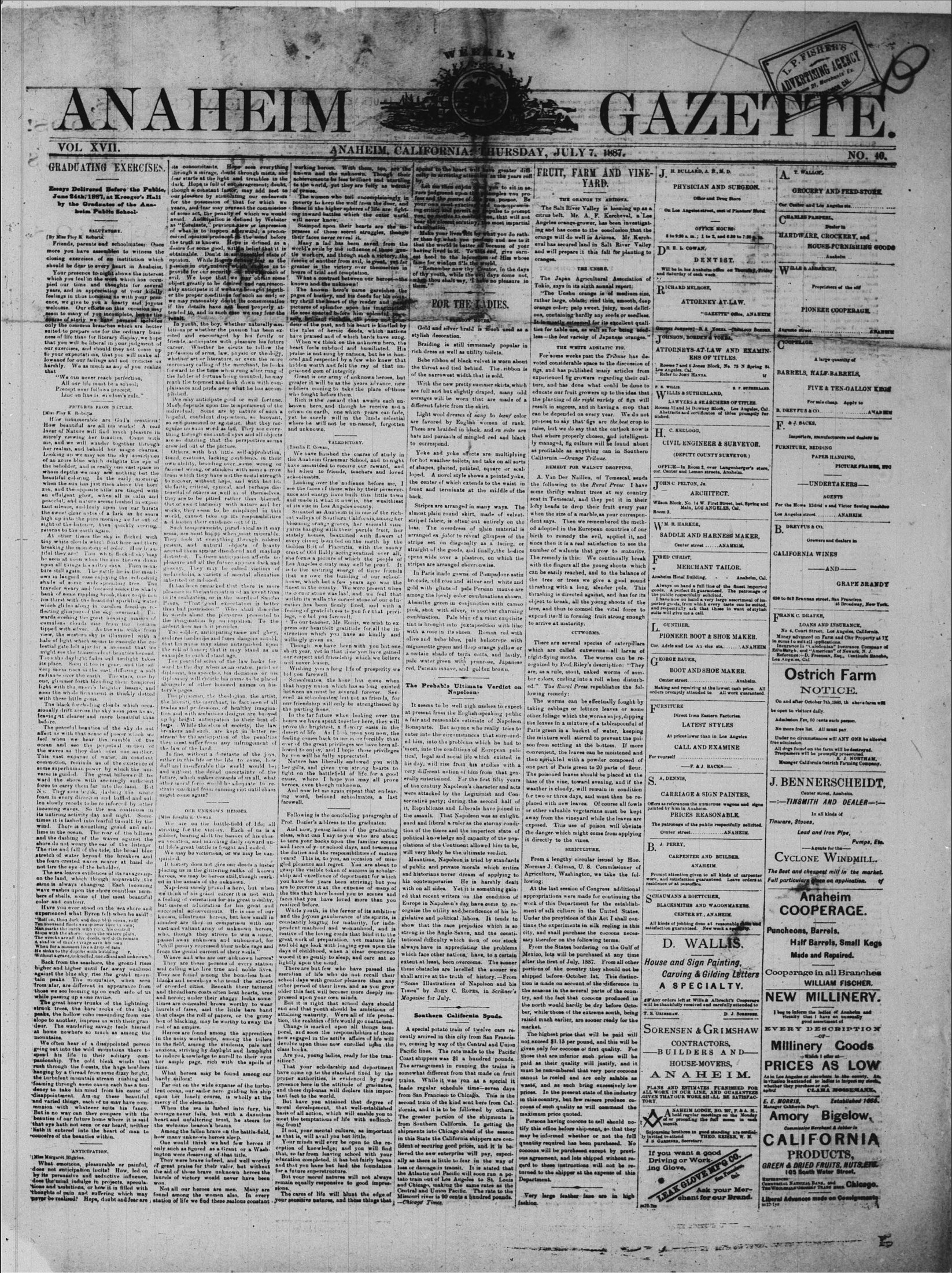
Searchable text
ANAHEIM
VOL XVII.
GRADUATING EXERCISES.
Essays Delivered Before the Public, June 24th, 1867, at Kreoger’s Hall by the Graduates of the Anaheim Public School.
SALUTATORY.
[By Miss Floy K Roberts.
Friends, parents and schoolmates; Once more you have assembled to witness the closing exercises of an institution which should be dear to every heart in Anaheim.
Your presence to night shows the interest which you feel in the work which has occupied our time and thoughts for several years, and in appreciation of your kindly feelings in thus honoring us with your presence, we give to you a hearty and joyous welcome. Our efforts on this occasion may seem to many of you incomplete, but as the course of study we have pursued includes only the common branches which are better suited to prepare one for the ordinary business of life than for literary display, we hope that you will be liberal in your judgment of our exercises, and should they not come up to your expectations, that you will make allowance for our failings and not criticise us harshly. We as much as any of you realize that
"We can never reach perfection,
All our life must be a school;
Precept ever follows precept,
Line on line is wisdom's rule."
PICTURES FROM NATURE.
[Miss Floy K Roberts.
How innumerable are God's creations! How beautiful are all his works! A real lover of Nature will find much pleasure in merely viewing her beauties. Come with me, and we will wander together through her realms, and behold her magic charms. Looking up we may see the sky sometimes of an azure blue which delights the eye of the beholder, and is really one vast space in whose depths we may see nothing but the its concomitants. Hope sees everything through a mirage, doubt through mists, and fear starts at the light and trembles in the dark. Hope is full of encouragement; doubt, though a constant factor, may add zeet to our pleasure by stimulating our endeavors for the possession of that for which we yearn, and fear may prevent the commission of some act, the penalty of which we would avoid. Anticipation is defined by Webster as "Foretaste," previous view or impression of what is to happen afterward; a preconceived opinion produced as the mind before the truth is known. Hope is defined as a desire for some good, with a belief that it is obtainable. Doubt is an unsettled state of opinion. While Roger defines that as the passion in our nature which excites us to provide for our security on the approach of evil. We hope that we may obtain some object greatly to be desired and can reasonably anticipate it if we have brought together the proper conditions for such an end; or we may reasonably doubt its consummation if the details have not been properly attended to, and in such case we may fear the result.
In youth, the boy, whether naturally ambitious or whether the passion has been excited and encouraged by his family or friends, anticipates with pleasure his future career. Whether he directs to follow the profession of arms, law, physic or theology, whether art or literature, or even the more mercenary calling of the merchant, he looks forward to the time when rung after rung of the ladder of fortune being mounted, he may reach the topmost and look down with complaisance and pride over what he has accomplished.
We may anticipate good or evil fortune. Muck depends upon the temperament of the individual. Some are by nature of such a hopeful, confident disposition, so buoyant, so self possessed or egotic; that they recognize no such word as fail. They see everything through enchanted eyes and all objects are so dazzling that the perspective seems crowded out of the picture.
Others, with but little self-approbation, timid, cautious, lacking confidence in their own ability, brooding over some wrong or fanciest wrong, or stricken with some a row from which they have not yet reached their working heroes. With known and the unknown achievements be less brave to the world, yet they of praise.
The women who toll poverty to keep the whole those in the higher sphere ing inward battles which will never know.
Stamped upon their praises of those secret their faces never reveal.
Many a lad has best world's evils by the infallible workers, and though rescue of another from e greater is the victory hours of trial and temptation.
What a contrast between known and the unknown.
The known hero's pages of history, and his try thrill the heart of the pictures of splendor upon He sees enacted before him early brilliant victories, deur of the past, and his tales of heroic deeds have praised and of whence When we think on the heart feels subdued and praise is not sung by natural and respected by a hidden worth and felt the prisoned gem of integrity.
Great is our army of utter greater it will be as the y soldiers coming to take who fought before them.
Rich is the reward that known hero, and though crown on earth, one which yet he surely will in where he will not be unand unknown.
VALEDICTO.
[Rosalia E Cowan.
We have finished the othe Anaheim Grammar So have assembled to receive bid adieu to friends, te
"We can never reach perfection,
All our life must be a school;
Precept ever follows precept,
Line on line is wisdom's rule."
PICTURES FROM NATURE.
[Miss Floy K. Roberts]
How innumerable are God's creations?
How beautiful are all his works? A real lover of Nature will find much pleasure in merely viewing her beauties. Come with me, and we will wander together through her realms, and behold her magic charms. Looking up we may see the sky sometimes of an azure blue which delights the eye of the beholder, and is really one vast space in whose depths we may see nothing but the beautiful coloring. In the early morning, when the sun has just risen above the horizon, and the opposite hills are tinged with an effulgent glow, when all is calm and peaceful, and nature seems hushed in expectant silence, suddenly upon the ear bursts the sweet clear notes of a lark as he soars high up into the pure morning air out of sight of the listener, then quickly veering returns to the earth again.
At other times the sky is flocked with tiny white clouds which float here and there breaking the monotony of color. How beautiful they are! Thus white flocked sky may be seen at noon when the sun throws down upon all things his safety rays. Then in nature still again. The battle he in the meadows in language ease enjoying the refreshing shade of some wide spreading tree. The traveler weary and footwear seeks the shady bank of some rippling brook, there quenches his thirst with the beautiful sparkling water which glides along in careless freedom reflecting glimpses of the sky overmeal. Towards evening the great heating masses of cumulous clouds rises from the horizon tipped with silver. As the sun sinks from view, the western sky is illuminated with a halo of light which seems to encircle the coelestial gate left ajar for a moment that we might see the transcendent beauties beyond. Then the daylight fades and twilight takes its place. Soon it too is gone, and the very moon rises in the east diffusing a soft radiance over the earth. The stars, one by one, glimmer forth blending their tempered light with the moon's brighter beams, and soon the whole firmament is thickly dotted with those little gems.
The black foreboding clouds which occasionally drift across the sky soon pass away, leaving at clearer and more beautiful than before.
The peaceful beauties of the sky do not affect us with that sense of power which we feel when we hear the rumble of the ocean and see the perpetual motion of the waves as they dash over one another. This vast expanse of water, in constant commotion, reminds us of the existence of some superhuman power by which the universe is guided. The great billows roll toward the shore with seemingly sufficient force to carry them far into the land. But No. They soon break, dislashing the white foam in every direction and baffled and sullied slowly recede to be reinforced by other incoming waves. So the sea continues in its uniting activity day and night. Sometimes it is lashed into fearful tumult by the wind. There is something grand and sublime in the ocean. The roar of the billows and the dashing of the waves against the shore do not weary the ear of the listener. The rise and fall of the tide, the broad blue stretch of water beyond the breakers and the foam crested waves nearer at hand do not tire the eye of the beholder.
The sea leaves evidences of its ravages upon the land, which though apparently the same is always changing. Each incoming wave washes upon the shore countless numbers of shells, some of the most beautiful
OUR UNKNOWN HEROES.
(Miss Rosalia E. Cowan)
We are on the battle-field of life; all striving for the victory. Each of us is a soldier, bearing aloft the banner of his chosen vocation, and marching daily onward until life's great battle is fought and ended.
We may be victorious, or we may be vanquished.
It history does not give our deeds a haster placing us in the glittering ranks of known heroes, we may be heroes still, though marked in the annals of the unknown.
Nap-leon surely proved a hero, but when we think of his grand career it is not with feeling of veneration for his great ability to reach the topmost and look down with compliance and pride over what he has accomplished.
We may anticipate good or evil fortune. Much depends upon the temperament of the individual. Some are by nature of such a hopeful, confident disposition, so buoyant, so self possessed or egotic, that they recognize no such word as fail. They see everything through enriched eyes and all objects are so dazzling that the perspective seems crowded out of the picture.
Others, with but little self-approbation, taint, cautions, lacking confidence in their own ability, brooding over some wrong or fancied wrong, or stricken with some a row from which they have not the moral strength to recover, without hope, and with but little faith, critical, cynical, and perhaps distrustful of others as well as of themselves, they are to be pitted rather than blamed. Out of sweet harmony with nature and her works, they seem to be misplaced in this world, cannot take up its responsibilities and hasten their existence out of it.
Such temperaments, paradoxical as it may seem, are most happy when most miserable. They look at everything through colored prisms, and natural objects of beauty around them appear discolored and may haplistuted. To them anticipation affords no pleasure and all the future appears dark and goomy. They may be called victims of melancholia, a variety of mental alienation inherited or induced.
It has been remarked that there is more pleasure in the antitension of an event than its realization, or in the words of Sancho Panza: "That good expectation is better than bad possession." Who shall describe by words alone the pleasures presented to the imagination by anticipation. To the ardent how much it provides.
The soldier, anticipating fame and glory, endures hardships and faces dangers untaught upon the role of honor; that it may stand as an example to each stant age.
The youthful son of the law looks forward to the day when as an orator, jurist or diplomat, his speeches, his decisions or his diplomacy will entitle his name to be placed alongside of other honored names on history's pages.
The physician, the neurologian, the artist, the literati, the merchant, in fact men of all trades and professions, of healthy imagination and with ambitions designs are buoyed up by bright anticipation to their best efforts. While she sham of society, the law breakers and such, are kept in better restraint by the anticipation of the penalties they must suffer from any infringement of the law of land.
In fine, without a foretaste of the joys either in this life or life to come, how dull and insufferable this world would be; and without the dread uncertainty of the future, which makes cowards us all, what other moral forces would be adequate to restrain mankind from running riot until chaos might come again?
Great is our army of ungreater it will be as the yew soldiers coming to take who fought before them.
Rich is the reward that known hero, and thought crown on earth, one which yet he surely will in time where he will not be unseen and unknown.
VALEDICTOR
[Rosalia E. Cowan]
We have finished the course on Anaheim Grammar School have assembled to receive bid adieu to friends, two schoolmates.
Looking over the audience see the faces of those whoance and energy have built and made it what it now is of its size in Los Angeles.
Situated as Anaheim is east valleys of Southern California blooming orange groves, by yards hanging with their stately homes, beautiful every clime; bounded on to Golden Belt of Placentia; crest of Old Bally acting as she forms a picture of which Los Angeles county may wish is to uniting energy that we owe to building house, which but a few years finest in the county. We wish its corner stone was laid within its walls the cornerization has been firmly feeling of gratitude to you later; we bid you farewell.
To our teacher, Mr Emily press our heartfelt gratitude situation which you have willingly given us.
Though we have been short year, yet in that time our respect and friendship will never lessen.
Wishing you a long life bid you farewell.
Schoolmates, the hour that happy union which has between us must be severed as schoolmates but not our friendship will only be parting hour.
In the far future when hours we have spent together prove the brightest, a flower desert of life. As I look up feeling comes back to me once ever of the great privileges lowed to enjoy, and I hope by you will be fully appreciated.
Nature has liberally end her gifts, and given you sight onthe battlefieldofcausewhereihopeheroeseventhoughunknownAndnowletmeagainrepeatwordbelovedschoolfarewell.
Following istheconcludingProf.Dozier'saddresstotheAndnowyoungladiesofclasswhatcanI saytoyoutoturnyourbacksupontheandfacesyourschooldaysthedutiesandtheresponsibilitiesYthisis,toyouanglodpleasureandregret.Ygraspthevisibletokenofsumshipandexcellenceofdepartureyouhavefaryearbeensattaretorecieveitattheexpressthetiesthathaveboundyoufacesyouhave loved
OUR UNKNOWN HEROES.
(Miss Rosalia E. Cowan)
We are on the battle-field of life; all striving for the victory. Each of us is a soldier, bearing aloft the banner of his chosen vocation, and marching daily onward until life's great battle is fought and ended.
We may be victorious, or we may be vanquished.
It history does not give our deeds a luster placing us in the glittering ranks of known heroes, we may be heroes still, though marked in the annals of the unknown.
Napoleon surely proved a hero, but when we think of his grand career it is not with a feeling of veneration for his great nobility, but more of admiration for his great and successful achievements. He is one of our known, illustrious heroes, but how small in number are they—in comparison with our vast and valiant army of unknown heroes, who, though they strove to win a name, passed away unknown and unhonored, for "chill penury repressed their noble rage and frogs the genial current of their souls."
Where and who are our unknown heroes?
They are those persons of every station and calling who live true and noble lives. They are found among the homeless boot-blacks and newsboys who tread the streets of crowded cities. Beneath their tattered and threadbare coats often beat hearts, true and heroic; under their shaggy locks some times are concealed brows worthy to wear laurels of fame, and the little bare hand that clasps the roll of papers, or the grimy box of blacking, may be worthy to sway the rood of an empire.
Heroes are found among the apprentices in the noisy workshops, among the toilers in the field, among the students, pale and anxious, striving by daylight and lamplight to induce knowledge to enroll to their eyes her ample page, rich with the spoils of time.
What heroes may be found among our hardly sailors!
Far out on the wide expanse of the turbulent ocean, our sailor hero guiding his ship upon her lonely course, is wholly at the mercy of the elements.
When the sea is lashed into fury, his courage never fails, but with a danutless heart and unfaltering trust, he steers for the welcome beacon's beams.
Among the fallen brave on the battle-field, how many unknown heroes sleep.
One would think we had few heroes if only such as figured as a Grant or a Washington were deserving of that title.
They were brave indeed, and well worthy of great praise for their valor, but without the aid of those brave unknown heroes the laurels of victory would never have been won.
Not all our heroes are men. Many are found among the women also. In every station of life we find these zealous constant farewell.
Following is the conclusion:
Prot. Dozier's address to the class, what can I say to you to turn your back upon them and faces of your school days—the duties and the responsible years? This is, to you, an old gled pleasure and regret. You grasp the visible token of such ship and excellence of deportment you have far years been at are to receive it at the expense the ties that have bound your faces that you have loved in realized before.
While youth, in the fervor and the joyous sexuburance constantly longing for mature pendent manhood and woman restive of the loving cords this great work of preparation, yet and old age look with longing days of childhood, when a child wooed it so gently to sleep, a lightly unto the mind.
There are but few who have meridian of life who do not school days with greater pleas other period of their lives, and older this fact will become unpressed upon your own minds.
But it is right that school end and that youth should be attaining maturity. Were allotion, the realities of life would change is marked upon all poral, and soon the responsibility now engaged in the active affair devolve upon those now enrol class books.
Are you, young ladies, ready sition?
That your scholarship and have come up to the standard proper authorities, is evident presence here in the attitude and these diplomas will declare tant fact to the world.
But have you attained this moral development, that was basis of all action, which will meet the temptations of life waiting front!
If not your mental culture, as that is, will avail you but life.
Your minds will ever be opception of knowledge; and you that, so far from leaving school education completed, it has built and that you have but laid the for a future superstructure.
But your moral natures will remain equally responsive to sensions.
The cares of life will blunt your sensitive natures, and th
WORKING HEROES. With them, too, are the known and the unknown. Though their achievements be less brilliant and startling to the world, yet they are fully as worthy of praise.
The women who toil uncomplainingly in poverty to keep the wolf from the door, and those in the higher spheres of life are fighting inward battles which the outer world will never know.
Stamped upon their hearts are the impresses of those secret struggles, though their faces never reveal it.
Many a lad has been saved from the world's evils by the influence of those gentle workers, and though such a victory, the rescue of another from evil, is great, yet far greater is the victory over themselves in hours of trial and temptation.
What a contrast between our heroes—the known and the unknown!
The known hero's name garnishes the pages of history, and his deeds for his country thrill the heart of the reader and pique pictures of splendor upon his imagination.
He sees enacted before him splendid pageants, brilliant victories, the pomp and grandeur of the past, and his heart is kindled by the tales of heroic deeds, which nations have praised and of which bards have sung.
When we think on the unknown hero, the heart feels subdued and humiliated. His praise is not sung by nations, but he is honored and respected by a few who knew that hidden worth and felt the ray of that imprisoned gem of integrity.
Great is our army of unknown heroes, but greater it will be as the years advance, new soldiers coming to take the place of those who fought before them.
Rich is the reward that awaits each unknown hero, and though he receive not a crown on earth, one which years can fade, yet he surely will in the lands celestial where he will not be un-named, forgotten and unknown.
VALEDICTORY.
[Rosalia E. Cowan]
We have finished the course of study in the Anaheim Grammar School, and to-night have assembled to receive our reward, and bid alieu to friends, teachers and loved
appeal to the heart will have greater difficulty in arresting attention as the years roll by.
Let me then enjoin you to sit in severe judgment upon the principles you profess and the course of your purpose. Be your own most exacting and uncompromising critics and permit no impulse to prompt you; no motive to continue you, that will not bear the closest scrutiny, the most impartial examination.
Make your lives felt by what you do rather than by what you present; and see to it that the world is better all because of your having lived in it. To this end, give earnest heed to the injunction of Him whose fame for wisdom fills the world.
"Remember now thy Creator, in the days of thy youth, while the evil days come not, when thou shalt say, 'I have no pleasure in them.'"
FOR THE LADIES.
ACTION NOTES:
Gold and silver braid is much used as a stylish decoration.
Braiding is still immensely popular in rich dress as well as utility toiletts.
Bebe ribbon of black velvet is worn about the throat and tied behind. The ribbon is of the narrowest width that is sold.
With the new pretty summer skirts, which are full and but slightly draped, many odd corsages will be worn that are made of a different fabric from the skirt.
Light wool dresses of sang boeuf color are favored by English women of rank. These are braided in black, and en suite are hats and parasols of mingled red and black to correspond.
Yoke and yoke effects are multiplying for hot weather toiletts; and take on all sorts of shapes, plaited, pointed, square or scalloped.
FRUIT, FARM AND VINEYARD.
THE ORANGE IN ARIZONA.
The Salt River Valley is looming up as a citrus belt. Mr. A. F. Kercheval, a Los Angeles orange-grower, has been investigating and has come to the conclusion that the orange will do well in Arizona. Mr. Kercheval has secured land in Salt River Valley and will prepare it this fall for planting to oranges.
THE UNSHROUGH.
The Japan Agricultural Association of Tokio, says in its sixth annual report:
"The Unshu orange is of medium size, rather large, oblate; rind thin, smooth, deep orange color; pulp sweet, juicy, most delicious, containing hardly any seeds or seedless. It is mostly esteemed for its excellent qualities for table use, as well as for being seedless—the best variety of Japanese oranges."
THE WHITE ADRIATIC FIG.
For some weeks past the Tribune has devoted considerable space to the discussion of figs, and has published many articles from experienced fig growers regarding their culture, and has done what could be done to educate our fruit growers up to the idea that the planting of the right variety of figs will result in success, and in having a crop that can be depended on every year. We do not propose to say that figs are the best crop to raise, but we do say that the outlook now is that where properly chosen, and intelligently managed, fig culture will be found about as profitable as anything can in Southern California.—Orange Tribune.
REMEDY FOR WALNUT DROPING.
Great is our army of unknown heroes, but greater it will be as the years advance, new soldiers coming to take the place of those who fought before them.
Rich is the reward that awaits each unknown hero, and though he receive not a crown on earth, one which years can fade, yet he surely will in the lands celestial where he will not be un-named, forgotten and unknown.
VALEDICTORY.
[Rosalia E. Cowan]
We have finished the course of study in the Anaheim Grammar School, and to-night have assembled to receive our reward, and bid adieu to friends, teachers and loved schoolmates.
Looking over the audience before me, I see the faces of those who by their perseverance and energy have built this little town and made it what it now is, the wealthiest of its size in Los Angeles county.
Situated as Anaheim is in one of the richest valleys of Southern California, among her blooming orange groves, her emerald vineyards hanging with their purple fruit, her stately homes, beautified with flowers of every clime; bounded on the north by the Golden Belt of Placentia, with the snowy crest of Old Baldy acting sentinel over all, she forms a picture of which the people of Los Angeles county may well be proud. It is to the untiring energy of these friends that we owe the building of our schoolhouse, which but a few years ago was the finest in the county. We were present when its corner stone was laid, and we feel that within its walls the corner stone of our education has been firmly fixed, and with a feeling of gratitude to you for that privilege, we bid you farewell.
To our teacher, Mr. Ennis, we wish to express our heartfelt gratitude for all the instruction which you have so kindly and willingly given us.
Though we have been with you but one short year, yet in that time you have gained our respect and friendship which we believe will never lessen.
Wishing you a long life of prosperity we bid you farewell.
Schoolmates, the hour has come when that happy union which has so long existed between us must be severed forever. Severe as schoolmates but not as friends, for our friendship will only be strengthened by the parting hour.
In the far future when looking over the hours we have spent together here, they will prove the brightest, a flowery oasis in the desert of life. As I look upon you now, the feeling comes back to me more forcibly than ever of the great privileges we have been allowed to enjoy, and I hope those privileges by you will be fully appreciated.
Nature has liberally endowed you with her gifts, and given you strong hearts to fight on the battlefield of life for a good cause, where I hope you may all prove heroes, even though unknown.
And now let me again repeat that endearing word, beloved schoolmates, a last farewell.
Following is the concluding paragraphs of Prof. Dozier's address to the graduates:
And now, young ladies of the graduating class, what can I say to you who are about to turn your back upon the familiar scenes and faces of your school days, and to assume the duties and the responsibilities of mature years? This is, to you, an occasion of mingled pleasure and regret. You are about to grasp the visible token of success in scholarship and excellence of deportment for which you have for years been striving; but you are to receive it at the expense of many of the ties that have bound you to scenes and faces that you have loved more than ye
With the new pretty summer skirts, which are full and but slightly draped, many old corsages will be worn that are made of a different fabric from the skirt.
Light wool dresses of sang boeuf color are favored by English women of rank. These are braided in black, and en suite are hats and parasols of mingled red and black to correspond.
Yoke and yoke effects are multiplying for hot weather toiletts; and take on all sorts of shapes, plaited, pointed, square or scalloped. A novel style shows a pointed yoke, the center of which extends to the waist in front and terminate at the middle of the back.
Stripes are arranged in many ways. The almost plain round skirt, made of velvet-striped fabric, is often cut entirely on the bias. The overdress of plain material is arranged en jabot to reveal glimpses of the stripe set on diagonally as a facing, or straight of the goods, and finally,the bodice opens wide over a plastron, on which the stripes are arranged chevronwise.
In Paris made gowns of Pompadour satin brocade, old rose and silver and white and gold with glints of pale Persian mauve are among the lovely color combinations shown. Absinthe green in conjunction with camo pink, shot with silver, is another charming combination. Pale blue of a most exquisite tint is brought into juxtaposition with lilac with a rose in its sheen. Roman red with olive and bebe blue, pale heliotrope with mignonette green and deep orange yellow or a certain shade of terra cotta, and lastly, pale water green with primrose, Japanese red, Persian mauve, and golden brown.
The Probable Ultimate Verdict on Napoleon:
It seems to be well nigh useless to expect at present from the English-speaking public a fair and reasonable estimate of Napoleon Bonaparte. But anyone who really tries to enter into the circumstances that surrounded him, into the problems which he had to meet, into the conditions of European political, legal and social life which existed in his day; will rise from his studies with a very different notion of him from that generally entertained. For the first fifty years of the century Napoleon's character and acts were attacked by the Legitimist and Conservative party; during the second half of it, Republicans and Liberals have joined in the assault. That Napoleon was as enlightened and liberal a ruler as the stormy condition of the times and the imperfect state of political knowledge and capacity of the populations of the Continent allowed him to be, will very likely be the ultimate verdict.
Meantime, Napoleon is tried by standards of public and private morals which critics and historians never dream of applying to his contemporaries. He is harshly dealt with on all sides. Yet it is something gained that recent writers on the condition of experienced fig growers regarding their culture, and has done what could be done to educate our fruit growers up to the idea that the planting of the right variety of fig will result in success, and in having a crop that can be depended on every year. We do not propose to say that figs are the best crop to raise, but we do say that the outlook now is that where properly chosen, and intelligently managed, fig culture will be found about as profitable as anything can in Southern California.—Orange Tribune.
REMEDY FOR WALNUT DROPPING.
A. Van Der Naillen, of Temescal, sends the following to the Rural Press: I have some thrifty walnut trees at my country seat in Temescal,and they put it in their lofty heads to drop their fruit every year when the size of a marble,as your correspondent says. Then we remembered the method adopted in the European countries of our birth to remedy the evil ,applied it,and since then it is a real satisfaction to see the number of walnuts that grow to maturity.The remedy is this: We continually break with the fingers all the young shoots which can be easily reached,and to the balance of the tree or trees we give a good sound thrashing with a long,sleender pole. This thrashing is directed against,and has for its object to break,a all young shoots of the tree,and thus to compel the vital force to expend itself in forming fruit strong enough to arrive at maturity.
CUTWORMS.
There are several species of caterpillars which are called cutworms-all larvae of night-dying moths. The worms can be recognized by Prof.Riley's description: "They are, as a rule, stout,naked worms of somber colors,curling into a roll when distubbed." The Rural Press republishes the following remedy:
The worms can be effectually fought by taking cabbage or lettuce leaves or some other foliage which the worms enjoy,dipping the leaves in a mixture of a tablespoonful of Paris green in a bucket of water,kepingthe mixture well stirred to preventthe poison from settlingatthe bottom.If more convenient,the leaves can be moistenedand then sprinkled with a powder composedof one part of Paris greento 20 partsof flour.The poisoned leaves should atthe baseofthe vine,towardevening,and iftheweatheriscloudy,mustremaininconditionfortwoorthreedays,andmustthenbe replacedwithnewleaves.Ofcourseallfowlsorothervaluablevegetariansmustbekeptawayfromthevineyardwhiletheleavesareexposed.Thisuseofpoisonwillobviatethe dangerwhichmightcomefromapplyingitdirectlytothevines.
SERICULTURE.
From a lengthy circular issued by Hon.Norman J.Colman.U.S.CommissionerofAgriculture.Washingtonwe takethefollowing:
AtthelastsessionOf Congressadditionalappropriationsweremadeforcontinuingtheexperiencedfiggrowersregardingtheirculture,andhasdonewhatcouldbedonetoeducateourfruitgrowersuptotheideathattheplantingoftherightvarietyoffigswillresultinsuccess,andinhavinga cropthatcanbepreservedonthesizeofmycountryseatinTemescal,andtheyputitin theirloftyheadstocropthefruiteveryyearwhenthesizeofamarble.asyourcorrespondentsaids.ThenwerememberedthemethodadoptedintheEuropeancountriesofourbirthtoremedytheevil.appliedit,andsincethenitisrealsatisfactiontoseethenumberofwalnutsthatgrowtomaturity.Theremedyisthis:Wecontinuallybreakwiththefingersofallewalksorothervaluablevegetariansmustbekeptawayfromthevineyardwhiletheleavesareexposed.Thisuseofpoisonwillobviatethe dangerwhichmightcomefromapplyingitdirectlytothevines.
Following is the concluding paragraphs of Prof. Dozier's address to the graduates:
And now, young ladies of the graduating class, what can I say to you who are about to turn your back upon the familiar scenes and faces of your school days, and assume the duties and responsibilities of mature years? This is, to you, an occasion of mingled pleasure and regret. You are about to grasp the visible token of success in scholarship and excellence of deportment for which you have for years been striving; but you are to receive it at the expense of many of the ties that have bound you to scenes and faces that you have loved more than you realized before.
While youth, in the fervor of its ambition and the joyous gexuberance of its spirits, is constantly longing for maturity, for independent manhood and womanhood, and is restive of the loving cords that bind it to the great work of preparation, yet mature life and old age look with longing eyes upon the days of childhood, when a clear conscience wooed it so gently to sleep, and care sat so lightly upon the mind.
There are but few who have passed the meridian of life who do not recall their school days with greater pleasure than any other period of their lives, and as you grow older this fact will become more deeply impressed upon your own minda.
But it is right that school days should end and that youth should be ambitious of attaining maturity. Were all of life probation, the realities of life would go unattained.
Change is marked upon all things temporal, and soon the responsibilities of those now engaged in the active affairs of life will devolve upon those now enrolled upon the class books.
Are you, young ladies, ready for the transition?
That your scholarship and department have come up to the standard fixed by the proper authorities, is evidenced by your presence here in the attitude of graduates, and these diplomas will declare this important fact to the world.
But have you attained that degree of moral development, that well-established basis of all action, which will enable you to meet the temptations of life with unflinching front!
If not, your mental culture, as important as that is, will avail you but little.
Your minds will ever be open to the reception of knowledge; and you will find that so far from leaving school with your education completed, it has but fairly begun and that you have but laid the foundation for a future superstructure.
But your moral natures will not always remain equally responsive to good impressions.
The cares of life will blunt the edge of your sensitive natures, and those things that servative party; during the second half of it, Republicans and Liberals have joined in the assault. That Napoleon was as enlightened and liberal a ruler as the stormy condition of the times and the imperfect state of political knowledge and capacity of the populations of the Continent allowed him to be, will very likely be the ultimate verdict.
Meantime, Napoleon is tried by standards of public and private morals which critics and historians never dream of applying to his contemporaries. He is harshly dealt with on all sides. Yet it is something gained that recent writers on the condition of Europe in Napoleon's day have come to recognize the utility and beneficence of his legislative and political labors. It tends to show that the race prejudice which is so strong in the Anglo-Saxon, and the constitutional difficulty which men of our stock always have in appreciating the problems which face other nations, have, to a certain extent at least, been overcome. The sooner these obstacles are levelled the sooner we shall arrive at the truth of history.—From "Some Illustrations of Napoleon and his Times" by John C. Ropes, in Scribner's Magazine for July.
Southern California Spuds.
A special potato train of twelve cars recently arrived in this city from San Francisco, coming by way of the Central and Union Pacific lines. The rate made to the Pacific Coast shippers was $1 a hundred pounds. The arrangement in running the trains is somewhat different from that made on fruit trains. While it was run as a special it made regular schedule time—seven days from San Francisco to Chicago. This is the second train of the kind sent here from California, and it is to be followed by others. The greater portion of the shipments is from Southern California. In getting the shipments into Chicago ahead of the season in this State the California shippers are confident of securing good prices, and it is believed the new enterprise will pay, especially as there is little to fear in the way of loss or damage in transit. It is stated that the Atlantic and Pacific will soon run a potato train out of Los Angeles to St. Louis and Chicago, making the same rates as the Central and Union Pacific. The rate to the Missouri river is 90 cents a hundred pounds.
Sericulture.
From a lengthy circular issued by Hon. Norman J. Colman, U.S. Commissioner of Agriculture, Washington, we take the following:
At the last session of Congress additional appropriations were made for continuing the work of this Department for the establishment of silk culture in the United States. Under the provisions of this Act I shall continue the experiments in silk reeling in this city, and shall purchase the coccoons necessary therefor on the following terms:
From States bordering on the Gulf of Mexico, lots will be purchased at any time after the first of July, 1887. From all other portions of the country they should not be shipped before October 1st. This distinction is made on account of the difference in the seasons in the several parts of the country, and the fact that coccoons produced in the north would hardly be dry before October, while those of the extreme south, being raised much earlier, are sooner ready for the market.
The highest price that will be paid will not exceed $1.15 per pound, and this will be given only for coccoons of first quality. For those that are inferior such prices will be paid as their quality will justify, and it must be remembered that very poor coccoons cannot be reeled and are only salable as waste, and as such bring excessively low prices. In the present state of the industry in this country, but few raisers produce coccoons of such quality as will command the maximum price quoted.
Persons having coccoons to sell should notify this office before shipment, so that they may be informed whether or not the full quantity required has been purchased. No coccoons will be purchased except by previous agreement, and lots shipped without regard to these instructions will not be returned to the shipper at the expense of this Department.
Very large feather fans are in high fashion.
GAZETTE.
1887.
NO. 40.
J. H. BULLARD, A. R., M. D.
PHYSICIAN AND SURGEON.
Office and Drug Store
On Los Angeles street, east of Planters' Hotel.
OFFICE HOURS:
8 to 9:30 a.m.; 1 to 2, and 6:30 to 7:30 p.m.
R. E. L. COWAN,
DENTIST.
Will be in his Anaheim office on Thursday, Friday and Saturday of each week.
RICHARD MELROSE,
ATTORNEY-AT-LAW.
"GAZETTE" Office, Anaheim
GRIESEN JOHNSON—B. A. YORK—(HILLOP BORUM)
JOHNSON, BORDEN & YOKA,
ATTORNEYS-AT-LAW AND EXAMINERS OF TITLES.
Rooms 7 and 8 Jones Block, No. 75 N Spring St.
Los Angeles, Cal.
Refer to JOHN HANNA.
P. R. WILLIS
WILLIS & SUTHERLAND,
LAWYERS & SEARCHERS OF TITLES.
Rooms 52 and 54 Downey Block, Los Angeles, Cal.
Abstracts and certificates of titles promptly furnished.
H. C. KEELOGO,
CIVIL ENGINEER & SURVEYOR.
(DEPUTY COUNTY SURVEYOR)
OFFICE—In Room 2, over Langenberger's store, cor. Center and Lemon streets, Anaheim.
A. T. WALLOW,
GROCERY AND FEED-STORE
Our Center and Los Angeles sts.
CHARLES PAMPERL,
Dealer in
HARDWARE, CROCKERY, and
HOUSE-FURNISHING GOODS
... Anaheim ...
WILLE & ALBERCHT,
Proprietors of the old
PIONEER COOPERAGE.
Anguette street ... Anaheim
COOPERAGE,
A large quantity of
BARRELS, HALF-BARRELS,
FIVE & TEN-GALLON KEGS
For sale cheap. Apply to
B. DREYFUS & CO.
F. & J. BACKS,
Imperial manufacturers and dealers in
FURNITURE, BEDDING
PAPER HANGING,
PICTURE FRAMES, HFO
OF Temescal, sends
rural Press: I have
lies at my country
they put it in their
fruit every year,
as your correspondmembered the methan countries of our
ill, applied it, and
faction to see the
grow to maturity,
continually break
young shoots which
will to the balance of
live a good sound
lender pole. This
mist, and has for its
young shoots of the
the vital force to
fruit strong enough
of caterpillars
worms—all larvae of
worms can be redescription: "They
and worms of somoll when distubpublishes the folectually fought by
leaves or some
forms enjoy, dipping
a tablespoonful of
water, keeping
to prevent the poibottom. If more
be moistened and
older composed of
20 parts of flour.
be placed at the
penning, and if the
pain in condition
must then be reOf course all fowls
must be kept
while the leaves are
son will obviate
me from applying
issued by Hon.
Commissioner of
we take the folgress additional
or continuing the
P. R. WILLIS B. P. SUTHERLAND.
WILLIS & SUTHERLAND,
LAWYERS & SEARCHERS OF TITLES.
Rooms 52 and 54 Downey Block, Los Angeles, Cal.
Abstracts and certificates of titles promptly furnished.
H. C. KEELOGG,
CIVIL ENGINEER & SURVEYOR.
(DEPUTY COUNTY SURVEYOR)
OFFICE—In Room 2, over Langenberger's store,
cor. Center and Lemon streets, Anaheim.
JOHN C. PELTON, Ja.
ARCHITECT.
Wilson Block, No. 14 W. First Street, bet. Spring and
Main, LOS ANGELES, Cal.
W. M. R. HARKER,
SADDLE AND HARNESS MAKER,
Center street ...ANAHEIM.
FRED CHRIST,
MERCHANT TAILOR.
Anaheim Hotel Building, Anaheim, Cal.
Always on hand a full line of the finest imported goods. A perfect fit guaranteed. The patronage of the public respectfully solicited.
I have now on hand a very large assortment of imported goods, from which every taste can be suited, and respectfully ask that those in want of stylish suite will give me a call.
L. OUNTHER,
PIONEER BOOT & SHOE MAKER.
Cor. Adele and Los Angeles sts...ANAHEIM
GEORGE BAUER,
BOOT AND SHOE MAKER.
Center street...ANAheim.
Making and repairing at the lowest cash price. All orders promptly attended to. All work guaranteed.
FURNITURE
Direct from Eastern Factories.
LATEST STYLES
At prices lower than in Los Angeles
CALL AND EXAMINE
For yourself ...ANAHEIM.
S. A. DENNIS,
CARRIAGE & SIGN PAINTER,
Offers as references the numerous wagons and signs painted by him in Anaheim.
PRICES REASONABLE.
The patronage of the public respectfully solicited.
Center street...ANAHEIM.
B. J. PERRY,
CARPENTER AND BUILDER.
ANAHEIM.
Prompt attention given to all kinds of carpenter work, and satisfaction guaranteed. Leave orders at residence or at postoffice.
FIVE & TEN-GALLON KEGS
For sale cheap. Apply to
B. DREYFUS & CO....ANAHEIM
F. & J. BACKS,
Imperials, manufacturers and dealers be
FURNITURE, BEDDING
PAPER HANGING,
PICTURE FRAME, WTO
UNDERTAKERS—AGENTS
For the Howe Eldridge and Victor Sewing machine
Los Angeles street...ANAHEIM.
B. DREYFUS & CO.
Orewers and dealers in
CALIFORNIA WINES
AND
GRAPE BRANDY
630 to 642 Brannan street, San Francisco.
45 Broadway, New York.
FRANK C. DRAFER,
LOANS AND INSURANCE.
No 4, Court Street, Los Angeles, California.
Money advanced on Farm and City Property at 7X in sums to suit all applications.
Insurance in "Caledonian" Insurance Company of Edinburgh, and "American" of Newark, N. J.
Reference: D. Freeman, Esq., Centinela Ranshe,
Los Angeles, Cal.
Ostrich Farm NOTICE.
On and after October 7th, 1880, th above farm will be open to visitors daily.
Admission Fee, 50 cents each person.
No more free list. All must pay.
Under no circumstances will ANY ONE be allowed free admission.
All dogs found on the farm will be destroyed.
Trespassers will be promptly prosecuted.
K. J. NORTHAM,
Manager California Ostrich Farming Company.
J. BENNERSCHEIDT,
Center street, Anaheim.
TINSMITH AND DEALER:
In all kinds of
Tinware, Stoves,
Lead and Iron Pipe,
Pumps, Etc.
Agents for the
CYCLONE WINDMILL.
The Best and cheapest mill in the market.
Full particuliare upon application.
Offers as references the numerous wagons and signs painted by him in Anaheim.
PRICES REASONABLE.
The patronage of the public respectfully solicited.
Center street...ANAHEIM.
B. PERRY,
CARPENTER AND BUILDER.
ANAHEIM.
Prompt attention given to all kinds of carpenter work, and satisfaction guaranteed. Leave orders at residence or at postoffice.
SCHAUMANN & BOETTCHER,
BLACKSMITHS AND WAGONMAKERS.
CENTER ST., ANAHEIM.
All kinds of jobbing done at reasonable rates and satisfaction guaranteed. New work a specialty.
D. WALLIS.
House and Sign Painting,
Carving & Gilding Letters
A SPECIALTY.
Any orders left at Willis & Albrecht's Cooperage will be thankfully received and carefully attended to.
T. S. GRINSHAW.
D. J. SORENSEN.
SORENSEN & GRIMSHAW
CONTRACTORS,
BUILDERS AND
HOUSE-MOVERS,
ANAHEIM.
PLANS AND ESTIMATES FURNISHED FOR ALL WORK IN OUR LINE, AND GUARANTEES GIVEN THAT OUR WORK SHALL BE SATISFACTORY.
ANAHEIM LODGE, NO. 207, F. & A. M.
hold regular meetings on the Monday of or preceding the full moon in each month.
Sojourning brethren in good standing are invited to attend THEO. REISER, W. M.
J. S. GARDNER, Secretary.
If you want a good Driving or Working Glove,
LEAK GLOVE MFG CO.
Ask your Merchant for our Brand.
TINSMITH AND DEALER:
In all kinds of Tinware, Stoves,
Lead and Iron Pipe,
Pumps, Etc.
Agents for the Cyclone Windmill.
The Best and cheapest mill in the market.
Full particulars given on application.
Anaheim COOPERAGE.
Puncheons, Barrels.
Half Barrels, Small Kegs
Made and Repaired.
Cooperage in all Branches
WILLIAM FISCHER.
NEW MILLINERY.
I beg to inform the ladies of Anaheim and vicinity that I have an unusually good assortment of Millinery Goods
Which I offer at PRICES AS LOW
As in Los Angeles or elsewhere in the county. An invitation is extended to ladies to inspect my stock whether they purchase or not.
CLARE MOSSEN MARK.
E. E. MORRIS,
Manager California Dep't.
Amory Bigelow,
Commission Merchant & Jobber in CALIFORNIA PRODUCTS,
GREEN & DRIED FRUITS, NUTS, ETC.
105 South Water Street.
REFERENCE:
Commercial National Bank, and The Wholesale Grocery Trade Bureau Chicago.
Liberal Advances made on Consignments m 12 yr.