anaheim-gazette 1887-06-23
Scanned page
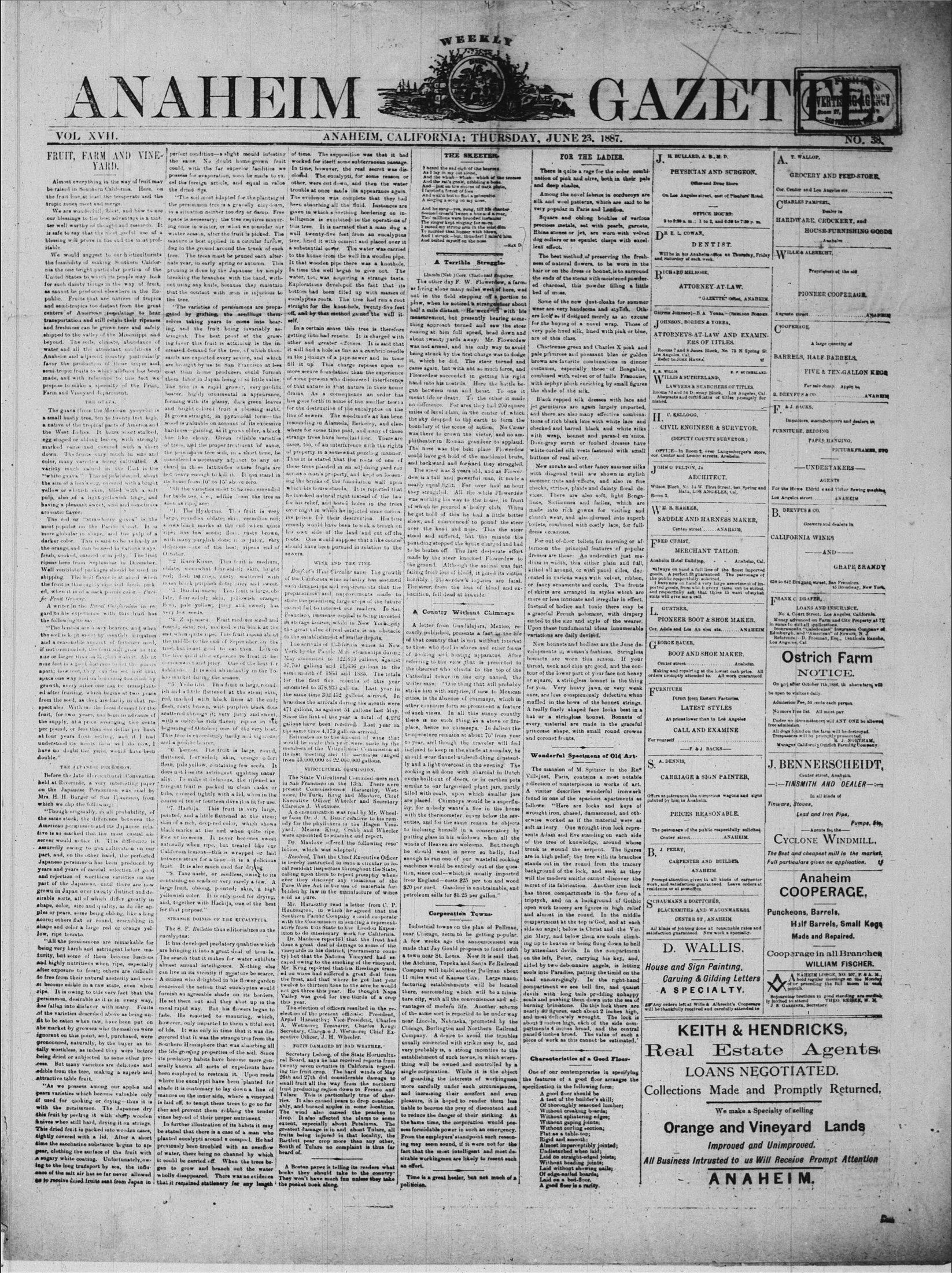
Searchable text
FRUIT, FARM AND VINEYARD.
Almost everything in the way of fruit may be raised in Southern California. Here, on the fruit line, at least the temperate and the tropic zones meet and merge.
We are wonderfully best, and how to use our blessings to the best advantage is a matter well worthy of thought and research. It is safe to say that the most useful use of a blessing will prove in the end the most profitable.
We would suggest to our horticulturists the feasibility of making Southern California the one bright particular portion of the United States to which its people may look for such dainty things in the way of fruit, as cannot be produced elsewhere in the Republic. Fruits that are natives of tropics and semi-tropics too distant from the great centers of American population to bear transportation and still retain their ripeness and freshness can be grown here and safely shipped to the valley of the Mississippi and beyond. The soils, climate, abundance of water and all the attendant conditions of Anaheim and adjacent country particularly favor the production of those tropic and semi-tropic fruits to which allusion has been made, and with reference to this fact we propose to make a specialty of the Fruit, Farm and Vineyard department.
THE GUAVA.
The guava (from the Mexican guayaba) is a small bushy tree, ten to twenty feet high, a native of the tropical parts of America and the West Indies. It bears short stalked, egg-shaped or oblong leaves, with strongly marked veins and covered with a short down. The fruits vary much in size and color, many varieties being cultivated. A variety much valued in the East is the perfect condition—a slight mould infesting the same. No doubt home-grown fruit could, with the far superior facilities we possess for evaporation, soon be made to excel the foreign article, and equal in value the dried figs.
"The soil most adapted for the planting of the persimmon tree is a gravelly clay-loam, in a situation neither too dry or damp. Free space is necessary; the tree requires manuring once in winter, or what we consider our winter season, after the fruit is picked. The manure is best applied in a circular furrow, dug in the ground around the trunk of each tree. The trees must be pruned each alternate year, in early spring or autumn. This pruning is done by the Japanese by simply breaking the branches with the hand, without using any knife, because they maintain that the contact with iron is injurious to the tree."
"The varieties of persimmons are propagated by grafting, the seedlings themselves taking years to come into bearing, and the fruit being invariably astringent. The best proof of the growing favor this fruit is attaining is the increased demand for the tree, of which thousands are exported every season, and which are brought by us to San Francisco at less cost than home producers could furnish them. Labor in Japan being of so little value. The tree is a rapid grower, very prolific bearer, highly ornamental in appearance, forming with its glassy, dark green leaves and bright colored fruit a pleasing sight. It grows straight, in pyramidal form—the wood is valuable on account of its excessive hardness—gaining, as it grows older, a black hue like ebony. Given reliable varieties of trees, and the proper treatment of same, the persimmon tree will, in a short time, be considered a necessary adjunct to any orchard in those latitudes where frosts are not heavy enough to kill it. It can stand in perfect condition—a slight mould infesting the same. No doubt home-grown fruit could, with the far superior facilities we possess for evaporation, soon be made to excel the foreign article, and equal in value the dried figs.
"The soil most adapted for the planting of the persimmon tree is a gravelly clay-loam, in a situation neither too dry or damp. Free space is necessary; the tree requires manuring once in winter, or what we consider our winter season, after the fruit is picked. The manure is best applied in a circular furrow, dug in the ground around the trunk of each tree. The trees must be pruned each alternate year, in early spring or autumn. This pruning is done by the Japanese by simply breaking the branches with the hand, without using any knife, because they maintain that the contact with iron is injurious to the tree."
"The varieties of persimmons are propagated by grafting, the seedlings themselves taking years to come into bearing, and the fruit being invariably astringent. The best proof of the growing favor this fruit is attaining is the increased demand for the tree, of which thousands are exported every season, and which are brought by us to San Francisco at less cost than home producers could furnish them. Labor in Japan being of so little value. The tree is a rapid grower, very prolific bearer, highly ornamental in appearance, forming with its glassy, dark green leaves and bright colored fruit a pleasing sight. It grows straight, in pyramidal form—the wood is valuable on account of its excessive hardness—gaining, as it grows older, a black hue like ebony. Given reliable varieties of trees, and the proper treatment of same, the persimmon tree will, in a short time, be considered a necessary adjunct to any orchard in those latitudes where frosts are not heavy enough to kill it. It can stand in perfect condition—a slight mould infesting the same. No doubt home-grown fruit could, with the far superior facilities we possess for evaporation, soon be made to excel the foreign article, and equal in value the dried figs."
made, and with reference to this fact we propose to make a specialty of the Fruit, Farm and Vineyard department.
THE GUAVA.
The guava (from the Mexican guayaba) is a small bushy tree, ten to twenty feet high, native of the tropical parts of America and the West Indies. It bears short stalked, egg-shaped or oblong leaves, with strongly marked veins and covered with a short down. The fruits vary much in size and color, many varieties being cultivated. A variety much valued in the East is the "white guava." This popular shape, about the size of a hen's egg, covered with a bright yellow or whitish skin, filled with a soft pulp, also of a light yellowish tinge, and having a pleasant sweet, acid and sometimes aromatic flavor.
The red or "strawberry guava" is the most popular on the Pacific Coast. It is more globular in shape, and the pulp of a darker color. This is said to be as hardy as the orange, and can be used in various ways, fresh cooked, canned or in jelly. The fruit ripens here from September to December. Well ventilated packages should be used in shipping. The best flavor is at aimed when the fruit is thoroughly ripe and fresh picked, when it is of a dark purple color — Pacific Fruit Grocer.
A writer in the Pural California in regard to his experience with this fruit has the following to say:
"The histes are heavy bearers, and when the soil is kept moist by monthly irrigation and a reasonable amount of fertilizer used, if not overloaded, the fruit will grow to the size or larger than an English walnut. About nine feet is a good distance to set the pots apart; however, they can be set into that space one way and on becoming too close by growth, every other one can be transplanted after fruiting, which begins at two years from the seed, as they are hardly in that respect also. With no local demand for the fruit, for two years, has been advance of the supply, at a price averaging two cents per pound, or less than one dollar per bush at four years from setting, and if I had understood its needs then as I do now, I have no doubt the yield would have been double."
THE JAPANESE PERFORMANCE.
Before the late Horticultural Convention held at Riverside, a very interesting paper on the Japanese Persimmon was read by Mrs. H. H. Burger of San Francisco, from which we chip the following:
Though originally, in all probability, of the same stock, the difference between the American persimmon and its Japanese relative is so marked that the most casual observer would notice it. This difference is assuredly owing to non cultivation on our part, and, on the other hand, the perfected Japanese persimmon has been produced by years and years of careful selection of good and rejection of worthless varieties on the part of the Japanese, until there are now grown in Japan over twenty distinct and desirable sorts, all of which differ greatly in them labor in Japan being of so little value. The tree is a rapid grower, very prolific bearer, highly ornamental in appearance, forming with its glassy, dark green leaves and bright colored fruit a pleasing sight. It grows straight, in pyramidal form—the wood is valuable on account of its excessive hardness—gaining, as it grows older, a black hue like ebony. Given reliable varieties of trees, and the proper treatment of same, the persimmon tree will, in a short time, be considered a necessary adjunct to any orchard in those latitudes where frogs are not heavy enough to kill it. It can stand in its home from 10' to 15' above zero.
Of the varieties most to be recommended for table use, i.e., edible from the tree as soon as ripe, are:
1. The Hyakurme. This fruit is very large, roundish oblate; skin, vermilion red; shows black marks at the end when quite ripe; has few seeds; flesh rusty brown, with many purplish dots; it is juicy; berry delicious—one of the best; ripens end of October.
2. Kuro-Kume. This fruit is medium, oblate, somewhat fern-sided; skin, bright red; flesh crisp; rusty scattered with many black purplish dots; juice and sweet.
3. Dandai-maru. This fruit is large, oblate, four-sided; skin, yellowish orange; flesh pale yellow; juicy and sweet; has very few seeds.
4. Zup maru. Fruit medium sized and round; skin, red, marked with black at the end when quite ripe. This fruit ripens about the middle to the end of September on the tree but is not good to eat then. Let on the tree until after exposure to frost it becomes sweet and juicy. One of the best for table use. It is sold abundantly in the Tokyo market during the season.
5. Yedo ichi. This fruit is large, roundish and a little flattened at the stem; skin, red, marked with black lines at the end; flesh rusty brown, with purplish black dots scattered through it; very juicy and sweet, with a dubious rich flavor; ripens in the beginning of October; one of the very best. This tree is exceedingly hardy and vigorous, and a prolific bearer.
6. Yemon. The fruit is large, flattened, four sided; skin, orange color; flesh pale yellow, containing few seeds. It does not lose its astounding qualities naturally. To make it delicious, the ripened as tangent fruit is packed in clean casks or tubs, covered tightly with a lid, when in the course of ten or fourteen days it is fit for use.
7. Hashija. This fruit is very large, pointed, and a little flattened at the stem; skin of a rich, deep-red color, which shows black marks at the end when quite ripe. Few or no seeds. It never becomes sweet naturally when ripe, but treated like our California lemons—this is wrapped or laid between straw for a time—it is a delicious fruit. It is also much used for drying.
8. Tane nashi, or seedless, owing to its containing no seeds or very rarely a few. A large fruit, oblong, pointed; skin, a high yellowish color. It is only used for drying.
of some persons who discount of that nature in that nature drains. As a consequence has gone forth in some of us for the destruction of the line of sewers. The wood resounding in Alameda, B.C., where for some time past, strange trees have been lain cases, too, of an interference of property in a somewhat remote area. Thus it is stated that these trees planted in an area across a man's property, among the bricks of the found which his house stands. He invoked natural right unto his relief and bored him over night in which he injure poison for their destruction remedy would have been to his own side of the land roots. One would suppose should have been pursued in sewers.
WINE AND THE
Bonfort's Wine Circular series of the California wine industry such dimensions and require preparations and improve store the promising large casks cannot fail to interest our Francisco immense capital in storage houses while in great value of real estate to the establishment of souls.
The arrivals of California York by the Pacific Mail ship May amounted to 122 855 gallons 37,760 gallons and 114 656 gallons month of 1860 and 19 for the first five months amounted to 378 935 gallons the same time 392 492 gallons brandies the arrivals during 471 gallons as against 54 gallons Since the first of the year 4 gallons have been received the same time 417 gallons.
Estimates as to the amount would be made this year were members of the Viticultural Committee its last meeting and that from 15 000 000 to 22 000 000.
VITICULTICAL COMMUNITY
The State Viticultural Council in San Francisco on the 12th present Commissioners H.Horeme De Turk Krug and Executive Officer Wheeler Clarence J. Wetmore.
A communication was read from Dr. J. A. Bauer reedy for the phylloxera in this yard. Messrs Krug Crab were appointed to examine Dr. Manlove offered this solution which was adopted.
Resolved That the Chief Krug is hereby instructed to issue cal resident inspectors through calling upon them to report ever they discover any viticulture Act in the use of boulden by law in the manufacture sold as pure.
Though originally in all probability of the same stock, the difference between the American persimmons and its Japanese relative is so marked that the most casual observer would notice it. This difference is assuredly owing to non cultivation on our part, and, on the other hand, the perfected Japanese persimmmon has been produced by years and years of careful selection of good and rejection of worthless varieties on the part of the Japanese, until there are now grown in Japan over twenty distinct and desirable sorts, all of which differ greatly in shape, color, size and quality, as do our apples or pears, some being oblong, like a long acorn; others flat or round, resembling in shape and color a large red or orange yellow, ripe tomato.
All the persimmons are remarkable for being very harsh and astringent before maturity, but some of them become luscious and highly nutritious when ripe, especially after exposure to frost; others are difficult to free from their natural austerity and never become edible in a raw state, even when ripe. It is owing to this very fact that the persimmon, desirable as it is in every way, has fallen into disfavor with many. Fruits of the varieties described above as being unfit to be eaten when raw, have been put on the market by growers who themselves were ignorant on this point, and, purchased, were pronounced, naturally, by the buyer as totally worthless, as indeed they were before being dried or subjected to some other process. But many varieties are delicious and edible from the tree, making a superb and attractive table fruit.
As we possess among our apples and pears varieties which become valuable only if used for cooking or drying—thus it is with the persimmon. The Japanese dry this fruit by peeling it with sharp wooden knives when still hard, drying it on strings. This dried fruit is packed into wooden cases, tightly covered with a lid. After a short time the saeccharine substance begins to appear, clothing the surface of the fruit with a sugary white coating. Unfortunately, owing to the long transport by sea, the influence of the salt air has so far never allowed us to receive dried fruits sent from Japan in course of ten or fourteen days it is fit for use.
7. Hashija. This fruit is very large, pointed, and a little flattened at the stem; skin of a rich, deep-red color, which shows black marks at the end when quite ripe. Few or no seeds. It never becomes sweet naturally when ripe, but treated like our California lemons—this is wrapped or laid between straw for a time—it is a delicious fruit. It is also much used for drying.
S. Tane nashi, or seedless, owing to its containing no seeds or very rarely a few. A large fruit, oblong, pointed; skin, a high yellowish color. It is only used for drying, and together with Hashija, one of the best for that purpose."
STRANGE DOINGS OF THE EUCALYPTUS.
The S. F. Bulletin thus editorializes on the eucalyptus:
It has developed predatory qualities which are bringing it into a great deal of trouble. The search that it makes for water exhibits almost animal intelligence. Nothing else can live in its vicinity if moisture be scarce. A citizen who delighted in his flower garden conceived the notion that eucalyptus would furnish an agreeable shade on its borders. He set them out and they shot up in the usual rapid way. But his flowers began to fade. He resorted to manuring, which, however, only imparted to them a fitful sort of life. It was only in time that it was discovered that it was the strange tree from the Southern Hemisphere that was absorbing all the life-growing properties of the soil. Since its predatory habits have become more generally known all sorts of expedients have been employed to restrain it. Upon roads where the eucalypti have been planted for shade it is customary to lay down a line of manure on the inner side, where a vineyard is laid off, to tempt these trees to go no further and prevent them robbing the tender vines beyond of their proper nutriment.
In further illustration of its habit it may be stated that there is a case of a man who planted eucalypti around a cesspool. He had previously been troubled with an overflow of water, there being no channel by which it could be carried off. When the trees began to grow and branch out the water wholly disappeared. There was no evidence that it remained stationery for any length
Executive Officer: Wheeler
Clarence J. Wetmore.
A communication was reader from Dr. J. A. Bauer rehired for the phylloxera in the yard. Messrs King, Craig were appointed to examine a Dr. Manlove offered the solution, which was adopted.
Resolved, That the Chief Keeper is hereby instructed to issue local resident inspectors through calling upon them to report ever they discover any vitreous Wine Act in the use of baken by law in the manufacture sold as pure.
Mr. Harazzhy read a letter Huntington, in which he addressed Southern Pacific Company with the Commission in sending active from this State to the nation to do missionary work.
Dr. Manlove reported that done a great deal of damage vineyards in his district (Sandy) but that the Natoma Vinecap owing to the smoking Mr. Krug reported that his ed on wires had suffered a girdle frost, and that where he twelve to thirteen tons to thou not get three this year. He Valley was good for two this year.
The election of officers resulted election of the present officer Arpad Haraszzy; Vice President A. Wetmore; Treasurer G Secretary, Clarene J. Wetmore executive Officer, J. H. Wheeler.
FRUIT DAMAGED BY BADNESS
Secretary Lelong, of the Royal Board, says he has received twenty seven counties in California fruiting the fruit crop. The hard 26th and 27th did consider small fruit all the way from fruit producing region down Tulare. This is particularly ries. It also caused pears to ably, and burned apples in The wind also caused drop. It also affected the extent, especially about P greatest damage is in and ab fruits being injured in that Bartlett pear crop more than South of Tulare no complaint heard of.
A Boston paper is telling its books they should take to They won't have much fun unthe pocket book along.
WEEKLY
CIM GA
ANAHEIM, CALIFORNIA: THURSDAY, JUNE 23. 1887.
THE SKEETER
I heard the sad sight of the hearse.
As I lay in my cot alone,
And the whisb—whisb—which of the trees
And the rat's gnaw, sibling a bush,
And just on the shores of dark photo,
I fancied a forest of fires,
And wak'd but to find a misquite
A singing a song on my nose.
And he sang—yes, sung, till his chanter
Seemed cross'd tween a bur and a war,
Too millions were brooded instainer
The singer kept singing for more.
I raised my strong arm in the mist dim
To murder that buzer with blows,
And I struck—but, thunder! I misd' him
And belted myself on the nose.
A Terrible Struggle
Lincoln (Neb.) Corr. Clachanall Enquirer.
The other day F. W. Flowerdew, a farmer living alone many miles west of here, was out in the field stepping off a portion to plow, when he noticed a strange steer about half a mile distant. He went on with his measurement, but presently bearing something approach turned and saw the steer coming at him full speed, head down and about twenty yards away. Mr. Flowerdew was not armed, and his only way to avoid being struck by the first charge was to dodge it, which he did. The steer turned and came again, but with nbt so much force, and Flowerdew succeeded in getting his right hand into his nostrils. Here the battle began between man and beast. To one it meant life or death. To the other it made no difference. For areas they had 200 square miles of level plain, in the center of which the sky dropped to the earth to form the boundary of the scene of action. No Caesar was there to crown the victor, and no amphitheater in Roman grandeur to applaud. The nose was the best place Flowerdew could have got hold of the maidened brute, and backward and forward they struggled.
FOR THE LADIES.
There is quite a rage for the color combination of pink and olive, both in their pale and deep shades.
Among the novel fabrics in corduroys are silk and wool patterns, which are said to be very popular in Paris and London.
Square and oblong buckles of various precious metals, set with pearls, garnets, rhina stones or jet, are worn with velvet dog collars or as epaulet clasps with excellent effect.
The best method of preserving the freshness of natural flowers, to be worn in the hair or on the dress or bonnet, is to surround the ends of the stems with moistened powdered charcoal, this powder filling a little bed of moss.
Some of the new dust-cloaks for summer wear are very handsome and stylish. Others look as if designed merely as an excuse for the buying of a novel wrap. Those of very pale-hued silk, lined with pink or blue, are of this class.
Chartreuse green and Charles X pink and pale primrose and pheasant blue or golden brown are favorite combinations in dinner costumes, especially those of Bengaline, combined with velvet or ofaille Francaise, with zephyr plush enriching by small figures the shade of the silk.
Black repped silk dresses with lace and jet garments are again largely imported, and there are also many effective combinations of rich black lace with white lace and checked and barred black and white silks with wrap, bonnet and parasol en suite.
Dove-gray surah or foulard dresses have white-corded silk vests fastened with small buttons of real silver.
New surahs and other fancy summer silks with diagonal twill are shown in stylish
of some persons who discovered interference of that nature in their house drains. As a consequence an order has gone forth in some of the smaller towns for the destruction of the eucalyptus on the line of sewers. The woodman's ax has been resounding in Alameda, Berkeley, and elsewhere for some time past, and many of these strange trees have been last low. There are cases, too, of an interference with the rights of property in a somewhat puzzling manner. Thus it is stated that the roots of one of these trees planted in an adjoining yard ran across a man's property, and kept on loosening the bricks of the foundation wall upon which his house stands. It is reported that he invoked natural right instead of the law for his relief, and bored holes in the trees over night in which he injected some corrosive poison for their destruction. His true remedy would have been to sink a trench on his own side of the land and cut off the roots. One would suppose that a like course should have been pursued in relation to the sewers.
WINE AND THE VINE.
Bonfait's Wine Circular says: The growth of the California wine industry has assumed such dimensions and requirements that the preparations and improvements made to store the promising large crops of the future cannot fail to interest our readers. In San Francisco, immense capital is being invested in storage houses, while in New York city the great value of real estate is an obstacle to the establishment of similar depots.
The arrivals of California wines in New York by the Pacific Man steamships during May amounted to 122,859 gallons, against 37,760 gallons and 11,636 gallons in the same month of 1880 and 1885. The totals for the first five months of this year amounted to 378,935 gallons. Last year in the same time 302,432 gallons arrived. In brandies the arrivals during the month were 471 gallons, as against 54 gallons last May. Since the first of the year a total of 4,226 gallons have been received. Last year in the same time 4,173 gallons arrived.
Estimates as to the amount of wine that would be made this year were made by the members of the Viticultural Commission at its last meeting and the estimates ranged from 15,000,000 to 22,000,000 gallons.
VITICULTURAL COMMISSION.
The State Viticultural Commissioners met in San Francisco on the 13th. There were present Commissioners Harazzty, Wetmore, De Turk, Krug and Malthove, Chief Executive Officer Wheeler and Secretary Clarence J. Wetmore.
A communication was read by Mr. Wheeler from Dr. J. A. Bauer relative to his remedy for the phylloxera in the Hagen Vineyard. Messrs Krug, Crabb and Wheeler were appointed to examine and report.
Dr. Manlove offered the following resolution, which was adopted:
Resolved That the Chief Executive Officer is hereby instructed to issue a circular to local resident inspectors throughout the State, calling upon them to report promptly whenever they discover any violations of the Pure Wine Act in the use of materials for building by law in the manufacture of wines sold as pure.
Flowerdew succeeded in getting his right hand into his nostrils. Here the battle began between man and beast. To one meant life or death. To the other it made no difference. For areas they had 200 square miles of level plain, in the center of which the sky dropped to the earth to form the boundary of the scene of action. No Caesar was there to crown the victor, and no amphitheater in Roman grandeur to applaud. The nose was the best place Flowerdew could have got hold of the maldened brute, and backward and forward they struggled.
The steer was 3 years old, and as Flowerdew is a tall and powerful man, it made a nearly equal fight. For over half an hour they struggled. All the while Flowerdew was working his way to the house in front of which he occurred a heavy club. When he got hold of this he had a little better show, and commenced to pound the steer over the head and nose. Thus the steer stood and suffered, but the minute the pounding stopped the brute charged and had to be beaten off. The last desperate effort made by the steer knocked Flowerdew to the ground. Although the animal was fast falling from lots of blood, it gored its victim horribly. Flowerdew's injuries are fatal. The steer, from the loss of blood and exhaustion, fell dead at his side.
A Country Without Chimneys.
A letter from Guadalajara, Mexico, recently published presents a fact in the life of that country that is not without interest to those who deal in sofves and other forms of cooking and heating apparatus. After referring to the view that is presented to the observer who climbs to the top of the Cathedral tower on the city named, the writer says: "One thing that will probably strike him with surprise, if new to Mexican cities, is the absence of chimneys, which in other countries form so prominent a feature of such views. In all this sunny country there is no such thing as a stove or fireplace, hence no chimneys. In Jalisco the temperature remains at about 70° from year to year, and though the traveler will feel inclined to keep in the shade at noonday, he should wear flannel underclothing constantly and a light overcoat in the evening. The cooking is all done with charcoal in Dutch ovens built out of doors, or in earthen pots similar to our large-sized plant jars, partly filled with coals, upon which smaller jars are placed. Chimneys would be a superfluity, for nobody wants a fire in the house with the thermometer never below the seventies, and for the same reason he objects to inclosing himself in a conservatory by putting glass in his windows when all the winds of Heaven are welcome. But, though he should want it never so bad, fuel enough to run one of our wasteful cooking machines would be entirely out of question, since coal—which is mostly imported from England—costs $25 per ton and wood $20 per cord. Gasoline is unobtainable, and petroleum sells for $1.25 per gallon."
Black reaped silk dresses with lace and jet garnitures are again largely imported, and there are also many effective combinations of rich black lace with white lace and checked and barred black and white silks with wrap, bonnet and parasol en suite. Dove-gray surah or foulard dresses have white-corded silk vests fastened with small buttons of real silver.
New surahs and other fancy summer silks with diagonal twill are shown in stylish summer tints and effects, and also in fine checks, stripes, plains and dainty floral devices. There are also soft, light Bengalines, Siciliennes and failles, which are made into rich gowns for visiting and church wear, and also formed into superb toiletts, combined with costly lace, for full-dress occasions.
For out-of-door toilets for morning or afternoon the principal features of popular dresses are these: An underskirt just medium in width, this either plain and full, kilted all around, or with panel sides, decorated in various ways with velvet, ribbon, or fancy ornaments and cords. The fronts of skirts are arranged in styles which are more or less intricate and irregular in effect. Instead of bodice and tunic there may be a graceful French polonaise, with drapery suited to the size and style of the wearer. Upon these fundamental ideas innumerable variations are daily devised.
New bonnets and bodices are the June developments in woman's fashions. Stringless bonnets are worn this season. If your throat, neck and chin are good, and the contour of the lower part of your face not heavy or square, a stringless bonnet is the thing for you. Very heavy jaws, or very weak ones are less conspicuously defective when muffled in the bows of the bonnet strings. A really finely shaped face looks best in a hat or a stringless bonnet. Bonnets of every material are made in the graceful princess shape, with small round crowns and coronet fronts.
Wonderful Specimens of Old Art-
The mansion of M. Spitziz in the Ru® Villejust, Paris, contains a most notable collection of masterpieces in works of art. A visitor describes wonderful ironwork found in one of the spacious apartments as follows: "Here are locks and keys of wrought iron, chased, damascened, and otherwise worked as if the material were as soft as ivory. One wrought-iron lock represents Adam and Eve standing on each side of the tree of knowledge, around whose trunk is wound the serpent. The figures are in high relief; the tree with its branches stands out in the round from the tracery background of the lock, and seek as they will the modern smiths cannot discover the secret of its fabrication. Another iron lock has three compartments in the form of a triquetra and two square compartments."
Executive Officer Wheeler and Secretary Clarence J. Wetmore.
A communication was read by Mr. Wheeler from Dr. J. A. Bauer relative to his remedy for the phylloxera in the Hagen Vineyard. Messrs. Krug, Crabb and Wheeler were appointed to examine and report.
Dr. Manlove offered the following resolution, which was adopted:
Resolved, That the Chief Executive Officer is hereby instructed to issue a circular to local resident inspectors throughout the State, calling upon them to report promptly whenever they discover any violations of the Pure Wine Act in the use of materials for building by law in the manufacture of wines sold as pure.
Mr. Haraszty read a letter from C. P. Huntington, in which he agreed that the Southern Pacific Company would cooperate with the Commission in sending a representative from this State to the London Exposition to do missionary work for California.
Dr. Manlove reported that the frost had done a great deal of damage to some of the vineyards in his district (Sacramento county) but that the Natoma Vineyard had escaped owing to the smoking of the vineyard. Mr. Krug reported that his Rieslings trained on wires had suffered a great deal from the frost, and that where he got last year twelve to thirteen tons to the sore he would not get three this year. He thought Napa Valley was good for two thirds of a crop this year.
The election of officers resulted in the re-election of the present officials: President, Arpad Haraszty; Vice-President, Charles A. Wetmore; Treasurer, Charles Krug; Secretary, Clarence J. Wetmore; Chief Executive Officer, J. H. Wheeler.
FRUIT DAMAGED BY BAD WEATHER.
Secretary Lelong of the State Horticultural Board, says he has received reports from twenty seven counties in California regarding the fruit crop. The hard winds of May 26th and 27th did considerable damage to small fruit all the way from the northern fruit producing region down to Fresno and Tulare. This is particularly true of cherries. It also caused pears to drop considerably, and burned apples in some localities. The wind also caused the peaches to drop. It also affected the plums to some extent, especially about Petaluma. The greatest damage is in and about Tulare, all fruits being injured in that locality, the Bartlett pear crop more than any other, South of Tulare no complaint is thus far heard of.
A Boston paper is telling its readers what books they should take to the country: They won't have much fun unless they take the pocket book along.
Chimneys would be a superfluity, for nobody wants a fire in the house with the thermometer never below the seventies, and for the same reason he objects to including himself in a conservatory by putting glass in his windows when all the winds of Heaven are welcome. But, though he should want it never so badly, fuel enough to run one of our wasteful cooking machines would be entirely out of the question, since coal—which is mostly imported from England—costs $25 per ton and wood $20 per cord. Gasoline is unobtainable, and petroleum sells for $1.25 per gallon."
Corporation Towns
Industrial towns on the plan of Pullman, near Chicago, seem to be getting popular. A few weeks ago the announcement was made that Jay Gould proposes to found such a town near St. Louis. Now it is said that the Atchison, Topeka and Santa Fe Railroad Company will build another Pullman about 11 miles west of Kansas City. Large manufacturing establishments will be located there, surrounding which will be a miniature city, with all the conveniences and advantages of modern life. Another scheme of the same sort is reported to be under way near Lincoln, Nebraska, promoted by the Chicago, Burlington and Northern Railroad Company. A desire to avoid the troubles usually connected with strikes may be, and very probably is, a strong incentive to the establishment of such towns, in which everything will be owned and controlled by a single corporation. While it is the object of guarding the interests of workingmen more carefully under such circumstances, and increasing their comfort and even pleasure, it is hoped to render them less liable to become the prey of discontent and to reduce the danger of their striking. At the same time, the corporation would possess formidable power in such an emergency. From the employers' standpoint such reasoning may seem sound, if it were not for the fact that the most intelligent and most desirable workingmen are likely to resent such an effort.
Time is a great heeler, but not much of a politician.
One of our contemporaries in specifying the features of a good floor arranges the specification in the following form:
A good floor should be
A test of the builder's skill;
Of thoroughly seasoned lumber;
Without creaking boards;
Without splintering edges;
Without gaping joints;
Without curling section;
Flat as a table-top;
Rigid and smooth;
Almost imperceptibly jointed;
Undisturbed when laid;
Laid on straight-edged joists;
Without heading joints;
Laid without showing nails;
Of edge-nailed boards;
Laid on a bed-floor.
A good floor is a rarity.
GAZETTE
1887.
NO. 38
J. H. BULLARD, A. B., M.D.
PHYSICIAN AND SURGEON.
Office and Drug Store
On Los Angeles street, east of Planters' Hotel.
OFFICE HOURS:
9 to 9:30 a.m.; 1 to 2, and 6:50 to 7:30 p.m.
D. E. L. COWAN,
DENTIST.
Will be in his Anaheim office on Thursday, Friday and Saturday of each week.
RICHARD MELROSE,
ATTORNEY-AT-LAW.
"GAZETTE" Office, Anaheim.
GRIPPER JOHNSON]—B. A. YORRA—[SHIELDON BORDEN.
JOHNSON, BORDEN & YOREA,
ATTORNEYS-AT-LAW AND EXAMINERS OF TITLES.
Rooms 7 and 8 Jones Block, No. 73 N Spring St
Los Angeles, Cal.
Refer to JOHN HANNA.
E. R. WILLIS
WILLIIS & SUTHERLAND,
LAWYERS & SEARCHERS OF TITLES.
Rooms 52 and 54 Dawney Block, Los Angeles, Cal.
Abstracts and certificates of titles promptly furnished.
H. C. KELLOGG,
CIVIL ENGINEER & SURVEYOR.
(DEPUTY COUNTY SURVEYOR.)
OFFICE—In Room 2, over Langenberger's store,
cor. Center and Lemon streets, Anaheim.
A. T. WALLOP,
GROCERY AND FEED-STORE.
Cor. Center and Los Angeles sts.
CHARLES PAMPERL,
Dealer in
HARDWARE, CROCKERY, and
HOUSE-FURNISHING GOODS
Anabeim.
WILLE & ALBRECHT,
Proprietors of the old
PIONEER COOPERAGE.
COOPERAGE,
A large quantity of
BARRELS, HALF-BARRELS.
FIVE & TEN-GALLON KEOS
For sale cheap. Apply to
B. DREYFUS & CO.
F. & J. BACKS,
Imposters, manufacturers and dealers in
FURNITURE, BEDDING
PAPER HANGING.
PICTURE FRAMES, ETO
UNDERTAKERS
WILLIS & SUTHERLAND,
LAWYERS & SEARCHERS OF TITLES.
Rooms 52 and 54 Downey Block, Los Angeles, Cal.
Abstracts and certificates of titles promptly furnished.
H. C. KELLOGG,
CIVIL ENGINEER & SURVEYOR.
(DEPUTY COUNTY SURVEYOR)
OFFICE—In Room 2, over Langenberger's store, cor. Center and Lemon streets, Anaheim.
JOHN C. PELTON, Ja.
ARCHITECT.
Wilson Block, No. 14 W. First Street, best Spring and Main, LOS ANGELES, Cal.
W. M. R. HARKER,
SADDLE AND HARNESS MAKER,
Center street...ANAHEIM.
FRED CHRIST,
MERCHANT TAILOR.
Anahiem Hotel Building, Anaheim, Cal.
Always on hand a full line of the finest imported goods. A perfect fit guaranteed. The patronage of the public respectfully solicited.
I have now on hand a very large assortment of imported goods, from which every taste can be suited, and respectfully ask that those in want of stylish suits will give me a call.
L. GUNTHER,
PIONEER BOOT & SHOE MAKER.
Cor. Adele and Los Angeles sta...ANAHEIM
GEORGE BAUER,
BOOT AND SHOE MAKER.
Center street...Anaheim.
Making and repairing at the lowest cash price. All orders promptly attended to. All work guaranteed.
FURNITURE
Direct from Eastern Factories.
LATEST STYLES
At prices lower than in Los Angeles
CALL AND EXAMINE
For yourself...F. & J. BACKS—
S. A. DENNIS,
CARRIAGE & SIGN PAINTER.
Offers as references the numerous wagons and signs painted by him in Anaheim.
PRICES REASONABLE.
The patronage of the public respectfully solicited.
Center street...ANAHEIM.
B. J. PERRY,
CARPENTER AND BUILDER.
ANAHEIM.
Prompt attention given to all kinds of carpenter work, and satisfaction guaranteed. Leave orders at residence or at postoffice.
For sale cheap Apply to
B. DREYFUS & CO.
F. & J. BACKS.
Imposters, manufacturers and dealers in FURNITURE, BEDDING
PAPER, HANGING.
PICTURE FRAMES, ETO
UNDERTAKERS
AGENTS
For the Howe Eldriff and Victor Sewing machine
Los Angeles street...ANAHEIM
B. DREYFUS & CO.
Growers and dealers in CALIFORNIA WINES
AND
GRAPE BRANDY
639 to 642 Branigan street, San Francisco.
45 Broadway, New York.
FRANK C. DRAPER,
LOANS AND INSURANCE.
No 4, Court Street, Los Angeles, California.
Money advanced on Farm and City Property at 7X in sums to suit all applications.
Insurance in "Caledonian" Insurance Company of Edinburgh, and "American" of Newark, N.J.
Reference—D. Freeman, Esq., Centinela Rancho, Los Angeles, Cal.
Ostrich Farm NOTICE.
On good after October 7th, 1886, the above farm will be open to visitors daily.
Admission Fee, 50 cents each person.
No more free list. All must pay.
Under no circumstances will ANY ONE be allowed free admission.
All dogs found on the farm will be destroyed.
Trespassers will be promptly prosecuted.
R. J. NORTHAM,
Manager California Ostrich Farming Company.
J. BENNERSCHEIDT,
Center street, Anaheim.
TINSMITH AND DEALER:
In all kinds of Tinware, Stoves,
Lead and Iron Pipe,
Pumps, Steps
Agents for the
CYCLONE WINDMILL.
The Best and cheapest mill in the market.
Full particulars given on application.
Anaheim COOPERAGE,
PRICES REASONABLE.
The patronage of the public respectfully solicited.
Center street...ANAHEIM.
B. J. PERRY,
CARPENTER AND BUILDER
ANAHEIM.
Prompt attention given to all kinds of carpenter work, and satisfaction guaranteed. Leave orders at residence or at postoffice.
SCHAUMANN & BOETTCHER,
BLACKSMITHS AND WAGONMAKERS.
CENTER ST., ANAHEIM.
All kinds of jobbing done at reasonable rates and satisfaction guaranteed. New work a specialty.
D. WALLIS.
House and Sign Painting,
Carving & Gilding Letters
A SPECIALTY.
Any orders left at Wille & Albrecht's Cooperage will be thankfully received and carefully attended to.
KEITH & HENDRICKS,
Real Estate Agents.
LOANS NEGOTIATED.
Collections Made and Promptly Returned,
We make a Specialty of selling
Orange and Vineyard Lands
Improved and Unimproved.
All Business Intrusted to us Will Receive Prompt Attention
ANAHEIM.