anaheim-gazette 1887-06-16
Scanned page
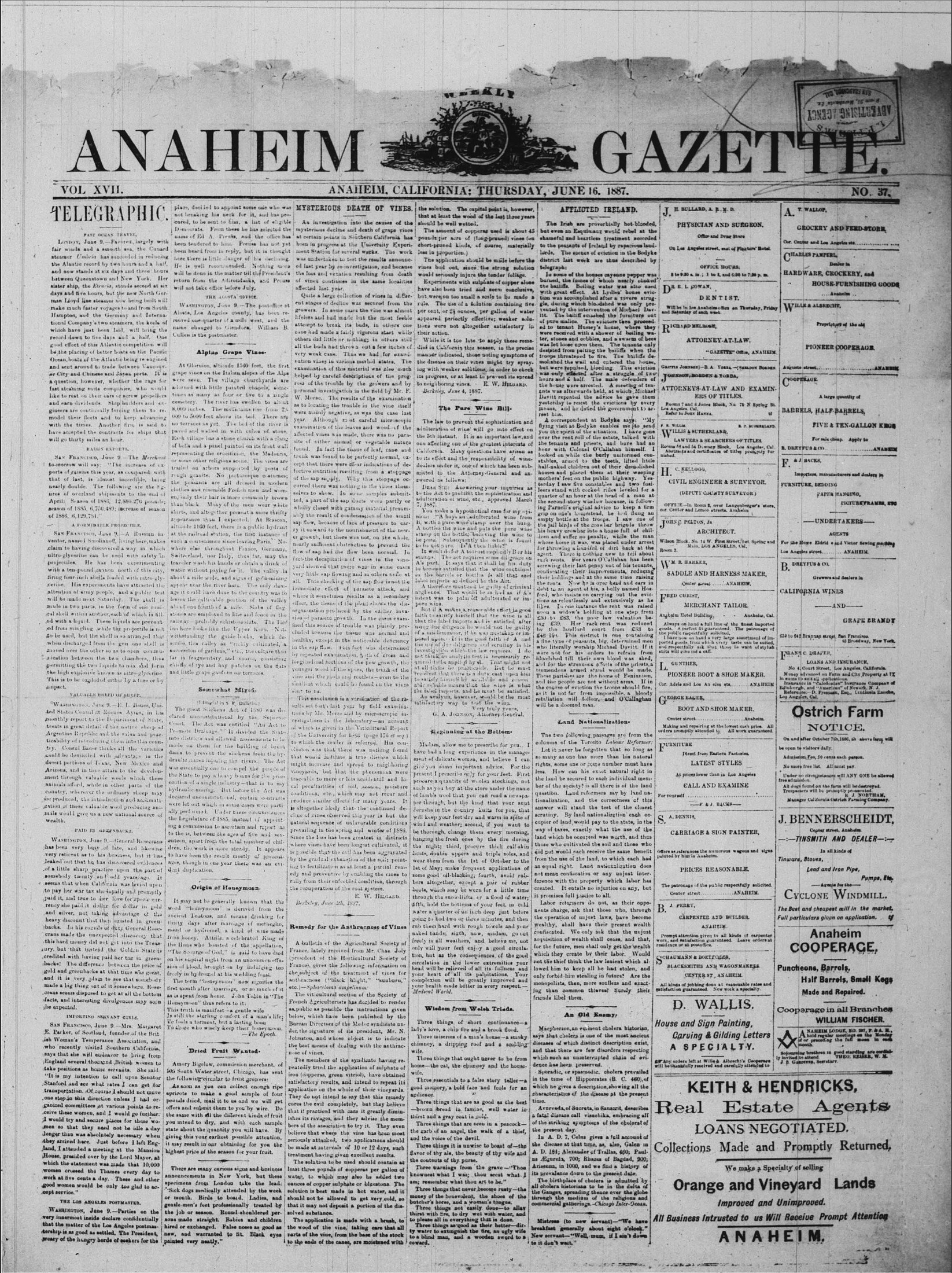
Searchable text
ANAHEIM
VOL XVII.
TELEGRAPHIC.
FAST OCEAN TRAVEL.
London, June 9.—Favored, largely with fair winds and a smooth sea, the Conard steamer Urabia has succeeded in reducing the Atlantic record by two hours and a half, and now stands at six days and three hours between Queenstown and New York. Her sister ship, the Etruria, stands second at six days and five hours, but the new North German Lloyd line steamer now being built will make much faster voyages to and from South Hampton, and the Germany and International Company's two steamers, the keels of which have just been laid, will bring the record down to five days and a half. One good effect of this Atlantic competition will be the placing of better boats on the Pacific Ocean, boats of the Atlantic being re-engined and sent around to trade between Vancouver City and Chinese and Japan ports. It is a question, however, whether the rage for fast steaming suits companies, who would like to rest on their oars or screw propellers and earn dividends. Ship builders and engineers are continually forcing them to remodel their fleets and to keep advancing with the times. Another firm is said to have accepted the contracts for ships that will go thirty miles an hour.
RAISIN EXPORTS.
San Francisco, June 9.—The Merchant to-morrow will say: "The increase of exports of raisins this year, as compared with place, decided to appoint some one who was not breaking his neck for it, and has procured, to be sent to him, a list of eligible Democrats. From these he has selected the name of Ed A. Preaks, and the office has been tendered to him. Preaks has not yet been heard from in reply, but it is thought here there is little danger of his declining. He is well recommended. Nothing more will be done in the matter till the President's return from the Adirondacks, and Preaks will not take office before July."
THE ALOSTA OFFICE.
WASHINGTON, June 9.—The postoffice at Alosta, Los Angeles county, has been removed one-quarter of a mile west, and the name changed to Glendora. William B. Cullen is the postmaster.
Alpine Grape Vines.
At Glornico, altitude 1560 feet, the first grape vines on the Italian slopes of the Alps were seen. The village churchyards are adorned with little painted chapels, sometimes as many as four or five to a single cemetery. The river has swollen to about 8,000 inches. The mountains rise from 25,000 to 5000 feet above its bed. There are no terraces as yet. The bed of the river is paved and walled in with cubes of stone. Each village has a stone church with a clang of bells and a panel painted on its front wall representing the crucifixion, the Madonna, or some other religious scene. The vines are trailed on arbors supported by posts of wood.
MYSTERIOUS DEATH.
An investigation into mysterious decline and at certain points in South Hampton in progress at the moment Station for severance was undertaken to test last year by re-investing the loss and veation of vines continues in affected last year.
Quite a large collection stages of decline with growers. In some cases lifeless and had made attempt to break its cane had made a fairly others did little or not all the buds had thrown very weak cane. This nation vine in various examination of this may helped by careful descent of the trouble by personal investigation in W. Morse. The result as to locating the trouble were mainly negative, no year. Although most examination of the leaves affected vines was made site of either animal found. In fact the time trunk was found to be except that there were effective nutrition results.
SAN FRANCISCO, June 9 — The Merchant to-morrow will say: "The increase of exports of gaisers this year, as compared with that of last, is almost incredible, being nearly double. The following are the figures of overland shipments to the end of April: Season of 1886, 12,880,270 pounds; season of 1885, 6,770,489; increase of season of 1886, 6,129,781."
A FORMIDABLE PROJECTILE.
SAN FRANCISCO, June 9 — A Russian inventor, named Smolianoff, living here, makes claim to having discovered a way in which nitro-glycerine can be used with safety in projectiles. He has been experimenting with a ten-pound cannon north of this city, firing four-inch shells loaded with nitro-glycerine. His experiments have attracted the attention of army people, and a public test will be made next Saturday. The shell is made in two parts, in the form of one conical shell within another, each of which is filled with a liquid. These liquids are prevented from mingling while the projectile is not to be used, but the shell is so arranged that when discharged from the gun one shell is moved over the other so as to open communication between the two chambers, thus permitting the two liquids to mix and form the high explosive known as nitro-glycerine. This is to be exploded either by a fuse or by impact.
VALUABLE BREED OF SHEEP.
WASHINGTON, June 9 — E. L. Bauer, United States Consul at Buenos Aires, in his monthly report to the Department of State, treats in great detail of the native sheep of Argentine Republic and the value and practicability of introducing them into this country. Consul Bauer thinks all the varieties could be domiciled with advantage in the desert portions of Texas, New Mexico and Arizona, and in time attain to the development through valuable wool which these animals afford, while in other parts of the country, wherever the ordinary sheep may be produced, the introduction and acclimatization of these valuable wool producing animals would give us a new national source of wealth.
PAID IN GREENBACKS.
WASHINGTON, June 9 — General Rosecrans has been very busy of late, and likewise very reticent as to his business, but it has leaked out that he has discovered evidences of a little sharp practice upon the part of somebody twenty and odd years ago. It seems that when California was levied upon to pay her war tax she joyfully and promptly paid it, and true to her love for agriculture on the Russian shores of the Arctic were seen. The village churchyards are adorned with little painted chapels, sometimes as many as four or five to a single cemetery. The river has swollen to about 8,000 inches. The mountains rise from 2,000 to 5000 feet above its bed. There are no terraces as yet. The bed of the river is paved and walled in with cubes of stone. Each village has a stone church with a clang of bellis and a panel painted on its front wall representing the crossion, the Madonna, or some other religious scene. The vines are trailed on arbors supported by posts of rough granite. No picturesque costumes; the peasants are all dressed in modern clothes and resemble French men and women; their hair is more commonly brown than black. Many of the men wear white shirts, and altogether present a more thrifty appearance than I expected. At Biaseon, altitude 1160 feet, there is a public hydrant at the railroad station, the first instance of such a convenience since leaving Paris. Nowhere else throughout France, Germany, Switzerland, nor Italy, thus far, may the traveler wash his hands or obtain a drink of water without paying for it. The valley is about a mile wide, and signs of gold-mining appear near the river bars. The only damage it could have done to the country was to lessen the cultivable portion of the valley about one fourth of a mile. Slabs of flagstones are employed to line and fence in the railway—probably schistosate slate. The Tiesino here looks like the Upper Kern. Notwithstanding the guide books, which describe this valley as "richly cultivated," a succession of gardens," etc., the culture thus far is fragmentary and scarce, consisting chiefly of rye and hay patches on the flats and little grape gardens on terraces.
Somewhat Mixed.
(Edition VIIIa S P. Bulletin)
The great Stickens Act of 1680 was declared unconstitutional by the Supreme Court. The Act was entitled "An Act to Promote Drainage." It divided the State into districts and allowed assessments to be made on them for the building of brush dams to prevent the stickens from the hydraulic mines injuring the rivers. The Act was essentially one to compel the people of the State to pay a heavy bonus for the prosecution of a single industry—that is to say hydraulic mining. But before the Act was declared unconstitutional, certain contracts were let out which in some cases were partially performed. Under these circumstances the Legislature of 1885, instead of appointing a commission to ascertain and report as to the is between the ages of five and seventeen, apart from the total number of children, the work is more steady. It appears to have been the result mostly of percentages, though in one year there was an evident duplication.
Origin of Honeymoon.
PAID IN GREENBACKS.
WASHINGTON, June 9. — General Rosecrans has been very busy of late, and likewise very reticent as to his business, but it has leaked out that he has discovered evidences of a little sharp practice upon the part of somebody twenty and odd years ago. It seems that when California was levied upon to pay her war tax she loyally and promptly paid it, and true to her love for specimen currency she paid it dollar for dollar in gold and silver, not taking advantage of the heavy discount that then existed in greenbacks. In his rounds of duty General Rosecrans made the unexpected discovery that this hard money did not get into the Treasury, but that instead the Golden State is credited with having paid her tag in greenbacks! The difference between the price of gold and greenbacks at that time was great, and it is very plain to see that somebody made a big thing out of it somewhere. Rosecrans seems disposed to get at all the bottom facts, and interesting divulgences may soon be expected.
IMPORTING SERVANT GIRLS.
SAN FRANCISCO, June 9. — Mrs. Margaret E. Parker, of Scotland, founder of the British Woman's Temperance Association, and who recently visited Southern California, says that she will endeavor to bring from England several thousand British women to take positions as house servants. She said: "It is my intention to call upon Senator Stanford and see what rates I can get for transportation. Of course I should not move one step in this direction unless I had organized committees at various points to receive these women, and I would go further: I would try and secure places for these women so that they need not be idle a day longer than was absolutely necessary when they arrived here. Just before I left England, I attended a meeting at the Mansion House, presided over by the Lord Mayor, at which the statement was made that 10,000 women crossed the Thames every day to work at five cents a day. These and other good women would be only too glad to accept service."
THE LOS ANGELES POSTMASTER.
WASHINGTON, June 9. — Parties on the very innermost inside declare confidentially that the matter of the Los Angeles postmaster is as good as settled. The President, weary of the hungry horde of seekers for the
It may not be generally known that the word "honeymoon" is derived from the ancient Teutons, and means drinking for thirty days after marriage of metheglin, mead or hydromel, a kind of wine made from honey. Attila, a celebrated King of the Huns who boasted of the appellation, "The Scourge of God," is said to have died on his nuptial night from an uncommon effusion of blood, brought on by indulging too freely in hydromel at his wedding feast.
The term "honeymoon" now signifies the first month after marriage, or so much of it as is spent from home. John Tobin in "The Honeymoon" thus refers to it: This truth is manifest—a gentle wife Is still the sterling comfort of a man's life; To foods a torment, but a lasting boon To those who wisely keep their honeymoon.
Dried Fruit Wanted.
Amory Bigelow, commission merchant, of 100 South Water street, Chicago, has sent the following circular to fruit growers:
As soon as you can collect enough ripe apricots to make a good sample of four pounds dried, mail it to us and we will get offers and submit them to you by wire. Do the same with all the different kinds of fruit you intend to dry, and with each sample state about the quantity you will have. By giving this your earliest possible attention, it may result in our obtaining for you the highest price of the season for your fruit.
There are many curious signs and business announcements in New York, but these specimens from London take the lead: "Sick dogs medically attended by the week or month. Birds to board. Ladies, and gentlemen's feet professionally treated by the job or season. Round-shouldered persons made straight. Babies and children hired or exchanged. False noses as good as new, and warranted to fit. Black eyes painted very neatly."
MYSTERIOUS DEATH OF VINES.
An investigation into the causes of the mysterious decline and death of grape vines at certain points in Southern California has been in progress at the University Experiment Station for several weeks. The work was undertaken to test the results announced last year by re-investigation, and because the loss and veination resulting from death of vines continues in the same localities affected last year.
Quite a large collection of vines in different stages of decline was secured from the growers. In some cases the vine was almost lifeless and had made but the most feeble attempt to break its buds, in others one cane had made a fairly vigorous start while others did little or nothing; in others still all the buds had thrown out a few inches of very weak cane. Thus we had for examination vines in various morbid states. The examination of this material was also much helped by careful descriptions of the progress of the trouble by the growers and by personal investigation in the field by Mr. F. W. Morse. The results of the examination as to locating the trouble in the vine itself were mainly negative, as was the case last year. Although most careful microscopic examination of the leaves and wood of the affected vines was made, there was no parasite of either animal or vegetable nature found. In fact the tissue of leaf, cane and trunk was found to be perfectly normal, except that there were clear indications of defective nutrition resulting from a stoppage of the solution. The capital point is, however, that at least the wood of the last three years should be well wetted.
The amount of copperas used is about 45 pounds per acre of (long-pruned) vines (on short-pruned kinds, of course, materially less in proportion.) The application should be made before the vines bud out, since the strong solution would seriously injure the tender foliage.
Experiments with sulphate of copper alone have also been tried and seem conclusive, but were on too small a scale to be made a rule. The use of a solution containing five per cent, or 2¼ ounces, per gallon of water appeared perfectly effective; weaker solutions were not altogether satisfactory in their action.
While it is too late to apply these remedies in California this season, in the precise manner indicated, those noting symptoms of the disease on their vines might try spraying with weaker solutions, in order to check its progress, or at least to prevent its spread to neighboring vines. E. W. Hilgard.
Berkeley, June 4, 1887.
The Pure Wine Bill.
The law to prevent the sophistication and adulteration of wine will go into effect on the 5th instant. It is an important law, and one affecting one of the greatest interests of California. Many questions have arisen as to its effect and the responsibility of wine dealers under it, one of which has been submitted to the Attorney-General and an
APPLICATED IRELAND.
The Irish are proverbially hot-blooded, but even an Esquinza would rebel at the shameful and heartless treatment accorded to the peasants of Ireland by rapacious landlords. The scenes of eviction in the Bodyke district last week are thus described by telegraph:
In some of the houses cayenne pepper was burned, the fumes of 'which nearly choked' the bailiffs. Boiling water was also used with great effect. At Lydia's house eviction was accomplished after a severe struggle, during which bloodshed was only prevented by the intervention of Michael Davitt. The bailiff smashed the furniture out of pure malice. The evictors then proceeded to tenant Hussey's house, where they were received with a shower of boiling water, stones and cobbles, and a swarm of bees was let loose upon them. The tenants only desisted from pelting the bailiffs when the troops threatened to fire. The bailiffs demolished the wall and entered the house, but were repulsed, bleeding. This eviction was only effected after a struggle of two hours and a half. The male defenders of the house were arrested. A meeting of tenants was afterwards held, at which Michael Davitt repeated the advice he gave them yesterday to resist the evictions by every means, and he denied the government to arrest him.
A correspondent at Bodyke says: "My flying visit at Bodyke enables me to send you the spirit of the situation. I have gone over the rent roll of the estate, talked with the tenants and priests, and have had an hour with Colonel O'Callahan himself. I looked on while the burly uniformed constables, armed to the teeth, lifted little half-naked children out of their demolished homes and placed them at their weeping
helped by careful descriptions of the progress of the trouble by the growers and by personal investigation in the field by Mr. F. W. Morse. The results of the examination as to locating the trouble in the vine itself were mainly negative, as was the case last year. Although most careful microscopic examination of the leaves and wood of the affected vines was made, there was no parasite of either animal or vegetable nature found. In fact the tissue of leaf, cane and trunk was found to be perfectly normal, except that there were clear indications of defective nutrition resulting from a stoppage of the sap supply. Why this stoppage occurred there was nothing in the vines themselves to show. In some samples submitted, a part of the sap ducts were partly or wholly closed with gummy material, presumably the result of condensation of the small sap flow, because of lack of pressure to carry it onward to the nourishment of the new growth, but there was not, on the whole, nearly sufficient obstruction to prevent the flow of sap had the flow been normal. In fact the decapitation of vines in the vineyard showed that there was in some cases very little sap flowing and in others none at all. This checking of the sap flow is not the immediate effect of parasite attack, and where it sometimes results as a secondary effect, the tissue of the plant shows the disorganization produced by the earlier invasion of parasite growth. In the cases examined this source of trouble was plainly precluded because the tissue was normal and healthy, except in the noticeable deficiency in the sap flow. This fact was determined by repeated examination, both of cross and longitudinal sections of the new growth, the younger wood of the spurs, the trunk of the vine and the roots and rootlets—even to the smallest which could be found on the vines sent to us.
This conclusion is a verification of the results set forth last year by field examinations by Mr. Morse and by microscopic investigations in the laboratory—an account of which is given in the Viticultural Report of the University for less (page 176 et seq) to which the reader is referred. His conclusion was that there was nothing found that would indicate a true disease which might increase and spread to neighboring vineyards, but that the phenomena were traceable to more or has accidental and local peculiarities of soil, season, moisture conditions, etc., which may not recur and produce similar effects for many years. It is altogether likely that the continued decline of vines observed this year is but the natural sequence of unfavorable conditions prevailing in the spring and winter of 1886. Since the loss has been greatest in districts where vines have been longest cultivated, it is possible that the evil has been aggravated by the gradual exhaustion of the soil; pointing to fertilization as at least a partial remedy and preventive by enabling the vines to rally from their enfeebled condition, through the recuperation of the root system.
E. W. Hilgard.
The law to prevent the sophistication and adulteration of wine will go into effect on the 5th instant. It is an important law, and one affecting one of the greatest interests of California. Many questions have arisen as to its effect and the responsibility of wine dealers under it, one of which has been submitted to the Attorney-General and answered as follows:
DEAR SIR: Answering your inquiries as to the Act to prohibit the sophistication and adulteration of wine, etc., approved March 7, 1887.
You make a hypothetical case for my opinion: "A boy's an adulterated wine from B, with a pure wine stamp over the bang. A bottles the wine and puts the pure wine stamp on the bottle; believing the wine to be pure. Subsequently the wine is found to be not pure." If A' then liable.
It won't do for A trust implicitly By his stamps. The act requires some diligence on A's part. It says that it shall be his duty to become satisfied that the wine contained in the barrels or bottles is all that said labors imports as defined by this Act.
A therefore must be guilty of criminal negligence. That would be as bad as if A' intent was to palm oil adulterated or impure wines.
But if A makes a reasonable effort in good faith to satisfy himself that the wine is all that the label imports and is satisfied after using due diligence he would not be guilty of a misdemeanor, if he was mistaken or imposed upon. It is the good faith of A and the use of due diligence and scrutiny in his investigation which the law requires. I do not think an analysis test is necessarily required to apply by itself. That might not at all times be practicable. But he must recodest that there is a duty cast upon him to satisfy himself by available and reasonably reliable means that the wine is what the label imports, and he must be satisfied.
An analysis, however, would be the most satisfactory way to test the wine.
Very truly yours,
G. A. Johnson, Attorney-General.
Beginning at the Bottom
Madam, allow me to prescribe for you. I have had a long experience in the management of delicate women, and believe I can give you some important advice. For the present I prescribe only for your feet. First procure a quantity of woolen stockings, not such as you buy at the store under the name of lamb's wool that you can read a newspaper through, but the kind that your anat Jervasha in the country knits for you, that will keep your feet dry and warm in spite of wind and weather; second, if you want to be thorough, change them every morning, hanging the fresh ones by the fire during the night; third, procure thick calf skin boots, double uppers and triple soles, and wear them from the 1st of October to the 1st of May; make frequent applications of some good oil-blacking; fourth, avoid rubbers altogether, except a pair of rubber boots, which may be worn for a little time through the snowdrifts or a flood of water.
was only enacted after a struggle of two hours and a half. The male defenders of the house were arrested. A meeting of tenants was afterwards held, at which Michael Davitt repeated the advice he gave them yesterday to resist evictions by every means, and he denied the government to arrest him.
A correspondent at Bodyke says: "My flying visit at Bodyke enables me to send you the spirit of the situation. I have gone over the rent roll of the estate, talked with the tenants and priests, and have had an hour with Colonel O'Callahan himself. I looked on while she burly uniformed constables, armed to the teeth, lifted little half-naked children out of their demolished homes and placed them at their weeping mothers' feet on public highway. Yesterday I saw five constables and two fusileers stand with cocked riles leveled for a quarter of an hour at the head of a man at the second-story window because, in following Parnell's original advice to keep a firm grip on one's homestead, he had dung an empty bottle at the troops. I saw one of the jail birds of the growbar brigade throw his heavy crowbar into a house full of children and suffer no penalty, while the man whose home it was, was placed under arrest for throwing a handful of dirt back at the rent. There is nothing new to tell about rack rents. For years O'Callahan has been screwing their last penny out of his tenants, confessing their improvements, reducing their holdings and at the same time raising the rent. Now he is over head and ears in debt to an agent of his, a bully named Hosford, who insists on carrying outthe evictions as relentlessly and extensively as he likes.
In one instance the rent was raised upon a widow's holding at one step from £30 to £83, the poor law valuation being £39. Her rack rent was reduced by landlord court from £83 to £48.10. This district is one containing a fine type of peasants, big, determined men who literally worship Michael Davitt. If it were not for his orders to refrain from bloodshed till their own blood was shed, and for the strenuous efforts of the priests,a tremendous armed stand would be made. These parishes are the home of Fenianism, and the people are not without arms. If in course of eviction the troops should fire, as it is not far from impossible,a bloody retaliation will follow,and O'Callaghan will be a doomed man.
Land Nationalization.
The two following passages are from the columns of the Toronto Labour Reformer:
Let it never be forgotten that so long as so many as one has more than his natural rights, some one or some number must have less. How can his exact natural right inland be secured to each individual member ofthe society?is all there isofthe land question.Land reformers say by land nationalization,andthecorrectnessofthisanswerwillstandthestefortheclosestscrutiny.Bylandnationalizationeachoccupieroflandwouldpaytothestate,inthewayoftaxesexactlywhattheuseofthelandwhichbeoccupiedwasworth,andthosewho cultivatedthesoilandthosewho didnotwouldeachreceivethesamebenefitfromtheuseoftheland,tothicheachhadanewalidright.Landnationalizationdoesnotmeanconfiscationoranyunjustinterferencewiththepropertywhichlaborhascreated。它 entailsnoinjusticeonany,但itpromisesfullpracticetoall。
produce similar effects for many years. It is altogether likely that the continued decline of vines observed this year is but the natural sequence of unfavorable conditions prevailing in the spring and winter of 1886. Since the loss has been greatest in districts where vines have been longest cultivated, it is possible that the evil has been aggravated by the gradual exhaustion of the soil; pointing to fertilization as at least a partial remedy and preventive by enabling the vines to rally from their enfeebled condition, through the recuperation of the root system.
E. W. Hilgard.
Berkeley, June 4th, 1887.
Remedy for the Anthracnose of Vines
A bulletin of the Agricultural Society of France, lately received from Mr. Chas. Joly (president of the Horticultural Society of France), gives the following information on the subject of the treatment of vines for anthracnose ("black blight," "sunburn," etc.)—Sphaecloma ampelinum.
The viticultural section of the Society of French Agriculturists has decided to render as public as possible the instructions given below, which have been published by the Bureau Director of the Medoc syndicate under the signature of its president, Mr. N. Johnston, and whose object is to indicate the best means of dealing with the anthracnose of vines.
The members of the syndicate having repeatedly tried the application of sulphate of iron (copperas, green vitriol), have obtained satisfactory results, and intend to repeat its application on the whole of their vineyards. They do not intend to say that this remedy cures the evil completely, but they believe that if practiced with care it greatly diminishes its ravages, and they advise the members of the association to try it. They even believe that where the vine has been most seriously attacked, two applications should be made at intervals of 10 or 12 days, such treatment having given excellent results.
The solution to be used should contain at least three pounds of copperas per gallon of water, to which may also be added two ounces of copper sulphate or blueactone. The solution is best made in hot water, and it should not be allowed to get very cold, so that it may not deposit a portion of the dissolved substance.
The application is made with a brush, to the wood of the vine, taking care that all parts of the vine, from the base of the stock to the ends of the canes, are moistened with per through, but the kind that your aunt Jerusha in the country knits for you, that will keep your feet dry and warm in spite of wind and weather; second, if you want to be thorough, change them every morning, hanging the fresh ones by the fire during the night; third, procure thick calf-skin boots, double uppers and triple soles, and wear them from the 1st of October to the 1st of May; make frequent applications of some good oil-blacking; fourth, avoid rubbers altogether, except a pair of rubber boots, which may be worn for a little time through the snowdrifts or a flood of water; fifth, hold the bottoms of your feet in cold water a quarter of an inch deep just before going to bed two or three minutes, and then rub them hard with rough towels and your naked hands; sixth, now, madam, go out freely in all weathers, and believe me, not only will your feet enjoy a good circulation, but as the consequences of the good circulation in the lower extremities your head will be relieved of all its fullness and your heart of all its palpitations. Your complexion will be greatly improved and your health made better in every respect.—Medical World.
Wisdom from Welsh Triads.
Three things of short continuance—a lady's love, a chip fire and a brook flood.
Three miseries of a man's house—a smoky chimney, a dripping roof and a scobling wife.
Three things that ought never to be from home—the cat, the chimney and the house-wife.
Three essentials to a false story teller—a good memory, a bold face and fools for an audience.
Three things that are as good as the best—brown bread in famine, well water in thirst and a gray coat in gold.
Three things that are seen in a peacock—the garb of an angel, the walk of a thief, and the voice of the devil.
Three things it is unwise to boast of—the flavor of thy ale, the beauty of thy wife and the contents of thy purse.
Three warnings from the grave—"Thou knowest what I was; thou seet what I am; remember what thou art to be."
Three things that never become rusty—the money of the benevolent, the shoes of the butcher's horse, and a woman's tongue.
Three things not easily done—to allow thirst with fire, to dry wet with water, and to please all in everything that is done.
Three things as good as their better—dirty water to extinguish the fire, an ugly wife to a blind man, and a wooden sword to a coward.
Nationalization, and the correctness of this answer will stand the test of the closest scrutiny. By land nationalization each occupier of land would pay to the state, in the way of taxes, exactly what the use of the land which he occupied was worth, and thus those who cultivated the soil and those who did not would each receive the same benefit from the use of the land, to which each had an equal right. Land nationalization does not mean confiscation or any unjust interference with the property which labor has created. It entails no injustice on any, but it promises full justice to all.
Labor retorners do not, as their opponents charge, ask that those who through the operation of unjust laws have become wealthy, shall have their present wealth confiscated. We only ask that the unjust acquisition of wealth shall cease, and that, for the future, men shall only get the wealth which they create by their labor. Would not the thief think the law lenient which allowed him to keep all he had stolen, and only forbid him stealing in future? Are the monopolists, then, more soulless and exacting than common thieves? Surely their friends libel them.
An Old Enemy,
Macpherson, an eminent cholera historian,
says that cholera is one of the most ancient diseases of which distinct description exist,
and that there are few disorders respecting which such an uninterrupted chain of evidence has been preserved.
Sporadic, or spasmodic, cholera prevailed in the time of Hippocrates (B. C. 460), of which he gives a description showing all the characteristics of the disease at the present time.
Avurveda, of Sucrata, in Sanscrit, describes a fatal disease call visuchika, embracing all of the striking symptoms of the choleral of the present day.
In A. D. 7, Celus gives a full account of the disease at that time, as also Galen in A. D. 181; Alexander of Trillasa, 460; Paulus Egureta, 700; Rhazes of Bagdad, 900; Arisenna, in 1000, and we find a history of its prevalence down to the present date.
The birthplace of cholera is admitted by all cholera historians to be in the delta of the Ganges, spreading thence over the globe through the medium of the religious and commercial gatherings.—Chicago Inter-Ocean.
Mistress (to new servant)—"We have breakfast generally about eight o'clock." New servant—"Well, mum, if Iain't down to it don't wait."
GAZETTE.
NO. 37.
IRELAND.
verbially hot-blooded,
would rebel at the
treatment accorded
land by rapacious landeviction in the Bodyke
are thus described by
cayenne pepper was
which nearly choked
water was also used
at Lydies' house evilated after a severe strugdaged was only prevention of Michael Davened the furniture out
victors then proceeded
's house, where they
shower of boiling wates, and a swarm of bees
from. The tenants only
the bailiffs when the
fire. The bailiffs deentered the house,
seeding. This eviction
over a struggle of two
male defenders of
a meeting of tenheld, at which Michael
adVICE he gave them
the evictions by every
the government to arBodyke says: "My
enables me to send
situation. I have gone
the estate, talked with
its, and have had an
Callahan himself. I
ourly uniformed contee teeth, lifted little
of their demolished
item at their weeping
J. H. BULLARD, A. R. M. D.
PHYSICIAN AND SURGEON.
Officer and Drug Store
On Los Angeles street, east of Planters' Hotel.
OFFICE HOURS.
8 to 9:30 a.m.; 1 to 2, and 6:30 to 7:30 p.m.
DR. E. L. POWAN,
DENTIST.
Will be in his Anaheim office on Thursday, Friday
and Saturday of each week.
RICHARD MELKOSE,
ATTORNEY-AT-LAW.
"GAZETTE" Office, ANAHEIM.
GRIPPIN JOHNSON]—B. A. TORBA—[SHELDON BORDER.
JOHNSON, BORDEN & YORDA,
ATTORNEYS-AT-LAW AND EXAMINERS OF TITLES.
Rooms 7 and 8 Jones Block, No. 75 N Spring St.
Los Angeles, Cal.
Refer to John Hanna.
F. R. WILLIAM.
WILLIS & SUTHERLAND,
LAWYERS & SEARCHERS OF TITLES.
Rooms 48 and 54 Downey Block, Los Angeles, Cal.
Abstracts and certificates of titles promptly furnished.
H. C. KELOGG.
A. T. WALLOP,
GROCERY AND FEED-STORE.
Our Center and Los Angeles sts.
CHARLES PAMPERL,
Dealer in
HARDWARE, CROCKERY, and
HOUSE-FURNISHING GOODS...
Anahiem...
WILLE & ALBRECHT,
Property of the old
PIONEER COOPERAGE.
Augustue street...ANAHEIM
COOPERAGE.
A large quantity of
BARRELS, HALF-BARRELS,
FIVE & TEN-GALLON KROS
For sale cheap. Apply to
B. DREYFUS & CO...ANAHEIM
F. & J. BACKS,
Importers, manufacturers and dealers in
JOHNSON, BORDEN & YORDA,
ATTORNEYS-AT-LAW AND EXAMINERS OF TITLES.
Rooms 7 and 8 Jones Block, No. 75 N Spring St.
Los Angeles, Cal.
Refer to John Hanna.
F. R. WILLIS
B. P. SUMMERLAND.
WILLIES & SUTHERLAND,
LAWYERS & SEARCHERS OF TITLES.
Rooms 42 and 54 Downey Block, Los Angeles, Cal.
Abstracts and certificates of titles promptly furnished.
H. C. KELLOGG,
CIVIL ENGINEER & SURVEYOR.
(DEPUTY COUNTY SURVEYOR)
OFFICE—In Room 2, over Langenberger's store,
cor. Center and Lemon streets, Anaheim.
JOHN E. PELTON, Jr.
ARCHITECT.
Wilson Block, No. 14 W. First Street, Pet. Spring and
Main, LOS ANGELES, Cal.
Room 3.
W. M. R. HARKER,
SADDLE AND HARNESS MAKER,
Center street ...ANAHEIM.
FRED CHRIST,
MERCHANT TAILOR.
Angelheim Hotel Building... Anaheim, Cal.
Always on hand a full line of the finest imported goods. A perfect fit guaranteed. The patronage of the public respectfully solicited.
I have now on hand a very large assortment of imported goods, from which every taste can be suited, and respectfully ask that those in want of stylish suits will give me a call.
L. GUNTHER,
PIONEER BOOT & SHOE MAKER.
Cor. Adela and Los Angeles sts...ANAHEIM
GEORGE BALER,
BOOT AND SHOE MAKER.
Center street... Anaheim.
Making and repairing at the lowest cash price. All orders promptly attended by. All work guaranteed.
FURNITURE
Direct from Eastern Factories.
LATEST STYLES
At prices lower than in Los Angeles.
CALL AND EXAMINE
For yourself ...ANAHEIM.
S. A. DENNIS,
CARRIAGE & SIGN PAINTER,
Offers as references the numerous wagons and signs painted by him in Anaheim.
PRICES REASONABLE.
The patronage of the public respectfully solicited.
Center street...ANAHEIM.
COOPERAGE.
A large quantity of
BARRELS, HALF-BARRELS.
FIVE & TEN-GALLON KROB
For sale cheap. Apply to
B. DREYFUS & CO...ANAHEIM
F. & J. BACKS,
Importers, manufacturers and dealers in
FURNITURE, BEDDING
PAPER HANGING,
FIGURE FRAMEES, EPO
UNDERTAKERS
AGENTS
For the Howe Eldridge and Victor Sewing machine
Los Angeles street...ANAHEIM.
B. DREYFUS & CO.
Growers and dealers in
CALIFORNIA WINES
AND
GRAPE BRANDY
634 to 642 Brannap street, San Francisco.
45 Broadway, New York.
FRANK C. DRAPER,
LOANS AND INSURANCE.
No 4 Court Street, Los Angeles, California.
Money advanced on Farm and City Property at 7X in sums to suit all applications.
Insurance in "Caledonian" Insurance Company of Edinburgh, and "American" of Newark, N. J.
Reference: D. Freeman, Esq., Centinela Lanche, Los Angeles, Cal.
Ostrich Farm NOTICE.
On and after October 7th, 1880, th above farm will be open to visitors daily.
Admission Fee, 50 cents each person.
No more free list. All must pay.
Under no circumstances will ANY ONE be allowed free admission.
All dogs found on the farm will be destroyed.
Trespassers will be promptly prosecuted.
K. J. NORTHAM,
Manager California Ostrich Farming Company.
J. BENNERSCHEIDT,
Center street, Anaheim.
TINSMITH AND DEALER:
In all kinds of
Tinware, Stoves,
Lead and Iron Pipe,
Pumps, Etc.
Agents for the
CYCLONE WINDMILL.
S. A. DENNIS,
CARRIAGE & SIGN PAINTER,
Offers as references the numerous wagons and signs painted by him in Anaheim.
PRICES REASONABLE.
The patronage of the public respectfully solicited.
Center street.....ANAHEIM.
B. J. PERBY,
CARPENTER AND BUILDER.
ANAHEIM.
Prompt attention given to all kinds of carpenter work, and satisfaction guaranteed. Leave orders at residence or at postoffice.
SCHAUMANN & DOETICHER,
BLACKSMITHS AND WAGONMAKERS.
CENTER ST., ANAHEIM.
All kinds of jobbing done at reasonable rates and satisfaction guaranteed. New work a specialty.
D. WALLIS.
House and Sign Painting,
Carving & Gilding Letters
A SPECIALTY.
Any orders left at Willie & Albrecht's Cooperage will be thankfully received and carefully attended to.
KEITH & HENDRICKS,
Real Estate Agents
LOANS NEGOTIATED.
Collections Made and Promptly Returned,
We make a Specialty of selling
Orange and Vineyard Lands
Improved and Unimproved.
All Business Intrusted to us Will Receive Prompt Attention
ANAHEIM.