anaheim-gazette 1887-05-12
Scanned page
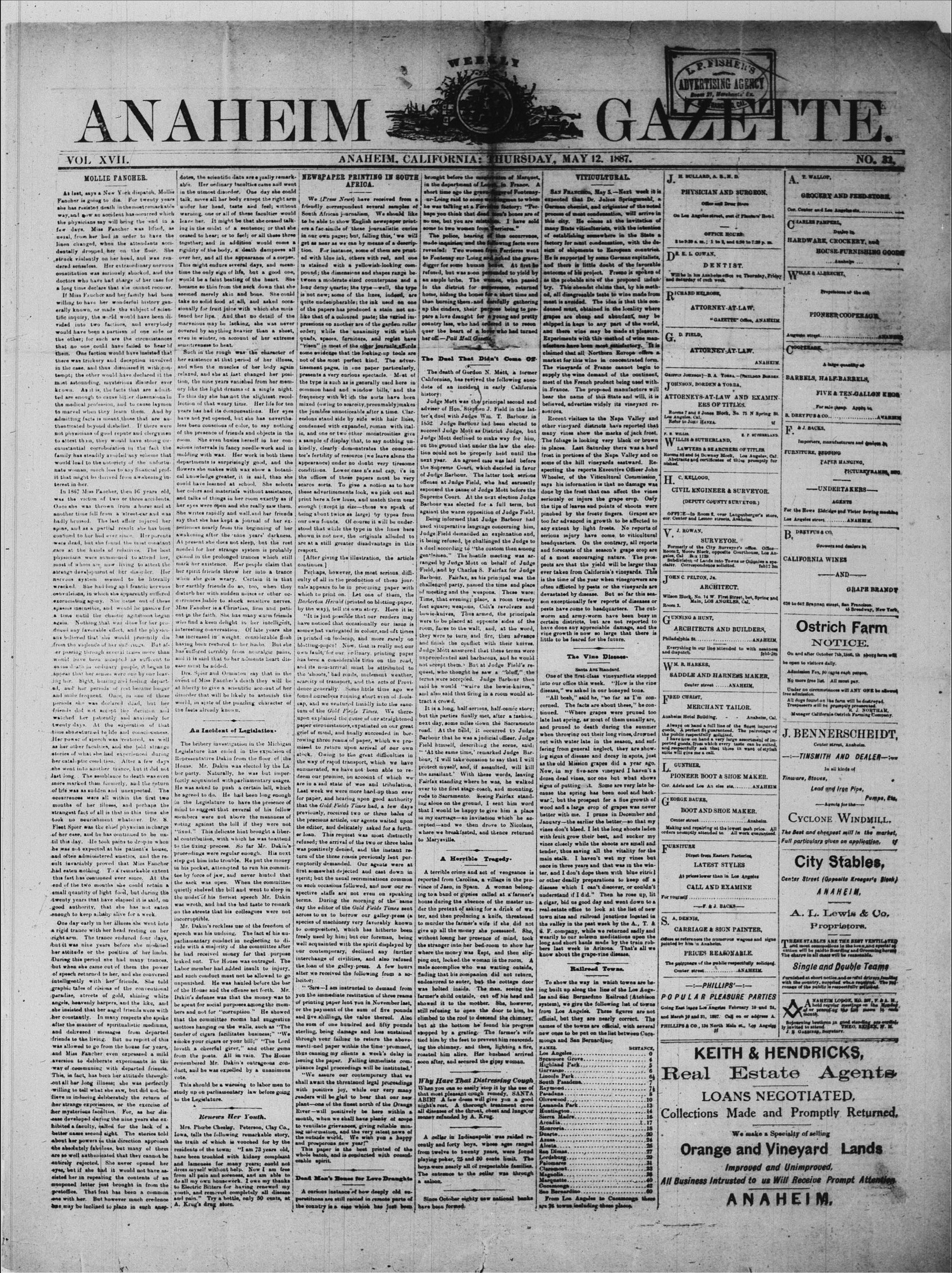
Searchable text
ANAHEIM
VOL. XVII.
MOLLIE PANCHER.
As last, says a New York dispatch, Mollie Pancher is going to die. For twenty years she has resisted death in the most remarkable way, and now an accident has occurred which the physicians say will bring the end in a few days. Miss Pancher was lifted, as usual, from her bed in order to have the linen changed, when the attendants accidentally dropped her on the floor. She struck violently on her head, and was rendered senseless. Her extraordinary nervous constitution was seriously shocked, and the doctors who have had charge of her case for a long time declare that she cannot recover.
If Miss Pancher and her family had been willing to have her wonderful history generally known, or made the subject of scientific inquiry, the world would have been divided into two factions, and everybody would have been a partisan of one side or the other; for such are the circumstances that no one could have failed to hear of them. One faction would have insisted that there was trickery and deception involved in the case, and thus dismissed it with contempt; the other would have declared it the most astounding, mysterious disorder ever known. As it is, the facts that are admitted are enough to cause bitter dissensions in the medical profession, and to cause laymen to marvel when they learn them. And by admitting facts is meant those that are authenticated beyond disbelief. If there were not physicians of good repute and clergymen to attest them, they would have strong circumstantial corroboration in the fact the family has steadily avoided any scheme that would lead to the notoriety of the unfortunate woman, much less to any financial proficiency, the scientific data are equally remarkable. Her ordinary faculties came and went in the utmost disorder. One day she could talk, move all her body except the right arm under her head, taste and feel; without warning, one or all of these faculties would leave her. It might be that she ceased talking in the midst of a sentence; or that she ceased to hear; or to feel; or all these three together; and in addition would come a rigidity of the body, a death dampness all over her, and all the appearance of a corpse. This might endure several days, and mean-time the only sign of life, but a good one, would be a faint beating of the heart. She became so thin from the neck down that she seemed merely skin and bone. She could take no solid food at all, and asked occasionally for fruit juice with which she moistened her lips. And that no detail of the marvellous may be lacking, she was never covered by anything heavier than a sheet, even in winter, on account of her extreme sensitivity to heat.
Such in the rough was the character of her existence at that period of her illness, and when the muscles of her body again relaxed, and she at last changed her position, the nine years vanished from her memory like the light dreams of a single night. To this day she has not the slightest recollection of that weary time. Her life for ten years has had its compensations. Her eyes have not yet opened, but she has nevertheless been conscious of color, to say nothing of the presence of friends and objects in the room. She even busies herself in her conscious intervals in fancy needle-work and in molding with wax. Her work in both these departments is surprisingly good, and the flowers she makes with wax show a botani-
NEWSPAPER PREVIEW
We (Press News) friendly correspondent South African journal to be able to show Evers a facsimile of this in our own pages; but get as near as we can tion. For instance, ed with blue ink, other pound; the dimension tween a moderate size long demy quarto; there is not new; some of quite undecipherable of the papers has pro- like that of a colourless pressions on another order; while the use quads, spaces, forming "risen" in most of th- some evidence that th- not of the most perfor- tisement pages, in o- presents a very curio- type is such as is common hand and w- frequency with which mixed (owing to scarce the jumbles unnotice- endons stand side by side condensed with expansion, and one or two other a sample of display th- kindly, clearly demon- tor's fertility of resource appearance) under no conditions. Lower c
In 1867 Miss Fancher, then 16 years old, was the victim of two or three accidents. Once she was thrown from a horse and at another time fell from a street-car and was badly bruised. The last affair injured her spine, and as a partial result she has been confined to her bed ever since. Her parents were dead, but she found the most constant care at the hands of relatives. The best physicians were summoned to attend her, most of whom are now living to attest the strange development of her disorder. Her nervous system seemed to be literally wracked. She had long and frantic nervous convulsions, in which she apparently suffered exorcising agony. She came out of these spasms insensible, and would be passive for a time until the chaotic agitations began again. Nothing that was done for her produced any favorable effect, and the physician believed that she would present die from the violence of her sufferings. But after passing through several times more than would have been accepted as sufficient to cause death in ordinary people, it began to appear that her senses were one by one leaving her. Sight, hearing and feeling departed, and her periods of rest became longer and more frequent. Once, in one of these periods she was declared dead, but her friends did not accept the decision and watched her patiently and anxiously for twenty days. At the expiration of that time shortened to life and consciousness. Her power of speech was restored, as well as her other faculties, and she told strange stories of what she had experienced during her cataleptic condition. After a few days she went into another trance, but it did not last long. The semblance to death was even more marked than formerly, and the return of life was as sudden and unexpected. The occurrences were all within the first two months of her illness, and perhaps the strangest fact of all is that in this time she took no nourishment whatever. Dr. S. Fleet Spier was the chief physician in charge of her case, and he has continued to be until this day. He took pains to drop in when he was not expected at his patient's house, and often administered emetics, and the result invariably proved that Miss Fancher had eaten nothing. To a remarkable extent this fast has continued ever since. At the end of the two months she could retain a small quantity of light food, but during the twenty years that have elapsed it is said on relaxed, and she at last changed her position, the nine years vanished from her memory like the light dreams of a single night. To this day she has not the slightest recollection of that weary time. Her life for ten years has had its compensations. Her eyes have not yet opened, but she has nevertheless been conscious of color, to say nothing of the presence of friends and objects in the room. She even bushes herself in her conscious intervals in fancy needle-work and in molding with wax. Her work in both these departments is surprisingly good, and the flowers she makes with wax show a botanical knowledge greater, it is said, than she could have learned at school. She selects her colors and materials without assistance, and talks of things in her room exactly as if her eyes were open and she really saw them. She writes rapidly and well, and her friends say that she has kept a journal of her experiences nearly from the beginning of her awakening after the "nine years' darkness." At present she does not sleep, but the rest needed for her strange system is probably gained in the prolonged trances which still mark her existence. Her people claim that her spirit friends throw her into a trance when she gets weary. Certain it is that her earthly friends do so, too, when they disturb her with sudden noises or other occurrences habile to shock sensitive nerves. Miss Fancher is a Christian, firm and patient in the faith. She has many warm friends who find a keen delight in her intelligent, interesting conversation. Of late years she has increased in weight, considerable flesh having been restored to her limbs. But she has suffered terribly from neuralgic pain, and it is said that to her adments heart disease must be added.
Drs. Spier and Ormiston say that in the event of Miss Fancher's death they will be at liberty to give a scientific account of her disorder that will be likely to astonish the world, in spite of the puzzling character of the facts already known.
An Incident of Legislation
The bribery investigation in the Michigan Legislature has ended in the expulsion of Representative Dakin from the floor of the House. Mr. Dakin was elected by the Labor party. Naturally, he was but imperfectly acquainted with parliamentary uses. He was asked to push a certain bill, which he agreed to do. He had been long enough in the Legislature to have the presence of mind to suggest that several of his fellow members were not above the meanness of voting against the bill if they were not "fixed." This delicate hint brought a liberal contribution, with which he was toattend to the fixing process. So far Mr. Dakin's proceedings were regular enough. His next step got him into trouble. He put the money in his pocket, attempted to run his committee by force of jaw, and never hinted that the sack was open. When the committee quietly shelved the bill and went to sleep in the midst of his fieriest speech Mr. Dakin presents a very curious type such as is common hand and wife frequency with which mixed (owing to scarce endorses stand side by side condensed with expansion, and one or two others a sample of display kindly, clearly demonstractor's fertility of resource appearance) under no conditions. Lower cases of these scarce sorts. To give these advertisements a print here a few lines, enough (except in size being about twice as our own founta). Of course that while the tilt shown is not new, there are at a still greater respect.
[After giving the ill-construites.]
Perhaps, however, culty of all in the procedures appears to be in which to print on. [Barberton Herald (print by the way), tell its own.] "It is just possible I have noticed that occur somewhat variegated it is printed on lookscap, blotting-paper! Now, own fault for our order has been a considerable and its non-arrival made 'shoots,' bad roads scarcity of transport, a dence generally. Some found ourselves running cap, and we ventured tum of the Gold Field upon explained the case paper circumstances, grief of mind, and how rowing three reams off misused to return upon attack. Owing to the way of rapid transmiserment, we have deem our promise, on are in a sad state of Laat week we were more for paper, and hearing that the Gold Fields T previously received two precious article, out the editor, and delicately or loan. This request refused; the arrival of was positively denied; turn of the three reams emptorily demanded. First somewhat dejected spirit; but the usual rejoice on such occasions follow respective staffs are no
One day early in her illness she went into a rigid trance with her head resting on her right arm. The trance endured four days, but it was nine years before she modified her attitude or the position of her limbs. During this period she had many trances, but when she came out of them the power of speech returned to her, and she conversed intelligently with her friends. She told graphic tales of visions of the conventional paradise, streets of gold, shining white angels, heavenly harpers, and the like, and she insisted that her angel friends were with her constantly. In many respects she spoke after the manner of spiritualistic mediums, and delivered messages from departed friends to the living. But no report of this was allowed to go from the house for years, and Miss Fancher even expressed a mild aversion to deliberate experiments in the way of communing with departed friends. This, in fact, has been her attitude throughout all her long illness; she was perfectly willing to tell what she saw, but did not believe in inducing deliberately the return of her strange experiences, or the exercise of her mysterious faculties. For, as her disease developed during the nine years she exhibited a faculty, called for the lack of a better name second sight. The stories told about her powers in this direction approach the absolutely fabulous, but many of them are so well authenticated that they cannot be entirely rejected. She never opened her eyes, but if she had it would not have assisted her in repeating the contents of an unopened letter just brought in from the postoffice. That feat has been a common one with her. But however much credence may be inclined to place in such anecdotes were all within the first two months of her illness, and perhaps the strangest fact of all is that in this time she took no nourishment whatever. Dr. S. Fleet Spier was the chief physician in charge of her case, and he has continued to be until this day. He took pains to drop in when he was not expected at his patient's house, and often administered emetics, and the result invariably proved that Miss Fancher had eaten nothing. To a remarkable extent this fast has continued ever since. At the end of the two months she could retain a small quantity of light food, but during the twenty years that have elapsed it is said, on good authority, that she has not eaten enough to keep a baby alive for a week.
Mr. Dakin's reckless use of the freedom of speech was his undoing. The fact of his unparliamentary conduct in neglecting to divide with a majority of the committee after he had received money for that purpose leaked out. The House was outraged. The Labor member had added insult to injury, and such conduct must not be allowed to go unpunished. He was hauled before the bar of the House and the offense set forth. Mr. Dakin's defense was that the money was to be spent for social purposes among the members and not for "corruption." He showed that the committee rooms had suggestive mottoes hanging on the walls, such as "The tender of cigars facilitates business;" "We smoke your cigars or your bill;" "The Lord loveth a cheerful giver," and other gems from the posts. All in vain. The House remembered Mr. Dakin's outrageous conduct, and he was expelled by a unanimous vote.
This should be a warning to labor men to study up on parliamentary law before going to the Legislature.
Renews Her Youth.
Mrs. Phoebe Chessley, Peterson, Clay Co., Iowa, tells the following remarkable story, the truth of which is vonched for by the residents of the town: "I am 73 years old, have been troubled with kidney complaint and lameness for many years; could not dress myself without help. Now I am free from all pain and soreness, and am able to do all my own housework. I owe my thanks to Electric Bitters for having renewed my youth, and removed completely all disease and pain." Try a bottle, only 50 cents, at A. Krug's drug store.
NEWSPAPER PRINTING IN SOUTH AFRICA.
We (Press News) have received from a friendly correspondent several samples of South African journalism. We should like to be able to show English newspaper printers a facsimile of these journalistic curios in our own pages; but, failing this, 'we will get as near as we can by means of a description. For instance, some of them are printed with blue ink, others with red, and one is stained with a yellowish-looking compound; the dimensions and shapes range between a moderate sized counterpane and a long demy quarto; the type—well, the type is not new; some of the lines, indeed, are quite undeniable; the ink used on one of the papers has produced a stain not unlike that of a coloured paste; the varied impressions on another are of the garden roller order; while the unanimity with which quads, spaces, furniture, and regist have "risen" in most of the other journals affords some evidence that the looking-up tools are not of the most perfect kind. The advertisement pages, in one paper particularly, presents a very curious spectacle. Most of the type is such as is generally used here in common hand and window bills, and the frequency with which the sorts have been mixed (owing to scarcity, presumably) makes the jumbles unnoticeable after a time. Clarendons stand side by side with hair lines, condensed with expanded, roman with italic, and one or two other monstrosities give a sample of display that, to say nothing unkindly, clearly demonstrates the compositor's fertility of resource (we leave alone the appearance) under no doubt very tiresome conditions. Lower case n's and cap, it's brought before the magistrate of Marquet, in the department of Leiden, in France. A short time ago the grave digger of Fontenay-sur-Loing said to some workingmen to whom he was talking at a Ferreries factory: "Perhaps you think that dead man's bones are of no use, but you are mistaken. I have sold some to two women from Ferrières."
The police, hearing of this occurrence, made inquiries and the following facts were revealed: Two women from Ferrières went to Fontenay-sur-Loing and asked the grave digger for some human bones. At first he refused, but was soon persuaded to yield by an ample bribe. The women, who passed in the district for sorceresses, returned home, hiding the bones for a short time and then burning them and carefully gathering up the cinders, their purpose being to prepare a love draught for a young and pretty country lass, who had ordered it to reconquer the heart of a lover who had turned her off. Pall Mall Gazette.
The Duel That Didn't Come Off
The death of Gordon N. Mett, a former Californian, has revived the following anecdote of an incident in early California history:
Judge Mott was the principal second and adviser of Hon. Stephen J. Field in the latter's duel with Judge Wm. T. Barbour in 1852. Judge Barbour had been elected to succeed Judge Mott as District Judge, but Judge Mott declined to make way for him, on the ground that under the law the election could not be properly held until the next year. An agreed case was laid before the Supreme Court, which decided in favor of Judge Barbour.
VITICULTURAL.
SAN FRANCISCO, May 5—Next week it is expected that Dr. Julius Springmühl, a German chemist, and originator of the noted process of must condensation, will arrive in this city. He comes at the invitation of many State viticulturists, with the intention of establishing somewhere in the State a factory for must condensation, with the design of shipments to European countries. He is supported by some German capitalists, and there is little doubt of the favorable outcome of his project. Freemoe is spoken of as the probable site of the proposed industry. This chemist claims that, by his method, all disagreeable taste to wine made from must is avoided. The idea is that this condensed must, obtained in the locality where grapes are cheap and abundant, may be shipped in kegs to any part of the world, and there wine may be made at pleasure. Experiments with this method of wine manufacture have been most satisfactory. It is claimed that all Northern Europe offers a market for this wine in concentrated form. The vineyards of France cannot begin to supply the wine demand of the continent, most of the French product being used within France. The proposed manufacturer will bear the name of this state and will, it is believed, advertise widely its vineyard resources.
Recent visitors to the Napa Valley and other vineyard districts have reported that many vines show the marks of jack frost. The foliage is looking very black or brown in places. Last Saturday there was a hard frost in portions of the Napa Valley and on some of the hill vineyards eastward. Respecting the reports Executive Officer John
presents a very curious spectacle. Most of the type is such as is generally used here in common hand and window bills, and the frequency with which the sorts have been mixed (owing to soaring, presumably) makes the jumbles unnoticeable after a time. Clarendons stand side by side with hair lines, condensed with expanded, roman with italic, and one or two other monstrosities give a sample of display that, to say nothing unkindly, clearly demonstrates the compositor's fertility of resource (we leave alone the appearance) under no doubt very tiresome conditions. Lower case n's and cap, it's in the offices of these papers must be very scarce sorts. To give a notion as to how these advertisements look, we pick out and print here a few lines, and match them near enough (except in size—these we speak of being about twice as large) by types from our own founta. Of course it will be understood that while the type in the lines here shown is not new, the originals alluded to are at a still greater disadvantage in this respect.
[After giving the illustration, the article continues.]
Perhaps, however, the most serious difficulty of all in the production of these journals appears to be in procuring paper with which to print on. Let one of them, the Barberton Herald (printed on blotting-paper, by the way), tell its own story. Here it is:
"It is just possible that our readers may have noticed that occasionally our issue is somewhat variegated in colour, and oft times is printed on foolscap, and more rarely on blotting-paper! Now, that is really not our own fault; for our ordinary printing paper has been a considerable time on the road, and its non-arrival must be attributed to the 'shoots,' bad roads, inclement weather, scarcity of transport, and the acts of Providence generally. Some little time ago we found ourselves running short even of foolscap, and we ventured timidly into the sanctum of the Gold Field Times. We thereupon explained the cause of our straightened paper circumstances, expatiated on our great grief of mind, and finally succeeded in borrowing three reams of paper, which we promised to return upon arrival of our own stock. Owing to the great difficulties in the way of rapid transport, which we have enumerated, we have not been able to redeem our promise, on account of which we are in a sad state of woe and tribulation. Last week we were more hard-up than ever for paper, and hearing upon good authority that the Gold Fields Times had, a few days previously, received two or three bales of the precious article, our agents waited upon the editor, and delicately asked for a further loan. This request was most distinctly refused; the arrival of the two or three bales was positively denied, and the instant return of the three reams previously lent perceptorily demanded. Our agents were at first somewhat dejected and cast down in spirit; but the usual recriminations common on such occasions followed, and now our respective staffs are not even on speaking terms."
Judge Mott was the principal second and adviser of Hon. Stephen J. Field in the latter duel with Judge Wm. T. Barbour in 1852. Judge Barbour had been elected to succeed Judge Mott as District Judge, but Judge Mott declined to make way for him, on the ground that under the law the election could not be properly held until the next year. An agreed case was laid before the Supreme Court, which decided in favor of Judge Barbour. The latter took serious offense at Judge Field, who had earnestly espoused the cause of Judge Mott before the Supreme Court. At the next election Judge Barbour was elected for a full term, but against the warm opposition of Judge Field.
Being informed that Judge Barbour had used vituperative language concerning him, Judge Field demanded an explanation and, it being refused, he challenged the Judge to a duel according to "the custom then among gentlemen." The hostile meeting was arranged by Judge Mott on behalf of Judge Field, and by Charles S. Fairfax for Judge Barbour. Fairfax, as his principal was the challenged party, pamed the time and place of meeting and the weapons. These were: Time, that evening; place, a room twenty feet square; weapons, Colt's revolvers and bowie-knives. Thus armed, the principals were to be placed at opposite sides of the room, faces to the wall, and, at the word, they were to turn and fire, then advance and finish the conflict with their knives. Judge Mott answered that these terms were unprecedented and barbarous, and he would not accept them. But at Judge Field's request, who thought he saw a "bluff," the terms were accepted. Judge Barbour then said he would "waive the bowie-knives," and also said that firing in a room would attract a crowd.
It is a long, half-serious, half-comic story; but the parties finally met, after a fashion next day, some miles down the Sacramento road. At the field, it occurred to Judge Barbour that he was a judicial officer. Judge Field himself, describing the scene, said:
"At the same time,' remarked Judge Barbour, I will take occasion to say that I will protect myself, and if assaulted, will kill the assailant.' With these words, leaving Fairfax standing where he was, he walked over to the first stage-coach, and mounting, rode to Sacramento. Seeing Fairfax standing alone on the ground, I sent him word that I would be happy to give him a place in my carriage—an invitation which he accepted—and we then drove to Nicolaus, where we breakfasted, and thence returned to Marysville.
A Horrible Tragedy.
A terrible crime and act of vengeance is reported from Carolina, a village in the province of Jaen, in Spain. A woman belonging to a band or gipsies called at a farmer's supply the wine demand of the continent, most of the French product being used within France. The proposed manufactures will bear the name of this State and will, it is believed, advertise widely its vineyard resources.
Recent visitors to the Napa Valley and other vineyard districts have reported that many vines show the marks of jack frost. The foliage is looking very black or brown in places. Last Saturday there was a hard frost in portions of the Napa Valley and on some of the hill vineyards eastward. Respecting the reports Executive Officer John Wheeler, of the Viticultural Commission, says his information is that no damage was done by the frost that can affect the vines seriously or injure the grape crop. Only the tips of leaves and points of shoots were pinched by the frosty fingers. Grapes are too far advanced in growth to be affected to any extent by light frosts. No reports of serious injury have come to viticultural headquarters. On the contrary, all reports and forecasts of the season's grape crop are of a most encouraging nature. The prospects are that the yield will be larger than ever taken from California's vineyards. This is the time of the year when vinegrowers are often afflicted by pests or the vineyards are devastated by disease. But so far this season exceptionally few reports of diseases or pests have come to headquarters. The cutworm and army-worm have been busy in certain districts, but are not reported to have done any appreciable damage, and the vine growth is now so large that there is little to be feared for the future.
The Vine Disease.
Santa Ana Standard.
One of the first-class vineyardists stepped into our office this week. "How is the vine disease," we asked in our honeyed tones.
"All bosh," said he, "so far as I'm concerned. The facts are about these," he continued. "Where grapes were pruned too late last spring, as most of them usually are, and pruned to death during the summer when throwing out their long vines, drowned out with water late in the season, and suffering from general neglect, they are showing signs of disease and decay in spots, just as the old Mission grapes did a year ago. Now, in my five-acre vineyard I haven't a dozen dead vines; nor one but what shows signs of putting at. Some are very late because the spring has been cool and backwarrior," but the prospect for a fine growth of wood and a large crop of grapes was never better with me. I prune in December and January—the earlier the better—so that my vines don't bleed. I let the long shoots laden with fruit grow their best, and sucker my vines closely while the shoots are small and tender; thus saving all the vitality for the main stalk. I haven’t wet my vines but once in three years and that was in the winter; and I don’t dope them with blue vitriol or other deadly preparations to keep off a disease which I can't discover, or couldn't understand if I did." Then he rose up, lit
for paper, and hearing upon good authority that the Gold Fields Times had, a few days previously, received two or three bales of the precious article, our agents waited upon the editor, and delicately asked for a further loan. This request was most distinctly refused; the arrival of the two or three bales was positively denied, and the instant return of the three reams previously lent peremptorily demanded. Our agents were at first somewhat dejected and cast down in spirit; but the usual recriminations common on such occasions followed, and now our respective staffs are not even on speaking terms. During the morning of the same day the editor of the Gold Fields Times sent across to us to borrow our galley-press (a species of machinery very favorably known to compositors), which has hitherto been freely used by him; but our foreman, being well acquainted with the spirit displayed by our contemporary, declined any further interchange of civilities, and also refused the loan of the galley-press. A few hours alter we received the following from a solicitor:
"Sire—I am instructed to demand from you the immediate restitution of three reams of printing paper lent you in November last, or the payment of the sum of five pounds and five shillings, the value thereof. Alas the sum of one hundred and fifty pounds sterling, being damage and loss sustained through your failing to return the above-mentioned paper within the time promised, thus causing my clients a week's delay in issuing the paper. Failing immediate compliance legal proceedings will be instituted."
"We assure our contemporary that we shall await the threatened legal proceedings with positive joy, while our very many readers will be glad to bear that our new plant—one of the finest north of the Orange River—will positively be here within a month, when we shall have plenty of scope to ventilate grievances, giving reliable mining information, and the very latest news of the outside world. We wish you a happy and prosperous new year!"
This paper is the best printed of the whole batch, and is conducted with considerable spirit.
Dead Man's Home for Love Draughts
A curious instance of how deeply old superstitions are still rooted in remote parts of the country is a case which has just been ing alone on the ground. I sent him word that I would be happy to give him a place in my carriage—an invitation which he accepted—and we then drove to Nicolaus, where we breakfasted, and thence returned to Marysville.
A Horrible Tragedy.
A terrible crime and act of vengeance is reported from Carolina, a village in the province of Jaen, in Spain. A woman belonging to a band or gipsies called at a farmer's house during the absence of the master under the pretext of asking for a drink of water, and then producing a knife, threatened to murder the farmer's wife if she did not give up all the money she possessed. She, without losing her presence of mind, took the stranger into her bed-room to show her where the money was kept, and then slipping out, locked the woman in the room. A male accomplice who was waiting outside, finding that his companion did not return, endeavored to enter, but the cottage door was bolted inside. The man, seeing the farmer's child outside, cut off his head and showed it to the mother. She, however, still refusing to open the door to him, he climbed to the roof to descend the chimney, but at the bottom he found his progress stopped by a grating. The farmer's wife tied him by the feet to prevent him resascending the chimney, and then, lighting a fire, roasted him alive. Her husband arrived soon after, and secured the gipsy woman.
Why Have That Distressing Cough?
When you can so easily stop it by the use of that most pleasant cough remedy, SANTA ABIM? A few doses will give you a good night's rest. A thorough treatment cure all diseases of the throat, chest and lungs, or money refunded by A. Krug.
A seller in Indianapolis was raided recently and forty boys whose ages ranged from twelve to twenty years, were found playing poker, 25 and 50 cents limit. The boys were nearly all of respectable families. The entrance to the seller was through a saloon.
Since October eighty new national banks have been formed.
War II, but the prospect for a fine growth of wood and a large crop of grapes was never better with me. I prune in December and January—the earlier the better—so that my vines don't bleed. I let the long shoots laden with fruit grow their best, and sucker my vines closely while the shoots are small and tender, thus saving all the vitality for the main stalk. I haven't wet my vines but once in three years and that was in the winter. And I don't dope them with blue vitriol or other deadly preparations to keep off a disease which I can't discover, or couldn't understand if I did." Then he rose up, lit a cigar, bid us good day and went down to a real-estate office to look at the list of new town sites and railroad junctions located in the valley in the past week by the A., T. & S. F. company, while we returned sadly and wearily to our solemn meditations upon the long and short bans made by the train robbers last week in Arizona. That's all we know about the grape-vine disease.
Railroad Towns.
To show way in which towns are being built up along the line of the Los Angeles and San Bernardino Railroad (Atchison system), we give the following list of towns from Los Angeles. These figures are not official, but they are nearly correct. The names of the towns are official, with several new ones to be put on the list between Cuacamonga and San Bernardino.
NAMES DISTANCE
Los Angeles 0
Sycamore Grove 4
Highland Park 5
Garvango 6
Lincoln Park 6
South Pasadena 7
Raymond 7
Pasadena 8
Olivewood 10
Lamanda Park 13
Huntington 14
Sierra Madre 16
Arcadia 17
Monrovia 18
Duarte 20
Arusa 24
Alosta 26
San Dimas 27
Lordaburg 29
Palomares 31
Claremont 33
Magnolia 28
Marquette 40
Cucamonga 42
San Bernardino 60
From Los Angeles to Cuacamonga there are 24 towns including these places.
GAZETTE.
NO. 32.
2. 1887.
CULTURAL.
May 5.—Next week it is
Jolius Springmühl, a
and originator of the noted
denation, will arrive in
here at the invitation of
curists, with the intention
nowhere in the State a
denation, with the deto European countries.
Some German capitalists,
doubt of the favorable
act. Fresno is spoken of
of the proposed indusclaims that, by his methtaste to wine made from
the idea is that this conceded in the locality where
and abundant, may be
any part of the world,
may be made at pleasure.
This method of wine manmost satisfactory. It is
northern Europe offers a
in concentrated form.
France cannot begin to
hand of the continent,
product being used withposed manufacture will
this state and will, it is
ridibly its vineyard rethe Napa Valley and
acts have reported that
the marks of jack frost,
very black or brown
day there was a hard
the Napa Valley and on
eyards eastward. ReExecutive Officer John
J. H. BULLARD, A. B. M. D.
PHYSICIAN AND SURGEON.
Office and Drum Store
On Los Angeles street, east of Phantom's Hotel.
OFFICE HOURS:
8 to 9:30 a.m.; 1 to 2, and 6:30 to 7:30 p.m.
D. R. E. L. COWAN,
DENTIST.
Will be in his Anaheim office on Thursday, Friday
and Saturday of each week.
RICHARD MELROSE,
ATTORNEY-AT-LAW.
"GAZETTE" Office, ANAHEIM.
G. D. FIELD,
ATTORNEY-AT-LAW.
ANAHEIM.
GRIPPIN JOHNSON]—B. A. YORBA—(MELROSE BORDEN)
JOHNSON, BORDEN & YORBA,
ATTORNEYS-AT-LAW AND EXAMINERS OF TITLES.
Rooms 7 and 8 Jones Block, No. 75 N Spring St.
Los Angeles, Cal.
Refer to John Hayne.
P. E. WILLIS,
E. P. SUTHERLAND.
WILLIS & SUTHERLAND,
LAWYERS & SEARCHERS OF TITLER.
Rooms 42 and 54 Downey Block, Los Angeles, Cal.
Abstracts and certificates of titles promptly furnished.
A. T. WALLOP,
GROCERY AND FEED-STORE.
Con. Center and Los Angeles dist.
CHARLES PAMPERL,
Dealer in
HARDWARE, CROCKERY, and
HOUSE-FURNISHING GOODS
... Anahalee...
WILLE & ALBRECHT,
Proprietor of the old
PIONEER COOPERAUM.
COOPERAGE,
A large quantity of
BARRELS, HALF-BARRELS,
FIVE & TEN-GALLON KEOS
For sale cheap Apply to
B. DREYFUS & CO... AVANHEIM
F. & J. BACKS,
Importers, manufacturers and dealers in
FURNITURE, BEDDING
PAPER HANGING,
PICTUREFRAME, MO
Ostrich Farm Notice.
On and after October 7th, 1806, the shorg farm will be open to visitors daily.
Admission Fee, 50 cents each person,
No more free list. All must pay.
Under no circumstances will ANY ONE be allowed free admission.
All dogs found on the farm will be destroyed.
Trespassers will be promptly presented.
R. J. NORTHAM,
Manager California Ostrich Farming Company.
J. BENNERSCHEIDT,
Center street, Anaheim.
TINSMITH AND DEALER
In all kinds of
Tinware, Stoves,
Lead and Iron Pipe,
Pumps, Etc.
Agents for the
CYCLONE WINDMILL.
The Best and cheapest mill in the market,
Full particulars given on application.
City Stables,
Center Street (Opensite Kroeger's Block)
ANAHEIM,
KEITH & HENDRICKS,
Real Estate Agents
LOANS NEGOTIATED,
Collections Made and Promptly Returned.
We make a Specialty of selling
Orange and Vineyard Lands
Improved and Unimproved,
All Business Intrusted to us Will Receive Prompt Attention
ANAHEIM.