anaheim-gazette 1887-05-05
Scanned page
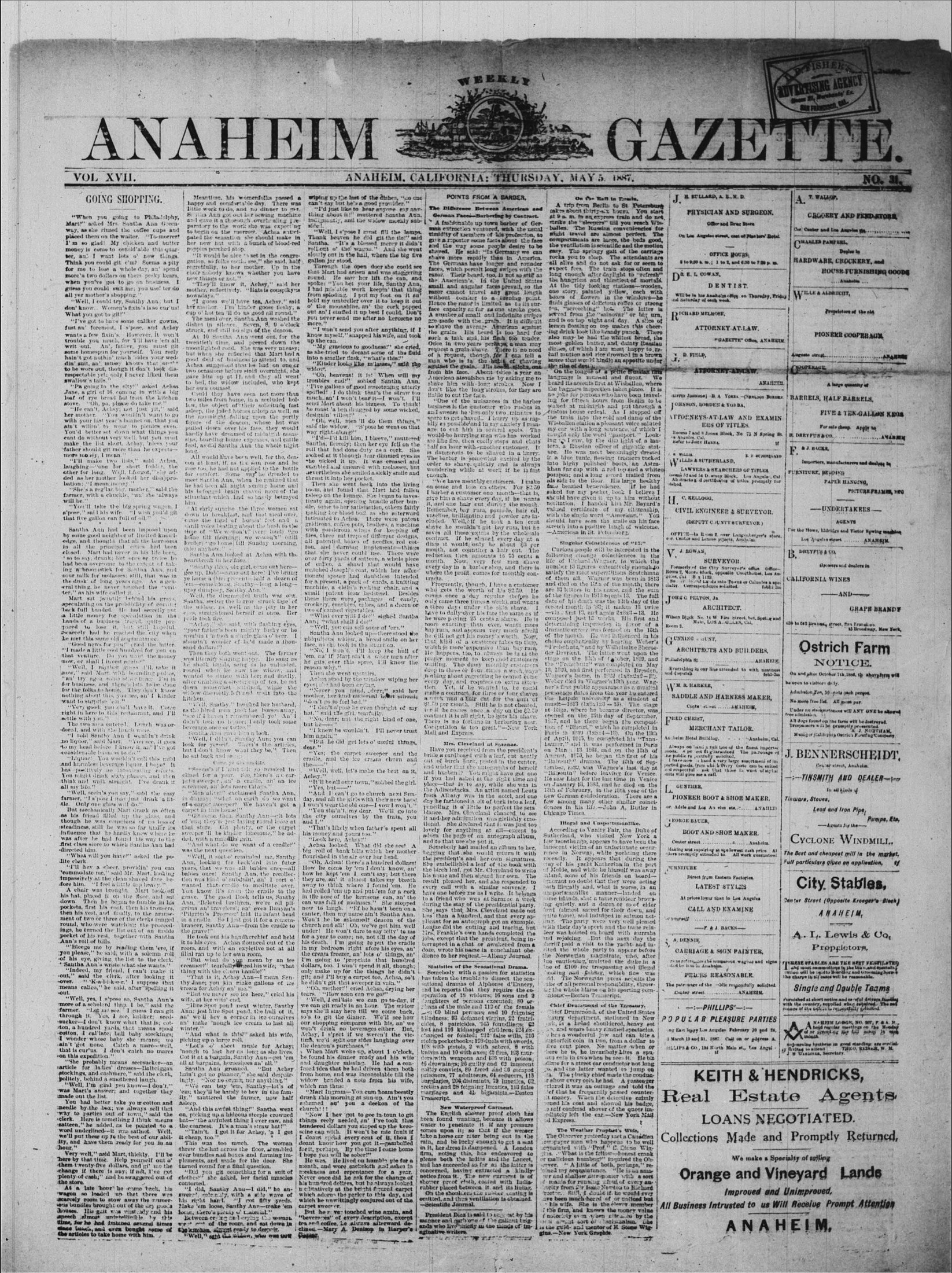
Searchable text
GOING SHOPPING.
"When you going to Philadelphia, Mart?" asked Mrs. Santha Ann Greenway, as she rinsed the coffee cups and placed them on the waiter. "To-morrer! I'm so glad! My chicken and butter money is come to consider this quarter, and I want lots of new things. Think you could git e'm? Seems a pity for me to lose a whole day, an' spend more'n two dollars on them pesky kears, when you've got to go on business. I guess you could suit me; you use'ter do all yer mother's shopping."
"Well, I could try, Santhy Ann; but I don't know... Women's fixin's is so cur'us! What you got to gift?"
"I've got to have some caliker gowns, just an' foremost, I s'pose, and Achsy wants a few fixin's. However, it won't trouble you much, for I'll have 'em all writ out. An', father, you must git some homespun for yourself. You reely hainn't got nothin' much 'sides your weddin' suit, an' mussy knows that one'' to be wore out, though it don't look disrespectable yet; only I never liked them swallow's tails."
"Pa going to the city?" asked Achsa Jane, a girl of 16, coming in with a big loaf of rye bread hot from the kitchen stove. "Oh, pa, please do take me."
"He can't, Achsy; not just yit," said her mother. "You wouldn't want to go with your last year's bonnet on, that you ain't willin', to wear to picnics even. You'd better set down what things you cant do without very well, but you must make the list short, Achsy, unless your father should git more than he expects—more money, I mean."
"I'll make two lists," said Achsa laughing—"one for short folder, the other for long. Well, I forgot," she ad
Meantime, his womenfolks passed a happy and comfortable day. There was little work to do, and no dinner to get. Santha Ann got out her sewing machine and gave it a thorough overhailing preparatory to the work she was expecting to begin on the morrow. Achsa anticipated the sensation she should make in her new hat with a bunch of blood-red poppies perched atop.
"It would be nice to set in the congregation, so folks could see," she said, half regretfully, to her mother. Up in the choir nobody knows whether you have new things or not."
"The they'll know it, Achsy," said her mother, reflectively. "Hats is conspikyn nowadays."
"I guess we'll have tea, Achsy," said her mother. "I'm hinder goose fleshy; a cup o' hot tea'll do us good all round."
The meal over Santha Ann washed the dishes in silence. Seven, 8, 9 o'clock struck, and still no sign of the dencon.
At 10 Santha Ann went out, for the twentleth time, and peered down the moonlighted road. She was very uneasy; but when she reflected that Mart had a good deal of business to attend to, and Achsa suggested that he had on one or two occasions before staid overnight, she gave him up at 11, and they all went to bed, the widow included, who kept her own counsel.
Could they have seen not more than two miles from home, in a secluded hollow, the object of their solicitude fast asleep, the jaded horses wake as well, as the moonlight falling upon the portly figure of the deacon, whose hat was pulled down over his face; they would hardly have dreamed of midnight assassins, boarding house expenses, and cattle feed, as did Santha Ann the whole night long.
All would have been well, for the dencon at least, if as the sun rose and he rose too; he had not applied to the bottle for comfort. Some way he dranked to wiping up the lace can't say but he!
"I'd just like thine thing about it!" indignantly, and side!
"Well, I s'posse Thank heaven H Santha." It's a roll-out o' the w slowly out in the gallon jar stood.
Through the door that Mart had arri round. He savored spoke: "You bet I had misable w from spioding. I held my umbrella o' the moonshining out an'I stuffed i you never send n more."
"I won't send y know myself," sn up the can.
"My gracious t as she tried to d into a smaller flasl Kinder looks b widow.
"Oh, heavens! troubles end!" "Five gallons of g spoiled! I do this much, an'I won't send Mart about he must'a ben du designin' villen!"
"Oh, well, men said the widow. way right-along!"
"I'd-I'd kill H Santha, fiercely; t roll that had done looked at it through she clicked it up trembled and emervedless she s
"I'm going to the city," asked Achsa Jane, a girl of 16, coming in with a big loaf of rye bread hat from the kitchen stove. "Oh, pa, please do take me."
"He can't, Achsa; not just yit," said her mother. "You wouldn't want to go with your last year's bonnet on, that you aren't willin' to wear to picnics even. You'd better set down what things you can do without very well, but you must make the list short. Achsa 'less your father should git more than he expects—more money, I mean."
"I'll make two lists," said Achsa laughing—"one for short folder, the other for long. Well, I forgot," she added as her mother looked her disproportion: "I mean money."
"She's a reg'l boy, mother," said the farmer, with a chuckle, "an' she always will be."
"You'll take the big spring wagon. I pose," said his wife. "I wish you'd git that five gallon can full of oil."
Santha Ann had been imposed upon by some good neighbor of limited knowledge, and thought that all the barrooms in all the principal cities had been closed. Mart had never in his life been, so to say, drunk; but once or twice he had been overcome to the extent of taking a brownstick for Santha Ann, and pour milk for molasses; still, that was in the dusk of long years ago. As a general thing, he never touched the "crater," as his wife called it.
Mart sat jauntily behind his gray speculating on the probability of coming back full handed. He had secretly put a little money for speculation in the hands of a business friend, quite prepared to lose it, but still hopeful. Scarcely had he reached the city when he met this same old acquaintance.
"Good news for you!" cried the batter. "I made a little cool hundred for you on that venture. Do you want the money now, or shall I invest again?"
"Weil, I neither grass I'll take it now," said Mart with bounding pulse, "an try agen some of a thing. I'm in for business, and there lots to be done for the folks to home. They don't know nothing about this, you we, an' I kinder want to surprise 'em."
"Very good; you shouldn't have it. Corre right in here to this restaurant, and I'll settle with you."
The two men entered. Lunch was ordered, and with the lunch wine.
"I told Santha Ann I won't drink no liquor," said Mart. "You see it goes to my head before I know it, an' I've got considerable business to do."
"Liquard." You wouldn't call this mild and harmless beverage liquor I hope! It has positively no intoxicating effects. You might drink sixty glasses, and then think and walk straight. I've drank it all my life."
"Well, seen's you say," said the easy farmer. "I pose I may just drink a little. Only one glass will do."
But mechanically Mart drank as often as his friend filled up the glass, and though he was conscious of no loss of steadiness, still he was so far under its influence that he hardly knew where he was after he had found his way to the first class store to which Santha Ann had directed him.
"What will you have?" asked the polite clerk.
"I'll hey a cheer, providin' you can commodate me," said Mr. Mart, looking impassively at the clean shaved face before him. "I feel a little top heavy."
A chair was brought. Mart took off his hat, placed it on the floor, and sat gave him up at 12, and they all went to bed, the widow included, who kept her own counsel.
Could they have seen not more than two miles from home, in a secluded hollow, the object of their solicitud fast asleep, the faded horses asleep as well, as the moonlight falling upon the portly figure of the deacon, whose hat was pulled down over his face; they would hardly have dreamed of midnight assassins, boarding house expenses, and cattle feed, as did Santha Ann the whole night long.
All would have been well, for the deacon at least, if as the san rose and he rose too, he had not applied to the bottle for comfort. Some way he drenched to meet Santha Ann, when he realized that he had been all night sitting home and his befogged brain craved more of the stimulant which had so basically betrayed him.
At early sunrise the three women sat down to breakfast, and that meal over came the tigid of horses' feet and a grill voice beating about the bush to the tinge of "We w-wont" (very loud) "go home till morning; we w-wont" (sill louder) "go home till Sunday morning (he) anyhow."
Santha Ann looked at Achsa with the heartbreak in her face.
"Santhy (do), old girl, come out here—gee up. Doht—some out here! I've brung ye home a bite) present—half a dozen of em—come along. Santhy—long a long upsy dumpsey, Santhy Ann."
Well, the disagreeful truth was out. Santha seeing the horror struck tage of the widow, as well as the pity in her eyes, straightened herself at once. Her pride took fire.
"Achsy," she said, with flashing eyes, "your father's been mighty lucky or he wouldn't 'a took a single glass o' beer. I shouldn't wonder of held made a thousand dollars!
Then they both went out. The farmer was literally singing happy. He sang as he shook hands, song as he unloaded, roared when he saw the widow, and wanted to dance with her; and finally after drinking a strong cup of tea, he sat down somewhat saddled, while the widow discreetly left and went into the kitchen.
"Well, Santhy," laughed her husband, as the hired man took the horses away, "see if I haven't remembered ye' An' I didn't touch no honor! I only took some beverage once or twice."
Santha Ann gave him a look.
"Well, I didn't, Santhy Ann; you can look for yourself. Then's the articles, but I don't know what they be." Then he sat back and smiled.
Come ye also complete.
"Seems'a if I mind felt so musical inclined for a year. See there's a carpet sweeper,' an' a cradle,' an' an ice screamer,' an' lots more things."
Man alley" exclaimed Santha Ann, in dismay: "what on earth do we want a carpet sweeper?' We haven't got a carpet in this house."
"Gift soon then, Santhy Ann—it lots of em; they're just laying round loose at that store. Gift plenty, or the carpet sweeper 'll be kinder lonesome,' he added, with a maudlin grin.
"And what do we want of a cradle?" was the next question.
"Well, it sort o' retained me, Santhy Ann, looking far back'ard into futter years, that we was all babies once—all babies once! Santhy Ann, the recollection was kind o' subduition,' an' sort o' wanted that cradle to meditate over. You know it's from the cradle to the grave. The good Book tells us Santhy
"Oh, heavens! troubles end!" "I've gallons of g spilled! I do this much,' an'I won't send Mart about me 'a bastion designin' villen!"
"Oh, well, mien said the widow,
way right-along!
"I'd-I'd kill his Santha; fiercely; she roll that had done looked at it through she clicked it up troubled and sinned she thrust it into her eye.
Then she went to town,and found some to her sash making her blood intimated to Achsa gridirons,coffee pot with ponderous wiles,tree rat tractor all patented,bookton,and darring that she never co-ver forty yards o' of collee,a shamed matched Joseph's intimate spouse hail for a present,a paist machine,a child's small patent iron these there were,crockery,renckers,two of canned vegetables.
"What ever will Ann;" "what shall it be gits,ever this reason why."
Then she went up Aachsa stood by thy eyes;he had been never Never you mather,mother,kind r'n't don't go fo feel b'hat.' "I don't'a posse h hat,' "said the girl.
No,dear;not but he—"
"I knew he woult him again."
But he did get dear."
Yes;the carpel cradle,and the lee—the—
Well,well,Lett'Achey.
"It'll be all over Yes,-but—"
And I can't get day,and all the girls I won't wear the widow
"You shi'n't my city ourselves and I."
That's likely whet his money and you
"Look here,Achsa Aachsa looked,big roll of bank book flourished in the air"
Oh,Achsa!the How he come by how he kept'em I they are ,an't al away to think wha had rolled 'em up n in the nose of the
But mechanically Mart drank as often as his friend filled up the glass, and though he was conscious of no loss of steadiness, still he was so far under its influence that he hardly knew where he was after he had found his way to the first class store to which Santha Ann had directed him.
"What will you have?" asked the polite clerk.
"I'll hey a cheer, providin' you can 'commodate me,' said Mr. Mart, looking impassively at the clean shaved face before him. "I feel a little top heavy."
A chair was brought. Mart took off his hat, placed it on the floor, and sat down. Then he began to fumble in his pockets, first his coat, then his trousers, then his vest, and finally, to the amusement of two or three of the clerks rung round, who were watching the proceedings, he turned the list out of an inside pocket of his vest, together with Santha Ann's roll of bills.
"Bleege me by reading them 'ere, if you please," he said, with a solemn roll of his eye, giving the list to the clerk. "Santha Ann's wrote what she wants."
"Indeed, my friend, I can't make it out," said the clerk, after looking it over. "'K-a-l-i-k-e-r,' I suppose that means calico," he said, after spelling it out.
"Well, yes, I s'pose so, Santha Ann's more of a scholard than I be," said the farmer. "Lot me see. I guess I can git through it. Yes, I see, kalker; seed-sucker—I don't know what that is; cotton, a hundred yards, that means spool cotton. I call late; ball baby stockings; I wonder whose baby she means; weain't got none. Catch a mare-well, that is cur-us. I don't catch no mares on this expedition."
"She probably means seersucker—an article for ladies' dresses—Balbriggan stockings, and cashmere," said the clerk, politely behind a smothered laugh.
"Well, I'm glad you know—I don't," was Mart's answer; and together they made out the list.
You had better take your cotton and needle by the box; we always sell that way to parties out of town," said the clerk. Here is something I think means satteen," he added, as he pointed to a word underlined—it was satnet. Well, we'll put these up to the best of our ability, and have them ready for you in an hour."
Very well," asid Mart, thickly. I'll be here by that time. Help yourself out o' them twenty-five dollars, and gi'm me the change if there is any; if not, I've got plenty of cash;" and he swaggered out of the store.
At a late hour he came back, his wagon so loaded up that there was scarcely room to stow away the numerous bundles brought out of the dry goods houses. His guilt was justady and his speech almost unintelligible by this time, for he had imbued several times since lunch, and even bought some of the articles to take home with him.
"Well, it sort o' reminded me, Santhy Ann, looking for backward into futter years, that we was all babies once—all babies once! Santhy Ann, the recollection was kind o' subduit', an' I sort o' wanted that credile to meditate over. You know it's from the cradle to the grave. The good Book tells us, Santhy Ann, 'Beloved brethren, we're all pilgrims an' travelers'; an' even Dunyan's 'Pilgrim's Progress' held its infant head in a cradle. So I just got it for a memorialcerer, Santhy Ann—from the cradle to the grave!"
He took out his handkerchief and held it to his eyes. Achsa flounced out of the room, and with an expletive not at all illial ran up to her own room.
"But what do you mean by an ice cream? tearfully urged his wife; 'that thing with the churn handle!'
"That is it, Achsy Ann—I mean Sentry Jane; you kna make gallons of ice cream for Achsy an' me."
"But we never see ice here," cried his wife, at her wits' end.
"Hire Spot pond next winter, Santhy Ann; jest hire Spot pond, the hull of it, an' we'll hev a corner in ice ourselves an' make 'nough ice cream to last all winter."
"And what is this?" asked his wife, picking up a large roll.
"Let's o' sheet muscle for Achsy; 'nough to last her as long as she lives. Got it at a bargain, Santhy Ann—got 'em all at bargains, homesides na' all."
Santhy Ann groaned. "But Achsy hain't got no planner," she said despairingly.
"Nor no organ, nor anything."
"We can buy 'em, Santhy—lot's of 'em; they'll be handy to hev in the family." muttered the farmer, now half asleep.
"And this awful thing!" Santha went on, picking up a hideous steeple crowned hat—'the awfulest thing I ever saw, and the coarsest.' It's a man's straw hat!
"Tain't. I got it for Achsy, 'n I got it cheap, too."
This was too much. The woman threw the hat across the floor, stumbled over bundles and boxes and farming implements, and made for the door. She turned round for a final question.
"Did you get something for a suit of clothes?" she asked, her facial muscles contorted.
"I did, Santhy Ann—I did," he answered colently, with a side wave of his right hand.
"I got fifty yards. Make 'em loose, Santhy Ann—make 'em loose, there's plenty o' lateral."
Between crying and crying the woman went out of the room and sat down in the kitchen almost ready to despair.
"Well," said the widow, who was now in distress on earth 60s we want of a carpet sweeper? We haven't got a carpet in this house!
"It gilt some then, Santhy Ann—gilt lots of ten; they're just having round loose at that store. Git plenty, or the carpet sweeper 'll be kinder lonesome," he added, with a maddlin grin.
"And what do we want of a cradle?" was the next question.
"Well, it sort o' reminded me, Santhy Ann, looking for backward into futter years, that we was all babies once—all babies once! Santhy Ann, the recollection was kind o' subduit', an' I sort o' wanted that cradle to meditate over. You know it's from the cradle to the grave. The good Book tells us, Santhy Ann, 'Beloved brethren, we're all pilgrims an' travelers'; an' even Dunyan's 'Pilgrim's Progress' held its infant head in a cradle. So I just got it for a memorialcerer, Santhy Ann—from the cradle to the grave!"
He took out his handkerchief and held it to his eyes. Achsa flounced out of the room, and with an expletive not at all illial ran up to her own room.
"But what do you mean by an ice cream? tearfully urged his wife; 'that thing with the churn handle!"
"That is it, Achsey Ann—I mean Sentry Jane; you kna make gallons of ice cream for Achsey an' me."
"But we never see ice here," cried his wife, at her wits' end.
"Hire Spot pond next winter, Santhy Ann; jest hire Spot pond, the hull of it, an' we'll hev a corner in ice ourselves an' make 'nough ice cream to last all winter."
"And what is this?" asked his wife, picking up a large roll.
"Let's o' sheet muscle for Achsy; 'nough to last her as long as she lives. Got it at a bargain, Santhy Ann—got 'em all at bargains, homesides na' all."
Santhy Ann groaned. "But Achsey hain't got no planner," she said despairingly.
"Nor no orgian, nor anything."
"We can buy 'em, Santhy—lot's of 'em; they'll be handy to hev in the family." muttered the farmer, now half asleep.
"And this awful thing!" Santha went on, picking up a hideous steeple crowned hat—'the awfulest thing I ever saw, and the coarsest.' It's a man's straw hat!
"Tain't. I got it for Achsey, 'n I got it cheap, too."
This was too much. The woman threw the hat across the floor, stumbled over bundles and boxes and farming implements, and made for the door. She turned round for a final question.
"Did you get something for a suit of clothes?" she asked her facial muscles contorted.
"I did, Santhy Ann—I did," he answered colently with a side wave of his right hand.
"I got fifty yards. Make 'em loose, Santhy Ann—make 'em loose, there's plenty o' lateral."
Between crying and crying the woman went out of the room and sat down in the kitchen almost ready to despair.
"Well," said the widow, who was now in distress on earth 60s we want of a carpet sweeper? We haven't got a carpet in this house!
"It gilt some then, Santhy Ann; looking for backward into futter years, that we was all babies once—all babies once! Santhy Ann, the recollection was kind o' subduit', an' I sort o' wanted that cradle to meditate over. You know it's from the cradle to the grave. The good Book tells us, Santhy Ann, 'Beloved brethren,we're all pilgrims an' travelers'; an' even Dunyan's 'Pilgrim's Progress' held its infant head in a cradle. So I just got it for a memorialcerer, Santhy Ann—from the cradle to the grave!"
He took out his handkerchief and held it to his eyes. Achsa flounced out of the room and with an expletive not at all illial ran up to her own room.
"But what do you mean by an ice cream? tearfully urged his wife; 'that thing with the churn handle!"
"That is it,Achsey Ann—I mean Sentry Jane; you kna make gallons of ice cream for Achsey an' me."
"But we never see ice here," cried his wife,at her wits' end.
"Hire Spot pond next winter,Santhy Ann;jest hire Spot pond,the hull of it,an'll hev a corner in ice ourselves an' make 'nough ice cream to last all winter."
"And what is this?" asked his wife,picking up a large roll.
"Let's o' sheet muscle for Achsy;‘nough to last her as long as she lives。Got it at a bargain,Santhy Ann—got 'em all at bargains, homesides na’ all."
Santhy Ann groaned. "But Achsey hain't got no planner," she said despairingly.
"Nor no orgian,nor anything."
"We can buy 'em,Santhy—lot's of 'em;they'll be handy to hev in the family." muttered the farmer,now half asleep.
"And this awful thing!" Santha went on,picking up a hideous steeple crowned hat—'the awfulest thing I ever saw,and the coarsest.' It's a man's straw hat!
"Tain't. I got it for Achsey,‘n I got it cheap,too."
This was too much. The woman threw the hat across the floor,stumbled over bundles and boxes and farming implements,and made for the door. She turned round for a final question.
"Did you get something for a suit of clothes?" she asked her facial muscles contorted.
"I did,Santhy Ann—I did,” he answered colently with a side wave of his right hand.
"I got fifty yards.Make 'em loose,Santhy Ann—make 'em loose,there's plenty o' lateral."
Between crying and crying the woman went out of the room and sat down in the kitchen almost ready to despair.
"Well,” said the widow,who was now in distress on earth 60s we want of a carpet sweeper? We haven't got a carpet in this house!
“Oh,Achsa!the how he come by by how he kept 'en but they are an’ it alway to think what had rolled 'en up ad in the nose of the can was full of moose now to laugh.‘Hi canter,then my name Won't he be ash church and all!Ox under!He won't do for a year to come;his death.I'm goin in my bedroom right,the cream freezer,and I'm going to 'pro dollardars too.I won't only make up for my gift;and I'll buy a cape he didn't git that suce.‘Oh,mother!cry tears.‘How soon!‘How soon!‘How soon!‘How soon!‘How soon!‘How soon!‘How soon!‘How soon!‘How soon!‘How soon!‘How soon!‘How soon!‘How soon!‘How soon!‘How soon!‘How soon!‘How soon!‘How soon!‘How soon!‘How soon!‘How soon!‘How soon!‘How soon!‘How soon!‘How soon!‘How soon!‘How soon!‘How soon!‘How soon!‘How soon!‘How soon!‘How soon!‘How soon!‘How soon!‘How soon!‘How soon!‘How soon!‘How soon!‘How soon!‘How soon!‘How soon!‘How soon!‘How soon!‘How soon!‘How soon!‘How soon!‘How soon!‘How soon!‘How sooner!‘How sooner!‘How sooner!‘How sooner!‘How sooner!‘How sooner!‘How sooner!‘How sooner!‘How sooner!‘How sooner!‘How sooner!‘How sooner!!’
But he won't tink about this morning as ashamed ad’you church!!!
Now I hav e got things really needed hundered dollars you scine can with.It wi e I doant spend ever doant know how yeor for it perhaps.By yi I hope you will be so.He wes.He lived month,and wore sae neekness and report Never once did he rhin hundred dollars,n elitatively at thie bach which adorns tho par which he unwitting carpet sweeter.
But he never touched "beverries" of every tea and coffee,he all clined.-Mary A.D.Paper
WEEKLY
EIM GA
ANAHEIM, CALIFORNIA: THURSDAY, MAY 5. 1887.
wiping up the last of the dishes, "no one can't say but he's a good provider."
"I'd just like to hear anyone say anything about it!" muttered Santha Ann, indignantly, and the widow meekly subsided.
"Well, I' pose I must fill the lamps. Thank heaven he did git the file!" said Santha. "It's a blessed mercy it didn't roll out of the wagon." And she went slowly out in the hail, where the big five gallon jar stood.
Through the open door she could see that Mart had arisen and was staggering round. He saw her lift the can, and spoke: "You bet your life, Santha Ann, I had misable work keepin' that thing from spioding. I put my foot on it an' held my umbreller over it to keep it out o' the moonshine, an' the cork popped out an' I stuffed it up best I could. Don't you never send me after no kerosene no more."
"I won't send you after anything, if I know myself," snapped his wife, and took up the can.
"My gracious to goodness!" she cried, as she tried to decant some of the fluid into a smaller flask, "what's this?"
"Kinder looks like in glasses," said the widow.
"Oh, heavens! it is! When will my troubles end?" sobbed Santha Ann. "Five gallons of good sweetening utterly spoiled! I do think that's the straw too much, an' I won't bear it—I won't. I'll send Mart about his bizness. To think he must'a been drugged by some wicked, designin' villen!"
"Oh, well, men'll do them things," said the widow. "S'pose he went on that way right-along!"
"I'd—I'd kill him, I bleeve," muttered Santha, fiercely; then her eye fell on the roll that had done duty as a cork. She looked at it through tear dimmed eyes as she picked it up. It was creased and trembled and smared with molasses, but nevertheless she smiled a sickly smile and wonderd while at work if he is fast enough."
POINTS FROM A BARBER,
The Difference Between American and German Faces—Barbering by Contract.
A fashionable up town barber of German extraction ventured, with the usual timidity of members of his profession, to give a reporter some facts about the face and the way some people desire to be shaved. He said: "In Germany we can shave more rapidly than in America. The Germans have longer and rounder faces, which permit long swipes with the razor. Their beard, too, is not so stiff as the American's. In the United States small and angular faces prevail, so the razor cannot travel any great length without coming to a turning point. Hence the razor is limited as to its surface capacity as far as one stroke goes. A number of small and indefinite swipes are made with the grain. It is difficult to shave the average American against the grain. His beard is too hard for such a task and his flash too tender. Once in two years perhaps, a man may request a grain-shave. There is no need of a request, though, for I can tell a man who is in the habit of shaving against the grain. His beard stitches out from his face. About twice a year an American ate snatches me by asking me to shave him with long strokes. Now I don't like the long strokes, for they are liable to cut the face.
"One of the nuisances in the barber business is the customer who rushes in and swears he has only two minutes to spare to get shaved... I hurry up as rapidly as possible and in my anxiety I manage to cut hith in several spots. The would-be hurrying man who has worked me like fire, then coolly stops and chats half an hour with another customer. It is dangerous to be shaved in a hurry. The barber is somewhat excited by the order to shave quickly and is always wondering while at work if he is fast enough."
On The Rail to Russia.
A trip from Berlin to St. Petersburg takes about thirty-six hours. You start at 9 a.m. to an express train and do not strike the "sleepers" till you reach Wishallen. The Russian conveniences for night travel are almost perfect. The compartments are large, the beds good, the ventilation is scientific and the motion easy. The springy gait of the carriage rocks you to sleep. The attendants are all alive and do not ask for or seem to expect fees. The train stops often and long enough after daylight to "refresh" the hungry and thirstiest of mortals. At the tidy looking stations—wooden, one story, painted yellow, each with boxes of flowers in the windows—he finds glasses of delicious coffee or strong tea, "screeching" hot. The latter is served from the "sainovz" or big urn, and is on tap night and day. A slice of lemon floating on top makes this cheering drink look like brandy punch. There also may be had the whitest bread, the most golden butter, and dainty Russian dishes, of which I am most happy to re-call mutton and rice drowned in a brown sauce that would kindly an appetite under the ribs of death.
On the tongue of a pellet Russian this language is musical and fluent. We heard its accents first at Wishallen, where the baggage inspection taken place. It is no joke for persons who have been traveling for fifteen hours from Berlin to be waked at midnight and put through a custom house ordeal. As I stepped off the train into the cold and damp of the Wishallen station a pleasant voice saluted my car with a long sentence, of which I caught only the word "passport." Looking at我 saw by the dia light of a lantern, a Russian officer of gigantic stature. He was most becomingly dressed it a blue tunic, flowing trousers tucked into highy polished boots, an Astra-khan fur cap with a red top and a white bottle; and he bottled it down.
---
```markdown
WEEKLY
ANAHEIM, CALIFORNIA: THURSDAY, MAY 5. 1887.
wipping up the last of the dishes, "no one can't say but he's a good provider."
"I'd just like to hear anyone say nothing about it!" muttered Santha Ann, indignantly, and the widow meekly subside.
"Well, I' pose I must fill the lamps. Thank heaven he did git the file!" said Santha. "It's a blessed mercy it didn't roll out of the wagon." And she went slowly out in the hail, where the big five gallon jar stood.
Through the open door she could see that Mart had arisen and was staggering round. He saw her lift the can, and spoke: "You bet your life, Santha Ann, I had misable work keepin' that thing from spioding. I put my foot on it an' held my umbreller over it to keep it out o' the moonshine, an' the cork popped out an' I stuffed it up best I could. Don't you never send me after no kerosene no more."
"I won't send you after anything, if I know myself," snapped his wife, and took up the can.
"My gracious to goodness!" she cried, as she tried to decant some of the fluid into a smaller flask, "what's this!"
"Kindler looks like in glasses," said tho widow.
"Oh, heavens! it is! When will my troubles end?" sobbed Santha Ann.
"I五 gallons of good sweetening utterly spoiled! I do think that's the straw too much,' an' I won't bear it—I won't. I'll send Mart about his bizness. To think he must'a been drugged by some wicked, designin' villen!"
"Oh well, men'll do them things," said tho widow. "S'pose he went on that way right-along!"
"I'd—I'd kill him, I bleeve," muttered Santha, fiercely; then her eye fell on the roll that had done duty as a cork. She looked at it through tear dimmed eyes as she picked it up. It was creased and trembled and smared with molasses, but nevertheless she smiled a sickly smile and wonderd while at work if he is fast enough."
POINTS FROM A BARBER,
The Difference Between American and German Extraction Ventured, with the usual timidity of members of his profession, to give a reporter some facts about the face and the way some people desire to be shaved. He said: "In Germany we can shave more rapidly than in America. The Germans have longer and rounder faces, which permit long swipes with the razor. Their beard, too, is not so stiff as the American's. In the United States small and angular faces prevail, so the razor cannot travel any great length without coming to a turning point. Hence the razor is limited as to its surface capacity as far as one stroke goes. A number of small and indefinite swipes are made with the grays. It is difficult to shave the average American against the grain. His beard is too hard for such a task and his flash too tender. Once in two years perhaps, a man may request a grain-shave. There is no need of a request, though, for I can tell a man who is in in the habit of shaving against the grain. His beard stitches out from his face. About twice a year an American ate snatches me by asking me to shave him with long strokes. Now I don't like the long strokes, for they are liable to cut the face.
"One of the nuisances in the barber business is the customer who rushes in and swears he has only two minutes to spare to get shaved..." I hurry up as rapidly as possible and in my anxiety I manage to cut hith in several spots. The would-be hurrying man who has worked me like fire, then coolly stops and chats half an hour with another customer. It is dangerous to be shaved in a hurry. The barber is somewhat excited by the order to shave quickly and is always wondering while at work if he is fast enough."
On The Rail to Russia.
A trip from Berlin to St. Petersburg takes about thirty-six hours. You start at 9 a.m., to an express train and do not strike the "sleepers" till you reach Wishallen. The Russian convenience for night travel are almost perfect. The compartments are large, the beds good, the ventilation is scientific and the motion easy. The springy gait of the carriage rocks you to sleep. The attendants are all alive and do not ask for or seem to expect fees. The train stops often and long enough after daylight to "refresh" the hungry and thirstiest of mortals. At the tidy looking stations—wooden, one story, painted yellow, each with boxes of flowers in the windows—he finds glasses of delicious coffee or strong tea, "screeching" hot. The latter is served from the "sainovz" or big urn,and is on tap night and day.A slice of lemon floating on top makes this cheering drink look like brandy punch. There also may be had the whitest bread,the most golden butter,and dainty Russian dishes,fof which I am most happy to re-call mutton and rice drowned in a brown sauce that would kindly an appetite under the ribs of death.
On the tongue of a pellet Russian this language is musical and fluent.We heard its accents first at Wishallen,where the baggage inspection taken place.it Is no joke for persons who have been traveling for fifteen hours from Berlin to be waked at midnight and put through a custom house ordeal.As I stepped offthe train intothe coldand dampofthe Wishallen stationa pleasant voice salutedmy carwitha long sentence.ofwhichI caughtonlytheword"passport."Look ingat saw bythe dia lightofa lantern,aRussian officerofgianticstature.Hewwasmostbecominglydressedifabluetunic,flowingtrouserstuckedintohighypolishedboots,anAstra-khanfurcapwitharedtopandawhitebottle;andhebottleditdown
"Oh, heavens! It is! When will my troubles end!" sobbed Santha Ann. "Fire gallons of good sweetening utterly spoiled! I do think that’s the straw too much, an’ I won’t bear it—I won’t. I’ll send Mart about his bizness. To think he must’a ben drugged by some wicked, designin’ villen!”
"Oh well, men’ll do them things,” said the widow. “S’pose he went on that way right-along.”
“I’d-I’d kill him, I bleeve,” muttered Santha, fiercely; then her eye fell on the roll that had done duty as a cork. She looked at it through tear dimmed eyes as she vicked it up. It was creased and trembled and smeared with molasses, but evertheless she smiled a sickly smile and thrust it into her pocket.
Then she went back into the living room, and found that Mart had fallen asleep on the lounge. She began to investigate again, opening bundle after bundle, some to her satisfaction, others fairly making her blood boil as she afterward intimated to Achisa. There were patent gridivons, coffee pots, broilers, a machine with ponderous wings for keeping off files, three rat traps of different designs, all patented, boots of needles, red cotton, and darning implements—things that she never could use. There were over forty yards of sattee, a whole piece of calico, a shawl that would have matched Joseph’s coat, which her affectionate spouse had doubtless intended for a present, a pack of cards, a knitting machine, a child’s roaching chair, and a small patent iron bedstead. Besides these there were packages of candy, crockery, crackers, cakes, and a dozen or two of canned vegetables.
“What ever will I do?” sighed Santha Ann. “what shall I do?”
Well, you can sell some of ‘em.” Santha Ann looked up—there stood the ubiquitous window, a broad smile on her face, as she took in the situation.
No, I won’t. I’ll keep the hull of ‘em, na’ if Mart didn’t a wiser man after he gets over this spree. I’ll know the reason why.
Then she went upstairs.
Achisa stood by the window wiping her eyes; she had been crying.
Never you mind, dear,” said her mother, her kind maternal heart stirred; “don’t go to feel bad.”
“I don’t apose he even thought of my hat,” said the girl, tearfully.
No, dear; not the right kind of one, but he—
"I knew he wouldn’t. I’ll never trust him again."
But he did get lots o’ useful things, dear."
Yes; the carpet sweeper and the crawl, and the ice cream churn and the——
Well, well, let’s make the best on it, Achesy."
"It’ll be all over town," sobbed the girl.
"Yes, but——"
And I can’t go to church next Sunday, and all the girls with their new hats I won’t wear the old one—I won’t."
"You shouldn’t, my dear. We’ll go into the city ourselves by the train, you and I."
"That’s likely when father’s spent all his money and yours too."
"Look here, Achesy!"
Achsa looked. What did she see? A big roll of bank bills which her mother flourished in the air over her head.
Oh, Acheya! there’s a hundred dollars! How he comes by ‘em I don’t know, an’ how he kept ‘em I can’t say; but there they are, an’ it almost takes my breath away to think where I found ‘em. He had rolled ’em up and put ’em for a cock in the nose of the kerosene can, an’ the language is musical and fluent.” We heard its accents first at Wishallon, where the bagger inspection takes place. It is no joke for persons who have been traveling for fifteen hours from Berlin to be waked at midnight and put through a custom house ordeal. As I stepped off the train into the cold and damp of the Wishallon station a pleasant voice saluted my car with a long sentence of which I caught only the word “passport.” Looking at我 saw by the din light of a lantern a Russian officer of gigantic stature. He was most becoming dressed in a blue tunic; now trussers tacked into highly polished books, an Astrakhan far cap with a red top and a white pompon; and a long sword trailed from his side to the floor. His large healthy face beamed benevolence. If he had asked for my pocket book I believe I should have given it up to him without hesitation. I handed him Mr. Bayard’s valued certificate of my citizenship, with the single word “American.” You should have seen the smile on his face stretch into a positive laugh of welcome.
—American in St. Petersburg.
Singular Coincidence of “13.”
Curious people will be interested in the following strange coincidences in the life of Richard Wagner, in which the number 13 figures extensively enough to satisfy the most superstitious Scotchman of them all. Warner was born in 1813 and died on the 12th of month; there are 13 letters in his name, and the sum of the figures in 1813 equals 13. The full date of his death was the 13th day of the second month; in 1821 it makes 13 twice vis-à-vis first and again 2x883–13. He composed just 15 works. His first and determining impression in favor of a dramatic career was formed on the 16th of the month. He was influenced in his choice emphatically by hearing Weber’s Freischutz,” and by Wilhelmine Sherod Davrient. The latter went upon the stage on the 13th of October, 1819, and the “Freischutz” was completed on May 13, 1820, and first performed in Dresden, Wagner’s home, in 1822 (1x828–12). Weller died in Wagner’s 19th year. Wagner’s first public appearance as a musical percussionist came from the year he entered the Leipzig university as a student of music at Riga, where he became director, was opened on the 13th day of September, 1857, and he there began the composition of “Rienzi,” which he completed in Paris in 1859 (1x854–13). On the 13th of April, 1845, he completed his “Tannauer,” and it was performed in Paris on Man 13 1861, and on the 12th of August, 1876, he began the first of his “Bailout!” dramas. The 13th of September, 1882 was Wagner’s last day at “Bailout!” before leaving for Venice. He saw Listen for the last time in Venice on January 13, 1883, and he died on the 13th of February, in the 15th year of the new German confederation. There are a few among many other similar coincidences in his life—John A. Butler in Chicago Times.
Higelal and Unsporsmanlike.
According to Vanity Fair, the Duke of Sutherland who visited New York a few months ago appears to have been the innocent victim of an unfortunate occurrence in Norway; while yachting there recently it appears that during the day of his yacht Katharina in the port of Molde; while he himself was away island; some of his friends on board—imprudent no doubt they were acting with illegally and what is worse, in an unportsmanlike manner—landed on some islands like a tame resident brusks...
I won't wear the old one—I vow I won't."
"You shin't, my dear. We'll go into the city ourselves by the train, you and I."
"That's likely when father's spent all his money and yours too."
"Look here, Aachsa!"
Achsa looked. What did she see? A big roll of bank bills which her mother flourished in the air over her head.
"Oh, Aachsa! there's a hundred dollars! How he come by 'em I don't know, an' how he kept 'em I can't say; but there they are, an' it almost takes my breath away to think where I found 'em. He had rolled 'em up and put 'em for a cork in the nose of the kerosene can, an' the can was full of molasses." She stopped now to laugh. "If he hasn't been on a canter, then my name ain't Santha Ann. Won't he be ashamed? deacon of the church and all! Oh, we've got him well under! He won't dare to say 'city' to me for a year to come; no, not till the day of his death. I'm going to put the cradle in my bedroom right before his eyes, an' the cream freezer, an' lots o' things, an' I'm going to 'propriate that hundred dollars, too. I won't spend it all, though; only make up for the things he didn't git; and I'll buy a carpet too, Aachsa, so't he didn't git that sweeper in vain."
"Oh, mother!" cried Aachsa, drying her tears. "How soon can we go?"
Well, I call late we can go to-day, if we can git ready in an hour. The widow says she'll stay here till we come back, so's to git the dinner. We'll see how our shopping compares with his, an' we won't drink no beverages either. But, Aachsy, I spect if we weren't the victim, we'd split our sides laughing over the deacon's purchases.
When Mart woke up, about I o'clock, he found his dinner ready and his wife and daughter missing. He had a confused idea that he had driven them both from home, and was inconsolable till the widow handed a note from his wife, which ran thus:
"Mart Ingram—You cum hoam beestly drunk this morning at sun-up. Ain't you ashamed on' you a deekon of the church!!!"
Now I hav' got to go in-town to git things reely needed, an' I've took that hundered dollars you stoped up the kerosine can with. It won't be mite fault if I doant spend every cent of it, thou I doant know how you got it—gambled for it, perhaps. By the time I come home I hope you will be sober!
He was. He lived on humble pie for a month, and wore sackcloth and ashes in meekness and repentance for a year. Never once did he ask for the change of his hundred dollars, but he always looked in elitatively at the bright figured carpet which adorns the parlor to this day, and which he unwittingly conjured out of the carpet sweeter.
But he never touched wine again, and "beveries" of every description, except trape and coffee. He always afterward declined—Mary A. Denison in Harper's Journal.
Somebody had mailed an album to her, begging that she would return it with the president's and her own signatures. She embellished a leaf of the book with the birch leaf, got Mr. Cleveland to write his name and then signed her own. The result pleased her, and she responded to every call with a similar souvenir. I have one before me as I write. It belongs to a friend who was at Saranase a week during the stay of the presidential party. She says that, Mrs. Cleveland made not less than a hundred, and that every applicant for an autograph got an example. Lontze did the cutting and tracing, but Mrs. Frankie's own hands completed the jobs, except that the president, being interrupted in a chat or awakened from a doze, wrote his name in nonchalant obedience to her request.—Albany Journal.
Statistics of the Sensational Drama.
Somebody with a passion for statistics has taken the trouble to dissect the sensational dramas of Alphonse d'Ennery, and he reports that they require the cooperation of 18 widows; 16 sons and 2 daughters of persons executed; 80 orphaned of the male and 112 of the female: 60 blind persons and 10 feigning blindness; 93 defamed virginia; 22 fratricides; 8 patricides; 145 foundlings; C2 lost and 116 kidnapped children; 124 exchanged or foisted; 212 false wills; 210 stolen pocketbooks; 193 duels with swords, 128 with pistols, 2 with sabres; 8 with knives and 10 with axes; 63 fires; 123 murders with weapons and 138 with poison; 49 drownings; 26 guilty and 62 innocent molly convicts; 80 freed and 60 escaped prisoners; 77 adulterers; 64 reducers; 115 burglaries; 206 distrints; 79 lunatics; 62 cretins and 28 feigning lunatics; 113 false marriages and 41 bigarnists.—Boston Transcript.
New Waterproof Garment.
The English shower proof cloth has been found wanting, because it allows water to penetrate it if any pressure comes upon it; so that if the weaver take a horse car riter being out in the rain, and be lucky enough to get a seat in it, her dress is dampened. A London firm, noting this, has endeavored to please both the ladies and the Lancet, and has succeeded as far as the latter is concerned, having extracted a kindly notice from it. The new garment is of shower proof cloth, coated with India rubber placed between it and its lining.
On the shoulders the rubber coating is omitted, and thus ventilation is obtained.—Scientific Journal.
President Diaz is said to request by his manner and garb one of the gallant brigands who live chiefly in the minds of imaginative writers.
Hlegal and Unsporsmanlike.
According to Vanity Fair, the Duke of Sutherland, who visited New York a few months ago, appears to have been the innocent victim of an unfortunate occurrence in Norway, while yachting there recently. It appears that during the stay of his yacht Katherine in the port of Molde, and while he himself was away inland, some of his friends on board—laborant no doubt that they were acting both illegally and what is worse, in an unportsmanlike manner—landed on some islands, shot a tame renilde browsing quietly, and a dogen or so of elderowl (almost sacred for their down, and quite tame), and indulged in salmon netting. The party were very well pleased with their day's sport; and the tame reinleer was holested on board with murrahs and rejoicing. But the next day the cheriff paid a visit to the yacht-and invited the whole party to appear before the Norwegian magistrate, who, after fine cautioning, nuleted the duke in a line of £100 for trespassing and illegal fishing, which fine was paid. The Norwegian press acquires the duke of all personal responsibility, throws out the whole blame on his sporting commons—Boston Transcript.
Chief Drummond of the Treasury.
Chief Drummond of the United States luxury department stationed in New York is a broad shouldered, heavy set coat and wears heavy rimmed spectacles. He has wonderful jaw and can bite a butterfelt coin in two, from a dollar to five cent piece. No matter when or where he is, he invariably lites a spurious coin in two when he sees it. He bit dime for a street car conductor not long ago, and the latter wanted to jump on it. The plucky chief made the condenser show every coin he had. A passenger declared it was an outrage and told the chef that he frequently pressed counter-it money. When the detective calmly opened his coat and showed his badge, he self confessed shiver of the queer immediately left the car—New York Mail and Express.
The Weather Prophet's Wife.
The Observer yesterday met a Canadian newspaper man who happens to be well acquainted with "Prof." E. Stone Wiggins. "What is the fellow—honest crank or malicious hurbing?" enquired the Observer. "A little of both," perhaps," remained my acquaintances." "He is an amateur and shallow astronomer with a sort of mania for running about every authority from Sir Isaac Newton to Richard Croston." Still, I doubt if he would ever have been much heard of or noticed but his wife. She is the clever member of the firm, and knows the money value of notoriety even when it comes by the most urgent sort of charismanism. She is the guide-and mentor of K. Stone Wiggins—New York Graphic.
GAZETTE.
5. 1887.
NO. 31.
J. H. BULLARD, A. R., M. D.
PHYSICIAN AND SURGEON.
Officer and Drug Store
On Los Angeles street, east of Plainers' Hotel.
OFFICE HOURS:
8 to 9:30 a.m.; 1 to 2, and 6:30 to 7:30 p.m.
DR. E. L. COWAN,
DENTIST.
Will be in his Anaheim office on Thursday, Friday and Saturday of each week.
RICHARD MELROSE,
ATTORNEY-AT-LAW.
"GAZETTE" Office, Anaheim.
Y. D. FIELD,
ATTORNEY-AT-LAW.
ANAHEIM.
RIPTEN JOHNSON] - B. A. YOREA. (SHELDON BORDEN)
JOHNSON, BORDER & YORBA.
ATTORNEYS-AT-LAW AND EXAMINERS OF TITLES.
Rooms 7 and 8 Jones Block, No. 75 N Spring St.
(Angelus, Cal.)
Refer to John Hanna.
A. T. WALLOP,
CROCERY AND PEDD-STORE.
Our Center and Los Angeles plaza.
CHARLED PAMPERL,
Dealer in
HARDWARE, CROCKERY, and
HOUSE-FURNISHING GOODS
Anahiem.
WILLE & ALBRECHT,
Prepristure of the old
PIONEER COOPERAGM.
COOPERAGE.
A large quantity of
BARRELS, HALF BARRELS.
FIVE & TEN-GALLON KEOS
For sale cheap. Apply to
B. DREYFUS & CO.
F. & J. BACKS,
Importers, manufacturers and dealers in
FURNITURE, BEPUING.
ANAHEIM.
RITTER JOHNSON]—B. A. YORK. (SHELTON BORDS)
JOHNSON, BORDEN & VORBA,
ATTORNEYS AT LAW AND EXAMINERS OF TITLES.
Rooms 7 and 8 Jones Block, No 73 N Spring St.
Los Angeles, Cal.
Refer to JOX HANNA.
R WILLIES & SUTHERLAND,
LAWYERS & SEARCHERS OF TITLES.
Rooms 52 and 54 Dawney Block, Los Angeles, Cal.
Abstracts and certificates of titles promptly furnished.
H. C. KELLOGG,
CIVIL ENGINEER & SURVEYOR.
(DEPUTY COUNTY SURVEYOR)
OFFICE—In Room 2 over Langenberger's store,
cor. Center and Lemon streets, Anaheim.
V. J. BOWAN,
SURVEYOR.
Formerly of the City Surveyor's office. Office—Room 2, Monroe Block, opposite Courthouse, Los Angeles, Cal.
B x 1129.
Suction of Lands into Towns or Colonies a specially. Correspondence solicited.
JOHE G PELTON, Jr.
ARCHITECT.
Wilson Block, No 14 W Fire street, bet. Spring and Main, LOS A. GOLES, Cal.
Room 2.
GUNNING COUNT,
ARCHITECTS AND BUILDERS.
Philadelphia St. ... Anaheim.
Everything in our line attended to with neatness and dispatch.
WM. R. HARKER,
SADDLE AND HARNESS MAKER,
Cente street ... Anaheim.
FRED CHRIST,
MERCHANT TAILOR.
Anheim Hotel Building... Anaheim, Cal.
Always on hand a full line of the finest imported goods. A perfect disguise. The parapage of the public is secretly solicited.
I have now to hand a very large assortment of imported goods from which every taste can be suited and respectful ask that those in want of stylistic units will give me a call.
L. GUSTHER,
PIONEER BOOT & SHOE MAKER.
or. Adele and Los Angeles sts. ... Anaheim.
GEORGE BAUER,
BOOT AND SHOE MAKER.
Center street ... Anaheim.
Making and repairing at the lowest cash price. All orders promptly attended to. All work guaranteed.
URNITURE
Direct from Eastern Factories.
LATEST STYLES
At prices lower than in Los Angeles.
A large quantity of
BARRELS, HALF BARRELS.
FIVE & TEN-GALLON KEOPS
For sale cheap. Apply to
B. DREYFUS & CO....... ANAHIM
F. & J. BACKS,
Importers, manufacturers and dealers in
FURNITURE, BEDDING
PAPER HANGING,
PICTURE FRAME, 180
UNDERTAKERS —
AGENTS
For the Howe, Eldridge and Victor Sewing machine
Los Angeles street ... Anaheim.
B. DREYFUS & CO.
Growers and dealers in
CALIFORNIA WINES
AND GRAPE BRANDF
639 to 642 Brannam street, San Francisco
15 Broadway, New York.
Ostrich Farm NOTICE.
On and after October 7th, 1886, the above farm will be open to visitors daily.
Admission Fee, 50 cents each person.
No more free list. All must pay.
Under no circumstances will ANY ONE be allowed free admission.
All dogs found on the farm will be destroyed.
Treepassers will be promptly prosecuted.
K. J. NOUTHAM,
Manager of California Ostrich Farming Company.
J. BENNERSCHEIDT,
Center street, Anaheim.
TINSMITH AND DEALER — In all kinds of
Tinware, Stoves,
Lead and Iron Pipe,
Pumps, Etc.
Agents for the
CYCLONE WINDMILL.
The Best and cheapest mill in the market,
Full particulars given on application, of
City Stables,
KEITH & HENDRICKS,
Real Estate Agents,
LOANS NEGOTIATED.
Collections Made and Promptly Returned,
We make a Specialty of selling
Orange and Vineyard Lands
Improved and Unimproved,
All Business Intrusted to us Will Receive Prompt Attention
ANAHEIM,