anaheim-gazette 1887-04-16
Scanned page
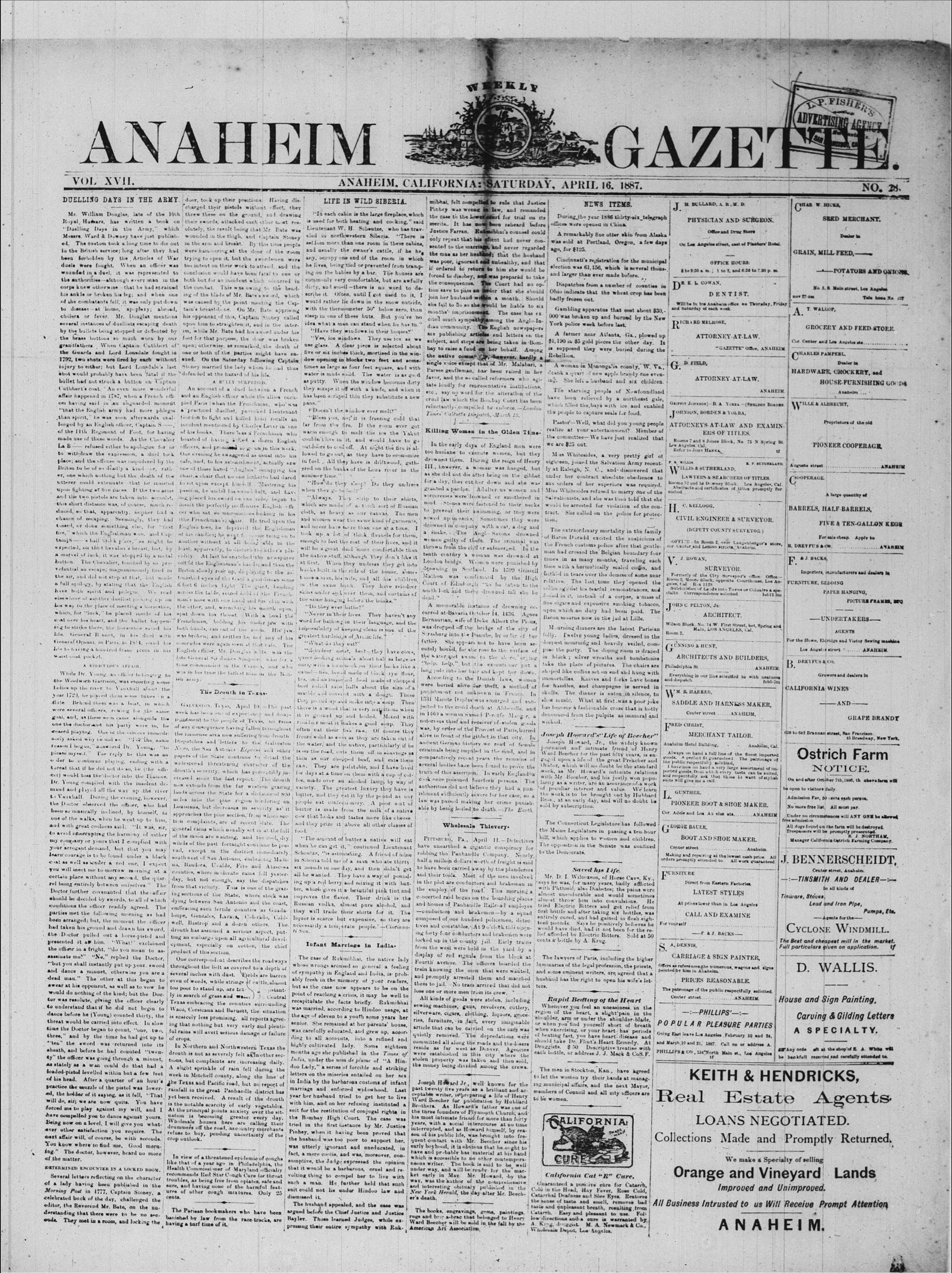
Searchable text
DUELLING DAYS IN THE ARMY.
Mr. William Douglas, late of the 10th Royal Hussars, has written a book on "Duelling Days in the Army," which Meerss. Ward & Downey have just published. The custom took a long time to die out in the British service; long after they had been forbidden by the Articles of War duels were fought. When an officer was wounded in a duel, it was represented to the authorities—although every man in the corps knew otherwise—that he had strained his ankle or broken his leg; and when one of the combatants fell, it was only put down to disease—at home, apoplexy; abroad, cholera or fever. Mr. Douglas mentions several instances of duellists escaping death by the bullets being stopped or deflected by the brass buttons so much worn by our grandfathers. When Captain Cuthbert of the Guards and Lord Lonsdale fought in 1792, two shots were fired by each without injury to either; but Lord Lonsdale's last shot would probably have been fatal if the bullet had not struck a button on Captain Cuthbert's coat. An even more wonderful affair happened in 1787, when a French officer having said in an unguarded moment "that the English army had more phlegm than spirit," he was soon afterwards challenged by an English officer, Captain S., of the 11th Regiment of Foot, for having made use of these words. As the Chevalier La B—refused either to apologize for or to withdraw the expression, a duel took place; and the offense was considered by the Briton to be of so deadly a kind—or, rather, one which is not known.
door, took up their positions. Having discharged their pistols without effect, they threw these on the ground, and drawing their swords, attacked each other most resolutely, the result being that Mr. Bate was wounded in the thigh, and Captain Stoney in the arm and breast. By this time people were hammering at the door of the room trying to open it, but the swordmen were too intent on their work to attend, and the conclusion would have been fatal to one or both but for an incident which occurred in the combat. This was owing to the bending of the blade of Mr. Bate's sword, which was caused by the point meeting the Captain's breastbone. On Mr. Bate appraising his opponent of this, Captain Stoney called upon him to straighten it, and in the interim, while Mr. Bate had his sword under his foot for that purpose, the door was broken open; otherwise, as remarked, the death of one or both of the parties might have ensued. On the Saturday following Captain Stoney married the lady whom he had thus defended at the hazard of his life.
A BULLY SURPRISED.
An account of a duel between a French and an English officer while the allies occupied Paris (when the Frenchman, who was a practiced duellist, provoked Lieutenant Gordon to fight and killed him) recalls an incident mentioned by Charles Lever in one of his books. There was a Frenchman who boasted of having killed a dozen English officers, and promised to go on in this work. One evening he swaggered as usual into his cafe, and, to his astonishment, actually saw one of those hated "Anglais" occupying his door, took up their positions. Having discharged their pistols without effect, they threw these on the ground, and drawing their swords, attacked each other most resolutely, the result being that Mr. Bate was wounded in the thigh, and Captain Stoney in the arm and breast. By this time people were hammering at the door of the room trying to open it, but the swordmen were too intent on their work to attend, and the conclusion would have been fatal to one or both but for an incident which occurred in the combat. This was owing to the bending of the blade of Mr. Bate's sword, which was caused by the point meeting the Captain's breastbone. On Mr. Bate appraising his opponent of this, Captain Stoney called upon him to straighten it, and in the interim, while Mr. Bate had his sword under his foot for that purpose, the door was broken open; otherwise, as remarked, the death of one or both of the parties might have ensured. On the Saturday following Captain Stoney married the lady whom he had thus defended at the hazard of his life.
LIFE IN W
"In each cabin it is used for both her Lieutenant W. H., died in northwest self more than any, occupy one ene he lives, being tied ing on the babies b commonly very com dirty, and smell—the scribe it. Often, u would rather lie do with the thermometer sleep in one of these idea what a man can."
"Have they win?
"Yes, ice window use glass. A clear five or six inches thick dow opening in bloom times as large as four water is made solid as putty. When they scrape it off we has been scraped tha pane."
"Doesn't the win?
"Bless you, no!" far from the fire. warm enough to moul coul'in't live in it, outdoors to cool off. lowed to go out, as in fuel." All they hared on the banks of
While Dr. Young an officer belonging to the Woodwich Garrison, was escorting some ladies up the river to Vanxhall about the year 1729, he played them some tunes in a dulce. Behind them was a beat, in which were several officers, rowing for the same goal, and as these soon came alongside this one the doctor and his party were in, he coaxed playing. One of the officers immediately asked why he did so. "For the same reason I began," answered Dr. Young, "to please myself." The reply to this was an order to continue playing, ending with a threat that if he did not do so, he (the officer) would toss the doctor into the Thames. Dr. Young complied with the insolent demand and played all the way up the river to Vanxhall. During the evening, however, the Doctor observed the officer, who had been so musically inclined, by himself, in one of the walks, when he went up to him, and with great coolness said: "It was sir, to avoid interrupting the harmony of either my company or yours that I complained with your arrogant demand, but that you may learn courage is to be found under a black coat as well as sander a red one. I expect you will meet me to marrow morning at a certain place without any second, the quarrel being entirely between ourselves." The Doctor further covenanted that the affair should be decided by swings to all of which not would probably have been fatal if the bullet had not struck a button on Captain Cuthbert's coat. An even more wonderful affair happened in 1587, when a French officer having said in an unguarded moment "that the English army had more phlegm than spirit," he was soon afterwards challenged by an English officer, Captain S—of the 11th Regiment of Foot, for having made use of these words. As the Chevalier La B—refused either to apologize for or to withdraw the expression, a duel took place; and the offense was considered by the Briton to be so deadly a kind—or, rather, one which nothing but the death of the utterer could extinguate that he insisted upon fighting at five paces. If the two arms and the two pistols are taken into account, this short distance was, of course, much reduced, so that, apparently, neither had a chance of escaping. Seemingly, they had tossed, or done something else, for "first fire," which the Englishman won, and Captain S—a ball Stock place," as might be expected, on the Chevalier's breast, but, by a marvel of luck, it was stopped by a metal button. The Chevalier, touched by so providential an escape, magnanimously fired in the air, and did not stop at that, but made a full apology, by stating that the English have both spirit and phlegm. We read elsewhere of another duelist poking up on his way to the place of meeting a horsehouse, which, for "luck," he placed inside of his coat over his heart, and the bullet happening to strike there; the horsehouse saved his life. General Bennet, in his duel with General Opunti, in Paris in 1814, owed his life to having a hundred frame piece in his waist coat pocket.
A RIDICULOUS AFFAIR.
While Dr. Young an officer belonging to the Woodwich Garrison, was escorting some ladies up the river to Vanxhall about the year 1729, he played them some tunes in a dulce. Behind them was a beat, in which were several officers, rowing for the same goal, and as these soon came alongside this one the doctor and his party were in, he coaxed playing. One of the officers immediately asked why he did so. "For the same reason I begin," answered Dr. Young, "to please myself." The reply to this was an order to continue playing, ending with a threat that if he did not do so, he (the officer) would toss the doctor into the Thames. Dr. Young complied with the insolent demand and played all the way up the river to Vanxhall. During the evening, however, the Doctor observed the officer, who had been so musically inclined, by himself, in one of the walks, when he went up to him, and with great coolness said: "It was sir, to avoid interrupting the harmony of either my company or yours that I complained with your arrogant demand, but that you may learn courage is to be found under a black coat as well as sander a red one. I expect you will meet me to marrow morning at a certain place without any second, the quarrel being entirely between ourselves." The Doctor further covenanted that the affair should be decided by swings to all of which not would probably have been fatal if the bullet had not struck a button on Captain Cuthbert's coat. An even more wonderful affair happened in 1587, when a French officer having said in an unguarded moment "that the English army had more phlegm than spirit," he was soon afterwards challenged by an English officer, Captain S—of the 11th Regiment of Foot, for having made use of these words. As the Chevalier La B—refused either to apologize for or to withdraw the expression, a duel took place; and the offense was considered by the Briton to be so deadly a kind—or, rather, one which nothing but the death of the utterer could extinguate that he insisted upon fighting at five paces. If the two arms and the two pistols are taken into account, this short distance was, of course, much reduced, so that, apparently, neither had a chance of escaping. Seemingly, they had tossed, or done something else, for "first fire," which the Englishman won, and Captain S—a ball Stock place," as might be expected, on the Chevalier's breast, but, by a marvel of luck, it was stopped by a metal button. The Chevalier, touched by so providential an escape; magnanimously fired in the air, and did not step at that, but made a full apology, by stating that the English have both spirit and phlegm. We read elsewhere of another duelist poking up on his way to the place of meeting a horsehouse, which, for "luck," he placed inside of his coat over his heart, and the bullet happening to strike there; the horsehouse saved his life. General Bennet, in his duel with General Opunti, in Paris in 1814, owed his life to having a hundred france piece in his waist coat pocket.
A RIDICULOUS AFFAIR.
While Dr. Young an officer belonging to the Woodwich Garrison, was escorting some ladies up the river to Vanxhall about the year 1729, he played them some tunes in a dulce. Behind them was a beat, in which were several officers, rowing for the same goal, and as these soon came alongside this one the doctor and his party were in, he coaxed playing. One of the officers immediately asked why he did so. "For the same reason I begin," answered Dr. Young, "to please myself." The reply to this was an order to continue playing, ending with a threat that if he did not do so, he (the officer) would toss the doctor into the Thames. Dr. Young complied with the insolent demand and played all the way up the river to Vanxhall. During the evening, however, the Doctor observed the officer, who had been so musically inclined, by himself, in one of the walks, when he went up to him, and with great coolness said: "It was sir,to avoid interrupting the harmony of either my company or yours that I complained with your arrogant demand,but that you may learn courage is to be found under a black coat as well as sander a red one.I expect you will meet me to marrow morning at a certain place without any second,the quarrel being entirely between ourselves." The Doctor further covenanted that the affair should be decided by swings to all of which not would probably have been fatal if the bullet had not struck a button on Captain Cuthbert's coat.An even more wonderful affair happened in 1587 when a French officer while the allies occupied Paris (when the Frenchman who was a practiced duellist,proved le汀tenant Gordon to fight and killed him) recalls an incident mentioned by Charles Lever in one of his books. There was a Frenchman who boasted of having killed a dozen English officers,and promised to go on in this work. One evening he swaggered as usual into his cafe,and,to his astonishment,actually saw one of those hated "Anglais" occupying his chair,a chair that no one lithered to had dared to sit upon except himself.Mastering his passion,he undid his sword belt,and having placed his sword on one side,began to insult perfectly infensive English officer who sat on unconscious looking in his (the Frenchman's) chair.He trod upon the English man,he swaggered the Englishman of his candies;he wopt for one thing on to another without at all being able in the least,apparently,to disturb other's placidity.At last he snatched the newspaper out of the Englishman's hand;and then the Briton slowly rose up,displaying to the astonished eyes of the Gaillac a guardian some 6 feet 6 inches tight.The giant,bending across the table,seized hold of the Frenchman's nose with one hand and his chin with other,and,wrenching his mouth open.spat down his throat.With a bowl,the Frenchman,holding his under jaw with both hands,ran out of the room.His jaw was broken;and neither he nor any of his comrades were again seen at that cafe.The English officer,Mr.Douglas Sills,was late General Sir James Simpson,who for a time commanded in the Crimea,and who was in his time-the tallest man in the British army.
The Drouth in Texas.
Galveston,Texas,April 10.-The past week has been one of expectancy and disappointment to the people of Texas,now rains of any consequence having fallen throughoutthe immense area now suffering from drought.Dispatches and letters to the Galveston News,the San Antonio Express,and other papers of State continue to detailthe widespread threatening character ofthe drouth's severity,which has perceptibly increased since last report.The drouth now extends from far western grazing lands acrossthe State for a distanceof 800 milesintothe pine region bordering on Louisiana,但 decreases in severityas it approachesthe pine section,从which section complaints,areof recent date.The general rainswhich usually set in atthe fullofthe moon are wanting,andthe cool,dry windsofthe pastfortnightcontinue to prevailexceptinthe district immediately southwestofSan Antonio Embracing Matina,Baudera.Uvale,Frio and Atascosa countieswhere moderate rains fell yesterday,但not enough,say,the dispatchesfrom that vicinityThis is one ofthe grazing sectionsofthe State where stock waswater is made soundthere isa wood that makesit groundup andremain meat it makesoften eat their fishfreeze solid as soonasthe water,andthe navyis onthe road,cutsthistimas our choppedraw They are palatablefor days at a time onthe fee,made over an alleyvariety.The greatestbutter,andthey eatitpeople eat confessionbutter is made from cowthat looks and tastesand they prize it abovefood.
"The amount of butterwhen he can get it,"ocean Schentze,"is astonishinginSiberia told me ofa six poundsin one day.allhe wantedThey hungupapredberryandfur,theirmeasureimprovesthe flavor."
Determined encounter in a locked room.
Several letters reflecting on the character of a lady having been published in the Morning Post in 1777, Captain Stoney, a celebrated buck of the day, challenged the editor, the Reverend Mr. Bate, on the understanding that there were to be no seceda. They met in a room, and locking the miles into the pine region bordering on Louisiana, but decreases in severity as it approaches the pine section, from which section complaints, are of recent date. The general rains which usually set in at the full of the moon are wanting, and the cool, dry winds of the past fortnight continue to prevail, except in the district immediately southwest of San Antonio, embracing Mataua, Bandera, Uvalde, Frio and Atascosa counties, where moderate rains fall yesterday, but not enough, say the dispatches from that vicinity. This is one of the grazing sections of the State, where stock was dying between San Antonio and the coast, embracing such fertile counties as Guadalupe, Gonzales, Lavaaca, Colorado, Caldwell, Bastrop and a dozen others. The drought has assumed a serious aspect, putting an embargo upon all agricultural development, especially on cotton, the chief product of this section.
One correspondent describes the roadways throughout the belt as covered to a depth of several inches with dust. Fields are barren even of weeds, while strings of cattle almost too poor to stand up are trauntly in search of grass and water. Central Texas embracing the counties surrounding Waco, Corsicana and Buruett, the situation is scarcely less promising, all reports agreeing that nothing but very early and plentiful rains will avvert serious damage or failure of crops.
In Northern and Northwestern Texas the drouth is not as severely felt as in other sections, but complaints are increasing daily. A slight sprinkle of rain fell during the week in Mitchell county, along the line of the Texas and Pacific road, but no report of rainfall in the great Panhandle district has yet been received. A result of the drouth is the notable scarcity of early vegetables. At the principal points anxiety over the situation is becoming greater every day. Wholesale houses here are calling their drummers off the road, as country merchants refuse to buy, pending uncertainty of the crop outlook.
In view of a threatened epidemic of coughs like that of a year ago in Philadelphia, the Health Commissioner of Maryland officially recommends Red Star Cough Cure for throat troubles, as being free from opiates, safe and sure, and having none of the harmful features of other cough mixtures. Only 25 cents.
The Parisian bookmakers who have been banished by law from the race tracks, are having a turf time of it.
The case of Rukmilbh whose wrongs aroused so sympathy in England ably fresh in the memory but as the case now applies point of reaching a crisis recapitulate the facts he was married, according to the age of eleven to a young senior. She remained at work carefully educated, diligent to all accounts highly cultivated lady. Months ago she published India, under the nom de la doo Lady," a series of letters on the miseries en in India by the barbarous marriage and enforced by year her husband tried with him, and on her refusal suit for the restitution of the Bombay High Court tried in the first instance Pinhey, when it having made the husband was too poor was utterly ignorant and fact, a mere coolie, and was sumptive, the Judge express that it would be a barbarous volting thing to compel such a man. He further suit could not lie under dismissed it.
The husband appealed, argued before the Chief Justice Baylev. Those learned pressing their entire sym
WEEKLY
EIM GA
ANAHEIM, CALIFORNIA: SATURDAY, APRIL 16. 1887.
LIFE IN WILD SIBERIA.
"In each cabin is the large fireplace, which is used for both heating and cooking," said Lieutenant W. H. Schentze, who has traveled in northwestern Siberia. "There is sellom more than one room in these cabins, and usually the owner's cattle, if he has any, occupy one end of the room in which he lives, being tied or prevented from tramping on the babies by a bar. The houses are commonly very comfortable, but are awfully dirty, and smell—there is no word to describe it. Often, until I got used to it, I would rather lie down in the snow outside, with the thermometer 50° below zero, than sleep in one of these huts. But you've no idea what a man can stand when he has to."
"Have they windows in their houses?"
"Yes, ice windows. They use ice as we use glass. A clear piece is selected about five or six inches thick, mortised in the window opening in blocks two feet and sometimes as large as four feet square, and with water is made solid. The water is as good as putty. When the window becomes dirty they scrape it off with a knife, and when it has been scraped thin they substitute a new pane."
"Doesn't the window ever melt?"
"Bless you, no; it is freezing cold that far from the fire. If the room ever got warm enough to melt the ice the Yakut couldn't live in it, and would have to go outdoors to cool off. At night the fire is allowed to go out, as they have to economize in fuel. All they have is driftwood, gathered on the banks of the Lena river in the mibhai, felt compelled to rule that Justice Pinhey was wrong in law, and remanded the case to the lower court for trial on its merits. It has now been reheard before Justice Farran. Ruhmibhai's counsel could only repeat that his client had never consented to the marriage, and never regarded the man as her husband; that the husband was poor, ignorant and unhealthy, and that if ordered to return to him she would be forced to disobey, and was prepared to take the consequences. The Court had no option save to pass an order that she should join her husband within a month. Should she fail to do so she would be liable to six months' imprisonment. The case has excited much sympathy among the Anglo-Indian community. The English newspapers are publishing articles and letters on the subject, and steps are being taken in Bombay to raise a fund on her behalf. Among the native community, however, hardly a single voice except that of Mr. Malabari, a Parsee gentleman, has been raised in her favor, and the so-called reformers who agitate loudly for representative institutions, etc., say no word for the alteration of the cruel law which the Bombay Court has been reluctantly compelled to enforce." —London Times Calcutta Dispatch, March 19.
Killing Women in the Olden Time.
In the early days of England men were too humane to execute women, but they drowned them. During the reign of Henry III., however, a woman was hanged, but as she did not die either being on the old time mibhai, felt compelled to rule that Justice Pinhey was wrong in law, and remanded the case to the lower court for trial on its merits. It has now been reheard before Justice Farran. Ruhmibhai's counsel could only repeat that his client had never consented to the marriage, and never regarded the man as her husband; that the husband was poor, ignorant and unhealthy, and that if ordered to return to him she would be forced to disobey, and was prepared to take the consequences. The Court had no option save to pass an order that she should join her husband within a month. Should she fail to do so she would be liable to six months' imprisonment. The case has excited much sympathy among the Anglo-Indian community. The English newspapers are publishing articles and letters on the subject, and steps are being taken in Bombay to raise a fund on her behalf. Among the native community, however, hardly a single voice except that of Mr. Malabari, a Parsee gentleman, has been raised in her favor, and the so-called reformers who agitate loudly for representative institutions, etc., say no word for the alteration of the cruel law which the Bombay Court has been reluctantly compelled to enforce." —London Times Calcutta Dispatch, March 19.
NEWS ITEMS.
During the year 1836 thirty-six telegraph offices were opened in China.
A remarkably fine otter skin from Alaska was sold at Portland, Oregon, a few days ago, for $125.
Cincinnati's registration for the municipal election was 61,156, which is several thousand and larger than ever made before.
Dispatches from a number of counties in Ohio indicate that the wheat crop has been badly frozen out.
Gambling apparatus that cost about $30,-000 was broken up and burned by the New York police week before last.
A farmer near Atlanta, Ga., plowed up $1,190 in $5 gold pieces the other day. It is supposed they were buried during the Rebellion.
A woman in Monongalia county, W. Va., drank a quart of new apple brandy one evening. She left a husband and six children.
The starving people of Newfoundland have been relieved by a northeast gale, which tilled the bays with ice and enabled the people to capture seals for food.
Pastor—Well, what did you young people realize at your entertainment? Member of the committee—We have just realized that we are $25 out.
Miss Whitesides, a very pretty girl of eighteen, joined the Salvation Army recently at Raleigh, N. C., and discovered that
The amount of butter a native will eat when he can get it," continued Lieutenant Schentze, "is astonishing. A friend of mine in Siberia told me of a man who ate thirty-six sounds in one day, and then didn't get all he wanted. They have a way of pounding up a red berry and mixing it with butter, which gives it a beautiful pink tint and improves the flavor. Their drink is the water is made solid. The water is as good as putty. When the window becomes dirty they scrape it off with a knife, and when it has been scraped thin they substitute a new pane."
"Doesn't the window ever melt?"
"Bless you, not! it is freezing cold that far from the fire. If the room ever got warm enough to melt the ice the Yakut couldn't live in it, and would have to go outdoors to cool off. At night the fire is allowed to go out, as they have to economize in fuel. All they have is driftwood, gathered on the banks of the Lena river in the summer time."
"How do they sleep? Do they undress when they go to bed?"
"Always. They strip to their shirts, which are made of a thick sort of Russian cloth, as heavy as our canvas. The men and women wear the same kind of garments, and never have more than one at a time. I took up a lot of thick flannels for them, enough to last the rest of their lives, and it will be a great deal more comfortable than the native stuff, although they don't like it at first. When they undress they get into banks built in the side of the house, sometimes a man, his wife, and all his children in the same bank. They have reindeer skins under and over them, and curtains of the same hanging before the banks."
"Do they ever bathe?"
"Never in their lives. They haven't any word for bathing in their language, and the impossibility of keeping clean is one of the greatest hardships of Arctic life."
"What do they eat?"
"Reindeer meat, beef—they have cows, queer looking animals about half as large as ours, with a hammock on their backs like a camel—fish, bread made of black rye flour, tea, and an amberged food made of chopped beef roasted into balls about the size of a marble and covered with a dough. These they pound up and make into a soup. Then there is a wood that is very nutritious when it is ground up and boiled. Mixed with reindeer meat it makes a good soup. They often eat their fish raw. Of course they freeze solid as soon as they are taken out of the water, and the native, particularly if he is on the road, cuts them off in savings as thin as our chopped beef, and eats them law. They are palatable, and I have lived for days at a time on them with a cup of coffee, made over an alcohol lamp by way of variety. The greatest luxury they have is butter, and they eat it by the pound as our people eat confectionery. A poor sort of butter is made from the milk of a native cow that looks and tastes more like cheese and they prize it above all other classes of food."
In the early days of England men were too humane to execute women, but they drowned them. During the reign of Henry III., however, a woman was hanged, but as she did not die after being on the gibbet for a day, they cut her down and she was granted a pardon. Adulter us women and sorceresses were drowned or smothered in mud. Stones were fastened to their necks to prevent their swimming, or they were sewed up in sacks. Sometimes they were drowned in company with a cat, a dog and a snake. The Anglo-Saxons drowned women guilty of theft. The criminal was thrown from the cliff or submerged. In the tenth century a woman was drowned at London bridge. Women were punished by drowning in Scotland. In 1599 Grissell Mathon was condemned by the High Court of Edinburgh "to be taken to the north lock and there drowned till she be dead."
A memorable instance of drowning occurred at Bavaria October 14, 1436. Agnes Bernaurian, wife of Duke Albert the Pious, was dropped off the bridge of the city of Strasburg into the Danube, by order of her father. She appears not to have been securely bound, for she rose to the surface of the water and swam to the shore, crying "help help," but the executioner put a long pole into her hair and kept her down.
According to the Danish laws, women were buried alive for theft, a method of punishment not unknown in France. In 1331 Marote Dupas was scourged and subjected to the cruel death at Abbeville, and in 1460 a woman named Perotfe Menger, a notorious thief and receiver of stolen goods was, by order of the Provost of Paris, buried alive in front of the gibbet in that city. In ancient German history we read of female criminals being impaled in the mind, and in comparatively recent years the remains of several bodies have been found to prove the truth of this assertion. In early England cook once poisoned fourteen persons. The authorities did not believe they had a punishment sufficiently severe for her case, so a law was passed making her crime punishable by being boiled to death.
Wholesale Thievery.
Piernsune, Pa., April 11.-Detectives have unearthed a gigantic conspiracy for robbing the Panhandle Company. Nearly half a million dollars worth of freight is said to have been carried away by the plunderers and their tools. Most of the men involved in the plot are conductors and brakemen in the employ of the road. This morning a concerted raid began on the boarding places.
She left a husband and six children.
The starving people of Newfoundland have been relieved by a northeast gale, which killed the bays with ice and enabled the people to capture seals for food.
Pastor—Well, what did you young people realize at your entertainment? Member of the committee—We have just realized that we are $25 out.
Miss Whitesides, a very pretty girl of eighteen, joined the Salvation Army recently at Raleigh, N.C., and discovered that under her contract absolute obedience to any orders of her superiors was required.
Miss Whitesides refused to marry one of the Salvationists, and she was then told that she would be arrested for violation of the contract. She called on the police for protection.
The extraordinary mortality in the family of Baron Duradd excited the suspicions of the French customs police after that gentleman had crossed the Beigian boundary four times in as many months, traveling each time with a hermetically sealed coat, and bathing in tears over the demise of some near relative. The last time they opened the collin against his tearful remonstrances, and found in it, instead of a corpse, a mass of fine cigars and expensive smoking tobacco, upon which no duty had been paid. The Baron mourns now in the jail at Lille.
Mourning dinners are the latest Parisian folly. Twelve young ladies, dressed in the deepest mourning and heavily veiled, compose the party. The dining room is draped in black; silver wreaths and tombstones take the place of pictures. The chairs are shaped like coffins set on end and hung withimmortelles. Knives and forks have bones for handles; and champagne is served in skulls. The dinner is eaten in silence, to slow music. What at first was a poor joke has become a fashionable craze that is hotly denounced from the pulpits as immoral and wicked.
Joseph Howard's "Life of Beecher"
Joseph Howard, Jr., the widely known journalist and intimate friend of Henry Ward Beecher for the past fifty years, is engaged upon a life of the great Preacher and Orator, which will no doubt be the standard work, as Mr. Howard's intimate relations with Mr. Beecher, and his jolly won popularity as a writer, are an assurance of a work of peculiar interest and value. We learn the work is to be brought out by Hubbard Bros., at an early day, and will no doubt be sold by subscription.
The Connecticut Legislature has followed the Maine Legislature in passing a ten-hour bill, which applies to women and children. The opposition in the Senate was confined to the Democrats.
Saved his Life.
Mr. D. I. Wilcoxson, of Horse Cave, Ky., says he was, for many years, badly afflicted with Phthisia; also Diabetes; the paines were almost unendurable; would sometimes almost die without aid.
people eat confectionery. A poor sort of butter is made from the milk of a native cow that looks and tastes more like cheese and they prize it above all other classes of food.
"The amount of butter a native will eat when he can get it," continued Lieutenant Schentze, "is astonishing. A friend of mine in Siberia told me of a man who ate thirty-six pounds in one day, and then didn't get all he wanted. They have a way of pound-ing up a red berry and mixing it with butter, which gives it a beautiful pink tint and improves the flavor. Their drink is the Russian vodka, almost pure alcohol, and they will trade their shirts for it. The liquor is scarce but expensive, so they are necessarily a temperate people." —Cincinnati Sun.
Infant Marriage in India
The case of Rukmibhai, the native lady whose wrongs aroused so general a feeling of sympathy in England and India, is probably fresh in the memory of your readers, but as the case now appears to be on the point of reaching a crisis, it may be well to recapitulate the facts briefly. Rukmibhai was married, according to Hindoo usage, at the age of eleven to a youth some years her senior. She remained at her parents' house, was carefully educated, and grew up, according to all accounts, into a refined and highly cultivated lady. Some eighteen months ago she published in the Times of India, under the nom de plume of "A Hindoo Lady," a series of forcible and striking letters on the miseries entailed on her sex in India by the barbarous customs of infant marriage and enforced widowhood. Last year her husband tried to get her to live with him, and on her refusing instituted a suit for the restitution of conjugal rights in the Bombay High Court. The case was tried in the first instance by Mr. Justice Pinhey, when it having been proved that the husband was too poor to support her, was utterly ignorant and uneducated, in fact, a mere cookie, and was moreover, consumptive, the Judge expressed the opinion that it would be a barbarous, cruel and revolting thing to compel her to live with such a man. He further held that such suit could not lie under Hindoo law and dismissed it.
The husband appealed, and the case was argued before the Chief Justice and Justice Raylev. Those learned Judges, while expressing their entire sympathy with Rukmibhai,
Pittsburg, Pa., April 11. Detectives have unearthed a gigantic conspiracy for robbing the Panhandle Company. Nearly half a million dollars worth of freight is said to have been carried away by the plunderers and their tools. Most of the men involved in the plot are conductors and brakemen in the employ of the road. This morning a concerted raid began on the boarding places and homes of Panhandle Railroad employees—conductors and brakemen—by a squad composed of one hundred policemen, detectives and constables. At 9 o'clock this morning forty-four conductors and brakemen were locked up in the county jail. Early trains from the west were held in the yard by a display of red signals from the block at Fourth avenue. The officers boarded the train knowing the men that were wanted, and promptly arrested them and marched them to jail. No train arrived that did not lose one or more men from its crew.
All kinds of goods were stolen, including sewing machines, guns, revolvers, cutlery, silverware, cigars, clothing, liquors, groceries, furniture, in fact, every imaginable article that can be carried on the cars was quietly removed. The depredations were committed all along the roads and the losers reside as far west as Denver. Agencies were established in this city where the stolen property was taken and then sold, the money being divided among the crews.
Joseph Howard Jr., well known for the past twenty-five years as a brilliant and acceptable writer, is preparing a life of Henry Ward Beecher for publication by Hubbard Brothers. As Howard's father was one of the three founders of Plymouth Church, and his most intimate friend for more than forty years, with a social intercourse at no time interrupted, and as Howard himself, by reason of his public life, was brought into frequent contact with Mr. Beecher since his early boyhood, it is obvious that he ought to have and probably has material at his hand which is accessible to no other contemporaneous writer. The book is said to be well under way, and will be ready for the market early in May. Mr. Howard, by the way, was the author of the comprehensive and interesting obituary published in the New York Herald, the day after Mr. Beecher's death.
The books, engravings, gems, paintings, rugs and brass-a-brac that belonged to Henry Ward Beecher will be sold in the fall by the American Art Association.
Wholesale Thievery
Pittsburg, Pa., April 11. Detectives have unearthed a gigantic conspiracy for robbing the Panhandle Company. Nearly half a million dollars worth of freight is said to have been carried away by the plunderers and their tools. Most of the men involved in the plot are conductors and brakemen in the employ of the road. This morning a concerted raid began on the boarding places and homes of Panhandle Railroad employees—conductors and brakemen—by a squad composed of one hundred policemen, detectives and constables. At 9 o'clock this morning forty-four conductors and brakemen were locked up in the county jail. Early trains from the west were held in the yard by a display of red signals from the block at Fourth avenue. The officers boarded the train knowing the men that were wanted, and promptly arrested them and marched them to jail. No train arrived that did not lose one or more men from its crew.
All kinds of goods were stolen, including sewing machines, guns, revolvers, cutlery, silverware, cigars, clothing, liquors, groceries, furniture, in fact, every imaginable article that can be carried on the cars was quietly removed. The depredations were committed all along the roads and the losers reside as far west as Denver. Agencies were established in this city where the stolen property was taken and then sold, the money being divided among the crews.
Joseph Howard Jr., well known for the past twenty-five years as a brilliant and acceptable writer, is preparing a life of Henry Ward Beecher for publication by Hubbard Brothers. As Howard's father was one of the three founders of Plymouth Church, and his most intimate friend for more than forty years, with a social intercourse at no time interrupted, and as Howard himself, by reason of his public life, was brought into frequent contact with Mr. Beecher since his early boyhood, it is obvious that he ought to have and probably has material at his hand which is accessible to no other contemporaneous writer. The book is said to be well under way, and will be ready for the market early in May. Mr. Howard, by the way, was the author of the comprehensive and interesting obituary published in the New York Herald, the day after Mr. Beecher's death.
The men in Stockton, Kan., have agreed to let the women try their hands at managing municipal affairs, and the next Mayor, members of Council and all city officers are to be women.
California Cat “R” Cure.
Guaranteed a positive cure for Catarrh,
Cold in the Head, Hay Fever, Rose Cold,
Catarrhal Deafness and Sore Eyes. Restores
the sense of taste and smell; removes bad
taste and unpleasant breath; resulting from
Catarrh. Easy and pleasant to use. Follow
directions and a cure is warranted by
A. King; druggist. M.A. Newmark & Co.
Wholesale Depot; Los Angeles.
GAZETTE.
NO. 28.
16. 1887.
J. H. BULLARD, A. R., M. D.
PHYSICIAN AND SURGEON.
Office and Drug Store
On Los Angeles street, east of Planters' Hotel.
OFFICE HOURS:
8 to 9:30 a.m.; 1 to 2, and 6:30 to 7:30 p.m.
D. E. L. COWAN,
DENTIST.
Will be in his Anabeim office on Thursday, Friday
and Saturday of each week.
R. CHARD MELROSE,
ATTORNEY-AT-LAW.
"GAZETTE" Office, ANAHEIM.
G. D. FIELD,
ATTORNEY-AT-LAW.
ANAHEIM.
GRIPPIN JOHNSON)—B. A. YORBA—(SHEDDON BORDEN
JOHNSON, BORDEN & YORBA,
ATTORNEYS-AT-LAW AND EXAMINERS OF TITLES.
Rooms 7 and 8 Jones Block, No. 75 N Spring St.
Los Angeles Cal.
Refer to Joan Hanna.
P. R. WILLIS
WILLIES & SUTHERLAND.
CHAR. W. HICKS,
SEED MERCHANT.
Dealer in
GRAIN, MILL-FEED,
POTATORS AND ONION.
No. 5, B. Main street, Los Angeles
nov 27-4m
Telephone No. 127
A. T. WALLOP,
GROCERY AND FEED-STORE.
Cor. Center and Los Angeles at.
CHARLES PAMPERL,
Dealer in
HARDWARE, CROCKERY, and
HOUSE-FURNISHING GOODS
Anabeim...
WILLE & ALBRECHT,
Proprietors of the old
PIONEER COOPERAGE.
Auguste street... ANAHEIM
ATTORNEY AT LAW.
ANAHEIM
GRIFFIN JOHNSON]—B A YORK—[SHELDON BORDEN
JOHNSON, BORDEN & YOKBA,
ATTORNEYS AT LAW AND EXAMINERS OF TITLES.
Rooms 7 and 8 Jones Block, No. 75 N Spring St
Los Angeles, Cal.
Refer to John Hanna.
F. R. WILLIS
R. P. SUTHERLAND.
WILLS & SUTHERLAND,
LAWYERS & SEARCHERS OF TITLES.
Rooms 52 and 54 Dewney Block, Los Angeles, Cal.
Abstracts and certificates of titles promptly furnished.
H. C. KELLOGG,
CIVIL ENGINEER & SURVEYOR.
(DEPUTY COUNTY SURVEYOR)
OFFICE—In Room 2, over Langenberger's store,
our Center and Lemon streets, Anaheim.
V. J. ROWAN,
SURVEYOR.
Formerly of the City Surveyor's office. Office—Room 2, Moore Block, opposite Courthouse, Los Angeles, Cal. Box 1129.
Subdivision of Lands into Towns or Colonies a specialty. Correspondence solicited.
JOHN C. PELTON, Jr.
ARCHITECT.
Wilson Block, No. 14 W. First Street, bet, Spring and Main, Los Angeles, Cal.
GUNNING & HUNT,
ARCHITECTS AND BUILDERS,
Philadelphia St.......ANAHEIM:
Everything in our line attended to with neatness and dispatch.
WM. R. HARKER,
SADDLE AND HARNESS MAKER,
Center street.....ANAHEIM.
FRED CHRIST,
MERCHANT TAILOR.
Anaheim Hotel Building, Anaheim, Cal.
Always on hand a full line of the finest imported goods. A perfect fit guaranteed. The patronage of the public respectfully solicited.
I have now on hand a very large assortment of imported goods, from which every taste can be suited, and respectfully ask that those in want of stylish suits will give me a call.
L. GUNTHER,
PIONEER BOOT & SHOE MAKER.
Cor. Adela and Los Angeles sta.......ANAHEIM
GEORGE BAUER,
BOOT AND SHOE MAKER.
Center street.....Anaheim.
Making and repairing at the lowest cash price. All orders promptly attended to. All work guaranteed.
FURNITURE
Direct from Eastern Factories.
LATEST STYLES
HOUSE FURNISHING GOODS
Anahiem...
WILLE & ALBRECHT,
Proprietors of the old
PIONEER COOPERAGE
Auguste street.....ANAHEIM
COOPERAGE.
A large quantity of
BARRELS, HALF-BARRELS,
FIVE & TEN-GALLON KEGS
For sale cheap. Apply to
B. DREYFUS & CO.....ANAHEIM
F. & J. BACKS,
Importers, manufacturers and dealers in
FURNITURE, BEDDING
PAPER HANGING,
PICTURE FRAME, INFO
UNDERTAKERS
AGENTS
For the Howe, Eldridge and Victor Sewing machine
Los Angeles street.....ANAHEIM.
B. DREYFUS & CO.
Growers and dealers in
CALIFORNIA WINES
AND
GRAPE BRANDY
620 to 642 Brannan street, San Francisco
45 Broadway, New York.
Ostrich Farm NOTICE.
On and after October 7th, 1896, th above farm will be open to visitors daily.
Admission Fee, 50 cents each person.
No more free list. All must pay.
Under no circumstances will ANY ONE be allowed free admission.
All dogs found on the farm will be destroyed.
Trespassers will be promptly prosecuted.
R. J. NORTHAM,
Manager California Ostrich Farming Company.
J. BENNERSCHEIDT,
Center street, Anaheim.
TINSMITH AND DEALER:
In all kinds of Tinware, Stoves,
PIONEER BOOT & SHOE MAKER.
Cor. Adele and Los Anseles at...ANAHEIM.
GEORGE BAUER,
BOOT AND SHOE MAKER.
Center street...Anaheim.
Making and repairing at the lowest cash price. All orders promptly attended to. All work guaranteed.
FURNITURE
Direct from Eastern Factories.
LATEST STYLES
At prices lower than in Los Angeles
CALL AND EXAMINE
For yourself...
—F & J. BACKS—
S. A. DENNIS,
CARRIAGE & SIGN PAINTER.
Offers as references the numerous wagons and signs painted by him in Anaheim.
PRICES REASONABLE.
The patronage of the public respectfully solicited.
Center street...ANAHEIM.
——PHILLIPS'——
POPULAR PLEASURE PARTIES
Going East leave Los Angeles February 10 and 24,
and March 10 and 31, 1887. Call on or address A.
PHILLIPS & CO., 134 North Main st., Los Angeles tf
KEITH & HENDRICKS,
Real Estate Agents
LOANS NEGOTIATED.
Collections Made and Promptly Returned.
We make a Specialty of selling
Orange and Vineyard Lands
Improved and Unimproved.
All Business Intrusted to us Will Receive Prompt Attention
ANAHEIM.