anaheim-gazette 1887-04-02
Scanned page
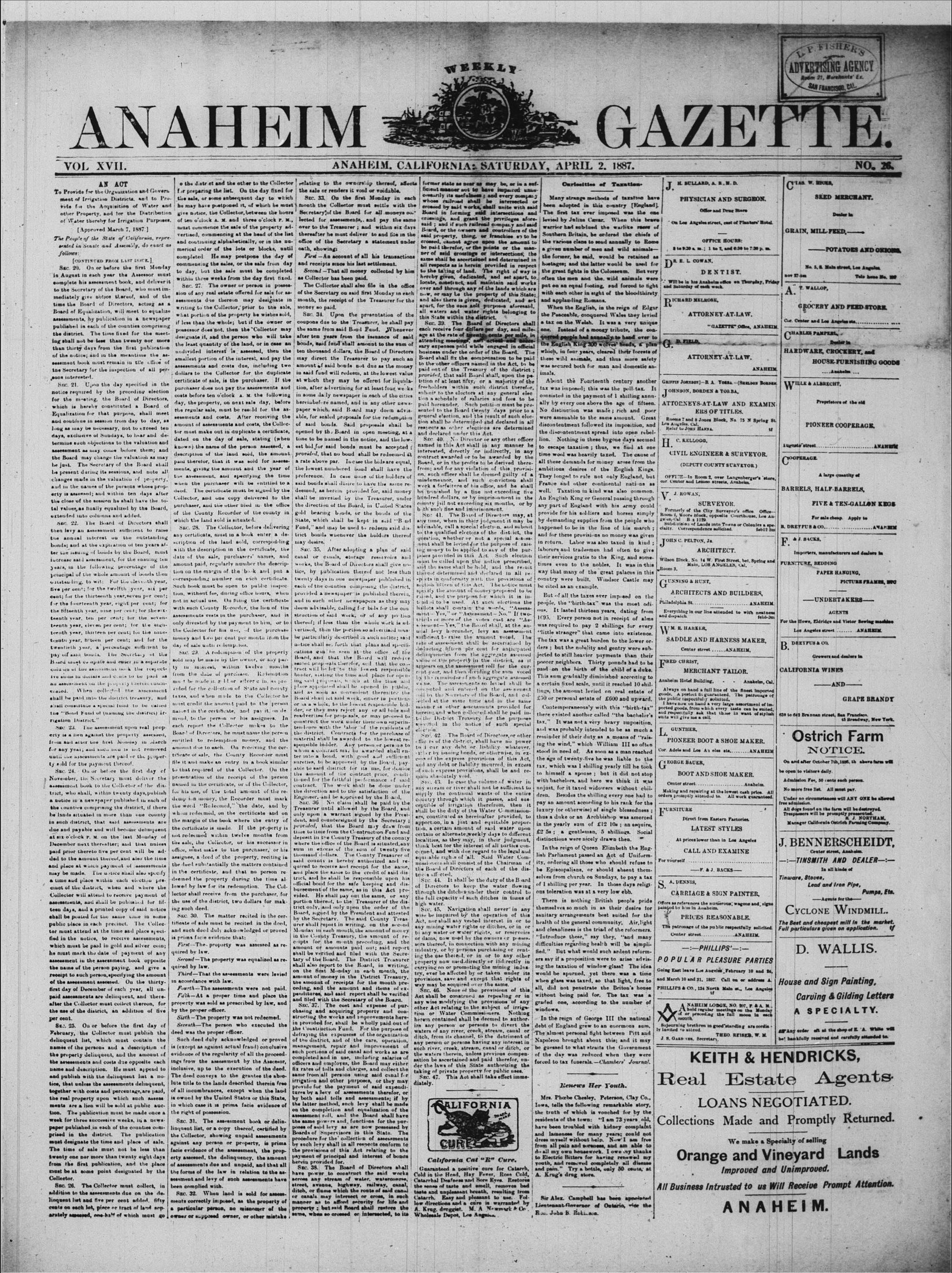
Searchable text
AN ACT
To Provide for the Organization and Government of Irrigation Districts, and to Provide for the Acquisition of Water and other Property, and for the Distribution of Water thereby for Irrigation Purposes.
[Approved March 7, 1837]
The People of the State of California, represented in Senate and Assembly, do enact as follows:
[CONTINUED FROM LAST ISSUE.]
Sec. 20. On or before the first Monday in August in each year the Assessor must complete his assessment book, and deliver it to the Secretary of the Board, who must immediately give notice thereof, and of the time the Board of Directors, acting as a Board of Equalization, will meet to equalize assessments, by publication in a newspaper published in each of the counties comprising the district. The time fixed for the meeting shall not be less than twenty nor more than thirty days from the first publication of the notice; and in the meantime the assessment book must remain in the office of the Secretary for the inspection of all persons interested.
Sec. 21. Upon the day specified in the notice required by the preceding election for the meeting, the Board of Directors, which is hereby constituted a Board of Equalization for that purpose, shall meet and continue in session from day to day, as long as may be necessary, not to exceed ten days, exclusive of Sundays, to hear and determine such objections to the valuation and assessment as may come before them; and the Board may change the valuation as may be just. The Secretary of the Board shall be present during its sessions, and note all relating to the district and the other to the Collector for preparing the list. On the day fixed for the sale, or some subsequent day to which he may have postponed it, of which he must give notice, the Collector, between the hours of ten o'clock A.M. and three o'clock P.M., must commence the sale of the property advertised, commencing at the head of the list and continuing alphabetically, or in the numerical order of the lots or blocks, until completed. He may postpone the day of commencing the sales, or the sale from day to day, but the sale must be completed within three weeks from the day first fixed.
Sec. 27. The owner or person in possession of any real estate offered for sale for assessments due thereon may designate in writing to the Collector, prior to the sale, what portion of the property be wishes sold, if less than the whole; but if the owner or possessor does not, then the Collector may designate it, and the person who will take the least quantity of the land, or in case an undivided interest is assessed, then the smallest portion of the interest, and pay the assessments and costs due, including two dollars to the Collector for the duplicate certificate of sale, is the purchaser. If the purchaser does not pay the assessments and costs before ten o'clock A.M. the following day, the property, on next sale day, before the regular sale, must be resold for the assessments and costs. After receiving the amount of assessments and costs, the Collector must make out in duplicate a certificate, dated on the day of sale, stating (when known) the name of the person assessed, a description of the land sold, the amount paid therefor, that it was sold for assessments, giving the amount and the year relating to the owning of the sale or renders it.
Sec. 33. On the month the Collector's Secretary's Office selected for assessment over to the Treasurer thereafter he must de-
Second—That all members as Collector has been
The Collector shall hold of the Secretary on said month, the receipt of money so paid.
Sec. 34. Upon thereto coupons due to the Taker same from said Bonds after ten years from said bonds, said fund shall ten thousand dollars, that may direct the Treat amount of said bonds in said fund will redeem at which they may be tendered after advertising in some daily newspapers hereinbefore named, and paper which said Bonds able, for sealed proposals of said bonds. Said bonds opened by the Board in time to be named in this est bid for said bonds provided that no bond a rate above par. Inclu-
SEC. 21. Upon the day specified in the notice required by the preceding election for the meeting, the Board of Directors, which is hereby constituted a Board of Equalization for that purpose, shall meet and continue in session from day to day, as long as may be necessary, not to exceed ten days, exclusive of Sundays, to hear and determine such objections to the valuation and assessment as may come before them; and the Board may change the valuation as may be just. The Secretary of the Board shall present during its sessions, and note all changes made in the valuation of property, and in the names of the persons whose property is assessed; and within ten days after the close of the session he shall have the total value as finally equalized by the Board, extended into columns and added.
SEC. 22. The Board of Directors shall then levy an assessment sufficient to raise the annual interest on the outstanding bonds; and at the expiration of ten years after the issuing of bonds by the Board, must increase said assessment, for the ensuing ten years, in the following percentage of the principal of the whole amount of bonds then outstanding, to wit: For the eleventh year, five per cent; for the twelfth year, six per cent; for the thirteenth year, seven per cent; for the fourteenth year, eight per cent; for the fifteenth year, nine per cent; for the sixteenth year, ten per cent; for the seventeenth year, eleven per cent; for the eighteenth year, thirteen per cent; for the nineteenth year, fifteen per cent; and for the twentieth year, a percentage sufficient to pay off said bonds. The Secretary of the Board must compute and enter in a separate column of the assessment book the respective sums in dollars and cents to be paid as an assessment on the property thereon enumerated. When collected, the assessment shall be paid into the district treasury, and shall constitute a special fund to be called "Bond Fund of (naming the district) irrigation District."
SEC. 23. The assessment upon real property is a lien against the property assessed, from and after the first Monday in march for any year; and such lien is not removed until the assessments are paid or the property sold for the payment thereof.
SEC. 24. On or before the first day of November, the Secretary must deliver the assessment book to the Collector of the district, who shall, within twenty days, publish a notice in a newspaper published in each of the counties comprising the district, if there be lands situated in more than one county in such district, that said assessments are due and payable and will become delinquent at six o'clock P.M. on the last Monday of December next thereafter; and that unless paid prior thereto five per cent will be added to the amount thereof, and also the time and place at which payment of assessments may be made. The notice shall also specify a time and place within each election precinct of the district, when and where the Collector will attend to receive payment of certificates of sale, is the purchaser. If the purchaser does not pay the assessments and costs before ten o'clock A.M. the following day, the property, on next sale day, before the regular sale, must be resold for the assessments and costs. After receiving the amount of assessments and costs, the Collector must make out in duplicate a certificate, dated on the day of sale, stating (when known) the name of the person assessed, a description of the land sold, the amount paid therefor, that it was sold for assessments, giving the amount and the year of the assessment, and specifying the time when the purchaser will be entitled to a need. The certificate must be signed by the Collector, and one copy delivered to the purchaser, and the other tied in the office of the County Recorder of the county in which the land sold is situated.
SEC. 28. The Collector, before delivering any certificate, must in a book enter a description of the land sold, corresponding with the description in the certificate, the date of sale, purchaser's names, and amount paid, regularly numbered the description on the margin of the book and put a corresponding number on each certificate. Such book must be open to public inspection without fee, during office hours, when not in actual use. On filing the certificate with such County Recorder, the lien of the assessments veats in the purchaser, and is only divested by the payment to him, or to the Collector for his use, of the purchase money and two percent per month from the day of sale until redemption.
SEC. 29. A redemption of the property sold may be made by the owner, or any party in interest, within twelve months from the date of purchase. Redemption must be made in gold or silver in as provided for the collection of State and county taxes, and when made to the Collector he must credit the amount paid to the person named in the certificate, and pay it on demand, to the person or his assignee. In each report the Collector makes to the Board of Directors, he must name the person entitled to redemption money, and the amount due to each. On receiving the certificate or sale, the County Recorder must file it and make an entry in a book similar to that required of the Collector. On the presentation of the receipt of the person named in the certificate, or of the Collector, for his use, of the total amount of the redemption money, the Recorder must mark the word "Redememed," "the date," and by whom redeemed, on the certificate and on the margin of the book where the entry of the certificate is made. If the property is not redeemed within twelve months from the sale, the Collector, or his successor in office, must make tothe purchaser, or his assignee,a deed ofthe property reciting inthedeed substantiallythe matters containedinthecertificate,andthatnopersonredeemedthepropertyduringthetimeallowedbylawforitsredemption.TheCollectorshallreceivefromthepurchaser,forsalldollartotheCollectorfortheduplicatecertificateofsale,thepurchaserdoesnotpaytheassessmentsandcostsbeforeteno'clockA.M.thefollowingday,theproperty.onnextsaleday,beforetheregularsale,mustberealdfortheassessmentsandcosts.Afterreceivingtheamountofassessmentsandcosts,theCollectormustmakeoutinduplicatea证书,datedonthedayofsale,satting(whenknown)thenameofthepersonassessed,adescriptionofthelandsold,theamountpaidtherefor,t hatitwassoldforassessments,givingtheamountandtheyearoftheassessment,andspecifyingthetimewhenthepurchaserwillbeentitledtoaneed.ThecertificatemustbesignedbytheCollector,andonecopydeliveredtothepurchaser,andtheotherliedintheofficeoftheCountyRecorderofthecountyinwhichthelandsoldis situated.
SEC. 35. After adopting canal or canals,stormworks,theBoardOfDistrictbypublicationtwentydaysinoneneweachofthecountiescollectedprovidedanewpaperandinsuchothernewdeemadvisable,callingstructionofsawworkthereof;iflessthanthevertised,thepartiebeparticularlydescribednoticeshallseeforthcitationscanbeseenaboard,andthathesesededproposelthetractwillbetetothebinder,satttingthetimingsapproposalwithplaceappointedwhobeadassoonasconboardshallletwornoraswhole,tolounder,或theymayrejectreadvertiseforprop-salesconstructtheworkunderthedistancewiththelaborthedistrict.Contractsmaterialshallbewarrantedforthefaithfulcontract.TheworkswhetherdirectandtoetheEngineer,andbeapprovedSEC.36No claimTreasureruntilallowedonlyuponawarrantintheCountyTreasurerwheretheofficeofthesumainexcessofthethousanddollars.Thesaidcountisherequiredtocereiveandrepeatandplacethesametothetruct,andheshallbereficialbondfordesignementofthesame,vided.Hewillpayon
a notice in a newspaper published in each of the counties comprising the district, if there be lands situated in more than one county in such district, that said assessments are due and payable and will become delinquent at six o'clock P.M. on the last Monday of December next thereafter; and that unless paid prior thereto five per cent will be added to the amount thereof, and also the time and place at which payment of assessments may be made. The notice shall also specify a time and place within each election precinct of the district, when and where the Collector will attend to receive payment of assessments, and shall be published for fifteen days, and a printed copy of said notice shall be posted for the same time in some public place in each precinct. The Collector must attend at the time and place specified in the notice, to receive assessments, which must be paid in gold and silver coin; he must mark the date of payment of any assessment in the assessment book opposite the name of the person paying, and give a receipt to such person, specifying the amount of the assessment assessed. On the thirty-first day of December of each year, all unpaid assessments are delinquent, and thereafter the Collector must collect thereon, for the use of the district, an addition of five per cent.
SEC. 25. On or before the first day of February, the Collector must publish the delinquent list, which must contain the names of the persons and a description of the property delinquent, and the amount of the assessments and costs due opposite each name and description. He must append to and publish with the delinquent list a notice, that unless the assessments delinquent, together with costs and percentage, are paid, the real property upon which such assessments are a lien will be sold at public auction. The publication must be made once a week for three successive weeks, in a newspaper published in each of the counties comprised in the district. The publication must designate the time and place of sale. The time of sale must not be less than twenty one nor more than twenty eight days from the first publication, and the place must be at some point designated by the Collector.
SEC. 26. The Collector must collect, in addition to the assessments due on the delinquent list and five per cent added, fifty cents on each lot, piece or tract of land separately assessed, one-half of which must go down on money, the recorder must mark the word "Released," the date, and by whom redeemed, on the certificate and on the margin of the book where the entry of the certificate is made. If the property is not redeemed within twelve months from the sale, the Collector, or his successor in office, must make to the purchaser, or his assignee, a deed of the property, reciting in the deed substantially the matters contained in the certificate, and that no person redeemed the property during the time allowed by law for its redemption. The Collector shall receive from the purchaser, for the use of the district, two dollars for making such deed.
SEC. 30. The matter recited in the certificate of sale must be recited in the deed, and such deed duly acknowledged or proved is prima facie evidence that:
First—The property was assessed as required by law.
Second—The property was equalized as required by law.
Third—That the assessments were levied in accordance with law.
Fourth—The assessments were not paid.
Fifth—At a proper time and place the property was sold as prescribed by law, and by the proper officer.
Sixth—The property was not redeemed.
Seventh—The person who executed the deed was the proper officer.
Such deed duly acknowledged or proved is (except as against actual fraud) conclusive evidence of the regularity of all the proceedings from the assessment by the Assessor, inclusive, up to the execution of the deed. The deed conveys to the grantee the absolute title to the lands described therein free of all incumbrances, except when the land is owned by the United States or this State, in which case it is prima facie evidence of the right of possession.
SEC. 31. The assessment book or delinquent list, or a copy thereof, certified by the Collector, showing unpaid assessments against any person or property, is prima facie evidence of the assessment, the property assessed, the delinquency, the amount of assessments due and unpaid, and that all the forms of the law in relation to the assessment and levy of such assessments have been complied with.
SEC. 32. When land is sold for assessments correctly imposed, as the property of a particular person, no misnomer of the owner or supposed owner, or other mistake
SEC. 36 No claim
Treasurer until allowed only upon a warrant and countersigned provided that the Board time to time from the County Treasurer where the office of the Board sum in excess of one thousand dollars. The said county is hereby required to receive and re-place the same to this trict, and he shall be official bond for the safe bursement of the same, vided. He shall pay no portion thereof, to this trict only, and only upon Board, signed by the Prisoner by the Secretary. Theurer shall report in writing Monday in each month in the County Treasury scripts for the month's amount or amounts paid shall be verified and notary of the Board. The shall also report to this trict on the first Monday in amount of money in these amounts of receipts ceding, and the amount penditures, and said re- filed with the Secretary.
SEC. 37. The cost of chasing and acquiring structures works and in provided for shall be Construction Fund defraying expenses of the district, and of management, repair and such portions of said can completed and in use; officers and employees; fix rates of tolls and charges same from all persons under irrigation and other purposes by a levy of assesses by both said tolls and on the latter method; such on completion and assessment roll; and that same powers and funds possessed of said levy as are Boards of Supervisors in procedure for their collection by such levy shall in all provisions of this Act payment of principal and herein provided for.
SEC. 38. The Board have power to construct across any stream of street, avenue, highway ditch, or flume which thence may intersect manner as to afford access property; but said Roan same, when so crossed o
WEEKLY
CIM GA
ANAHEIM, CALIFORNIA: SATURDAY, APRIL 2. 1887.
relating to the ownership thereof, affects the sale or renders it void or voidable.
Sec. 33. On the first Monday in each month the Collector must settle with the Secretary of the Board for all moneys collected for assessments, and pay the same over to the Treasurer; and within six days thereafter he must deliver to and file in the office of the Secretary a statement under oath, showing:
First—An account of all his transactions and receipts since his last settlement.
Second—That all money collected by him as Collector has been paid.
The Collector shall also file in the office of the Secretary on said first Monday in each month, the receipt of the Treasurer for the money so paid.
Sec. 34. Upon the presentation of the coupons due to the Treasurer, he shall pay the same from said Bond Fund. Whenever after ten years from the issuance of said bonds, said fund shall amount to the sum of ten thousand dollars, the Board of Directors may direct the Treasurer to pay such an amount of said bonds not due as the money in said fund will redeem, at the lowest value at which they may be offered for liquidation, after advertising for at least four weeks in some daily newspaper in each of the cities hereinbefore named, and in any other newspaper which, said Board may deem advisable, for sealed proposals for the redemption of said bonds. Said proposals shall be opened by the Board in open meeting, at a tune to be named in the notice, and the lowest bid for said bonds must be accepted; provided, that no bond shall be redeemed at a rate above par. In case the bids are equal, the lowest numbered bond shall have the former state as near as may be, or in a sufficient manner not to have impaired unnecessarily its usefulness and every company whose railroad shall be intersected or crossed by said works, shall unite with said Board in forming said intersections and crossings, and grant the privileges aforesaid; and if such railroad company and said Board, or the owners and controllers of the said property, thing, or franchise so to be crossed, cannot agree upon the amount to be paid therefor, or the points or the manner of said crossings or intersections; the same shall be ascertained and determined in all respects as is herein provided in respect to the taxing of land. The right of way is hereby given, dedicated, and set apart, to locate, construct, and maintain said works over and through any of the lands which are now, or may be the property of this State; and also there is given, dedicated, and set apart, for the uses and purposes aforesaid, all waters and water rights belonging to this State within the district.
Sec. 35. The Board of Directors shall each receive four dollars per day, and mileage at the rate of twenty cents per mile, in attending meetings, and actual and necessary expenses paid while engaged in official business under the order of the Board. The Board shall fix the compensation to be paid to the other officers named in the Act, to be paid out of the Treasury of the district; provided, that said Board shall, upon the petition of at least fifty, or a majority of the freeholders within such district therefor, submit to the electors at any general election a schedule of salaries and fees to be paid hereunder. Such petition must be presented to the Board twenty days prior to a general election, and the result of such election shall be determined and declared in all respects as other elections are determined and declared under this Act.
Sec. 36. No Director or any other officer named in this Act shall in any manner be interested, directly or indirectly, in any contract awarded or to be awarded by the Board, or in the profits to be derived therefrom; and for any violation of this provision such officer shall be deemed guilty of a
Curiosities of Taxation
Many strange methods of taxation have been adopted in this country [England]. The first tax ever imposed was the one levied by Julius Caesar. When this brave warrior had subdued the warlike races of Southern Britain, he ordered the chiefs of the various clans to send annually to Rome a given number of men and wild animals—the former, he said, would be retained as hostages; and the latter would be used for the great fights in the Colosseum. But very often the men and the wild animals were put on an equal footing, and forced to fight with each other in sight of the bloodthirsty and applauding Romans.
When the English, in the reign of Edgar the Peaceable, conquered Wales they levied a tax on the Welsh. It was a very unique one. Instead of a money tribute, the conquered people had annually to hand over to the English King 300 wolves heads, a plan which, in four years, cleared their forests of these wild animals, and thus more safety was secured both for man and domestic animals.
About the Fourteenth century another tax was imposed; this was the poll-tax. It consisted in the payment of 1 shilling annually by every one above the age of fifteen. No distinction was made; rich and poor were amenable to the same amount. Great discontentment followed its imposition, and the discontentment spread into open rebellion. Nothing in these bygone days seemed to escape taxation; thus, we find at one time wool was heavily taxed. The cause of all these demands for money arose from the ambitious desires of the English Kings.
at which they may be offered for liquidation, after advertising for at least four weeks in some daily newspaper in each of the cities herein before named, and in any other newspaper which said Board may deem advisable, for sealed proposals for the redemption of said bonds. Said proposals shall be opened by the Board in open meeting, at a time to be named in the notice, and the lowest bid for said bonds must be accepted; provided, that no bond shall be redeemed at a rate above par. In case the bids are equal, the lowest numbered bond shall have the preference. In case none of the holders of said bonds shall desire to have the same redeemed, as herein provided for, said money shall be invested by the Treasurer, under the direction of the Board, in United States gold bearing bonds, or the bonds of the State, which shall be kept in said "Bund Fund," and may be used to redeem said district bonds whenever the holders thereof may desire.
Sec. 35. After adopting a plan of said canal or canals, storage reservoirs and works, the Board of Directors shall give notice, by publication thereof not less than twenty days in one newspaper published in each of the counties composing the district, provided a newspaper is published therein, and in such other newspapers as they may deem advisable, calling for bids for the construction of said work, or of any petition thereof; if less than the whole work is advertised, then the portion so advertised must be particularly described in such notice; said notice shall see forth that plans and specifications can be seen at the office of the Board, and that the Board will receive sequestration proposals therefor, and that the contract will be let to the lowest responsible binder, stating the time and place for opening said proposals, which at the time and place appointed shall be opened in public, and as soon as convenient thereafter the Board shall let said work, either in portions or as a whale, to the lowest responsible binder, or they may reject any or all bids and readvertise for proposals, or may proceed to construct the work under their own superintendence with the labor of the residents of the district. Contracts for the purchase of material shall be awarded to the lowest responsible binder. Any person or persons to whom a contract may be awarded shall enter into a bond, with good and sufficient sureties, to be approved by the Board, payable to said district for its use, for double the amount of the contract price, conditioned for the faithful performance of said contract. The work shall be done under the direction and to the satisfaction of the Engineer, and be approved by the Board.
Sec. 36. No claim shall be paid by the Treasurer until allowed by the Board, and only upon a warrant signed by the President, and countersigned by the Secretary; provided, that the Board may draw from time to time from the Construction Fund and deposit in the County Treasury of the county where the office of the Board is situated, any sum in excess of the sum of twenty-five thousand dollars. The County Treasurer of said county is hereby authorized and required to receive and receipt for the same, and place the same to the credit of said district, and he shall be responsible upon his official bond for the safe keeping and disbursement of the same, as in this Act provided. He shall pay out the same, or any
About the Fourteenth century another tax was imposed; this was the poll-tax. It consisted in the payment of 1 shilling annually by every one above the age of fifteen. No distinction was made; rich and poor were amenable to the same amount. Great discontentment followed its imposition, and the discontentment spread into open rebellion. Nothing in these bygone days seemed to escape taxation; thus, we find at one time wool was heavily taxed. The cause of all these demands for money arose from the ambitious desires of the English Kings. They longed to rule not only England, but France and other continental nations as well. Taxation in kind was also common. An English King or General passing through any part of England with his army could provide for his soldiers and horses simply by demanding supplies from the people who happened to be in the line of his march; and for these provisions no money was given in return. Labor was also taxed in kind; laborers and tradesmen had often to give their services gratis to the King, and sometimes even to the nobles. It was in this way that many of the great palaces in this country were built. Windsor Castle may be cited as an example.
But of all the taxes ever imposed on the people, the "birth-tax" was the most odious. It lasted thirteen years, dating from 1095. Every person not in receipt of alms was required to pay 2 shillings for every little stranger that came into existence. The tax was a great burden to the lower orders; but the nobility and gentry were subjected to still heavier payments than their poorer neighbors. Thirty pounds had to be paid on the birth of the child of a duke. This sum gradually diminished according to a certain fixed scale, until it reached 10 shillings, the amount levied on real estate of £50 or personal estate of £600 and upward.
Contemporaneously with this "birth-tax" there existed another called "the bachelor's tax." It was not a very heavy imposition, and was probably intended to be as much a reminder of their duty as a means of "raising the wind," which William III so often stood in need of. As soon as a man reached the age of twenty-five he was liable to the tax, which was 1 shilling yearly till he took himself a spouse; but it did not stop with bachelors, and here we think it was unjust; with it taxed widowers without children. Besides the shilling every one had to pay an amount according to his rank for the luxury (or otherwise) of single blessedness; thus a duke or an Archbishop was amended in the yearly sum of £12 10s.; an acquire, £2 5s.; a gentleman, 5 shillings. Social distinctions were nicely drawn then.
In the reign of Queen Elizabeth the Euglish Parliament passed an Act of Uniformity, ordering all those who should refuse to be Episcopalians, or should absent themselves from church on Sundays, to pay a tax of 1 shilling per year. In those days religious toleration was at a very low ebb.
No claim shall be paid by the Treasurer until allowed by the Board, and only upon a warrant signed by the President, and counterigned by the Secretary; provided that the Board may draw from time to time from the Construction Fund and deposit in the County Treasury of the county where the office of the Board is situated, any sum in excess of the sum of twenty-five thousand dollars. The County Treasurer of said county is hereby authorized and required to receive and receipt for the same, and place the same to the credit of said district, and he shall be responsible upon his official bond for the safe keeping and disbursement of the same, as in this Act provided. He shall pay out the same, or any portion thereof, to the Treasurer of the district only, and only upon the order of the Board, signed by the President and attested by the Secretary. The said County Treasurer shall report in writing, on the second Monday in each month, the amount of money in the County Treasury, the amount of receipts for the month preceding, and the amount or amounts paid out; said report shall be verified and filed with the Secretary of the Board. The District Treasurer shall also report to the Board, in writing, on the first Monday in each month, the amount of money in the District Treasury, the amount of receipts for the month preceding, and the amount and items of expenditures, and said report shall be verified and filed with the Secretary of the Board.
SEC. 37. The cost and expense of purchasing and acquiring property and constructing the works and improvements herein provided for, shall be wholly paid out of the Construction Fund. For the purpose of defraying the expenses of the organization of the district, and of the care, operation, management, repair and improvement of such portions of said canal and works as are completed and in use, including salaries of officers and employees, the Board may either fix rates of tolls and charges, and collect the same from all persons using said canal for irrigation and other purposes, or they may provide for the payment of said expenditures by a levy of assessments therefor, or by both said tolls and assessments; if by the latter method, such levy shall be made on the completion and equalization of the assessment roll, and the Board shall have the same powers and functions for the purposes of said levy as are now possessed by Boards of Supervisors in this State. The procedure for the collection of assessments by such levy shall in all respects conform to the provisions of this Act relating to the payment of principal and interest of bonds herein provided for.
SEC. 38. The Board of Directors shall have power to construct the said works across any stream of water, watercourse, street, avenue, highway, railway, canal, ditch, or flume which the route of said canal or canals may intersect or cross, in such manner as to afford security for life and property; but said Board shall restore the same, when so crossed or intersected, to its
California Cat "R" Cure.
Guaranteed a positive cure for Catarrh, Cold in the Head, Hay Fever, Rose Cold, Catarrhal Deafness and Sore Eyes. Restores the sense of taste and smell, removes bad taste and unpleasant breath, resulting from Catarrh. Easy and pleasant to use. Follow directions and a cure is warranted by A. Krug's druggist. M. A Newmark & On Wholesale Depot, Los Angeles.
In the reign of Queen Elizabeth the English Parliament passed an Act of Uniformity, ordering all those who should refuse to be Episcopalians, or should absent themselves from church on Sundays, to pay a tax of 1 shilling per year. In those days religious toleration was at a very low ebb.
There is nothing British people pride themselves so much in as their desire for sanitary arrangements best suited for the health of the general community. Air, light and cleanliness is the triad of the reformers. "Introduce these," say they, "and many difficulties regarding health will be simplified." But what would such ardent reformers say if a proposition were to arise advising the taxation of window glass? The idea would be spurned, yet there was a time when glass was taxed, so that light, free to all, did not penetrate the Briton's house without being paid for. The tax was a graded one, according to the number of windows.
In the reign of George III the national debt of England grew to an enormous sum. The almost personal fight between Pitt and Napoleon brought about this; and it may be guessed to what straits the Government of the day was reduced when they were forced to tax funerals.—Chambers' Journal.
Renews Her Youth.
Mrs. Phoebe Cheesley, Peterson, Clay Co., Iowa, tells the following remarkable story, the truth of which is vouchered for by the residents of the town: "I am 73 years old, have been troubled with kidney complaint and lameness for many years; could not dress myself without help. Now I am free from all pain and soreness, and am able to do all my own housework. I owe my thanks to Electric Bitters for having renewed my youth, and removed completely all disease and pain." Try a bottle, only 50 cents; at A. Krug's drug store.
Sir Alex Campbell has been appointed Lieutenant-Governor of Ontario; vice president John B. Rottelson.
GAZETTE.
2. 1887. NO. 26.
J. H. BULLARD, A. R., M. D.
PHYSICIAN AND SURGEON.
Office and Drug Store
On Los Angeles street, east of Planters' Hotel.
OFFICE HOURS:
8 to 9:30 a.m.; 1 to 2, and 6:30 to 7:30 p.m.
D. E. L. COWAN.
DENTIST.
Will be in his Anaheim office on Thursday, Friday and Saturday of each week.
RICHARD MELROSE,
ATTORNEY-AT-LAW.
"GAZETTE" Office, ANAHEIM.
G. D. FIELD.
ATTORNEY-AT-LAW.
ANAHEIM.
GRIPPIN JOHNSON]—B. A. YORBA—[SHELDON BORDER
JOHNSON, BORDEN & YORBA,
ATTORNEYS-AT-LAW AND EXAMINERS OF TITLES.
Rooms 7 and 8 Jones Block, No. 75 N Spring St
Los Angeles, Cal.
Refer to John Harna.
H. C. KELLOGG,
CIVIL ENGINEER & SURVEYOR.
(DEPUTY COUNTY SURVEYOR.)
seventh century another tax was the poll-tax. It went of 1 shilling annunce the age of fifteen.
made; rich and poor same amount. Great lived its imposition, and spread into open rebelage bygone days seemed usus, we find at one taxed. The cause of money arose from the English Kings.
not only England, but continental nations as well also common.
general passing through with his army could be from the people who line of his march;
no money was given also taxed in kind; he had often to give the King, and some nobles. It was in this great palace in this Windsor Castle may never imposed on the tax was the most odious years, dating from not in receipt of alms 2 shillings for every came into existence. Solden to the lower or gentry were sub-payments than their forty pounds had to be the child of a duke. Unfinished according to until it reached 10 shilled on real estate of £600 and upward. With this "birth-tax" called "the bachelor's heavy imposition, ended to be as much as a means of 'rais- William III so often soon as a man reached he was liable to the long yearly till he took but it did not stop here we think it was flowers without chili-ling every one had to bring to his rank for the of single blessedness; Bishop was amerced £12 10s; an esquire, 5 shillings. Social drawn then.
Elizabeth the Bugan Act of Uniform who should refuse to shall absent them Sundays, to pay a tax In those days religivery low ebb.
GRIFFIN JOHNSON]—B A YORBA. [SHELDON BORDER]
JOHNSON, BORDEN & YORBA,
ATTORNEYS-AT-LAW AND EXAMINERS OF TITLES.
Rooms 7 and 8 Jones Block, No. 75 N Spring St.
Los Angeles, Cal.
Refer to JOHN HAKNA.
H. C. KELLOGG,
CIVIL ENGINEER & SURVEYOR.
(DEPUTY COUNTY SURVEYOR.)
OFFICE—In Room 2, over Langenberger's store, cor. Center and Lemon streets, Anaheim.
V. J. ROWAN,
SURVEYOR.
Formerly of the City Surveyor's office Office—Room 2, Moore Block, opposite Courthouse, Los Angeles, Cal.
B x 1129.
Subdivision of Lands into Towns or Colonies a speciality. Correspondence solicited.
JOHN C. PELTON, Ja.
ARCHITECT.
Wilson Block, No. 14 W. First Street, bet. Spring and Main, LOS ANGELES, Cal.
Room 3.
GUNNING & HUNT,
ARCHITECTS AND BUILDERS,
Philadelphia St. ...ANAHEIM.
Everything in our line attended to with neatness and dispatch.
W M. R. HARKER,
SADDLE AND HARNESS MAKER,
Center street ...ANAHEIM.
FRED CHRIST,
MERCHANT TAILOR.
Anaheim Hotel Building... Anakelm, Cal.
Always on hand a full line of the finest imported goods. A perfect fit guaranteed. The patronage of the public respectfully solicited.
I have now on hand a very large assortment of imported goods, from which every taste can be suited, and respectfully ask that those in want of stylish suits will give me a call.
L. GUNTHER,
PIONEER BOOT & SHOE MAKER.
Cor. Adele and Los Angeles sts...ANAHEIM
GEORGE BAUER,
BOOT AND SHOE MAKER.
Center street ...Anakhelm.
Making and repairing at the lowest cash price. All orders promptly attended to. All work guaranteed.
FURNITURE
Direct from Eastern Factories.
LATEST STYLES
At prices lower than in Los Angeles
CALL AND EXAMINE
For yourself ...F. & J. BACKS
S. A. DENNIS,
CARRIAGE & SIGN PAINTER,
WILLK & ALBRECHT.
Preprietors of the old
PIONEER COOPERAGE.
COOPERAGE.
A large quantity of
BARRELS, HALF-BARRELS,
FIVE & TEN-GALLON KEGS
For sale cheap. Apply to
B. DREYFUS & CO...ANAHEIM
F. & J. BACKS.
Importers, manufacturers and dealers in
FURNITURE, BEDDING
PAPER HANGING,
PICTURE FRAMES, INFO
UNDERTAKERS
AGENTS
For the Howe, Eldridge and Victor Sewing machine
Los Angeles street ...ANAHEIM.
B. DREYFUS & CO.
Growers and dealers in
CALIFORNIA WINES
AND
GRAPE BRANDY
638 to 642 Brannan street, San Francisco
45 Broadway, New York.
Ostrich Farm NOTICE.
On and after October 7th, 1886, th above farm will be open to visitors daily.
Admission Fee, 50 cents each person.
No more free list. All must pay.
Under no circumstances will ANY ONE be allowed free admission.
All dogs found on the farm will be destroyed.
Trespassers will be promptly prosecuted.
R. J. NORTHAM.
Manager California Ostrich Farming Company.
J. BENNERSCHEIDT,
Center street, Anaheim:
TINSMITH AND DEALER: In all kinds of
Tinware, Stoves,
Lead and Iron Pipe,
Pumps, Eta.
FURNITURE
Direct from Eastern Factories.
LATEST STYLES
At prices lower than in Los Angeles
CALL AND EXAMINE
For yourself
— F. & J. BACKS —
S. A. DENNIS,
CARRIAGE & SIGN PAINTER,
Offers as references the numerous wagons and signs painted by him in Anaheim.
PRICES REASONABLE.
The patronage of the public respectfully solicited.
Center street.....ANAHEIM.
—— PHILLIPS' ——
POPULAR PLEASURE PARTIES
Going East leave Los Angeles February 10 and 24,
and March 10 and 31, 1897. Call on or address A.
PHILLIPS & CO., 134 North Main st., Los Angeles tf
ANAHEIM LODGE, NO. 207, F. & A. M.
hold regular meetings on the Monday of or preceding the full moon in each month.
Sojourning brethren in good standing are cordially invited to attend.
THEO. RFISER, W. M.
J. S. GARDNER, Secretary
KEITH & HENDRICKS,
Real Estate Agents
LOANS NEGOTIATED.
Collections Made and Promptly Returned.
We make a Specialty of selling
Orange and Vineyard Lands
Improved and Unimproved.
All Business Intrusted to us Will Receive Prompt Attention.
ANAHEIM.