anaheim-gazette 1887-02-26
Scanned page
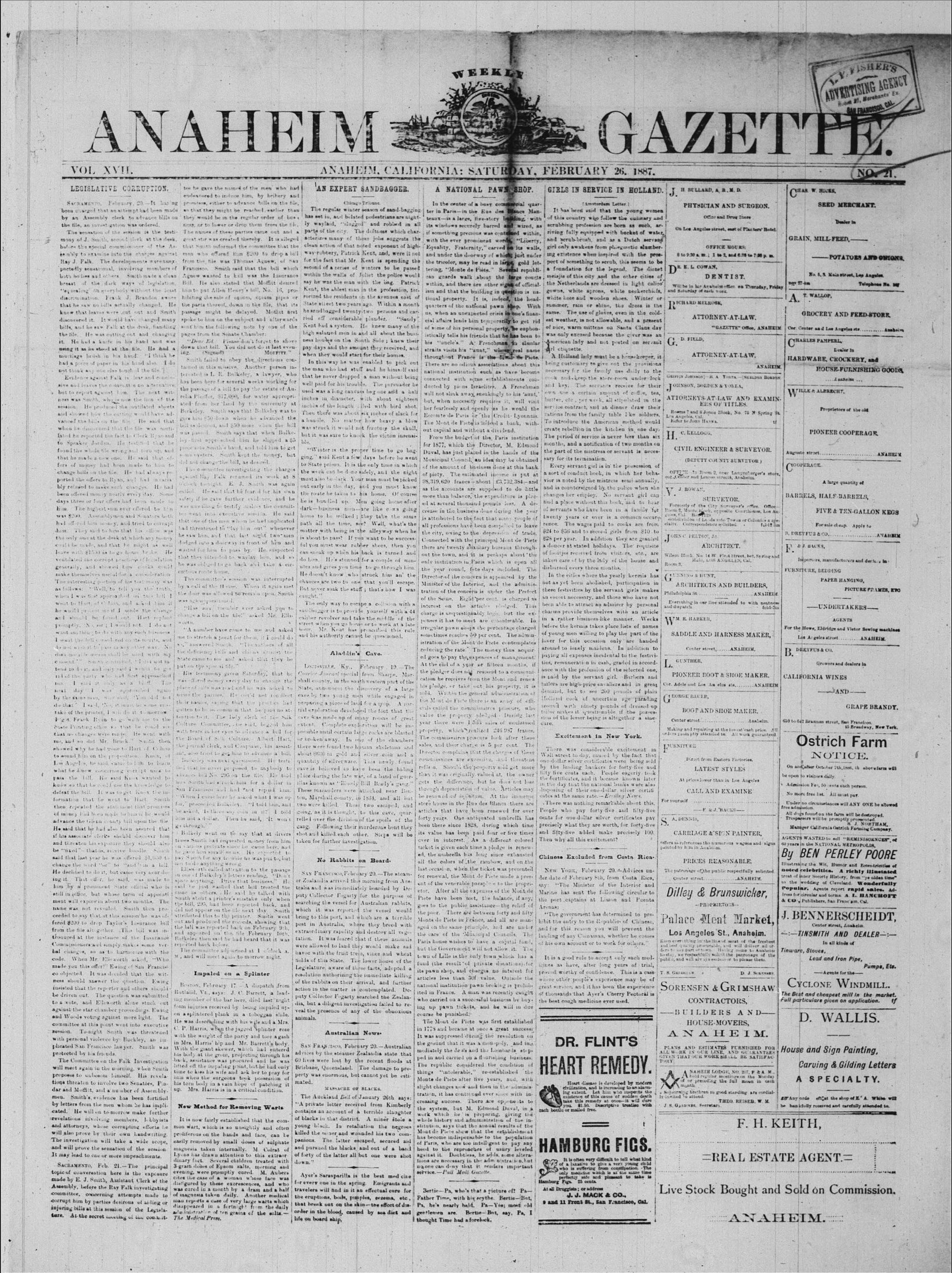
Searchable text
LEGISLATIVE CORRUPTION.
SACRAMENTO, February 20. It having been charged that an attempt had been made by an Assembly clerk to advance bills on the file, an investigation was ordered.
The sensation of the session is the testimony of J. Smith, second clerk at the desk, before the special commissioner of the Assembly to examine into the charges against Ray J. Palk. The developments were unevenly sensational, involving members of both bodies and others. Smith made a clean breast of the dark ways of legislation, "sealing" on everybody without the least discrimination. Frank J. Brandon aware that he saw no bills actually changed. He knew that leaves were cut out and Smith discovered it. It would have changed many bills, and he saw Palk at the desk, handling the file. He was cutting out and changing it. He had a knife in his hand and was using it as he stood at the file. He had a mutilation brush in his hand. "I think he had a piece of paper in his hand also. I do not think any one else touched the file."
Evidence against Palk is clear and conclusive and leaves the committee no alternative but to report against him. The next witness was Smith, who is now the lien of the session. He produced the outlated objections and showed how the cutting would have advanced the bills on the file. He said that when he discovered that the file was mutilated he reported the fact to Clerk Ryan and to Speaker Jordan. He testified that he found the whole file wrong and torn up, and that he made a new one. He said that offers of money had been made to him to change bills on the file. He had always re-tee he gave the names of the men who had endeavored to induce him, by beibery and promises, either to advance bills on the file, so that they might be reached earlier than they would be in the regular order of business, or to lower or drop them from the file.
The names of these parties came out and a great stir was created thereby. It is alleged that Smith informed the committee that the man who offered him $200 to drop a bill from the file was Thomas Agnew, of San Francisco. Smith said that the bill which Agnew wanted to kill was the Insurance Bill. He also stated that Moffitt desired him to put Allen Henry's bill, No. 18, prohibiting the sale of opium, opium pipes or the parts thereof, down in the file, that its passage might be delayed. Moffitt first spoke to him on the subject and afterwards sent him the following note by one of the pages from the Senate Chamber:
"Dear Ed., Please don't forget to shove down that bill. You did not do it last evening. (Signed) Morriss."
Smith failed to obey the directions contained in this massive. Another person interested is L. K. Bulkeley, a lawyer, who has been here for several weeks working for the passage of a bill to pay the estate of Anrella Pleifer, $17,000, for water appropriated from her land by the university at Berkeley. Smith says that Bulkeley was to give him $50 down when he advanced the bill as destruct, and $50 more when the bill was passed. Smith says that when Bulkeley first approached him he slipped a $5 piece into Smith's hand, and told him to get some oysters. Smith kept the money, but did not change the bill, as desired.
The committee investigating the charges
AN EXPERT
Chicago
The regular winter has set in, and belays waylaid, "slagging" parts of the city. Asterizes many of clean action of that wayrobbery, Patrick for the fact that Mr second of a series of within the walls of Kent, the ablest man morized the residents State street two years he sendbagged twenty ried off considerably Kent bad a system. High salaried men in ness houses on the i pay days and the am when they would str.
In this way he was the man who had stitched that he never dropped well paid for his trousers was a long canvass inches in diameter, inches of the length Then there was about a handle. No matter was struck it would but it was sure to knob.
"Winter is the paging," said Kent a foil to State prison. It is the work can be done
Evidence against Falk is fear and conclusive and leaves the concurrete no alternative but to report against him. The next witness was Smith, who is now the lien of the session. He produced the outlated sheets and showed how the cutting would have advanced the bills on the file. He said that when he discovered that the file was mutilated he reported the fact to Clerk Ryan and to Speaker Jordan. He testified that he found the whole file wrong and torn up, and that he made a new one. He said that offers of money had been made to him to change bills on the file. He had always reported the offers to Ryan, and had invariably refused to make such changes. He had been offered money nearly every day. Some days three or four offers had been made to him. The highest sum ever offered to him was $200. Assemblymen and Senators both had off-red him money, and tried to corrupt him. They said to him that his office was the only one at the desk at which any money could be made, and that he might as well leave with $1500 as to go home brake. He ventilated the corrupt practices of legislation generally, and showed how clerks could make themselves useful for a consideration. The interesting portion of his testimony was as follows: "Well, to tell you the truth, when I was that approached on this bill I went to Hart of Clarks, and asked him if he would present it if I made the change and should be found out. Hart replied promptly. No, sorry; I would not. I do not want anything to do with any such business. I want the bill considered in its merits, and do not wish to pass in any other way. No does not be means shall be used with my consent." Smith witnessed, "I did not intend to do it, and only said I would get rid of the party who had first approached me. I said it only as a bluff. The next day" I was approached again by the same man, who said, "You did not do that." I said, "No, it must be some mistake of the printer. I will do it tomorrow." I got Frank Ryan to go with me to the State Printing office so that he could see that no changes were made. He went with me, and so did Mr. Brick." Smith then showed why he had gone to Hart of Colson to sound him on the proposition. Knox, of Los Angeles, he said came to him to learn what he knew concerning curtains used to pass the bill. He said Knox wanted to know so that he could use the knowledge to defeat the bill. It was to get Knox the information that he went to Hart. Smith then repeated the statement that promises of money had been made to him if he would advance the Glenn county bill upon the file. He said that he had also been assured that if his associate clerk should discover him and threaten his exposure they should also be "fixed"—that is, receive bobble. Smith said that last year he was offered $1,600 to change the word "car" to "and" in a bill. He declined to do it, but came very near doing it. That offer, he said, was made to him by a prominent State official who is still in prison, but whose term of appointment is L.E.K. Balkley, a lawyer, who has been here for several weeks working for the passage of a bill to pay the estate of Anrela Pleifer, $17,000, for water appropriated from her land by the university at Berkeley. Smith says that Balkley was to give him $50 down when he advanced the bill as desired, and $50 more when the bill was passed. Smith says that when Balkley most approached him he slipped a $5 piece into Smith's hand, and told him to get some cysts. Smith kept the money, but did not change the bill, as desired.
The committee investigating the charges against L.E.K. Balkley remanded its work at 8 o'clock tonight. E.J. Smith was again exciled. He said that he feared for his own safety if he gave further evidence, and he was unwilling to testify unless the committee went into executive session. He said that one of the men whom he had implicated had threatened to "lay him out" whenever he saw him, and that last night two men lodged into a doorway in front of him and wanted for him to pass by. He suspected that they intended to waylay him, and so he was obliged to go back and take a circuitous route home.
The committee's session was interrupted by a call of the House. When it again met the door was allowed to remain open, Smith was agonizing questioned.
Has any member ever asked you to change a bill on the file? asked Mr. Ellsworth.
A number have come to me and asked me to stretch a point for them, if I could do so," answered Smith. "The authors of all the deficiency bills and claims against the State came to me and asked that they be put on the special filly."
His testimony given Saturday, that he was offered money every day to change the place of bills was read and he was asked to name the parties. He couldn't recollect their names, saying that the practice had gotten to be so common that he paid no attention to it. The lady clerk of the Sulk Culture Committee, she said, began him with tears in her eyes to advance a bill for the Board of Sulk Culture. Albert Hart, the journal clerk, and Caspian, his assistant, also tried to get him to advance a bill.
Balkley was next questioned. He testified that never proposed anybody to advance bill No. 295 on the file. He told how Smith had struck him for a dollar in San Francisco and had not repaid him. "When I came here he asked what I was up for," proceeded Balkley. "I told him, and he asked, Is there any coin in it?" I told him not a dollar. Then he said, "It won't go through."
Balkley went on to say that at divers times Smith had requested money from him on various pretents since he came here, and he gave him small sums. He expected to pay Smith for any trouble he was put to, but not to do anything wrong.
Ellsworth called attention to the passage in one of Balkley's letters reading, "Don't space anything." Drive that business." He said he just wanted that bill treated the same as others. He said he talked with Smith about a printer's mistake only when...
then repeated the statement that promises of money had been made to him if he would advance the Glenn county bill upon the file. He said that he had also been assured that if his associate clerk's should discover him and threaten his exposure they should also be "used"—that is, receive boodle. Smith said that last year he was offered $1,000 to change the word "or" to "and" on a bill. He declined to do it, but came very near doing it. That offer, he said, was made to him by a prominent State official who is still in police, but whose term of appointment will expire in about two months. The name was not revealed. Smith then proceeded to say that at this session he was offered $200 to drop Taylor's Insurance bill from the file altogether. This bill was introduced at the instance of the Insurance Commissioners; and simply makes some verbal changes, so as to harmonize with the code. When Mr. Ellsworth asked, "Who made you this offer?" Ewing of San Francisco objected. It was decided that the witness should answer the question. Ewing insisted that the reporter and others should be driven out. The question was submitted to a vote, and Ellsworth alone stuck out against the star chamber proceedings. Ewing and Woods voting against more light. The committee at this point went into executive session. To-night Smith was threatened with personal violence by Buckley, an implicated San Francisco lawyer. Smith was protected by his friends.
The Committee on the Falk Investigation will meet again in the morning, when Smith proposes to unboss himself. His revelations threaten to involve two Senators, Pindar and Moffitt, and a number of Assemblymen. Smith's evidence has been fortified by letters from the men whom he has implicated. He will on to-morrow make further revelations involving members, lobbyists and attorneys, whose corrupting efforts he will also prove by their own handwriting. The investigation will take a wide scope, and will prove the sensation of the session. It may lead to one or more impeachments.
SACRAMENTO, Feb. 21.—The principal topic of conversation here is the exposure made by E. J. Smith, Assistant Clerk of the Assembly, before the Ray Falk investigating committee, concerning attempts made to corrupt him by parties desirous of aiding or injuring bills at this session of the Legislature. At the secret meeting of the commit-
Impaled on a Splinter
Boston, February 17.—A dispatch from Rutland, Vt., says: J. C. Barrett, a leading member of the bar here, died last night from injuries received by being impaled upon a splintered plank in a toboggan slide. He was descending with his wife and a Mrs. C. P. Harris, when the jagged splinter rose with the weight of the party and tore a gash in Mrs. Harris' hip and Mr. Barrett's body. With the giant skewer, which had entered his body at the groin, projecting through his back, assistance was procured and he was lifted off the impaling point, but he had only time to kiss his wife and ask her to pray for him when the surgeons took possession of his torn body in a vain hope of patching it up. Mrs. Harris is in a critical condition.
New Method for Removing Warts
It is now fairly established that the common wart, which is so unsightly and often proliferous on the hands and face, can be easily removed by small doses of sulphate magnesia taken internally. M. Colrat of Lyons has drawn attention to this extraordinary fact. Several children treated with 3-grain doses of Epsom salts, morning and evening, were promptly cured. M. Aubers cites the case of a woman whose face was disgusted by these excrecences, and who was cured in a month by a dram and a half of magnesia taken daily. Another medical man reports a case of very large warts which disappeared in a fortnight from the daily administration of ten grains of the salts.
The Medical Press,
No Rabbits
SAN FRANCISCO, February 21.—Ernest Zoalandia arrived thirteen traina and was immeasurable putty Collector Fogarty searching the vessel for which it was reported bring to this port, and post in Australia, where extraordinary rapidity is evident. It was feared were allowed to land there havoc with the fruit trees of this State. The Legislature aware of the resolution authorizing them action in the matter is putty Collector Fogarty dia, but a diligent investigative presence of animals.
AUSTRALIA
SAN FRANCISCO, February 21.—Advices by the steamer 60 lives were lost by Brisbane, Queensland. Property was enormous, but mated.
MASSACHUSETTS
The Anckland Bell owl "A private letter receives contains an account of all blacks in that district young black. In retaliation killed the miner and wiped panions. The latter surrendered and pursued the blacks for forty of the latter all down."
WEEKLY
EIM GA
ANAHEIM, CALIFORNIA: SATURDAY, FEBRUARY 26. 1887.
AN EXPERT SANDBAGGER.
Chicago Tribune.
The regular winter season of sand-bagging has set in, and belated pedestrians are nightly wayland, "slugged" and robbed in all parts of the city. The deltas which characterizes many of these jobs suggest the clean action of that noted exponent of highway-robbery, Patrick Kent, and, were it not for the fact that Mr. Kent is spending the second of a series of winters to be passed within the walls of Joliet the police would say he was the man with the bag. Patrick Kent, the ablest man in the profession, terrorized the residents on the avenues east of State street two years ago. Within a month he sandbagged twenty-two persons and carried off considerable plunder, "Sandy" Kent had a system. He knew many of the high salaried men in and all about the business houses on the South Side; knew their pay days and the amount they received, and when they would start for their homes.
In this way he was enabled to pick out the man who had stuff and he himself said that he never dropped a man without being well paid for his trouble. The persuader he used was a long canvass bag one and a half inches in diameter, with about eighteen inches of the length filled with bird shot. Then there was about six inches of slack for a handle. No matter how heavy a blow was struck it would not fracture the skull, but it was sure to knock the victim insensible.
"Winter is the proper time to go bagging," said Kent a few days before he went to State prison. It is the only time in which the work can be done safely, and the night
A NATIONAL PAWN SHOP.
In the center of a busy commercial quarter in Paris—in the Rue des Blancs Manteaux—is a large, five-story building, with its windows securely barred and wired, as if something precious was contained within, with the ever prominent words, "Liberty, Equality, Fraternity," carved on its walls, and under the doorway of which, just under the tricolor, may be read in large gold lettering, "Monte de Piète." Several republican guards walk about the large courts within, and there are other signs of officialism and that the building in question is national property. It is, indeed, the headquarters of the national pawn shop. With us, when an unexpected crisis in one's financial affairs leads him temporarily to get rid of some of his personal property, he euphonistically tells his friends that he has been to his "uncle's." A Frenchman in similar straits visits his "aunt," whose real name throughout France is the Lima de Piete.
There are no odious associations about this national institution such as have become connected with some establishments conducted by priors Israelites. A Frenchman will not shak away sneakingly to his 'aunt,' but, when necessity requires it, will visit her fearlessly and openly as he would the Escomte de Paris or 'the Credit Lyonnais. The Mont de Piète is indeed a bank, without capital and without a dividend.
From the budget of the Paris institution for 1877, which the Director, M. Edmond Duval, has just placed in the hands of the Municipal Council, an idea may be obtained of the amount of business done at this bank of piety. The estimated income is not at all.
GIRLS IN SERVICE IN HOLLAND.
Amsterdam Letter.
It has been said that the young women of this country wigo follow the culinary and scrubbing profession are born as such, arriving fully equipped with bucket of water, and scrub-brush, and as a Dutch servant girl only awakens from phlegmatic slumbering existence when inspired with the prospect of something to scrub, this seems to be a foundation for the legend. The dienet meisjia of this city and the other cities of the Netherlands are dressed in light calico gowns, white aprons, white neckerchiefs, white hose and wooden shoes. Winter or summer, rain or shine, the dress is the same. The use of gloves, even in the coldest weather, is not allowable, and a present of nice, warm mittens on Santa Claus day was only excused because the giver was an American lady and not posted on servant girl etiquette.
A Holland lady must be a housekeeper, it being customary to give out the provisions necessary for the family use daily to the cook and keep the store-room under lock and key. The servants receive for their own use a certain amount of coffee, tea, butter, etc., per week, all stipulated in the service contract, and at dinner draw their ration from the family table like soldiers. To introduce the American method would create rebellion in the kitchen in one day. The period of service is never less than six months, and a notification of two months on the part of the mistress or servant is necessary for its termination.
Every servant girl is in the possession of a sort of conduct book, in which her beha-
Winter is the proper time to go bagging," said Kent a few days before he went to State prison. It is the only time in which the work can be done safely, and the night must also be dark. Your man must be picked out early in the day, and you must know the route he takes to his home. Of course he is bundled up. Men going home after dark—business men—are like cows going home to be milked; they take the same path all the time, see? Well, what's the matter with being in the alleyway when he is about to pass? If you want to be successful you must wear rubber shoes, then you can sneak up when his back is turned and do him. He's stunned for a couple of minutes and gives you time to go through him. He doesn't know who struck him an' chances are two to one that you'll escape. But never soak the stuff; that's how I was caught."
The only way to escape a collision with a sandbagger is to provide yourself with a 44 caliber revolver and take the middle of the street when you go home or work at a late hour. Mr. Kent has prescribed this rule and his authority cannot be questioned.
Aladdin's Cave.
Louisville, Ky., February 19 — The Courrier Journal special from Sharpe, Marshall county, in the southwestern part of the State, announces the discovery of a large cave by two young men while engaged in preparing a piece of land for a crop. A partial exploration developed the fact that the cave was made up of many rooms of great extent. Complete exploration will be impossible until certain large rocks are blasted or broken away. In one of the chambers there were found two human skeletons and about $630 in gold and silver coin and a quantity of silverware. This newly found cave is believed to have been the hiding place during the late war, of a band of guerillas known as "Bloody Bill Brady's gang." These marauders were attacked near Boston, Marshall county, in 1834, and all but two were killed. These two escaped, and going, as it is thought, to this cave, quarrelled over the division of the spoils of the cang. Following their murderous bent they shot and killed each other. Steps will be taken for further investigation.
No Rabbits on Board.
San Francisco, February 20 — The steamer Zealandia arrived this morning from Australia and was immediately boarded by Deputy Collector Fogarty for the purpose of that he never dropped a man without being well paid for his trouble. The persuader he used was a long canvass bag one and a half inches in diameter, with about eighteen inches of the length filled with bird shot. Then there was about six inches of slack for a handle. No matter how heavy a blow it was struck it would not fracture the skull, but it was sure to knock the victim insensible.
From the budget of the Paris institution for 1877, which the Director, M. Edmond Duval, has just placed in the hands of the Municipal Council, an idea may be obtained of the amount of business done at this bank of piety. The estimated income is put at 98,319,620 francs—about £3,732,384—and as the accounts are supposed to do little more than balance, the expenditure is placed at several thousand pounds less. A decrease in the business done during the year is attributed to the fact that many people of all professions have been compelled to leave the city, owing to the depression of trade. Connected with the principal Mont de Piete there are twenty auxiliary bureaus throughout the town, and it is perhaps about 'the only institution in Paris which is open all the year round, fete days included.' The Director of the concern is appointed by the Minister of the Interior, and the administration of the concern is under the Prefect of the Seine. Eight per cent. is charged as interest on the articles pledged. This charge is unquestionably high, but the expenses it has to meet are considerable. In irregular pawn shops the percentage charged sometimes reaches 50 per cent. The administration of the Mont de Piete contemplates reducing the rate. The money thus acquired goes to pay the expenses of management. At the end of a year or fifteen months, if the pleder does not reside to a communication he receives from the Mont and renews his pledge, or take out his property, it is sold. Within the general administration of the Mont de Piete there is an army of officials called the commissaries pursues, who value the property pledged. During last year there were 1,553 sales of unclaimed property, which realized 246,987 francs. The commissaires priscurs back after these sales, and their charge is 5 per cent. The Director complains that the charges of these commissaires are excessive, and threatens refusal. Should the property sold get more than it was originally valued at, the owner gets the difference, but he does not lose through depreciation of value. Articles may be renewed ad infiltrum. At the immense store house in Rue des Blancs there are articles that have been renewed for over forty years. One antiquated umbrella has been there since 1828, during which time its value has been paid four or five times ever in interest. As a different colored ticket is given each time a pledge is renewed, the umbrella has long since exhausted all the colors of the rainbow, and on the last occasion, when the ticket was presented for renewal, the Mont de Piete made a present of the venerable parapile to the proprietor. After all the expenses of the Mont de Piete have been met, the balance if any cook and keep at store-room under clock and key. The servants receive for their own use a certain amount of coffee, tea, butter, etc., per week, all stipulated in the service contract, and at dinner draw their rations from the family table like soldiers. To introduce the American method would create rebellion in the kitchen in one day. The period of service is never less than six months, and a notification of two months on the part of the mistress or servant is necessary for its termination.
Every servant girl is in the possession of a sort of conduct book, in which her behavior is noted by the mistress semi-annually, and is countersigned by the police when she changes her employ. No servant girl can find a place without this book, and to hear of servants who have been in a family for twenty years or over is a common occurrence. The wages paid to cooks are from $24 to $36 and to second girls from $10 to $28 per year. In addition they are granted a dancer at stated holidays. The requisite of fooljes received from visitors, etc., are taken care of by the lady of the house and disbursed every three months.
In cities where the yearly kermis has not as yet been abolished, participation in these festivities by the servant girls makes an escort necessary, and those who have not been able to attract an admirer by personal charms provide themselves with an article in a rather business-like manner. Weeks before the kermis takes place lists of names of young men willing to play the part of the lover for this occasion only are handed around to lonely maidens. In addition to paying all expenses incidental to the festivities, remuneration in cash, graded in accordance with the profession of the selected one, is paid by the servant girl. Barbers and tailors are high-price cavaliers and in great demand, but to see 200 pounds of plain woolland cook of uncertain age parading around with ninety pounds of dressed up tailor makes it questionable if the possession of the lesser being altogether a sinecure.
Excitement in New York.
There was considerable excitement in Wall street to day, caused by the fact that one dollar silver certificates were being sold by the leading bankers for forty-five and fifty-five cents each. People eagerly took the certificates, and it became known later in the day that national banks were also disposing of their one-dollar silver certificates at the same rate.—Ecording News.
There was nothing remarkable about this. People who pay forty-five and fifty-five cents for one-dollar silver certificates pay precisely what they are worth, for forty-five and fifty-five added make precisely 100. Then why all this excitement?
Chinese Excluded from Costa Rica.
New York, February 20 — Advices under date of February 8th, from Costa Rica, say: "The Minister of the Interior and Marine has sent the following circular to port authorities at Limon and Ponte."
No Rabbits on Board.
SAN FRANCISCO, February 20.—The steamer Zealandia arrived this morning from Australia and was immediately boarded by Deputy Collector Fogarty for the purpose of searching the vessel for Australian rabbits, which it was reported the vessel would bring to this port, and which are a terrible pest in Australia, where they breed with extraordinary rapidity and destroy all vegetation. It was feared that if these animals were allowed to land they would make sad havoc with the fruit trees, vines and wheat fields of this State. The lower house of the Legislature, aware of these facts, adopted a resolution authorizing the immediate killing of the rabbits on their arrival, and further action in the matter is contemplated. Deputy Collector Fogarty searched the Zealandia, but a diligent investigation failed to reveal the presence of any of the obnoxious animals.
Australian News.
SAN FRANCISCO, February 20.—Australian advice by the steamer Zealandia state that 60 lives were lost by the recent floods at Brisbane, Queensland. The damage to property was enormous, but cannot yet be estimated.
MASSACRE OF BLACKS.
The Auckland Bell of January 26th says: "A private letter received from Kimberly contains an account of a terrible slaughter of blacks in that district. A miner stole a young black. In retaliation the negroes killed the miner and wounded his two companions. The latter escaped, secured and pursued the blacks and out of a band of forty of the latter all but one were shot down."
Ayer's Sarasparilla is the best medicine for every one in the spring. Emigrants and travelers will find in it an effectual cure for the eruptions, boils, pumples, eczema, etc., that break out on the skin—the effect of disorder in the blood, caused by sea diet and life on board ship.
Sertie—Pa, who's that a picture off? Pa—Father Time, with big scythe. Bertie—But, Pa, he's nearly bald. Pa—Yes; most old gentlemen are. Bertie—But, say, Pa, I thought Time had a forelock.
There was nothing remarkable about this. People who pay forty-five and fifty-five cents for one-dollar silver certificates pay precisely what they are worth, for forty-five and fifty-five added make precisely 100. Then why all this excitement?
Chinese Excluded from Costa Rica.
New York, February 20. Advices under date of February 8th, from Costa Rica, say: "The Minister of the Interior and Marine has sent the following circular to the port captains at Limon and Puenta Arenas:
"The government has determined to prohibit the entry to the Republic of Chinese, and for this reason you will prevent the landing of any Chinaman, whether he comes of his own account or to work for others."
It is a good rule to accept only such medicines as have, after long years of trial, proved worthy of confidence. This is a case where other people's experience may be of great service, and it has been the experience of thousands that Ayer's Cherry Pectoral is the best cough medicine ever used.
DR. FLINT'S HEART REMEDY.
Heart disease is developed by modern civilization, and is increasing to an alarming extent. Let him who suspects the existence of this cause of sudden death take this remedy at once—it will cure you $81.50. Descriptive treatise with each bottle or mailed free.
HAMBURG FIGS.
It is often very difficult to tell what kind of a laxative to give a very young child who is suffering from constipation. The only medicine which is at the same time perfectly safe and pleasant to take is Hamburg Pigs. 25 cents.
At all Druggists; or address
J. J. MACK & CO., 9 and 11 Front St., San Francisco, Cal.
GAZETTE.
RY 26. 1887.
NO. 21.
VICE IN HOLLAND.
that the young women follow the culinary and are born as such, armed with bucket of water and as a Dutch servant from phlegmatic slumber inspired with the prose scrub, this seems to be the legend. The dienst and the other cities of dressed in light calico ons, white neckerchiefs, golden shoes. Winter or shine, the dress is the gloves, even in the cold allowable, and a present on Santa Claus day because the giver was an not posted on servant must be a housekeeper, it give out the provisions usually use daily to the store-room under-clock vendors receive for their amount of coffee, tea, milk, all stipulated in the at dinner draw their daily table like soldiers, American method would the kitchen in one day; he is never less than six location of two months on press or servant is necession.
is in the possession of book, in which her behavior
J. H. BULLARD, A. B., M.D.
PHYSICIAN AND SURGEON.
Office and Drug Store
On Los Angeles street, east of Planters' Hotel.
OFFICE HOURS:
8 to 9:30 a.m.; 1 to 2, and 6:30 to 7:20 p.m.
DR. E. L. COWAN,
DENTIST.
Will be in his Anaheim office on Thursday, Friday and Saturday of each week.
RICHARD MELROSE,
ATTORNEY-AT-LAW.
"GAZETTE" Office, ANAHEIM.
G. D. FIELD,
ATTORNEY-AT-LAW.
ANAHEIM.
GRIFFIN JOHNSON]—R.A. YORK—[SHEDON BORDEN.
JOHNSON, BORDEN & YOKLA,
ATTORNEYS-AT-LAW AND EXAMINERS OF TITLES.
Rooms 7 and 8 Jones Block, No. 75 N Spring St.
Los Angeles, Cal.
Refer to John Hanna.
H. C. KELOGO.
CIVIL ENGINEER & SURVEYOR.
(DEFUTY COUNTY SURVEYOR)
OFFICE In Room 2, over Langenberger's store.
CHAR. W. RICKS,
SEED MERCHANT.
Dealer in
GRAIN, MILL-FEED,
POTATOES AND ONION.
No. 5, S. Main street, Los Angeles.
novy 27-am
Telephone No. MF
A. T. WALLOP,
GROCERY AND FEED-STORE.
Cor. Center and Los Angeles sts... Anaheim
CHARLES PAMPERL,
Dealer in
HARDWARE, CROCKERY, and HOUSE-FURNISHING GOODS...
Anaheim ...
WILLE & ALBRECHT,
Proprietors of the old
PIONEER COOPERAGE.
Auguste street... ANAHEIM
COOPERAGE.
JOHNSON, BORDEN & YOKEA,
ATTORNEYS AT LAW AND EXAMINERS OF TITLES.
Room 7 and 8 Jones Block, No. 75 N. Spring St.
Los Angeles, Cal.
Refer to John Hanna.
H. C. KELLOGG.
CIVIL ENGINEER & SURVEYOR.
(DEPUTY COUNTY SURVEYOR)
OFFICE: In Room 2, over Langenberger's store,
cor. Center and Lemon streets, Anaheim.
V. J. ROWAN.
SURVEYOR.
Formerly of the City Surveyor's office. OfficeRoom 2, Moore Rock, opposite Courthouse, Los Angles, Cal. Box 129
subsidiation of Lands into Towns or Colonies a speciality. Correspondence solicited.
JOHN C. PELTON, Jr.
ARCHITECT.
Wilson Block, No. 14 W. First Street, bet, Spring and
Main, Los Angeles, Cal.
Room 3.
GUNNING & HUNT.
ARCHITECTS AND BUILDERS,
Philadelphia St.
ANAHEIM
Everything in our line attended to with nextness
and dispatch.
WM. R. HAREER,
SADDLE AND HARNESS MAKER,
Center street...ANAHEIM.
L. GUNTHER,
PIONEER BOOT & SHOE MAKER.
Cor. Adele and Los Angeles sts...ANAHEIM
GEORGE BACER,
BOOT AND SHOE MAKER.
Center street...ANAheim.
Making and repairing at the lowest cash price. All
orders promptly attended to. All work guaranteed.
FURNITURE
Direct from Eastern Factories.
LATEST STYLES
At prices lower than in Los Angeles
CALL AND EXAMINE
For yourself...
F. & J. BACKS
S. A. DENNIS,
CARRIAGE & SIGN PAINTER,
Offers as references the numerous wagons and signs
painted by him in Anaheim.
PRICES REASONABLE.
The patronage of the public respectfully solicited.
Center street...ANAHEIM.
Dilley & Brunswicker,
Anahima...
WILLE & ALERECHT.
Proprietors of the old
PIONEER COOPERAGE.
Auguststreet...ANAHEIM
COOPERAGE.
A large quantity of
BARRELS, HALF-BARRELS,
FIVE & TEN-GALLON KEGS
For sale cheap. Apply to
B. DREYFUS & CO...ANAHEIM
F. & J. BACKS,
Importers, manufacturers and dealers in
FURNITURE, DEEDING
PAPER HANGING,
PICTURE FRAMES, ETO
UNDERTAKERS—
AGENTS
For the Howe, Eldridge and Victor Sewing machines
Los Angeles street...ANAHEIM.
B. DREYFUS & CO.
Growers and dealers in
CALIFORNIA WINES
AND
GRAPE BRANDY.
630 to 642 Brannan street, San Francisco.
15 Broadway, New York.
Ostrich Farm NOTICE.
On and after October 7th, 1886, th above farm will
be open to visitors daily.
Admission Fee, 50 cents each person.
No more free lost. All must pay.
Under no circumstances will ANY ONE be allowed
free admission.
All dogs found on the farm will be destroyed.
Trespassers will be promptly presented.
R. J. NORTHAM,
Manager California Ostrich Farming Company.
AGENTS WANTED to sell "REMINISCENCES", of
60 years in the NATIONAL METROPOLIS.
By BEN PERLEY POORE
Illustrating the Wit, Humor and Excertainties of
noted celebrities. A richly Illustated
treat of inner Society History, from "ye olden time"
to the wedding of Cleveland. Wonderfully
Popular. Agents report rapid sales. Adress for circular and terms. A.L.BANCHOFT
F. & J. BACKS
S. A. DENNIS,
CARRIAGE & SIGN PAINTER,
Offers as references the numerous wagons and signs painted by him in Anaheim.
PRICES REASONABLE.
The patronage of the public respectfully solicited.
Center street.....ANAHEIM.
Dilley & Brunswicker,
PROPRIETORS
Palace Meat Market,
Los Angeles St., Anaheim.
Keep everything in the line of meat of the freshest and best quality procurable, and will deliver all orders to any part of town. Having come to Anaheim today, we respectfully solicit the patronage of the public, and will always endeavor to please them.
T. S. GRISHAW
D. J. SORENSES
SORENSEN & GRIMSHAW CONTRACTORS,
BUILDERS AND HOUSE-MOVERS,
ANAHEIM.
PLANS AND ESTIMATES FURNISHED FOR ALL WORK IN OUR LINE, AND GUARANTEES GIVEN THAT OUR WORK SHALL BE SATISFACTORY.
ANAHEIM LODGE, NO. 207, F & A.M.
hold regular meetings on the Monday or preceding the full moon in each month.
Sojourning brethren in good standing are cordially invited to attend.
THEO. REISED, W. M.
J. S. GARDNER, Secretary.
AGENTS WANTED to sell "REMINISCENCES", of 60 years in the NATIONAL METROPOLIS,
By BEN PERLEY POORE
Illustrating the Wit, Humor and Eccentricities of noted celebrities. A richly illustrated treat of inner Society History, from "ye olden time" to the wedding of Cleveland. Wonderfully Popular. Agents report rapid sales. Address for circular and terms. A. L. BANCHOFT & CO., Publishers, San Francisco, Cal.
J. BENNERSCHEIDT,
Center street, Anaheim.
: TINSMITH AND DEALER:
In all kinds of Tinware, Stoves,
Lead and Iron Pipe,
Pumps, Eta.
Agents for the Cyclone Windmill.
The Beat and cheapest mill in the market. Full particulars given on application.
D. WALLIS.
House and Sign Painting,
Carving & Gilding Letters
A SPECIALTY.
Any order eft at the shop of E.' A. White will be handfully received and carefully attended to.
F. H. KEITH,
=REAL ESTATE AGENT=
Live Stock Bought and Sold on Commission.
ANAHEIM.