anaheim-gazette 1887-01-22
Scanned page
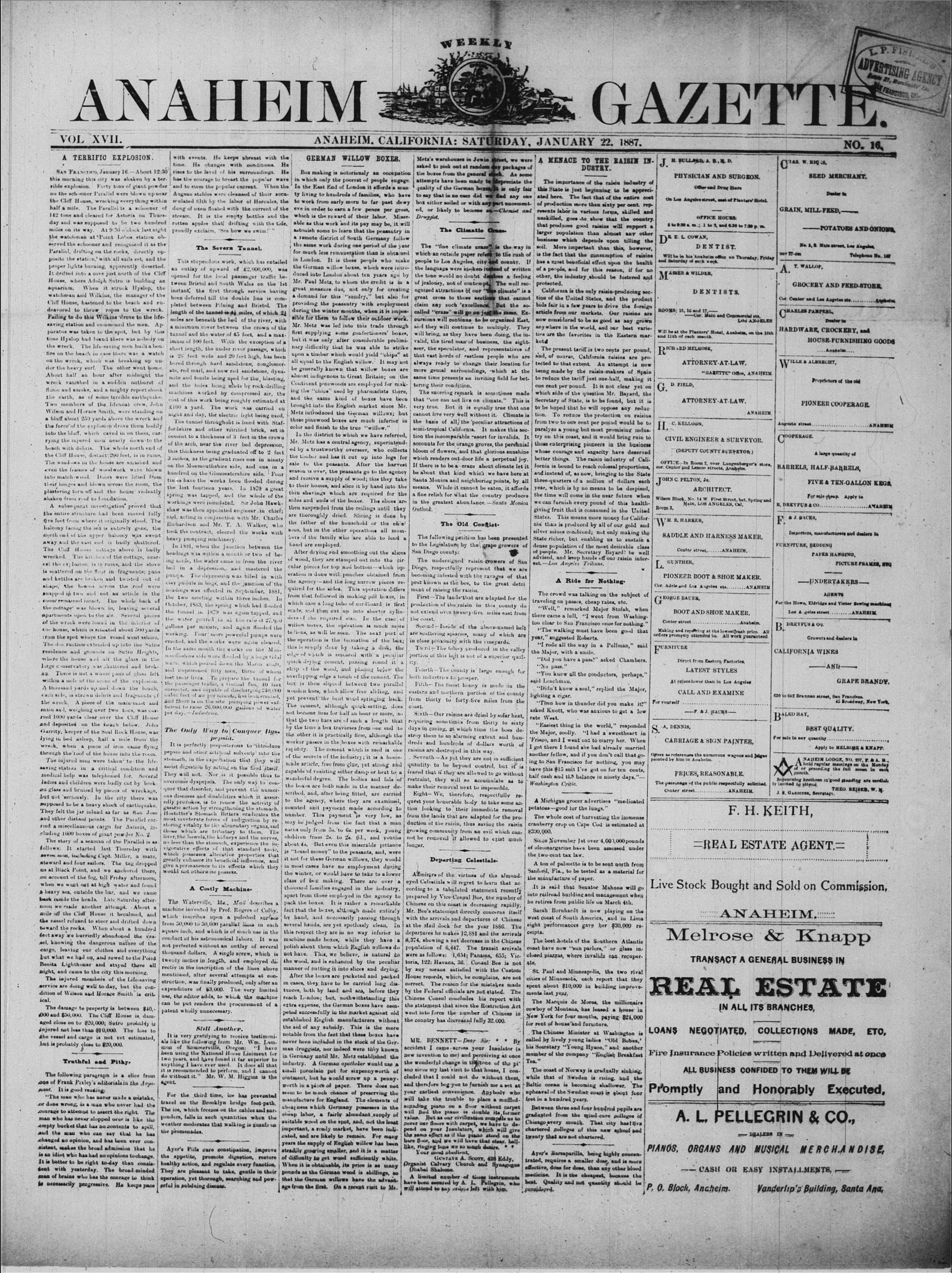
Searchable text
A TERRIFIC EXPLOSION.
SAN FRANCISCO, January 16. About 12:30 this morning this city was shaken by a terrible explosion. Forty tons of giant powder on the schooner Parallel were blown up near the Cliff House, wrecking everything within half a mile. The Parallel is a schooner of 142 tons and cleared for Astoria on Thursday and was supposed to be two hundred miles on its way. At 9:30 o'clock last night the watchman at Point Lobos station observed the schooner and recognized it as the Parallel, drifting on the rocks, directly opposite the station, with all sails set, and the proper lights burning, apparently deserted. It drifted into a cove just north of the Cliff House, where Adolph Sutro is building an aquarium. When it struck Hyslop, the watchman and Wilkins, the manager of the Cliff House, hastened to the beach and endeavored to throw ropes to the wreck. Failing to do this Wilkins drove to the life-saving station and summoned the men. Apparatus was taken to the spot, but by this time Hyslop had found there was nobody on the wreck. The life-saving men built a bonfire on the beach in case there was a watch on the wreck, which was breaking up under the heavy surf. The other went home. About half an hour after midnight the wreck vanished in a sudden outburst of flame and smoke, and a mighty report shook the earth, as of some terrible earthquake. Two members of the lifeboat crew, John Wilson and Horace Smith, were standing on a bluff about 250 yards above the wreck and the force of the explosion drove them bodily into the bluff, which caved in on them, carrying the injured men nearly down to the beach with debris. The whole north end of the Cliff House, distant 200 feet, is in ruins. The windows in the house are smashed and even the frames of woodwork were blown with events. He keeps abreast with the time. He changes with conditions. He rises to the level of his surroundings. He has the courage to breast the popular wave and to stem the popular current. When the Augean stables were cleansed of their accumulated filth by the labor of Hercules, the dung of oxen floated with the current of the stream. It is the empty bottles and the rotten apples that drifted with the tide, proudly exclaim, "See how we swim!"
The Severn Tunnel.
This stupendous work, which has entailed an outlay of upward of £2,000,080, was opened for the local passenger traffic between Bristol and South Wales on the 1st instant; the first through service having been deferred till the double line is completed between Pilning and Bristol. The length of the tunnel is 44 miles, of which 24 miles are beneath the bed of the river, with a minimum cover between the crown of the tunnel and the water of 45 feet, and a maximum of 100 feet. With the exception of a short length, the under river passage, which is 26 feet wide and 20 feet high, has been bored through hard sandstone, conglomerate, red marl, and new red sandstone, dynamite and tonite being used for the blasting, and the holes being made by rock-drilling machines worked by compressed air, the cost of this work being roughly estimated at £100 a yard. The work was carried on night and day, the electric light being used.
The tunnel throughout is lined with Staffordshire and other vitrified brick, set in cement to a thickness of 3 feet in the crown of the arch, near the river bed depression, this thickness being graduated off to 2 feet 3 inches, as the gradient rises one in ninety on the Monmouthshire side, and one in a hundred on the Gloucestershire side. Four
GERMAN WILLE
Box making is notorious in which only the poor live. In the East End of London living to hundreds of to work from early morning eve in order to earn a fife which is the reward of able as this work and it astonish some to learn that a remote district of South Europe same work during one for much less remuneration in London. It is these German willow boxes introduced into London about Mr. Paul Metz, to whom great measure due, now a demand for this "surviving" providing the peasantry during the winter monthssible for them to follow Mr. Metz was led into first supplying some piles but it was only after certain difficulty that he upon a timber which would all equal to the English be generally known that almost indigenous to Great Continent pinewoods are ing the "chips" used by and the same kind of brought into English Metz introduced the German these pinewood boxes are color and finish to the trunk.
In the district to which Mr. Metz has a central aped by a trustworthy overseeing timber and has it cut sale to the peasants. Season is over, the peasants
About half an hour after midnight the wreck vanished in a sudden outburst of flame and smoke, and a mighty report shook the earth, as of some terrible earthquake. Two members of the lifeboat crew, John Wilson and Horace Smith, were standing on a bluff about 250 yards above the wreck and the force of the explosion drove them bodily into the bluff, which caved in on them, carrying the injured men nearly down to the beach with debris. The whole north end of the Cliff House, distant 290 feet, is in ruins. The windows in the house are smashed and even the frames of woodwork were blown into matchwood. Doors were lifted from their hinges and blown across the room, the plastering torn off and the house violently shaken from roof to foundation.
A subsequent investigation proved that the entire structure had been moved fully five feet from where it originally stood. The balcony facing the sea is entirely gone, the north end of the upper balcony was swept away and the east end is badly shattered. The Cliff House cottage above is badly wrecked. The kitchen of the cottage, nearest the explosion, is in ruins, and the stove is scattered on the floor in fragments; pans and kettles are broken and twisted out of shape; the beams across the roof were snapped in two and not an article in the room remained intact. The whole back of the cottage was blown in, leaving several apartments open to the air. Several pieces of the wreck were found in the interior of the house, which is situated about 500 yards from the spot where the vessel went ashore. The disruption extended up into the Sutro residence and grounds on Sutro Heights, where the house and all the glass in the large conservatory was shattered and broken. There is not a whole pan of glass left within a mile of the scene of the explosion.
A thousand yards up and down the beach, each side is strewn debris and fragments of the wreck. A piece of the mainast and main sail, weighing over two tons, was carried 1000 yards clear over the Chif House and deposited on the seash below. John Garrity, keeper of the Seal Rock House, was lying in bed asleep, half a mile from the wreck, when a piece of iron came flying through the roof of the house into the room.
The injured men were taken to the life-saving station in a critical condition and medical help was telephoned for. Several ladies and children were badly cut by broken glass and bruised by pieces of wreckage, but not seriously. In the city there was supposed to be a heavy shock of earthquake. They felt the jar inland as far as 640 Jose and other distant points. The Parallel carried a miscellaneous cargo for Astoria, including 1600 boxes of giant powder No. 2.
The story of a seaman of the Parallel is as follows: It started last Thursday with seven men, including Capt. Miller, a mate, steward and four sailors. The tag dropped us at Black Point, and we anchored there, on account of the fog, till Friday afternoon, when we wegt out at high water and found a heavy sea, outside the bar, and we came back inside the heads. Late Saturday afternoon mite and tonite being used for the blasting, and the holes being made by rock-drilling machines worked by compressed air, the cost of this work being roughly estimated at £100 a yard. The work was carried on night and day, the electric light being used.
The tunnel throughout is lined with Staffordshire and other vitrified brick, set in cement to a thickness of 3 feet in the crown of the arch, near the river bed depression, this thickness being graduated off to 2 feet 3 inches, as the gradient rises one in ninety on the Monmouthshire side, and one in a hundred on the Gloucestershire side. Four times have works been flooded during the last fourteen years. In 1879 a great spring was tapped, and the whole of the workings were annulated. Sir John Hawkshaw was then appointed engineer in chief; and acting in conjunction with Mr. Charles Richardson and Mr. T. A. Walker, who took the contract, cleared the works with heavy pumping machinery.
In 1881, when the junction between the headings was within a month or two of being made, the water came in from the river bed in a depression, and mastered the pumps. The depression was filled in with clay puddle in bags, and the junction of the headings was effected in September, 1881, the two meeting within three inches. In October, 1883, the spring which had flooded the tunnel in 1879 was again tapped, and the water poured in at the rate of 27,000 gallons per minute, and again flooded the working. Four more powerful pumps were erected, and the works were again cleared. In the same month the works on the Monmouthshire side were flooded by a huge tidal wave which poured down the Marsh shaft, and imprisoned fifty men, three of whom lost their lives. To prepare the tunnel for the passenger traffic, a Global fan, 40 feet diameter, and capable of discharge 240,000 cubic feet of air per minute, has been erected, and there is on site pumping power sufficient to raise 26,000,000 gallons of water per day.
Industries
The Only Way to Conquer Dyspepsia.
It is perfectly preposterous to introduce pepsin and other artificial solvents into the stomach, in its expectation that they will assist digestion by acting on its food itself. They will not. Nor is it possible thus to overcome dyspepsia. The only way to conquer that disorder, and prevent the numerous diseases and disabilities which it assuredly provokes, is to renew the activity of gastric action by strengthening the stomach. Hostetter's Stomach Bitters eradicates the most inveterate forms of indigestion by restoring vitality to the alimentary organs, and those which are tributary to them. The liver,the bowels,the kidneys和the nerves no less than the stomach, experience its vigorative effects of that standard tonic which possesses alternative properties that greatly enhance its beneficial influence,and give a permanence to its effects which they would not otherwise possess.
A Costly Machine-
supposed to be a heavy shock of earthquake.
They felt the jar inland as far as 6an Jose and other distant points.
The Parallel carried a miscellaneous cargo for Astoria, including 1600 boxes of giant powder No. 2.
The story of a seaman of the Parallel is as follows: It started last Thursday with seven men, including Capt. Miller, a mate, steward and four sailors. The tug dropped us at Black Point, and we anchored there on account of the fog, till Friday afternoon, when we went out at high water and found a heavy sea, outside the bar, and we came back inside the heads. Late Saturday afternoon we made another attempt. About a mile off the Cliff House it becalmed, and the vessel refused to steer and drifted down toward the rocks. When about a hundred feet away we hurriedly abandoned the vessel, knowing the dangerous nature of the cargo, leaving our clothes and everything but what we had on, and rowed to the Point Bonita Lighthouse and stayed there all night, and came to the city this morning.
The injured members of the Life-saving service are doing well to-day, but the condition of Wilson and Horace Smith is critical.
The damage to property is between $40,000 and $50,000. The Cliff House is damaged close on to $20,000; Sutro probably is injured not less than $10,000. The loss to the vessel and cargo is not yet estimated, but is probably close to $20,000.
Truthful and Pithy
The following paragraph is a slice from one of Frank Pixley's editorials in the Argosport. It is good reading:
"The man who has never made a mistake, or done wrong, is a man who never had the courage to attempt to assert the right. The man who has never slopped over is like the empty bucket that has no contents to spill, and the man who can say that he has changed no opinion, and has been ever consistent, makes the broad admission that he is an idiot who has had no opinions to change. It is better to be right to-day than consistent with yesterday. The broad-minded man of brains who has the courage to think is necessarily progressive. He keeps pace easily provokes, is to renew the activity of gastric action by strengthening the stomach. Hostetter's Stomach Bitters eradicates the most inveterate forms of indigestion by restoring vitality to the alimentary organs, and those which are tributary to them. The liver, the bowels, the kidneys and the nerves, no less than the stomach, experience the investigative effects of that standard tonic, which possesses alternative properties that greatly enhance its beneficial influence, and give a permanence to its effects which they would not otherwise possess.
A Costly Machine
The Waterville, Me., Mail describes a machine invented by Prof. Rogers of Colby, which inscribes upon a polished surface from 30,000 to 50,000 parallel lines in each square inch, and which is of much use in the conduct of his astronomical labor. It was not perfected without an outlay of several thousand dollars. A single screw, which is twenty inches in length, and employed directly in the inscription of the lines above mentioned, after several attempts at construction, was finally produced, only after an expenditure of $3,000. The very limited use, the editor adds, to which the machine can be put renders the procurement of a patent wholly unnecessary.
Still Another.
It is very gratifying to receive testimonials like the following from Mr. Wm. Lammon of Summerville, Oregon: "I have been using the National Horse Liniment for two years, and have found it far superior to anything I have ever used. It does all that it is recommended to perform, and I cannot do without it." Mr. W. M. Higgins is the agent.
For the third time, ice has prevented travel on the Brooklyn bridge foot-path. The ice, which freezes on the cables and suspenders, falls in such quantities when the weather moderates that walking is unsafe on the promenades.
Ayer's Pills cure constipation, improve the appetite, promote digestion, restore healthy action, and regulate every function. They are pleasant to take, gentle in their operation, yet thorough, searching and powerful in subduing disease.
The thousand families engaged apart from those employed pack the boxes. It is rather fact that the boxes, although by hand, and necessarily several hands, are yet spotless this respect they are in no machine made boxes, whilst polish about them which Erik not have. This we believe the wood, and is enhanced in manner of cutting it into slips.
After the boxes are packed in cases, they have to be cautious both by land and reach London; but, notwithstanding extra expense, the German industry may be successful in the establishment English manufacture for England.
cheapness which Germany cheap labor, a fairly abundant suitable wood on the spot, an important, a readily marketable, and are likely to remain years the supply of English steadily growing smaller, and of difficulty to get wood superseded as the German wood that the German willows age from the first. On a reckoning
WEEKLY
CIM GA
ANAHEIM, CALIFORNIA: SATURDAY, JANUARY 22. 1887.
GERMAN WILLOW BOXES.
Box making is notoriously an occupation in which only the poorest of people engage. In the East End of London it affords a scanty living to hundreds of families, who have to work from early morn to far past dewy eve in order to earn a few pence per gross, which is the reward of their labor. Miserable as this work and its pay may be, it will astonish some to learn that the peasantry in a remote district of South Germany follow the same work during one period of the year for much less remuneration than is obtained in London. It is these people who make the German willow boxes, which were introduced into London about ten years ago by Mr. Paul Metz, to whom the credit is in a great measure due, not only for creating a demand for this "sundry," but also for providing the peasantry with employment during the winter months, when it is impossible for them to follow their outdoor work. Mr. Metz was led into this trade through first supplying some confectioners' boxes, but it was only after considerable preliminary difficulty that he was able to strike upon a timber which would yield "chips" at all equal to the English willow. It may not be generally known that willow boxes are almost indigenous to Great Britain; on the Continent pinewoods are employed for making the "chips" used by pharmacists there, and the same kind of boxes have been brought into the English market since Mr. Metz introduced the German willows; but these pinewood boxes are much inferior in color and finish to the true "willow."
In the district to which we have referred, Mr. Metz has a central agency, superintended by a trustworthy overseer, who collects the timber and has it cut up into logs for sale to the peasants. After the harvest season is over, the peasants go to the agency
Metz's warehouses in Jewin street, we were asked to pick out at random any packages of the boxes from the general stock. As some attempts have been made to depreciate the quality of the German boxes, it is only fair to say that in no case did we find any one box either soiled or with any part uncemented, or likely to become so.—Chemist and Druppist.
The Climatic Grass.
The "fine climate craze" is the way in which an outside paper refers to the rush of people to Los Angeles, city and county. If the language were spoken instead of written the tone would no doubt disclose a feeling of jealousy, not of contempt. The well recognized attractions of our "fine climate" is a great cross to those sections that cannot claim any such 'excellence. But the so-called "craze" will go on just the same. Excursions will continue to be organized East, and they will continue to multiply. They will bring, as they have been doing, the invalid, the tired man of business, the sightseer, the speculator, and representatives of that vast horde of restless people who are always ready to change their location for more genial surroundings, which at the same time presents an inviting field for bettering their condition.
The sneering remark is sometimes made that "one can not live on climate." This is very true. But it is equally true that one cannot live very well without it. Climate is the basis of all the peculiar attractions of semi-tropical California. It makes this section the incomparable resort for invalids. It accounts for the orange groves, the perehnial bloom of flowers, and that glorious sunshine which renders out-door life a perpetual joy. If there is to be a craze about climate let it be about that kind which we have here at
A MENACE TO THE RAISIN INDUSTRY.
The importance of the raisin industry of this State is just beginning to be appreciated here. The fact that of the entire cost of production more than sixty per cent represents labor in various forms, skilled and unskilled, goes so show that the country that produces good raisins will support a larger population than almost any other business which depends upon tilling the soil. More important than this, however, is the fact that the consumption of raisins has a most beneficial effect upon the health of a people, and for this reason, if for no other, the industry should be fostered and protected.
California is the only raisin-producing section of the United States, and the product bids fair in a few years to drive the foreign article from our markets. Our raisins are now considered to be as good as any grown anywhere in the world, and our best varieties are the favorites in the Eastern market.
The present tariff is two cents per pound, and of course, California raisins are protected to that extent. An attempt is now being made by the raisin-makers of Spain to reduce the tariff just one-half, making it one cent per pound. It is not clear yet on which side of this question Mr. Bayard, the Secretary of State, is to be found, but it is to be hoped that he will oppose any reduction. To reduce the protection on raisins from two to one cent per pound would be to paralyze a young but most promising industry on this coast, and it would bring ruin to those enterprising pioneers in the business whose courage and sagacity have deserved better things. The raisin industry of California is bound to reach colossal proportions, and instead of, as now, bringing to the State...
almost indigenous to Great Britain; on the Continent pinewoods are employed for making the "chips" used by pharmacists there, and the same kind of boxes have been brought into the English market since Mr. Metz introduced the German willows; but these pinewood boxes are much inferior in color and finish to the true "willow."
In the district to which we have referred, Mr. Metz has a central agency, superintended by a trustworthy overseer, who collects the timber and has it cut up into logs for sale to the peasants. After the harvest season is over, the peasants go to the agency and receive a supply of wood; this they take to their homes, and slice it by hand into the thin shavings which are required for the sides and ends of the boxes. The slices are then suspended from the ceilings until they are thoroughly dried. Slicing is done by the father of the household or the elder sons, but in the other operations all members of the family who are able to lend a hand are employed.
After drying and smoothing out the slices of wood, they are stamped out into the circular pieces for top and bottom—which operation is done with punches obtained from the agency—and the long narrow pieces required for the sides. This operation differs from that followed in making pill boxes, in which case a long tube of cardboard is first made, and then cut up into shorter cylinders of the required size. In the case of willow boxes, the operation is much more tedious, as will be seen. The next part of the operation is the formation of the box; this is simply done by taking a disk, the edge of which is smoaked with a peculiar quick-drying cement, passing round it a strip of the wood, and placing below the overlapping edge a touch of the cement. The box is then slipped between two parallel wooden bars, which allow free sliding, and yet prevent the heat wood springing back. The cement, although quick-setting, does not become firm for half an hour or more, so that the two bars are of such a length that by the time a box traverses from one end to this other it is practically firm, although the worker passes in the boxes with remarkable rapidity. The cement which is used is one of the secrets of the industry; it is a homemade article, free from glue, yet strong and capable of resisting either damp or heat to a wonderful degree. The bodies and lids of the boxes are both made in the manner described, and, after being fitted, are carried to the agency, where they are examined, counted and payment made according to number. This payment is very low, as may be judged from the fact that a man earns only from 5s. to 6s. per week, young children from 2s. to 2s. 9d., and yontis about 4s. But even this miserable pittance is "tound money" to the peasants, and, were it not for these German willows, they would in most cases have no employment during the winter, or would have to take to a lower class of box making. There are over a thousand families engaged in the industry, apart from those employed in the agency to same time presents an inviting field for bettering their condition.
The sneering remark is sometimes made that "one can not live on climate." This is very true. But it is equally true that one cannot live very well without it. Climate is the basis of all the peculiar attractions of semi-tropical California. It makes this section incomparable resort for invalids. It accounts for the orange groves, the perennial bloom of flowers, and that glorious sunshine which renders outdoor life a perpetual joy. If there is to be a craze about climate let it be about that kind which we have here at Santa Monica and neighboring points, by all means. While it cannot be eaten, it affords a fine relish for what the country produces in the greatest abundance. —Santa Monica Outlook.
The Old Conflict
The following petition has been presented to the Legislature by the grape growers of San Diego county:
The undersigned raisin-growers of San Diego, respectfully represent that we are becoming infested with the ravages of that pest known as the bee, to the great detriment of raising the raisin.
First—The lands that are adapted for the production of the raisin in this county do not extend over twenty-five miles east from the coast.
Second—Inside of the above-named belt are scattering aparies, many of which are in close proximity with the vineyards.
Third—The honey produced in the valley portion of this belt is not of a superior quality.
Fourth—The county is large enough for both industries to prosper.
Fifth—the finest honey is made in the eastern and northern portion of the county from thirty to forty-five miles from the coast.
Sixth—Our raisins are dried by solar heat, requiring sometimes from thirty to sixty days in curing, at which time the bees destroy them to an alarming extent and hundreds and hundreds of dollars worth of raisins are destroyed in this way.
Seventh—As yet they are not in sufficient quantity to be beyond control, but it is feared that if they are allowed to go without restraint, they will so accumulate as to make their removal next to impossible.
Eight—We therefore, respectfully request your honorable body to take some action looking to their immediate removal from the lands that are adapted for the production of the raisin, thus saving the raisin growing community from an evil which cannot be removed it allowed to exist much longer.
A Ride for Nothing
The crowd was talking on the subject of traveling on passes, cheap rates, etc.
"Well," remarked Major Stofah, when there came a hall, "I went from Washington clear to San Francisco once for nothing."
"The walking must have been good that year," suggested Roberts.
"I rode all the way in a Pullman," said the Major, with a smile.
"Did you have a pass?" asked Chambers.
"No pass."
"You knew all the conductors, perhaps," said Leachman.
"Didn't know a soul," replied the Major, lighting a cigar.
"Then how in thunder did you make it?" asked Knott, who was anxious to get a low rate West.
"Easiest thing in the world," responded the Major, coolly.
"I had a sweetheart in Frisco, and I went out to marry her. When I got there I found she had already married another fellow, and if you don't call that going to San Francisco for nothing, you may have this $15 suit I've got on for ten cents, half cash and that balance in ninety days." —Washington Critic.
A Michigan grocer advertises "medicated potatoes—good for the lungs."
The whole cost of harvesting the immense cranberry crop on Cape Cod is estimated at $300,000.
Since November 1st over 4,000,000 pounds of oleomargarine have been assessed under the two-cent tax law.
A ton of palmetto is to be sent north from Sanford, Fla., to be tested as a material for the manufacture of paper.
It is said that Senator Mahone will go into railroad building and management when
to the agency, where they are examined, counted and payment made according to number. This payment is very low, as may be judged from the fact that a man earns only from 5s. to 6s. per week, young children from 2s. to 2s. 6d., and youths about 4s. But even this miserable pittance is "found money" to the peasants, and, were it not for these German willows, they would in most cases have no employment during the winter, or would have to take to a lower class of box making. There are over a thousand families engaged in the industry, apart from those employed in the agency to pack the boxes. It is rather a remarkable fact that the boxes, although made entirely by hand, and necessarily passing through several hands, are yet spotlessly clean. In this respect they are in no way inferior to machine made boxes, while they have a polish about them which English willows do not have. This, we believe, is natural to the wood, and is enhanced by the peculiar manner of cutting it into slices and drying.
After the boxes are packeted and packed in cases, they have to be carried long distances, both by land and sea, before they reach London; but, notwithstanding this extra expense, the German boxes have competed successfully in the market against old established English manufacturers without the aid of any subsidy. This is the more notable from the fact that these boxes have never been included in the stock of the German druggists, nor indeed were they known in Germany until Mr. Metz established the industry. A German apotheker would use a small porcelain pot for sixpennyworth of ointment, but he would screw up a penny-worth in a piece of paper. There does not seem to be much chance of preserving the manufacture for England. The elements of cheapness which Germany possesses in the cheap labor, a fairly abundant supply of suitable wood on the spot, and not the least important, a ready market, have been indicated, and are likely to remain. For many years the supply of English willow has been steadily growing smaller, and it is a matter of difficulty to get wood sufficiently white. When it is obtainable, its price is as many pounds as the German wood is shillings, so that the German willows have the advantage from the first. On a recent visit to Mr.
Departing Celestials.
Admirers of the virtues of the almondeyed Celestials will regret to learn that according to a tabulated statement recently prepared by Vice Consul Bee, the number of Chinese on this coast is decreasing rapidly. Mr. Bee's statement directly concerns itself with the arrivals and departures of Chinese at the Mail dock for the year 1886. The departures he makes 12,881 and the arrivals 6,374, showing a net decrease in the Chinese population of 6,447. The transit arrivals were as follows: 1,654; Panama, 655; Victoria, 122; Havana, 36. Consul Bee is not by any means satisfied with the Custom House records, which he complains, are not correct. The reason for the mistakes made by the Federal officials are not stated. The Chinese Consul concludes his report with the statement that since the Restriction Act went into force the number of Chinese in the country has decreased fully 32,000.
MR. BENNETT—Dear Sir:
By accident I came across your Insulator (a new invention to me) and perceiving at once the wonderful change in the tone of the piano since my last visit to that house, I concluded that I could not do without them, and therefore beg you to furnish me a set at your earliest convenience. Anybody who will take the trouble to place a muffled-sounding piano on a floor without carpet will find the piano is double its former value. But as our civilization compels us to cover our floors with carpet, we have to depend on your Insulators, which will give the same effect as if the piano stood on the bare floor, and we will have that clear, bell-like, ringing tone we so much desire.
Your most obedient,
GUSTAVE A. SCOTT, 428 Eddly,
Organist Calvary Church and Synagogue
Ohabai Shalome.
A limited number of these instruments have been secured by A. L. Pellegrin, who will attend to any orders left with him.
A Michigan grocer advertises "medicated potatoes—good for the lungs."
The whole cost of harvesting the immense cranberry crop on Cape Cod is estimated at $300,000.
Since November 1st over 4,001,000 pounds of oleomargarine have been assessed under the two-cent tax law.
A ton of palmetto is to be sent north from Sanford, Fla., to be tested as a material for the manufacture of paper.
It is said that Senator Mahone will go into railroad building and management when he retires from public life on March 4th.
Sarah Bernhardt is now playing on the west coast of South America, and in Lima eight performances gave her $30,000 receipts.
The best hotels of the Southern Atlantic coast have now "sun parlors," or glass enclosed piazzas, where invalids can recuperate.
St. Paul and Minneapolis, the two rival cities of Minnesota, each report that they spent about $10,000 in building improvements last year.
The Marquis de Mores, the millionaire cowboy of Montana, has leased a house in New York for four months, paying $24,000 for rent of house and furniture.
The Chinese Minister at Washington is called by lively young ladies "Old Bohea," his Secretary "Young Hyson," and another member of the company "English Breakfast Tea."
The coast of Norway is gradually sinking, while that of Sweden is rising, and the Baltic ocean is becoming shallower. The upheaval of the Swedish coast is about four feet in a hundred years.
Between three and four hundred pupils are graduated from the mind-cure colleges of Chicago every month. That city has five chartered colleges of this new school and twenty that are not chartered.
Ayer's Saraparilla, being highly concentrated, requires a smaller dose, and is more effective; dose for dose, than any other blood medicine. It is the cheapest because the best. Quality and not quantity should be considered.
GAZETTE.
22. 1887. NO. 16
THE RAISIN INDUSTRY.
The raisin industry of the city is growing to be appreciable that of the entire cost in sixty per cent. repaired forms, skilled and now that the country raisins will support a small almost any other goods upon tilling the less than this, however, consumption of raisins affects upon the health this reason, if for no reason should be fostered and raisin-producing secues, and the product to drive the foreign raisins. Our raisins are good as any grown and our best variety on the Eastern marches two cents per pound,onia raisins are pro-An attempt is now raisin-makers of Spain one-half, making it not clear yet on Mr. Bayard, the be found, but it is oppose any reduc-tion on raisins or pound would be to most promising industries would bring ruin to workers in the business facility have deserved in industry of Cali-colossal proportions, bringing to the State
J. H. BULLARD, A. R., M.D.
PHYSICIAN AND SURGEON.
Officer and Drug Store
On Los Angeles street, east of Planters' Hotel.
OFFICE HOURS:
8 to 9:30 a.m.; 1 to 2, and 6:30 to 7:30 p.m.
DR. E. L. COWAN,
DENTIST.
Will be in his Anaheim office on Thursday, Friday and Saturday of each week.
MASSER & WILDER,
DENTISTS.
ROOMS: 15, 16 and 17.
Cor. Main and Commercial sts.
LOS ANGELES
Will be at the Planters' Hotel, Anaheim, on the 10th and 11th of each month.
RICHARD MELROSE,
ATTORNEY-AT-LAW.
"GAZETTE" Office, ANAHEIM.
G. D. FIELD,
ATTORNEY-AT-LAW.
ANAHEIM.
H. C. KELLOGG,
CIVIL ENGINEER & SURVEYOR.
(DEPUTY COUNTY SURVEYOR.)
OFFICE—In Room 2, over Langenberger's store, cor. Center and Lemon streets, Anaheim.
CITAS W. NIQS,
SEED MERCHANT.
Dealer in
GRAIN, MILL-FREED,
POTATOES AND ONIONS.
No. 4, B. Main street, Los Angeles
nov 27-4m
Telephone No. 107
A. T. WALLOP,
GROCERY AND FEED-STORE.
Cor. Center and Los Angeles sts.......Appheim
CHARLES PAMPERL,
Dealer in
HARDWARE, CROCKERY, and HOUSE-FURNISHING GOODS ....Anaheim...
WILLE & ALBRECHT,
Proprietors of the old
PIONEER COOPERAGE.
August street.....ANAHEIM
COOPERAGE.
A large quantity of
BARRELS, HALF-BARRELS,
G. D. FIELD,
ATTORNEY-AT-LAW.
ANAHEIM.
H. C. KELLOGG.
CIVIL ENGINEER & SURVEYOR.
(DEPUTY COUNTY SURVEYOR.)
OFFICE... In Room 2, over Langenberger's store, cor. Center and Lemon streets, Anaheim.
JOHN C. PELTON, Ja.
ARCHITECT.
Wilson Block, No. 14 W. First Street, bet. Spring and Main, Los Angeles, Cal., Room 3.
W. M. R. HARKER,
SADDLE AND HARNESS MAKER,
Center street.....ANAHEIM.
L. GUNTHER,
PIONEER BOOT & SHOE MAKER.
Cor. Adele and Los Angeles sts.....ANAHEIM
GEORGE BAUER,
BOOT AND SHOE MAKER.
Center street.....Anaheim.
Making and repairing at the lowest cash price. All orders promptly attended to. All work guaranteed.
FURNITURE
Direct from Eastern Factories.
LATEST STYLES
At prices lower than in Los Angeles.
CALL AND EXAMINE
For yourself
—F. & J. BACKS—
S. A. DENNIS,
CARRIAGE & SIGN PAINTER,
Offer as references the numerous wagons and jigs painted by him in Anaheim.
PRICES, REASONABLE.
The patronage of the public respectfully solicited.
Center street.....ANAHEIM.
Proprietors of the old
PIONEER COOPERAGE.
Augustte street.....ANAHEIM
COOPERAGE.
A large quantity of
BARRELS, HALF-BARRELS,
FIVE & TEN-GALLON KEGS.
For sale cheap. Apply to
B. DREYFUS & CO.....ANAHEIM
F. & J. BACKS,
Importers, manufacturers and dealers in
FURNITURE, BEDDING
PAPER HANGING,
PICTURE FRAME, HTQ
—UNDERTAKERS—
AGENTS
For the Howe, Eldridge and Victor Sewing machines
Los Angeles street.....ANAHEIM.
B. DREYFUS & CO.
Growers and dealers in
CALIFORNIA WINES
AND
GRAPE BRANDY.
630 to 642 Brannan street, San Francisco.
45 Broadway, New York.
BALED HAY.
BEST QUALITY.
For sale in any quantity...
Apply to MELROSE & KNAPP.
ANAHEIM LODGE, NO. 207, F. & A. M., hold regular meetings on the Monday of or preceding the full moon in each month.
Sojourning brethren in good standing are cordial, invited to attend.
THEO. REISED, W. M.
J. R. GARDINER, Secretary.
F. H. KEITH,
=REAL ESTATE AGENT=
Live Stock Bought and Sold on Commission,
F. H. KEITH,
=REAL ESTATE AGENT.
Live Stock Bought and Sold on Commission,
ANAHEIM.
Melrose & Knapp
TRANSACT A GENERAL BUSINESS IN
REAL ESTATE
IN ALL ITS BRANCHES,
LOANS NEGOTIATED, COLLECTIONS MADE, ETO,
Fire Insurance Policies written and Delivered at once
ALL BUSINESS CONFIDED TO THEM WILL BE
Promptly and Honorably Executed,
A. L. PELLEGRIN & CO.,
DEALERS IN
PIANOS, ORGANS AND MUSICAL MERCHANDISE,
CASH OR EASY INSTALLMENTS,
P. O. Block, Ancheim. Vanderlip's Building, Santa Ana,