anaheim-gazette 1887-01-01
Scanned page
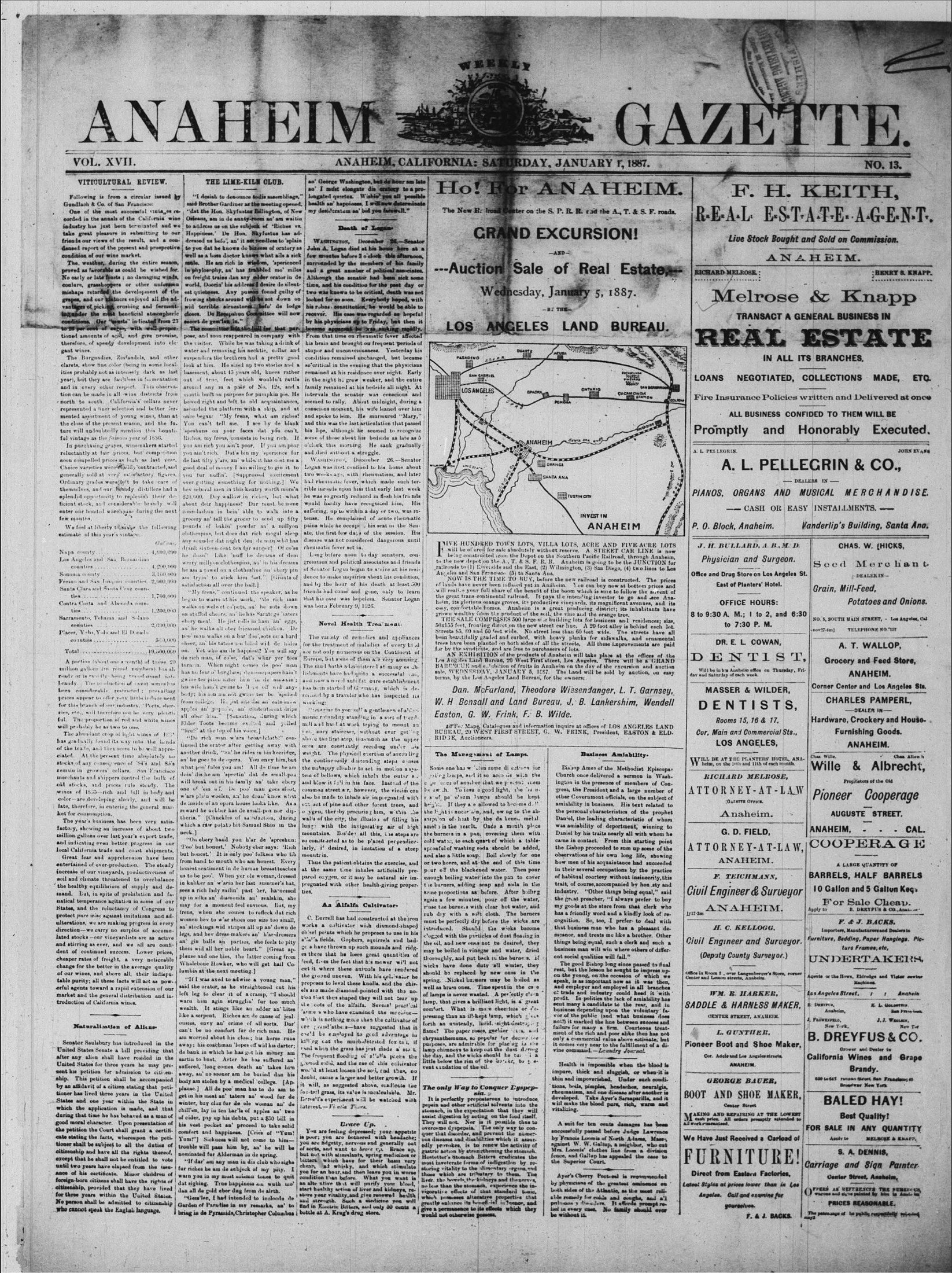
Searchable text
VITICULTURAL REVIEW.
Following is from a circular issued by Gundlach & Co. of San Francisco:
One of the most successful vintages recorded in the annals of the California wine industry has just been terminated and we take great pleasure in submitting to our friends our views of the result, and a condensed report of the present and prospective condition of our wine market.
The weather, during the entire season, proved as favorable as could be wished for. No early or late frosts; no damaging winds, coulure, grasshoppers or other unforeseen mishaps retarded the development of the grapes, and our winners enjoyed all the advantages of picking, crushing and fermenting under the most beneficial atmospheric conditions. Our "musta" indicated from 27 to 26 per cent of sugar, with well-proportioned amounts of acid, and give promise, therefore, of speedy development into elegant wines.
The Burgundies, Zinfandels, and other clarets, show fine color (being in some localities probably not as intensely dark as last year), but they are faultless in fermentation and in every other respect. This observation can be made in all wine districts from north to south. California's cellars never represented a finer selection and better fermented assortment of young wines, than at the close of the present season, and the future will undoubtedly mention this bountiful vintage as the famous year of 1836.
In purchasing grapes, winemakers started reluctantly at fair prices, but competition soon compelled prices as high as last year. Choice varieties were readily contracted, and generally sold at very satisfactory figures.
THE LIME-KILN CLUB.
"I desiab to denounce todis assemblage," said Brother Gardiner as the meeting opened. "dat the Hon. Skyfustus Billington, of New Orleans, am in de sunty-room an' am waitin to address us on the subject of 'Riches vs. Happiness.' De Hon. Skyfustus has addressed us before', an' it am needless to 'splain to you dat he knows de bissess of oratory as well as a boss doctor knows what a sick male. He am rich in wisdom, 'sperience in phylosophy, an' has trabbled mo' miles on freight trains dan any older orator in de world. Doorin' his address I desire de silentest quietness. Any passion found guilty of frowning shucks around will be not down on wid terrible airnestness, befo' de lodge closes. De Recapshun Committee will now escort de gem'last in."
The committee left the hall for that purpose, and soon reappeared in company with the visitor. While he was taking a drink of water and removing his necktie, collar and suspenders the brethren had a pretty good look at him. He sized up two stories and a basement, about 45 years old, knees rather out of true, feet which wouldn't rattle around any in a pale of No. 12s, and a month built on purpose for pumpkin pie. He bowed right and left to old acquaintances, ascended the platform with a skip, and at once began: "My frens, what am riches? You can't tell me. I see by de blank speshuns on your faces dat you can't. Riches, my frens, consists in being rich. If you am rich you ain't poor. If you am poor you ain't rich. Dat's bin my 'sperience fur de last fifty years, an' while it has cost me a good deal of money I am willing to gun it to you."
An' George Washil an' I must elong longated quietus health an' happiness my desideratum
DEATH
WASHINGTON,
John A. Logan died few minutes before surrounded by the and a great numb Although the sen time, and his cond two was known to looked for so soon his robus constitu recover. His case by his physicians became apparent.
From that time on his brain and brought stupor and unconscous condition remained so critical in the even remained at his rest in the night he greeted family remained at intervals the sen seemed to rally. A conscious moment, and spoke to him. And this was the last his lips, although some of those about o'clock this morning and died without a
but they are faultless in fermentation and in every other respect. This observation can be made in all wine districts from north to south. California's cellars never represented a finer selection and better fermented assortment of young wines, than at the close of the present season, and the future will unoubtedly mention this bountiful vintage as the famous year of 1836.
In purchasing grapes, winemakers started reluctantly at fair prices, but competition soon compelled prices as high as last year. Choice varieties were readily contracted, and generally sold at very satisfactory figures. Ordinary grades were left to take care of themselves, and our brandy distillers had a splendid opportunity to replenish their deficient stock, and considerable brandy will enter our bonded warehouse during the next few months.
We feel at liberty to make the following estimate of this year's vintage.
Gallons:
Napa county ... 4,800,000
Los Angeles and San Bernardino counties ... 4,200,000
Sonoma county ... 3,160,000
Fresno and San Joaquin counties ... 2,000,000
Santa Clara and Santa Cruz counties ... 1,700,000
Contra Costa and Alamoda counties ... 1,200,000
Sacramento, Tehama and Solano counties ... 2,050,000
Placer, Yolo, Yolo and El Dorado counties ... 500,000
Total ... 19,500,000
A portion (about one seventh) of these 20 million gallons (in round numbers) has already or is rapidly being transformed into brandy. The production of sweet wines has been considerably restricted; prevailing prices appear to offer very little inducement for this branch of our industry. Ports, sherry, etc., will therefore not be very plentiful. The proportion of red and white wines will probably be as two to one.
The abundant crop of light wines of 1934 has gradually found its way into the hands of the trade, and they seem to be well appreciated. At the present time absolutely no stocks of any consequence of 1834 and 1835 remain in growers' cellars. San Francisco merchants and shippers control the bulk of old stocks, and prices rule steady. The wines of 1835—rich and full in body and color—are developing slowly, and will be late, therefore, in entering the general market for consumption.
The year's business has been very satisfactory, showing an increase of about two million gallons over last year's export trade, and indicating even better progress in our local California trade and coast shipments.
Great fear and apprehension have been entertained of over-production. The steady increase of our vineyards, productiveness of soil and climate threatened to overbalance the healthy equilibrium of supply and demand. But, in spite of prohibition and factionality, but they are faultless in fermentation and in every other respect. This observation can be made in all wine districts from north to south. California's cellars never represented a finer selection and better fermented assortment of young wines, than at the close of the present season, and the future will unobtrutely mention this bountiful vintage as the famous year of 1836.
In purchasing grapes, winemakers started reluctantly at fair prices, but competition soon compelled prices as high as last year. Choice varieties were readily contracted, and generally sold at very satisfactory figures. Ordinary grades were left to take care of themselves, and our brandy distillers had a splendid opportunity to replenish their deficient stock, and considerable brandy will enter our bonded warehouse during the next few months.
We feel at liberty to make the following estimate of this year's vintage.
Gallons:
Napa county ... 4,800,000
Los Angeles and San Bernardino counties ... 4,200,000
Sonoma county ... 3,160,000
Fresno and San Joaquin counties... 2,000,000
Santa Clara and Santa Cruz counties ... 1,700,000
Contra Costa and Alamoda counties ... 1,200,000
Sacramento, Tehama and Solano counties ... 2,050,000
Placer, Yolo, Yolo and El Dorado counties ... 500,000
Total ... 19,500,000
A portion (about one seventh) of these 20 million gallons (in round numbers) has already or is rapidly being transformed into brandy. The production of sweet wines has been considerably restricted; prevailing prices appear to offer very little inducement for this branch of our industry. Ports, sherry, etc., will therefore not be very plentiful. The proportion of red and white wines will probably be as two to one.
The abundant crop of light wines of 1934 has gradually found its way into the hands of the trade, and they seem to be well appreciated. At the present time absolutely no stocks of any consequence of 1834 and 1835 remain in growers' cellars. San Francisco merchants and shippers control the bulk of old stocks, and prices rule steady. The wines of 1835—rich and full in body and color—are developing slowly, and will be late, therefore, in entering the general market for consumption.
The year's business has been very satisfactory, showing an increase of about two million gallons over last year's export trade, and indicating even better progress in our local California trade and coast shipments.
Great fear and apprehension have been entertained of over-production. The steady increase of our vineyards, productiveness of soil and climate threatened to overbalance the healthy equilibrium of supply and demand. But, in spite of prohibition and factionality,
"My frens," continued the speaker, as he began to warm at his work, "de rich man walks on welwet carpets, an' he sits down on stuffed cheers, an' he has Saratoga eaters ebery meal. He just rolls in ham an' eggs, an' he walks all ober fricassed chicken. De poo' man walks on a bar 'floo', sots on a hard cheer, an' his taters am bilied will de hides on. Yet who am de happiest? You will say de rich man, of coe,' dat's whar yeroes turn in. When night comes de poo' man has no fear o' burglars; denosepapers hain't gwine ter piten later him 'an de mawin'; his wife hain't gwine to 'lope off wid anybody; his son am not gwine ter be 'spilled from college. He jist sits dat an' cats snow apples an' popson; an' contentment drips all ober him." [Sensation, during which Elder Toots became excited and yelled "fire!" at the top of his voice.]
"De rich man w'ars broad cloth!" continued the orator after getting away with another drink," an' he rides in his keeridge, an' he goes to de opera. You envy him, but what poo' fules you am! All de time he am doin' dis he am 'spectin' dat de small-pox will break out in his family an' take ebery one of 'em oil. De poo' man goes afoot, w'ars plain woolen; an' he doan' know what de inside of an opera house looks like. As a reward he nebber has de small-pox nor diptheria." [Chuckles of satisfaction, during which a raw potato hit Samuel Shin in the neck.]"
"On ebery hand you h'ar de 'spreshun: Poo' but honest.' Nobody eber says: 'Rich but honest.' It is only poo' folkses who lib from hand to mouth who am honest. Every honest sentiment in de human breast teaches us to be poo'. When yer ole woman, dressed in kahliker an' warin her last summer's hat, sees a rich lady sailin' past her, harnessed up in silks an' diamonds an' sealskin, she remains out of true feet which wouldn't rattle around any in a pale of No. 12s,and a month built on purpose for pumpkin pie. He bowed right and left to old acquaintances, ascended the platform with a skip, and at once began: "My freens, what am riches? You can't tell me. I see by de blank speshans on your faces dat you can't. Riches my freens consists in being rich. If you am rich you aimn't poor. If you am poor you ain't rich. Dat's bin my 'experience fur de last fifty yars,' an' while it has cost me a good deal of money I am willing to gin it to you tur nuffin'. [Suppressed excitement over getting something for nothing.] We hev seeral men in this kentry worth more'n $20,600. Dey wallow in riches, but what about deir happiness? Dar must be some consolashun in bein' able to walk into a grocery an' tell the grocer to send fifty pounds of bakin' powder an'a millyon clothespins; but does dat rich mogul sleep any sound dat night den de man who has drank sixteen-cent tea for supper? Of co'e he doan't Like 'nuff he dreams of dem worry millyon clothespins; an'in his dreams he am a towel on a clothesline an' ebery pin am tryin' to stick him 'ast.' [Grants of satisfaction all over the hall.]"
"My freens," continued the speaker, as he began to warm at his work," de rich man walks on welwet carpets; an' he sits down on stuffed cheers; an' he has Saratoga eaters ebery meal. He just rolls in ham an' eggs; an' he walks all ober fricassed chicken. De poo' man walks on a bar 'floo', sots on a hard cheer; an' his tathers am bilied will de hides on. Yet who am de happiest? You will say de rich man w'ars broad cloth!" continued the orator after getting away with another drink," an' he rides in his keeridge; an' he goes to de opera. You envy him; but what poo' fules you am! All de time he am doin' dis he am 'spectin' dat de small-pox will break out in his family an' take ebery one of 'em oil. De poo' man goes afoothold; w'ars plain woolen; an' he doan't know what de inside of an opera house looks like. As a reward he nebber has de small-pox nor diptheria." [Chuckles of satisfaction during which a raw potato hit Samuel Shin in the neck.]"
"On ebery hand you h'ar de 'spreshun: Poo' but honest.' Nobody eber says: 'Rich but honest.' It is only poo' folkses who lib from hand to mouth who am honest. Every honest sentiment in de human breast teaches us to be poo'. When yer ole woman,dressed in kahliker an' warin her last summer's hat,
sees a rich lady sailin' past her,harnessed up in silks an'diamonds an'realskin,she remains out of true feet which wouldn't rattle around any in a pale of No. 12s,and a month built on purpose for pumpkin pie. He bowed right and left to old acquaintances; ascended the platform with a skip; and at once began: "My freens," continued the speaker, as he began to warm at his work," de rich man walks on welwet carpets; an' he sits down on stuffed cheeks; an' he has Saratoga eaters ebery meal. He just rolls in ham an' eggs; an' he walks all ober fricassed chicken. De poo' man walks on a bar 'floo', sots on a hard cheer; an' his tathers am bilied will de hides on. Yet who am de happiest? You will say de rich man w'ars broad cloth!" continued the orator after getting away with another drink," an' he rides in his keeridge; an' he goes to de opera. You envy him; but what poo' fules you am! All de time he am doin' dis he am 'spectin' dat de small-pox will break out in his family an' take ebery one of 'em oil. De poo' man goes afoothold; w'ars plain woolen; an' he doan't know what de inside of an opera house looks like. As a reward he nebber has de small-pox nor diptheria." [Chuckles of satisfaction during which a raw potato hit Samuel Shin in the neck.]"
"The variety of roses for the treatment of race not only numerous Europe; but some of them have had rheumatic fever since friends had come into that his case was here was born February."
Long before noon greensmen and politicians of Senator Logan had dence to make inquiry and by the hour of friends had come into that his case was here was born February."
Novel Health
The variety of roses for the treatment of race not only numerous Europe; but some of them have had rheumatic fever since friends had come into that his case was here was born February.
Thus the patient at the same time paired oxygen; or it prevailed with other ties."
The year’s business has been very satisfactory, showing an increase of about two million gallons over last year’s export trade, and indicating even better progress in our local California trade and coast shipments.
Great fear and apprehension have been entertained of over-production. The steady increase of our vineyards, productiveness of soil and climate threatened to overbalance the healthy equilibrium of supply and demand. But, in spite of prohibition and factual temperance agitation in some of our States, and the reluctance of Congress to protect pure wine against imitations and adulterations, we are making progress in every direction—we carry no surplus of accumulated stocks—our vineyardists are as active and stirring as ever, and we all are confident of continued success. Lower prices, cheaper rates of freight, a very noticeable change for the better in the average quality of our wines, and above all, their indispensable purity; all these facts will act as powerful agents toward a rapid extension of our market and the general distribution and introduction of California wines.
Naturalization of Aliens
Senator Saulsbury has introduced in the United States Senate a bill providing that after any alien shall have resided in the United States for three years he may present his petition for admission to citizenship. This petition shall be accompanied by an affirmation of a citizen stating that petitioner has lived three years in the United States and one year within the State in which the application is made, and that during that time he has behaved as a man of good moral character. Upon presentation of the petition the Court shall grant a certificate stating the facts, whereupon the petitioner shall be subject to all the duties of citizenship and have all the rights thereof, except that he shall not be entitled to vote until two years have elapsed from the issuance of his certificate. Minor children of foreign-born citizens shall have the rights of citizenship, provided that they have lived for three years within the United States. No person shall be admitted to citizenship who cannot speak the English language.
"On ebery hand you h’ar de ’apreshun: ‘Poo’ but honest.’ Nobody ever says: ‘Rich but honest.’ It is only poo’ folkses who lib from hand to mouth who am honest. Every honest sentiment in de human breast teaches us to be poo’. When yer ole woman, dressed in kahlker an’ w’arin her last summer’s hat, sees a rich lady sailin’ past her, harnessed up in silks an’ diamonds an’ sealskin, she may for a moment feel envious. But, my frens, when she comes to reflect dat rich women hev to w’ar shoes one size too small, an’ stockings-wid stripes all up an’ down de legs, and hev dress-makers an’ h’ar-dressers an’ gin balls an parties, she feels to pity them wid all her noble heart.” [Great applause and one hiss, the latter coming from Whalebone Howker, who will get hail Columbia at the next meeting.]
“If I was axed to adwise a young man,” said the orator, as he straightened out his left leg to clear it of a cramp, “I should warn him again struggling fur too much wealth. It stings like an adder an’ bites like a serpent. Riches am de cause of jealousies, envy an’ crime of all sorts. Dar can’t be no comfort fur de rich man. He am worried about his close; his horse runs away; his coachman 'lopes off wid his darter; de bank in which he has got his money am sartin to bust. Arter he has suffered an’ suffered, 'long comes death an’ takes him away, au' no sooner am he buried dan his body am stolen by a medical college. [Applause.] All de poo’ man has to do am to get in his meat an’ taters an’ wood fur de winter, buy claz fur de ole woman an’ de chill’en, lay in ten bar’la of apples an’ two of cider, pay up his debts, put a $50 bill in his vest pocket an’ proceed to take solid comfort and happiness. [Cries of “Yum! Yum!”] Sickness will not come to him—trouble will pass him by, an’ he will be nominated fur Alderman in de spring.
“If dar’ am any man in dis club who sighs fur riches he am de subjeck of my pity. I warn you in my most solemn tones to quit sating. True happiness am wuth mo' dan all de gold ebor dug from de airth.
“Gem'len, I had intended to include de Garden of Paradise in my remarks, an' to bring in de Pyramids, Christopher Columbus...
WEEKLY
EIM GA
ANAHEIM, CALIFORNIA: SATURDAY, JANUARY 1, 1887.
Ho! For ANAHEIM
The New Railroad Center on the S. P. R. R. road the A., T. & S. F. roads
GRAND EXCURSION!
AND
---Auction Sale of Real Estate,
Wednesday, January 5, 1887.
BY THE
LOS ANGELES LAND BUREAU.
WASHINGTON, December 26.—Senator John A. Logan died at his home here at a few minutes before 3 o'clock this afternoon, surrounded by the members of his family and a great number of political associates. Although the senator had been sick some time, and his condition for the past day or two was known to be critical, death was not looked for so soon. Everybody hoped, with his robust constitution, he would be able to recover. His case was regarded as hopeful by his physicians up to Friday, but then it became apparent he was sinking rapidly. From that time on rheumatic fever affected his brain and brought on frequent periods of stupor and unconsciousness. Yesterday his condition remained unchanged, but became so critical in the evening that the physicians remained at his residence over night. Early in the night he grew weaker, and the entire family remained at his bedside all night. At intervals the senator was conscious and seemed to rally. About midnight, during a conscious moment, his wife leaned over him and spoke to him. He murmured "Mary," and this was the last articulation that passed his lips, although he seemed to recognize some of those about his bedside as late as 5 o'clock this morning. He sank gradually and died without a struggle.
WASHINGTON, December 26.—Senator Logan was first confined to his home about two weeks ago with rheumatism and later
FIVE HUNDRED TOWN LOTS, VILLA LOTS, ACRE AND FIVE ACRE LOTS will be offered for sale absolutely without reserve. A STREET CAR LINE is now being constructed from the Depot on the Southern Pacific Railroad, through Anaheim to the new depot on the A., T. & S. F. R. R. Anaheim is going to be the JUNCTION for railroads to (1) Riverside and the East, (2) Wilmington, (3) San Diego, (4) two lines to Los Angeles and San Francisco, (5) to Santa Ana.
NOW IS THE TIME TO BUY, before the new railroad is constructed. The prices of lands have never been inflated yet in Anaheim. You can buy now at bottom prices and will realize your full share of the benefit of the boom which is sure to follow the savent of the great transcontinental railroad. It pays the intending investor to go and see Anaheim, its glorious orange groves, its productive vineyards, its magnificent avenues, and its cozy, comfortable homes. Anaheim is a great producing district; its inhabitants have grown wealthy from the product of the soil, the vine and the orange tree.
THE SALE COMPRESES 500 large size building lots for business and residences; size 50x155 feet, fronting direct on the new street car line. A 20 foot alley is behind each lot. Streets 85, 80 and 60 feet wide. No street less than 60 feet wide. The streets have all been beautifully graded and curbed, with heavy planks for sidewalks, and ornamental trees have been planted on both sides of all the streets. All these improvements are paid for by the syndicate, and are free to purchasers of lots.
AN EXHIBITION of the products of Anaheim will take place at the offices of the Los Angeles Land Bureau, 20 West First street, Los Angeles. There will be a GRAND BARDECUE and exhibition of fruits in Anaheim on the day of the excursion and auction sale, WEDNESDAY, JANUARY 5, 1877. The Land will be sold by auction, on easy terms, by the Los Angeles Land Bureau, for the owners:
Dan. McFarland, Theodore Wiesendanger, L. T. Garnsey, W. H. Bonsall and Land Bureau, J. B. Lankershim, Wendell Easton, G. W. Frink, F. B. Wilde.
For Maps, Catalogues and information inquire at offices of LOS ANGELES LAND BUREAU, 20 WEST FIRST STREET, G. W. FRINK, President, EASTON & ELD-RIDGE, Auctioneers.
The Management of Lamps.
Some one has written some diagrams for lighting lamps, and it so accords with the experience of another that we present them here. To insure good light, the business of petroleum lamps should be kept bright. If they are allowed to become dull, the light is uncertain, and owing to the absorption of heat by the darkened metal smelts is the result. Once a month place the burners in a pan, covering them with cold water, to each quart of which a table-spoonful of washing soda should be added, and also a little soap. Boil slowly for one or two hours, and at the end of this time pour of the blackened water. Then pour enough boiling water into the pan to cover the burners, adding soap and soda in the same proportions as before. After boiling again a few minutes pour off the water.
Business Amiability-
Bishop Ames of the Methodist Episcopal Church once delivered a sermon in Washington in the presence of members of Congress, the President and a large number of other Government officials, on the subject of amiability in business. His text related to the personal characteristics of the prophet Daniel, the leading characteristic of whom was amiability of deportment, winning to Daniel by his traits nearly all with whom he came in contact. From this starting point the Bishop proceeded to sum up some of the observations of his own long life, showing how men of his acquaintance had succeeded in their several occupations by the practice of habitual courtesy without insincerity; this trait, of course, accompanied by honesty and industry. "Other things being equal," said the great preacher, "I always prefer to buy
An Alfalfa Cultivator.
C. Burrell has had constructed at the iron works a cultivator with diamond-shaped chisel points which he proposes to use in his alfalfa fields. Gophers, equirrels and badgers have thrown up such mounds and ridges there that he loses great quantities of feed, from the fact that his mower will not cut it where these animals have rendered the ground uneven. With his cultivator he proposes to level these knolls, and the chisels are made diamond-pointed with the notion that thus shaped they will not tear up the roots of the alfalfa. Several practical farmers who have examined the machine—which is nothing more than the cultivator of our grandfather—have suggested that it could be employed to good advantage in killing out the much-detested fox tail, if used when the grass has just made a start. The frequent flooding of alfalfa pests the ground solid, and the use of this cultivator would at least loosen the soil, and thus, no doubt, cause a larger and better growth. If it will, as suggested above, eradicate the fortail grass, its value is calculable. Mr. Burrell's experiment will be watched with interest.
Grace Up.
You are feeling depressed; your appetite is poor; you are bothered with headache; you areidgety, nervous and generally out of sorts, and want to brace up. Brace up, but not with stimulants, spring medicines or bitters which have for their basis very cheap, ad whisky, and which stimulate you for an hour, and then leave you in worse condition than before. What you want is an alternative that will purify your blood, start healthy action of liver and kidneys, restore your vitality, and give renewed health and strength. Such a medicine you will find in Electric Bitters, and only 50 cents a bottle at A. Krug's drug store.
The only Way to Conquer Dyspepsia.
It is perfectly preposterous to introduce pepsin and other artificial solvents into the stomach, in the expectation that they will assist digestion by acting on the food itself. They will not. Nor is it possible thus to overcome dyspepsia. The only way to conquer that disorder, and prevent the numerous diseases and disabilities which it assuredly provokes, is to renew the activity of gastric action by strengthening the stomach. Hostetter's Stomach Bitters eradicates the most inveterate forms of indigestion by restoring vitality to the alimentary organs, and those which are tributary to them. The liver, the bowels, the kidneys and thymus, no less than the stomach, experience the invigorative effects of that standard tonic, which possesses alterative properties that greatly enhance its beneficial influence, and give a permanence to its effects which they would not otherwise possess.
A suit for ten cents damages has been successfully passed before Judge Lawrence by Francis Loomis of North Adams, Mass., against W. W. Gallup, a neighbor, who cut Mrs. Loomis' clothes line from a division fence, and Gallup has appealed the case to the Superior Court.
Ayer's Cherry Pectal is recommended by physicians of the greatest aminence on both sides of the Atlantic, as the most reliable remedy for colds and coughs, and all pulmonary disorders. It affords prompt relief in every case. No family should ever be without it.
GAZETTE.
RY 1, 1887. NO. 13.
F. H. KEITH,
REAL ESTATE AGENT.
Live Stock Bought and Sold on Commission.
ANAHEIM.
RICHARD MELROSE; HENRY & KNAPP.
Melrose & Knapp
TRANSACT A GENERAL BUSINESS IN
REAL ESTATE
IN ALL ITS BRANCHES.
LOANS NEGOTIATED, COLLECTIONS MADE, ETQ.
Fire Insurance Policies written and Delivered at once
ALL BUSINESS CONFIDED TO THEM WILL BE
Promptly and Honorably Executed.
A. L. PELLEGRIN.
JOHN EVANS
A. L. PELLEGRIN & CO.,
LOANS NEGOTIATED, COLLECTIONS MADE, ETO.
Fire Insurance Policies written and Delivered at once
ALL BUSINESS CONFIDED TO THEM WILL BE
Promptly and Honorably Executed.
A. L. PELLEGRIN.
JOHN EVANS
A. L. PELLEGRIN & CO.,
— DEALERS IN —
PIANOS, ORGANS AND MUSICAL MERCHANDISE.
— CASH OR EASY INSTALLMENTS.
P. O. Block, Anaheim. Vanderlip's Building, Santa Ana.
J. H. BULLARD, A. B., M. D.
Physician and Surgeon.
Office and Drug Store on Los Angeles St.
East of Planters' Hotel.
OFFICE HOURS:
8 to 9:30 A. M.; 1 to 2, and 6:30
to 7:30 P. M.
DR. E. L. COWAN,
DENTIST,
Will be in his Anaheim office on Thursday, Friday and Saturday of each week.
MASSER & WILDER,
DENTISTS,
Rooms 15, 16 & 17.
Cor, Main and Commercial Sts., LOS ANGELES,
WILL BE AT THE PLANTERS' HOTEL, Anaheim, on the 10th and 11th of each month.
RICHARD MELROSE,
ATTORNEY-AT-LAW
(GAZETTE OFFICE)
Anaheim.
G. D. FIELD,
ATTORNEY-AT-LAW,
ANAHEIM.
F. TEICHMANN,
Civil Engineer & Surveyor
CHAS. W. (HICKS,
Seed Merchant
— DEALER IN —
Grain, Mill-Feed,
Potatoes and Onions.
NO. 5, SOUTH MAIN STREET, Los Angeles, Cal.
nov27-4m) TELEPHONE NO.'157
A. T. WALLOP,
Grocery and Feed Store,
ANAHEIM.
Corner Center and Los Angeles Sts.
CHARLES PAMPERL,
— DEALER IN —
Hardware, Crockery and HouseFurnishing Goods.
ANAHEIM.
Chas. Wille.
Wille & Albrecht,
Proprietors of the Old
Pioneer Cooperage
AUGUSTE STREET.
ANAHEIM, . . . CAL.
COOPERAGE
A LARGE QUANTITY OF
BARRELS, HALF BARRELS
10 Gallon and 5 Gallon Keq.
G. D. FIELD,
ATTORNEY-AT-LAW,
ANAHEIM.
F. TEICHMANN,
Civil Engineer & Surveyor
ANAHEIM.
H. C. KELLOGG,
Civil Engineer and Surveyor.
(Deputy County Surveyor.)
WM. R. HARKER,
SADDLE & HARNESS MAKER,
CENTER STREET, ANAHEIM.
L. GUNTHER,
Pioneer Boot and Shoe Maker,
Cor. Adelaide and Los Angeles streets.
GEORGE BAUER,
BOOT AND SHOE MAKER,
Center Street
We Have Just Received a Carload of
FURNITURE!
Direct from Eastern Factories.
Latest Styles at prices lower than in Los
Angeles. Call and examine for
yourselves.
F. & J. BACKS.