anaheim-gazette 1886-10-02
Scanned page
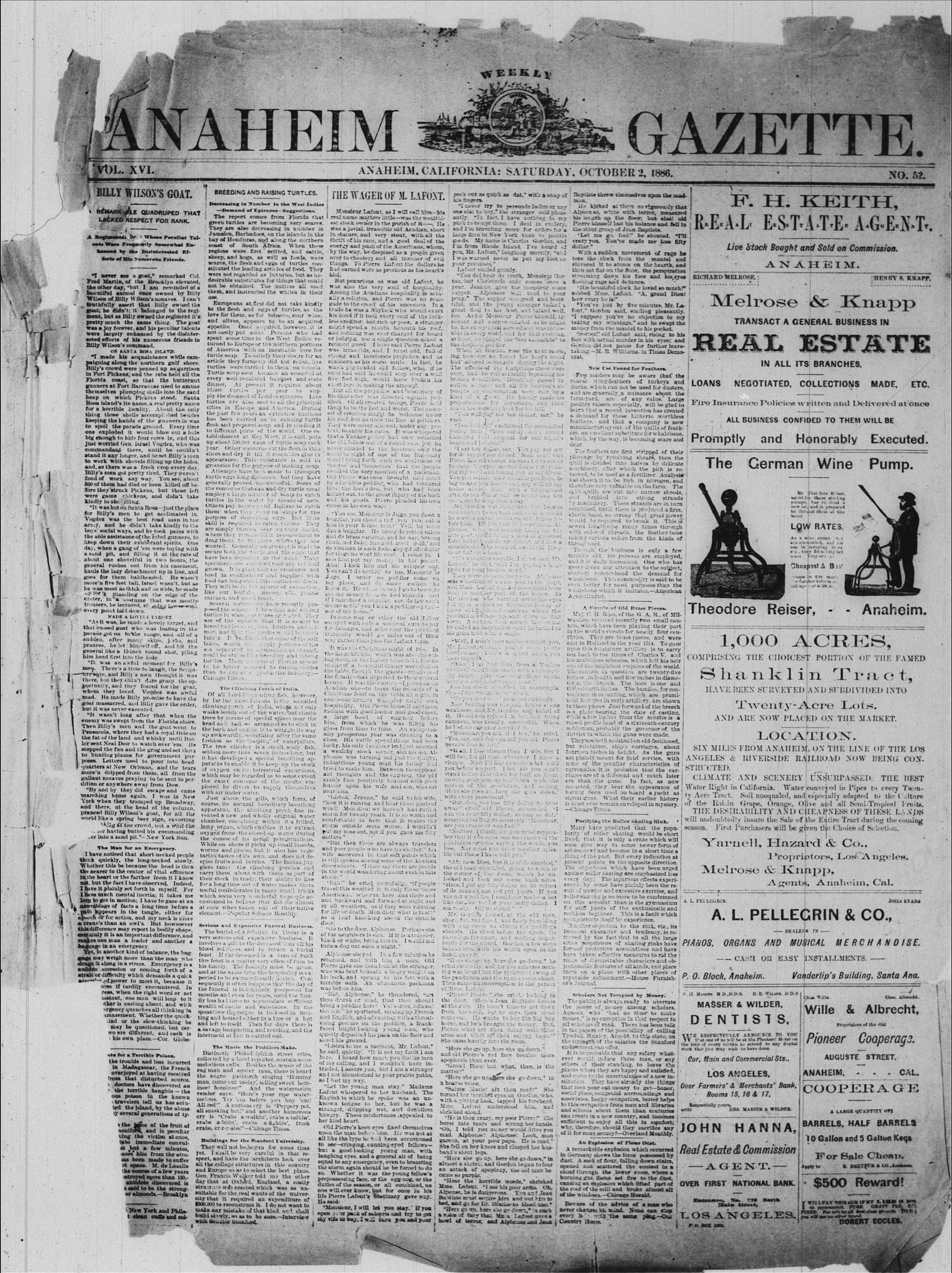
Searchable text
BILLY WILSON'S GOAT.
REMARKABLE QUADRUPED THAT LACKED RESPECT FOR RANK.
A Regimental Dr. Whose Peculiar Talents Were Frequently Somewhat Enhanced by the Disinterested Efforts of His Numerous Friends.
"I never see a goat," remarked Col. Fred Martin, of the Brooklyn elevated, the other day, "but I am reminded of a beautiful animal once owned by Billy Wilson of Billy Wilson's zouaves. I can't truthfully assert that Billy owned the goat; he didn't; it belonged to the regiment, but as Billy owned the regiment it's pretty much the same thing. The goat was a joy forever, and his peculiar talents were largely enhanced by the disinterested efforts of his numerous friends in Billy Wilson's command.
ON SANTA ROSA ISLAND.
"I made his acquaintance while campaigning along the northern gulf shore. Billy's crowd were penned up as garrison in Fort Pickens; and the rebs held all the Florida coast, so that the butternut gunners at Fort Barrancas used to amuse themselves plumping shells into the sand heap on which Pickens stood. Santa Rosa island's its name, a real pretty name for a horrible locality. About the only thing those shells accomplished besides keeping the hands of the gunners in was to spoil the parade ground. Every time one exploded it would blow out a hole big enough to hide four cows in, and this just worried Gen. Israel Vogdez, who was commandant there, until he couldn't stand it any longer, and he set Billy's men to work with shovels filling up the holes, and, as there was a fresh crop every day, Billy's men got pretty tired. They weren't
BREEDING AND RAISING TURTLES.
Decreasing in Number in the West Indies — Demand of Epicures—Suggestions.
The report comes from Florida that green turtles are becoming very scarce. They are also decreasing in number in Jamaica, Barbados, on the islands in the bay of Honduras, and along the northern coast of South Africa. When these regions were first settled, and cattle, sheep, and hogs, as well as fowls, were scarce, the flesh and eggs of turtles constituted the leading articles of food. They were not regarded as luxuries, but as undesirable substitutes for things that could not be obtained. The natives all used them, and instructed the whites in their use.
Europeans at first did not take kindly to the flesh and eggs of turtles, as the love for them, as for tobacco, sour wine, and olives, appears to be an acquired appetite. Once acquired, however, it is not easily put aside. Persons who had spent some time in the West Indies returned to Europe or the northern portions of America with an insatiable love for turtle soup. To satisfy their desire for an article they formerly did not relish, live turtles were carried to them on vessels. Turtle soup soon became an essential at every well-regulated banquet and state dinner. At present it requires about 16,000 turtles per year to supply the demand of London epicures. Live turtles are also sent to all the principal cities in Europe and America. During the past few years an extensive business has been carried on in canning turtle flesh and prepared soup and in sending it to different parts of the world. One establishment at Key West, it is said, puts up about 500,000 cans of turtle soap each year. Other concerns cut the flesh in thin slices and dry it till it resembles glue in appearance. This substance is sold in groceries for the purpose of making soup.
Attempts have been made to transport
In Fort Pickens; and the rebs held all the Florida coast, so that the butternut gunners at Fort Barrancas used to amuse themselves plumping shells into the sand heap on which Pickens stood. Santa Rosa island's its name, a real pretty name for a horrible locality. About the only thing those shells accomplished besides keeping the hands of the gunners in was to spoil the parade ground. Every time one exploded it would blow out a hole big enough to hide four cows in, and this just worried Gen. Israel Vogdez, who was commandant there, until he couldn't stand it any longer, and he set Billy's men to work with shovels filling up the holes, and, as there was a fresh crop every day, Billy's men got pretty tired. They weren't fond of work any way. You see, about 500 of them had died or been killed off before they struck Pickens, but those left were game chickens, and didn't take kindly to shepling.
"It was hot on Santa Rosa—just the place for Billy's men to get acclimated in. Vogdez was the best read man in the army, and he didn't take kindly to the boys' social ways, and he took pains with the able assistance of the rebel gunners, to keep down their exuberant spirits. One day, when a gang of 'em were toying with a sand pit, and filling it at the rate of about one shovelful in two hours, the general rushes out from his casement, hauls the lazy detachment up in line, and goes for them baldheaded. He wasn't more'n five feet tall, Israel wasn't, but as he was most as thick and as wide, he made up for it. Standing on the edge of the crater, in a costume that was mostly trousers, he lectured, stopping lower with every point laid down.
MADE A LOVELY TARGET.
"As it was, he made a lovely target, and that caused goat who was looting in the parade got on to the range, and all of a sudden, after many skips, jerks, and prances, he let himself off, and hit the general like a 15-inch round shot, piling him head first into the hole.
"It was an awful moment for Billy's men. There's a time to laugh, the Scripture says, and Billy's men thought it was there, but they didn't dare grasp the opportunity, and they feared for the goat, whom they loved. Vogdez was awful mad. He made Billy promise to have the goat massacred, and Billy gave the order, but it was never executed.
"It wasn't long after that when the enemy was swept from the Florida shore. Then Billy's men and the goat went to Peninsula, where they had a royal time on the fat of the land and whisky until Butler sent Neal Dow to watch over 'em. He stopped the fun and the grog and set them to hunting planos for government purposes. Letters used to pour into headquarters at New Orleans, and the tears more'n dripped from them, all from the gallant zouaves praying to be sent to perdition or anywhere away from Dow.
"By and by they did escape and came marching home again. I was in New York when they tramped up Broadway, and there, at the head of the column, pranced Billy Wilson's goat, for all the world like a spring beer sign, cavorting at the crowd, not a whirl of having butted his commander into a sand pit." — New York Sun.
The Man for an Emergency.
I have noticed that short-necked people think quickly, the long-necked slowly. Whether this be because the head is then the nearer to the center of vital influence in the heart or the farther from it I know not, but the fact I have observed. Indeed, I have it plainly set forth in myself. For I have much mental inertia; it takes me on shore it picks up small insects, worms and grubs; but it also has vegetarian tastes of its own, and does not despise fruits and berries. The Indian jugglers tame the climbing perches and carry them about with them as part of their stock in trade; their ability to live for a long time out of water makes them useful confederates in many small tricks which seem very wonderful to people accustomed to every well-regulated banquet and state dinner. At present it requires about 15,000 turtles per year to supply the demand of London epicures. Live turtles are also sent to all the principal cities in Europe and America. During the past few years an extensive business has been carried on in canning turtle flesh and prepared soup and in sending it to different parts of the world. One establishment at Key West, it said, puts up about 500,000 cans of turtle soup each year. Other concerns cut the flesh in thin slices and dry it till it resembles glue in appearance. This substance is sold in groceries for the purpose of making soup.
Attempts have been made to transport turtle eggs long distances, but they have generally proved insuccessful. Some of the concerns that can and dry turtle meat employ a large number of boats to catch turtles in the water by means of nets. Others pay negroes and Indians to catch them when they come on shore for the purpose of depositing eggs. But little skill is required to eat turtles. They are simply thrown over on their backs where they remain till it is convenient to drag them to the place where they are wanted. Generally an attempt is made to secure both the turtle and the eggs that have been deposited in the sea. Many specimens are captured that are not half grown. It is playful that no creatures not breed in confinement and supplied with food can long stand this continuous drain. They will be in the course of extinction, like our bulls, moose, elk, prairie chicken, and boars trout.
Several naturalists have recently proposed the scheme of breeding and raising turtles in waves over certain depths. They are of the opinion that it is as easy to breed turtles in captivity as that possible would larger. It is likely that some of the salt lakes, which are simply portions of the sea separated by accumulations of sand could be utilized for breeding and raising turtles. Many portions of Florida appear to be better adapted to raising turtles than to any other productive industry—Chicago Times.
The Climbing Perch of India.
Of all land frequenting fish, however, by far the most famous is the so-called climbing porch of India, which not only walks bodily out of the water but climbs trees by means of special spines near the head and tail, so arranged as to stick in the bark and enable it to wriggle its way up awkwardly, something after the same fashion as the "sooping" of caterpillars. The tree climber is a small, sealy fish, seldom more than seven inches long, but it has developed a special breathing apparatus to enable it to keep up the stock of oxygen on its terrestrial excursions, which may be regarded as to some extent the exact converse of the means employed by divers to supply themselves with air under water.
Just above the gills, which form, of course its natural hereditary breathing apparatus, the climbing porch has invented a new and wholly original water chamber, containing within it a frilled, bony organ which enables it to extract oxygen from the stored-up water during the course of its aerial perigrinations.
While on shore it picks up small insects, worms and grubs; but it also has vegetarian tastes of its own, and does not despise fruits and berries. The Indian jugglers tame the climbing perches and carry them about with them as part of their stock in trade; their ability to live for a long time out of water makes them useful confederates in many small tricks which seem very wonderful to people accustomed to every well-regulated banquet and state dinner. At present it requires about 15,000 turtles per year to supply the demand of London epicures. Live turtles are also sent to all the principal cities in Europe and America. During the past few years an extensive business has been carried on in canning turtle flesh and prepared soup and in sending it to different parts of the world. One establishment at Key West, it said, puts up about 500,000 cans of turtle soup each year. Other concerns cut the flesh in thin slices and dry it till it resembles glue in appearance. This substance is sold in groceries for the purpose of making soup.
Attempts have been made to transport turtle eggs long distances, but they have generally proved insuccessful. Some of the concerns that can and dry turtle meat employ a large number of boats to catch turtles in the water by means of nets. Others pay negroes and Indians to catch them when they come on shore for the purpose of depositing eggs. But little skill is required to eat turtles. They are simply thrown over on their backs where they remain till it is convenient to drag them to the place where they are wanted. Generally an attempt is made to secure both the turtle and the eggs that have been deposited in the sea. Many specimens are captured that are not half grown. It is playful that no creatures not breed in confederation and supplied with food can long stand this continuous drain. They will be in the course of extinction, like our bulls, moose, elk, prairie chicken, and boars trout.
Several naturalists have recently proposed the scheme of breeding and raising turtles in waves over certain depths. They are of the opinion that it is as easy to breed turtles in captivity as that possible would larger. It is likely that some of the salt lakes are simply portions of the sea separated by accumulations of sand could be utilized for breeding and raising turtles. Many portions of Florida appear to be better adapted to raising turtles than to any other productive industry—Chicago Times.
The Man for an Emergency.
I have noticed that short-necked people think quickly, the long-necked slowly. Whether this be because the head is then the nearer to the center of vital influence in the heart or the farther from it I know not, but the fact I have observed. Indeed, I have it plainly set forth in myself. For I have much mental inertia; it takes me on shore it picks up small insects, worms and grubs; but it also has vegetarian tastes of its own, and does not despise fruits and berries. The Indian jugglers tame the climbing perches and carry them about with them as part of their stock in trade; their ability to live for a long time out of water makes them useful confederates in many small tricks which seem very wonderful to people accustomed to every well-regulated banquet and state dinner. At present it requires about 15,000 turtles per year to supply the demand of London epicures. Live turtles are also sent to all the principal cities in Europe and America. During the past few years an extensive business has been carried on in canning turtle flesh and prepared soup and in sending it to different parts of the world. One establishment at Key West, it said, puts up about 500,000 cans of turtle soup each year. Other concerns cut the flesh in thin slices and dry it till it resembles glue in appearance. This substance is sold in groceries for the purpose of making soup.
Attempts have been made to transport turtle eggs long distances, but they have generally proved insuccessful. Some of the concerns that can and dry turtle meat employ a large number of boats to catch turtles in the water by means of nets. Others pay negroes and Indians to catch them when they come on shore for the purpose of depositing eggs. But little skill is required to eat turtles. They are simply thrown over on their backs where they remain till it is convenient to drag them to the place where they are wanted. Generally an attempt is made to secure both the turtle and the eggs that have been deposited in the sea. Many specimens are captured that are not half grown. It is playful that no creatures not breed in confederation and supplied with food can long stand this continuous drain. They will be in the course of extinction, like our bulls, moose, elk, prairie chicken, and boars trout.
Several naturalists have recently proposed the scheme of breeding and raising turtles in waves over certain depths. They are of the opinion that it is as easy to breed turtles in captivity as that possible would larger. It is likely that some of the salt lakes are simply portions of the sea separated by accumulations of sand could be utilized for breeding and raising turtles. Many portions of Florida appear to be better adapted to raising turtles than to any other productive industry—Chicago Times.
The Man for an Emergency.
I have noticed that short-necked people think quickly, the long-necked slowly. Whether this be because the head is then the nearer to the center of vital influence in the heart or the farther from it I know not, but the fact I have observed. Indeed, I have它 plainly set forth in myself. For I have much mental inertia; it takes me on shore it picks up small insects, worms and grubs; but it also has vegetarian tastes of its own, and does not despise fruits and berries. The Indian jugglers tame the climbing perches and carry them about with them as part of their stock in trade; their ability to live for a long time out of water makes them useful confederates in many small tricks which seem very wonderful to people accustomed to every well-regulated banquet and state dinner. At present it requires about 15,000 turtles per year to supply the demand of London epicures. Live turtles are also sent to all the principal cities in Europe and America. During the past few years an extensive business has been carried on in canning turtle flesh and prepared soup和in sending it to different parts ofthe world. One establishment at Key West,it said,puts up about 500,000 cans of turtle soup each year.
Other concerns cut both these heads where they remain till it is convenient to drag them to therelike place where they are wanted. Generally an attempt is made to secure both these heads where they remain till it is convenient to drag them to therelike place where they are wanted.
Other concerns cut both these heads where they remain till it is convenient to drag them to therelike place where they are wanted.
Other concerns cut both these heads where they remain till it is convenient to drag them to therelike place where they are wanted.
Other concerns cut both these heads where they remain till it is convenient to drag them to therelike place where they are wanted.
Other concerns cut both these heads where they remain till it is convenient to drag them to therelike place where they are wanted.
Other concerns cut both these heads where they remain till it is convenient to drag them to therelike place where they are wanted.
Other concerns cut both these heads where they remain till it is convenientto drag them therelike place where they are wanted.
Other concerns cut both these heads where they remain till it is convenientto drag them therelike place where they are wanted.
Other concerns cut both these heads where they remain till it is convenientto drag them therelike place where they are wanted.
Other concerns cut both these heads where they remain till it is convenientto drag them therelike place where they are wanted.
Other concerns cut both these heads where they remain till it is convenientto drag them therelike place where they are wanted.
Other concerns cut both these heads where they remain till it is convenientto drag them therelike place where they are wanted.
Other concerns cut both these heads where they remain till it is convenientto drag them therelike place where they are wanted.
Other concerns cut both these heads where they remain till it is convenientto drag them therelike place where they are wanted.
Other concerns cut both these heads where they remain till it is convenientto drag them therelike place where they are wanted.
Other concerns cut both these heads where they remain till it is convenientto drag them therelike place where they are wanted.
Other concerns cut both these heads where they remain till it is convenientto drag them therelike place where they are wanted.
Other concerns cut both these heads where they remain till it is convenientto drag them therelike place where they are wanted.
Other concerns cut both these heads where they remain till it is convenientto drag them therelike place where they are wanted.
Other concerns cut both these heads where they remain till it is convenientto drag them therelike place where they are wanted.
Other concerns cut both these heads where they remain till it is convenientto drag them therelike place where they are wanted.
Other concerns cut both these heads where they remain till it is convenientto drag them therelike place where they are wanted.
Other concerns cut both these heads where they remain till it is convenientto drag them therelike placewhere they are wanted.
Other concerns cut both these heads where they remain till it is convenientto drag them therelike placewhere they are wanted.
Other concerns cut both these heads where they remain till it is convenientto drag them therelike placewhere they are wanted.
Other concerns cut both these heads where they remain till it is convenientto drag them therelike placewhere they are wanted.
Other concerns cut both these heads where they remain till it is convenientto drag them therelike placewhere they are wanted.
Other concerns cut both these heads where they remain till it is convenientto drag them therelike placewhere they are wanted.
Other concerns cut both these heads where they remain till it is convenientto drag them therelike placewhere they are wanted.
Other concerns cut both these heads where they remain till it is convenientto drag them therelike placewhere they are wanted.
Other concerns cut both these heads where they remain till it is convenientto drag them therelike placewhere they are wanted.
Other concerns cut both these heads wheretheyremaintilitisconvenienttodragthemtherrelikeparticularshomewithalargehimselfharmwithalargehimselfharmwithalargehimselfharmwithalargehimselfharmwithalargehimselfharmwithalargehimselfharmwithalargehimselfharmwithalargehimselfharmwithalargehimselfharmwithalargehimselfharmwithalargehimselfharmwithalargehimselfharmwithalargehimselfharmwithalargehimselfharmwithalargehimselfharmwithalargehimselfharmwithalargehimselfharmwithalargehimselfharmwithalargehimselfharmwithalargehimselfharmwithalargehimselfharmwithalargehimselfharmwithalargehimselfharmwithalargehimselfharmwithalargehimselfharmwithalargehimselfharmwithalargehimselfharmwithalargehimselfharmwithalargehimselfharmwithalargehimselfharmwithaLargehimselfharmwithaLargehimselfharmwithaLargehimselfharmwithaLargehemselfharmwithaLargehemselfharmwithaLargehemselfharmwithaLargehemselfharmwithaLargehemselfharmwithaLargehemselfharmwithaLargehemselfharmwithaLargehemselfharmwithaLargehemselfharmwithaLargehemselfharmwithaLargehemselfharmwithaLargehemselfharmwithaLargehemselfharmwithaLargehemselfharmwithaLargehemselfharmwithaLargehemselfharmwithaLargehemselfharmwithaLargehemselfharmwithaLargehemselfharmwithaLargehemselfharmwithaLargehemselfharmwithaLargehemselfharmwithaLargehemselfharmwithaLargehemselfharmwithaLargehemselfharmwithaLargehemselfharmWithA Large hem self hARM WITH A Large hem self hARM WITH A Large hem self hARM WITH A Large hem self hARM WITH A Large hem self hARM WITH A Large hem self hARM WITH A Large hem self hARM WITH A Large hem self hARM WITH A Large hem self hARM WITH A Large hem self hARM WITH A Large hem self hARM WITH A Large hem self hARM WITH A Large hem self hARM WITH A Large hem self hARM WITH A Large hem self hARM WITH A Large hem self hARM WITH A Large hem self hARM WITH A Large hem self hARM WITH A Large hem self hARM WITH A Large hem self hARM WITH A Large hem self hARM WITH A Large hem self hARM WITH A Large hem self hARM WITH A Large hem self hARM WITH A Large hem self hARM WITH A Large hem self hARM WITH A Large hem self hARM WITH A Large hem self hARM WITH A Large hem self hARM WITH A Large hem self hARM WITH A Large hem self hARM WITH A large hem self hARM WITH A Large hem self hARM WITH A Large hem self hARM WITH A Large hem self hARM WITH A Large hem self hARM WITH A Large hem self hARM WITH A Large hem self hARM WITH A Large hem self hARM WITH A Large hem self hARM WITH A Large hem self hARM WITH A Large hem self hARM WITH A Large hem self hARM WITH A Large hem self hARM WITH A Large hem self hARM WITH A large hem self hARM WITH A Large hem self hARM WITH A Large hem self hARM WITH A Large hem self hARM WITH A Large hem self hARM WITH A Large hem self hARM WITH A大型hemselfharmWithA大型hemselfharmWithA大型hemselfharmWithA大型hemselfharmWithA大型hemselfharmWithA大型hemselfharmWithA大型hemselfharmWithA大型hemselfharmWithA大型hemselfharmWithA大型hemselfharmWithA大型hemselfharmWithA大型hemselfharmWithA大型hemselfharmWithA大型hemselfharmWithA大型hemselfharn WithA大型hemselfharn WithA大型hemselfharn WithA大型hemselfharn WithA大型hemselfharn WithA大型hemselfharn WithA大型hemselfharn WithA大型hemselfharn WithA大型hemselfharn WithA大型hemselfharn WithA大型hemselfharn WithA大型hemselfharn WithA大型hemselfharn WithA大型hemSelfHARN WITH A大型hm Self HARN WITH A大型hm Self HARN WITH A大型hm Self HARN WITH A大型hm Self HARN WITH A大型hm Self HARN WITH A大型hm Self HARN WITH A大型hm Self HARN WITH A大型hm Self HARN WITH A大型hm Self HARN WITH A大型hm Self HARN WITH A大型hm Self HARN WITH A大型hm Self HARN WITH An的大型hm Self HARN WITH An的大型hm Self HARN WITH An的大型hm Self HARN WITH An的大型hm Self HARN WITH An的大型hm Self HARN WITH An的大型hm Self HARN WITH An的大型hm Self HARN WITH An的大型hm Self HARN WITHSANLHM SELFHARN WITHSANLHM SELFHARN WITHSANLHM SELFHARN WITHSANLHM SELFHARN WITHSANLHM SELFHARN WITHSANLHM SELFHARN WITHSANLHM SELFHARN WITHSANLHM SELFHARK WITHSANLHM SELFHARK WITHSANLHM SELFHARK WITHSANLHM SELFHARK WITHSANLHM SELFHARK WITHSANLHM SELFHARK WITHSANLHM SELFHARK WITHSANLHM SELFHARK WITHSANLHM SELFHARK WITHSANLHM SELFHARK WITHSANLHM SELFHARK WITHSANLHM SELFHARK WITHSANLHM SELFHARK WITHSANLHM SELFHARK WITHSANLHM SELFHARK WITHSANLHM SELFHARK WITHSANLHM SELFHARK WITHSANLHM SELFHARK WITHSANLHM SELFHARK WITHSANLHM SELFHARK WITHSANLHM SELFHARK WITHSANLHM SELFHARK WITHSANLHM SELFHARK WITHSANLHM SELFHARK WITHSANLHM SELFHARK WITHSANLHM SELFHARK WITHSANLHM SELFHARK WITHSANLHM SELFHARK WITHSANLHM SELFHARK WITHSANLHM SELFHARK WITHSANLHM SELFHARK WITHSANLHM SELFHARK WITHSANLHM SELFHARK WITHSANLHM SELFHARK WITHSANLHM SELFHARK WITHSANLHM SELFHARK WITHSANLHM SELFHARK WITHSANLHM SELFHARK WITHSANLHM SELFHARK WITHSANLHM SELFHARK WITHSANLHM SELFHARK WITHSANLHM SELFHARK WITHSANLHM SELFHARK WITHSANLHM SELFHARK WITHSANLHM SELFHARK WITHSANLHM SELFHARK WITHSANLHM SELFHARK WITHSANLHM SELFHARK WITHSANSLANLM SELFHARK MITSANSLANLM SELFHARK MITSANSLANLM SELFHARK MITSANSLANLM SELFHARK MITSANSLANLM SELFHARK MITSANSLANLM SELFHARK MITSANSLANLM SELFHARK MITSANSLANLM SELFHARK MITSANSLANLM SELFHARK MITSANSLANLM SELFHARK MITSANSLANLM MITSANSLANLM MITSANSLANLM MITSANSLANLM MITSANSLANLM MITSANSLANLM MITSANSLANLM MITSANSLANLM MITSANSLANLM MITSANSLANLM MITSANSLANLM MITSANSLANLM MITSANSLANLM MITSANSLANLM MITSANSLANLM MITSANSLANLM MITSANSLANLM MITSANSLANLM MITSANSLANLM MITSANSLANLM MITSANSLANLMMITSANSLANLMMITSANSLANLMMITSANSLANLMMITSANSLANLMMITSANSLANLMMITSANSLANLMMITSANSLANLMMITSANSLANLMMITSANSLANLMMITSANSLANLMMITSANSLANLMMITSANSLANLMMITSANSLANLMMITSANSLANLMMITS SanslanlmMITS SanslanlmMITS SanslanlmMITS SanslanlmMITS SanslanlmMITS SanslanlmMITS SanslanlmMITS SanslanlmMITS SanslanlmMITS SanslanlmMITS SanslanlmMITS SanslanlmMITS SanslanlmMITS SanslanlmMITS SanslanlmMITS SanslanlmMITS SanslanlmMITS SanslanlmMITS SanslanlmMITMTS SanslanlmMITMTS SanslanlmMITMTS SanslanlmMITMTS SanslanlmMITMTS SanslanlmMITMTS SanslanlmMITMTS SanslanlmMITMTS SanslanlmMITMTS SanslanlmMITMTS SanslanlmMITMTS SanslanlmMITMTS SanslanlmMIT
The Man for an Emergency.
I have noticed that short-necked people think quickly, the long-necked slowly. Whether this be because the head is then the nearer to the center of vital effluence in the heart or the farther from it I know not, but the fact I have observed. Indeed, I have it plainly forth in myself. For I have much mental inertia; it takes me long to get in motion; I have to gaze at an assemblage of facts a long time before a path appears in the tangle, either for speech or for action, and my neck is more a crane's than an owl's. But howsoever this difference may report in bodily shape, certainly it is an important difference, and makes one man a leader and another a baggage in an emergency.
Yet, in another kind of balance, the baggage may weigh more than the man who drags it along in a stress. Emergency is a sudden accession or coming forth of a strait or difficulty which demands a quick access of power to meet it, because it once if tardily encountered. In press, when the right word or act instant, one man will leap to it rather is casting about; and with urgency quenches all thinking in amazement. Whether the quick-land or the slow-thinking be may be questioned; but certo are different, and each is his own place.—Cor. Globe-eote for a Terrible Poison.
the trouble and loss incurred in Madagascar, the French overjoyed at having received from that disturbed source doctors have discovered an terrible tanghin—theous poison in the known travelers tell us has actuated the island, by the abuse by several generations of tyrors the price of the fruit of nonfierment, and is peculiar king the victim at once, into immediate convulst but a few minutes, causes him from the atrovas been made to suffer art space. M. de Lasalle the course of a few years destroyed more than 150, antidote discovered is said to be the stronger almonds.—Brooklyn
New York and Philadelphia clean cuffs and collar
Just above the girls, which form, of course, its natural hereditary breathing apparatus, the climbing perch has invented a new and wholly original water chamber, containing within it a frilled, bony organ, which enables it to extract oxygen from the stored-up water during the course of its aerial peregrinations. While on shore it picks up small insects, worms and grubs; but it also has vegetarian tastes of its own, and does not despise fruits and berries. The Indian jinglers fame the climbing perches and carry them about with them as part of their stock in trade; their ability to live for a long time out of water makes them useful confederates in many small tricks which seem very wonderful to people accustomed to believe that fish die almost at once when taken out of their native element.—Popular Science Monthly.
Serious and Expensive Funeral Business.
The burial of a relative in Timur is a very serious and expensive business. It involves a gift to the deceased from all his blood relatives, and in return a burial feast. If the deceased is a man of rank this feast is a matter very often of ruin to his family. The festivity must be given, and at the same time the hospitality is expected to be extraordinarily lavish. Consequently it often happens that the day of the funeral is definitely postponed for months and even for years, until the family has had time to accumulate sufficient wealth of cattle and substance. In the meantime the corpse is included in mating and housed either in a tree or a hut and left to itself. Then for days there is a savage banquet and reveling, and the interment at last is carried out.
The Music the Peddlers Make.
Distinctly Philadelphia street cries, collected by a local reporter, contain some melodious calls. Besides the music of the rag man and oyster man, there is heard the negro patriarch singing "Hominy man, come out to-day," selling sweet hominee! hominee!" And the watermelon vender says: "Here's your ripe watermelons. Try 'em before you buy 'em! All red!" A curious cry is "Peppery pot, all smoking hot!" and another humorous cry is "Crabs a-walkin', crabs a-talkin', crabs a-bitin', crabs a-fightin', fresh crabs, cr-r-r-abs!"—Chicago Times.
Buildings for the Stanford University.
They will not be begun for some time yet. I shall be very careful in that respect, and have the architects look over all the college structures in this country and Europe so as to select the best plans. Gen. Francis Walker told me the other day that at Oxford, England, a costly structure was erected which was so unsuitable for the real wants of the university that it required an expenditure of $300,000 to reconstruct it. I do want to make any mistake of that kind, and shall build slowly, so as to be sure. Interview with Senator Stanford.
"Listen to me said, quiet here. I hear of my calling traded, I assué and not accuse so I lost my wife." "Let the ye Lafont whisper English in which known tongues stranger, drink hungry. The her kind heart."
Old Pierre's upon the man all like the type to see—cringing but a good-laughing eyes equal to any eagle storm again so. Whether he prepossessing duties of the slave one will ever live Pierre Laud He said:
"Monsieur, I open your pass my wife to buy..."
WEEKLY
EIM-G
ANAHEIM, CALIFORNIA: SATURDAY, OCTOBER 2, 1886.
ING TURTLES.
In the West Indies—Suggestions.
From Florida that king very scarre,
in number in the islands in the king the northern
When these need, and cattle,
as fowls, were of turtles cones of food. They curries, but as unchants that could natives all used whites in their not take kindly turtles, as the cocco, sour wine, be an acquired, however, it is sons who had West Indies northern portions valuable love for their desire for an not relish, live been on vessels, an essential at quet and state requires about fear to supreciures. Live till the principal America. During intensive business canning turtle and in sending it world. One esse it is said, puts turtle soup each the flesh in thin brombles glue in which is sold in making soup. He to transport
THE WAGER OF M. LAFONT.
Monsieur Lafont, as I will call him—his real name matters little—was the wealthiest stock owner in the parish of H——He was a jovial, irrascible old Acadian, short in stature, and very stout, with all the thrift of his race, and a good deal of the energy and push of the Americans, whom, by the way, he despised as a people given over to cheatery and all manner of evil things. To Pierre Lafont the dollars he had earned were as precious as his heart's kilol.
But penurious as was old Lafont, he was also the very soul of hospitality. Among the Acadians hospitality is actually a religion, and Pierre was no renegade to the creed of his ancestors. In a trade he was a Shylock who would exact his bond if it took every cent of the luckless creditor, but rich or poor, a stranger might spend a month beneath his roof, and nothing was ever charged for board or lodging, nor a single question asked a reticent guest. I have said Pierre Lafont was irrascible, and I must add, full of strong and inveterate prejudice, and as stubborn as his worst mule. In fact, he was a pig headed old fellow, who, if he once had said he could step over a wall five feet high, would have broken his short legs in making the attempt.
But all the prejudice and obstinacy of his character was directed against peddlers. Of all created beings, Pierre held thereto be the last and worst. The meanest of creation might be welcome under his roof, but he drew the line at peddlers. They were never allowed, under any pretext, to enter his gates. It was whispered that a Yankee poller had once swindled the old fellow out of a round sun; but he never minded to the incident; only the move or sight of one of the fragrant would being forth such an avalanche of "sacres" and "tonneries" that the people avoided the very mention of a packman,
pack out as quick as dat," with a snap of his fingers.
"I never try to persuade ladies or any one else to buy," the stranger said pleasantly. "In fact, I have nothing in my pack to tempt them. I deal in entlery, and I'm traveling more for orders for a large firm in New York than to paddle goods. My name is Charles Gordon, and I'm from Rhode Island. I've heard of you, Mr. Lafont," laughing merrily, "and I was warned never to put my foot on your premises."
Lafont smiled grimly.
"You did hear do truth, Monsieur Gordon, but Christmas only comes once a year. Jeanne, give the monsieur some supper. Alphonse will tend to your pony." The supper was good and bountiful, and the young stranger talked a great deal to his host, and talked well too. As for Monsieur Pierre himself, ignorant and narrow-minded as he might be, his exceptional suredwance was noticeable in every word, and for that evening, at least he played the "bon camarade" to the dispensed peddler.
When Mr. Gordon rose the next morning, however, he found his host's mood altered strongly during the night. The effects of the Christmas cheer were over, and he will evidently repent his broken resolution. Breakfast passed in sullen silence and all Mr Gordon's attempts at conversation were met by a kind of a growl. He hardly made his preparations for departure, and then asked his snowing host for his bill.
"I you will pay me ten dollar, sir," he said.
"Ten dollars!" exclaimed the astonished young man. "You surely don't intend charging that amount for one night's board and lodging."
"I say ten dollar, sir," You pay too not for de supplier nor de bed." Not none! Old Pierre Lafont charged no man to eat or to sleep. Yet pay me ten dollar for brooking my voice and taking you in my house.
Baptiste threw themselves upon the man.
He kleeked at them so vigorously Alphos so white with terrot, meant his length on the floor; but alas Pierre himself lost his balance and fell the stout grasp of Jean Baptiste.
"Let me go, fool!" he shouted, crazy you. You've made me lose your dollar."
With a sudden movement of rage tote the clock from the mantel shivered it to atoms on the hearth then sat flat on the floor, the perspiring streaming down his face and his flashing rage and defiance.
"His beautiful clock he loved so much sobbed Mme. Lafont." "A, grand I how crazy he is."
"You've lost by five minutes, Mr font." Gordon said, smiling pleasant.
"I suppose you've no objection to taking my winnings," and he swept money from the mantel to his pocket.
"Sortez!" old Lafont said, rising to feet with actual murder in his eyes; Gordon did not pause for further leaking—M. B. Williams; in Times Docrat.
New Use Found for Feathers.
Few readers may be aware that coarse wing-feathers of turkeys ducks, which cannot be used for dust and are generally a nuisance about farm-yard, are of any value. Lepoultry raisers especially will be glamorous learn that a recent invention has created a demand for these hitherto worthless feathers, and that a company is manufacturing out of the quills of feathers; an excellent substitute for whalebob which, by the way, is becoming scarier.
The feathers are first stripped of their plumage by revolving shears; then quill is divided into halves by delicately machined; after which the pith is moved to be used as a fertilizer.
recently provided and raited by the
Lafont farm.
It was the Christmas night of 18-19. In the large kitchen, which was also the eating room, of the Lafont house, the remodel of a beautiful dinner was still on the table, though the guests—rendezvous of the family—had departed to their several homes. It was the custom—I preach in Anadian one—to leave the remains of a Christmas feast on the table all night, in case some hungry way later might seek hospitality. Old Pierre himself sat there, radiant with good humor and good cheer, a large bowl of eggnog before him, from which he was filling his glass from time to time. An exceptionally prosperous year was drawing to a close. His cattle speculations had been lucky, his only daughter had just married a wealthy stock owner, and his son Alphonse was turning out just the trifty, industrious young man his father had tried to make him. Between these pleasures and the eggnog, the old man's face positively beamed with good humor upon his wife and son, who sat near him.
"Lasten, Jeanne," he said to his wife, "how it is raining, and hear those gusts of wind. Mon dient we haven't had garrh a storm for twenty years. It is so warm and comfortable in here that it makes the storm outside seem worse. I wouldn't put my nose out, not if you gave me fifty dollars."
But then there are always travelers and poor people who have no shelter," his wife answered in that soft patois which is still spoken among some of the Acadian descendants. "I dare say there are people in the world wandering about even in this storm."
"Bah!" he cried scornfully. "If people travel this weather it is only these bees Americans, who run here and there and under any pretence to enter his gates. It was whispered that a Yankee poller had once swindled the old fellow out of a round sum, but he never minded to the incident; only the notice or sight of one of the fragrant women would bring forth such an avalanche of sources and tonneries that the people revealed the very mention of a packman. Old Pierre was once brought into court by a black peeler, who had ventured into the lion's den, but who had been kicked out, to the great injury of his back and his goods. Pierre pleaded his own cause in his own way:
"You see, Monsieur le Juge, you shoot a burglar, you shoot a tiger venom you catch a him in your house, hein? Vell, he vorse dan a bugglar. He bring de rotten calico and de brass earrings, and he say, Strong cloth, not fader; line goot, good yolk," and die vimmen is such foods, keyg life dollar for things no wolf life cent. I come in. I sees him put my money in his pocket. Ahal I kick him and his salopir out. You can't do nothing' to me. Monsieur le Juge. I order no poliller come on my place, and de saur cochon his know it. He snail in venil I got to town to get my money from de food vitamina, and if I can shoot a bugglar, sar, de law can't do me nothin' ven I kick a pedlier—a tar-out of my house.
In some way or other the old fellow escaped with only a nominal sum to pay for damages, and after that the pelting fraternity would go miles out of their way rather than pass the Lafont farm.
It was the Christmas night of 18-19. In the large kitchen, which was also the eating room, of the Lafont house, the remodel of a beautiful dinner was still on the table, though the guests—rendezvous of the family—had departed to their several homes. It was the custom—I preach in Anadian one—to leave the remains of a Christmas feast on the table all night, in case some hungry way later might seek hospitality. Old Pierre himself sat there, radiant with good humor and good cheer, a large bowl of eggnog before him, from which he was filling his glass from time to time. An exceptionally prosperous year was drawing to a close. His cattle speculations had been lucky, his only daughter had just married a wealthy stock owner, and his son Alphonse was turning out just the trifty, industrious young man his father had tried to make him. Between these pleasures and the eggnog, the old man's face positively beamed with good humor upon his wife and son, who sat near him.
"Lasten, Jeanne," he said to his wife, "how it is raining, and hear those gusts of wind. Mon dient we haven't had garrh a storm for twenty years. It is so warm and comfortable in here that it makes the storm outside seem worse. I wouldn't put my nose out, not if you gave me fifty dollars."
But then there are always travelers and poor people who have no shelter," his wife answered in that soft patois which is still spoken among some of the Acadian descendants. "I dare say there are people in the world wandering about even in this storm."
"Bah!" he cried scornfully. "If people travel this weather it is only these bees Americans, who run here and there and under any pretence to enter his gates. It was whispered that a Yankee poller had once swindled the old fellow out of a round sum, but he never minded to the incident; only the notice or sight of one of the fragrant women would bring forth such an avalanche of sources and tonneries that the people revealed the very mention of a packman. Old Pierre was once brought into court by a black peeler, who had ventured into tae lion's den, but who had been kicked out, to the great injury of his back and his goods. Pierre pleaded his own cause in his own way:
"You see, Monsieur le Juge, you shoot a burglar, you shoot a tiger venom you catch a him in your house, hein? Vell, he vorse dan a bugglar. He bring de rotten calico and de brass earrings, and he say, Strong cloth, not fader; line goot, good yolk," and die vimmen is such foods, keyg life dollar for things no wolf life cent. I come in. I sees him put my money in his pocket. Ahal I kick him and his salopir out. You can't do nothing' to me. Monsieur le Juge. I order no poliller come on my place, and de saur cochon his know it. He snail in venil I got to town to get my money from de food vitamina, and if I can shoot a bugglar, sar, de law can't do me nothin' ven I kick a pedlier—a tar-out of my house.
In some way or other the old fellow escaped with only a nominal sum to pay for damages, and after that the pelting fraternity would go miles out of their way rather than pass the Lafont farm.
It was the Christmas night of 18-19. In the large kitchen, which was also the eating room, of the Lafont house, the remodel of a beautiful dinner was still on the table, though the guests—rendezvous of the family—had departed to their several homes. It was the custom—I preach in Anadian one—to leave the remains of a Christmas feast on the table all night, in case some hungry way later might seek hospitality. Old Pierre himself sat there, radiant with good humor and good cheer, a large bowl of eggnog before him, from which he was filling his glass from time to time. An exceptionally prosperous year was drawing to a close. His cattle speculations had been lucky, his only daughter had just married a wealthy stock owner, and his son Alphonse was turning out just the trifty, industrious young man his father had tried to make him. Between these pleasures and the eggnog, the old man's face positively beamed with good humor upon his wife and son, who sat near him.
"Lasten, Jeanne," he said to his wife, "how it is raining, and hear those gusts of wind. Mon dient we haven't had garrh a storm for twenty years. It is so warm and comfortable in here that it makes the storm outside seem worse. I wouldn't put my nose out, not if you gave me fifty dollars."
But then there are always travelers and poor people who have no shelter," his wife answered in that soft patois which is still spoken among some of the Acadian descendants. "I dare say there are people in the world wandering about even in this storm."
"Bah!" he cried scornfully. "If people travel this weather it is only these bees Americans, who run here and there and under any pretence to enter his gates. It was whispered that a Yankee poller had once swindled the old fellow out of a round sum, but he never minded to the incident; only the notice or sight of one of the fragrant women would bring forth such an avalanche of sources and tonneries that the people revealed the very mention of a packman. Old Pierre was once brought into court by a black peeler, who had ventured into tae lion's den, but who had been kicked out, to the great injury of his back and its goods. Pierre pleaded his own cause in his own way:
"You see, Monsieur le Juge, you shoot a burglar, you shoot a tiger venom you catch a him in your house, hein? Vell, he vorse丹a bugglar. He bring de rotten calico and de brass earrings,and he say,强ough cloth,不fader;line goot,goold,'and die vimmen is such foods,gkeyg life dollar for things no wolf life cent.I come in. I sees him put my money in his pocket.Ahal I kick him and his salopir out.You can't do nothing' to me.Monsieur le Juge.I order no poliller come on my place,and de saur cochon his know it.Amberlon was turning away his eyes for up on the mantel-one of those old fragrant concerns wherethe pendulum sings up and down in full view.A shilon lor sar search him what he called an inspiration—and he turned to his grim head with a smile.
"Well.I won't leer mollars atristy you.Mr.Lafont,Russell,and I shall say Mr.Lafont,Russell,and I shall say Mr.Lafont,Russell,and I shall say Mr.Lafont,Russell,and I shall say Mr.Lafont,Russell,and I shall say Mr.Lafont,Russell,and I shall say Mr.Lafont,Russell,and I shall say Mr.Lafont,Russell,and I shall say Mr.Lafont,Russell,and I shall say Mr.Lafont,Russell,and I shall say Mr.Lafont,Russell,and I shall say Mr.Lafont,Russell,and I shall say Mr.Lafont,Russell,and I shall say Mr.Lafont,Russell,and I shall say Mr.Lafont,Russell,and I shall say Mr.Lafont,Russell,and I shall say Mr.Lafont,Russell,and I shall say Mr.Lafont,Russell,and I shall say Mr.Lafont,Russell,and I shall say Mr.Lafont,Russell,and I shall say Mr.Lafont,Russell,and I shall say Mr.Lafont,Russell,and I shall sayMr.Lafont,Russell,andIshallsayMr.Lafont,Russell,andIshallsayMr.Lafont,Russell,andIshallsayMr.Lafont,Russell,andIshallsayMr.Lafont,Russell,andIshallsayMr.Lafont,Russell,andIshallsayMr.Lafont,Russell,andIshallsayMr.Lafont,Russell,andIshallsayMr.Lafont,Russell,andIshallsayMr.Lafont,Russell,andIshallsayMr.Lafont,Russell,andIshallsayMr.Lafont,Russell,andIshallsayMr.Lafont,Russell,andIshallsayMr.Lafont,Russell,andIshallsayMr.Lafont,Russell,andIshallsayMr.Lafont,Russell,andIshallsayMr.Lafont,Russell,andIshallsayMr.Lafont,Russell,andIshallsayMr.Lafont,Russell,andIshallsayMr.Lafont,Russell,andIshallsayMr.Lafont,Russell,andIshallsayMr.Lafont,Russell,andIshallsayMr.Lafont,Russell,andIshallsayMr.Lafont,Russell,andIshallsayMr.Lafont,Russell,andIshallsayMr.Lafont,Russell,andIshallsayMr.Lafont,Russell,andIshallsayMr.Lafont,Russell,andIshallsayMr.Lafont,Russell,andIshallsayMr.Lafont,Russell,andIshallsayMr.Lafont,Russell,andIshallsayMr.Lafont,Russell,andIshallsayMr.Lafont,Russell,andIshallsayMr.Lafont,Russell,andIshallsayMr.Lafont,Russell,andIshallsayMr.Lafont,Russell,andIshallsayMr.Lafont,Russell,andIshallsayMr.Lafont,Russell,andIshallsayMr.Lafont,RussllandIshallsayMr.LaffondRussllandIshallsayMr.laffondRussllandIshallsayMr.laffondRussllandIshallsayMr.laffondRussllandIshallsayMr.laffondRussllandIshallsayMr.laffondRussllandIshallsayMr.laffondRussllandIshallsayMr.laffondRussllandIshallsayMr.laffondRussllandIshallsayMr.laffondRussllandIshallsayMr.laffondRussllandIshallsayMr.laffondRussllandIshallsayMr.laffondRussllandIshallsayMr.laffondRussllandIshallsayMr.laffondRussllandIshallsayMr.laffondRussllandIshallsayMr.laffondRussllandIshallsayMr.laffondRussllandIshallsayMR.laffondRussllandIshallsayMR.laffondRussllandIshallsayMR.laffondR RussllandI shallowlsaysyM.RaffondR RussllandI shallowlsaysyM.RaffondR RussllandI shallowlsaysyM.RaffondR RussllandI shallowlsaysyM.RaffondR RussllandI shallowlsaysyM.RaffondR RussllandI shallowlsaysyM.RaffondR RussllandI shallowlsaysyM.RaffondR RussllandI shallowlsaysyM.RaffondR RussllandI shallowlsaysyM.RaffondR RussllandI shallowlsaysyM.RaffondR RussllandI shallowlsaysyM.RaffondR RussllandI shallowlsaysyM.RaffondR RussllandI shallowlsaysyM.RaffondR RussllandII shallowlsaysyM.RaffondR RussllandII shallowlsaysyM.RaffondR RussllandII shallowlsaysyM.RaffondR RussllandII shallowlsaysyM.RaffondR RussllandII shallowlsaysyM.RaffondR RussllandII shallowlsaysyM.RaffondR RussllandII shallowlsaysyM.RaffondR RussllandII shallowlsaysyM.RaffondR Russia Russia Russia Russia Russia Russia Russia Russia Russia Russia Russia Russia Russia Russia Russia Russia Russia Russia Russia Russia Russia Russia Russia Russia Russia Russia Russia Russia Russia Russia Russia Russia Russia Russia Russia Russia Russia Russia Russia Russia Russia Russia Russia Russia Russia Russia Russia Russia Russia Russia Russia Russia Russia Russia Russia Russia Russia Russia Russia Russia Russia Russia Russia Russia Russia Russia Russia Russia Россия Россия Россия Россия Россия Россия Россия Россия Россия Россия Россия Россия Россия Россия Россия Россия Россия Россия Россия Россия Россия Россия Россия Россия Россия Россия Российской Федерации Российской Федерации Российской Федерации Российской Федерации Российской Федерации Российской Федерации Российской Федерации Российской Федерации Российской Федерации Российской Федерации Российской Федерации Российской Федерации Российской Федерации Российской Федерации Российской Федерации Российской Федерации Российской Федерации Российской Федерации Российской Федерации Российской Федерации Российской Федерации Российской Федерации Российской Федерации Российской Федерации Российской Федерации Российской Федерации Российской Федерации Российской Федерации Российской Федерации Российской Федерации Российской Федерации Российской Федерации Россий Федеральный государственный университет имени М.А.С.Н.К.М.М.М.М.М.М.М.М.М.М.М.М.М.М.М.М.М.М.М.М.М.М.М.М.М.М.М.М.М.М.М.М.М.М.М.М.М.М.М.М.М.П.П.П.П.П.П.П.П.П.П.П.П.П.П.П.П.П.П.П.П.П.П.П.П.П.П.П.П.П.П.П.П.П.П.П.П.П.П.П.П.П.П.П.П.П.П.П.П.П.П.П.П.П.П.П.П.П.П.П.П.П.PППППППППППППППППППППППППППППППППППППППППППППППППППППППППППП ПPPPPPPPPPPPPPPPPPPPPPPPPPPPPPPPPPPPPPPPPPPPPPPPPPPPPPPPPPPPPPPPPPPPPPPPPPPPPPPPPPPPPPPPPPPPPPPPPPPPPPPPPPPPPPPPPPPPPPPPPPPPPPPPPPPPPPPPPPPPPPPPPPPPPPPPPPPPPPPPPPPPPPPPPPPPPPPPPPPPPPPPPPPPPPPPPPPPPPPPPPPPPPPPPPPPPPPPPPPPPPPPPPPPPPPPPPPPPPPPPPPPPPPPPPPPPPPPPPPPPPPPPPPPPPPPPPPPPPPPPPPPPPPPPPPPPPPPPPPPPPPPPPPPPPPPPPPPPPPPFFFFFFFFFFFFFFFFFFFFFFFFFFFFFFFFFFFFFFFFFFFFFFFFFFFFFFFFFFFFFFFFFFFFFFFFFFFFFFFFFFFFFFFFFFFFFFFFFFFFFFFFFFFFFFFFFFFFFFFFFFFFFFFFFFFFFFFFFFFFFFFFFFFFFFFFFFFFFFFFFFFFFFFFFFFFFFFFFFFFFFFFFFFFFFFFFFFFFFFFFFFFFFFFFFFFFFFFFFFFFFFFFFFFFFFFFFFFFFFFFFFFFFFFFFFFFFFFFFFFFFFFFFFFFFFFFFFFFFFFFFFFFFFFFFFFFFFFFFFFFFFFFFFFFFFFFFFFFFFFFFFFFFFFFFFFFFFFFFFFFFFFFFFFFFFFFFFFFFFFFFFFFFFFFFFFFFFFFFFFFFFFFFFFFFFFFFFFFFFFFFFFFFFFFFFFFFFFFFFFFFFFFFFFFFFFFFFFFFFFFFFFFFFFFFFFFFFFFFFFFFFFFFFFFFFFFFFFFFFFFFFFFFFFFFFFFFFFFFFFFFFFFFFFFFFFFFFFFFFFFFFFFFFFFFFFFFFFFFFFFFFFFFFFFFFFFFFFFFFFFFFFFFFFFFFFFFFFFFFFFFFFFFFFFFFFFFFFFFFFFFFFFFFFFFFFFFFFFFFFFFFFFFFFFFFFFFFFFFFFFFFFFFFFFFFFFFFFFFFFFFFFFFFFFFFFFFFFFFFFFFFFFFFFFFFFFFFFFFFFFFFFFFFFFFFFFFFFFFFFFFFFFFFFFFFFFFFffffffffffffffffffffffffffffffffffffffffffffffffffffffffffffffffffffffffffffffffffffffffffffffffffffffffffffffffffffffffffffffffffffffffffffffffffffffffffffffffffffffffffffffffffffffffffffffffffffffffffffffffffffffffffffffffffffffffffffffffffffffffffffffffffffffffffffffffffffffffffffffffffffffffffffffffffffffffffffffffffffffffffffffffffffffffffffffffffffffffffffffffffffffffffffffffffffffffffffffffffffffffffffffffffffffffffffffffffffffffffffffffffffffffffffffffffffffffffffffffffffffffffffffffffffffffffffffffffffffffffffffffffffffffffffffffffffffffffffffffffffffffffffffffffffffffffffffffffffffffffffffffffffffffffffffffffffffffffffffffffffffffffffffffffffffffffffffffffffiffffffffffffffffffffffffffffffffffffffffffffffffffffffffffffffffffffffffffffffffffffffffffffffffffffffffffffffff ff ff ff ff ff ff ff ff ff ff ff ff ff ff ff ff ff ff ff ff ff ff ff ff ff ff ff ff ff ff ff ff ff ff ff ff ff ff ff ff ff ff ff ff ff ff ff ff ff ff ff ff ff ff ff ff ff ff ff ff ff ff ff ff ff ff ff ff ff ff ff ff ff ff ff ff ff ff ft ft ft ft ft ft ft ft ft ft ft ft ft ft ft ft ft ft ft ft ft ft ft ft ft ft ft ft ft ft ft ft ft ft ft ft ft ft ft ft ft ft ft ft ft ft ft ft ft ft ft ft ftftftftftftftftftftftftftftftftftftftftftftftftftftftftftftftftftftftftftftftftftftftftftftftftftftftftftftftftftftftftftftftftftftftftftftftftftftftftftftftftftftFTFTFTFTFTFTFTFTFTFTFTFTFTFTFTFTFTFTFTFTFTFTFTFTFTFTFTFTFTFTFTFTFTFTFTFTFTFTFTFTFTFTFTFTFTFTFTFTFTFTFTFTFTFTFTFTFTFTFTFTFTFTFTFT FT FT FT FT FT FT FT FT FT FT FT FT FT FT FT FT FT FT FT FT FT FT FT FT FT FT FT FT FT FT FT FT FT FT FT FT FT FT FT FT FT FT FT FT FT FT FT FT FT FT FT FT FT FT FT FT FT FT FT FT FT FT FT FT FT FT FT FT FT FT FT FT FC FC FC FC FC FC FC FC FC FC FC FC FC FC FC FC FC FC FC FC FC FC FC FC FC FC FC FC FC FC FC FC FC FC FC FC FC FC FC FC FC FC FC FC FC FC FC FCFC FCFCFCFCFCFCFCFCFCFCFCFCFCFCFCFCFCFCFCFCFCFCFCFCFCFCFCFCFCFCFCFCFCFCFCFCFCFCFCFCFCFCFCFCFCFCFCFCFCFCFCFCFCFCFCFCFCFCFCFCFCFCFCFCFCFCFCFCFCFCFCFCFCFCFCFCFCFCFCFCFCFCFCFCFCFCFCFCFCFCFCFC
"how it is raining, and hear those gusts of wind! Mon dient we haven't had such a storm for twenty years. It is so warm and comfortable in here that it makes the storm outside seem worse. I wouldn't put my nose out, not if you gave me fifty dollars."
"But then there are always travelers and poor people who have no shelter," his wife answered in that soft patrol which is still spoken among some of the Acadian descendants. "I dare say there are people in the world wandering about even in this storm."
"Bah!" he cried scornfully, "If people travel this weather it is only these bodies Americans, who run here and there and backward and forward at night and in all weathers, as if they were running for life or death. Mon dient what is that?" as a loud knocking saok the outside door.
"Go to the door, Alphonse. Perhaps one of the neighbors is sick. If it is a traveller, black or white, bring him in. I would not turn a dog out such a night."
Alphonse obeyed. In a few minutes he returned, and with him a man. Old Pierre gave one keen look at the stranger, who was bent beneath a heavy weight on his back, and sprung to his feet with a terrible oath. An obnoxious packman was before him.
"But, Alphonse," he thundered, "art thou drunk or mad, that thou should bring a peddler here? Val sortez, infame! Get out! He sputtered, mixing up French and English, and advancing with a threatening gesture on the peddler, a frank-faced bright looking young man, who quietly deposited his pack on the floor and stood his ground.
"Listen to me a moment, Mr. Lafont," he said, quietly. "It is not my fault I am here. I heard how much you dislike men of my calling, and I wouldn't have intruded, I assure you, but I am a stranger and not accustomed to your prairie paths, so I lost my way.
"Let the young man stay." Mailame Lafont whispered to her husband. The English in which he spoke was an unknown tongue to her, but he was a stranger, dripping wet, and doubled hungry. These misfortunes appealed to her kind heart.
Old Pierre's keen eyes fixed themselves upon the man before him. He was not at all like the type he had been accustomed to see—cringing, cunning-eyed fellows—but a good-looking young man, with laughing eyes, and a general air of being equal to any emergency, even to breasting the storm again should he be forced to do so. Whether it was the young fellow's prepossessing face, or the egg-nog, or the duties of the season, or all combined, no one will ever know, but for once in his life Pierre Lafont's obstinacy gave way. He said:
"Monsieur, I will let you stay." If you open your pack of salopris and try to get my wife to buy, I will turn you and your
"But, den you has fifty dollar to trow away!" crief old Pierre, assembled. "I can vin your fifty dollar, as easy as dat," snapping his fingers riderlessly "Monseur, are you craise or you fool?"
"Neither, I think; but you must remember that if you miss one movement of the pendulum or miles saying the words, you lose. Nor must you utter another appellable but those I have told you."
"Ah, mon Dlen, but it is of do simplest," the old man chuckled, going to a box in the corner of the room. When he unlocked and took out some bank notes "Here, I put my fifty dollar on de corner de mantelle and you put yours. If you was not a petticoat I would not move a bet like dat, but yet for your defy dollar. I am ready." Of de signal."
Mr. Gordon looked at the old man, short, fat, red face, and fairly trending with cigars to clutch the prodigies shekels. He stood before the clock, his shoulders far apart, and waiting impatiently for the signal. Gordon, a few steps behind him, with his watch open in his hand, gave it.
"Here she go up, here she go down," he crief exerciseily, and for five minutes nothing was heard but the rhythmical swing of the pendulum and the monstrous chant. Then came an interruption in the person of Mme. Lafont.
"Pierre Pierre," she crief, looking in the door. "Here's Jean Baptiste Levais at the gate." He hasn't time to get down from his phone but he says thou must come out. He wants to buy the big hay horse, and he's brought the money. But Pierre, what art thou doing with seine arms and what art thou saying there?" She came hastily into the room.
"Here she go up, here she go down," and old Pierre's red face became more appoplecte than ever.
"Grand Dieu! but what, then, is the matter?"
Here she goes up where she goes down," in a hoarse voice.
"Salinte Marie! art thou mad?" She turned her terrified eyes on Gordon, who with a pitting look, tapped his forehead. Mme. Lafont understood him, and shrieked aloud.
"He is then crazy, my poor Pierre!" She burst into tears and wrung her hands. "Oh, I told you money would drive you mad. Alphonse! Look, mon garcon, at your poor papa. He is mad." She fell on her knees and clasped her husband's stout legs.
"Here she go up, here she go down," in almost a shriek; and Gordon began to fear an attack of apoplexy, the old man became so purple.
"Hear the horrible words," shrieked Mme. Lafont. "I see his poor arms. Oh, Alponse, he is dangerous. You and Jean Bastien must secure him and put him to bed, and go for Mr. Braille to bleed him."
"Here go up, here she go down," in such a voice of fury that Mme. Lafont gave a howl of terror; and Alphonse and Jean
GAZETTE.
OCTOBER 2, 1886.
NO. 52.
F. H. KEITH,
REAL ESTATE AGENT.
Live Stock Bought and Sold on Commission.
ANAHEIM.
RICHARD MELROSE:
HENRY & KNAPP.
Melrose & Knapp
TRANSACT A GENERAL BUSINESS IN
REAL ESTATE
IN ALL ITS BRANCHES.
LOANS NEGOTIATED, COLLECTIONS MADE, ETC.
Fire Insurance Policies written and Delivered at once
ALL BUSINESS CONFIDED TO THEM WILL BE
Promptly and Honorably Executed.
The German Wine Pump.
LOANS NEGOTIATED, COLLECTIONS MADE, ETC.
Fire Insurance Policies written and Delivered at once
ALL BUSINESS CONFIDED TO THEM WILL BE
Promptly and Honorably Executed.
The German Wine Pump.
Mr. Theodore Reiser,
agent for these sterling pumps, has received a new lot and is prepared to furnish them at the usual
LOW RATES.
As a wine pump they are unscalled, and for use in spraying trees etc., they fill a long-felt want. They are at Cheapest & Best
pumps in the market or further information will upon or a dress.
Theodore Reiser, - Anaheim.
1,000 ACRES,
COMPRISING THE CHOICEST PORTION OF THE FAMED
Shanklin Tract,
HAVE BEEN SURVEYED AND SUBDIVIDED INTO
Twenty-Acre Lots.
AND ARE NOW PLACED ON THE MARKET.
LOCATION.
SIX MILES FROM ANAHEIM, ON THE LINE OF THE LOS ANGELES & RIVERSIDE RAILROAD NOW BEING CONSTRUCTED.
CLIMATE AND SCENERY UNSURPASSED. THE BEST Water Right in California. Water conveyed in Pipes to every Twenty-Acre Tract. Soil unequaled, and especially adapted to the Culture of the Rainin Grape, Orange, Olive and all Semi-Tropical Fruits.
THE DESIRABILITY AND CHEAPNESS OF THESE LANDS will undoubtedly insure the Sale of the Entire Tract during the coming season. First Purchasers will be given the Choice of Selection.
Yarnell, Hazard & Co.,
Proprietors, Los Angeles.
Melrose & Knapp,
Agents, Anaheim, Cal.
of the Raisin Grape, Orange, Olive and all Semi-Tropical Fruits,
THE DESIRABILITY AND CHEAPNESS OF THESE LANDS
will undoubtedly insure the Sale of the Entire Tract during the coming season. First Purchasers will be given the Choice of Selection.
Yarnell, Hazard & Co.,
Proprietors, Los Angeles.
Melrose & Knapp,
Agents, Anaheim, Cal.
A. L. PELLEGRIN & CO.,
DEALERS IN
PIANOS, ORGANS AND MUSICAL MERCHANDISE.
CASH OR EASY INSTALLMENTS.
P. O. Bloch, Anaheim. Vanderlip's Building, Santa Ana.
A. H. Masser MD,DDS D.R. Wilder DDS
MASSER & WILDER,
DENTISTS,
WE RESPECTFULLY ANNOUNCE TO YOU
that one of us will be at the Planters' Hotel on
the 10th of every month to attend to any dental
work that you may wish to have done.
Cor, Main and Commercial Sts.,
LOS ANGELES,
Over Farmers' & Merchants' Bank,
Rooms 15, 10 & 17,
Respectfully yours,
DRS. MASSER & WILDER.
JOHN HANNA,
Real Estate & Commission
AGENT.
OVER FIRST NATIONAL BANK.
Entrance No. 120 North
Main Street,
LOS ANGELES.
P.O. BOX 1000.
Wille & Albrecht,
Proprietors of the Old
Pioneer Cooperage.
AUGUSTE STREET.
ANAHEIM, CAL.
COOPERAGE
A LARGE QUANTITY OP!
BARRELS, HALF BARRELS
10 Gallon and 5 Gallon Keqs
For Sale Cheap.
Apply to:
R. DEEYFUS & CO., Anaheim.
$500 Reward!
WILL PAY THIS SUM IF MY L.E.M.D IS NOT
as represented. PURK GRAIN FED. REFINED. For sale by all first-class grocers. Try it!
you will use no other brand.
ROBERT ECCLES.