anaheim-gazette 1886-09-25
Scanned page
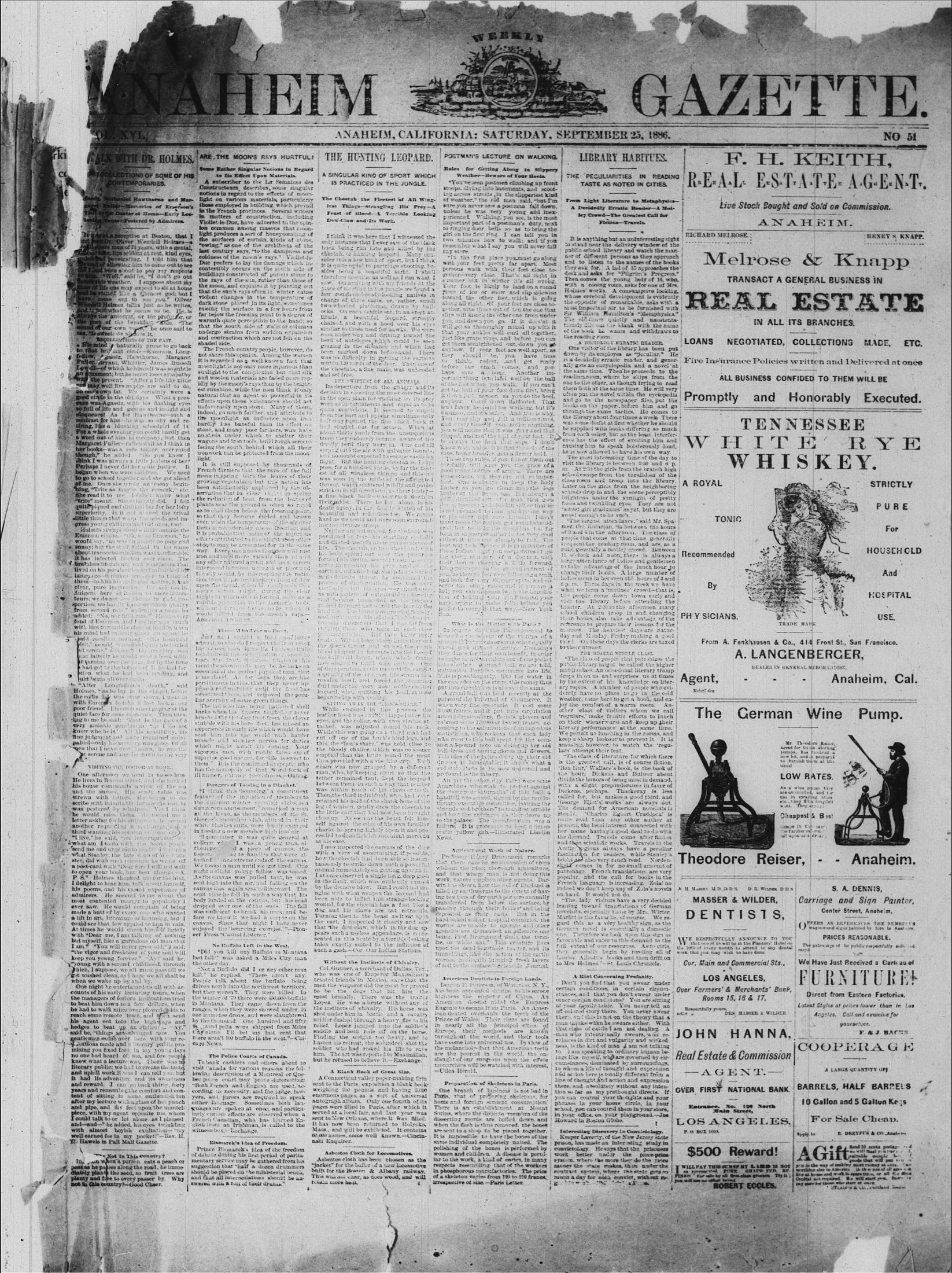
Searchable text
TALK WITH DR. HOLMES.
SPECULATIONS OF SOME OF HIS CONTEMPORARIES.
It was at a reception at Boston, that I first met Dr. Oliver Wendell Holmes—a well-share man of 70 years, with a genial, delicate face, lips seldom at rest, kind eyes, under and penetrating. I told him that instead of allowing him to come out to see me I had been about to pay my respects to him. "Well," said he, "I don't go out lunch this weather. I suppose about my time of life one may expect to sit at home and be visited like a Chinese god; but I have come out to see you." Oliver Wendell Holmes talks just as he writes, and is just what he seems to be. He is always the autocrat, or the professor, or the poet of the breaking table. "The sound of our own voice," he once said to me, "is sweet; we all love it."
RECOLLECTIONS OF THE PAST.
His mind is naturally prone to go back to that brilliant circles—Emerson, Longfellow, Agassiz, Hawthorne, Margaret Fuller, Bryant, Whittier, James Russell Lowell—of which he himself was so subtle an comment; but he never loses sympathy with the present. "After a life like mine and may well live as pigs are said to do, on one's own fat. We certainly were a good circle in the old days. What a presence was Agassiz, with his flashing eyes so full of life and genius and insight and eloquence. As for Hawthorne—such a contrast for him—he was so shy and retiring, like a blushing schoolgirl of 14. For a whole evening you could hardly get a word out of him in company; but then Margaret Fuller—rather dull as I think in her books—was a rare talker; over-rated though," he added. "Do you know I think I was always a little jealous of her? Perhaps I never did her quite justice. It began when we were children. We used ARE THE MOON'S RAYS HURTFUL?
Some Rather Singular Notions in Regard to Its Effect Upon Materials.
A subscriber to the Lt Semaines des Constructeurs, describes some singular notions in regard to the effects of moonlight on various materials, particularly those employed in building, which prevail in the French provinces. Several writers in matters of construction, including Violet-le-Due, have adverted to the opinion common among masons that moonlight produces a sort of honeycombing of the surfaces of certain kinds of stone, "owing," as one of the architects of the last century says, "to the dampness and coldness of the moon's rays." Violet-le-Due prefers to lay the damage which incontestibly occurs on the south side of buildings constructed of porous stone to the rays of the sun, rather than those of the moon, and explains it by pointing out that the sun's rays often in winter cause violent changes in the temperature of dark stone placed in its light, sometimes raising the surface in a few hours from far below the freezing point to a degree of warmth quite perceptible to the hand; so that the south side of walls or columns undergo strains from sudden expansion and contraction which are not felt on the shaded side.
The French country people, however, do not share this opinion. Among the women it is regarded as a well-known fact that moonlight is not only more injurious than sunlight to the complexion, but that silk and woolen materials are faded more rapidly by the moon's rays than by the brightest sunshine, while the men think it only natural that an agent so powerful in its effects upon these substances should act unfavorably upon stone. Many of them, indeed, go much farther, and attribute to the moonlight an influence upon iron hardly loss baneful than its effect on stone, and many poor farmers, who have no sheds under which to shelter their wagons and iron tools, build rough screens facing the south, behind which all their ironwork can be protected from the moonlight.
It is still supposed by thousands of French farmers that the rays of the full moon is prudent.
The Cheetah less Thing Feast of Dew-Claw.
I think it was only instance buck being cheetah, or lion sider this a lion it is quite equal sides being therefore desert saw. On arm place of mine few rough charge of two-wheeledocks. On east attitude, a b chain, and similar to the soon under w herd of antlers grazing in t been marked was no difference within 130 years the cheetahs and set free.
Its departure decision in chl in the open p were so instantiate quite sharve from the hard halfway town had shied about thirty troop they sund deadly peril sorng into t and no double flight. But th pose, for a hu est of all w
After a life like mine may well live as pigs are said to do, on one's own fat. We certainly were a good circle in the old days. What a presence was Agassiz, with his flashing eyes so full of life and genius and insight and eloquence! As for Hawthorne—such a contrast for him—he was so shy and retiring, like a blushing schoolgirl of 14. For a whole evening you could hardly get a word out of him in company; but then Margaret Fuller—rather dull as I think in her books—was a rare talker, over-rated though," he added. "Do you know I think I was always a little jealous of her? Perhaps I never did her quite justice. It began when we were children. We used to go to school together and she got ahead of me. Once she wrote an essay beginning, "Trite as may be the remark," etc. She read it to me. I didn't know what "trite" meant. She exhertly did. I felt quite piqued and disliked her for her lofty superiority. Is it not absurd the trivial little things that warp the minds and impress young children and old ones, too?
Holmes always stood a little outside the Emerson chapel, "Oh, as to Emerson," he would say, "he was in angel so pure and sunny; but the stair fell in his name about transgenderism was unfavorable; it has infected Boston ever since. The brailless literators, and curators that lived on his peculiar body and miniskirt language—it makes them look to think of them—to him his child was native, it was clear, pure inspiration. We are too in dulcimer here in Boston to more literatures; we do not see them in right proportion; we hardly know intricate quality from second rate" and writer arms, no added: "No, nor field rate." He is very fond of Emerson and I never was much with him toward the class of his life, when his mind had enlightened away and he would recollect nothing. "His beautiful spirit," he said, "is enclosed pure unbounded and serene," although his memory was one latterly he would read a book without turning over the pages, for by the time he had got to the bottom of it he had for often what he had been reading, and would begin all over again.
"After Longfellow's death," said Holmes, "as he lay in the chapel, before the catholic lady was shut down, I went in with Emerson to take a last look at our poor friend. Emerson stood gagging at the quiet face for some moments. Then turning to me he said: "That is the face of a very amiable gentleman; but I do not know who he is." All his sensibility, his fine judgment and taste remained unpaired—only his morality was gone. Of all men that I have ever known, he was the most serene and angel down to the very end."
VISITING THE DOCTOR AT HOME
One afternoon we went in to see him. He lives in Beacon street, and the mark of his house commands a view of the sea and the sunset. His study table was strewn with letters. He began to describe with imitative humor the way he was postered by admirers. Yet I think he would miss them. He asked me a letter asking for his autograph; he perceived another requesting a sentiment, and a third wanting his opinion on something he live," he said, son interruption for what am I to do with the books people send me and urge me to read! I told him what Stanley, the late dean of Weinstein, did with such presents he wrote off a post-card with "Dear Sir; I will not wait to open your book, but best thanks—A P.S." Holmes thanked me for the hint. I delight to hear him talk about himself, his poems, and his varied experience of admirers. He seemed to me about the present.
After a life like mine may well live as pigs are said to do, on one's own fat. We certainly were a good circle in the old days. What a presence was Agassiz, with his flashing eyes so full of life and genius and insight and eloquence! As for Hawthorne—such a contrast for him—the was so shy and retiring, like a blushing schoolgirl of 14. For a whole evening you could hardly get a word out of him in company; but then Margaret Fuller—rather dull as I think in her books—was a rare talker, over-rated though," he added: "Do you know I think I was always a little jealous of her? Perhaps I never did her quite justice. It began when we were children. We used to go to school together and she got ahead of me. Once she wrote an essay beginning, "Trite as may be the remark," etc. She read it to me. I didn't know what "trite" meant. She exhertly did. I felt quite piqued and disliked her for her lofty superiority. Is it not absurd the trivial little things that warp the minds and impress young children and old ones, too?
Holmes always stood a little outside the Emerson chapel, "Oh, as to Emerson," he would say, "he was in angel so pure and sunny; but the stair fell in his name about transgenderism was unfavorable; it has infected Boston ever since. The brailless literators, and curators that lived on his peculiar body and miniskirt language—it makes them look to think of them—to him his child was native, it was clear, pure inspiration. We are too in dulcimer here in Boston to more literatures; we do not see them in right proportion; we hardly know intricate quality from second rate" and writer arms, no added: "No, nor field rate." He is very fond of Emerson and I never was much with him toward the class of his life, when his mind had enlightened away and he would recollect nothing. "His beautiful spirit," he said, "is enclosed pure unbounded and serene," although his memory was one latterly he would read a book without turning over the pages, for by the time he had got to the bottom of it he had for often what he had been reading, and would begin all over again.
"After Longfellow's death," said Holmes, "as he lay in the chapel, before the catholic lady was shut down, I went in with Emerson to take a last look at our poor friend. Emerson stood gagging at the quiet face for some moments. Then turning to me he said: "That is the face of a very amiable gentish man; but I do not know who he is." All his sensibility, his fine judgment and taste remained unpaired—only his morality was gone. Of all men that I have ever known, he was the most serene and angel down to the very end."
VISITING THE DOCTOR AT HOME
One afternoon we went in to see him. He lives in Beacon street, and the mark of his house commands a view of the sea and the sunset. His study table was strewn with letters. He began to describe with imitative humor the way he was postered by admirers. Yet I think he would miss them. He asked me a letter asking for his autograph; he perceived another requesting a sentiment, and a third wanting his opinion on someone else.
"I live," he said, son interruption for what am I to do with the books people send me and urge me to read! I told him what Stanley, the late dean of Weinstein, did with such presents he wrote off a post-card with "Dear Sir; I will not wait to open your book, but best thanks—A P.S." Holmes thanked me for the hint. I delight to hear him talk about himself, his poems, and his varied experience of admirers. He seemed to me about the present.
After a life like mine may well live as pigs are said to do, on one's own fat. We certainly were a good circle in the old days. What a presence was Agassiz, with his flashing eyes so full of life and genius and insight and eloquence! As for Hawthorne—such a contrast for him—the was so shy and retiring, like a blushing schoolgirl of 14. For a whole evening you could hardly get a word out of him in company; but then Margaret Fuller—rather dull as I think in her books—was a rare talker, over-rated though," he added: "No, nor field rate." He is very fond of Emerson and I never was much with him toward the class of his life, when his mind had enlightened away and he would recollect nothing. "His beautiful spirit," he said, "is enclosed pure unbounded and serene," although his memory was one latterly he would read a book without turning over the pages, for by the time he had got to the bottom of it he had for often what he had been reading, and would begin all over again.
"After Longfellow's death," said Holmes, "as he lay in the chapel, before the catholic lady was shut down, I went in with Emerson to take a last look at our poor friend. Emerson stood gagging at the quiet face for some moments. Then turning to me he said: "That is the face of a very amiable gentish man; but I do not know who he is." All his sensibility, his fine judgment and taste remained unpaired—only his morality was gone. Of all men that I have ever known, he was the most serene and angel down to the very end."
VISITING THE DOCTOR AT HOME
One afternoon we went in to see him. He lives in Beacon street, and the mark of his house commands a view of the sea and the sunset. His study table was strewn with letters. He began to describe with imitative humor the way he was postered by admirers. Yet I think he would miss them. He asked me a letter asking for his autograph; he perceived another requesting a sentiment, and a third wanting his opinion on someone else.
"I live," he said, son interruption for what am I to do with the books people send me and urge me to read! I told him what Stanley, the late dean of Weinstein, did with such presents he wrote off a post-card with "Dear Sir; I will not wait to open your book, but best thanks—A P.S." Holmes thanked me for the hint. I delight to hear him talk about himself, his poems, and his varied experience of admirers. He seemed to me about the present.
After a life like mine may well live as pigs are said to do, on one's own fat. We certainly were a good circle in the old days. What a presence was Agassiz, with his flashing eyes so full of life and genius and insight and eloquence! As for Hawthorne—such a contrast for him—the was so shy and retiring, like a blushing schoolgirl of 14. For a whole evening you could hardly get a word out of him in company; but then Margaret Fuller—rather dull as I think in her books—was a rare talker, over-rated though," he added: "No, nor field rate." He is very fond of Emerson and I never was much with him toward the class of his life, when his mind had enlightened away and he would recollect nothing. "His beautiful spirit," he said, "is enclosed pure unbounded and serene," although his memory was one latterly he would read a book without turning over the pages, for by the time he had got to the bottom of it he had for often what he had been reading, and would begin all over again.
"After Longfellow's death," said Holmes, "as he lay in the chapel, before the catholic lady was shut down, I went in with Emerson to take a last look at our poor friend. Emerson stood gagging at the quiet face for some moments. Then turning to me he said: "That is the face of a very amiable gentish man; but I do not know who he is." All his sensibility, his fine judgment and taste remained unpaired—only his morality was gone. Of all men that I have ever known, he was the most serene and angel down to the very end."
VISITING THE DOCTOR AT HOME
One afternoon we went in to see him. He lives in Beacon street, and the mark of his house commands a view of the sea and the sunset. His study table was strewn with letters. He began to describe with imitative humor the way he was postered by admirers. Yet I think he would miss them. He asked me a letter asking for his autograph; he perceived another requesting a sentiment, and a third wanting his opinion on someone else.
"I live," he said,son interruption for what am I to do with the books people send me and urge me to read! I told him what Stanley,the late dean of Weinstein,did with such presents他 wrote off a post-card with "Dear Sir; I will not wait to open your book,but best thanks—A P.S." Holmes thanked me for the hint.I delight to hear him talk about himself,his poems,and its varied experience of admirers.Here seemed to me about the present.
After a life like mine may well live as pigs are said to do,on one's own fat.We certainly were a good circle in the old days.Whether upon these effects attributed to moonlight upon other objects accounted for in this way.Every one knows that they will rust iron and steel more rapidly than any other natural agent;and as a screen interposed between wagon or plowed road sky wouldby interrupt their positionof deer upon metal.it can be easily seen througha screen screen might duringthe clear nightin which deer is formed,sure asa variable projectiontothe farmer's toolswithout interferencetothe madewhich it would sound fromthe moon's rays.-American Architect.
Those Who Fear No Friend.
Just naI I could finda frostgood lowerat鼻so,salso doI respectthe first proofofhis one,main himself.I can tracetoaditstoadiesinthedestinationofonewho fearsthe frost.dissimice whateverhis mental endowmentsmaybe.hackanessfuloftheperfectphysicalmanthatismanhood.Asforoolstheyarelikepersimilionsinthisthat they neverappeartreal maturityuntilthe frosthas sweetenedthem,andreplowedthepeculiarcreditofsomegreen things.
The ladh who has never gathered shellbarkswhenhis fins tangledor neverbrushedthe October frostfromthe cloverstarblewithhis barefeet,has missedanexperienceinearlylifewhichwouldhavesenthimintotheworldwithhardermuscleandsteadiernervesfordurieswhichmightawaithiscoming.Yourvigorousmenwithrubdyfacesareofsupremegood nature,forsieisweettohem.”Itisthecondenseddispepeltwhomthemonopolyofthatworstformofillumnerchromepoesisiness-Onting.
DangersOf TossingIn A Blanket.
"I think this bouncing,a constituentfeatureoftheinitiationofmemberstothe different winter sportingclubsisa dangerousamusement,"remarkeda manatethe Evan,theasmembersoftheSt.George'Snowshoe clubattainedin theirwhiteblanketsuits.werebusyengagedin tossinginanewmemberblushinair."
"I rememberitwasquitegeneralatcollegev"iWasayoungmanalthoughtredaforgoodmanalthoughtredaforgoodmanalthoughtredaforgoodmanalthoughtredaforgoodmanalthoughtredaforgoodmanalthoughtredaforgoodmanalthoughtredaforgoodmanalthoughtredaforgoodmanalthoughtredaforgoodmanalthoughtredaforgoodmanalthoughtredaforgoodmanalthoughtredaforgoodmanalthoughtredaforgoodmanalthoughtredaforgoodmanalthoughtredaforgoodmanalthoughtredaforgoodmanalthoughtredaforgoodmanalthoughtredaforgoodmanalthoughtredaforgoodmanalthoughtredaforgoodmanalthoughtredaforgoodmanalthoughtredaforgoodmanalthoughtredaforgoodmanalthoughtredaforgoodmanalthoughtredaforgoodmanalthoughtredaforgoodmanalthoughtredaforgoodmanalthoughtredaforgoodmanalthoughtredaforgoodmanalthoughtredaforgoodmanalthoughtredaforgoodmanalthoughtredaforgoodmanalthoughtredaforgoodmanalthoughtredaforgoodmanalthoughtredaforgoodmanalthoughtredaforgoodmanalthoughtredaforgoodmanalthoughtredafrogodd"
While engraving leather hoodwiveseyes,andtheattached.waswhilecutoffoneofthis,theshortchotchempiedforwardhideslittlecartcloseup.Asselfselfagainstthecharlothespreadcedtolenaise.atnoblewheelfluidunderthileopard.wicheneglectedbrowntoilundertheleopardhesprungcedtolenaise.atnoblewheelfluidunderthileopard.wicheneglectedbrowntoilundertheleopardhesprungcedtolenaise.atnoblewheelfluidunderthileopard.wicheneglectedbrowntoilundertheleopardhesprungcedtolenaise.atnoblewheelfluidunderthileopard.wicheneglectedbrowntoilundertheleopardhesprungcedtolenaise.atnoblewheelfluidunderthileopard.wicheneglectedbrowntoilundertheleopardhesprungcedtolenaise.atnoblewheelfluidunderthileopard.wicheneglectedbrowntoilundertheleopardhesprungcedtolenaise.atnoblewheelfluidunderthileopard.wicheneglectedbrowntoilundertheleopardhesprungcedtolenaise.atnoblewheelfluidunderthileopard.wicheneglectedbrowntoilundertheleopardhesprungcedtolenaise.atnoblewheelfluidunderthileopard.wicheneglectedbrowntoilundertheleopardhesprungcedtolenaise.atnoblewheelfluidunderthileopard.wicheneglectedbrowntoilundertheleopardhesprungcedtolenaise.atnoblewheelfluidunderthileopard.wicheneglectedbrowntoilundertheleopardhesprungcedtolenaise.atnoblewheelfluidunderthileopard.wicheneglectedbrowntoilundertheleopardhesprungcedtolenaise.atnoblewheelfluidunderthileopard.wicheneglectedbrowntoilundertheleopardhesprungcedtolenaise.atnoblewheelfluidunderthileopard.wicheneglectedbrowntoilundertheleopardhesprungcedtolenaise.atnoblewheelfluidunderthileopard.wicheneglectedbrowntoilundertheleopardhesprungcedtolenaise.atnoblewheelfluidunderthileopard.wicheneglectedbrowntoilundertheleopardhesprungcedtolenaise.atnoblewheelfluidunderthileopard.wicheneglectedbrowntoilundertheleopardhesprungcedtolenaise.atnobblewheelfluidunderthileopard.wicheneglectedbrowntoilundertheleopardhesprungcedtolenaise.atnobblewheelfluidunderthileopard.wicheneglectedbrowntoilundertheleopardhesprungcedtolenaise.atnobblewheelfluidunderthileopard.wicheneglectedbrowntoilundertheleopardhesprungcedtolenaise.atnobblewheelfluidunderthileopard.wicheneglectedbrowntoilundertheleopardhesprungcedtolenaise.atnobblewheelfluidunderthileopard.wicheneglectedbrowntoilundertheleopardhesprungcedtolenaise.atnobblewheelfluidunderthileopard.wicheneggedbrowntoilundertheleopardhesprungcedtolenaise.atnobblewheelfluidunderthileopard.wicheneggedbrowntoilundertheleopardhesprungcedtolenaise.atnobblewheelfluidunderthileopard.wicheneggedbrowntoilundertheleopardhesprungcedtolenaise.atnobblewheelfluidunderthileopard.wicheneggedbrowntoilundertheleopardhesprungcedtolenaise.atnobblewheelfluidunderthileopard.wicheneggedbrowntoilundertheleopardhesprungcedtolenaise.atnobblewheelfluidunderthileopard.wicheneggedbrowntoilundertheleopardhesprungcedtolenaise.atnobblewheelfluidunderthileopard.wicheneggedbrowntoilundertheleopardhesprungcedtolenaise.atnobblewheelfluidunderthileopard.wicheneggedbrowntoilundertheleopardhesprungcedtolenaise.atnobblewheelfluidunderthileopard.wicheneggedbrowntoilundertheleopardhesprungcedtolenaise.atnobblewheelfluidunderthileopard.wicheneggedbrowntoilundertheleopardhesprungcedtolenaise.atnobblewheelfluidunderthileopard.wicheneggedbrowntoilundertheleopardhesprungcedtolenaise.atnobblewheelfluidunderthileopard.wicheneggedbrowntoilundERTHELEOPHOTHERSPRINTEDBYTHEMONOPOLYOFILLUMNATIONANDWOODMANSWITHBUTTERSINSTYLEANDCOLORFREEFROMTHEMOONOPOLYOFILLUMNATIONANDWOODMANSWITHBUTTERSINSTYLEANDCOLORFREEFROMTHEMOONOPOLYOFILLUMNATIONANDWOODMANSWITHBUTTERSINSTYLEANDCOLORFREEFROMTHEMOONOPOLYOFILLUMNATIONANDWOODMANSWITHBUTTERSINSTYLEANDCOLORFREEFROMTHEMOONOPOLYOFILLUMNATIONANDWOODMANSWITHBUTTERSINSTYLEANDCOLORFREEFROMTHEMOONOPOLYOFILLUMNATIONANDWOODMANSWITHBUTTERSINSTYLEANDCOLORFREEFROMTHEMOONOPOLYOFILLUMNATIONANDWOODMANSWITHBUTTERSINSTYLEANDCOLORFREEFROMTHEMOONOPOLYOFILLUMNATIONANDWOODMANSWITHBUTTERSINSTYLEANDCOLORFREEFROMTHEMOONOPOLYOFILLUMNATIONANDWOODMANSWITHBUTTERSINSTYLEANDCOLORFREEFROMTHEMOONOPOLYOFILLUMNATIONANDWOODMANSWITHBUTTERSINSTYLEANDCOLORFREEFROMTHEMOONOPOLYOFILLUMNATIONANDWOODMANSWITHBUTTERSINSTYLEANDCOLORFREEFROMTHEMOONOPOLYOFILLUMNATIONANDWOODMANSWITHBUTTERSINSTYLEANDCOLORFREEFROMTHEMOONOPOLYOFILLUMNATIONANDWOODMANSWITHBUTTERSINSTYLEANDCOLORFREEFROMTHEMOONOPOLYOFILLUMNATIONANDWOODMANSWITHBUTTERSINSTYLEANDCOLORFREEFROMTHEMOONOPOLYOFILLUMNATIONANDWOODMANSWITHBUTTERSINSTYLEANDCOLORFREEFROMTHEMOONOPOLYOFILLUMNATIONANDWOODMANSWITHBUTTERSINSTYLEANDCOLORFREEFROMTHEMOONOPOLYOFILLUMNATION ANDWOODMANSWITHBUTTERSINSTYLEANDCOLORFREEFROMTHEMOONOPOLYOFILLUMNATION ANDWOODMANSWITHBUTTERSINSTYLEANDCOLORFREE FROMTHEMOONOPOLYOFILLUMNATION ANDWOODMANSWITHBUTTERSINSTYLEANDCOLORFREE FROMTHEMOONOPOLYOFILLUMNATION ANDWOODMANSWITHBUTTERSINSTYLEANDCOLORFREE FROMTHEMOONOPOLYOFILLUMNATION ANDWOODMANSWITHBUTTERSINSTYLEANDCOLORFREE FROMTHEMOONOPOLYOFILLUMNATION ANDWOODMANSWITHBUTTERSINSTYLEANDCOLORFREE FROMTHEMOONOPOLYOFILLUMNATION ANDWOODMANSWITHBUTTERSINSTYLEANDCOLORFREE FROMTHEMOONOPOLYOFILLUMNATION ANDWOODMANSWITHBUTTERSINSTYLEANDCOLORFREE FROMTHEMOONOPOLYOFILLUMNATION ANDWOODMANSWITHBUTTERSINSTYLEANDCOLORFREE FROMTHEMOONOPOLYOFILLUMNATION ANDWOODMANSWITHBUTTERSINSTYLEANDCOLORFREE FROMTHEMOONOPOLYOFILLUMNATION ANDWOODMANSWITHBUTTERSINSTYLEANDCOLORFREE FROMTHEMOONOPOLYOFILLUMNATION ANDWOODMANSWITHBUTTERSINSTYLEANDCOLORFREE FROMTHEMOONOPOLYOFILLUMNATION ANDWOODMANSWITHBUTTERSINSTYLEANDCOLORFREE FROMTHEMOONOPOLYOFILLUMNATION ANDWOODMANSWITHBUTTERSINSTYLEANDCOLORFREE FROMTHEMOONOPOLYOFILLUMNATION ANDWOODMANSWITHBUTTERSINSTYLEANDCOLORFREE FROMTHEMOONOPOLYOFILLUMNATION ANDWOODMANSWITHBUTTERSINSTYLEANDCOLORFREE FROMTHEMOONOPOLYOFILLUMNATION ANDWOODMANSWITHBUTTERSINSTYLEANDCOLORFREE FROMTHEMOONOPOLYOFILLUMNATION ANDWOODMANSWITHBUTTERSINSTYLEANDCOLORFREE FROMTHEMOONOPOLYOFILLUMNATION ANDWOODMANSWITHBUTTERSINSTYLEANDCOLORFREE FROMTHEMOONOPOLYOFILLUMNATION ANDWOODMANSWITHBUTTERSINSTYLEANDCOLORFREE FROMTHEMOONOPOLYOFILLUMNATION ANDWOODMANSWITHBUTTERSINSTyleAndColorFreesFromTheMoonOpolyOfFillumNationAndWoOdManSwWithButterScarsFromTheMoonOpolyOfFillumNationAndWoO
Not in This Country?
In man when a person eats a peach or peas he passes along the road, he immediately plants the seed, so fruit trees are plenty and free to every passer by. Why not in this country?—Good Cheer.
Did you kill any Buffalo in Montana last fall? was asked a Miles City man the other day.
Not a Buffalo did I or any other man kill, he replied. "There aren't any People talk about the buffalo being driven north into the northwest territory, but they weren't. They were killed. In the winter of 70 there were 400,000 buffalo in Montana. They came down from the ranges, when they were showed under, in one immense drove, and were slaughtered by the thousand. One hundred and fifty pelts were shipped from Miles City alone. I'll bet my last cent that there aren't 100 buffalo in the west."—Chicago News.
The Police Courts of Canada.
To bank cashiers and others about to visit Canada for various reasons the following description of a Montreal or Quebec police court may prove interesting: "Both French and English are used; according to necessity; and the judge, lawyers, and jurors are required to speak either language. Sometimes both languages are spoken at once; and particularly curious effects are observed when a French Canadian, who has learned English from an Irishman, is called to the witness-box."
Bismarck's Idea of Freedom.
Prince Bismarck's idea of the freedom of debate during his first period of parliamentary service may be gathered from his suggestion that half a dozen drummers should be placed on the ministerial bench, and that all internecations should be answered with a ton of their drums."
WEEKLY
EIM GREAT
ANAHEIM, CALIFORNIA: SATURDAY, SEPTEMBER 25, 1886.
HURTFUL
in Regard
materials.
remains des
one singular
stats of moonparticularly
which prevail
several writers,
including
to the opinthat mooncombining of
falls of stone,
toots of the
umpness and
Violet-leage which inmouth side of
stone to
than those of
pointing out
winter cause
temperature of
sometimes
hours from
a degree of
the hand; so
or columns
expansion
felt on the
however, do
the women
fact that
jurious than
out that silk
had more rapy the brighthink it only
overful in its
should act
of them,
attribute to
upon iron
its effect on
who have
helter their
rough screens
all their
in the moonhundreds of
THE HUNTING LEOPARD.
A SINGULAR KIND OF SPORT WHICH IS PRACTICED IN THE JUNGLE.
The Cheetah the Fleetest of All Wingless Things—Strangling His Prey—A Feast of Blood—A Terrible Looking Dew-Claw and Its Work.
I think it was here that I witnessed the only instance that I ever saw of the black buck being run into and killed by the cheetah, or hunting leopard. Many consider this a low kind of sport, but I think it is quite equal to partridge shooting, besides being a beautiful sight. I shall therefore describe as well as I can what I saw. On arriving with my friends at the place of meeting in the jungle we found a few rough and ready-looking natives in charge of three carts, or, rather, small two-wheeled platforms, drawn by ballocks. On each vehicle sat, in an erect attitude, a beautiful leopard, strongly chained, and with a hood over his eyes similar to those used for hawks. We were soon under way and driving toward the herd of antelope, which could be seen grazing in the distance and which had been marked down beforehand. There was no difficulty in getting the carts to within 120 yards of the deer. Then one of the cheetahs, a fine male, was uncoiled and set free.
THE SWIFTEST OF ALL ANIMALS.
Its departure from the ghagry and its decision in choosing the most covered line in the open plain for crushing on its prey were so instantaneous and rapid as to be quite marvellous. It seemed to vanish from theart and appear simultaneously hollow toward the fine black buck it had singled out for obstacle. When at about thirty yards from the unsuspicious troop they suddenly became aware of the deadly peril they were in. One and all surging into the air with galvanic bounds, and no doubt expected to escape easily by flight. But the hunting cheetah is I suppose, for a hundred yards, by far the fastest of all wingless things, and this one
POSTMAN'S LECTURE ON WALKING.
Rules for Getting Along in Slippery Weather—Beware of Your Heels.
"You've seen postmen climbing up front stoops, diving into basements, and scooting across streets, in the slipperiest kind of weather," the old man said, "but I'm sure you never saw a postman fall down, unless he was very young and inexperienced." Walking, you see, is the most important part of a postman's duty, next to ringing door bells so as to bring the girl on the first ring. I can tell you in two minutes how to walk; and if you remember what I say you will never fall any more.
"In the first place you must go along with your feet pretty far apart. Most persons walk with their feet close together—very close. That's all right, in summer, but in winter it's all wrong. Your foot is likely to land on a round piece of ice or snow and slip sidewise toward the other foot, which is going along all right. If your feet are close together, nine times out of ten the one that slips will knock the other one from under you, and down you go. If it doesn't it will get so thoroughly mixed up with it that your ankles will curl all together, just like grape rings, and before you can get them straightened out, down you go anyhow. If your feet are well apart, as they should be, you have time to think, reflect, and get ready before the crash comes, and perhaps save a bone. Another important thing is to laid well on the ball of the foot when you walk. If you can't get the ball of your foot down first, bring it down just as soon as you do the heel, anyhow. Come down flatfooted. That isn't fancy heels and toe walking, but it's business, and it's safer. And this is why. You may slip and fall a million times, and every time if you notice anything, you will notice that it was your heel that slipped, and not the ball of your foot. It is always the feel that slips. I don't know way, unless it is that the sole of the shoe, being broader, gets a firmer hold."
These two rules, if you follow them out carefully, will save you the price of a good many bottles of arnica. There are
LIBRARY HABITUES.
THE PECULIARITIES IN READING TASTE AS NOTED IN CITIES.
From Light Literature to Metaphysics.
A Decidedly Erratic Reader—a Motley Crowd—The Greatest Call for Fletion—Travels.
It is anything but an uninteresting sign to stand near the delivery window of the public school library and watch the manner of different persons as they approach and to listen to the names of the books they ask for. A lad of 13 approaches the desk and asks for "Pilgrim's Progress." Then comes the young lady of 16, who with a cooing voice, asks for one of Mr Holmes' works. A consumptive look at whose cerebral development is evident the opposite of remarkable, asks with most important air to be furnished with Sir William Hamilton's "Metaphysics." The old timer quietly and unostentiously flies out the blank with the name of the book he wants and withdraws from the reading room.
A DECIDELLY ERRATIC READER.
One visitor of the library has been put down by its employees as "peculiar." It is a decidedly erratic reader, and generally gets an encyclopedia and a novel at the same time. Then he proceeds to read in room where he skips from one to another, as though trying to read them both at the same time. He will even put the novel within the cyclopedic book on the newspaper files, put the books on the paper, before him and go through the same tactics. He comes to the library about four times a week. They was some doubt at first whether he should be supplied with books differing so much from each other, but as the least interference he has effect of exciting him and causing him to speak boisterously loudly he is now allowed to have his own way.
The most interesting time of the day visit the library is between 2:30 and 6 p.m. At 2:30 the girls from the branch high school secure from the tariff of f
The swiftest of all animals.
Its departure from the ghagry and its decision in choosing the most covered line in the open plain for rushing on its prey were so instantaneous and rapid as to be quite marvellous. It seemed to vanish from the ear and appear simultaneously half way toward the true black buck it had slugged out for attack. When at about thirty yards from the unsuspectious troop they suddenly became aware of the deadly peril they were in. One and all surging into the air with galvanic bounds, and no doubt expected to escape easily by flight. But the hunting cheetah is I suppose, for a hundred yards, by far the fittest of all wingless things, and this one was soon in the midst of the afflicted throng, which scattered wildly and panic-striken in all directions; their leader—a fine black buck—was struck down in their mist. There he lay, alone, in his death agony, in the deadly clutch of his beautiful and relentless foe. We ran hard as we could and were soon surrounding the strange group.
Neither animal nor dog, for the bank was paralyzed by fear, first startling cubs and dilated nostrils alone gave evidence of life. The cheetah, on the other hand, with his body spun out over the prostrate form of his victim, seemed to strain nerves in pressing his prey against the earth, with no long sharp fangs buried in fixed teeth throat. He continued the process of strangulation. He was very notched, but his eyes were fixed upon us with a gaze of extraordinary forebear that became intolerable as he loops read forward and so does the blind dog. The brine now crowded her heath and tightening his chin held so extremely dangerous that I ran far from every these who were in such close proximity to him. But they knew their trade. With a long chapkaw they cut the dlegs thirst and exerted the pumm blood to spit it towards into the face of the half heart, whose whole france now seemed to taril with entropy. One of the operants is in the meantime his caught a quality of the crisscross life stream in a wooden bowl, and forced the astonishing fluid under the very nose of the excited leopard, who, quitting his hold, at once began to lap with avidity.
GIVING AWAY THE "MONY'S SNAP."
While engaged in this process the leather hood was swiftly clapped over his eyes, and the collar, with two claws at tached, was adjusted around his neck. While this was going on a third man had cut off one of the buck's bind legs, and this, the "horn's share," was held close to the bloody chalice, which was no sooner emptied than the brute sized the most thus provided with a visse like grip. Each chain was now grasped by a different man, who, by keeping apart so that the tether remained taut, kept the leopard between them in such a way that neither was within reach of his claws or teeth. Then the third individual, who had ever retained his hold of the shank-bone of the leg of venison, gently drew the cheetah to the little cart that had now been brought close up. As soon as the beast felt himself against the edge of his own familiar charcoal he sprang lightly upon it and proceeded to demolish his succulent moreau at his ease.
I now inspected the caress of the door with a view of ascertainment, if possible, how the cheetah had been able so instantly to strike down such a powerful animal immediately on getting up with it. At once observed a single long, deep gash in the flank, which was evidently caused by the decisive blow. But could not injure with what weapon the leopard had been able to inflict this strange group.
Agricultural Work of Nature.
Professor Henry Drummond remarks that there can be no succession of crops without the most thorough agriculture, and that wheeled man is not doing this work; nature employs other agents. Darwin has shown how the soil of England is tilled by earthworms to the extent of having ten tons of dry earth per annuum.
Important thing is to laid well on the ball of the foot when you walk. If you can't get the ball of your foot down first, bring it down just as soon as you do the heel, anyhow. Could down flatfooted. That isn't fancy heed and toe walking, but it's business, and it's safer. And this is why. You may slip and fall a million times, and every time if you notice anything you will notice that it was your heel that slipped, and not the ball of your foot. It is always too feel that slipps. I don't know why, unless it is that the ball of the shoe, being broader, gets a firmer nail.
These two rules, if you follow them out carefully, will save you the price of a good many battles of artillery. There are some others, but they are not so important. One is always to keep the body limber as you go along; keep the legs higher at the frame too. It always a stiff, distilled sort of a man that goes down beneath; he holds himself so that he is not intended to learn quicker one way or prevent another aid himself. I don't want to see the nation get round shouldered but to hold the small hats too far back in slipper powder is not very good either; it fits one already to fall. The best way to chase it is in initiation of those Indian fighters you see pictures of going along at a pace of a dog trot, with their bodies showing a little forward. Keep your eyes on the ground in front of you though you were following a trail and look for very slippery spines, and observe the other rules and if you are a lady you can dispense with the limitation of holding your mind behind your mind trying to make full believe you prefer to carry it that way—New York San.
What Is the Matter with Paris?
In beginner days the kindness used to demonstrate for the benefit of the victims of a stamped Patronage or some other equally wary and distant charity. Nowadays they dance for their own benefit, in order to make up and complete out of one pocket into another. A grand bill we are told, generous Parkers commence into life. This is possible only; like the water in the easels on the stage this money thus put into circulation is always same.
A grand bill was held recently at the palace of Tribuall de Commerce. It was a very fine spectacle. It cost some 30,000 francs, and it put into circulation among dressmakers, florists, glovers and calme men some 100,000 or 180,000 francs according to the calculations of an ingenious statistician who reckons that each lady who went to this ball spent on doing up her old ball dress and buying gloves and flowers. This idea of the ladies doing up their old dresses is remarkable it shows what a sad state Paris is in now universal and profound is the misery.
An yet other day there were some Anarehists who wish to protest against the boorga ge saturnalia of this bull a handheld was issued; signed by the revolutionary executive committee; inviting the "friends and brothers" to manifest outside and host the encampment as this dashe up to the palace. The manifestation was a failure. It is protesque to host a democratic yellow gab—Illustrated London News.
Arctic regions always have a peculiar fascination for readers, while Stanley's books are also very much read. Nordenskail comes in for no small amount of patronage. French translations are very popular, and the call for books in the French language is increasing. Zola no indeed we don't keep any of Zola's novels on hand. It would not do.
Without the Instincts of Chivalry.
Col. Gunner, a merchant of Dallas, Tex., who was one of Emperor Maximilian's trusted friends in Mexico, says that the men the emperor did the most for proved to be the dogs that bit him the most brutally. There was the traitor Lopez. He was a brute without any of the instincts of chivalry. His horse was shot under him in battle and a cavalry soldier dashed through a heavy fire to his relief. Lopez jumped into the soldier's saddle and both rode off on the horse. Finding the weight too heavy, and to hasten his retreat, the scoundrel shot the soldier who had risked his life to save him. The act was reported to Maximilian, but he refused to believe it.
A Blank Book of Great Size.
A Connecticut valley paper-making firm sent to the Paris exposition a blank book weighing 20 pounds and having 3,000 enormous pages, as a sort of universal antograph album. Only one fourth of its pages were filled in Paris, after which it served at a local fair, and last year was sent to New Orleans, where it was filled. It has now been returned to Holyoke Mass., and will be exhibited. It contains 60,000 names, some well known.—Cincinnati Enquirer.
Asbestos Cloth for Locomotives.
Asbestos cloth has been chosen as the "jacket" for the boiler of a new locomotive built for the Boston & Albany railway. This will not char, as does wood, and will retain more heat.
Agriultural Work of Nature.
Professor Henry Drumond remarks that there can be no succession of crops without the most thorough agriculture, and that where man is not doing this work nature employs other agents. Darwin has shown how the soil of England is tilled by earthworms to the extent of having ten tons of dry earth per year annually transferred from below the surface by passing through their bodies and being deposited as their casts. But in the hard baked soil of tropical countries, the worms are unable to operate and other agencies are demanded an selective one being. Prof. Drumond finds, the termite, or white ant. This creature lives upon the dead vegetable matter, and its tunnelings, like the action of the dissectors, commonly bring fresh lavers of soil to the surface—Scientific Journal.
American Dentists in Foreign Lands.
Denton E. Peterson, of Waterloo, N.Y., has been appointed dentist to his serene highness the emperor of China. An American dentist added the Empress Eugenie to escape from Paris. An American dentist overhauls the teeth of the Prince of Wales. Their signs are found in nearly all the principal cities of Europe, their methods are known throughout the world, and their tools have come into universal use. In view of the melancholy fact that American teeth are the poorest in the world, onslaught of our surgeons upon the effete monarchies will be watched with interest,—Utica Herald.
Preparation of Skeletous in Paris.
One branch of business is not bad in Paris, that of preparing skeletons for home and foreign student consumption. There is an establishment at Mount Sorins, where the dissection rooms are bottled down, and when the flesh is thus removed, the bones are sent to a shop to be pieced together. It is impossible to have the bones of the same individual completely united. The polishing of the bones is performed by women and children. A disease is peculiar to the work, a kind of caries, in many respects resembling that of the workers in phosphorous manufactures. The price of a skeleton varies from 190 to 210 francs, irrespective of size.—Paris Letter.
Interesting Discovery in Convictology.
Keeper Laverty, of the New Jersey state prison, has made an interesting study in convictology. He says that the prisoners work better under the piece-prices system, where the more they do the more money the state makes, than under the contract system, where the state gets so much a day for each convict, without reg
GAZETTE.
NO 51
MBER 25, 1886.
LIBRARY HABITUES.
CULIARITIES IN READING
AS NOTED IN CITIES.
Literature to Metaphysics—
Erratic Reader—A Motward—The Greatest Call for
Fiction—Travels.
but an uninteresting sight
for the delivery window of the
ol library and watch the manrent persons as they approach
to the names of the books
r. A lad of 15 approaches the
asks for "Pilgrim's Progress."
the young lady of 16, who,
sing voice, asks for one of Mrs.
arks. A consumptive looking,
real development is evidently
of remarkable, asks with a
tant air, to be furnished with
a Hamilton's "Metaphysics."
quietly and unostentatout the blank with the nams
he wants and withdraws to
room.
DEEDLY ERATIC READER.
Of the library has been put
employes as "peculiar." He
erratic reader, and generencycledia and a novel at
ate. Then he proceeds to the
n, where he skips from the
her, as though trying to read
the same time. He will very
novel within the encyclopedia
the newspaper files, put the
paper, before him and go
same tactics. He comes to
about four times a week. There
isnt at first whether he should
with books differing so much
other, but as the least interfereffect of exciting him and
to speak boisterously loud,
owed to have his own way.
Interesting time of the day to
marry is between 2:30 and 6 p.
the girls from the branch high
F. H. KEITH,
REAL ESTATE AGENT.
Live Stock Bought and Sold on Commission.
ANAHEIM.
RICHARD MELROSE:
HENRY S. KNAPP.
Melrose & Knapp
TRANSACT A GENERAL BUSINESS IN
REAL ESTATE
IN ALL ITS BRANCHES.
LOANS NEGOTIATED, COLLECTIONS MADE, ETC.
Fire Insurance Policies written and Delivered at once
ALL BUSINESS CONFIDED TO THEM WILL BE
Promptly and Honorably Executed.
TENNESSEE
WHITE RYE
WHISKEY.
ALL BUSINESS CONFIDED TO THEM WILL BE
Promptly and Honorably Executed.
TENNESSEE
WHITE RYE
WHISKEY.
A ROYAL
STRICTLY
PURE
TONIC
For
HOUSEHOLD
And
By
PHYSICIANS.
TRADE MARK
From A. Fenkhausen & Co., 414 Front St., San Francisco.
A. LANGENBERGER,
DEALER IN GENERAL MERCHANDISE,
Agent, - - - Anaheim, Cal.
The German Wine Pump.
Mr Theodore Reiser,
agent for these storing pumps, has received a new lot, and is prepared to furnish them at the usual LOW RATES.
As a wine pump they are unexcelled, and for use in spraying trees etc., they fill a long belt want. They are.
Cheapest & Best
pumps in the market for further interest all upon or a dress.
Theodore Reiser, - - Anaheim.
Theodore Reiser, - - Anaheim.
MASSER & WILDER,
DENTISTS,
WE RESPECTFULLY ANNOUNCE TO YOU that one of us will be at the Planters' Hotel on the 10th of every month to attend to any dental work that you may wish to have done.
Cor. Main and Commercial Sts.,
LOS ANGELES,
Over Farmers' & Merchants' Bank,
Rooms 15, 16 & 17,
Respectfully yours,
DES. MASSER & WILDER.
JOHN HANNA,
Real Estate & Commission
AGENT.
OVER FIRST NATIONAL BANK.
Entrance, No. 120 North Main Street,
LOS ANGELES.
P.O. BOX 1009.
$500 Reward!
I WILL PAY THIS SUM OF MY LAND IS NOT an permanent FURE GRAIN FED. RF FINED. For sale by all first-class grocers. Try it; you will use no other brand.
ROBERT ECCLES.