anaheim-gazette 1886-09-04
Scanned page
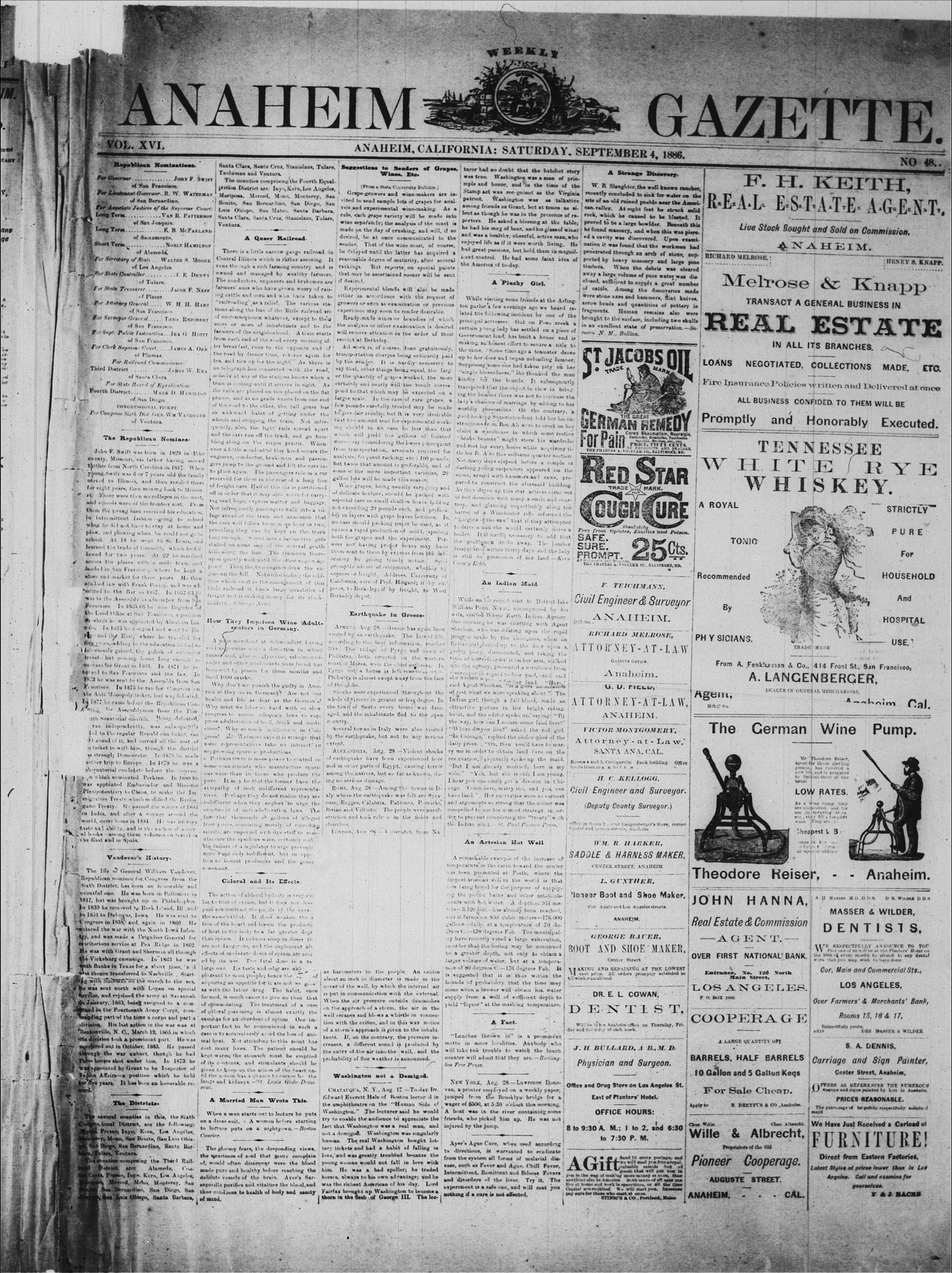
Searchable text
ANAHEIM
VOL. XVI.
Republican Nominations.
For Governor ... JOHN F. SWIFT of San Francisco.
For Lieutenant-Governor ... R. W. WATERMAN of San Bernardino.
For Associate Justices of the Supreme Court: Long Term ... VAN R. PATTERSON of San Joaquin.
Long Term ... E. B. McFARLAND of Sacramento.
Short Term ... NOBLE HAMILTON of Alameda.
For Secretary of State ... WALTER S. MOORE of Los Angeles.
For State Controller ... J. E. DENNY of Tulare.
For State Treasurer ... JACOB F. NEFF of Placer.
For Attorney General ... W. H. H. HART of San Francisco.
For Surveysor General ... THEO REICHERT of San Francisco.
For Supt. Public Instruction ... IRA G. HOITT of San Francisco.
For Clerk Supreme Court ... JAMES A. ORR of Plumas.
For Railroad Commissioner:
Third District ... JAMES W. REA of Santa Clara.
For State Board of Equalization:
Fourth District ... MARK D. HAMILTON of San Diego.
CONGRESSIONAL TICKET.
For Congress Sixth Dist Gen WM. VANDEVER of Ventura.
The Republican Nominee.
John F. Swift was born in 1829 in Pike county, Missouri, his father having moved thither from North Carolina in 1817. When young Swift was 6 or 7 years old the family
Santa Clara, Santa Cruz, Stanislaus, Tulare, Tuolumne and Ventura.
The counties comprising the Fourth Equalization District are: Inyo, Kern, Los Angeles, Mariposa, Merced, Mono, Monterey, San Benito, San Bernardino, San Diego, San Luis Obispo, San Mateo, Santa Barbara, Santa Clara, Santa Cruz, Stanislaus, Tulare, Ventura.
A Queer Railroad.
There is a little narrow-gauge railroad in Central Illinois which is rather amusing. It runs through a rich farming country and is owned and managed by wealthy farmers. The conductors, engineers and brakemen are farmers' sons who have grown weevry of raising cattle and corn and who have taken to "railroading" as a relief. The various stations along the line of the little railroad are of no consequence whatever, except to their score or more of inhabitants and to the farmers of the neighborhood. A train starts from each end of the road every morning after breakfast, runs to the opposite end of the road by dinner time, returns again for tea, and ties up for the night. As there is no telegraph line connected with the road, nobody at any of the stations knows when a train is coming until it arrives in sight. As the rails are placed on the flat prairie, and as no grade exists from one end of the road to the other, the tall grass has an awkward habit of getting under the wheels and stopping the train. Not infrequently, also, the light rails spread apart and the cars run off the track, and go tumbling along on the virgin prairie. Whenever a little accident of this kind occurs the engineer, conductor, brakemen and passengers jump to the ground and lift the cars into place again. The passengers ride in a car
The Republican Nominee.
John F. Swift was born in 1829 in Pike county, Missouri, his father having moved thither from North Carolina in 1817. When young Swift was 6 or 7 years old the family moved to Illinois, and then resided there for eight years, then moving back to Missouri. There were then no colleges in the west, and schools were of the frontier sort. From them the young man received his education, in intermittent fashion—going to school when he did not have to stay at home and plow, and plowing when he could not go to school. At 18 he went to St. Louis, and learned the trade of tinsmith, which he followed for two years. At 22 he marched across the plains with a mole team, and landed in San Francisco, where he kept a store and market for three years. He then studied law with Frank Paxley, and was admitted to the Bar in 1857. In 1852-63 he was in the Assembly as a member from San Francisco. In 1865-66 he was Register of the Land Office at San Francisco, a position so which he was appointed by Abraham Lincoln. In 1863 he resigned and went to Europe and the East, where he traveled for five years adding to the education he had so laboriously gained, the polish of extensive travel—but coming home long enough to canvass for Grant in 1863. In 1874 he returned to San Francisco and the law. In 1873 he was sent to the Assembly from San Francisco. In 1875 he ran for Congress on the Anti Monopoly ticket, but was defeated. In 1877 he came before the Republican Convention for Assemblyman from the Third-third Senateorial district. Being defeated, he ran independently, was subsequently led to the regular Republcan ticket, ran 90 ahead of it, and carried all the rest of the ticket in with him, though the district was strongly Democratic. In 1878 he made another trip to Europe. In 1879 he was aubernatorial candidate before the convenance which nominated Perkins. In 1880 he was appointed Embassador and Minister Plenipotentiary to China, to make the Immigration Treaty which modified the Burkin game Treaty. He passed the winter of 1883 in India, and after a voyage around the world, came home in 1884. He was literary taste and ability, and is the author of several books—among them volumes on travel in the East and in Spain.
Vandever's History.
The life of General William Vandever, Republican nominee for Congress from the Sixth District, has been an honorable and eventful one. He was born in Baltimore in 1817 but now lives at any of the stations knows when a train is coming until it arrives in sight. As the rails are placed on ties placed on the flat prairie, and as no grade exists from one end of the road to the other, the tall grass has an awkward habit of getting under the wheels and stopping the train. Not infrequently, also, the light rails spread apart and the cars run off the track, and go tumbling along on the virgin prairie. Whenever a little accident of this kind occurs the engineer, conductor, brakemen and passengers jump to the ground and lift the cars into place again. The passengers ride in a car reserved for them in the rear of a long line of freight cars. Half of this car is partitioned off in order that it may also serve for carrying mail bags, express matter and baggage. Not infrequently passengers walk into a village ahead of the train and announce that the cars will follow them in an hour or two, providing they can be kept on the track long enough. Sometimes a locomotive gets stalled on some one of the several gentle hills along the line. The trammen there upon quietly wait until the other engine appears. Then the two engines draw the engine up the hill. Notwithstanding the oldness which exist in the management of this little railroad at hands large quantities of freight and is making money for its stockholders.
How They Imprison Wine Adulterators in Germany.
A wine merchant at Schweinfurt having sold as genuine wine a deposition in which tannic acid, glucose, glycerine, saline condender and other adulterants were found has been sent to prison for three months and financed 1000 marks.
Why don't we punish the guilty in America as they do in Germany? Are not our health and life as dear as the German's? Why must we labor so hard with so slow progress to secure adequate laws to suppress adulteration of food, drink and medicines? Why so much indifference in Congress? Mr. Wetmore says it is strange that some representatives take no interest in suppressing spurious productions.
Perhaps they do not realize they are indifferent when they neglect to urge the enactment of anti-adulteration laws. The fact that thousands of gallons of alleged fruit juices, consisting mainly of corroding spirits, are imported with dye stuff to manufacture the spurious wine certainly makes the failure of a legislator to urge preventive apportion only indifferent, but in opposition to honest producers and the general consumer.
Chloral and Its Effects.
The action of chloral hydrate is very sin
Vandever's History.
The life of General William Vandever,
Republican nominee for Congress from the Sixth District, has been an honorable and eventful one. He was born in Baltimore in 1817, but was brought up in Philadelphia. In 1839 he removed to Rock Island, Ill., and in 1851 to Dubuque, Iowa. He was sent to Congress in 1858, and again in 1860. He entered the war with the Ninth Iowa Infantry, and was made a Brigadier General for maritorious service at Pea Ridge in 1862. He was with Grant and Sherman all through the Vicksburg campaign. In 1863 he was with Banks in Texas for a short time, and thus thence transferred to Nashville. Starting with Sherman on the march to the sea, he was sent north with Logan on special service, and rejoined the army at Savannah in January, 1865, being assigned to a command in the Fourteenth Army Corps, commanding part of the time a corps and part a division. His last action in the war was at Bentonville, N.C., March 19, 1865, in which his division took a prominent part. He was murdered out in October, 1865. He passed through the war unhurt, though he had three horses shot under him. In 1873 he was appointed by Grant to be Inspector of Indian Affairs—a position which he held for five years. It has been an honorable record.
The Districts.
The several counties in this, the Sixth Congressional District, are the following: Alameda, Fresno, Inyo, Kern, Los Angeles, Montayev, Mono, San Benito, San Luis Obispo, San Diego, San Bernardino, Santa Barbara, Talara, Ventura.
The counties composing the Third Railroad District are: Alameda, Contra Costa, Fresno, Inyo, Kern, Los Angeles, Mariposa, Merced, Moho, Monterey, San Bernardo, San Diego, San Jorge, San Luis Obispo, Santa Barbara,
indifferent when they neglect to urge the enactment of antidultery laws. The fact that thousands of gallons of alleged front pints, consisting mainly of curdling spirits, are imported with dye stuff to manufacture the spurious wine, certainly makes the failure of a legislator to urge preventance right only indifferent, but in opposition to honest producers and the general consumer.
Chloral and Its Effects.
The action of chloral hydrate is very similar to that of oxyum, but it does not less pain nor contract the pupils of the eyes; the same extent. It does weaken the action of the heart and lessen the productio of heat in the body to a far greater degree than opium. It induces sleep in doses that are not dangerous, and the unpleasant effects of moderate doses of opium are avoided by its use. The fatal dose is a very large one. Its taste and odor are pleasant to most people; hence the need of acquiring an appetite for it are not so great as with the latter drug. The habit once formed is much easier to give up than that of opium-eating. The treatment of a case of chloral poisoning is almost exactly the same as for an overdose of opium. One important fact to be remembered in such a case is to acclimatously avoid the loss of animal heat. Not attending to this point has cost many lives. The patient should be kept warm; the stomach must be emptied of its contents, and stimulants should be given to keep up the action of the heart until the notion has a chance to escape by the lungs and kidneys.
A Married Man Wrote This.
When a man starts out to lecture he puts on a dress suit. A woman before starting to lecture puts on a nightgown. Boston Courier.
The gloomy fears, the desponding views, the weariness of soul that many complain of, would often disappear were the blood made pure and healthy before reaching the delicate vessels of the brain. Ayer's Saraparilla purifies and vitalizes the blood, and thus conduces to health of body and sanity of mind.
WEEKLY
HEIM
ANAHEIM, CALIFORNIA: SATURDAY, SEPTEMBER 4, 1870
Suggestions to Senders of Grapes, Wines, Etc.
[From a State University Bulletin.]
Grape-growers and wine-makers are invited to send sample lots of grapes for analysis and experimental wine-making. As a rule, each grape variety will be made into wine separately; the analysis of the must is made on the day of crushing, and will, if so desired, be at once communicated to the sender. That of the wine must, of course, be delayed until the latter has acquired a reasonable degree of maturity, after several rackings. But reports on special points that may be ascertained sooner will be sent if desired.
Experimental blends will also be made either in accordance with the request of growers or such as examination or previous experience may seem to render desirable.
Ready-made wines or brandies of which the analysis or other examination is desired will receive attention in the order of their receipt at Berkeley.
All work is, of course, done gratuitously, transportation charges being ordinarily paid by the sender. It is hardly necessary to say that, other things being equal, the larger the quantity of grapes worked, the more certainly and nearly will the result correspond to that which may be expected on a larger scale. In the case of rare grapes, a few pounds carefully treated may be made to give fair results; but it is very desirable that the amount sent for experimental working should in no case be less than that when will yield five gallons of finished wine—say (considering the losses consequent from transportation, amounts required for analysis (requent racking etc.) 100 pounds; but twice that amount is preferable, and of some of the more important varieties, 20 turer had no doubt that the hatchet story was true. Washington was a man of principle and honor, and in the time of the Stamp act was recognized as the Virginia patriot. Washington was as talkative among friends as Grant, but at times as silent as though he was in the presence of reporters. He asked a blessing at the table; he had his mug of beer, and his glass of winer; and was a healthy, cheerful, active man, who enjoyed life as if it were worth living. He had great passions, but held them in magnificent control. He had some faint idea of the America of to-day.
A Plucky Girl.
While visiting some friends at the Arlington parlor a few evenings ago we heard related the following incident by one of the principal actresses: Out on Poas creek a certain young lady has settled on a piece of Government land, has built a house and is making an honest effort to secure a title to the same. Some time ago a teamster drove up to her door and began unloading lumber. Supposing one one had taken pity on her "single blessedness," she thanked the man kindly for the boards. It subsequently transpired that the object in view in bringing the lumber there was not to increase the lady's chances of marriage by adding to her worldly possessions. On the contrary, a good-looking Superintendent told her his instructions from Ben Ali were to erect on her claim a warehouse in which some restive "brake beamer" might store his wardrobe and rest his weary bones while acquiring title for B. A to this self-same quarter section. Not many days elapsed before a couple of dashing yong carpenters appeared on the
Wine Adult- many.
weinfurt having section in which one sale came there were found has two months and guilty in Ame. Are not our the German's with so slow laws to supervise and intelligence in Con- tertainment is strange that no interest in serious. der control in manufacture spuri- no produce the farmer have the representa- realize they are act to urge the nation laws. The obsions of alleged y of corroding the stuil to man certainly make large prevent but in opp- ered the gener
Earthquake in Greece.
Athens, Aug. 28 — Greece has again been visited by an earthquake. The loss of life according to the best information, reaches 300. The village of Pyrge and town of Philiatra, both situated on the western coast of Morea, were the chief sufferers. In Pyrge not a house is left sanctioned. Philiatra is almost swept away from the face of the globe.
Shocks were experienced throughout the whole of Greece in greater or less degree. In the town of Santo every house was damaged, and the inhabitants fled to the open country.
Several towns in Italy were also visited by the earthquake, but not to any serious extent.
Alexandria, Aug. 28 — Violent shocks of earthquake have been experienced here and in other parts of Egypt, causing terror among the natives, but so far as known, doing no serious damage.
Rome, Aug. 28 — Among the towns in Italy where the earthquake was felt are Syracuse, Regges, Calabria, Pattensa, Pozzarky, Brian and Villuto. The people were panic- stricken and took refuge in the fields and churches.
London, Aug. 28 — Attnatch from Na
An Indian Maid.
While on his recent visit to Detroit lake William Penn, Nixon, accompanied by his wife, visited White Karth Indian Agency. One morning he was chatting with Agent Sheehan, who was dilating upon the rapid progress made by the aborigines, when an Indian girl pushed up to the door upon a pretty pony, dismounted, and taking the train of her riding-hat it on her arm, walked into the agency, presented a certificate from surveyor in regard to fees paid, and said she wished a pen for her land. "Here" said Agent Sheehan, "is a good illustration of past what we were speaking about." The Indian girl, though a full blood, made an attractive picture in her bright riding-habit, and the editor spoke up, saying: "By the way, how can I secure some land here?" "Where do you live?" asked the red girl. "In Chicago," replied the philosopher of the daily press. "Oh, then you'll have to marry me in order to obtain land here on the reservation," pliquantly spoke up the maid. "But I already married; here is my wife." "Yes, but she is old; I am young. I hear you can easily get a divorce in Chicago." Comme here, marry me, and you can have land." Her entreaties were so earnest and arguments so strong that the editor was compelled to use his utmost strategy in order to prevent completing the "treaty" with the Indian maid. St. Paul Pioneer Press,
An Artesian Hot Well
A remarkable example of the increase of temperature in the earth toward the center has been presented at Pesth, where the deepest artesian well in the world is that now being bored for the purpose of supplying the public baths and other establishments she thanked the man kindly for the boards. It subsequently transpired that the object in view in bringing the lumber there was not to increase the lady's chances of marriage by adding to her worldly possessions. On the contrary, a good-looking Superintendent told her his instructions from Ben Ali were to erect on her claim a warehouse in which some restive "brake beamer" might store his wardrobe and rest his weary bones while acquiring title for B. A to this self-same quarter section. Not many days elapsed before a couple of dashing young carpenters appeared on the scene, armed with hammers and saws, prepared to construct the aforesaid building. As they drive up this star actress came out of her domicile with many a smile and courtey, and glancing coquettsily along the barrel of a Winchester rille informed the "knights of the saw" that if they attempted to drive a nail she would certainly drive a bullet. It is hardly necessary to add that the gentleman drove away. The lumber disappeared within thirty days and the lady is still in possession of her land — Keru County Echo.
F. TEICHMANN,
Civil Engineer & Survever
ANAHEIM.
RICHARD MELROSE,
ATTORNEY-AT-LA
GAZETTE OFFICE.
Anaheim.
G.D. FIELD,
ATTORNEY-AT-LA
ANAHEIM.
VICTOR MONTGOMERY
Attorney-at-LA
SANTA ANA, CAL.
Rooms 4 and 5, Commercial Bank building.
hours from 10 a.m. WEDDING.
H.C.KELLOGG,
Civil Engineer and Surveyor
(Deputy County Surveyor.)
Office in Room 2 over Langeberger's Store,
Center and Lemon streets, Anaheim.
WM.R.HARKER,
SADDLE & HARNESS MAKCENTER STREET. ANAHEIM.
L.GUNTHER,
Pioneer Boot and Shoe Ma-
as barometers to the people. An orifice about an inch in diameter is made in the cover of the well, by which the internal air is put in communication with the external. When the air pressure outside diminishes on the approach of a storm, the air in the well escapes and blows a whistle in connection with the orifice, and in this way notice of a storm's approach is given to the inhabitants. If, on the contrary, the pressure increases, a different sound is produced by the entry of the air into the well, and the probability of fine weather is announced.
Washington not a Demigod.
CHATAUQUA, N. Y., Aug. 17.—To-day Dr. Edward Everett Hale of Boston lectured in the amphitheatre on the "Human Side of Washington." The lecturer said he would try to enable the audience to appreciate the fact that Washington was a real man, and not a demigod. Washington was singularly human. The real Washington bought lottery tickets and had a habit of falling in love, and was greatly troubled because the young woman would not fall in love with him. He was a bad speller; he traded horses, always to his own advantage; and he was the richest American of his day. Lord Fairfax brought up Washington to become a thorn in the flesh of George III. The lec-
An Artesian Hot Well
A remarkable example of the increase of temperature in the earth toward the center has been presented at Pesth, where the deepest artesian well in the world is that now being bored for the purpose of supplying the public baths and other establishments with hot water. A depth of 951 meters—3,120 feet—has already been reached, and it furnishes 800 cubic meters—176,000 gallons—daily, at a temperature of 70 degrees C.—158 degrees Fah. The municipality have recently voted a large subvention, in order that the boring may be continued to a greater depth, not only to obtain a larger volume of water, but at a temperature of 80 degrees C.—176 degrees Fah. It is suggested that it is thus within the bounds of probability that the time may come when a brewer will obtain his water supply from a well of sufficient depth to yield "liquor" at the mashing temperature.
A Fact.
"Lunches thrown in" is a prominent motto in some localities. Anybody who will take tué trouble to watch the lunch counter will admit that they are.—Burlington Free Press.
New York, Aug. 28.—Lawrence Donovan, a printer employed on a weekly paper, jumped from the Brooklyn bridge for a wager of $500, at 5:30 o'clock this morning. A boat was in the river containing some friends, who picked him up. He was not injured by the jump.
Ayer's Ague Cure, when used according to directions, is warranted to eradicate from the system all forms of malarial disease, such as Fever and Ague, Chill Fever, Intermittent, Remittent and Bilious Fevers and disorders of the liver. Try it. The experiment is a safe one, and will cost you nothing if a cure is not effected.
GAZETTE.
TEMBER 4, 1886.
NO 48.
A Strange Discovery.
F. B. Slaughter, the well-known rancher,
antly concluded to sink for water on the
of an old ruined pueblo near the Amerivalley. At eight feet he struck solid
which he caused to be blasted. It
led to be a large bowlder. Beneath this
masonry, and when this was pierccavity was discovered. Upon examination it was found that the workmen had
drated through an arch of stone, suppended by heavy masonry and large pine
ers. When the debris was cleared
a large volume of pure water was dissolved, sufficient to supply a great number
battle. Among the discoveries made
stone axes and hammers, flint knives,
heads and quantities of pottery in
vents. Human remains also were
right to the surface, including two skulls
excellent state of preservation.—SooN. M., Bullion.
F. H. KEITH,
REAL ESTATE AGENT,
Live Stock Bought and Sold on Commission.
ANAHEIM.
RICHARD MELROSE:
HENRY S. KNAPP.
Melrose & Knapp
TRANSACT A GENERAL BUSINESS IN
REAL ESTATE
IN ALL ITS BRANCHES.
LOANS NEGOTIATED, COLLECTIONS MADE, ETC.
Fire Insurance Policies written and Delivered at once
ALL BUSINESS CONFIDED TO THEM WILL BE
Promptly and Honorably Executed.
TENNESSEE
WHITE RYE
Fire Insurance Policies written and Delivered at once
ALL BUSINESS CONFIDED TO THEM WILL BE
Promptly and Honorably Executed.
TENNESSEE
WHITE RYE
WHISKEY.
A ROYAL
STRICTLY
PURE
TONIC
For
HOUSEHOLD
And
HOSPITAL
By
PHYSICIANS.
TRADE MARK
From A. Fenkhausen & Co., 414 Front St., San Francisco,
A. LANGENBERGER,
Agent,
Dealer in General Merchandise.
Anheim Cal.
The German Wine Pump.
Mr. Theodore Reiser,
agent for these sterling pumps, has received a new bot and is prepared to furnish them at the usual
LOW RATES.
As a wine pump they are unscoiled, and for use in spraying trees etc., they fill a long-distant want. They are:
Cheapest & B
Theodore Reiser, - Anaheim.
Theodore Reiser, - Anaheim.
JOHN HANNA,
Real Estate & Commission
AGENT.
OVER FIRST NATIONAL BANK.
Entrance, No. 120 North Main Street,
LOS ANGELES.
P.O. BOX 1009.
COOPERAGE
A LARGE QUANTITY OF
BARRELS, HALF BARRELS
10 Gallon and 5 Gallon Kegs
For Sale Cheap.
Apply to B. DREYFUS & CO., Anaheim.
Chas Wille.
Chas. Albrecht.
Wille & Albrecht,
Proprietors of the Old Pioneer Cooperage.
AUGUSTE STREET.
ANAHEIM, - - CAL.
MASSER & WILDER,
DENTISTS,
WE RESPECTFULLY ANNOUNCE TO YOU that one of us will be at the Planters' Hotel on the 10th of every month to attend to any dental work that you may wish to have done.
Cor, Main and Commercial Sts., LOS ANGELES,
Over Farmers' & Merchants' Bank,
Rooms 15, 16 & 17,
Respectfully yours,
DRS. MASSER & WILDER.
S. A. DENNIS,
Carriage and Sign Painter,
Center Street, Anaheim.
OFFERS AS REFERENCES THE NUMEROUS wagons and signs painted by him in Anaheim.
PRICES REASONABLE.
The patroots of the public respectfully solicited may
We Have Just Received a Carload of FURNITURE!
Direct from Eastern Factories.
Latest Styles at prices lower than in Los Angeles. Call and examine for yourselves.
F. & J. BACKS