anaheim-gazette 1886-08-21
Scanned page
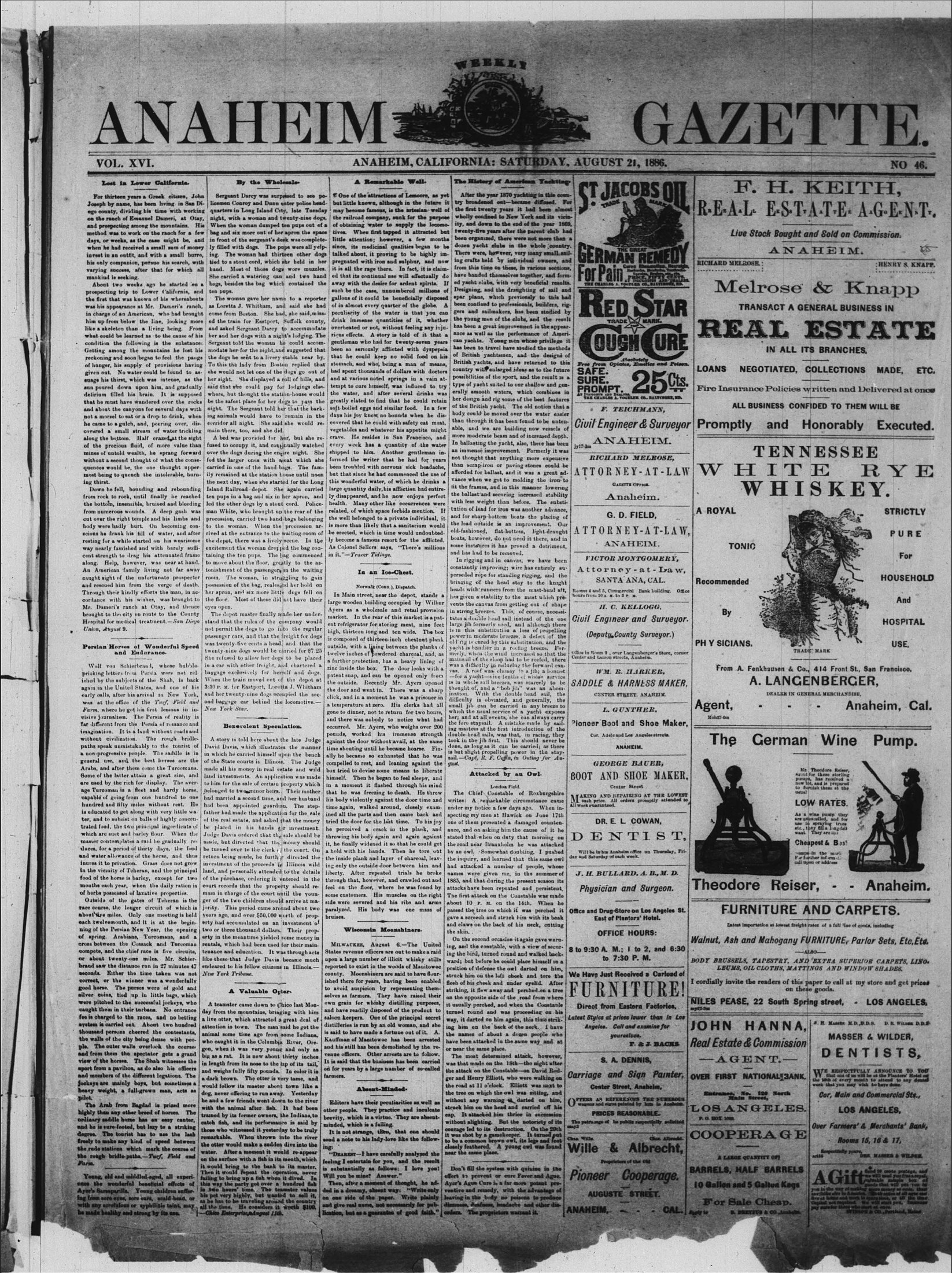
Searchable text
ANAHEIM
VOL. XVI.
Lost in Lower California.
For thirteen years a Greek citizen, John Joseph by name, has been living in San Diego county, dividing his time with working on the ranch of Emanuel Dameri, at Otay, and prospecting among the mountains. His method was to work on the ranch for a few days, or weeks, as the case might be, and when he had received a small sum of money invest in an outfit, and with a small burro, his only companion, pursue his search, with varying success, after that for which all mankind is seeking.
About two weeks ago he started on a prospecting trip to Lower California, and the first that was known of his whereabouts was his appearance at Mr. Dameri's ranch, in charge of an American, who had brought him up from below the line, looking more like a skeleton than a living being. From what could be learned as to the cause of his condition the following is the substance: Getting among the mountains he lost his reckoning and soon began to feel the paigs of hunger, his supply of provisions having given out. No water could be found to assuage his thirst, which was intense, as the sun poured down upon him, and gradually delirium filled his brain. It is supposed that he must have wandered over the rocks and about the canyons for several days with not a morsel to eat or a drop to drink, when he came to a gulch, and peering over, discovered a small stream of water trickling along the bottom. Half crazed at the sight of the precious fluid, of more value than mines of untold wealth, he sprang forward without a second thought of what the consequences would be, the one thought uppermost being to enench the intolerable burn.
By the Wholesale.
Sergeant Darcy was surprised to see policemen Conroy and Dunn enter police headquarters in Long Island City, late Tuesday night, with a woman and twenty-nine dogs. When the woman dumped ten pups out of a bag and six more out of her apron the space in front of the sergeant's desk was completely filled with dogs. The pups were all yelping. The woman had thirteen other dogs tied to a stout cord, which she held in her hand. Most of those dogs wore muzzles. She carried a watering can and two hand bags, besides the bag which contained the ten pups.
The woman gave her name to a reporter as Loretta J. Whitham, and said she had come from Boston. She had, she said, missed the train for Eastport, Suffolk county, and asked Sergeant Darcy to accommodate her and her dogs with a night's lodging. The Sergeant told the woman he could accommodate her for the night, and suggested that the dogs be sent to a livery stable near by. To this the lady from Boston replied that she would not let one of the dogs go out of her sight. She displayed a roll of bills, and said that she could pay for lodgings elsewhere, but thought the station-house would be the safest place for her dogs to pass the night. The Sergeant told her that the barking animals would have to remain in the corridor all night. She said she would remain there, too, and she did.
A bed was provided for her, but she refused to occupy it, and continually watched over the dogs during the entire night. She fed the larger ones with meat which she carried in one of the hand-bags. The family remained at the station house until noon.
One of but little may become the railroad of obtain tives. W little attained since it talked alopecrion; gentleman been so that he stomach had spent and at vain tempt to die; the water greatly elicited soft-boiled days his jersey covered the vegetable crave. He every week shipped them formed tha been troubled but that a
sauge his thirst, which was intense, as the sun poured down upon him, and gradually delirium filled his brain. It is supposed that he must have wandered over the rocks and about the canyons for several days with not a morsel to eat or a drop to drink, when he came to a gulch, and, peering over, discovered a small stream of water trickling along the bottom. Half crazed at the sight of the precious fluid, of more value than mines of untold wealth, he sprang forward without a second thought of what the consequences would be, the one thought uppermost being to quench the intolerable, burning thirst.
Down he fell, bounding and rebounding from rock to rock, until finally he reached the bottom, insensible, bruised and bleeding from numerous wounds. A deep gash was cut over the right temple and his limbs and body were badly hurt. On becoming conscious he drank his fill of water, and after resting for a while started on his wearisome way nearly famished and with barely sufficient strength to drag his attenuated frame along. Help, however, was near at hand. An American family living not far away caught sight of the unfortunate prospector and rescued him from the verge of death. Through their kindly efforts the man, in accordance with his wishes, was brought to Mr. Dameri's ranch at Otay, and thence brought to the city en route to the County Hospital for medical treatment. — San Diego Union, August 9.
Persian Horses of Wonderful Speed and Endurance.
Wolf von Schierbrand, whose bubble-pricking letters from Persia were not relished by the subjects of the Shah, is back again in the United States, and one of his early calls, after his arrival in New York, was at the office of the Turf Field and Farm, where he got his first lessons in incisive journalism. The Persia of reality is far different from the Persia of romance and imagination. It is a land without roads and without civilization. The rough bridle-paths speak unmistakably to the tourist of a non-progressive people. The saddle is in general use, and the best horses are the Arabs, and after them come the Turcomans. Some of the latter attain a great size, and are used by the rich for display. The average Turcoman is a fleet and hardy horse, capable of going from one hundred to one hundred and fifty miles without rest. He is educated to get along with very little water, and to subsist on balls of highly concentrated food, the two principal ingredients of which are suet and barley flour. When the masser contemplates a raid he gradually reduces, for a period of thirty days, the food and water allowance of the horse, and thus inures it to privation. Grass does not grow in the vicinity of Teheran, and the principal food of the horse is barley, except for two months each year, when the daily ration is of herbs possessed of laxative properties.
Benevolent Speculation.
A story is told here about the late Judge David Davis, which illustrates the manner in which he carried himself upon the bench of the State courts in Illinois. The Judge made all his money in real estate and wild land investments. An application was made to him for the sale of certain property which belonged to two minor heirs. Their mother had married a second time, and her husband had been appointed guardian. The stepfather had made the application for the sale of the real estate, and asked that the money be placed in his hands for investment. Judge Davis ordered that the sale should be made, but directed that the money should be turned over to the clerk of the court. On return being made, he further directed the investment of the proceeds to Illinois wild land, and personally attended to the details of the purchase, ordering it entered in the court records that the property should remain in charge of the court until the youngest person can take care of it.
In Main large wood Ayers as market. In ent refrigerator high, thirty is composed outside, with twelve inclining a further p zinc inside patent snaps the outside door and click, and in a temperate gone to dine and there occurred pounds, we against these time shout ally he became compelled a box tried to himself. T in a moment that he was his body vi time again, inined all the tried the do he perceive throwing hit it, he finally a hold with the inside p ing only the liberty. A through that feel on the some custom
capable of going from one hundred to one hundred and fifty miles without rest. He is educated to get along with very little water, and to subsist on balls of highly concentrated food, the two principal ingredients of which are suet and barley flour. When the master contemplates a raid he gradually reduces, for a period of thirty days, the food and water allowance of the horse, and thus inures it to privation. Grass does not grow in the vicinity of Teheran, and the principal food of the horse is barley, except for two months each year, when the daily ration is of herbs possessed of laxative properties.
Outside of the gates of Teheran is the race course, the longer circuit of which is about five miles. Only one meeting is held each twelfemonth, and it is at the beginning of the Persian New Year, the opening of spring. Arabians, Turcomans, and a cross between the Cossack and Turcoman compete, and the chief race is five circuits, or about twenty-one miles. Mr. Schierbrand saw the distance run in 27 minutes 47 seconds. Either the time taken was not correct, or the winner was a wonderfully good horse. The purses were of gold and silver coins, tied up in little bags, which were pitched to the successful jockeys, who caught them in their turbans. No entrance fee is charged to the races, and no betting system is carried out. About two hundred thousand persons cheered the contestants, the walls of the city being dense with people. The outer walls overlook the courses and from them the spectator gets a grand view of the horses. The Shah witnesses the sport from a pavilion, as do also his officers and members of the different legations. The jockeys are mainly boys, but sometimes a heavy weight, a full-grown man, acts as pilot.
The Arab from Bagdad is prized more highly than any other breed of horses. The ordinary saddle horse has an easy canter, and he is sure-footed, but lazy to a striking degree. The tourist has to use the lash freely to make any kind of speed between the rude stations which mark the course of the rough bridle-paths.—Turf, Field and Farm.
Young, old and middled-aged, all experiences the wonderful beneficial effects of Ayer's Sarsaparilla. Young children suffering from sore eyes, sore ears, scald-head, or with any sorrowful or syphilitic taint, may be made healthy and strong by its use.
The stepfather had made the application for the sale of the real estate, and asked that the money be placed in his hands for investment. Judge Davis ordered that the sale should be made, but directed that the money should be turned over to the clerk of the court. On return being made, he further directed the investment of the proceeds in Illinois wild land, and personally attended to the details of the purchase, ordering it entered in the court records that the property should remain in charge of the court until the younger of the two children should arrive at majority. This period came around about two years ago, and over $50,000 worth of property had accumulated on an investment of two or three thousand dollars. Their property in the meantime yielded some money in rentals, which had been used for their maintenance and education. It was through acts like these that Judge Davis became much endeared to his fellow citizens in Illinois.—New York Tribune.
A Valuable Otter
A teamster came down to Chico last Monday from the mountains, bringing with him a live otter, which attracted a great deal of attention in town. The man said he got the animal some time ago from some Indians, who caught it in the Columbia River, Oregon, when it was very young and only as big as a rat. It is now about thirty inches in length from its nose to the tip of its tail, and weighs fully fifty pounds. In color it is a dark brown. The otter is very tame, and would follow its master about town like a dog, never offering to run away. Yesterday he and a few friends went down to the river with the animal after fish. It had been trained by its former owners, the Indians, to catch fish, and its performance is said by those who witnessed it yesterday to be truly remarkable. When thrown into the river the otter would make a sudden dive into the water. After a moment it would re-apparent on the surface with a fish in its mouth, which it would bring to the bank to its master. Then it would repeat the operation, never failing to bring up a fish when it dived. In this way the party got over a hundred fish in two hours' time. The teamster values his pet very highly, but wanted to sell it, as he has to be traveling around the country all the time. He considers it worth $100.
—Chico EnterpriseAugust 11th.
WEEKLY
EIM
ANAHEIM, CALIFORNIA: SATURDAY, AUGUST 21, 1886.
A Remarkable Well
One of the attractions of Lemoore, as yet but little known, although in the future it may become famous, is the artesian well of the railroad company, sunk for the purpose of obtaining water to supply the locomotives. When first tapped it attracted but little attention; however, a few months since, its medicinal qualities began to be talked about, it proving to be highly impregnated with iron and sulphur, and now it is all the rage there. In fact, it is claimed that its continual use will effectually do away with the desire for ardent spirits. If such be the case, unnumbered millions of gallons of it could be beneficially disposed of in almost every quarter of the globe. A peculiarity of the water is that you can drink immense quantities of it, whether overheated or not, without feeling any injurious effects. A story is told of it that a gentleman who had for twenty-seven years been so seriously afflicted with dyspepsia that he could keep no solid food on his stomach, and who, being a man of means, had spent thousands of dollars with doctors and at various noted springs in a vain attempt to cure himself, was induced to try the water, and after several drinks was greatly elated to find that he could retain soft-boiled eggs and similar food. In a few days his joy knew no bounds when he discovered that he could with safety eat meat, vegetables and whatever his appetite might crave. He resides in San Francisco, and every week has a quantity of the water shipped to him. Another gentleman informed the writer that he had for years been troubled with nervous sick headache, but that since he had commenced the use of
The History of American Yachting
After the year 1870 yachting in this country broadened out—became diffused. For the first twenty years it had been almost wholly confined to New York and its vicinity, and down to the end of the year 1869, twenty-five years after the parent club had been organized, there were not more than a dozen yacht clubs in the whole country. There were, however, very many small sailing crafts held by individual owners, and from this time on these, in various sections, have banded themselves together, and formed yacht clubs, with very beneficial results. Designing, and the draughting of sail and spar plans, which previously to this had been confined to professionals, builders, riggers and sailmakers, has been studied by the young men of the clubs, and the result has been a great improvement in the appearance as well as the performance of American yachts. Young men whose privilege it has been to travel have studied the methods of British yachtsmen, and the designs of British yachts, and have returned to this country with enlarged ideas as to the future possibilities of the sport, and the result is a type of yacht suited to our shallow and generally smooth waters, which combines in her design and rig some of the best features of the British yacht. The old notion that a body could be moved over the water easier than through it has been found to be untenable, and we are building now vessels of more moderate beam and of increased depth. In ballasting the yacht, also, there has been an immense improvement. Formerly it was not thought that anything more expensive than scrap iron or paving stones could be afforded for ballast, and it was a great ad-
and at various noted springs in a vain attempt to cure himself, was induced to try the water, and after several drinks was greatly elated to find that he could retain soft-boiled eggs and similar food. In a few days his joy knew no bounds when he discovered that he could with safety eat meat, vegetables and whatever his appetite might crave. He resides in San Francisco, and every week has a quantity of the water shipped to him. Another gentleman informed the writer that he had for years been troubled with nervous sick headache, but that since he had commenced the use of this wonderful water, of which he drinks a large quantity daily, his affliction had entirely disappeared, and he now enjoys perfect health. Many other like occurrences were related, of which space forbids mention. If the well belonged to a private individual, it is more than likely that a sanitarium would be erected, which in time would undoubtedly become a famous resort for the afflicted. As Colonel Sellers says, "There's millions in it."—Tracer Tidings.
In an Ice-Chest.
Norwalk (Conn.), Dispatch.
In Main street, near the depot, stands a large wooden building occupied by Wilbur Ayers as a wholesale and retail provision market. In the rear of this market is a patient refrigerator for storing meat, nine feet high, thirteen long and ten wide. The box is composed of thirteen-inch chestnut plank outside, with a lining between the planks of twelve inches of powdered charcoal, and, as a further protection, has a heavy lining of zinc inside the box. The door looks with a patent snap, and can be opened only from the outside. Recently Mr. Ayers opened the door and went in. There was a sharp click, and in a moment he was a prisoner in a temperature at zero. His clerks had all gone to dinner, not to return for two hours, and there was nobody to notice what had occurred. Mr. Ayers, who weighs over 200 pounds, worked his immense strength against the door without avail, at the same time shouting until he became hoarse. Finally he became so exhausted that he was compelled to rest, and leaning against the box tried to devise some means to liberate himself. Then he began to feel sleepy, and in a moment it flashed through his mind that he was freezing to death. He threw his body violently against the door time and time again, walked around, closely examined all the parts and then came back and tried the door for the last time. To his joy he perceived a crack in the plank, and throwing his body again and again against it, he finally widened it so that he could get a hold with his hands. Then he tore out the inside plank and layer of charcoal, leaving only the outside door between him and liberty. After repeated trials he broke through that, however, and crawled out and feel on the floor, where he was found by some customers. His muscles on the right possibilities of the sport, and the result is a type of yacht suited to our shallow and generally smooth waters, which combines in her design and rig some of the best features of the British yacht. The old notion that a body could be moved over the water easier than through it has been found to be untenable, and we are building now vessels of more moderate beam and of increased depth. In ballasting the yacht, also, there has been an immense improvement. Formerly it was not thought that anything more expensive than scrap iron or paving stones could be afforded for ballast, and it was a great advance when we got to molding the iron to fit the frames, and in this manner lowering the ballast and securing increased stability with less weight than before. The substitution of lead for iron was another advance, and for sharp-bottom boats the placing of the lead outside is an improvement. Our old-fashioned, flat-bottom, light-draught boats, however, do not need it there, and in some instances it has proved a detriment, and has had to be removed.
In rigging and in canvas, we have been constantly improving; wire has entirely superseded rope for standing rigging, and the bringing of the head stay to the knight heads with runners from the mast-head aft, has given a stability to the mast which prevents the canvas from getting out of shape in strong breezes. This, of course, necessitates a double-head sail instead of the one large jib formerly used, and although there is in this substitution a loss of propelling power in moderate breezes, a defect of the old rig is cured by this substitution, and the yacht is handier in a roofing breeze. Formerly, when the wind increased so that the mainsail of the sloop had to be reefed, there was difficulty in reducing the forward canvas. A reef was clamsy in a jib; a bonnet for a yacht—nine tenths of whose service is in whole sail breezes, was scarcely to be thought of, and a "bob jib" was an abomination. With the double head sail, the difficulty is obviated, and generally, the small jib can be carried in any breeze to which the usual service of a yacht exposes her; and at all events, she can always carry the fore staysail. A mistake-made by sailing masters at the first introduction of the double head sails, was that, in racing, they took in the jib first. This should never be done, as long as it can be carried; as there is but slight propelling power in the staysail.—Capt. R. F. Coffin, in Outing for August.
Attacked by an Owl.
London Field.
The Chief Constable of Roxburgshire writes: A remarkable circumstance came under my notice a few days ago. When inspecting my men at Hawick on June 17th one of them presented a damaged countenance, and on asking him the cause of it he stated that when on duty that morning on the road near Branxholm he was attacked by an owl. Somewhat doubling I pushed the inquiry, and learned that this same owl had attacked a number of people, whose names were given me, in the summer of 1885, and that during the present season its attacks have been repeated and persistent. The first attack on the Constable was made
his body violently against the door time and time again, walked around, closely examined all the parts and then came back and tried the door for the last time. To his joy he perceived a crack in the plank, and throwing his body again and again against it, he finally widened it so that he could get a hold with his hands. Then he tore out the inside plank and layer of charcoal, leaving only the outside door between him and liberty. After repeated trials he broke through that, however, and crawled out and feel on the floor, where he was found by some customers. His muscles on the right side were severed and his ribs and arms paralyzed. His body was one mass of bruises.
Wisconsin Moonshiners.
Milwaukee, August 6.—The United States revenue officers are out to make a raid upon a large number of illicit whisky stills reported to exist in the woods of Manitowoc county. Moonshiners are said to have flourished there for years, having been enabled to avoid suspicion by representing themselves as farmers. They have raised their own grain for whisky distilling purposes, and have readily disposed of the product to saloon keepers. One of the principal secret distilleries is run by an old woman, and she is said to have made a fortune out of it. A Kauffman of Manitowoc has been arrested and his still has been demolished by the revenue officers. Other arrests are to follow. It is said that the business has been carried on for years by a large number of so-called farmers.
Absent-Minded-
Editors have their peculiarities as well as other people. They practice and inculcate brevity, which is a virtue. They are absent-minded, which is a failing.
It is not strange, then, that one should send a note to his lady-love like the following:
"DEAREST—I have carefully analyzed the feeling I entertain for you, and the result is substantially as follows: I love you! Will you be mine? Answer."
Then, after a moment of thought, he added in a dreamy, absent way: "Write only on one side of the paper. Write plainly and give real name, not necessarily for publication, but as a guarantee of good faith."
On the second occasion it again gave warning, and the constable, with a view of securing the bird, turned round and walked backward; but before he could place himself in a position of defense the owl darted on him, struck him on the left cheek and tore the flesh of his cheek and under eyelid. After striking, it flew away and perched on a tree on the opposite side of the road from where it usually perched, and when the Constable turned round and was proceeding on his way, it darted on him again, this time striking him on the back of the neck. I have the names of about a dozen people who have been attacked in the same way and at or near the same place.
The most determined attack, however, was that made on the 18th—the night after the attack on the Constable—on David Rodger and Henry Elliott, who were walking on the road at 11 o'clock. Elliott was next to the tree on which the owl was sitting, and without any warning it darted on him, struck him on the head and carried off his cap. It attacked him thrice in succession without alighting. But the notoriety of its courage led to its destruction. On the 20th it was shot by a gamekeeper. It turned out to be a common brown owl, its legs and feet closely feathered. A young owl was found near the same place.
Don’t fill the system with quinine in the effort to prevent or cure Fever and Ague. Ayer’s Ague Cure is a far more potent preventive and remedy, with the advantage of leaving in the body no poisons to produce distress, deafness, headache and other disorders. The proprietors warrant it.
GAZETTE.
AUGUST 21, 1886.
NO 46.
F. H. KEITH,
REAL ESTATE AGENT.
Live Stock Bought and Sold on Commission.
ANAHEIM.
RICHARD MELROSE:
HENRY S. KNAPP.
Melrose & Knapp
TRANSACT A GENERAL BUSINESS IN
REAL ESTATE
IN ALL ITS BRANCHES.
LOANS NEGOTIATED, COLLECTIONS MADE, ETC.
Fire Insurance Policies written and Delivered at once
ALL BUSINESS CONFIDED TO THEM WILL BE
Promptly and Honorably Executed.
TENNESSEE
WHITE RYE
F. TEICHMANN,
Engineer & Surveyor
ANAHEIM.
RICHARD MELROSE,
BORNEY-AT-LAW
GALETTE OFFICE.
Anaheim.
G. D. FIELD,
BORNEY-AT-LAW,
ANAHEIM.
STORER MONTGOMERY,
BORNEY-AT-LAW,
SANTA ANA, CAL.
H. C. KELLOGG.
Engineer and Surveyor.
(Deputy County Surveyor.)
WM. R. HARKER,
E & HARNESS MAKER,
CENTER STREET. ANAHEIM.
L. GUNTHER.
Boot and Shoe Maker.
r. Adele and Los Angeles streets.
GEORGE BAUER,
AND SHOE MAKER.
Center Street
AND REPAIRING AT THE LOWEST
price. All orders promptly attended to
guaranteed.
DR. E. L COWAN,
ENTIST,
in his Anaheim office on Thursday, Friday
of each week.
BULLARD, A. B., M. D.
Medician and Surgeon.
Fire Insurance Policies written and Delivered at once
ALL BUSINESS CONFIDED TO THEM WILL BE
Promptly and Honorably Executed.
TENNESSEE
WHITE RYE
WHISKEY.
A ROYAL
STRICTLY
PURE
TONIC
For
Recommended
By
HOUSEHOLD
And
PHYSICIANS.
TRADE MARK
From A. Fenkhausen & Co., 414 Front St., San Francisco.
A. LANGENBERGER,
DEALER IN GENERAL MERCHANDISE.
Agent, - - Anaheim, Cal.
Meh27-Gm
The German Wine Pump.
Mr. Theodore Reiser,
screw for these sterling pumps, has received a new lot, and is prepared to furnish them at the usual
LOW RATES.
As a wine pump they are unexcelled, and for use in spraying trees etc., they fill a long-felt want. They are the Cheapest & Best pumps in the market.
For further information call upon or address
Theodore Reiser, - - Anaheim.
DR. E. L COWAN,
ENTIST,
in his Anaheim office on Thursday, Friday
BULLARD, A. B., M. D.
ician and Surgeon.
Drug-Store on Los Angeles St.
East of Planters' Hotel.
OFFICE HOURS:
A. M.; 1 to 2, and 6:30
to 7:30 P. M.
Just Received a Carload of
FURNITURE!
from Eastern Factories,
les at prices lower than in Los
les. Call and examine for
youreelves.
P. & J. BACKS
S. A. DENNIS,
and Sign Painter,
enter Street, Anaheim,
REFERENCES THE NUMEROUS
and signs painted by him in Anaheim.
PRICES REASONABLE.
age of the public respectfully solicited
Chas. Albrecht.
Proprietors of the Old
Peer Cooperage.
GUSTE STREET.
IM, CAL.
LOW RATES.
As a wine pump they
are unexcelled, and for
use in spraying trees
etc., they fill a long-felt
want. They are the
Cheapest & Best
compes in the market.
For further informacall upon or address
Theodore Reiser, - - Anaheim.
FURNITURE AND CARPETS.
Latest importation at lowest freight rates of a full line of goods, including
Walnut, Ash and Mahogany FURNITURE, Parlor Sets, Etc., Etc.
ALSO—
BODY BRUSSELS, TAPESTRY, AND EXTRA SUPERIOR CARPETS, LINOLEUMS, OIL CLOTHS, MATTINOS AND WINDOW SHADE.
I cordially invite the readers of this paper to call at my store and get prices
on these goods.
NILES PEASE, 22 South Spring street, - LOS ANGELES,
my62-0m
JOHN HANNA,
Real Estate & Commission
AGENT.
OVER FIRST NATIONAL BANK.
Entrance, No. 120 North
Main Street,
LOS ANGELES.
P.O. BOX 1098.
COOPERAGE
A LARGE QUANTITY OF]
BARRELS, HALF BARRELS
10 Gallon and 5 Gallon Kegs
For Sale Cheap.
Apply to R. DREYFUS & CO., Anaheim.
MASSER & WILDER,
DENTISTS,
WE RESPECTFULLY ARNOUNCE TO YOU
that one of us will be at the Planters' Hotel on
the 16th of every month to attend to any dental
work that you may wish to have done.
Cor, Main and Commercial Sts..
LOS ANGELES,
Over Farmers' & Merchants' Bank,
Rooms 15, 16 & 17,
Respectfully yours,
DES. MASSER & WILDER.
AGift
Hand 10 cents postage, and we will mail you from our loyal,
valuable sample box of goods that will put you in
you in the way of making more money as once, thus
everybler else in America. With some of all open cast
River at home and work in spare time, or all the time
Capital not required. We will start you. Immediate
pay sure for them who start at once.
MINDS & CO., Portland, Maine