anaheim-gazette 1886-08-14
Scanned page
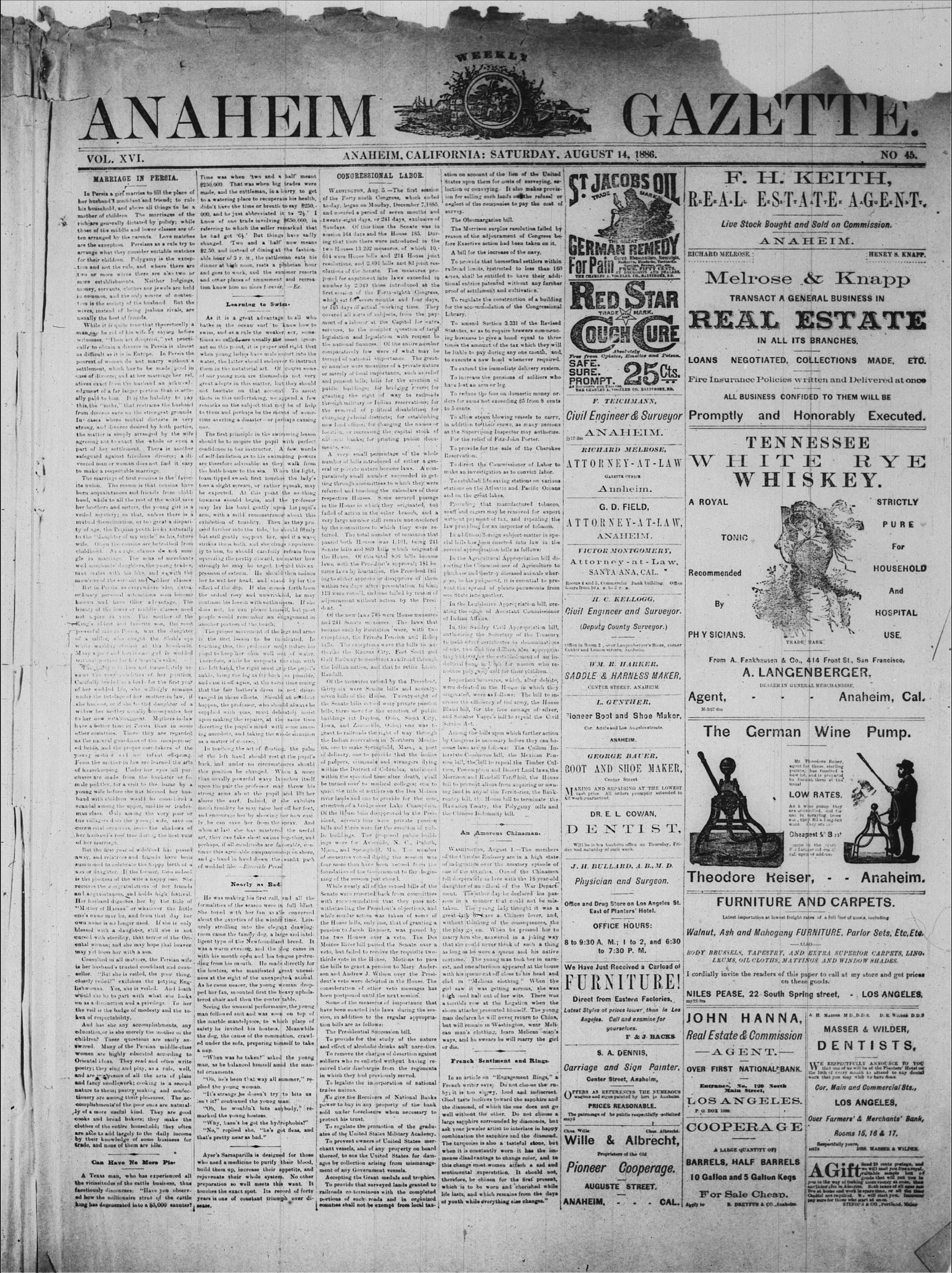
Searchable text
MARRIAGE IN PERSIA.
In Persia a girl marries to fill the place of her husband's confidant and friend; to rule his household, and above all things to be a mother of children. The marriages of the rich are generally dictated by policy; while those of the middle and lower classes are often arranged by the parents. Love matches are the exception. Persians as a rule try to arrange what they consider suitable matches for their children. Polygamy is the exception and not the rule, and where there are two or more wives there are also two or more establishments. Neither lodgings, money, servants, clothes nor jewels are held in common, and the only source of contention is the society of the husband. But the wives, instead of being jealous rivals, are usually the best of friends.
While it is quite true that theoretically a man can be rid of his wife by saying before witnesses, "Thou art divorced," yet practically to obtain a divorce in Persia is almost as difficult as it is in Europe. In Persia the poorest of women do not marry without a settlement, which has to be made good in case of divorce; and at her marriage her relatives exact from the husband an acknowledgment of a far larger portion than is actually paid to him. It is the liability to pay this, the "mehr," that restrains the husband from divorce save on the strongest grounds. In cases where mutual distaste is very strong, and divorce desired by both parties, the matter is simply arranged by the wife agreeing not to exact the whole or even a part of her settlement. There is another safeguard against frivolous divorce; a divorced man or woman does not find it easy to make a respectable marriage.
Time was when 'two and a half' meant $250,000. That was when big trades were made, and the cattleman, in a hurry, to get to a watering place to recuperate his health, didn't have the time or breath to say $250,000, and he just abbreviated it to '2½.' I know of one trade involving $650,000, in referring to which the seller remarked that he had got '6½.' But things have sally changed. Two and a half now means $2.50, and instead of dining at the fashionable hour of 3 p.m., the cattleman eats his dinner at high noon, rests a plbeian hour and goes to work, and the summer resorts and other places of amusement and recreation know him no more forever. — Ez.
Learning to Swim.
As it is a great advantage to all who bathe in the ocean surf to know how to swim, and as a rule the weaker sex, sometimes so called are usually the most ignorant on this point, it is proper and right that when young ladies have male escort into the water, the latter should endeavor to instruct them in the natatorial art. Of course some of our young men are themselves not very great adepts in this matter, but they should not hesitate on that account. To assist them in this undertaking, we append a few remarks on the subject that may be of help to them and perhaps be the means of sometime averting a disaster—or perhaps causing one.
The first principle in the swimming lesson should be to inspire the pupil with perfect confidence in her instructor. A few words of self-landauation as to his swimming powers are therefore advisable: as they walk from the bath-house to the sea. When the light,
CONGRESS
WASHINGTON OF THE FORTY-TWO TO DAY, BEGAN AND COVERED TWENTY-EIGHT SUNDAYS. On session 164 diving that time two Houses 614 were Home resolutions, collections of the posed for enquiry number by first session which sat for 9 or 165 days covered all aspects of lab services, to legislation at the national comparative termed of navy number ww or merely of land and pension public building granting through military removal changing jurisdiction new land office location, or national banements etc.
A very small number of bishops or private
The marriage of first cousins is the favorite union. The reason is that cousins have been acquaintances and friends from childhood, while to all the rest of the world, save her brothers and sisters, the young girl is a veiled mystery; so that, unless there is a mutual disinclination, or to great a disparity of age, the Pusian youth looks naturally to the "daughter of my uncle" as his future wife. Often the cousins are betrothed from childhood. As a rule, clauses do not mingle in marriage. The sens of merchants wel merchandise daughters, the young tradesman makes with his like, and so with the members of the servant and soldier classes.
But in Persia, as everywhere else, extraordinary personal attractions soon become known and have their advantage. The beauty of this lower or middle classes need not arise in vain. The mother of the King's eldest and favorite son, the most powerful man in Persia, was the daughter of a miller, who caught the Shad's eye while washing clothes at this brookside. May a poor and handsome girl be wedded without portion for her beauty's sake.
The marriage does not immediately assume the real abilities of her position. Carefully suited as a bride for the first year of her wedding life, she willingly remains under the tutelage of her mother-in-law, if she has one, or if she is the daughter of a widow her mother usually accompanies her to her new establishment. Mothers in-law have a better time in Persia than in some other countries. There they are regarded as the natural guardians of the mexperienced bride, and the proper care-takers of the young mother and her infant offspring. From the mother-in-law are learned the arts of housekeeping. Under her eyes all purchases are made from the huckster or female pedlter, for a visit to the bazar by a young wife before she was blessed her husband with children would be considered a scandal among the upper, middle or tradesman class. Only among the very poor or the villagers does the young wife, save on ceremonial occasions, leave the shadows of her husband's roof tree during the first year of her marriage.
But the first year of wifhood has passed away, and relatives and friends have been summoned to celebrate the happy birth of a son or daughter. If the former, then indeed is the position of the wife a happy one. She receives the congratulations of her friends and acquaintances, and holds high festival.
Nearly as Bad:
He was making his first call, and all the young men are themselves not very great adepts in this matter, but they should not hesitate on that account. To assist them in this undertaking, we append a few remarks on the subject that may be of help to them and perhaps be the means of sometime averting a disaster—or perhaps causing one.
The first principle in the swimming lesson should be to inspire the pupil with perfect confidence in her instructor. A few words of self-landation as to his swimming powers are therefore advisable as they walk from the bath-house to the sea. When the light, foam-tipped swash first touches the lady's toes a slight scream, or rather squeak, may be expected. At this point the soothing business should begin, and the professor may lay his hand gently upon his pupil's arm, with a mild remonstrance about this exhibition of timidity. Then as they proceed further into the tide, he should firmly but still gently support her, and it a wave strikes them both, and she clings impulsively to him, he should carefully refrain from squeezing the pretty coward, no matter how strongly he may be urged toward this expression of esteem. He should then induce her to wet her head, and stand by for the effect of the dip. If she comes forth from the ordeal rosy and unwrinkled, he may continue his lesson with enthusiasm. If she does not, he can please himself, but most people would remember an engagement in another portion of the beach.
The proper movement of the legs and arms is the first lesson to be indicated. In teaching this, the professor must induce his pupil to keep her chin well out of water. Therefore, while he supports the chin with the left hand, the right must grip the pupil's ankle, bring the leg as far back as possible, and ease it off again, at the same time seeing that the fair bather's dress is not disarranged in these efforts. Should an accident happen, the professor, who should always be supplied with pins, must deliberately insist upon making the repairs, at the same time diverting the pupil's mind with some amusing anecdote, and taking the whole situation as a matter of course.
In teaching the art of floating, the palm of the left hand should rest at the pupil's back, and under no circumstances should this position be changed. When a more than usually powerful wave launches itself upon the pair the professor may throw strong arms about the pupil and lift her above the surf. Indeed, it she exhibits much timidity he may raise her off her feet, and encourage her by showing her now easily he can save her from the spray. And when at last she has mastered the useful art, they can take short swims together, and perhaps if all conditions are favorable, continue this agreeable companionship on shore, and go hand in hand down the sunlit path of wadded life.
Nearly as Bad:
He was making his first call, and all
Bat the first year of wifelihood has passed away, and relatives and friends have been summoned to celebrate the happy birth of a son or daughter. If the former, then indeed is the position of the wife a happy one. She receives the congratulations of her friends and acquaintances, and holds high festival. Her husband dignifies her by the title of "Mother of Hassan" or whatever the little one's name may be, and from that day her own name is no longer used. If she is only blessed with a daughter, still she is not cursed with sterility, that terror of the Oriental woman; and she may hope that heaven may yet bless her with a son.
Consulted in all matters, the Persian wife is her husband's trusted confidant and counselor. "But she is veiled, the poor thing, closely veiled!" exclaims the pitying Englishwoman. Yes, she is veiled. And loath would she be to part with what she looks on as a distinction and a privilege. To her the veil is the badge of modesty and the token of respectability.
And has she any accomplishments, any education, or is she merely the mother of the children? These questions are easily answered. Many of the Persian middle-class women are highly educated according to Oriental ideas. They read and often write poetry; they sing and play, as a rule, well, and are professors of all the arts of plain and fancy needlework; cooking is a second nature to them; pastry making and confectionery are among their pleasures. The accomplishments of the poor ones are naturally of a more useful kind. They are good cooks and bread bakers; they make the clothes of the entire household; they often are able to aid largely to the daily income by their knowledge of some business for trade, and none of them are idle.
Can Have No More Pie?
A Texas man, who has experienced all the vicissitudes of the cattle business, thus facetiously discourses: "Have you observed how the millionaire strut of the cattle king has degenerated into a $5,000 saunter!"
Nearly as Bad:
He was making his first call, and all the formalities of the season were in full blast. She towed with her fan as she conversed about the gayeties of the winter time. Leisurely strolling into the elegant drawing-room came the family dog, a large and intelligent type of the Newfoundland breed. It was a warm evening, and the dog came in with his mouth open and his tongue protruding from his mouth. He made directly for the hostess, who manifested great uneasiness at the sight of the unexpected animal. As he came nearer, the young woman dropped her fan, mounted first the heavy upholstered chair and then the center table.
Seeing the unusual performance, the young man followed suit and was soon on top of the marble mantelpiece, to which place of safety he invited his hostess. Meanwhile the dog, the cause of the commotion, crawled under the sofa, preparing himself to take a nap.
"When was he taken?" asked the young man, as he balanced himself amid the mantel ornaments.
"Oh, he's been that way all summer," replied the young woman.
"It's strange he doesn't try to bite us isn't it?" continued the young man.
"Oh, he wouldn't bite anybody," remarked the young hostess.
"Why, hasn't he got the hydrophobia?"
"No," replied she, "he's got fleas, and that's pretty near as bad."
Ayer's Sarsaparilla is designed for those who need a medicine to purify their blood, build them up, increase their appetite, and rejuvenate their whole system. No other preparation so well meets this want. It touches the exact spot. Its record of forty years is one of constant triumph over disease.
WEEKLY
ANAHEIM, CALIFORNIA: SATURDAY, AUGUST 14, 1886.
CONGRESSIONAL LABOR.
WASHINGTON, Aug. 5.—The first session of the Forty-ninth Congress, which ended to-day, began on Monday, December 7, 1885, and covered a period of seven months and twenty-eight days, or 241 days, exclusive of Sundays. Of this time the Senate was in session 164 days and the House 185. During that time there were introduced in the two Houses 13,292 measures, of which 10,014 were House bills and 214 House joint resolutions, and 2,891 bills and 83 joint resolutions of the Senate. The measures proposed for enactment into laws exceeded in number by 2,949 those introduced at the first session of the Forty-eighth Congress, which sat for seven months and four days, or 165 days of actual working time. They covered all sorts of subjects, from the payment of a laborer at the Capitol for extra services, to the complex question of tariff legislation and legislation with respect to the national finances. Of the entire number comparatively few were of what may be termed of national importance. The greater number were measures of a private nature or merely of local importance, such as relief and pension bills; bills for the erection of public buildings; for bridging rivers; for granting the right of way to railroads through military or Indian reservations; for the removal of political disabilities; for changing judicial districts; for establishing new land offices; for changing the names or location, or increasing the capital stock of national banks; for printing public documents, etc.
A very small percentage of the whole number of bills introduced of either a general or private nature became laws. A continuation on account of the lien of the United States upon them for costs of surveying, selection or conveying. It also makes provision for selling such lands on the refusal or neglect of the companies to pay the cost of survey.
The Oleomargarine bill.
The Morrison surplus resolution failed by reason of the adjournment of Congress before Exective action had been taken on it.
A bill for the increase of the navy.
To provide that homestead settlers within railroad limits, restricted to less than 160 acres, shall be entitled to have their additional entries patented without any further proof of settlement and cultivation.
To regulate the construction of a building for the accommodation of the Congressional Library.
To amend Section 3,331 of the Revised Statutes, so as to require brewers commencing business to give a bond equal to three times the amount of the tax which they will be liable to pay during any one month, and, to execute a new bond whenever required.
To extend the immediate delivery system.
To increase the pensions of soldiers who have lost an arm or leg.
To reduce the fees on domestic money orders for sums not exceeding $5 from 8 cents to 5 cents.
To allow steam blowing vessels to carry, in addition to their crews, as many persons as the Supervising Inspector may authorize.
For the relief of Fitz-John Porter.
To provide for the sale of the Cherokee Reservation.
To direct the Commissioner of Labor to make an investigation as to convict labor.
A few words using powers to walk from the light, uses the lady's squeak, may be soothing the professor on his pupil's face about this as they should family it a wave large impulsive refrain from matter howward this exertion induce and by for the cess forth from aid, he may ignam. If she self, but most engagement in legs and arms implicated. In might induce his out of water, the chin with grip the pupil's as possible, time seeing not disarranged an accident would always be carefully insist the same time with some amus- mole situation the palm at the pupil's finances should when a more branches itself throw his hand lift her exhibits off her feet, then now easily spray. And all the useful together, and favorable, consigns on shore, sunset path or merely of local importance, such as service and pension bills; bills for the erection of public buildings; for bridging rivers; for granting the right of way to railroads through military or Indian reservations; for the removal of political disabilities; for changing public districts; for establishing new land offices; for changing the names or location, or increasing the capital stock of national banks; for printing public documents, etc.
A very small percentage of the whole number of bills introduced of either a general or private nature became laws. A comparatively small number succeeded in getting through committees to which they were referred and touching the calendars of their respective Houses. Some secured passage in the House in which they originated, but failed of action in the other branch, and a very large number still remain unconsulered by the committees to which they were referred. The total number of measures that passed both Houses was 1,101, being 241 Senate bills and 869 bills which originated the House. Of this total 896 bills became laws, with the President's approval; 181 became laws by limitation, the President failing to either approve or disapprove of them within ten days after presentation to him; 113 were vetoed, and one failed by reason of adjournment without action by the President.
Of the new laws 746 were House measures and 241 Senate measures. The laws that became such by limitation were, with two exceptions, the Private Pension and Relief bills. The exceptions were the bills to authorize the Kansas City, Fort Scott and Gulf Railway to construct a railroad through the Indian nation, and that to retire Liech Randall.
Of the measures vetoed by the President, thirty-six were Senate bills and seventy-seven bills of the House. Twenty-eight of the Senate bills vetoed were private pension bills, three were for the erection of public buildings (at Dayton, Ohio, Sioux City, Iowa, and Zanesville, Ohio) one was to grant to railroads the right of way through the Indian reservation in Northern Montana, one to make Springfield, Mass., a port of delivery, one to provide that the bodies of palpers, criminals and strangers dying within the District of Columbia, unclaimed within the specified time after death, shall be turned over to medical colleges; one to quiet the title of settlers on the Des Moines river lands and one to provide for the construction of a bridge over Lake Champlain. Of the House bills disapproved by the President, seventy-four were private pension bills and three were for the erection of public buildings. The proposed public buildings were for Astorville, N. C., Palphh, Mion., and Springfield. Mo. The number of measures vetoed during the session was four more than have been vetoed from the foundation of the Government to the beginning of the session just closed.
While nearly all of the vetoed bills of the Senate were reported back from committees to increase the pensions of soldiers who have lost an arm or leg.
To reduce the fees on domestic money orders for sums not exceeding $5 from 8 cents to 5 cents.
To allow steam blowing vessels to carry, in addition to their crews, as many persons as the Supervise Inspector may authorize.
For the relief of Fitz-John Porter.
To provide for the sale of the Cherokee Reservation:
To direct the Commissioner of Labor to make an investigation as to convict labor.
To establish life-saving stations on various stations on the Atlantic and Pacific Oceans and on the great lakes.
Providing that manufactured tobacco, snuff and cigars may be removed for export without payment of tax, and repealing the law providing for an inspector of tobacco.
In addition foreign subject-matter in special bills has been enacted into law in the several appropriation bills as follows:
In the Agricultural Appropriation bill directing the Commissioner of Agriculture to purchase and destroy diseased animals where in his judgment, it is essential to prevent the spread of pleuro-pneumonia from one State into another.
In the Legislative Appropriation bill, creating office of Assistant Commissioner of Indian Affairs.
In the Sandry Civil Appropriation bill, authorizing the Secretary of the Treasury to issue silver certificates in denominations of one, two and five dollars; also appropriating $100,000 for the establishment of an industrial zone in Utah for women who rejoice poly-wax and for their children.
Important measures, which, after debate, were defeated in the House in which they originated, were as follows: The bill to increase the efficiency of the army, the House Bland bill, for the free coinage of silver, and Senator Vance's bill to repeal the Civil Service Act.
Among the bills upon which further action by Congress is necessary before they can become laws are as follows: The Cullom Interstate Commerce bill, the Mexican Pension bill, the bill to repeal the Timber Culture, Presemption and Desert Land laws, the Morrison and Randall Tariff bill, the House bill to prevent aliens from acquiring or owning land in any of the Territories, the Bankruptcy bill, the House bill to terminate the Hawaiian Treaty, the Polygamy bills and the Chinese Indemnity bill.
An Amorous Chinaman.
Washington, August 1.—The members of the Chinese Embassy are in a high state of indigestion over the amatory episode of one of the attaches. One of the Chinamen fell desperately in love with the 18 year-old daughter of an official of the War Department. The other day he declared his pass-
An Amorous Chinaman.
Washington, August 1.—The members of the Chinese Embassy are in a high state of indignation over the amatory episode of one of the attaches. One of the Chinamen fell desperately in love with the 18-year-old daughter of an official of the War Department. The other day he declared his passion in a manner that could not be mistaken. The young lady thought it was a great lack to have a Chinese lover, and without thinking of the consequences, she play go on. When he pressed her to marry him she answered in a joking way that she could never think of such a thing as long as he wore a quene and his native costume. The young man took her in earnest, and one afternoon appeared at the house with his quene cut off close to his head and clad in "Melican clothing." When the girl saw it was getting serious, she was frightened halt out of her wits. There was a terrible row at the Legation when the shorn attache presented himself. The young man declares he will never return to China, but will remain in Washington, wear Melican man's clothing, learn Melican man's ways, and he swears he will marry the girl or die.
French Sentiment and Rings.
In an article on "Engagement Rings," a French writer says: Do not choose the ruby; it is too sugary, loud and indiscreet. Good taste inclines toward the sapphire and the diamond, of which the one does not go well without the other. Do not choose a large sapphire surrounded by diamonds, but ask your jeweler artist to interlace in happy combination the sapphire and the diamond. The turquoise is also a tasteful stone, but when it is constantly worn it has immense disadvantage to change color, and to this change most women attach a sad and sentimental superstition. It should not, therefore, be chosen for the first present, which is to be worn and cherished while life lasts, and which remains from the days of youth while everything else changes."
GAZETTE.
JUST 14, 1886.
NO 45.
F. H. KEITH,
REAL ESTATE AGENT.
Live Stock Bought and Sold on Commission.
ANAHEIM.
RICHARD MELROSE:
HENRY S. KNAPP.
Melrose & Knapp
TRANSACT A GENERAL BUSINESS IN
REAL ESTATE
IN ALL ITS BRANCHES.
LOANS NEGOTIATED, COLLECTIONS MADE, ETC.
Fire Insurance Policies written and Delivered at once
ALL BUSINESS CONFIDED TO THEM WILL BE
Promptly and Honorably Executed.
TENNESSEE
WHITE RYE
WHICKEN
Fire Insurance Policies written and Delivered at once
ALL BUSINESS CONFIDED TO THEM WILL BE
Promptly and Honorably Executed.
TENNESSEE
WHITE RYE
WHISKEY.
A ROYAL
STRICTLY
PURE
TONIC
For
HOUSEHOLD
By
HOSPITAL
USE.
PHYSICIANS.
TRADE MARK
From A. Fenkhausen & Co., 414 Front St., San Francisco,
A. LANGENBERGER,
DEALER IN GENERAL MERCHANDISE.
Agent, Anaheim, Cal.
Mch27-6m
The German Wine Pump.
Mr. Theodore Reiser,
agent for these sterling pumps, has received a new lot, and is prepared to furnish them at the usual
LOW RATES.
As a wine pump they are uncoiled, and for use in spraying trees else, they fill a long-delt want. They are 30¢.
Cheapest & Best pumps in the market.
For larger inform call upon or address.
Theodore Keiser, - Anaheim.
Theodore Keiser, - Anaheim.
FURNITURE AND CARPETS.
Latest importation at lowest freight rates of a full line of goods, including
Walnut, Ash and Mahogany FURNITURE, Parlor Sets, Etc., etc.
Also body brussels, tapestry, and extra superior carpets, linens, leums, oil cloths, mattings and window shades.
I cordially invite the readers of this paper to call at my store and get prices on these goods.
NILES PEASE, 22 South Spring street, LOS ANGELES,
my 22-3m
JOHN HANNA,
Real Estate & Commission
AGENT.
OVER FIRST NATIONAL BANK.
Entrance No. 120 North Main Street,
LOS ANGELES.
P.O. BOX 1009.
COOPERAGE
A LARGE QUANTITY OF
BARRELS, HALF BARRELS
10 Gallon and 5 Gallon Kegs
For Sale Cheap.
Apply to B. DREYFUS & CO., Anaheim.
MASSER & WILDER,
DENTISTS,
We respectfully announce to you that one of us will be at the Planters' Hotel on the 10th of every month to attend to any dental work that you may wish to have done.
Cor, Main and Commercial 8ts., LOS ANGELES,
Over Farmers' & Merchants' Bank,
Rooms 15, 18 & 17.
Respectfully yours,
DRS. MASSER & WILDER.
AGift
Send 10 coins postage, and we will mail you free a royal, valuable sample lot of goods that will put you in your way of making more money as once, than anything else in America. Both sexes of all ages can live at home and work in spare time, or all the time Capital not required. We will start you. Immense pay sure for those who start at once.
STINSON & CO., Portland, Maine.