anaheim-gazette 1886-08-07
Scanned page
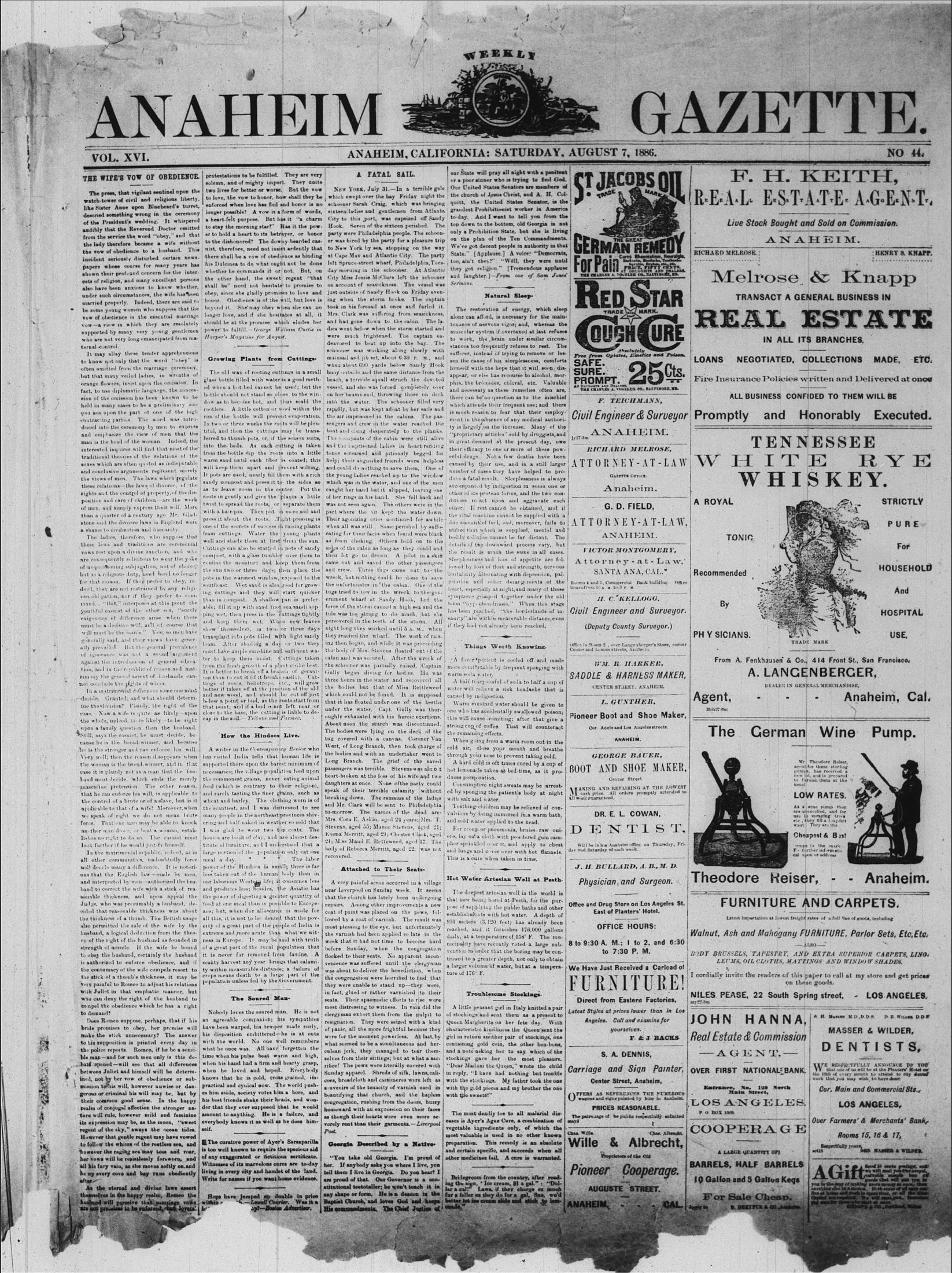
Searchable text
THE WIFE'S VOW OF OBEDIENCE.
The press, that vigilant sentinel upon the watch-tower of civil and religious liberty, like Sister Anne upon Bluebeard's turret, deserved something wrong in the ceremony of the President's wedding. It whispered andibly that the Reverend Doctor omitted from the service the word "obey," and that the lady therefore became a wife without the vow of obedience to a husband. This incident seriously disturbed certain newspapers whose course for many years has shown their profound concern for the interests of religion, and many excellent persons also have been anxious to know whether, under such circumstances, the wife has been married properly. Indeed, there are said to be some young women who suppose that the vow of obedience is the essential marriage vow—a view in which they are resolutely supported by many very young gentlemen who are not very long emancipated from maternal control.
It may allay these tender apprehensions to know not only that the word "obey" is often omitted from the marriage ceremony, but that many veiled ladies, in wreaths of orange flowers, insist upon the omission. In fact, to use diplomatic language, the concession of the omission has been known to be held in many cases to be a preliminary one qua non upon the part of one of the high contracting parties. The word was introduced into the ceremony by men to express and emphasize the view of men that the man is the head of the woman. Indeed, the interested inquirer will find that most of the traditional theories of the relations of the sexes which are often quoted as indisputable and conclusive arguments represent merely protestations to be fulfilled. They are very solemn, and of mighty import. They unite two lives for better or worse. But the vow to love, the vow to honor, how shall they be enforced when love has fled and honor is no longer possible? A vow is a form of words, a heart-felt purpose. But has it "a charm to stay the morning star?" Has it the power to hold a heart to its betrayer, or honor to the dishonored? The downy-bearded casist, therefore, need not insist ardently that there shall be a vow of obedience as binding his Dulcinea to do what ought not be done whether he commands it or not. But, on the other hand, the sweet regent "that shall be" need not hesitate to promise to obey, since she gladly promises to love and honor. Obedience is of the will, but love is beyond it. She may obey when she can no longer love, and if she hesitates at all, it should be at the promise which eludes her power to fulfill.—George William Curtis in Harper's Magazine for August.
Growing Plants from Cuttings
The old way of rooting cuttings in a small glass bottle filled with water is a good method when a hot-bed cannot be used; but the bottle should not stand so close to the window as to become hot, and thus scald the rootlets. A little cotton or wool within the rim of the bottle will prevent evaporation. In two or three weeks the roots will be pleniful, and then the cuttings may be transferred to thumb pots, or, if the season suits, into the beds. As each cutting is taken from the bottle dip the roots into a little warm sand until each fiber is coated; this will keep them apart and prevent wilting. It pots are used nearly till they with a rich protestations to be fulfilled. They are very solemn, and of mighty import. They unite two lives for better or worse. But the vow to love, the vow to honor, how shall they be enforced when love has fled and honor is no longer possible? A vow is a form of words, a heart-felt purpose. But has it "a charm to stay the morning star?" Has it the power to hold a heart to its betrayer, or honor to the dishonored? The downy-bearded casist, therefore, need not insist ardently that there shall be a vow of obedience as binding his Dulcinea to do what ought not be done whether he commands it or not. But, on the other hand, the sweet regent "that shall be" need not hesitate to promise to obey, since she gladly promises to love and honor. Obedience is of the will, but love is beyond it. She may obey when she can no longer love, and if she hesitates at all, it should be at the promise which eludes her power to fulfill.—George William Curtis in Harper's Magazine for August.
New York which swet schooner sixteen lady City to the Hook. Se party were hired to New York at Cape May left Spruce day morning City Miss on account just outside when took in his Mrs. Clark and had gone dies went b were much deavored schooner w mainsail ar when about buoy outside beach, a te vessel, and on her beam into the w rapilly, but the air imp sengers an boat and clothe The occupa and the im tones scree help; their and could d
but that many veiled ladies, in wreaths of orange flowers, insist upon the omission. In fact, to use diplomatic language, the concession of the omission has been known to be held in many cases to be a preliminary one qua non upon the part of one of the high contracting parties. The word was introduced into the ceremony by men to express and emphasize the view of men that the man is the head of the woman. Indeed, the interested inquirer will find that most of the traditional theories of the relations of the sexes which are often quoted as indisputable and conclusive arguments represent merely the views of men. The laws which regulate these relations—the laws of divorce, of the rights and the control of property, of the disposition and care of children—are the work of men, and simply express their will. More than a quarter of a century ago Mr. Gladstone said the divorce laws in England were a shame to civilization and humanity.
The ladies, therefore, who suppose that these laws and traditions are ceremonial vows rest upon a divine sanction, and who are consequently solicitous to wear the yoke of unquestioning subjugation, not of choice; but as a religious duty, need bend no longer for that reason. If they prefer to obey, indeed, they are not restrained by any religious obligation, nor if they prefer to command. "But," interposes at this point the youthful casust of the other sex, "surely exigencies of difference arise when there must be a decisive will, and of course that will must be the man's." Yes; so men have generally said, and their views have generally prevailed. But the general prevalence of ignorance was not a sound argument against the introduction of general education, and in the republic of reason and matrimony the general assent of husbands cannot conclude the rights of wives.
In a matrimonial difference some one must decide. Granted; and what should determine their decision? Plainly, the right of the case. Now a wife is quite as likely—upon the whole, indeed, more likely—to be right upon a family question than the husband. Still, says the casuist, he must decide, because he is the bread-winner, and because he is the stronger and can enforce his will. Very well; then the reason disappears when the woman is the bread-winner, and in that case it is plainly not as a man that the husband must decide, which ends the merely masculine pretension. The other reason, that he can enforce his will, is applicable to the control of a brute or of a slave, but is it applicable to that of a wife? Moreover, when we speak of right we do not mean brute force. That one man may be able to knock another man down, or beat a woman, establishes no right to do so. The casuist must look further if he would justify himself.
In the matrimonial republic, indeed, as in all other communities, undoubtedly force will decide many a difference. It is notorious that the English law—made by men, and interpreted by men—authorized the husband to correct the wife with a stick of reasonable thickness, and upon appeal the glass bottle filled with water is a good method when a hot-bed cannot be used; but the bottle should not stand so close to the window as to become hot, and thus scald the rootlets. A little cotton or wool within the rim of the bottle will prevent evaporation. In two or three weeks the roots will be pleniful, and then the cuttings may be transferred to thumb pots, or, if the season suits, into the beds. As each cutting is taken from the bottle dip the roots into a little warm sand until each fiber is coated; this will keep them apart and prevent wilting. It pots are used, nearly till them with a rich sandy compost and press it to the sides so as to leave room in the center. Put the roots in gently and give the plants a little twist to spread the roots, or separate them with a hairpin. Then put in more soil and press it about the roots. Tight pressing is one of the secrets of success in raising plants from cuttings. Water the young plants well and shade them at first from the sun. Cuttings can also be starged in pots of sandy compost, with a glass tumbler over them to combine the moisture and keep them from the sun two or three days; then place the pots in the warmest window, exposed to the southeast. Wet sand is also good for growing cuttings and they will start quicker than in compost. A shallow pan is preferable; fill it up with sand (not sea sand) sopping wet, then press in the cuttings tightly and keep them wet. When new leaves show themselves, in two or three days transplant into pots filled with light sandy loam. After shading a day or two they must have ample sunshine and sufficient water to keep them moist. Cuttings taken from the fresh growth of a plant strike best. It is better to break off a branch of geranium than to cut it (if it breaks easily). Cuttings of roses, heliotrope, etc., will grow better if taken off at the junction of the old and new wood, and should be cut off just below a point or bud, as the roots start from that point; and if a bud is not left near or close to the base, the cutting is liable to decay in the soil. —Tribune and Farmer.
How the Hindooos Live:
A writer in the Contemporary Review who has visited India tells that human life is supported there upon the barest minimum of necessaries; the village population feed upon the commonest grains, never eating animal food (which is contrary to their religion), and rarely tasting the finer grains, such as wheat and barley. The clothing worn is of the scantiest, and I was distressed to see many people in the northeast provinces shivering and half-naked in weather so cold that I was glad to wear two top coats. The houses are built of clay, and are almost destitute of furniture, and I understand that a large portion of the population only eat one meal a day.
The labor power of the Hindooos is small; there is far less taken out of the human body than in our laborious Western life; it consumes less and produces less; besides, the Asiatic has the power of digesting a greater quantity of
the control of a brute or of a slave, but is it applicable to that of a wife? Moreover, when we speak of right we do not mean brute force. That one man may be able to knock another man down, or beat a woman, establishes no right to do so. The casusist must look further if he would justify himself.
In the matrimonial republic, indeed, as in all other communities, undoubtedly force will decide many a difference. It is notorious that the English law—made by men, and interpreted by men—authorized the husband to correct the wife with a stick of reasonable thickness, and upon appeal the Judge, who was presumably a husband, decided that reasonable thickness was about the thickness of a thumb. The British usage also permitted the sale of the wife by the husband, a logical deduction from the theory of the right of the husband as founded in strength of muscle. If the wife be bound to obey the husband, certainly the husband is authorized to enforce obedience, and if the continuity of the wife compels resort to the stick of a thumb's thickness, it may be very painful to Romeo to adjust his relations with Juliet in that emphatic manner, but who can deny the right of the husband to compel the obedience which he has a right to demand?
Does Romeo suppose, perhaps, that if his bride promises to obey her premise will make the stick unnecessary? The answer to his supposition is printed every day in the police reports. Romeo, if he be a sensible map—and for such men only is this debated—will see that all differences between Juliet and himself will be determined, not by her vow of obedience or submission to his will, however unwise or dangerous or criminal his will may be, but by their common good sense. In the happy realm of conjugal affection the stronger nature will rule, however mild and feminine its expression may be, as the moon, "sweet regent of the sky," always the ocean tides. However that gentle regent may have vowed to follow the whims of the restless sea, and however the raging sea may toss and roar, her vows will be resistlessly foreworn, and all his fury vain, as she moves softly on,and he up every cove and bay runs obediently after.
As the eternal and divine laws assert themselves in the happy realm, Romeo the husband will perceive that marriage vows are not promises to be enforced, but lovera'
The Sourced Man
Nobody loves the sourced man. He is not an agreeable companion; his sympathies have been warped, his temper made surly, his disposition embittered—he is at outs with the world. No one well remembers what he once was. All have forgetten the time when his pulse beat warm and high, when his hand had a firm and hearty grasp, when he loved and hoped. Everybody knows that he is cold, cross grained, impractical and cynical now. The world pushes him aside, society votes him a bore, and his best friends shake their heads, and wonder that they ever supposed that he would amount to anything. He is a failure, and everybody knows it as well as he does himself.
The curative power of Ayer's Sarsaparilla is too well known to require the specious aid of any exaggerated or fictitious certificate. Witnesses of its marvelous cares are to-day living in every city and hamlet of the land. Write for names if you want home evidence.
Hops have jumped up double in price within — Lowell Courier. Was it a heap and barley. The clothing worn is of the scantiest, and I was distressed to see many people in the northeast provinces shivering and half-naked in weather so cold that I was glad to wear two top coats. The houses are built of clay, and are almost desitute of furniture, and I understand that a large portion of the population only eat one meal a day.
The labor power of the Hindoos is small; there is far less taken out of the human body than in our laborious Western life; it consumes less and produces less; besides, the Asiatic has the power of digesting a greater quantity of food at one meal than is possible to Europeans; but, when due allowance is made for all this, it is not to be denied that the poverty of a great part of the people of India is extreme and more acute than what we witness in Europe. It may be said with truth of a great part of the rural population that it is never far removed from famine. A scanty harvest any year brings that calamity within measurable distance; a failure of crops means death to a large part of the population unless fed by the Government.
Georgia
"You talk her. If any tell them I am proud of stintational to any shape or Baptist Church His command."
They are very hurt. They unite. But the vow shall they be and honor is no form of words, as it "a charm Has it the power, or honor army-bearded casist ardently that science as binding not be done nor not. But, on it regent "that we to promise to love and will, but love is when she can no states at all, it which eludes her William Curtis inust.
A FATAL SAIL.
New York, July 31.—In a terrible gale which swept over the bay Friday night the schooner Sarah Craig, which was bringing sixteen ladies and gentlemen from Atlanta City to this port, was capsized off Sandy Hook. Seven of the sixteen perished. The party were Philadelphia people. The schooner was hired by the party for a pleasure trip to New York by sea, stopping on the way at Cape May and Atlantic City. The party left Spruce-street wharf, Philadelphia, Tuesday morning in the schooner. At Atlantic City Miss Jessie McClure left the schooner on account of seasickness. The vessel was just outside of Sandy Hook on Friday evening when the storm broke. The captain took in his foresail at once and farled it. Mrs. Clark was suffering from seasickness, and had gone down to the cabin. The ladies went below when the storm started and were much frightened. The captain endeavored to beat up into the bay. The schooner was working along slowly with mainsail and jib set, about 6:30 P.M., and when about 600 yards below Sandy Hook buoy outside and the same distance from the beach, a terrible squall struck the devoted vessel, and she was forced completely over on her beams-end, throwing those on deck into the water. The schooner filled very rapidly, but was kept adoot by her sails and the air imprisoned in the cabins. The passengers and crew in the water reached the boat and clung desperately to the planks. The occupants of the cabin were still alive and the imprisoned ladies in heart-rending tones screamed and pitiously begged for help; their anguished friends were helpless and could do nothing to save them. One of the young ladies reached up at the window our State will pray all night with a penitent or a poor sinner who is trying to find God. Our United States Senators are members of the church of Jesus Christ, and A. H. Colquitt, the United States Senator, is the grandest Prohibitionist worker in America to-day. And I want to tell you from the top down to the bottom, old Georgia is not only a Prohibition State, but she is living on the plan of the Ten Commandments. We've got decent people in authority in that State." [Applause.] A voice: "Democrats, too, ain't they?" "Well, they were until they got religion." [Tremendous applause and laughter.]—From one of Sam Jones' Serimans.
Natural Sleep.
The restoration of energy, which sleep alone can afford, is necessary for the maintenance of nervous vigor; and, whereas the muscular system if overtaxed at last refuses to work, the brain under similar circumstances too frequently refuses to rest. The sufferer, instead of trying to remove or lessen the cause of his sleeplessness, comforts himself with the hope that it will soon disappear, or else has recourse to alcohol, morphia, the bronzides, chloral, etc. Valuable and necessary as these remedies often are, there can be no question as to the mischief which attends their frequent use; and there is much reason to fear that their employment in the absence of any medical authority is largely on the increase. Many of the "proprietary articles" sold by druggists, and in great demand at the present day, owe their efficacy to one or more of these powerful drugs. Not a few deaths have been caused by their use, and in a still larger number of cases they have helped to pro-
is a good methane used; but the dose to the winthus scald the wool within the heat evaporation. Boots will be plenish may be trans-ine season suits, cutting is taken into a little coat; this prevent wilting. them with a rich so the sides so enter. Put the plants a little separate them in more soil and light pressing is in raising plants by young plants from the sun. In pots of sandy soil over them to keep them from then place the exposed to the good for grow- start quicker Japan is prefer- sea sand) sop cuttings tightly on new leaves or three days with light sandy soil or two they sufficient water Cuttings taken ant strike best. each of geranium easily). Cut- etc., will growth of the old be cut off just roots start from left near or is liable to de-Farmer.
Live:
Artery Review who human life is best minimum of nutrition feed upon eating animal their religion), grains, such as thing worn is of stressed to see provinces shiver so cold that cup coats. The are almost des- stand that a non eat one The labor all; there is far body than in consumes less Asiatic has latter quantity of
Attached to Their Seats
A very painful scene occurred in a village near Liverpool on Sunday week. It seems that the church has lately been undergoing
Hot Water Artesian Well at Pesth-
The deepest artesian well in the world is appear, or else has recourse to alcohol, morphia, the bronides, chaleral, etc. Valuable and necessary as these remedies often are, there can be no question as to the mischief which attends their frequent use; and there is much reason to fear that their employment in the absence of any medical authority is largely on the increase. Many of the "proprietary articles" sold by druggists, and in great demand at the present day, owe their efficacy to one or more of these powerful drugs. Not a few deaths have been caused by their use, and in a still larger number of cases they have helped to produce a fatal result. Sleeplessness is always accompanied by indigestion in some one or other of its protean forms, and the two conditions react upon and aggravate each other. If rest cannot be obtained, and if the vital machine cannot be supplied with a due amount of fuel, and, moreover, fails to utilize that is supplied, mental and bodily collapse cannot be far distant. The details of the downward process vary, but the result is much the same in all cases. Sleeplessness and loss of appetite are followed by loss of flesh and strength, nervous irritability alternating with depression, palpitation and other derangements of the heart, especially at night, and many of those symptoms grouped together under the old term "hyperchondrosis." When this stage has been reached, "the borderlands of insanity" are within measurable distance, even if they had not already been reached.
Things Worth Knowing
A fever patient is cooled off and made more comfortable by frequent sponging with warm soda water.
A half teaspoonful of soda to half a cup of water will relieve a sick headache that is caused by indigestion.
Warm mustard water should be given to one who has accidentally swallowed poison; this will cause vomiting; after that give a strong cup of coffee. That will counteract the remaining effects.
When going from a warm room out in the cold air, close your mouth and breathe through your nose to prevent taking cold.
A hard cold is oft times cured by a cup of hot lemonade taken at bed-time, as it produces perspiration.
Consumptive night sweats may be arrested by sponging the patient's body at night with salt and water.
Teething children may be relieved of convulsions by being immersed in a warm bath, and cold water applied to the head.
For croup or pneumonia, bruise raw onions, lay on a cloth with powdered gum camphor sprinkled over it, and apply to chest and lungs and cover over with hot flannels. This is a cure when taken in time.
Attached to Their Seats.
A very painful scene occurred in a village near Liverpool on Sunday week. It seems that the church has lately been undergoing repairs. Among other improvements a new coat of paint was placed on the pews, followed by a coat of varnish. The result was most pleasing to the eye, but unfortunately the varnish had been applied so late in the week that it had not time to become hard before Sunday, when the congregation flocked to their seats. No apparent inconvenience was suffered until the clergyman was about to deliver the benediction, when the congregation were horrified to find that they were unable to stand up—they were, in fact, glued or rather varnished to their seats. Their spasmodic efforts to rise were most distressing to witness. In vain did the clergyman exhort them from the pulpit to resignation. They were seized with a kind of panic, all the more frightful because they were for the moment powerless. At last, by what seemed to be a simultaneous and herculean jerk, they managed to tear themselves from their sittings; but at what a sacrifice! The pews were literally covered with Sunday apparel. Shreds of silk, lawns, calicoes, broadcloth and cassimeres were left as souvenirs of the tenacity of varnish used in beautifying that church, and the hapless congregation, rushing from the doors, hurry homeward with an expression on their faces as though their hearts were even more severely rent than their garments.—Liverpool Post.
Georgia Described by a Native-
"You take old Georgia. I'm proud of her. If anybody asks you where I live, you tell them I live in Georgia. Do you hear? I am proud of that. Our Governor is a constitutional teetotaller; he won't touch it in any shape or form. He is a deacon in the Baptist Church, and loves God and keeps His commandments. The Chief Justice of Teething children may be relieved of convulsions by being immersed in a warm bath, and cold water applied to the head.
For croup or pneumonia, bruise raw onions, lay on a cloth with powdered gum camphor sprinkled over it, and apply to chest and lungs and cover over with hot flannels. This is a cure when taken in time.
Hot Water Artesian Well at Pesth.
The deepest artesian well in the world is that now being bored at Pesth, for the purpose of supplying the public baths and other establishments with hot water. A depth of 951 meters (3,120 feet) has already been reached, and it furnishes 176,000 gallons daily, at a temperature of 158° F. The municipality have recently voted a large subvention in order that the boring may be continued to a greater depth, not only to obtain a larger volume of water, but at a temperature of 176° F.
Troublesome Stockings!
A little peasant girl in Italy knitted a pair of stockings and sent them as a present to Queen Margherita on her fete day. With characteristic kindness the Queen sent the girl in return another pair of stockings, one containing gold coin, the other bon-bons, and a note asking her to say which of the stockings gave her the most pleasure. "Dear Madam the Queen," wrote the child in reply, "I have bad nothing but trouble with the stockings. My father took the one with the gold pieces and my brother the one with the sweets."
The most deadly foe to all malarial diseases is Ayer's Ague Cure, a combination of vegetable ingredients only, of which the most valuable is used in no other known preparation. This remedy is an absolute and certain specific, and succeeds when all other medicines fail. A cure is warranted.
Bridegroom from the country, after reading the sign, "Ice cream, $1 a gal.": "Dollar a calf." Laws, if they charge ez much fur a fellier ea they do for a gal. Sue, we'd better let ice cream slide and stick to lemonade."
GAZETTE.
JUST 7, 1886.
NO 44.
F. H. KEITH,
REAL ESTATE AGENT.
Live Stock Bought and Sold on Commission.
ANAHEIM.
RICHARD MELROSE: HENRY S. KNAPP.
Melrose & Knapp
TRANSACT A GENERAL BUSINESS IN
REAL ESTATE
IN ALL ITS BRANCHES.
LOANS NEGOTIATED, COLLECTIONS MADE, ETC.
Fire Insurance Policies written and Delivered at once
ALL BUSINESS CONFIDED TO THEM WILL BE
Promptly and Honorably Executed.
TENNESSEE
WHITE RYE
WHICKEY
FIRE INSURANCE POLICIES written and Delivered at once
ALL BUSINESS CONFIDED TO THEM WILL BE
Promptly and Honorably Executed.
TENNESSEE WHITE RYE WHISKEY.
A ROYAL STRICTLY PURE TONIC For HOUSEHOLD Recommended By HOSPITAL PHYSICIANS.
TRADE MARK
From A. Fenkhausen & Co., 414 Front St., San Francisco,
A. LANGENBERGER,
DEALER IN GENERAL MERCHANDISE,
Agent, Anaheim, Cal.
The German Wine Pump.
Mr. Theodore Reiser, agent for these sterling pumps, has received a new list, and is prepared to furnish them at the usual LOW RATES.
As a wine pump they are unexcelled, and for use in spraying trees etc., they fill a long felt want. They are the Cheapest & Best pumps in the mark. Further information upon or address Theodore Reiser, - Anaheim.
DR. E. L. COWAN,
ENTIST,
on his Anaheim office on Thursday, Friday
day of each week.
BULLARD, A. B., M. D.
Medician and Surgeon.
OFFICE HOURS:
D. A. M.; 1 to 2, and 6:30
to 7:30 P. M.
Just Received a Carload of
FURNITURE!
from Eastern Factories,
at prices lower than in Los
eles. Call and examine for
yourselves.
F & J. BACKS
S. A. DENNIS,
and Sign Painter,
enter Street, Anaheim,
REFERENCES THE NUMEROUS
signs painted by him in Anaheim.
RICES REASONABLE.
age of be public respectfully solicited
Chaz. Albrecht.
Proprietors of the Old
Peer Cooperage.
INGUSTE STREET.
CAL.
Theodore Reiser, - - Anaheim.
FURNITURE AND CARPETS.
Latest importation at lowest freight rates of a full line of goods, including
Walnut, Ash and Mahogany FURNITURE, Parlor Sets, Etc., Etc.
Also body brussels, tapestry, and extra superior carpets, linoleum, leums, oil cloths, mattings and window shades.
I cordially invite the readers of this paper to call at my store and get prices on these goods.
NILES PEASE, 22 South Spring street, LOS ANGELES.
my 22-3m
JOHN HANNA,
Real Estate & Commission
AGENT.
OVER FIRST NATIONAL BANK.
Entrance, No. 120 North
Main Street,
LOS ANGELES.
P.O. BOX 1909.
COOPERAGE
A LARGE QUANTITY OF
BARRELS, HALF BARRELS
10 Gallon and 5 Gallon Kegs
For Sale Cheap.
Apply to B. DREYFUR & CO., Anaheim.
A. H. Masser M.D., D.D.S. D.R. WILLER D.D.F.
MASSER & WILDER,
DENTISTS,
We respectfully announce to you that one of us will be at the Planters' Hotel or the 10th of every month to attend to any dental work that you may wish to have done.
Cor, Main and Commercial Sts..
LOS ANGELES.
Over Farmers' & Merchants' Bank,
Rooms 15, 16 & 17,
Respectfully yours,
sets DRS. MASSER & WILDER.
AGift
Send 10 cents postage, and we will mail you fine surplus, valuable sample box of goods that will put you in your way of making more money as once; then something also in America. Both sexes of all ages can live at home and work in many time, or all the time Capital not required. We will start you. Immediate pay sure for those who start at once.
KINNEYS & CO., Portland, Windsor.