anaheim-gazette 1886-07-10
Scanned page
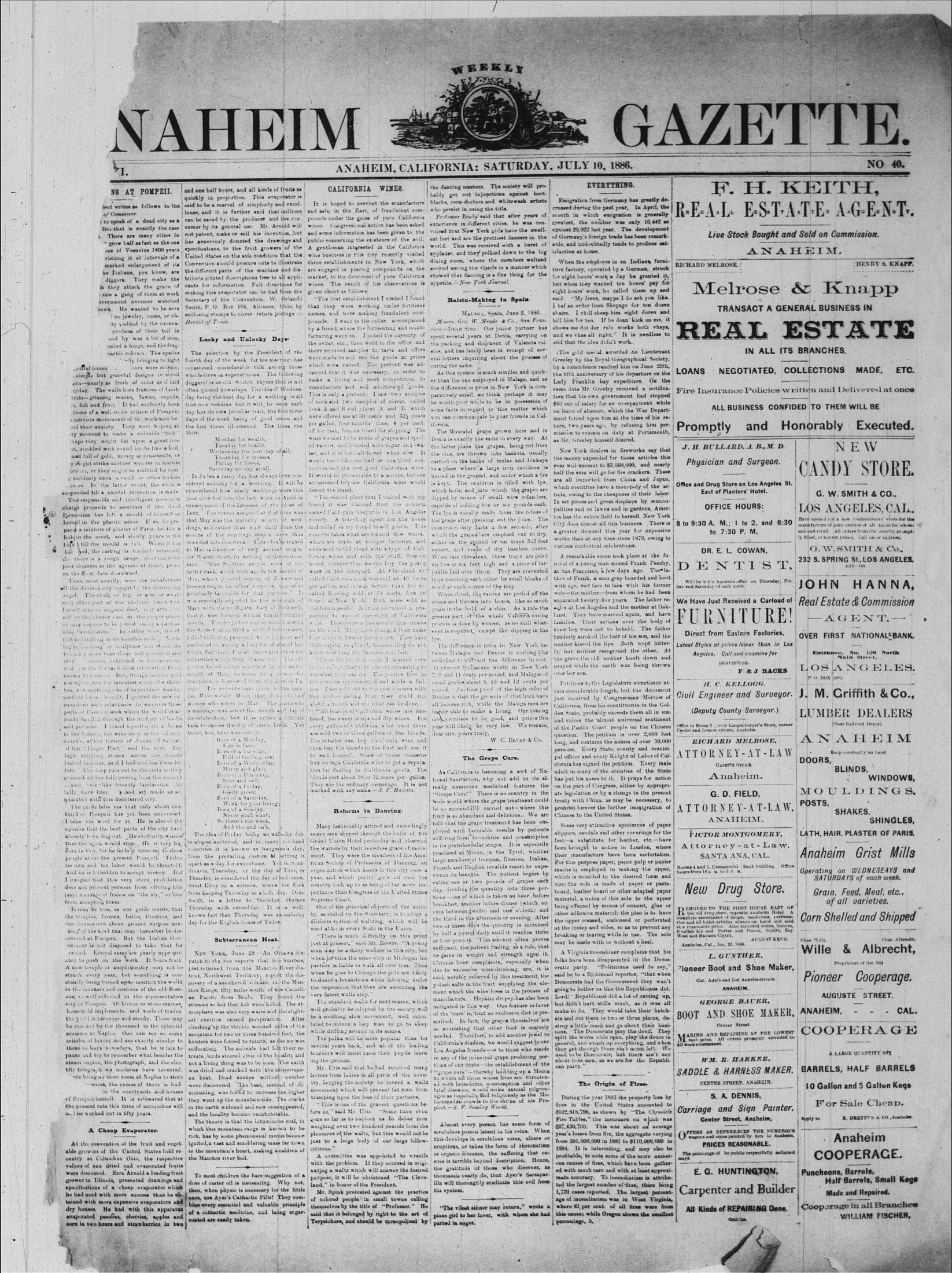
Searchable text
NS AT POMPEII.
lent writes as follows to the of Commerce:
to speak of a dead city as a But that is exactly the case.
There are many cities in grow half as fast as the one ones of Veauvius 1800 years visiting it at intervals of a marked enlargement of its he Italians, you know, are diggers. They make the in they attack the grave of saw a gang of them at work government overseer watched hawk. He wanted to be sure no jewelry, coins, or obbity yielded by the excavation produce of their toil in food by was a bit of iron, called a hinge, and the fragarble column. The spades really bringing to light beautiful house doors were mosaic, simple but graceful designs in scroll barn—nearly as fresh of color as if laid day. The walls bore frescoes of faint tints—grinning masks, fawns, cupids, fish and fruit. It had evidently been home of a well-to-do citizen of Pompeii, nervous movements of the workmen behind their anxiety. They were hoping at every moment to make a valuable "find." shapes they might hit upon a great iron stat, studded with round knobs like a boil, full of gold, money or ornaments, or they might strike another wonder in marble bronze, or they might be stabled by com-
and one half hours, and all kinds of fruits as quickly in proportion. This evaporator is said to be a marvel of simplicity and excellence, and it is further said that millions can be saved by the producer and the consumer by its general use. Mr. Arnold will not patent, make or sell his invention, but has generously donated the drawings and specifications, to the fruit growers of the United States on the sole condition that the Convention should procure cuts to illustrate the different parts of the machine and distribute printed descriptions free to all applicants for information. Full directions for making this evaporator can be had from the Secretary of the Convention, W. Orlando Smith, P. O. Box 104, Alliance, Ohio, by enclosing stamps to cover return postage. — Herald of Trade.
Lucky and Unlucky Days.
The selection by the President of the fourth day of the week for his marriage has occasioned considerable talk among those who believe in superstitions. The following doggerel is an old Scotch rhyme that is not often quoted nowadays. The idea of Wednesday being the best day for a wedding is all that now remains but it will be seen each day has its own peculiar trait, the first three days of the week being of goodomen and the last three ill-o-mened. The lines run thus:
Monday for wealth,
Tuesday for health,
Wednesday the best day of all;
Thursday for crosses,
Friday for losses,
Saturday no day at all.
CALIFORNIA.
It is hoped to and sale, in the pounds under the wines. Congression and some information public concerning A gentleman into wine business in the three establishments are engaged in plant market, to the detrives given about as follows:
"The first establishment that they were named names, and were pounds. I went to by a friend, where facturing went on the cellar, etc., there received sand were made to sell which were named vanced that it would make a living a manufacture and This is only a pref of hook and two hook A and B and were offered me a per gallon, four mils off for cash, free o wine seemed to be ed raisins; and blter, and it is difficult would taste like coction and the
simple but graceful designs in scroll barn—nearly as fresh of color as if laid贿厢. The walls bore frescoes of faint tints—grinning masks, fawns, cupids, fish and fruit. It had evidently been home of a well to-do citizen of Pompeii, nervous movements of the workmen beamed their anxiety. They were hoping at every moment to make a valuable "find." Whaps they might hit upon a great iron cast, studded with round knobs like a boil, full of gold, money or ornaments, or eight strike another wonder in marble bronze, or they might be stalled by compulsion suddenly upon a skull or other human remains. In the latter event, the work is suspended till a careful inspection is made.
The responsible and intelligent person in charge proceeds to ascertain if the dead Pompeian has left a mould of himself or herself in the plastic ashes. If so, he prepares a mixture of plaster of Paris, breaks a hole in the crust, and slowly pours in the liquid till the mould is full. When it has been filled, the casting is tenderly removed. There is a rough image showing some poor creature in the agonies of death, prone on the floor, face downward.
Thus, most usually, were the inhabitants of the domed city caught by the destroying angel. The skull, or leg, or arm, or whatever other part of the skeleton has not released into its original dust, may attach itself to the plaster cast in the proper place, or may require to be punched on by a pardonable "restoration." In either case, the effect is tardling in its horrible reality. Nothing in painting or sculpture can shock the beholder more than those self-proclaimed and true statues exhibited in the museum, what is the firewall most interesting thing known to visitors. But, though neither gold nor silver nor the minute spray of a skeleton, nor anything else of importance was carved for my benefit, I quitted the new excavations with reluctance to examine those parts of Pompeii with which the world is already familiar through the medium of books and pictures. I found myself quite at home in the bakery, the wine shop, at the oil market, at the houses of Jansa, of Salent, of the "Tragic Poet," and the rest. The high stepping stones across the streets looked familiar, as if I had trodden them before. The deep ruts cut by the carts as they groomed up the hill, coming from the ancient Causes love-like friendly landmarks. So fully have litter and art made us acquainted with this disinterred city.
The guide tells me that only about one-third of Pompeii has yet been uncovered. I take his word for it. He is also of the opinion that the best parts of the city have already been dug out. He evidently wishes that the work would stop. He is very humbain in this, for he finds it tiresome to show people about the present Pompeii. Trouble its size, and his labor would be threefold. And he is forbidden to accept money. But I imagine that this very stern prohibition does not prevent persons from offering him (say) a couple of frames on "the sly," or him simple but graceful designs in scroll barn—nearly as fresh of color as if laid贿厢. The walls bore freescoes of faint tints—grinning masks, fawns, cupids, fish and fruit. It had evidently been home of a well to-do citizen of Pompeii, nervous movements of the workmen beamed their anxiety. They were hoping at every moment to make a valuable "find."
Whaps they might hit upon a great iron cast, studded with round knobs like a boil, full of gold, money or ornaments, or eight strike another wonder in marble bronze, or they might be stalled by compulsion suddenly upon a skull or other human remains. In the latter event, the work is suspended till a careful inspection is made.
The responsible and intelligent person in charge proceeds to ascertain if the dead Pompeian has left a mould of himself or herself in the plastic ashes. If so, he prepares a mixture of plaster of Paris, breaks a hole in the crust, and slowly pours in the liquid till the mould is full. When it has been filled, the casting is tenderly removed. So there is a rough image showing some poor creature in the agonies of death, prone on the floor, face downward.
Thus, most usually, were the inhabitants of the domed city caught by the destroying angel. The skull, or leg, or arm, or whatever other part of the skeleton has not released into its original dust, may attach itself to the plaster cast in the proper place, or may require to be punched on by a pardonable "restoration." In either case, the effect is tardling in its horrible reality. Nothing in painting or sculpture can shock the beholder more than those self-proclaimed and true statues exhibited in the museum, what is the firewall most interesting thing known to visitors. But, though neither gold nor silver nor the minute spray of a skeleton, nor anything else of importance was carved for my benefit, I quitted the new excavations with reluctance to examine those parts of Pompeii with which the world is already familiar through the medium of books and pictures. I found myself quite at home in the bakery, the wine shop, at the oil market, at the houses of Jansa, of Salent, of the "Tragic Poet," and the rest.
The high stepping stones across the streets looked familiar, as if I had trodden them before. The deep ruts cut by the carts as they groomed up the hill, coming from the ancient Causes love-like friendly landmarks. So fully have litter and art made us acquainted with this disinterred city.
The guide tells me that only about one-third of Pompeii has yet been uncovered. I take his word for it. He is also of the opinion that the best parts of the city have already been dug out. He evidently wishes that the work would stop. He is very humbain in this, for he finds it tiresome to show people about the present Pompeii. Trouble its size, and his labor would be threefold. And he is forbidden to accept money. But I imagine that this very stern prohibition does not prevent persons from offering him (say) a couple of frames on "the sly," or him simple but graceful designs in scroll barn—nearly as fresh of color as if laid贿厢. The walls bore freescoes of faint tints—grinning masks, fawns, cupids, fish and fruit. It had evidently been home of a well to-do citizen of Pompeii, nervous movements of the workmen beamed their anxiety. They were hoping at every moment to make a valuable "find."
Whaps they might hit upon a great iron cast, studded with round knobs like a boil, full of gold, money or ornaments, or eight strike another wonder in marble bronze, or they might be stalled by compulsion suddenly upon a skull or other human remains. In the latter event, the work is suspended till a careful inspection is made.
The responsible and intelligent person in charge proceeds to ascertain if the dead Pompeian has left a mould of himself or herself in the plastic ashes. If so, he prepares a mixture of plaster of Paris, breaks a hole in the crust, and slowly pours in the liquid till the mould is full. When it has been filled, the casting is tenderly removed. So there is a rough image showing some poor creature in the agonies of death, prone on the floor, face downward.
Thus, most usually, were the inhabitants of the domed city caught by the destroying angel. The skull, or leg, or arm, or whatever other part of the skeleton has not released into its original dust, may attach itself to the plaster cast in the proper place, or may require to be punched on by a pardonable "restoration." In either case, the effect is tardling in its horrible reality. Nothing in painting or sculpture can shock the beholder more than those self-proclaimed and true statues exhibited in the museum, what is the firewall most interesting thing known to visitors. But though neither gold nor silver nor the minute spray of a skeleton nor anything else of importance was carved for my benefit, I quitted the new excavations with reluctance to examine those parts of Pompeii with which the world is already familiar through the medium of books and pictures. I found myself quite at home in the bakery, the wine shop at the oil market, at the houses of Jansa, of Salent, of the "Tragic Poet," and the rest.
The high stepping stones across the streets looked familiar as if I had trodden them before. The deep ruts cut by the carts as they groomed up the hill, coming from the ancient Causes love-like friendly landmarks. So fully have litter and art made us acquainted with this disinterred city.
The guide tells me that only about one-third of Pompeii has yet been uncovered. I take his word for it. He is also of the opinion that the best parts of the city have already been dug out. He evidently wishes that the work would stop. He is very humbain in this, for he finds it tiresome to show people about the present Pompeii. Trouble its size, and his labor would be threefold. And he is forbidden to accept money. But I imagine that this very stern prohibition does not prevent persons from offering him (say) a couple of frames on "the sly," or him simple but graceful designs in scroll barn—nearly as fresh of color as if laid贿厢. The walls bore freescoes of faint tints—grinning masks, fawns, cupids, fish and fruit. It had evidently been home of a well to-do citizen of Pompeii, nervous movements of the workmen beamed their anxiety. They were hoping at every moment to make a valuable "find."
Whaps they might hit upon a great iron cast, studded with round knobs like a boil, full of gold, money or ornaments, or eight strike another wonder in marble bronze, or they might be stalled by compulsionently upon a skull or other human remains. In the latter event, the work is suspended till a careful inspection is made.
The responsible and intelligent person in charge proceeds to ascertain if the dead Pompeian has left a mould of himself or herself in the plastic ashes. If so, he prepares a mixture of plaster of Paris, breaks a hole in the crust, and slowly pours in the liquid till the mould is full. When it has been filled, the casting is tenderly removed. So there is a rough image showing some poor creature in the agonies of death,prone on the floor,face downward.
Thus,most usually,weretheinhabitantsofthedomedcitycaughtbythedestroyingangel.Theskull.orleg.orarm.orwhateverotherpartoftheskkeletonhasnotreleasedintotheoriginaldust,mayattachitselftotheplastercastintherproperplaceormayrequiretobepunchedoncethepardonable"restoration."In eithercase,theeffectis tardlinginitshorriblereality.Nothinginpaintingor雕塑canshockthebeholdermorethanthoseselfproclaimedandtruestatuesexhibitedinthemuseum.whetheratholeliststatedfestivals,fastdays,Penguinsrelievesandrecreativitieswhichtheydenounceool.Theobjectiontocolonialmarriageinthenochemonsoil.Theobjecttocolonialmarriageinthenochemonsoil.Theobjectiontocolonialmarriageinthenochemonsoil.Theobjectiontocolonialmarriageinthenochemonsoil.Theobjectiontocolonialmarriageinthenochemonsoil.Theobjectiontocolonialmarriageinthenochemonsoil.Theobjectiontocolonialmarriageinthenochemonsoil.Theobjectiontocolonialmarriageinthenochemonsoil.Theobjectiontocolonialmarriageinthenochemonsoil.Theobjectiontocolonialmarriageinthenochemonsoil.Theobjectiontocolonialmarriageinthenochemonsoil.Theobjectiontocolonialmarriageinthenochemonsoil.Theobjectiontocolonialmarriageinthenochemonsoil.Theobjectiontocolonialmarriageinthenochemonsoil.Theobjectiontocolonialmarriageinthenochemonsoil.Theobjectiontocolonialmarriageinthenochemonsoil.Theobjectiontocolonialmarriageinthenochemonsoil.Theobjectiontocolonialmarriageinthenochemonsoil.Theobjectiontocolonialmarriageinthenochemonsoil.Theobjectiontocolonialmarriageinthenochemonsoil.Theobjectiontocolonialmarriageinthenochemonsoil.Theobjectiontocolonialmarriageinthenochemonsoil.Theobjectiontocolonialmarriageinthenochemonsoil.Theobjectiontocolonialmarriageinthenochemonsoil.Theobjectiontocolonialmarriageinthenochemonsoil.Theobjectiontocolonialmarriageinthenochemonsoil.Theobjectiontocolonialmarriageinthenochemonsoil.Theobjectiontocolonialmarriageinthenochemonsoil.Theobjectiontocolonialmarriageinthenochemonsoil.Theobjectiontocolonialmarriageinthenochemonsoil.Theobjectiontocolonialmarriageinthenochemonsoil.Theobjectiontocolonialmarriageinthenochemonsoil.Theobjectiontocolonialmarriageinthenochemonsoil.Theobjectiontocolonialmarriageinthenochemonsoil.Theobjectiontocolonialmarriageinthenochemonsoil.Theobjectiontocolonialmarriageinthenochemonsoil.Theobjectiontocolonialmarriageinthenochemonsoil.Theobjectiontocolonialmarriageinthenochemonsoil.Theobjectiontocolonialmarriageinthenochemonsoil.Theobjectiontocolonialmarriageinthenochemonsoil.Theobjectiontocolonialmarriageinthenochemonsoil.Theobjectiontocolonialmarriageinthenochemonsoil.Theobjectiontocolonialmarriageinthenchechomonoils.Accountedwiththisdisinterredcity.
Many fashionable sawn oak slipper Grand Union Hotel by waiters by month. They were rican Society of organization which year,and which country look up importance than Coarse Court
The guide tells me that only about one-third of Pompen has yet been uncovered. I take his word for it. He is also of the opinion that the best parts of the city have already been dug out. He evidently wishes that the work would stop. He is very humble in this, for he finds it tiresome to show people about the present Pompen. Treble its size, and his labor would be threefold. And he is too bidden to accept money. But I imagine that this very stern prohibition does not prevent persons from offering him (say) a couple of francs on "the sly," or him from accepting them.
He may be true, as our guide insists, that the temples, forums, baths, theatres, and fine houses now above ground surpass anything of the kind that may hereafter be discovered at Pompen. But the Italian Government is not disposed to take that for raided. Liberal sums are yearly appropriated to push on the work. It bears fruit. A new temple or amphitheater may not be struck every year, but something is constantly being turned up to instruct the world in the manners and customs of the old Romans, so well reflected in the representative city of Pompen. Of bronze or stone statues, household implements, and tools of trades, the yield is immense and steady. These may be counted by the thousand in the splendid museum at Naples. One can see so many articles of luxury and use exactly similar to those he buys nowadays, that he is fain to pause and try to remember what besides the steam engine, the photograph, and the electric telegraph we moderns have invented.
There being no more room at Naples to store sures, the excess of them is hud- in the courtyards and houses of Pompen herself. It is estimated that at the present rate this mine of antiquities will not be worked out in fifty years.
A Cheap Evaporator.
At the convention of the fruit and vegetable growers of the United States held recently at Columbus Ohio, the respective values of sun dried and evaporated fruits were discussed. Ezra Arnold a leading fruit grower in Illinois, presented drawings and specifications of a cheap evaporator which he had used with more success than he obtained with more expensive evaporators and dry houses. He had with this apparatus evaporated peaches, cherries, apples and corn in two hours and strawberries in two
The idea of Friday being an unlucky day is almost universal, and in many civilized countries it is known as hangman's day, from the prevailing custom of setting it apart as a day for executions. Yet in Scandinavia, Thursday, or the day of Thor, or Thunder, is considered the day of bad omen. Saint Elroy in a sermon, warns his flock from keeping Thursday as a holy day. Dean Swift, in a letter to Sheridan rhymes Thursday with cursedday. It is a well-known fact that Thursday was an unlucky day for the English house of Tudor.
Subterranean Heat.
New York, June 29 — An Ottawa dispatch to the Sun reports that five hunters, just returned from the Manitou River district, Northwest Territory, report the discovery of a smothered volcano in the Manitou Range, fifty miles south of the Canadian Pacific from Brule. They found the streams so hot that fish were killed. The atmosphere was also very warm and the slightest exertion caused perspiration. After climbing up the thickly wooded slopes of the mountain for two or three hundred feet, the hunters were forced to return, as the air was suffocating. The animals had left their retreats, birds steered clear of the locality and not a living thing was to be seen. The earth was dried and cracked with the subterranean heat. Dead snakes without number were discovered. The heat, instead of diminishing, was found to increase the higher they went up the mountain side. The cracks in the earth widened and new ones appeared, and the locality became uninhabitable.
The theory is that the bituminous coal, in which this mountain range is known to be rich, has by some phenomenal means become ignited, a vast and smoldering mass far down in the mountain's heart, making a caldron of the Manitou river-bed.
To most children the bare suggestion of a dose of castor oil is nauseating. Why not, then, when physic is necessary for the little ones, use Ayer's Cathartic Pills! They combine every essential and valuable principle of a cathartic medicine, and being sugar-coated are easily taken.
Many fashionable save men slipped Grand Union Houses; the waiters by their ment. They were rican Society of organization which year, and which country look up importance than Court Supreme Court.
One of the primary as stated by the uniform system of used alike in even "There is much just at present," man may be a day when he tries the partner is liable when he goes to dance a breake thm impression tha very latest waltz.
The standard will probably be be a soothing slow lated to induce a while drifting area.
The polka will several years back teachers will insti ing the german.
Mr. Uris said t letters from ladie try, begging the movement which tramping upon tha "This is one o'f fore us," said Mr gone so far as to weighing over two pleasures of the w just to a large citizen."
A committee with the problem nating a waltz w purpose, it will b land," in honor o Mr. Spink proof of colored people themselves by tho said that it belong Terpsichore, and
WEEKLY
CIM GA
ANAHEIM, CALIFORNIA: SATURDAY, JULY 10, 1886.
CALIFORNIA WINES.
It is hoped to prevent the manufacture and sale in the East of fraudulent compounds under the guise of pure California wines. Congressional action has been asked and some information has been given to the public concerning the existence of the evil. A gentleman intergested in the California wine business in this city recently visited three establishments in New York, which are engaged in placing compounds on the market, to the detriment of pure California wines. The result of his observations is given about as follows:
"The first establishment I visited I found that they were working under fictitious names, and were making fraudulent compounds. I went to the cellar, accompanied by a friend, where the fermenting and manufacturing went on. I noted the capacity of the cellar, etc., then went to the office and there received samples to taste and offers were made to sell me the goods at prices which were named. The pretext was advanced that it was necessary, in order to make a living and meet competition, to manufacture and sell adulterated goods. This is only a pretext; I saw two samples of hock and two samples of claret, called hock A and B and claret A and B, which were offered me at 30 cents and 32 cents per gallon, four months' time, 4 per cent off for cash, free on board for shipping. The wine seemed to be made of grapes and spoiled raisins, and blended with sugar and water, and it is difficult to say what else. It would taste like one half or one third concoction and the rest good California wine."
the dancing masters. The society will probably get out injupections against boot-blacks, corn-doctors and whitewash artists who persist in using the title.
Professor Brady said that after years of experience in different cities, he was convinced that New York girls have the smallest feet and are the prettiest dancers in the world. This was received with a burst of applause, and they polkized down to the big dining room, where the members waltzed around among the vlands in a manner which showed that dancing is a fine thing for the appetite. —New York Journal.
Raisin-Making in Spain
MALAGA, Spain, June 2, 1886.
Messrs. Geo. W. Merde & Co., San Francisco—DEAR SIRS: Our junior partner has spent several years at Denia, carrying on the packing and shipment of Valencia raisins, and has lately been in receipt of several letters inquiring about the process of curing the same.
As this system is much simpler and quicker than the one employed in Malaga, and as the difference in price in New York is comparatively small, we think perhaps it may be worth your while to be in possession of some facts in regard to this matter which you can communicate to your friends in California.
The Muscatel grape grown here and in Denia is exactly the same in every way. At the latter place the grapes, being cut from the vine, are thrown into baskets, usually carried on the backs of mules and donkeys to a place where "a large iron cauldron is placed over them." A large iron cauldron is placed over them."
EVERYTHING.
Emigration from Germany has greatly decreased during the past year. In April, the month in which emigration is generally greatest, the number was only 10,442 as against 20,022 last year. The development of Germany's foreign trade has been remarkable, and undoubtedly tends to produce satisfaction at home.
When the employs in an Indiana furniture factory operated by a German, struck for eight hours' work a day he granted it, but when they wanted ten hours' pay for eight hours' work, he called them up and said: "My freens, maype I do ash you like. I haf an order from Shegago for ten dozen chairs. I yhill sheep him eight dozen and bill him for ten. If he doan' kick on me, it shows me dot der rule works both vhays, und we vhas all right." It is needless to mid that the idea didn't work.
The gold medal awarded to Lieutenant Greeley by the Royal Geographical Society, by a coincidence reached him on June 20th, the fifth anniversary of his departure on the Lady Franklin bay expedition. On the same date Mr. Greeley received a notification that his own government had stopped $40 out of salary for an overpayment while on leave of absence, which the War Department forced upon him at the time of his return, two years ago, by refusing him permission to remain on duty at Portsmouth, as Mr. Greeley himself desired.
New York dealers in fireworks say that the money expended for these articles this year will amount to $3,000,000, and nearly half the sum will go for fire crackers. These
make a living and meet competition, to manufacture and sell adulterated goods. This is only a pretext. I saw two samples of hook and two samples of claret, called hook A and B and claret A and B, which were offered me at 30 cents and 32 cents per gallon, four months’ time, 4 per cent. off for cash, free on board for shipping. The wine seemed to be made of grapes and spodded rains, and blended with sugar and water, and it is difficult to say what else. It would taste like one-half or one third concoction and the best good California wine. It would be presentable to a novice, but one accustomed to place California wine would detect the fraud.
The second place that I visited with my friend it was claimed that the concern owned California vineyards in Los Angeles county. A traveling agent for the house had called on my friend to sell goods. This concern takes what are termed low wines, which are made at vinegar factories, and adds to the blend with a type of California wines and sells the stuff. Free on board, cheaper than we can buy the young wine in the vineyard. At Cleveland sold California hook was sold at 40 cents per gallon, and it was better than the so-called Rushing sold at 58 cents, free on board, at New York. Both were sold as California goods. Neither contained a proportion to exceed one-eight of California wine. This concern has several firm names on the road. They have changed their name four times in two or three years. They have little capital employed, because they do not know how long the business will last.
From the third concern I learned very little, except that they are experimenting to see what they can do. The parties first in the concern experimented and made a failure. They sold out to the new concern with the understanding that they could run about a month and see what can be done.
All brands of California wines are limited, the sweet wines and dry wines. For every gallon of California wine used there are sold two or three gallons of the blends. The retailer can buy California wine and then buy the blends in the East and use it to suit himself. Some of these concerns buy enough California wine to get a reputation for dealing in California goods. The blends cost about 10 or 12 cents per gallon. They use the ordinary cooperage. It is not marked with any name. S. F. Bulletin.
Reforms in Dancing:
Many fashionably attired and exceedingly savvy men slipped through the halls of the Grand Union Hotel yesterday and charmed the waiters by their noiseless grace of movement. They were the members of the American Society of Professors of Dancing, an organization which meets in this city once a year, and which pretty girls all over the country look up to as being of far more importance than Congress or the United States Supreme Court.
As California is becoming a sort of National Sanitarium, why not add to its already numerous medicinal features the "Grape Cure!" There is no country in the wide world where the grape treatment could be so successfully carried out—where this fruit is so abundant and delicious. We are told that the grape treatment has been employed with favorable results by patients suffering from bronchitis and consumption in its pretubercular stages. It is especially practiced at Moran, in the Tyrol, whither large numbers of German, Russian, Italian, French and English invalids resort to experience its benefits. The patient begins by eating one or two pounds of grapes each day, dividing the quantity into three portions—one of which is taken an hour before as one employed in Malaga, and as the difference in price in New York is comparatively small, we think perhaps it may be worth your while to be in possession of some facts in regard to this matter which you can communicate to your friends in California.
The Muscatel grape grown here and in Denia is exactly the same in every way. At the latter place the grapes, being cut from the vine, are thrown into baskets, usually carried on the backs of mules and donkeys to a place where a large iron cauldron is buried in the ground, and under which a fire is kept. The cauldron is filled with lye, which boils, and into which the grapes are dipped by means of small wire colanders, capable of holding five or six pounds each. The lye is usually made from the refuse of the grape after pressing out the juice. The immersion only lasts a few seconds, after which the grapes are emptied out to dry, either on the ground or on trays 5x3 feet squares, and made of dry bamboo canes. When rain threatens, these trays are piled up five or six feet high and a piece of tarcalin laid over them. They are prevented from touching each other by small blocks of wood at each corner of the tray.
When dried, the rains are pouled off the stems and thrown into boxes, like so much grain in the hold of a ship. As a rule the greater part of the whole Valencia curing process is done by women, as no skill whatever is required, except the dipping in the lye.
The difference in price in New York between Malagas and Denias is nothing like sufficient to warrant the difference in cost. At present Daliasa are worth in New York 7.9 and 11 cents per pound, and Malagas of equal grades about 8.10 and 12 cents per pound. Another proof of the high value of Denias is that the growers of that fruit have become rich, while the Malaga men are barely able to make a living. Our coming crops promises to be good, and prices this year will likely be very low. We remain dear sirrs, yours truly.
W. C. BEVAN & Co.
The Grape Cure.
As California is becoming a sort of National Sanitarium, why not add to its already numerous medicinal features the "Grape Cure!" There is no country in the wide world where the grape treatment could be so successfully carried out—where this fruit is so abundant and delicious. We are told that the grape treatment has been employed with favorable results by patients suffering from bronchitis and consumption in its pretubercular stages. It is especially practiced at Moran, in the Tyrol, whither large numbers of German, Russian, Italian, French and English invalids resort to experience its benefits. The patient begins by eating one or two pounds of grapes each day, dividing the quantity into three portions—one of which is taken an hour before as one employed in Malaga, and as the difference in price in New York is comparatively small, we think perhaps it may be worth your while to be in possession of some facts in regard to this matter which you can communicate to your friends in California.
The Muscatel grape grown here and in Denia is exactly the same in every way. At the latter place the grapes, being cut from the vine, are thrown into baskets, usually carried on the backs of mules and donkeys to a place where a large iron cauldron is buried in the ground, and under which a fire is kept. The cauldron is filled with lye, which boils, and into which the grapes are dipped by means of small wire colanders, capable of holding five or six pounds each. The lye is usually made from the refuse of the grape after pressing out the juice. The immersion only lasts a few seconds, after which the grapes are emptied out to dry, either on the ground or on trays 5x3 feet squares, and made of dry bamboo canes. When rain threatens, these trays are piled up five or six feet high and a piece of tarcalin laid over them. They are prevented from touching each other by small blocks of wood at each corner of the tray.
When dried, the rains are pouled off the stems and thrown into boxes, like so much grain in the hold of a ship. As a rule the greater part of the whole Valencia curing process is done by women, as no skill whatever is required, except the dipping in the lye.
The difference in price in New York between Malagas and Denias is nothing like sufficient to warrant the difference in cost. At present Daliasa are worth in New York 7.9 and 11 cents per pound, and Malagas of equal grades about 8.10 and 12 cents per pound. Another proof of the high value of Denias is that the growers of that fruit have become rich, while the Malaga men are barely able to make a living. Our coming crops promises to be good, and prices this year will likely be very low. We remain dear sirrs, yours truly.
W. C. BEVAN & Co.
Some very attractive specimens of paper shippers, sandals and other coverings for the feet—a substitute for leather, etc.—have been brought to notice in London, where their manufacture have been undertaken. For this purpose paper, paper pulp or papier maché is employed in making the upper, which is moulded to the desired form and size; the sole is made of paper or pasteboard, leather board or other adapted paper material—a union of this sole to the upper...
Reforms in Dancing.
Many fashionably attired and exceedingly save men slipped through the halls of the Grand Union Hotel yesterday and charmed the waiters by their noiseless grace of movement. They were the members of the American Society of Professors of Dancing, an organization which meets in this city once a year, and which pretty girls all over the country look up to as being of far more importance than Congress or the United States Supreme Court.
One of the principal objects of the society, as stated by the Secretary, is to adopt a uniform system of waltzing, which will be used alike in every State in the Union.
“There is much difficulty on this point just at present,” said Mr. Rivers. “A young man may be a daisy waller in this city, but when he tries the same step in Michigan his partner is liable to walk all over him. Then when he goes to Chicago the girls are likely to dance a breakdown while laboring under the impression that they are executing the very latest waltz step.”
The standard waltz for next season, which will probably be adopted by the society, will be a soothing, slow movement, well calculated to induce a lazy man to go to sleep while drifting around in its mazes.
The polka will be more popular than for several years back, and all of the leading teachers will insist upon their pupils learning the geranian.
Mr. Uris said that he had received many letters from ladies in all parts of the country, begging the society to invent a waltz movement which will prevent fat men from tramping upon the loes of their partners.
“This is one of the gravest questions before us,” said Mr. Uris. “Some have even gone so far as to implore us to debar men weighing over two hundred pounds from the pleasures of the waltz, but this would not be just to a large body of our large fellow citizens.”
A committee was appointed to wrestle with the problem. If they succeed in originating a waltz which will answer the desired purpose, it will be christened “The Cleveland,” in honor of the President.
Mr. Spink protested against the practice of colored people in small towns calling themselves by the title of “Professor.” He said that it belonged by right to the art of Terpsichore, and should be monopolized by wide world where the grape treatment could be so successfully carried out—where this fruit is so abundant and delicious. We are told that the grape treatment has been employed with favorable results by patients suffering from bronchitis and consumption in its pretubercular stages. It is especially practiced at Moran, in the Tyrol, whither large numbers of German, Russian, Italian, French and English invalids resort to experience its benefits. The patient begins by eating one or two pounds of grapes each day, dividing file quantity into three portions—one of which is taken an hour, before breakfast, another before dinner (which occurs between twelve and one o'clock) and the third in the afternoon or evening. After two or three days the quantity is increased by half a pound daily until it reaches three or four pounds. This amount often proves sufficient, the patient finding, as a rule, that he gains in weight and strength upon it. Chronic liver complaints, especially when due to excessive wine-drinking, are; it is said, notably relieved by this treatment, the potash salts in the fruit supplying the element which the wine loses in the process of manufacture. Hepatic dropsy has also been mitigated in this way. One feature in favor of the 'cure' is that no exclusive diet is prescribed. In fact, the grapes themselves are so nourishing that other food is scarcely needed. Therefore, to add another jewel to California's diadem, we would suggest to our Los Angeles friends—or to those who reside in any of the principal grape producing portions of our State—the establishment of the "grape cure"—thereby building up a Mecca to which all those whose lives are threatened with bronchitis, consumption and other fatal diseases, would make annual pilgrimages as hopefully and religiously as the Mohammedan crawls to the shrine of nos Prophet.—S. F. Sunday World.
Almost every person has some form of scrofulous poison latent in his veins. When this develops in scrofulous sores, ulcers or eruptions, or takes the form of rheumatism or organic diseases, the suffering that ensues is terrible beyond description. Hence, the gratitude of those who discover, as thousands yearly do, that Ayer's Sarsaparilla will thoroughly eradicate this evil from the system.
"The vilest sinner may return," wrote a pious girl to her lover, with whom she had parted in anger.
Some very attractive specimens of paper slippers, sandals and other coverings for the feet—a substitute for leather, etc.—have been brought to notice in London, where their manufacture have been undertaken. For this purpose paper, paper pulp or papier mache is employed in making the upper, which is moulded to the desired form and size; the sole is made of paper or pasteboard, leather board or other adapted paper material, a union of this sole to the upper being effected by means of cement, glue or other adhesive material; the plan is to have the upper creased, embossed or perforated at the instep and sides, so as to prevent any breaking or tearing while in use. The sole may be made with or without a heel.
A Virginia moonshiner complains that his folks have been disappointed in the Democratic party. "Politicians used to say," said he to a Richmond reporter, "that when Democrats had the Government they won't going to bother us like the Republicans did. Lord! Republicans did a lot of cutting up, but didn't hurt stills much, as it was all make to do. They would take their hatchets and cut them in two or three places, destroy a little mash and go about their business. The Democrats play the devil. They split the worm wide open, play the deuce in general, and smash up everything, and when they get through there isn't much left. We used to be Democrats, but there ain't any about here now, as we are for the Republican party."
The Origin of Fires.
During the year 1885 the property loss by fires in the United States amounted to $102,818,796, as shown by "The Chronicle Fire Tables," the insurance on which was $57,430,700. This was about an average year's losses from fire, the aggregate varying from $81,000,000 in 1881 to $110,000,000 in 1884. It is interesting, and may also be profitable, to note some of the more numerous causes of fires, which have been gathered with much care and with at least approximate accuracy. To incendiarism is attributed the largest number of fires, there being 1,731 cases reported. The largest percentage of incendiarism was in West Virginia, where 61 per cent. of all fires were from this cause; while Oregon shows the smallest percentage, 5.
GAZETTE.
NO 40.
EVERYTHING.
F. H. KEITH,
REAL ESTATE AGENT.
Live Stock Bought and Sold on Commission.
ANAHEIM.
RICHARD MELROSE: HENRY S. KNAPP.
Melrose & Knapp
TRANSACT A GENERAL BUSINESS IN
REAL ESTATE
IN ALL ITS BRANCHES.
LOANS NEGOTIATED, COLLECTIONS MADE, ETC.
Fire Insurance Policies written and Delivered at once
ALL BUSINESS CONFIDED TO THEM WILL BE
Promptly and Honorably Executed.
J. H. BULLARD, A. B., M. D.
Physician and Surgeon.
NEW
CANDY STORE.
Fire Insurance Policies written and Delivered at once
ALL BUSINESS CONFIDED TO THEM WILL BE
Promptly and Honorably Executed.
J. H. BULLARD, A. B., M. D.
Physician and Surgeon.
Office and Drug Store on Los Angeles St.
East of Planters' Hotel.
OFFICE HOURS:
8 to 9:30 A. M.; 1 to 2, and 6:30
to 7:30 P. M.
DR. E. L. COWAN,
DENTIST,
Will be in his Anaheim office on Thursday, Friday and Saturday of each week.
We Have Just Received a Carload of
FURNITURE!
Direct from Eastern Factories.
Latest Styles at prices lower than in Los
Angeles. Call and examine for
yourselves.
F & J BACKS
H. C. KELLOGG.
Civil Engineer and Surveyor.
(Deputy County Surveyor.)
Office in Room 2, over Langenberger's Store, corner
Center and Lemon streets, Anaheim.
RICHARD MELROSE,
ATTORNEY-AT-LAW
GAZETTE OFFIC.
Anaheim.
G. D. FIELD,
ATTORNEY-AT-LAW,
ANAHEIM.
VICTOR MONTGOMERY,
Attorney-at-Law,
SANTA ANA, CAL.
Rooms 4 and 5, Commercial Bank building. Office hours from 10 A. M. to 3 P. M.
New Drug Store.
NEW
CANDY STORE.
G. W. SMITH & CO.,
LOS ANGELES, CAL.
Have opened out a new confectionery store for the manufacture of pure candies of all kinds for wholesale and retail. All orders from the country promptly filled, at honest prices. Call on or address.
G. W. SMITH & Co.,
232 S. SPRING St., LOS ANGELES.
JOHN HANNA,
Real Estate & Commission
AGENT.
OVER FIRST NATIONAL BANK.
Entrance, No. 120 North Main Street,
LOS ANGELES.
J. M. Griffith & Co.,
LUMBER DEALERS
(Near Railroad Depot)
ANAHEIM
Keep constantly on hand
DOORS,
BLINDS,
WINDOWS,
MOULDINGS.
POSTS,
SHAKES,
SHINGLES,
LATH, HAIR, PLASTER OF PARIS.
Anaheim Grist Mills
Operating on WEDNESDAYS and SATURDAYS of each week.
Grain, Feed, Meal, etc.,
ATTORNEY-AT-LAW,
ANAHEIM.
VICTOR MONTGOMERY,
Attorney-at-Law,
SANTA ANA, CAL.
Rooms 4 and 5, Commercial Bank building. Office hours from 10 A.M. to 3 P.M.
New Drug Store.
REMOVED TO THE FIRST HOUSE EAST OF the old drug store, opposite Anaheim Hotel. A complete assortment of drugs, medicines, perfumes and all toilet articles always on hand and sold at a reasonable price. Also imported wines, liquor, English Ale and Porter and Punch, Squire, Key West and Havana Cigars.
AUGUST KRUG.
Anaheim, Cal., Jan. 23, 1886.
L. GUNTHER,
Pioneer Boot and Shoe Maker,
Cor. Adele and Los Angeles streets.
ANAHEIM.
GEORGE BAUER,
BOOT AND SHOE MAKER,
Center Street.
MAKING AND REPAIRING AT THE LOWEST cash price. All orders promptly attended to. All work guaranteed.
WM. R. HARKER,
SADDLE & HARNESS MAKER,
CENTER STREET, ANAHEIM.
S. A. DENNIS,
Carriage and Sign Painter,
Center Street, Anaheim,
OFFERS AS REFERENCES THE NUMEROUS wagons and signs painted by him in Anaheim.
PRICES REASONABLE.
The patronage of be public respectfully solicited may
E. G. HUNTINGTON,
Carpenter and Builder
All Kinds of REPAIRING Done.
POSTS,
SHAKES,
SHINGLES,
LATH, HAIR, PLASTER OF PARIS.
Anaheim Grist Mills
Operating on WEDNESDAYS and SATURDAYS of each week.
Grain, Feed, Meal, etc., of all varieties.
Corn Shelled and Shipped
Chas Wille.
Chas Albrecht,
Wille & Albrecht,
Proprietors of the Old Pioneer Cooperage.
AUGUST STREET.
ANAHEIM, - - - CAL.
COOPERAGE
A LARGE QUANTITY OF BARRELS, HALF BARRELS
10 Gallon and 5 Gallon Kegs For Sale Cheap.
Apply to R. DREYFUS & CO., Anaheim.
Anaheim COOPERAGE.
Puncheons, Barrels,
Half Barrels, Small Kegs Made and Repaired.
Cooperage in all Branches
WILLIAM FISCHER,