anaheim-gazette 1886-05-08
Scanned page
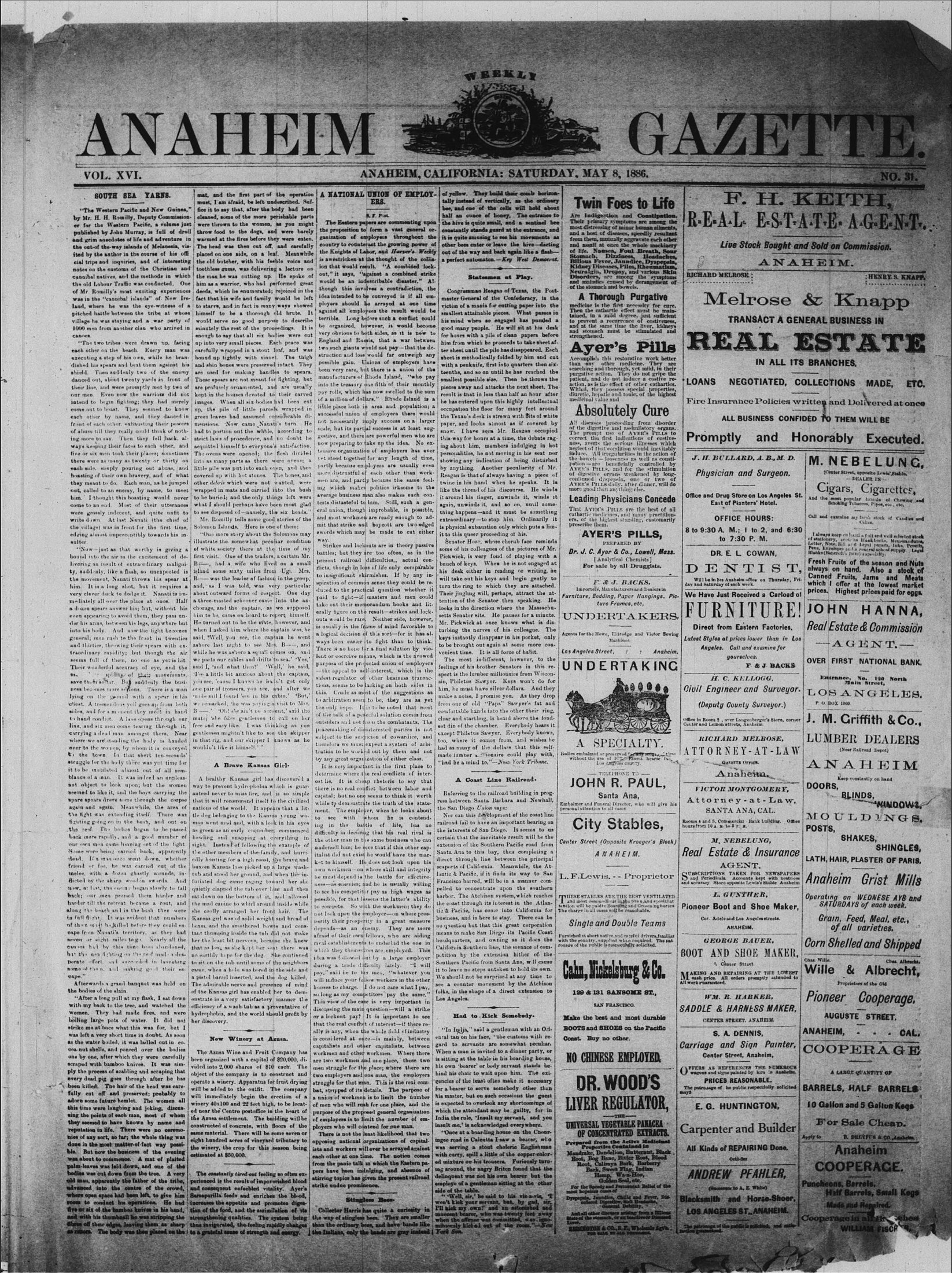
Searchable text
ANAHEIM
VOL. XVI.
SOUTH SEA YARNS.
"The Western Pacific and New Guinea," by Mr. H. H. Romilly, Deputy Commissioner for the Western Pacific, a volume just published by John Murray, is full of droll and grim anecdotes of life and adventure in the out-of-the-way islands of Melanesia, visited by the author in the course of his official trips and inquiries, and of interesting notes on the customs of the Christian and cannibal natives, and the methods in which the old Labour Traffic was conducted. One of Mr. Romilly's most exciting experiences was in the "cannibal islands" of New Ireland, where he was the eye-witness of a pitched battle between the tribe at whose village he was staying and a war party of 1000 men from another clan who arrived in canoes.
"The two tribes were drawn up, facing each other on the beach. Every man was executing a step of his own, while he brandished his spears and beat them against his shield. Then suddenly two of the enemy danced out, about twenty yards in front of their line, and were promptly met by two of our men. Even now the warriors did not intend to begin fighting; they had merely come out to boast. They seemed to know each other by name, and they danced in front of each other, exhausting their powers of abuse till they really could think of nothing more to say. Then they fell back, always keeping their faces to each other, and five or six men took their places; sometimes there were as many as twenty or thirty on each side, simply pouring out abuse, and bursting of their own brains and of what mat, and the first part of the operation must, I am afraid, be left undescribed. Suffice it to say that, after the body had been cleaned, some of the more perishable parts were thrown to the women, as you might throw food to the dogs, and were barely warmed at the fires before they were eaten. The head was then cut off, and carefully placed on one side, on a leaf. Meanwhile the old butcher, with his feeble voice and toothless gums, was delivering a lecture on the man he was cutting up. He spoke of him as a warrior, who had performed great deeds, which he enumerated; rejoiced in the fact that his wife and family would be left to starve, and in fact in many ways showed himself to be a thorough old brute. It would serve no good purpose to describe minutely the rest of the proceedings. It is enough to say that all six bodies were cut up into very small pieces. Each peace was carefully wrapped in a stout leaf, and was bound up tightly with sinnet. The thigh and shin bones were preserved intact. They are used for making handles to spears. These spears are not meant for fighting, but are profusely ornamented, and are usually kept in the houses devoted to their carved images. When all six bodies had been cut up, the pile of little parcels wrapped in green leaves had assumed considerable dimensions. Now came Nanati's turn. He had to portion out the while, according to strict laws of procedure, and no doubt he acquitted himself to everyone's satisfaction. The ovens were opened; the flesh divided into as many parts as there were ovens; a little pile was put into each oven, and then covered up with hot stones. The bones and
danced out, about twenty yards in front of their line, and were promptly met by two of our men. Even now the warriors did not intend to begin fighting; they had merely come out to boast. They seemed to know each other by name, and they danced in front of each other, exhausting their powers of abuse till they really could think of nothing more to say. Then they fell back, always keeping their faces to each other, and five or six men took their places; sometimes there were as many as twenty or thirty on each side, simply pouring out abuse, and boasting of their own bravery, and of what they meant to do. Each man, as he jumped out, called to an enemy, by name, to meet him. I thought this boasting would never come to an end. Most of their utterances were grossly indecent, and quite unfit to write down. At last Nanati (the chief of the village) was in front for the first time, edging almost imperceptibly towards his insult.
"Now—just as that worthy is giving a bound into the air in the excitement of delivering an insult of extraordinary malignity, suddenly like a flash, so unexpected is the movement, Nanati throws his spear at him. It is a long shot, but it requires a very clever duck to dodge it. Nanati is immediately all over the place at once. Half a dozen spears answer his; but, without his even appearing to avoid them, they pass under his arms, between his legs, anywhere but into his body. And now the fight becomes general; men rush to the front in twenties and thirties, throwing their spears with extraordinary rapidity; but though the air seems full of them, no one as yet is hit. Their wonderful accuracy of eye, and the skill of their movements, save them so far. But suddenly the business becomes more serious. There is a man lying on the ground with a spear in his chest. A tremendous yell goes up from both sides, and for a moment they meet in hand to hand conflict. A lane opens through our line, and six men come tearing through it, carrying a dead man amongst them. Near where we are standing the body is handed over to the women, by whom it is conveyed to the town. In that short ten-seconds' struggle for the body there was yet time for it to be instilated almost out of all semblance of a man. It was indeed an unpleasant object to look upon; but the women seemed to like it, and the boys carrying the spare spears drove some through the corpse again and again. Meanwhile, the area of the fight was extending itself. There was fighting going on in the bush, and out on the reef. The bodies began to be passed back mere rapidly, and a good number of our own men came hopping out of the fight. Some were being carried back, apparently dead. If a man once went down, whether friend or foe, he was carried out of the mulee, with a dozen ghastly wounds, inflicted by the sharp wooden swords. And now, at last, the enemy began slowly to fall back; our men pressed them harder and These spears are not meant for fighting, but are profusely ornamented, and are usually kept in the houses devoted to their carved images. When all six bodies had been cut up, the pile of little parcels wrapped in green leaves had assumed considerable dimensions. Now came Nanati's turn. He had to portion out the whble, according to strict laws of procedure, and no doubt he acquitted himself to everyone's satisfaction. The ovens were opened; the flesh divided into as many parts as there were ovens; a little pile was put into each oven, and then covered up with hot stones. The bones, and other debris which were not wanted, were wrapped in mats and carried into the bush to be buried; and the only things left were what I should perhaps have been most glad to see disposed of—namely, the six heads."
Mr. Romilly tells some good stories of the Solomon Islands. Here is one of them:
"One more story about the Solomons may illustrate the somewhat peculiar condition of white society there at the time of my first visit. One of the traders, a certain Mr. B——had a wife who lived on a small island some sixty miles from Ugi. Mrs. B——was the leader of fashion in the group, and, as I was told, was very particular about outward forms of respect. One day a three-masted schooner came into the anchorage, and the captain, as we supposed him to be, came on board to report himself. He turned out to be the mate, however, and when I asked him where the captain was, he said, "Well, you see, the captain he went ashore last night to see Mrs. B——and while he was ashore a squall comes on, and we parts our cables and drifts to sea." 'Yes,' said I, 'and what then?' 'Well,' he said, 'I'm a little bit anxious about the captain, you see,' cause I knows he hasn't got only one pair of trousers, you see, and after we made sail I found 'en in his cabin.' 'But,' we remarked, 'he was paying a visit to Mrs. B——.' 'Oh! she ain't no account,' said the mate; 'she likes gentlemen to call on her free and easy like. I was thinking as you gentlemen mightn't like to see the skipper in that rig, and our skipper I knows as he wouldn't like it himself.'"
A Brave Kansas Girl
A healthy Kansas girl has discovered a way to prevent hydrophobia which is guaranteed never to miss fire, and is so simple that it will recommend itself to the civilized nations of the world. It appears that a little dog belonging to the Kansas young woman went mad and, with a look in his eyes as green as an early cucumber, commenced howling and snapping at everything in sight. Instead of following the example of the other members of the family, and hurriedly hunting for a high roost, the brave and buxom Kansas lass picked up a large wash-tub and stood her ground, and when the infuriated dog came raging toward her she quietly clapped the tub over him and then sat down on the bottom of it, and allowed manufacturers into the treasury pay rolls, which of a million of little place boats successful union not necessarily scale, but its pensive gestive, and thus now preparing tensive organization yet stood together partly because more distrustful men are, and putting which man average business tests distasteful eral union, thus and most work mit that strikes swords which run way.
Strikes and battles; but this present railroad dicties; though it to insignificant spiration of course deduced to the point paid to fight-take out their erally figure on outs would be used is usually in this logical decision ways been easier.
There is no hope lent or coercive purpose of this—the appeal to safest regulations seems too this. Crude as to arbitration since the only hope of the talk of a outsiders and no peacemaking of subject to the therefore we must traction to be wise by any great or It is very impatient determine when est he. It is there is no real capital; but no while to demonstration. The eminent to see with ing in the difficulty in decide the other man in undersell him; italist did not eat key to himself. Own workmen—he must dependness—as enmire to see his competi
spare spears drove some through the corpse again and again. Meanwhile, the area of the fight was extending itself. There was fighting going on in the bush, and out on the reef. The bodies began to be paused back more rapidly, and a good number of our own men came hunging out of the fight. Some were being carried back, apparently dead. If a man once went down, whether friend or foe, he was carried out of the mulee, with a dozen ghastly wounds, inflicted by the sharp wooden swords. And now, at last, the enemy began slowly to fall back; our men pressed them harder and harder till the retreat became a rout, and along the beach and in the bush they were in full flight. It was evident that numbers of them must be killed before they could escape from Nanati's territory, as they had seven or eight miles to go. Nearly all the canoes had by this time been abandoned, but the naval lighting on the reef made a desperate effort, and succeeded in launching some of them, and making good their escape."
Afterwards a grand banquet was held on the bodies of the slain.
"After a long pull at my flask, I sat down with my back to the tree, and watched the women. They had made fires, and were boiling large pots of water. It did not strike me at once what this was for, but I was left a very short time in doubt. As soon as the water boiled, it was ladled out in cocoa-nut shells, and poured over the bodies one by one, after which they were carefully scraped with bamboo knives. It was simply the process of scalding and scraping that every dead pig goes through after he has been killed. The hair of the head was carefully cut off and preserved; probably to adorn some future hemlet. The women all this time were laughing and joking, discussing the points of each man, most of whom they seemed to have known by name and reputation in life. There were no ceremonies of any sort, so far; the whole thing was done in the most matter-of-fact way possible. But now the business of the evening was about to commence. A mat of plaited palm-leaves was laid down, and one of the bodies was cut down from the tree. A very old man, apparently the father of the tribe, advanced into the centre of the crowd, where open space had been left, to give him room to conduct his operations. He had five or six of the bamboo knives in his hand, and with his thumbail he was stripping the fibres off their edges, leaving them as sharp as rushes. The body was then placed on the that it will recommend itself to the civilized nations of the world. It appears that a little dog belonging to the Kansas young woman went mad and, with a look in his eyes as green as an early cucumber, commenced howling and snapping at everything in sight. Instead of following the example of the other members of the family, and hurriedly hunting for a high roost, the brave and buxom Kansas lass picked up a large wash-tub and stood her ground, and when the infuriated dog came raging toward her she quietly clapped the tub over him and then sat down on the bottom of it, and allowed the mad canine to whirl around inside while she coolly arranged her front hair. The Kansas girl was of solid weight and broad of beam, and the smothered bowls and constant thumping inside the tub did not make her the least bit nervous, because she knew that as long as she kept her seat there was no earthly hope for the dog. She continued to sit on the rub until some of the neighbors came, when a hole was bored in the side and a pistol barrel inserted, and the dog killed. The admirable nerve and presence of mind of the Kansas girl has enabled her to demonstrate in a very satisfactory manner the efficiency of a wash-tub as a preventative of hydrophobia, and the world should profit by her discovery.
New Winery at Azusa.
The Azusa Wine and Fruit Company has been organized with a capital of $20,000, divided into 2,000 shares of $10 each. The object of the company is to construct and operate a winery. Apparatus for fruit drying will immediately begin the erection of a winery 40x100 and 22 feet high, to be located near the Centre postoffice in the heart of the Azusa settlement. The building will be constructed of concrete, with floors of the same material. There will be some seven or eight hundred acres of vineyard tributary to the winery, the crop for this season being estimated at $50,000.
The constantly tired-out feeling so often experienced is the result of impoverished blood and consequent enfeebled vitality. Ayer's Sarsaparilla feeds and enriches the blood, increases the appetite and promotes digestion of the food, and the assimilation of its strengthening qualities. The system being thus invigorated, the feeling rapidly changes to a grateful sense of strength and energy.
While to demonstrate this emotion to see with it difficulty in decoding other man's undersell him; it italic did not even get to himself. Own workmen—he must depend on us as enemies to see his competence possible, for that to compete. So not look upon their peril their prowess depends—as an afraid of their rival establishment which they then idea was followed during a trade pay," said he to will induce your houses to charge so long as my cow This view of these discussions the most or a lockout pass that the real consequence is any, where is considered at capitalists and workmen and others two workmen men struggle for two employers as struggle for that bat, stripped off a union of workers men who will purpose of the power of employers is to ployers who will.
There is not too opposing nationists and workers each other at once from the panic that pers have been stirring topics like strike undue pressure.
Collector Harper
the way of sting than the ordinary Italianans, only
WEEKLY
EIM
GRA
ANAHEIM, CALIFORNIA: SATURDAY, MAY 8, 1886.
A NATIONAL UNION OF EMPLOYERS.
B. F. Post.
The Eastern papers are commenting upon the proposition to form a vast general organization of employers throughout the country to counteract the growing power of the Knights of Labor, and Harper's Weekly is awestricken at the thought of the collision that would result. "A combined lock-out," it says, "against a combined strike would be an indescribable disaster." Although this involves a contradiction, the idea intended to be conveyed is if all employers should be arrayed at one time against all employees the result would be terrible. Long before such a conflict could be organized, however, it would become very obvious to both sides, as it is now to England and Russia, that a war between two such giants would not pay—that the destruction and loss would far outweigh any possible gain. Unions of employers have been very rare, but there is a union of the manufacturers of Rhode Island, "who pay into the treasury one fifth of their monthly pay rolls, which has now swelled to the sum of a million of dollars." Rhode Island is a little place both in area and population; a successful union of employers there would not necessarily imply success on a larger scale, but its partial success is at least suggestive, and there are powerful men who are now preparing to take up the idea. No extensive organization of employers has ever yet stood together for any length of time, partly because employers are usually even more distrustful of each other than workmen.
of yellow. They build their comb horizontally instead of vertically, as the ordinary bee, and one of the cells will hold about half an ounce of honey. The entrance to the hive is quite small, and a sentinel bee constantly stands guard at the entrance, and it is quite amusing to see his movements as other bees enter or leave the hive—darting out of the way and back again like a flash—a perfect automaton. —Key West Democrat.
Statesmen at Play.
Congressman Reagan of Texas, the Postmaster General of the Confederacy, is the victim of a mania for cutting paper into the smallest attainable pieces. What passes in his mind when so engaged has puzzled a good many people. He will sit at his desk for hours with a pile of clean papers before him from which he proceeds to take sheet after sheet until the pile has disappeared. Each sheet is methodically folded by him and cut with a penknife, first into quarters then sixteenths, and so on until he has reached the smallest possible size. Then he throws the pieces away and attacks the next sheet. The result is that in less than half an hour after he has entered upon this highly intellectual occupation the floor for many feet around the Texan's desk is strewn with bits of white paper, and looks almost as if covered by snow. I have seen Mr. Reagan occupied this way for hours at a time, the debate raging about him, members indulging in hot personalities, he not moving in his seat nor showing any indication of being disturbed by anything. Another peculiarity of Mr. Reagan is that always having a piece of yellow. They build their comb horizontally instead of vertically, as the ordinary bee, and one of the cells will hold about half an ounce of honey. The entrance to the hive is quite small, and a sentinel bee constantly stands guard at the entrance, and it is quite amusing to see his movements as other bees enter or leave the hive—darting out of the way and back again like a flash—a perfect automaton. —Key West Democrat.
Twin Foes to Life
Are Indigestion and Constipation Their primary symptoms are among the most distressing of minor human ailments and a host of diseases, speedily resulting from them, mutually aggravate each other and assail at once the whole machinery of life. Nausea, Foul Breath, Soup Stomach, Dizziness, Headache, Billious Fever, Jaundice, Dyspepsia, Kidney Diseases, Piles, Rheumatism Neuralgia, Dropsy, and various Skin Disorders, are among the symptoms and maladies caused by derangement of the stomach and bowels.
A Thorough Purgative medicine is the first necessity for cure. Then the cathartic effect must be maintained in a mild degree, just sufficient to prevent a recurrence of costiveness and at the same time the liver, kidney and stomach must be stimulated and strengthened.
Ayer's Pills
Accomplish this restorative work better than any other medicine. They are searching and thorough, yet mild, in their purgative action. They do not gripe the patient, and do not induce a costive reaction, as is the effect of other cathartics. Withal, they possess special properties diuretic, hepatic and tonic, of the highest medicainal value and
Absolutely Cure
All diseases proceeding from disorder of the digestive and assimilatory organs. The prompt use of AVER'S PILLS to correct the first indications of costiveness, averts the serious illnesses while neglect of that condition would inevitably induce. All irregularities in the action of the bowels—looseness as well as constipation—are benefited controlled by AVER'S PILLS, and for the stimulation of digestive organs weakened by long-standing stress.
lighting, but are usually their carved and been cut wrapped in different diagrams turn. He according to no doubt he satisfaction, flesh divided are ovens; a man, and then the bones, and wanted, were too the bush legs left were most glad six heads.” The stories of the authorities of the town may our condition time of my certain Mr. on a small Ugi. Mrs. in the group, particularly one day into the anatomy supposed sort himself. However, and certain was, he went B——, and lies on, and sea.’ ‘Yes,’ he said, the captain, it got only after weoin.’ ‘But,’ is sit to Mrs., out,” said the call on her being as you the skipper knows as he discovered a chick is guard so simple the civilized that a lit- young woman in his eyes commenced anything in example of and hurri- brave and large wash when the injured her she and then allowed it to be made to cut either way.
Strikes and lockouts are in theory passive battles; but they are too often, as in the present railroad difficulties,, actual conflicts, though in loss of life only comparable to insignificant skirmishes. If by any inspiration of common sense they could be reduced to the practical question whether it paid to fight—if masters and men could take out their memorandum books and literally figure on the result—strikes and lockouts would be rare. Neither side, however, is usually in the frame of mind favorable to a logical decision of this sort—for it has always been easier to fight than to think. There is no hope for a final solution by violent or coercive means, which is the avowed purpose of the projected union of employers—the appeal to self-interest, which is the safest regulator of other business transactions, seems to be lacking on both sides in this. Crude as most of the suggestions as to arbitration seem to be, they are as yet the only hope. It is to be noted that most of the talk of a peaceful solution comes from outsiders and not from the combatants. The peacemaking of disinterested parties is not subject to the suspicion of cowardice, and therefore we must expect a system of arbitration to be worked out by them and not by any great organization of either class.
It is very important in the first place to determine where the real conflicts of interest lie. It is cheap rhetoric to say that there is no real conflict between labor and capital; but no one seems to think it worth while to demonstrate the truth of the statement. The employer, when he looks about to see with whom he is contending in the battle of life, has no difficulty in deciding that his real rival is the other man in the same business who can undersell him; he sees that if this other capitalist did not exist he would have the market to himself. He does not look upon his own workmen—on whose skill and integrity he must depend in the battle for effectiveness—as enemies; and he is usually willing to see his competitor pay as high wages as possible for less than the latter’s ability
manufacturers of Rhode Island, “who pay into the treasury one fifth of their monthly pay rolls, which has now swelled to the sum of a million dollars.” Rhode Island is a little place both in area and population; a successful union of employers there would not necessarily imply success on a larger scale, but its partial success is at least suggestive, and there are powerful men who are now preparing to take up the idea. No extensive organization of employers has ever stood together for any length of time, partly because employers are usually even more distrustful of each other than workers are, and partly because the same feeling which makes politics irksome to the average business man also makes such contests distasteful to him. Still, such a general union, though improbable, is possible, and most workmen are ready enough to admit that strike and boycott are two-edged swords which may be made to cut either way.
Strikes and lockouts are in theory passive battles; but they are too often, as in the present railroad difficulties,, actual conflicts, though in loss of life only comparable to insignificant skirmishes. If by any inspiration of common sense they could be reduced to the practical question whether it paid to fight—if masters and men could take out their memorandum books and literally figure on the result—strikes and lockouts would be rare. Neither side, however, is usually in the frame of mind favorable to a logical decision of this sort—for it has always been easier to fight than to think. There is no hope for a final solution by violent or coercive means, which is the avowed purpose of the projected union of employers—the appeal to self-interest, which is the safest regulator of other business transactions, seems to be lacking on both sides in this. Crude as most of the suggestions as to arbitration seem to be, they are as yet the only hope. It is to be noted that most of the talk of a peaceful solution comes from outsiders and not from the combatants. The peacemaking of disinterested parties is not subject to the suspicion of cowardice, and therefore we must expect a system of arbitration to be worked out by them and not by any great organization of either class.
It is very important in the first place to determine where the real conflicts of interest lie. It is cheap rhetoric to say that there is no real conflict between labor and capital; but no one seems to think it worth while to demonstrate the truth of the statement. The employer, when he looks about to see with whom he is contending in the battle of life, has no difficulty in deciding that his real rival is the other man in the same business who can undersell him; he sees that if this other capitalist did not exist he would have the market to himself. He does not look upon his own workmen—on whose skill and integrity he must depend in the battle for effectiveness—as enemies; and he is usually willing to see his competitor pay as high wages as possible for less than the latter’s ability
Senator Hon., whose cherub face reminds some of his colleagues of the pictures of Mr. Pickwick, is very fond of playing with a bunch of keys. When he is not engaged at his desk either in reading or writing, he will take out his keys and begin gently to turn the ring to which they are attached. Their jingling will perhaps, attract the attention of the Senator then speaking. He looks in the direction where the Massachusetts Senator sits. He pauses for a minute. Mr. Pickwick at once knows what is disturbing the nerves of his colleague. The keys instantly disappear in his pocket, only to be brought out again at some more convenient time. It is all force of habit.
The most indifferent, however, to the feelings of his brother Senators in this respect is the lumber millionaire from Wisconsin, Philetus Sawyer. Keys won't do for him, he must have silver dollars. And they make a noise, I promise you. As they drop from one of old “Papa” Sawyer's fat and comfortable hands into the other their ring, clear and startling, is heard above the loudest din of the chamber. Everybody hears it except Philetus Sawyer. Everybody knows, too, where it comes from, and wishes he had as many of the dollars that this self-made number millionaire could play with, "had he a mind to."—New York Tribune.
A Coast Line Railroad
Referring to the railroad building in progress between Santa Barbara and Newhall, the San Diego Union says:
Nor can this development of the coast line railroad fail to have an important bearing on the interests of San Diego. It seems to us certain that the inevitable result will be the extension of the Southern Pacific road from Santa Ana to this bay, thus completing a direct through line between the principal seaports of California. Meanwhile, the Atlantic & Pacific, if it finds its way to San Francisco barred, will be in a manner compelled to concentrate upon the southern harbor. The Atchison system, which reaches smallest possible size. Then he throws the pieces away and attacks the next sheet. The result is that in less than half an hour after he has entered upon this highly intellectual occupation the floor for many feet around the Texan's desk is strewn with bits of white paper, and looks almost as if covered by snow. I have seen Mr. Reagan occupied this way for hours at a time, the debate raging about him, members indulging in hot personalities, he not moving in his seat nor showing any indication of being disturbed by anything. Another peculiarity of Mr. Reagan is that always having a piece of twine in his hand when he speaks. It is like the thread of his discourse. He winds it around his finger, unwinds it, winds it again, unwinds it, and so on until something happens—and it must be something extraordinary—to stop him. Ordinarily it is physical exhaustion only which puts a limit to this queer proceeding of his.
Senator Hon., whose cherub face reminds some of his colleagues of the pictures of Mr. Pickwick, is very fond of playing with a bunch of keys. When he is not engaged at his desk either in reading or writing, he will take out his keys and begin gently to turn the ring to which they are attached. Their jingling will perhaps, attract the attention of the Senator then speaking. He looks in the direction where the Massachusetts Senator sits. He pauses for a minute. Mr. Pickwick at once knows what is disturbing the nerves of his colleague. The keys instantly disappear in his pocket, only to be brought out again at some more convenient time. It is all force of habit.
The most indifferent, however, to the feelings of his brother Senators in this respect is the lumber millionaire from Wisconsin, Philetus Sawyer. Keys won't do for him, he must have silver dollars. And they make a noise, I promise you. As they drop from one of old “Papa” Sawyer's fat and comfortable hands into the other their ring, clear and startling, is heard above the loudest din of the chamber. Everybody hears it except Philetus Sawyer. Everybody knows, too, where it comes from, and wishes he had as many of the dollars that this self-made number millionaire could play with, "had he a mind to."—New York Tribune.
A Coast Line Railroad
Referring to the railroad building in progress between Santa Barbara and Newhall, the San Diego Union says:
Nor can this development of the coast line railroad fail to have an important bearing on the interests of San Diego. It seems to us certain that the inevitable result will be the extension of the Southern Pacific road from Santa Ana to this bay, thus completing a direct through line between the principal seaports of California. Meanwhile, the Atlantic & Pacific, if it finds its way to San Francisco barred, will be in a manner compelled to concentrate upon the southern harbor. The Atchison system, which reaches smallest possible size. Then he throws the pieces away and attacks the next sheet. The result is that in less than half an hour after he has entered upon this highly intellectual occupation the floor for many feet around the Texan's desk is strewn with bits of white paper, and looks almost as if covered by snow. I have seen Mr. Reagan occupied this way for hours at a time, the debate ragging about him, members indulging in hot personalities, he not moving in his seat nor showing any indication of being disturbed by anything. Another peculiarity of Mr. Reagan is that always having a piece of twine in his hand when he speaks. It is like the thread of his discourse. He winds it around his finger, unwinds it, winds it again, unwinds it,and so on until something happens—and it must be something extraordinary—to stop him. Ordinarily it is physical exhaustion only which puts a limit to this queer proceeding of his.
Senator Hon., whose cherub face reminds some of his colleagues of the pictures of Mr. Pickwick, is very fond of playing with a bunch of keys. When he is not engaged at his desk either in reading or writing, he will take out his keys and begin gently to turn the ring to which they are attached. Their jingling will perhaps, attract the attention of the Senator then speaking. He looks in the direction wherethe Massachusetts Senator sits. He pauses for a minute.Mr.Pickwick at once knows what is disturbingthe nervesofhis colleague.ThekeysinstantlydisappearinhispocketonlytobemovedbysomeoneinthefirstplacetocurtainwheretherelationsofinterestlieitthereisnorealconflictbetweenlaborandcapitalbutnooneseemstothinkitworthwhiletodemonstratetherthetruthofthestatementTheemployerwhenhelookabouttoseewithwhomhehislentdinginthebattleoflife,hasso dificultyindecidingthathisrealrivalsisotheremaninthesamebusinesswhocundersellhim;heseethatsifthisothercapitalistdidnotexisthewouldhavethetargettohimselfHedoesnotlookuphishoworkmen-onwhoseskillandintegrityhemustdependindethebattleforeffectiveness-asenemies;andheisusuallywillingtoseehiscompetitorpayashighwagesaspossibleforlessthanthe latter'sability
THESE STABLES ARE THE BEST VENTILATE
while to demonstrate the truth of the statement. The employer, when he looks about to see with whom he is contending in the battle of life, has no difficulty in deciding that his real rival is the other man in the same business who can undersell him; he sees that if this other capitalist did not exist he would have the market to himself. He does not look upon his own workmen—on whose skill and integrity he must depend in the battle for effectiveness—as enemies; and he is usually willing to see his competitor pay as high wages as possible, for that lessens the latter's ability to compete. So with the workmen; they do not look upon the employer—on whose prosperity their prosperity in a great measure depends—as an enemy. They are more afraid of their own fellows, who are aiding rival establishments to underbid the one in which they themselves are employed. This idea was followed out by a large employer during a trade difficulty lately. "I will pay," said he to his men, "whatever you will induce your fellow workers in the other houses to charge. I do not care what I pay, so long as my competitors pay the same." This view of the case is very important in discussing the main question—will a strike or a lockout pay? It is important to see that the real conflict of interest—if there really is any, when the whole field of industry is considered at once—is mainly, between capitalists and other capitalists, between workmen and other workmen. Where there are two workmen and one place, these two men struggle for the place; where there are two employers and one man, the employers struggle for that man. This is the real combat, stripped of its details. The purpose of a union of workmen is to limit the number of men who will rush for one place, and the purpose of the proposed general organization of employers is to limit the number of employers who will contend for one man.
There is not the least likelihood that two opposing national organizations of capitalists and workers will ever be arrayed against each other at one time. The notion comes from the panic talk in which the Eastern papers have been indulging, and absence of stirring topics has given the present railroad strike undue prominence.
Stingless BeesCollector Harris has quite a curiosity in the way of stingless bees. They are smaller than the ordinary bees, and have bands like the Italians, only the hands are gray instead
Nor can this development of the coast line railroad fail to have an important bearing on the interests of San Diego. It seems to us certain that the inevitable result will be the extension of the Southern Pacific road from Santa Ana to this bay, thus completing a direct through line between the principal seaports of California. Meanwhile, the Atlantic & Pacific, if it finds its way to San Francisco barred, will be in a manner compelled to concentrate upon the southern harbor. The Atchison system, which reaches the coast through its interest in the Atlantic & Pacific, has come into California for business, and is here to stay. There can be no question but that this great corporation means to make San Diego its Pacific Coast headquarters, and owning as it does the California Southern line, the menace of competition by the extension hitherto of the Southern Pacific from Santa Ana, will cause it to leave no steps untaken to hold its own. We should not be surprised at any time to see a counter movement by the Atchison folks, in the shape of a direct extension to Los Angeles.
Had to Kick Somebody.
"In Inglia," said a gentleman with an Oriental tan on his face, "the customs with regard to servants are somewhat peculiar. When a man is invited to a dinner party, or is sitting at the table in his boarding house, his own 'bearer' or body servant stands behind his chair to wait upon him. The exigencies of the feast often make it necessary for a bearer to serve somebody other than his master, but on such occasions the guest is expected to overlook any shortcomings of which the attendant may be guilty, for in India the rule, 'Insult my servant,' and you insult me," is acknowledged everywhere.
"Once at a boarding house on the Chouringe road in Calcutta I saw a bearer, who was serving a stout choleric Englishman with curry, spill a little of the copper-colored mixture on his trousers. Furiously turning around, the angry Briton found that the delinquent was not his own bearer but the employe of a gentleman sitting at the other side of the table.
"'Well, sir,' he said to his vis-a-vis, 'I won't kick your servant, but, by god, sir. I'll kick my own!" and an astonished and innocent bearer, who was twenty feet away when the offense was committed, was ignominiously kicked out of the room.' — New York Sun."
GAZETTE.
AY 8, 1886.
NO. 31.
F. H. KEITH,
REAL ESTATE AGENT.
Live Stock Bought and Sold on Commission.
ANAHEIM.
RICHARD MELROSE: HENRY S. KNAPP.
Melrose & Knapp
TRANSACT A GENERAL BUSINESS IN
REAL ESTATE
IN ALL ITS BRANCHES.
LOANS NEGOTIATED, COLLECTIONS MADE, ETC.
Fire Insurance Policies written and Delivered at once
ALL BUSINESS CONFIDED TO THEM WILL BE
Promptly and Honorably Executed.
J. H. BULLARD, A. B., M. D.
Physician and Surgeon.
M. NEBELUNG,
(Center Street, opposite Lewis Stable)
LOANS NEGOTIATED, COLLECTIONS MADE, ETC.
Fire Insurance Policies written and Delivered at once
ALL BUSINESS CONFIDED TO THEM WILL BE
Promptly and Honorably Executed.
J. H. BULLARD, A. B., M. D.
Physician and Surgeon.
Office and Drug Store on Los Angeles St.
East of Planters' Hotel.
OFFICE HOURS:
8 to 9:30 A. M.; 1 to 2, and 6:30
to 7:30 P. M.
DR. E. L. COWAN,
DENTIST,
Will be in his Anaheim office on Thursday, Friday and Saturday of each week.
We Have Just Received a Carload of
FURNITURE!
Direct from Eastern Factories.
Latest Styles at prices lower than in Los
Angeles. Call and examine for
yourselves.
F & J. BACKS
H. C. KELLOGG.
Civil Engineer and Surveyor.
(Deputy County Surveyor.)
Office in Room 2, over Langenberger's Store, corner Center and Lemon streets, Anaheim.
RICHARD MELROSE,
ATTORNEY-AT-LAW
GARNETTE OFFICE.
Anaheim.
VICTOR MONTGOMERY,
Attorney-at-Law,
SANTA ANA, CAL.
Rooms 4 and 5, Commercial Bank Building. Office hours from 10 a.m. to 8 p.m.
M. NEBELUNG,
Real Estate & Insurance
AGENT.
SUBSCRIPTIONS TAKEN FOR NEWSPAPERS
and Periodicals. Accounts kept with neatness
and accuracy. Store opposite Lewis's Stable Anaheim
L. GUNTHER.
M. NEBELUNG,
(Center Street, opposite Lewis' Stable).
— DEALER IN —
Cigars, Cigarettes,
And the most popular brands of Chewing and Smoking Tobacco, Pipes, etc., etc.
Call and examine my fresh stock of Candles and Cakes.
I always keep on hand a full and well selected stock of stationery, made as Bankbooks, Memorandums, Letter, Note, Bill and Legal papers, Inks, Penalties, Pens, Envelopes and a general school supply. Legal Blanks (Banerett's forte) a speciality.
Fresh Fruits of the season and Nuts always on hand. Also a stock of Canned Fruits, Jams and Meats which I offer at the lowest market prices. Highest prices paid for eggs.
JOHN HANNA,
Real Estate & Commission
— AGENT.
OVER FIRST NATIONAL BANK.
Entrance No. 120 North Main Street,
LOS ANGELES.
P.O. BOX 1009.
J. M. Griffith & Co.,
LUMBER DEALERS
(Near Railroad Depot)
ANAHEIM
Keep constantly on hand
DOORS,
BLINDS,
WINDOWS.
MOULDINGS.
POSTS,
SHAKES,
SHINGLES,
LATH, HAIR, PLASTER OF PARIS.
Anaheim Grist Mills
Operating on WEDNESE AYR and
Attorney-at-Law,
SANTA ANA, CAL.
Rooms 4 and 5, Commercial Bank building. Office hours from 10 A.M. to 8 P.M.
M. NEBELUNG,
Real Estate & Insurance
AGENT.
SUBSCRIPTIONS TAKEN FOR NEWSPAPERS
and Periodicals. Accounts kept with neatness
and accuracy. Store opposite Lewis's Stable Anaheim
L. GUNTHER,
Pioneer Boot and Shoe Maker,
Cor. Adele and Los Angeles streets.
ANAHEIM.
GEORGE BAUER,
BOOT AND SHOE MAKER,
Center Street
MAKING AND REPAIRING AT THE LOWEST
cash price. All orders promptly attended to
All work guaranteed.
WM. R. HARKER,
SADDLE & HARNESS MAKER,
CENTER STREET, ANAHEIM.
S. A. DENNIS,
Carriage and Sign Painter,
Center Street, Anaheim,
OFFERS AS REFERENCES THE NUMEROUS
wagons and signs painted by him in Anaheim.
PRICES REASONABLE.
The patronage of the public respectfully solicited may be
E. G. HUNTINGTON,
Carpenter and Builder
All Kinds of REPAIRING Done.
October 2nd
ANDREW PFAHLER,
(Successor to A. E. White)
Blacksmith and Horse-Shoer,
LOS ANGELES ST., ANAHEIM.
The patronage of the public is solicited, and entitlement guaranteed.
MOULDINGS.
POSTS,
SHAKES,
SHINGLES,
LATH, HAIR, PLASTER OF PARIS.
Anaheim Grist Mills
Operating on WEDNESE AYS and
SATURDAYS of each week.
Grain, Feed, Meal, etc.,
of all varieties.
Corn Shelled and Shipped
Chas. Willie.
Chas. Albrecht.
Wille & Albrecht,
Proprietors of the Old
Pioneer Cooperage.
AUGUSTE STREET.
ANAHEIM, CAL.
COOPERAGE
A LARGE QUANTITY OF
BARRELS, HALF BARRELS
10 Gallon and 5 Gallon Kegs
For Sale Cheap.
Apply to B. DEYPTUS & Co., Anaheim.
Anaheim COOPERAGE.
Puncheons, Barrels,
Half Barrels, Small Kegs
Made and Repaired.
Cooperage in all Breeds
WILLIAM FISCHER.