anaheim-gazette 1886-05-01
Scanned page
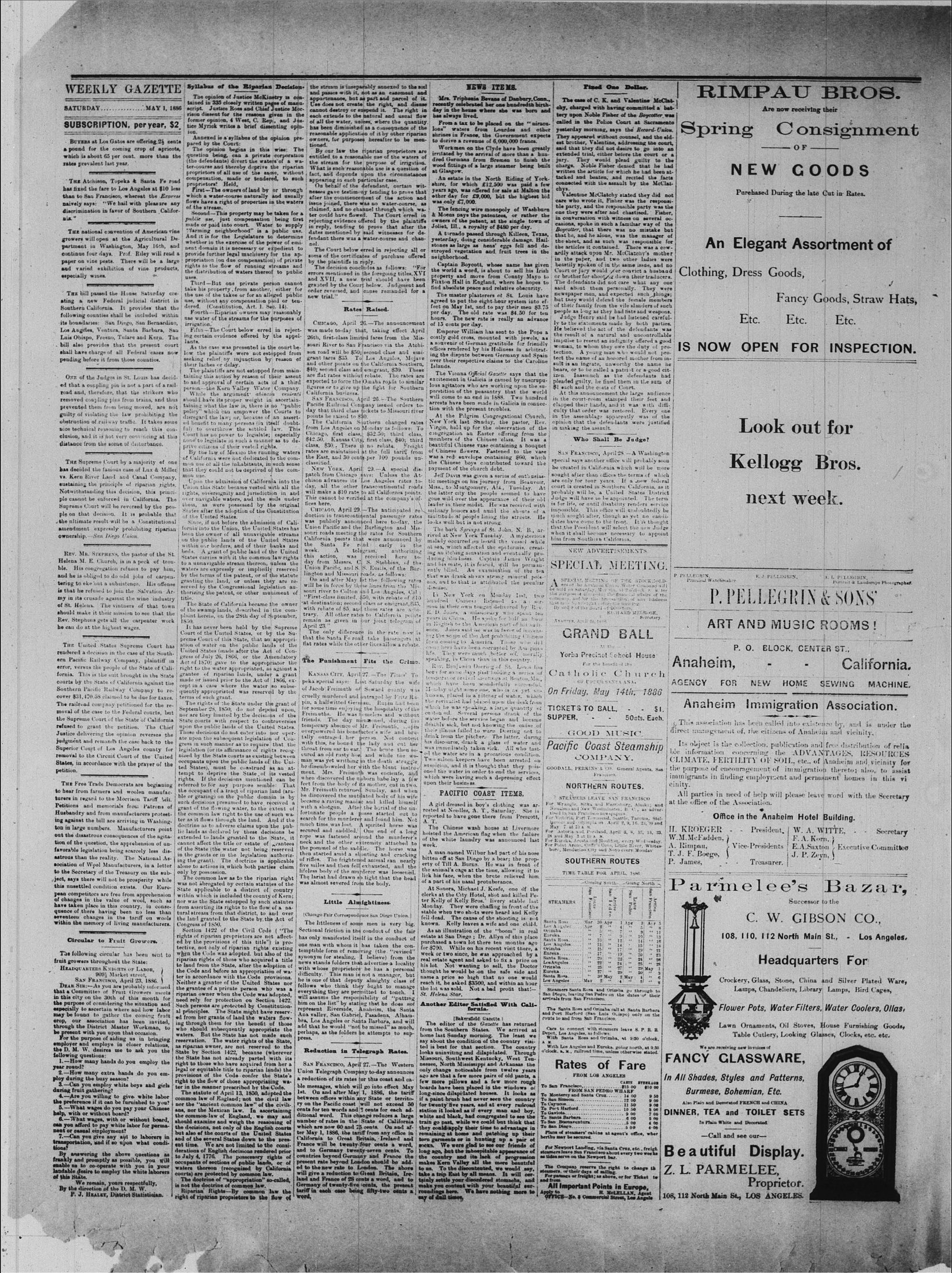
Searchable text
WEEKLY GAZETTE
SATURDAY...MAY 1, 1886
SUBSCRIPTION, per year, $2.
BUYERS at Los Gatos are offering 2½ cents a pound for the coming crop of apricots, which is about 65 per cent. more than the rates prevalent last year.
The Atchison, Topeka & Santa Fe road has fixed the fare to Los Angeles at $10 less than to San Francisco, whereat the Express naively says: "We hail with pleasure any discrimination in favor of Southern California."
The national convention of American vine growers will open at the Agricultural Department in Washington, May 16th, and continue four days. Prof. Riley will read a paper on vine pests. There will be a large and varied exhibition of vine products, especially wines.
The bill passed the House Saturday creating a new Federal judicial district in Southern California. It provides that the following counties shall be included within its boundaries: San Diego, San Bernardino, Los Angeles, Ventura, Santa Barbara, San Luis Obispo, Fresno, Tulare and Kern. The bill also provides that the present court shall have charge of all Federal cases now pending before it from those counties.
One of the Judges in St. Louis has decided that a coupling pin is not a part of a railroad and, therefore, that the strikers who removed coupling pins from trains, and thus prevented them from being moved, are not guilty of violating the law prohibiting the obstruction of railway traffic. It takes some nice technical reasoning to reach this conclusion, and it is not very convincing at this distance from the scene of disturbance.
The Supreme Court by a majority of one has decided the famous case of Lux & Miller
Syllabus of the Riparian Decision:
The opinion of Justice McKinsey is contained in 335 closely written pages of manuscript. Justice Ross and Chief Justice Morrison dissent for the reasons given in the former opinion, 4 West, C. Rep., and Justice Myrick writes a brief dissenting opinion.
Annexed is a syllabus of the opinion prepared by the Court:
The opinion begins in this wise: The question being, can a private corporation (the defendants) divert the waters of a water-course and thereby deprive the riparian proprietors of all use of the same, without compensation, made or tendered, to such proprietors? Held,
First—The owners of land by or through which a water-course naturally and usually flows have a right of properties in the waters of the stream.
Second—This property may be taken for a public use, just compensation being first made or paid into court. Water to supply "farming neighborhood" is a public use. And it is for the Legislature to determine whether in the exercise of the power of eminent domain it is necessary or expedient to provide further legal machinery for the appropriation (on due compensation) of private rights to the flow of running streams and the distribution of waters thereof to public uses.
Third—But one private person cannot take his property from another, either for the use of the takee or for an alleged public use, without any compensation paid or tendered. (Constitution, Art. I. Sec. 14).
Fourth—Riparian owners may reasonably use water of the streams for the purposes of irrigation.
Fifth—The Court below erred in rejecting certain evidence offered by the appellants.
As the case was presented in the court below the plaintiffs were not estopped from seeking relief by injunction by reason of their laches or delay.
The plaintiffs are not estopped from maintaining this action by reason of their assent to and approval of certain acts of a third person—the Kern Valley Water Company.
While the argument 'ahicon venenti' should have its proper weight in ascertainting what the law is, there is no "public policy" which can empower the Courts to disregard the law; or, because of an asserted benefit to many persons (in itself doubtful) to overthrow the settled law. This Court has no power to legislate; especially none to legislate in such a manner as to deprive citizens of their vested rights.
By the law of Mexico the running waters of California were not dedicated to the common use of all the inhabitants, in such sense that they could not be deprived of the com-
the stream is insured and passes with it appurtenance, but Use does not creep cannot destroy or each extends to theof all the water, which has been diminished reasonable applicantsowners, for purportation.
By our law ther entitled to a reason,the stream for ther What is such rea-fact,and depends appearing in each On behalf of these nesses gave testing after the comment issue joined,there claimed,and no ceter could have flo-rejecting evidences in reply,tending dates mentioned by fendant there was nel.
The Court below some of the certifi-ed by the plaintiffs in The decision co-morrections mentioned by and XVII,a new granted by the Co-order reversed,and new trial."
Ratior
Chicago, April was made to-day 26th, first-class line souri River to San Bernardino road will be $5 grant tares $35 and other points o $40; second class a are flat rates without expected to force thie figures or to give us California business.
SAN FRANCISCO,Pacific Railroad Co.day that third class points be raised to The California from Los Angeles on Chicago,first class $42.50.Kansas Class,$30..There rates are maintainedthe East,and 30 co-classified.
NEW YORK.Appatch from Chicago.
One of the Judges in St. Louis has decided that a coupling pin is not a part of a railroad and, therefore, that the strikers who removed coupling pins from trains, and thus prevented them from being moved, are not guilty of violating the law prohibiting the obstruction of railway traffic. It takes some nice technical reasoning to reach this conclusion, and it is not very convincing at this distance from the scene of disturbance.
The Supreme Court by a majority of one has decided the famous case of Lux & Miller vs. Kern River Land and Canal Company, sustaining the principle of riparian rights. Notwithstanding this decision, this principle cannot be enforced in California. The Supreme Court will be reversed by the people on that decision. It is probable that the ultimate result will be a Constitutional amendment expressly prohibiting riparian ownership. — San Diego Union.
Rev. Mr. Stephens, the pastor of the St. Helena M. E. Church, is in a peek of trouble. His congregation refuses to pay him, and he is obliged to do odd jobs of carpentry to eke out a subsistence. His offense is that he refused to join the Salvation Army in its crusade against the wine industry of St. Helena. The vintners of that town should make it their mission to see that the Rev. Stephens gets all the carpenter work he can do at the highest wages.
The United States Supreme Court has rendered a decision in the case of the Southern Pacific Railway Company, plaintiff in error, versus the people of the State of California. This is the suit brought in the State courts by the State of California against the Southern Pacific Railway Company to recover $31,470.58 claimed to be due for taxes. The railroad company petitioned for the removal of the case to the Federal courts, but the Supreme Court of the State of California refused to grant the petition. The Chief Justice delivering the opinion reverses the judgment and remands the case back to the Superior Court of Los Angeles county for removal to the Circuit Court of the United States, in accordance with the prayer of the petition.
The Free Trade Democrats are beginning to hear from farmers and woolen manufacturers in regard to the Morrison Tariff bill. Petitions and memorials from Patrons of Husbandry and from manufacturers protesting against the bill are arriving in Washington in large numbers. Manufacturers point out the disastrous consequences of the agitation of the question, the apprehension of unfavorable legislation being scarcely less disastrous than the reality. The National Association of Wool Manufacturers, in a letter to the Secretary of the Treasury on the subject, says there will not be prosperity while this unsettled condition exists. Our European competitors are free from apprehension of changes in the value of wool.
Training this action by reason of their assent to and approval of certain acts of a third person—the Kern Valley Water Company.
While the argument abison venienti should have its proper weight in ascertainting what the law is, there is no "public policy" which can empower the Courts to disregard the law; or, because of an asserted benefit to many persons (in itself doubtful) to overthrow the settled law. This Court has no power to legislate; especially none to legislate in such a manner as to deprive citizens of their vested rights.
By the law of Mexico the running waters of California were not dedicated to the common use of all the inhabitants, in such sense that they could not be deprived of the common use.
Upon the admission of California into the Union this State became vested with all the rights, sovereignty and jurisdiction in and over navigable waters, and the soils under them, as were possessed by the original States after the adoption of the Constitution of the United States.
Since, if not before the admission of California into the Union, the United States has been the owner of all unnavigable streams on the public lands of the United States within our borders, and of their banks and beds. A grant of public land of the United States carries with it the common law rights to an unnavigable stream thereon, unless the waters are expressly or implicitly reserved by the terms of the patent, or of the statute granting the land, or unless they are reserved by the Congressional legislation authorizing the patent, or other muniment of title.
The State of California became the owner of the swamp lands, described in the complaint herein, on the 28th day of September, 1850.
It has never been held by the Supreme Court of the United States, or by the Supreme Court of this State, that an appropriation of water on the public lands of the United States (made after the Act of Congress of July 26, 1866, or the Amendatory Act of 1870) gave to the appropriator the right to water appropriated, as against a grantee of riparian lands, under a grant made or issued prior to the Act of 1866, except in a case where the water so subsequently appropriated was reserved by the terms of such grant.
The rights of the State under the grant of September 28, 1850, do not depend upon nor are they limited by the decisions of the State courts with respect to controversies upon the public lands of the United States. Those decisions do not enter into nor operate upon the subsequent legislation of Congress in such manner as to require that the legislation (or its affirmance of rights recognized by the State courts as existing between occupants upon the public lands of the United States), must be construed as an attempt to deprive the State of its vested rights. If the decisions mentioned can be referred to for any purpose semble: That the occupant of a tract of riparian land (arable or grazing) on the public domain is by such decisions presumed to have received a grant of flowing water, to the extent of the common law right to use such water as it flows through the land. And if the doctrine as to adverse claims upon the public lands as declared by these decisions be extended to lands granted to the State, it cannot affect the title or estate of grantees of the State (the water not being reserved in the grants or in the legislation authorizing the grant). The doctrine is applicable alone to actions in which both parties claim only by possession.
The common law as to the riparian right was not abrogated by certain statutes of the State applicable to a district of country within which is included the county of Kern;
training this action by reason of their assent to and approval of certain acts of a third person—the Kern Valley Water Company.
While the argument abison venienti should have its proper weight in ascertainting what the law is, there is no "public policy" which can empower the Courts to disregard the law; or because of an asserted benefit to many persons (in itself doubtful) to overthrow the settled law. This Court has no power to legislate; especially none to legislate in such a manner as to deprive citizens of their vested rights.
By the law of Mexico the running waters of California were not dedicated to the common use of all the inhabitable, in such sense that they could not be deprived of the common use.
Upon the admission of California into the Union this State became vested with all the rights, sovereignty and jurisdiction in and over navigable waters, and the soils under them, as were possessed by the original States after the adoption of the Constitution of the United States.
Since, if not before the admission of California into the Union, the United States has beenthe ownerofallunnavigablestreamsonthepubliclandsoftheUnitedStateswithourborders,andofthebanksbeds.AgrantofpubliclandoftheUnitedStatescarrieswithitthecommonlawrightstoanunnavigablestreamthereon Unlessthewatersareexpresslyorimplicitlyreservedbythetermsofthepatent,rorofthestatelgawtingtheland.orunlesstheyarereservedbytheCongressionallegislationauthorizingthepatent.orothermunimentoftitle.
TheStateOfCaliforniabecametheowneroftheswamplands.describedinthecomplainthere.onthe28thdayofSeptember,1850.
IthasneverbeenheldbytheSupremeCourtoftheUnitedStates,或bytheSupremeCourtofthisState,该anappropriationofwateronthepubliclandsoftheUnitedStates(madeaftertheActOfCongressofJuly26,1866,或theAmendatoryActof1870) gaveto,theappropriatortherighttowaterappropriated,asagainstagranteeofriparianlands,underam GrantmadeorissuedpriortotheActof1866,exceptinacasewheretherewaitinhumandisyetwritihimhedisemboweledherment.Mrs.Freimuthwhen discoveredthenfeetfromthebodyofMr.Freimuthreturningmuchtimewaslostsecuredandsaddledropewasfastenednearthandthepennelofthesawnthenstartedamida rifles.Thefrightfivemilesandthenfelllifelessbodyofthem.Thelariathad drawnwasalmostseveredfro
Circular to Fruit Growers.
The following circular has been sent to fruit growers throughout the State:
HEADQUARTERS KNIGHTS OF LABOR,
909 Market street,
SAN FRANCISCO, April 23, 1886.
DEAR SIR: As you are probably informed that a Committee of Fruit Growers meets in this city on the 30th of this month for the purpose of considering the situation and especially to ascertain where and how labor may be found to gather the coming fruit crop, our association has been invited, through the District Master Workman, to be present with you upon that occasion.
For the purpose of aiding us in bringing employer and employee in closer relations, the D. M. W. desires me to ask you the following questions:
1. How many hands do you employ the year round?
2. How many extra hands do you employ during the busy season?
3. Can you employ white boys and girls during fruit gathering?
4. Are you willing to give white labor the preference if it can be furnished to you?
5. What wages do you pay your Chinese help, with or without board?
6. What wages, with or without board, can you afford to pay white labor for permanent or casual employment?
7. Can you give any aid to laborers in transportation, and if so upon what conditions?
By answering the above questions as frankly and promptly as possible, you will enable us to co-operate with you in your landable desire to employ the white laborers of this State.
We remain, yours respectfully,
By the direction of the D. M. W.
P. J. HEALEY, District Statistician.
Section 1422 of the Civil Code ("The rights of riparian proprietors are not affected by the provisions of this title") is protective, not only of riparian rights existing when the Code was adopted, but also of the riparian rights of those who acquired a title to land from the State, after the adoption of the Code and before an appropriation of water in accordance with the Code provisions. Neither a grantee of the United States nor the grantee of a private person who was a riparian owner when the Code was adopted, need rely for protection on Section 1422. Such persons are protected by Constitutional principles. The State might have reserved from her grants of land the waters flowing through them for the benefit of those who should subsequently appropriate the waters. But the State has not made such reservation. The water rights of the State, as riparian owner, are not reserved to the State by Section 1422, because (wherever the State has not already parted with its right to those who have acquired from her a legal or equitable title to riparian lands) the provisions of the Code confer the State's right to the flow of those appropriating water in the manner prescribed by the Code.
The statute of April 13, 1850, adopted the common law of England; not the civil law nor the "ancient common law" of the civilians, nor the Mexican law. In ascertaining the common-law of England, we may and should examine and weigh the reasoning of the decisions, not only of the English courts but also of the courts of the United States and of several States down to the present time. We are not limited to the considerations of English decisions rendered prior to July 4, 1776. The possessory rights of occupants of sections of public lands, or of waters thereon (recognized by California courts) are protected by common law.
The doctrine of "appropriation" so-called, is not the doctrine of common law.
Riparian Rights—By common law the right of riparian proprietors to the flow of such decisions presumed to have received a grant of the flowing water, to the extent of the common law right to the use of such water as it flows through the land. And if the doctrine as to adverse claims upon the public lands as declared by these decisions be extended to lands granted to the State, it cannot affect the title or estate of grantees of the State (the water not being reserved in the grants or in the legislation authorizing the grant). The doctrine is applicable alone to actions in which both parties claim only by possession.
The common law as to the riparian right was not abrogated by certain statutes of the State applicable to a district of country within which is included the county of Kern; nor was the State estopped by such statutes from asserting its rights to the flow of a natural stream from that district, to and over the land granted to the State by the Act of Congress of 1850.
Little Alley
[Chicago Fair Correspondence]
The littleness of some Sectional friction in this one man with whom it temptible form of remy synonym for stealing news stands folders tie with whose proprietor difficulty. This man he is one of that deputies fellows who think everything they are po will assume the respite him on the list" by stating represent Riverside, Ana valley, San Gabriel bra, Los Angeles or Santa Ana valley, San Gabriel bra, Los Angeles or Santa Ana valley, San Gabriel bra, Los Angeles or Santa Ana valley, San Gabriel bra, Los Angeles or Santa Ana valley, San Gabriel bra, Los Angeles or Santa Ana valley, San Gabriel bra, Los Angeles or Santa Ana valley, San Gabriel bra, Los Angeles or Santa Ana valley, San Gabriel bra, Los Angeles or Santa Ana valley, San Gabriel bra, Los Angeles or Santa Ana valley, San Gabriel bra, Los Angeles or Santa Ana valley, San Gabriel bra, Los Angeles or Santa Ana valley, San Gabriel bra, Los Angeles or Santa Ana valley, San Gabriel bra, Los Angeles or Santa Ana valley, San Gabriel bra, Los Angeles or Santa Ana valley, San Gabriel bra, Los Angeles or Santa Ana valley, San Gabriel bra, Los Angeles or Santa Ana valley, San Gabriel bra, Los Angeles or Santa Ana valley, San Gabriel bra, Los Angeles or Santa Ana valley, San Gabriel bra, Los Angeles or Santa Ana valley, San Gabriel bra, Los Angeles or Santa Ana valley, San Gabriel bra, Los Angeles or Santa Ana valley, San Gabriel bra, Los Angeles or Santa Ana valley, San Gabriel bra, Los Angeles or Santa Ana valley, San Gabriel bra, Los Angeles or Santa Ana valley, San Gabriel bra, Los Angeles or Santa Ana valley, San Gabriel bra, Los Angeles or Santa Ana valley, San Gabriel bra, Los Angeles or Santa Ana valley, San Gabriel bra, Los Angeles or Santa Ana valley, San Gabriel bra, Los Angeles or Santa Ana valley, San Gabriel bra, Los Angeles or Santa Ana valley, San Gabriel bra, Los Angeles or Santa Ana valley, San Gabriel bra, Los Angeles or Santa Ana valley, San Gabriel bra, Los Angeles or Santa Ana valley, San Gabriel bra, Los Angeles or Santa Anas Valley.
Reduction in T
SAN FRANCISCO, April Union Telegraph Company a reduction of its rates message which was lat. On and after March between offices within ry on the Pacific coast cents for ten words and additional word. This c number of rates in th which are now 60 and ter May 1, 1886,the tr California to Great France will be twenty and to Germany two countries beyond Germ present rate beyond L ed to the new rate to will give a reduction t land and France of 28 Germany of twenty-five tariff in each case be word.
Decisiony is condent of manustice Mornin in the
and Jusing opinion prerence: The
corporation
of a wariparian without to such
through and usually the waters
ken for a
going first to supply public use.
determine or emidient to the apport of private claims and public use.
cannot other for and public or ten-14).
Reasonablyposes of reject-the appellate court be used from season of maintenance of third company venienti ascertain "public courts to assert doubt." This especially to dewaters the community sense comthe stream is inseparably annexed to the soil and passes with it, not as an easement and appurtenance, but as part and parcel of it. Use does not create the right, and disuse cannot destroy or suspend it. The right in each extends to the natural and usual flow of all the water, unless, where the quantity has been diminished as a consequence of the reasonable application of it by other riparian owners, for purposes hereafter to be mentioned.
By our law the riparian proprietors are entitled to a reasonable use of the waters of the stream for the purpose of irrigation. What is such reasonable use is a question of fact, and depends upon the circumstances appearing in each particular case.
On behalf of the defendant, certain witnesses gave testimony tending to prove that after the commencement of the action and issue joined, there was no water-course, as claimed, and no channel through which water could have flowed. The Court erred in rejecting evidence offered by the plaintiffs in reply, tending to prove that after the dates mentioned by said witnesses for defendant there was a water-course and channel.
The Court below erred in rejecting all or some of the certificates of purchase offered by the plaintiffs in reply.
The decision concludes as follows: "For errors mentioned in the foregoing titles, XVI and XVII, a new trial should have been granted by the Court below. Judgment and order reversed, and cause remanded for a new trial."
Rates Raised.
Chicago, April 26.—The announcement was made to-day that, taking effect April 26th, first-class limited fares from the Missouri River to San Francisco via the Atchison road will be $50; second class and emigrant fares $35. To Los Angeles, Mojave and other points on the California Southern, $40; second class and emigrant, $30. These are flat rates without rebate. The rates are expected to force the Omaha roals to similar figures or to give up the fight for Southern California business.
San Francisco, April 26.—The Southern Pacific Railroad Company issued orders today that third class tickets to Missouri river points be raised to $30.
The California Southern changed rates from Los Angeles on Monday as follows: To Chicago, first class, $52.50; third class, $42.50; Kansas City, first class, $40; third class, $30. There is no rebate. Freight rates are maintained at the full tariff from the East, and 30 cents per 100 pounds unclassified.
New York, April 29.—A special dispatch from Chicago says: Unless AtNEWS ITEMS.
Mrs. Triphenia Bevans of Danbury, Conn., recently celebrated her one hundredth birthday in the house where she was born and has always lived.
From a tax to be placed on the "niraculons" waters from Lourdes and other shrines in France, the Government expects to derive a revenue of 6,000,000 francs.
Workmen on the Clyde have been greatly irritated by the arrival of more than a hundred Germans from Bremen to finish the wood fittings of a large steamer being built at Glasgow.
An estate in the North Riding of Yorkshire, for which £12,500 was paid a few years ago, was offered for sale at Malton the other day for £9,000, but the highest bid was only £7,000.
The fencing wire monopoly of Washburn & Moena pays the patentees, or rather the owners of the patent, at the single town of Joliet, Ill., a royalty of $480 per day.
A tornado passed through Killeen, Texas, yesterday, doing considerable damage. Hail-stones as large as hens' eggs fell and destroyed vegetation and fruit trees in the neighborhood.
Captain Boycott, whose name has given the world a word, is about to sell his Irish property and move from County Mayo to Flixton Hall in England, where he hopes to find absolute peace and relative obscurity.
The master plasterers at St. Louis have agreed to put the eight-hour system into effect on May 1st, and to pay their men $3.75 per day. The old rate was $4.50 for ten hours. The new rate is really an advance of 15 cents per day.
Emperor William has sent to Pope a costly gold cross, mounted with jewels, as a souvenir of German gratitude for friendly offices rendered by his Holiness in arbitration the dispute between Germany and Spain over their respective claims to the Caroline Islands.
The Vienna Official Gazette says that the excitement in Galicia is caused by unscrupulous agitators who are working upon the superstition of the peasantry that the world will come to an end in 1888. Two hundred arrests have been made in Galicia in connection with the present troubles.
At the Pilgrim Congregational Church, New York last Sunday, the pastor, Rev. Virgin, held up for the observation of the congregation an Easter offering from the members of the Chinese class. It was a beautiful Chinese vase containing a bouquet of Chinese flowers. Fastened to the vase was a red envelope containing $60, which the Chinese boys contributed toward the payment of the church debt.
Fixed One Dollar.
The case of C. K. and Valentine McClatchy, charged with having committed a battery upon Noble Fisher of the Boycotter was called in the Police Court at Sacramento yesterday morning, says the Record-Union. They appeared without counsel, and the eldest brother, Valentine, addressing the court, said that they did not desire to go into an extended trial, either before the court or a jury. They would plead guilty to the charge. Noble Fisher denied that he had written the article for which he had been attacked and beaten, and recited the facts connected with the assault by the McClatchys.
Valentine McClatchy stated they did not care who wrote it. Fisher was the responsible party, and the responsible party was the one they were after and chastised. Fisher, in conversation with witness on several occasions, spoke in such a familiar way of the Boycotter, that there was no mistake but that he, and he alone, was the manager of the sheet, and as such was responsible for the articles it contained. There was a cowardly attack upon Mr. McClatchy's mother in the paper, and two other ladies were beastily spoken of in this issue, and no Court or jury would convict a husband or brother for shooting down their traducers. The defendants did not care what any one said about them personally. They were newspaper mon., and expected such things; but they would defend the female members of their family from the vile slanders of such people as long as they had fists and weapons.
Judge Henry said he had listened carefully to the statements made by both parties. He believed the act of the defendants was the result of a natural and uncontrollable impulse to resent an indignity offered a good woman, to whom they owe the duty of protection. A young man who would not protect the name of an honored mother from insult is an ingrate, unworthy the name he bears, or to be called a patriot or a good citizen. Inasmuch as the defendants had pleaded guilty, he fined them in the sum of $1 each and the costs of Court.
At this announcement the large audience in the court-room stamped their feet and clapped their hands, and it was with difficulty that order was restored. Every one in the assemblage apparently was of the opinion that the defendants were justified in making the assault.
Who Shall Be Judge?
SAN FRANCISCO, April 28 — A Washington special says another office will probably soon be created in California which will be more sought after than office at the terms of which
The Punishment Fits the Crime.
Kansas City, April 27 — The Times' Topeka special says: Last Saturday the wife of Jacob Freimuth of Seward county was cruelly murdered and outraged by Fritz Rappin, a halfwitted German. Rappin had been for some time enjoying the hospitality of the Freimuths. He was homeless and without friends. The day mentioned, during the temporary absence of Mr. Freimuth, Rappin overpowered his benefactor's wife and brutally outraged her person. Not content with this, he bound the lady and cut her throat from ear to ear. The brute then secured an old rasty boe, and while the woman was yet writting in the death struggle he disembowelled her with the blunt instrument. Mrs. Freimuth was enciente, and when discovered the unborn babe lay a few feet from the body of its mother, cut in two. Mr. Freimuth returned Sunday, and when he discovered the mutated body of his wife became a raving maniac and killed himself with a shotgun. After the burial of the unfortunate people a posse started out to search for the murderer and found him. Not much time was lost. A spirited horse was secured and saddled. One end of a long rope was fastened around the murderer's neck and the other extremity attached to the pommel of the saddle. The horse was then started amid a shouting and cracking of rifles. The frightened animal ran nearly five miles and then fell exhausted, and the lifeless body of the murderer was loosened. The lariat had drawn so tight that the head was almost severed from the body.
PACIFIC COAST ITEMS,
A girl dressed in boy's clothing was arrested at Needles, A. T., Saturday. She is reported to have gone there from Prescott, A. T.
The Chinese wash house at Livermore hoisted the American flag when the failure of the white laundry was announced last week.
A man named Wilbur had part of his nose bitten off at San Diego by a bear; the property of Till A. Burns. He was in front of the animal's cage at the time, allowing it to lick his face, when the brute relieved him of a part of his nasal protuberance.
At Sonora, Michael J. Keefe, one of the clerks at the City Hotel, shot and killed Peter Vinson.
The excitement in Galicia is caused by unsurpulous agitators who are working upon the superstition of the peasantry that the world will come to an end in 1888. Two hundred arrests have been made in Galicia in connection with the present troubles.
At the Pilgrim Congregational Church, New York last Sunday, the pastor, Rev. Virgin, held up for the observation of the congregation an Easter offering from the members of the Chinese class. It was a beautiful Chinese vase containing a bouquet of Chinese flowers. Fastened to the vase was a red envelope containing $60, which the Chinese boys contributed toward the payment of the church debt.
Jeff Davis was given a series of enthusiastic meetings on his journey from Beauvoir, Miss., to Montgomery, Ala., Tuesday. At the latter city the people seemed to have gone wild over the appearance of their old leader in their midst. He was received with military honors and amid the shouts of a multitude of people lining the streets. He looks well but is not strong.
The bark syranga of St. John, N. B., arrived at New York Tuesday. A mysterious malady occurred on board the vessel while at sea, which affected the epilepsis, creating an itching sensation and eventually producing blindness. Captain James Wright and his mate, it is feared, will be permanently blind. An examination of the tea that drank shows strong mineral poisons, and to that is attributed the peculiar disease.
In New York on Monday lost, two hundred Chinese listed to a sammon in their own tongas delivered by Rev. E.D. Jones, a missionary who spent ten years in China. He spoke for half an hour in English to the American part of his audience. Jones said he was in favor of increasing the scope of the Act prohibiting Chinese from coming to America. Those who did compere have been corrupted by Amirno life. They were much better off, morally speaking, in China than in this country.
Rev. Benjamin Deering of St. Louis has been for some days past holding a series of temperate revival meetings at Benton, Mo., which have been wonderfully successful. Monday night some one who is as yet unknown, placed in a pitcher of water, which the revivalist had placed upon the desk from which he was speaking, a large quantity of cotton oil. Several persons drank of the water before the service began and became deathly sick, but not knowing the cause of their illness failed to warn Deering not to drink from the pitcher. The latter, during his discourse, drank a glass of water and was immediately taken sick. All who tasted the water are in a precarious condition. Two saloon keepers have been arrested on suspicion, and it is thought that they poisoned the water in order to end the services, which were having such a depressing effect upon their business.
NEW ADVERTISEMENTS
SPECIAL MEETING.
A SPECIAL MEETING OF THE STOCKHOLDERS OF THE ARCHITECTURE WATER COMPANY will be held on Saturday May 30 at 2 o'clock in Washington District Judge will have to be appointed. The term is for life, or until disability renders service impossible. This office will undoubtedly be much sought after, though as yet no candidates have come to the front. It is thought that the President will select new Judge when shall become necessary to appoint him from Southern California.
GRAND BALL
Yorba Precinct School House
For the benefit of the Catholic Church
On Friday, May 14th, 1886
TICKETS TO BALL - $1.
SUPPER - 50cts Each.
GOOD MUSIC
Pacific Coast Steamship COMPANY.
GOODALL, PERKINS & CO., General Agents, San Francisco.
NORTHERN ROUTES.
STEAMERS LEAVE SAN FRANCISCO
For Wrangle, Sitka and Harrisonburg, Alaska; and Nanaimo and New Westminster, B.C., as advertised in San Francisco newspapers.
For Victoria, Port Townsend, Seattle, Tacoma, Stellapoin and Olympia on April 29, 9, 16, 25, 30 and May 7 at 10 A.M.
For Astoria and Portland, April 3, 8, 15, 13, 23, 28 and May 3 at 10 A.M.
For Eureka, Arcata and Houston, every Wednesday.
For Point Arons, Quincy's Cove, Little River, Whitesboro; Mendocino City and Novo every Monday.
SOUTHERN ROUTES
TIME TABLE FOR APRIL, 1886
Coming South - Going North
Little Almightiness.
[Chicago Fair Correspondence San Diego Union.]
The littleness of some men is very big. Sectional friction in the conduct of the fair has only manifested itself in the conduct of one man with whom it has taken the contemptible form of removing (the "revised" synonym for stealing). I believe from the news stands folders that advertise a locality with whose proprietors he has a personal difficulty. This man is not a manager, but he is one of that deputy almighty class of fellows who think they ought to manage everything they are permitted to touch. I will assume the responsibility of "putting him on the list" by stating that he does not represent Riverside, Anaheim, the Santa Ana valley, San Gabriel, Pasadena, Albambra, Los Angeles or Santa Barbara, and will add that he would "not be missed" as much, perhaps, as the folders he attempts to suppress.
Reduction in Telegraph Rates.
SAN FRANCISCO, April 27.—The Western Union Telegraph Company to-day announces a reduction of its rates for this coast and cable messages, which will go into effect May last. On and after May 1, 1886, the tariff between offices within any State or territory on the Pacific coast will not exceed 50 cents for ten words and 2 cents for each additional word. This change reduces a large number of rates in the State of California which are now 60 and 75 cents. On and after May 1, 1886, the tariff from any office in California to Great Britain, Ireland and France will be twenty-four cents a word, and to Germany twenty-seven cents. To countries beyond Germany and France the present rate beyond London should be added to the new rate to London. The above will give a reduction to Great Britain, Ireland and France of 28 cents a word, and to Germany of twenty-five cents, the present tariff in each case being fifty-two cents a word.
A girl dressed in boy's clothing was arrested at Needles, A. T., Saturday. She is reported to have gone there from Prescott, A. T.
The Chinese wash house at Livermore hoisted the American flag when the failure of the white laundry was announced last week.
A man named Wilbur had part of his nose bitten off at San Diego by a bear; the property of Till A. Burns. He was in front of the animal's cage at the time, allowing it to lick his face, when the brute relieved him of a part of his nasal protuberance.
At Sonora, Michael J. Keefe, one of the clerks at the City Hotel, shot and killed Peter Kelly of Kelly Bros.' livery stable last Monday. They were chaffing in front of the stable when two shots were heard and Kelly fell dead. The cause of the shooting is not known. Kelly leaves a wife and one child.
As an illustration of the "boom" in real estate at San Diego; Dr. Allyn of this place purchased a town lot there ten months ago for $700. While on his recent visit there, a week or two since, he was approached by a real estate agent and asked to fix a price on his lot. Not wanting to sell, the Doctor thought he would be on the safe side and name a price so high that no one would reach it, he asked $3500, and within an hour the lot was sold. Not a bad profit that!—St. Helena Star.
Another Editor Satisfied With California.
[Bakersfield Gazette.]
The editor of the Gazette has returned from the Southern States. We arrived at home last Sunday morning. The least we say about the condition of the country visited is best for that section. The country looks uninviting and dilapidated. Through Missouri, Southwest Kentucky, West Tennessee, North Mississippi and Arkansas the only change noticeable from twelve years ago are that a few more pairs of old pants, a few more pillows and a few more rough boards have been placed in the windows of long-since dilapidated houses. It looks as if a paint brush had never seen the country for twenty five years, and at every railroad station it looked as if every man and boy, white and black, had congregated to see the train go past, while we could but think that they could apply their time to advantage in remaining at home and patching up their torn garments or in hunting up a pair of socks. We were glad to see our friends of long ago, but the inhospitable appearance of the country and its lack of progression makes Kern Valley all the more beautiful to us. To the discontented, we would say, take a trip East by all means. It will certainly settle your disordered stomachs, and make you content with your beautiful surroundings here. We have nothing more to say of dull times.
Steamers Santa Rosa and Orizaba go through to San Diego, leaving San Pedro on the dates of their arrivals from San Francisco.
The Santa Rosa and Orizaba call at Santa Barbara and Port Harford (San Luis Obispo) only on the route to and from San Francisco.
Cars to connect with steamers leave S.P.R.R Depot, Los Angeles, as follows:
With Santa Rosa and Orizaba, at 9:30 o'clock,
A.M.
With Los Angeles and Orizaba, going north at 9:30 o'clock,
A.M., railroad time, unless otherwise stated.
Rates of Fare
FROM LOS ANGELES
CABIN STEERAGE
To San Francisco...$15 00
FROM SAN PEDRO WHARF
To Monterey and Santa Cruz...14 00
To San Simeon...12 00
To Cayucos...11 50
To Port Harford...10 50
To Gaviota...9 00
To Santa Barbara...6 00
To San Buenaventura...5 00
To San Diego...5 00
Plans of steamers' cabins at agent's office, where berths may be secured.
For Newport Landing, via Santa Cruz, etc., freigh steamers leave San Francisco about every two weeks as tides serve on the Newport bar.
The Company reserve the right to change th steamers, or their days of sailing.
For passage or freight; as above, or for Ticket to and from
All Important Points in Europe,
Apply to H. McLELLAN, Agent OFFICE—No. 8 Commercial Street, Los Angeles
RIMPAU BROS.
Are now receiving their
Spring Consignment
OF
NEW GOODS
Purehased During the late Cut in Rates.
An Elegant Assortment of
Clothing, Dress Goods,
Fancy Goods, Straw Hats,
Etc. Etc. Etc.
IS NOW OPEN FOR INSPECTION.
Look out for
Kellogg Bros.
Look out for
Kellogg Bros.
next week.
P. PELLEGRIN & SONS'
ART AND MUSIC ROOMS!
P. O. BLOCK, CENTER ST.;
Anaheim, California.
AGENCY FOR NEW HOME SEWING MACHINE.
Anaheim Immigration Association.
This association has been called into existence by, and is under the direct management of, the citizens of Anaheim and vicinity.
Its object is the collection, publication and free distribution of reliable information concerning the ADVANTAGES, RESOURCES, CLIMATE, FERTILITY OF SOIL, etc., of Anaheim and vicinity for the purpose of encouragement of immigration thereto; also, to assist immigrants in finding employment and permanent homes in this vicinity.
All parties in need of help will please leave word with the Secretary at the office of the Association.
Office in the Anaheim Hotel Building.
II. KROEGER - President,
W.M. McFadden,
A. Rimpau,
T. J. F. Boege,
P. James,
Treasurer.
W. A. WITTE, Secretary
F. A. Korn,
E.A. Saxton
J. P. Zeyn,
Parmelee's Bazar,
Office in the Anaheim Hotel Building.
H. KROEGER - President.
W.M. McFadden,
A. Rimpau,
T. J. F. Boege,
P. James,
W. A. WITTE, Secretary
F. A. Korn,
E.A. Saxton, Executive Committee
J. P. Zeyn,
Parmelee's Bazar,
Successor to the
C. W. GIBSON CO.,
108, 110, 112 North Main St., Los Angeles.
Headquarters For
Crockery, Glass, Stone, China and Silver Plated Ware,
Lamps, Chandeliers, Library Lamps, Bird Cages,
Flower Pots, Water Filters, Water Coolers, Ollas,
Lawn Ornaments, Oil Stoves, House Furnishing Goods,
Table Cutlery, Looking Glasses, Clocks, etc. etc.
We are receiving new invoices of
FANCY GLASSWARE,
In All Shades, Styles and Patterns,
Burmese, Bohemian, Etc.
Also Plain and Decorated FRENCH and CHINA
DINNER, TEA and TOILET SETS
In Plain White and Decorated
—Call and see our—
Beautiful Display.
Z. L. PARMELEE,
Proprietor.
108, 112 North Main St., LOS ANGELES.